EP0865452B1 - Alkali-widerständig fluor-enthaltende polymere - Google Patents
Alkali-widerständig fluor-enthaltende polymere Download PDFInfo
- Publication number
- EP0865452B1 EP0865452B1 EP96919279A EP96919279A EP0865452B1 EP 0865452 B1 EP0865452 B1 EP 0865452B1 EP 96919279 A EP96919279 A EP 96919279A EP 96919279 A EP96919279 A EP 96919279A EP 0865452 B1 EP0865452 B1 EP 0865452B1
- Authority
- EP
- European Patent Office
- Prior art keywords
- polymer
- recited
- crosslinked
- repeat units
- iii
- Prior art date
- Legal status (The legal status is an assumption and is not a legal conclusion. Google has not performed a legal analysis and makes no representation as to the accuracy of the status listed.)
- Expired - Lifetime
Links
- 229920002313 fluoropolymer Polymers 0.000 title claims description 9
- 229920000642 polymer Polymers 0.000 claims description 138
- BFKJFAAPBSQJPD-UHFFFAOYSA-N tetrafluoroethene Chemical group FC(F)=C(F)F BFKJFAAPBSQJPD-UHFFFAOYSA-N 0.000 claims description 43
- 239000000178 monomer Substances 0.000 claims description 27
- 150000003254 radicals Chemical class 0.000 claims description 16
- 125000004432 carbon atom Chemical group C* 0.000 claims description 14
- 125000000217 alkyl group Chemical group 0.000 claims description 13
- 238000006116 polymerization reaction Methods 0.000 claims description 12
- 239000000839 emulsion Substances 0.000 claims description 10
- 229920001971 elastomer Polymers 0.000 claims description 9
- 239000000806 elastomer Substances 0.000 claims description 9
- 238000000034 method Methods 0.000 claims description 9
- ZCYVEMRRCGMTRW-UHFFFAOYSA-N 7553-56-2 Chemical compound [I] ZCYVEMRRCGMTRW-UHFFFAOYSA-N 0.000 claims description 7
- -1 alkyl vinyl ether Chemical compound 0.000 claims description 7
- 229910052740 iodine Inorganic materials 0.000 claims description 6
- 239000011630 iodine Substances 0.000 claims description 6
- 125000002496 methyl group Chemical group [H]C([H])([H])* 0.000 claims description 6
- 125000004108 n-butyl group Chemical group [H]C([H])([H])C([H])([H])C([H])([H])C([H])([H])* 0.000 claims description 6
- 239000004811 fluoropolymer Substances 0.000 claims description 5
- XMBWDFGMSWQBCA-UHFFFAOYSA-N hydrogen iodide Chemical compound I XMBWDFGMSWQBCA-UHFFFAOYSA-N 0.000 claims description 5
- 239000011541 reaction mixture Substances 0.000 claims description 5
- 150000001875 compounds Chemical class 0.000 claims description 4
- HCDGVLDPFQMKDK-UHFFFAOYSA-N hexafluoropropylene Chemical group FC(F)=C(F)C(F)(F)F HCDGVLDPFQMKDK-UHFFFAOYSA-N 0.000 claims description 4
- BQCIDUSAKPWEOX-UHFFFAOYSA-N 1,1-Difluoroethene Chemical compound FC(F)=C BQCIDUSAKPWEOX-UHFFFAOYSA-N 0.000 claims description 3
- 125000001495 ethyl group Chemical group [H]C([H])([H])C([H])([H])* 0.000 claims description 3
- 238000004519 manufacturing process Methods 0.000 claims description 3
- 125000004123 n-propyl group Chemical group [H]C([H])([H])C([H])([H])C([H])([H])* 0.000 claims description 3
- 238000010526 radical polymerization reaction Methods 0.000 claims description 3
- NZZFYRREKKOMAT-UHFFFAOYSA-N diiodomethane Chemical compound ICI NZZFYRREKKOMAT-UHFFFAOYSA-N 0.000 claims description 2
- 125000005010 perfluoroalkyl group Chemical group 0.000 claims description 2
- 125000000484 butyl group Chemical group [H]C([*])([H])C([H])([H])C([H])([H])C([H])([H])[H] 0.000 description 41
- 239000000243 solution Substances 0.000 description 41
- IJGRMHOSHXDMSA-UHFFFAOYSA-N Atomic nitrogen Chemical compound N#N IJGRMHOSHXDMSA-UHFFFAOYSA-N 0.000 description 32
- QPFMBZIOSGYJDE-UHFFFAOYSA-N 1,1,2,2-tetrachloroethane Chemical compound ClC(Cl)C(Cl)Cl QPFMBZIOSGYJDE-UHFFFAOYSA-N 0.000 description 20
- XLYOFNOQVPJJNP-UHFFFAOYSA-N water Chemical compound O XLYOFNOQVPJJNP-UHFFFAOYSA-N 0.000 description 20
- 239000008367 deionised water Substances 0.000 description 16
- 229910021641 deionized water Inorganic materials 0.000 description 16
- 229910052757 nitrogen Inorganic materials 0.000 description 16
- 239000012530 fluid Substances 0.000 description 15
- 238000000113 differential scanning calorimetry Methods 0.000 description 13
- 238000006243 chemical reaction Methods 0.000 description 12
- GEHJYWRUCIMESM-UHFFFAOYSA-L sodium sulfite Chemical compound [Na+].[Na+].[O-]S([O-])=O GEHJYWRUCIMESM-UHFFFAOYSA-L 0.000 description 12
- 238000007334 copolymerization reaction Methods 0.000 description 11
- 238000002844 melting Methods 0.000 description 11
- 230000008018 melting Effects 0.000 description 11
- 230000010354 integration Effects 0.000 description 10
- 239000000203 mixture Substances 0.000 description 9
- GQHTUMJGOHRCHB-UHFFFAOYSA-N 2,3,4,6,7,8,9,10-octahydropyrimido[1,2-a]azepine Chemical compound C1CCCCN2CCCN=C21 GQHTUMJGOHRCHB-UHFFFAOYSA-N 0.000 description 8
- CSNNHWWHGAXBCP-UHFFFAOYSA-L Magnesium sulfate Chemical compound [Mg+2].[O-][S+2]([O-])([O-])[O-] CSNNHWWHGAXBCP-UHFFFAOYSA-L 0.000 description 8
- ROOXNKNUYICQNP-UHFFFAOYSA-N ammonium persulfate Chemical compound [NH4+].[NH4+].[O-]S(=O)(=O)OOS([O-])(=O)=O ROOXNKNUYICQNP-UHFFFAOYSA-N 0.000 description 8
- 238000000921 elemental analysis Methods 0.000 description 8
- 238000002411 thermogravimetry Methods 0.000 description 8
- PVCVRLMCLUQGBT-UHFFFAOYSA-N (1-tert-butylcyclohexyl) (1-tert-butylcyclohexyl)oxycarbonyloxy carbonate Chemical compound C1CCCCC1(C(C)(C)C)OC(=O)OOC(=O)OC1(C(C)(C)C)CCCCC1 PVCVRLMCLUQGBT-UHFFFAOYSA-N 0.000 description 7
- AJDIZQLSFPQPEY-UHFFFAOYSA-N 1,1,2-Trichlorotrifluoroethane Chemical compound FC(F)(Cl)C(F)(Cl)Cl AJDIZQLSFPQPEY-UHFFFAOYSA-N 0.000 description 7
- CURLTUGMZLYLDI-UHFFFAOYSA-N Carbon dioxide Chemical compound O=C=O CURLTUGMZLYLDI-UHFFFAOYSA-N 0.000 description 7
- 238000013019 agitation Methods 0.000 description 7
- 235000011089 carbon dioxide Nutrition 0.000 description 7
- 238000004132 cross linking Methods 0.000 description 7
- 230000004580 weight loss Effects 0.000 description 7
- 235000010265 sodium sulphite Nutrition 0.000 description 6
- 125000004200 2-methoxyethyl group Chemical group [H]C([H])([H])OC([H])([H])C([H])([H])* 0.000 description 5
- 238000002347 injection Methods 0.000 description 5
- 239000007924 injection Substances 0.000 description 5
- VHUUQVKOLVNVRT-UHFFFAOYSA-N Ammonium hydroxide Chemical compound [NH4+].[OH-] VHUUQVKOLVNVRT-UHFFFAOYSA-N 0.000 description 4
- 239000000908 ammonium hydroxide Substances 0.000 description 4
- 229910001870 ammonium persulfate Inorganic materials 0.000 description 4
- 239000012736 aqueous medium Substances 0.000 description 4
- YOALFLHFSFEMLP-UHFFFAOYSA-N azane;2,2,3,3,4,4,5,5,6,6,7,7,8,8,8-pentadecafluorooctanoic acid Chemical compound [NH4+].[O-]C(=O)C(F)(F)C(F)(F)C(F)(F)C(F)(F)C(F)(F)C(F)(F)C(F)(F)F YOALFLHFSFEMLP-UHFFFAOYSA-N 0.000 description 4
- ZQBFAOFFOQMSGJ-UHFFFAOYSA-N hexafluorobenzene Chemical compound FC1=C(F)C(F)=C(F)C(F)=C1F ZQBFAOFFOQMSGJ-UHFFFAOYSA-N 0.000 description 4
- 150000004694 iodide salts Chemical class 0.000 description 4
- 229910052943 magnesium sulfate Inorganic materials 0.000 description 4
- 235000019341 magnesium sulphate Nutrition 0.000 description 4
- 238000000465 moulding Methods 0.000 description 4
- 238000010926 purge Methods 0.000 description 4
- 229910001220 stainless steel Inorganic materials 0.000 description 4
- 239000010935 stainless steel Substances 0.000 description 4
- 239000000126 substance Substances 0.000 description 4
- 238000013022 venting Methods 0.000 description 4
- ZWEHNKRNPOVVGH-UHFFFAOYSA-N 2-Butanone Chemical compound CCC(C)=O ZWEHNKRNPOVVGH-UHFFFAOYSA-N 0.000 description 3
- 229920002449 FKM Polymers 0.000 description 3
- 229910052799 carbon Inorganic materials 0.000 description 3
- 229920001577 copolymer Polymers 0.000 description 3
- 230000003247 decreasing effect Effects 0.000 description 3
- RRZIJNVZMJUGTK-UHFFFAOYSA-N 1,1,2-trifluoro-2-(1,2,2-trifluoroethenoxy)ethene Chemical compound FC(F)=C(F)OC(F)=C(F)F RRZIJNVZMJUGTK-UHFFFAOYSA-N 0.000 description 2
- KOMNUTZXSVSERR-UHFFFAOYSA-N 1,3,5-tris(prop-2-enyl)-1,3,5-triazinane-2,4,6-trione Chemical compound C=CCN1C(=O)N(CC=C)C(=O)N(CC=C)C1=O KOMNUTZXSVSERR-UHFFFAOYSA-N 0.000 description 2
- WKBOTKDWSSQWDR-UHFFFAOYSA-N Bromine atom Chemical compound [Br] WKBOTKDWSSQWDR-UHFFFAOYSA-N 0.000 description 2
- GDTBXPJZTBHREO-UHFFFAOYSA-N bromine Substances BrBr GDTBXPJZTBHREO-UHFFFAOYSA-N 0.000 description 2
- 229910052794 bromium Inorganic materials 0.000 description 2
- 239000012986 chain transfer agent Substances 0.000 description 2
- 239000003795 chemical substances by application Substances 0.000 description 2
- 238000007720 emulsion polymerization reaction Methods 0.000 description 2
- 238000005516 engineering process Methods 0.000 description 2
- 239000000499 gel Substances 0.000 description 2
- 230000009477 glass transition Effects 0.000 description 2
- 239000000463 material Substances 0.000 description 2
- 229920005989 resin Polymers 0.000 description 2
- 239000011347 resin Substances 0.000 description 2
- BLTXWCKMNMYXEA-UHFFFAOYSA-N 1,1,2-trifluoro-2-(trifluoromethoxy)ethene Chemical compound FC(F)=C(F)OC(F)(F)F BLTXWCKMNMYXEA-UHFFFAOYSA-N 0.000 description 1
- MPJPKEMZYOAIRN-UHFFFAOYSA-N 1,3,5-tris(2-methylprop-2-enyl)-1,3,5-triazinane-2,4,6-trione Chemical compound CC(=C)CN1C(=O)N(CC(C)=C)C(=O)N(CC(C)=C)C1=O MPJPKEMZYOAIRN-UHFFFAOYSA-N 0.000 description 1
- AYJDQJZUPAAIRK-UHFFFAOYSA-N 1-(1,2,2-trifluoroethenoxy)butane Chemical compound CCCCOC(F)=C(F)F AYJDQJZUPAAIRK-UHFFFAOYSA-N 0.000 description 1
- AYCANDRGVPTASA-UHFFFAOYSA-N 1-bromo-1,2,2-trifluoroethene Chemical group FC(F)=C(F)Br AYCANDRGVPTASA-UHFFFAOYSA-N 0.000 description 1
- DMWVYCCGCQPJEA-UHFFFAOYSA-N 2,5-bis(tert-butylperoxy)-2,5-dimethylhexane Chemical compound CC(C)(C)OOC(C)(C)CCC(C)(C)OOC(C)(C)C DMWVYCCGCQPJEA-UHFFFAOYSA-N 0.000 description 1
- XMNIXWIUMCBBBL-UHFFFAOYSA-N 2-(2-phenylpropan-2-ylperoxy)propan-2-ylbenzene Chemical compound C=1C=CC=CC=1C(C)(C)OOC(C)(C)C1=CC=CC=C1 XMNIXWIUMCBBBL-UHFFFAOYSA-N 0.000 description 1
- WBLRBQCSSBJIPF-UHFFFAOYSA-N 3-bromo-1,1,2,3-tetrafluorobut-1-ene Chemical compound CC(F)(Br)C(F)=C(F)F WBLRBQCSSBJIPF-UHFFFAOYSA-N 0.000 description 1
- GVCWGFZDSIWLMO-UHFFFAOYSA-N 4-bromo-3,3,4,4-tetrafluorobut-1-ene Chemical compound FC(F)(Br)C(F)(F)C=C GVCWGFZDSIWLMO-UHFFFAOYSA-N 0.000 description 1
- LFQSCWFLJHTTHZ-UHFFFAOYSA-N Ethanol Chemical compound CCO LFQSCWFLJHTTHZ-UHFFFAOYSA-N 0.000 description 1
- KRHYYFGTRYWZRS-UHFFFAOYSA-M Fluoride anion Chemical compound [F-] KRHYYFGTRYWZRS-UHFFFAOYSA-M 0.000 description 1
- 150000004703 alkoxides Chemical class 0.000 description 1
- 125000005011 alkyl ether group Chemical group 0.000 description 1
- 238000004458 analytical method Methods 0.000 description 1
- 239000007900 aqueous suspension Substances 0.000 description 1
- 238000010923 batch production Methods 0.000 description 1
- 238000010924 continuous production Methods 0.000 description 1
- 238000005796 dehydrofluorination reaction Methods 0.000 description 1
- LSXWFXONGKSEMY-UHFFFAOYSA-N di-tert-butyl peroxide Chemical compound CC(C)(C)OOC(C)(C)C LSXWFXONGKSEMY-UHFFFAOYSA-N 0.000 description 1
- 150000002170 ethers Chemical class 0.000 description 1
- 238000001125 extrusion Methods 0.000 description 1
- 239000011521 glass Substances 0.000 description 1
- 238000010438 heat treatment Methods 0.000 description 1
- ZFZQWCCRTIHYLE-UHFFFAOYSA-N hex-3-yne Chemical compound [CH2]CC#CCC ZFZQWCCRTIHYLE-UHFFFAOYSA-N 0.000 description 1
- 125000004435 hydrogen atom Chemical group [H]* 0.000 description 1
- 238000007689 inspection Methods 0.000 description 1
- PNDPGZBMCMUPRI-UHFFFAOYSA-N iodine Chemical compound II PNDPGZBMCMUPRI-UHFFFAOYSA-N 0.000 description 1
- 239000007788 liquid Substances 0.000 description 1
- 229940032007 methylethyl ketone Drugs 0.000 description 1
- 238000002156 mixing Methods 0.000 description 1
- 150000001451 organic peroxides Chemical class 0.000 description 1
- 229920000768 polyamine Polymers 0.000 description 1
- 238000003756 stirring Methods 0.000 description 1
- 238000009757 thermoplastic moulding Methods 0.000 description 1
Classifications
-
- C—CHEMISTRY; METALLURGY
- C08—ORGANIC MACROMOLECULAR COMPOUNDS; THEIR PREPARATION OR CHEMICAL WORKING-UP; COMPOSITIONS BASED THEREON
- C08F—MACROMOLECULAR COMPOUNDS OBTAINED BY REACTIONS ONLY INVOLVING CARBON-TO-CARBON UNSATURATED BONDS
- C08F214/00—Copolymers of compounds having one or more unsaturated aliphatic radicals, each having only one carbon-to-carbon double bond, and at least one being terminated by a halogen
- C08F214/18—Monomers containing fluorine
- C08F214/26—Tetrafluoroethene
- C08F214/262—Tetrafluoroethene with fluorinated vinyl ethers
Definitions
- polymers derived from tetrafluoroethylene, an alkyl trifluorovinyl ether, and a curesite monomer and/or an organic iodide compound are also disclosed. Such polymers are especially useful as base resistant elastomers.
- Fluoropolymers are generally well known for their chemical and thermal resistance. Partially fluorinated polymers, however, usually have some weakness towards certain types of chemicals, particularly bases. Such polymers often undergo dehydrofluorination or other reactions in the presence of bases, making them unsuitable for use in basic environments. This is particularly true for partially fluorinated polymers which are elastomers, since they are often used as seals for systems which are basic. For this reason, partially fluorinated polymers which are relatively stable to bases have been sought.
- U.S. Patent 3,525,724 describes polymers containing repeat units derived from tetrafluoroethylene, alkyl trifluorovinyl ethers, and the repeat unit -CF 2 C(O)-. Such polymers are not free radically crosslinkable, as defined herein.
- This invention concerns a first polymer, which is not crosslinked, comprising the repeat units -CF 2 -CF 2 - and a crosslinkable-functional repeat unit (III), which enables said polymer to readily crosslink upon exposure of said polymer to free radicals, wherein R 1 is an alkyl group containing 1 to 6 carbon atoms.
- R 1 is an alkyl group containing 1 to 6 carbon atoms.
- the molar ratio of (I) : (II) is 4:1 to 1:1, and the molar ratio of [(I)+(II)]:(III) is 200:1 to 20:1.
- the repeat units (I)+(II)+(III) are, in combination, 50 mole percent or more of the repeat units making up the polymer.
- the monomers (IV) and (V) react to form, respectively, repeat units (I) and (II), as defined above, which repeat units, in combination, are at least 50 mole percent of the repeat units making up the polymer product.
- the present invention includes two kinds of copolymers which which are useful as base resistant elastomers and which contain a repeat unit derived from a trifluorovinyl ether monomer.
- the first polymer described herein has three necessary repeat units, herein labelled (I), (II) and (III).
- the monomer from which repeat unit (II) is derived may be made by the method described in U.S. Patent 2,917,548.
- R 1 in (II) and (V) are ethyl, n-propyl or n-butyl, more preferably n-butyl.
- Repeat unit (III) enables the polymer to be readily crosslinked when exposed to free radicals (or sources of energy that create free radicals).
- free radicals or sources of energy that create free radicals.
- the ability to readily form crosslinks at a sufficiently high level or concentration is important for elastomeric polymers, in order to provide good vulcanizate properties.
- the polymer is an elastomer, i.e., a copolymer that is above its glass transition temperature and contains no appreciable amount of crystallinity at 20°C, as measured by differential scanning calorimetry.
- Crosslinkable-functional monomers which are adapted to provide a reactive curesite for the polymer, include those that contain bromine in a side chain.
- Free-radical crosslinking sites may also be found on repeat units which contain alkyl groups having at least 1 methine hydrogen atom (a hydrogen atom bound to a carbon atom which in turn is bound to three other carbon atoms) in a side chain, or which contain an alkyl ether group in a side chain, wherein the alkyl is substituted or unsubstituted. More than one repeat unit (III) that promotes free radical crosslinking of the polymer may be present.
- Preferred repeat units (III) are as follows: wherein i and k is an integer in the range of 2 to 10, preferably 2 or 4, j is an integer in the range of 1 to 4, preferably 1, and each R 2 is independently an alkyl group containing 1 to 4 carbons. It is preferred if both R 2 groups are methyl.
- the monomers for preferred repeat unit (IIIA) can be made by methods described in P. Tarrant, et al., J. Org. Chem., vol. 34, p. 864ff (1969).
- the monomers which polymerize to form the above repeat units (IIIB) and (IIIC) can be made by the reaction of an alkoxide of the corresponding alcohol with tetrafluoroethylene, as will be readily appreciated by the skilled artisan.
- the molar ratio of (I):(II) is about 3:1 to about 13:7, and/or the molar ratio of [(I)+(II)]:(III) is about 130:1 to about 70:1.
- the repeat units may be units other than (I), (II), and (III).
- These other units may be derived from a wide variety of known monomers which free radically copolymerize with the monomers from which repeat units (I), (II) and (III) are derived.
- known monomers see, for instance, W. Gerhartz, et al., Ed., Ullmann's Encyclopedia of Industrial Chemistry, vol. A11, at p. 393-429 (VCH Verlagsgesellschaft mbH, Weinheim 5th Ed. 1988); and H. F. Mark, et al., Ed., Encyclopedia of Polymer Science and Technology, at p.
- suitable optional comonomers include vinylidene fluoride, hexafluoropropylene, perfluoro(alkyl vinyl ether), preferably wherein the alkyl group contains 1 to 5 carbon atoms, especially perfluoro(methyl vinyl ether).
- the optional repeat units are present in the first polymer in an amount of less than 35 mole percent of the repeat units of the first polymer. More preferably, the first polymer consists essentially of repeat units (I), (II) and (III).
- the first polymers according to the present invention may be prepared by free radical polymerization using methods known to the skilled artisan. See, for instance, W. Gerhartz, et al., Ed., Ullmann's Encyclopedia of Industrial Chemistry, vol. All, at p. 393-429 (VCH Verlagsgesellschaft mbH, Weinheim, 5th Ed. 1988); and H. F. Mark, et al., Ed., Encyclopedia of Polymer science and Technology, at 577-648 (John Wiley & Sons, New York 3d Ed. 1989). These polymers may be made by batch, semi-batch or continuous processes, employing solution, aqueous, non-aqueous suspension, or emulsion polymerization processes. Such polymers should preferably be of sufficient molecular weight so that a useful crosslinkable elastomer can be formed, although lower molecular weights may also be useful, for example, as crosslinkable caulks.
- the first or second polymers according to the present invention is made by an aqueous emulsion polymerization carried out at about 30 to 80°C, preferably about 35 to 45°C, and most preferably about 40 ⁇ 5°C in a semi-batch or continuous mode, at a TFE pressure of about 1-6 MPa, preferably 1-3 MPa.
- aqueous emulsion polymerization carried out at about 30 to 80°C, preferably about 35 to 45°C, and most preferably about 40 ⁇ 5°C in a semi-batch or continuous mode, at a TFE pressure of about 1-6 MPa, preferably 1-3 MPa.
- the first polymers according to the present invention may be in a crosslinked or uncrosslinked form. These polymers may be crosslinked by mixing them with a suitable amount of at least one free radical generator, typically about 1 to about 10 weight percent of the generator in the reaction mixture, and heating to generate free radicals and hence crosslink. As the artisan will readily understand, free radicals should be generated which are of sufficiently high energy to cause crosslinking.
- Suitable free radical generators include 2,5-dimethyl-2,5-bis(t-butylperoxy)hexane (available as Lupersol®/Luperco® 101XL from Atochem, Inc.), 2,5-dimethyl-2,5-bis-t-butylperoxy)hex-3-yne (available as Lupersol®/Luperco® 130XL from Atochem, Inc.), di-t-butyl peroxide, and dicumyl peroxide.
- Suitable coagents such as triallyl isocyanurate or trimethallyl isocyanurate, may also be used to improve the efficiency of crosslinking by the radical generator.
- the polymerization to make the second polymer is carried out by essentially the same methods employed to prepare the first polymer disclosed herein (see above), except that an organic iodide must be present and the monomer for making repeat unit (III) may not necessarily be present.
- the organic iodide acts as a chain transfer agent, thereby resulting in iodine atoms becoming part of the product polymer.
- the product polymer contains 0.1 to 5 weight percent of iodine, preferably 0.5 to 2.5 weight percent of iodine.
- iodides for listings of such iodides, and how such iodides are used, see U.S. Patents 4,158,678, 4,243,770, 4,948,852 and 4,973,633.
- Preferred iodides are R 4 I, wherein R 4 is perfluoroalkyl, CH 2 I 2 , and I(CH 2 CH 2 ) p (CF 2 ) m (CH 2 CH 2 ) p I, wherein m is 1-10, preferably 2 or 4, and each p is independently 0 or 1, preferably 0.
- the weight percent of iodine in the polymer may be measured as described in Analytical Chemistry, vol. 22, p. 1047ff (1950). The iodine analyses reported herein were done by Schwartzkopf Microanalytical Laboratories using this method.
- the second polymer according to the present invention is preferably elastomeric.
- the optional and preferred monomers listed above for the first polymer are also optional and preferred for the second polymer.
- any of the repeat units (III) mentioned above may be present in the second polymer (as part of the optional repeat units).
- the preferred repeat units (III) mentioned above are also the preferred optional repeat units in the second polymer.
- the second polymer herein may be crosslinked or uncrosslinked.
- the polymer may be free radically crosslinked by methods described above for the first polymer.
- Polymers according to the present invention are useful as elastomers and molding resins for making parts which require heat and chemical, especially base, resistance.
- the polymers When used as thermoplastic molding resins, the polymers may be crosslinked during molding by incorporating a free radical generating agent that decomposes at the molding temperatures. If the polymer is elastomeric, however, it is preferably crosslinked during, for example, molding or extrusion, as is done with most elastomers.
- the resulting parts are useful, for example, in gaskets and seals, including o-rings, especially where chemical and temperature resistance, particularly base resistance, is required.
- These polymers are especially useful when used in contact with certain basic fluids, such as monoamines and polyamines.
- the vessel was then heated to 60°C for 12 hr with agitation.
- the internal pressure reached a maximum of about 1.89 MPa and fell to less than 345 kPa after 5.6 hr.
- the vessel was cooled to 25°C and vented to atmospheric pressure.
- a hazy fluid polymer solution was discharged.
- the volatile components were evaporated under a heat lamp and then in a vacuum oven at 100°C to yield 22 g of a clear polymer which could be pressed at 80°C into a clear, flexible, tough film.
- DSC analysis showed a T g at -19.1°C on the second heat and no crystalline melting point.
- TGA analysis showed a 10% weight loss at 316.7°C in air and at 363.0°C in nitrogen.
- the vessel was heated to 60°C for 12 hr with agitation. The internal pressure reached a maximum of about 2.07 MPa and fell to less than 345 kPa after 7 hr.
- the vessel was cooled to 25°C and vented to atmospheric pressure. A hazy fluid containing chunks of gelatinous material was discharged.
- the volatile components were evaporated under a heat lamp and then in a vacuum oven at 100°C to yield 24.5 g of a clear polymer which could be pressed at 80°C into a clear, flexible, tough film.
- DSC analysis showed a T g at -17.1°C on the second heat and no crystalline melting point.
- TGA analysis showed a 10% weight loss at 321.5°C, in air, and at 380.2°C, in nitrogen.
- the vessel was heated to 60°C for 12 hr with agitation.
- the internal pressure reached a maximum of about 2.07 MPa and fell to less than 345 kPa after 6 hr.
- the vessel was cooled to 25°C and vented to atmospheric pressure.
- a hazy fluid containing chunks of gelatinous material was discharged.
- the volatile components were evaporated under a heat lamp and then in a vacuum oven at 100°C to yield 23.5 g of a clear polymer which could be pressed at 100°C into a clear, flexible, tough film.
- DSC analysis showed a T g at -20.7°C on the second heat and no crystalline melting point.
- TGA analysis showed a 10% weight loss at 326.4°C in air and at 378.8°C in nitrogen.
- the vessel was heated to 60°C for 12 hr with agitation.
- the internal pressure reached a maximum of about 1.86 MPa and fell to less than 482 kPa after 12 hr.
- the vessel was cooled to 25°C and vented to atmospheric pressure.
- a hazy fluid of low viscosity was discharged.
- the volatile components were evaporated under a heat lamp and then in a vacuum oven at 100°C to yield 20.3 g of clear polymer which could be pressed at 80°C into a clear, flexible film.
- DSC analysis showed a T g at -17.4°C on the second heat and no crystalline melting point.
- TGA analysis showed a 10% weight loss at 307.1°C in air and at 351.6°C in nitrogen.
- the vessel was heated to 60°C for 12 hr with agitation. The internal pressure reached a maximum of about 2.07 MPa and fell to less than 345 kPa after 10 hr.
- the vessel was cooled to 25°C and vented to atmospheric pressure. A clear polymer solution of low viscosity was discharged. The volatile components were evaporated under a heat lamp and then in a vacuum oven at 100°C to yield 24.9 g of a clear polymer which could be pressed at 60°C into a clear, flexible film.
- DSC analysis showed a T g at -29°C on the second heat and no crystalline melting point.
- TGA analysis showed a 10% weight loss at about 320°C in air and at about 350°C in nitrogen.
- the vessel was heated to 60°C for 12 hr with agitation. The internal pressure reached a maximum of about 1.89 MPa and fell to less than 345 kPa after 6 hr.
- the vessel was cooled to 25°C and vented to atmospheric pressure. A clear polymer solution of low viscosity was discharged. The volatile components were evaporated under a heat lamp and then in a vacuum oven at 100°C to yield 23.7 g of a clear polymer which could be pressed at 60°C into a slightly pink, flexible film.
- DSC analysis showed a T g at -25.9°C on the second heat and no crystalline melting point.
- TGA analysis showed a 10% weight loss at about 299.5°C in air and at about 328.1°C in nitrogen.
- the vessel was heated to 60°C for 12 hr with agitation.
- the vessel was cooled to 25°C and vented to atmospheric pressure.
- the volatile components were evaporated under a heat lamp and then in a vacuum oven at 100°C to yield 24.2 g of a clear polymer which could be pressed at 80°C into a clear, tough, flexible film.
- DSC analysis showed a T g at -26.9°C on the second heat and no crystalline melting point.
- TGA analysis showed a 10% weight loss at about 325°C in air and at about 370°C in nitrogen.
- This example illustrates crosslinking polymers by action of an organic peroxide and radical trapping agent.
- Solutions of the polymers made in Examples 1-7 were prepared by dissolving 1 g of polymer, 0.03 g of Lupersol®-101 and 0.03 g of Diak®-7 (triallyl isocyanurate) in 5 ml of hexafluorobenzene. The solutions were transferred to 10 ml glass pressure vessels. The vessels were cooled in liquid nitrogen, evacuated and sealed. The reaction mixtures were defrosted and swirled until all components were completely dissolved. The solutions were completely fluid and of low viscosity. The vessels were heated in an upright position to 170°C for 16-17 hr at which time they were cooled to 25°C in an upright position. Upon inspection, the reaction mixtures had all undergone crosslinking to polymer networks which turned the reaction mixtures from low-viscosity fluids to immobile gels.
- a 1940 ml horizontal stainless-steel autoclave equipped with a 4-bladed agitator was charged with 1100 ml deionized water and 16 g ammonium perfluorooctanoate. The autoclave was sealed, pressurized with nitrogen to 684 kPa and then vented to 0 kPa. This pressure/venting cycle was repeated two times.
- the autoclave was agitated at 150 rpm and heated to 80°C and then charged with an additional 72 g TFE, 5.8 ml BuFVE and 0.5 ml BTFB (a 95:5:0.5 mole ratio). The pressure reached a maximum of about 2.07 MPa.
- Solution A containing 1 g ammonium persulfate and 1 ml concentrated ammonium hydroxide per 100 ml deionized water, was injected at 10 ml/min for 20 ml and then continuously at 1 ml/min.
- the polymerization initiated, a mixture of TFE, BuFVE and BTFB in a 75:25:0.55 mole ratio was fed to the autoclave at about the rate at which it was consumed, while maintaining about 2.07 MPa pressure in the autoclave. After the reaction had progressed for about 2.5 hr, the rate of injection of solution A was decreased to 0.75 ml/min.
- the rate of injection of solution A was decreased to 0.5 ml/min. After the reaction had progressed for about 3 hr, the rate of injection of solution A was decreased to 0.25 ml/min.
- the reaction was continued until about 400 g of TFE and BuFVE were fed to the autoclave.
- the autoclave contents were cooled to ambient temperature, vented to 0 kPa and discharged as a polymer emulsion.
- the emulsion was poured into a rapidly stirred solution of 50 g magnesium sulfate in 6 l deionized water at 25°C to precipitate the polymer.
- a 1940 ml horizontal stainless-steel autoclave equipped with a 4-bladed agitator was charged with 1000 ml deionized water, 0.5 g sodium sulfite and 16 g ammonium perfluorooctanoate. The autoclave was sealed, pressurized with nitrogen to 689 kPa and then vented to 0 Pa. This pressure/venting cycle was repeated two times.
- the autoclave was agitated at 150 rpm and heated to 70°C and then charged with an additional 93 g TFE, 6.8 ml BuFVE and 0.62 ml BTFB (a 95:5:0.5 mole ratio). The pressure reached a maximum of about 2.07 MPa.
- Solution A containing 2 g ammonium persulfate and 2 ml concentrated ammonium hydroxide per 100 ml deionized water, was injected at 3 ml/min for 15 ml.
- solution B containing 2.2 g sodium sulfite per 100 ml deionized water, was injected at 3 ml/min for 15 ml. Solutions A and B were then each injected continuously at 0.5 ml/min. The polymerization initiated, a mixture of TFE, BuFVE and BTFB in a 70:30:0.67 mole ratio was fed to the autoclave at about the rate at which it was consumed maintaining about 2.07 MPa pressure in the autoclave. After the reaction had progressed for about 2 hr, the rates of injection of solutions A and B were each increased to 0.75 ml/min.
- a 3600 ml horizontal stainless-steel autoclave equipped with a 4-bladed agitator was charged with 2000 ml deionized water, 0.5 g sodium sulfite and 28 g ammonium perfluorooctanoate. The autoclave was sealed, pressurized with nitrogen to 689 kPa, and then vented to 0 kPa. This pressure/venting cycle was repeated two times.
- TFE CF 2
- This evacuation/purge cycle was repeated two times.
- the autoclave was agitated at 175 rpm and heated to 30°C and then charged with an additional 207 g TFE, 15.2 ml BuFVE and 1.7 ml BTFB (a 95:5:0.6 mole ratio).
- Solution A containing 4 g ammonium persulfate and 4 ml concentrated ammonium hydroxide per 100 ml deionized water, was injected at 3 ml/min for 9 ml.
- solution B containing 4.4 g sodium sulfite per 100 ml deionized water, was injected at 3 ml/min for 9 ml. Solutions A and B were then each injected continuously at 0.5 ml/min. After the reaction had progressed for about 1 hr, the autoclave temperature was increased to 35°C.
- the polymer was filtered and washed four times with water at about 50°C, two times with deionized water at 25°C, and then dried at 100°C under partial vacuum with a sweep of nitrogen to yield 484 g of a polymer which could be pressed into dense slabs at 125°C.
- DSC analysis showed a T g at -12.3°C on the second heat and no crystalline melting point.
- a 3600 ml horizontal stainless-steel autoclave equipped with a 4-bladed agitator was charged with 2000 ml deionized water, 0.5 g sodium sulfite and 28 g ammonium perfluorooctanoate. The autoclave was sealed, pressurized with nitrogen to 689 kPa and then vented to 0 kPa. This pressure/venting cycle was repeated two times.
- TFE CF 2
- This evacuation/purge cycle was repeated two times.
- the autoclave was agitated at 175 rpm and heated to 40°C and then charged with an additional 192 g TFE, 14.1 ml BuFVE and 1.6 ml BTFB (a 95:5:0.6 mole ratio).
- Solution A containing 4 g ammonium persulfate and 4 ml concentrated ammonium hydroxide per 100 ml deionized water, was injected at 3 ml/min for 9 ml.
- solution B containing 4.4 g sodium sulfite per 100 ml deionized water, was injected at 3 ml/min for 9 ml. Solutions A and B were then each injected continuously at 0.5 ml/min.
- the polymer was filtered and washed five times with water at about 50°C and then dried at 100°C under partial vacuum with a sweep of nitrogen to yield 422 g of a polymer which could be pressed into dense slabs at 120°C.
- This example illustrates the base resistance of polymers prepared according to the present invention.
- Clear solutions of the polymers prepared in Examples 1-7 and 12 were prepared by dissolving 0.5 g of polymer in 5 ml hexafluorobenzene.
- a solution of a fluoropolymer comprised of hexafluoropropylene and vinylidine fluoride (Viton® E60, available from E. I. du Pont de Nemours and Company, Inc., Wilmington, DE, U.S.A.) was prepared by dissolving 0.5 g of polymer in 5 ml methyl-ethyl ketone.
Landscapes
- Chemical & Material Sciences (AREA)
- Health & Medical Sciences (AREA)
- Chemical Kinetics & Catalysis (AREA)
- Medicinal Chemistry (AREA)
- Polymers & Plastics (AREA)
- Organic Chemistry (AREA)
- Addition Polymer Or Copolymer, Post-Treatments, Or Chemical Modifications (AREA)
- Polymerisation Methods In General (AREA)
Claims (32)
- Ein Polymer, das nicht vernetzt bzw. quervernetzt ist, das die folgenden Struktureinheiten enthält:
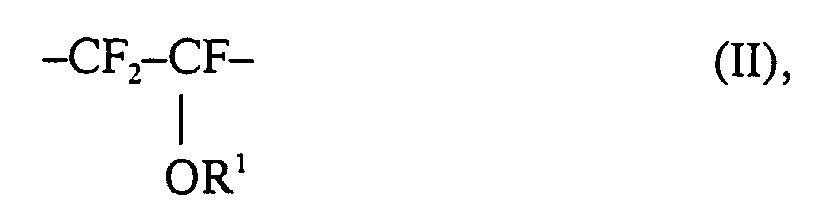 und eine vemetzbare bzw. quervernetzbare funktionelle Struktureinheiten (III) durch welche das Polymer leicht vernetzt bzw. quervernetzt wird nach Aussetzen des Polymers freien Radikalen;worin R1 ein Alkyl ist, das 1 bis 6 Kohlenstoffatome enthält;vorausgesetzt, daß (I)+(II)+(III) wenigstens 50 Mol% der Struktureinheiten in dem Polymer sind.
 - Das Polymer wie in Anspruch 1 zitiert, worin das Molverhältnis von (I):(II) 4:1 bis 1:1 ist und das Molverhältnis von [(I)+(II)]:(III) 200:1 bis 20:1 ist.
- Das Polymer wie in Anspruch 2 zitiert, worin (III) ausgewählt ist aus der Gruppe bestehend ausworin i und k eine ganze Zahl im Bereich von 2 bis 10 ist, j eine ganze Zahl im Bereich von 1 bis 4 ist und jedes R2 unabhängig eine Alkylgruppe mit 1 bis 4 Kohlenstoffatomen ist.

- Das Polymer wie in Anspruch 3 zitiert, worin i und k 2 oder 4 sind, j 1 ist und beide R2-Gruppen Methyl sind.
- Das Polymer wie in Anspruch 2 zitiert, worin das Molverhältnis von (I):(II) 3:1 bis 13:7 ist.
- Das Polymer wie in Anspruch 2 zitiert, worin das Molverhältnis von [(I)+(II)]:(III) 130:1 bis 70:1 ist.
- Das Polymer wie in Anspruch 2 zitiert, worin (I), (II) und (III) in Kombination wenigstens 65 Mol% des Polymers sind.
- Das Polymer wie in Anspruch 2 zitiert, das im wesentlichen aus den Struktureinheiten (I), (II) und (III) besteht.
- Das Polymer wie in Anspruch 2 zitiert, welches ferner ein oder mehrere Komonomere enthält, die ausgewählt sind aus der Gruppe bestehend aus Vinylidenfluorid, Hexafluorpropylen und einem Perfluor(Alkylvinylether), worin die Alkylgruppe 1 bis 5 Kohlenstoffatome enthält.
- Das Polymer wie in Anspruch 1 zitiert, welches ein Elasotmer ist.
- Das Polymer wie in Anspruch 2 zitiert, welches vernetzt bzw. quervernetzt ist.
- Das Polymer wie in Anspruch 2 zitiert, worin R1 Ethyl, n-Propyl oder n-Butyl ist.
- Das Polymer wie in Anspruch 11 zitiert, worin R1 n-Butyl ist.
- Ein Polymer, das nicht vernetzt bzw. quervernetzt ist, das das Produkt von Radikalkopolymerisierung ist, in der Gegenwart eines organischen Iodids, einer Reaktionsmischung aus Monomeren, die Tetrafluorethylen enthält, einer Verbindung der Formel CF2=CFOR1, worin R1 ein n-Alkyl mit 1 bis 6 Kohlenstoffatomen ist, und optional weiteren radikalkopolymerisierbaren Monomeren, vorausgesetzt daß:
das Polymer 0,1 bis 5 Gewichts% an Iod enthält; und
Struktureinheiten abgeleitet aus Tetrafluorethylen und einer Verbindung mit der Formel CF2=CFOR1 wenigstens 50 Mol% der Struktureinheiten des Polymers sind. - Das Polymer wie in Anspruch 14 zitiert, worin R1 Ethyl, n-Propyl oder n-Butyl ist.
- Das Polymer wie in Anspruch 15 zitiert, worin R1 n-Butyl ist.
- Das Polymer wie in Anspruch 14 zitiert, worin das Molverhältnis von (I):(II) 3:1 bis 13:7 beträgt.
- Das Polymer wie in Anspruch 14 zitiert, das auch einen oder mehrere Komonomere enthält, die ausgewählt sind aus der Gruppe bestehend aus Vinylidenfluorid, Hexafluorpropylen und einem Perfluor(Alkylvinylether), worin die Alkylgruppe 1 bis 5 Kohlenstoffatome enthält.
- Das Polymer wie in Anspruch 14 zitiert, worin (IV) und (V) in Kombination wenigstens 65 Mol% der Struktureinheiten sind.
- Das Polymer wie in Anspruch 14 zitiert, welches ein Elastomer ist.
- Das Polymer wie in Anspruch 14 zitiert, welches vernetzt bzw. quervernetzt ist.
- Das Polymer wie in Anspruch 14 zitiert, welches im wesentlichen aus Struktureinheiten besteht, die von Struktureinheiten abgeleitet sind, die von Tetrafluorethylen und eine Verbindung mit der Formel CF2=CFOR1 abgeleitet sind.
- Das Polymer wie in Anspruch 14 zitiert, welches 0,5 bis 2,5 Gewichts% Iod enthält.
- Das Polymer wie in Anspruch 14 zitiert, worin das organische Iodid ausgewählt ist aus der Gruppe bestehend aus CH2I2, R4I, worin R4 ein Perfluoralkyl ist, und I(CH2CH2)p(CF2)m(CH2CH)pI, worin m 1-10 ist, und jedes p unabhängig 0 oder 1 ist.
- Das Polymer wie in Anspruch 24 zitiert, worin m 2 oder 4 ist und p 0 ist.
- Das Polymer wie in Anspruch 14 zitiert, das durch Kontakt mit freien Radikalen vernetzt bzw. quervemetzt wurde.
- Das Polymer wie in Anspruch 1 zitiert, das nicht vernetzt bzw. quervernetzt ist.
- Das Polymer wie in Anspruch 1 zitiert, das durch Kontakt mit freien Radikalen vernetzt bzw. quervernetzt wurde.
- Ein Radikalpolymerisationsverfahren zum Herstellen eines Fluorpolymers, das nicht vernetzt bzw. quervernetzt ist, wobei das Verfahren das Umsetzen einer Beimischung aus Monomeren beinhaltet, die wenigstens 50 Mol% einer Kombination enthält aus (1) Tetrafluorethylen, (2) wenigstens einem Monomer innerhalb der Formel CF2=CFOR1, worin R1 ein Alkyl mit 1 bis 6 Kohlenstoffatomen ist, und (3) wenigstens einem vemetzungs- bzw. quervernetzungs-funktionellem Komonomer, von welchem das korrespondierende Strukturelement es dem Produktpolymer ermöglicht, leicht nach Aussetzen des Fluorpolymers freien Radikalen zu vernetzen bzw. querzuvernetzen; worin das Polymerisationsverfahren in einer wässrigen Emulsion bei einer Temperatur von etwa 30 bis 80°C bei einem Tetrafluorethylendruck von etwa 1 bis 6 MPa durchgeführt wird.
- Das Polymerisationsverfahren nach Anspruch 29, worin das Molverhältnis von Tetrafluorethylen zu CF2=CFOR1 in dem Produktpolymer etwa 4:1 bis etwa 1:1 ist und das Molverhältnis von Tetrafluorethylen plus CF2=CFOR1 zum vemetzungs- bzw. quervernetzungs-funktionellem Monomer etwa 200:1 bis etwa 20:1 ist.
- Das Polymerisationsverfahren nach Anspruch 29, worin das vernetzungs- bzw. quervernetzungs-funktionelle Komonomer ausgewählt ist aus der Gruppe bestehend ausworin i und k eine ganze Zahl im Bereich von 2 bis 10 ist, j eine ganze Zahl im Bereich von 1 bis 4 ist und jedes R2 unabhängig eine Alkylgruppe mit 1 bis 4 Kohlenstoffatomen ist.

- Das Polymerisationsverfahren nach Anspruch 31, worin die Temperatur etwa 35 bis 45 °C ist.
Applications Claiming Priority (3)
| Application Number | Priority Date | Filing Date | Title |
|---|---|---|---|
| US6295P | 1995-06-08 | 1995-06-08 | |
| US62P | 1995-06-08 | ||
| PCT/US1996/009754 WO1996041823A1 (en) | 1995-06-08 | 1996-06-07 | Base resistant fluorinated polymers |
Publications (2)
| Publication Number | Publication Date |
|---|---|
| EP0865452A1 EP0865452A1 (de) | 1998-09-23 |
| EP0865452B1 true EP0865452B1 (de) | 2000-03-01 |
Family
ID=21689736
Family Applications (1)
| Application Number | Title | Priority Date | Filing Date |
|---|---|---|---|
| EP96919279A Expired - Lifetime EP0865452B1 (de) | 1995-06-08 | 1996-06-07 | Alkali-widerständig fluor-enthaltende polymere |
Country Status (4)
| Country | Link |
|---|---|
| EP (1) | EP0865452B1 (de) |
| JP (1) | JP3993635B2 (de) |
| DE (1) | DE69606886T2 (de) |
| WO (1) | WO1996041823A1 (de) |
Families Citing this family (2)
| Publication number | Priority date | Publication date | Assignee | Title |
|---|---|---|---|---|
| EP0891997A1 (de) * | 1997-07-15 | 1999-01-20 | E.I. Du Pont De Nemours And Company | Fluorpolymer Zusammensetzungen und Verfahren zu ihrer Herstellung |
| IT1301973B1 (it) * | 1998-07-31 | 2000-07-20 | Ausimont Spa | Idro-fluoroalchilvinileteri e procedimento per il loro ottenimento |
Family Cites Families (3)
| Publication number | Priority date | Publication date | Assignee | Title |
|---|---|---|---|---|
| US3159609A (en) * | 1956-10-26 | 1964-12-01 | Du Pont | Copolymers of perfluorovinyl ethers |
| US3525724A (en) * | 1967-01-13 | 1970-08-25 | Du Pont | Fluorocarbon polymers comprising carbonyl groups |
| GB1292643A (en) * | 1968-11-19 | 1972-10-11 | Du Pont | Ethylene/tetrafluoroethylene copolymers |
-
1996
- 1996-06-07 DE DE69606886T patent/DE69606886T2/de not_active Expired - Fee Related
- 1996-06-07 EP EP96919279A patent/EP0865452B1/de not_active Expired - Lifetime
- 1996-06-07 WO PCT/US1996/009754 patent/WO1996041823A1/en not_active Ceased
- 1996-06-07 JP JP50321897A patent/JP3993635B2/ja not_active Expired - Fee Related
Also Published As
| Publication number | Publication date |
|---|---|
| EP0865452A1 (de) | 1998-09-23 |
| WO1996041823A1 (en) | 1996-12-27 |
| DE69606886D1 (de) | 2000-04-06 |
| DE69606886T2 (de) | 2000-10-26 |
| JP3993635B2 (ja) | 2007-10-17 |
| JPH11507695A (ja) | 1999-07-06 |
Similar Documents
| Publication | Publication Date | Title |
|---|---|---|
| EP0872495B1 (de) | Fluorhaltige, elastische copolymere, härtbare zusammensetzung und daraus hergestellte dichtungsmasse | |
| US4973634A (en) | Preparation of bromo-containing perfluoropolymers having iodine curesites | |
| EP0011853B1 (de) | Vulkanisierbare fluorierte Copolymere | |
| RU2122550C1 (ru) | Фторэластомеры | |
| EP0662096B1 (de) | Jod enthaltende kettenübertragungsmittel für die polymerisation von fluormonomeren | |
| CN101374872B (zh) | 含氟弹性体 | |
| JP3103386B2 (ja) | フルオル弾性体及びその製造法 | |
| AU2012350856B2 (en) | Crosslinkable vinylidene fluoride and trifluoroethylene polymers | |
| JPH0352907A (ja) | 改良された加工性を有する新規なフルオロエラストマーおよびその製造法 | |
| EP0979832B1 (de) | Fluoroelastomere | |
| EP1709113A1 (de) | Fluorelastomere mit verbesserter eigenschaft bei niedrigen temperaturen und verfahren zur herstellung derselben | |
| BR9907309B1 (pt) | composição curável de fluorelastÈmeros, seu uso, e, processo para a obtenção de uma composição curável de fluorelastÈmeros. | |
| JP2004502786A (ja) | 低いTgを示すフッ化ビニリデンを主成分とする、架橋性ブロモスルホン化フルオロエラストマー | |
| US4920170A (en) | Process for producing fluorine-containing elastic copolymer | |
| JPH06220143A (ja) | 塩基に対する安定性が改善された熱可塑性弗素弾性体 | |
| EP1537154A1 (de) | Fluorelastomere mit verringerter permeation und herstellungsverfahren derselben | |
| CA2155458A1 (en) | Process for preparing hydrogen-fluoropolymers by suspension (co)polymerization | |
| KR101378422B1 (ko) | 플루오로엘라스토머 | |
| CN101084246B (zh) | 用于制备含氟弹性体的含氟聚合物 | |
| JPH02191613A (ja) | 新規非結晶性含フッ素共重合体 | |
| US4774302A (en) | Process for producing peroxide-vulcanizable, fluorine-containing elastomer | |
| EP0865452B1 (de) | Alkali-widerständig fluor-enthaltende polymere | |
| RU2107698C1 (ru) | Фторэластомерный сополимер | |
| US6040405A (en) | Base resistant fluorinated polymers | |
| JPS6323907A (ja) | パ−オキサイド加硫可能な含フツ素エラストマ−の製造方法 |
Legal Events
| Date | Code | Title | Description |
|---|---|---|---|
| PUAI | Public reference made under article 153(3) epc to a published international application that has entered the european phase |
Free format text: ORIGINAL CODE: 0009012 |
|
| 17P | Request for examination filed |
Effective date: 19971203 |
|
| AK | Designated contracting states |
Kind code of ref document: A1 Designated state(s): DE FR GB IT |
|
| 17Q | First examination report despatched |
Effective date: 19981203 |
|
| GRAG | Despatch of communication of intention to grant |
Free format text: ORIGINAL CODE: EPIDOS AGRA |
|
| GRAG | Despatch of communication of intention to grant |
Free format text: ORIGINAL CODE: EPIDOS AGRA |
|
| GRAH | Despatch of communication of intention to grant a patent |
Free format text: ORIGINAL CODE: EPIDOS IGRA |
|
| GRAH | Despatch of communication of intention to grant a patent |
Free format text: ORIGINAL CODE: EPIDOS IGRA |
|
| GRAA | (expected) grant |
Free format text: ORIGINAL CODE: 0009210 |
|
| AK | Designated contracting states |
Kind code of ref document: B1 Designated state(s): DE FR GB IT |
|
| REF | Corresponds to: |
Ref document number: 69606886 Country of ref document: DE Date of ref document: 20000406 |
|
| ET | Fr: translation filed | ||
| ITF | It: translation for a ep patent filed | ||
| PLBE | No opposition filed within time limit |
Free format text: ORIGINAL CODE: 0009261 |
|
| STAA | Information on the status of an ep patent application or granted ep patent |
Free format text: STATUS: NO OPPOSITION FILED WITHIN TIME LIMIT |
|
| 26N | No opposition filed | ||
| PGFP | Annual fee paid to national office [announced via postgrant information from national office to epo] |
Ref country code: DE Payment date: 20010528 Year of fee payment: 6 |
|
| PGFP | Annual fee paid to national office [announced via postgrant information from national office to epo] |
Ref country code: GB Payment date: 20010606 Year of fee payment: 6 |
|
| PGFP | Annual fee paid to national office [announced via postgrant information from national office to epo] |
Ref country code: FR Payment date: 20010611 Year of fee payment: 6 |
|
| REG | Reference to a national code |
Ref country code: GB Ref legal event code: IF02 |
|
| PG25 | Lapsed in a contracting state [announced via postgrant information from national office to epo] |
Ref country code: GB Free format text: LAPSE BECAUSE OF NON-PAYMENT OF DUE FEES Effective date: 20020607 |
|
| PG25 | Lapsed in a contracting state [announced via postgrant information from national office to epo] |
Ref country code: DE Free format text: LAPSE BECAUSE OF NON-PAYMENT OF DUE FEES Effective date: 20030101 |
|
| GBPC | Gb: european patent ceased through non-payment of renewal fee |
Effective date: 20020607 |
|
| PG25 | Lapsed in a contracting state [announced via postgrant information from national office to epo] |
Ref country code: FR Free format text: LAPSE BECAUSE OF NON-PAYMENT OF DUE FEES Effective date: 20030228 |
|
| REG | Reference to a national code |
Ref country code: FR Ref legal event code: ST |
|
| PG25 | Lapsed in a contracting state [announced via postgrant information from national office to epo] |
Ref country code: IT Free format text: LAPSE BECAUSE OF NON-PAYMENT OF DUE FEES Effective date: 20050607 |