EP0865498B1 - Verfahren zur herstellung von substituierten arylmilchsäure-haltigen cyclodepsipeptiden mit 24 ringatomen - Google Patents
Verfahren zur herstellung von substituierten arylmilchsäure-haltigen cyclodepsipeptiden mit 24 ringatomen Download PDFInfo
- Publication number
- EP0865498B1 EP0865498B1 EP96939916A EP96939916A EP0865498B1 EP 0865498 B1 EP0865498 B1 EP 0865498B1 EP 96939916 A EP96939916 A EP 96939916A EP 96939916 A EP96939916 A EP 96939916A EP 0865498 B1 EP0865498 B1 EP 0865498B1
- Authority
- EP
- European Patent Office
- Prior art keywords
- methyl
- leucyl
- lactyl
- phenyllactyl
- cyclo
- Prior art date
- Legal status (The legal status is an assumption and is not a legal conclusion. Google has not performed a legal analysis and makes no representation as to the accuracy of the status listed.)
- Expired - Lifetime
Links
- 0 CC(C)CC(C(OC(Cc(cc1)ccc1[N+]([O-])O)C(N(C)C(CC(C)*)C(OC(C)C(N(C)C(CC(*)*)C(OC(Cc(cc1)ccc1[N+]([O-])O)C(N(C)C(CC(C)*)C(OC1C)=O)=O)=O)=O)=O)=O)=O)N(*)C1=O Chemical compound CC(C)CC(C(OC(Cc(cc1)ccc1[N+]([O-])O)C(N(C)C(CC(C)*)C(OC(C)C(N(C)C(CC(*)*)C(OC(Cc(cc1)ccc1[N+]([O-])O)C(N(C)C(CC(C)*)C(OC1C)=O)=O)=O)=O)=O)=O)=O)N(*)C1=O 0.000 description 1
Classifications
-
- C—CHEMISTRY; METALLURGY
- C07—ORGANIC CHEMISTRY
- C07D—HETEROCYCLIC COMPOUNDS
- C07D273/00—Heterocyclic compounds containing rings having nitrogen and oxygen atoms as the only ring hetero atoms, not provided for by groups C07D261/00 - C07D271/00
-
- C—CHEMISTRY; METALLURGY
- C12—BIOCHEMISTRY; BEER; SPIRITS; WINE; VINEGAR; MICROBIOLOGY; ENZYMOLOGY; MUTATION OR GENETIC ENGINEERING
- C12P—FERMENTATION OR ENZYME-USING PROCESSES TO SYNTHESISE A DESIRED CHEMICAL COMPOUND OR COMPOSITION OR TO SEPARATE OPTICAL ISOMERS FROM A RACEMIC MIXTURE
- C12P1/00—Preparation of compounds or compositions, not provided for in groups C12P3/00 - C12P39/00, by using microorganisms or enzymes
-
- C—CHEMISTRY; METALLURGY
- C12—BIOCHEMISTRY; BEER; SPIRITS; WINE; VINEGAR; MICROBIOLOGY; ENZYMOLOGY; MUTATION OR GENETIC ENGINEERING
- C12P—FERMENTATION OR ENZYME-USING PROCESSES TO SYNTHESISE A DESIRED CHEMICAL COMPOUND OR COMPOSITION OR TO SEPARATE OPTICAL ISOMERS FROM A RACEMIC MIXTURE
- C12P17/00—Preparation of heterocyclic carbon compounds with only O, N, S, Se or Te as ring hetero atoms
- C12P17/14—Nitrogen or oxygen as hetero atom and at least one other diverse hetero ring atom in the same ring
-
- Y—GENERAL TAGGING OF NEW TECHNOLOGICAL DEVELOPMENTS; GENERAL TAGGING OF CROSS-SECTIONAL TECHNOLOGIES SPANNING OVER SEVERAL SECTIONS OF THE IPC; TECHNICAL SUBJECTS COVERED BY FORMER USPC CROSS-REFERENCE ART COLLECTIONS [XRACs] AND DIGESTS
- Y10—TECHNICAL SUBJECTS COVERED BY FORMER USPC
- Y10S—TECHNICAL SUBJECTS COVERED BY FORMER USPC CROSS-REFERENCE ART COLLECTIONS [XRACs] AND DIGESTS
- Y10S435/00—Chemistry: molecular biology and microbiology
- Y10S435/8215—Microorganisms
- Y10S435/911—Microorganisms using fungi
Definitions
- the present invention relates to a new process for the production of partially known substituted aryl lactic acid-containing cyclodepsipeptides 24 ring atoms.
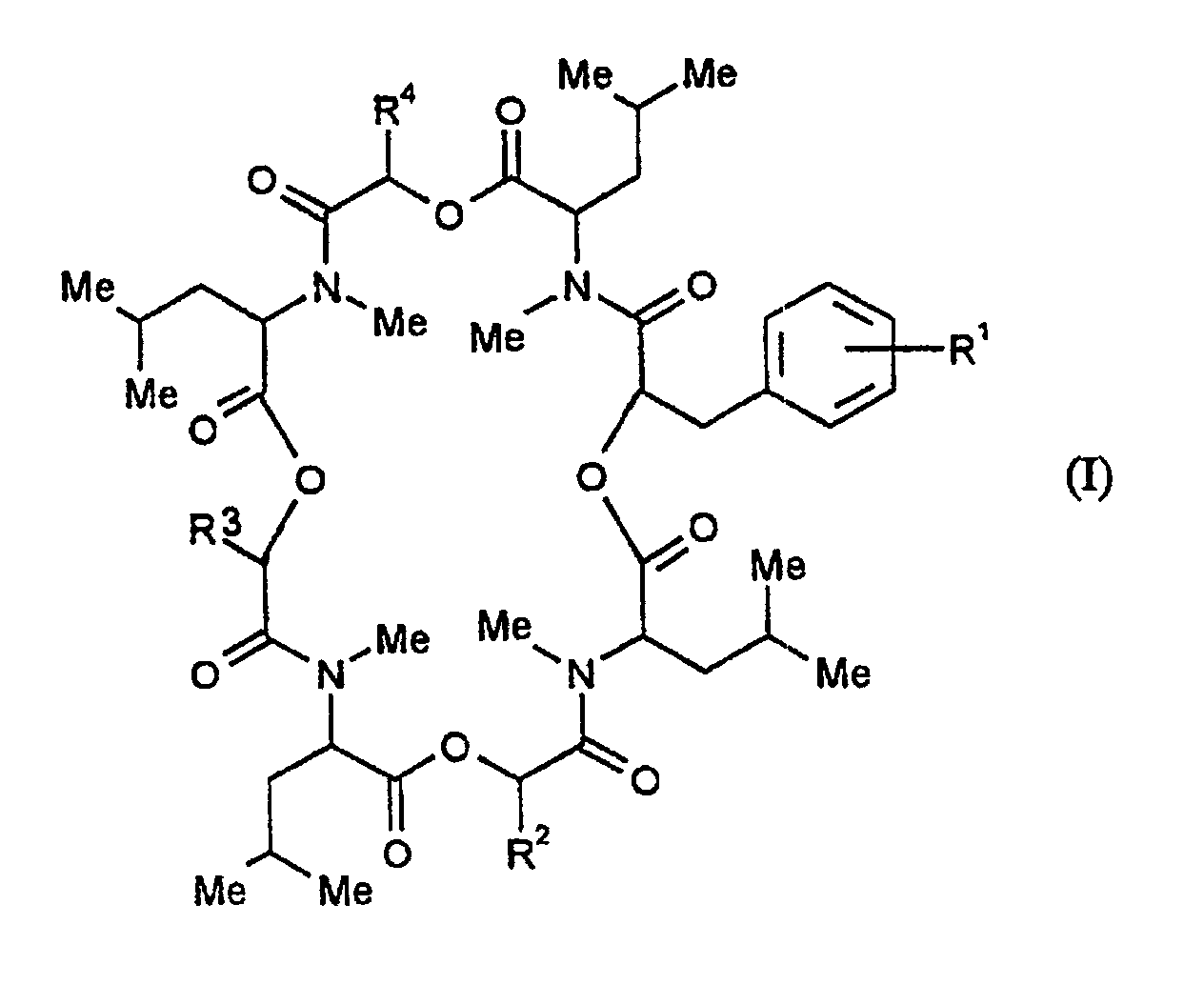
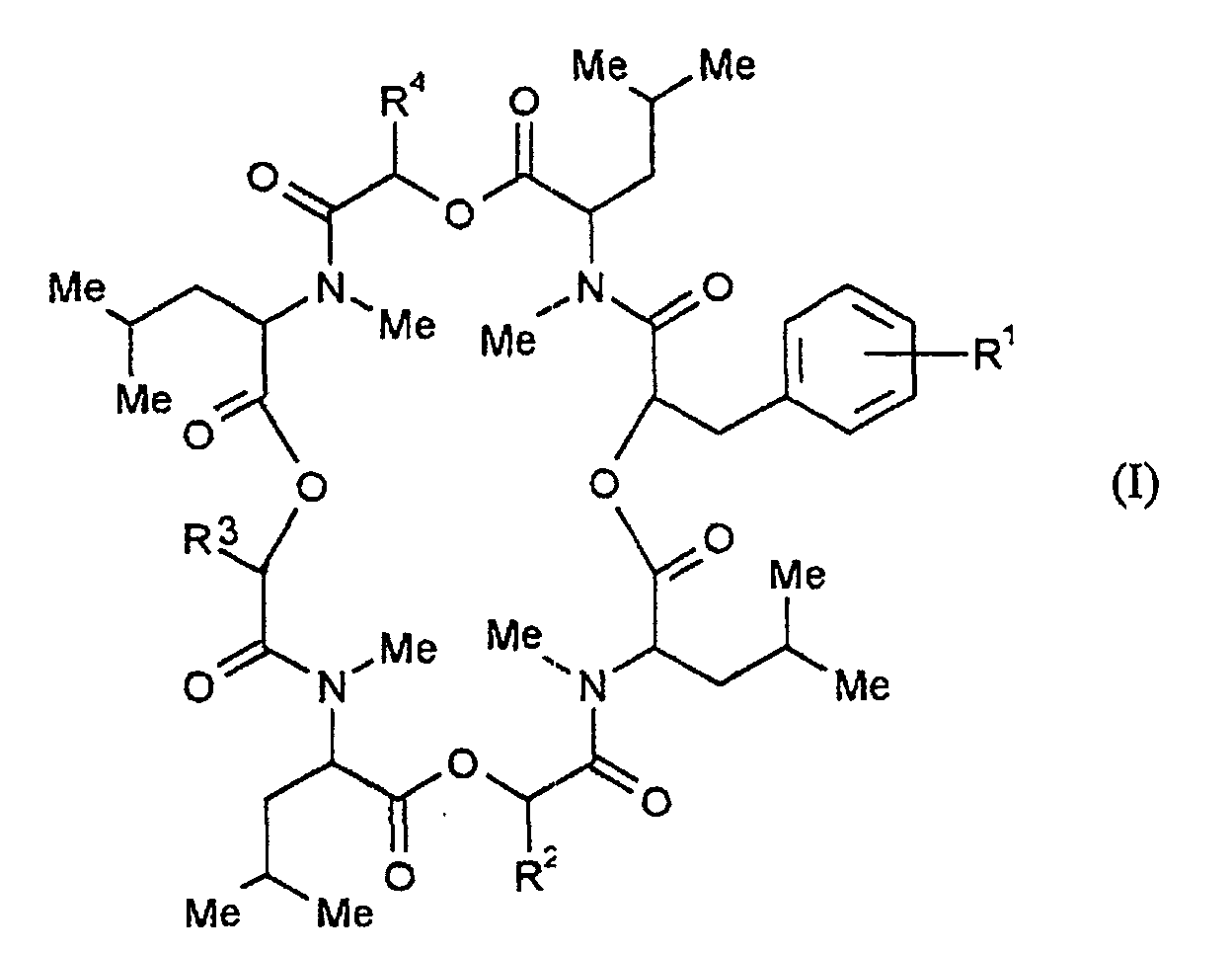
- the compounds of the PF 1022 series have the following formula (I): description R 1 R 2 R 3 R 4 PF 1022A -H -Methyl benzyl -Methyl PF 1022B -H benzyl benzyl benzyl PF 1022C -H -Methyl benzyl benzyl PF 1022D -H -Methyl -Methyl -Methyl PF 1022E 4-hydroxy -Methyl benzyl -Methyl
- the present invention therefore relates to a process for the preparation of substituted Aryl lactic acid containing cyclodepsipeptides with 24 ring atoms with the help of Fungal strains of the species Agonomycetales or enzymatically isolated from them Preparations.
- the aryl lactic acid-containing cyclic depsipeptides with 24 ring atoms of the general Formula (I) and their acid addition salts and metal salt complexes are excellent for fighting endoparasites, especially on the Field of medicine and veterinary medicine.
- Optionally substituted alkyl alone or as part of a radical in the general formulas means straight-chain or branched alkyl with preferably 1 to 6, especially 1 to 4 carbon atoms. If necessary, be an example substituted methyl, ethyl, n-propyl, isopropyl, n-butyl, isobutyl, sec-butyl, tert-butyl, pentyl, 1-methylbutyl, 2-methylbutyl, 3-methylbutyl, 1,2-dimethylpropyl, 1,1-dimethylpropyl, 2,2-dimethylpropyl, 1-ethylpropyl, hexyl, 1-methylpentyl, 2-methylpentyl, 3-methylpentyl, 4-methylpentyl, 1,2-dimethylbutyl, 1,3-dimethylbutyl, 2,3-dimethylbutyl, 1,1-dimethylbutyl, 2,2-dimethylbutyl, 3,3-dimethylbutyl
- Optionally substituted alkenyl alone or as part of a radical in the general formulas preferably means straight-chain or branched alkenyl 1 to 6, especially 1 to 4 carbon atoms.
- Optionally substituted cycloalkyl alone or as part of a radical in the general formulas mean mono-, bi- and tricyclic cycloalkyl, preferably with 3 to 10, in particular with 3, 5 or 7 carbon atoms.
- Examples include optionally substituted cyclopropyl, cyclobutyl, cyclopentyl, Cyclohexyl, cycloheptyl, cyclooctyl, bicyclo [2.2.1] heptyl, bicyclo [2.2.2] octyl and called Adamantyl.
- Optionally substituted alkoxy alone or as part of a radical in the general formulas preferably means straight-chain or branched alkoxy 1 to 6, especially 1 to 4 carbon atoms. If necessary, be an example substituted methoxy, ethoxy, n-propoxy, isopropoxy, n-butoxy, Isobutoxy, sec-butoxy and tert-butoxy called.
- Optionally substituted alkylthio alone or as part of a radical in the general formulas mean straight-chain or branched alkylthio preferably 1 to 6, in particular 1 to 4 carbon atoms.
- Optionally substituted alkoxycarbonyl alone or as part of a The remainder in the general formulas means straight-chain or branched alkoxycarbonyl with preferably 1 to 6, in particular 1 to 4 carbon atoms.
- Examples include optionally substituted methoxycarbonyl, ethoxycarbonyl, n-propoxycarbonyl, isopropoxycarbonyl, n-butoxycarbonyl, isobutoxycarbonyl, called sec-butoxycarbonyl and tert-butoxycarbonyl.
- the rest in the general formulas mean straight-chain or branched alkylcarbonyl with preferably 1 to 6, in particular 1 to 4 carbon atoms.
- exemplary are optionally substituted methylcarbonyl, ethylcarbonyl, n-propylcarbonyl, Isopropylcarbonyl, n-butylcarbonyl, isobutylcarbonyl, sec-butylcarbonyl and called tert-butylcarbonyl.
- Optionally substituted arylalkyl in the general formulas preferably means Arylalkyl optionally substituted in the aryl part and / or alkyl preferably 6 or 10, in particular 8 carbon atoms in the aryl part (preferably Phenyl or naphthyl, in particular phenyl) and preferably 1 to 4, in particular 1 or 2 carbon atoms in the alkyl part, the alkyl part being straight-chain or can be branched. Exemplary and preferred are where appropriate substituted benzyl and phenylethyl called.
- Optionally substituted hetaryl alone or as part of a residue in the general formulas mean 5- to 7-membered rings with preferably 1 to 3, in particular 1 or 2 identical or different heteroaromatics.
- the heteroaromatics contain oxygen, sulfur or nitrogen.
- Suitable cyclic amino groups are heteroaromatic or aliphatic Ring systems with one or more nitrogen atoms as heteroatom in Question where the heterocycles are saturated or unsaturated, a ring system or can be several condensed ring systems, and optionally further heteroatoms such as nitrogen, oxygen and sulfur, etc. contain. Moreover cyclic amino groups can also be a spiro ring or a bridged ring system mean.
- the number of atoms that form cyclic amino groups is not restricted, for example in the case of a single ring system they consist of 3 up to 8 atoms and in the case of a three-ring system from 7 to 11 atoms.
- cyclic amino groups are saturated and unsaturated monocyclic Ring systems with a nitrogen atom as hetero atom, such as 1-azetidinyl, Pyrrolidino, 2-pyrrolin-1-yl, 1-pyrrolyl, piperidino, 1,4-dihydropyridin-1-yl, 1,2,5,6-tetrahydropyridin-1-yl called homopiperidino;
- exemplary of cyclic Amino groups are saturated and unsaturated monocyclic ring systems with two or more nitrogen atoms as heteroatoms such as 1-imidazolidinyl, 1-imidazolyl, 1-pyrazolyl, 1-triazolyl, 1-tetrazolyl, 1-piperazinyl, 1-homopiperazinyl, 1,2-dihydropyridazin-1-yl, 1,2-dihydropyrimidin-1-yl, perhydropyrimidin-1-yl and called 1,4-diazacycloheptan-1-yl; exemplary
- the substitutable aryl lactic acid-containing cyclodepsipeptides with 24 ring atoms which can be prepared according to the invention are generally defined by the general formula (I).
- compounds of the general formula (I) are preferably formed in which the ⁇ -amino acids have an (S) configuration (L-form) and the 2-hydroxycarboxylic acids have an (R) configuration (D-shape).
- R 1 , R 2 , R 3 and R 4 preferably represent those radicals which have already been mentioned as preferred for these substituents in connection with the description of the substances of the formula (I) according to the invention.
- substituted phenylalanines are preferred.
- R 1 preferably represents that radical which has already been mentioned as preferred for this substituent in connection with the description of the substances of the formula (I) according to the invention.
- R 1 , R 2 , R 3 and R 4 preferably represent those radicals which have already been mentioned as preferred for these substituents in connection with the description of the substances of the formula (I) according to the invention.
- the 2-hydroxy-carboxylic acids used as starting materials can, if chiral, are in the (S) or (R) configuration (L or D form). Are preferred however, the (S) -configured 2-hydroxy-carboxylic acids.
- substituted phenyllactic acids are preferred.
- R 1 preferably represents that radical which has already been mentioned as preferred for this substituent in connection with the description of the substances of the formula (I) according to the invention.
- Mycelia sterilia of the species Agonomycetales may be mentioned as a suitable fungus strain for carrying out the two methods a and b according to the invention.
- the method can also be carried out with synthetases isolated from microorganisms become.
- the cyclodepsipeptide synthetases required for this can be made from isolated the mushroom strain mentioned above by methods known from the literature (see e.g. isolation of enniatin synthetases: R. Pieper, H. Kleinkauf, R. Zocher, J. Antibiotics 45, 1993, pp. 1273-1277; DE-A 4 406 025).
- the fermentation of the fungal strains of the Agonomycetales species is carried out according to known methods Methods in the presence of suitable nutrient solutions. These nutrient solutions contain the salts necessary for the growth of the mushrooms as well as carbon and Nitrogen sources.
- organic salts for carrying out the process according to the invention come all alkali, alkaline earth and metal salts with elements of the II bis VIII. Subgroup of the periodic table in question.
- Examples include the monosaccharides such as pentoses, in particular Ribose, the hexoses, especially glucose and fructose, the oligosaccharides such as Disaccharides, especially sucrose, maltose and lactose, the trisaccharides, especially raffinose, as well as the tetra-, penta- and hexasaccharides.
- monosaccharides such as pentoses, in particular Ribose
- the hexoses especially glucose and fructose
- the oligosaccharides such as Disaccharides, especially sucrose, maltose and lactose
- the trisaccharides especially raffinose
- Monosaccharides such as hexoses are preferably used, in particular Glucose, and oligosaccharides such as disaccharides, in particular Sucrose.
- Examples include the natural and synthetic ones mentioned above Amino acids mentioned or nitrogen-containing salts such as ammonium nitrate, Ammonium nitrite or nitrates and nitrites of the metals mentioned above.
- the natural amino acids mentioned above are preferably used and nitrogenous salts such as ammonium nitrate.
- the fungal strains used for the fermentative process are first of all known methods in a medium consisting of, for. B. from molasses / Comsteep liquor, grown. After cultivation, the mycelium is isolated. to Representation of the preculture is a Fusarium defined medium (FDM) from a carbon source and inorganic salts, inoculated with mycelium and fermented again. After a few days, the main FDM culture prepared by inoculating 1 ml of preculture and fermented analogously become.
- FDM Fusarium defined medium
- the fermentation period is 1 to 30 days.
- the fermentation takes place at temperatures between + 5 ° C and + 40 ° C, preferably between + 15 ° C and + 35 ° C, particularly preferably between + 25 ° C and + 30 ° C. It becomes sterile and under Normal pressure worked.
- the mycelium of the culture is separated off, the filtrate optionally extracted several times with an organic solvent, homogenized and then filtered.
- the resulting culture filtrate is more common Way extracted, dried and concentrated in vacuo.
- the resulting cyclodepsipeptide raw products can be used in the usual way purify by column chromatography or by Craig distribution. What that best practice must be decided on a case by case basis. (see also the Preparation Examples).
- the method according to the invention is used in the presence of isolated cyclodepsipeptide synthetases is carried out in an aqueous buffer system in the presence of metal salts, S-adenosyl-L-methionine (SAM) and adenosine triphosphate (ATP) worked.
- SAM S-adenosyl-L-methionine
- ATP adenosine triphosphate
- metal salts acetates, chlorides, bromides, iodides, fluorides, Nitrates, phosphates, hydrogen phosphates, phosphites, hydrogen phosphites, sulfates, Hydrogen sulfates, sulfites, hydrogen sulfites, carbonates and hydrogen carbonates of Lithium, sodium, potassium, cesium.
- metal salts acetates, chlorides, bromides, iodides, fluorides, Nitrates, phosphates, hydrogen phosphates, phosphites, hydrogen phosphites, sulfates, Hydrogen sulfates, sulfites, hydrogen sulfites, carbonates and hydrogen carbonates of Lithium, sodium, potassium, cesium.
- metal salts acetates, chlorides, bromides, iodides, fluorides, Nitrates, phosphates, hydrogen phosphates, phosphites, hydrogen phosphi
- Alkaline earth metal salts such as magnesium chloride, are preferably used. sulfate or acetate.
- the methods a and b according to the invention are in an aqueous buffer solution carried out.
- buffer solutions e.g. For the pH 1.0, in particular glycine-hydrochloric acid, for the pH 2.0 to 4.0, in particular Citrate hydrochloric acid, for the pH value 5.0 to 6.0, in particular citrate sodium hydroxide solution, for pH 7.0, especially phosphate, for pH 8.0, in particular borate hydrochloric acid, and for the pH 9.0 to 10.0, in particular Boric acid / potassium chloride sodium hydroxide solution.
- pH 1.0 in particular glycine-hydrochloric acid
- Citrate hydrochloric acid for the pH value 5.0 to 6.0, in particular citrate sodium hydroxide solution, for pH 7.0, especially phosphate, for pH 8.0, in particular borate hydrochloric acid, and for the pH 9.0 to 10.0, in particular Boric acid / potassium chloride sodium hydroxide solution.
- a phosphate buffer solution in particular Potassium hydrogen phosphate / disodium hydrogen phosphate or potassium hydrogen phosphate / dipotassium hydrogen phosphate.
- the reaction time of the enzymatic in vitro synthesis is 2 minutes to 24 hours.
- the enzymatic in vitro synthesis takes place at a temperature range from 0 ° C to + 50 ° C, preferably at + 10 ° C to + 35 ° C, particularly preferably between + 20 ° C and + 30 ° C.
- the reaction is preferably carried out under sterile reaction conditions and at normal pressure.
- the in vitro enzymatic synthesis can be stopped by adding water.
- the aqueous phase is worked up several times with an organic solvent extracted, dried and concentrated in vacuo.
- the resulting cyclodepsipeptide raw products can be used in the usual way purify by column chromatography or by Craig distribution. What that is the best practice, it must be decided on a case-by-case basis (cf. also the manufacturing examples).
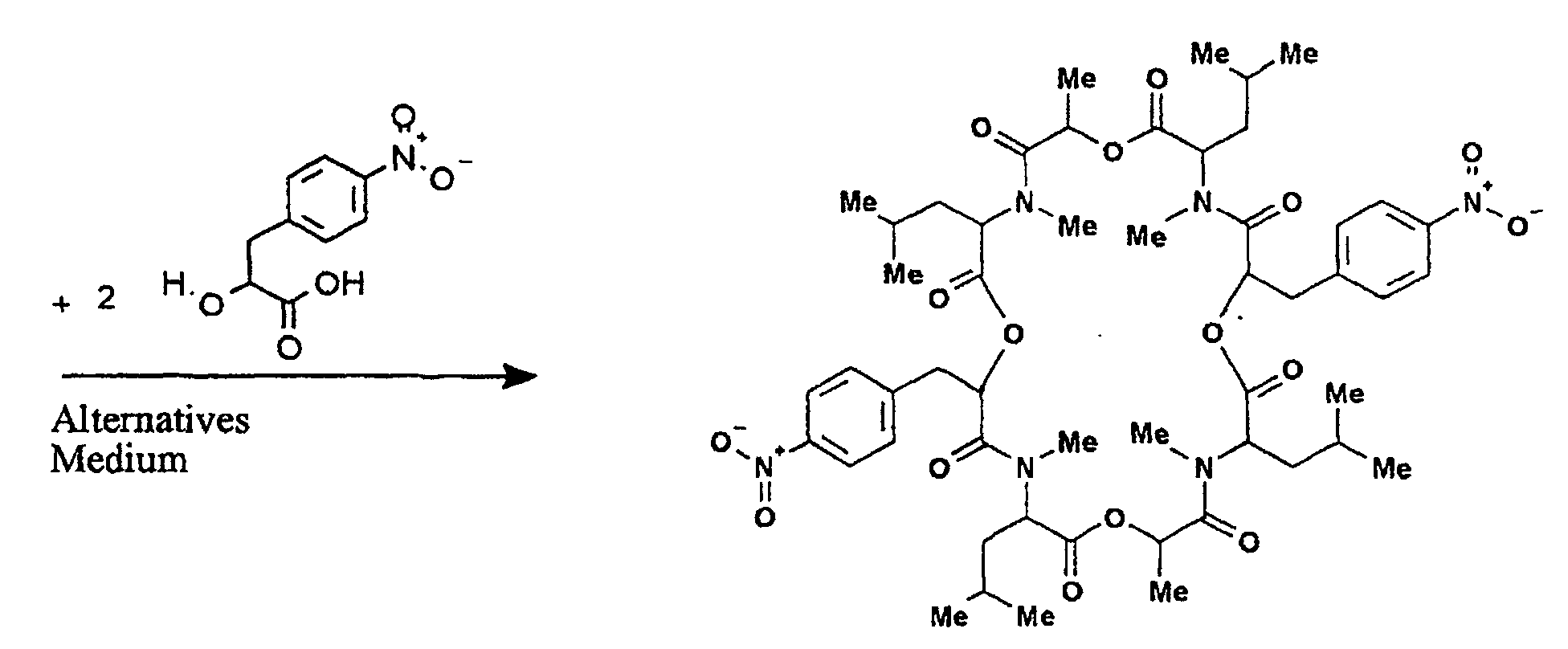
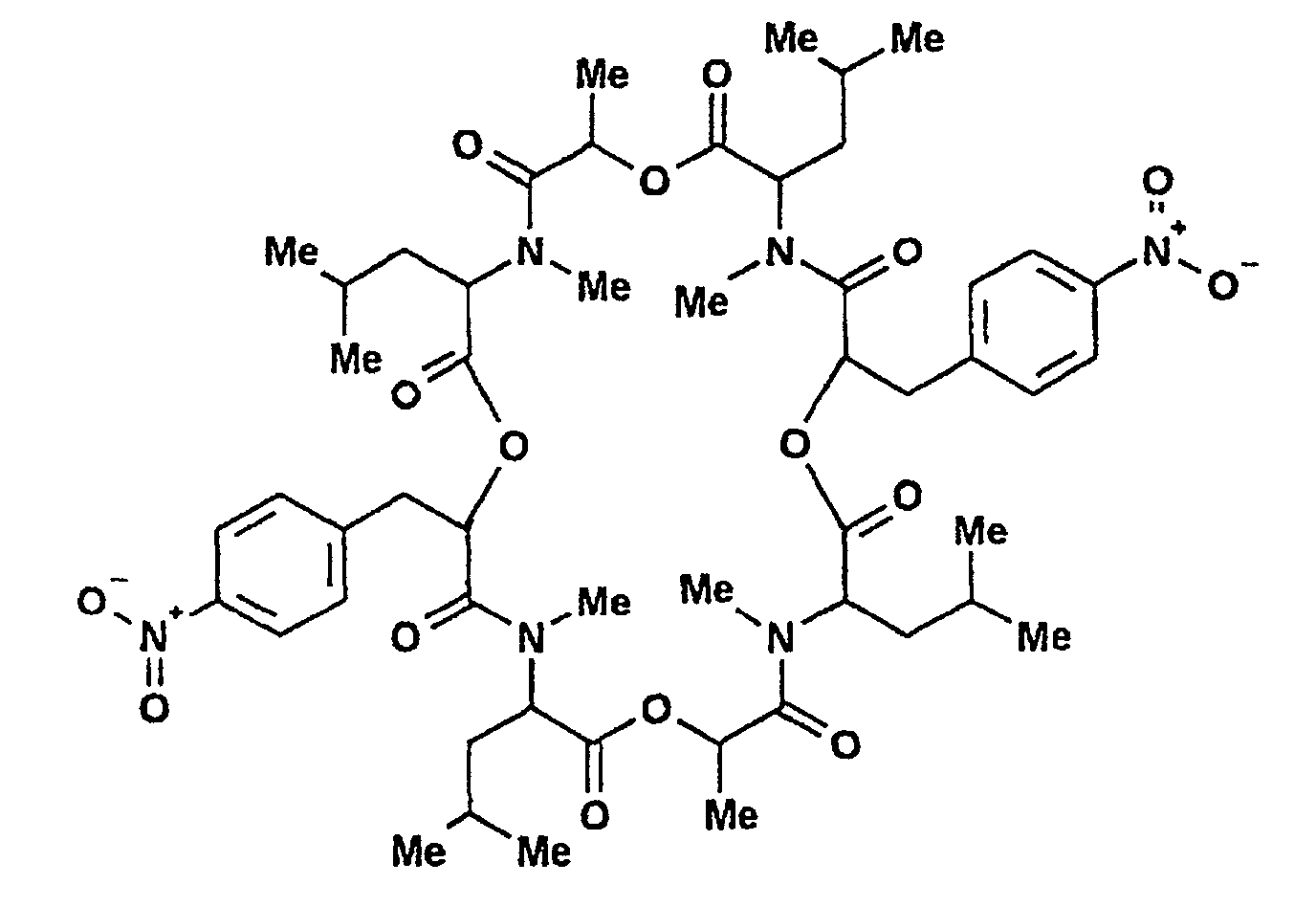
- 4-Nitro-phenylalanine is added sterile in a concentration of 50 mM to a 3-day-old main culture of Mycelia sterilia of the species Agonomycetales and the fermentation is continued for 3 days.
- the mycelium of the fusarium culture is then separated off and, after freeze-drying, extracted several times with methanol. The collected organic phases are then evaporated to dryness.
- the relevant strain Mycelia sterilia is composed of in a medium. Molasses (30 g / l), corn steep liquor (10 g / l) and glucose (30 g / l) grown.
- the medium with mycelium is removed from an agar plate inoculated and after about 3 days on a shaker to inoculate for additional flasks (content 100 ml each) were used with the same medium.
- the relevant precursors are used for the subsequent feeding attempts (e.g. 4-nitrophenylalanine, 4-nitrophenyllactic acid, 4-aminophenylamine, 4-aminophenyllactic acid) added to 3 day old cultures; the final concentration is 50 mM.
Landscapes
- Organic Chemistry (AREA)
- Chemical & Material Sciences (AREA)
- Life Sciences & Earth Sciences (AREA)
- Wood Science & Technology (AREA)
- Engineering & Computer Science (AREA)
- Zoology (AREA)
- Biochemistry (AREA)
- General Health & Medical Sciences (AREA)
- Microbiology (AREA)
- Chemical Kinetics & Catalysis (AREA)
- Biotechnology (AREA)
- Health & Medical Sciences (AREA)
- Genetics & Genomics (AREA)
- Bioinformatics & Cheminformatics (AREA)
- General Engineering & Computer Science (AREA)
- General Chemical & Material Sciences (AREA)
- Mycology (AREA)
- Peptides Or Proteins (AREA)
- Medicines That Contain Protein Lipid Enzymes And Other Medicines (AREA)
- Preparation Of Compounds By Using Micro-Organisms (AREA)
- Pharmaceuticals Containing Other Organic And Inorganic Compounds (AREA)
- Organic Low-Molecular-Weight Compounds And Preparation Thereof (AREA)
- Saccharide Compounds (AREA)
- Nitrogen And Oxygen Or Sulfur-Condensed Heterocyclic Ring Systems (AREA)
- Medicines Containing Plant Substances (AREA)
- Heterocyclic Carbon Compounds Containing A Hetero Ring Having Nitrogen And Oxygen As The Only Ring Hetero Atoms (AREA)
Description
| Bezeichnung | R 1 | R 2 | R 3 | R 4 |
| PF 1022A | -H | -Methyl | -Benzyl | -Methyl |
| PF 1022B | -H | -Benzyl | -Benzyl | -Benzyl |
| PF 1022C | -H | -Methyl | -Benzyl | -Benzyl |
| PF 1022D | -H | -Methyl | -Methyl | -Methyl |
| PF 1022E | 4-Hydroxy | -Methyl | -Benzyl | -Methyl |

- R1
- für geradkettiges oder verzweigtes Alkyl, cyclisches Alkyl, Alkenyl, Alkoxy, Alkenyloxy, Arylalkoxy, Cycloalkoxy, Alkylamino, Dialkylamino, Alkylcarbonyl, Alkylcarbonyloxy, Alkoxycarbonyl, Allylaminocarbonyl, Dialkylaminocarbonyl, Heteroarylcarbonyl, Alkoxysulfonyl, Alkylaminosulfonyl, Dialkylaminosulfonyl, Alkylthio, Alkylsulfinyl, Alkylsulfonyl, Heteroarylsulfonyl, die gegebenenfalls substituiert sein können, Hydroxy, Halogen, Nitro, Amino, Carboxyl, Carbamoyl, Cyano oder gegebenenfalls für substituierte cyclische Aminogruppen, steht, und
- R2, R3 und R4
- unabhängig voneinander für geradkettiges oder verzweigtes Alkyl, Heteroarylmethyl oder für einen Benzylrest stehen, der gegebenenfalls durch Reste aus der Reihe Wasserstoff, geradkettiges oder verzweigtes Alkyl, cyclisches Alkyl, Alkenyl, Alkoxy, Alkenyloxy, Arylalkoxy, Cycloalkoxy, Alkylamino, Dialkylamino, Alkylcarbonyl, Alkylcarbonyloxy, Alkoxycarbonyl, Alkylaminocarbonyl, Dialkylaminocarbonyl, Heteroarylcarbonyl, Alkoxysulfonyl, Alkylaminosulfonyl, Dialkylaminosulfonyl, Alkylthio, Alkylsulfinyl, Alkylsulfonyl, Heteroarylsulfonyl, die gegebenenfalls substituiert sein können, Hydroxy, Halogen, Nitro, Amino, Carboxyl, Carbamoyl, Cyano oder der gegebenenfalls durch eine geeignete cyclische Aminogruppe substituert ist, steht,
- R1
- für 4-Hydroxy steht,
- R3
- für unsubstituiertes Benzyl steht
- a) optisch aktive oder racemische Aminosäuren der allgemeinen Formeln (II),
(III), (IV) und (V)
worin

- R1, R2, R3 und R4
- die oben angegebene Bedeutung haben, oder
- b) optisch aktive oder racemische 2-Hydroxy-carbonsäuren der allgemeinen
Formeln (VI), (VII), (VIII) und (IX)
worin

- R1, R2, R3 und R4
- die oben angegebene Bedeutung haben,

in welcher
- R1
- für geradkettiges oder verzweigtes Alkyl mit bis zu 4 Kohlenstoffatomen, insbesondere Methyl, Ethyl, Propyl, Isopropyl, Butyl, Isobutyl, sec-Butyl, tert-Butyl, cyclisches Alkyl mit bis zu 6 Kohlenstoffatomen, insbesondere Cyclopropyl, Cyclobutyl, Cyclopentyl, Cyclohexyl, Alkoxy, insbesondere Methoxy, Ethoxy, Propoxy, Isopropoxy, Butoxy, Isobutoxy, sec-Butoxy, tert-Butoxy, Cycloalkoxy, insbesondere Cyclopropyloxy, Alkenyloxy, insbesondere Allyloxy, Dioxoalkylen, insbesondere Dioxomethylen, Alkylamino, insbesondere Methylamino, Ethylamino, Dialkylamino, insbesondere Dimethylamino, Diethylamino, Alkoxycarbonyl, insbesondere Methoxycarbonyl, Ethoxycarbonyl, tert-Butoxycarbonyl, Alkylaminocarbonyl, insbesondere Methylaminocarbonyl, Dialkylaminocarbonyl, insbesondere Dimethylaminocarbonyl, Alkylaminosulfonyl, insbesondere Methylaminosulfonyl, Dialkylaminosulfonyl, insbesondere Dimethylaminosulfonyl, Alkylthio, insbesondere Methylthio oder tert-Butylthio, Alkylsulfinyl, insbesondere Methylsulfinyl oder tert-Butylsulfinyl, Alkylsulfonyl, insbesondere Methylsulfonyl oder tert-Butylsulfonyl, Heteroarylsulfonyl, insbesondere N-Morpholinosulfonyl oder N-Pyrazolylsulfonyl, die gegebenenfalls substituiert sein können, Hydroxy, Halogen, insbesondere Brom, Chlor, Fluor oder Iod, Nitro, Amino, Carboxyl, Carbamoyl, Cyano oder gegebenenfalls für substituierte cyclische Aminogruppen, insbesondere N-Pyrrolidino, N-Piperidino, N-Morpholino, N-(2,6-Dimethyl-morpholino), N-Methylpiperazino, N-Thiomorpholino oder N-Dioxothiomorpholino, steht, und
- R2 und R4
- für geradkettiges oder verzweigtes Alkyl mit bis zu 4 Kohlenstoffatomen, insbesondere Methyl, stehen, und
- R3
- für geradkettiges oder verzweigtes Alkyl mit bis zu 4 Kohlenstoffatomen, insbesondere Methyl, oder für einen Benzylrest steht, der gegebenenfalls durch Reste aus der Reihe Wasserstoff, geradkettiges oder verzweigtes Alkyl mit bis zu 4 Kohlenstoffatomen, insbesondere Methyl, Ethyl, Propyl, Isopropyl, Butyl, Isobutyl, sec-Butyl, tert-Butyl, cyclisches Alkyl mit bis zu 6 Kohlenstoffatomen, insbesondere Cyclopropyl, Cyclobutyl, Cyclopentyl, Cyclohexyl, Alkoxy, insbesondere Methoxy, Ethoxy, Propoxy, Isopropoxy, Butoxy, Isobutoxy, sec-Butoxy, tert-Butoxy, Cycloalkoxy, insbesondere Cyclopropyloxy, Alkenyloxy, insbesondere Allyloxy, Dioxoalkylen, insbesondere Dioxomethylen, Alkylamino, insbesondere Methylamino, Ethylamino, Dialkylamino, insbesondere Dimethylamino, Diethylamino, Alkoxycarbonyl, insbesondere Methoxycarbonyl, Ethoxycarbonyl, tertButoxycarbonyl, Alkylaminocarbonyl, insbesondere Methylaminocarbonyl, Dialkylaminocarbonyl, insbesondere Dimethylaminocarbonyl, Alkylaminosulfonyl, insbesondere Methylaminosulfonyl, Dialkylaminosulfonyl, insbesondere Dimethylaminosulfonyl, Alkylthio, insbesondere Methylthio oder tert-Butylthio, Alkylsulfinyl, insbesondere Methylsulfinyl oder tert-Butylsulfinyl, Alkylsulfonyl, insbesondere Methylsulfonyl oder tert-Butylsulfonyl, Heteroarylsulfonyl, insbesondere N-Morpholinosulfonyl oder N-Pyrazolylsulfonyl, die gegebenenfalls substituiert sein können, Hydroxy, Halogen, insbesondere Brom, Chlor, Fluor oder Iod, Nitro, Amino, Carboxyl, Carbamoyl, Cyano oder der gegebenenfalls durch eine geeignete cyclische Aminogruppe, insbesondere N-Pyrrolidino, N-Piperidino, NMorpholino, N-(2,6-Dimethyl-morpholino), N-Methylpiperazino, N-Thiomorpholino oder N-Dioxothiomorpholino, substituiert ist, steht,
- R1
- für 4-Hydroxy steht,
- R3
- für unsubstituiertes Benzyl steht
in welcher
- R1
- für Alkoxy, insbesondere Methoxy, Ethoxy, Propoxy, Isopropoxy, Butoxy, Isobutoxy, sec-Butoxy, tert-Butoxy, Alkylamino, insbesondere Methylamino, Ethylamino, Dialkylamino, insbesondere Dimethylamino, Diethylamino, Hydroxy, Halogen, insbesondere Brom, Chlor, Fluor oder Iod, Nitro, Amino, gegebenenfalls für substituierte cyclische Aminogruppen, insbesondere N-Morpholino, N-Methylpiperazino oder N-Dioxothiomorpholino, steht, und
- R2 und R4
- für geradkettiges oder verzweigtes Alkyl mit bis zu 4 Kohlenstoffatomen, insbesondere Methyl, stehen, und
- R3
- für geradkettiges oder verzweigtes Alkyl mit bis zu 4 Kohlenstoffatomen, insbesondere Methyl, oder für einen Benzylrest steht, der gegebenenfalls durch Reste aus der Reihe Wasserstoff, Alkoxy, insbesondere Methoxy, Ethoxy, Propoxy, Isopropoxy, Butoxy, Isobutoxy, sec-Butoxy, tert-Butoxy, Alkylamino, insbesondere Methylamino, Ethylamino, Dialkylamino, insbesondere Dimethylamino, Diethylamino, Hydroxy, Halogen, insbesondere Brom, Chlor, Fluor oder Iod, Nitro, Amino oder der gegebenenfalls durch eine geeignete cyclische Aminogruppe, insbesondere N-Morpholino, N-Methylpiperazino oder N-Dioxothiomorpholino, substituiert ist, steht,
- R1
- für 4-Hydroxy steht,
- R3
- für unsubstituiertes Benzyl steht
in welcher
- R1
- für Alkoxy, insbesondere Methoxy, tert-Butoxy, Hydroxy, Halogen, insbesondere Brom, Chlor, Fluor oder Iod, Nitro, Amino, Dialkylamino, insbesondere Dimethylamino, oder gegebenenfalls für substituierte cyclische Aminogruppen, insbesondere N-Morpholino, steht, und
- R2 und R4
- für Methyl stehen, und
- R3
- für einen Benzylrest steht, der gegebenenfalls durch Reste aus der Reihe Wasserstoff, Alkoxy, insbesondere Methoxy, tert-Butoxy, Hydroxy, Halogen, insbesondere Brom, Chlor, Fluor oder Iod, Nitro, Amino, Dialkylamino, insbesondere Dimethylamino, oder der gegebenenfalls durch eine geeignete cyclische Aminogruppe, insbesondere N-Morpholino, substituiert ist, steht,
- R1
- für 4-Hydroxy steht,
- R3
- für unsubstituiertes Benzyl steht

1H-NMR (600 MHz, CDCl3, δ): 7,43 (d, 8H, =CHmeta; 4-NO2-Benzyl); 8,15; 8,18 (2d, 8H, =CHortho; 4-NO2-Benzyl) ppm [Konformerengemisch]
APCI-MS m/z (%): 1040 (MH+, 13)

Der pH-Wert des Mediums beträgt nach der Sterilisation ≈ 7,0.
Der pH-Wert des Mediums beträgt nach der Sterilisation 7,5.
Claims (1)
- Verfahren zur Herstellung von substituierten Arylmilchsäure-haltigen Cyclodepsipeptiden mit 24 Ringatomen der allgemeinen Formel (I)in welcher
- R1
- für geradkettiges oder verzweigtes Alkyl, cyclisches Alkyl, Alkenyl, Alkoxy, Alkenyloxy, Arylalkoxy, Cycloalkoxy, Alkylamino, Dialkylamino, Alkylcarbonyl, Alkylcarbonyloxy, Alkoxycarbonyl, Alkylaminocarbonyl, Dialkylaminocarbonyl, Heteroarylcarbonyl, Alkoxysulfonyl, Alkylaminosulfonyl, Dialkylaminosulfonyl, Alkylthio, Alkylsulfinyl, Alkylsulfonyl, Heteroarylsulfonyl, die gegebenenfalls substituiert sein können, Hydroxy, Halogen, Nitro, Amino, Carboxyl, Carbamoyl, Cyano oder gegebenenfalls für substituierte cyclische Aminogruppen, steht, und
- R2, R3 und R4
- unabhängig voneinander für geradkettiges oder verzweigtes Alkyl, Heteroarylmethyl oder für einen Benzylrest stehen, der gegebenenfalls durch Reste aus der Reihe Wasserstoff, geradkettiges oder verzweigtes Alkyl, cyclisches Alkyl, Alkenyl, Alkoxy, Alkenyloxy, Arylalkoxy, Cycloalkoxy, Alkylamino, Dialkylamino, Alkylcarbonyl, Alkylcarbonyloxy, Alkoxycarbonyl, Alkylaminocarbonyl, Dialkylaminocarbonyl, Heteroarylcarbonyl, Alkoxysulfonyl, Alkylaminosulfonyl, Dialkylaminosulfonyl, Alkylthio, Alkylsulfinyl, Alkylsulfonyl, Heteroarylsulfonyl, die gegebenenfalls substituiert sein können, Hydroxy, Halogen, Nitro, Amino, Carboxyl, Carbamoyl, Cyano oder der gegebenenfalls durch eine geeignete cyclische Aminogruppe substituert ist,
- R1
- für 4-Hydroxy steht,
- R3
- für unsubstituiertes Benzyl steht
in Gegenwart von Pilzstämmen der Art Agonomycetales in geeigneten Nährlösungen oder in Gegenwart von aus diesen Pilzstämmen isolierten Synthetasen in einem Puffersystem umsetzt und anschließend die gewünschten, substituierten Arylmilchsäure-haltigen Cyclodepsipeptide mit 24 Ringatomen isoliert.a) optisch aktive oder racemische Aminosäuren der allgemeinen Formeln (II), (III), (IV) und (V)worin
- R1, R2, R3 und R4
- die oben angegebene Bedeutung haben, oder
b) optisch aktive oder racemische 2-Hydroxy-carbonsäuren der allgemeinen Formeln (VI), (VII), (VIII) und (IX)worin
- R1, R2, R3 und R4
- die oben angegebene Bedeutung haben,
Applications Claiming Priority (3)
| Application Number | Priority Date | Filing Date | Title |
|---|---|---|---|
| DE19545639 | 1995-12-07 | ||
| DE19545639A DE19545639A1 (de) | 1995-12-07 | 1995-12-07 | Verfahren zur Herstellung von substituierten Arylmilchsäure-haltigen Cyclodepsipeptiden mit 24 Ringatomen |
| PCT/EP1996/005190 WO1997020945A1 (de) | 1995-12-07 | 1996-11-25 | Verfahren zur herstellung von substituierten arylmilchsäure-haltigen cyclodepsipeptiden mit 24 ringatomen |
Publications (2)
| Publication Number | Publication Date |
|---|---|
| EP0865498A1 EP0865498A1 (de) | 1998-09-23 |
| EP0865498B1 true EP0865498B1 (de) | 2002-10-23 |
Family
ID=7779430
Family Applications (1)
| Application Number | Title | Priority Date | Filing Date |
|---|---|---|---|
| EP96939916A Expired - Lifetime EP0865498B1 (de) | 1995-12-07 | 1996-11-25 | Verfahren zur herstellung von substituierten arylmilchsäure-haltigen cyclodepsipeptiden mit 24 ringatomen |
Country Status (15)
| Country | Link |
|---|---|
| US (1) | US6033879A (de) |
| EP (1) | EP0865498B1 (de) |
| JP (2) | JP4054063B2 (de) |
| CN (1) | CN1113101C (de) |
| AT (1) | ATE226640T1 (de) |
| AU (1) | AU705762B2 (de) |
| BR (1) | BR9611928A (de) |
| CA (1) | CA2239537C (de) |
| DE (2) | DE19545639A1 (de) |
| DK (1) | DK0865498T3 (de) |
| ES (1) | ES2184896T3 (de) |
| HU (1) | HU223879B1 (de) |
| NZ (1) | NZ322929A (de) |
| PT (1) | PT865498E (de) |
| WO (1) | WO1997020945A1 (de) |
Families Citing this family (19)
| Publication number | Priority date | Publication date | Assignee | Title |
|---|---|---|---|---|
| WO1998005655A1 (en) * | 1996-08-07 | 1998-02-12 | Meiji Seika Kaisha, Ltd. | Process for producing cyclodepsipeptide compounds and novel cyclodepsipeptide |
| AU6229898A (en) * | 1997-02-19 | 1998-09-09 | Bayer Aktiengesellschaft | Derivatives of cyclodepsipeptide, pf1022 substance |
| DE19811559A1 (de) * | 1998-03-17 | 1999-09-23 | Bayer Ag | Cyclooctadepsipeptide |
| US7109018B1 (en) | 1999-09-29 | 2006-09-19 | Meiji Seika Kaisha, Ltd. | Transformant producing secondary metabolite modified with functional group and novel biosynthesis genes |
| AU5260801A (en) * | 2000-04-26 | 2001-11-07 | Meiji Seika Kaisha | Novel (r)-2-hydroxy-3-phenylpropionate (d-phenyllactate) dehydrogenase and gene encoding the same |
| DE10031044A1 (de) * | 2000-06-26 | 2002-01-03 | Bayer Ag | Endoparasitizide Mittel zur freiwilligen oralen Aufnahme durch Tiere |
| WO2002048332A2 (en) * | 2000-12-12 | 2002-06-20 | Diversa Corporation | Recombinant phytases and uses thereof |
| DE102004055316A1 (de) * | 2004-11-16 | 2006-05-18 | Bayer Healthcare Ag | Verhinderung vertikaler Endoparasiten-Infektionen |
| DE102008022520A1 (de) | 2008-05-07 | 2009-11-12 | Bayer Animal Health Gmbh | Feste Arzneimittelformulierung mit verzögerter Freisetzung |
| DE102008030764A1 (de) | 2008-06-28 | 2009-12-31 | Bayer Animal Health Gmbh | Kombination von Amidin-Derivaten mit cyclischen Depsipeptiden |
| DE102008031284A1 (de) * | 2008-07-02 | 2010-01-07 | Bayer Schering Pharma Aktiengesellschaft | Neue Bekämpfungsmöglichkeit der Giardiose |
| DE102008031283A1 (de) | 2008-07-02 | 2010-01-07 | Bayer Schering Pharma Aktiengesellschaft | Neue Bekämpfungsmöglichkeit von durch Trichomonadida hervorgerufenen Krankheiten |
| DE102009012423A1 (de) | 2009-03-10 | 2010-09-16 | Bayer Animal Health Gmbh | Zubereitung auf Ölbasis |
| DE102010064245A1 (de) | 2010-12-28 | 2012-06-28 | Bayer Animal Health Gmbh | Makrocylischen Lactone und deren Verwendung und deren Kombinationen mit anderen Wirkstoffen |
| WO2012028556A1 (en) | 2010-08-31 | 2012-03-08 | Bayer Animal Health Gmbh | Macrocyclic lactones and their use and their combinations with other active substances |
| CN107835818B (zh) | 2015-05-20 | 2022-04-29 | 勃林格殷格翰动物保健美国公司 | 驱虫缩酚酸肽化合物 |
| EP3541789A1 (de) | 2016-11-16 | 2019-09-25 | Boehringer Ingelheim Animal Health USA Inc. | Anthelmintische depsipeptidverbindungen |
| JP7164608B2 (ja) | 2017-11-29 | 2022-11-01 | ゾエティス・サービシーズ・エルエルシー | 内部寄生性デプシペプチド |
| EP3790876B1 (de) | 2018-05-10 | 2025-04-30 | Zoetis Services LLC | Endoparasitische depsipeptide |
Family Cites Families (6)
| Publication number | Priority date | Publication date | Assignee | Title |
|---|---|---|---|---|
| CA1292200C (en) * | 1987-04-24 | 1991-11-19 | Tatsuo Miyazawa | Method for producing protein containing nonprotein amino acids |
| NO176766C (no) * | 1989-02-07 | 1995-05-24 | Meiji Seika Kaisha | Fremgangsmåte for fremstilling av en forbindelse med anthelmintaktivitet |
| JP2873894B2 (ja) * | 1992-10-19 | 1999-03-24 | 明治製菓株式会社 | 環状デプシペプチドおよびその製造法 |
| CN1073560C (zh) * | 1993-02-19 | 2001-10-24 | 明治制果株式会社 | 环缩酚酸肽pf1022衍生物 |
| US5763221A (en) * | 1995-06-22 | 1998-06-09 | Meiji Seika Kaisha, Ltd. | Transformant producing substance PF1022, and method for transforming microorganism belonging to the class hyphomycetes |
| WO1998005655A1 (en) * | 1996-08-07 | 1998-02-12 | Meiji Seika Kaisha, Ltd. | Process for producing cyclodepsipeptide compounds and novel cyclodepsipeptide |
-
1995
- 1995-12-07 DE DE19545639A patent/DE19545639A1/de not_active Withdrawn
-
1996
- 1996-11-25 CA CA002239537A patent/CA2239537C/en not_active Expired - Lifetime
- 1996-11-25 BR BR9611928A patent/BR9611928A/pt not_active Application Discontinuation
- 1996-11-25 JP JP52093497A patent/JP4054063B2/ja not_active Expired - Lifetime
- 1996-11-25 US US09/077,913 patent/US6033879A/en not_active Expired - Lifetime
- 1996-11-25 DE DE59609824T patent/DE59609824D1/de not_active Expired - Lifetime
- 1996-11-25 AU AU28384/97A patent/AU705762B2/en not_active Expired
- 1996-11-25 AT AT96939916T patent/ATE226640T1/de active
- 1996-11-25 DK DK96939916T patent/DK0865498T3/da active
- 1996-11-25 NZ NZ322929A patent/NZ322929A/xx not_active IP Right Cessation
- 1996-11-25 WO PCT/EP1996/005190 patent/WO1997020945A1/de not_active Ceased
- 1996-11-25 PT PT96939916T patent/PT865498E/pt unknown
- 1996-11-25 EP EP96939916A patent/EP0865498B1/de not_active Expired - Lifetime
- 1996-11-25 CN CN96199838A patent/CN1113101C/zh not_active Expired - Lifetime
- 1996-11-25 ES ES96939916T patent/ES2184896T3/es not_active Expired - Lifetime
- 1996-11-25 HU HU9903808A patent/HU223879B1/hu active IP Right Grant
-
2007
- 2007-10-18 JP JP2007271390A patent/JP2008092952A/ja active Pending
Also Published As
| Publication number | Publication date |
|---|---|
| HUP9903808A2 (hu) | 2000-03-28 |
| NZ322929A (en) | 1999-03-29 |
| CN1113101C (zh) | 2003-07-02 |
| HK1018482A1 (en) | 1999-12-24 |
| CN1208439A (zh) | 1999-02-17 |
| DE19545639A1 (de) | 1997-06-12 |
| US6033879A (en) | 2000-03-07 |
| CA2239537C (en) | 2008-01-29 |
| HUP9903808A3 (en) | 2000-10-30 |
| BR9611928A (pt) | 1999-03-30 |
| ATE226640T1 (de) | 2002-11-15 |
| DE59609824D1 (de) | 2002-11-28 |
| WO1997020945A1 (de) | 1997-06-12 |
| JP4054063B2 (ja) | 2008-02-27 |
| CA2239537A1 (en) | 1997-06-12 |
| EP0865498A1 (de) | 1998-09-23 |
| AU705762B2 (en) | 1999-06-03 |
| ES2184896T3 (es) | 2003-04-16 |
| PT865498E (pt) | 2003-03-31 |
| JP2008092952A (ja) | 2008-04-24 |
| JP2000500984A (ja) | 2000-02-02 |
| HU223879B1 (hu) | 2005-02-28 |
| AU2838497A (en) | 1997-06-27 |
| DK0865498T3 (da) | 2003-02-17 |
Similar Documents
| Publication | Publication Date | Title |
|---|---|---|
| JP2008092952A (ja) | 24個の環原子を有する置換アリール乳酸含有シクロデプシぺプチドの製造方法 | |
| EP0669343B1 (de) | Milchsäure-haltige cyclische Depsipeptide mit 18 Ringatomen als endoparasitizide Mittel und Verfahren zu ihrer Herstellung | |
| DE69119964T2 (de) | Rebeccamycinanaloga-Biosynthese durch Zuführung von Tryptophananalogen | |
| EP0333024B1 (de) | Neue 10-Ring-Lactone, Verfahren zu ihrer Herstellung und ihre Verwendung | |
| DE69322235T2 (de) | Thiomarinol-Derivate und Verfahren zu ihrer Herstellung | |
| Cricchio et al. | THIAZORIFAMYCINS. III BIOSYNTHESIS OF RIFAMYCINS P, Q AND VERDE, NOVEL METABOLITES FROM A MUTANT OF NOCARDIA MEDITERRANEA | |
| DE69908569T2 (de) | Verfahren zur herstellung von fexofenadin | |
| DE2150375A1 (de) | Verfahren zur biotechnischen Herstellung rhamnosehaltiger Glycolipide | |
| US3541078A (en) | Amine compounds and methods for their production | |
| DE3687100T2 (de) | Clavamderivate, herstellung und zwischenprodukte. | |
| Westley et al. | Isolation of novel antibiotics X-14667A and X-14667B from Streptomyces cinnamonensis subsp. urethanofaciens and their characterization as 2-phenethylurethanes of monensins B and A | |
| US2834714A (en) | Culture process for erythromycin b | |
| US2504067A (en) | Process for production of streptomycin using fermentation solubles | |
| DE4031854A1 (de) | Mikroorganismus und verfahren zur gewinnung von anthranilsaeure | |
| DD202049A5 (de) | Verfahren zur herstellung von 3-oxo- delta hoch 1, hoch 4 -steroiden | |
| DE2332065C2 (de) | Verfahren zur Herstellung von Cephalosporinen sowie deren N-Alkoxycarbonyl- oder N-Arylcarbamoylderivaten | |
| US3619374A (en) | Antibiotic production utilizing streptomyces refuineus var. thermotolerans | |
| IE883842L (en) | Process for the preparation of pregneno- oxazolines | |
| CA1151090A (en) | Fortimicin an | |
| US3720691A (en) | 2-(3,8-dioxatricyclo[5.1.0.0 ]oct-5-en-5-yl)-4h-pyran-4-one | |
| DE1470393A1 (de) | 7-D-Ribofuransoyl-7H-pyrrolo[2,3-d]pyrimidin-4-ole und -thiole sowie Verfahren zu ihrer Herstellung | |
| DE1792019C (de) | Verfahren zur Herstellung von Rifamycin-SV | |
| US3154476A (en) | Process for production of 7-chloro-6-demethyltetracycline | |
| DE2412890C3 (de) | Purpuromycin-Verbindungen | |
| DE69219841T2 (de) | Antibiotikum LL-E19020 Zeta und Antibiotikum LL-E19020 Eta |
Legal Events
| Date | Code | Title | Description |
|---|---|---|---|
| PUAI | Public reference made under article 153(3) epc to a published international application that has entered the european phase |
Free format text: ORIGINAL CODE: 0009012 |
|
| 17P | Request for examination filed |
Effective date: 19980707 |
|
| AK | Designated contracting states |
Kind code of ref document: A1 Designated state(s): AT BE CH DE DK ES FR GB IT LI NL PT SE |
|
| 17Q | First examination report despatched |
Effective date: 20010725 |
|
| GRAG | Despatch of communication of intention to grant |
Free format text: ORIGINAL CODE: EPIDOS AGRA |
|
| GRAG | Despatch of communication of intention to grant |
Free format text: ORIGINAL CODE: EPIDOS AGRA |
|
| GRAH | Despatch of communication of intention to grant a patent |
Free format text: ORIGINAL CODE: EPIDOS IGRA |
|
| GRAH | Despatch of communication of intention to grant a patent |
Free format text: ORIGINAL CODE: EPIDOS IGRA |
|
| GRAA | (expected) grant |
Free format text: ORIGINAL CODE: 0009210 |
|
| AK | Designated contracting states |
Kind code of ref document: B1 Designated state(s): AT BE CH DE DK ES FR GB IT LI NL PT SE |
|
| REF | Corresponds to: |
Ref document number: 226640 Country of ref document: AT Date of ref document: 20021115 Kind code of ref document: T |
|
| REG | Reference to a national code |
Ref country code: GB Ref legal event code: FG4D Free format text: NOT ENGLISH |
|
| REG | Reference to a national code |
Ref country code: CH Ref legal event code: EP |
|
| REG | Reference to a national code |
Ref country code: CH Ref legal event code: NV Representative=s name: E. BLUM & CO. PATENTANWAELTE |
|
| REF | Corresponds to: |
Ref document number: 59609824 Country of ref document: DE Date of ref document: 20021128 |
|
| GBT | Gb: translation of ep patent filed (gb section 77(6)(a)/1977) |
Effective date: 20021123 |
|
| REG | Reference to a national code |
Ref country code: DK Ref legal event code: T3 |
|
| ET | Fr: translation filed | ||
| REG | Reference to a national code |
Ref country code: PT Ref legal event code: SC4A Free format text: AVAILABILITY OF NATIONAL TRANSLATION Effective date: 20030121 |
|
| REG | Reference to a national code |
Ref country code: ES Ref legal event code: FG2A Ref document number: 2184896 Country of ref document: ES Kind code of ref document: T3 |
|
| PLBE | No opposition filed within time limit |
Free format text: ORIGINAL CODE: 0009261 |
|
| STAA | Information on the status of an ep patent application or granted ep patent |
Free format text: STATUS: NO OPPOSITION FILED WITHIN TIME LIMIT |
|
| 26N | No opposition filed |
Effective date: 20030724 |
|
| REG | Reference to a national code |
Ref country code: CH Ref legal event code: PFA Owner name: BAYER AG Free format text: BAYER AG# #51368 LEVERKUSEN (DE) -TRANSFER TO- BAYER AG# #51368 LEVERKUSEN (DE) |
|
| REG | Reference to a national code |
Ref country code: PT Ref legal event code: PC4A Owner name: BAYER ANIMAL HEALTH GMBH, DE Effective date: 20090218 |
|
| REG | Reference to a national code |
Ref country code: CH Ref legal event code: PUE Owner name: BAYER ANIMAL HEALTH GMBH Free format text: BAYER AG# #51368 LEVERKUSEN (DE) -TRANSFER TO- BAYER ANIMAL HEALTH GMBH# #51368 LEVERKUSEN (DE) |
|
| NLS | Nl: assignments of ep-patents |
Owner name: BAYER ANIMAL HEALTH GMBH Effective date: 20090622 |
|
| REG | Reference to a national code |
Ref country code: GB Ref legal event code: 732E Free format text: REGISTERED BETWEEN 20090917 AND 20090923 |
|
| REG | Reference to a national code |
Ref country code: FR Ref legal event code: TP |
|
| REG | Reference to a national code |
Ref country code: PT Ref legal event code: PC4A Owner name: BAYER INTELLECTUAL PROPERTY GMBH, DE Effective date: 20121114 |
|
| REG | Reference to a national code |
Ref country code: CH Ref legal event code: PUE Owner name: BAYER INTELLECTUAL PROPERTY GMBH, DE Free format text: FORMER OWNER: BAYER ANIMAL HEALTH GMBH, DE |
|
| REG | Reference to a national code |
Ref country code: DE Ref legal event code: R081 Ref document number: 59609824 Country of ref document: DE Owner name: BAYER INTELLECTUAL PROPERTY GMBH, DE Free format text: FORMER OWNER: BAYER ANIMAL HEALTH GMBH, 51373 LEVERKUSEN, DE Effective date: 20121119 |
|
| REG | Reference to a national code |
Ref country code: ES Ref legal event code: PC2A Owner name: BAYER INTELLECTUAL PROPERTY GMBH Effective date: 20130314 |
|
| REG | Reference to a national code |
Ref country code: FR Ref legal event code: TP Owner name: BAYER INTELLECTUAL PROPERTY GMBH, DE Effective date: 20130320 |
|
| REG | Reference to a national code |
Ref country code: AT Ref legal event code: PC Ref document number: 226640 Country of ref document: AT Kind code of ref document: T Owner name: BAYER INTELLECTUAL PROPERTY GMBH, DE Effective date: 20131211 |
|
| REG | Reference to a national code |
Ref country code: GB Ref legal event code: 732E Free format text: REGISTERED BETWEEN 20140306 AND 20140312 |
|
| REG | Reference to a national code |
Ref country code: NL Ref legal event code: SD Effective date: 20140820 |
|
| REG | Reference to a national code |
Ref country code: FR Ref legal event code: PLFP Year of fee payment: 20 |
|
| PGFP | Annual fee paid to national office [announced via postgrant information from national office to epo] |
Ref country code: DE Payment date: 20151118 Year of fee payment: 20 Ref country code: DK Payment date: 20151110 Year of fee payment: 20 Ref country code: IT Payment date: 20151124 Year of fee payment: 20 Ref country code: GB Payment date: 20151125 Year of fee payment: 20 Ref country code: CH Payment date: 20151111 Year of fee payment: 20 |
|
| PGFP | Annual fee paid to national office [announced via postgrant information from national office to epo] |
Ref country code: ES Payment date: 20151028 Year of fee payment: 20 Ref country code: NL Payment date: 20151026 Year of fee payment: 20 Ref country code: SE Payment date: 20151111 Year of fee payment: 20 Ref country code: BE Payment date: 20151111 Year of fee payment: 20 Ref country code: FR Payment date: 20151023 Year of fee payment: 20 Ref country code: AT Payment date: 20151027 Year of fee payment: 20 Ref country code: PT Payment date: 20151116 Year of fee payment: 20 |
|
| REG | Reference to a national code |
Ref country code: DE Ref legal event code: R071 Ref document number: 59609824 Country of ref document: DE |
|
| REG | Reference to a national code |
Ref country code: DK Ref legal event code: EUP Effective date: 20161125 |
|
| REG | Reference to a national code |
Ref country code: CH Ref legal event code: PL Ref country code: NL Ref legal event code: MK Effective date: 20161124 |
|
| REG | Reference to a national code |
Ref country code: GB Ref legal event code: PE20 Expiry date: 20161124 |
|
| REG | Reference to a national code |
Ref country code: AT Ref legal event code: MK07 Ref document number: 226640 Country of ref document: AT Kind code of ref document: T Effective date: 20161125 |
|
| PG25 | Lapsed in a contracting state [announced via postgrant information from national office to epo] |
Ref country code: GB Free format text: LAPSE BECAUSE OF EXPIRATION OF PROTECTION Effective date: 20161124 |
|
| PG25 | Lapsed in a contracting state [announced via postgrant information from national office to epo] |
Ref country code: PT Free format text: LAPSE BECAUSE OF EXPIRATION OF PROTECTION Effective date: 20161205 |
|
| REG | Reference to a national code |
Ref country code: ES Ref legal event code: FD2A Effective date: 20170303 |
|
| PG25 | Lapsed in a contracting state [announced via postgrant information from national office to epo] |
Ref country code: ES Free format text: LAPSE BECAUSE OF EXPIRATION OF PROTECTION Effective date: 20161126 |