EP0865896A1 - Extrusionsvorrichtung - Google Patents
Extrusionsvorrichtung Download PDFInfo
- Publication number
- EP0865896A1 EP0865896A1 EP97830113A EP97830113A EP0865896A1 EP 0865896 A1 EP0865896 A1 EP 0865896A1 EP 97830113 A EP97830113 A EP 97830113A EP 97830113 A EP97830113 A EP 97830113A EP 0865896 A1 EP0865896 A1 EP 0865896A1
- Authority
- EP
- European Patent Office
- Prior art keywords
- shafts
- extrusion device
- housing
- shaft
- extrusion
- Prior art date
- Legal status (The legal status is an assumption and is not a legal conclusion. Google has not performed a legal analysis and makes no representation as to the accuracy of the status listed.)
- Granted
Links
- 238000001125 extrusion Methods 0.000 title claims abstract description 63
- 239000000463 material Substances 0.000 claims abstract description 45
- 238000007493 shaping process Methods 0.000 claims abstract description 12
- 238000005452 bending Methods 0.000 claims description 5
- 238000000265 homogenisation Methods 0.000 description 6
- 238000004519 manufacturing process Methods 0.000 description 6
- 238000005096 rolling process Methods 0.000 description 6
- 230000009471 action Effects 0.000 description 4
- 230000006835 compression Effects 0.000 description 4
- 238000007906 compression Methods 0.000 description 4
- 238000010276 construction Methods 0.000 description 4
- 239000006185 dispersion Substances 0.000 description 4
- 239000000203 mixture Substances 0.000 description 4
- 230000008901 benefit Effects 0.000 description 3
- 238000002156 mixing Methods 0.000 description 3
- 239000012815 thermoplastic material Substances 0.000 description 3
- 230000005540 biological transmission Effects 0.000 description 2
- 239000000919 ceramic Substances 0.000 description 2
- 230000008878 coupling Effects 0.000 description 2
- 238000010168 coupling process Methods 0.000 description 2
- 238000005859 coupling reaction Methods 0.000 description 2
- 230000007246 mechanism Effects 0.000 description 2
- 239000000843 powder Substances 0.000 description 2
- 239000000047 product Substances 0.000 description 2
- 230000009467 reduction Effects 0.000 description 2
- 239000000654 additive Substances 0.000 description 1
- 230000001143 conditioned effect Effects 0.000 description 1
- 238000010924 continuous production Methods 0.000 description 1
- 238000001816 cooling Methods 0.000 description 1
- 238000007872 degassing Methods 0.000 description 1
- 238000010586 diagram Methods 0.000 description 1
- 238000005485 electric heating Methods 0.000 description 1
- 238000009778 extrusion testing Methods 0.000 description 1
- 239000008187 granular material Substances 0.000 description 1
- 238000010438 heat treatment Methods 0.000 description 1
- 239000007970 homogeneous dispersion Substances 0.000 description 1
- 239000012764 mineral filler Substances 0.000 description 1
- 239000002245 particle Substances 0.000 description 1
- 239000006072 paste Substances 0.000 description 1
- 239000008188 pellet Substances 0.000 description 1
- 239000000049 pigment Substances 0.000 description 1
- 239000011265 semifinished product Substances 0.000 description 1
- 239000007787 solid Substances 0.000 description 1
- 239000000126 substance Substances 0.000 description 1
- 230000001360 synchronised effect Effects 0.000 description 1
- 229920005992 thermoplastic resin Polymers 0.000 description 1
- 230000003245 working effect Effects 0.000 description 1
- 239000008207 working material Substances 0.000 description 1
Images


Classifications
-
- B—PERFORMING OPERATIONS; TRANSPORTING
- B29—WORKING OF PLASTICS; WORKING OF SUBSTANCES IN A PLASTIC STATE IN GENERAL
- B29C—SHAPING OR JOINING OF PLASTICS; SHAPING OF MATERIAL IN A PLASTIC STATE, NOT OTHERWISE PROVIDED FOR; AFTER-TREATMENT OF THE SHAPED PRODUCTS, e.g. REPAIRING
- B29C48/00—Extrusion moulding, i.e. expressing the moulding material through a die or nozzle which imparts the desired form; Apparatus therefor
- B29C48/25—Component parts, details or accessories; Auxiliary operations
- B29C48/36—Means for plasticising or homogenising the moulding material or forcing it through the nozzle or die
- B29C48/50—Details of extruders
- B29C48/68—Barrels or cylinders
- B29C48/685—Barrels or cylinders characterised by their inner surfaces, e.g. having grooves, projections or threads
- B29C48/686—Barrels or cylinders characterised by their inner surfaces, e.g. having grooves, projections or threads having grooves or cavities
-
- B—PERFORMING OPERATIONS; TRANSPORTING
- B29—WORKING OF PLASTICS; WORKING OF SUBSTANCES IN A PLASTIC STATE IN GENERAL
- B29C—SHAPING OR JOINING OF PLASTICS; SHAPING OF MATERIAL IN A PLASTIC STATE, NOT OTHERWISE PROVIDED FOR; AFTER-TREATMENT OF THE SHAPED PRODUCTS, e.g. REPAIRING
- B29C48/00—Extrusion moulding, i.e. expressing the moulding material through a die or nozzle which imparts the desired form; Apparatus therefor
- B29C48/25—Component parts, details or accessories; Auxiliary operations
- B29C48/252—Drive or actuation means; Transmission means; Screw supporting means
-
- B—PERFORMING OPERATIONS; TRANSPORTING
- B29—WORKING OF PLASTICS; WORKING OF SUBSTANCES IN A PLASTIC STATE IN GENERAL
- B29C—SHAPING OR JOINING OF PLASTICS; SHAPING OF MATERIAL IN A PLASTIC STATE, NOT OTHERWISE PROVIDED FOR; AFTER-TREATMENT OF THE SHAPED PRODUCTS, e.g. REPAIRING
- B29C48/00—Extrusion moulding, i.e. expressing the moulding material through a die or nozzle which imparts the desired form; Apparatus therefor
- B29C48/25—Component parts, details or accessories; Auxiliary operations
- B29C48/36—Means for plasticising or homogenising the moulding material or forcing it through the nozzle or die
- B29C48/395—Means for plasticising or homogenising the moulding material or forcing it through the nozzle or die using screws surrounded by a cooperating barrel, e.g. single screw extruders
-
- B—PERFORMING OPERATIONS; TRANSPORTING
- B29—WORKING OF PLASTICS; WORKING OF SUBSTANCES IN A PLASTIC STATE IN GENERAL
- B29C—SHAPING OR JOINING OF PLASTICS; SHAPING OF MATERIAL IN A PLASTIC STATE, NOT OTHERWISE PROVIDED FOR; AFTER-TREATMENT OF THE SHAPED PRODUCTS, e.g. REPAIRING
- B29C48/00—Extrusion moulding, i.e. expressing the moulding material through a die or nozzle which imparts the desired form; Apparatus therefor
- B29C48/25—Component parts, details or accessories; Auxiliary operations
- B29C48/36—Means for plasticising or homogenising the moulding material or forcing it through the nozzle or die
- B29C48/465—Means for plasticising or homogenising the moulding material or forcing it through the nozzle or die using rollers
- B29C48/467—Means for plasticising or homogenising the moulding material or forcing it through the nozzle or die using rollers using single rollers, e.g. provided with protrusions, closely surrounded by a housing with movement of the material in the axial direction
-
- B—PERFORMING OPERATIONS; TRANSPORTING
- B29—WORKING OF PLASTICS; WORKING OF SUBSTANCES IN A PLASTIC STATE IN GENERAL
- B29C—SHAPING OR JOINING OF PLASTICS; SHAPING OF MATERIAL IN A PLASTIC STATE, NOT OTHERWISE PROVIDED FOR; AFTER-TREATMENT OF THE SHAPED PRODUCTS, e.g. REPAIRING
- B29C48/00—Extrusion moulding, i.e. expressing the moulding material through a die or nozzle which imparts the desired form; Apparatus therefor
- B29C48/25—Component parts, details or accessories; Auxiliary operations
- B29C48/36—Means for plasticising or homogenising the moulding material or forcing it through the nozzle or die
- B29C48/50—Details of extruders
- B29C48/505—Screws
- B29C48/56—Screws having grooves or cavities other than the thread or the channel
-
- B—PERFORMING OPERATIONS; TRANSPORTING
- B29—WORKING OF PLASTICS; WORKING OF SUBSTANCES IN A PLASTIC STATE IN GENERAL
- B29C—SHAPING OR JOINING OF PLASTICS; SHAPING OF MATERIAL IN A PLASTIC STATE, NOT OTHERWISE PROVIDED FOR; AFTER-TREATMENT OF THE SHAPED PRODUCTS, e.g. REPAIRING
- B29C48/00—Extrusion moulding, i.e. expressing the moulding material through a die or nozzle which imparts the desired form; Apparatus therefor
- B29C48/03—Extrusion moulding, i.e. expressing the moulding material through a die or nozzle which imparts the desired form; Apparatus therefor characterised by the shape of the extruded material at extrusion
Definitions
- the present invention relates to an extrusion device.
- extrusion devices are apparatuses intended for working materials like thermoplastic resins arid ceramic blends for example, for continuous production of semifinished products such as section members, the section of which is set by the shape of the extruder mounted on the extrusion head.
- Extrusion devices are usually comprised of one or more hoppers, an advance system (usually heat conditioned by electric heating elements and cooling fans) and an extrusion head placed downstream of the advance system.
- an advance system usually heat conditioned by electric heating elements and cooling fans
- an extrusion head placed downstream of the advance system.
- the material changes from a solid state to a melted state so that it can be conveniently pressure-extruded through the head.
- a first typology consists of an advance system comprising a housing or cylinder inside which a rotating worm screw operates, by which the material to be extruded is submitted to a compression, transportation and friction work.
- the material simultaneously submitted to heating, plasticizes and is pushed towards the cylinder outlet where the extrusion head is located.
- the worm screw will have a profile and pitch of different conformation and in conclusion different features to meet the encountered requirements by turns.
- single-screw extrusion devices have a poor capability to mix the material.
- single-screw extrusion devices appear of very low efficiency in that the action they exert is a mere compression and friction action without carrying out an efficient rolling action that, as known, causes mutual mixing and dispersion of the different materials and additives, if any.
- single-screw extrusion devices are unable to conveniently carry out, together with the thermoplastic material, feeding of possible substances of different particle sizes and physical features such as powders, mineral fillers, pigments, paste, etc.
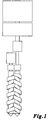
- a kinematic mechanism relating to a twin-screw extrusion device is diagrammatically shown which comprises first and second counter-rotating screws which are connected by respective movement-transmitting gears to a motor drive optionally provided with a reduction motor.
- thrust bearings disposed axially offset relative to each other are provided.
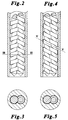
- FIGs. 4 and 5 Shown in Figs. 4 and 5 is, instead, a diagram relating to a twin-screw extrusion device provided with counter-rotating screws.
- screws are coaxially housed within two cylindrical cavities or bores formed in the housing.
- twin-screw extrusion devices briefly described above have greatly higher production capacities than those of the single-screw extrusion devices, power being the same, and in addition they succeed in obtaining products having a good homogeneity degree even when starting from different base materials.
- twin-screw extrusion devices succeed in offering an important rolling work of the thermoplastic material, thereby ensuring an efficient dispersion of the different materials into each other.
- twin-screw extrusion devices have an operating behaviour which can be partly comparable to that of two rolls in a calender and are therefore preferred, when two or more products are to be made homogeneous.
- twin-screw devices are surely the most preferred advance devices in most applications presently on the market.
- Twin-screw systems however are problematic as regards costs and poor flexibility of same. Actually, in case of breaking of one component, the whole kinematic mechanism may become damaged. As a matter of fact, it is to note that in twin-screw systems, motor drive, transmission gears and screws form a unitary set necessarily operating mechanically.
- Feeding systems for extrusion devices of the twin-screw type have proved to be susceptible of further improvements from this very point of view. It is in fact to note that the surface actually carrying out the material rolling and therefore homogenization, is preset and not adjustable, in that the advance screws, due to their own nature, have a helix on their outer surface which is exactly intended for defining the advance system. Therefore, no true surfaces of cylindrical extension are present in which the material may undergo a rolling operation capable of adjustment depending on progress.
- twin-screw devices are in any case limited. Actually, due to the presence of interpenetrating helices, the two screws are prevented from being set in rotation at differentiated angular speeds. Sometimes this limitation can be very important in that, since the materials to be mixed together or blended may be varied, suitable adjustment of the rolling phenomena may be advantageous. For doing so however, in traditional twin-screw devices, replacement of the whole driving set (screw, transmission gears) would be necessary each time feeding and related mixing of materials having differentiated features and dispersion qualities is to be carried out.
- a further limitation of traditional twin-screw devices is their substantially incapability to operate at low flow rates per hour. Therefore, when twin-screw systems are to be applied to extrusion devices of reduced hour production, reduction of the diameter of each screw is needed in order to lower the flow rate of the whole advance device.
- hydraulic thrust systems or bearings of reduced radial bulkiness and exclusively planned for this specific application could be employed.
- Yet another object of the invention is to provide an extrusion device in which the advance system is such accomplished as to enable employment of screws or shafts of very reduced diameter, without on the other hand requiring the use of expensive thrust bearings or systems expressly made for this application, employment of traditional thrust systems of relatively high radial bulkiness being on the contrary allowed.
- an extrusion device in accordance with the present invention has been generally identified by reference numeral 1.
- the device 1 comprises a feed station 2 for feeding at least one predetermined material to be extruded.
- the feed station may consist of one or more hoppers 2a, depending on whether one material or several materials are wished to be worked, which materials will have to be conveniently blended during working so as to form a homogeneous dispersion, as better clarified in the following.
- hoppers 2a depending on whether one material or several materials are wished to be worked, which materials will have to be conveniently blended during working so as to form a homogeneous dispersion, as better clarified in the following.
- advance means 3 comprising a housing or cylinder 4 rotatably holding, at the inside thereof, at least one first and, in the case of twin-screw extrusion devices, also one second shaft, 5 and 6 respectively, which are positioned in mutual side-by-side relationship.
- the hopper or hoppers 2a forming the feed station are usually employed at one end of, or along the housing or cylinder.
- outlet orifice generally consisting of an extrusion head 7 which is conventionally provided with an extruder arranged to form the material to be extruded according to desired profiles.
- first and optionally the second shaft advantageously have at least one operating length 8 extending within the housing 4 and having smooth surfaces.
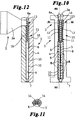
- the operating length as seen in particular in Figs. 7 and 10, has a longitudinal extension interesting a prevailing portion of the longitudinal extension of the housing.
- the housing at least at the operating length, is provided with active surfaces 9 facing the first and second shafts which are provided with shapings 10 adapted to define an axial movement of the material when the first and second (if present) shafts are set in rotation. More particularly, these shapings substantially define female threads having a helix of a longitudinally constant or variable pitch with a longitudinally constant or variable depth.
- the active surfaces 9 in the case of twin-screws provided within the housing are defined by mutually-facing cylindrical-surface portions intersecting at common generatrices (see in this connection Figs 8 and 11). It is to note that female threads can be either interpenetrating or not.
- shapings or threads formed in each of said cylindrical active surfaces 9 can have different conformations depending on whether the shafts are co-rotating (Fig. 7) or counter-rotating (Fig. 10).
- shapings or threads defined in the cylindrical active surfaces have helices which, section by section, have the same inclination and arrangement one in the extension of the other.
- helices of shapings or threads defined in each cylindrical active surface 9 have, section by section, an opposite inclination with the same or a different pitch, depending on requirements, and they are of the single-threaded or double-threaded type.
- the shaft or shafts perform a tangential-movement work of the material and substantially operate as calender cylinders, thereby ensuring an optimal blending, and consequently homogenization, if several mixtures to be dispersed into each other are used.
- housing 4 has an initial length 13 substantially disposed at the area in which said hoppers 2a operate and having active surfaces in which conveying channels 14 facing the first and second shafts 5 and 6 are preferably defined.
- the conveying channels are disposed at radially opposite positions and have a radial bulkiness becoming increasingly smaller in an axial direction, towards the extrusion head.
- the active surfaces of the housing immediately downstream of said initial length have an intermediate length 15 in which ridges 16 are defined which can have different shapes and sizes depending on the thermoplastic material and the sizes of the granular material to be extruded and extend axially and parallelly to each other. These ridges, in cooperation with the externally-threaded lengths 12 on said shafts 5 and 6 enable a constant and efficient feeding of the material to be obtained, even when said material is not yet completely fused, which exactly occurs at the inlet area of housing 4.
- a housing internally provided with shapings or female threads can be envisaged.
- the initial length 11 of the shaft or shafts can afford ridges, threads or in any case surface workings adapted to promote axial transportation of the material.
- first and second shafts have end portions 5a, 6a at a position opposite the extrusion head, which are torsionally connected to a first and second movement-transmitting elements 17 and 18 respectively, that diverge from each other, away from the extrusion head.
- both the first and second movement-transmitting elements are shafts as well, made divergent by resilient bending.
- first and a second thrust units 19 and 20 which units consist of bearings of the traditional type, usually available on the market and having a standard radial bulkiness, without hydraulic thrust units or bearings of reduced radial bulkiness expressly planned for this exclusive application being required.
- the extrusion device is comprised of a first and a second drive members 21 and 23 independent of each other and connected in a tensional manner to the first and second shafts respectively, so as to set said shafts in rotation at either differentiated or synchronized angular speeds, thereby ensuring the maximum operating flexibility of the whole device.
- the invention achieves important advantages.
- the device in question substantially achieves all the above listed aims.
- device 1 due to the smooth surface of the first and second (if present) shafts 5 and 6, at least over one prevailing portion 8 thereof, ensures a rolling degree, and consequently homogenization degree, of the employed material never achieved until now.
- the two shafts can be set in rotation at variable independent speeds, without any rotation synchronism being needed to be respected.
- This aspect is particularly advantageous when the device 1 is made in such a manner that it can operate to a reduced flow rate because, practically, the behaviour of much bigger apparatuses can be simulated, said device therefore operating at very reduced flow rates while simulating a greater flow rate, which will give rise to an important saving in terms of costs.
- each of the shafts forming the device is controlled by a motor of its own, protection against possible breakages due to torsional stresses of the shafts can be obtained by adopting breakage-resistant couplings, frictions or torque restrictors independently active on each of said shafts.
- the device in accordance with the invention equipped either with one, two or more shafts can be provided with degassing areas known per se, comparable to those already employed in conventional extrusion devices.
Landscapes
- Engineering & Computer Science (AREA)
- Mechanical Engineering (AREA)
- Extrusion Moulding Of Plastics Or The Like (AREA)
- Formation And Processing Of Food Products (AREA)
- Seal Device For Vehicle (AREA)
Priority Applications (4)
| Application Number | Priority Date | Filing Date | Title |
|---|---|---|---|
| AT97830113T ATE228426T1 (de) | 1997-03-12 | 1997-03-12 | Extrusionsvorrichtung |
| ES97830113T ES2187745T3 (es) | 1997-03-12 | 1997-03-12 | Dispositivo de extrusion. |
| DE69717417T DE69717417T2 (de) | 1997-03-12 | 1997-03-12 | Extrusionsvorrichtung |
| EP97830113A EP0865896B1 (de) | 1997-03-12 | 1997-03-12 | Extrusionsvorrichtung |
Applications Claiming Priority (1)
| Application Number | Priority Date | Filing Date | Title |
|---|---|---|---|
| EP97830113A EP0865896B1 (de) | 1997-03-12 | 1997-03-12 | Extrusionsvorrichtung |
Publications (2)
| Publication Number | Publication Date |
|---|---|
| EP0865896A1 true EP0865896A1 (de) | 1998-09-23 |
| EP0865896B1 EP0865896B1 (de) | 2002-11-27 |
Family
ID=8230596
Family Applications (1)
| Application Number | Title | Priority Date | Filing Date |
|---|---|---|---|
| EP97830113A Expired - Lifetime EP0865896B1 (de) | 1997-03-12 | 1997-03-12 | Extrusionsvorrichtung |
Country Status (4)
| Country | Link |
|---|---|
| EP (1) | EP0865896B1 (de) |
| AT (1) | ATE228426T1 (de) |
| DE (1) | DE69717417T2 (de) |
| ES (1) | ES2187745T3 (de) |
Cited By (3)
| Publication number | Priority date | Publication date | Assignee | Title |
|---|---|---|---|---|
| DE19856534A1 (de) * | 1998-12-08 | 2000-06-15 | Flender A F & Co | Getriebe für einen Doppelschneckenextruder |
| WO2003051526A1 (en) * | 2001-12-14 | 2003-06-26 | Mydata Automation Ab | Viscous medium feeder |
| EP1543930A3 (de) * | 2003-12-19 | 2005-07-13 | ThyssenKrupp Elastomertechnik GmbH | Vorrichtung zum Verarbeiten von Gummi |
Families Citing this family (2)
| Publication number | Priority date | Publication date | Assignee | Title |
|---|---|---|---|---|
| DE10354172A1 (de) * | 2003-11-19 | 2005-06-23 | Entex Rust & Mitschke Gmbh | Extruder |
| DE102005061936A1 (de) * | 2005-12-23 | 2007-06-28 | Cincinnati Extrusion Gmbh | Getriebe für Mehrschneckenextruder |
Citations (6)
| Publication number | Priority date | Publication date | Assignee | Title |
|---|---|---|---|---|
| US2693348A (en) * | 1953-07-30 | 1954-11-02 | Joseph Eck & Sohne | Continuously operating screw press for plastic compositions |
| DE1778369A1 (de) * | 1968-04-24 | 1971-07-29 | Franco Prandi | Antriebsvorrichtung fuer Strangpressen mit einer Mehrzahl von Schnecken zur Verarbeitung von plastischen Massen |
| US3850415A (en) * | 1972-03-25 | 1974-11-26 | G Hansen | Screw extruder for synthetic plastics material |
| DE2649045A1 (de) * | 1976-10-28 | 1978-05-03 | Gerhard Prof Dr Ing Schenkel | Einwellen-mehrstoff-extruder mit schneckengaengen |
| US4491417A (en) * | 1983-04-29 | 1985-01-01 | Usm Corporation | Devolatilizing mixing extruder |
| EP0658414A1 (de) * | 1993-12-17 | 1995-06-21 | The Gates Rubber Company | Drehmonatverteilungsgetriebe für Schneckenextruder |
-
1997
- 1997-03-12 AT AT97830113T patent/ATE228426T1/de active
- 1997-03-12 EP EP97830113A patent/EP0865896B1/de not_active Expired - Lifetime
- 1997-03-12 ES ES97830113T patent/ES2187745T3/es not_active Expired - Lifetime
- 1997-03-12 DE DE69717417T patent/DE69717417T2/de not_active Expired - Lifetime
Patent Citations (6)
| Publication number | Priority date | Publication date | Assignee | Title |
|---|---|---|---|---|
| US2693348A (en) * | 1953-07-30 | 1954-11-02 | Joseph Eck & Sohne | Continuously operating screw press for plastic compositions |
| DE1778369A1 (de) * | 1968-04-24 | 1971-07-29 | Franco Prandi | Antriebsvorrichtung fuer Strangpressen mit einer Mehrzahl von Schnecken zur Verarbeitung von plastischen Massen |
| US3850415A (en) * | 1972-03-25 | 1974-11-26 | G Hansen | Screw extruder for synthetic plastics material |
| DE2649045A1 (de) * | 1976-10-28 | 1978-05-03 | Gerhard Prof Dr Ing Schenkel | Einwellen-mehrstoff-extruder mit schneckengaengen |
| US4491417A (en) * | 1983-04-29 | 1985-01-01 | Usm Corporation | Devolatilizing mixing extruder |
| EP0658414A1 (de) * | 1993-12-17 | 1995-06-21 | The Gates Rubber Company | Drehmonatverteilungsgetriebe für Schneckenextruder |
Cited By (4)
| Publication number | Priority date | Publication date | Assignee | Title |
|---|---|---|---|---|
| DE19856534A1 (de) * | 1998-12-08 | 2000-06-15 | Flender A F & Co | Getriebe für einen Doppelschneckenextruder |
| WO2003051526A1 (en) * | 2001-12-14 | 2003-06-26 | Mydata Automation Ab | Viscous medium feeder |
| US7648052B2 (en) | 2001-12-14 | 2010-01-19 | Mydata Automation Ab | Viscous medium feeder |
| EP1543930A3 (de) * | 2003-12-19 | 2005-07-13 | ThyssenKrupp Elastomertechnik GmbH | Vorrichtung zum Verarbeiten von Gummi |
Also Published As
| Publication number | Publication date |
|---|---|
| EP0865896B1 (de) | 2002-11-27 |
| DE69717417T2 (de) | 2003-10-02 |
| ATE228426T1 (de) | 2002-12-15 |
| ES2187745T3 (es) | 2003-06-16 |
| DE69717417D1 (de) | 2003-01-09 |
Similar Documents
| Publication | Publication Date | Title |
|---|---|---|
| US6170975B1 (en) | Multi-shaft extruder kneading discs, kneading disc blocks and extruder | |
| US20050041521A1 (en) | Screw-type extruding machine comprising mixing and kneading disks | |
| US5244373A (en) | Extruder for poorly miscible extrudates | |
| RU2145281C1 (ru) | Многошнековые экструдеры-смесители с модульными смесительными элементами | |
| CN1052184C (zh) | 用于可增塑混合料的多螺杆连续混合机 | |
| CA1213115A (en) | Controlled shear cold-feed mixture extruder | |
| JPH03175013A (ja) | 再成形可能な自立性薄肉パネルの製造法 | |
| US4749279A (en) | Modular mixing apparatus for extruded material including rotary for processing modules having variable speed independent drive means | |
| US20050084559A1 (en) | Extruder | |
| EP0865896B1 (de) | Extrusionsvorrichtung | |
| US20050152214A1 (en) | Device for dispersing and melting flowable materials | |
| CN104742353A (zh) | 为将塑料熔体压过模具而建立压力的熔体泵 | |
| US4519712A (en) | Positive displacement pump assembly | |
| JPH01317534A (ja) | 混合機械およびそれを操作する方法 | |
| US5217303A (en) | Millstone extrusion apparatus | |
| US6116771A (en) | Multi-shaft extruder screw bushing and extruder | |
| JP2012504057A (ja) | 押出機および押出機の動作方法 | |
| CA2644925C (en) | Screw element | |
| CN100354104C (zh) | 一种高聚物共混物混炼成型的装备和方法 | |
| US7017732B2 (en) | Multiple extruder configuration | |
| JPS63278537A (ja) | 混合機及び押出し機 | |
| CN111497188B (zh) | 一种橡胶挤出机塑化装置 | |
| JP2726187B2 (ja) | ピントランスファー押出機 | |
| CN214645752U (zh) | 一种双螺杆挤出机用混炼转子 | |
| JPH0857849A (ja) | 一様ねじり及び逆ねじりウオーム要素を有する多重シヤフトウオーム機械 |
Legal Events
| Date | Code | Title | Description |
|---|---|---|---|
| PUAI | Public reference made under article 153(3) epc to a published international application that has entered the european phase |
Free format text: ORIGINAL CODE: 0009012 |
|
| AK | Designated contracting states |
Kind code of ref document: A1 Designated state(s): AT BE CH DE ES FI FR GB IT LI NL SE |
|
| AX | Request for extension of the european patent |
Free format text: AL;LT;LV;RO;SI |
|
| 17P | Request for examination filed |
Effective date: 19981012 |
|
| AKX | Designation fees paid |
Free format text: AT BE CH DE ES FI FR GB IT LI NL SE |
|
| RBV | Designated contracting states (corrected) |
Designated state(s): AT BE CH DE ES FI FR GB IT LI NL SE |
|
| 17Q | First examination report despatched |
Effective date: 20010615 |
|
| GRAH | Despatch of communication of intention to grant a patent |
Free format text: ORIGINAL CODE: EPIDOS IGRA |
|
| GRAH | Despatch of communication of intention to grant a patent |
Free format text: ORIGINAL CODE: EPIDOS IGRA |
|
| GRAA | (expected) grant |
Free format text: ORIGINAL CODE: 0009210 |
|
| AK | Designated contracting states |
Kind code of ref document: B1 Designated state(s): AT BE CH DE ES FI FR GB IT LI NL SE |
|
| PG25 | Lapsed in a contracting state [announced via postgrant information from national office to epo] |
Ref country code: NL Free format text: LAPSE BECAUSE OF FAILURE TO SUBMIT A TRANSLATION OF THE DESCRIPTION OR TO PAY THE FEE WITHIN THE PRESCRIBED TIME-LIMIT Effective date: 20021127 Ref country code: FI Free format text: LAPSE BECAUSE OF FAILURE TO SUBMIT A TRANSLATION OF THE DESCRIPTION OR TO PAY THE FEE WITHIN THE PRESCRIBED TIME-LIMIT Effective date: 20021127 Ref country code: BE Free format text: LAPSE BECAUSE OF FAILURE TO SUBMIT A TRANSLATION OF THE DESCRIPTION OR TO PAY THE FEE WITHIN THE PRESCRIBED TIME-LIMIT Effective date: 20021127 |
|
| REF | Corresponds to: |
Ref document number: 228426 Country of ref document: AT Date of ref document: 20021215 Kind code of ref document: T |
|
| REG | Reference to a national code |
Ref country code: GB Ref legal event code: FG4D |
|
| REG | Reference to a national code |
Ref country code: CH Ref legal event code: EP |
|
| REF | Corresponds to: |
Ref document number: 69717417 Country of ref document: DE Date of ref document: 20030109 |
|
| PG25 | Lapsed in a contracting state [announced via postgrant information from national office to epo] |
Ref country code: SE Free format text: LAPSE BECAUSE OF FAILURE TO SUBMIT A TRANSLATION OF THE DESCRIPTION OR TO PAY THE FEE WITHIN THE PRESCRIBED TIME-LIMIT Effective date: 20030227 |
|
| REG | Reference to a national code |
Ref country code: CH Ref legal event code: NV Representative=s name: ISLER & PEDRAZZINI AG |
|
| NLV1 | Nl: lapsed or annulled due to failure to fulfill the requirements of art. 29p and 29m of the patents act | ||
| REG | Reference to a national code |
Ref country code: ES Ref legal event code: FG2A Ref document number: 2187745 Country of ref document: ES Kind code of ref document: T3 |
|
| ET | Fr: translation filed | ||
| PLBE | No opposition filed within time limit |
Free format text: ORIGINAL CODE: 0009261 |
|
| STAA | Information on the status of an ep patent application or granted ep patent |
Free format text: STATUS: NO OPPOSITION FILED WITHIN TIME LIMIT |
|
| 26N | No opposition filed |
Effective date: 20030828 |
|
| REG | Reference to a national code |
Ref country code: CH Ref legal event code: PCAR Free format text: ISLER & PEDRAZZINI AG;POSTFACH 1772;8027 ZUERICH (CH) |
|
| REG | Reference to a national code |
Ref country code: FR Ref legal event code: PLFP Year of fee payment: 20 |
|
| PGFP | Annual fee paid to national office [announced via postgrant information from national office to epo] |
Ref country code: CH Payment date: 20160324 Year of fee payment: 20 |
|
| PGFP | Annual fee paid to national office [announced via postgrant information from national office to epo] |
Ref country code: GB Payment date: 20160331 Year of fee payment: 20 Ref country code: AT Payment date: 20160329 Year of fee payment: 20 Ref country code: FR Payment date: 20160330 Year of fee payment: 20 |
|
| PGFP | Annual fee paid to national office [announced via postgrant information from national office to epo] |
Ref country code: DE Payment date: 20160531 Year of fee payment: 20 Ref country code: ES Payment date: 20160422 Year of fee payment: 20 |
|
| PGFP | Annual fee paid to national office [announced via postgrant information from national office to epo] |
Ref country code: IT Payment date: 20160324 Year of fee payment: 20 |
|
| REG | Reference to a national code |
Ref country code: DE Ref legal event code: R071 Ref document number: 69717417 Country of ref document: DE |
|
| REG | Reference to a national code |
Ref country code: CH Ref legal event code: PL |
|
| REG | Reference to a national code |
Ref country code: GB Ref legal event code: PE20 Expiry date: 20170311 |
|
| REG | Reference to a national code |
Ref country code: AT Ref legal event code: MK07 Ref document number: 228426 Country of ref document: AT Kind code of ref document: T Effective date: 20170312 |
|
| PG25 | Lapsed in a contracting state [announced via postgrant information from national office to epo] |
Ref country code: GB Free format text: LAPSE BECAUSE OF EXPIRATION OF PROTECTION Effective date: 20170311 |
|
| REG | Reference to a national code |
Ref country code: ES Ref legal event code: FD2A Effective date: 20170626 |
|
| PG25 | Lapsed in a contracting state [announced via postgrant information from national office to epo] |
Ref country code: ES Free format text: LAPSE BECAUSE OF EXPIRATION OF PROTECTION Effective date: 20170313 |