EP0867183B1 - Derives arylpiperidinol et arylpiperidine et medicaments les contenant - Google Patents
Derives arylpiperidinol et arylpiperidine et medicaments les contenant Download PDFInfo
- Publication number
- EP0867183B1 EP0867183B1 EP97930865A EP97930865A EP0867183B1 EP 0867183 B1 EP0867183 B1 EP 0867183B1 EP 97930865 A EP97930865 A EP 97930865A EP 97930865 A EP97930865 A EP 97930865A EP 0867183 B1 EP0867183 B1 EP 0867183B1
- Authority
- EP
- European Patent Office
- Prior art keywords
- group
- optionally substituted
- halogen atom
- hydroxyl
- hydroxyl group
- Prior art date
- Legal status (The legal status is an assumption and is not a legal conclusion. Google has not performed a legal analysis and makes no representation as to the accuracy of the status listed.)
- Expired - Lifetime
Links
- 239000003814 drug Substances 0.000 title claims description 5
- 229940079593 drug Drugs 0.000 title description 2
- 125000000217 alkyl group Chemical group 0.000 claims abstract description 74
- 125000003545 alkoxy group Chemical group 0.000 claims abstract description 65
- 125000001997 phenyl group Chemical group [H]C1=C([H])C([H])=C(*)C([H])=C1[H] 0.000 claims abstract description 28
- 125000004450 alkenylene group Chemical group 0.000 claims abstract description 23
- 125000002993 cycloalkylene group Chemical group 0.000 claims abstract description 22
- 125000000951 phenoxy group Chemical group [H]C1=C([H])C([H])=C(O*)C([H])=C1[H] 0.000 claims abstract description 21
- 208000024891 symptom Diseases 0.000 claims abstract description 16
- 125000003236 benzoyl group Chemical group [H]C1=C([H])C([H])=C(C([H])=C1[H])C(*)=O 0.000 claims abstract description 14
- 239000008194 pharmaceutical composition Substances 0.000 claims abstract description 13
- 206010010904 Convulsion Diseases 0.000 claims abstract description 10
- 208000023589 ischemic disease Diseases 0.000 claims abstract description 10
- 208000019695 Migraine disease Diseases 0.000 claims abstract description 6
- 206010015037 epilepsy Diseases 0.000 claims abstract description 6
- 206010027599 migraine Diseases 0.000 claims abstract description 6
- 150000001875 compounds Chemical class 0.000 claims description 213
- 125000005843 halogen group Chemical group 0.000 claims description 99
- 125000002887 hydroxy group Chemical group [H]O* 0.000 claims description 90
- 125000001424 substituent group Chemical group 0.000 claims description 33
- 125000004435 hydrogen atom Chemical group [H]* 0.000 claims description 27
- -1 dimethylene group Chemical group 0.000 claims description 18
- 125000001570 methylene group Chemical group [H]C([H])([*:1])[*:2] 0.000 claims description 16
- 125000001495 ethyl group Chemical group [H]C([H])([H])C([H])([H])* 0.000 claims description 15
- 125000002496 methyl group Chemical group [H]C([H])([H])* 0.000 claims description 15
- 125000004430 oxygen atom Chemical group O* 0.000 claims description 12
- 230000001964 calcium overload Effects 0.000 claims description 10
- 125000001449 isopropyl group Chemical group [H]C([H])([H])C([H])(*)C([H])([H])[H] 0.000 claims description 10
- 239000000203 mixture Substances 0.000 claims description 10
- 125000001436 propyl group Chemical group [H]C([*])([H])C([H])([H])C([H])([H])[H] 0.000 claims description 10
- 238000002360 preparation method Methods 0.000 claims description 7
- 150000003839 salts Chemical class 0.000 claims description 7
- 239000004615 ingredient Substances 0.000 claims description 6
- 125000003258 trimethylene group Chemical group [H]C([H])([*:2])C([H])([H])C([H])([H])[*:1] 0.000 claims description 6
- 125000003161 (C1-C6) alkylene group Chemical group 0.000 claims 10
- 125000006527 (C1-C5) alkyl group Chemical group 0.000 claims 4
- 125000004169 (C1-C6) alkyl group Chemical group 0.000 claims 1
- 239000003937 drug carrier Substances 0.000 claims 1
- 125000002947 alkylene group Chemical group 0.000 abstract description 25
- 229910052727 yttrium Inorganic materials 0.000 abstract description 5
- 229910052736 halogen Inorganic materials 0.000 abstract 2
- 150000002367 halogens Chemical class 0.000 abstract 2
- 125000000325 methylidene group Chemical group [H]C([H])=* 0.000 abstract 2
- 238000000034 method Methods 0.000 description 68
- 238000003786 synthesis reaction Methods 0.000 description 62
- 230000015572 biosynthetic process Effects 0.000 description 61
- OKKJLVBELUTLKV-UHFFFAOYSA-N Methanol Chemical compound OC OKKJLVBELUTLKV-UHFFFAOYSA-N 0.000 description 42
- RTZKZFJDLAIYFH-UHFFFAOYSA-N Diethyl ether Chemical compound CCOCC RTZKZFJDLAIYFH-UHFFFAOYSA-N 0.000 description 23
- YMWUJEATGCHHMB-UHFFFAOYSA-N Dichloromethane Chemical compound ClCCl YMWUJEATGCHHMB-UHFFFAOYSA-N 0.000 description 21
- 238000006243 chemical reaction Methods 0.000 description 19
- YXFVVABEGXRONW-UHFFFAOYSA-N Toluene Chemical compound CC1=CC=CC=C1 YXFVVABEGXRONW-UHFFFAOYSA-N 0.000 description 18
- HEDRZPFGACZZDS-UHFFFAOYSA-N Chloroform Chemical compound ClC(Cl)Cl HEDRZPFGACZZDS-UHFFFAOYSA-N 0.000 description 16
- UHOVQNZJYSORNB-UHFFFAOYSA-N Benzene Chemical compound C1=CC=CC=C1 UHOVQNZJYSORNB-UHFFFAOYSA-N 0.000 description 15
- WYURNTSHIVDZCO-UHFFFAOYSA-N Tetrahydrofuran Chemical compound C1CCOC1 WYURNTSHIVDZCO-UHFFFAOYSA-N 0.000 description 14
- IIHYMUPEJUBHRY-UHFFFAOYSA-N 4-[4-[(4-fluorophenyl)methyl]phenyl]piperidin-4-ol Chemical compound C=1C=C(CC=2C=CC(F)=CC=2)C=CC=1C1(O)CCNCC1 IIHYMUPEJUBHRY-UHFFFAOYSA-N 0.000 description 13
- QTBSBXVTEAMEQO-UHFFFAOYSA-N Acetic acid Chemical compound CC(O)=O QTBSBXVTEAMEQO-UHFFFAOYSA-N 0.000 description 12
- NQRYJNQNLNOLGT-UHFFFAOYSA-N Piperidine Chemical compound C1CCNCC1 NQRYJNQNLNOLGT-UHFFFAOYSA-N 0.000 description 12
- ZMANZCXQSJIPKH-UHFFFAOYSA-N Triethylamine Chemical compound CCN(CC)CC ZMANZCXQSJIPKH-UHFFFAOYSA-N 0.000 description 12
- 230000000694 effects Effects 0.000 description 12
- WKBOTKDWSSQWDR-UHFFFAOYSA-N Bromine atom Chemical group [Br] WKBOTKDWSSQWDR-UHFFFAOYSA-N 0.000 description 11
- 229910052801 chlorine Inorganic materials 0.000 description 11
- 125000001309 chloro group Chemical group Cl* 0.000 description 11
- 229910052731 fluorine Inorganic materials 0.000 description 10
- 125000001153 fluoro group Chemical group F* 0.000 description 10
- 239000000243 solution Substances 0.000 description 10
- WEVYAHXRMPXWCK-UHFFFAOYSA-N Acetonitrile Chemical compound CC#N WEVYAHXRMPXWCK-UHFFFAOYSA-N 0.000 description 9
- LFQSCWFLJHTTHZ-UHFFFAOYSA-N Ethanol Chemical compound CCO LFQSCWFLJHTTHZ-UHFFFAOYSA-N 0.000 description 9
- XEKOWRVHYACXOJ-UHFFFAOYSA-N Ethyl acetate Chemical compound CCOC(C)=O XEKOWRVHYACXOJ-UHFFFAOYSA-N 0.000 description 9
- KFZMGEQAYNKOFK-UHFFFAOYSA-N Isopropanol Chemical compound CC(C)O KFZMGEQAYNKOFK-UHFFFAOYSA-N 0.000 description 9
- LIGACIXOYTUXAW-UHFFFAOYSA-N phenacyl bromide Chemical compound BrCC(=O)C1=CC=CC=C1 LIGACIXOYTUXAW-UHFFFAOYSA-N 0.000 description 8
- 238000010898 silica gel chromatography Methods 0.000 description 8
- 239000002904 solvent Substances 0.000 description 8
- 125000001301 ethoxy group Chemical group [H]C([H])([H])C([H])([H])O* 0.000 description 7
- 125000000956 methoxy group Chemical group [H]C([H])([H])O* 0.000 description 7
- YLQBMQCUIZJEEH-UHFFFAOYSA-N tetrahydrofuran Natural products C=1C=COC=1 YLQBMQCUIZJEEH-UHFFFAOYSA-N 0.000 description 7
- UMRMIEMXLZEBGA-UHFFFAOYSA-N 1-benzyl-4-[4-[(4-fluorophenyl)methyl]phenyl]piperidin-4-ol Chemical compound C1CC(O)(C=2C=CC(CC=3C=CC(F)=CC=3)=CC=2)CCN1CC1=CC=CC=C1 UMRMIEMXLZEBGA-UHFFFAOYSA-N 0.000 description 6
- XTHFKEDIFFGKHM-UHFFFAOYSA-N Dimethoxyethane Chemical compound COCCOC XTHFKEDIFFGKHM-UHFFFAOYSA-N 0.000 description 6
- VEXZGXHMUGYJMC-UHFFFAOYSA-N Hydrochloric acid Chemical compound Cl VEXZGXHMUGYJMC-UHFFFAOYSA-N 0.000 description 6
- JGFZNNIVVJXRND-UHFFFAOYSA-N N,N-Diisopropylethylamine (DIPEA) Chemical compound CCN(C(C)C)C(C)C JGFZNNIVVJXRND-UHFFFAOYSA-N 0.000 description 6
- ZMXDDKWLCZADIW-UHFFFAOYSA-N N,N-Dimethylformamide Chemical compound CN(C)C=O ZMXDDKWLCZADIW-UHFFFAOYSA-N 0.000 description 6
- JUJWROOIHBZHMG-UHFFFAOYSA-N Pyridine Chemical compound C1=CC=NC=C1 JUJWROOIHBZHMG-UHFFFAOYSA-N 0.000 description 6
- 238000007796 conventional method Methods 0.000 description 6
- 208000037265 diseases, disorders, signs and symptoms Diseases 0.000 description 6
- 208000035475 disorder Diseases 0.000 description 6
- 210000000056 organ Anatomy 0.000 description 6
- FVAUCKIRQBBSSJ-UHFFFAOYSA-M sodium iodide Chemical compound [Na+].[I-] FVAUCKIRQBBSSJ-UHFFFAOYSA-M 0.000 description 6
- 238000001356 surgical procedure Methods 0.000 description 6
- XLYOFNOQVPJJNP-UHFFFAOYSA-N water Substances O XLYOFNOQVPJJNP-UHFFFAOYSA-N 0.000 description 6
- FQYUMYWMJTYZTK-SECBINFHSA-N (2s)-2-(phenoxymethyl)oxirane Chemical compound C([C@H]1OC1)OC1=CC=CC=C1 FQYUMYWMJTYZTK-SECBINFHSA-N 0.000 description 5
- QYDBZVRKADDLFQ-UWVGGRQHSA-N [(1r,2r)-2-(bromomethyl)cyclopropyl]benzene Chemical compound BrC[C@@H]1C[C@H]1C1=CC=CC=C1 QYDBZVRKADDLFQ-UWVGGRQHSA-N 0.000 description 5
- 230000002401 inhibitory effect Effects 0.000 description 5
- 125000003944 tolyl group Chemical group 0.000 description 5
- 125000002023 trifluoromethyl group Chemical group FC(F)(F)* 0.000 description 5
- FQYUMYWMJTYZTK-VIFPVBQESA-N (2r)-2-(phenoxymethyl)oxirane Chemical compound C([C@@H]1OC1)OC1=CC=CC=C1 FQYUMYWMJTYZTK-VIFPVBQESA-N 0.000 description 4
- FMQPTEFSATTZFW-UHFFFAOYSA-N 2-bromo-n-(2,6-dimethylphenyl)acetamide Chemical compound CC1=CC=CC(C)=C1NC(=O)CBr FMQPTEFSATTZFW-UHFFFAOYSA-N 0.000 description 4
- NLXLAEXVIDQMFP-UHFFFAOYSA-N Ammonia chloride Chemical compound [NH4+].[Cl-] NLXLAEXVIDQMFP-UHFFFAOYSA-N 0.000 description 4
- CPELXLSAUQHCOX-UHFFFAOYSA-M Bromide Chemical compound [Br-] CPELXLSAUQHCOX-UHFFFAOYSA-M 0.000 description 4
- 0 CCC=CC(*c1ccc(C2(CCN(C[N+](NC(C)=O)[O-])CC2)O)cc1)=C*C Chemical compound CCC=CC(*c1ccc(C2(CCN(C[N+](NC(C)=O)[O-])CC2)O)cc1)=C*C 0.000 description 4
- IAZDPXIOMUYVGZ-UHFFFAOYSA-N Dimethylsulphoxide Chemical compound CS(C)=O IAZDPXIOMUYVGZ-UHFFFAOYSA-N 0.000 description 4
- AFVFQIVMOAPDHO-UHFFFAOYSA-N Methanesulfonic acid Chemical compound CS(O)(=O)=O AFVFQIVMOAPDHO-UHFFFAOYSA-N 0.000 description 4
- CDBYLPFSWZWCQE-UHFFFAOYSA-L Sodium Carbonate Chemical compound [Na+].[Na+].[O-]C([O-])=O CDBYLPFSWZWCQE-UHFFFAOYSA-L 0.000 description 4
- UIIMBOGNXHQVGW-UHFFFAOYSA-M Sodium bicarbonate Chemical compound [Na+].OC([O-])=O UIIMBOGNXHQVGW-UHFFFAOYSA-M 0.000 description 4
- QAOWNCQODCNURD-UHFFFAOYSA-N Sulfuric acid Chemical compound OS(O)(=O)=O QAOWNCQODCNURD-UHFFFAOYSA-N 0.000 description 4
- DTQVDTLACAAQTR-UHFFFAOYSA-N Trifluoroacetic acid Chemical compound OC(=O)C(F)(F)F DTQVDTLACAAQTR-UHFFFAOYSA-N 0.000 description 4
- KAKZBPTYRLMSJV-UHFFFAOYSA-N butadiene group Chemical group C=CC=C KAKZBPTYRLMSJV-UHFFFAOYSA-N 0.000 description 4
- XJHCXCQVJFPJIK-UHFFFAOYSA-M caesium fluoride Chemical compound [F-].[Cs+] XJHCXCQVJFPJIK-UHFFFAOYSA-M 0.000 description 4
- 229910001424 calcium ion Inorganic materials 0.000 description 4
- 208000026106 cerebrovascular disease Diseases 0.000 description 4
- 239000012528 membrane Substances 0.000 description 4
- BWHMMNNQKKPAPP-UHFFFAOYSA-L potassium carbonate Chemical compound [K+].[K+].[O-]C([O-])=O BWHMMNNQKKPAPP-UHFFFAOYSA-L 0.000 description 4
- 239000011541 reaction mixture Substances 0.000 description 4
- 230000001629 suppression Effects 0.000 description 4
- VZGDMQKNWNREIO-UHFFFAOYSA-N tetrachloromethane Chemical compound ClC(Cl)(Cl)Cl VZGDMQKNWNREIO-UHFFFAOYSA-N 0.000 description 4
- 125000000383 tetramethylene group Chemical group [H]C([H])([*:1])C([H])([H])C([H])([H])C([H])([H])[*:2] 0.000 description 4
- SJZKULRDWHPHGG-UHFFFAOYSA-N 1-benzylpiperidin-4-one Chemical compound C1CC(=O)CCN1CC1=CC=CC=C1 SJZKULRDWHPHGG-UHFFFAOYSA-N 0.000 description 3
- PKJBWOWQJHHAHG-UHFFFAOYSA-N 1-bromo-4-phenylbenzene Chemical group C1=CC(Br)=CC=C1C1=CC=CC=C1 PKJBWOWQJHHAHG-UHFFFAOYSA-N 0.000 description 3
- VTDIWMPYBAVEDY-UHFFFAOYSA-N 1-propylpiperidine Chemical compound CCCN1CCCCC1 VTDIWMPYBAVEDY-UHFFFAOYSA-N 0.000 description 3
- SZHXKMNTGHSOAH-UHFFFAOYSA-N 2-[4-[4-[(4-fluorophenyl)methyl]phenyl]-4-hydroxypiperidin-1-yl]-1-phenylethanone Chemical compound C1CC(O)(C=2C=CC(CC=3C=CC(F)=CC=3)=CC=2)CCN1CC(=O)C1=CC=CC=C1 SZHXKMNTGHSOAH-UHFFFAOYSA-N 0.000 description 3
- MIXIFBJVQJETDY-RRPNLBNLSA-N 2-[4-[4-[(4-fluorophenyl)methyl]phenyl]-4-hydroxypiperidin-1-yl]-n-[(1r,2s)-2-phenylcyclopropyl]acetamide Chemical compound C1([C@@H]2C[C@H]2NC(=O)CN2CCC(CC2)(O)C=2C=CC(CC=3C=CC(F)=CC=3)=CC=2)=CC=CC=C1 MIXIFBJVQJETDY-RRPNLBNLSA-N 0.000 description 3
- DAEUUSZFVYITTQ-VHSXEESVSA-N 2-bromo-n-[(1r,2s)-2-phenylcyclopropyl]acetamide Chemical compound BrCC(=O)N[C@@H]1C[C@H]1C1=CC=CC=C1 DAEUUSZFVYITTQ-VHSXEESVSA-N 0.000 description 3
- SDBFIVHURCUVRE-QPJJXVBHSA-N 4-[4-[(4-fluorophenyl)methyl]phenyl]-1-[(e)-3-phenylprop-2-enyl]piperidin-4-ol Chemical compound C1CC(O)(C=2C=CC(CC=3C=CC(F)=CC=3)=CC=2)CCN1C\C=C\C1=CC=CC=C1 SDBFIVHURCUVRE-QPJJXVBHSA-N 0.000 description 3
- FWQULWDCONKOND-IGKIAQTJSA-N 4-[4-[(4-fluorophenyl)methyl]phenyl]-1-[[(1r,2r)-2-phenylcyclopropyl]methyl]piperidin-4-ol Chemical compound C1([C@@H]2C[C@H]2CN2CCC(CC2)(O)C=2C=CC(CC=3C=CC(F)=CC=3)=CC=2)=CC=CC=C1 FWQULWDCONKOND-IGKIAQTJSA-N 0.000 description 3
- HTRNHWBOBYFTQF-UHFFFAOYSA-N 4-bromo-2-fluoro-1-phenylbenzene Chemical group FC1=CC(Br)=CC=C1C1=CC=CC=C1 HTRNHWBOBYFTQF-UHFFFAOYSA-N 0.000 description 3
- CSCPPACGZOOCGX-UHFFFAOYSA-N Acetone Chemical compound CC(C)=O CSCPPACGZOOCGX-UHFFFAOYSA-N 0.000 description 3
- 108091006146 Channels Proteins 0.000 description 3
- LYCAIKOWRPUZTN-UHFFFAOYSA-N Ethylene glycol Chemical compound OCCO LYCAIKOWRPUZTN-UHFFFAOYSA-N 0.000 description 3
- OFOBLEOULBTSOW-UHFFFAOYSA-N Malonic acid Chemical compound OC(=O)CC(O)=O OFOBLEOULBTSOW-UHFFFAOYSA-N 0.000 description 3
- MUBZPKHOEPUJKR-UHFFFAOYSA-N Oxalic acid Chemical compound OC(=O)C(O)=O MUBZPKHOEPUJKR-UHFFFAOYSA-N 0.000 description 3
- 206010038669 Respiratory arrest Diseases 0.000 description 3
- HEMHJVSKTPXQMS-UHFFFAOYSA-M Sodium hydroxide Chemical compound [OH-].[Na+] HEMHJVSKTPXQMS-UHFFFAOYSA-M 0.000 description 3
- DKGAVHZHDRPRBM-UHFFFAOYSA-N Tert-Butanol Chemical compound CC(C)(C)O DKGAVHZHDRPRBM-UHFFFAOYSA-N 0.000 description 3
- 239000007864 aqueous solution Substances 0.000 description 3
- 210000004556 brain Anatomy 0.000 description 3
- KRKNYBCHXYNGOX-UHFFFAOYSA-N citric acid Chemical compound OC(=O)CC(O)(C(O)=O)CC(O)=O KRKNYBCHXYNGOX-UHFFFAOYSA-N 0.000 description 3
- 238000004440 column chromatography Methods 0.000 description 3
- 238000001816 cooling Methods 0.000 description 3
- 231100000433 cytotoxic Toxicity 0.000 description 3
- 230000001472 cytotoxic effect Effects 0.000 description 3
- 229960004132 diethyl ether Drugs 0.000 description 3
- 238000002347 injection Methods 0.000 description 3
- 239000007924 injection Substances 0.000 description 3
- 150000007522 mineralic acids Chemical class 0.000 description 3
- VLKZOEOYAKHREP-UHFFFAOYSA-N n-Hexane Chemical compound CCCCCC VLKZOEOYAKHREP-UHFFFAOYSA-N 0.000 description 3
- 150000007524 organic acids Chemical class 0.000 description 3
- 239000000546 pharmaceutical excipient Substances 0.000 description 3
- UMJSCPRVCHMLSP-UHFFFAOYSA-N pyridine Natural products COC1=CC=CN=C1 UMJSCPRVCHMLSP-UHFFFAOYSA-N 0.000 description 3
- 238000001953 recrystallisation Methods 0.000 description 3
- 230000000250 revascularization Effects 0.000 description 3
- ROUYFJUVMYHXFJ-UHFFFAOYSA-N tert-butyl 4-oxopiperidine-1-carboxylate Chemical compound CC(C)(C)OC(=O)N1CCC(=O)CC1 ROUYFJUVMYHXFJ-UHFFFAOYSA-N 0.000 description 3
- RYHBNJHYFVUHQT-UHFFFAOYSA-N 1,4-Dioxane Chemical compound C1COCCO1 RYHBNJHYFVUHQT-UHFFFAOYSA-N 0.000 description 2
- WDJKAQCAPHSOIO-UHFFFAOYSA-N 1-phenyl-3,6-dihydro-2h-pyridine Chemical compound C1C=CCCN1C1=CC=CC=C1 WDJKAQCAPHSOIO-UHFFFAOYSA-N 0.000 description 2
- XQJAHBHCLXUGEP-UHFFFAOYSA-N 2-bromo-1-(4-methoxyphenyl)ethanone Chemical compound COC1=CC=C(C(=O)CBr)C=C1 XQJAHBHCLXUGEP-UHFFFAOYSA-N 0.000 description 2
- VQGHOUODWALEFC-UHFFFAOYSA-N 2-phenylpyridine Chemical compound C1=CC=CC=C1C1=CC=CC=N1 VQGHOUODWALEFC-UHFFFAOYSA-N 0.000 description 2
- RUROFEVDCUGKHD-UHFFFAOYSA-N 3-bromoprop-1-enylbenzene Chemical compound BrCC=CC1=CC=CC=C1 RUROFEVDCUGKHD-UHFFFAOYSA-N 0.000 description 2
- JDUYPUMQALQRCN-UHFFFAOYSA-N 4-bromophenyl phenyl ether Chemical compound C1=CC(Br)=CC=C1OC1=CC=CC=C1 JDUYPUMQALQRCN-UHFFFAOYSA-N 0.000 description 2
- YYROPELSRYBVMQ-UHFFFAOYSA-N 4-toluenesulfonyl chloride Chemical compound CC1=CC=C(S(Cl)(=O)=O)C=C1 YYROPELSRYBVMQ-UHFFFAOYSA-N 0.000 description 2
- DLFVBJFMPXGRIB-UHFFFAOYSA-N Acetamide Chemical compound CC(N)=O DLFVBJFMPXGRIB-UHFFFAOYSA-N 0.000 description 2
- 206010002388 Angina unstable Diseases 0.000 description 2
- 208000024255 Audiogenic seizures Diseases 0.000 description 2
- FERIUCNNQQJTOY-UHFFFAOYSA-N Butyric acid Chemical compound CCCC(O)=O FERIUCNNQQJTOY-UHFFFAOYSA-N 0.000 description 2
- 206010065559 Cerebral arteriosclerosis Diseases 0.000 description 2
- 206010008111 Cerebral haemorrhage Diseases 0.000 description 2
- 206010009346 Clonus Diseases 0.000 description 2
- VZCYOOQTPOCHFL-OWOJBTEDSA-N Fumaric acid Chemical compound OC(=O)\C=C\C(O)=O VZCYOOQTPOCHFL-OWOJBTEDSA-N 0.000 description 2
- 239000007818 Grignard reagent Substances 0.000 description 2
- 206010019196 Head injury Diseases 0.000 description 2
- 241000699670 Mus sp. Species 0.000 description 2
- MZRVEZGGRBJDDB-UHFFFAOYSA-N N-Butyllithium Chemical compound [Li]CCCC MZRVEZGGRBJDDB-UHFFFAOYSA-N 0.000 description 2
- GRYLNZFGIOXLOG-UHFFFAOYSA-N Nitric acid Chemical compound O[N+]([O-])=O GRYLNZFGIOXLOG-UHFFFAOYSA-N 0.000 description 2
- FQYUMYWMJTYZTK-UHFFFAOYSA-N Phenyl glycidyl ether Chemical compound C1OC1COC1=CC=CC=C1 FQYUMYWMJTYZTK-UHFFFAOYSA-N 0.000 description 2
- NBIIXXVUZAFLBC-UHFFFAOYSA-N Phosphoric acid Chemical compound OP(O)(O)=O NBIIXXVUZAFLBC-UHFFFAOYSA-N 0.000 description 2
- 201000001068 Prinzmetal angina Diseases 0.000 description 2
- 241000700157 Rattus norvegicus Species 0.000 description 2
- 206010063837 Reperfusion injury Diseases 0.000 description 2
- FAPWRFPIFSIZLT-UHFFFAOYSA-M Sodium chloride Chemical class [Na+].[Cl-] FAPWRFPIFSIZLT-UHFFFAOYSA-M 0.000 description 2
- 208000032851 Subarachnoid Hemorrhage Diseases 0.000 description 2
- 208000032109 Transient ischaemic attack Diseases 0.000 description 2
- 208000007814 Unstable Angina Diseases 0.000 description 2
- 125000003277 amino group Chemical group 0.000 description 2
- 235000019270 ammonium chloride Nutrition 0.000 description 2
- 206010003119 arrhythmia Diseases 0.000 description 2
- 230000006793 arrhythmia Effects 0.000 description 2
- WPYMKLBDIGXBTP-UHFFFAOYSA-N benzoic acid Chemical compound OC(=O)C1=CC=CC=C1 WPYMKLBDIGXBTP-UHFFFAOYSA-N 0.000 description 2
- 125000001797 benzyl group Chemical group [H]C1=C([H])C([H])=C(C([H])=C1[H])C([H])([H])* 0.000 description 2
- 230000017531 blood circulation Effects 0.000 description 2
- FJDQFPXHSGXQBY-UHFFFAOYSA-L caesium carbonate Chemical compound [Cs+].[Cs+].[O-]C([O-])=O FJDQFPXHSGXQBY-UHFFFAOYSA-L 0.000 description 2
- 229910000024 caesium carbonate Inorganic materials 0.000 description 2
- 239000002775 capsule Substances 0.000 description 2
- 210000000748 cardiovascular system Anatomy 0.000 description 2
- 210000004027 cell Anatomy 0.000 description 2
- 206010008118 cerebral infarction Diseases 0.000 description 2
- 239000003153 chemical reaction reagent Substances 0.000 description 2
- 230000006378 damage Effects 0.000 description 2
- 230000001419 dependent effect Effects 0.000 description 2
- XBDQKXXYIPTUBI-UHFFFAOYSA-N dimethylselenoniopropionate Natural products CCC(O)=O XBDQKXXYIPTUBI-UHFFFAOYSA-N 0.000 description 2
- 125000005678 ethenylene group Chemical group [H]C([*:1])=C([H])[*:2] 0.000 description 2
- 238000000605 extraction Methods 0.000 description 2
- 239000000706 filtrate Substances 0.000 description 2
- 239000005457 ice water Substances 0.000 description 2
- 150000007529 inorganic bases Chemical class 0.000 description 2
- 239000000543 intermediate Substances 0.000 description 2
- 201000004332 intermediate coronary syndrome Diseases 0.000 description 2
- 208000020658 intracerebral hemorrhage Diseases 0.000 description 2
- 201000005851 intracranial arteriosclerosis Diseases 0.000 description 2
- KWGKDLIKAYFUFQ-UHFFFAOYSA-M lithium chloride Chemical compound [Li+].[Cl-] KWGKDLIKAYFUFQ-UHFFFAOYSA-M 0.000 description 2
- 230000003211 malignant effect Effects 0.000 description 2
- UKVIEHSSVKSQBA-UHFFFAOYSA-N methane;palladium Chemical compound C.[Pd] UKVIEHSSVKSQBA-UHFFFAOYSA-N 0.000 description 2
- 229940098779 methanesulfonic acid Drugs 0.000 description 2
- BDAGIHXWWSANSR-UHFFFAOYSA-N methanoic acid Natural products OC=O BDAGIHXWWSANSR-UHFFFAOYSA-N 0.000 description 2
- 208000010125 myocardial infarction Diseases 0.000 description 2
- 208000031225 myocardial ischemia Diseases 0.000 description 2
- GBGWGRKABZZUDB-UHFFFAOYSA-N n-(2,6-dimethylphenyl)-2-[4-[4-[(4-fluorophenyl)methyl]phenyl]-4-hydroxypiperidin-1-yl]acetamide Chemical compound CC1=CC=CC(C)=C1NC(=O)CN1CCC(O)(C=2C=CC(CC=3C=CC(F)=CC=3)=CC=2)CC1 GBGWGRKABZZUDB-UHFFFAOYSA-N 0.000 description 2
- 229910017604 nitric acid Inorganic materials 0.000 description 2
- 150000007530 organic bases Chemical class 0.000 description 2
- NXJCBFBQEVOTOW-UHFFFAOYSA-L palladium(2+);dihydroxide Chemical compound O[Pd]O NXJCBFBQEVOTOW-UHFFFAOYSA-L 0.000 description 2
- XHXFXVLFKHQFAL-UHFFFAOYSA-N phosphoryl trichloride Chemical compound ClP(Cl)(Cl)=O XHXFXVLFKHQFAL-UHFFFAOYSA-N 0.000 description 2
- BASFCYQUMIYNBI-UHFFFAOYSA-N platinum Chemical compound [Pt] BASFCYQUMIYNBI-UHFFFAOYSA-N 0.000 description 2
- 229910000028 potassium bicarbonate Inorganic materials 0.000 description 2
- 235000015497 potassium bicarbonate Nutrition 0.000 description 2
- 239000011736 potassium bicarbonate Substances 0.000 description 2
- 229910000027 potassium carbonate Inorganic materials 0.000 description 2
- 235000011181 potassium carbonates Nutrition 0.000 description 2
- TYJJADVDDVDEDZ-UHFFFAOYSA-M potassium hydrogencarbonate Chemical compound [K+].OC([O-])=O TYJJADVDDVDEDZ-UHFFFAOYSA-M 0.000 description 2
- 229940086066 potassium hydrogencarbonate Drugs 0.000 description 2
- 238000000746 purification Methods 0.000 description 2
- 229920006395 saturated elastomer Polymers 0.000 description 2
- 229910000030 sodium bicarbonate Inorganic materials 0.000 description 2
- 235000017557 sodium bicarbonate Nutrition 0.000 description 2
- 229910000029 sodium carbonate Inorganic materials 0.000 description 2
- 235000009518 sodium iodide Nutrition 0.000 description 2
- 239000007858 starting material Substances 0.000 description 2
- 239000000126 substance Substances 0.000 description 2
- DPKBAXPHAYBPRL-UHFFFAOYSA-M tetrabutylazanium;iodide Chemical compound [I-].CCCC[N+](CCCC)(CCCC)CCCC DPKBAXPHAYBPRL-UHFFFAOYSA-M 0.000 description 2
- FYSNRJHAOHDILO-UHFFFAOYSA-N thionyl chloride Chemical compound ClS(Cl)=O FYSNRJHAOHDILO-UHFFFAOYSA-N 0.000 description 2
- JOXIMZWYDAKGHI-UHFFFAOYSA-N toluene-4-sulfonic acid Chemical compound CC1=CC=C(S(O)(=O)=O)C=C1 JOXIMZWYDAKGHI-UHFFFAOYSA-N 0.000 description 2
- 231100000419 toxicity Toxicity 0.000 description 2
- 230000001988 toxicity Effects 0.000 description 2
- VZCYOOQTPOCHFL-UHFFFAOYSA-N trans-butenedioic acid Natural products OC(=O)C=CC(O)=O VZCYOOQTPOCHFL-UHFFFAOYSA-N 0.000 description 2
- 201000010875 transient cerebral ischemia Diseases 0.000 description 2
- WJKHJLXJJJATHN-UHFFFAOYSA-N triflic anhydride Chemical compound FC(F)(F)S(=O)(=O)OS(=O)(=O)C(F)(F)F WJKHJLXJJJATHN-UHFFFAOYSA-N 0.000 description 2
- NQPDZGIKBAWPEJ-UHFFFAOYSA-N valeric acid Chemical compound CCCCC(O)=O NQPDZGIKBAWPEJ-UHFFFAOYSA-N 0.000 description 2
- VNDYJBBGRKZCSX-UHFFFAOYSA-L zinc bromide Chemical compound Br[Zn]Br VNDYJBBGRKZCSX-UHFFFAOYSA-L 0.000 description 2
- GSTSTIGWDCLDHZ-UHFFFAOYSA-N (2-bromo-1,1-diethoxyethyl)benzene Chemical compound CCOC(CBr)(OCC)C1=CC=CC=C1 GSTSTIGWDCLDHZ-UHFFFAOYSA-N 0.000 description 1
- XLUICHSZBNGJHF-UHFFFAOYSA-N (2-bromo-1-methoxyethyl)benzene Chemical compound COC(CBr)C1=CC=CC=C1 XLUICHSZBNGJHF-UHFFFAOYSA-N 0.000 description 1
- QNYBOILAKBSWFG-JTQLQIEISA-N (2r)-2-(phenylmethoxymethyl)oxirane Chemical compound C([C@@H]1OC1)OCC1=CC=CC=C1 QNYBOILAKBSWFG-JTQLQIEISA-N 0.000 description 1
- QNYBOILAKBSWFG-SNVBAGLBSA-N (2s)-2-(phenylmethoxymethyl)oxirane Chemical compound C([C@H]1OC1)OCC1=CC=CC=C1 QNYBOILAKBSWFG-SNVBAGLBSA-N 0.000 description 1
- YVCOJTATJWDGEU-IONNQARKSA-N (2s,3s)-2-methyl-3-phenyloxirane Chemical compound C[C@@H]1O[C@H]1C1=CC=CC=C1 YVCOJTATJWDGEU-IONNQARKSA-N 0.000 description 1
- YDZSYRFPGNMHHZ-UHFFFAOYSA-N (3-bromo-2-methylprop-1-enyl)benzene Chemical compound BrCC(C)=CC1=CC=CC=C1 YDZSYRFPGNMHHZ-UHFFFAOYSA-N 0.000 description 1
- BJEPYKJPYRNKOW-REOHCLBHSA-N (S)-malic acid Chemical compound OC(=O)[C@@H](O)CC(O)=O BJEPYKJPYRNKOW-REOHCLBHSA-N 0.000 description 1
- AWMVMTVKBNGEAK-MRVPVSSYSA-N (S)-styrene oxide Chemical compound C1O[C@H]1C1=CC=CC=C1 AWMVMTVKBNGEAK-MRVPVSSYSA-N 0.000 description 1
- JXSPKRUNMHMICQ-UHFFFAOYSA-N 1-(2-bromoethoxy)-4-fluorobenzene Chemical compound FC1=CC=C(OCCBr)C=C1 JXSPKRUNMHMICQ-UHFFFAOYSA-N 0.000 description 1
- RXJJOGDVEOECJZ-UHFFFAOYSA-N 1-(3-bromoprop-1-enyl)-2,3,4-trimethoxybenzene Chemical compound COC1=CC=C(C=CCBr)C(OC)=C1OC RXJJOGDVEOECJZ-UHFFFAOYSA-N 0.000 description 1
- XPEHBUDGRZOFBP-UHFFFAOYSA-N 1-(3-bromoprop-1-enyl)-4-fluorobenzene Chemical compound FC1=CC=C(C=CCBr)C=C1 XPEHBUDGRZOFBP-UHFFFAOYSA-N 0.000 description 1
- XXILDBMRKXAIDA-UHFFFAOYSA-N 1-(3-bromoprop-1-enyl)-4-methoxybenzene Chemical compound COC1=CC=C(C=CCBr)C=C1 XXILDBMRKXAIDA-UHFFFAOYSA-N 0.000 description 1
- SESKDKZVNDEQBM-UHFFFAOYSA-N 1-(4-bromobutoxy)-4-fluorobenzene Chemical compound FC1=CC=C(OCCCCBr)C=C1 SESKDKZVNDEQBM-UHFFFAOYSA-N 0.000 description 1
- TXVVVEUSVBLDED-UHFFFAOYSA-N 1-(bromomethyl)-2-(trifluoromethyl)benzene Chemical compound FC(F)(F)C1=CC=CC=C1CBr TXVVVEUSVBLDED-UHFFFAOYSA-N 0.000 description 1
- FFWQLZFIMNTUCZ-UHFFFAOYSA-N 1-(bromomethyl)-2-fluorobenzene Chemical compound FC1=CC=CC=C1CBr FFWQLZFIMNTUCZ-UHFFFAOYSA-N 0.000 description 1
- MYYYZNVAUZVXBO-UHFFFAOYSA-N 1-(bromomethyl)-3-(trifluoromethyl)benzene Chemical compound FC(F)(F)C1=CC=CC(CBr)=C1 MYYYZNVAUZVXBO-UHFFFAOYSA-N 0.000 description 1
- SCBZBMXPJYMXRC-UHFFFAOYSA-N 1-(bromomethyl)-3-fluorobenzene Chemical compound FC1=CC=CC(CBr)=C1 SCBZBMXPJYMXRC-UHFFFAOYSA-N 0.000 description 1
- IKSNDOVDVVPSMA-UHFFFAOYSA-N 1-(bromomethyl)-4-(trifluoromethyl)benzene Chemical compound FC(F)(F)C1=CC=C(CBr)C=C1 IKSNDOVDVVPSMA-UHFFFAOYSA-N 0.000 description 1
- NVNPLEPBDPJYRZ-UHFFFAOYSA-N 1-(bromomethyl)-4-fluorobenzene Chemical compound FC1=CC=C(CBr)C=C1 NVNPLEPBDPJYRZ-UHFFFAOYSA-N 0.000 description 1
- HEAQHTKDZPKODU-UHFFFAOYSA-N 1-(chloromethyl)-2,3,4-trimethoxybenzene Chemical compound COC1=CC=C(CCl)C(OC)=C1OC HEAQHTKDZPKODU-UHFFFAOYSA-N 0.000 description 1
- VGISFWWEOGVMED-UHFFFAOYSA-N 1-(chloromethyl)-3-methoxybenzene Chemical compound COC1=CC=CC(CCl)=C1 VGISFWWEOGVMED-UHFFFAOYSA-N 0.000 description 1
- MOHYOXXOKFQHDC-UHFFFAOYSA-N 1-(chloromethyl)-4-methoxybenzene Chemical compound COC1=CC=C(CCl)C=C1 MOHYOXXOKFQHDC-UHFFFAOYSA-N 0.000 description 1
- ALUMNZBTDKQKNP-UHFFFAOYSA-N 1-[(4-methoxyphenyl)methyl]piperidin-4-one Chemical compound C1=CC(OC)=CC=C1CN1CCC(=O)CC1 ALUMNZBTDKQKNP-UHFFFAOYSA-N 0.000 description 1
- NNFOVLFUGLWWCL-UHFFFAOYSA-N 1-acetylpiperidin-4-one Chemical compound CC(=O)N1CCC(=O)CC1 NNFOVLFUGLWWCL-UHFFFAOYSA-N 0.000 description 1
- DLCYFIIONMLNAJ-UHFFFAOYSA-N 1-benzyl-2-bromobenzene Chemical compound BrC1=CC=CC=C1CC1=CC=CC=C1 DLCYFIIONMLNAJ-UHFFFAOYSA-N 0.000 description 1
- KMBNQIVUWJLMIN-UHFFFAOYSA-N 1-benzyl-3-bromobenzene Chemical compound BrC1=CC=CC(CC=2C=CC=CC=2)=C1 KMBNQIVUWJLMIN-UHFFFAOYSA-N 0.000 description 1
- NNEOYCMCJMLRSD-UHFFFAOYSA-N 1-benzyl-4-bromobenzene Chemical compound C1=CC(Br)=CC=C1CC1=CC=CC=C1 NNEOYCMCJMLRSD-UHFFFAOYSA-N 0.000 description 1
- ADGMRCLDJLCOKF-UHFFFAOYSA-N 1-bromo-3-(4-fluorophenoxy)benzene Chemical compound C1=CC(F)=CC=C1OC1=CC=CC(Br)=C1 ADGMRCLDJLCOKF-UHFFFAOYSA-N 0.000 description 1
- YAWIAFUBXXPJMQ-UHFFFAOYSA-N 1-bromo-4-(4-bromophenoxy)benzene Chemical compound C1=CC(Br)=CC=C1OC1=CC=C(Br)C=C1 YAWIAFUBXXPJMQ-UHFFFAOYSA-N 0.000 description 1
- HQJQYILBCQPYBI-UHFFFAOYSA-N 1-bromo-4-(4-bromophenyl)benzene Chemical group C1=CC(Br)=CC=C1C1=CC=C(Br)C=C1 HQJQYILBCQPYBI-UHFFFAOYSA-N 0.000 description 1
- XFGPSHWWPIFPNL-UHFFFAOYSA-N 1-bromo-4-(4-fluorophenyl)benzene Chemical group C1=CC(F)=CC=C1C1=CC=C(Br)C=C1 XFGPSHWWPIFPNL-UHFFFAOYSA-N 0.000 description 1
- CMYZTJCWFRFRIW-UHFFFAOYSA-N 1-bromo-4-(4-methoxyphenyl)benzene Chemical group C1=CC(OC)=CC=C1C1=CC=C(Br)C=C1 CMYZTJCWFRFRIW-UHFFFAOYSA-N 0.000 description 1
- MYWLXURJCXISCT-UHFFFAOYSA-N 1-bromo-4-(4-methylphenyl)benzene Chemical group C1=CC(C)=CC=C1C1=CC=C(Br)C=C1 MYWLXURJCXISCT-UHFFFAOYSA-N 0.000 description 1
- KLTJNRREHHZLKL-UHFFFAOYSA-N 1-bromo-4-[4-(trifluoromethyl)phenyl]benzene Chemical group C1=CC(C(F)(F)F)=CC=C1C1=CC=C(Br)C=C1 KLTJNRREHHZLKL-UHFFFAOYSA-N 0.000 description 1
- CRRUGYDDEMGVDY-UHFFFAOYSA-N 1-bromoethylbenzene Chemical compound CC(Br)C1=CC=CC=C1 CRRUGYDDEMGVDY-UHFFFAOYSA-N 0.000 description 1
- DKSBHBVHZCRXGQ-UHFFFAOYSA-N 1-bromopropan-2-yloxybenzene Chemical compound BrCC(C)OC1=CC=CC=C1 DKSBHBVHZCRXGQ-UHFFFAOYSA-N 0.000 description 1
- CYNYIHKIEHGYOZ-UHFFFAOYSA-N 1-bromopropane Chemical compound CCCBr CYNYIHKIEHGYOZ-UHFFFAOYSA-N 0.000 description 1
- PAMIQIKDUOTOBW-UHFFFAOYSA-N 1-methylpiperidine Chemical compound CN1CCCCC1 PAMIQIKDUOTOBW-UHFFFAOYSA-N 0.000 description 1
- LLSKXGRDUPMXLC-UHFFFAOYSA-N 1-phenylpiperidine Chemical compound C1CCCCN1C1=CC=CC=C1 LLSKXGRDUPMXLC-UHFFFAOYSA-N 0.000 description 1
- MEKOFIRRDATTAG-UHFFFAOYSA-N 2,2,5,8-tetramethyl-3,4-dihydrochromen-6-ol Chemical compound C1CC(C)(C)OC2=C1C(C)=C(O)C=C2C MEKOFIRRDATTAG-UHFFFAOYSA-N 0.000 description 1
- XVCCETUPKGWPKC-UHFFFAOYSA-N 2-(1-bromoethyl)-2-phenyl-1,3-dioxolane Chemical compound C=1C=CC=CC=1C1(C(Br)C)OCCO1 XVCCETUPKGWPKC-UHFFFAOYSA-N 0.000 description 1
- ARJOJUQBOMFBDN-UHFFFAOYSA-N 2-(bromomethyl)-1-benzofuran Chemical compound C1=CC=C2OC(CBr)=CC2=C1 ARJOJUQBOMFBDN-UHFFFAOYSA-N 0.000 description 1
- CBAOMMREIQIJPZ-UHFFFAOYSA-N 2-(bromomethyl)-2-(2,4-dimethoxyphenyl)-1,3-dioxolane Chemical compound COC1=CC(OC)=CC=C1C1(CBr)OCCO1 CBAOMMREIQIJPZ-UHFFFAOYSA-N 0.000 description 1
- MIWXUFUEQMDGTA-UHFFFAOYSA-N 2-(bromomethyl)-2-(2,5-dimethoxyphenyl)-1,3-dioxolane Chemical compound COC1=CC=C(OC)C(C2(CBr)OCCO2)=C1 MIWXUFUEQMDGTA-UHFFFAOYSA-N 0.000 description 1
- XKXPROBTEJTMQK-UHFFFAOYSA-N 2-(bromomethyl)-2-(4-chlorophenyl)-1,3-dioxolane Chemical compound C1=CC(Cl)=CC=C1C1(CBr)OCCO1 XKXPROBTEJTMQK-UHFFFAOYSA-N 0.000 description 1
- QHEFPEZWGHZBOI-UHFFFAOYSA-N 2-(bromomethyl)-2-(4-fluorophenyl)-1,3-dioxolane Chemical compound C1=CC(F)=CC=C1C1(CBr)OCCO1 QHEFPEZWGHZBOI-UHFFFAOYSA-N 0.000 description 1
- FOYOTJMTLCJRJN-UHFFFAOYSA-N 2-(bromomethyl)-2-(4-methoxyphenyl)-1,3-dioxolane Chemical compound C1=CC(OC)=CC=C1C1(CBr)OCCO1 FOYOTJMTLCJRJN-UHFFFAOYSA-N 0.000 description 1
- GVKQPGVOSXECCX-UHFFFAOYSA-N 2-(bromomethyl)-2-(4-methylphenyl)-1,3-dioxolane Chemical compound C1=CC(C)=CC=C1C1(CBr)OCCO1 GVKQPGVOSXECCX-UHFFFAOYSA-N 0.000 description 1
- NTRATOUBIPAKPQ-UHFFFAOYSA-N 2-(bromomethyl)-2-phenyl-1,3-dioxolane Chemical compound C=1C=CC=CC=1C1(CBr)OCCO1 NTRATOUBIPAKPQ-UHFFFAOYSA-N 0.000 description 1
- KFUSXMDYOPXKKT-UHFFFAOYSA-N 2-[(2-methylphenoxy)methyl]oxirane Chemical compound CC1=CC=CC=C1OCC1OC1 KFUSXMDYOPXKKT-UHFFFAOYSA-N 0.000 description 1
- KSLSZOOZWRMSAP-UHFFFAOYSA-N 2-[(4-chlorophenoxy)methyl]oxirane Chemical compound C1=CC(Cl)=CC=C1OCC1OC1 KSLSZOOZWRMSAP-UHFFFAOYSA-N 0.000 description 1
- HHRACYLRBOUBKM-UHFFFAOYSA-N 2-[(4-tert-butylphenoxy)methyl]oxirane Chemical compound C1=CC(C(C)(C)C)=CC=C1OCC1OC1 HHRACYLRBOUBKM-UHFFFAOYSA-N 0.000 description 1
- NGNBDVOYPDDBFK-UHFFFAOYSA-N 2-[2,4-di(pentan-2-yl)phenoxy]acetyl chloride Chemical class CCCC(C)C1=CC=C(OCC(Cl)=O)C(C(C)CCC)=C1 NGNBDVOYPDDBFK-UHFFFAOYSA-N 0.000 description 1
- SPMYYWZTCLZLQV-UHFFFAOYSA-N 2-[[5-methoxy-2-[4-methoxy-2-(oxiran-2-ylmethyl)phenoxy]phenyl]methyl]oxirane Chemical compound C1OC1CC1=CC(OC)=CC=C1OC1=CC=C(OC)C=C1CC1CO1 SPMYYWZTCLZLQV-UHFFFAOYSA-N 0.000 description 1
- JFDMLXYWGLECEY-UHFFFAOYSA-N 2-benzyloxirane Chemical compound C=1C=CC=CC=1CC1CO1 JFDMLXYWGLECEY-UHFFFAOYSA-N 0.000 description 1
- FLAYZKKEOIAALB-UHFFFAOYSA-N 2-bromo-1-(4-chlorophenyl)ethanone Chemical compound ClC1=CC=C(C(=O)CBr)C=C1 FLAYZKKEOIAALB-UHFFFAOYSA-N 0.000 description 1
- ZJFWCELATJMDNO-UHFFFAOYSA-N 2-bromo-1-(4-fluorophenyl)ethanone Chemical compound FC1=CC=C(C(=O)CBr)C=C1 ZJFWCELATJMDNO-UHFFFAOYSA-N 0.000 description 1
- KRVGXFREOJHJAX-UHFFFAOYSA-N 2-bromo-1-(4-methylphenyl)ethanone Chemical compound CC1=CC=C(C(=O)CBr)C=C1 KRVGXFREOJHJAX-UHFFFAOYSA-N 0.000 description 1
- WPDWOCRJBPXJFM-UHFFFAOYSA-N 2-bromo-1-phenylpropan-1-one Chemical compound CC(Br)C(=O)C1=CC=CC=C1 WPDWOCRJBPXJFM-UHFFFAOYSA-N 0.000 description 1
- UXVCSPSWUNMPMT-UHFFFAOYSA-N 2-bromo-2,3-dihydroinden-1-one Chemical compound C1=CC=C2C(=O)C(Br)CC2=C1 UXVCSPSWUNMPMT-UHFFFAOYSA-N 0.000 description 1
- DCPLOIFDMMEBQZ-UHFFFAOYSA-N 2-bromo-n-phenylacetamide Chemical compound BrCC(=O)NC1=CC=CC=C1 DCPLOIFDMMEBQZ-UHFFFAOYSA-N 0.000 description 1
- JJFOBACUIRKUPN-UHFFFAOYSA-N 2-bromoethoxybenzene Chemical compound BrCCOC1=CC=CC=C1 JJFOBACUIRKUPN-UHFFFAOYSA-N 0.000 description 1
- WMPPDTMATNBGJN-UHFFFAOYSA-N 2-phenylethylbromide Chemical compound BrCCC1=CC=CC=C1 WMPPDTMATNBGJN-UHFFFAOYSA-N 0.000 description 1
- MWTWAEXAFOVSLO-UHFFFAOYSA-N 3-bromoprop-2-enylbenzene Chemical compound BrC=CCC1=CC=CC=C1 MWTWAEXAFOVSLO-UHFFFAOYSA-N 0.000 description 1
- OSWFIVFLDKOXQC-UHFFFAOYSA-N 4-(3-methoxyphenyl)aniline Chemical compound COC1=CC=CC(C=2C=CC(N)=CC=2)=C1 OSWFIVFLDKOXQC-UHFFFAOYSA-N 0.000 description 1
- QBLISOIWPZSVIK-UHFFFAOYSA-N 4-bromobutoxybenzene Chemical compound BrCCCCOC1=CC=CC=C1 QBLISOIWPZSVIK-UHFFFAOYSA-N 0.000 description 1
- HXAOUYGZEOZTJO-UHFFFAOYSA-N 4-chloro-1-(4-fluorophenyl)butan-1-one Chemical compound FC1=CC=C(C(=O)CCCCl)C=C1 HXAOUYGZEOZTJO-UHFFFAOYSA-N 0.000 description 1
- GHEFQKHLHFXSBR-UHFFFAOYSA-N 4-chloro-1-phenylbutan-1-one Chemical compound ClCCCC(=O)C1=CC=CC=C1 GHEFQKHLHFXSBR-UHFFFAOYSA-N 0.000 description 1
- 239000005711 Benzoic acid Substances 0.000 description 1
- XMBNGENIXVMMLH-UHFFFAOYSA-N C=CCC1=CCN=CC=C1 Chemical compound C=CCC1=CCN=CC=C1 XMBNGENIXVMMLH-UHFFFAOYSA-N 0.000 description 1
- OYPRJOBELJOOCE-UHFFFAOYSA-N Calcium Chemical compound [Ca] OYPRJOBELJOOCE-UHFFFAOYSA-N 0.000 description 1
- 206010053398 Clonic convulsion Diseases 0.000 description 1
- FEWJPZIEWOKRBE-JCYAYHJZSA-N Dextrotartaric acid Chemical compound OC(=O)[C@H](O)[C@@H](O)C(O)=O FEWJPZIEWOKRBE-JCYAYHJZSA-N 0.000 description 1
- GUBGYTABKSRVRQ-QKKXKWKRSA-N Lactose Natural products OC[C@H]1O[C@@H](O[C@H]2[C@H](O)[C@@H](O)C(O)O[C@@H]2CO)[C@H](O)[C@@H](O)[C@H]1O GUBGYTABKSRVRQ-QKKXKWKRSA-N 0.000 description 1
- 239000012359 Methanesulfonyl chloride Substances 0.000 description 1
- CTZHOZZXSPVNII-UHFFFAOYSA-N N-(4-bromobutyl)-2,4,6-trimethylaniline Chemical compound CC1=CC(C)=C(NCCCCBr)C(C)=C1 CTZHOZZXSPVNII-UHFFFAOYSA-N 0.000 description 1
- ITNAWUQKNKMTPG-UHFFFAOYSA-N OC1(CCNCC1)c(cc1)ccc1[F]c1ccccc1 Chemical compound OC1(CCNCC1)c(cc1)ccc1[F]c1ccccc1 ITNAWUQKNKMTPG-UHFFFAOYSA-N 0.000 description 1
- ZLMJMSJWJFRBEC-UHFFFAOYSA-N Potassium Chemical class [K] ZLMJMSJWJFRBEC-UHFFFAOYSA-N 0.000 description 1
- 108010052164 Sodium Channels Proteins 0.000 description 1
- 102000018674 Sodium Channels Human genes 0.000 description 1
- 229920002472 Starch Polymers 0.000 description 1
- 235000021355 Stearic acid Nutrition 0.000 description 1
- AWMVMTVKBNGEAK-UHFFFAOYSA-N Styrene oxide Chemical compound C1OC1C1=CC=CC=C1 AWMVMTVKBNGEAK-UHFFFAOYSA-N 0.000 description 1
- KDYFGRWQOYBRFD-UHFFFAOYSA-N Succinic acid Natural products OC(=O)CCC(O)=O KDYFGRWQOYBRFD-UHFFFAOYSA-N 0.000 description 1
- 102000003691 T-Type Calcium Channels Human genes 0.000 description 1
- 108090000030 T-Type Calcium Channels Proteins 0.000 description 1
- FEWJPZIEWOKRBE-UHFFFAOYSA-N Tartaric acid Natural products [H+].[H+].[O-]C(=O)C(O)C(O)C([O-])=O FEWJPZIEWOKRBE-UHFFFAOYSA-N 0.000 description 1
- 206010043994 Tonic convulsion Diseases 0.000 description 1
- IWTYTFSSTWXZFU-QPJJXVBHSA-N [(e)-3-chloroprop-1-enyl]benzene Chemical compound ClC\C=C\C1=CC=CC=C1 IWTYTFSSTWXZFU-QPJJXVBHSA-N 0.000 description 1
- NQSUQAQPOPPGIN-UHFFFAOYSA-M [Br-].FC1=CC([Mg+])=CC=C1C1=CC=CC=C1 Chemical compound [Br-].FC1=CC([Mg+])=CC=C1C1=CC=CC=C1 NQSUQAQPOPPGIN-UHFFFAOYSA-M 0.000 description 1
- GQRWKSOCRPULQJ-UHFFFAOYSA-N [bromo(cyclopropyl)methyl]benzene Chemical compound C=1C=CC=CC=1C(Br)C1CC1 GQRWKSOCRPULQJ-UHFFFAOYSA-N 0.000 description 1
- 238000009825 accumulation Methods 0.000 description 1
- DPXJVFZANSGRMM-UHFFFAOYSA-N acetic acid;2,3,4,5,6-pentahydroxyhexanal;sodium Chemical compound [Na].CC(O)=O.OCC(O)C(O)C(O)C(O)C=O DPXJVFZANSGRMM-UHFFFAOYSA-N 0.000 description 1
- 125000002777 acetyl group Chemical group [H]C([H])([H])C(*)=O 0.000 description 1
- 239000002253 acid Substances 0.000 description 1
- 238000010306 acid treatment Methods 0.000 description 1
- 239000012042 active reagent Substances 0.000 description 1
- 230000007059 acute toxicity Effects 0.000 description 1
- 231100000403 acute toxicity Toxicity 0.000 description 1
- 239000000783 alginic acid Substances 0.000 description 1
- 235000010443 alginic acid Nutrition 0.000 description 1
- 229920000615 alginic acid Polymers 0.000 description 1
- 229960001126 alginic acid Drugs 0.000 description 1
- 150000004781 alginic acids Chemical class 0.000 description 1
- 125000005278 alkyl sulfonyloxy group Chemical group 0.000 description 1
- BJEPYKJPYRNKOW-UHFFFAOYSA-N alpha-hydroxysuccinic acid Natural products OC(=O)C(O)CC(O)=O BJEPYKJPYRNKOW-UHFFFAOYSA-N 0.000 description 1
- 229910000147 aluminium phosphate Inorganic materials 0.000 description 1
- 239000003708 ampul Substances 0.000 description 1
- 230000000573 anti-seizure effect Effects 0.000 description 1
- 150000001499 aryl bromides Chemical class 0.000 description 1
- 125000005279 aryl sulfonyloxy group Chemical group 0.000 description 1
- 235000010233 benzoic acid Nutrition 0.000 description 1
- AGEZXYOZHKGVCM-UHFFFAOYSA-N benzyl bromide Chemical compound BrCC1=CC=CC=C1 AGEZXYOZHKGVCM-UHFFFAOYSA-N 0.000 description 1
- 239000011230 binding agent Substances 0.000 description 1
- RDHPKYGYEGBMSE-UHFFFAOYSA-N bromoethane Chemical compound CCBr RDHPKYGYEGBMSE-UHFFFAOYSA-N 0.000 description 1
- AEILLAXRDHDKDY-UHFFFAOYSA-N bromomethylcyclopropane Chemical compound BrCC1CC1 AEILLAXRDHDKDY-UHFFFAOYSA-N 0.000 description 1
- 239000000872 buffer Substances 0.000 description 1
- KDYFGRWQOYBRFD-NUQCWPJISA-N butanedioic acid Chemical compound O[14C](=O)CC[14C](O)=O KDYFGRWQOYBRFD-NUQCWPJISA-N 0.000 description 1
- 239000011575 calcium Substances 0.000 description 1
- 229910052791 calcium Inorganic materials 0.000 description 1
- 239000001768 carboxy methyl cellulose Substances 0.000 description 1
- 239000000969 carrier Substances 0.000 description 1
- 230000003197 catalytic effect Effects 0.000 description 1
- 230000030833 cell death Effects 0.000 description 1
- 210000002421 cell wall Anatomy 0.000 description 1
- 230000001413 cellular effect Effects 0.000 description 1
- 239000001913 cellulose Substances 0.000 description 1
- 229920002678 cellulose Polymers 0.000 description 1
- VYXSBFYARXAAKO-WTKGSRSZSA-N chembl402140 Chemical compound Cl.C1=2C=C(C)C(NCC)=CC=2OC2=C\C(=N/CC)C(C)=CC2=C1C1=CC=CC=C1C(=O)OCC VYXSBFYARXAAKO-WTKGSRSZSA-N 0.000 description 1
- PMOWTIHVNWZYFI-WAYWQWQTSA-N cis-2-coumaric acid Chemical compound OC(=O)\C=C/C1=CC=CC=C1O PMOWTIHVNWZYFI-WAYWQWQTSA-N 0.000 description 1
- 235000015165 citric acid Nutrition 0.000 description 1
- 229940125773 compound 10 Drugs 0.000 description 1
- 230000006835 compression Effects 0.000 description 1
- 238000007906 compression Methods 0.000 description 1
- 238000007887 coronary angioplasty Methods 0.000 description 1
- 210000004351 coronary vessel Anatomy 0.000 description 1
- 230000034994 death Effects 0.000 description 1
- 239000012153 distilled water Substances 0.000 description 1
- 238000006911 enzymatic reaction Methods 0.000 description 1
- 125000003754 ethoxycarbonyl group Chemical group C(=O)(OCC)* 0.000 description 1
- LUBGFMZTGFXIIN-UHFFFAOYSA-N ethyl 4-oxopiperidine-1-carboxylate Chemical compound CCOC(=O)N1CCC(=O)CC1 LUBGFMZTGFXIIN-UHFFFAOYSA-N 0.000 description 1
- 229940093476 ethylene glycol Drugs 0.000 description 1
- 239000007850 fluorescent dye Substances 0.000 description 1
- 235000019253 formic acid Nutrition 0.000 description 1
- 239000001530 fumaric acid Substances 0.000 description 1
- JVZRCNQLWOELDU-UHFFFAOYSA-N gamma-Phenylpyridine Natural products C1=CC=CC=C1C1=CC=NC=C1 JVZRCNQLWOELDU-UHFFFAOYSA-N 0.000 description 1
- 239000007903 gelatin capsule Substances 0.000 description 1
- 230000005484 gravity Effects 0.000 description 1
- 150000004795 grignard reagents Chemical class 0.000 description 1
- 238000004128 high performance liquid chromatography Methods 0.000 description 1
- 230000000971 hippocampal effect Effects 0.000 description 1
- 238000005984 hydrogenation reaction Methods 0.000 description 1
- 230000001939 inductive effect Effects 0.000 description 1
- 230000003834 intracellular effect Effects 0.000 description 1
- 238000010253 intravenous injection Methods 0.000 description 1
- HVTICUPFWKNHNG-UHFFFAOYSA-N iodoethane Chemical compound CCI HVTICUPFWKNHNG-UHFFFAOYSA-N 0.000 description 1
- INQOMBQAUSQDDS-UHFFFAOYSA-N iodomethane Chemical compound IC INQOMBQAUSQDDS-UHFFFAOYSA-N 0.000 description 1
- 230000019948 ion homeostasis Effects 0.000 description 1
- 208000028867 ischemia Diseases 0.000 description 1
- ZLVXBBHTMQJRSX-VMGNSXQWSA-N jdtic Chemical compound C1([C@]2(C)CCN(C[C@@H]2C)C[C@H](C(C)C)NC(=O)[C@@H]2NCC3=CC(O)=CC=C3C2)=CC=CC(O)=C1 ZLVXBBHTMQJRSX-VMGNSXQWSA-N 0.000 description 1
- 238000004898 kneading Methods 0.000 description 1
- 239000008101 lactose Substances 0.000 description 1
- 231100000636 lethal dose Toxicity 0.000 description 1
- 229910052744 lithium Inorganic materials 0.000 description 1
- XGZVUEUWXADBQD-UHFFFAOYSA-L lithium carbonate Chemical compound [Li+].[Li+].[O-]C([O-])=O XGZVUEUWXADBQD-UHFFFAOYSA-L 0.000 description 1
- 229910052808 lithium carbonate Inorganic materials 0.000 description 1
- 239000000314 lubricant Substances 0.000 description 1
- OTCKOJUMXQWKQG-UHFFFAOYSA-L magnesium bromide Chemical compound [Mg+2].[Br-].[Br-] OTCKOJUMXQWKQG-UHFFFAOYSA-L 0.000 description 1
- 229910001623 magnesium bromide Inorganic materials 0.000 description 1
- 238000012423 maintenance Methods 0.000 description 1
- VZCYOOQTPOCHFL-UPHRSURJSA-N maleic acid Chemical compound OC(=O)\C=C/C(O)=O VZCYOOQTPOCHFL-UPHRSURJSA-N 0.000 description 1
- 239000011976 maleic acid Substances 0.000 description 1
- 239000001630 malic acid Substances 0.000 description 1
- 235000011090 malic acid Nutrition 0.000 description 1
- 230000028161 membrane depolarization Effects 0.000 description 1
- QARBMVPHQWIHKH-UHFFFAOYSA-N methanesulfonyl chloride Chemical compound CS(Cl)(=O)=O QARBMVPHQWIHKH-UHFFFAOYSA-N 0.000 description 1
- 125000005948 methanesulfonyloxy group Chemical group 0.000 description 1
- 210000003470 mitochondria Anatomy 0.000 description 1
- 238000002156 mixing Methods 0.000 description 1
- CPIZBNJPBHXWFN-UHFFFAOYSA-N n-(2-bromo-1-phenylethylidene)hydroxylamine Chemical compound ON=C(CBr)C1=CC=CC=C1 CPIZBNJPBHXWFN-UHFFFAOYSA-N 0.000 description 1
- BVKMMFPQFRPFSV-UHFFFAOYSA-N n-(4-bromobutyl)-2,6-dimethylaniline Chemical compound CC1=CC=CC(C)=C1NCCCCBr BVKMMFPQFRPFSV-UHFFFAOYSA-N 0.000 description 1
- QIQXTHQIDYTFRH-UHFFFAOYSA-N octadecanoic acid Chemical compound CCCCCCCCCCCCCCCCCC(O)=O QIQXTHQIDYTFRH-UHFFFAOYSA-N 0.000 description 1
- OQCDKBAXFALNLD-UHFFFAOYSA-N octadecanoic acid Natural products CCCCCCCC(C)CCCCCCCCC(O)=O OQCDKBAXFALNLD-UHFFFAOYSA-N 0.000 description 1
- 230000003287 optical effect Effects 0.000 description 1
- 235000005985 organic acids Nutrition 0.000 description 1
- 239000003960 organic solvent Substances 0.000 description 1
- 125000001979 organolithium group Chemical group 0.000 description 1
- 235000006408 oxalic acid Nutrition 0.000 description 1
- 238000012856 packing Methods 0.000 description 1
- 238000012402 patch clamp technique Methods 0.000 description 1
- KHIWWQKSHDUIBK-UHFFFAOYSA-N periodic acid Chemical compound OI(=O)(=O)=O KHIWWQKSHDUIBK-UHFFFAOYSA-N 0.000 description 1
- 239000002504 physiological saline solution Substances 0.000 description 1
- 229910052697 platinum Inorganic materials 0.000 description 1
- 239000000843 powder Substances 0.000 description 1
- 235000019260 propionic acid Nutrition 0.000 description 1
- 210000002763 pyramidal cell Anatomy 0.000 description 1
- IUVKMZGDUIUOCP-BTNSXGMBSA-N quinbolone Chemical compound O([C@H]1CC[C@H]2[C@H]3[C@@H]([C@]4(C=CC(=O)C=C4CC3)C)CC[C@@]21C)C1=CCCC1 IUVKMZGDUIUOCP-BTNSXGMBSA-N 0.000 description 1
- 238000010992 reflux Methods 0.000 description 1
- 229910000033 sodium borohydride Inorganic materials 0.000 description 1
- 239000012279 sodium borohydride Substances 0.000 description 1
- 235000019812 sodium carboxymethyl cellulose Nutrition 0.000 description 1
- 229920001027 sodium carboxymethylcellulose Polymers 0.000 description 1
- 239000003381 stabilizer Substances 0.000 description 1
- 239000008107 starch Substances 0.000 description 1
- 235000019698 starch Nutrition 0.000 description 1
- 239000008117 stearic acid Substances 0.000 description 1
- 239000003826 tablet Substances 0.000 description 1
- 239000000454 talc Substances 0.000 description 1
- 229910052623 talc Inorganic materials 0.000 description 1
- 239000011975 tartaric acid Substances 0.000 description 1
- 235000002906 tartaric acid Nutrition 0.000 description 1
- 125000005931 tert-butyloxycarbonyl group Chemical group [H]C([H])([H])C(OC(*)=O)(C([H])([H])[H])C([H])([H])[H] 0.000 description 1
- 238000004809 thin layer chromatography Methods 0.000 description 1
- ODLHGICHYURWBS-LKONHMLTSA-N trappsol cyclo Chemical compound CC(O)COC[C@H]([C@H]([C@@H]([C@H]1O)O)O[C@H]2O[C@@H]([C@@H](O[C@H]3O[C@H](COCC(C)O)[C@H]([C@@H]([C@H]3O)O)O[C@H]3O[C@H](COCC(C)O)[C@H]([C@@H]([C@H]3O)O)O[C@H]3O[C@H](COCC(C)O)[C@H]([C@@H]([C@H]3O)O)O[C@H]3O[C@H](COCC(C)O)[C@H]([C@@H]([C@H]3O)O)O3)[C@H](O)[C@H]2O)COCC(O)C)O[C@@H]1O[C@H]1[C@H](O)[C@@H](O)[C@@H]3O[C@@H]1COCC(C)O ODLHGICHYURWBS-LKONHMLTSA-N 0.000 description 1
- ITMCEJHCFYSIIV-UHFFFAOYSA-N triflic acid Chemical compound OS(=O)(=O)C(F)(F)F ITMCEJHCFYSIIV-UHFFFAOYSA-N 0.000 description 1
- GRGCWBWNLSTIEN-UHFFFAOYSA-N trifluoromethanesulfonyl chloride Chemical compound FC(F)(F)S(Cl)(=O)=O GRGCWBWNLSTIEN-UHFFFAOYSA-N 0.000 description 1
- 229940005605 valeric acid Drugs 0.000 description 1
- 229940102001 zinc bromide Drugs 0.000 description 1
Classifications
-
- A—HUMAN NECESSITIES
- A61—MEDICAL OR VETERINARY SCIENCE; HYGIENE
- A61K—PREPARATIONS FOR MEDICAL, DENTAL OR TOILETRY PURPOSES
- A61K31/00—Medicinal preparations containing organic active ingredients
- A61K31/33—Heterocyclic compounds
- A61K31/395—Heterocyclic compounds having nitrogen as a ring hetero atom, e.g. guanethidine or rifamycins
- A61K31/435—Heterocyclic compounds having nitrogen as a ring hetero atom, e.g. guanethidine or rifamycins having six-membered rings with one nitrogen as the only ring hetero atom
- A61K31/44—Non condensed pyridines; Hydrogenated derivatives thereof
- A61K31/445—Non condensed piperidines, e.g. piperocaine
-
- C—CHEMISTRY; METALLURGY
- C07—ORGANIC CHEMISTRY
- C07D—HETEROCYCLIC COMPOUNDS
- C07D211/00—Heterocyclic compounds containing hydrogenated pyridine rings, not condensed with other rings
- C07D211/04—Heterocyclic compounds containing hydrogenated pyridine rings, not condensed with other rings with only hydrogen or carbon atoms directly attached to the ring nitrogen atom
- C07D211/06—Heterocyclic compounds containing hydrogenated pyridine rings, not condensed with other rings with only hydrogen or carbon atoms directly attached to the ring nitrogen atom having no double bonds between ring members or between ring members and non-ring members
- C07D211/36—Heterocyclic compounds containing hydrogenated pyridine rings, not condensed with other rings with only hydrogen or carbon atoms directly attached to the ring nitrogen atom having no double bonds between ring members or between ring members and non-ring members with hetero atoms or with carbon atoms having three bonds to hetero atoms with at the most one bond to halogen, e.g. ester or nitrile radicals, directly attached to ring carbon atoms
- C07D211/40—Oxygen atoms
- C07D211/44—Oxygen atoms attached in position 4
-
- A—HUMAN NECESSITIES
- A61—MEDICAL OR VETERINARY SCIENCE; HYGIENE
- A61P—SPECIFIC THERAPEUTIC ACTIVITY OF CHEMICAL COMPOUNDS OR MEDICINAL PREPARATIONS
- A61P9/00—Drugs for disorders of the cardiovascular system
- A61P9/10—Drugs for disorders of the cardiovascular system for treating ischaemic or atherosclerotic diseases, e.g. antianginal drugs, coronary vasodilators, drugs for myocardial infarction, retinopathy, cerebrovascula insufficiency, renal arteriosclerosis
-
- C—CHEMISTRY; METALLURGY
- C07—ORGANIC CHEMISTRY
- C07D—HETEROCYCLIC COMPOUNDS
- C07D211/00—Heterocyclic compounds containing hydrogenated pyridine rings, not condensed with other rings
- C07D211/04—Heterocyclic compounds containing hydrogenated pyridine rings, not condensed with other rings with only hydrogen or carbon atoms directly attached to the ring nitrogen atom
- C07D211/06—Heterocyclic compounds containing hydrogenated pyridine rings, not condensed with other rings with only hydrogen or carbon atoms directly attached to the ring nitrogen atom having no double bonds between ring members or between ring members and non-ring members
- C07D211/08—Heterocyclic compounds containing hydrogenated pyridine rings, not condensed with other rings with only hydrogen or carbon atoms directly attached to the ring nitrogen atom having no double bonds between ring members or between ring members and non-ring members with hydrocarbon or substituted hydrocarbon radicals directly attached to ring carbon atoms
- C07D211/10—Heterocyclic compounds containing hydrogenated pyridine rings, not condensed with other rings with only hydrogen or carbon atoms directly attached to the ring nitrogen atom having no double bonds between ring members or between ring members and non-ring members with hydrocarbon or substituted hydrocarbon radicals directly attached to ring carbon atoms with radicals containing only carbon and hydrogen atoms attached to ring carbon atoms
- C07D211/12—Heterocyclic compounds containing hydrogenated pyridine rings, not condensed with other rings with only hydrogen or carbon atoms directly attached to the ring nitrogen atom having no double bonds between ring members or between ring members and non-ring members with hydrocarbon or substituted hydrocarbon radicals directly attached to ring carbon atoms with radicals containing only carbon and hydrogen atoms attached to ring carbon atoms with only hydrogen atoms attached to the ring nitrogen atom
-
- C—CHEMISTRY; METALLURGY
- C07—ORGANIC CHEMISTRY
- C07D—HETEROCYCLIC COMPOUNDS
- C07D211/00—Heterocyclic compounds containing hydrogenated pyridine rings, not condensed with other rings
- C07D211/04—Heterocyclic compounds containing hydrogenated pyridine rings, not condensed with other rings with only hydrogen or carbon atoms directly attached to the ring nitrogen atom
- C07D211/06—Heterocyclic compounds containing hydrogenated pyridine rings, not condensed with other rings with only hydrogen or carbon atoms directly attached to the ring nitrogen atom having no double bonds between ring members or between ring members and non-ring members
- C07D211/08—Heterocyclic compounds containing hydrogenated pyridine rings, not condensed with other rings with only hydrogen or carbon atoms directly attached to the ring nitrogen atom having no double bonds between ring members or between ring members and non-ring members with hydrocarbon or substituted hydrocarbon radicals directly attached to ring carbon atoms
- C07D211/10—Heterocyclic compounds containing hydrogenated pyridine rings, not condensed with other rings with only hydrogen or carbon atoms directly attached to the ring nitrogen atom having no double bonds between ring members or between ring members and non-ring members with hydrocarbon or substituted hydrocarbon radicals directly attached to ring carbon atoms with radicals containing only carbon and hydrogen atoms attached to ring carbon atoms
- C07D211/14—Heterocyclic compounds containing hydrogenated pyridine rings, not condensed with other rings with only hydrogen or carbon atoms directly attached to the ring nitrogen atom having no double bonds between ring members or between ring members and non-ring members with hydrocarbon or substituted hydrocarbon radicals directly attached to ring carbon atoms with radicals containing only carbon and hydrogen atoms attached to ring carbon atoms with hydrocarbon or substituted hydrocarbon radicals attached to the ring nitrogen atom
-
- C—CHEMISTRY; METALLURGY
- C07—ORGANIC CHEMISTRY
- C07D—HETEROCYCLIC COMPOUNDS
- C07D211/00—Heterocyclic compounds containing hydrogenated pyridine rings, not condensed with other rings
- C07D211/04—Heterocyclic compounds containing hydrogenated pyridine rings, not condensed with other rings with only hydrogen or carbon atoms directly attached to the ring nitrogen atom
- C07D211/06—Heterocyclic compounds containing hydrogenated pyridine rings, not condensed with other rings with only hydrogen or carbon atoms directly attached to the ring nitrogen atom having no double bonds between ring members or between ring members and non-ring members
- C07D211/08—Heterocyclic compounds containing hydrogenated pyridine rings, not condensed with other rings with only hydrogen or carbon atoms directly attached to the ring nitrogen atom having no double bonds between ring members or between ring members and non-ring members with hydrocarbon or substituted hydrocarbon radicals directly attached to ring carbon atoms
- C07D211/18—Heterocyclic compounds containing hydrogenated pyridine rings, not condensed with other rings with only hydrogen or carbon atoms directly attached to the ring nitrogen atom having no double bonds between ring members or between ring members and non-ring members with hydrocarbon or substituted hydrocarbon radicals directly attached to ring carbon atoms with substituted hydrocarbon radicals attached to ring carbon atoms
-
- C—CHEMISTRY; METALLURGY
- C07—ORGANIC CHEMISTRY
- C07D—HETEROCYCLIC COMPOUNDS
- C07D211/00—Heterocyclic compounds containing hydrogenated pyridine rings, not condensed with other rings
- C07D211/04—Heterocyclic compounds containing hydrogenated pyridine rings, not condensed with other rings with only hydrogen or carbon atoms directly attached to the ring nitrogen atom
- C07D211/06—Heterocyclic compounds containing hydrogenated pyridine rings, not condensed with other rings with only hydrogen or carbon atoms directly attached to the ring nitrogen atom having no double bonds between ring members or between ring members and non-ring members
- C07D211/36—Heterocyclic compounds containing hydrogenated pyridine rings, not condensed with other rings with only hydrogen or carbon atoms directly attached to the ring nitrogen atom having no double bonds between ring members or between ring members and non-ring members with hetero atoms or with carbon atoms having three bonds to hetero atoms with at the most one bond to halogen, e.g. ester or nitrile radicals, directly attached to ring carbon atoms
- C07D211/40—Oxygen atoms
- C07D211/44—Oxygen atoms attached in position 4
- C07D211/52—Oxygen atoms attached in position 4 having an aryl radical as the second substituent in position 4
-
- C—CHEMISTRY; METALLURGY
- C07—ORGANIC CHEMISTRY
- C07D—HETEROCYCLIC COMPOUNDS
- C07D211/00—Heterocyclic compounds containing hydrogenated pyridine rings, not condensed with other rings
- C07D211/04—Heterocyclic compounds containing hydrogenated pyridine rings, not condensed with other rings with only hydrogen or carbon atoms directly attached to the ring nitrogen atom
- C07D211/68—Heterocyclic compounds containing hydrogenated pyridine rings, not condensed with other rings with only hydrogen or carbon atoms directly attached to the ring nitrogen atom having one double bond between ring members or between a ring member and a non-ring member
- C07D211/70—Heterocyclic compounds containing hydrogenated pyridine rings, not condensed with other rings with only hydrogen or carbon atoms directly attached to the ring nitrogen atom having one double bond between ring members or between a ring member and a non-ring member with only hydrogen atoms, hydrocarbon or substituted hydrocarbon radicals, directly attached to ring carbon atoms
Definitions
- the present invention relates to a pharmaceutical composition for the alleviation or treatment of symptoms due to ischemic diseases, for example, cerebral infarction, intracerebral hemorrhage, transient ischemic attack, subarachnoid hemorrhage, head trauma, after effects of brain surgery, after effects of cerebral arteriosclerosis, and other cerebrovascular disorders, or variant angina, unstable angina, myocardial infarction, cardiovascular system disorders accompanying surgery for revascularization by PTCA (percutaneous transluminal coronary angioplasty)/PTCR (percutaneous transluminal coronary revascularization)/CABG (coronary artery bypass grafting) etc., malignant arrhythmia and myocardial ischemia-reperfusion injury, and further disorders of transplanted organs at the time of organ transplants and temporary blockage of the blood flow in organs at the time of surgery, and also symptoms derived from seizures, epilepsy, migraine, etc.
- ischemic diseases for example, cerebral infarction, intracerebral
- the present invention further relates to a arylpiperidinol and arylpiperidine derivatives having an action in suppressing Ca 2+ overload and useful for the alleviation or treatment of symptoms due to the above ischemic diseases and also symptoms derived from seizures, epilepsy, migraine, etc., their pharmaceutically acceptable salts, and synthetic intermediates for the preparation of the aforementioned compounds.
- ischemic diseases for example, cerebral infarction, intracerebral hemorrhage, transient ischemic attack, subarachnoid hemorrhage, head trauma, after effects of brain surgery, after effects of cerebral arteriosclerosis, and other cerebrovascular disorders, or variant angina, unstable angina, myocardial infarction, cardiovascular system disorders accompanying surgery for revascularization by PTCA/PTCR/CABG etc., malignant arrhythmia and myocardial ischemia-reperfusion injury, and further disorders of transplanted organs at the time of organ transplants and temporary blockage of the blood flow in organs at the time of surgery.
- ischemic diseases for example, cerebral infarction, intracerebral hemorrhage, transient ischemic attack, subarachnoid hemorrhage, head trauma, after effects of brain surgery, after effects of cerebral arteriosclerosis, and other cerebrovascular disorders, or variant angina, unstable angina, myocardial infarction, cardiovascular system disorders accompanying surgery for re
- the objective of the present invention is to provide a pharmaceutical composition having an action of suppressing cytotoxic Ca 2+ overload, with high safety, and useful for the alleviation or treatment of symptoms due to ischemic diseases or symptoms derived from seizures, epilepsy, and migraine.
- Another objective of the present invention is to provide a novel arylpiperidinol and arylpiperidine derivatives useful as pharmaceutical ingredients, their pharmaceutically acceptable salts, and synthetic intermediates of the same.
- a pharmaceutical composition as set out in claim 1 and claim 16 a use of a compound as set out in claim 7, a compound as set out in claim 8 and a compound as set out in claim 17.
- the present inventors screened compounds by evaluating the inhibitory effects on the non-L-type Ca 2+ channel and Na + channel reported to be involved in the mechanism of cause of Ca 2+ overload [P. J. Pauwels et al.; Life Science, 48, 1881 (1991)].
- the compounds having the formula (I) have a powerful action in suppressing one type of the non-L-type Ca 2+ channel, that is, the T-type Ca 2+ channel, and Na + channel and was effective in various types of animal disease models as well, whereby the present invention was completed.
- cerebral ischemic diseases for example, cerebral infarction, intracerebral hemorrhage, transient ischemic attack, subarachnoid hemorrhage, head trauma, after effects of brain surgery, after effects of cerebral arteriosclerosis, and other functional and organic diseases of the brain
- ischemic cardiac diseases for example, variant angina, unstable angina, myocardial infarction, cardiovascular system disorders accompanying surgery for revascularization by PTCA/PTCR/CABG etc., malignant arrhythmia and other myocardial ischemia-reperfusion injury, and also disorders of transplanted organs at the time of organ transplants, and temporary blockage of the blood flow in organs at the time of surgery may be mentioned.
- the compounds having the formula (I) according to the present invention include compounds having the formulas (Ia) and (Ib):
- examples of the preferable substituent of the optionally substituted phenyl group, the optionally substituted phenoxy group, or the optionally substituted benzoyl group represented by R include a halogen atom such as a fluorine atom, a chlorine atom, and a bromine atom, a hydroxyl group, a C 1 to C 5 optionally branched alkoxy group such as a methoxy group and an ethoxy group, and a C 1 to C 5 optionally branched alkyl group optionally substituted with a halogen atom such as a methyl group, an ethyl group and a trifluoromethyl group.
- examples of the halogen atom of the C 1 to C 5 optionally branched alkyl group optionally substituted with a halogen atom include a fluorine atom, a chlorine atom, a bromine
- Examples of the cycloalkylene group represented by A in formula (Ia) include preferably a C 3 to C 6 cycloalkylene group such as a 1,1-cyclopropylene group, a 1,2-cyclopropylene group, a 1,1-cyclobutylene group, a 1,1-cyclopentylene group, and a 1,1-cyclohexylene group, more preferably a 1,1-cyclopropylene group or a 1,2-cyclopropylene group.
- a C 3 to C 6 cycloalkylene group such as a 1,1-cyclopropylene group, a 1,2-cyclopropylene group, a 1,1-cyclobutylene group, a 1,1-cyclopentylene group, and a 1,1-cyclohexylene group, more preferably a 1,1-cyclopropylene group or a 1,2-cyclopropylene group.
- alkenylene group of the alkenylene group optionally substituted with a lower alkyl group include preferably a C 2 to C 4 alkenylene group such as a vinylene group and a butadiene group, more preferably a butadiene group.
- alkyl groups of the alkenylene group optionally substituted with a lower alkyl group include a methyl group, an ethyl group, a propyl group, and an isopropyl group.
- Preferable examples of the alkylene group of the alkylene group optionally substituted with a hydroxy group or an alkoxy group represented by B in formula (Ia) include preferably a C 1 to C 6 optionally branched alkylene group such as a methylene group, a dimethylene group, a trimethylene group, a tetramethylene group, a methylmethylene group, and a cyclopropylmethylene group, more preferably a methylene group, a dimethylene group, a trimethylene group, a tetramethylene group, and a cyclopropylmethylene group.
- a C 1 to C 6 optionally branched alkylene group such as a methylene group, a dimethylene group, a trimethylene group, a tetramethylene group, a methylmethylene group, and a cyclopropylmethylene group, more preferably a methylene group, a dimethylene group, a trimethylene group, a te
- alkoxy group of the alkylene group optionally substituted with an alkoxy group include a C 1 to C 5 optionally branched alkoxy group such as a methoxy group and an ethoxy group.
- the integer n of 1 to 5 of the group -NHCO(CH 2 ) n - is preferably 1 or 3.
- Preferable examples of the halogen atom represented by Y or Z in formula (Ia) include a fluorine atom, a chlorine atom, and a bromine atom.
- Preferable examples of the alkoxy group include a C 1 to C 5 optionally branched alkoxy group such as a methoxy group and an ethoxy group.
- Preferable examples of the alkyl group optionally substituted with a halogen atom include a C 1 to C 5 optionally branched alkyl group such as a methyl group, an ethyl group, and a trifluoromethyl group.
- Examples of the halogen atom of an alkyl group optionally substituted with a halogen atom include a fluorine atom, a chlorine atom and a bromine atom.
- examples of the preferable substituent of the optionally substituted phenyl group, the optionally substituted phenoxy group, or the optionally substituted benzoyl group represented by R include a halogen atom such as a fluorine atom a chlorine atom and a bromine atom, a hydroxyl group, a C 1 to C 5 optionally branched alkoxy group such as a methoxy group and an ethoxy group, and a C 1 to C 5 optionally branched alkyl group optionally substituted with a halogen atom such as a methyl group, an ethyl group and a trifluoromethyl group.
- examples of the halogen atom of the C 1 to C 5 optionally branched alkyl group optionally substituted with a halogen atom include a fluorine atom, a chlorine atom, a bromine atom, etc.
- Examples of the cycloalkylene group represented by A in formula (Ib) include preferably a C 3 to C 6 cycloalkylene group such as a 1,1-cyclopropylene group, a 1,2-cyclopropylene group, a 1,1-cyclobutylene group, a 1,1-cyclopentylene group, and a 1,1-cyclohexylene group, more preferably a 1,1-cyclopropylene group and a 1,2-cyclopropylene group.
- a C 3 to C 6 cycloalkylene group such as a 1,1-cyclopropylene group, a 1,2-cyclopropylene group, a 1,1-cyclobutylene group, a 1,1-cyclopentylene group, and a 1,1-cyclohexylene group, more preferably a 1,1-cyclopropylene group and a 1,2-cyclopropylene group.
- alkenylene group of the alkenylene group optionally substituted with a lower alkyl group include preferably a C 2 to C 4 alkenylene group such as a vinylene group and a butadiene group, more preferably a butadiene group.
- alkyl groups of the alkenylene group optionally substituted with a lower alkyl group include a methyl group, an ethyl group, a propyl group, and an isopropyl group.
- Preferable examples of the alkylene group of the alkylene group optionally substituted with a hydroxy group or an alkoxy group represented by B in formula (Ib) include preferably a C 1 to C 6 optionally branched alkylene group such as a methylene group, a dimethylene group, a trimethylene group, a tetramethylene group, a methylmethylene group, and a cyclopropylmethylene group, particularly preferably a methylene group, a dimethylene group, a trimethylene group, a tetramethylene group, and a cyclopropylmethylene group.
- a C 1 to C 6 optionally branched alkylene group such as a methylene group, a dimethylene group, a trimethylene group, a tetramethylene group, a methylmethylene group, and a cyclopropylmethylene group, particularly preferably a methylene group, a dimethylene group, a trimethylene group, a te
- alkoxy group of the alkylene group optionally substituted with an alkoxy group include a C 1 to C 5 optionally branched alkoxy group such as a methoxy group and an ethoxy group.
- the integer n of 1 to 5 of the group -NHCO(CH 2 ) n - is preferably 1 or 3.
- Preferable examples of the halogen atom represented by Y or Z include a fluorine atom, a chlorine atom and a bromine atom.
- Preferable examples of the alkoxy group include a C 1 to C 5 optionally branched alkoxy group such as a methoxy group and an ethoxy group.
- Preferable examples of the alkyl group optionally substituted with a halogen atom include a C 1 to C 5 optionally branched alkyl group such as a methyl group, an ethyl group and a trifluoromethyl group.
- Examples of the halogen atom of an alkyl group optionally substituted with a halogen atom include a fluorine atom, a chlorine atom and a bromine atom.
- R' is an optionally substituted phenyl group, an optionally substituted phenoxy group, or an optionally substituted benzoyl group
- A is a connecting bond, a cycloalkylene group, or an alkenylene group optionally substituted with a lower alkyl group
- B is an alkylene group optionally substituted with a hydroxyl group or an alkoxyl group, or group -NHCO(CH 2 ) n -, where n is an integer of 1 to 5,
- E is a connecting bond, an oxygen atom, or a methylene group
- X is a hydroxyl group or a hydrogen atom provided that, when E is an oxygen atom or a methylene group, X is not a hydrogen atom
- Y and Z may be the same or different from each other and represent a hydrogen atom, a halogen atom, an alkoxy group, or an alkyl group
- Examples of the preferable substituent of the optionally substituted phenyl group, the optionally substituted phenoxy group, or the optionally substituted benzoyl group represented by R' include a halogen atom such as a fluorine atom, a chlorine atom, and a bromine atom, a hydroxyl group, a C 1 to C 5 optionally branched alkoxy group such as a methoxy group and an ethoxy group, and a C 1 to C 5 optionally branched alkyl group optionally substituted with a halogen atom such as a methyl group, an ethyl group and a trifluoromethyl group.
- Examples of the halogen atom of the C 1 to C 5 optionally branched alkyl group optionally substituted with a halogen atom include a fluorine atom, a chlorine atom, a bromine atom, etc.
- the preferable examples of the cycloalkylene group and the alkenylene group optionally substituted with a lower alkyl group represented by A, the preferable examples of the alkylene group optionally substituted with a hydroxyl group or an alkoxy group represented by B, the preferable examples of the integer n of the group -NHCO(CH 2 ) n -, and the preferable examples of the halogen atom, an alkoxy group, or an alkyl group optionally substituted with a halogen atom represented by Y or Z are the same as the A, B, n, Y, and Z in the above formula (I).
- Preferable examples of the compound of the formula (I') include compounds where, in the formula (I'), R', A, B, and X are selected from the group consisting of:
- the compounds having the formula (I') in the present invention include compounds having the formulas (I'a) and (I'b):
- the compounds having the formulas (I) and (I') include isomers.
- the present invention includes all of the individual isomers and mixtures thereof.
- A is an alkenylene group optionally substituted with a lower alkyl group
- geometric isomers that is, the (E)-form and (Z)-form
- B is an alkylene group substituted with a hydroxyl group or an alkoxy group
- optical isomers there are a pair of optical isomers
- the compounds according to the present invention include individual isomers formed by all combinations of these and mixtures thereof.
- the compounds having the formulas (I) and (I') according to the present invention may be synthesized in, for example, the following manners. These methods will be successively explained below.
- the compounds (Ia) and (I'a) where, in the formulas (I) and (I'), X is a hydroxyl group can be obtained as follows: That is, the compound (IV) is obtained from a known starting substance (III) (step 1), then is converted to the compound (IIa) (step 2), which is then allowed to react with the compound (V) or (V') to obtain the compound (Ia) or (I'a) (step 3).
- the compounds (Ia) and (I'a) where B is an alkylene group substituted with a hydroxyl group are obtained from the compound (IIa) and compound (VI) or (VI') (step 4).
- the compounds (Ib) and (I'b) where, in the formula (I), E is a connecting bond and X is a hydrogen atom are obtained by a reaction of the compound (IIb), derived from the compound (IV') (step 5), with the compound (V) or (V') (step 6).
- the compounds (Ib) and (I'b) where B is an alkylene group substituted with a hydroxyl group are obtained from the compound (IIb) and the compound (VI) or (VI') (step 7).
- the compound(IV) may be synthesized from the known starting substance (III) by the following method: wherein, E, Y, and Z are the same as defined above, and D represents a benzyl group, a p-methoxybenzyl group, a tert-butoxycarbonyl group, an ethoxycarbonyl group, or an acetyl group.
- an aryl bromide derivative (III) is converted to a corresponding aryl Grignard reagent or aryl lithium reagent by the conventional method, then is allowed to react in tetrahydrofuran, diethylether, ethyleneglycol dimethylether, toluene, or another solvent not participating in the reaction at -100 to 50°C, preferably -78°C to room temperature, with 1 to 1.5 equivalents of the known starting material N-benzyl-4-piperidone, N-(p-methoxybenzyl)-4-piperidone, N-tert-butoxycarbonyl-4-piperidone, N-ethoxycarbonyl-4-piperidone, or N-acetyl-4-piperidone for 1 to 6 hours so as to obtain the compound having the formula (IV).
- the starting material (III) used in the reaction is a known compound or can be synthesized by a known method [L. Martin et al., J. Med. Chem., 22, 1347 (1979); J.-P. Genet et al., Tetrahedron Lett., 37, 3857 (1996); G. Faye Crr et al., J. Med. Chem., 40, 1179 (1997)].
- the compound obtained from the above reaction can be used as is for the next step or, if necessary, can be used after purification by a conventional method such as recrystallization or column chromatography.
- the compound (IIa) can be synthesized from the compound (IV) obtained in step 1: where, E, Y, and Z are the same as defined above, and D' is a benzyl group or a p-methoxybenzyl group.
- the compound (IV) obtained in step 1 can be converted to the compound having the formula (IIa) by hydrogenation in ethyl acetate, methanol, ethanol, isopropyl alcohol, or another solvent not participating in the reaction in the presence of a catalytic amount of palladium carbon, palladium hydroxide, platinum, etc. at atmospheric pressure to 6 atmospheres. Further, in the reaction, acetic acid, hydrochloric acid, or other acid may be added, if necessary.
- the compounds (Ia) and (I'a) where X is a hydroxyl group in the formulas (I) and (I') can be synthesized by a reaction of the compound (V) or (V') with the compound (IIa) obtained in step 2. or where, R, R', A, B, E, Y, and Z are the same as defined above, and W is a group which can be easily exchanged with an amino group.
- the compound (IIa) obtained in step 2 is heated and stirred in benzene, toluene, tetrahydrofuran, dioxane, dimethylformamide, dimethylsulfoxide, acetonitrile, acetone, or another solvent not participating in the reaction, in the presence of triethylamine, diisopropylethylamine, pyridine, or another organic base or sodium carbonate, potassium carbonate, cesium carbonate, cesium fluoride, sodium hydrogencarbonate, potassium hydrogencarbonate, or another inorganic base, at room temperature to 150°C, preferably room temperature to 100°C, with 1.0 to 1.5 equivalents of the compound (V) or (V') to obtain the compound having the formula (Ia) or (I'a).
- W is a leaving group easily exchanged with an amino group.
- a chlorine atom, a bromine atom, or other halogen atom, an alkylsulfonyloxy group such as a methanesulfonyloxy group, or an arylsulfonyloxy group such as a p-toluenesulfonyloxy group may be mentioned.
- a commercially available or known compound or one which can be synthesized by a known method can be used as the compound (V) or (V') used in this reaction.
- the compound where in the formula (I'a) R' is an optionally substituted phenyl group, A is a connecting bond, and B is an alkylene group substituted with a hydroxyl group can be also synthesized by a reduction of the compound (I'a) obtained in this step where R' is an optionally substituted benzoyl group, A is a connecting bond, and B is an alkylene group by a conventional method.
- the compound (Ia') or (I'a') where A is a bond arm and B is an alkylene group substituted with a hydroxyl group in the formulas (Ia) and (I'a) can be synthesized from the compound (IIa) obtained in step 2: or where, R, R', E, Y, and z are the same as defined above, and p is 0 or an integer of 1.
- the compound (IIa) obtained in step 2 can be synthesized by a reaction of the compound (IIa) obtained in step 2 in a solvent not participating in the reaction, such as benzene, toluene, tetrahydrofuran, diethyl ether, ethyleneglycol dimethyl ether, dioxane, dimethylformamide, dimethylsulfoxide, acetonitrile, methanol, ethanol, isopropyl alcohol, tert-butyl alcohol, ethylene glycol, at room temperature to 200°C, preferably 50 to 150 °C, with 0.9 to 1.5 equivalents of the compound (VI) or (VI') for 1 to 24 hours.
- a solvent not participating in the reaction such as benzene, toluene, tetrahydrofuran, diethyl ether, ethyleneglycol dimethyl ether, dioxane, dimethylformamide, dimethylsulfoxide, acetonitrile, methanol,
- a commercially available or known compound or one which can be synthesized by a known method can be used.
- organic base such as triethylamine, diisopropylethylamine and pyridine
- inorganic base such as sodium carbonate, potassium carbonate, cesium carbonate, cesium fluoride, sodium hydrogencarbonate and potassium hydrogencarbonate, or metal salt such as sodium iodide, tetrabutylammonium iodide, lithium carbonate, lithium chloride, zinc bromide and magnesium bromide
- metal salt such as sodium iodide, tetrabutylammonium iodide, lithium carbonate, lithium chloride, zinc bromide and magnesium bromide
- the compound (IIb) can be synthesized from the compound (IV') where E is a connecting bond among the compounds represented by the formula (IV) obtained in step 1. where, Y, Z, D, and D' are the same as defined above.
- the compound (IV') obtained in step 1 is treated under non-solvent conditions or in solvent not participating in the reaction such as tetrahydrofuran, diethyl ether, ethyleneglycol dimethylether, benzene, toluene, methylene chloride, chloroform, carbon tetrachloride, water, methanol and ethanol, at -20 to 150°C, preferably 0 to 80°C, with 1 to 20 equivalents of acetic acid, trifluoroacetic acid, methanesulfonic acid, trifluoromethanesulfonic acid, and other organic acids or hydrochloric acid, sulfuric acid, nitric acid, or other inorganic acids for 1 to 12 hours, or the compound (IV') is reacted in solvent not participating in the reaction such as benzene, toluene, methylene chloride, chloroform, and carbon tetrachloride, if necessary, in the presence of triethylamine, pyridine, di
- the compounds obtained by the above reactions can be used, as they are, for the next step, but can also be used after purification if necessary by a conventional method such as recrystallization or column chromatography.
- the compound (Ib) or (I'b) where X is a hydrogen atom in the formula (I) or (I') can be synthesized by a similar method as described in step 3 from the compound (IIb) obtained in step 5 and the compound (V) or (V'): where, R, R', A, B, Y, and Z are the same as defined above.
- the compound (Ib') or (I'b') where A is a connecting bond and B is an alkylene group substituted with a hydroxyl group can be synthesized by a similar method as described in step 4 from the compound (IIb) obtained in step 5: where, R, R' , Y, Z, and p are the same as defined above.
- the isomers included in the compound having the formulas (I) and (I') of the present invention may be separated by conventional methods, for example, recrystallization, column chromatography, thin layer chromatography, high pressure liquid chromatography, or similar methods using optically active reagents.
- the compound having the formulas (I) or (I') of the present invention may be dissolved in a suitable organic solvent, for example, ether, tetrahydrofuran, methylene chloride, chloroform, benzene, toluene, etc. and treated with an inorganic or organic acid to obtain the corresponding salt.
- a suitable organic solvent for example, ether, tetrahydrofuran, methylene chloride, chloroform, benzene, toluene, etc.
- an inorganic or organic acid examples include hydrochloric acid, sulfuric acid, nitric acid, phosphoric acid, periodic acid, etc.
- organic acid examples include formic acid, acetic acid, butyric acid, oxalic acid, malonic acid, propionic acid, valeric acid, succinic acid, fumaric acid, maleic acid, tartaric acid, citric acid, malic acid, benzoic acid, p-toluenesulfonic acid, methanesulfonic acid, etc.
- the compound according to the present invention is low in toxicity.
- the compound having the formula (I) or (I') of the present invention is low in toxicity and can be used alone by itself, or if desired, can be prepared with other normal pharmaceutically allowable known and generally used carriers into preparations designed for the alleviation and treatment of symptoms due to ischemic diseases.
- the effective ingredient can be administered orally or nonorally by itself or made into a capsule, tablet, injection, or other suitable preparation together with usually used excipients.
- capsule preparations are prepared by mixing the original powder with lactose, starch or its derivatives, cellulose derivatives or other excipients and packing the mixture into gelatin capsules.
- tablets can be prepared by adding and kneading in, in addition to said excipient, sodium carboxymethylcellulose, alginic acid, arabia gum, and other binders and water, if necessary granulating the same, then further adding talc, stearic acid, or other lubricants and preparing the final form using a usual compression tablet-making machine.
- the effective ingredient is dissolved together with a solubilizer in sterilized distilled water or sterilized physiological saline and sealed in an ampule to make the injection preparation.
- a stabilizing agent, buffer, etc. may also be included.
- the dosage of the pharmaceutical composition for the alleviation or treatment of ischemic diseases differs depending on various factors, for example, the symptoms, gravity of symptoms, age, and complications of the patient to be treated and depending on the route of administration, the form of the preparation, the frequency of administration, etc., but usually is 0.1 to 1000 mg/day/person, preferably 1 to 500 mg/day/person as an effective ingredient in the case of oral administration, and 1/100 to 1/2 the amount of oral dosage in the case of non-oral administration. These amounts of dosages may be suitably changed in accordance with the age, symptoms, etc. of the patient.
- Example 2 The same procedure was followed as in Example 1 using 4-bromodiphenyl ether to produce the above.
- Example 6 The same procedure was followed as in Example 6 to produce the above compound from the compound (2) synthesized in Example 2.
- Example 6 The same procedure was followed as in Example 6 to produce the above compound from the compound (3) synthesized in Example 3.
- Example 6 The same procedure was followed as in Example 6 to produce the above compound from the compound (4) synthesized in Example 4.
- Example 6 The same procedure was followed as in Example 6 to produce the above compound from the compound (5) synthesized in Example 5.
- Example 11 The same procedure was followed as in Example 11 to produce the above compound from the compound (9) synthesized in Reference Example 4.
- Example 11 The same procedure was followed as in Example 11 to produce the above compound from the compound (9) synthesized in Reference Example 4 and phenacyl bromide.
- Example 11 The same procedure was followed as in Example 11 to produce the above compound from the compound (12) synthesized in Example 6 and phenacyl bromide.
- Example 11 The same procedure was followed as in Example 11 to produce the above compound from the compound (12) synthesized in Example 6 and 2-bromo-4'-methoxyacetophenone.
- Example 11 The same procedure was followed as in Example 11 to produce the above compound from the compound (11) synthesized in Reference Example 6.
- Example 11 The same procedure was followed as in Example 11 to produce the above compound from the compound (11) synthesized in Reference Example 6 and phenacyl bromide.
- Example 11 The same procedure was followed as in Example 11 to produce the above compound from the compound (9) synthesized in Reference Example 4 and trans-2-phenyl-1-cyclopropylmethyl bromide.
- Example 11 The same procedure was followed as in Example 11 to produce the above compound from the compound (12) synthesized in Example 6 and 1-phenyl-1-cyclopropanemethyl bromide.
- Example 11 The same procedure was followed as in Example 11 to produce the above compound from the compound (11) synthesized in Reference Example 6 and trans-2-phenyl-1-cyclopropylmethyl bromide.
- Example 11 The same procedure was followed as in Example 11 to produce the above compound from the compound (11) synthesized in Reference Example 6 and 1-phenyl-1-cyclopropanemethyl bromide.
- Example 18 The same procedure was followed as in Example 18 to produce the above compound from the compound (11) synthesized in Reference Example 6.
- Example 11 The same procedure was followed as in Example 11 to produce the above compound from the compound (9) synthesized in Reference Example 4 and N-(2,6-dimethylphenyl)-2-bromoacetamide [I. Mezo et al., J. Label, Compounds, 8, 359 (1972)].
- Example 11 The same procedure was followed as in Example 11 to produce the above compound from the compound (9) synthesized in Reference Example 4 and 2-bromo-N-(trans-2-phenylcyclopropyl)acetamide [N. Bodor et al., J. Pharm. Sci., 80, 255 (1991)].
- Example 11 The same procedure was followed as in Example 11 to produce the above compound from the compound (12) synthesized in Example 6 and trans-2-phenyl-1-cyclopropylmethyl bromide.
- Example 11 The same procedure was followed as in Example 11 to produce the above compound from the compound (13) synthesized in Example 7.
- Example 11 The same procedure was followed as in Example 11 to produce the above compound from the compound (14) synthesized in Example 8.
- Example 11 The same procedure was followed as in Example 11 to produce the above compound from the compound (14) synthesized in Example 8 and phenacyl bromide.
- Example 18 The same procedure was followed as in Example 18 to produce the above compound from the compound (14) synthesized in Example 8.
- Example 11 The same procedure was followed as in Example 11 to produce the above compound from the compound (15) synthesized in Example 9.
- Example 11 The same procedure was followed as in Example 11 to produce the above compound from the compound (15) synthesized in Example 9 and phenacyl bromide.
- Example 18 The same procedure was followed as in Example 18 to produce the above compound from the compound (15) synthesized in Example 9.
- Example 11 The same procedure was followed as in Example 11 to produce the above compound from the compound (13) synthesized in Example 7 and phenacyl bromide.
- Example 18 The same procedure was followed as in Example 18 to produce the above compound from the compound (13) synthesized in Example 7.
- Example 18 The same procedure was followed as in Example 18 to produce the above compound from the compound (12) synthesized in Example 6 and (S)-(+)-1,2-epoxy-3-phenoxypropane.
- Example 18 The same procedure was followed as in Example 18 to produce the above compound from the compound (12) synthesized in Example 6 and (R)-(-)-1,2-epoxy-3-phenoxypropane.
- Example 18 The same procedure was followed as in Example 18 to produce the above compound from the compound (14) synthesized in Example 8 and (S)-(+)-1,2-epoxy-3-phenoxypropane.
- Example 18 The same procedure was followed as in Example 18 to produce the above compound from the compound (14) synthesized in Example 8 and (R)-(-)-1,2-epoxy-3-phenoxypropane.
- Example 18 The same procedure was followed as in Example 18 to produce the above compound from the compound (15) synthesized in Example 9 and (S)-(+)-1,2-epoxy-3-phenoxypropane.
- Example 18 The same procedure was followed as in Example 18 to produce the above compound from the compound (15) synthesized in Example 9 and (R)-(-)-1,2-epoxy-3-phenoxypropane.
- Example 11 The same procedure was followed as in Example 11 to produce the above compound from the compound (14) synthesized in Example 8 and 1-phenyl-1-cyclopropanemethyl bromide.
- Example 11 The same procedure was followed as in Example 11 to produce the above compound from the compound (14) synthesized in Example 8 and trans-2-phenyl-1-cyclopropylmethyl bromide.
- Example 11 The same procedure was followed as in Example 11 to produce the above compound from the compound (15) synthesized in Example 9 and 1-phenyl-1-cyclopropanemethyl bromide.
- Example 11 The same procedure was followed as in Example 11 to produce the above compound from the compound (15) synthesized in Example 9 and trans-2-phenyl-1-cyclopropylmethyl bromide.
- Example 11 The same procedure was followed as in Example 11 to produce the above compound from the compound (14) synthesized in Example 8 and 2-bromo-N-(trans-2-phenylcyclopropyl)acetamide [N. Bodor et al., J. Pharm. Sci., 80, 255 (1991)].
- Example 11 The same procedure was followed as in Example 11 to produce the above compound from the compound (15) synthesized in Example 9 and 2-bromo-N-(trans-2-phenylcyclopropyl)acetamide.
- Example 11 The same procedure was followed as in Example 11 to produce the above compound from the compound (14) synthesized in Example 8 and N-(2,6-dimethylphenyl)-2-bromoacetamide [I. Mezo et al., J. Label. Compounds, 8, 859 (1972)].
- Example 11 The same procedure was followed as in Example 11 to produce the above compound from the compound (15) synthesized in Example 9 and N-(2,6-dimethylphenyl)-2-bromoacetamide.
- Example 11 The same procedure was followed as in Example 11 to produce the above compound from the compound (14) synthesized in Example 8 and N-(1-phenyl)cyclopropyl-2-bromoacetamide.
- Example 11 The same procedure was followed as in Example 11 to produce the above compound from the compound (15) synthesized in Example 9 and N-(1-phenyl)cyclopropyl-2-bromoacetamide synthesized according to the method reported by Kirino et al. [Japanese Unexamined Patent Publication No. 56-26854 (1981)].
- Example 11 The same procedure was followed as in Example 11 to produce the above compound from the compound (16) synthesized in Example 10.
- Example 11 The same procedure was followed as in Example 11 to produce the above compound from the compound (16) synthesized in Example 10 and phenacyl bromide.
- Example 18 The same procedure was followed as in Example 18 to produce the above compound from the compound (16) synthesized in Example 10 and (S)-(+)-1,2-epoxy-3-phenoxypropane.
- the membrane potential of the synaptozomes prepared from the brain membrane of Wistar rats was measured by the method of Aiuchi et al. [T. Aiuchi et al: Biochimi. Biophys. Acta. 771 , 228 (1984)] using a membrane potential sensitive fluorescent dye Rhodamine 6G to evaluate the effects of suppression of the compound on the veratrizine-inducing depolarization response. The results are shown in Table II.
- Anti-veratrizine effect (compound 0.1 ⁇ M) 17 26.8 18 13.1 19 12.9 20 20.2 21 18.6 23 11.3 24 23.8 25 57 26 30 27 41 28 24 29 40 31 14 32 27.3 33 12.8 34 29.9 35 27.7 36 28.6 37 39.7 38 18 39 18.7 40 23 41 23.7 42 21 43 21.2 45 19.8 46 19.8 47 39.5 48 22.7 49 18.9 50 33.4 53 32.3 54 20.4 55 28.3 57 40.1 58 11.3
- the hippocampal CA1 pyramidal cells were isolated from Wistar rats (female, 1 week old) according to the method reported by Takahashi et al. [K. Takahashi et al.; J. Pharmacol. Exp. Ther., 256 , 169 (1991)] and the T-type calcium current under conditions of a fixed membrane potential was measured using the whole-cell configration of the patch clamp technique. The effects of the compounds were evaluated from the rate of suppression of the peak current after one minute of application using the concentration clamp method. The results are shown in Compound No. T-type Ca 2+ channel inhibitory effect IC 50 ( ⁇ M) 17 1.9 20 3.0 34 1.7 39 1.3 42 0.55 43 1.4
- the audiogenic seizure suppressing effect of the compounds was evaluated by the method of Sarro et al. [G. B. De Sarro et al., Br. J. Pharmacol., 93, 247 (1988)]. That is, the compound dissolved in 10% 2-hydroxypropyl- ⁇ -cyclodextrin was administered intraperitoneally to DBA/2N type mice (male, 3 weeks old). After 20 minutes, a supersonic washer was used to apply audio stimulus of at least 90 dB for one minute. The wild running (WR), clonic seizures (clonus), tonic seizures (tonus), and respiratory arrest (RA) were observed.
- the results are shown in Table IV.
- Compound No. Antiseizure effect (suppression rate %) (compound 10 mg/kg, i.p.) 17 88 18 62 19 52 20 91.3 21 91.3 22 72 23 84 24 74 25 54 27 52 28 56 29 68 34 80 35 98 36 68 37 88 38 82 39 90 40 84 41 92 42 72 43 90 44 68 45 82 46 82 47 78 48 82 49 50 50 56 53 74 54 58 55 71.7 57 60 58 51.7
- the arylpiperidinol or arylpiperidine derivatives represented by the formula (I) in the present invention have an effect suppressing cytotoxic Ca 2+ overload with high safety, and are useful as pharmaceuticals for the alleviation or treatment of ischemic diseases.
Landscapes
- Chemical & Material Sciences (AREA)
- Organic Chemistry (AREA)
- Health & Medical Sciences (AREA)
- Animal Behavior & Ethology (AREA)
- General Health & Medical Sciences (AREA)
- Veterinary Medicine (AREA)
- Public Health (AREA)
- Engineering & Computer Science (AREA)
- Life Sciences & Earth Sciences (AREA)
- Pharmacology & Pharmacy (AREA)
- Medicinal Chemistry (AREA)
- Bioinformatics & Cheminformatics (AREA)
- Nuclear Medicine, Radiotherapy & Molecular Imaging (AREA)
- General Chemical & Material Sciences (AREA)
- Chemical Kinetics & Catalysis (AREA)
- Urology & Nephrology (AREA)
- Vascular Medicine (AREA)
- Heart & Thoracic Surgery (AREA)
- Cardiology (AREA)
- Epidemiology (AREA)
- Pharmaceuticals Containing Other Organic And Inorganic Compounds (AREA)
- Hydrogenated Pyridines (AREA)
Claims (17)
- Une composition pharmaceutique contenant, comme ingrédient efficace, un composé qui estladite composition contenant également un support pharmaceutiquement acceptable.(a) un composé de formule (I) :dans laquelle R est un groupe phényle facultativement substitué par un substituant choisi dans le groupe consistant en un atome d'halogène, un groupe hydroxyle, un groupe alcoxy en C1 à C5 facultativement ramifié et un groupe alkyle en C1 à C5 facultativement ramifié, facultativement substitué par un atome d'halogène, un groupe phénoxy facultativement substitué par un substituant choisi dans le groupe consistant en un atome d'halogène, un groupe hydroxyle, un groupe alcoxy en C1 à C5 facultativement ramifié et un groupe alkyle en C1 à C5 facultativement ramifié, facultativement substitué par un atome d'halogène ou un groupe benzoyle facultativement substitué par un substituant choisi dans le groupe consistant en un atome d'halogène, un groupe hydroxyle, un groupe alcoxy en C1 à C5 facultativement ramifié et un groupe alkyle en C1 à C5 facultativement ramifié, facultativement substitué par un atome d'halogène, A est une liaison de connexion, un groupe cycloalkylène en C3 à C6, ou un groupe alcénylène en C2 à C4 facultativement substitué par un groupe méthyle, éthyle, propyle ou isopropyle, B est un groupe alkylène en C1 à C6 facultativement substitué par un groupe hydroxyle ou un groupe alcoxy en C1 à C5 ou un groupe -NHCO(CH2)n-, où n est un entier de 1 à 5, E est une liaison de connexion, un atome d'oxygène, ou un groupe méthylène, X est un groupe hydroxyle ou un atome d'hydrogène, à condition que, quand E est un atome d'oxygène ou un groupe méthylène, X ne soit pas un atome d'hydrogène, et Y et Z peuvent être les mêmes ou différents l'un de l'autre et représentent un atome d'hydrogène, un atome d'halogène, un groupe alcoxy en C1 à C5, ou un groupe alkyle en C1 à C5 facultativement substitué par un atome d'halogène, et également à condition que, quand X est un groupe hydroxyle, et R est un atome d'hydrogène ou un groupe phényle facultativement substitué par un substituant choisi dans le groupe consistant en un atome d'halogène, un groupe hydroxyle, un groupe alcoxy en C1 à C5 facultativement ramifié et un groupe alkyle en C1 à C5 facultativement ramifié, facultativement substitué par un atome d'halogène et A est une liaison de connexion

ou un groupe cycloalkylène en C3 à C6, B ne soit pas un groupe -NHCO(CH2)n-, où n est un entier de 1 à 5 ; ou(b) un sel pharmaceutiquement acceptable d'un composé de formule (I) ; - Une composition pharmaceutique selon la revendication 1 qui supprime une surcharge en Ca2+, ou qui est destinée à traiter ou à soulager les symptômes dus aux maladies ischémiques ou les symptômes provenant des crises d'épilepsie ou de migraine.
- Une composition pharmaceutique selon la revendication 1 ou 2 dans laquelle, dans la formule (I), R est un groupe phényle facultativement substitué par un substituant choisi dans le groupe consistant en un atome d'halogène, un groupe hydroxyle, un groupe alcoxy en C1 à C5 facultativement ramifié et un groupe alkyle en C1 à C5 facultativement ramifié, facultativement substitué par un atome d'halogène, A est un groupe alcénylène en C2 à C4 facultativement substitué par un groupe méthyle, éthyle, propyle ou isopropyle, et X est un groupe hydroxyle.
- Une composition pharmaceutique selon la revendication 1 ou 2 dans laquelle, dans la formule (I), R est un groupe benzoyle facultativement substitué par un substituant choisi dans le groupe consistant en un atome d'halogène, un groupe hydroxyle, un groupe alcoxy en C1 à C5 facultativement ramifié et un groupe alkyle en C1 à C5 facultativement ramifié, facultativement substitué par un atome d'halogène, A est une liaison de connexion, et X est un groupe hydroxyle.
- Une composition pharmaceutique selon la revendication 1 ou 2 dans laquelle, dans la formule (I), R est un groupe phényle facultativement substitué par un substituant choisi dans le groupe consistant en un atome d'halogène, un groupe hydroxyle, un groupe alcoxy en C1 à C5 facultativement ramifié et un groupe alkyle en C1 à C5 facultativement ramifié, facultativement substitué par un atome d'halogène, A est une liaison de connexion, B est un groupe diméthylène substitué par un groupe hydroxyle, et X est un groupe hydroxyle.
- Une composition pharmaceutique selon la revendication 1 ou 2 dans laquelle, dans la formule (I), R est un groupe phénoxy facultativement substitué par un substituant choisi dans le groupe consistant en un atome d'halogène, un groupe hydroxyle, un groupe alcoxy en C1 à C5 facultativement ramifié et un groupe alkyle en C1 à C5 facultativement ramifié, facultativement substitué par un atome d'halogène, A est une liaison de connexion, B est un groupe triméthylène substitué par un groupe hydroxy, et X est un groupe hydroxyle.
- L'utilisation d'un composé de formule (I) ci-dessous ou un sel pharmaceutiquement acceptable de celui-ci dans la préparation d'un médicament destiné à traiter ou à soulager les symptômes dus aux maladies ischémiques ou les symptômes provenant des crises d'épilepsie ou de migraine, ou pour supprimer une surcharge en Ca2+ :dans laquelle R est un atome d'hydrogène, un groupe phényle facultativement substitué par un substituant choisi dans le groupe consistant en un atome d'halogène, un groupe hydroxyle, un groupe alcoxy en C1 à C5 facultativement ramifié et un groupe alkyle en C1 à C5 facultativement ramifié, facultativement substitué par un atome d'halogène, un groupe phénoxy facultativement substitué par un substituant choisi dans le groupe consistant en un atome d'halogène, un groupe hydroxyle, un groupe alcoxy en C1 à C5 facultativement ramifié et un groupe alkyle en C1 à C5 facultativement ramifié, facultativement substitué par un atome d'halogène ou un groupe benzoyle facultativement substitué par un substituant choisi dans le groupe consistant en un atome d'halogène, un groupe hydroxyle, un groupe alcoxy en C1 à C5 facultativement ramifié et un groupe alkyle en C1 à C5 facultativement ramifié, facultativement substitué par un atome d'halogène, A est une liaison de connexion, un groupe cycloalkylène en C3 à C6, ou un groupe alcénylène en C2 à C4 facultativement substitué par un groupe méthyle, éthyle, propyle ou isopropyle, B est un groupe alkylène en C1 à C6 facultativement substitué par un groupe hydroxyle ou un groupe alcoxy en C1 à C5 ou un groupe -NHCO(CH2)n-, où n est un entier de 1 à 5, E est une liaison de connexion, un atome d'oxygène, ou un groupe méthylène, X est un groupe hydroxyle ou un atome d'hydrogène, à condition que, quand E est un atome d'oxygène ou un groupe méthylène, X ne soit pas un atome d'hydrogène, et Y et Z peuvent être les mêmes ou différents l'un de l'autre et représentent un atome d'hydrogène, un atome d'halogène, un groupe alcoxy en C1 à C5, ou un groupe alkyle en C1 à C5 facultativement substitué par un atome d'halogène.
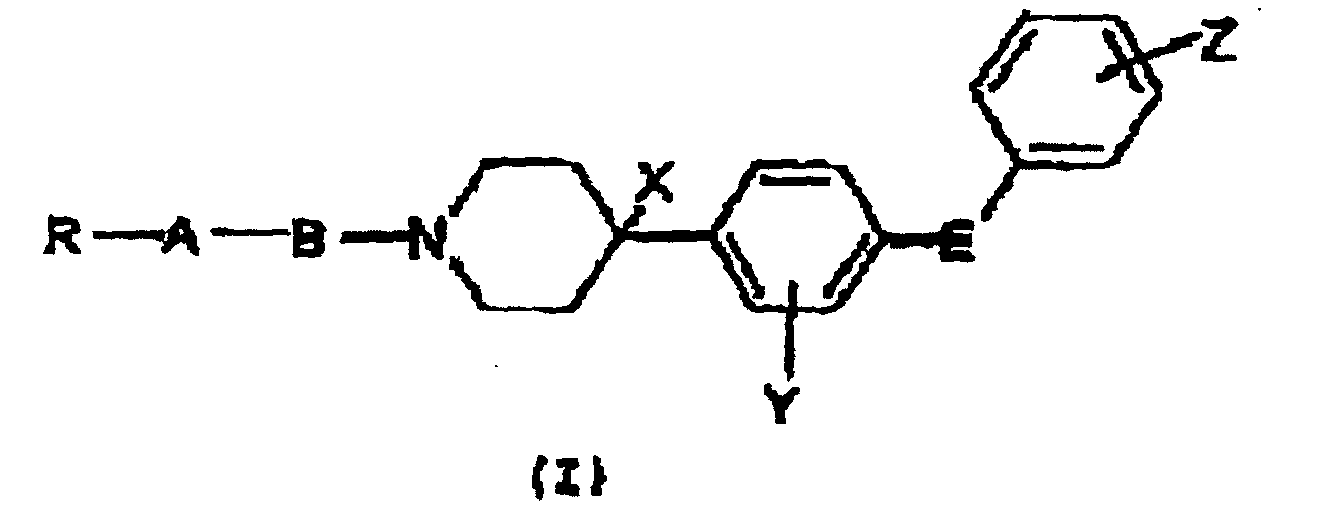
- Un composé qui est(a) un composé de formule (I')dans laquelle, R' est un groupe phényle facultativement substitué par un substituant choisi dans le groupe consistant en un atome d'halogène, un groupe hydroxyle, un groupe alcoxy en C1 à C5 facultativement ramifié et un groupe alkyle en C1 à C5 facultativement ramifié, facultativement substitué par un atome d'halogène, un groupe phénoxy facultativement substitué par un substituant choisi dans le groupe consistant en un atome d'halogène, un groupe hydroxyle, un groupe alcoxy en C1 à C5 facultativement ramifié et un groupe alkyle en C1 à C5 facultativement ramifié, facultativement substitué par un atome d'halogène ou un groupe benzoyle facultativement substitué par un substituant choisi dans le groupe consistant en un atome d'halogène, un groupe hydroxyle, un groupe alcoxy en C1 à C5 facultativement ramifié, un groupe alkyle en C1 à C5 facultativement ramifié, facultativement substitué par un atome d'halogène, A est une liaison de connexion, un groupe cycloalkylène en C3 à C6, ou un groupe alcénylène en C2 à C4 facultativement substitué par un groupe méthyle, éthyle, propyle ou isopropyle, B est un groupe alkylène en C1 à C6 facultativement substitué par un groupe hydroxyle ou un groupe alcoxy en C1 à C5 ou un groupe -NHCO(CH2)n-, où n est un entier de 1 à 5, E est une liaison de connexion, un atome d'oxygène, ou un groupe méthylène, X est un groupe hydroxyle ou un atome d'hydrogène, à condition que, quand E est un atome d'oxygène ou un groupe méthylène, X ne soit pas un atome d'hydrogène, et Y et Z peuvent être les mêmes ou différents l'un de l'autre et représentent un atome d'hydrogène, un atome d'halogène, un groupe alcoxy en C1 à C5, ou un groupe alkyle en C1 à C5 facultativement substitué par un atome d'halogène, à condition que, quand X est un atome d'hydrogène et R' est un groupe phényle facultativement substitué par un substituant choisi dans le groupe consistant en un atome d'halogène, un groupe hydroxyle, un groupe alcoxy en C1 à C5 facultativement ramifié et un groupe alkyle en C1 à C5 facultativement ramifié, facultativement substitué par un atome d'halogène, un groupe phénoxy facultativement substitué par un substituant choisi dans le groupe consistant en un atome d'halogène, un groupe hydroxyle, un groupe alcoxy en C1 à C5 facultativement ramifié et un groupe alkyle en C1 à C5 facultativement ramifié, facultativement substitué par un atome d'halogène, B ne soit pas un groupe alkylène en C1 à C6, que, quand X est un groupe hydroxyle et R' est un groupe phénoxy facultativement substitué par un substituant choisi dans le groupe consistant en un atome d'halogène, un groupe hydroxyle, un groupe alcoxy en C1 à C5 facultativement ramifié et un groupe alkyle en C1 à C5 facultativement ramifié, facultativement substitué par un atome d'halogène, B ne soit pas un groupe alkylène en C1 à C6 non substitué, que, quand X est un groupe hydroxyle, R' est un groupe phényle facultativement substitué par un substituant choisi dans le groupe consistant en un atome d'halogène, un groupe hydroxyle, un groupe alcoxy en C1 à C5 facultativement ramifié et un groupe alkyle en C1 à C5 facultativement ramifié, facultativement substitué par un atome d'halogène, et A est une liaison de connexion, B ne soit pas un groupe alkylène en C1 à C6 non substitué ou un groupe -NHCO(CH2)n-, et que, quand X est un groupe hydroxy, R' est un groupe phényle facultativement substitué par un substituant choisi dans le groupe consistant en un atome d'halogène, un groupe hydroxyle, un groupe alcoxy en C1 à C5 facultativement ramifié et un groupe alkyle en C1 à C5 facultativement ramifié, facultativement substitué par un atome d'halogène, et A est un groupe cycloalkylène en C3 à C6, B ne soit pas un groupe -NHCO(CH2)n- ; ou
 (b) un sel pharmaceutiquement acceptable d'un tel composé.
- Un composé selon la revendication 8 dans lequel, dans la formule (I'), R', A, B, et X sont conformes à l'une quelconque des sélections (a) à (e) suivantes :où en outre E est une liaison de connexion, un atome d'oxygène, ou un groupe méthylène, Y et Z peuvent être les mêmes ou différents l'un de l'autre et représentent un atome d'hydrogène, un atome d'halogène, un groupe alcoxy en C1 à C5, ou un groupe alkyle en C1 à C6 facultativement substitué par un atome d'halogène.(a) R' est un groupe phényle facultativement substitué par un substituant choisi dans le groupe consistant en un atome d'halogène, un groupe hydroxyle, un groupe alcoxy en C1 à C5 facultativement ramifié et un groupe alkyle en C1 à C5 facultativement ramifié, facultativement substitué par un atome d'halogène, A est un groupe alcénylène en C2 à C4 facultativement substitué par un groupe méthyle, éthyle, propyle ou isopropyle, B est un groupe alkylène en C1 à C6 facultativement substitué par un groupe hydroxyle ou un groupe alcoxy en C1 à C5 ou un groupe -NHCO(CH2)n-, où n est un entier de 1 à 5, et X est un groupe hydroxyle ;(b) R' est un groupe phényle facultativement substitué par un substituant choisi dans le groupe consistant en un atome d'halogène, un groupe hydroxyle, un groupe alcoxy en C1 à C5 facultativement ramifié et un groupe alkyle en C1 à C5 facultativement ramifié, facultativement substitué par un atome d'halogène, A est une liaison de connexion ou un groupe cycloalkylène en C3 à C6, B est un groupe alkylène en C1 à C6 substitué par un groupe hydroxyle, et X est un groupe hydroxyle ;(c) R' est un groupe phényle facultativement substitué par un substituant choisi dans le groupe consistant en un atome d'halogène, un groupe hydroxyle, un groupe alcoxy en C1 à C5 facultativement ramifié et un groupe alkyle en C1 à C5 facultativement ramifié, facultativement substitué par un atome d'halogène, A est une liaison de connexion ou un groupe cycloalkylène en C3 à C6, B est un groupe -NHCO(CH2)n-, où n est un entier de 1 à 5, et X est un groupe hydroxyle ou un atome d'hydrogène ;(d) R' est un groupe phénoxy facultativement substitué par un substituant choisi dans le groupe consistant en un atome d'halogène, un groupe hydroxyle, un groupe alcoxy en C1 à C5 facultativement ramifié et un groupe alkyle en C1 à C5 facultativement ramifié, facultativement substitué par un atome d'halogène, A est une liaison de connexion, un groupe cycloalkylène en C3 à C6, ou un groupe alcénylène en C2 à C4 facultativement substitué par un groupe méthyle, éthyle, propyle ou isopropyle, B est un groupe alkylène en C1 à C6 facultativement substitué par un groupe hydroxyle, et X est un groupe hydroxyle ;(e) R' est un groupe benzoyle facultativement substitué par un substituant choisi dans le groupe consistant en un atome d'halogène, un groupe hydroxyle, un groupe alcoxy en C1 à C5 facultativement ramifié et un groupe alkyle en C1 à C5 facultativement ramifié, facultativement substitué par un atome d'halogène, A est une liaison de connexion, un groupe cycloalkylène en C3 à C6, ou un groupe alcénylène en C2 à C4 facultativement substitué par un groupe méthyle, éthyle, propyle ou isopropyle, B est un groupe alkylène en C1 à C6 facultativement substitué par un groupe hydroxyle ou un groupe alcoxy en C1 à C5 ou un groupe -NHCO(CH2)n-, où n est un entier de 1 à 5, et X est un groupe hydroxyle ou un atome d'hydrogène ;
- Un composé selon la revendication 8 ou 9 dans lequel, dans la formule (I'), R' est un groupe phényle facultativement substitué par un substituant choisi dans le groupe consistant en un atome d'halogène, un groupe hydroxyle, un groupe alcoxy en C1 à C5 facultativement ramifié et un groupe alkyle en C1 à C5 facultativement ramifié, facultativement substitué par un atome d'halogène, A est un groupe alcénylène en C2 à C4 facultativement substitué par un groupe méthyle, éthyle, propyle ou isopropyle, et X est un groupe hydroxyle.
- Un composé selon la revendication 8 ou la revendication 9 dans lequel, dans la formule (I'), R' est un groupe benzoyle facultativement substitué par un substituant choisi dans le groupe consistant en un atome d'halogène, un groupe hydroxyle, un groupe alcoxy en C1 à C5 facultativement ramifié et un groupe alkyle en C1 à C5 facultativement ramifié, facultativement substitué par un atome d'halogène, A est une liaison de connexion, et X est un groupe hydroxyle.
- Un composé selon la revendication 8 ou la revendication 9 dans lequel, dans la formule (I'), R' est un groupe phényle facultativement substitué par un substituant choisi dans le groupe consistant en un atome d'halogène, un groupe hydroxyle, un groupe alcoxy en C1 à C5 facultativement ramifié et un groupe alkyle en C1 à C5 facultativement ramifié, facultativement substitué par un atome d'halogène, A est une liaison de connexion, B est un groupe diméthylène substitué par un groupe hydroxyle, et X est un groupe hydroxyle.
- Un composé selon la revendication 8 ou la revendication 9 dans lequel, dans la formule (I'), R' est un groupe phénoxy facultativement substitué par un substituant choisi dans le groupe consistant en un atome d'halogène, un groupe hydroxyle, un groupe alcoxy en C1 à C5 facultativement ramifié et un groupe alkyle en C1 à C5 facultativement ramifié, facultativement substitué par un atome d'halogène, A est une liaison de connexion, B est un groupe triméthylène substitué par un groupe hydroxyle, et X est un groupe hydroxyle.
- Un composé selon la revendication 8 ou la revendication 9 dans lequel, dans la formule (I'), R' est un groupe phényle facultativement substitué par un substituant choisi dans le groupe consistant en un atome d'halogène, un groupe hydroxyle, un groupe alcoxy en C1 à C5 facultativement ramifié et un groupe alkyle en C1 à C5 facultativement ramifié, facultativement substitué par un atome d'halogène, A est une liaison de connexion ou un groupe cycloalkylène en C3 à C6, B est un groupe -NHCO(CH2)n-, dans lequel n est un entier de 1 à 5, et X est un groupe hydroxyle ou un atome d'hydrogène.
- Un composé selon la revendication 8 ou la revendication 9 dans lequel, dans la formule (I'), R' est un groupe benzoyle facultativement substitué par un substituant choisi dans le groupe consistant en un atome d'halogène, un groupe hydroxyle, un groupe alcoxy en C1 à C5 facultativement ramifié et un groupe alkyle en C1 à C5 facultativement ramifié, facultativement substitué par un atome d'halogène, et A et E sont des liaisons de connexion.
- Une composition pharmaceutique contenant, comme ingrédient efficace, un composé selon l'une quelconque des revendications 8 à 15.
- Un composé ayant la formule (II) :dans laquelle E' est un atome d'oxygène ou un groupe méthylène, et Y et Z peuvent être les mêmes ou différents l'un de l'autre et représentent un atome d'hydrogène, un atome d'halogène, un groupe alcoxy en C1 à C5, ou un groupe alkyle en C1 à C5 facultativement substitué par un atome d'halogène.

Applications Claiming Priority (4)
| Application Number | Priority Date | Filing Date | Title |
|---|---|---|---|
| JP192123/96 | 1996-07-22 | ||
| JP19212396 | 1996-07-22 | ||
| JP19212396 | 1996-07-22 | ||
| PCT/JP1997/002531 WO1998003172A1 (fr) | 1996-07-22 | 1997-07-22 | Derives arylpiperidinol et arylpiperidine et medicaments les contenant |
Publications (3)
| Publication Number | Publication Date |
|---|---|
| EP0867183A1 EP0867183A1 (fr) | 1998-09-30 |
| EP0867183A4 EP0867183A4 (fr) | 1999-11-17 |
| EP0867183B1 true EP0867183B1 (fr) | 2004-10-06 |
Family
ID=16286065
Family Applications (1)
| Application Number | Title | Priority Date | Filing Date |
|---|---|---|---|
| EP97930865A Expired - Lifetime EP0867183B1 (fr) | 1996-07-22 | 1997-07-22 | Derives arylpiperidinol et arylpiperidine et medicaments les contenant |
Country Status (9)
| Country | Link |
|---|---|
| US (3) | US6455549B1 (fr) |
| EP (1) | EP0867183B1 (fr) |
| KR (1) | KR100537843B1 (fr) |
| AT (1) | ATE278402T1 (fr) |
| AU (1) | AU710594B2 (fr) |
| CA (1) | CA2231879C (fr) |
| DE (1) | DE69731070T2 (fr) |
| ES (1) | ES2225979T3 (fr) |
| HU (1) | HUP9904335A3 (fr) |
Families Citing this family (29)
| Publication number | Priority date | Publication date | Assignee | Title |
|---|---|---|---|---|
| EP0867183B1 (fr) * | 1996-07-22 | 2004-10-06 | Daiichi Suntory Pharma Co., Ltd. | Derives arylpiperidinol et arylpiperidine et medicaments les contenant |
| WO1999023072A1 (fr) * | 1997-10-31 | 1999-05-14 | Suntory Limited | Rylpiperidinopropanol et derives d'arylpiperazinopropanol et produits pharmaceutiques contenant lesdits composes |
| CA2369695A1 (fr) * | 1999-04-09 | 2000-10-19 | Manabu Itoh | Agent pour traiter les douleurs neurogenes |
| AU3676000A (en) | 1999-04-09 | 2000-11-14 | Mochida Pharmaceutical Co., Ltd. | 4-hydroxypiperidine derivatives having antiarrhythmic effect |
| USRE46117E1 (en) | 1999-12-22 | 2016-08-23 | Teva Pharmaceuticals International Gmbh | Modulators of dopamine neurotransmission |
| WO2002004433A2 (fr) * | 2000-07-06 | 2002-01-17 | Neurogen Corporation | Ligands de recepteur d'hormone a concentration de melanine |
| US20020128203A1 (en) * | 2000-09-20 | 2002-09-12 | Laurent Schild | Methods of identifying inhibitory compounds and uses thereof |
| EP1942551A1 (fr) * | 2001-10-16 | 2008-07-09 | Fractus, S.A. | Antenne multibande |
| WO2004037843A2 (fr) * | 2002-10-25 | 2004-05-06 | Yissum Research Development Company Of The Hebrew University Of Jerusalem | Composes steroides comprenant des groupes mimetiques de la superoxyde dismutase et des groupes donneurs d'oxyde nitrique, et leur utilisation dans la preparation de medicaments |
| WO2004050084A2 (fr) * | 2002-11-29 | 2004-06-17 | Yissum Research Development Company Of The Hebrew University Of Jerusalem | Inhibiteurs d'enzyme de conversion de l'angiotensine possedant une activite antioxydante et de donneur d'oxyde nitrique (no) |
| SE0401465D0 (sv) | 2004-06-08 | 2004-06-08 | Carlsson A Research Ab | New substituted piperdines as modulators of dopamine neurotransmission |
| MXPA06013941A (es) | 2004-06-08 | 2007-12-10 | Neurosearch Sweden Ab | Fenilpiperidinas disustituidas, novedosas, como moduladores de la neurotransmision de dopamina y serotonina. |
| ES2659577T3 (es) | 2004-10-13 | 2018-03-16 | Teva Pharmaceuticals International Gmbh | Proceso para la síntesis de 4-(3-metanosulfonilfenil)-1-N-propil-piperidina |
| MX2007004216A (es) * | 2004-10-13 | 2007-10-10 | Neurosearch Sweden Ab | Proceso para la sintesis de 4-(3-sulfonil)-piperidinas. |
| US20080035163A1 (en) * | 2006-08-10 | 2008-02-14 | Shaahin Cheyene | Magnetic Advanced Cigarette Filtration System |
| US7638541B2 (en) | 2006-12-28 | 2009-12-29 | Metabolex Inc. | 5-ethyl-2-{4-[4-(4-tetrazol-1-yl-phenoxymethyl)-thiazol-2-yl]-piperidin-1-yl}-pyrimidine |
| AU2008279447A1 (en) | 2007-07-19 | 2009-01-29 | Metabolex, Inc. | N-azacyclic substituted pyrrole, pyrazole, imidazole, triazole and tetrazole derivatives as agonists of the RUP3 or GPR119 receptor for the treatment of diabetes and metabolic disorders |
| BRPI0914891A2 (pt) * | 2008-06-20 | 2015-11-24 | Metabolex Inc | agonistas de aril gpr119 e usos dos mesmos |
| EP2483281B1 (fr) | 2009-10-01 | 2014-06-04 | Cymabay Therapeutics, Inc. | Sels de la tétrazol-1-yl-phénoxyméthyl-thiazol-2-yl-pipéridinyl-pyrimidine substituée |
| BR112012032248A2 (pt) | 2010-06-23 | 2016-09-13 | Metabolex Inc | composições de 5-etil-2-{4-[-4(-4-tetrazol-1-il-fenoximetil)-tiazol-2-il]-piperidin-1-il}-pirimidina |
| WO2012068589A2 (fr) * | 2010-11-19 | 2012-05-24 | Constellation Pharmaceuticals | Modulateurs d'enzymes de modification par méthylation, compositions et utilisations associées |
| EP2787997A4 (fr) | 2011-12-08 | 2015-05-27 | Ivax Int Gmbh | Bromhydrate de pridopidine |
| US9085583B2 (en) | 2012-02-10 | 2015-07-21 | Constellation—Pharmaceuticals, Inc. | Modulators of methyl modifying enzymes, compositions and uses thereof |
| BR112014024672A8 (pt) | 2012-04-04 | 2018-04-03 | Ivax Int Gmbh | Composições farmacêuticas para terapia de combinação |
| US9745305B2 (en) | 2013-03-15 | 2017-08-29 | Constellation Pharmaceuticals, Inc. | Modulators of methyl modifying enzymes, compositions and uses thereof |
| US9969716B2 (en) | 2013-08-15 | 2018-05-15 | Constellation Pharmaceuticals, Inc. | Indole derivatives as modulators of methyl modifying enzymes, compositions and uses thereof |
| WO2017040190A1 (fr) | 2015-08-28 | 2017-03-09 | Constellation Pharmaceuticals, Inc. | Formes cristallines de (r)-n-((4-méthoxy-6-méthyl-2-oxo-1,2-dihydropyridin-3-yl)méthyl)-2-méthyl-1-(1-(1-(2,2,2-trifluoroéthyl)pipéridin-4-yl)éthyl)-1h-indole-3-carboxamide |
| WO2018026890A1 (fr) | 2016-08-03 | 2018-02-08 | Cymabay Therapeutics | Composés d'aryle d'oxyméthylène pour le traitement de maladies gastro-intestinales inflammatoires ou de troubles gastro-intestinaux |
| WO2018075598A1 (fr) | 2016-10-19 | 2018-04-26 | Constellation Pharmaceuticals, Inc. | Synthèse d'inhibiteurs d'ezh2 |
Citations (1)
| Publication number | Priority date | Publication date | Assignee | Title |
|---|---|---|---|---|
| EP0445701A1 (fr) * | 1990-03-05 | 1991-09-11 | SHIONOGI SEIYAKU KABUSHIKI KAISHA trading under the name of SHIONOGI & CO. LTD. | Dérivés de tétrahydropyridine |
Family Cites Families (14)
| Publication number | Priority date | Publication date | Assignee | Title |
|---|---|---|---|---|
| US3301862A (en) | 1964-04-07 | 1967-01-31 | Aldrich Chem Co Inc | Nu-cyclopropyl, amides of 4-phenyl piperidino-alkanoic acids |
| US3350403A (en) * | 1964-04-07 | 1967-10-31 | Aldrich Chem Co Inc | Nu-phenyl amides of 4-phenyl-4-hydroxypiperidino alkyl acids |
| US4241071A (en) * | 1977-01-27 | 1980-12-23 | American Hoechst Corporation | Antidepressant (α-phenyl-2-tolyl)azacycloalkanes |
| DE2802306A1 (de) | 1977-01-27 | 1978-08-10 | Hoechst Ag | Azacycloalkane, azacycloalkene und ihre derivate |
| IE66332B1 (en) * | 1986-11-03 | 1995-12-27 | Novo Nordisk As | Piperidine compounds and their preparation and use |
| US5227379A (en) * | 1986-11-03 | 1993-07-13 | Novo Nordisk A/S | Piperidine compounds and their preparation and use |
| DK231088D0 (da) * | 1988-04-28 | 1988-04-28 | Ferrosan As | Piperidinforbindelser, deres fremstilling og anvendelse |
| GB9100505D0 (en) * | 1991-01-10 | 1991-02-20 | Shell Int Research | Piperidine derivatives |
| FR2706894A1 (en) * | 1993-06-22 | 1994-12-30 | Synthelabo | N-Phenyl-N-(piperidinoalkyl)arylamide derivatives, their preparation and their application in therapeutics |
| WO1995024390A1 (fr) * | 1994-03-11 | 1995-09-14 | Smithkline Beecham Plc | Nouvelles piperidines substituees par phenyl(-alkyl/alkoxy)-1-aminoalkyle et pyrolidines utilisees comme antagonistes des canaux calciques |
| WO1996022977A1 (fr) | 1995-01-23 | 1996-08-01 | Suntory Limited | Ameliorant ou remede contre des symptomes provoques par des maladies ischemiques et composes utiles a cet effet |
| CA2188924C (fr) * | 1995-02-28 | 2008-04-08 | Hirokazu Annoura | Derives d'arylpiperidine et d'arylpiperazine et medicaments contenant lesdits derives |
| EP0867183B1 (fr) * | 1996-07-22 | 2004-10-06 | Daiichi Suntory Pharma Co., Ltd. | Derives arylpiperidinol et arylpiperidine et medicaments les contenant |
| WO1999023072A1 (fr) * | 1997-10-31 | 1999-05-14 | Suntory Limited | Rylpiperidinopropanol et derives d'arylpiperazinopropanol et produits pharmaceutiques contenant lesdits composes |
-
1997
- 1997-07-22 EP EP97930865A patent/EP0867183B1/fr not_active Expired - Lifetime
- 1997-07-22 AU AU34640/97A patent/AU710594B2/en not_active Ceased
- 1997-07-22 KR KR1019980702029A patent/KR100537843B1/ko not_active Expired - Fee Related
- 1997-07-22 DE DE69731070T patent/DE69731070T2/de not_active Expired - Fee Related
- 1997-07-22 HU HU9904335A patent/HUP9904335A3/hu unknown
- 1997-07-22 US US09/043,563 patent/US6455549B1/en not_active Expired - Fee Related
- 1997-07-22 CA CA002231879A patent/CA2231879C/fr not_active Expired - Fee Related
- 1997-07-22 ES ES97930865T patent/ES2225979T3/es not_active Expired - Lifetime
- 1997-07-22 AT AT97930865T patent/ATE278402T1/de not_active IP Right Cessation
-
2002
- 2002-07-17 US US10/196,362 patent/US6706734B2/en not_active Expired - Fee Related
-
2004
- 2004-03-15 US US10/799,681 patent/US7498344B2/en not_active Expired - Fee Related
Patent Citations (1)
| Publication number | Priority date | Publication date | Assignee | Title |
|---|---|---|---|---|
| EP0445701A1 (fr) * | 1990-03-05 | 1991-09-11 | SHIONOGI SEIYAKU KABUSHIKI KAISHA trading under the name of SHIONOGI & CO. LTD. | Dérivés de tétrahydropyridine |
Also Published As
| Publication number | Publication date |
|---|---|
| EP0867183A4 (fr) | 1999-11-17 |
| US20040186138A1 (en) | 2004-09-23 |
| US20030130312A1 (en) | 2003-07-10 |
| US6455549B1 (en) | 2002-09-24 |
| ATE278402T1 (de) | 2004-10-15 |
| KR100537843B1 (ko) | 2006-04-28 |
| HUP9904335A3 (en) | 2001-07-30 |
| CA2231879A1 (fr) | 1998-01-29 |
| HUP9904335A2 (hu) | 2000-05-28 |
| AU710594B2 (en) | 1999-09-23 |
| KR20000064249A (ko) | 2000-11-06 |
| DE69731070T2 (de) | 2005-03-17 |
| EP0867183A1 (fr) | 1998-09-30 |
| AU3464097A (en) | 1998-02-10 |
| CA2231879C (fr) | 2007-01-23 |
| ES2225979T3 (es) | 2005-03-16 |
| US6706734B2 (en) | 2004-03-16 |
| US7498344B2 (en) | 2009-03-03 |
| DE69731070D1 (de) | 2004-11-11 |
Similar Documents
| Publication | Publication Date | Title |
|---|---|---|
| EP0867183A1 (fr) | Derives arylpiperidinol et arylpiperidine et medicaments les contenant | |
| EP0755923B1 (fr) | Ameliorant ou remede contre des symptomes provoques par des maladies ischemiques et composes phenylpiperidiniques utiles a cet effet | |
| JP4785807B2 (ja) | アリールピペリジノプロパノール及びアリールピペラジノプロパノール誘導体の製造中間体の製造方法 | |
| JPWO1996022977A1 (ja) | 虚血性疾患に基づく症状の改善又は治療薬及びそれに有用な化合物 | |
| JP2008001712A6 (ja) | アリールピペリジノプロパノール及びアリールピペラジノプロパノール誘導体の製造中間体の製造方法 | |
| US5589486A (en) | N-hydroxyalkyl-substituted 1,2,3,6-tetrahydro-pyridine and piperidine derivatives | |
| NZ239267A (en) | 3-substituted piperidine derivatives and pharmaceutical compositions | |
| HU196195B (en) | Process for producing 1,4-disubstituted piperazine derivatives and pharmaceuticals comprising the compounds | |
| HU190887B (en) | Process for the preparation of 2-pehnyl-methylen-cycloalkyl-amines and azetidines | |
| CZ279282B6 (cs) | Způsob přípravy 1-/(diarylmethoxy)- alkyl/ pyrrolidinů a piperidinů | |
| EP0243905B1 (fr) | 1(Oméga-[bis-(phényl)alcoxy]-alcoyl)-4-(di-(phényl)-méthyl-pipérazines, leur procédé de préparation et médicaments qui les contiennent | |
| JPWO1998003172A1 (ja) | アリールピペリジノール及びアリールピペリジン誘導体並びにそれらを含む医薬 | |
| US4250184A (en) | Treatment of pain, fever, and inflammation with compositions containing piperidinobutan-and 3-buten-2-ones | |
| JPH10500967A (ja) | カルシウムチャンネルアンタゴニストとしてのフェノキシアルキル置換ピペリジン、ピロリジン、モルホリンおよびチオモルホリン | |
| US4254131A (en) | Treatment of pain, fever, and inflammation with compositions containing 2-(substitutedpiperidinomethyl)propane and propene nitriles | |
| US4273781A (en) | Treatment of pain, fever, and inflammation with compositions containing piperidinobutan-and 3-buten-2-ones | |
| IE42638B1 (en) | Pyridine derivatives |
Legal Events
| Date | Code | Title | Description |
|---|---|---|---|
| PUAI | Public reference made under article 153(3) epc to a published international application that has entered the european phase |
Free format text: ORIGINAL CODE: 0009012 |
|
| 17P | Request for examination filed |
Effective date: 19980414 |
|
| AK | Designated contracting states |
Kind code of ref document: A1 Designated state(s): AT BE CH DE DK ES FI FR GB GR IE IT LI LU MC NL PT SE |
|
| A4 | Supplementary search report drawn up and despatched |
Effective date: 19991006 |
|
| AK | Designated contracting states |
Kind code of ref document: A4 Designated state(s): AT BE CH DE DK ES FI FR GB GR IE IT LI LU MC NL PT SE |
|
| 17Q | First examination report despatched |
Effective date: 20010605 |
|
| RAP1 | Party data changed (applicant data changed or rights of an application transferred) |
Owner name: DAIICHI SUNTORY PHARMA CO., LTD. |
|
| GRAP | Despatch of communication of intention to grant a patent |
Free format text: ORIGINAL CODE: EPIDOSNIGR1 |
|
| GRAS | Grant fee paid |
Free format text: ORIGINAL CODE: EPIDOSNIGR3 |
|
| GRAA | (expected) grant |
Free format text: ORIGINAL CODE: 0009210 |
|
| AK | Designated contracting states |
Kind code of ref document: B1 Designated state(s): AT BE CH DE DK ES FI FR GB GR IE IT LI LU MC NL PT SE |
|
| PG25 | Lapsed in a contracting state [announced via postgrant information from national office to epo] |
Ref country code: NL Free format text: LAPSE BECAUSE OF FAILURE TO SUBMIT A TRANSLATION OF THE DESCRIPTION OR TO PAY THE FEE WITHIN THE PRESCRIBED TIME-LIMIT Effective date: 20041006 Ref country code: FI Free format text: LAPSE BECAUSE OF FAILURE TO SUBMIT A TRANSLATION OF THE DESCRIPTION OR TO PAY THE FEE WITHIN THE PRESCRIBED TIME-LIMIT Effective date: 20041006 Ref country code: BE Free format text: LAPSE BECAUSE OF FAILURE TO SUBMIT A TRANSLATION OF THE DESCRIPTION OR TO PAY THE FEE WITHIN THE PRESCRIBED TIME-LIMIT Effective date: 20041006 Ref country code: AT Free format text: LAPSE BECAUSE OF FAILURE TO SUBMIT A TRANSLATION OF THE DESCRIPTION OR TO PAY THE FEE WITHIN THE PRESCRIBED TIME-LIMIT Effective date: 20041006 |
|
| REG | Reference to a national code |
Ref country code: GB Ref legal event code: FG4D |
|
| REG | Reference to a national code |
Ref country code: CH Ref legal event code: NV Representative=s name: E. BLUM & CO. PATENTANWAELTE Ref country code: CH Ref legal event code: EP |
|
| REG | Reference to a national code |
Ref country code: IE Ref legal event code: FG4D |
|
| REF | Corresponds to: |
Ref document number: 69731070 Country of ref document: DE Date of ref document: 20041111 Kind code of ref document: P |
|
| PG25 | Lapsed in a contracting state [announced via postgrant information from national office to epo] |
Ref country code: SE Free format text: LAPSE BECAUSE OF FAILURE TO SUBMIT A TRANSLATION OF THE DESCRIPTION OR TO PAY THE FEE WITHIN THE PRESCRIBED TIME-LIMIT Effective date: 20050106 Ref country code: GR Free format text: LAPSE BECAUSE OF FAILURE TO SUBMIT A TRANSLATION OF THE DESCRIPTION OR TO PAY THE FEE WITHIN THE PRESCRIBED TIME-LIMIT Effective date: 20050106 Ref country code: DK Free format text: LAPSE BECAUSE OF FAILURE TO SUBMIT A TRANSLATION OF THE DESCRIPTION OR TO PAY THE FEE WITHIN THE PRESCRIBED TIME-LIMIT Effective date: 20050106 |
|
| REG | Reference to a national code |
Ref country code: ES Ref legal event code: FG2A Ref document number: 2225979 Country of ref document: ES Kind code of ref document: T3 |
|
| NLV1 | Nl: lapsed or annulled due to failure to fulfill the requirements of art. 29p and 29m of the patents act | ||
| ET | Fr: translation filed | ||
| PG25 | Lapsed in a contracting state [announced via postgrant information from national office to epo] |
Ref country code: LU Free format text: LAPSE BECAUSE OF NON-PAYMENT OF DUE FEES Effective date: 20050722 |
|
| PG25 | Lapsed in a contracting state [announced via postgrant information from national office to epo] |
Ref country code: MC Free format text: LAPSE BECAUSE OF NON-PAYMENT OF DUE FEES Effective date: 20050731 |
|
| PLBE | No opposition filed within time limit |
Free format text: ORIGINAL CODE: 0009261 |
|
| STAA | Information on the status of an ep patent application or granted ep patent |
Free format text: STATUS: NO OPPOSITION FILED WITHIN TIME LIMIT |
|
| 26N | No opposition filed |
Effective date: 20050707 |
|
| REG | Reference to a national code |
Ref country code: CH Ref legal event code: PFA Owner name: DAIICHI ASUBIO PHARMA CO., LTD. Free format text: DAIICHI SUNTORY PHARMA CO., LTD.#7-2, KOJIMACHI 5-CHOME, CHIYODA-KU#TOKYO (JP) -TRANSFER TO- DAIICHI ASUBIO PHARMA CO., LTD.#9-11, AKASAKA 2-CHOME, MINATO-KU#TOKYO (JP) |
|
| REG | Reference to a national code |
Ref country code: FR Ref legal event code: CD Ref country code: FR Ref legal event code: CA |
|
| REG | Reference to a national code |
Ref country code: CH Ref legal event code: PFA Owner name: ASUBIO PHARMA CO., LTD. Free format text: DAIICHI ASUBIO PHARMA CO., LTD.#9-11, AKASAKA 2-CHOME, MINATO-KU#TOKYO (JP) -TRANSFER TO- ASUBIO PHARMA CO., LTD.#9-11, AKASAKA 2-CHOME#MINATO-KU, TOKYO (JP) |
|
| PGFP | Annual fee paid to national office [announced via postgrant information from national office to epo] |
Ref country code: IE Payment date: 20070718 Year of fee payment: 11 |
|
| PGFP | Annual fee paid to national office [announced via postgrant information from national office to epo] |
Ref country code: DE Payment date: 20070719 Year of fee payment: 11 |
|
| PGFP | Annual fee paid to national office [announced via postgrant information from national office to epo] |
Ref country code: ES Payment date: 20070727 Year of fee payment: 11 |
|
| REG | Reference to a national code |
Ref country code: FR Ref legal event code: CD |
|
| REG | Reference to a national code |
Ref country code: CH Ref legal event code: PFA Owner name: ASUBIO PHARMA CO., LTD. Free format text: ASUBIO PHARMA CO., LTD.#9-11, AKASAKA 2-CHOME#MINATO-KU, TOKYO (JP) -TRANSFER TO- ASUBIO PHARMA CO., LTD.#9-11, AKASAKA 2-CHOME#MINATO-KU, TOKYO (JP) |
|
| PGFP | Annual fee paid to national office [announced via postgrant information from national office to epo] |
Ref country code: CH Payment date: 20070713 Year of fee payment: 11 |
|
| PG25 | Lapsed in a contracting state [announced via postgrant information from national office to epo] |
Ref country code: PT Free format text: LAPSE BECAUSE OF NON-PAYMENT OF DUE FEES Effective date: 20050306 |
|
| PGFP | Annual fee paid to national office [announced via postgrant information from national office to epo] |
Ref country code: GB Payment date: 20070718 Year of fee payment: 11 |
|
| PGFP | Annual fee paid to national office [announced via postgrant information from national office to epo] |
Ref country code: IT Payment date: 20070728 Year of fee payment: 11 |
|
| PGFP | Annual fee paid to national office [announced via postgrant information from national office to epo] |
Ref country code: FR Payment date: 20070710 Year of fee payment: 11 |
|
| REG | Reference to a national code |
Ref country code: CH Ref legal event code: PL |
|
| GBPC | Gb: european patent ceased through non-payment of renewal fee |
Effective date: 20080722 |
|
| REG | Reference to a national code |
Ref country code: IE Ref legal event code: MM4A |
|
| PG25 | Lapsed in a contracting state [announced via postgrant information from national office to epo] |
Ref country code: DE Free format text: LAPSE BECAUSE OF NON-PAYMENT OF DUE FEES Effective date: 20090203 |
|
| REG | Reference to a national code |
Ref country code: FR Ref legal event code: ST Effective date: 20090331 |
|
| PG25 | Lapsed in a contracting state [announced via postgrant information from national office to epo] |
Ref country code: LI Free format text: LAPSE BECAUSE OF NON-PAYMENT OF DUE FEES Effective date: 20080731 Ref country code: GB Free format text: LAPSE BECAUSE OF NON-PAYMENT OF DUE FEES Effective date: 20080722 Ref country code: CH Free format text: LAPSE BECAUSE OF NON-PAYMENT OF DUE FEES Effective date: 20080731 |
|
| PG25 | Lapsed in a contracting state [announced via postgrant information from national office to epo] |
Ref country code: IE Free format text: LAPSE BECAUSE OF NON-PAYMENT OF DUE FEES Effective date: 20080722 |
|
| PG25 | Lapsed in a contracting state [announced via postgrant information from national office to epo] |
Ref country code: IT Free format text: LAPSE BECAUSE OF NON-PAYMENT OF DUE FEES Effective date: 20080722 Ref country code: FR Free format text: LAPSE BECAUSE OF NON-PAYMENT OF DUE FEES Effective date: 20080731 |
|
| REG | Reference to a national code |
Ref country code: ES Ref legal event code: FD2A Effective date: 20080723 |
|
| PG25 | Lapsed in a contracting state [announced via postgrant information from national office to epo] |
Ref country code: ES Free format text: LAPSE BECAUSE OF NON-PAYMENT OF DUE FEES Effective date: 20080723 |