EP0867488B1 - Strahlungshärtbare Harzschicht enthaltender Tintenstrahldruckkopf - Google Patents
Strahlungshärtbare Harzschicht enthaltender Tintenstrahldruckkopf Download PDFInfo
- Publication number
- EP0867488B1 EP0867488B1 EP98302358A EP98302358A EP0867488B1 EP 0867488 B1 EP0867488 B1 EP 0867488B1 EP 98302358 A EP98302358 A EP 98302358A EP 98302358 A EP98302358 A EP 98302358A EP 0867488 B1 EP0867488 B1 EP 0867488B1
- Authority
- EP
- European Patent Office
- Prior art keywords
- ink jet
- resin composition
- print head
- jet print
- weight percent
- Prior art date
- Legal status (The legal status is an assumption and is not a legal conclusion. Google has not performed a legal analysis and makes no representation as to the accuracy of the status listed.)
- Expired - Lifetime
Links
Images
Classifications
-
- G—PHYSICS
- G03—PHOTOGRAPHY; CINEMATOGRAPHY; ANALOGOUS TECHNIQUES USING WAVES OTHER THAN OPTICAL WAVES; ELECTROGRAPHY; HOLOGRAPHY
- G03F—PHOTOMECHANICAL PRODUCTION OF TEXTURED OR PATTERNED SURFACES, e.g. FOR PRINTING, FOR PROCESSING OF SEMICONDUCTOR DEVICES; MATERIALS THEREFOR; ORIGINALS THEREFOR; APPARATUS SPECIALLY ADAPTED THEREFOR
- G03F7/00—Photomechanical, e.g. photolithographic, production of textured or patterned surfaces, e.g. printing surfaces; Materials therefor, e.g. comprising photoresists; Apparatus specially adapted therefor
- G03F7/004—Photosensitive materials
- G03F7/038—Macromolecular compounds which are rendered insoluble or differentially wettable
-
- B—PERFORMING OPERATIONS; TRANSPORTING
- B41—PRINTING; LINING MACHINES; TYPEWRITERS; STAMPS
- B41J—TYPEWRITERS; SELECTIVE PRINTING MECHANISMS, i.e. MECHANISMS PRINTING OTHERWISE THAN FROM A FORME; CORRECTION OF TYPOGRAPHICAL ERRORS
- B41J2/00—Typewriters or selective printing mechanisms characterised by the printing or marking process for which they are designed
- B41J2/005—Typewriters or selective printing mechanisms characterised by the printing or marking process for which they are designed characterised by bringing liquid or particles selectively into contact with a printing material
- B41J2/01—Ink jet
- B41J2/135—Nozzles
- B41J2/16—Production of nozzles
- B41J2/1601—Production of bubble jet print heads
- B41J2/1603—Production of bubble jet print heads of the front shooter type
-
- B—PERFORMING OPERATIONS; TRANSPORTING
- B41—PRINTING; LINING MACHINES; TYPEWRITERS; STAMPS
- B41J—TYPEWRITERS; SELECTIVE PRINTING MECHANISMS, i.e. MECHANISMS PRINTING OTHERWISE THAN FROM A FORME; CORRECTION OF TYPOGRAPHICAL ERRORS
- B41J2/00—Typewriters or selective printing mechanisms characterised by the printing or marking process for which they are designed
- B41J2/005—Typewriters or selective printing mechanisms characterised by the printing or marking process for which they are designed characterised by bringing liquid or particles selectively into contact with a printing material
- B41J2/01—Ink jet
- B41J2/135—Nozzles
- B41J2/16—Production of nozzles
- B41J2/1607—Production of print heads with piezoelectric elements
-
- B—PERFORMING OPERATIONS; TRANSPORTING
- B41—PRINTING; LINING MACHINES; TYPEWRITERS; STAMPS
- B41J—TYPEWRITERS; SELECTIVE PRINTING MECHANISMS, i.e. MECHANISMS PRINTING OTHERWISE THAN FROM A FORME; CORRECTION OF TYPOGRAPHICAL ERRORS
- B41J2/00—Typewriters or selective printing mechanisms characterised by the printing or marking process for which they are designed
- B41J2/005—Typewriters or selective printing mechanisms characterised by the printing or marking process for which they are designed characterised by bringing liquid or particles selectively into contact with a printing material
- B41J2/01—Ink jet
- B41J2/135—Nozzles
- B41J2/16—Production of nozzles
- B41J2/1621—Manufacturing processes
- B41J2/1623—Manufacturing processes bonding and adhesion
-
- B—PERFORMING OPERATIONS; TRANSPORTING
- B41—PRINTING; LINING MACHINES; TYPEWRITERS; STAMPS
- B41J—TYPEWRITERS; SELECTIVE PRINTING MECHANISMS, i.e. MECHANISMS PRINTING OTHERWISE THAN FROM A FORME; CORRECTION OF TYPOGRAPHICAL ERRORS
- B41J2/00—Typewriters or selective printing mechanisms characterised by the printing or marking process for which they are designed
- B41J2/005—Typewriters or selective printing mechanisms characterised by the printing or marking process for which they are designed characterised by bringing liquid or particles selectively into contact with a printing material
- B41J2/01—Ink jet
- B41J2/135—Nozzles
- B41J2/16—Production of nozzles
- B41J2/1621—Manufacturing processes
- B41J2/1631—Manufacturing processes photolithography
-
- B—PERFORMING OPERATIONS; TRANSPORTING
- B41—PRINTING; LINING MACHINES; TYPEWRITERS; STAMPS
- B41J—TYPEWRITERS; SELECTIVE PRINTING MECHANISMS, i.e. MECHANISMS PRINTING OTHERWISE THAN FROM A FORME; CORRECTION OF TYPOGRAPHICAL ERRORS
- B41J2/00—Typewriters or selective printing mechanisms characterised by the printing or marking process for which they are designed
- B41J2/005—Typewriters or selective printing mechanisms characterised by the printing or marking process for which they are designed characterised by bringing liquid or particles selectively into contact with a printing material
- B41J2/01—Ink jet
- B41J2/135—Nozzles
- B41J2/16—Production of nozzles
- B41J2/1621—Manufacturing processes
- B41J2/164—Manufacturing processes thin film formation
- B41J2/1645—Manufacturing processes thin film formation thin film formation by spincoating
-
- C—CHEMISTRY; METALLURGY
- C08—ORGANIC MACROMOLECULAR COMPOUNDS; THEIR PREPARATION OR CHEMICAL WORKING-UP; COMPOSITIONS BASED THEREON
- C08G—MACROMOLECULAR COMPOUNDS OBTAINED OTHERWISE THAN BY REACTIONS ONLY INVOLVING UNSATURATED CARBON-TO-CARBON BONDS
- C08G59/00—Polycondensates containing more than one epoxy group per molecule; Macromolecules obtained by polymerising compounds containing more than one epoxy group per molecule using curing agents or catalysts which react with the epoxy groups
- C08G59/18—Macromolecules obtained by polymerising compounds containing more than one epoxy group per molecule using curing agents or catalysts which react with the epoxy groups ; e.g. general methods of curing
- C08G59/68—Macromolecules obtained by polymerising compounds containing more than one epoxy group per molecule using curing agents or catalysts which react with the epoxy groups ; e.g. general methods of curing characterised by the catalysts used
-
- C—CHEMISTRY; METALLURGY
- C08—ORGANIC MACROMOLECULAR COMPOUNDS; THEIR PREPARATION OR CHEMICAL WORKING-UP; COMPOSITIONS BASED THEREON
- C08L—COMPOSITIONS OF MACROMOLECULAR COMPOUNDS
- C08L63/00—Compositions of epoxy resins; Compositions of derivatives of epoxy resins
-
- B—PERFORMING OPERATIONS; TRANSPORTING
- B41—PRINTING; LINING MACHINES; TYPEWRITERS; STAMPS
- B41J—TYPEWRITERS; SELECTIVE PRINTING MECHANISMS, i.e. MECHANISMS PRINTING OTHERWISE THAN FROM A FORME; CORRECTION OF TYPOGRAPHICAL ERRORS
- B41J2202/00—Embodiments of or processes related to ink-jet or thermal heads
- B41J2202/01—Embodiments of or processes related to ink-jet heads
- B41J2202/03—Specific materials used
Definitions
- This invention relates to an ink jet print head containing an improved radiation curable resin layer.
- the ink jet print head of an ink jet printer generally consists of an orifice plate containing orifices or injection parts for discharging ink for recording on a substrate, ink passage ways connecting the orifices to an ink supply and an energy imparting device for ejecting ink from the print head through the orifices.
- the energy for discharging the ink during recording is generated in most cases by resistance elements or piezoelectric devices.
- Methods for making the ink passage ways for ink jet print heads include, for example, forming fine grooves in a thin layer of glass, metal, or plastic by cutting or etching and then bonding another thin layer of material onto the layer having such grooves formed thereon to form liquid passage ways.
- Another method involves forming grooves in a photosensitive resin coated on a substrate containing the energy imparting device by photo lithographic techniques. Once the grooves are formed in the photosensitive resin another thin layered material is attached to the grooved resin to form, for example, nozzle plates.
- the use of a photosensitive resin to provide at least a portion of the ink passage layer is more advantageous than other methods since the liquid passage ways can be manufactured with higher precision and yield and liquid jet recording heads can be obtained with better quality and lower cost.
- the photosensitive resin is required to have (1) excellent adhesion as a cured film to a substrate; (2) excellent mechanical strength and durability, when cured; and (3) excellent sensitivity and resolution upon patterning with a radiation source.
- U.S. Patent No. 4,623,676 describes a radiation curable composition for use as a protective coating for a photographic element containing a polymerizable acrylic compound, a polymerizable epoxy-functional silane, a free radical aromatic complex salt photoinitiator capable of initiating polymerization of said acrylic compound, and a cationic aromatic complex salt photoinitiator capable of initiating polymerization of said epoxy functional silane.
- U.S. Patent No. 4,688,053 describes a liquid jet recording head having a layer of a radiation curable resin composition containing a linear polymer having a glass transition temperature of at least 50/C and a weight average molecular weight of at least 3.0 X 10 4 , a monomer having an ethylenically unsaturated bond, an epoxy resin having one or more epoxy groups, and a polymerization initiator capable of generating a Lewis acid by irradiation with an active energy source.
- U.S. Patent No. 4,090, 936 describes a photohardenable composition containing an organic compound having an average epoxide functionality in the range of about 1 to 1.3; an organic polymer selected from polymers derived from acrylate or methacrylate monomers, copolymers of styrene and allyl alcohol, and polyvinyl butyral polymers; and an aromatic complex salt aromatic complex salt photoinitiator.
- photosensitive resins provide all of the requisite characteristics for use in jet print head applications.
- photosensitive resins used for pattern formation in printing plates, print wires, etc. have inferior adhesion to glass, metal, ceramic and plastic, and insufficient in mechanical strength and durability when cured although they may have good sensitivity and resolution.
- deformation or delamination from the substrate or degradation of the photosensitive resin layer are liable to occur during usage which reduces the reliability of the ink jet print head by impeding the flow of ink in the ink passage ways or making the ink droplet discharge noticeably unstable.
- photo curable resins which adhere to glass, metal, ceramic and plastic, and provide satisfactory mechanical strength and durability after curing, are inferior in sensitivity and resolution.
- the inherent characteristics of photo curable resins makes them unsuitable for use in providing ink passage ways because they cannot be cured in the precise patterns required for use in ink jet print heads.
- An object of the present invention is to provide an improved radiation curable resin for use in ink jet print heads.
- Another object of the present invention is to provide an ink jet print head containing an ink passage layer made of a resin satisfying all of the requisite characteristics as mentioned above, which is inexpensive, precise, high in reliability and excellent in durability.
- Yet another object of the present invention is to provide an ink jet print head having precisely manufactured ink passage ways.
- the invention provides an ink jet print head containing ink passage ways in a radiation curable resin attached to a substrate containing an energy imparting device for ejecting ink from the print head.
- the passage ways are formed in the resin by subjecting a layer of radiation curable resin to a predetermined radiation pattern to thereby form cured regions of the resin. Uncured regions of the resin may then be removed.
- the invention provides an ink jet print head having ink passage ways connected to an ink discharging outlet provided on a substrate, said passage ways being formed by subjecting a layer of a radiation curable resin composition to a predetermined pattern exposure with said radiation to thereby form a cured region of said resin composition and removing the uncured resin composition region from said layer, said radiation curable resin composition comprising:
- the resin composition uses a nonphotoreactive solvent system (which could be aqueous or nonaqueous) that is environmentally acceptable.
- the radiation cured resin layer used in the invention exhibits greater resolution, higher aspect ratios and enhanced adhesion to metal surfaces such as gold or gold/tantalum, thereby extending its application to present and projected product requirements.
- the cured resin provides a permanently defined and high pH ink resistant barrier layer that can contribute to controlled ink droplet size in ink jet print heads while resisting corrosion or chemical attack by the ink itself.
- the radiation cured resin also results in unexpectedly superior adhesion between the nozzle plate and substrate when the nozzle plate is a phenolic butyral coated polymer, such as a polymide nozzle plate coated with phenolic butyral.
- This invention relates to an ink jet print head having ink passage ways formed in a radiation cured resin layer which is attached to a substrate.
- the passageways are connected in fluid flow communication to an ink discharging outlet provided by an orifice plate.
- a resin composition is exposed to a radiation source in a predetermined pattern to cure certain regions of resin layer while other regions which provide the passage ways remain uncured. The uncured regions are removed from the resin layer leaving the desired passage ways.
- the resin composition to be used for forming the radiation curable layers is a resin composition comprising: a first difunctional epoxy compound, a second multifunctional crosslinking epoxy compound, a photoinitiator capable of generating a cation, a non photoreactive solvent, and a silane having a functional group capable of reacting with at least one member selected from the group consisting of the first difunctional epoxy compound, the second multifunctional crosslinking epoxy compound and the photoinitiator.
- a silane is preferably a silane with an epoxide functional group such as a glycidoxyalkyltrialkoxy-silane like gamma-glycidoxypropyltrimethoxy-silane.
- the silane is present in an amount from 0.05 to 10 weight percent and preferably from 0.1 to 2.0 weight percent based on total weight of the resin composition, including all ranges subsumed therein.
- the resin composition further comprises a film enhancing agent such as an acrylate or methacrylate polymer.
- Film enhancing agent as used herein, is defined to mean an organic material soluble in the resin composition which assists the film forming characteristics of the resin composition.
- the first component of the resin composition is a first difunctional epoxy compound which includes any organic compound having two oxirane rings polymerizable by ring opening.
- Multifunctional means having an average epoxide functionality of greater than 1.0 and preferably greater than or equal to 2. It is further noted that the first difunctional epoxy compound and/or the second multifunctional epoxy compound may polymerize and/or crosslink. Preferably, the second multifunctional epoxy compound is the primary crosslinking agent.
- the first difunctional epoxy compound includes monomeric difunctional epoxy compounds and polymeric difunctional epoxy compounds which may vary in the nature of their backbone and substituent groups. Furthermore, the first difunctional epoxy compound preferably has a hydroxy group as a substituent.
- the molecular weight (MN) of the first difunctional epoxy compounds may vary from 75 to 100.000.
- the difunctional epoxy compound or mixture of difunctional epoxy compounds are preferably liquids, however, one or more solid difunctional epoxy compounds may be included In the mixture provided that the final mixture is in a liquid phase.
- Difunctional epoxy compounds which may be used include diglycidyl ethers of Bisphenol A (e.g. those available under the trade designations "Epon 828", “Epon 1004", “Epon 1001F”, “Epon SU-8” and “Epon 1010” from Shell Chemical Co., "DER-331", “DER-332", and “DER-334" from Dow Chemical Co.), 3,4-epoxycyclohexylmethyl -3,4 -epoxycyclohexene carboxylate (e.g. "ERL-4221” from Union Carbide Corp.), 3,4-epoxy-6-methylcyclohexylmethyl-3,4-epoxy-6-methylcyclohexene carboxylate (e.g.
- the difunctional epoxy compound is present in the composition in an amount of from 5 to 50 weight percent, preferably from 10 to 20 weight percent.
- the second component of the resin composition is a second multiifunctional crosslinking compound.
- the second multifunctional epoxy compound increases the crosslink density thereby increasing resolution and improving resistance to solvent swelling.
- the type of second multifunctional epoxy compound is generally not limited, as long as it is a compound capable of resulting in the desired resin.
- An illustrative list of such second multifunctional epoxy compound includes, for example, those which are the reaction product of phenol; aldehydes and epoxides like DEN-431, DEN-438, DEN 439 (commercially available from Dow Plastics).
- the second multifunctional epoxy compound is present in the composition in an amount of from 0.05 to 20 weight percent, preferably from 0.1 to 10 weight percent and most preferably from 0.1 to 5 weight percent, based on the total weight of the resin composition.
- compound is meant to include monomers and polymers.
- the third component of the resin composition is a photoinitiator capable of generating a cation such as an aromatic complex salt photoinitiator which may be selected from onium salts of a Group VA element, onium salts of a Group VIA element, and aromatic halonium salts. These complex salts, upon being exposed to ultraviolet radiation or electron beam irradiation, are capable of generating moieties which initiate reactions with epoxides.
- the aromatic complex salt aromatic complex salt photoinitiator is present in the compositions in an amount of from 1.0 to 10 weight percent, preferably from 1.5 to 5 weight percent, based on the total weight of the resin composition.
- Preferred aromatic complex salt photoinitiators include aromatic iodonium complex salts and aromatic sulfonium complex salts.
- aromatic iodonium complex salt aromatic complex salt photoinitiators include:
- the preferred salts are the diaryliodonium hexafluorophosphate and the diaryliodonium hexafluoroantimonate. These salts are preferred because, in general, they are more thermally stable, promote faster reaction, and are more soluble in inert organic solvents than are other aromatic iodonium salts of complex ions.
- aromatic sulfonium complex salt aromatic complex salt photoinitiators examples include:
- the preferred salts are the triaryl-substituted salts such as triphenylsulfonium hexafluorophosphate.
- the triaryl-substituted salts are preferred because they are more thermally stable than the mono-and diaryl substituted salts thereby providing a one-part system with long shelf life.
- the triaryl-substituted complex salts are also more amenable to dye sensitization. Consequently, the use of such complex salts results in compositions which are much more useful in applications where near ultraviolet and visible light are used for exposure.
- the composition may be prepared in shelf stable concentrate form (i.e. with high levels of complex salt) which is suitable for later dilution to a more commercially practical coating composition.
- the most preferred photoinitiator capable of generating a cation is a mixed triarylsulfonium hexafluoroantimonate salt, commercially available from Union Carbide (UV 1-6975).
- the fourth component of the resin composition is a nonphotoreactive solvent.
- This solvent is limited only to the extent that the desired components, prior to curing are soluble in it.
- Preferred nonphotoreactive solvents include gamma-butyrolactone, C 1-6 acetates, tetrahydrofuran low molecular weight ketones, mixtures thereof and the like.
- the nonphotoreactive solvent is present in the composition an amount of from 20 to 90 weight percent, preferably from 45 to 75 weight percent, based on the total weight of the resin composition.
- the resin composition of the present invention may include up to 35 weight percent and preferably 10 to 20 weight percent of an acrylate or methacrylate polymer which is derived from at least one acrylate or methacrylate monomer.
- the polymer may be a homopolymer, a copolymer, or a blend.
- the term "polymer” as used herein is meant to include oligomers (e.g. materials having a number average molecular weight as low as about 1000) as well as high polymers (which may have a number average molecular weight ranging up to about 1,000,000).
- the number average molecular weight of the acrylate or methacrylate polymer is in the range of from 10,000 to 60,000 and most preferably from 20,000 to 30,000.
- Preferred acrylate or methacrylate polymers may be derived from various monomers so long as at least one of those monomers is an acrylate or methacrylate monomer.
- representative useful acrylate and methacrylate monomers include: methylmethacrylate, n-butylacrylate, hydroxyethylacrylate, hydroxyethylmethacrylate, n-butylmethacrylate, hydroxypropylacrylate, hydroxypropylmethacrylate, and ethylacrylate.
- the acrylate and methacrylate monomers are esters of acrylic, or methacrylic, acid with an aliphatic alcohol of 1 to 4 carbon atoms or an aliphatic diol of 2 to 4 carbon atoms.
- Representative useful acrylate or methacrylate polymers derived from the foregoing monomers include: methylmethacrylate/styrene/n-butylacrylate/hydroxyethylacrylate, methylmethacrylate/n-butylmethacrylate/hydroxyethylmethacrylate, and methylmethacrylate/n- butylmethacrylate.
- the backbone of the acrylate or methacrylate polymer contains a major amount (by weight) of acrylate or methacrylate constituents while non-acrylate constituents, if any, represent a minor portion of the backbone.
- acrylate or methacrylate polymers include "Elvacite 2008”, “Elvacite” 2013 (available from ICI Acrylics) which is methylmethacrylate(73)/n-butylmethacrylate(27) copolymer; “B-48N” (available from Rohm and Haas) which is an acrylic polymer; “lonac X-208” (available from lonac Chemical Company) which is a methylmethacrylate(44)/n-butylmethacrylate(45)/hydroxyelhylacrylate(11) copolymer; “QR-572” (available from Rohm and Haas) which is a n-butylacrylate(80)/hydroxyethylacrylate(15)/vinyl acetate(5) copolymer; and “G-Cure 868” (available from General Mills) which is a methylmethacrylate(30)/n-butylacrylate(50)/hydroxyethylacrylate(20) cop
- the resin composition of the invention may also contain various additives such as conventional fillers (e.g. barium sulfate, talc, glass bubbles) viscosity modifiers (e.g. pyrogenic silica), pigments, etc.
- conventional fillers e.g. barium sulfate, talc, glass bubbles
- viscosity modifiers e.g. pyrogenic silica
- pigments etc.
- the composition contains from 45 to 75 weight percent gamma-butyrolactone, from 10 to 20 weight percent first difunctional epoxy compound, from 0.1 to 5.0 weight percent of a second multifunctional crosslinking epoxy compound, from 1.5 to 5 weight percent of an aromatic complex salt photoiniator, and from 0.1 to 2 weight percent gamma glycidoxypropyltrimethoxy-silane.
- the composition contains from 45 to 75 weight percent gamma-butyrolactone, from 10 to 20 weight percent polymethyl methylacrylate-comethacrylic acid, from 10 to 20 weight percent first difunctional epoxy compound, from 0.1 to 5.0% by weight second multifunctional epoxy compound, from 1.5 to 3.0 weight percent aromatic complex salt photoinitiator, and from 0.1 to 2 weight percent gamma glycidoxypropyltrimethodxy-silane.
- a method for applying the composition to a substrate involves centering the substrate on an appropriate sized chuck of either a resist spinner or conventional wafer resist deposition track.
- the composition is either dispensed by hand or mechanically into the center of the substrate.
- the chuck holding the substrate is then rotated at a predetermined number of revolutions per minute to evenly spread the composition from the center of the substrate to the edge of the substrate.
- the rotational speed of the substrate may be adjusted or the viscosity of the material may be altered to vary the resulting film thickness.
- the resulting coated substrate is then removed from the chuck either manually or mechanically and placed on either a temperature controlled hotplate or in a temperature controlled oven until the material is "soft" baked. This step removes a portion of the solvent from the liquid resulting in a partially dried film on the substrate.
- the substrate is removed from the heat source and allowed to cool to room temperature.
- the material In order to define patterns in the resulting film, the material must be masked, exposed to a collimated ultraviolet light source, baked after exposure and developed to define the final pattern by removing unneeded material.
- This procedure is very similar to a standard semiconductor lithographic process.
- the mask is a clear, flat substrate usually glass or quartz with opaque areas defining the pattern to be removed from the coated film (i.e. negative acting photoresist). The opaque areas prevent the ultraviolet light from cross linking the film masked beneath it.
- the non-cross linked material is then solubilized by a developer and removed leaving the predetermined pattern behind on the substrate.
- Illustrative developers include, for example, a xylene and butyl cellosolve acetate mixture and C 1-6 acetates like butyl acetate.
- Curing of the resin composition of the invention occurs on exposure of the composition to any suitable source of radiation emitting actinic radiation at a wavelength within the ultraviolet and visible spectral regions. Exposures may be from less than about 1 second to 10 minutes or more depending upon the amounts of particular epoxy materials and aromatic complex salts being utilized and depending upon the radiation source and distance from the source and the thickness of the resist pattern to be hardened. The resin compositions may also be hardened by exposure to electron beam irradiation.
- the substrate of the ink jet print head containing the energy imparting devices is a dielectric layer made from glass, metal, ceramic, or silicon.
- the hardening is a triggered reaction, i.e. once the degradation of the aromatic complex salt has been initiated by exposure to a radiation source, the hardening reaction proceeds and will continue after the radiation source is removed.
- the use of thermal energy during or after exposure to a radiation source will generally accelerate the hardening reaction, and even a moderate increase in temperature may greatly accelerate hardening rate.
- the resin compositions of the invention are prepared, for example, by simply mixing the first and second multifunctional epoxy compounds, silane, acrylates, and non photoreactive solvent under conditions which do not promote curing. Once the resin mixture is prepared it is coated, for instance, onto an ink jet print head substrate by a coating technique known in the art such as spin coating, spraying, roll coating, and the like.
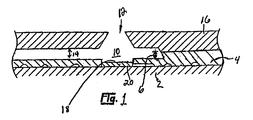
- FIG. 1 is a schematic illustration of the ink jet print head of the invention.
- the ink jet print head comprises a substrate 2, a radiation cured resin layer 4 on the substrate, an ink ejection chamber 10, an orifice 12, and a passage way 6.
- the passage way 6 is in fluid flow communication with the orifice 12.
- the print head contains an energy imparting device 18 for discharging the ink through the orifice 12.
- the energy for discharging the ink is generated by applying electronic signals to the energy imparting device 18 as desired.
- These energy imparting devices include heat resistance elements or piezoelectric elements which are arranged in predetermined patterns on the substrate 2.
- ELVACITE 2008 is a low molecular weight polymethylmethacrylate (comprising 2-3% carboxylic acid functionality) which is a nonphotoreactive, impact absorbing binder that exhibits excellent film forming capabilities as well as providing the good thermal tack and adhesion needed for thermal compression bonding.
- ELVACITE 2008 is available from ICI Acrylics.
- EPON 1001 F is a difunctional epoxy compound which adds to the tensile strength and to the elastomeric properties of the spun on film. EPON 1001 F is available from Shell Chemical Company.
- DEN 431 is a multifunctional epoxy resin that increases crosslink density thereby increasing resolution and improving the resistance to solvent swelling. DEN 431 is available from Dow Chemical Company.
- Cyracure UVI 6974 is a aromatic complex salt photoinitiator allowing for the definition of patterns in the film when UV light is shown through an optical mask onto a film below. The resulting images are defined by developing away the uncrosslinked film leaving behind high resolution images in the epoxy thick film.
- a 50g/50g solution of ELVACITE 2008 in gamma-butyrolactone was prepared. The mixture was turned for 16 hours on a roller mill. EPON 1001F, 40 grams, was crushed to a powder and added to the solution. The solution was turned for 16 hours on a roller mill. DEN 431, 10 grams, and 5 grams limonene oxide (a low viscosity liquid monofunctional epoxy) were added to the solution and mixed until the solution was homogeneous. UVI 6974, 10 grams, was added and mixed thoroughly.
- the solution was spun onto a substrate used to make a printhead for an inkjet printer by means of a silicon wafer in a spinner at 2.5K rpm for 30 seconds to provide a 30 micron film which was subsequently developed. After this an inkjet nozzle plate was attached to the substrate by a conventional adhesion technique to produce an inkjet printhead. After placing the inkjet printhead in a conventional ink jet ink (at 60 °C), the nozzle plate began to detach after about 1 month.
- a 50g/50g solution of ELVACITE 2008 in gamma-butyrolactone was prepared. The mixture was turned for 16 hours on a roller mill. EPON 1001F, 40 grams, was crushed to a powder and added to the solution. The solution was turned for 16 hours on a roller mill. DEN 431, 10 grams, was added to the solution and mixed until the solution was homogeneous. UVI 6974, 5 grams, was added and mixed thoroughly. To the resulting solution, 1 gram of glycidoxypropyltrimethoxy-silane was added.
- the solution was spun onto a substrate used to make a printhead for an ink jet printer by means of a silicon wafer in a spinner at 2.5K rpm for 30 seconds to provide a 30 micron film which was developed.
- a phenolic butyral coated polyimide ink jet nozzle plate was attached to the substrate by a conventional technique to produce an ink jet printhead. After placing the ink jet printhead in a conventional ink jet ink (at 60 °C), the nozzle plate did not, even remotely, begin to detach after about 1 month.
- a curable resin and ink jet printhead were prepared in a manner similar to the one described in Example 2 except that the Elvacite 2008: gamma-butyrolactone ratio was 50g/100g, the spinner was set at 3.0 rpm for 60 seconds and the film was 2.5 microns.
- the resulting printhead was placed in a conventional ink jet ink at 60 °C. After about 1 month, the nozzle plate did not, even remotely, begin to detach from the substrate.
Landscapes
- Engineering & Computer Science (AREA)
- Manufacturing & Machinery (AREA)
- Chemical & Material Sciences (AREA)
- Medicinal Chemistry (AREA)
- Health & Medical Sciences (AREA)
- Chemical Kinetics & Catalysis (AREA)
- Physics & Mathematics (AREA)
- Polymers & Plastics (AREA)
- Organic Chemistry (AREA)
- General Physics & Mathematics (AREA)
- Spectroscopy & Molecular Physics (AREA)
- Epoxy Resins (AREA)
- Particle Formation And Scattering Control In Inkjet Printers (AREA)
- Compositions Of Macromolecular Compounds (AREA)
- Polymerization Catalysts (AREA)
- Inks, Pencil-Leads, Or Crayons (AREA)
Claims (6)
- Tintenstrahldruckkopf mit Tintenkanälen, welche verbunden sind mit einer Tintenaustrittsöffnung, bereitgestellt auf einem Substrat, wobei die genannten Kanäle gebildet werden, indem eine Schicht aus einer durch Strahlung härtbaren Harzzusammensetzung einer Bestrahlung mit der genannten Strahlung in einem vorbestimmten Muster unterworfen wird, um dadurch einen gehärteten Bereich der genannten Harzzusammensetzung zu bilden, und der ungehärtete Harzzusammensetzungsbereich von der genannten Schicht entfernt wird, wobei die genannte durch Strahlung härtbare Harzzusammensetzung umfaßt:wobei die genannte härtbare Harzzusammensetzung an einer Seite an das Substrat und an der gegenüberliegenden Seite an eine mit Phenolbutyral beschichtete Düsenplatte gebunden ist.(A) 5 bis 50 Gew.-% einer ersten bifunktionellen Epoxidverbindung,(B) 0,05 bis 20 Gew.-% einer zweiten multifunktionellen vernetzenden Epoxidverbindung,(C) 1,0 bis 10 Gew.-% eines Photoinitiators, der in der Lage ist, ein Kation zu erzeugen,(D) ein Silan mit einer funktionellen Gruppe, die in der Lage ist, mit wenigstens einem Element, ausgewählt aus A, B und C, zu reagieren, und(E) 20 bis 90 Gew.-% eines nicht-photoreaktiven Lösungsmittels, wobei die Gewichtsprozente auf das Gesamtgewicht der Harzzusammensetzung bezogen sind,
- Tintenstrahldruckkopf gemäß Anspruch 1, wobei das Molekulargewicht der ersten bifunktionellen Epoxidverbindung 100 bis 100000 beträgt.
- Tintenstrahldruckkopf gemäß Anspruch 1 oder Anspruch 2, wobei die erste bifunktionelle Epoxidverbindung ein Diglycidylether von Bisphenol A ist.
- Tintenstrahldruckkopf gemäß irgendeinem der Ansprüche 1 bis 3, wobei der Photoinitiator ein aromatischer Komplexsalz-Photoinitiator ist, ausgewählt aus der Gruppe, bestehend aus Onium-Salzen eines Gruppe-VA-Elements, Onium-Salzen eines Gruppe VIA-Elements, aromatischen Halonium-Salzen und Kombinationen davon.
- Tintenstrahlkopf gemäß irgendeinem der Ansprüche 1 bis 4, wobei die Harzzusammensetzung ferner bis zu etwa 35 Gew.-% eines Acrylat- oder Methacrylatpolymers umfaßt.
- Tintenstrahldruckkopf gemäß Anspruch 5, wobei das Acrylatoder Methacrylatpolymer ausgewählt ist aus der Gruppe, bestehend aus Copolymeren aus Methylmethacrylat/n-Butylmethacrylat, Methylmethacrylat/n-Butylmethacrylat/Hydroxyethylmethacrylat, Methylmethacrylat/Styrol/n-Butylacrylat/Hydroxyethylacrylat, Styrol/Hydroxyethylacrylat und n-Butylacrylat/Hydroxyethylacrylat/Vinylacetat.
Applications Claiming Priority (2)
| Application Number | Priority Date | Filing Date | Title |
|---|---|---|---|
| US827564 | 1997-03-28 | ||
| US08/827,564 US5907333A (en) | 1997-03-28 | 1997-03-28 | Ink jet print head containing a radiation curable resin layer |
Publications (2)
| Publication Number | Publication Date |
|---|---|
| EP0867488A1 EP0867488A1 (de) | 1998-09-30 |
| EP0867488B1 true EP0867488B1 (de) | 2003-06-04 |
Family
ID=25249544
Family Applications (1)
| Application Number | Title | Priority Date | Filing Date |
|---|---|---|---|
| EP98302358A Expired - Lifetime EP0867488B1 (de) | 1997-03-28 | 1998-03-27 | Strahlungshärtbare Harzschicht enthaltender Tintenstrahldruckkopf |
Country Status (8)
| Country | Link |
|---|---|
| US (1) | US5907333A (de) |
| EP (1) | EP0867488B1 (de) |
| JP (1) | JP4051467B2 (de) |
| KR (1) | KR100527608B1 (de) |
| CN (1) | CN1119245C (de) |
| AT (1) | ATE242299T1 (de) |
| DE (1) | DE69815189T2 (de) |
| TW (1) | TW412633B (de) |
Families Citing this family (32)
| Publication number | Priority date | Publication date | Assignee | Title |
|---|---|---|---|---|
| US6124372A (en) | 1996-08-29 | 2000-09-26 | Xerox Corporation | High performance polymer compositions having photosensitivity-imparting substituents and thermal sensitivity-imparting substituents |
| US6158843A (en) * | 1997-03-28 | 2000-12-12 | Lexmark International, Inc. | Ink jet printer nozzle plates with ink filtering projections |
| US6193359B1 (en) * | 1998-04-21 | 2001-02-27 | Lexmark International, Inc. | Ink jet print head containing a radiation curable resin layer |
| US6371600B1 (en) * | 1998-06-15 | 2002-04-16 | Lexmark International, Inc. | Polymeric nozzle plate |
| CA2253409C (en) * | 1998-11-04 | 2003-06-17 | Microjet Technology Co., Ltd. | Method and device for manufacturing ink jet printhead |
| US6294317B1 (en) * | 1999-07-14 | 2001-09-25 | Xerox Corporation | Patterned photoresist structures having features with high aspect ratios and method of forming such structures |
| US6322848B1 (en) * | 1999-10-26 | 2001-11-27 | Lord Corporation | Flexible epoxy encapsulating material |
| WO2001042023A1 (en) | 1999-12-10 | 2001-06-14 | Fujitsu Limited | Ink jet head, method of producing ink jet heads, and printer |
| US6409316B1 (en) | 2000-03-28 | 2002-06-25 | Xerox Corporation | Thermal ink jet printhead with crosslinked polymer layer |
| US6327458B1 (en) | 2000-04-06 | 2001-12-04 | Lexmark International, Inc. | Method and apparatus for positioning paper in an imaging system having an intermediate transfer medium |
| US6283584B1 (en) | 2000-04-18 | 2001-09-04 | Lexmark International, Inc. | Ink jet flow distribution system for ink jet printer |
| US6830646B2 (en) * | 2000-08-30 | 2004-12-14 | Lexmark International, Inc. | Radiation curable resin layer |
| US6783918B2 (en) * | 2000-08-30 | 2004-08-31 | Lexmark International, Inc. | Radiation curable resin layer |
| US6387719B1 (en) * | 2001-02-28 | 2002-05-14 | Lexmark International, Inc. | Method for improving adhesion |
| CN1304498C (zh) * | 2002-06-20 | 2007-03-14 | 日立麦克赛尔株式会社 | 颜料油墨组合物 |
| DE10328525B4 (de) * | 2003-06-24 | 2008-02-28 | W.C. Heraeus Gmbh | Verwendung von Siebdrucklacken bei der Herstellung von Abziehbildern zur Dekoration von keramischen Substraten, Porzellan und Glas |
| US7244014B2 (en) * | 2003-10-28 | 2007-07-17 | Lexmark International, Inc. | Micro-fluid ejection devices and method therefor |
| US7183353B2 (en) * | 2004-04-29 | 2007-02-27 | Hewlett-Packard Development Company, L.P. | UV curable coating composition |
| US7196136B2 (en) * | 2004-04-29 | 2007-03-27 | Hewlett-Packard Development Company, L.P. | UV curable coating composition |
| KR100590881B1 (ko) * | 2004-05-14 | 2006-06-19 | 삼성전자주식회사 | 광경화성 수지 조성물 및 그의 패터닝 방법 |
| US7204574B2 (en) * | 2004-06-30 | 2007-04-17 | Lexmark International, Inc. | Polyimide thickfilm flow feature photoresist and method of applying same |
| US20070085881A1 (en) * | 2004-08-19 | 2007-04-19 | Cornell Robert W | Methods for improved micro-fluid ejection devices |
| JP4646610B2 (ja) * | 2004-12-01 | 2011-03-09 | キヤノン株式会社 | インクジェット記録ヘッド |
| KR100670004B1 (ko) | 2005-02-25 | 2007-01-19 | 삼성전자주식회사 | 잉크젯 프린트헤드 |
| US20060221115A1 (en) * | 2005-04-01 | 2006-10-05 | Lexmark International, Inc. | Methods for bonding radiation curable compositions to a substrate |
| KR100657334B1 (ko) * | 2005-09-13 | 2006-12-14 | 삼성전자주식회사 | 잉크젯 프린터 헤드의 제조 방법 및 상기 방법에 의하여제조된 잉크젯 프린터 헤드 |
| US7571979B2 (en) * | 2005-09-30 | 2009-08-11 | Lexmark International, Inc. | Thick film layers and methods relating thereto |
| JP4850637B2 (ja) * | 2006-09-04 | 2012-01-11 | キヤノン株式会社 | 液体吐出ヘッドの製造方法および液体吐出ヘッド |
| US7784917B2 (en) | 2007-10-03 | 2010-08-31 | Lexmark International, Inc. | Process for making a micro-fluid ejection head structure |
| US20090186293A1 (en) * | 2008-01-23 | 2009-07-23 | Bryan Thomas Fannin | Dry film protoresist for a micro-fluid ejection head and method therefor |
| CN102802958B (zh) * | 2009-06-29 | 2015-11-25 | 录象射流技术公司 | 具有耐溶剂性的热喷墨印刷头 |
| CN102576801B (zh) * | 2009-10-12 | 2015-04-08 | 惠普发展公司,有限责任合伙企业 | 修复压电构件的缺陷的方法及使用其修复的流体运动装置 |
Family Cites Families (25)
| Publication number | Priority date | Publication date | Assignee | Title |
|---|---|---|---|---|
| US4090936A (en) * | 1976-10-28 | 1978-05-23 | Minnesota Mining And Manufacturing Company | Photohardenable compositions |
| US4173476A (en) * | 1978-02-08 | 1979-11-06 | Minnesota Mining And Manufacturing Company | Complex salt photoinitiator |
| US4297401A (en) * | 1978-12-26 | 1981-10-27 | Minnesota Mining & Manufacturing Company | Liquid crystal display and photopolymerizable sealant therefor |
| US4401537A (en) * | 1978-12-26 | 1983-08-30 | Minnesota Mining And Manufacturing Company | Liquid crystal display and photopolymerizable sealant therefor |
| US4392013A (en) * | 1979-12-27 | 1983-07-05 | Asahi Kasei Kogyo Kabushiki Kaisha | Fine-patterned thick film conductor structure and manufacturing method thereof |
| JPS58220756A (ja) * | 1982-06-18 | 1983-12-22 | Canon Inc | インクジエツト記録ヘツドの製造方法 |
| US4609427A (en) * | 1982-06-25 | 1986-09-02 | Canon Kabushiki Kaisha | Method for producing ink jet recording head |
| US4426431A (en) * | 1982-09-22 | 1984-01-17 | Eastman Kodak Company | Radiation-curable compositions for restorative and/or protective treatment of photographic elements |
| JPH0645242B2 (ja) * | 1984-12-28 | 1994-06-15 | キヤノン株式会社 | 液体噴射記録ヘツドの製造方法 |
| US4623676A (en) * | 1985-01-18 | 1986-11-18 | Minnesota Mining And Manufacturing Company | Protective coating for phototools |
| US4688056A (en) * | 1985-07-13 | 1987-08-18 | Canon Kabushiki Kaisha | Liquid jet recording head having a layer of a resin composition curable with an active energy ray |
| US4688053A (en) * | 1985-07-13 | 1987-08-18 | Canon Kabushiki Kaisha | Liquid jet recording head having a layer of a resin composition curable with an active energy ray |
| JPH02113022A (ja) * | 1988-10-20 | 1990-04-25 | Yokohama Rubber Co Ltd:The | 紫外線硬化型エポキシ樹脂組成物 |
| US5578417A (en) * | 1989-01-10 | 1996-11-26 | Canon Kabushiki Kaisha | Liquid jet recording head and recording apparatus having same |
| KR910010027B1 (ko) * | 1989-03-03 | 1991-12-10 | 동양나이론 주식회사 | 열가소성 수지 조성물 |
| US4948645A (en) * | 1989-08-01 | 1990-08-14 | Rogers Corporation | Tape automated bonding and method of making the same |
| JP2897272B2 (ja) * | 1989-08-25 | 1999-05-31 | 東洋紡績株式会社 | 電子部品封止用硬化型樹脂組成物 |
| JP2697937B2 (ja) * | 1989-12-15 | 1998-01-19 | キヤノン株式会社 | 活性エネルギー線硬化性樹脂組成物 |
| EP0481788B1 (de) * | 1990-10-18 | 1997-01-02 | Canon Kabushiki Kaisha | Herstellungsverfahren eines Tintenstrahldruckkopfes |
| US5290667A (en) * | 1991-12-03 | 1994-03-01 | Canon Kabushiki Kaisha | Method for producing ink jet recording head |
| US5297331A (en) * | 1992-04-03 | 1994-03-29 | Hewlett-Packard Company | Method for aligning a substrate with respect to orifices in an inkjet printhead |
| US5275695A (en) * | 1992-12-18 | 1994-01-04 | International Business Machines Corporation | Process for generating beveled edges |
| JP3143307B2 (ja) * | 1993-02-03 | 2001-03-07 | キヤノン株式会社 | インクジェット記録ヘッドの製造方法 |
| JPH091804A (ja) * | 1995-06-21 | 1997-01-07 | Canon Inc | インクジェット記録ヘッドの製造方法および同方法により製造されたインクジェット記録ヘッド |
| JPH0924614A (ja) * | 1995-07-11 | 1997-01-28 | Canon Inc | 液体噴射記録ヘッド用保護膜材料および該保護膜材料を用いた液体噴射記録ヘッドおよび液体噴射記録ヘッドキット |
-
1997
- 1997-03-28 US US08/827,564 patent/US5907333A/en not_active Expired - Lifetime
-
1998
- 1998-03-27 EP EP98302358A patent/EP0867488B1/de not_active Expired - Lifetime
- 1998-03-27 DE DE69815189T patent/DE69815189T2/de not_active Expired - Lifetime
- 1998-03-27 CN CN98108878A patent/CN1119245C/zh not_active Expired - Lifetime
- 1998-03-27 AT AT98302358T patent/ATE242299T1/de not_active IP Right Cessation
- 1998-03-28 KR KR1019980010855A patent/KR100527608B1/ko not_active Expired - Fee Related
- 1998-03-30 JP JP12383498A patent/JP4051467B2/ja not_active Expired - Fee Related
- 1998-06-23 TW TW087104671A patent/TW412633B/zh not_active IP Right Cessation
Also Published As
| Publication number | Publication date |
|---|---|
| JP4051467B2 (ja) | 2008-02-27 |
| EP0867488A1 (de) | 1998-09-30 |
| TW412633B (en) | 2000-11-21 |
| CN1197817A (zh) | 1998-11-04 |
| DE69815189T2 (de) | 2004-06-03 |
| KR100527608B1 (ko) | 2006-02-28 |
| ATE242299T1 (de) | 2003-06-15 |
| CN1119245C (zh) | 2003-08-27 |
| KR19980080815A (ko) | 1998-11-25 |
| JPH10338798A (ja) | 1998-12-22 |
| DE69815189D1 (de) | 2003-07-10 |
| US5907333A (en) | 1999-05-25 |
Similar Documents
| Publication | Publication Date | Title |
|---|---|---|
| US5907333A (en) | Ink jet print head containing a radiation curable resin layer | |
| US6193359B1 (en) | Ink jet print head containing a radiation curable resin layer | |
| JP3143307B2 (ja) | インクジェット記録ヘッドの製造方法 | |
| US7954927B2 (en) | Nozzle members, compositions, and methods for micro-fluid ejection heads | |
| US6409316B1 (en) | Thermal ink jet printhead with crosslinked polymer layer | |
| US8173031B2 (en) | Photoimageable nozzle members and methods relating thereto | |
| EP0734866A2 (de) | Verfahren zum Herstellen eines Tintenstrahlkopfes | |
| US8007990B2 (en) | Thick film layers and methods relating thereto | |
| US7485412B2 (en) | Ink jet head manufacturing method and ink jet head manufactured by the manufacturing method | |
| KR20070043805A (ko) | 감광성 수지 조성물, 감광성 수지 조성물을 사용한 잉크젯헤드 및 잉크젯 헤드의 제조 방법 | |
| JP3986060B2 (ja) | インクジェット記録ヘッドの流路構成部材及びインクジェット記録ヘッドの製造方法 | |
| US20070142491A1 (en) | Resin composition, resin cured product, and liquid discharge head | |
| US20060221115A1 (en) | Methods for bonding radiation curable compositions to a substrate | |
| JP2001179990A (ja) | インクジェット記録ヘッド及びその製造方法 | |
| US11987052B2 (en) | Photoimageable nozzle plate having increased solvent resistance | |
| US6982022B2 (en) | Formation of photopatterned ink jet nozzle plates by transfer methods | |
| US7423073B2 (en) | Radiation curable compositions having improved flexibility | |
| JPH04312856A (ja) | 液体噴射記録ヘッド、その製造方法、及び同ヘッドを備えた記録装置 | |
| JP2005169846A (ja) | 液体噴射記録ヘッドの製造方法、及び該製造工程における中間構造体 | |
| KR20060094687A (ko) | 잉크젯 프린트헤드 |
Legal Events
| Date | Code | Title | Description |
|---|---|---|---|
| PUAI | Public reference made under article 153(3) epc to a published international application that has entered the european phase |
Free format text: ORIGINAL CODE: 0009012 |
|
| AK | Designated contracting states |
Kind code of ref document: A1 Designated state(s): AT BE CH DE DK ES FI FR GB GR IE IT LI LU MC NL PT SE |
|
| AX | Request for extension of the european patent |
Free format text: AL;LT;LV;MK;RO;SI |
|
| 17P | Request for examination filed |
Effective date: 19990318 |
|
| AKX | Designation fees paid |
Free format text: AT BE CH DE DK ES FI FR GB GR IE IT LI LU MC NL PT SE |
|
| AXX | Extension fees paid |
Free format text: AL PAYMENT 19990330;LT PAYMENT 19990330;LV PAYMENT 19990330;MK PAYMENT 19990330;RO PAYMENT 19990330;SI PAYMENT 19990330 |
|
| 17Q | First examination report despatched |
Effective date: 20020131 |
|
| GRAH | Despatch of communication of intention to grant a patent |
Free format text: ORIGINAL CODE: EPIDOS IGRA |
|
| GRAH | Despatch of communication of intention to grant a patent |
Free format text: ORIGINAL CODE: EPIDOS IGRA |
|
| GRAA | (expected) grant |
Free format text: ORIGINAL CODE: 0009210 |
|
| AK | Designated contracting states |
Designated state(s): AT BE CH DE DK ES FI FR GB GR IE IT LI LU MC NL PT SE |
|
| AX | Request for extension of the european patent |
Extension state: AL LT LV MK RO SI |
|
| PG25 | Lapsed in a contracting state [announced via postgrant information from national office to epo] |
Ref country code: NL Free format text: LAPSE BECAUSE OF FAILURE TO SUBMIT A TRANSLATION OF THE DESCRIPTION OR TO PAY THE FEE WITHIN THE PRESCRIBED TIME-LIMIT Effective date: 20030604 Ref country code: LI Free format text: LAPSE BECAUSE OF FAILURE TO SUBMIT A TRANSLATION OF THE DESCRIPTION OR TO PAY THE FEE WITHIN THE PRESCRIBED TIME-LIMIT Effective date: 20030604 Ref country code: IT Free format text: LAPSE BECAUSE OF FAILURE TO SUBMIT A TRANSLATION OF THE DESCRIPTION OR TO PAY THE FEE WITHIN THE PRESCRIBED TIME-LIMIT;WARNING: LAPSES OF ITALIAN PATENTS WITH EFFECTIVE DATE BEFORE 2007 MAY HAVE OCCURRED AT ANY TIME BEFORE 2007. THE CORRECT EFFECTIVE DATE MAY BE DIFFERENT FROM THE ONE RECORDED. Effective date: 20030604 Ref country code: FI Free format text: LAPSE BECAUSE OF FAILURE TO SUBMIT A TRANSLATION OF THE DESCRIPTION OR TO PAY THE FEE WITHIN THE PRESCRIBED TIME-LIMIT Effective date: 20030604 Ref country code: CH Free format text: LAPSE BECAUSE OF FAILURE TO SUBMIT A TRANSLATION OF THE DESCRIPTION OR TO PAY THE FEE WITHIN THE PRESCRIBED TIME-LIMIT Effective date: 20030604 Ref country code: BE Free format text: LAPSE BECAUSE OF FAILURE TO SUBMIT A TRANSLATION OF THE DESCRIPTION OR TO PAY THE FEE WITHIN THE PRESCRIBED TIME-LIMIT Effective date: 20030604 Ref country code: AT Free format text: LAPSE BECAUSE OF FAILURE TO SUBMIT A TRANSLATION OF THE DESCRIPTION OR TO PAY THE FEE WITHIN THE PRESCRIBED TIME-LIMIT Effective date: 20030604 |
|
| REG | Reference to a national code |
Ref country code: GB Ref legal event code: FG4D |
|
| REG | Reference to a national code |
Ref country code: CH Ref legal event code: EP |
|
| REG | Reference to a national code |
Ref country code: IE Ref legal event code: FG4D |
|
| REF | Corresponds to: |
Ref document number: 69815189 Country of ref document: DE Date of ref document: 20030710 Kind code of ref document: P |
|
| PG25 | Lapsed in a contracting state [announced via postgrant information from national office to epo] |
Ref country code: SE Free format text: LAPSE BECAUSE OF FAILURE TO SUBMIT A TRANSLATION OF THE DESCRIPTION OR TO PAY THE FEE WITHIN THE PRESCRIBED TIME-LIMIT Effective date: 20030904 Ref country code: PT Free format text: LAPSE BECAUSE OF FAILURE TO SUBMIT A TRANSLATION OF THE DESCRIPTION OR TO PAY THE FEE WITHIN THE PRESCRIBED TIME-LIMIT Effective date: 20030904 Ref country code: GR Free format text: LAPSE BECAUSE OF FAILURE TO SUBMIT A TRANSLATION OF THE DESCRIPTION OR TO PAY THE FEE WITHIN THE PRESCRIBED TIME-LIMIT Effective date: 20030904 Ref country code: DK Free format text: LAPSE BECAUSE OF FAILURE TO SUBMIT A TRANSLATION OF THE DESCRIPTION OR TO PAY THE FEE WITHIN THE PRESCRIBED TIME-LIMIT Effective date: 20030904 |
|
| PG25 | Lapsed in a contracting state [announced via postgrant information from national office to epo] |
Ref country code: ES Free format text: LAPSE BECAUSE OF FAILURE TO SUBMIT A TRANSLATION OF THE DESCRIPTION OR TO PAY THE FEE WITHIN THE PRESCRIBED TIME-LIMIT Effective date: 20030915 |
|
| NLV1 | Nl: lapsed or annulled due to failure to fulfill the requirements of art. 29p and 29m of the patents act | ||
| LTIE | Lt: invalidation of european patent or patent extension |
Effective date: 20030604 |
|
| REG | Reference to a national code |
Ref country code: CH Ref legal event code: PL |
|
| ET | Fr: translation filed | ||
| PLBE | No opposition filed within time limit |
Free format text: ORIGINAL CODE: 0009261 |
|
| STAA | Information on the status of an ep patent application or granted ep patent |
Free format text: STATUS: NO OPPOSITION FILED WITHIN TIME LIMIT |
|
| 26N | No opposition filed |
Effective date: 20040305 |
|
| PGFP | Annual fee paid to national office [announced via postgrant information from national office to epo] |
Ref country code: MC Payment date: 20070312 Year of fee payment: 10 |
|
| PGFP | Annual fee paid to national office [announced via postgrant information from national office to epo] |
Ref country code: LU Payment date: 20070403 Year of fee payment: 10 |
|
| PG25 | Lapsed in a contracting state [announced via postgrant information from national office to epo] |
Ref country code: MC Free format text: LAPSE BECAUSE OF NON-PAYMENT OF DUE FEES Effective date: 20080331 |
|
| PG25 | Lapsed in a contracting state [announced via postgrant information from national office to epo] |
Ref country code: LU Free format text: LAPSE BECAUSE OF NON-PAYMENT OF DUE FEES Effective date: 20080327 |
|
| PGFP | Annual fee paid to national office [announced via postgrant information from national office to epo] |
Ref country code: IE Payment date: 20120326 Year of fee payment: 15 |
|
| REG | Reference to a national code |
Ref country code: GB Ref legal event code: 732E Free format text: REGISTERED BETWEEN 20131107 AND 20131113 |
|
| REG | Reference to a national code |
Ref country code: IE Ref legal event code: MM4A |
|
| REG | Reference to a national code |
Ref country code: DE Ref legal event code: R082 Ref document number: 69815189 Country of ref document: DE Representative=s name: ABITZ & PARTNER PATENTANWAELTE MBB, DE Effective date: 20131107 Ref country code: DE Ref legal event code: R082 Ref document number: 69815189 Country of ref document: DE Representative=s name: ABITZ & PARTNER, DE Effective date: 20131107 Ref country code: DE Ref legal event code: R081 Ref document number: 69815189 Country of ref document: DE Owner name: FUNAI ELECTRIC CO., LTD, DAITO CITY, JP Free format text: FORMER OWNER: LEXMARK INTERNATIONAL, INC., LEXINGTON, KY., US Effective date: 20131107 Ref country code: DE Ref legal event code: R081 Ref document number: 69815189 Country of ref document: DE Owner name: FUNAI ELECTRIC CO., LTD, JP Free format text: FORMER OWNER: LEXMARK INTERNATIONAL, INC., LEXINGTON, US Effective date: 20131107 |
|
| PG25 | Lapsed in a contracting state [announced via postgrant information from national office to epo] |
Ref country code: IE Free format text: LAPSE BECAUSE OF NON-PAYMENT OF DUE FEES Effective date: 20130327 |
|
| REG | Reference to a national code |
Ref country code: FR Ref legal event code: TP Owner name: FUNAI ELECTRIC CO LTD, JP Effective date: 20140102 |
|
| REG | Reference to a national code |
Ref country code: FR Ref legal event code: PLFP Year of fee payment: 18 |
|
| REG | Reference to a national code |
Ref country code: FR Ref legal event code: PLFP Year of fee payment: 19 |
|
| PGFP | Annual fee paid to national office [announced via postgrant information from national office to epo] |
Ref country code: FR Payment date: 20160208 Year of fee payment: 19 Ref country code: GB Payment date: 20160323 Year of fee payment: 19 |
|
| PGFP | Annual fee paid to national office [announced via postgrant information from national office to epo] |
Ref country code: DE Payment date: 20170321 Year of fee payment: 20 |
|
| GBPC | Gb: european patent ceased through non-payment of renewal fee |
Effective date: 20170327 |
|
| REG | Reference to a national code |
Ref country code: FR Ref legal event code: ST Effective date: 20171130 |
|
| PG25 | Lapsed in a contracting state [announced via postgrant information from national office to epo] |
Ref country code: FR Free format text: LAPSE BECAUSE OF NON-PAYMENT OF DUE FEES Effective date: 20170331 |
|
| PG25 | Lapsed in a contracting state [announced via postgrant information from national office to epo] |
Ref country code: GB Free format text: LAPSE BECAUSE OF NON-PAYMENT OF DUE FEES Effective date: 20170327 |
|
| REG | Reference to a national code |
Ref country code: DE Ref legal event code: R071 Ref document number: 69815189 Country of ref document: DE |