EP0868740B1 - Verfahren und vorrichtung zur maldi analyse - Google Patents
Verfahren und vorrichtung zur maldi analyse Download PDFInfo
- Publication number
- EP0868740B1 EP0868740B1 EP97941535A EP97941535A EP0868740B1 EP 0868740 B1 EP0868740 B1 EP 0868740B1 EP 97941535 A EP97941535 A EP 97941535A EP 97941535 A EP97941535 A EP 97941535A EP 0868740 B1 EP0868740 B1 EP 0868740B1
- Authority
- EP
- European Patent Office
- Prior art keywords
- sample
- analyte
- desorbed
- confining
- stage
- Prior art date
- Legal status (The legal status is an assumption and is not a legal conclusion. Google has not performed a legal analysis and makes no representation as to the accuracy of the status listed.)
- Expired - Lifetime
Links
- 238000004458 analytical method Methods 0.000 title claims abstract description 27
- 238000000034 method Methods 0.000 title claims description 37
- 239000000463 material Substances 0.000 claims abstract description 70
- 238000005286 illumination Methods 0.000 claims abstract description 46
- 239000012491 analyte Substances 0.000 claims abstract description 44
- 239000011159 matrix material Substances 0.000 claims abstract description 42
- 239000000758 substrate Substances 0.000 claims abstract description 40
- 239000000835 fiber Substances 0.000 claims abstract description 32
- 238000003795 desorption Methods 0.000 claims abstract description 31
- 150000002500 ions Chemical class 0.000 claims abstract description 27
- 239000013307 optical fiber Substances 0.000 claims abstract description 9
- 238000000605 extraction Methods 0.000 claims description 10
- 229920002521 macromolecule Polymers 0.000 claims description 10
- 150000002605 large molecules Chemical class 0.000 claims description 8
- 239000007789 gas Substances 0.000 claims description 7
- 230000003993 interaction Effects 0.000 claims description 7
- 239000011148 porous material Substances 0.000 claims description 4
- 238000000451 chemical ionisation Methods 0.000 claims description 2
- 238000006243 chemical reaction Methods 0.000 claims description 2
- 230000003750 conditioning effect Effects 0.000 claims description 2
- 238000010494 dissociation reaction Methods 0.000 claims description 2
- 230000005593 dissociations Effects 0.000 claims description 2
- 238000005070 sampling Methods 0.000 claims 2
- 238000000151 deposition Methods 0.000 claims 1
- 238000003384 imaging method Methods 0.000 claims 1
- 230000001133 acceleration Effects 0.000 abstract description 12
- 230000005855 radiation Effects 0.000 abstract description 4
- 230000005012 migration Effects 0.000 abstract description 2
- 238000013508 migration Methods 0.000 abstract description 2
- 230000003595 spectral effect Effects 0.000 abstract description 2
- 238000004611 spectroscopical analysis Methods 0.000 abstract description 2
- 230000005540 biological transmission Effects 0.000 description 13
- 230000008569 process Effects 0.000 description 7
- 238000001228 spectrum Methods 0.000 description 7
- 239000013078 crystal Substances 0.000 description 6
- 230000005684 electric field Effects 0.000 description 6
- 230000007246 mechanism Effects 0.000 description 6
- 239000013081 microcrystal Substances 0.000 description 6
- 239000000126 substance Substances 0.000 description 5
- 238000010276 construction Methods 0.000 description 4
- 239000011521 glass Substances 0.000 description 4
- PEDCQBHIVMGVHV-UHFFFAOYSA-N Glycerine Chemical compound OCC(O)CO PEDCQBHIVMGVHV-UHFFFAOYSA-N 0.000 description 3
- 230000000875 corresponding effect Effects 0.000 description 3
- 238000009826 distribution Methods 0.000 description 3
- 238000004949 mass spectrometry Methods 0.000 description 3
- 239000002184 metal Substances 0.000 description 3
- 102000004169 proteins and genes Human genes 0.000 description 3
- 108090000623 proteins and genes Proteins 0.000 description 3
- 238000000926 separation method Methods 0.000 description 3
- PVNIIMVLHYAWGP-UHFFFAOYSA-N Niacin Chemical compound OC(=O)C1=CC=CN=C1 PVNIIMVLHYAWGP-UHFFFAOYSA-N 0.000 description 2
- 230000004888 barrier function Effects 0.000 description 2
- 230000008859 change Effects 0.000 description 2
- 238000002144 chemical decomposition reaction Methods 0.000 description 2
- 210000001520 comb Anatomy 0.000 description 2
- 238000001514 detection method Methods 0.000 description 2
- 238000013467 fragmentation Methods 0.000 description 2
- 238000006062 fragmentation reaction Methods 0.000 description 2
- 230000006872 improvement Effects 0.000 description 2
- -1 large molecule ions Chemical class 0.000 description 2
- 239000007788 liquid Substances 0.000 description 2
- 108090000765 processed proteins & peptides Proteins 0.000 description 2
- 230000000979 retarding effect Effects 0.000 description 2
- 239000007787 solid Substances 0.000 description 2
- 125000006850 spacer group Chemical group 0.000 description 2
- 230000007480 spreading Effects 0.000 description 2
- 238000003892 spreading Methods 0.000 description 2
- WBYWAXJHAXSJNI-VOTSOKGWSA-M .beta-Phenylacrylic acid Natural products [O-]C(=O)\C=C\C1=CC=CC=C1 WBYWAXJHAXSJNI-VOTSOKGWSA-M 0.000 description 1
- WPYMKLBDIGXBTP-UHFFFAOYSA-N Benzoic acid Natural products OC(=O)C1=CC=CC=C1 WPYMKLBDIGXBTP-UHFFFAOYSA-N 0.000 description 1
- WBYWAXJHAXSJNI-SREVYHEPSA-N Cinnamic acid Chemical compound OC(=O)\C=C/C1=CC=CC=C1 WBYWAXJHAXSJNI-SREVYHEPSA-N 0.000 description 1
- 108020004414 DNA Proteins 0.000 description 1
- 241000289669 Erinaceus europaeus Species 0.000 description 1
- 241000102542 Kara Species 0.000 description 1
- 239000002250 absorbent Substances 0.000 description 1
- 150000001491 aromatic compounds Chemical class 0.000 description 1
- 125000003118 aryl group Chemical group 0.000 description 1
- WXBLLCUINBKULX-UHFFFAOYSA-N benzoic acid Chemical compound OC(=O)C1=CC=CC=C1.OC(=O)C1=CC=CC=C1 WXBLLCUINBKULX-UHFFFAOYSA-N 0.000 description 1
- 235000010233 benzoic acid Nutrition 0.000 description 1
- 229920001222 biopolymer Polymers 0.000 description 1
- 230000015572 biosynthetic process Effects 0.000 description 1
- 239000000919 ceramic Substances 0.000 description 1
- 229930016911 cinnamic acid Natural products 0.000 description 1
- 235000013985 cinnamic acid Nutrition 0.000 description 1
- 238000004140 cleaning Methods 0.000 description 1
- 150000001875 compounds Chemical class 0.000 description 1
- 230000001010 compromised effect Effects 0.000 description 1
- 230000002596 correlated effect Effects 0.000 description 1
- 238000002425 crystallisation Methods 0.000 description 1
- 230000008025 crystallization Effects 0.000 description 1
- 230000003111 delayed effect Effects 0.000 description 1
- 230000001419 dependent effect Effects 0.000 description 1
- 238000009792 diffusion process Methods 0.000 description 1
- 238000001035 drying Methods 0.000 description 1
- 230000000694 effects Effects 0.000 description 1
- 238000001704 evaporation Methods 0.000 description 1
- 230000008020 evaporation Effects 0.000 description 1
- 238000002474 experimental method Methods 0.000 description 1
- 239000002657 fibrous material Substances 0.000 description 1
- 230000004907 flux Effects 0.000 description 1
- 239000011888 foil Substances 0.000 description 1
- 239000012634 fragment Substances 0.000 description 1
- 230000003760 hair shine Effects 0.000 description 1
- 238000011065 in-situ storage Methods 0.000 description 1
- 238000005040 ion trap Methods 0.000 description 1
- 230000001788 irregular Effects 0.000 description 1
- 238000001869 matrix assisted laser desorption--ionisation mass spectrum Methods 0.000 description 1
- 238000005259 measurement Methods 0.000 description 1
- 239000012528 membrane Substances 0.000 description 1
- WBYWAXJHAXSJNI-UHFFFAOYSA-N methyl p-hydroxycinnamate Natural products OC(=O)C=CC1=CC=CC=C1 WBYWAXJHAXSJNI-UHFFFAOYSA-N 0.000 description 1
- 238000001393 microlithography Methods 0.000 description 1
- 239000000203 mixture Substances 0.000 description 1
- 229960003512 nicotinic acid Drugs 0.000 description 1
- 235000001968 nicotinic acid Nutrition 0.000 description 1
- 239000011664 nicotinic acid Substances 0.000 description 1
- 230000003287 optical effect Effects 0.000 description 1
- 229920000642 polymer Polymers 0.000 description 1
- 238000002360 preparation method Methods 0.000 description 1
- 102000004196 processed proteins & peptides Human genes 0.000 description 1
- 230000035945 sensitivity Effects 0.000 description 1
- 150000003384 small molecules Chemical class 0.000 description 1
- 239000011343 solid material Substances 0.000 description 1
- 239000002904 solvent Substances 0.000 description 1
- 229920001059 synthetic polymer Polymers 0.000 description 1
- XLYOFNOQVPJJNP-UHFFFAOYSA-N water Substances O XLYOFNOQVPJJNP-UHFFFAOYSA-N 0.000 description 1
Images



Classifications
-
- H—ELECTRICITY
- H01—ELECTRIC ELEMENTS
- H01J—ELECTRIC DISCHARGE TUBES OR DISCHARGE LAMPS
- H01J49/00—Particle spectrometers or separator tubes
- H01J49/02—Details
- H01J49/10—Ion sources; Ion guns
- H01J49/16—Ion sources; Ion guns using surface ionisation, e.g. field-, thermionic- or photo-emission
- H01J49/161—Ion sources; Ion guns using surface ionisation, e.g. field-, thermionic- or photo-emission using photoionisation, e.g. by laser
- H01J49/164—Laser desorption/ionisation, e.g. matrix-assisted laser desorption/ionisation [MALDI]
-
- H—ELECTRICITY
- H01—ELECTRIC ELEMENTS
- H01J—ELECTRIC DISCHARGE TUBES OR DISCHARGE LAMPS
- H01J49/00—Particle spectrometers or separator tubes
- H01J49/02—Details
- H01J49/04—Arrangements for introducing or extracting samples to be analysed, e.g. vacuum locks; Arrangements for external adjustment of electron- or ion-optical components
- H01J49/0409—Sample holders or containers
- H01J49/0418—Sample holders or containers for laser desorption, e.g. matrix-assisted laser desorption/ionisation [MALDI] plates or surface enhanced laser desorption/ionisation [SELDI] plates
-
- B—PERFORMING OPERATIONS; TRANSPORTING
- B01—PHYSICAL OR CHEMICAL PROCESSES OR APPARATUS IN GENERAL
- B01J—CHEMICAL OR PHYSICAL PROCESSES, e.g. CATALYSIS OR COLLOID CHEMISTRY; THEIR RELEVANT APPARATUS
- B01J2219/00—Chemical, physical or physico-chemical processes in general; Their relevant apparatus
- B01J2219/00274—Sequential or parallel reactions; Apparatus and devices for combinatorial chemistry or for making arrays; Chemical library technology
- B01J2219/00277—Apparatus
- B01J2219/00351—Means for dispensing and evacuation of reagents
- B01J2219/00387—Applications using probes
-
- C—CHEMISTRY; METALLURGY
- C40—COMBINATORIAL TECHNOLOGY
- C40B—COMBINATORIAL CHEMISTRY; LIBRARIES, e.g. CHEMICAL LIBRARIES
- C40B60/00—Apparatus specially adapted for use in combinatorial chemistry or with libraries
- C40B60/14—Apparatus specially adapted for use in combinatorial chemistry or with libraries for creating libraries
Definitions
- the present invention relates to Matrix Assisted Laser Desorption/Ionization Mass Spectrometry (MALDI-MS).
- MALDI-MS Matrix Assisted Laser Desorption/Ionization Mass Spectrometry
- This method introduced by Karas and Hillenkamp in 1988 has become established as a method for mass determination of biopolymers and substances such as peptides, proteins and DNA fragments.
- the substance to be analyzed is typically placed in a solution of matrix material and coated onto a support.
- the solute evaporates, leaving the analyte in a solid matrix which is then illuminated to cause the analyte molecules or synthetic polymers to be desorbed.
- This desorption process is especially useful for releasing large biological molecules without charring, fragmentation or chemical degradation to a mass spectrometer or similar instrument for separation and detection.
- the sample is placed on a metal substrate and is irradiated from the side facing the ion analyzer ("top illumination").
- top illumination the side facing the ion analyzer
- transmission illumination is also possible wherein the rear side of the sample is illuminated through a transparent substrate, for example by a focused laser beam.
- the matrix consisting of a relatively low molecular weight aromatic organic substance such as nicotinic acid, benzoic or cinnamic acid, holds a quantity of the peptide, protein or other substance to be analyzed and is irradiated with a high intensity laser beam to cause desorption of the analyte from a surface of the sample.
- ions of the analyte are subjected to electric field acceleration for mass separation in the instrument, such as a time-of-flight (TOF) mass spectrometer.
- the laser radiation is selected such that matrix strongly absorbs at the laser wavelength and desorbs material sufficiently quickly to form an ejecting plume at its outer surface.
- the laser wavelength is sufficiently long to not break bonds of the analyte, and the desorption process is non-thermal so that large molecules are provided to the spectrometer instrument substantially intact.
- the mechanism of desorbing or ejecting large molecules from a relatively light matrix material is quite general, and allows one to detect analytes having a mass of tens or hundreds of kiloDaltons.
- Various techniques for preparing certain classes of substances for desorption from a variety of matrix materials have extended the usefulness of the technique. Suitable apparatus for carrying out such a technique is described in, for example US-A-5 382 793.
- the standard configuration involves performing both illumination and mass analysis from the same side of the sample. This produces a relatively high yield of large molecule ions and good mass resolution. Illumination spot sizes of between 50 and 1000 micrometers in diameter have been used with illumination levels in the range of 10 6- 10 7 watts/square centimeter to essentially eject small volumes of the sample and provide a short, high velocity plume of material for analysis. An extensive library of organic large molecule spectra has been built up using such instruments. Nonetheless, the geomedrical requirements of providing an ion extraction and acceleration optics in a vacuum flight chamber with a number of high voltage electrodes to accelerate the material to an analysis detector impose constraints on the optical path of the laser illumination beam, resulting in a relatively costly and inflexible instrument.
- the provision of a relatively high energy plume as the initial ion source results in a spread of velocities and spatial position of the initial burst of ions, which in addition are subject to differing electric fields because of the spatial spread of the plume, so that, while the instrument provides a good yield of analyte, the mass resolution is compromised.
- the matrix molecules provide an internal reference peak.
- the acquired spectra include unrecognized shifts and other artifacts resulting from initial plume geometry or release dynamics that will complicate the accuracy of mass determination and a comparison with independently produced spectra in the future.
- the shape of the plume, the velocities or directions of molecules or ions upon release, and the underlying mechanism or yield of the release may all be affected by a change in the illumination/desorption geometry.
- Relatively few experiments have utilized transmission illumination, and these have in general yielded lower quality spectra than top illumination, and have been tried only with a limited range of relatively light analyte molecules.
- One or more of the above desirable ends are achieved in accordance with the present invention by carrying out matrix assisted laser desorption analysis in a manner to inject analyte ions into a spectrometric analysis system with a low or zero mean velocity at a defined instant in time.
- the invention provides a method for matrix assisted laser desorption/ionization (MALDI) of an analyte material, such method comprising the steps of:
- the improved method may further comprise the step of providing a collision buffer gas while confining said desorbed material, said collision buffer gas being selected from among gases having a property to promote at least one of
- the laser light is delivered to a matrix or sample holder having a cover, baffle or compartment.
- the laser illuminates the matrix, preferably over a relatively large spot at a fluence in the range of 10 6 watts/square centimeter, causing the desorption of analyte and matrix material which is released in a plume.
- the baffle or compartment impedes or contains the plume to instantaneously define a region with a relatively high density of analyte and matrix.
- the analyte which may have a molecular weight tens to thousands of times greater than the matrix, undergoes collisions to achieve a mean velocity which is low or zero.
- the analyte ions are passed from the baffle region to undergo a conventional mass analysis.
- the laser illumination is provided by the output end of an optical fiber which may for example receive illumination at its input end from a gas laser, a hybrid frequency-multiplying laser arrangement, a high powered laser diode array, or a diode-pumped source.
- the end of the optical fiber butts up against a thin transparent plate on which the sample reside, the sample being on the side of the plate opposite the fiber facing in a vacuum acceleration chamber.
- a mechanical stage moves the plate in both the x- and y- in-plane directions to select a sample or a point on a given sample which is to receive the radiation.
- a fiber optic illuminator allows the entire stage assembly to be subsumed essentially within the dimensions of a conventional instrument stage yet provide a robust and accurate illumination source of well defined intensity and high uniformity. Emission from source then illuminates the sample, causing the analyte to be desorbed at a surface of the plate facing the mass analyzer assembly.
- the plume is partially confined so that its highly directional momentum is randomized, or "thermalized”. After thermalizing, the plume environment contains slow ions which are accelerated in the analyzer, separating each characteristic charge/mass component into a sharply defined interval for spectrometric detection.
- a thermalizing region is defined by a small ferrule or capillary-like tube enclosure which surrounds a region at the end of the illumination fiber.
- the matrix is deposited along the inner cylindrical wall of the tube, where the divergent fiber output illuminates the matrix.
- the tube provides a short tunnel as a migration path to the outlet in which the desorbed material is initially ejected with oblique paths for thermalization of the desorbed analyte.
- microstructures having the shape of a small lean-to, overhang or perforated cover plate provide containment to increase residence time or provide collisional interaction for thermalization of the released analyte.
- Such a confining microstructure can also be formed by the sample crystals and the surface of the substrate if the crystallization process is specifically controlled to achieve such structures.
- the latter constructions may include a two stage release configuration wherein the laser illumination forms a plume which then fills a compartment.
- the compartment has an opening in one wall through which the thermalized ions which have migrated from the illumination plume are emitted.
- the distance between illumination and outlet is made large enough to thermalize the large molecules, but small enough to assure that emission of analyte ions occurs in a short time interval that does not broaden the TOF peak width.
- Figure 1 shows a representative prior art set up for the matrix assisted laser desorption and ionization of a specimen such as a large molecule compound having a molecular weight, for example, in the range of 500 to 100,000 daltons or more.
- a substrate 3 such as a sheet of metal foil or a glass slide, bears a sample 2 in a region on its surface.
- sample 2 is generally deposited as a solution of a relatively low molecular weight laser-absorbent material with a minor amount of the large molecule analyte contained therein, and it is allowed to dry in place to form a thin layer of solid material which may for example consist of a granular or continuous bed of crystals.
- a solvent, stable in vaccuo is used such as glycerol.
- the sample 2 than forms a thin liquid layer or droplet on substrate 3.
- a laser beam 1 is directed at the sample 2 causing a plume 4 of material to be desorbed therefrom.
- the matrix material is taken to be a low molecular weight compound, e.g. an aromatic compound for desorption with wavelengths in the ultraviolet (UV), and the laser has a wavelength selected to excite and be strongly absorbed by the matrix material. Illumination of the sample then results in desorption of material therefrom and formation of a plume 4 which expands away from the illuminated site as shown in this figure.
- the desorbed material is highly directional, having a large component of velocity in the direction normal to the surface indicated by vector V 1 in the figure.
- the plume expansion velocity is typically on the order of 500 to 1,000 meters per second.
- the desorbed material in plume 4 is provided to a mass spectrometer such as a sector or quadrupole scanning spectrometer which provides both acceleration and a mass-dependent transmission from, or to a time of flight (TOF) mass analyzer.
- a mass spectrometer such as a sector or quadrupole scanning spectrometer which provides both acceleration and a mass-dependent transmission from, or to a time of flight (TOF) mass analyzer.
- TOF time of flight
- the kinetics of molecular transport may be roughly modeled based on certain assumptions about the nature of the plume, the geometry of the plume generation stage, and surrounding electrodes and field strengths.
- the mass resolution, m/ m may with the initial velocity spread the certain simplifying assumptions be approximated as the magnitude of a sum of terms including a term varying with the initial velocity spread and plume extent in relation to electrode spacing.
- initial velocity (energy) spread, the extent to which the plume extent subjects molecules to different field conditions, and the extent to which the ions undergo collisions or experience a turnaround time in the desorption and acceleration geometry all introduce a spreading in the time of arrival peaks at the detector.
- the sample consists of a solid matrix including the analyte material to be measured, and is deposited on a support for illumination by a laser, substantially as in the prior art.
- the sample is illuminated causing material to be desorbed therefrom.
- the illumination step is effected by a short pulse of laser radiation having a duration of 0.5-200 nanoseconds and directed at an illumination spot with a diameter between approximately ten micrometers and several hundred micrometers, and an irradiance in the range of 10 6 watts/square centimeter or more to form a plume of desorbed and ionized material.
- this desorbed material initially has a directional momentum imparted to it by the physical processes of laser-induced desorption.
- a second step confines this desorbed material for a period such that the directional momentum is at least partially thermalized, i.e., randomized in direction and reduced in overall magnitude, by undergoing internal collisions and collisions with the surroundings before being subjected to spectrometric separation.
- the plume itself is of small dimension, and the confinement is of corresponding dimension, for example, with a wall spacing such that analyte molecules in the plume undergo at least one collision with a surrounding wall or obstruction.
- the invention also contemplates that the thermalization may be accomplished using a two stage ion extraction in which low field strength is provided in an initial region to result in an extended residence time near the initial site of the plume before acceleration.
- the invention may be practiced with either transmission or top illumination geometries, although different factors enter into consideration for positioning the actual containment and acceleration structures in relation to the substrate.
- Representative physical embodiments of the invention will be described below, with particular reference to a time of flight mass analysis instrument.
- the invention serves equally well and provides significant improvements when operated as the sample input for various other analysis instruments such as an ion trap, and ion cyclotron resonance Fourier transform mass spectrometer, and other instruments used to detect or characterize ions at low pressure.
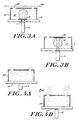
- Figures 3A and 3B illustrate a basic embodiment of the present invention, with the elements corresponding to those of Figure 1 numbered correspondingly.
- an optical fiber 10 which may, for example, have a core of 140 or 200 micrometers diameter, is butted up against one face of a transparent substrate 3 upon which a sample 2 comprised of a matrix with the analyte therein is deposited.
- a dried matrix is illustrated.
- the fiber 10 illuminates the sample 2 with its divergent output beam 1 causing a plume 4 of desorbed material to emanate therefrom.
- a containment structure 20 forms a compartment 21 about the plume 4 having one or more exit apertures 22 in a wall thereof.
- the dimensions of the compartment 21 are comparable to that of the illumination spot e.g. 10 to 500 micrometers, and may be of the same order of magnitude of the extent of plume 4, such that the plume expands to fill the compartment within a few hundred nanoseconds.
- the configuration shown in Figures 3A and 3B are both transmission illumination configurations in that the laser light illuminates the sample from a direction opposite to the ion extraction direction.
- the sample is placed directly on the transparent substrate such that the fiber illuminates the sample from the bottom side, i.e. the side facing the substrate.
- the material is desorbed from the bottom side of the sample; the sample 2 may for example consist of microcrystals in a layer several micrometers thick on a substrate and the plume 4 may consist largely of material which has been desorbed from the bottom (substrate-facing) side of the crystals and which has turned around before forming the main body of the projecting the plume.
- Figure 3B shows a corresponding configuration of this embodiment for reflection MALDI.
- the sample 2 is deposited not on the substrate 3 separating the fiber and analysis chamber, but on a wall 20 of the enclosure.
- the fiber 10 then shines its beam through the substrate and across a small gap constituting the compartment to the sample on the far side. In either case, the plume 4 expands into the compartmentalized space 21.
- Figures 4A and 4B illustrate the subsequent evolution of the plume over time.
- the velocity of molecules in the plume 4 may initially be on the order of several hundred meters per second or more.
- the plume 4 evolves to fill the compartment 21 and in general to undergo internal collisions among matrix molecules and between matrix and analyte molecules as well as with the walls 20 of the specimen holder. This results in a randomization of the directions of movement of the molecules, and in the case of molecules having various degrees of freedom beyond the three orthogonal translational modes, as is typically the case for proteins and large organic molecules, the energy may also be partitioned internally to result in a substantially lower average velocity with a well behaved Maxwellian distribution.
- the molecules reach the exit apertures 22 after a relatively short diffusion time.
- Figure 4B shows the plume material accelerated from the apertures upon the application of an electric extraction field E ext .
- the apertures 22 provide the sample through discrete openings of defined size with a velocity which has been at least partly randomized, and preferably fully randomized with a Maxwellian distribution and a low mean velocity.
- This defined initial condition results in time of flight spectra having more sharply defined peaks and less spreading, resulting in a calculated mass resolution which is not only several times higher than conventional instruments, but can be independent of mass, resulting in a substantial improvement in spectral definition at high molecular weights.
- FIGS 5A and 5B illustrate a second embodiment 30 of the present invention in which a single body of novel construction has replaced the substrate and compartment of the first embodiment.
- a high aspect capillary 32 is held by an electrically conducting housing or jacket, which serves for example to provide a uniform and field flattening conducive starting plane for the spectrometric acceleration.
- the sample 2 is deposited on inside walls of the capillary, which in turn surrounds the end of fiber 10 so that the output beam diverging from the fiber end irradiates the sample 2 and causes a plume of material to be ejected from the sides of the capillary into the central lumen 33.
- the resultant plume is self-interfering i.e. the highly directional desorption plume is aimed radially inward so that material from different portions of the wall collides with plume material from other portions resulting in a high incidence of collision within the small capillary volume 33.
- the extraction electric field results in acceleration of a thermalized sample of material 35 along a direction transverse to the capillary axis into the analysis instrumentation.
- the confinement geometry shown in Figure 5A can also be used in a top illumination arrangement.
- the laser beam emerging from the fiber 10 is preferably replaced by a focused or small diameter laser beam entering the confinement from the front (i.e. facing the mass analyzer) side.
- the confinement of the plume need not amount to a total enclosure, but need only include an arrangement which assures collisional interaction of the desorbed material, preferably including at least one collision with a wall of a physical confining structure, which may for example change the direction of molecular travel and thus more quickly reduce the highly directional momentum by collisions among molecules of the desorbed material.
- Figure 6A and 6B illustrate another confinement arrangement, which in this case is configured for top side (i.e. the side of ion extraction) illumination.
- numerals 1, 2, 3 and 4 designate respectively the laser illumination beam, the sample, the substrate holding the sample and the plume emitted by desorption from the sample.
- a structure 40 provides a barrier or overhang 42 across the emission path of plume 4.
- Overhang 42 may for example consist of a shelf or cap held by a support or post 41. Overhang 42 does not entirely cover the sample 2, but extends like a lean-to with an open sector 43 allowing oblique illumination by the laser beam 1, focused to a small spot on the sample.
- the plume then thermalizes under the lean to and is accelerated out through the sector 43, to provide slow ions to the analysis instrument, which traps or accelerates them from that point outward.
- the ion extraction may be accomplished by implementing several retarding and acceleration electric fields generated by suitable electrodes and/or meshes in the space between the plume confinement structures and the mass analyzer.
- suitable electrodes and/or meshes One such mesh 80 at a potential U relative to the confinement is drawn in Figure 3A by way of illustration. All potentials of the retarding or extraction electrodes may be time modulated, e.g. time delayed.
- FIGS 7 and 7A illustrate an experimental set up wherein thermalization has been observed to occur in a transmission mode illumination geometry due to partially thermalizing conditions provided by a bed of microcrystals of matrix material.
- a laser source was set up to provide illumination to a first fiber F 1 for top illumination of the sample, or a second fiber F 2 for transmission illumination from the backside of the sample.
- the sample was held on a substrate 3 with the fiber F 2 carried by a stage with its end face positioned exactly on the axis of the mass analyzer.
- the emerging laser beam aims at a selected position on the sample which was controlled by the stage carriage.
- the sample 2 consisted of a relatively thin bed of microcrystals having a maximum size in the range of a few to a few hundred micrometers deposited on the surface of the substrate facing the analysis chamber.
- the plume was emitted from the rear face of the crystals, i.e. the crystal faces facing the substrate and fiber, across a gap of no more than 5 nucrometers, so that the emitted material quickly collided with the substrate and turned around to interact with plume material and result in a partially thermalized state of the desorbed material reaching the analysis instrument.
- microcrystals lay in a random geometry, with rear faces lying a varying oblique angles so that the overall desorption momentum was initially less directional than for a top-illumination set-up, and quickly randomized further as the molecules collided and turned back into the flux of desorbed plume material.
- the stage 60 includes a metal plate 61 which provided a substantially flat field about the substrate 3 for enhanced emission and acceleration geometry.
- the illumination fiber F 2 passes through a slot in this planar electrode, and butts against the substrate 3.
- the fiber had a high numerical aperture and provided a substantially homogeneous beam profile of defined diameter at the sample.
- a 141 ⁇ m fiber was used such that the butt coupled geometry provided a 200 micrometer spot on the sample.
- the sample consisted of a typical drying deposit of microcrystals and macrocrystals on a simple glass cover sheet.
- the larger crystals were approximately 100 ⁇ m in dimension while the remaining microcrystals were much smaller and were completely removed by the initial actuations of the laser.
- the macrocrystals themselves naturally oriented with the substrate faces at an assortment of angles so that the plume emitted at substantially normal incidence from these surfaces would quickly collide with the substrate, heading off in a direction generally away from the substrate and back into the plume material, quickly undergoing thermalization.
- FIG. 70 there is shown yet a fourth embodiment of the invention, wherein containment, or more accurately, enhanced collisional interaction is provided by a porous or permeable structure.
- the sample 2 is placed on a substrate 3, and covered with a shroud or sheath of porous or fibrous material 71 mounted above the sample with a suitable spacer 72. Thermalization of the plume then occurs upon extraction of the ions through the porous or fibrous sheath, with or without an applied electric field which may be provided by suitable electrodes.
- the sheath 71 is thin, for example 100 ⁇ m or less, and the spacer 72 provides a free distance of the order of the sample thickness.
- a pulp-based fibrous paper similar to a laboratory filter paper was found to thermalize the emitted plume, although in general the material for this layer will be selected to neither react with nor contaminate the plume.
- the sample is illuminated through the optically transparent substrate 3 in transmission geometry by a fiber 10 as described above.
- the sample is illuminated by a focused collimated light beam 1a in top illumination geometry through the porous or fibrous sheath 71 which is optically transparent or translucent.
- Suitable materials for the fibrous or porous sheath 71 include glass, ceramic and polymeric materials.
- a glass frit of a polymer or paper micropore membrane as used for cleaning or purifying liquids such as water is also suitable for the sheath 71.
- the sample can be placed directly onto the bottom side of the porous material, i.e., the side facing away from the mass analyzer.
- the sample is incorporated into an optically transparent or translucent sheath of the porous material, and is illuminated in situ so that desorption occurs directly into the collision-enhancing porous structure of the sheath.
- the substrate 2 may consist of a plate having a plurality of thin needle-like projections or deep wells at its instrument-facing surface onto which the sample 2 is coated.
- the illumination 1 provided by the laser causes desorption from the sides of the pins, or from the walls of the wells, into a space confined by the surrounding walls or adjacent pins.
- the initial plume velocity then is substantially parallel to the general plane of the substrate and results in containment with a high collisional incidence, and subsequent emission of thermalized plume material across a plane normal thereto, at the ends of the pins or wells formed on the substrate.
- Such pins or wells may be formed as microstructures by known techniques of microlithography using compatible materials, and may for example be configured to additionally act as sample combs (e.g., hedgehog combs) or microtiter plates, allowing the support from a previous preparation process to serve as the substrate in a MALDI analyzer.
- sample combs e.g., hedgehog combs
- microtiter plates allowing the support from a previous preparation process to serve as the substrate in a MALDI analyzer.
- Other novel microlithographic constructions will be readily implemented to provide an effective collision space for modulating the plume.
- a preferred embodiment of the invention is implemented with the substrate 3 carried on a stage 12 which is configured in conjunction with the fiber carrier to allow the fiber to illuminate any selected x, y position on the substrate 3 and desorb material therefrom.
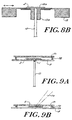
- a stage is illustrated in Figures 8A and 8B.
- the fiber 10 is mounted in a collar 10a fixed to a plate 11 which provides a stable mechanical mounting to position the end of the fiber protruding from plate 11 into an opening 12a in a stage plate 12.
- the fiber end face is exactly centered in a fixed position on the axis of the mass analyzer so as to determine a symmetrical distribution of ions injected into the analyzer.
- the stage plate 12 is mounted inside the vacuum chamber for two dimension movement, e.g.
- the substrate 3 has a somewhat conductive and dielectric thin layer of material on its bottom (fiber facing) side, which electrically contacts stage 12 and thus charges to an identical voltage as the stage, thereby providing a flat electrical field at the emission surface of the substrate 3.
Landscapes
- Physics & Mathematics (AREA)
- Optics & Photonics (AREA)
- Chemical & Material Sciences (AREA)
- Analytical Chemistry (AREA)
- Engineering & Computer Science (AREA)
- Plasma & Fusion (AREA)
- Electron Tubes For Measurement (AREA)
- Other Investigation Or Analysis Of Materials By Electrical Means (AREA)
- Analysing Materials By The Use Of Radiation (AREA)
- Sampling And Sample Adjustment (AREA)
Claims (21)
- Verfahren zur matrixunterstützten Laserdesorption/Ionisierung (MALDI) eines Analytenmaterials, wobei das Verfahren die Schritte umfasst:Herstellung eines Probenstücks, das aus einem größeren Anteil an Matrixmaterial und einem kleineren Anteil an Analytenmaterial besteht, wobei die Matrix und der Analyt als Probe auf einem Träger abgeschieden werden,Bestrahlen der Matrix derart, dass Material einschließlich des Analyten von einer Oberfläche der Probe desorbiert und ionisiert wird, undanfängliches Begrenzen des desorbierten Materials derart, dass der Desorptionsimpuls zumindest teilweise gerichtet durch Kollisionswechselwirkung statistisch verteilt wird, wodurch der desorbierte Analyt aufbereitet wird, um seinen Anfangszustand für die Analyse zu kontrollieren.
- Verfahren gemäß Anspruch 1, das ferner den Schritt umfasst, ein Kollisionspuffergas während des Begrenzens des desorbierten Materials bereitzustellen, wobei das Kollisionspuffergas aus Gasen ausgewählt wird, die eine Eigenschaft besitzen, um zumindest eines zu fördern:i) Stoßdissozation,ii) chemische Ionisierung, undiii) Molekül-Molekül- oder Ionen-Molekül Reaktion mit dem Analyten.
- Verfahren gemäß Anspruch 1, wobei der Bestrahlungsschritt den Schritt der Bestrahlung durch die Strahlleistung eines Lichtwellenleiters einschließt.
- Verfahren gemäß Anspruch 3, wobei der Bestrahlungsschritt durch Abbilden des Ende des Leiterauslasses auf der Probe bewirkt wird.
- Verfahren gemäß Anspruch 3, wobei der Bestrahlungsschritt direkt bewirkt wird durch Anordnen des Leiters nahe an ein optisch transparentes Substrat, welches die Probe trägt, und Bestrahlung durch das Substrat.
- Verfahren gemäß Anspruch 1, wobei der Begrenzungsschritt durch Begrenzung mit einer Prallfläche bewirkt wird.
- Verfahren gemäß Anspruch 1, wobei der Begrenzungsschritt durch Begrenzung in einem teilweise geschlossenen Kompartiment bewirkt wird.
- Verfahren gemäß Anspruch 1, wobei der Begrenzungsschritt einschließt, das desorbierte Material durch eine poröse Materialschicht zu durchdringen.
- Verfahren gemäß Anspruch 8, wobei die poröse Materialschicht die Matrix ist.
- Verfahren gemäß Anspruch 1, wobei der Begrenzungsschritt durchgeführt wird, indem das Probenstück als ein permeables Bett auf dem Träger abgeschieden wird und eine Unterseite des Bettes derart bestrahlt wird, dass das desorbierte Material durch den Träger begrenzt wird.
- Verfahren gemäß Anspruch 1, wobei der Begrenzungsschritt ferner eine Begrenzung mit zumindest einer ein elektrisches Potential definierenden Struktur einschließt, wobei die das elektrische Potential definierende Struktur eine Spannung besitzt, die gewählt ist, um die Ionen zumindest teilweise gerichtet durch Kollisionswechselwirkung statistisch zu verteilen.
- Verfahren gemäß Anspruch 1, wobei eine Extraktionsspannung nur nach einer Verzögerung im Anschluss an die Desorption des Materials angelegt wird, wodurch nur ein Teil des desorbierten Materials extrahiert oder als Probe entnommen wird, das einen Zusammenstoß erfahren hat.
- Vorrichtung, um eine ionisierte Materialprobe einem Analysegerät wie einem Massenspektrometer oder dergleichen, bereitzustellen, wobei die Vorrichtung aufweist:einen Objekttisch (60) zum Halten eines Probenstücks, von dem die Probe bereitgestellt werden soll,ein Mittel (10), auf den Objekttisch, zur Bestrahlung des Probenstücks gerichtet, um die Desorption des Materials aus der Probe und die Ionisierung davon zu veranlassen, wodurch das desorbierte Material einen gerichteten Impuls besitzt, undein Mittel (20) zur ausreichenden Begrenzung des desorbierten Materials, um den gerichteten Impuls zumindest teilweise derart zu thermalisieren, dass große Moleküle in dem Material in ihrer Geschwindigkeit vermindert werden,wobei das Mittel zur Begrenzung einen Auslaß (22) besitzt, welcher mit dem Analysegerät kommuniziert, um dazu die großen Moleküle reduzierter Geschwindigkeit bereitzustellen.
- Vorrichtung gemäß Anspruch 13, wobei das auf den Objekttisch (60) gerichtete Mittel einen Lichtwellenleiter (10) von dem Probestück beabstandet einschließt, um einen definierten Bereich darauf zu bestrahlen.
- Vorrichtung gemäß Anspruch 14, wobei der Objekttisch (60) und der Leiter (10) für eine wechselseitige Relativbewegung angebracht sind, um den definierten Bereich des Probenstücks nach einer Bestrahlungsposition zur Entnahme von Teilen davon selektiv abzutasten.
- Vorrichtung gemäß Anspruch 13, wobei das Mittel zur Begrenzung poröses Material (71) quer durch einen Weg zum Auslaß einschließt.
- Vorrichtung gemäß Anspruch 13, wobei das Mittel zur Begrenzung elektrostatische Mittel einschließt, um das desorbierte Material in einem begrenzten Bereich zu halten, um Kollisionswechselwirkungen vor dem Auslaß zu steigern.
- Vorrichtung gemäß Anspruch 13, wobei der Objekttisch einen leitenden Bereich enthält, der ein flaches Feld (61) benachbart zum Probenstück definiert.
- Vorrichtung gemäß Anspruch 13, wobei der Trägerobjekttisch Mittel zum Halten der Probe auf einem Substrat (3) in einem definierten Bereich des Objekttisches (60) einschließt, und
das auf den Objekttisch gerichtete Mittel einen Lichtwellenleiter (10) einschließt, der ein erstes zur Kopplung an eine Lichtquelle zum Empfang von Licht angepasstes Ende sowie ein zweites Ende besitzt, das durch den Objekttisch in einer Position gehalten wird, um einen Spotbereich der Probe zu bestrahlen, wobei der Objekttisch das zweite Ende so positioniert, dass sein Austrittsstrahl durch das Substrat hindurchtritt, um direkt den Spotbereich mit einem Lichtfleck definierter Größe bei einem Teilchenfluß zu bestrahlen, der wirksam ist den Analyten aus der Probe zu desorbieren. - Vorrichtung gemäß Anspruch 19 mit einer Vielzahl von in einem Raster angeordneten Lichtwellenleitern, um ein Raster separater Spotbereiche der Probe zu bestrahlen, wobei jeder Leiter getrennt ansteuerbar ist, um Material von einem entsprechenden Spotbereich der Probe zu verschiedenen Zeiten zu desorbieren, wodurch Mehrfach-Proben des desorbierten Analyten zu aufeinanderfolgenden Zeitpunkten einem gemeinsamen Massenanalysator bereitgestellt werden können.
- Vorrichtung gemäß Anspruch 19, wobei der Objekttisch funktionsfähig ist, das Substrat mit der Probe in zumindest zwei laterale Dimensionen bezogen auf das zweite Ende des Lichtwellenleiters zu bewegen, um darauf abzuzielen, an beliebigen Stellen der Probe Material zu desorbieren.
Priority Applications (1)
| Application Number | Priority Date | Filing Date | Title |
|---|---|---|---|
| EP02018808A EP1271609A3 (de) | 1996-09-19 | 1997-09-19 | Verfahren und Vorrichtung zur MALDI Analyse |
Applications Claiming Priority (3)
| Application Number | Priority Date | Filing Date | Title |
|---|---|---|---|
| US710565 | 1996-09-19 | ||
| US08/710,565 US5777324A (en) | 1996-09-19 | 1996-09-19 | Method and apparatus for maldi analysis |
| PCT/US1997/016115 WO1998012734A1 (en) | 1996-09-19 | 1997-09-19 | Method and apparatus for maldi analysis |
Related Child Applications (1)
| Application Number | Title | Priority Date | Filing Date |
|---|---|---|---|
| EP02018808A Division EP1271609A3 (de) | 1996-09-19 | 1997-09-19 | Verfahren und Vorrichtung zur MALDI Analyse |
Publications (2)
| Publication Number | Publication Date |
|---|---|
| EP0868740A1 EP0868740A1 (de) | 1998-10-07 |
| EP0868740B1 true EP0868740B1 (de) | 2003-01-15 |
Family
ID=24854565
Family Applications (2)
| Application Number | Title | Priority Date | Filing Date |
|---|---|---|---|
| EP02018808A Withdrawn EP1271609A3 (de) | 1996-09-19 | 1997-09-19 | Verfahren und Vorrichtung zur MALDI Analyse |
| EP97941535A Expired - Lifetime EP0868740B1 (de) | 1996-09-19 | 1997-09-19 | Verfahren und vorrichtung zur maldi analyse |
Family Applications Before (1)
| Application Number | Title | Priority Date | Filing Date |
|---|---|---|---|
| EP02018808A Withdrawn EP1271609A3 (de) | 1996-09-19 | 1997-09-19 | Verfahren und Vorrichtung zur MALDI Analyse |
Country Status (8)
| Country | Link |
|---|---|
| US (4) | US5777324A (de) |
| EP (2) | EP1271609A3 (de) |
| JP (1) | JP3601834B2 (de) |
| AT (1) | ATE231284T1 (de) |
| AU (1) | AU724884B2 (de) |
| CA (1) | CA2237946C (de) |
| DE (1) | DE69718438T2 (de) |
| WO (1) | WO1998012734A1 (de) |
Cited By (2)
| Publication number | Priority date | Publication date | Assignee | Title |
|---|---|---|---|---|
| US7074563B2 (en) | 1995-03-17 | 2006-07-11 | Sequenom, Inc. | Mass spectrometric methods for detecting mutations in a target nucleic acid |
| US7180058B1 (en) | 2005-10-05 | 2007-02-20 | Thermo Finnigan Llc | LDI/MALDI source for enhanced spatial resolution |
Families Citing this family (256)
| Publication number | Priority date | Publication date | Assignee | Title |
|---|---|---|---|---|
| US5795714A (en) * | 1992-11-06 | 1998-08-18 | Trustees Of Boston University | Method for replicating an array of nucleic acid probes |
| US6436635B1 (en) * | 1992-11-06 | 2002-08-20 | Boston University | Solid phase sequencing of double-stranded nucleic acids |
| US6194144B1 (en) | 1993-01-07 | 2001-02-27 | Sequenom, Inc. | DNA sequencing by mass spectrometry |
| DE69433811T2 (de) | 1993-01-07 | 2005-06-23 | Sequenom, Inc., San Diego | Dns - sequenzierung durch massenspektronomie |
| US20060063193A1 (en) * | 1995-04-11 | 2006-03-23 | Dong-Jing Fu | Solid phase sequencing of double-stranded nucleic acids |
| US7803529B1 (en) | 1995-04-11 | 2010-09-28 | Sequenom, Inc. | Solid phase sequencing of biopolymers |
| US5830655A (en) | 1995-05-22 | 1998-11-03 | Sri International | Oligonucleotide sizing using cleavable primers |
| US6146854A (en) * | 1995-08-31 | 2000-11-14 | Sequenom, Inc. | Filtration processes, kits and devices for isolating plasmids |
| AU2069597A (en) * | 1996-03-04 | 1997-09-22 | Genetrace Systems, Inc. | Methods of screening nucleic acids using mass spectrometry |
| AU2462497A (en) | 1996-04-17 | 1997-11-19 | Hubert Koster | A combinatorial protecting group strategy for multifunctional molecules |
| US5965363A (en) | 1996-09-19 | 1999-10-12 | Genetrace Systems Inc. | Methods of preparing nucleic acids for mass spectrometric analysis |
| US5777324A (en) * | 1996-09-19 | 1998-07-07 | Sequenom, Inc. | Method and apparatus for maldi analysis |
| EP1164203B1 (de) | 1996-11-06 | 2007-10-10 | Sequenom, Inc. | DNA-Diagnostik mittels Massenspektrometrie |
| US6140053A (en) * | 1996-11-06 | 2000-10-31 | Sequenom, Inc. | DNA sequencing by mass spectrometry via exonuclease degradation |
| US7285422B1 (en) | 1997-01-23 | 2007-10-23 | Sequenom, Inc. | Systems and methods for preparing and analyzing low volume analyte array elements |
| DE69735112T2 (de) | 1996-11-06 | 2006-09-07 | Sequenom, Inc., San Diego | Verfahren zur Analyse und Vorrichtung |
| EP0963443B1 (de) | 1996-12-10 | 2006-03-08 | Sequenom, Inc. | Abspaltbare, nicht-flüchtige moleküle zur massenmarkierung |
| EP0991930B1 (de) * | 1997-06-26 | 2004-06-16 | Perseptive Biosystems, Inc. | Probenträger hoher dichte für die analyse biologischer proben |
| US6207370B1 (en) | 1997-09-02 | 2001-03-27 | Sequenom, Inc. | Diagnostics based on mass spectrometric detection of translated target polypeptides |
| US20110166040A1 (en) * | 1997-09-05 | 2011-07-07 | Ibis Biosciences, Inc. | Compositions for use in identification of strains of e. coli o157:h7 |
| DE19741874A1 (de) * | 1997-09-23 | 1999-04-01 | Henkel Ecolab Gmbh & Co Ohg | Alkoholathaltiger Reiniger |
| US6331702B1 (en) | 1999-01-25 | 2001-12-18 | University Of Manitoba | Spectrometer provided with pulsed ion source and transmission device to damp ion motion and method of use |
| USRE39099E1 (en) * | 1998-01-23 | 2006-05-23 | University Of Manitoba | Spectrometer provided with pulsed ion source and transmission device to damp ion motion and method of use |
| US6723564B2 (en) | 1998-05-07 | 2004-04-20 | Sequenom, Inc. | IR MALDI mass spectrometry of nucleic acids using liquid matrices |
| JP4106751B2 (ja) * | 1998-08-04 | 2008-06-25 | ソニー株式会社 | 画像表示装置及びその製造方法 |
| US6288390B1 (en) | 1999-03-09 | 2001-09-11 | Scripps Research Institute | Desorption/ionization of analytes from porous light-absorbing semiconductor |
| US6225061B1 (en) | 1999-03-10 | 2001-05-01 | Sequenom, Inc. | Systems and methods for performing reactions in an unsealed environment |
| US6436640B1 (en) | 1999-03-18 | 2002-08-20 | Exiqon A/S | Use of LNA in mass spectrometry |
| US20020009394A1 (en) | 1999-04-02 | 2002-01-24 | Hubert Koster | Automated process line |
| US6504150B1 (en) * | 1999-06-11 | 2003-01-07 | Perseptive Biosystems, Inc. | Method and apparatus for determining molecular weight of labile molecules |
| DE19937438C2 (de) * | 1999-08-07 | 2001-09-13 | Bruker Daltonik Gmbh | Kopplung Dünnschicht-Chromatographie und Massenspektrometrie (TLC/MS) |
| GB9922837D0 (en) | 1999-09-27 | 1999-11-24 | Ludwig Inst Cancer Res | Modified ion source targets for use in liquid maldi ms |
| CA2387035A1 (en) | 1999-10-13 | 2001-04-19 | Sequenom, Inc. | Methods for generating databases and databases for identifying polymorphic genetic markers |
| US7668658B2 (en) | 1999-10-13 | 2010-02-23 | Sequenom, Inc. | Methods for generating databases and databases for identifying polymorphic genetic markers |
| US7917301B1 (en) | 2000-09-19 | 2011-03-29 | Sequenom, Inc. | Method and device for identifying a biological sample |
| US20030207297A1 (en) * | 1999-10-13 | 2003-11-06 | Hubert Koster | Methods for generating databases and databases for identifying polymorphic genetic markers |
| US6454924B2 (en) * | 2000-02-23 | 2002-09-24 | Zyomyx, Inc. | Microfluidic devices and methods |
| US7122790B2 (en) * | 2000-05-30 | 2006-10-17 | The Penn State Research Foundation | Matrix-free desorption ionization mass spectrometry using tailored morphology layer devices |
| DE10027794A1 (de) * | 2000-06-07 | 2001-12-13 | Basf Ag | Verfahren zur Analyse Enzym-katalysierter Umsetzungen mit MALDI-TOF-Massenspektrometrie |
| US7375319B1 (en) | 2000-06-09 | 2008-05-20 | Willoughby Ross C | Laser desorption ion source |
| DE60137722D1 (de) | 2000-06-13 | 2009-04-02 | Univ Boston | Verwendung von mass-matched nukleotide in der analyse von oligonukleotidmischungen sowie in der hoch-multiplexen nukleinsäuresequenzierung |
| US6958214B2 (en) | 2000-07-10 | 2005-10-25 | Sequenom, Inc. | Polymorphic kinase anchor proteins and nucleic acids encoding the same |
| ATE399216T1 (de) * | 2000-07-11 | 2008-07-15 | Kirk Hogan | Verfahren und zusammensetzungen zur perioperativen genomischen profilerstellung |
| CA2425434A1 (en) * | 2000-10-11 | 2002-04-18 | Tina Morris | Methods for characterizing molecular interactions using affinity capture tandem mass spectrometry |
| US20020195555A1 (en) * | 2000-10-11 | 2002-12-26 | Weinberger Scot R. | Apparatus and methods for affinity capture tandem mass spectrometry |
| US20020142483A1 (en) | 2000-10-30 | 2002-10-03 | Sequenom, Inc. | Method and apparatus for delivery of submicroliter volumes onto a substrate |
| US7060442B2 (en) * | 2000-10-30 | 2006-06-13 | Regents Of The University Of Michigan | Modulators on Nod2 signaling |
| US7166436B2 (en) | 2001-01-26 | 2007-01-23 | Syngenta Participations, Ag | Differential labeling for quantitative analysis of complex protein mixtures |
| US6969757B2 (en) * | 2001-01-26 | 2005-11-29 | Syngenta Participations Ag | Differential labeling for quantitative analysis of complex protein mixtures |
| US8208505B2 (en) | 2001-01-30 | 2012-06-26 | Board Of Trustees Of Michigan State University | Laser system employing harmonic generation |
| AU2002245345A1 (en) * | 2001-01-30 | 2002-08-12 | Board Of Trustees Operating Michigan State University | Control system and apparatus for use with laser excitation or ionization |
| US7583710B2 (en) | 2001-01-30 | 2009-09-01 | Board Of Trustees Operating Michigan State University | Laser and environmental monitoring system |
| US7567596B2 (en) * | 2001-01-30 | 2009-07-28 | Board Of Trustees Of Michigan State University | Control system and apparatus for use with ultra-fast laser |
| US7450618B2 (en) | 2001-01-30 | 2008-11-11 | Board Of Trustees Operating Michigan State University | Laser system using ultrashort laser pulses |
| US7609731B2 (en) * | 2001-01-30 | 2009-10-27 | Board Of Trustees Operating Michigan State University | Laser system using ultra-short laser pulses |
| US7973936B2 (en) | 2001-01-30 | 2011-07-05 | Board Of Trustees Of Michigan State University | Control system and apparatus for use with ultra-fast laser |
| WO2002061047A2 (en) * | 2001-02-01 | 2002-08-08 | Ciphergen Biosystems, Inc. | Improved methods for protein identification, characterization and sequencing by tandem mass spectrometry |
| US7666588B2 (en) | 2001-03-02 | 2010-02-23 | Ibis Biosciences, Inc. | Methods for rapid forensic analysis of mitochondrial DNA and characterization of mitochondrial DNA heteroplasmy |
| US20030027135A1 (en) | 2001-03-02 | 2003-02-06 | Ecker David J. | Method for rapid detection and identification of bioagents |
| US7718354B2 (en) * | 2001-03-02 | 2010-05-18 | Ibis Biosciences, Inc. | Methods for rapid identification of pathogens in humans and animals |
| US7226739B2 (en) | 2001-03-02 | 2007-06-05 | Isis Pharmaceuticals, Inc | Methods for rapid detection and identification of bioagents in epidemiological and forensic investigations |
| WO2004060278A2 (en) | 2002-12-06 | 2004-07-22 | Isis Pharmaceuticals, Inc. | Methods for rapid identification of pathogens in humans and animals |
| US20040121314A1 (en) * | 2002-12-06 | 2004-06-24 | Ecker David J. | Methods for rapid detection and identification of bioagents in containers |
| US20040121310A1 (en) * | 2002-12-18 | 2004-06-24 | Ecker David J. | Methods for rapid detection and identification of bioagents in forensic studies |
| US20040121309A1 (en) | 2002-12-06 | 2004-06-24 | Ecker David J. | Methods for rapid detection and identification of bioagents in blood, bodily fluids, and bodily tissues |
| US20030036057A1 (en) * | 2001-03-09 | 2003-02-20 | Andreas Braun | Genes and polymorphisms associated with cardiovascular disease and their use |
| US20020155587A1 (en) | 2001-04-20 | 2002-10-24 | Sequenom, Inc. | System and method for testing a biological sample |
| EP1395939A4 (de) | 2001-05-24 | 2006-06-07 | New Objective Inc | Verfahren und vorrichtung für elektrospray mit rückkopplungsregelung |
| US6936224B2 (en) * | 2001-06-21 | 2005-08-30 | Perseptive Biosystems, Inc. | Apparatus and process for transporting sample plates |
| US8073627B2 (en) | 2001-06-26 | 2011-12-06 | Ibis Biosciences, Inc. | System for indentification of pathogens |
| US7217510B2 (en) | 2001-06-26 | 2007-05-15 | Isis Pharmaceuticals, Inc. | Methods for providing bacterial bioagent characterizing information |
| US6800449B1 (en) | 2001-07-13 | 2004-10-05 | Syngenta Participations Ag | High throughput functional proteomics |
| DE10140499B4 (de) * | 2001-08-17 | 2005-02-03 | Bruker Daltonik Gmbh | Probenträgerplatten für Massenspektrometrie mit Ionisierung durch matrixunterstützte Laserdesorption |
| US7582425B2 (en) * | 2001-09-21 | 2009-09-01 | The Regents Of The University Of Michigan | Atlastin |
| US7108975B2 (en) * | 2001-09-21 | 2006-09-19 | Regents Of The University Of Michigan | Atlastin |
| US20030111494A1 (en) * | 2001-10-26 | 2003-06-19 | Sequenom, Inc. | Method and apparatus for high-throughput sample handling process line |
| US7255986B2 (en) * | 2002-01-31 | 2007-08-14 | The Board Of Trustees Operating Michigan State University | Compositions for the diagnosis and treatment of epizootic catarrhal enteritis in ferrets |
| BR0200690A (pt) * | 2002-03-04 | 2004-03-23 | Embrapa Pesquisa Agropecuaria | Método para detecção de proteinas de origem em misturas complexas |
| JP3530942B2 (ja) * | 2002-03-05 | 2004-05-24 | 独立行政法人通信総合研究所 | 分子ビーム発生方法及び装置 |
| CA2479872C (en) * | 2002-03-21 | 2009-06-23 | Thermo Finnigan Llc | Ionization apparatus and method for mass spectrometer system |
| AUPS177202A0 (en) * | 2002-04-16 | 2002-05-23 | Diakyne Pty Ltd | Multi-element screening of trace elements |
| WO2003093296A2 (en) * | 2002-05-03 | 2003-11-13 | Sequenom, Inc. | Kinase anchor protein muteins, peptides thereof, and related methods |
| US6680477B2 (en) * | 2002-05-31 | 2004-01-20 | Battelle Memorial Institute | High spatial resolution matrix assisted laser desorption/ionization (MALDI) |
| US6624409B1 (en) | 2002-07-30 | 2003-09-23 | Agilent Technologies, Inc. | Matrix assisted laser desorption substrates for biological and reactive samples |
| US7214353B2 (en) * | 2002-08-30 | 2007-05-08 | Corning Incorporated | Peptide or protein-capturing surfaces for high throughput MALDI mass spectrometry |
| US20030119063A1 (en) * | 2002-09-03 | 2003-06-26 | Pham Thang T. | High accuracy protein identification |
| US6707039B1 (en) | 2002-09-19 | 2004-03-16 | Agilent Technologies, Inc. | AP-MALDI target illumination device and method for using an AP-MALDI target illumination device |
| US6863731B2 (en) * | 2002-10-18 | 2005-03-08 | Controls Corporation Of America | System for deposition of inert barrier coating to increase corrosion resistance |
| JP4241006B2 (ja) * | 2002-11-11 | 2009-03-18 | 株式会社島津製作所 | レーザー脱離イオン化質量分析方法とそれに用いるサンプルプレート |
| US7105809B2 (en) * | 2002-11-18 | 2006-09-12 | 3M Innovative Properties Company | Microstructured polymeric substrate |
| AU2003298733B2 (en) * | 2002-11-27 | 2009-06-18 | Agena Bioscience, Inc. | Fragmentation-based methods and systems for sequence variation detection and discovery |
| US6642516B1 (en) * | 2002-12-18 | 2003-11-04 | Agilent Technologies, Inc. | Apparatus and method of laser dissociation for mass spectrometry |
| US6822230B2 (en) * | 2002-12-23 | 2004-11-23 | Agilent Technologies, Inc. | Matrix-assisted laser desorption/ionization sample holders and methods of using the same |
| JP2004264043A (ja) * | 2003-01-31 | 2004-09-24 | National Institute Of Advanced Industrial & Technology | イオン化装置および微小領域分析装置 |
| JP4555820B2 (ja) * | 2003-02-10 | 2010-10-06 | ウオーターズ・テクノロジーズ・コーポレイシヨン | シリコン上の脱離/イオン化質量分析(dios−ms)を使用した周囲空気の成分の吸着、検出、および同定 |
| US7586091B2 (en) * | 2003-03-14 | 2009-09-08 | Nec Corporation | Mass spectrometric system and mass spectrometry |
| US6903334B1 (en) | 2003-03-19 | 2005-06-07 | Thermo Finnigan Llc | High throughput ion source for MALDI mass spectrometry |
| US20040185448A1 (en) * | 2003-03-20 | 2004-09-23 | Viorica Lopez-Avila | Methods and devices for performing matrix assisted laser desorption/lonization protocols |
| US8046171B2 (en) | 2003-04-18 | 2011-10-25 | Ibis Biosciences, Inc. | Methods and apparatus for genetic evaluation |
| EP1618216A2 (de) * | 2003-04-25 | 2006-01-25 | Sequenom, Inc. | Auf fragmentierung beruhende verfahren und systeme zur de-novo-sequenzierung |
| US8057993B2 (en) | 2003-04-26 | 2011-11-15 | Ibis Biosciences, Inc. | Methods for identification of coronaviruses |
| US8158354B2 (en) | 2003-05-13 | 2012-04-17 | Ibis Biosciences, Inc. | Methods for rapid purification of nucleic acids for subsequent analysis by mass spectrometry by solution capture |
| US7964343B2 (en) | 2003-05-13 | 2011-06-21 | Ibis Biosciences, Inc. | Method for rapid purification of nucleic acids for subsequent analysis by mass spectrometry by solution capture |
| US7145135B1 (en) | 2003-05-30 | 2006-12-05 | Agilent Technologies, Inc. | Apparatus and method for MALDI source control with external image capture |
| GB0313170D0 (en) | 2003-06-09 | 2003-07-16 | Qinetiq Ltd | Method and apparatus for spore disruption and/or detection |
| DE112004001121T5 (de) * | 2003-06-25 | 2006-05-04 | Waters Investments Ltd., New Castle | Vorrichtung zur Verhinderung der Kreuzverunreinigung in einer Plattform und Herstellungsverfahren |
| EP2107129B1 (de) | 2003-07-31 | 2012-08-22 | Sequenom, Inc. | Verfahren für Multiplex-Polymerasekettenreaktionen auf hohem Niveau und homogene Massenausdehnungsreaktionen zur Genotypisierung von Polymorphismen |
| WO2005024068A2 (en) * | 2003-09-05 | 2005-03-17 | Sequenom, Inc. | Allele-specific sequence variation analysis |
| US20100129811A1 (en) * | 2003-09-11 | 2010-05-27 | Ibis Biosciences, Inc. | Compositions for use in identification of pseudomonas aeruginosa |
| US8546082B2 (en) | 2003-09-11 | 2013-10-01 | Ibis Biosciences, Inc. | Methods for identification of sepsis-causing bacteria |
| US8242254B2 (en) | 2003-09-11 | 2012-08-14 | Ibis Biosciences, Inc. | Compositions for use in identification of bacteria |
| US8097416B2 (en) | 2003-09-11 | 2012-01-17 | Ibis Biosciences, Inc. | Methods for identification of sepsis-causing bacteria |
| AU2004274977B2 (en) | 2003-09-19 | 2011-06-23 | Epitopix, Llc | Campylobacter polypeptides and methods of use |
| US6825478B1 (en) * | 2003-10-10 | 2004-11-30 | Perseptive Biosystems, Inc. | MALDI plate with removable magnetic insert |
| US6953928B2 (en) * | 2003-10-31 | 2005-10-11 | Applera Corporation | Ion source and methods for MALDI mass spectrometry |
| US20050128754A1 (en) * | 2003-12-12 | 2005-06-16 | Redden Myron K. | Ceramic foam light diffuser |
| US7030373B2 (en) * | 2003-12-19 | 2006-04-18 | Applera Corporation | MALDI plate construction with grid |
| US7438859B2 (en) * | 2003-12-31 | 2008-10-21 | Protedyne Corporation | Method and apparatus for laser impulse sample deposition |
| CA2493836A1 (en) * | 2004-01-22 | 2005-07-22 | Ionalytics Corporation | Method and apparatus for faims for in-line analysis of multiple samples |
| US7432057B2 (en) * | 2004-01-30 | 2008-10-07 | Michigan State University | Genetic test for PSE-susceptible turkeys |
| US7666592B2 (en) | 2004-02-18 | 2010-02-23 | Ibis Biosciences, Inc. | Methods for concurrent identification and quantification of an unknown bioagent |
| US8119336B2 (en) | 2004-03-03 | 2012-02-21 | Ibis Biosciences, Inc. | Compositions for use in identification of alphaviruses |
| US7623234B2 (en) * | 2004-03-22 | 2009-11-24 | Quantaspec, Inc. | System and method for detecting and identifying an analyte |
| CA2561381C (en) * | 2004-03-26 | 2015-05-12 | Sequenom, Inc. | Base specific cleavage of methylation-specific amplification products in combination with mass analysis |
| US7608394B2 (en) | 2004-03-26 | 2009-10-27 | Sequenom, Inc. | Methods and compositions for phenotype identification based on nucleic acid methylation |
| WO2005104181A1 (ja) * | 2004-03-30 | 2005-11-03 | Yamanashi Tlo Co., Ltd. | 質量分析のためのイオン化方法および装置 |
| ES2641832T3 (es) | 2004-05-24 | 2017-11-14 | Ibis Biosciences, Inc. | Espectrometría de masas con filtración de iones selectiva por establecimiento de umbrales digitales |
| US20050266411A1 (en) | 2004-05-25 | 2005-12-01 | Hofstadler Steven A | Methods for rapid forensic analysis of mitochondrial DNA |
| US7785843B2 (en) | 2004-06-23 | 2010-08-31 | Sequenom, Inc. | Target-specific compomers and methods of use |
| US7811753B2 (en) | 2004-07-14 | 2010-10-12 | Ibis Biosciences, Inc. | Methods for repairing degraded DNA |
| WO2006135400A2 (en) | 2004-08-24 | 2006-12-21 | Isis Pharmaceuticals, Inc. | Methods for rapid identification of recombinant organisms |
| JP2008512129A (ja) * | 2004-09-10 | 2008-04-24 | セクエノム,インコーポレイティド | 核酸の広範囲配列分析法 |
| EP1804958A4 (de) * | 2004-09-17 | 2010-11-17 | Nanosys Inc | Nanostrukturierte dünnfilme und ihre verwendung |
| WO2006088841A1 (en) | 2005-02-14 | 2006-08-24 | Board Of Trustees Of Michigan State University | Ultra-fast laser system |
| US20060205040A1 (en) | 2005-03-03 | 2006-09-14 | Rangarajan Sampath | Compositions for use in identification of adventitious viruses |
| US8084207B2 (en) | 2005-03-03 | 2011-12-27 | Ibis Bioscience, Inc. | Compositions for use in identification of papillomavirus |
| US7265368B2 (en) * | 2005-05-13 | 2007-09-04 | Applera Corporation | Ion optical mounting assemblies |
| US20060266941A1 (en) * | 2005-05-26 | 2006-11-30 | Vestal Marvin L | Method and apparatus for interfacing separations techniques to MALDI-TOF mass spectrometry |
| US7435951B2 (en) * | 2005-06-08 | 2008-10-14 | Agilent Technologies, Inc. | Ion source sample plate illumination system |
| JP2009502137A (ja) | 2005-07-21 | 2009-01-29 | アイシス ファーマシューティカルズ インコーポレイティッド | 核酸変種の迅速な同定および定量のための方法 |
| US7495231B2 (en) * | 2005-09-08 | 2009-02-24 | Agilent Technologies, Inc. | MALDI sample plate imaging workstation |
| WO2007041067A2 (en) * | 2005-09-29 | 2007-04-12 | Children's Hospital & Research Center At Oakland | Methods and compositions for kir genotyping |
| US8237114B2 (en) * | 2005-10-20 | 2012-08-07 | Japan Science & Technology Agency | Sample target used in mass spectrometry, method for producing the same, and mass spectrometer using the sample target |
| US7423260B2 (en) * | 2005-11-04 | 2008-09-09 | Agilent Technologies, Inc. | Apparatus for combined laser focusing and spot imaging for MALDI |
| US20070207455A1 (en) * | 2005-11-17 | 2007-09-06 | Third Wave Technologies, Inc. | Compositions and methods for detecting an HCV-1 subtype |
| EP2468901B1 (de) | 2005-11-29 | 2017-04-05 | Cambridge Enterprise Limited | Marker für Brustkrebs |
| US8618470B2 (en) | 2005-11-30 | 2013-12-31 | Board Of Trustees Of Michigan State University | Laser based identification of molecular characteristics |
| US7781730B2 (en) * | 2006-02-14 | 2010-08-24 | Los Alamos National Security, Llc | Linear electronic field time-of-flight ion mass spectrometers |
| KR20080114773A (ko) * | 2006-03-01 | 2008-12-31 | 펄리건 사이언시스, 인코퍼레이티드 | 중독에 대한 마커 |
| US20110143344A1 (en) * | 2006-03-01 | 2011-06-16 | The Washington University | Genetic polymorphisms and substance dependence |
| US8026477B2 (en) * | 2006-03-03 | 2011-09-27 | Ionsense, Inc. | Sampling system for use with surface ionization spectroscopy |
| US7700913B2 (en) | 2006-03-03 | 2010-04-20 | Ionsense, Inc. | Sampling system for use with surface ionization spectroscopy |
| EP2010679A2 (de) | 2006-04-06 | 2009-01-07 | Ibis Biosciences, Inc. | Zusammensetzungen für die identifizierung von pilzen |
| WO2007145702A2 (en) | 2006-04-10 | 2007-12-21 | Board Of Trustees Of Michigan State University | Laser material processing systems and methods with, in particular, use of a hollow waveguide for broadening the bandwidth of the pulse above 20 nm |
| DE102006023061B4 (de) * | 2006-05-17 | 2008-08-14 | Fraunhofer-Gesellschaft zur Förderung der angewandten Forschung e.V. | Gasdetektor mit akustischer Messzelle und selektiv adsorbierender Oberfläche |
| EP2035122A4 (de) | 2006-05-26 | 2010-05-05 | Ionsense Inc | Biegsames probennahmesystem mit offener röhre zur verwendung mit oberflächenionisierungstechnik |
| US9149473B2 (en) | 2006-09-14 | 2015-10-06 | Ibis Biosciences, Inc. | Targeted whole genome amplification method for identification of pathogens |
| US8440965B2 (en) | 2006-10-13 | 2013-05-14 | Ionsense, Inc. | Sampling system for use with surface ionization spectroscopy |
| US7928364B2 (en) | 2006-10-13 | 2011-04-19 | Ionsense, Inc. | Sampling system for containment and transfer of ions into a spectroscopy system |
| US7642806B2 (en) * | 2006-10-13 | 2010-01-05 | General Atomics | Test apparatus, system, and method with a magnetic feature |
| AU2008210421B2 (en) | 2007-01-30 | 2014-03-13 | Pharmacyclics Llc | Methods for determining cancer resistance to histone deacetylase inhibitors |
| EP2126132B1 (de) | 2007-02-23 | 2013-03-20 | Ibis Biosciences, Inc. | Verfahren für schnelle forensische dna-analyse |
| WO2009023358A2 (en) * | 2007-05-25 | 2009-02-19 | Ibis Biosciences, Inc. | Compositions for use in identification of strains of hepatitis c virus |
| WO2008151023A2 (en) | 2007-06-01 | 2008-12-11 | Ibis Biosciences, Inc. | Methods and compositions for multiple displacement amplification of nucleic acids |
| WO2009038840A2 (en) * | 2007-06-14 | 2009-03-26 | Ibis Biosciences, Inc. | Compositions for use in identification of adventitious contaminant viruses |
| DE102007043456B4 (de) * | 2007-07-31 | 2012-02-09 | Bruker Daltonik Gmbh | Matrixunterstützte Laserdesorption hoher Ionisierungsausbeute |
| GB2453407B (en) * | 2007-07-31 | 2012-07-18 | Bruker Daltonik Gmbh | Matrix-assisted laser desorption with high ionization yield |
| WO2009039122A2 (en) | 2007-09-17 | 2009-03-26 | Sequenom, Inc. | Integrated robotic sample transfer device |
| US8044346B2 (en) * | 2007-12-21 | 2011-10-25 | Licentia Oy | Method and system for desorbing and ionizing chemical compounds from surfaces |
| US8311069B2 (en) | 2007-12-21 | 2012-11-13 | Board Of Trustees Of Michigan State University | Direct ultrashort laser system |
| US20110097704A1 (en) * | 2008-01-29 | 2011-04-28 | Ibis Biosciences, Inc. | Compositions for use in identification of picornaviruses |
| US20110177515A1 (en) * | 2008-05-30 | 2011-07-21 | Ibis Biosciences, Inc. | Compositions for use in identification of francisella |
| WO2009155103A2 (en) * | 2008-05-30 | 2009-12-23 | Ibis Biosciences, Inc. | Compositions for use in identification of tick-borne pathogens |
| WO2009148995A2 (en) * | 2008-06-02 | 2009-12-10 | Ibis Biosciences, Inc. | Compositions for use in identification of adventitious viruses |
| US8550694B2 (en) | 2008-09-16 | 2013-10-08 | Ibis Biosciences, Inc. | Mixing cartridges, mixing stations, and related kits, systems, and methods |
| US8148163B2 (en) | 2008-09-16 | 2012-04-03 | Ibis Biosciences, Inc. | Sample processing units, systems, and related methods |
| WO2010033625A1 (en) | 2008-09-16 | 2010-03-25 | Ibis Biosciences, Inc. | Microplate handling systems and related computer program products and methods |
| US20110189687A1 (en) * | 2008-10-02 | 2011-08-04 | Ibis Bioscience, Inc. | Compositions for use in identification of members of the bacterial genus mycoplasma |
| WO2010039696A1 (en) * | 2008-10-02 | 2010-04-08 | Ibis Biosciences, Inc. | Compositions for use in identification of herpesviruses |
| US20110190170A1 (en) * | 2008-10-03 | 2011-08-04 | Ibis Biosciences, Inc. | Compositions for use in identification of antibiotic-resistant bacteria |
| WO2010039870A1 (en) * | 2008-10-03 | 2010-04-08 | Ibis Biosciences, Inc. | Compositions for use in identification of neisseria, chlamydia, and/or chlamydophila bacteria |
| US20110183343A1 (en) * | 2008-10-03 | 2011-07-28 | Rangarajan Sampath | Compositions for use in identification of members of the bacterial class alphaproteobacter |
| WO2010039787A1 (en) * | 2008-10-03 | 2010-04-08 | Ibis Biosciences, Inc. | Compositions for use in identification of clostridium difficile |
| WO2010039848A2 (en) * | 2008-10-03 | 2010-04-08 | Ibis Biosciences, Inc. | Compositions for use in identification of streptococcus pneumoniae |
| US9202678B2 (en) * | 2008-11-14 | 2015-12-01 | Board Of Trustees Of Michigan State University | Ultrafast laser system for biological mass spectrometry |
| EP2211430A3 (de) | 2009-01-23 | 2015-05-27 | Board of Trustees of Michigan State University | Laserautokorrelationssystem |
| EP2396803A4 (de) | 2009-02-12 | 2016-10-26 | Ibis Biosciences Inc | Ionisationssondenanordnungen |
| DE202009002192U1 (de) * | 2009-02-16 | 2009-04-23 | Thermo Fisher Scientific (Bremen) Gmbh | Elektrode zur Beeinflussung der Ionenbewegung in Massenspektrometern |
| US8861075B2 (en) | 2009-03-05 | 2014-10-14 | Board Of Trustees Of Michigan State University | Laser amplification system |
| US9719083B2 (en) | 2009-03-08 | 2017-08-01 | Ibis Biosciences, Inc. | Bioagent detection methods |
| WO2010114842A1 (en) | 2009-03-30 | 2010-10-07 | Ibis Biosciences, Inc. | Bioagent detection systems, devices, and methods |
| US20110091931A1 (en) * | 2009-04-24 | 2011-04-21 | Colby Pharmaceutical Company | Methods and Kits for Determining Oxygen Free Radical (OFR) Levels in Animal and Human Tissues as a Prognostic Marker for Cancer and Other Pathophysiologies |
| US8207497B2 (en) | 2009-05-08 | 2012-06-26 | Ionsense, Inc. | Sampling of confined spaces |
| US8950604B2 (en) | 2009-07-17 | 2015-02-10 | Ibis Biosciences, Inc. | Lift and mount apparatus |
| EP2454000A4 (de) | 2009-07-17 | 2016-08-10 | Ibis Biosciences Inc | Systeme zur identifizierung von biowirkstoffen |
| WO2011014811A1 (en) * | 2009-07-31 | 2011-02-03 | Ibis Biosciences, Inc. | Capture primers and capture sequence linked solid supports for molecular diagnostic tests |
| EP3098325A1 (de) | 2009-08-06 | 2016-11-30 | Ibis Biosciences, Inc. | Basenzusammensetzungen ohne massenbestimmung zur nukleinsäureerkennung |
| US20110065111A1 (en) * | 2009-08-31 | 2011-03-17 | Ibis Biosciences, Inc. | Compositions For Use In Genotyping Of Klebsiella Pneumoniae |
| EP2488656B1 (de) | 2009-10-15 | 2015-06-03 | Ibis Biosciences, Inc. | Mehrfache verschiebungsverstärkung |
| US8630322B2 (en) | 2010-03-01 | 2014-01-14 | Board Of Trustees Of Michigan State University | Laser system for output manipulation |
| US8774488B2 (en) | 2010-03-11 | 2014-07-08 | Cellscape Corporation | Method and device for identification of nucleated red blood cells from a maternal blood sample |
| US9758840B2 (en) * | 2010-03-14 | 2017-09-12 | Ibis Biosciences, Inc. | Parasite detection via endosymbiont detection |
| US9492887B2 (en) | 2010-04-01 | 2016-11-15 | Electro Scientific Industries, Inc. | Touch screen interface for laser processing |
| US8637813B2 (en) * | 2010-10-01 | 2014-01-28 | Ut-Battelle, Llc | System and method for laser assisted sample transfer to solution for chemical analysis |
| US8519330B2 (en) | 2010-10-01 | 2013-08-27 | Ut-Battelle, Llc | Systems and methods for laser assisted sample transfer to solution for chemical analysis |
| US8822949B2 (en) | 2011-02-05 | 2014-09-02 | Ionsense Inc. | Apparatus and method for thermal assisted desorption ionization systems |
| US8901488B1 (en) | 2011-04-18 | 2014-12-02 | Ionsense, Inc. | Robust, rapid, secure sample manipulation before during and after ionization for a spectroscopy system |
| JP2014524121A (ja) * | 2011-07-14 | 2014-09-18 | ザ・ジョージ・ワシントン・ユニバーシティ | レーザアブレーション・エレクトロスプレイイオン化質量分析用のプルームコリメーション |
| GB2493179B (en) * | 2011-07-26 | 2018-09-05 | Kratos Analytical Ltd | MALDI sample preparation methods and targets |
| CA2867996C (en) * | 2011-10-26 | 2020-03-10 | Dh Technologies Development Pte. Ltd. | Quantification of an analyte in serum and other biological matrices |
| GB201122309D0 (en) * | 2011-12-23 | 2012-02-01 | Micromass Ltd | An imaging mass spectrometer and a method of mass spectrometry |
| WO2013101741A1 (en) | 2011-12-30 | 2013-07-04 | Abbott Molecular, Inc. | Channels with cross-sectional thermal gradients |
| SG193046A1 (en) * | 2012-02-23 | 2013-09-30 | Histoindex Pte Ltd | A digital imaging system for biopsy inspection |
| EP2836482B1 (de) | 2012-04-10 | 2019-12-25 | The Regents of The University of California | Zusammensetzungen und verfahren zur behandlung von krebs |
| JP5875483B2 (ja) * | 2012-08-14 | 2016-03-02 | 富士フイルム株式会社 | 質量分析装置 |
| US9227978B2 (en) | 2013-03-15 | 2016-01-05 | Araxes Pharma Llc | Covalent inhibitors of Kras G12C |
| EP2792471B1 (de) | 2013-04-16 | 2018-01-31 | Stratec Consumables GmbH | Polymerteile |
| SG10201808165YA (en) | 2013-04-17 | 2018-10-30 | Fluidigm Canada Inc | Sample analysis for mass cytometry |
| JO3805B1 (ar) | 2013-10-10 | 2021-01-31 | Araxes Pharma Llc | مثبطات كراس جي12سي |
| US9337007B2 (en) | 2014-06-15 | 2016-05-10 | Ionsense, Inc. | Apparatus and method for generating chemical signatures using differential desorption |
| ES2753573T3 (es) | 2014-06-27 | 2020-04-13 | Abbott Lab | Composiciones y métodos para detectar pegivirus humano 2 (HPGV-2) |
| JO3556B1 (ar) | 2014-09-18 | 2020-07-05 | Araxes Pharma Llc | علاجات مدمجة لمعالجة السرطان |
| WO2016049568A1 (en) | 2014-09-25 | 2016-03-31 | Araxes Pharma Llc | Methods and compositions for inhibition of ras |
| JP2017528498A (ja) | 2014-09-25 | 2017-09-28 | アラクセス ファーマ エルエルシー | Kras g12c変異体タンパク質のインヒビター |
| WO2016061432A1 (en) * | 2014-10-17 | 2016-04-21 | Porex Corporation | Disposable porous cleaning devices and methods |
| US9850479B2 (en) * | 2015-03-03 | 2017-12-26 | The Board Of Regents Of The University Of Oklahoma | Method and apparatus for sampling macromolecules from a biological specimen |
| ES2898765T3 (es) | 2015-04-10 | 2022-03-08 | Araxes Pharma Llc | Compuestos de quinazolina sustituidos y métodos de uso de los mismos |
| US10428064B2 (en) | 2015-04-15 | 2019-10-01 | Araxes Pharma Llc | Fused-tricyclic inhibitors of KRAS and methods of use thereof |
| US10144724B2 (en) | 2015-07-22 | 2018-12-04 | Araxes Pharma Llc | Substituted quinazoline compounds and methods of use thereof |
| SMT202100712T1 (it) | 2015-08-17 | 2022-01-10 | Kura Oncology Inc | Metodi di trattamento di pazienti di cancro con inibitori di farnesil trasferasi |
| EP3356347A1 (de) | 2015-09-28 | 2018-08-08 | Araxes Pharma LLC | Inhibitoren von kras-g12c-mutanten proteinen |
| EP3356349A1 (de) | 2015-09-28 | 2018-08-08 | Araxes Pharma LLC | Inhibitoren von kras-g12c-mutanten proteinen |
| EP3356351A1 (de) | 2015-09-28 | 2018-08-08 | Araxes Pharma LLC | Inhibitoren von kras-g12c-mutanten proteinen |
| WO2017058728A1 (en) | 2015-09-28 | 2017-04-06 | Araxes Pharma Llc | Inhibitors of kras g12c mutant proteins |
| WO2017058805A1 (en) | 2015-09-28 | 2017-04-06 | Araxes Pharma Llc | Inhibitors of kras g12c mutant proteins |
| EP3356359B1 (de) | 2015-09-28 | 2021-10-20 | Araxes Pharma LLC | Inhibitoren von kras-g12c-mutanten proteinen |
| WO2017058902A1 (en) | 2015-09-28 | 2017-04-06 | Araxes Pharma Llc | Inhibitors of kras g12c mutant proteins |
| WO2017070256A2 (en) | 2015-10-19 | 2017-04-27 | Araxes Pharma Llc | Method for screening inhibitors of ras |
| KR20180081596A (ko) | 2015-11-16 | 2018-07-16 | 아락세스 파마 엘엘씨 | 치환된 헤테로사이클릭 그룹을 포함하는 2-치환된 퀴나졸린 화합물 및 이의 사용 방법 |
| US9988357B2 (en) | 2015-12-09 | 2018-06-05 | Araxes Pharma Llc | Methods for preparation of quinazoline derivatives |
| WO2017172979A1 (en) | 2016-03-30 | 2017-10-05 | Araxes Pharma Llc | Substituted quinazoline compounds and methods of use |
| US10646488B2 (en) | 2016-07-13 | 2020-05-12 | Araxes Pharma Llc | Conjugates of cereblon binding compounds and G12C mutant KRAS, HRAS or NRAS protein modulating compounds and methods of use thereof |
| WO2018064510A1 (en) | 2016-09-29 | 2018-04-05 | Araxes Pharma Llc | Inhibitors of kras g12c mutant proteins |
| EP3523289A1 (de) | 2016-10-07 | 2019-08-14 | Araxes Pharma LLC | Heterocyclische verbindungen als ras-inhibitoren und verfahren zur verwendung davon |
| KR20190095355A (ko) | 2016-12-15 | 2019-08-14 | 더 리젠츠 오브 더 유니버시티 오브 캘리포니아 | 암의 치료를 위한 조성물 및 방법 |
| WO2018140599A1 (en) | 2017-01-26 | 2018-08-02 | Araxes Pharma Llc | Benzothiophene and benzothiazole compounds and methods of use thereof |
| US11136308B2 (en) | 2017-01-26 | 2021-10-05 | Araxes Pharma Llc | Substituted quinazoline and quinazolinone compounds and methods of use thereof |
| EP3573954A1 (de) | 2017-01-26 | 2019-12-04 | Araxes Pharma LLC | Fusionierte bicyclische benzoheteroaromatische verbindungen und verfahren zur verwendung davon |
| WO2018140513A1 (en) | 2017-01-26 | 2018-08-02 | Araxes Pharma Llc | 1-(3-(6-(3-hydroxynaphthalen-1-yl)benzofuran-2-yl)azetidin-1yl)prop-2-en-1-one derivatives and similar compounds as kras g12c modulators for treating cancer |
| JP7327802B2 (ja) | 2017-01-26 | 2023-08-16 | アラクセス ファーマ エルエルシー | 縮合ヘテロ-ヘテロ二環式化合物およびその使用方法 |
| US10745385B2 (en) | 2017-05-25 | 2020-08-18 | Araxes Pharma Llc | Covalent inhibitors of KRAS |
| CN110869357A (zh) | 2017-05-25 | 2020-03-06 | 亚瑞克西斯制药公司 | 化合物及其用于治疗癌症的使用方法 |
| WO2018218069A1 (en) | 2017-05-25 | 2018-11-29 | Araxes Pharma Llc | Quinazoline derivatives as modulators of mutant kras, hras or nras |
| MX2021000887A (es) | 2018-08-01 | 2021-03-31 | Araxes Pharma Llc | Compuestos espiroheterociclicos y metodos de uso de los mismos para el tratamiento de cancer. |
| US10991563B2 (en) * | 2018-08-28 | 2021-04-27 | Virgin Instruments Corporation | Molecular imaging of biological samples with sub-cellular spatial resolution and high sensitivity |
| DE102021105327B3 (de) | 2021-03-05 | 2022-05-12 | Bruker Daltonics GmbH & Co. KG | Desorptions-Ionenquelle mit Postdesorptions-Ionisierung in Transmissionsgeometrie |
Family Cites Families (65)
| Publication number | Priority date | Publication date | Assignee | Title |
|---|---|---|---|---|
| DE2141387C3 (de) * | 1971-08-18 | 1975-12-11 | Ernst Dr. 8000 Muenchen Remy | Verfahren zur auf Mikrobereiche beschränkten Verdampfung, Zerstörung, Anregung und/oder Ionisierung von Probenmaterial sowie Anordnung zur Durchführung des Verfahrens |
| DE2739829C2 (de) * | 1977-09-03 | 1986-04-10 | Gesellschaft für Strahlen- und Umweltforschung mbH, 8000 München | Anordnung zur Analyse einer Probenschicht durch Beschuß mit elektromagnetischer Strahlung |
| DE2739828C2 (de) * | 1977-09-03 | 1986-07-03 | Gesellschaft für Strahlen- und Umweltforschung mbH, 8000 München | Einrichtung zur Analyse von Proben |
| DE2819711C2 (de) | 1978-05-05 | 1984-02-16 | Gesellschaft für Strahlen- und Umweltforschung mbH, 8000 München | Verfahren und Vorrichtung zur Analyse einer Probe mit Hilfe gepulster Laserstrahlung |
| US4442354A (en) | 1982-01-22 | 1984-04-10 | Atom Sciences, Inc. | Sputter initiated resonance ionization spectrometry |
| DE3221681A1 (de) * | 1982-06-08 | 1983-12-08 | Bayer Ag, 5090 Leverkusen | Massenspektrometer mit externer probenhalterung |
| DE3329892A1 (de) * | 1983-08-18 | 1985-03-07 | Köster, Hubert, Prof. Dr., 2000 Hamburg | Verfahren zur herstellung von oligonucleotiden |
| US5118605A (en) * | 1984-10-16 | 1992-06-02 | Chiron Corporation | Polynucleotide determination with selectable cleavage sites |
| GB2177507B (en) * | 1985-06-13 | 1989-02-15 | Mitsubishi Electric Corp | Laser mass spectroscopic analyzer |
| FR2597260B1 (fr) * | 1986-04-10 | 1988-07-15 | Univ Pasteur | Procede d'introduction directe automatique d'echantillons dans un spectrometre de masse, et dispositif pour la mise en oeuvre de ce procede |
| GB8626075D0 (en) | 1986-10-31 | 1986-12-03 | Vg Instr Group | Time-of-flight mass spectrometer |
| DE3809504C1 (de) | 1988-03-22 | 1989-09-21 | Bruker - Franzen Analytik Gmbh, 2800 Bremen, De | |
| US4920264A (en) | 1989-01-17 | 1990-04-24 | Sri International | Method for preparing samples for mass analysis by desorption from a frozen solution |
| CA2032490A1 (en) | 1989-05-19 | 1990-11-20 | Chin Kai Meng | Multiply charged ions and a method for determining the molecular weight of large molecules |
| US5118937A (en) * | 1989-08-22 | 1992-06-02 | Finnigan Mat Gmbh | Process and device for the laser desorption of an analyte molecular ions, especially of biomolecules |
| US5045694A (en) | 1989-09-27 | 1991-09-03 | The Rockefeller University | Instrument and method for the laser desorption of ions in mass spectrometry |
| US5288644A (en) * | 1990-04-04 | 1994-02-22 | The Rockefeller University | Instrument and method for the sequencing of genome |
| US5135870A (en) | 1990-06-01 | 1992-08-04 | Arizona Board Of Regents | Laser ablation/ionizaton and mass spectrometric analysis of massive polymers |
| DE4019005C2 (de) | 1990-06-13 | 2000-03-09 | Finnigan Mat Gmbh | Vorrichtungen zur Analyse von Ionen hoher Masse |
| WO1992013629A1 (en) | 1991-01-31 | 1992-08-20 | Wayne State University | A method for analyzing an organic sample |
| US5210412A (en) | 1991-01-31 | 1993-05-11 | Wayne State University | Method for analyzing an organic sample |
| US5300774A (en) * | 1991-04-25 | 1994-04-05 | Applied Biosystems, Inc. | Time-of-flight mass spectrometer with an aperture enabling tradeoff of transmission efficiency and resolution |
| DE4202123C2 (de) * | 1992-01-27 | 1995-04-06 | Bruker Franzen Analytik Gmbh | Vorrichtung für die massenspektrometrische Untersuchung schneller organischer Ionen |
| US5382793A (en) * | 1992-03-06 | 1995-01-17 | Hewlett-Packard Company | Laser desorption ionization mass monitor (LDIM) |
| US5503980A (en) * | 1992-11-06 | 1996-04-02 | Trustees Of Boston University | Positional sequencing by hybridization |
| US5795714A (en) * | 1992-11-06 | 1998-08-18 | Trustees Of Boston University | Method for replicating an array of nucleic acid probes |
| US5605798A (en) * | 1993-01-07 | 1997-02-25 | Sequenom, Inc. | DNA diagnostic based on mass spectrometry |
| DE69433811T2 (de) * | 1993-01-07 | 2005-06-23 | Sequenom, Inc., San Diego | Dns - sequenzierung durch massenspektronomie |
| CA2158642A1 (en) | 1993-03-19 | 1994-09-29 | Hubert Koster | Dna sequencing by mass spectrometry via exonuclease degradation |
| US5381008A (en) * | 1993-05-11 | 1995-01-10 | Mds Health Group Ltd. | Method of plasma mass analysis with reduced space charge effects |
| US5376788A (en) * | 1993-05-26 | 1994-12-27 | University Of Manitoba | Apparatus and method for matrix-assisted laser desorption mass spectrometry |
| GB9315847D0 (en) * | 1993-07-30 | 1993-09-15 | Isis Innovation | Tag reagent and assay method |
| FR2709761B1 (fr) | 1993-09-10 | 1995-11-24 | Pasteur Institut | Procédé de détection de molécules contenant des mésappariements nucléotidiques et de localisation de ces mésappariements, et application à la détection de substitutions ou de délétions de bases . |
| US5807522A (en) * | 1994-06-17 | 1998-09-15 | The Board Of Trustees Of The Leland Stanford Junior University | Methods for fabricating microarrays of biological samples |
| US5498545A (en) * | 1994-07-21 | 1996-03-12 | Vestal; Marvin L. | Mass spectrometer system and method for matrix-assisted laser desorption measurements |
| US5504326A (en) * | 1994-10-24 | 1996-04-02 | Indiana University Foundation | Spatial-velocity correlation focusing in time-of-flight mass spectrometry |
| AU5544696A (en) * | 1995-04-11 | 1996-10-30 | Trustees Of Boston University | Solid phase sequencing of biopolymers |
| US5591969A (en) * | 1995-04-12 | 1997-01-07 | The United States Of America As Represented By The Secretary Of The Navy | Inductive detector for time-of-flight mass spectrometers |
| US5625184A (en) | 1995-05-19 | 1997-04-29 | Perseptive Biosystems, Inc. | Time-of-flight mass spectrometry analysis of biomolecules |
| US5753439A (en) * | 1995-05-19 | 1998-05-19 | Trustees Of Boston University | Nucleic acid detection methods |
| JP2001500606A (ja) | 1995-05-19 | 2001-01-16 | パーセプティブ バイオシステムズ,インコーポレーテッド | 質量スペクトル分析を用いた統計的に確実性のあるポリマー配列決定のための方法および装置 |
| US5700642A (en) | 1995-05-22 | 1997-12-23 | Sri International | Oligonucleotide sizing using immobilized cleavable primers |
| US5830655A (en) | 1995-05-22 | 1998-11-03 | Sri International | Oligonucleotide sizing using cleavable primers |
| US6146854A (en) * | 1995-08-31 | 2000-11-14 | Sequenom, Inc. | Filtration processes, kits and devices for isolating plasmids |
| US5869242A (en) | 1995-09-18 | 1999-02-09 | Myriad Genetics, Inc. | Mass spectrometry to assess DNA sequence polymorphisms |
| US5654545A (en) | 1995-09-19 | 1997-08-05 | Bruker-Franzen Analytik Gmbh | Mass resolution in time-of-flight mass spectrometers with reflectors |
| WO1997016699A1 (en) * | 1995-10-30 | 1997-05-09 | Trustees Of Boston University | Piezoelectric force sensing apparatus and methods for biopolymer sequencing |
| US5716825A (en) * | 1995-11-01 | 1998-02-10 | Hewlett Packard Company | Integrated nucleic acid analysis system for MALDI-TOF MS |
| US5742049A (en) | 1995-12-21 | 1998-04-21 | Bruker-Franzen Analytik Gmbh | Method of improving mass resolution in time-of-flight mass spectrometry |
| US5641959A (en) | 1995-12-21 | 1997-06-24 | Bruker-Franzen Analytik Gmbh | Method for improved mass resolution with a TOF-LD source |
| WO1997037041A2 (en) * | 1996-03-18 | 1997-10-09 | Sequenom, Inc. | Dna sequencing by mass spectrometry |
| US5777325A (en) | 1996-05-06 | 1998-07-07 | Hewlett-Packard Company | Device for time lag focusing time-of-flight mass spectrometry |
| US5928906A (en) * | 1996-05-09 | 1999-07-27 | Sequenom, Inc. | Process for direct sequencing during template amplification |
| US6022688A (en) * | 1996-05-13 | 2000-02-08 | Sequenom, Inc. | Method for dissociating biotin complexes |
| DE19628178C1 (de) * | 1996-07-12 | 1997-09-18 | Bruker Franzen Analytik Gmbh | Verfahren zum Beladen von Probenträgern für Massenspektrometer |
| US5777324A (en) * | 1996-09-19 | 1998-07-07 | Sequenom, Inc. | Method and apparatus for maldi analysis |
| US5864137A (en) * | 1996-10-01 | 1999-01-26 | Genetrace Systems, Inc. | Mass spectrometer |
| US5885775A (en) | 1996-10-04 | 1999-03-23 | Perseptive Biosystems, Inc. | Methods for determining sequences information in polynucleotides using mass spectrometry |
| WO1998020019A1 (en) | 1996-11-06 | 1998-05-14 | Sequenom, Inc. | Compositions and methods for immobilizing nucleic acids to solid supports |
| US5900481A (en) | 1996-11-06 | 1999-05-04 | Sequenom, Inc. | Bead linkers for immobilizing nucleic acids to solid supports |
| DE69735112T2 (de) | 1996-11-06 | 2006-09-07 | Sequenom, Inc., San Diego | Verfahren zur Analyse und Vorrichtung |
| EP1164203B1 (de) * | 1996-11-06 | 2007-10-10 | Sequenom, Inc. | DNA-Diagnostik mittels Massenspektrometrie |
| WO1998031273A1 (en) | 1997-01-22 | 1998-07-23 | Barzell Whitmore Maroon Bells, Inc. | Omni-directional precision instrument platform |
| US6207370B1 (en) | 1997-09-02 | 2001-03-27 | Sequenom, Inc. | Diagnostics based on mass spectrometric detection of translated target polypeptides |
| US6723564B2 (en) | 1998-05-07 | 2004-04-20 | Sequenom, Inc. | IR MALDI mass spectrometry of nucleic acids using liquid matrices |
-
1996
- 1996-09-19 US US08/710,565 patent/US5777324A/en not_active Expired - Lifetime
-
1997
- 1997-09-19 AU AU43423/97A patent/AU724884B2/en not_active Ceased
- 1997-09-19 JP JP51475098A patent/JP3601834B2/ja not_active Expired - Fee Related
- 1997-09-19 DE DE69718438T patent/DE69718438T2/de not_active Expired - Lifetime
- 1997-09-19 WO PCT/US1997/016115 patent/WO1998012734A1/en not_active Ceased
- 1997-09-19 US US08/934,455 patent/US6111251A/en not_active Expired - Lifetime
- 1997-09-19 EP EP02018808A patent/EP1271609A3/de not_active Withdrawn
- 1997-09-19 EP EP97941535A patent/EP0868740B1/de not_active Expired - Lifetime
- 1997-09-19 CA CA002237946A patent/CA2237946C/en not_active Expired - Fee Related
- 1997-09-19 AT AT97941535T patent/ATE231284T1/de not_active IP Right Cessation
-
2000
- 2000-01-14 US US09/483,629 patent/US6423966B2/en not_active Expired - Lifetime
-
2002
- 2002-04-03 US US10/117,558 patent/US6812455B2/en not_active Expired - Fee Related
Cited By (3)
| Publication number | Priority date | Publication date | Assignee | Title |
|---|---|---|---|---|
| US7074563B2 (en) | 1995-03-17 | 2006-07-11 | Sequenom, Inc. | Mass spectrometric methods for detecting mutations in a target nucleic acid |
| US7419787B2 (en) | 1995-03-17 | 2008-09-02 | Sequenom, Inc. | Mass spectrometric methods for detecting mutations in a target nucleic acid |
| US7180058B1 (en) | 2005-10-05 | 2007-02-20 | Thermo Finnigan Llc | LDI/MALDI source for enhanced spatial resolution |
Also Published As
| Publication number | Publication date |
|---|---|
| US20020005478A1 (en) | 2002-01-17 |
| ATE231284T1 (de) | 2003-02-15 |
| AU4342397A (en) | 1998-04-14 |
| CA2237946A1 (en) | 1998-03-26 |
| US20020109085A1 (en) | 2002-08-15 |
| JP2000500915A (ja) | 2000-01-25 |
| WO1998012734A1 (en) | 1998-03-26 |
| DE69718438T2 (de) | 2003-10-23 |
| US6423966B2 (en) | 2002-07-23 |
| EP1271609A2 (de) | 2003-01-02 |
| AU724884B2 (en) | 2000-10-05 |
| EP1271609A3 (de) | 2006-05-03 |
| US5777324A (en) | 1998-07-07 |
| US6111251A (en) | 2000-08-29 |
| JP3601834B2 (ja) | 2004-12-15 |
| US6812455B2 (en) | 2004-11-02 |
| DE69718438D1 (de) | 2003-02-20 |
| CA2237946C (en) | 2003-06-17 |
| EP0868740A1 (de) | 1998-10-07 |
Similar Documents
| Publication | Publication Date | Title |
|---|---|---|
| EP0868740B1 (de) | Verfahren und vorrichtung zur maldi analyse | |
| US7170052B2 (en) | MALDI-IM-ortho-TOF mass spectrometry with simultaneous positive and negative mode detection | |
| US7525105B2 (en) | Laser desorption—electrospray ion (ESI) source for mass spectrometers | |
| US7629576B2 (en) | Gold implantation/deposition of biological samples for laser desorption two and three dimensional depth profiling of biological tissues | |
| US6414306B1 (en) | TLC/MALDI carrier plate and method for using same | |
| GB2441200A (en) | Preparative ion mobility spectrometry | |
| US20110139977A1 (en) | Matrix-assisted laser desorption with high ionization yield | |
| EP1381446A4 (de) | Verfahren und systme zur massenspektroskopie | |
| GB2474172A (en) | Ionisation of desorbed analyte molecules | |
| JP2004511894A (ja) | 個別粒子を生成する方法及び機器 | |
| JP2004205510A (ja) | 分析装置の注入口に流体試料を供給するシステム | |
| US20060110833A1 (en) | Method and apparatus for coupling an analyte supply to an electrodynamic droplet processor | |
| CA2515433C (en) | Formation of closely packed microspots and irradiation of same | |
| JP2008064727A (ja) | 液体クロマトグラフ・レーザー脱離イオン化飛行時間質量分析計 | |
| GB2453407A (en) | Matrix-assisted laser desorption with high ionization yield |
Legal Events
| Date | Code | Title | Description |
|---|---|---|---|
| PUAI | Public reference made under article 153(3) epc to a published international application that has entered the european phase |
Free format text: ORIGINAL CODE: 0009012 |
|
| 17P | Request for examination filed |
Effective date: 19980619 |
|
| AK | Designated contracting states |
Kind code of ref document: A1 Designated state(s): AT BE CH DE DK ES FI FR GB GR IE IT LI LU MC NL PT SE |
|
| 17Q | First examination report despatched |
Effective date: 20010206 |
|
| RAP1 | Party data changed (applicant data changed or rights of an application transferred) |
Owner name: SEQUENOM, INC. |
|
| GRAG | Despatch of communication of intention to grant |
Free format text: ORIGINAL CODE: EPIDOS AGRA |
|
| GRAG | Despatch of communication of intention to grant |
Free format text: ORIGINAL CODE: EPIDOS AGRA |
|
| GRAH | Despatch of communication of intention to grant a patent |
Free format text: ORIGINAL CODE: EPIDOS IGRA |
|
| RIN1 | Information on inventor provided before grant (corrected) |
Inventor name: HILLENKAMP, FRANZ |
|
| GRAH | Despatch of communication of intention to grant a patent |
Free format text: ORIGINAL CODE: EPIDOS IGRA |
|
| GRAA | (expected) grant |
Free format text: ORIGINAL CODE: 0009210 |
|
| AK | Designated contracting states |
Kind code of ref document: B1 Designated state(s): AT BE CH DE DK ES FI FR GB GR IE IT LI LU MC NL PT SE |
|
| PG25 | Lapsed in a contracting state [announced via postgrant information from national office to epo] |
Ref country code: IT Free format text: LAPSE BECAUSE OF FAILURE TO SUBMIT A TRANSLATION OF THE DESCRIPTION OR TO PAY THE FEE WITHIN THE PRE;WARNING: LAPSES OF ITALIAN PATENTS WITH EFFECTIVE DATE BEFORE 2007 MAY HAVE OCCURRED AT ANY TIME BEFORE 2007. THE CORRECT EFFECTIVE DATE MAY BE DIFFERENT FROM THE ONE RECORDED.SCRIBED TIME-LIMIT Effective date: 20030115 Ref country code: GR Free format text: LAPSE BECAUSE OF FAILURE TO SUBMIT A TRANSLATION OF THE DESCRIPTION OR TO PAY THE FEE WITHIN THE PRESCRIBED TIME-LIMIT Effective date: 20030115 Ref country code: FI Free format text: LAPSE BECAUSE OF FAILURE TO SUBMIT A TRANSLATION OF THE DESCRIPTION OR TO PAY THE FEE WITHIN THE PRESCRIBED TIME-LIMIT Effective date: 20030115 Ref country code: BE Free format text: LAPSE BECAUSE OF FAILURE TO SUBMIT A TRANSLATION OF THE DESCRIPTION OR TO PAY THE FEE WITHIN THE PRESCRIBED TIME-LIMIT Effective date: 20030115 Ref country code: AT Free format text: LAPSE BECAUSE OF FAILURE TO SUBMIT A TRANSLATION OF THE DESCRIPTION OR TO PAY THE FEE WITHIN THE PRESCRIBED TIME-LIMIT Effective date: 20030115 |
|
| REG | Reference to a national code |
Ref country code: GB Ref legal event code: FG4D Ref country code: CH Ref legal event code: EP |
|
| REG | Reference to a national code |
Ref country code: IE Ref legal event code: FG4D |
|
| REF | Corresponds to: |
Ref document number: 69718438 Country of ref document: DE Date of ref document: 20030220 Kind code of ref document: P |
|
| REG | Reference to a national code |
Ref country code: CH Ref legal event code: NV Representative=s name: BOVARD AG PATENTANWAELTE |
|
| REG | Reference to a national code |
Ref country code: SE Ref legal event code: TRGR |
|
| PG25 | Lapsed in a contracting state [announced via postgrant information from national office to epo] |
Ref country code: PT Free format text: LAPSE BECAUSE OF FAILURE TO SUBMIT A TRANSLATION OF THE DESCRIPTION OR TO PAY THE FEE WITHIN THE PRESCRIBED TIME-LIMIT Effective date: 20030415 Ref country code: DK Free format text: LAPSE BECAUSE OF FAILURE TO SUBMIT A TRANSLATION OF THE DESCRIPTION OR TO PAY THE FEE WITHIN THE PRESCRIBED TIME-LIMIT Effective date: 20030415 |
|
| ET | Fr: translation filed | ||
| PG25 | Lapsed in a contracting state [announced via postgrant information from national office to epo] |
Ref country code: ES Free format text: LAPSE BECAUSE OF FAILURE TO SUBMIT A TRANSLATION OF THE DESCRIPTION OR TO PAY THE FEE WITHIN THE PRESCRIBED TIME-LIMIT Effective date: 20030730 |
|
| PG25 | Lapsed in a contracting state [announced via postgrant information from national office to epo] |
Ref country code: LU Free format text: LAPSE BECAUSE OF NON-PAYMENT OF DUE FEES Effective date: 20030919 Ref country code: IE Free format text: LAPSE BECAUSE OF NON-PAYMENT OF DUE FEES Effective date: 20030919 |
|
| PG25 | Lapsed in a contracting state [announced via postgrant information from national office to epo] |
Ref country code: MC Free format text: LAPSE BECAUSE OF NON-PAYMENT OF DUE FEES Effective date: 20030930 |
|
| PLBE | No opposition filed within time limit |
Free format text: ORIGINAL CODE: 0009261 |
|
| STAA | Information on the status of an ep patent application or granted ep patent |
Free format text: STATUS: NO OPPOSITION FILED WITHIN TIME LIMIT |
|
| 26N | No opposition filed |
Effective date: 20031016 |
|
| REG | Reference to a national code |
Ref country code: IE Ref legal event code: MM4A |
|
| REG | Reference to a national code |
Ref country code: CH Ref legal event code: PFA Owner name: SEQUENOM, INC. Free format text: SEQUENOM, INC.#3595 JOHN HOPKINS COURT#SAN DIEGO, CALIFORNIA 92121 (US) -TRANSFER TO- SEQUENOM, INC.#3595 JOHN HOPKINS COURT#SAN DIEGO, CALIFORNIA 92121 (US) |
|
| PGFP | Annual fee paid to national office [announced via postgrant information from national office to epo] |
Ref country code: CH Payment date: 20110913 Year of fee payment: 15 |
|
| PGFP | Annual fee paid to national office [announced via postgrant information from national office to epo] |
Ref country code: SE Payment date: 20120911 Year of fee payment: 16 Ref country code: GB Payment date: 20120919 Year of fee payment: 16 |
|
| PGFP | Annual fee paid to national office [announced via postgrant information from national office to epo] |
Ref country code: FR Payment date: 20120926 Year of fee payment: 16 Ref country code: DE Payment date: 20120912 Year of fee payment: 16 |
|
| PGFP | Annual fee paid to national office [announced via postgrant information from national office to epo] |
Ref country code: NL Payment date: 20120908 Year of fee payment: 16 |
|
| REG | Reference to a national code |
Ref country code: NL Ref legal event code: V1 Effective date: 20140401 |
|
| REG | Reference to a national code |
Ref country code: SE Ref legal event code: EUG |
|
| PG25 | Lapsed in a contracting state [announced via postgrant information from national office to epo] |
Ref country code: SE Free format text: LAPSE BECAUSE OF NON-PAYMENT OF DUE FEES Effective date: 20130920 |
|
| REG | Reference to a national code |
Ref country code: CH Ref legal event code: PL |
|
| GBPC | Gb: european patent ceased through non-payment of renewal fee |
Effective date: 20130919 |
|
| REG | Reference to a national code |
Ref country code: FR Ref legal event code: ST Effective date: 20140530 |
|
| REG | Reference to a national code |
Ref country code: DE Ref legal event code: R119 Ref document number: 69718438 Country of ref document: DE Effective date: 20140401 |
|
| PG25 | Lapsed in a contracting state [announced via postgrant information from national office to epo] |
Ref country code: CH Free format text: LAPSE BECAUSE OF NON-PAYMENT OF DUE FEES Effective date: 20130930 Ref country code: GB Free format text: LAPSE BECAUSE OF NON-PAYMENT OF DUE FEES Effective date: 20130919 Ref country code: LI Free format text: LAPSE BECAUSE OF NON-PAYMENT OF DUE FEES Effective date: 20130930 |
|
| PG25 | Lapsed in a contracting state [announced via postgrant information from national office to epo] |
Ref country code: DE Free format text: LAPSE BECAUSE OF NON-PAYMENT OF DUE FEES Effective date: 20140401 Ref country code: NL Free format text: LAPSE BECAUSE OF NON-PAYMENT OF DUE FEES Effective date: 20140401 Ref country code: FR Free format text: LAPSE BECAUSE OF NON-PAYMENT OF DUE FEES Effective date: 20130930 |