EP0869766B1 - Zusammensetzungen zur behandlung von keratinmaterial enthaltend ein polyampholyt und ein kationisches polymer - Google Patents
Zusammensetzungen zur behandlung von keratinmaterial enthaltend ein polyampholyt und ein kationisches polymer Download PDFInfo
- Publication number
- EP0869766B1 EP0869766B1 EP96939151A EP96939151A EP0869766B1 EP 0869766 B1 EP0869766 B1 EP 0869766B1 EP 96939151 A EP96939151 A EP 96939151A EP 96939151 A EP96939151 A EP 96939151A EP 0869766 B1 EP0869766 B1 EP 0869766B1
- Authority
- EP
- European Patent Office
- Prior art keywords
- group
- composition according
- polymer
- chosen
- weight
- Prior art date
- Legal status (The legal status is an assumption and is not a legal conclusion. Google has not performed a legal analysis and makes no representation as to the accuracy of the status listed.)
- Expired - Lifetime
Links
Classifications
-
- A—HUMAN NECESSITIES
- A61—MEDICAL OR VETERINARY SCIENCE; HYGIENE
- A61Q—SPECIFIC USE OF COSMETICS OR SIMILAR TOILETRY PREPARATIONS
- A61Q5/00—Preparations for care of the hair
- A61Q5/06—Preparations for styling the hair, e.g. by temporary shaping or colouring
-
- A—HUMAN NECESSITIES
- A61—MEDICAL OR VETERINARY SCIENCE; HYGIENE
- A61K—PREPARATIONS FOR MEDICAL, DENTAL OR TOILETRY PURPOSES
- A61K8/00—Cosmetics or similar toiletry preparations
- A61K8/18—Cosmetics or similar toiletry preparations characterised by the composition
- A61K8/19—Cosmetics or similar toiletry preparations characterised by the composition containing inorganic ingredients
- A61K8/20—Halogens; Compounds thereof
-
- A—HUMAN NECESSITIES
- A61—MEDICAL OR VETERINARY SCIENCE; HYGIENE
- A61K—PREPARATIONS FOR MEDICAL, DENTAL OR TOILETRY PURPOSES
- A61K8/00—Cosmetics or similar toiletry preparations
- A61K8/18—Cosmetics or similar toiletry preparations characterised by the composition
- A61K8/72—Cosmetics or similar toiletry preparations characterised by the composition containing organic macromolecular compounds
- A61K8/73—Polysaccharides
-
- A—HUMAN NECESSITIES
- A61—MEDICAL OR VETERINARY SCIENCE; HYGIENE
- A61K—PREPARATIONS FOR MEDICAL, DENTAL OR TOILETRY PURPOSES
- A61K8/00—Cosmetics or similar toiletry preparations
- A61K8/18—Cosmetics or similar toiletry preparations characterised by the composition
- A61K8/72—Cosmetics or similar toiletry preparations characterised by the composition containing organic macromolecular compounds
- A61K8/73—Polysaccharides
- A61K8/731—Cellulose; Quaternized cellulose derivatives
-
- A—HUMAN NECESSITIES
- A61—MEDICAL OR VETERINARY SCIENCE; HYGIENE
- A61K—PREPARATIONS FOR MEDICAL, DENTAL OR TOILETRY PURPOSES
- A61K8/00—Cosmetics or similar toiletry preparations
- A61K8/18—Cosmetics or similar toiletry preparations characterised by the composition
- A61K8/72—Cosmetics or similar toiletry preparations characterised by the composition containing organic macromolecular compounds
- A61K8/73—Polysaccharides
- A61K8/732—Starch; Amylose; Amylopectin; Derivatives thereof
-
- A—HUMAN NECESSITIES
- A61—MEDICAL OR VETERINARY SCIENCE; HYGIENE
- A61K—PREPARATIONS FOR MEDICAL, DENTAL OR TOILETRY PURPOSES
- A61K8/00—Cosmetics or similar toiletry preparations
- A61K8/18—Cosmetics or similar toiletry preparations characterised by the composition
- A61K8/72—Cosmetics or similar toiletry preparations characterised by the composition containing organic macromolecular compounds
- A61K8/73—Polysaccharides
- A61K8/737—Galactomannans, e.g. guar; Derivatives thereof
-
- A—HUMAN NECESSITIES
- A61—MEDICAL OR VETERINARY SCIENCE; HYGIENE
- A61K—PREPARATIONS FOR MEDICAL, DENTAL OR TOILETRY PURPOSES
- A61K8/00—Cosmetics or similar toiletry preparations
- A61K8/18—Cosmetics or similar toiletry preparations characterised by the composition
- A61K8/72—Cosmetics or similar toiletry preparations characterised by the composition containing organic macromolecular compounds
- A61K8/81—Cosmetics or similar toiletry preparations characterised by the composition containing organic macromolecular compounds obtained by reactions involving only carbon-to-carbon unsaturated bonds
- A61K8/8141—Compositions of homopolymers or copolymers of compounds having one or more unsaturated aliphatic radicals, each having only one carbon-to-carbon double bond, and at least one being terminated by only one carboxyl radical, or of salts, anhydrides, esters, amides, imides or nitriles thereof; Compositions of derivatives of such polymers
- A61K8/8152—Homopolymers or copolymers of esters, e.g. (meth)acrylic acid esters; Compositions of derivatives of such polymers
-
- A—HUMAN NECESSITIES
- A61—MEDICAL OR VETERINARY SCIENCE; HYGIENE
- A61K—PREPARATIONS FOR MEDICAL, DENTAL OR TOILETRY PURPOSES
- A61K8/00—Cosmetics or similar toiletry preparations
- A61K8/18—Cosmetics or similar toiletry preparations characterised by the composition
- A61K8/72—Cosmetics or similar toiletry preparations characterised by the composition containing organic macromolecular compounds
- A61K8/81—Cosmetics or similar toiletry preparations characterised by the composition containing organic macromolecular compounds obtained by reactions involving only carbon-to-carbon unsaturated bonds
- A61K8/8141—Compositions of homopolymers or copolymers of compounds having one or more unsaturated aliphatic radicals, each having only one carbon-to-carbon double bond, and at least one being terminated by only one carboxyl radical, or of salts, anhydrides, esters, amides, imides or nitriles thereof; Compositions of derivatives of such polymers
- A61K8/8158—Homopolymers or copolymers of amides or imides, e.g. (meth) acrylamide; Compositions of derivatives of such polymers
-
- A—HUMAN NECESSITIES
- A61—MEDICAL OR VETERINARY SCIENCE; HYGIENE
- A61K—PREPARATIONS FOR MEDICAL, DENTAL OR TOILETRY PURPOSES
- A61K8/00—Cosmetics or similar toiletry preparations
- A61K8/18—Cosmetics or similar toiletry preparations characterised by the composition
- A61K8/72—Cosmetics or similar toiletry preparations characterised by the composition containing organic macromolecular compounds
- A61K8/81—Cosmetics or similar toiletry preparations characterised by the composition containing organic macromolecular compounds obtained by reactions involving only carbon-to-carbon unsaturated bonds
- A61K8/817—Compositions of homopolymers or copolymers of compounds having one or more unsaturated aliphatic radicals, each having only one carbon-to-carbon double bond, and at least one being terminated by a single or double bond to nitrogen or by a heterocyclic ring containing nitrogen; Compositions or derivatives of such polymers, e.g. vinylimidazol, vinylcaprolactame, allylamines (Polyquaternium 6)
-
- A—HUMAN NECESSITIES
- A61—MEDICAL OR VETERINARY SCIENCE; HYGIENE
- A61K—PREPARATIONS FOR MEDICAL, DENTAL OR TOILETRY PURPOSES
- A61K8/00—Cosmetics or similar toiletry preparations
- A61K8/18—Cosmetics or similar toiletry preparations characterised by the composition
- A61K8/72—Cosmetics or similar toiletry preparations characterised by the composition containing organic macromolecular compounds
- A61K8/84—Cosmetics or similar toiletry preparations characterised by the composition containing organic macromolecular compounds obtained by reactions otherwise than those involving only carbon-carbon unsaturated bonds
- A61K8/86—Polyethers
-
- A—HUMAN NECESSITIES
- A61—MEDICAL OR VETERINARY SCIENCE; HYGIENE
- A61Q—SPECIFIC USE OF COSMETICS OR SIMILAR TOILETRY PREPARATIONS
- A61Q5/00—Preparations for care of the hair
-
- A—HUMAN NECESSITIES
- A61—MEDICAL OR VETERINARY SCIENCE; HYGIENE
- A61Q—SPECIFIC USE OF COSMETICS OR SIMILAR TOILETRY PREPARATIONS
- A61Q5/00—Preparations for care of the hair
- A61Q5/02—Preparations for cleaning the hair
-
- A—HUMAN NECESSITIES
- A61—MEDICAL OR VETERINARY SCIENCE; HYGIENE
- A61K—PREPARATIONS FOR MEDICAL, DENTAL OR TOILETRY PURPOSES
- A61K2800/00—Properties of cosmetic compositions or active ingredients thereof or formulation aids used therein and process related aspects
- A61K2800/40—Chemical, physico-chemical or functional or structural properties of particular ingredients
- A61K2800/54—Polymers characterized by specific structures/properties
- A61K2800/542—Polymers characterized by specific structures/properties characterized by the charge
- A61K2800/5428—Polymers characterized by specific structures/properties characterized by the charge amphoteric or zwitterionic
Definitions
- the present invention relates to new compositions for the treatment of keratin materials, in particular hair containing the association of a polyampholyte polymer and a cationic polymer and their uses.
- the patent application JP 7-15115 and the patent USP 4,994,088 have been considered shampoo compositions based on polyampholyte polymers. It is particular polyelectrolyte polymers having equimolar amounts (or practically equimolar) of negative charges and positive charges. These polymers are generally insoluble in water and have the characteristic of deposit on the hair by dilution and precipitation during the rinsing and fix and / or maintain the hair after applying the shampoo.
- Polyampholyte polymers however, have the disadvantage of slowing down the detangling wet hair.
- polyampholyte polymers corresponding to the definition indicated above, according to the invention have an overall charge close to zero at a neighboring pH of 7.
- These polymers are generally insoluble in water at a higher concentration or equal to 0.1% by weight and at 20 ° C. Some may dissolve in aqueous solutions of electrolytes, preferably containing mineral electrolytes. Some can also be dissolved directly in a washing base based of surfactants, others dissolve in a washing base in the presence additional electrolytes.
- the solubility of these polymers in the aqueous medium will depend on the structure of the polyampholyte chosen. In general, these polymers will be able to deposit on the hair by dilution and precipitation during rinsing, whether applied in the presence or not of electrolytes and / or surfactants.
- the counter ion X (+) associated with D (-) generally results from the neutralization of the group D with an inorganic base such as NaOH or KOH or an organic base such as an amine or an aminoalcoot.
- the monomers leading to the structural units -B- are chosen from hydrophilic ethylenically unsaturated monomers or hydrophobic, more particularly not very polar and are chosen so that the final polymer is not soluble in water in the absence of electrolyte and / or surfactant.
- vinyl monomers such as linear, branched or cyclic C 1 -C 24 vinyl esters, olefins such as ethylene, styrene and its substituted derivatives; linear, branched or cyclic C 1 -C 24 (meth) acrylic acid esters or amides.
- the monomers leading by copolymerization to the units -B- can be copolymerized with silicone macromers having a vinyl function terminal. They can also be copolymerized with monomers with groups fluorinated or perfluorinated vinyl, allyl or (meth) acrylic type such as for example vinylidene fluoride, chlorotrifluoroethylene, tetrafluoroethylene; the (meth) perfluorinated acrylates such as perfluorohexyl (meth) acrylate or perfluorooctyle.
- groups fluorinated or perfluorinated vinyl, allyl or (meth) acrylic type such as for example vinylidene fluoride, chlorotrifluoroethylene, tetrafluoroethylene
- the (meth) perfluorinated acrylates such as perfluorohexyl (meth) acrylate or perfluorooctyle.
- the monomers leading after copolymerization to the structural units are chosen, preferably from monomers, of the (meth) acrylic, vinyl, allylic or diallylic type comprising a tertiary amine function quaternized by an alkyl halide or a dialkyl sulfate.
- the particularly preferred polyampholytes of formula (I) are chosen from sodium styrene sulfonate / trimethylammonio ethylmethacrylate chloride copolymers and styrene sulfonate / trimethylammonio chloride copolymers propyl- (meth) acrylamide.
- the molecular weights of polyampholytes can vary from 500 to 50,000,000 and are preferably greater than 10,000.
- the polyampholytes of formula (f) can be synthesized by copolymerization direct in solution in water with or without electrolyte, by solution polymerization in water / organic solvent medium. They can be obtained by copolymerization by precipitation or dispersion polymerization in a water / organic solvent medium.
- a water-soluble initiator such as sodium persulfate or potassium or a redox system.
- the monomers constituting the polyampholytes of the invention are preferably already neutralized and / or quaternized. When operating with already neutralized monomers in solution in water, self-neutralization is observed during polymerization anionic and cationic groups therebetween; which can cause precipitation of the polymer formed.
- the polyampholytes of formula (I) can also be obtained by direct polymerization of the pair of monomer ions: according to the method described by JC SALAMONE in the article extracted from J. Macromol. Sc. Chem. A22 (5-7) p 653-664 (1985).
- the polyampholyte polymers of formula (II) can be obtained by synthesis of monomer already betainized by carrying out a quaternization reaction and then a polymerization. They can also be obtained by making the polymer to amine groups and then by quaternization.
- the polyampholyte polymers of the invention are present in the compositions of the invention in proportions preferably ranging from 0.01 to 20% by weight and more particularly from 0.1 to 10% by weight relative to the total weight of the composition.
- the cationic polymers used in accordance with the invention generally have a weight weight average molecular of at least 5,000, preferably at least 10,000 and less than 10,000,000 and more particularly ranging from 100,000 to 2,000,000. They generally have units containing a nitrogen atom such as units quaternary or amino ammoniums or their mixtures. Their charge density cation is less than or equal to 4 meq / g and preferably greater than or equal to 0.9 meq / g and more preferably between 1.1 and 3 meq / g.
- the density of load can be determined according to the Kjeldahl method. It generally corresponds to a pH of the order of 3 to 9.
- cationic polymers which can be used according to the invention, mention may be made of copolymers of vinyl monomers having quaternary amine or ammonium functions with water-soluble ethylenically unsaturated monomers such as acrylamide, methacrylamide, alkyl- or dialkyl (meth) acrylamides , alkyl (meth) acrylates, vinylcaprolactone, vinylpyrrolidone; or goods of other monomers such as vinyl esters, vinyl alcohol, maleic anhydride, propylene glycol, ethylene glycol.
- the alkyl or dialkyl groups of the amine or ammonium functions are preferably C 1 -C 9 and more preferably C 1 -C 3 .
- the amines can be primary, secondary or tertiary. Secondary amines and tertiary are preferential.
- the amino-substituted vinyl monomers can be polymerized in their amine form and then optionally quaternized.
- the amines can also be quaternized after the formation of the polymer.
- the tertiary amine functions can be quaternized by reaction with a salt of formula R'X where R 'is an alkyl radical of short chain (preferably C 1 -C 7 and more particularly C 1 -C 3 ) and X is an anion forming a water-soluble salt with quaternary ammonium.
- vinyl monomers containing amine or quaternary ammonium functions mention may, for example, be made of vinyl compounds substituted by a group of the dialkylaminoalkyl (meth) acrylate, monoalkyl-aminoalkyl (meth) acrylate type; trialkyl-methacryloxyalkyl ammonium salts; diallyl quaternary ammonium salts; quaternary vinyl monomers having rings carrying nitrogen atoms such as pyridinium, imidazolium, quaternized pyrrolidone such as alkylvinylimidazolium, alkyl-vinylpyridinium, quaternary salts of alkylvinyl pyrrolidone.
- the alkyl portions of these monomers are preferably C 1 -C 3 alkyls and more preferably C 1 or C 2 alkyls.
- dialkylaminoalkyl (meth) acrylates Mention may also be made, as amino-substituted vinyl monomers, of dialkylaminoalkyl (meth) acrylates, of dialkylaminoalkyl (meth) acrylamides.
- the alkyl or dialkyl groups are preferably C 1 -C 9 and more preferably C 1 -C 3 .
- cationic cellulosic polymers mention may be made of those sold by the AMERCHOL CORP. under the names JR and LR such as salts of quaternary hydroxyethylcellulose obtained by reaction with a substituted epoxide by a trimethylammonium (polyquaternium-10 according to the CTFA).
- JR and LR such as salts of quaternary hydroxyethylcellulose obtained by reaction with a substituted epoxide by a trimethylammonium (polyquaternium-10 according to the CTFA).
- quaternary hydroxyethyl cellulose salts obtained by reaction with a epoxide substituted with lauryl-dimethylammonium (polyquatemium-24 according to CTFA) like those sold under the name POLYMER LM200 by AMERCHOL CORP.
- cationic polymers which can be used according to the invention, cationic guar gum derivatives such as chloride guar hydroxypropyltrimonium sold under the names JAGUAR by the company CELANESE CORP.
- the cationic polymers of the invention are present in the compositions in proportions ranging, preferably, from 0.01 to 5% by weight and preferably from 0.1 at 3% by weight relative to the total weight of the composition.
- aqueous compositions of the invention may additionally contain electrolytes mineral or organic to dissolve polyampholyte polymers.
- the electrolytes used are preferably mineral water-soluble salts such as alkali metal salts, alkaline earth metal salts or salts aluminum hydrochloric, sulfuric or nitric acid or organic acid such as citric, lactic or tartaric acid.
- Particularly preferred electrolytes are chosen from potassium sulfate, sodium sulfate, magnesium sulfate, calcium nitrate, aluminum nitrate, magnesium nitrate, chloride sodium, ie potassium chloride, aluminum chloride, potassium carbonate, sodium carbonate, aluminum carbonate, sodium citrate.
- compositions are present in proportions ranging from 0.1 to 30% by weight and more preferably from 1 to 10% by weight relative to the total weight of the composition.
- the pH of the aqueous compositions in accordance with the invention is preferably adjusted between 3 and 11 and more particularly between 5 and 9 by the use of basifying agents or acidifiers or buffers. It is important to adjust the pH so that the polyampholyte polymer in dissolved or dispersed form in the aqueous medium of the composition, can precipitate by dilution during the rinsing step after application of the composition to keratin materials.
- compositions according to the invention when they are in particular in the form of shampoo include a washing base, usually aqueous.
- This base of surfactants can also be used to dissolve in the aqueous medium the polyampholytes.
- the surfactant (s) forming the washing base can be chosen indifferently, alone or in mixtures, within anionic, amphoteric surfactants, not ionic, zwitterionic and cationic.
- the minimum amount of washing base is that just sufficient to give the final composition satisfactory foaming and / or detergent power and / or dissolve the polyampholytes present in the composition.
- the washing base can represent from 4% to 30% by weight, preferably from 10% to 25% by weight, and even more preferably from 12% to 20% by weight, of the total weight of the final composition.
- Surfactants suitable for carrying out the present invention are including the following:
- Compounds of formula (1) are sold for example by the company CHEM Y under AKYPOS names (NP40, NP70, OP40, OP80, RLM25, RLM38, RLMQ38 NV, RLM 45, RLM 45 NV, RLM 100, RLM 100 NV, RO20, RO 90, RCS 60, RS 60, RS 100, RO 50) or by the company SANDOZ under the names SANDOPAN (DTC Acid, DTC).
- Non-ionic surfactants are also well known compounds per se (see in particular in this regard "Handbook of Surfactants” by MR PORTER, Blackie & Son editions (Glasgow and London), 1991, pp 116-178) and their nature is not, in the context of the present invention, critical. Thus, they can in particular be chosen from (nonlimiting list) alcohols, alpha-diols, alkylphenols or polyethoxylated, polypropoxylated or polyglycerolated fatty acids having a fatty chain comprising for example 8 to 18 carbon atoms, the number of groups ethylene oxide or propylene oxide which may range in particular from 2 to 50 and the number of glycerol groups which may range in particular from 2 to 30.
- copolymers of ethylene oxide and of propylene, oxide condensates ethylene and propylene on fatty alcohols polyethoxylated fatty amides preferably having from 2 to 30 moles of ethylene oxide, polyglycerolated fatty amides comprising on average 1 to 5 glycerol groups and in particular 1.5 to 4; polyethoxylated fatty amines preferably having 2 to 30 moles of ethylene oxide; esters of oxyethylenated sorbitan fatty acids having from 2 to 30 moles of ethylene oxide; sucrose fatty acid esters, polyethylene glycol fatty acid esters, alkylpolyglycosides, N-alkyl glucamine derivatives, amine oxides such as (C 10 -C 14 ) alkyl oxides or N-acylaminopropylmorpholine oxides.
- the alkylpolyglycosides constitute nonionic surfactants which fall particularly well within the scope
- Amphoteric or zwitterionic surfactants may in particular be (non-limiting list) derivatives of aliphatic secondary or tertiary amines, in which the aliphatic radical is a chain linear or branched having 8 to 18 carbon atoms and containing at least one water-soluble anionic group (for example carboxylate, sulfonate, sulfate, phosphate or phosphonate); Mention may also be made of (C 8 -C 20 ) alkyl betaines, sulfobetaines, (C 8 -C 20 ) alkyl amidoalkyl (C 1 -C 6 ) betaines or (C 8 -C 20 ) alkyl amidoalkyl (C 1 -C 6 ) sulfobetaines.
- aliphatic secondary or tertiary amines in which the aliphatic radical is a chain linear or branched having 8 to 18 carbon atoms and containing at least one water-
- cocoamphocarboxyglycinate sold under the trade name MIRANOL C 2 M concentrated by the company MIRANOL.
- cationic surfactants the nature of which is not relevant in the context of present invention of a critical nature, mention may be made in particular (list not restrictive): salts of primary, secondary or tertiary fatty amines, optionally polyoxyalkylenated; quaternary ammonium salts such as chlorides or bromides of tetraalkylammonium, of alkylamidoalkyltrialkylammonium, trialkylbenzylammonium, trialkylhydroxyalkyl-ammonium or alkylpyridinium; imidazoline derivatives; or cationic amine oxides.
- cationic surfactants do not do not constitute preferred surfactants for the implementation of the present invention.
- the cosmetically or dermatologically acceptable medium of the compositions of the invention is preferably water or a hydroalcoholic solution of an alcohol lower such as ethanol, isopropanol or butanol.
- compositions according to the invention can of course also contain usual adjuvants in the field of hair compositions, for example fragrances, preservatives, sequestrants, thickeners, softeners, foam modifiers, dyes, pearlescent agents, moisturizers, anti-dandruff or antiseborrhoeic agents, vitamins, sun filters and the like.
- adjuvants for example fragrances, preservatives, sequestrants, thickeners, softeners, foam modifiers, dyes, pearlescent agents, moisturizers, anti-dandruff or antiseborrhoeic agents, vitamins, sun filters and the like.
- compositions can be presented in the form of liquids more or less thickened, creams or gels and they are mainly suitable for washing, care and / or styling the hair. They can also be in the form of rinse-off lotions.
- Another subject of the invention consists of a non-therapeutic treatment method hair characterized by the fact that it is applied directly to the hair wet a composition as defined above, and after a possible time of pause, rinse with water; said process can be repeated several time.
- compositions according to the invention give the hair, after rinsing, a remarkable styling effect which manifests itself in particular by ease of styling and maintenance as well as detangling wet hair significantly improved.
- the reaction medium is stirred at 400 rpm to obtain dissolution and homogenization.
- Nitrogen is bubbled through.
- the medium is heated to 72 ° C. and this is maintained. temperature, with stirring for 24 hours.
- reaction medium At the end of polymerization, the reaction medium is brought to ambient temperature.
- the medium is cloudy but the polymer does not precipitate.
- the polymer is purified by precipitation of the synthesis solution in 5 l of water permuted. The precipitate is recovered. It is dried in an oven under vacuum and at 45 ° C. until constant weight.
- the polymer thus obtained is insoluble in water at 1% by weight.
- Example 2 The operation is carried out under the same conditions as those implemented in Example 1 in using 48.3 g of sodium styrene sulfonate, 98.48 g of an aqueous solution 52.5% dry extract of trimethylammonio propylmethacrylamide chloride, 500 g of permuted water and 2 g of ammonium persulfate.
- the polymer thus obtained is insoluble in water at a concentration of 1% by weight. They can dissolve in water at the same concentration in the presence of minus 5.66% of the weight of NaCl.
- Example 2 The operation is carried out in the same reactor as that used in Example 1 in using 47.42 g of acrylamido-2-methyl-2-propane sulfonic acid, 60.25 g of a 78.9% aqueous solution of dry extract of trimethylammonioethyl chloride methacrylate.
- the reactor Before the quaternary monomer is introduced, the reactor is introduced into the reactor. sulfonic monomer then 200 g of permuted water for dissolution and homogenization at room temperature.
- the sulfonic monomer is neutralized by adding 26.3 g of 35% NaOH, under stirring at room temperature. Then the quaternary monomer is introduced and add 150 g of deionized water and 2 g of ammonium persulfate. We shake, we do bubbling with nitrogen and heating at 72 ° C for 24 hours. We get a cloudy solution. This concentrated solution precipitates in water but the precipitate is recovered and purified by precipitation of the synthesis solution in 5 l of ethanol. We dries in an oven until a constant weight is obtained. The yield obtained is 85%.
- the polymer obtained dissolves directly at a concentration of 1% by weight in the washing base of Example 1. Beyond 4% by weight in this washing base, it NaCl must be added to maintain solubilization.
- the polymer thus obtained is insoluble in water at a concentration of 1% and dissolves at the same concentration in the presence of at least 3.62% NaCl. It dissolves directly at the same concentration in the washing base of Example 1. Above 5.5% by weight, an electrolyte must be added to maintain its dissolution.
- Example A Shampoo Lauryl ether sodium sulfate with 22 moles of ethylene oxide sold by the company ALBRIGHT and WILSON under the name of EMPICOL ESB B / FL 24 g MA Cocoylbetaine in 32% aqueous solution 8 g MA Polymer of Example 1 1 g MA NaCl 2g Dimethyldiallylammonium chloride copolymer / acrylamide 50/50 in 8% aqueous solution 1 g MA Preservatives, perfumes Water qs 100g pH adjusted to 7 by HCI.
- Example B Rinsed lotion Copolymer of trimethyl ethyl ammonium methacrylate / acrylamide (42/58) conveyed in dispersion at 50% in oil 0.3 g MA Polymer of Example 1 2 g MA NaCl 3 g Perfumes, dyes, sequestrants Water qs 100g
- Example C Conditioner Cetyltrimethylammonium chloride in 29% aqueous solution sold by LONZA under the name of BURQUAT CT29 1 g MA Behenyl trimethyl ammonium chloride 80% in a water / isopropanol mixture (15/81) 2 g MA Hydroxyethylcellulose crosslinked with trimethylamine epichlorohydrin 0.5 g MA Mixture of cetylstearyl alcohol and cetylstearyl oxyethylene 33 moles of ethylene oxide (88/20) 2 g Xanthan gum 0.5 g NaCl 3 g Polymer of Example 1 2 g Water qs 100g pH adjusted to 7 with NaOH.
- This conditioner after rinsing, provides hold and softness to the hair.
Landscapes
- Health & Medical Sciences (AREA)
- Life Sciences & Earth Sciences (AREA)
- Animal Behavior & Ethology (AREA)
- General Health & Medical Sciences (AREA)
- Public Health (AREA)
- Veterinary Medicine (AREA)
- Birds (AREA)
- Epidemiology (AREA)
- Chemical & Material Sciences (AREA)
- Inorganic Chemistry (AREA)
- Cosmetics (AREA)
- Detergent Compositions (AREA)
Claims (28)
- Zusammensetzung für die Behandlung von Keratinmaterialien, dadurch gekennzeichnet, daß sie in einem kosmetisch und/oder dermatologisch akzeptablen Medium mindestens enthält:a) ein polyampholytisches Polymer, das aus mindestens einem ethylenisch ungesättigten Monomer besteht und das in der Kette oder seitlich an die Kette angebunden äquimolare oder nahezu äquimolare Mengen negativer Ladungen und positiver Ladungen aufweist, wobei das Polymer in Wasser bei 20 °C in einer Konzentration von 1 Gew.-% oder darüber unlöslich ist;b) ein kationisches Polymer, dessen kationische Ladungsdichte kleiner als oder gleich 4 mÄq/g ist.
- Zusammensetzung nach Anspruch 1, dadurch gekennzeichnet, daß das polyampholytische Polymer unter den Polymeren der folgenden Formel (1)ausgewählt ist, in der bedeuten:
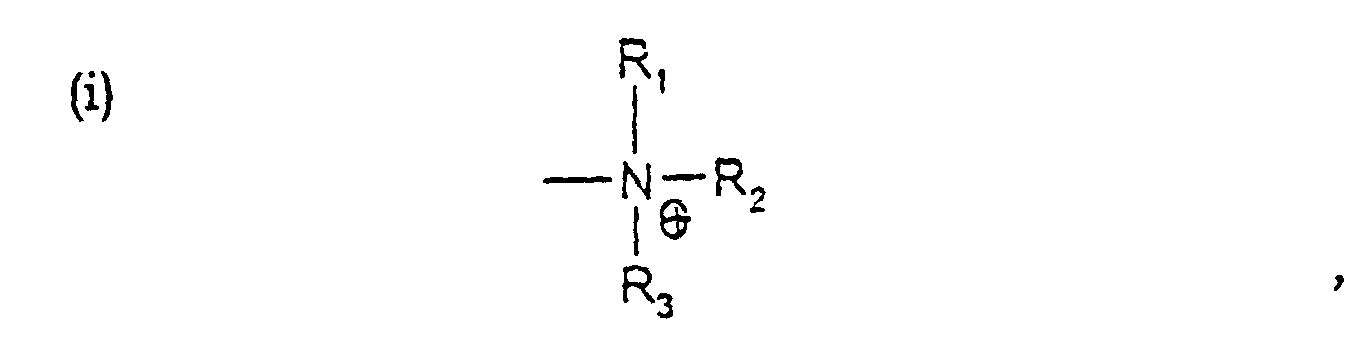
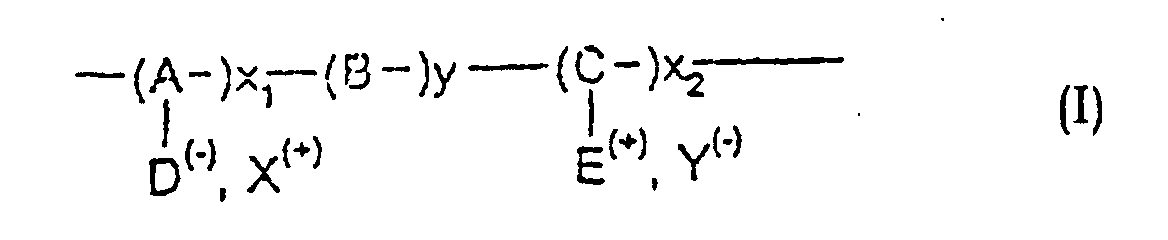 - A- eine Gruppe, die bei der Copolymerisation mindestens eines ethylenisch ungesättigten Monomers entsteht und die eine Gruppe D(-) trägt;- D(-) eine anionische Gruppe, die ausgewählt ist unter(i) -COO-;(ii) -SO3 -;(iii) -PO3 2-;(iv) -HPO3 -;- X(+) ein Kation, das bei der Neutralisation der Gruppen D mit einer anorganischen oder organischen Base gebildet wird;- B- eine Gruppe, die bei der Copolymerisation mindestens eines hydrophilen oder hydrophoben, ethylenisch ungesättigten Monomers entsteht,- C- eine Gruppe, die bei der Copolymerisation mindestens eines ethylenisch ungesättigten Monomers entsteht und die eine Gruppe -E(+) trägt;- E(+) eine kationische Gruppe, die ausgewählt ist unterworin R1, R2 und R3, gleich oder verschieden, Wasserstoff, geradkettiges, verzweigtes oder cyclisches (cycloaliphatisch oder aromatisch) C1-C22-Alkyl bedeuten;
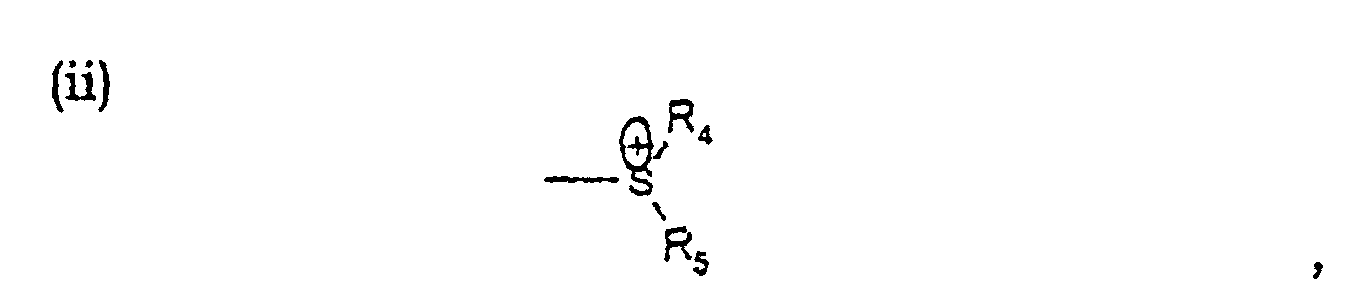
 worin R4 und R5, gleich oder verschieden, eine aliphatische, cycloaliphatische oder aromatische Gruppe bedeuten;
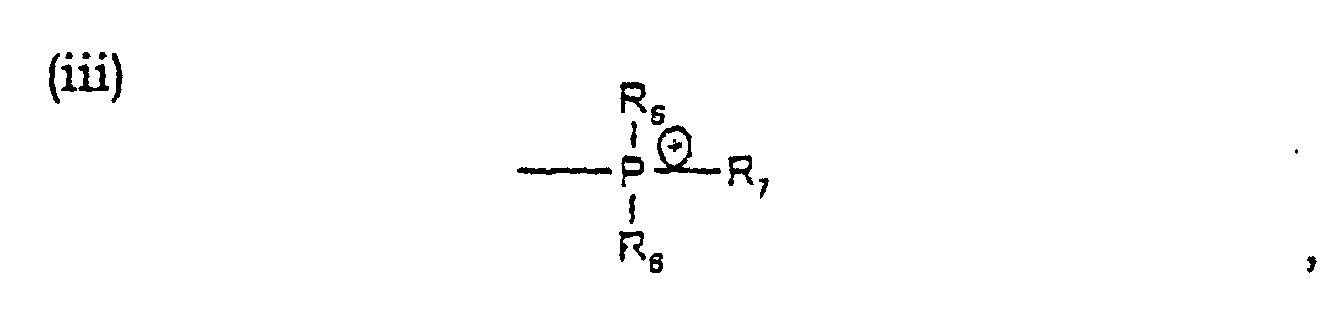
 worin R6, R7 und R8, gleich oder verschieden, eine aliphatische, cycloaliphatische oder aromatische Gruppe bedeuten;
 - Y(-) ein Anion, das bei der Neutralisation der Gruppen E mit einer anorganischen oder organischen Säure oder durch Quaternisierung der Gruppe E gebildet wird;- x1, x2, y die in Mol angegebene Konzentration an Gruppen A, Gruppen B bzw. Gruppen C,
wobei x1 und x2 identisch oder nahezu identisch sind, damit die Gesamtladung des Polymers bei einem pH-Wert von etwa 7 etwa Null beträgt. - Zusammensetzung nach Anspruch 2, dadurch gekennzeichnet, daß in der Formel (I) die Summe x1 + x2 größer als oder gleich 40 Mol-% ist und y kleiner als oder gleich 60 Mol-% ist.
- Zusammensetzung nach Anspruch 2 oder 3, dadurch gekennzeichnet, daß in der Formel (I) D(-) Carboxylat bedeutet und die Gruppeausgewählt ist unter den Salzen geradkettiger, verzweigter oder cyclischer Carbonsäuren, den Salzen geradkettiger, verzweigter oder cyclischer Dicarbonsäuren und ihren Monoestern und Monoamiden.

- Zusammensetzung nach Anspruch 2 oder 3, dadurch gekennzeichnet, daß in der Formel (I) D(-) Sulfonat bedeutet und die Gruppeausgewählt ist unter den Salzen der Aciylamido-2-methyl-2-propansulfonsäure, der Vinylsulfonsäure, der Styrolsulfonsäure, den Salzen des 2-Sulfoethyl(meth)acrylats.

- Zusammensetzung nach Anspruch 2 oder 3, dadurch gekennzeichnet, daß D(-) Phosphonat bedeutet undein Salz der Vinylphosphonsäure bedeutet.
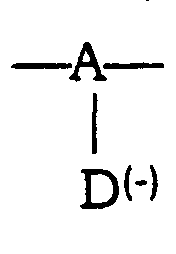
- Zusammensetzung nach einem der Ansprüche 2 bis 6, dadurch gekennzeichnet, daß die Gruppe -B- aus mindestens einem Monomer, das unter den geradkettigen, verzweigten oder cyclischen C1-C24-Vinylestern, den Olefinen, Styrol und den substituierten Styrol-Derivaten, den geradkettigen, verzweigten oder cyclischen C1-C24-Estern oder C1-C24-Amiden der (Meth)acrylsäure ausgewählt ist und gegebenenfalls mindestens einem Monomer besteht, das unter siliconhaltigen Makromeren, die eine endständige Vinylgruppe aufweisen, Vinylmonomeren, Allylmonomeren und (Meth)acrylmonomeren, die fluorhaltige oder perfluorierte Gruppen tragen, ausgewählt ist.
- Zusammensetzung nach einem der Ansprüche 2 bis 7, dadurch gekennzeichnet, daß das Monomerausgewählt ist unter den (Meth)acryl-, Vinyl-, Allyl- und Diallylmonomeren, die ein tertiäres Amin E tragen, das mit einem Alkylhalogenid oder einem Dialkylsulfat quatemisiert ist.

- Zusammensetzung nach einem der Ansprüche 2 bis 8, dadurch gekennzeichnet, daß das Polymer der Formel (I) unter den Natriumstyrolsulfonat/Trimethylammoniumpropyl(meth)acrylamidchlorid-Copolymeren und den Natriumstyrolsulfonat/Trimethylammoniumethylmethacrylat-Copolymeren ausgewählt ist.
- Zusammensetzung nach Anspruch 1, dadurch gekennzeichnet, daß das polyampholytische Polymer als Grundmonomer das Monomer der folgenden Formelenthält, in der bedeuten:
 R9, R11 und R12, gleich oder verschieden, Wasserstoff oder geradkettiges oder verzweigtes C1-C4-Alkyl;Z COO(-), SO3 (-) oder HPO3 (-);F die Gruppe -NH oder O oder einen Rest, der zusammen mit der Gruppe R10 einen aromatischen oder nicht-aromatischen Ring oder Heterocyclus mit 5 bis 7 Kohlenstoffatomen bildet,R10 und R13 unabhängig eine zweiwertige Kohlenwasserstoffgruppe, insbesondere eine Gruppe -(CH2)n-, worin n eine gänze Zahl im Bereich von 1 bis 4 bedeutet,R10 einen Rest, der mit R11 und R12 einen C5-C7-Heterocyclus bilden kann;p die Zahl 0 oder 1 und q die Zahl 0 oder 1.
 - Zusammensetzung nach Anspruch 10, dadurch gekennzeichnet, daß das Polymer der Formel (II) ausgewählt ist unter:Poly(1-vinyl-2-(3-sulfopropyl)-imidazoliumhydroxid);Poly(1-vinyl-3-(3-sulfopropyl)-imidazoliumhydroxid);Poly(1-vinyl-3-(4-sulfobutyl)-imidazoliumhydroxid);Poly(1-vinyl-2-methyl-3-(4-sulfobutyl)-imidazoliumhydroxid);Poly(2-vinyl-1-(3-sulfopropyl)-pyridiniumhydroxid);Poly(2-methyl-5-vinyl-1-(3-sulfopropyl)-pyridiniumhydroxid);Poly(4-vinyl-1-(3-sulfopropyl)-pyridiniumhydroxid);Poly(dimethyl-(2-methacryloxyethyl)-(3-sulfopropyl)-ammoniumhydroxid);Poly(diethyl-(2-methacryloxyethoxy-2-ethyl)-(3-sulfopropyl)-ammoniumhydroxid);Poly(4-vinyl-4-(3-sulfobutyl)-pyridiniumhydroxid);Poly(N-(3-sulfopropyl)-N-methacrylamidopropyl-N,N-dimethylammoniumbetain.
- Zusammensetzung nach einem der Ansprüche 1 bis 11, dadurch gekennzeichnet, daß das polyampholytische Polymer in einer Konzentration im Bereich von 0,01 bis 20 Gew.-% und vorzugsweise 0,1 bis 10 Gew.-%, bezogen auf das Gesamtgewicht der Zusammensetzung, enthalten ist.
- Zusammensetzung nach einem der Ansprüche 1 bis 12, dadurch gekennzeichnet, daß das kationische Polymer ein Gewichtsmittel des Molekulargewichts von mindestens 5000 und bevorzugter von mindestens 10000 aufweist.
- Zusammensetzung nach Anspruch 13, dadurch gekennzeichnet, daß das Gewichtsmittel des Molekulargewichts des kationischen Polymers im Bereich von 10000 bis 10000000 liegt.
- Zusammensetzung nach einem der Ansprüche 1 bis 14, dadurch gekennzeichnet, daß die kationische Ladungsdichte des kationischen Polymers im Bereich von 0,9 bis 4 mÄq/g und vorzugsweise 1,1 bis 3 mÄq/g liegt.
- Zusammensetzung nach einem der Ansprüche 1 bis 15, dadurch gekennzeichnet, daß das kationische Polymer ausgewählt ist untera) den Copolymeren von Vinylmonomeren, die primäre, sekundäre, tertiäre Amingruppen oder quartäre Ammoniumgruppen tragen,b) den kationischen Polysacchariden, die von Stärke oder Cellulose abgeleitet sind,c) den kationischen Polysacchariden, die von Guargummi abgeleitet sind,d) den quartären Celluloseethern, den veretherten Copolymeren von Cellulose und Stärke.
- Zusammensetzung nach Anspruch 16, dadurch gekennzeichnet, daß die kationischen Polysaccharide gemäß Abschnitt b) unter den Polymeren der Formelausgewählt sind, in der bedeuten:
 H einen Anhydroglucoserest, wie Stärke, oder einen CelluloseanhydroglucoserestR Alkylen, Oxyalkylen, Polyoxyalkylen oder Hyroxyalkylen oder Gemische dieser Reste,R1, R2 und R3, gleich oder verschieden, Alkyl, Aryl, Alkylaryl, Arylalkyl, Alkoxyalkyl oder Alkoxyaryl, wobei jede dieser Gruppen bis zu 18 Kohlenstoffatome enthält, wobei die Gesamtzahl der Kohlenstoffatome pro kationischer Einheit vorzugsweise kleiner als oder gleich 20 ist,G- ein Anion, das bei der Quaternisierung des Amins NR1R2R3 entsteht.
 - Zusammensetzung nach einem der Ansprüche 1 bis 17, dadurch gekennzeichnet, daß das kationische Polymer in einem Anteil von 0,01 bis 5 Gew.-% und vorzugsweise 0,1 bis 3 Gew.-%, bezogen auf das Gesamtgewicht der Zusammensetzung, enthalten ist.
- Zusammensetzung nach einem der Ansprüche 1 bis 18, dadurch gekennzeichnet, daß sie mindestens einen anorganischen oder organischen Elektrolyten enthält.
- Zusammensetzung nach Anspruch 19, dadurch gekennzeichnet, daß der Elektrolyt in einer Konzentration von 0,1 bis 30 Gew.-% und vorzugsweise 1 bis 10 Gew.-% enthalten ist.
- Zusammensetzung nach einem der Ansprüche 1 bis 20, dadurch gekennzeichnet, daß der pH-Wert auf einen Wert im Bereich von 3 bis 11 eingestellt ist.
- Zusammensetzung nach einem der Ansprüche 1 bis 21, dadurch gekennzeichnet, daß sie außerdem eine reinigende Grundlage enthält, die aus mindestens einem grenzflächenaktiven Stoff oder einem Gemisch grenzflächenaktiver Stoffe besteht, die unter den anionischen, kationischen, nichtionischen, amphoteren und zwitterionischen grenzflächenaktiven Stoffen ausgewählt sind.
- Zusammensetzung nach Anspruch 22, dadurch gekennzeichnet, daß die reinigende Grundlage 4 bis 30 Gew.-% des Gesamtgewichts der Zusammensetzung ausmacht.
- Zusammensetzung nach einem der Ansprüche 1 bis 23, dadurch gekennzeichnet, daß das kosmetisch oder dermatologisch akzeptable Medium aus Wasser oder einem Gemisch aus Wasser und einem niederen Alkohol besteht.
- Zusammensetzung nach einem der Ansprüche 1 bis 24, dadurch gekennzeichnet, daß sie außerdem Hilfsstoffe enthält, die ausgewählt sind unter Parfüms, Konservierungsmitteln, Maskierungsmitteln, Verdickungsmitteln, reizlindernden Mitteln, schaummodifizierenden Mitteln, Farbmitteln, Perlglanzpigmenten, Hydratisierungsmitteln, Antischuppenmitteln, Antiseborrhöika, Vitaminen, Sonnenschutzfiltern.
- Zusammensetzung nach einem der Anspruche 1 bis 25, dadurch gekennzeichnet, daß sie in Form einer mehr oder weniger verdickten Flüssigkeit, einer Lotion, einer Creme oder eines Gels vorliegt.
- Zusammensetzung nach einem der Ansprüche 1 bis 26, dadurch gekennzeichnet, daß es sich um ein auszuspülendes Produkt zum Waschen, Pflegen und/oder Frisieren der Haare handelt.
- Verfahren zur nicht-therapeutischen Behandlung der Haare, dadurch gekennzeichnet, daß eine Zusammensetzung nach einem der Ansprüche 1 bis 27 unmittelbar auf die Haare aufgetragen wird und daß die Zusammensetzung nach einer möglichen Einwirkungszeit mit Wasser aus den Haaren ausgespült wird.
Applications Claiming Priority (3)
| Application Number | Priority Date | Filing Date | Title |
|---|---|---|---|
| FR9515290 | 1995-12-21 | ||
| FR9515290A FR2742657B1 (fr) | 1995-12-21 | 1995-12-21 | Compositions pour le traitement des matieres keratiniques contenant l'association d'un polymere polyampholyte et d'un polymere cationique |
| PCT/FR1996/001831 WO1997023193A1 (fr) | 1995-12-21 | 1996-11-19 | Compositions pour le traitement des matieres keratiniques contenant l'association d'un polymere polyampholyte et d'un polymere cationique |
Publications (2)
| Publication Number | Publication Date |
|---|---|
| EP0869766A1 EP0869766A1 (de) | 1998-10-14 |
| EP0869766B1 true EP0869766B1 (de) | 2001-11-21 |
Family
ID=9485816
Family Applications (1)
| Application Number | Title | Priority Date | Filing Date |
|---|---|---|---|
| EP96939151A Expired - Lifetime EP0869766B1 (de) | 1995-12-21 | 1996-11-19 | Zusammensetzungen zur behandlung von keratinmaterial enthaltend ein polyampholyt und ein kationisches polymer |
Country Status (8)
| Country | Link |
|---|---|
| EP (1) | EP0869766B1 (de) |
| JP (1) | JPH11506119A (de) |
| AR (1) | AR005145A1 (de) |
| AU (1) | AU7630296A (de) |
| DE (1) | DE69617266T2 (de) |
| ES (1) | ES2168519T3 (de) |
| FR (1) | FR2742657B1 (de) |
| WO (1) | WO1997023193A1 (de) |
Cited By (1)
| Publication number | Priority date | Publication date | Assignee | Title |
|---|---|---|---|---|
| US9427391B2 (en) | 2006-01-09 | 2016-08-30 | The Procter & Gamble Company | Personal care compositions containing cationic synthetic copolymer and a detersive surfactant |
Families Citing this family (18)
| Publication number | Priority date | Publication date | Assignee | Title |
|---|---|---|---|---|
| JPH10152422A (ja) * | 1996-11-21 | 1998-06-09 | Pola Chem Ind Inc | 毛髪処理組成物 |
| WO2000006096A1 (en) * | 1998-07-30 | 2000-02-10 | The Procter & Gamble Company | Hair care compositions |
| US6110451A (en) * | 1998-12-18 | 2000-08-29 | Calgon Corporation | Synergistic combination of cationic and ampholytic polymers for cleansing and/or conditioning keratin based substrates |
| FR2789574B1 (fr) * | 1999-02-16 | 2001-03-30 | Oreal | Compositions cosmetiques detergentes contenant un tensioactif hydroxyalkylether anionique et un polymere cationique et leurs utilisations |
| FR2799972B1 (fr) * | 1999-10-20 | 2001-12-07 | Oreal | Compositions cosmetiques contenant un copolymere vinyl dimethicone/dimethicone en emulsion aqueuse et un epaississant et leurs utilisations |
| FR2799955B1 (fr) * | 1999-10-20 | 2001-12-07 | Oreal | Compositions cosmetiques contenant une emulsion d'un copolymere vinyldimethicone/dimethicone et un tensioactif cationique et leurs utilisations |
| FR2799970B1 (fr) * | 1999-10-20 | 2001-12-07 | Oreal | Compositions cosmetiques contenant un copolymere vinyldimethicone/dimethicone et un agent conditionneur et leurs utilisations |
| DE10059819A1 (de) | 2000-12-01 | 2002-06-13 | Clariant Gmbh | Tensidhaltige kosmetische, dermatologische und pharmazeutische Mittel |
| DE10059827A1 (de) * | 2000-12-01 | 2002-06-20 | Clariant Gmbh | Kosmetische und dermatologische Haarbehandlungsmittel |
| AU2003274286A1 (en) * | 2002-09-09 | 2004-03-29 | Rhodia Chimie | Formulations designed to be applied on keratinous material and to be rinsed |
| WO2004022680A2 (fr) * | 2002-09-09 | 2004-03-18 | Rhodia Chimie | Formulation a base de polymeres pour le rincage des textiles |
| US7012048B2 (en) | 2003-02-11 | 2006-03-14 | National Starch And Chemical Investment Holding Corporation | Composition and method for treating hair containing a cationic ampholytic polymer and an anionic benefit agent |
| EP1552809A1 (de) * | 2004-01-07 | 2005-07-13 | L'oreal | Kosmetische Zusammensetzung enthaltend ein kationisches Tensid, einen spinnenden Polymer mit hohem Molekulargewicht und ein Verdickungsmittel und kosmetisches Verfahren |
| FR2864774A1 (fr) * | 2004-01-07 | 2005-07-08 | Oreal | Composition cosmetique comprenant un cation, un polymere de haut poids moleculaire et un epaississant et procede de traitement cosmetique |
| US8623341B2 (en) | 2004-07-02 | 2014-01-07 | The Procter & Gamble Company | Personal care compositions containing cationically modified starch and an anionic surfactant system |
| FR2894585B1 (fr) | 2005-12-14 | 2012-04-27 | Rhodia Recherches Et Tech | Copolymere comprenant des unites zwitterioniques et d'autres unites, composition comprenant le copolymere, et utilisation |
| FR2926979B1 (fr) * | 2008-02-04 | 2010-12-17 | Oreal | Nouveaux composes cationiques, compositions les comprenant, utilisation comme conditionneur, et procede de traitement cosmetique. |
| CN112275328A (zh) * | 2020-11-03 | 2021-01-29 | 天津工业大学 | 一种带季铵基的淀粉基离子交换树脂及其制备方法和应用 |
Family Cites Families (4)
| Publication number | Priority date | Publication date | Assignee | Title |
|---|---|---|---|---|
| FR2553779B1 (fr) * | 1983-10-19 | 1986-02-21 | Hoechst France | Tetrapolymeres ampholytes cationiques, leur application dans le traitement des fibres keratiniques et les compositions les renfermant |
| EP0217274A3 (de) * | 1985-09-30 | 1988-06-29 | Kao Corporation | Haarkosmetikum |
| US5254333A (en) * | 1990-07-10 | 1993-10-19 | Kao Corporation | Hair treatment composition and hair dye composition |
| CA2072175A1 (en) * | 1991-06-28 | 1992-12-29 | Shih-Ruey T. Chen | Ampholyte terpolymers providing superior conditioning properties in shampoos and other hair care products |
-
1995
- 1995-12-21 FR FR9515290A patent/FR2742657B1/fr not_active Expired - Fee Related
-
1996
- 1996-11-19 EP EP96939151A patent/EP0869766B1/de not_active Expired - Lifetime
- 1996-11-19 JP JP9523350A patent/JPH11506119A/ja active Pending
- 1996-11-19 DE DE69617266T patent/DE69617266T2/de not_active Expired - Fee Related
- 1996-11-19 ES ES96939151T patent/ES2168519T3/es not_active Expired - Lifetime
- 1996-11-19 WO PCT/FR1996/001831 patent/WO1997023193A1/fr not_active Ceased
- 1996-11-19 AU AU76302/96A patent/AU7630296A/en not_active Abandoned
- 1996-12-19 AR ARP960105772A patent/AR005145A1/es unknown
Non-Patent Citations (1)
| Title |
|---|
| International Cosmetic Ingredient Dictionary and Handbook, publié par "The Cosmetic, Toiletry and Fragance Association", Edition 2000, page 1265. * |
Cited By (1)
| Publication number | Priority date | Publication date | Assignee | Title |
|---|---|---|---|---|
| US9427391B2 (en) | 2006-01-09 | 2016-08-30 | The Procter & Gamble Company | Personal care compositions containing cationic synthetic copolymer and a detersive surfactant |
Also Published As
| Publication number | Publication date |
|---|---|
| AR005145A1 (es) | 1999-04-14 |
| FR2742657A1 (fr) | 1997-06-27 |
| JPH11506119A (ja) | 1999-06-02 |
| WO1997023193A1 (fr) | 1997-07-03 |
| EP0869766A1 (de) | 1998-10-14 |
| ES2168519T3 (es) | 2002-06-16 |
| DE69617266D1 (de) | 2002-01-03 |
| FR2742657B1 (fr) | 1998-01-30 |
| AU7630296A (en) | 1997-07-17 |
| DE69617266T2 (de) | 2002-07-04 |
Similar Documents
| Publication | Publication Date | Title |
|---|---|---|
| DE69900453T2 (de) | Kosmetische Zusammensetzung enthaltend ein kationisches Polymer und ein acrylisches Terpolymer und Verwendung dieser Zusammensetzung zur Behandlung von Keratinfasern | |
| EP1291001B2 (de) | Ein Copolymer aus Methacrylsäure und ein Öl enthaltende kosmetische Zusammensetzungen und deren Verwendungen | |
| EP1383462B1 (de) | Kosmetische zusammensetzungen mit dispersionspolymeren | |
| EP0974335B1 (de) | Kosmetische Tensid Zusammensetzung sowie ihre Verwendung | |
| CA1179268A (fr) | Composition destinee au traitement des fibres keratiniques a base de polymere cationique et de polymere anionique a groupements vinylsulfoniques et procede de traitement la mettant en oeuvre | |
| DE69600048T2 (de) | Kosmetisches Haarwaschmittel und dessen Verwendung | |
| EP1025839B1 (de) | Kosmetische Zusammensetzung enthaltend ein anionisches und amphoteres Tensid, ein Polyolefin, ein kationisches Polymer und ein Salz oder einen wasserlöslichen Alkohol, Verwendung und Verfahren | |
| FR2742657A1 (fr) | Compositions pour le traitement des matieres keratiniques contenant l'association d'un polymere polyampholyte et d'un polymere cationique | |
| DE3150338A1 (de) | Oeliges, schaeumendes mittel mit einer fluessigen phase zur pflege von keratinmaterialien und der haut | |
| LU83911A1 (fr) | Produit nettoyant des cheveux et de la peau a base d'acylise thionates et de polymeres cationiques | |
| EP1132079A1 (de) | Waschmittel für keratinische Materialien die ein niedrig ethoxylierten Ester des Sorbits enthalten | |
| CH659389A5 (fr) | Composition epaissie ou gelifiee de conditionnement des cheveux contenant au moins un polymere cationique, au moins un polymere anionique et au moins une gomme de xanthane. | |
| CH657523A5 (fr) | Composition cosmetique destinee au traitement des fibres keratiniques et procede de traitement de celles-ci. | |
| CN103619312A (zh) | 包含阴离子型表面活性剂、非离子型或两性型表面活性剂和固体脂肪醇的化妆品组合物以及化妆处理方法 | |
| EP1092419B1 (de) | Zusammensetzung zur Reinigung von Keratinsubstanzen auf der Basis eines reinigenden grenzflächenaktiven Stoffes, eines Polyorganosiloxans und eines Acrylterpolymers | |
| FR2798851A1 (fr) | Composition de lavage des matieres keratiniques, a base d'un agent tensio-actif detergent, d'un agent nacrant et ou opacifiant et d'un terpolymere acrylique | |
| JPH11513998A (ja) | 洗浄化粧品組成物及びその使用 | |
| EP1366741B1 (de) | Haarwaschmittel enthaltend mindestens ein amphiphiles folgerichtiges Copolymer und mindestens ein kationisches oder amphoteres Polymer | |
| EP3813777B1 (de) | Zusammensetzung mit mindestens zwei verschiedenen anionischen tensiden, nichtionischen und amphoteren tensiden und kationischen oder amphoteren polymeren | |
| WO1997042931A1 (fr) | Compositions pour le traitement des matieres keratiniques contenant l'association d'un polymere polyampholyte et d'un organopolysiloxane non-volatil et insoluble dans l'eau | |
| FR2705890A1 (fr) | Compositions cosmétiques contenant au moins un tensio-actif anionique du type alkylgalactoside uronate et au moins un polymère cationique, et leurs utilisations pour le traitement des matières kératiniques. | |
| EP1348420B1 (de) | Kosmetische Zusammensetzung, enthaltend mindestens ein anionisches Tensid, mindestens ein kationisches Polymer und mindestens ein verzweigtes, amphiphiles Acrylblockcopolymer und Haarbehandlungsverfahren unter Verwendung dieser Zusammensetzung | |
| US7498022B2 (en) | Cosmetic composition comprising at least one anionic surfactant, at least one cationic polymer and at least one amphiphilic, branched block acrylic copolymer and method for treating hair using such a composition | |
| FR3104030A1 (fr) | Procédé de traitement capillaire comprenant l’application d’une composition cosmétique de soin comprenant un polymère cationique et un organosilane, puis d’une composition cosmétique lavante | |
| FR3136158A1 (fr) | Composition cosmétique comprenant des aminoacides, des (poly)acides carboxyliques hydroxylés et des tensioactifs amphotères, et procédé de traitement cosmétique |
Legal Events
| Date | Code | Title | Description |
|---|---|---|---|
| PUAI | Public reference made under article 153(3) epc to a published international application that has entered the european phase |
Free format text: ORIGINAL CODE: 0009012 |
|
| 17P | Request for examination filed |
Effective date: 19980721 |
|
| AK | Designated contracting states |
Kind code of ref document: A1 Designated state(s): DE ES FR GB IT |
|
| 17Q | First examination report despatched |
Effective date: 20001006 |
|
| GRAG | Despatch of communication of intention to grant |
Free format text: ORIGINAL CODE: EPIDOS AGRA |
|
| GRAG | Despatch of communication of intention to grant |
Free format text: ORIGINAL CODE: EPIDOS AGRA |
|
| GRAH | Despatch of communication of intention to grant a patent |
Free format text: ORIGINAL CODE: EPIDOS IGRA |
|
| GRAH | Despatch of communication of intention to grant a patent |
Free format text: ORIGINAL CODE: EPIDOS IGRA |
|
| GRAA | (expected) grant |
Free format text: ORIGINAL CODE: 0009210 |
|
| AK | Designated contracting states |
Kind code of ref document: B1 Designated state(s): DE ES FR GB IT |
|
| REG | Reference to a national code |
Ref country code: GB Ref legal event code: IF02 |
|
| REF | Corresponds to: |
Ref document number: 69617266 Country of ref document: DE Date of ref document: 20020103 |
|
| GBT | Gb: translation of ep patent filed (gb section 77(6)(a)/1977) |
Effective date: 20020216 |
|
| REG | Reference to a national code |
Ref country code: ES Ref legal event code: FG2A Ref document number: 2168519 Country of ref document: ES Kind code of ref document: T3 |
|
| PLBE | No opposition filed within time limit |
Free format text: ORIGINAL CODE: 0009261 |
|
| STAA | Information on the status of an ep patent application or granted ep patent |
Free format text: STATUS: NO OPPOSITION FILED WITHIN TIME LIMIT |
|
| 26N | No opposition filed | ||
| PG25 | Lapsed in a contracting state [announced via postgrant information from national office to epo] |
Ref country code: GB Free format text: LAPSE BECAUSE OF NON-PAYMENT OF DUE FEES Effective date: 20021119 |
|
| PG25 | Lapsed in a contracting state [announced via postgrant information from national office to epo] |
Ref country code: ES Free format text: LAPSE BECAUSE OF NON-PAYMENT OF DUE FEES Effective date: 20021120 |
|
| PG25 | Lapsed in a contracting state [announced via postgrant information from national office to epo] |
Ref country code: DE Free format text: LAPSE BECAUSE OF NON-PAYMENT OF DUE FEES Effective date: 20030603 |
|
| GBPC | Gb: european patent ceased through non-payment of renewal fee | ||
| PG25 | Lapsed in a contracting state [announced via postgrant information from national office to epo] |
Ref country code: FR Free format text: LAPSE BECAUSE OF NON-PAYMENT OF DUE FEES Effective date: 20030731 |
|
| REG | Reference to a national code |
Ref country code: FR Ref legal event code: ST |
|
| REG | Reference to a national code |
Ref country code: ES Ref legal event code: FD2A Effective date: 20031213 |
|
| PG25 | Lapsed in a contracting state [announced via postgrant information from national office to epo] |
Ref country code: IT Free format text: LAPSE BECAUSE OF NON-PAYMENT OF DUE FEES Effective date: 20051119 |