EP0870185B1 - Verfahren zur behandlung einer zellsuspension - Google Patents
Verfahren zur behandlung einer zellsuspension Download PDFInfo
- Publication number
- EP0870185B1 EP0870185B1 EP96944119A EP96944119A EP0870185B1 EP 0870185 B1 EP0870185 B1 EP 0870185B1 EP 96944119 A EP96944119 A EP 96944119A EP 96944119 A EP96944119 A EP 96944119A EP 0870185 B1 EP0870185 B1 EP 0870185B1
- Authority
- EP
- European Patent Office
- Prior art keywords
- osmolality
- cells
- diluent
- cell
- suspension
- Prior art date
- Legal status (The legal status is an assumption and is not a legal conclusion. Google has not performed a legal analysis and makes no representation as to the accuracy of the status listed.)
- Expired - Lifetime
Links
- 239000006285 cell suspension Substances 0.000 title claims abstract description 62
- 238000000034 method Methods 0.000 title claims abstract description 59
- 238000012360 testing method Methods 0.000 title abstract description 23
- 238000005259 measurement Methods 0.000 claims abstract description 58
- 239000000725 suspension Substances 0.000 claims abstract description 35
- 239000007788 liquid Substances 0.000 claims abstract description 17
- 238000007865 diluting Methods 0.000 claims abstract description 6
- 230000003204 osmotic effect Effects 0.000 claims abstract description 6
- 210000004027 cell Anatomy 0.000 claims description 172
- 239000003085 diluting agent Substances 0.000 claims description 65
- 230000008859 change Effects 0.000 claims description 12
- 210000000601 blood cell Anatomy 0.000 claims description 6
- 238000011088 calibration curve Methods 0.000 claims description 4
- 239000012530 fluid Substances 0.000 claims description 2
- 238000001727 in vivo Methods 0.000 abstract description 12
- 230000008961 swelling Effects 0.000 abstract description 2
- 230000001413 cellular effect Effects 0.000 abstract 1
- 239000002245 particle Substances 0.000 description 22
- 239000000872 buffer Substances 0.000 description 13
- 210000004369 blood Anatomy 0.000 description 9
- 239000008280 blood Substances 0.000 description 9
- 238000010790 dilution Methods 0.000 description 9
- 239000012895 dilution Substances 0.000 description 9
- 210000003743 erythrocyte Anatomy 0.000 description 6
- 238000004513 sizing Methods 0.000 description 6
- 239000000243 solution Substances 0.000 description 5
- 238000004458 analytical method Methods 0.000 description 3
- 239000007975 buffered saline Substances 0.000 description 3
- 230000000694 effects Effects 0.000 description 3
- KCXVZYZYPLLWCC-UHFFFAOYSA-N EDTA Chemical compound OC(=O)CN(CC(O)=O)CCN(CC(O)=O)CC(O)=O KCXVZYZYPLLWCC-UHFFFAOYSA-N 0.000 description 2
- 206010018910 Haemolysis Diseases 0.000 description 2
- 230000004075 alteration Effects 0.000 description 2
- 230000009172 bursting Effects 0.000 description 2
- 238000006243 chemical reaction Methods 0.000 description 2
- 238000012937 correction Methods 0.000 description 2
- 238000001514 detection method Methods 0.000 description 2
- LOKCTEFSRHRXRJ-UHFFFAOYSA-I dipotassium trisodium dihydrogen phosphate hydrogen phosphate dichloride Chemical compound P(=O)(O)(O)[O-].[K+].P(=O)(O)([O-])[O-].[Na+].[Na+].[Cl-].[K+].[Cl-].[Na+] LOKCTEFSRHRXRJ-UHFFFAOYSA-I 0.000 description 2
- 229960001484 edetic acid Drugs 0.000 description 2
- 230000005684 electric field Effects 0.000 description 2
- 239000003792 electrolyte Substances 0.000 description 2
- 230000008588 hemolysis Effects 0.000 description 2
- 238000011835 investigation Methods 0.000 description 2
- 230000003287 optical effect Effects 0.000 description 2
- 239000002953 phosphate buffered saline Substances 0.000 description 2
- 230000000704 physical effect Effects 0.000 description 2
- PUZPDOWCWNUUKD-UHFFFAOYSA-M sodium fluoride Chemical compound [F-].[Na+] PUZPDOWCWNUUKD-UHFFFAOYSA-M 0.000 description 2
- XLYOFNOQVPJJNP-UHFFFAOYSA-N water Substances O XLYOFNOQVPJJNP-UHFFFAOYSA-N 0.000 description 2
- QCDWFXQBSFUVSP-UHFFFAOYSA-N 2-phenoxyethanol Chemical compound OCCOC1=CC=CC=C1 QCDWFXQBSFUVSP-UHFFFAOYSA-N 0.000 description 1
- FAPWRFPIFSIZLT-UHFFFAOYSA-M Sodium chloride Chemical compound [Na+].[Cl-] FAPWRFPIFSIZLT-UHFFFAOYSA-M 0.000 description 1
- 230000002159 abnormal effect Effects 0.000 description 1
- 230000032683 aging Effects 0.000 description 1
- 239000000022 bacteriostatic agent Substances 0.000 description 1
- 238000004820 blood count Methods 0.000 description 1
- 239000006172 buffering agent Substances 0.000 description 1
- 238000004364 calculation method Methods 0.000 description 1
- 210000002421 cell wall Anatomy 0.000 description 1
- 238000005119 centrifugation Methods 0.000 description 1
- 239000003795 chemical substances by application Substances 0.000 description 1
- 230000000052 comparative effect Effects 0.000 description 1
- 239000007859 condensation product Substances 0.000 description 1
- 238000012790 confirmation Methods 0.000 description 1
- 238000013480 data collection Methods 0.000 description 1
- 239000008367 deionised water Substances 0.000 description 1
- 239000003599 detergent Substances 0.000 description 1
- 238000005516 engineering process Methods 0.000 description 1
- 230000007613 environmental effect Effects 0.000 description 1
- -1 ethylene oxide-polypropylene Chemical group 0.000 description 1
- 230000004907 flux Effects 0.000 description 1
- 238000007429 general method Methods 0.000 description 1
- 238000000338 in vitro Methods 0.000 description 1
- 239000000203 mixture Substances 0.000 description 1
- 230000007935 neutral effect Effects 0.000 description 1
- 239000006174 pH buffer Substances 0.000 description 1
- 229960005323 phenoxyethanol Drugs 0.000 description 1
- 239000003755 preservative agent Substances 0.000 description 1
- 230000002335 preservative effect Effects 0.000 description 1
- 230000008569 process Effects 0.000 description 1
- 239000000047 product Substances 0.000 description 1
- 230000004044 response Effects 0.000 description 1
- 238000000926 separation method Methods 0.000 description 1
- 239000000344 soap Substances 0.000 description 1
- 239000011775 sodium fluoride Substances 0.000 description 1
- 235000013024 sodium fluoride Nutrition 0.000 description 1
- 238000004611 spectroscopical analysis Methods 0.000 description 1
- 239000000126 substance Substances 0.000 description 1
- 239000004094 surface-active agent Substances 0.000 description 1
- 210000001048 venom Anatomy 0.000 description 1
- 239000002435 venom Substances 0.000 description 1
- 231100000611 venom Toxicity 0.000 description 1
- 239000002699 waste material Substances 0.000 description 1
Images

Classifications
-
- G—PHYSICS
- G01—MEASURING; TESTING
- G01N—INVESTIGATING OR ANALYSING MATERIALS BY DETERMINING THEIR CHEMICAL OR PHYSICAL PROPERTIES
- G01N13/00—Investigating surface or boundary effects, e.g. wetting power; Investigating diffusion effects; Analysing materials by determining surface, boundary, or diffusion effects
- G01N13/04—Investigating osmotic effects
-
- Y—GENERAL TAGGING OF NEW TECHNOLOGICAL DEVELOPMENTS; GENERAL TAGGING OF CROSS-SECTIONAL TECHNOLOGIES SPANNING OVER SEVERAL SECTIONS OF THE IPC; TECHNICAL SUBJECTS COVERED BY FORMER USPC CROSS-REFERENCE ART COLLECTIONS [XRACs] AND DIGESTS
- Y10—TECHNICAL SUBJECTS COVERED BY FORMER USPC
- Y10T—TECHNICAL SUBJECTS COVERED BY FORMER US CLASSIFICATION
- Y10T436/00—Chemistry: analytical and immunological testing
- Y10T436/10—Composition for standardization, calibration, simulation, stabilization, preparation or preservation; processes of use in preparation for chemical testing
- Y10T436/108331—Preservative, buffer, anticoagulant or diluent
-
- Y—GENERAL TAGGING OF NEW TECHNOLOGICAL DEVELOPMENTS; GENERAL TAGGING OF CROSS-SECTIONAL TECHNOLOGIES SPANNING OVER SEVERAL SECTIONS OF THE IPC; TECHNICAL SUBJECTS COVERED BY FORMER USPC CROSS-REFERENCE ART COLLECTIONS [XRACs] AND DIGESTS
- Y10—TECHNICAL SUBJECTS COVERED BY FORMER USPC
- Y10T—TECHNICAL SUBJECTS COVERED BY FORMER US CLASSIFICATION
- Y10T436/00—Chemistry: analytical and immunological testing
- Y10T436/25—Chemistry: analytical and immunological testing including sample preparation
- Y10T436/25625—Dilution
Definitions
- the present invention relates to a method in which a sample of cell suspension is analysed to determine a parameter of the cells relating to size, for instance volume, diameter or shape.
- a parameter of the cells relating to size, for instance volume, diameter or shape.
- the cells are tested after dilution and the size measurement is corrected to the environmental conditions, especially osmolality, of the sample as supplied.
- CBC complete blood count
- Electronic particle counters typically use a sensor which detects particles in a restricted flow, producing a measure of particle size and count for each particular type of particle.
- the sensor usually detects a change in an electrical field, an alteration in the light scatter from a laser, a change in the magnetic field density or magnetic flux, or changes in the optical, acoustic or other physical properties of the cells or cell suspension and/or suspending liquid. Whatever type of sensor is used, it produces a signal which is a product of a particle's size, shape, trajectory, number and other properties, some of which may be measured concomitantly.
- Electronic particle counters which use a direct or alternating current as a method to detect particles can be referred to as electronic particle sizing devices (hereinafter referred to as EPS), and produce a characteristic change in voltage or current, usually recorded as a voltage pulse as a particle passes through a restriction (aperture).
- EPS electronic particle sizing devices
- Electronic particle sizing relies on two electrodes suspended in a conducting solution which are isolated from each other except for a single conducting channel which is traversed by cells or other small particles in suspension. As a particle passes through the channel (aperture) the physical characteristics of the channel temporarily alters in proportion to the particle's size. By measuring the properties of these changes, the size and concentration of particles is determined. This is performed on red cells, white cells and platelets and any free cell suspension and may be combined with stains or other techniques to further differentiate the cells by any means (i.e. optically, NMR etc).
- EPS instruments do not use an isotonic diluent to produce a cell suspension, but instead use a hypertonic diluent typically phosphate buffered saline (PBS) fixed at 30 to 50 mOsm/Kg above the population's mean plasma osmolality. It is well known that there is a natural range of plasma osmolalities amongst individuals. It is also well known that for all permeable cells with non-rigid walls, cell size varies with the osmolality of the buffer in which it is suspended.
- PBS phosphate buffered saline
- EP-A-0,115,077 discloses a general purpose blood diluent solution which allows measurements of the blood cells to be made.
- the solution has neutral pH and consists of electrolytes, pH buffers, ethylene diamine tetraacetic acid, a preservative and the surfactant ethylene oxide-polypropylene condensation product.
- US 3,962,125 discloses a multipurpose blood diluent for use in the determination of various blood cell parameters which can be analysed using instrumentation of the Coulter type.
- the diluent is isotonic and osmotically balanced with respect to the solutions in blood cells and contains electrolytes, a bacteriostatic agent (2-phenoxyethanol), a buffering agent (ethylenediamine tetraacetic acid) and sodium fluoride.
- the method of the invention overcomes the above problems by testing cells at their in vivo osmolality, thereby minimizing the possibility of swelling over time and mimicking the cell's in vivo condition in respect of its osmotic environment.
- the most accurate in vitro measures of in vivo cell size is possible if cells are tested in a buffer of the same osmolality as their plasma, as this removes the need for "correction factors" to adjust for incorrect buffer osmolality. In existing technology these correction factors are always fixed because the individual's plasma osmolality is unknown or is not used in existing tests.
- haemolysis can be induced osmotically using water, or by detergents (eg soap), venoms or other chemical, thermal, mechanical or electrical agents.
- the critical osmolality at which haemolysis occurs can be determined by subjecting aliquots of a red blood cell suspension to a concentration gradient which may include stepped or continuous changes in concentration, for instance as described in DE-A-3103792.
- the osmolality of the plasma may vary from individual to individual and, occasionally, within an individual over time.
- the value which is obtained for the cell size when diluted in isotonic saline will be different to the in vivo cell size.
- the present invention seeks to correct such errors.
- a cell suspension is subjected to the following steps:
- the diluent used in step 1 may be constituted by plasma separated from the starting cell suspension.3 Separation may, for instance, be carried out manually or by other means. In this case it is unnecessary to determine the osmolality of the plasma to produce an accurate osmotically correct cell size. It may, however, be preferred in addition for a reference measurement of cell size to be conducted using, in place of the plasma, a diluent of known composition having an osmolality equal to that of the plasma, which requires a determination of that osmolality. Alternatively the reference measurement of size may consist of a series of measurements in varying osmolality diluents as described below in step 5. This allows a determination of the size measurement by interpolation. These reference tests allow confirmation to be obtained that the plasma used as diluent in step 1 is not having an effect on the values obtained in the measurement step 2. If the values are different further investigations have to be made.
- the osmolality of the starting cell suspension is determined and a diluent is then made up to that osmolality.
- the diluent may be made up using appropriate buffers of known concentrations in suitable amounts (eg using suitable amounts of hypotonic and hypertonic fluids).
- the osmolality is determined, for instance, by measuring the osmolality of the plasma of the starting cell suspension, usually after separating a portion of the cell suspension into cells and plasma.
- the osmolality can alternatively be calculated using standard blood chemistry analysis which measures the concentration of most of the molecules in the plasma which contribute to osmotic pressure or by using standard osmometers.
- the value obtained from the cell size measurement carried out in step 2 can be used to determine the osmolality of the plasma, in a preferred embodiment of this aspect of the invention.
- the method further includes the following steps:
- step 1 instead of or in addition to using neat plasma in step 1, plasma diluted by a known amount (for instance 1 volume (per volume) or more, usually up to 20 volumes, for instance 2-10 volumes) of a diluent having known osmolality is used as diluent for the cells.
- a known amount for instance 1 volume (per volume) or more, usually up to 20 volumes, for instance 2-10 volumes
- this step serves as a check on the cell size measurement determined in step 2 and hence on the value determined for the plasma osmolality calculated in step 6 above.
- the function determined in step 5 may be determined by several techniques. In one of these the cells of the cell suspension itself may be used to determine the function. In this method the following steps at least are carried out:
- the function may not be linear within the range of osmolalities between the hypertonic and hypotonic diluent, it is preferred for the cell size measurements to be carried out for the diluted suspensions at several different known osmolalities in the range.
- the range includes a hypotonic osmolality at which the cells have their maximum size before bursting.
- a calibrating cell suspension of a similar type to that of the starting cell suspension, but which has a well characterised shape change with changing osmolality is used to determine the function.
- the calibrating cell suspension is diluted using hypotonic and hypertonic diluents of various known concentrations and subjected to size measurements. This method is described further in our copending International patent applications, filed even date herewith, respectively claiming priority from British patent application Nos. 9526649.0, 9526684.7 and 9526720.9.
- the test can be carried out on several comparison cell suspensions of a similar type and the average of the population used as the function.
- cell size measurements may be carried out on the cells of the starting cell suspension when diluted to at least two known osmolalities.
- at least one of these is a hypotonic osmolality at which the cells are at their maximum size without bursting, since this optimises the determination of the relevant constants for the cells of the cell suspension.
- the method used in these embodiments of the invention for determining the osmolality of the plasma of the starting cell suspension used in step 1, may alternatively be used to determine the osmolality of any diluent of unknown osmolality.
- a diluent is used to dilute a portion of starting cell suspension which is made up of a known proportion of plasma and a known proportion of diluent of known osmolality
- the method can by used to determine-the osmolality of the plasma.
- smaller quantities of plasma need be used as diluent which reduces the size of the sample of starting cell suspension required to provide the plasma.
- the method can, in effect, be used as an osmometer for use in the determination of osmolality of a variety of aqueous liquids, provided that the cells' response to a buffer of known osmolality is also determined.
- a diluent of known preferably about isotonic, osmolality
- a calibration curve has been set up, using the calibrating cells, of cell size measurement against osmolality.
- the cell size measurement of those cells when suspended in a medium from the cell sample under test, allows a determination of the osmolality of the extracellular liquid. Accordingly it may be necessary to make only a single determination of cell size measurement at a single dilution of the O-negative cell, although it often improves the accuracy and may be just as convenient, when using automated apparatus capable of setting up the concentration gradient of changing osmolality, to determine the cell size measurement over a range of osmolalities down to the concentration at which the cells have their maximum size.
- the data collected in any of the above embodiments where cells are subjected to a range of diluent osmolalities may allow a profile of the average cell size measurement against dilution to be created, or for a frequency distribution of cell size measurement of individual cells or of a fixed number of cells. It is preferred for the data to be collected on a cell-by-cell basis and for the results to be reported as a frequency distribution of a population of individual cells, as described in our copending application No. 9526720.9.
- the profiles (frequency distribution) from the various series of tests can be compared with one another, in particular maxima of the profiles and the shapes of the curves, to allow an interpolation to determine the osmolality of the extracellular medium or of other diluent whose osmolality is to be determined.
- This technique can be used to determine the osmolality of the medium to such an accuracy that the value can be quoted to the nearest 0.1 or even 0.01 of a milliosmole. This is more accurate than existing conventional osmometers which can report values to the nearest 1 or 2 milliosmoles.
- a conventional osmometer may be used in conjunction with the present method to estimate the osmolality of the medium before the range of tonicities for the measurements for step 5 is arranged.
- the starting cell suspension is diluted preferably in a double dilution before being subjected to the respective cell size measurement step.
- each step dilutes by at least 10 volumes of diluent, usually at least 30 volumes, often at least 50 volumes, for instance up to 500 or 1000 volumes.
- the total dilution is usually in the range 4000-25,000. Suitable levels of dilution are twice 100 volumes (i.e. a total of 10,000).
- the cell size measurement which is made on the cell suspensions provides data about at least one size parameter of the cells.
- the measurement is usually determined using electronic particle sizing techniques, preferably determining the change in electric field as the diluted suspension passes through a restriction.
- the signal from the sensor is affected primarily by particles' size and shape, whilst the trajectory and, usually, number are kept approximately constant, using apparatus described in our copending application No. 9526652.4 filed even date herewith. From the data collected, information about the cells' size and shape under in vivo conditions can be determined using the methods of-calculation described in the above-mentioned copending applications.
- the present invention provides three methods of determining the true in vivo cell size. They are:
- sample volume 0.1 to 2 ⁇ l upwards A portion of a sample (sample volume 0.1 to 2 ⁇ l upwards) of blood is diluted twice by 100 volumes (per volume of the portion of sample) of buffered saline at 290 mOsm/kg, but ranging form 200 to 400 mOsm/kg. Successive aliquots of the diluted suspension are then subjected to successively increasing amounts of a hypotonic diluent, which in this example is deionised water to subject the cells to osmolalities in the range 400 mOsm/kg to 0 mOsm/kg (or equivalent resistance of 2k ⁇ to 18.3M ⁇ ).
- a hypotonic diluent which in this example is deionised water to subject the cells to osmolalities in the range 400 mOsm/kg to 0 mOsm/kg (or equivalent resistance of 2k ⁇ to 18.3M ⁇ ).
- the further diluted suspensions then pass through the measuring chamber of an electronic particle size spectroscopy apparatus (as illustrated in our copending application No. 9526652.4 filed even date herewith.
- the flow rate is about 5000 cells per second through the aperture (representing about 10% of the suspension and hence of the cells).
- the remaining 90% of the suspension is drained to waste.
- the electrical pulse for individual cells passing through the aperture is measured by an analogue peak detection circuit which measures the maximum voltage of each pulse detected. This allows the analogue pulse to be converted to digital data signals.
- the detector is serviced about ten times as often as a cell passes through the aperture, that is about 5 x 10 4 times per second. Each digital conversion of a cell's voltage is performed more quickly than a cell traverses the aperture. These data can be analysed and displayed in real time and/or stored for comparative analyses.
- the pulse may be continuously digitized using very high speed analogue to digital converters ( ⁇ 1 ⁇ S conversion time) eliminating the need to peak detection by comparing the digitized values as a cell traverses the aperture.
- a value for a cell size measurement parameter for each cell is determined.
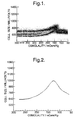
- the frequency distribution for the values is plotted against osmolality of the suspending liquid, which is calculated from the quantities of buffered saline and of water for the aliquot under observation (or it may be measured during the test), for all osmolality values down to the value below which the cells react to reach their maximum size and burst.
- the frequency distribution is shown in Figure 1.
- Figure 2 shows the mean cell size value against osmolality for the data from Figure 1.
- the maximum of the curve is the point at which the cells are at their maximum cell size (cm max ). Above this dilution, or below the osmolality O b , the cells burst. At isotonic osmolality the cells have cell size measurement cm i .
- the extracellular medium of the original cell suspension under test has an osmolality greater than the buffer osmolality i.e. is hypertonic O y , the true cell size measurement cm y of the cells in vivo will be lower than that determined at the plasma osmolality. Similarly if the extracellular medium of the original suspension is lower than average (O o ) the true in vivo cell size measurement (cm o ) will be higher than that determined at the plasma osmolality.
- a sample of O-negative red blood cells is subjected to the same general method as the cells under test in example 1 to generate the frequency distribution profile shown in Figure 3.
- a second portion of the blood sample used in example 1 is separated by centrifugation to remove cells from the extracellular liquid.
- the extracellular liquid is then diluted with 9 volumes of buffered saline as used in example 1 to dilute the first portion of the cell sample.
- This medium was then used to dilute a portion of the calibrating O-negative red blood cells and the cell size measurement of those cells determined as cm s .
- the value for the osmolality of the cells having that cell size measurement is determined as shown in Figure 4 to be O s . From this value the osmolality of the extracellular medium can be calculated. This value can then be used to determine the in vivo cell size measurement for the cells of the sample from the profile shown in Figures 3 and 4.
- the data is generally converted to digital where the data are collected on a cell-by-cell basis. It may be possible to measure the average cell size only, by using standard data collection techniques in which the voltages of a known number of cells are summated, although the accuracy of such techniques may not be good enough to obtain adequate results in the methods of the present invention.
Landscapes
- Physics & Mathematics (AREA)
- Health & Medical Sciences (AREA)
- Life Sciences & Earth Sciences (AREA)
- Chemical & Material Sciences (AREA)
- Analytical Chemistry (AREA)
- Biochemistry (AREA)
- General Health & Medical Sciences (AREA)
- General Physics & Mathematics (AREA)
- Immunology (AREA)
- Pathology (AREA)
- Investigating Or Analysing Biological Materials (AREA)
- Chemical Treatment Of Metals (AREA)
- Immobilizing And Processing Of Enzymes And Microorganisms (AREA)
- Sampling And Sample Adjustment (AREA)
Claims (18)
- Verfahren, wobei eine Zellsuspension folgenden Schritten unterworfen wird:1) ein Teil der Zellsuspension wird mit einem Verdünnungsmittel verdünnt, das die gleiche Osmolalität besitzt wie das extrazelluläre flüssige Plasma, und2) die Zellen in der in Schritt 1 gebildeten Lösung werden einer Zellgrößenmessung unterworfen, während sie in dieser Lösung suspendiert sind.
- Verfahren gemäß Anspruch 1, wobei das in Schritt 1 verwendete Verdünnungsmittel aus Plasma gebildet werden kann, das von der anfänglichen Zellsuspension abgetrennt wird.
- Verfahren gemäß Anspruch 1, wobei in einem ersten Schritt die Osmolalität des Plasmas der Zellsuspension bestimmt wird, ein Verdünnungsmittel mit der bestimmten Osmolalität hergestellt wird, das anschließend in Schritt 1 verwendet wird, um eine Probe der gesamten Suspension zu verdünnen.
- Verfahren gemäß Anspruch 3, weiter enthaltend folgende Schritte:3) Verdünnung eines weiteren Teils der Zellsuspension in einem wäßrigen Verdünnungsmittel bekannter Osmolalität,4) Messung der Zellgröße der Zellen in dem Verdünnungsmittel bekannter Osmolalität,5) Bestimmung der Funktion der Änderung der Zellgröße für die Zellen der Zellsuspension in Abhängigkeit der von hypertonisch zu hypotonisch wechselnden Osmolalität, und6) Verwendung der in Schritt 5 bestimmten Funktion, der in den Schritten 2 und 4 bestimmten Zellgrößen und der Osmolalltät des in Schritt 3 verwendeten Verdünnungsmittels zur Berechnung der Osmolalität des in Schritt 1 verwendeten Plasmas.
- Verfahren gemäß Anspruch 4, wobei die in Schritt 5 genannte Funktion durch das Ausführen folgender Schritte bestimmt wird:7) Verdünnung eines Teils der anfänglichen Zellsuspension in einem wäßrigen Verdünnungsmittel bekannter hypertonischer (in Bezug auf das Plasma der anfänglichen Zellsuspension) Osmolalität, zur Bildung einer hypertonischen verdünnten Suspension,8) Messung der Zellgröße der Zellen in der hypertonischen verdünnten Suspension,9) Verdünnung eines weiteren Teils der Zellsuspension in einem wäßrigen Verdünnungsmittel bekannter Osmolalität (hypotonisch in Bezug auf das Plasma der anfänglichen Zellsuspension), zur Bilduung einer hypotonischen verdünnten Suspension,10) Messung der Zellgröße der Zellen in der hypotonischen verdünnten Suspension,11) Verwendung der für die hypertonischen und die hypotonischen Zellsuspensionen aus den Schritten 8 und 10 erhaltenen Zellgrößenmessungen, und der Werte der Osmolalität der verwendeten hypertonischen und hypotonischen Verdünnungsmittel zur Berechnung der obengenannten Funktion.
- Verfahren gemäß Anspruch 5, wobei die Schritte 9 und 10 mit Verdünnungsmitteln verschiedener bekannter hypotonischer Osmolalität durchgeführt werden und die Schritte 7 und 8 mit Verdünnungsmitteln verschiedener bekannter hypertonischer Osmolalität.
- Verfahren gemäß Anspruch 5 oder 6, wobei die Funktion eine Kalibrierungskurve der Größe gegen die Osmolalität ist.
- Verfahren gemäß einem der Ansprüche 4 bis 7, wobei die Zellgrößenmessung durch die Verdünnung von mindestens zwei weiteren Teilen der Zellsuspension mit Verdünnungsmitteln mit mindestens zwei bekannten hypotonischen Osmolalitäten durchgeführt wird und die Zellen in jeder der verdünnten Suspensionen einer Zellgrößenmessung unterworfen werden, während sie in der genannten verdünnten Suspension suspendiert sind, wobei vorzugsweise die genannten Verdünnungsmittel mindestens ein Verdünnungsmittel einschließen, das eine Osmolalität besitzt bei der die Zellen in ihrer Größe zu ihrem maximalen Zellgrößenwert anwachsen, oder eine geringere Osmolalität.
- Verfahren gemäß Anspruch 8, wobei dadurch die maximale Zellgröße bestimmt wird.
- Verfahren gemäß Anspruch 8, in welchem die maximale Zellgröße vorbestimmt wurde, und die Kalibrierungskurve der Zellgröße gegen die Osmolalität, die aus der Zellgrößenmessung in der Gegenwart von Verdünnungsmitteln bekannter Osmolalität besimmt wurde, verwendet wird, um die Osmolalität eines Verdünnungsmittels unbekannter Osmolalität zu bestimmen, indem ein weiterer Teil der Zellsuspension mit genanntem Verdünnungsmittel unbekannter Osmolalität verdünnt wird, oder mit einem gemischten Verdünnungsmittel verdünnt wird, das eine bekannte Menge des genannten Verdünnungsmittels und eine bekannte Menge eines Verdünnungsmittels bekannter Osmolalität enthält, und wobei die Größe der Zellen in der dabei hergestellten Suspension gemessen wird.
- Verfahren gemäß Anspruch 1, wobei die Osmolalität einer Zellsuspension zu bestimmen ist, die Zellen und extrazelluläres flüssiges Plasma umfaßt, und wobei das Verfahren umfaßt:i) Verdünnen der Zellsuspension durch die Verwendung eines wäßrigen Verdünnungsmittels, das ein bekanntes Volumen an Plasma enthält, das von der anfänglichen Zellsuspension abgetrennt wurde, um eine verdünnte Suspension herzustellen,ii) Durchführung einer Zellgrößenmessung der Zellen in der in Schritt i) gebildeten verdünnten Zellsuspension bei einer Anzahl unterschiedlicher Konzentrationen des Verdünnungsmittels,iii) Verdünnen eines weiteren Teils der Zellsuspension unter Verwendung eines Referenz-Verdünnungsmittels bekannter Osmolalität, um eine verdünnte Suspension zu herzustellen,iv) Durchführen einer Zellgrößenmessung der Zellen in der in Schritt iii) gebildeten verdünnten Zellsuspension bei eine Anzahl unterschiedlicher Konzentrationen des Referenz-Verdünnungsmittels,v) Verwenden der in den Schritten ii) und iv) erhaltenen Zellgrößenmessungen und der bekannten Osmolalitäten des Referenz-Verdünnungsmittels in Schritt iii), zur Bestimmung der Osmolalität des extrazellulären flüssigen Plasmas der Zellsuspension, wobei in beiden Schritten ii) und iv), die Zelisuspension so über eine Reihe von verschiedenen Konzentrationen verdünnt wird, dass die Zellen maximale Zellgröße erreichen, und die Osmolalität des Plasmas berechnet wird aus der Änderung der Konzentration in jedem der Schritte ii) und iv) die benötigt werden, um die maximale Zellgröße zu erhalten, und der bekannten Osmolalität des Referenz-Verdünnungsmittels.
- Verfahren gemäß einem der Ansprüche 4 bis 11, wobei die Zellen einem osmotischen Gradienten unterworfen werden und die Zellgrößenmessung bei einer Anzahl verschiedener Osmolalitäten durchgeführt wird.
- Verfahren gemäß einem der Ansprüche 4 bis 11, wobei die Zellen, die einer Zellgrößenmessung in einem Verdünnungsmittel bekannter Osmolalität unterworfen werden, zuerst von jeglicher suspendierenden Flüssigkeit abgetrennt und in dem Verdünnungsmittel bekannter Osmolalität gewaschen werden.
- Verfahren gemäß irgendeinem der vorherigen Ansprüche, wobei die Zellen Blutzellen sind.
- Verfahren zur Bestimmung der Osmolatität einer wäßrigen Flüssigkeit, in welcher eine bekannte Menge der Flüssigkeit verwendet wird, optional in Beimischung einer bekannten Menge eines Referenz-Verdünnungsmittels bekannter Osmolalität, um einen Teil der Zellen zu verdünnen, die eine vorbestimmte Abhängigkeit der Änderung der Größe mit der Änderung der Osmolalität des umgebenden Mediums aufweisen, wobei die verdünnte Zellsuspension einer Zellgrößenmessung unterworfen wird und die erhaltenen Werte aus der Zellgrößenmessung verwendet werden, um die Osmolalität der wäßrigen Lösung zu berechnen.
- Verfahren gemäß Anspruch 15, wobei die wäßrige Flüssigkeit Plasma ist.
- Verfahren gemäß Anspruch 15 oder 16, wobei die Zellen O-negative Blutzellen sind.
- Verfahren gemäß einem der Ansprüche 16 oder 17, wobei verschiedene Anteile der Zellen in Anteilen an Verdünnungsmitteln steigender hypotonischer Osmolalität suspendiert werden, wobei jeder Anteil eine bestimmte Menge der genannten wäßrigen Flüssigkeit enthält, und eine bekannte Menge an hypotonischem Verdünnungsmittel bekannter hypotonischer Osmolalität, und wobei eine Zellgrößenmessung für jede verdünnte Suspension durchgeführt wird, bevorzugt einschließlich einer verdünnten Suspension, die eine Osmolalität besitzt, die bei oder unter der Osmolalität liegt, die die Zellen veranlaßt, zu ihrer maximalen Größe anzuwachsen.
Applications Claiming Priority (3)
| Application Number | Priority Date | Filing Date | Title |
|---|---|---|---|
| GB9526676 | 1995-12-29 | ||
| GBGB9526676.3A GB9526676D0 (en) | 1995-12-29 | 1995-12-29 | Method for testing a cell suspension |
| PCT/GB1996/003259 WO1997024599A1 (en) | 1995-12-29 | 1996-12-27 | Method for testing a cell suspension |
Publications (2)
| Publication Number | Publication Date |
|---|---|
| EP0870185A1 EP0870185A1 (de) | 1998-10-14 |
| EP0870185B1 true EP0870185B1 (de) | 2002-10-02 |
Family
ID=10786173
Family Applications (1)
| Application Number | Title | Priority Date | Filing Date |
|---|---|---|---|
| EP96944119A Expired - Lifetime EP0870185B1 (de) | 1995-12-29 | 1996-12-27 | Verfahren zur behandlung einer zellsuspension |
Country Status (9)
| Country | Link |
|---|---|
| US (1) | US6218190B1 (de) |
| EP (1) | EP0870185B1 (de) |
| JP (1) | JP4087446B2 (de) |
| AT (1) | ATE225503T1 (de) |
| AU (1) | AU724287B2 (de) |
| CA (1) | CA2240475C (de) |
| DE (1) | DE69624135T2 (de) |
| GB (1) | GB9526676D0 (de) |
| WO (1) | WO1997024599A1 (de) |
Families Citing this family (2)
| Publication number | Priority date | Publication date | Assignee | Title |
|---|---|---|---|---|
| NZ506590A (en) * | 1998-12-29 | 2002-10-25 | Thomas Adam Shine | A method of analysing a sample of free cells |
| US12433869B2 (en) | 2019-04-22 | 2025-10-07 | Ian Basil Shine | Preventing and treating malaria |
Family Cites Families (14)
| Publication number | Priority date | Publication date | Assignee | Title |
|---|---|---|---|---|
| US3962125A (en) * | 1975-01-13 | 1976-06-08 | Coulter Diagnostics, Inc. | Multi-purpose diluent for use in blood analysis by electronic instrumentation of the coulter type |
| US4185964A (en) * | 1977-02-08 | 1980-01-29 | Central Laboratories of Associated Maryland Pathologists, Ltd. | Lysing reagent |
| US4213876A (en) * | 1978-08-22 | 1980-07-22 | Coulter Electronics, Inc. | Multi-purpose blood diluent for use in electronic blood analysis instrumentation |
| US4299726A (en) * | 1979-05-07 | 1981-11-10 | Coulter Electronics, Inc. | Process for preparing whole blood reference controls having long term stability, preconditioning diluent and media therefor |
| US4358436A (en) * | 1979-10-05 | 1982-11-09 | Ortho Diagnostics, Inc. | Blood typing tests and reagents |
| US4278936A (en) * | 1980-02-05 | 1981-07-14 | Coulter Electronics, Inc. | Biological cell parameter change test method and apparatus |
| US4346018A (en) * | 1980-06-16 | 1982-08-24 | Coulter Electronics, Inc. | Multi-purpose blood diluent and lysing agent for differential determination of lymphoid-myeloid population of leukocytes |
| US4322313A (en) * | 1980-10-02 | 1982-03-30 | J. T. Baker Chemicals B.V. | Stabilized multi-purpose blood diluent |
| US4535284A (en) * | 1981-07-10 | 1985-08-13 | Coulter Electronics, Inc. | High and low frequency analysis of osmotic stress of cells |
| US4506018A (en) * | 1982-12-30 | 1985-03-19 | Becton, Dickinson And Company | Blood diluent |
| US4968629A (en) * | 1986-08-20 | 1990-11-06 | Hematology Marketing Associates, Inc. | Blood diluent for automatic and semi-automatic determination of white cells and method of utilizing same |
| FR2633047B1 (fr) * | 1988-06-21 | 1990-08-24 | Univ Rene Descartes | Dispositif et appareil de detection et de mesure par echographie de particules en suspension dans un liquide |
| US5008202A (en) * | 1988-11-29 | 1991-04-16 | Sequoia Turner Corporation | Blood diluent for red blood cell analysis |
| US5227304A (en) * | 1991-01-16 | 1993-07-13 | Sequoia Turner Corporation | Method for counting whole blood diluent and detergent reagent system |
-
1995
- 1995-12-29 GB GBGB9526676.3A patent/GB9526676D0/en active Pending
-
1996
- 1996-12-27 EP EP96944119A patent/EP0870185B1/de not_active Expired - Lifetime
- 1996-12-27 WO PCT/GB1996/003259 patent/WO1997024599A1/en not_active Ceased
- 1996-12-27 AT AT96944119T patent/ATE225503T1/de not_active IP Right Cessation
- 1996-12-27 CA CA002240475A patent/CA2240475C/en not_active Expired - Lifetime
- 1996-12-27 AU AU13849/97A patent/AU724287B2/en not_active Expired
- 1996-12-27 US US09/101,039 patent/US6218190B1/en not_active Expired - Lifetime
- 1996-12-27 DE DE69624135T patent/DE69624135T2/de not_active Expired - Lifetime
- 1996-12-27 JP JP52411897A patent/JP4087446B2/ja not_active Expired - Lifetime
Also Published As
| Publication number | Publication date |
|---|---|
| JP4087446B2 (ja) | 2008-05-21 |
| DE69624135T2 (de) | 2003-02-13 |
| WO1997024599A1 (en) | 1997-07-10 |
| AU724287B2 (en) | 2000-09-14 |
| US6218190B1 (en) | 2001-04-17 |
| CA2240475A1 (en) | 1997-07-10 |
| EP0870185A1 (de) | 1998-10-14 |
| JP2000503116A (ja) | 2000-03-14 |
| AU1384997A (en) | 1997-07-28 |
| CA2240475C (en) | 2004-11-23 |
| ATE225503T1 (de) | 2002-10-15 |
| GB9526676D0 (en) | 1996-02-28 |
| DE69624135D1 (de) | 2002-11-07 |
Similar Documents
| Publication | Publication Date | Title |
|---|---|---|
| US5197017A (en) | Potentiophotometric fibrinogen determination | |
| EP0874983B1 (de) | Verfahren und vorrichtung zur bestimmung des hämoglobingehalts von einzelnen roten blutkörperchen | |
| US4535284A (en) | High and low frequency analysis of osmotic stress of cells | |
| Lines | The electrical sensing zone method (the Coulter principle) | |
| JP3049371B2 (ja) | 試薬及び抵抗率の変化を測定する装置で血液中の好塩基球を自動的に計数するために該試薬を使用する方法 | |
| US3997838A (en) | Apparatus and method for measurement of total volume of particles in a liquid sample | |
| US4699887A (en) | Electrochemical determination of hematocrit | |
| US6218190B1 (en) | Method for testing a cell suspension | |
| US6030838A (en) | Hematological parameter | |
| US6699680B1 (en) | Method of determining a number of platelets | |
| US5939327A (en) | Measurement of bile pigments in serum or plasma | |
| EP1588164B1 (de) | Leistungsverbesserungen für die Hämatologieanalyse | |
| EP0801743A1 (de) | Messung von kohlendioxid im blut | |
| JP2005077148A (ja) | 血液検査方法及び装置 | |
| CN119757774B (zh) | 一种医学检验中血液细胞检验的质量控制方法 | |
| US4605628A (en) | Electrochemical determination of hematocrit | |
| Hamilton et al. | Evaluation of a semi‐automated reticulocyte counting method using the Coulter® STKS‐2A blood cell counter | |
| CA2012056A1 (en) | Optical standards for automated blood analysis instruments |
Legal Events
| Date | Code | Title | Description |
|---|---|---|---|
| PUAI | Public reference made under article 153(3) epc to a published international application that has entered the european phase |
Free format text: ORIGINAL CODE: 0009012 |
|
| 17P | Request for examination filed |
Effective date: 19980717 |
|
| AK | Designated contracting states |
Kind code of ref document: A1 Designated state(s): AT BE CH DE DK ES FI FR GB GR IE IT LI LU MC NL PT SE |
|
| 17Q | First examination report despatched |
Effective date: 20010426 |
|
| GRAG | Despatch of communication of intention to grant |
Free format text: ORIGINAL CODE: EPIDOS AGRA |
|
| GRAG | Despatch of communication of intention to grant |
Free format text: ORIGINAL CODE: EPIDOS AGRA |
|
| GRAG | Despatch of communication of intention to grant |
Free format text: ORIGINAL CODE: EPIDOS AGRA |
|
| GRAH | Despatch of communication of intention to grant a patent |
Free format text: ORIGINAL CODE: EPIDOS IGRA |
|
| GRAH | Despatch of communication of intention to grant a patent |
Free format text: ORIGINAL CODE: EPIDOS IGRA |
|
| GRAA | (expected) grant |
Free format text: ORIGINAL CODE: 0009210 |
|
| AK | Designated contracting states |
Kind code of ref document: B1 Designated state(s): AT BE CH DE DK ES FI FR GB GR IE IT LI LU MC NL PT SE |
|
| PG25 | Lapsed in a contracting state [announced via postgrant information from national office to epo] |
Ref country code: NL Free format text: LAPSE BECAUSE OF FAILURE TO SUBMIT A TRANSLATION OF THE DESCRIPTION OR TO PAY THE FEE WITHIN THE PRESCRIBED TIME-LIMIT Effective date: 20021002 Ref country code: LI Free format text: LAPSE BECAUSE OF FAILURE TO SUBMIT A TRANSLATION OF THE DESCRIPTION OR TO PAY THE FEE WITHIN THE PRESCRIBED TIME-LIMIT Effective date: 20021002 Ref country code: IT Free format text: LAPSE BECAUSE OF FAILURE TO SUBMIT A TRANSLATION OF THE DESCRIPTION OR TO PAY THE FEE WITHIN THE PRE;WARNING: LAPSES OF ITALIAN PATENTS WITH EFFECTIVE DATE BEFORE 2007 MAY HAVE OCCURRED AT ANY TIME BEFORE 2007. THE CORRECT EFFECTIVE DATE MAY BE DIFFERENT FROM THE ONE RECORDED.SCRIBED TIME-LIMIT Effective date: 20021002 Ref country code: GR Free format text: LAPSE BECAUSE OF FAILURE TO SUBMIT A TRANSLATION OF THE DESCRIPTION OR TO PAY THE FEE WITHIN THE PRESCRIBED TIME-LIMIT Effective date: 20021002 Ref country code: FI Free format text: LAPSE BECAUSE OF FAILURE TO SUBMIT A TRANSLATION OF THE DESCRIPTION OR TO PAY THE FEE WITHIN THE PRESCRIBED TIME-LIMIT Effective date: 20021002 Ref country code: CH Free format text: LAPSE BECAUSE OF FAILURE TO SUBMIT A TRANSLATION OF THE DESCRIPTION OR TO PAY THE FEE WITHIN THE PRESCRIBED TIME-LIMIT Effective date: 20021002 Ref country code: BE Free format text: LAPSE BECAUSE OF FAILURE TO SUBMIT A TRANSLATION OF THE DESCRIPTION OR TO PAY THE FEE WITHIN THE PRESCRIBED TIME-LIMIT Effective date: 20021002 Ref country code: AT Free format text: LAPSE BECAUSE OF FAILURE TO SUBMIT A TRANSLATION OF THE DESCRIPTION OR TO PAY THE FEE WITHIN THE PRESCRIBED TIME-LIMIT Effective date: 20021002 |
|
| REF | Corresponds to: |
Ref document number: 225503 Country of ref document: AT Date of ref document: 20021015 Kind code of ref document: T |
|
| REG | Reference to a national code |
Ref country code: GB Ref legal event code: FG4D |
|
| REG | Reference to a national code |
Ref country code: CH Ref legal event code: EP |
|
| REG | Reference to a national code |
Ref country code: IE Ref legal event code: FG4D |
|
| REF | Corresponds to: |
Ref document number: 69624135 Country of ref document: DE Date of ref document: 20021107 |
|
| PGFP | Annual fee paid to national office [announced via postgrant information from national office to epo] |
Ref country code: SE Payment date: 20021204 Year of fee payment: 7 |
|
| PGFP | Annual fee paid to national office [announced via postgrant information from national office to epo] |
Ref country code: AT Payment date: 20021211 Year of fee payment: 7 |
|
| PGFP | Annual fee paid to national office [announced via postgrant information from national office to epo] |
Ref country code: DK Payment date: 20021212 Year of fee payment: 7 |
|
| PGFP | Annual fee paid to national office [announced via postgrant information from national office to epo] |
Ref country code: GR Payment date: 20021220 Year of fee payment: 7 |
|
| PGFP | Annual fee paid to national office [announced via postgrant information from national office to epo] |
Ref country code: IE Payment date: 20021223 Year of fee payment: 7 |
|
| PG25 | Lapsed in a contracting state [announced via postgrant information from national office to epo] |
Ref country code: LU Free format text: LAPSE BECAUSE OF NON-PAYMENT OF DUE FEES Effective date: 20021227 |
|
| PGFP | Annual fee paid to national office [announced via postgrant information from national office to epo] |
Ref country code: NL Payment date: 20021227 Year of fee payment: 7 |
|
| PGFP | Annual fee paid to national office [announced via postgrant information from national office to epo] |
Ref country code: MC Payment date: 20021231 Year of fee payment: 7 |
|
| PG25 | Lapsed in a contracting state [announced via postgrant information from national office to epo] |
Ref country code: SE Free format text: LAPSE BECAUSE OF FAILURE TO SUBMIT A TRANSLATION OF THE DESCRIPTION OR TO PAY THE FEE WITHIN THE PRESCRIBED TIME-LIMIT Effective date: 20030102 Ref country code: PT Free format text: LAPSE BECAUSE OF FAILURE TO SUBMIT A TRANSLATION OF THE DESCRIPTION OR TO PAY THE FEE WITHIN THE PRESCRIBED TIME-LIMIT Effective date: 20030102 Ref country code: DK Free format text: LAPSE BECAUSE OF FAILURE TO SUBMIT A TRANSLATION OF THE DESCRIPTION OR TO PAY THE FEE WITHIN THE PRESCRIBED TIME-LIMIT Effective date: 20030102 |
|
| NLV1 | Nl: lapsed or annulled due to failure to fulfill the requirements of art. 29p and 29m of the patents act | ||
| ET | Fr: translation filed | ||
| PG25 | Lapsed in a contracting state [announced via postgrant information from national office to epo] |
Ref country code: ES Free format text: LAPSE BECAUSE OF FAILURE TO SUBMIT A TRANSLATION OF THE DESCRIPTION OR TO PAY THE FEE WITHIN THE PRESCRIBED TIME-LIMIT Effective date: 20030429 |
|
| REG | Reference to a national code |
Ref country code: CH Ref legal event code: PL |
|
| PLBE | No opposition filed within time limit |
Free format text: ORIGINAL CODE: 0009261 |
|
| STAA | Information on the status of an ep patent application or granted ep patent |
Free format text: STATUS: NO OPPOSITION FILED WITHIN TIME LIMIT |
|
| 26N | No opposition filed |
Effective date: 20030703 |
|
| PG25 | Lapsed in a contracting state [announced via postgrant information from national office to epo] |
Ref country code: IE Free format text: LAPSE BECAUSE OF NON-PAYMENT OF DUE FEES Effective date: 20031229 |
|
| PG25 | Lapsed in a contracting state [announced via postgrant information from national office to epo] |
Ref country code: MC Free format text: LAPSE BECAUSE OF NON-PAYMENT OF DUE FEES Effective date: 20031231 |
|
| REG | Reference to a national code |
Ref country code: IE Ref legal event code: MM4A |
|
| PGRI | Patent reinstated in contracting state [announced from national office to epo] |
Ref country code: DE Effective date: 20070427 |
|
| REG | Reference to a national code |
Ref country code: FR Ref legal event code: PLFP Year of fee payment: 20 |
|
| PGFP | Annual fee paid to national office [announced via postgrant information from national office to epo] |
Ref country code: GB Payment date: 20151223 Year of fee payment: 20 |
|
| PGFP | Annual fee paid to national office [announced via postgrant information from national office to epo] |
Ref country code: FR Payment date: 20151110 Year of fee payment: 20 |
|
| PGFP | Annual fee paid to national office [announced via postgrant information from national office to epo] |
Ref country code: DE Payment date: 20151222 Year of fee payment: 20 |
|
| REG | Reference to a national code |
Ref country code: DE Ref legal event code: R071 Ref document number: 69624135 Country of ref document: DE |
|
| REG | Reference to a national code |
Ref country code: GB Ref legal event code: PE20 Expiry date: 20161226 |
|
| PG25 | Lapsed in a contracting state [announced via postgrant information from national office to epo] |
Ref country code: GB Free format text: LAPSE BECAUSE OF EXPIRATION OF PROTECTION Effective date: 20161226 |