EP0871144A2 - Höchstdurchflussverfahren zur Stereoübereinstimmung - Google Patents
Höchstdurchflussverfahren zur Stereoübereinstimmung Download PDFInfo
- Publication number
- EP0871144A2 EP0871144A2 EP98250129A EP98250129A EP0871144A2 EP 0871144 A2 EP0871144 A2 EP 0871144A2 EP 98250129 A EP98250129 A EP 98250129A EP 98250129 A EP98250129 A EP 98250129A EP 0871144 A2 EP0871144 A2 EP 0871144A2
- Authority
- EP
- European Patent Office
- Prior art keywords
- dimensional mesh
- edge
- sink
- source
- linking
- Prior art date
- Legal status (The legal status is an assumption and is not a legal conclusion. Google has not performed a legal analysis and makes no representation as to the accuracy of the status listed.)
- Withdrawn
Links
Images








Classifications
-
- G—PHYSICS
- G06—COMPUTING OR CALCULATING; COUNTING
- G06T—IMAGE DATA PROCESSING OR GENERATION, IN GENERAL
- G06T7/00—Image analysis
- G06T7/50—Depth or shape recovery
- G06T7/55—Depth or shape recovery from multiple images
- G06T7/593—Depth or shape recovery from multiple images from stereo images
-
- G—PHYSICS
- G06—COMPUTING OR CALCULATING; COUNTING
- G06T—IMAGE DATA PROCESSING OR GENERATION, IN GENERAL
- G06T2207/00—Indexing scheme for image analysis or image enhancement
- G06T2207/10—Image acquisition modality
- G06T2207/10004—Still image; Photographic image
- G06T2207/10012—Stereo images
-
- H—ELECTRICITY
- H04—ELECTRIC COMMUNICATION TECHNIQUE
- H04N—PICTORIAL COMMUNICATION, e.g. TELEVISION
- H04N13/00—Stereoscopic video systems; Multi-view video systems; Details thereof
- H04N13/20—Image signal generators
- H04N13/204—Image signal generators using stereoscopic image cameras
- H04N13/239—Image signal generators using stereoscopic image cameras using two two-dimensional [2D] image sensors having a relative position equal to or related to the interocular distance
-
- H—ELECTRICITY
- H04—ELECTRIC COMMUNICATION TECHNIQUE
- H04N—PICTORIAL COMMUNICATION, e.g. TELEVISION
- H04N13/00—Stereoscopic video systems; Multi-view video systems; Details thereof
- H04N13/20—Image signal generators
- H04N13/204—Image signal generators using stereoscopic image cameras
- H04N13/243—Image signal generators using stereoscopic image cameras using three or more two-dimensional [2D] image sensors
-
- H—ELECTRICITY
- H04—ELECTRIC COMMUNICATION TECHNIQUE
- H04N—PICTORIAL COMMUNICATION, e.g. TELEVISION
- H04N13/00—Stereoscopic video systems; Multi-view video systems; Details thereof
- H04N2013/0074—Stereoscopic image analysis
- H04N2013/0081—Depth or disparity estimation from stereoscopic image signals
Definitions
- the present invention relates generally to the field of machine vision and in particular to a method for providing stereo correspondence between two or more arbitrary views of a scene.
- the above problems are solved and an advance is made over the prior art in accordance to the teachings of the present invention in which a new method is used to perform stereoscopic correspondence between two or more arbitrary views of a scene.
- the method advantageously solves the stereo correspondence problem which is formulated as a maximum flow in a graph, thereby alleviating many of the problems associated with standard line-by-line stereo methods.
- the present invention teaches a method of obtaining stereo correspondence between multiple views of a scene from a sequence of images thereof.
- Stereo matching of images is a process of matching points in the different images of the same scene in order to determine the depth of the points, so called depth map or disparity map, as the output of the stereo matching process.
- Previous stereo matching processes were limited to arrangements where the cameras recording the image had to be on the same line, i.e., share a common baseline.
- prior stereo correspondence was performed on a line-by-line basis using epipolar lines.
- the present invention matches points from two or more images when the images are arbitrary views. That is, the positions of the cameras recording the image are not collinear.
- a primary advantage of the invention is the ability to match the entire image at one time rather than matching in a line-to-line manner.
- the invention relies upon a maximum flow-minimum cut method to perform the stereoscopic correspondence between two or more arbitrary views of a scene.
- the result is a more efficient, faster and higher quality solution to the stereo correspondence problem.
- the standard stereo geometry is composed of two cameras viewing the same scene from different viewpoints.
- the geometry equations can be derived describing arbitrary multi-image stereo geometry.
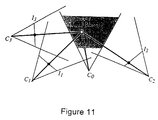
- the general framework of the invention is illustrated in Figure 11.
- Three cameras C 1 ,C 2 and C 3 provide the images I 1 , I 2 and I 3 for corresponding matching.
- the reference camera C 0 is the view for which it is desired to compute the disparity map (or equivalently depth map) for every image point.
- the reference camera may have no associated image. It will rather be reconstructed after stereo matching.
- Figures 1 2A and 1 2B the standard horizontal binocular stereo setup is easily expressed in this general framework. In that case, the reference view C 0 coincides exactly with the first camera C 1 ( Figure 12A). Placing the reference view equidistant between camera C 1 and camera C 2 gives rise to the cyclopean stereo setup ( Figure 12B).
- a set of n camera C 1 ,...,C n provides n images I 1 ,..,I n .
- each reference image point( x ' / 0, y ' / 0) and disparity value d has a set of associated reprojected pixel values that form a pixel value vector v.
- each image point is restricted to move along a single line called the epipolar line.
- a single epipolar line A in one stereo image is matched with a corresponding epipolar line B in the other sterco image.
- the established matching between the two lines is a path in the grid of all possible matches (a,b), as shown on the left of Figure 1.
- the allowed starting and ending positions of the path are shown as thick black lines.
- each potential match has the form (a, d) where a is the position along the epipolar line and d the associated disparity.
- the coordinates in image B corresponding to the match (a,d) are easy to compute from Eq. 1 (i.e., from the relation between x ' / 0 and x ' / 0 + bd ), while the cost function is directly obtained from Eq. 2.
- An extension to matching a single pair of epipolar lines at a time would be to extend it to whole image at once, as depicted in Figure 2, by matching all pairs of epipolar lines simultaneously. Every minimum-cost path defining the matching of one pair of epipolar lines is now assembled into a single minimum-cost surface.
- This surface contains all the disparity information of the reference image.
- the goal of this construction is to take advantage of one very important property of disparity fields, local coherence, suggesting that disparities tend to be locally very similar.
- This property was exploited indirectly by using the ordering constraint (i.e., the assumption that point ordering is maintained, described above), along epipolar lines because the ordering constraint can be used under assumption of local coherence.
- local coherence occurs in all directions and thus across epipolar lines.
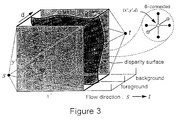
- the present method solves globally for the disparity surface by adding a source and a sink to the formulation of Figure 2, and treating the solution as a flow problem as depicted in Figure 3.
- G (V, E) forming a 3D mesh as depicted in Figure 3.
- edges E is where u and v are vertices in the 3D mesh, equation
- each vertex of the new problem is not only connected to its neighbors along the epipolar line, but also across adjacent epipolar lines (see Figure 3). Since dynamic programming is useless in this situation, it is possible instead to compute the maximum-flow between the source and sink. The minimum-cut associated with the maximum flow will give the disparity surface directly.
- the edge capacity c(u,v) represents the matching cost, except for edges adjacent to the source or sink, which have infinite capacities.
- (0,0, ⁇ d ) represents a vector directing in the direction of the d-axis
- ( ⁇ x , ⁇ y ,0) represents a vector in the xy-plane
- reg(u,v) is a cost characterized by the absence of occlusion (i.e. regular)
- occ(u,v) is an occlusion cost.
- the edges linking (x', y', d) to four black vertices are occlusion costs while links to gray vertices are regular costs.
- Extreme values of the occlusion cost have intuitive consequences. When the occlusion cost is set to ⁇ , the resulting disparity surface is flat and featurs a single disparity value for the whole image. Setting the occlusion cost to 0, each pixel of the image is independently given a disparity, therefore achieving maximal discontinuity in the disparity surface.
- Any cut of G must break this path and thus contain at least one edge of the form (x,y,d)-(x,y,d+1) since the edges s ⁇ (x,y,0) and (x,y,d max ) ⁇ t have infinite capacities. (As a result of the infinite capacities of the edges associated with the source and the sink, a solution surface would never cut through those edges because the surface that cuts those edges would not be of a minimum capacity.)
- a depth map can be constructed from the minimum-cut C of graph G as follows. For each point (x,y), the disparity is the largest d such that the edge (x.y,d)-(x,y,d+1) belongs to C. This results in the desired global disparity surface.
- the epipolar geometry is now only indirectly used in computing the matching cost for points with given disparity values but does not contribute any actual constraint to the matching process.
- discharge and “Lift” refer to well-known basic operations in the preflow-push maximum flow algorithm
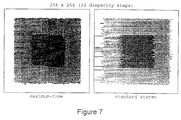
- Reference time stand for the actual computer time to run the preflow-push algorithm to solve a stereo vision problem.
- the average running time is O(n d 1.4 ), which is linear with respect to image size n (in pixels) and compares favorably with the dynamic programming approach.
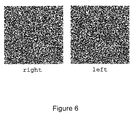
- Fig. 6 the center of the image is shifted 8 pixels in the left and right image, the outer portion is shifted 0 pixels between the left and right images and intermediate portions are shifted 4 pixels between the left and right images. If the left and the right image are fused, then the result would be three floating rectangular planes.
- the images shown in Fig. 6 are a standard pair of images for testing people for what is referred to as stereo blindness.
- Figures 9A - 9D are a set of disparity maps for shrub images shown in Figure 8.
- the maximum flow maps (the minimum cut maps) are shown in Figure 9A and Figure 9C.
- Standard stereo maps are shown in Figure 9B and Figure 9D.
- Figure 9A and Figure 9B are 32 disparity step resolution and Figure 9C and Figure 9D are 128 disparity step resolution.
- the occlusion cost is the regular non-occluded cost. It is set to a very high value in order to discourage occlusion and favor surface smoothness. In the opposite extreme, this cost is set to the smallest possible value allowing a non trivial solution, i.e. the constant 1.
- Figure 10A, Figure 10B and Figure 10C illustrate how changing the occlusion cost can affect the disparity maps obtained. As expected, lowering the capacities favors depth discontinuities and therefore creates sharper object edges, at the expense of smoothness of surfaces. It is observed, however, that depth discontinuities tend to be sharper than other methods, for a given level of smoothness. This result differs strongly from most other methods where high level of smoothness correspond to blurred or missing depth discontinuities.
- the invention applies to an arbitrary sequence of images of a common scene.
- the invention also applies to a sequence taken by one or more cameras at a single instance or over a period time. For example, two or more synchronized still cameras obtaining an image at the same instance, or a single camera taking images over a time period, e.g. one or more still cameras obtaining images while the camera(s) is/are in motion or a video camera which is in motion.
- c(c',y',d) 1 n ⁇ ( v - v ) 2
- a graph (G) is created (step 1304) composed of a step of establishing vertices (V) (step 1306) and a step of establishing edges (E) linking these vertices (step 1308) and a step of establishing capacities of the edges or establishing a capacity function (c(u,v)) (step 131O).
- a maximum-flow is determined in the graph (G) using standard flow method (preflow-push) (step 1320).
- the minimum-cut is extracted from the determined maximum-flow (step 1330).
- the disparity surface depth map is computed from the extracted minimum-cut (step 1340).
- the final disparity surface is derived from the computed disparity surface in step 1340 (step 1350). The result is a disparity surface which is the stereo correspondence sought.
Landscapes
- Engineering & Computer Science (AREA)
- Computer Vision & Pattern Recognition (AREA)
- Physics & Mathematics (AREA)
- General Physics & Mathematics (AREA)
- Theoretical Computer Science (AREA)
- Multimedia (AREA)
- Signal Processing (AREA)
- Image Processing (AREA)
- Image Analysis (AREA)
- Length Measuring Devices By Optical Means (AREA)
Applications Claiming Priority (4)
| Application Number | Priority Date | Filing Date | Title |
|---|---|---|---|
| US978834 | 1992-11-19 | ||
| US4366597P | 1997-04-11 | 1997-04-11 | |
| US43665P | 1997-04-11 | ||
| US08/978,834 US6046763A (en) | 1997-04-11 | 1997-11-26 | Maximum flow method for stereo correspondence |
Publications (2)
| Publication Number | Publication Date |
|---|---|
| EP0871144A2 true EP0871144A2 (de) | 1998-10-14 |
| EP0871144A3 EP0871144A3 (de) | 2002-11-13 |
Family
ID=26720687
Family Applications (1)
| Application Number | Title | Priority Date | Filing Date |
|---|---|---|---|
| EP98250129A Withdrawn EP0871144A3 (de) | 1997-04-11 | 1998-04-09 | Höchstdurchflussverfahren zur Stereoübereinstimmung |
Country Status (3)
| Country | Link |
|---|---|
| US (1) | US6046763A (de) |
| EP (1) | EP0871144A3 (de) |
| JP (1) | JP3180757B2 (de) |
Cited By (6)
| Publication number | Priority date | Publication date | Assignee | Title |
|---|---|---|---|---|
| WO2002001502A3 (en) * | 2000-06-28 | 2002-06-27 | Ericsson Telefon Ab L M | System and method for median fusion of depth maps |
| WO2002001503A3 (en) * | 2000-06-28 | 2003-08-21 | Ericsson Telefon Ab L M | Depth map creation through hypothesis blending in a bayesian framework |
| EP1047019A3 (de) * | 1999-04-20 | 2003-10-29 | Nec Corporation | Verfahren zur Schätzung eines Bewegungsvektorfeldes |
| CN100592338C (zh) * | 2008-02-03 | 2010-02-24 | 四川虹微技术有限公司 | 多视角视频图像深度搜索方法及深度估计方法 |
| US8280149B2 (en) | 2007-09-11 | 2012-10-02 | Motorola Solutions, Inc. | Method and apparatus to facilitate processing a stereoscopic image using first and second images to facilitate computing a depth/disparity image |
| CN101689299B (zh) * | 2007-06-20 | 2016-04-13 | 汤姆逊许可证公司 | 用于图像的立体匹配的系统和方法 |
Families Citing this family (25)
| Publication number | Priority date | Publication date | Assignee | Title |
|---|---|---|---|---|
| FR2767404B1 (fr) * | 1997-08-12 | 1999-10-22 | Matra Systemes Et Information | Procede de production de donnees cartographiques par stereovision |
| US6751345B2 (en) | 2001-02-12 | 2004-06-15 | Koninklijke Philips Electronics N.V. | Method and apparatus for improving object boundaries extracted from stereoscopic images |
| US7444013B2 (en) * | 2001-08-10 | 2008-10-28 | Stmicroelectronics, Inc. | Method and apparatus for recovering depth using multi-plane stereo and spatial propagation |
| US7515173B2 (en) * | 2002-05-23 | 2009-04-07 | Microsoft Corporation | Head pose tracking system |
| US6847728B2 (en) * | 2002-12-09 | 2005-01-25 | Sarnoff Corporation | Dynamic depth recovery from multiple synchronized video streams |
| KR100503820B1 (ko) * | 2003-01-30 | 2005-07-27 | 학교법인 포항공과대학교 | 시스톨릭 어레이를 이용한 멀티레이어 실시간 입체 영상정합 시스템 및 방법 |
| US7428330B2 (en) * | 2003-05-02 | 2008-09-23 | Microsoft Corporation | Cyclopean virtual imaging via generalized probabilistic smoothing |
| US7809183B2 (en) * | 2003-10-08 | 2010-10-05 | Microsoft Corporation | Gaze manipulation |
| WO2005060629A2 (en) * | 2003-12-11 | 2005-07-07 | Strider Labs, Inc. | Probable reconstruction of surfaces in occluded regions by computed symmetry |
| CA2511040A1 (en) * | 2004-09-23 | 2006-03-23 | The Governors Of The University Of Alberta | Method and system for real time image rendering |
| JP4617965B2 (ja) * | 2005-03-31 | 2011-01-26 | ソニー株式会社 | 画像処理方法、その装置およびプログラム |
| WO2007072102A1 (en) * | 2005-12-21 | 2007-06-28 | Telecom Italia S.P.A. | Method for determining dense disparity fields in stereo vision |
| US7751626B2 (en) * | 2006-12-05 | 2010-07-06 | Fujifilm Corporation | Method and apparatus for detection using gradient-weighted and/or distance-weighted graph cuts |
| US8411934B2 (en) | 2007-11-09 | 2013-04-02 | Thomson Licensing | System and method for depth map extraction using region-based filtering |
| CN102047288B (zh) * | 2008-05-28 | 2014-04-23 | 汤姆森特许公司 | 利用正向和反向深度预测进行图像的深度提取的系统和方法 |
| JP5035195B2 (ja) * | 2008-09-25 | 2012-09-26 | Kddi株式会社 | 画像生成装置及びプログラム |
| JP5068732B2 (ja) * | 2008-11-17 | 2012-11-07 | 日本放送協会 | 3次元形状生成装置 |
| US9406132B2 (en) | 2010-07-16 | 2016-08-02 | Qualcomm Incorporated | Vision-based quality metric for three dimensional video |
| US8428342B2 (en) | 2010-08-12 | 2013-04-23 | At&T Intellectual Property I, L.P. | Apparatus and method for providing three dimensional media content |
| US9229106B2 (en) | 2010-08-13 | 2016-01-05 | Ryan Dotson | Enhancement of range measurement resolution using imagery |
| KR101792501B1 (ko) * | 2011-03-16 | 2017-11-21 | 한국전자통신연구원 | 특징기반의 스테레오 매칭 방법 및 장치 |
| US9228833B2 (en) * | 2012-06-28 | 2016-01-05 | GM Global Technology Operations LLC | Wide baseline binocular object matching method using minimal cost flow network |
| US9571819B1 (en) * | 2014-09-16 | 2017-02-14 | Google Inc. | Efficient dense stereo computation |
| US9892496B2 (en) | 2015-11-05 | 2018-02-13 | Google Llc | Edge-aware bilateral image processing |
| JP6601883B2 (ja) * | 2016-01-29 | 2019-11-06 | Necソリューションイノベータ株式会社 | 画像処理装置、画像処理方法、及びプログラム |
Family Cites Families (3)
| Publication number | Priority date | Publication date | Assignee | Title |
|---|---|---|---|---|
| US5383013A (en) * | 1992-09-18 | 1995-01-17 | Nec Research Institute, Inc. | Stereoscopic computer vision system |
| DE19548452C1 (de) * | 1995-12-22 | 1997-02-20 | Siemens Ag | Verfahren zur rechnergestützten Bewegungsschätzung für Bildpunkte zeitlich aufeinander folgender Bilder einer Videosequenz |
| US5917937A (en) * | 1997-04-15 | 1999-06-29 | Microsoft Corporation | Method for performing stereo matching to recover depths, colors and opacities of surface elements |
-
1997
- 1997-11-26 US US08/978,834 patent/US6046763A/en not_active Expired - Lifetime
-
1998
- 1998-04-09 EP EP98250129A patent/EP0871144A3/de not_active Withdrawn
- 1998-04-10 JP JP09921598A patent/JP3180757B2/ja not_active Expired - Fee Related
Non-Patent Citations (4)
| Title |
|---|
| CHEN Y -L ET AL: "A graph matching approach to correspondence between inconsistent regions" REPORTS OF THE GRADUATE SCHOOL OF ELECTRONIC SCIENCE AND TECHNOLOGY, SHIZUOKA UNIVERSITY, MARCH 1993, JAPAN, no. 14, pages 67-72, XP008007396 ISSN: 0388-5070 * |
| FUA P ET AL: "REGISTRATION WITHOUT CORRESPONDENCES" PROCEEDINGS OF THE COMPUTER SOCIETY CONFERENCE ON COMPUTER VISION AND PATTERN RECOGNITION. SEATTLE, JUNE 21 - 23, 1994, LOS ALAMITOS, IEEE COMP. SOC. PRESS, US, 21 June 1994 (1994-06-21), pages 121-128, XP000515830 ISBN: 0-8186-5827-4 * |
| MILLER G L ET AL: "Flow in planar graphs with multiple sources and sinks" ANNUAL SYMPOSIUM ON FOUNDATIONS OF COMPUTER SCIENCE. RESEARCH TRIANGLE PARK, OCT. 30 - NOV. 1, 1989, WASHINGTON, IEEE COMP. SOC. PRESS, US, vol. SYMP. 30, 30 October 1989 (1989-10-30), pages 112-117, XP010017270 ISBN: 0-8186-1982-1 * |
| WANG C ET AL: "REGION CORRESPONDENCE BY INEXACT ATTRIBUTED PLANAR GRAPH MATCHING" PROCEEDINGS OF THE FIFTH INTERNATIONAL CONFERENCE ON COMPUTER VISION. CAMBRIDGE, MA., JUNE 20 - 23, 1995, PROCEEDINGS OF THE INTERNATIONAL CONFERENCE ON COMPUTER VISION, LOS ALAMITOS, IEEE COMP. SOC. PRESS, US, vol. CONF. 5, 20 June 1995 (1995-06-20), pages 440-447, XP000557097 ISBN: 0-7803-2925-2 * |
Cited By (7)
| Publication number | Priority date | Publication date | Assignee | Title |
|---|---|---|---|---|
| EP1047019A3 (de) * | 1999-04-20 | 2003-10-29 | Nec Corporation | Verfahren zur Schätzung eines Bewegungsvektorfeldes |
| WO2002001502A3 (en) * | 2000-06-28 | 2002-06-27 | Ericsson Telefon Ab L M | System and method for median fusion of depth maps |
| WO2002001503A3 (en) * | 2000-06-28 | 2003-08-21 | Ericsson Telefon Ab L M | Depth map creation through hypothesis blending in a bayesian framework |
| US6868191B2 (en) | 2000-06-28 | 2005-03-15 | Telefonaktiebolaget Lm Ericsson (Publ) | System and method for median fusion of depth maps |
| CN101689299B (zh) * | 2007-06-20 | 2016-04-13 | 汤姆逊许可证公司 | 用于图像的立体匹配的系统和方法 |
| US8280149B2 (en) | 2007-09-11 | 2012-10-02 | Motorola Solutions, Inc. | Method and apparatus to facilitate processing a stereoscopic image using first and second images to facilitate computing a depth/disparity image |
| CN100592338C (zh) * | 2008-02-03 | 2010-02-24 | 四川虹微技术有限公司 | 多视角视频图像深度搜索方法及深度估计方法 |
Also Published As
| Publication number | Publication date |
|---|---|
| EP0871144A3 (de) | 2002-11-13 |
| JP3180757B2 (ja) | 2001-06-25 |
| JPH117531A (ja) | 1999-01-12 |
| US6046763A (en) | 2000-04-04 |
Similar Documents
| Publication | Publication Date | Title |
|---|---|---|
| EP0871144A2 (de) | Höchstdurchflussverfahren zur Stereoübereinstimmung | |
| Roy et al. | A maximum-flow formulation of the n-camera stereo correspondence problem | |
| EP2064675B1 (de) | Verfahren zur herstellung einer tiefenkarte aus bildern und vorrichtung zur herstellung einer tiefenkarte | |
| US5734743A (en) | Image processing method and apparatus for block-based corresponding point extraction | |
| US7643025B2 (en) | Method and apparatus for applying stereoscopic imagery to three-dimensionally defined substrates | |
| Roy | Stereo without epipolar lines: A maximum-flow formulation | |
| US6791598B1 (en) | Methods and apparatus for information capture and steroscopic display of panoramic images | |
| US9113043B1 (en) | Multi-perspective stereoscopy from light fields | |
| US20120182403A1 (en) | Stereoscopic imaging | |
| CN113192179B (zh) | 一种基于双目立体视觉的三维重建方法 | |
| US20020024516A1 (en) | Three-dimensional modeling and based on photographic images | |
| Schmidt et al. | Dense Disparity Maps in Real-Time with an Application to Augmented Reality. | |
| Ceulemans et al. | Robust multiview synthesis for wide-baseline camera arrays | |
| EP1668919B1 (de) | Stereoskopische bilderstellung | |
| Wang et al. | Depth from semi-calibrated stereo and defocus | |
| Cheng et al. | Spatio-temporally consistent novel view synthesis algorithm from video-plus-depth sequences for autostereoscopic displays | |
| Mellor et al. | Dense depth maps from epipolar images | |
| CN110827338B (zh) | 一种分区域自适应匹配的光场数据深度重建方法 | |
| Bi et al. | A novel holes filling method based on layered depth map and patch sparsity for complex-scene images | |
| CN117061720B (zh) | 基于单目图像及深度图像渲染的立体图像对生成方法 | |
| Nozick | Multiple view image rectification | |
| KR100489894B1 (ko) | 양안식 스테레오 영상의 카메라 광축 간격 조절 장치 및그 방법 | |
| Jantet et al. | Joint projection filling method for occlusion handling in depth-image-based rendering | |
| Tran et al. | On consistent inter-view synthesis for autostereoscopic displays | |
| Naemura et al. | Three-dimensional segmentation of multiview images based on disparity estimation |
Legal Events
| Date | Code | Title | Description |
|---|---|---|---|
| PUAI | Public reference made under article 153(3) epc to a published international application that has entered the european phase |
Free format text: ORIGINAL CODE: 0009012 |
|
| AK | Designated contracting states |
Kind code of ref document: A2 Designated state(s): AT BE CH CY DE DK ES FI FR GB GR IE IT LI LU MC NL PT SE |
|
| AX | Request for extension of the european patent |
Free format text: AL;LT;LV;MK;RO;SI |
|
| PUAL | Search report despatched |
Free format text: ORIGINAL CODE: 0009013 |
|
| AK | Designated contracting states |
Kind code of ref document: A3 Designated state(s): AT BE CH CY DE DK ES FI FR GB GR IE IT LI LU MC NL PT SE |
|
| AX | Request for extension of the european patent |
Free format text: AL;LT;LV;MK;RO;SI |
|
| 17P | Request for examination filed |
Effective date: 20021205 |
|
| AKX | Designation fees paid |
Designated state(s): DE FR GB |
|
| GRAP | Despatch of communication of intention to grant a patent |
Free format text: ORIGINAL CODE: EPIDOSNIGR1 |
|
| STAA | Information on the status of an ep patent application or granted ep patent |
Free format text: STATUS: THE APPLICATION IS DEEMED TO BE WITHDRAWN |
|
| 18D | Application deemed to be withdrawn |
Effective date: 20090729 |