EP0873490B1 - Procede d'amelioration de l'efficacite de produits chimiques de reduction de la teneur en scories destines a la recuperation de liqueur noire et a d'autres unites de combustion - Google Patents
Procede d'amelioration de l'efficacite de produits chimiques de reduction de la teneur en scories destines a la recuperation de liqueur noire et a d'autres unites de combustion Download PDFInfo
- Publication number
- EP0873490B1 EP0873490B1 EP97942669A EP97942669A EP0873490B1 EP 0873490 B1 EP0873490 B1 EP 0873490B1 EP 97942669 A EP97942669 A EP 97942669A EP 97942669 A EP97942669 A EP 97942669A EP 0873490 B1 EP0873490 B1 EP 0873490B1
- Authority
- EP
- European Patent Office
- Prior art keywords
- chemical
- furnace
- corrosion
- process according
- black liquor
- Prior art date
- Legal status (The legal status is an assumption and is not a legal conclusion. Google has not performed a legal analysis and makes no representation as to the accuracy of the status listed.)
- Expired - Lifetime
Links
Images
Classifications
-
- F—MECHANICAL ENGINEERING; LIGHTING; HEATING; WEAPONS; BLASTING
- F23—COMBUSTION APPARATUS; COMBUSTION PROCESSES
- F23J—REMOVAL OR TREATMENT OF COMBUSTION PRODUCTS OR COMBUSTION RESIDUES; FLUES
- F23J7/00—Arrangement of devices for supplying chemicals to fire
-
- C—CHEMISTRY; METALLURGY
- C10—PETROLEUM, GAS OR COKE INDUSTRIES; TECHNICAL GASES CONTAINING CARBON MONOXIDE; FUELS; LUBRICANTS; PEAT
- C10L—FUELS NOT OTHERWISE PROVIDED FOR; NATURAL GAS; SYNTHETIC NATURAL GAS OBTAINED BY PROCESSES NOT COVERED BY SUBCLASSES C10G OR C10K; LIQUIFIED PETROLEUM GAS; USE OF ADDITIVES TO FUELS OR FIRES; FIRE-LIGHTERS
- C10L10/00—Use of additives to fuels or fires for particular purposes
- C10L10/04—Use of additives to fuels or fires for particular purposes for minimising corrosion or incrustation
-
- C—CHEMISTRY; METALLURGY
- C10—PETROLEUM, GAS OR COKE INDUSTRIES; TECHNICAL GASES CONTAINING CARBON MONOXIDE; FUELS; LUBRICANTS; PEAT
- C10L—FUELS NOT OTHERWISE PROVIDED FOR; NATURAL GAS; SYNTHETIC NATURAL GAS OBTAINED BY PROCESSES NOT COVERED BY SUBCLASSES C10G OR C10K; LIQUIFIED PETROLEUM GAS; USE OF ADDITIVES TO FUELS OR FIRES; FIRE-LIGHTERS
- C10L10/00—Use of additives to fuels or fires for particular purposes
- C10L10/06—Use of additives to fuels or fires for particular purposes for facilitating soot removal
-
- D—TEXTILES; PAPER
- D21—PAPER-MAKING; PRODUCTION OF CELLULOSE
- D21C—PRODUCTION OF CELLULOSE BY REMOVING NON-CELLULOSE SUBSTANCES FROM CELLULOSE-CONTAINING MATERIALS; REGENERATION OF PULPING LIQUORS; APPARATUS THEREFOR
- D21C11/00—Regeneration of pulp liquors or effluent waste waters
- D21C11/10—Concentrating spent liquor by evaporation
- D21C11/106—Prevention of incrustations on heating surfaces during the concentration, e.g. by elimination of the scale-forming substances contained in the liquors
-
- D—TEXTILES; PAPER
- D21—PAPER-MAKING; PRODUCTION OF CELLULOSE
- D21C—PRODUCTION OF CELLULOSE BY REMOVING NON-CELLULOSE SUBSTANCES FROM CELLULOSE-CONTAINING MATERIALS; REGENERATION OF PULPING LIQUORS; APPARATUS THEREFOR
- D21C11/00—Regeneration of pulp liquors or effluent waste waters
- D21C11/12—Combustion of pulp liquors
-
- F—MECHANICAL ENGINEERING; LIGHTING; HEATING; WEAPONS; BLASTING
- F23—COMBUSTION APPARATUS; COMBUSTION PROCESSES
- F23G—CREMATION FURNACES; CONSUMING WASTE PRODUCTS BY COMBUSTION
- F23G5/00—Incineration of waste; Incinerator constructions; Details, accessories or control therefor
- F23G5/44—Details; Accessories
- F23G5/48—Preventing corrosion
-
- F—MECHANICAL ENGINEERING; LIGHTING; HEATING; WEAPONS; BLASTING
- F23—COMBUSTION APPARATUS; COMBUSTION PROCESSES
- F23G—CREMATION FURNACES; CONSUMING WASTE PRODUCTS BY COMBUSTION
- F23G7/00—Incinerators or other apparatus for consuming industrial waste, e.g. chemicals
- F23G7/04—Incinerators or other apparatus for consuming industrial waste, e.g. chemicals of waste liquors, e.g. sulfite liquors
-
- F—MECHANICAL ENGINEERING; LIGHTING; HEATING; WEAPONS; BLASTING
- F23—COMBUSTION APPARATUS; COMBUSTION PROCESSES
- F23G—CREMATION FURNACES; CONSUMING WASTE PRODUCTS BY COMBUSTION
- F23G2209/00—Specific waste
- F23G2209/10—Liquid waste
- F23G2209/101—Waste liquor
Definitions
- the invention relates to improving the effectiveness of chemicals introduced into the fire side of black liquor recovery and other boilers for the purpose of reducing hot-side slagging, plugging and/or corrosion.
- the art has endeavored to solve the slagging problem by the introduction of various chemicals, such as magnesium oxide or hydroxide.
- various chemicals such as magnesium oxide or hydroxide.
- Magnesium hydroxide has the ability to survive the hot environment of the furnace and react with the deposit-forming compounds, raising their ash-fusion temperature and thereby modifying the texture of the resulting deposits.
- the introduction of the chemicals has been very expensive due to poor utilization of the chemicals, much simply going to waste and some reacting with hot ash that would not otherwise cause a problem.
- treatment chemicals such as magnesium oxide and magnesium hydroxide
- a yet further, but related, object is to mitigate the costs resulting from the presence of slag by reducing its formation.
- a yet further object is to increase furnace throughputs over time.
- a still further object is to provide longer production runs with decreased downtime and easier cleanup
- the present invention provides an improved process for introducing fireside chemical additives into black liquor recovery boilers to achieve highly effective, reliable slag control treatments with reduced chemical consumption by effecting improved distribution of active slag-reducing chemicals, comprising: determining slogging locations within a furnace where slogging will occur in the absence of treatment; determining the temperature and gas flow conditions within the boiler; locating introduction points on the furnace wall where introduction of chemicals could be accomplished; based on the temperature and gas flow conditions existing between the introduction points and the slagging locations, determining the droplet size, amount of chemical, amount of water (or other medium) as a carrier, and droplet momentum necessary to direct the chemical in active form to the slagging locations; and, based on the determinations of the previous step, introducing chemical to reduce slagging.
- the invention calls for determining the temperature, velocity and flow path of the hot combustion gases inside the furnace to determine temperature and flow profiles therein; determining the points within the furnace, through observation alone or with modeling, most subject to slagging; and based on this information, determining, for an aqueous treatment fluid, the best droplet size, momentum and reagent concentration, injection location and injection strategy to reach the points in the furnace most affected by slagging.
- the temperatures can be determined by placing suction pyrometers, such as those employing a k-type thermocouple, at a sufficient number of locations within the furnace.
- suction pyrometers such as those employing a k-type thermocouple. The exact number and location of the thermocouples will at first be estimated based on past experience with boilers of the type being treated, and the initial determinations will then be modified based on the results achieved.
- the velocities of the hot combustion gases within the boiler is determined at a sufficient number of locations to permit the use of a suitable computational fluid dynamics (CFD) modeling technique to establish a three-dimensional temperature profile.
- CFD computational fluid dynamics
- the process units are approximated as a set of space-filling cells that adequately resemble their physical geometry.
- the number of cells is chosen to be great enough to provide the necessary details of the unit, but not so great as to require unacceptable data storage space or computational time. Anywhere from 40,000 to 300,000 cells are typically used, depending on the number of conserved quantities solved.
- the intricacies of the physical unit are included either by setting the porosities of individual cells or cell faces to values between 0 and 1 or by the use of cells that closely fit the actual geometry with body-fitted and/or molhblock methods. In this way it is possible to closely approximate the geometry of the process unit being modeled.
- Cells corresponding to the locations of inlets or exits on the unit are assigned net mass sources which are positive for inflow or negative for outflow.
- Energy sources such as heat loss to a tube bundle or heat released during combustion are also specified for cells where appropriate.
- Chemical concentrations of different species are specified for mass entering a cell or for compositional changes due to reactions,
- the net flow for a given cell is very close to zero; that is, the amount of a quantity flowing into a cell exactly equals the amount flowing out. If the solution is not at steady state, a net imbalance exists which causes an accumulation of mass, energy, or momentum in a cell. This accumulation produces a change in the flow and physical properties of the cell, and the new values are used as initial values for the next iteration. Iterations are performed until the total changes in properties are sufficiently small compared to their absolute values.
- turbulence The primary effect of turbulence is to greatly increase the rate of mass and energy dispersion, resulting in much larger transfer coefficients than in nonturbulent situations.
- One model known as the k-epsilon model, has been widely used as an estimate of the effects of turbulent dispersion (see, for example, Launder, B. E., "Turbulence Models and Their Experimental Verification. 2. Two-Equation Models-I", Imperial College of Science and Technology, Rept, HTS/73/17,N7;4-12056, April 1973).
- the heat released during combustion reactions can be modeled in several ways. In the most simple case, the heat is added as an enthalpy source in a boundary cell containing the mass inflow. Alternately, this heat is released in a set of cells covering the expected combustion zone. When possible, and preferably, the combustion process is modeled as a set of median combustion reactions, and can include particulate combustion.
- the chemical reaction model gives a more realistic combustion zone predictions and temperature estimates, but is very costly in terms of convergence, data storage, and total computational time. Consequently, combustion is usually approximated as occurring in a specified zone with the sources of heat and combustion products distributed throughout the volume.
- Radiation is a primary heat transfer mechanism in furnaces, but is also very difficult to treat computationally. Because of the complexity of numerical treatment, radiation may not in some cases be specifically included in the model. Instead, heat transfer approximation to radiation can be included.
- the use of the model in accordance with the invention has yielded unexpectedly effective treatment regimens in terms of utilization of chemicals and effectiveness of the slag control. Indeed, the process of the invention in Its preferred form will actually reduce slag deposits that have already developed. Heat transfer to internal tube bundles is modeled as a heat loss per unit volume over the cells corresponding to the bundle locations.
- Typical sprays produce droplets with a wide range of sizes traveling at different velocities and directions. These drops interact with the flue gas and evaporate at a rate dependent on their size and trajectory and the temperatures along the trajectory. Improper spray patterns are typical of prior art slag reducing procedures and result in less than adequate chemical distributions and lessen the opportunity for effective treatment.
- a frequently used spray model is the PSI-Cell model for droplet evaporation and motion, which is convenient for iterative CFD solutions of steady state processes.
- the PSI-Cell method uses the gas properties from the fluid dynamics calculations to predict droplet trajectories and evaporation rates from mass, momentum, and energy balances.
- the momentum, heat, and mass changes of the droplets are then included as source terms for the next iteration of the fluid dynamics calculations, hence after enough iterations both the fluid properties and the droplet trajectories converge to a steady solution.
- Sprays are treated as a series of individual droplets having different initial velocities and droplet sizes emanating from a central point. Correlations between droplet trajectory angle and the size or mass flow distribution are included, and the droplet frequency is determined from the droplet size and mass flow rate at each angle.
- the model should further predict multi component droplet behavior.
- the equations for the force, mass, and energy balances are supplemented with flash calculations, providing the instantaneous velocity, droplet size, temperature, and chemical composition over the lifetime of the droplet.
- the momentum, mass, and energy contributions of atomizing fluid are also included.
- the slag-reducing agent is most desirably introduced as an aqueous treatment solution, a slurry in the case of magnesium oxide or magnesium hydroxide.
- concentration of the slurry will be determined as necessary to assure proper direction of the treatment solution to the desired area in the boiler. Typical concentrations are from about 51 to about 80% active chemical by weight of the slurry, preferably from about 5 to about 30%.
- Other effective metal oxides and hydroxides e.g. , copper, titanium and blends are known and can be employed.
- the total amount of the slag-control reagent injected into the combustion gases from all points should be sufficient to obtain a reduction in the rate of slag build-up of the frequency of clean-up.
- the build-up of slag results in increased pressure drop through the furnace, e.g. , through the generating bank.
- Typical treatment rates will be from about 0.1 to about 10 pounds of chemical for each ton of black liquor solids or other waste. Preferred treatment rates will be within the range of from about 0.5 to about 5 pounds per ton of liquor solids. Dosing rates can be varied to achieve long-term slag formation control or at higher rates to actually reduce slag deposits.
- injectors for introducing active chemicals for reducing slag in accordance with the invention employ multiple levels of injection to best optimize the spray pattern and assure targeting the chemical to the point that It is needed.
- the invention can be carried out with a single zone, e . g ., in the upper furnace, where conditions permit or physical limitations dictate.
- Average droplet sizes within the range of from 20 to 600 microns are typical, and most typically fall within the range of from about 100 to about 300 microns. And, unless otherwise indicated, all parts and percentages are based on the weight of the composition at the particular point of reference.
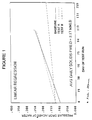
- Figure 1 shows regression lines for this baseline run along with one test run (A) not in accord with the invention and one ( B ) according to the invention.
- test run (A) modeling was attempted but not completed and injection locations were not optimized.
- the treatment liquid was a slurry without necessary control of droplet size and velocity necessary to achieve optimum targeting.
- test run ( B ) the invention was employed with highly effective results.
- Test run (A) began with four injectors. As compared to the baseline, this run resulted in a boiler that remained below the maximum permissible generating bank pressure differential at the time it would usually be taken out of service. At about day 53, the treatment rate was increased. Without proper droplet size and velocity control, the additional reagent did not significantly improve results. At day 120, the regression line passes the value of approximately 6.35 mm (0.25 inches). Near the end of this run, the two additional injectors were installed. Early, normal shutdown was avoided by the use of chemical and a modified "chill and blow" maintained operation. However, it was clear that further improvement was required. The results of test run (A) are also shown in Figure 1.
- run ( B ) began six injectors were in use, and the unit ran for over 150 days with the thermal sheds now being highly effective at cleaning heat transfer surfaces. As previously mentioned, these would work well when the boiler was clean, but their effectiveness decreased rapidly as the boiler fouled. The difference in this run was that the thermal sheds retained its effectiveness and even reversed the fouling trend downward.
- test run ( B ) The results of test run ( B ) are also shown Figure 1. This regression line is quite flat, indicating considerably less fouling even after over 150 days.
- the boiler was brought down in a plant-wide shutdown to hook up a new water treatment facility; but It did not have to be brought down due to excessive fouling.
- Inspection revealed much cleaner tube surfaces. With the targeted in-furnace injection program, the condition of the boilers changed dramatically. The tube surfaces were able to be cleaned in less than 12 hours.
Landscapes
- Engineering & Computer Science (AREA)
- Chemical & Material Sciences (AREA)
- Mechanical Engineering (AREA)
- General Engineering & Computer Science (AREA)
- Combustion & Propulsion (AREA)
- Oil, Petroleum & Natural Gas (AREA)
- Organic Chemistry (AREA)
- Environmental & Geological Engineering (AREA)
- Paper (AREA)
- Manufacture And Refinement Of Metals (AREA)
- Incineration Of Waste (AREA)
Claims (10)
- Procédé de réduction de l'accumulation de laitier et/ou de la corrosion d'une chaudière de récupération de liqueur noire. comprenant :caractérisé en ce que les conditions de température et de débit de gaz dans la chaudière sont déterminées,la détermination des emplacements d'accumulation de laitier et/ou de corrosion dans un four dans lequel la formation de laitier et/ou la corrosion se produisent en l'absence de traitement, et l'introduction d'un produit chimique destiné à réduire l'accumulation de laitier et/ou la corrosion,des points d'introduction dans la paroi du four auxquels l'introduction de produits chimiques peut être réalisée sont déterminés,d'après les conditions de température et de débit de gaz existant entre les points d'introduction et les emplacements d'accumulation de laitier et/ou de corrosion, la dimension des gouttelettes, la quantité du produit chimique de traitement, la quantité d'eau constituant un véhicule, et l'énergie cinétique des gouttelettes nécessaires pour diriger le produit chimique sous forme active aux emplacements d'accumulation de laitier et/ou de corrosion sont déterminées, etle produit chimique est introduit d'après les déterminations de l'étape précédente.
- Procédé selon la revendication 1, dans lequel le produit chimique de traitement est une suspension d'oxyde de magnésium ou d'hydroxyde de magnésium.
- Procédé selon la revendication 2, dans lequel la concentration du produit chimique dans la suspension est comprise entre environ 1 et 80 %.
- Procédé selon la revendication 1, dans laquel le produit chimique est introduit dans le four avec un débit de dose compris entre environ 0,23 et 2,27 kg (environ 0,5 et 5 livres) par tonne de matières solides de liqueur noire brûlée dans le four.
- Procédé selon la revendication 4, dans lequel les produits chimiques sont introduits à plusieurs hauteurs.
- Procédé de nettoyage d'un appareil de combustion présentant une accumulation de laitier et/ou une corrosion, comprenant : la détermination d'emplacements d'accumulation de laitier et/ou de corrosion dans un four dans lequel se produit une accumulation de laitier et/ou une corrosion en l'absence de traitement, et l'introduction d'un produit chimique, caractérisé en ce queles conditions de température et de débit de gaz dans l'appareil de combustion sont déterminées,les points d'introduction, dans la paroi du four, auxquels une introduction de produits chimiques peut être réalisée sont déterminés, etd'après les conditions de température et de débit de gaz existant entre les points d'introduction et les emplacements d'accumulation de laitier, la dimension des gouttelettes, la quantité de produit chimique de traitement, la quantité de véhicule du produit chimique et l'énergie cinétique des gouttelettes nécessaire pour la direction du produit chimique sous forme active aux emplacements d'accumulation de laitier et/ou de corrosion sont déterminées et,d'après les déterminations des étapes précédentes, le produit chimique est introduit.
- Procédé selon la revendication 6, dans lequel le produit chimique de traitement est une suspension d'un oxyde ou hydroxyde métallique.
- Procédé selon la revendication 7, dans lequel la concentration du produit chimique dans la suspension est comprise dans la plage allant d'environ 1 à 80 %.
- Procédé selon la revendication 8, dans lequel l'appareil de combustion est une chaudière de récupération de liqueur noire, et dans lequel le produit chimique est introduit dans le four avec un débit de dose compris entre environ 0,045 et 4,5 kg (environ 0,1 et 10 livres) par tonne de matières solides de liqueur noire brûlée dans le four.
- Procédé selon la revendication 6, dans lequel les produits chimiques sont introduits à plusieurs hauteurs.
Applications Claiming Priority (3)
| Application Number | Priority Date | Filing Date | Title |
|---|---|---|---|
| US710630 | 1996-09-20 | ||
| US08/710,630 US5740745A (en) | 1996-09-20 | 1996-09-20 | Process for increasing the effectiveness of slag control chemicals for black liquor recovery and other combustion units |
| PCT/US1997/017000 WO1998012473A1 (fr) | 1996-09-20 | 1997-09-19 | Procede d'amelioration de l'efficacite de produits chimiques de reduction de la teneur en scories destines a la recuperation de liqueur noire et a d'autres unites de combustion |
Publications (3)
| Publication Number | Publication Date |
|---|---|
| EP0873490A1 EP0873490A1 (fr) | 1998-10-28 |
| EP0873490A4 EP0873490A4 (fr) | 1999-04-14 |
| EP0873490B1 true EP0873490B1 (fr) | 2002-01-02 |
Family
ID=24854863
Family Applications (1)
| Application Number | Title | Priority Date | Filing Date |
|---|---|---|---|
| EP97942669A Expired - Lifetime EP0873490B1 (fr) | 1996-09-20 | 1997-09-19 | Procede d'amelioration de l'efficacite de produits chimiques de reduction de la teneur en scories destines a la recuperation de liqueur noire et a d'autres unites de combustion |
Country Status (7)
| Country | Link |
|---|---|
| US (2) | US5740745A (fr) |
| EP (1) | EP0873490B1 (fr) |
| AU (1) | AU4431497A (fr) |
| BR (1) | BR9710161A (fr) |
| CA (1) | CA2244981C (fr) |
| DE (1) | DE69709848T2 (fr) |
| WO (1) | WO1998012473A1 (fr) |
Cited By (1)
| Publication number | Priority date | Publication date | Assignee | Title |
|---|---|---|---|---|
| DE102005031528A1 (de) * | 2005-06-29 | 2007-03-15 | Hoffmann Gmbh & Co. Kg | Verfahren und Steuerungssystem zur Minderung von Korrosionen und zur Reduzierung von Ablagerungen in einer Verbrennungsanlage |
Families Citing this family (41)
| Publication number | Priority date | Publication date | Assignee | Title |
|---|---|---|---|---|
| US6085673A (en) * | 1998-06-18 | 2000-07-11 | Electric Power Research Institute, Inc. | Method for reducing waterwall corrosion in low NOx boilers |
| US6164221A (en) * | 1998-06-18 | 2000-12-26 | Electric Power Research Institute, Inc. | Method for reducing unburned carbon in low NOx boilers |
| RU2233835C2 (ru) * | 1999-02-05 | 2004-08-10 | Эмисфере Текнолоджиз, Инк. | Соединения и композиции для доставки активных средств |
| US8439989B2 (en) * | 2000-06-26 | 2013-05-14 | ADA-ES, Inc. | Additives for mercury oxidation in coal-fired power plants |
| US8124036B1 (en) | 2005-10-27 | 2012-02-28 | ADA-ES, Inc. | Additives for mercury oxidation in coal-fired power plants |
| US6729248B2 (en) * | 2000-06-26 | 2004-05-04 | Ada Environmental Solutions, Llc | Low sulfur coal additive for improved furnace operation |
| US6484651B1 (en) | 2000-10-06 | 2002-11-26 | Crown Coal & Coke Co. | Method for operating a slag tap combustion apparatus |
| US6710285B2 (en) * | 2002-06-01 | 2004-03-23 | First Call Explosive Solutions, Inc. | Laser system for slag removal |
| US20040063053A1 (en) * | 2002-09-26 | 2004-04-01 | Monro Richard J. | Combustion process with a preferential injection of a chemical for pollutant reduction |
| US7162960B2 (en) * | 2004-01-08 | 2007-01-16 | Fuel Tech, Inc. | Process for reducing plume opacity |
| DE102004022514A1 (de) * | 2004-05-05 | 2005-12-01 | Babcock-Hitachi Europe Gmbh | Dampferzeuger und Verfahren zum Betreiben eines Dampferzeugers |
| US8079845B2 (en) * | 2005-05-10 | 2011-12-20 | Environmental Energy Services, Inc. | Processes for operating a utility boiler and methods therefor |
| KR101110485B1 (ko) * | 2005-05-17 | 2012-01-31 | 퓨얼 테크 인코포레이티드 | 보일러 내의 부식 억제 방법 |
| AU2007310971A1 (en) * | 2006-10-18 | 2008-04-24 | Lean Flame, Inc. | Premixer for gas and fuel for use in combination with energy release/conversion device |
| US7775166B2 (en) * | 2007-03-16 | 2010-08-17 | Afton Chemical Corporation | Method of using nanoalloy additives to reduce plume opacity, slagging, fouling, corrosion and emissions |
| WO2008143962A1 (fr) * | 2007-05-18 | 2008-11-27 | Enviormental Energy Services, Inc. | Procédé de mesure du dépôt de cendre/scorie dans une chaudière de centrale |
| US8381690B2 (en) | 2007-12-17 | 2013-02-26 | International Paper Company | Controlling cooling flow in a sootblower based on lance tube temperature |
| US20090309028A1 (en) * | 2008-06-16 | 2009-12-17 | Honeywell International Inc. | Intelligent system and method to monitor object movement |
| US20110017110A1 (en) * | 2009-07-24 | 2011-01-27 | Higgins Brian S | Methods and systems for improving combustion processes |
| MX2012003096A (es) | 2009-09-13 | 2012-08-03 | Lean Flame Inc | Pre-mezclador de vortice para aparato de combustion. |
| WO2011106429A1 (fr) * | 2010-02-23 | 2011-09-01 | Fuel Tech, Inc. | Procédés, appareil et systèmes pour améliorer le fonctionnement de chaudières à cyclone |
| CA2792732C (fr) | 2010-03-10 | 2018-07-31 | Martin A. Dillon | Procede d'injection en phase diluee de matieres alcalines seches |
| US8784757B2 (en) | 2010-03-10 | 2014-07-22 | ADA-ES, Inc. | Air treatment process for dilute phase injection of dry alkaline materials |
| US9487721B2 (en) | 2011-03-25 | 2016-11-08 | Hm3 Energy, Inc. | Refined torrefied biomass |
| US9017452B2 (en) | 2011-11-14 | 2015-04-28 | ADA-ES, Inc. | System and method for dense phase sorbent injection |
| US9802154B2 (en) | 2012-03-30 | 2017-10-31 | Fuel Tech, Inc. | Process for sulfur dioxide, hydrochloric acid and mercury mediation |
| US8992868B2 (en) * | 2012-05-01 | 2015-03-31 | Fuel Tech, Inc. | Dry processes, apparatus compositions and systems for reducing mercury, sulfur oxides and HCl |
| WO2013149241A1 (fr) | 2012-03-30 | 2013-10-03 | Fuel Tech, Inc. | Procédés à sec, appareil, compositions et systèmes pour la réduction d'oxydes de soufre et d'hcl |
| US8974756B2 (en) | 2012-07-25 | 2015-03-10 | ADA-ES, Inc. | Process to enhance mixing of dry sorbents and flue gas for air pollution control |
| CA2902909C (fr) | 2013-02-27 | 2017-11-28 | Fuel Tech, Inc. | Procedes, appareil, compositions et systemes permettant de reduire des emissions de hcl et/ou d'oxydes de soufre |
| US9289721B2 (en) | 2013-02-27 | 2016-03-22 | Fuel Tech, Inc. | Process and apparatus for improving the operation of wet scrubbers |
| US9399597B2 (en) | 2013-04-01 | 2016-07-26 | Fuel Tech, Inc. | Ash compositions recovered from coal combustion gases having reduced emissions of HCI and/or mercury |
| US9718025B2 (en) | 2013-04-01 | 2017-08-01 | Fuel Tech, Inc. | Reducing hydrochloric acid in cement kilns |
| US9541282B2 (en) | 2014-03-10 | 2017-01-10 | International Paper Company | Boiler system controlling fuel to a furnace based on temperature of a structure in a superheater section |
| US9927231B2 (en) * | 2014-07-25 | 2018-03-27 | Integrated Test & Measurement (ITM), LLC | System and methods for detecting, monitoring, and removing deposits on boiler heat exchanger surfaces using vibrational analysis |
| PL3172520T3 (pl) | 2014-07-25 | 2019-07-31 | International Paper Company | System i sposób określania lokalizacji zanieczyszczenia na powierzchni przenoszenia ciepła kotła |
| US10350545B2 (en) | 2014-11-25 | 2019-07-16 | ADA-ES, Inc. | Low pressure drop static mixing system |
| WO2017136679A1 (fr) * | 2016-02-04 | 2017-08-10 | Liquid Minerals Group Ltd. | Système et procédé destinés à désagréger des dépôts de scories et compositions utilisées |
| US11008704B2 (en) | 2017-08-01 | 2021-05-18 | Fuel Tech, Inc. | Deposit control for a black liquor recovery boiler |
| US11124724B2 (en) | 2018-12-05 | 2021-09-21 | Hm3 Energy, Inc. | Method for producing a water-resistant, compressed biomass product |
| US20210341140A1 (en) | 2020-05-01 | 2021-11-04 | International Paper Company | System and methods for controlling operation of a recovery boiler to reduce fouling |
Family Cites Families (10)
| Publication number | Priority date | Publication date | Assignee | Title |
|---|---|---|---|---|
| US3800466A (en) * | 1971-12-13 | 1974-04-02 | Sybron Corp | Composition for treating aqueous alkaline fuel |
| US4159683A (en) * | 1978-03-13 | 1979-07-03 | American Colloid Company | Method for reducing the formation of slag and soot formed from the combustion of carbonaceous waste material |
| JPS598410A (ja) * | 1982-07-05 | 1984-01-17 | Advantest Corp | 周波数掃引信号発生装置 |
| US4514256A (en) * | 1983-04-18 | 1985-04-30 | Kober Alfred E | Method of minimizing slagging in the burning of black liquid |
| US4616574A (en) * | 1984-05-25 | 1986-10-14 | Empire State Electric Energy Research Corp. (Eseerco) | Process for treating combustion systems with pressure-hydrated dolomitic lime |
| US4903642A (en) * | 1986-12-17 | 1990-02-27 | Ebara Corporation | Apparatus for controlling injection of chemical liquid in boiler system |
| US5288857A (en) * | 1988-12-12 | 1994-02-22 | Ligno Tech Sweden Ab | Lignin preparation and method for its manufacture |
| US5113802A (en) * | 1991-03-26 | 1992-05-19 | Union Camp Corporation | Method and apparatus for removing deposit from recovery boilers |
| US5658547A (en) * | 1994-06-30 | 1997-08-19 | Nalco Fuel Tech | Simplified efficient process for reducing NOx, SOx, and particulates |
| US5551354A (en) * | 1995-08-23 | 1996-09-03 | The Babcock & Wilcox Company | Biased flow directional liquor nozzle |
-
1996
- 1996-09-20 US US08/710,630 patent/US5740745A/en not_active Expired - Lifetime
-
1997
- 1997-09-19 BR BR9710161-3A patent/BR9710161A/pt not_active IP Right Cessation
- 1997-09-19 WO PCT/US1997/017000 patent/WO1998012473A1/fr not_active Ceased
- 1997-09-19 DE DE69709848T patent/DE69709848T2/de not_active Expired - Lifetime
- 1997-09-19 EP EP97942669A patent/EP0873490B1/fr not_active Expired - Lifetime
- 1997-09-19 AU AU44314/97A patent/AU4431497A/en not_active Abandoned
- 1997-09-19 CA CA002244981A patent/CA2244981C/fr not_active Expired - Lifetime
- 1997-12-30 US US09/000,629 patent/US5894806A/en not_active Expired - Lifetime
Cited By (1)
| Publication number | Priority date | Publication date | Assignee | Title |
|---|---|---|---|---|
| DE102005031528A1 (de) * | 2005-06-29 | 2007-03-15 | Hoffmann Gmbh & Co. Kg | Verfahren und Steuerungssystem zur Minderung von Korrosionen und zur Reduzierung von Ablagerungen in einer Verbrennungsanlage |
Also Published As
| Publication number | Publication date |
|---|---|
| US5740745A (en) | 1998-04-21 |
| BR9710161A (pt) | 1999-09-28 |
| US5894806A (en) | 1999-04-20 |
| EP0873490A1 (fr) | 1998-10-28 |
| DE69709848T2 (de) | 2002-08-22 |
| CA2244981C (fr) | 2002-07-16 |
| EP0873490A4 (fr) | 1999-04-14 |
| WO1998012473A1 (fr) | 1998-03-26 |
| AU4431497A (en) | 1998-04-14 |
| DE69709848D1 (de) | 2002-02-28 |
| CA2244981A1 (fr) | 1998-03-26 |
Similar Documents
| Publication | Publication Date | Title |
|---|---|---|
| EP0873490B1 (fr) | Procede d'amelioration de l'efficacite de produits chimiques de reduction de la teneur en scories destines a la recuperation de liqueur noire et a d'autres unites de combustion | |
| US7845292B2 (en) | Process for slag and corrosion control in boilers | |
| CN101522287B (zh) | 用于so3控制的定位管道注入 | |
| AU2009202595B2 (en) | Process for reducing plume opacity | |
| US4616574A (en) | Process for treating combustion systems with pressure-hydrated dolomitic lime | |
| CN109099442B (zh) | 用于控制回收锅炉的方法 | |
| CA2729959C (fr) | Injection de reactif cible pour la commande de scories provenant de la combustion de charbons a teneur elevee en fer et/ou calcium | |
| CA1265784A (fr) | Methode et dispositif pour recuperer la chaleur des gaz charriant des substances qui encrassent les surfaces de transfert thermique | |
| EP3479023B1 (fr) | Procédé de nettoyage de chaudière, dispositif et chaudière correspondants | |
| US10197272B2 (en) | Process and apparatus for reducing acid plume | |
| MXPA99002646A (es) | Proceso para incrementar la efectividad de los compuestos quimicos para control de escoria en calderas de recuperacion de licor negro y otras unidades de combustion | |
| US10124288B2 (en) | Controlling injection of magnesium oxide for controlling SO3 with enhanced boiler efficiency | |
| US20110203498A1 (en) | Methods, Apparatus and Systems for Improving the Operation of Cyclone Boilers | |
| CN212456948U (zh) | 抑制空气预热器堵塞的热风正压吹扫系统 | |
| Volchyn et al. | SELECTIVE NON-CATALYTIC REDUCTION OF NITROGEN OXIDES IN THE PRODUCTION OF IRON ORE PELLETS. | |
| CN109690265A (zh) | 用于黑液回收锅炉的沉积物控制 | |
| KR102890518B1 (ko) | 순환유동층 연소설비의 클링커 저감 장치 및 운전방법 | |
| JPH0826977B2 (ja) | 回収ボイラのスートブロー制御装置 | |
| Zhao | The effectiveness of magnesium oxide-based additives in mitigating fouling problems in kraft recovery boilers | |
| Vakkilainen | Troubleshooting recovery boiler fouling | |
| JPS62125202A (ja) | 回収ボイラ運転方法 | |
| CN112240556A (zh) | 一种垃圾焚烧炉烟气余热利用装置 | |
| JPH03294590A (ja) | 回収ボイラの燃焼制御方法 |
Legal Events
| Date | Code | Title | Description |
|---|---|---|---|
| PUAI | Public reference made under article 153(3) epc to a published international application that has entered the european phase |
Free format text: ORIGINAL CODE: 0009012 |
|
| 17P | Request for examination filed |
Effective date: 19980826 |
|
| AK | Designated contracting states |
Kind code of ref document: A1 Designated state(s): DE ES FI FR IT SE |
|
| A4 | Supplementary search report drawn up and despatched |
Effective date: 19990303 |
|
| AK | Designated contracting states |
Kind code of ref document: A4 Designated state(s): DE ES FI FR IT SE |
|
| 17Q | First examination report despatched |
Effective date: 19990804 |
|
| GRAG | Despatch of communication of intention to grant |
Free format text: ORIGINAL CODE: EPIDOS AGRA |
|
| GRAG | Despatch of communication of intention to grant |
Free format text: ORIGINAL CODE: EPIDOS AGRA |
|
| GRAG | Despatch of communication of intention to grant |
Free format text: ORIGINAL CODE: EPIDOS AGRA |
|
| GRAH | Despatch of communication of intention to grant a patent |
Free format text: ORIGINAL CODE: EPIDOS IGRA |
|
| GRAH | Despatch of communication of intention to grant a patent |
Free format text: ORIGINAL CODE: EPIDOS IGRA |
|
| GRAA | (expected) grant |
Free format text: ORIGINAL CODE: 0009210 |
|
| AK | Designated contracting states |
Kind code of ref document: B1 Designated state(s): DE ES FI FR IT SE |
|
| REF | Corresponds to: |
Ref document number: 69709848 Country of ref document: DE Date of ref document: 20020228 |
|
| PG25 | Lapsed in a contracting state [announced via postgrant information from national office to epo] |
Ref country code: ES Free format text: LAPSE BECAUSE OF FAILURE TO SUBMIT A TRANSLATION OF THE DESCRIPTION OR TO PAY THE FEE WITHIN THE PRESCRIBED TIME-LIMIT Effective date: 20020730 |
|
| PLBE | No opposition filed within time limit |
Free format text: ORIGINAL CODE: 0009261 |
|
| STAA | Information on the status of an ep patent application or granted ep patent |
Free format text: STATUS: NO OPPOSITION FILED WITHIN TIME LIMIT |
|
| 26N | No opposition filed | ||
| REG | Reference to a national code |
Ref country code: FR Ref legal event code: PLFP Year of fee payment: 20 |
|
| PGFP | Annual fee paid to national office [announced via postgrant information from national office to epo] |
Ref country code: FI Payment date: 20160927 Year of fee payment: 20 |
|
| PGFP | Annual fee paid to national office [announced via postgrant information from national office to epo] |
Ref country code: FR Payment date: 20160926 Year of fee payment: 20 Ref country code: SE Payment date: 20160928 Year of fee payment: 20 |
|
| PGFP | Annual fee paid to national office [announced via postgrant information from national office to epo] |
Ref country code: DE Payment date: 20160928 Year of fee payment: 20 |
|
| PGFP | Annual fee paid to national office [announced via postgrant information from national office to epo] |
Ref country code: IT Payment date: 20160923 Year of fee payment: 20 |
|
| REG | Reference to a national code |
Ref country code: DE Ref legal event code: R071 Ref document number: 69709848 Country of ref document: DE |
|
| REG | Reference to a national code |
Ref country code: SE Ref legal event code: EUG |