EP0874010A1 - Vernetzer für Epoxidharze bzw. neue Polyisocyanatmodifizierte Polycarbonsäuren - Google Patents
Vernetzer für Epoxidharze bzw. neue Polyisocyanatmodifizierte Polycarbonsäuren Download PDFInfo
- Publication number
- EP0874010A1 EP0874010A1 EP98106762A EP98106762A EP0874010A1 EP 0874010 A1 EP0874010 A1 EP 0874010A1 EP 98106762 A EP98106762 A EP 98106762A EP 98106762 A EP98106762 A EP 98106762A EP 0874010 A1 EP0874010 A1 EP 0874010A1
- Authority
- EP
- European Patent Office
- Prior art keywords
- polyisocyanate
- dicarboxylic acid
- water
- anhydride
- acid derivatives
- Prior art date
- Legal status (The legal status is an assumption and is not a legal conclusion. Google has not performed a legal analysis and makes no representation as to the accuracy of the status listed.)
- Withdrawn
Links
- 239000005056 polyisocyanate Substances 0.000 title claims abstract description 20
- 229920001228 polyisocyanate Polymers 0.000 title claims abstract description 20
- 229920000647 polyepoxide Polymers 0.000 title claims description 9
- 239000003822 epoxy resin Substances 0.000 title claims description 6
- 239000002253 acid Substances 0.000 title description 9
- 150000007513 acids Chemical class 0.000 title description 4
- 239000004971 Cross linker Substances 0.000 title description 2
- LNEPOXFFQSENCJ-UHFFFAOYSA-N haloperidol Chemical compound C1CC(O)(C=2C=CC(Cl)=CC=2)CCN1CCCC(=O)C1=CC=C(F)C=C1 LNEPOXFFQSENCJ-UHFFFAOYSA-N 0.000 title description 2
- 150000008064 anhydrides Chemical class 0.000 claims abstract description 33
- XLYOFNOQVPJJNP-UHFFFAOYSA-N water Substances O XLYOFNOQVPJJNP-UHFFFAOYSA-N 0.000 claims abstract description 28
- 125000003178 carboxy group Chemical group [H]OC(*)=O 0.000 claims abstract description 26
- 238000006243 chemical reaction Methods 0.000 claims abstract description 15
- 150000001990 dicarboxylic acid derivatives Chemical class 0.000 claims abstract description 11
- 238000000034 method Methods 0.000 claims abstract description 9
- OFOBLEOULBTSOW-UHFFFAOYSA-N Malonic acid Chemical compound OC(=O)CC(O)=O OFOBLEOULBTSOW-UHFFFAOYSA-N 0.000 claims abstract description 8
- IJGRMHOSHXDMSA-UHFFFAOYSA-N Atomic nitrogen Chemical compound N#N IJGRMHOSHXDMSA-UHFFFAOYSA-N 0.000 claims description 32
- 238000000576 coating method Methods 0.000 claims description 22
- 239000004848 polyfunctional curative Substances 0.000 claims description 20
- 229910052757 nitrogen Inorganic materials 0.000 claims description 16
- 239000003973 paint Substances 0.000 claims description 15
- 239000011230 binding agent Substances 0.000 claims description 14
- 239000000843 powder Substances 0.000 claims description 13
- 239000011248 coating agent Substances 0.000 claims description 10
- 239000007795 chemical reaction product Substances 0.000 claims description 9
- 150000001991 dicarboxylic acids Chemical class 0.000 claims description 7
- 239000000203 mixture Substances 0.000 claims description 7
- CURLTUGMZLYLDI-UHFFFAOYSA-N Carbon dioxide Chemical compound O=C=O CURLTUGMZLYLDI-UHFFFAOYSA-N 0.000 claims description 5
- 239000007788 liquid Substances 0.000 claims description 4
- 239000001569 carbon dioxide Substances 0.000 claims description 3
- 229910002092 carbon dioxide Inorganic materials 0.000 claims description 3
- 238000002360 preparation method Methods 0.000 claims description 3
- 230000008030 elimination Effects 0.000 claims description 2
- 238000003379 elimination reaction Methods 0.000 claims description 2
- 239000007787 solid Substances 0.000 claims description 2
- 229910052799 carbon Inorganic materials 0.000 claims 1
- 238000004519 manufacturing process Methods 0.000 abstract description 4
- 239000000047 product Substances 0.000 description 19
- TVIDDXQYHWJXFK-UHFFFAOYSA-N n-Dodecanedioic acid Natural products OC(=O)CCCCCCCCCCC(O)=O TVIDDXQYHWJXFK-UHFFFAOYSA-N 0.000 description 14
- WFDIJRYMOXRFFG-UHFFFAOYSA-N Acetic anhydride Chemical compound CC(=O)OC(C)=O WFDIJRYMOXRFFG-UHFFFAOYSA-N 0.000 description 12
- 150000001875 compounds Chemical class 0.000 description 10
- WNLRTRBMVRJNCN-UHFFFAOYSA-N adipic acid Chemical compound OC(=O)CCCCC(O)=O WNLRTRBMVRJNCN-UHFFFAOYSA-N 0.000 description 8
- 238000002844 melting Methods 0.000 description 8
- 230000008018 melting Effects 0.000 description 8
- 239000011541 reaction mixture Substances 0.000 description 8
- NIXOWILDQLNWCW-UHFFFAOYSA-M Acrylate Chemical compound [O-]C(=O)C=C NIXOWILDQLNWCW-UHFFFAOYSA-M 0.000 description 7
- 239000004593 Epoxy Substances 0.000 description 7
- 238000004132 cross linking Methods 0.000 description 7
- QTBSBXVTEAMEQO-UHFFFAOYSA-N Acetic acid Chemical compound CC(O)=O QTBSBXVTEAMEQO-UHFFFAOYSA-N 0.000 description 6
- PTMYSDNLUQKJQW-UHFFFAOYSA-N oxacyclotridecane-2,13-dione Chemical compound O=C1CCCCCCCCCCC(=O)O1 PTMYSDNLUQKJQW-UHFFFAOYSA-N 0.000 description 6
- YXRKNIZYMIXSAD-UHFFFAOYSA-N 1,6-diisocyanatohexane Chemical compound O=C=NCCCCCCN=C=O.O=C=NCCCCCCN=C=O.O=C=NCCCCCCN=C=O YXRKNIZYMIXSAD-UHFFFAOYSA-N 0.000 description 5
- AZUYLZMQTIKGSC-UHFFFAOYSA-N 1-[6-[4-(5-chloro-6-methyl-1H-indazol-4-yl)-5-methyl-3-(1-methylindazol-5-yl)pyrazol-1-yl]-2-azaspiro[3.3]heptan-2-yl]prop-2-en-1-one Chemical compound ClC=1C(=C2C=NNC2=CC=1C)C=1C(=NN(C=1C)C1CC2(CN(C2)C(C=C)=O)C1)C=1C=C2C=NN(C2=CC=1)C AZUYLZMQTIKGSC-UHFFFAOYSA-N 0.000 description 5
- 125000002887 hydroxy group Chemical group [H]O* 0.000 description 5
- 239000012948 isocyanate Substances 0.000 description 5
- 150000002513 isocyanates Chemical class 0.000 description 5
- NIMLQBUJDJZYEJ-UHFFFAOYSA-N isophorone diisocyanate Chemical compound CC1(C)CC(N=C=O)CC(C)(CN=C=O)C1 NIMLQBUJDJZYEJ-UHFFFAOYSA-N 0.000 description 5
- 239000002904 solvent Substances 0.000 description 5
- LYCAIKOWRPUZTN-UHFFFAOYSA-N Ethylene glycol Chemical compound OCCO LYCAIKOWRPUZTN-UHFFFAOYSA-N 0.000 description 4
- 239000005057 Hexamethylene diisocyanate Substances 0.000 description 4
- 239000005058 Isophorone diisocyanate Substances 0.000 description 4
- 239000001361 adipic acid Substances 0.000 description 4
- 235000011037 adipic acid Nutrition 0.000 description 4
- -1 carboxylic acids Carbon dioxide amides Chemical class 0.000 description 4
- KORSJDCBLAPZEQ-UHFFFAOYSA-N dicyclohexylmethane-4,4'-diisocyanate Chemical compound C1CC(N=C=O)CCC1CC1CCC(N=C=O)CC1 KORSJDCBLAPZEQ-UHFFFAOYSA-N 0.000 description 4
- 125000003700 epoxy group Chemical group 0.000 description 4
- RRAMGCGOFNQTLD-UHFFFAOYSA-N hexamethylene diisocyanate Chemical compound O=C=NCCCCCCN=C=O RRAMGCGOFNQTLD-UHFFFAOYSA-N 0.000 description 4
- IQPQWNKOIGAROB-UHFFFAOYSA-N isocyanate group Chemical group [N-]=C=O IQPQWNKOIGAROB-UHFFFAOYSA-N 0.000 description 4
- 229920000058 polyacrylate Polymers 0.000 description 4
- 239000011347 resin Substances 0.000 description 4
- 229920005989 resin Polymers 0.000 description 4
- 238000012360 testing method Methods 0.000 description 4
- MGYGFNQQGAQEON-UHFFFAOYSA-N 4-tolyl isocyanate Chemical compound CC1=CC=C(N=C=O)C=C1 MGYGFNQQGAQEON-UHFFFAOYSA-N 0.000 description 3
- KXDHJXZQYSOELW-UHFFFAOYSA-N Carbamic acid Chemical class NC(O)=O KXDHJXZQYSOELW-UHFFFAOYSA-N 0.000 description 3
- LFQSCWFLJHTTHZ-UHFFFAOYSA-N Ethanol Chemical compound CCO LFQSCWFLJHTTHZ-UHFFFAOYSA-N 0.000 description 3
- OKKJLVBELUTLKV-UHFFFAOYSA-N Methanol Chemical compound OC OKKJLVBELUTLKV-UHFFFAOYSA-N 0.000 description 3
- DNIAPMSPPWPWGF-UHFFFAOYSA-N Propylene glycol Chemical compound CC(O)CO DNIAPMSPPWPWGF-UHFFFAOYSA-N 0.000 description 3
- HEMHJVSKTPXQMS-UHFFFAOYSA-M Sodium hydroxide Chemical compound [OH-].[Na+] HEMHJVSKTPXQMS-UHFFFAOYSA-M 0.000 description 3
- QAOWNCQODCNURD-UHFFFAOYSA-N Sulfuric acid Chemical compound OS(O)(=O)=O QAOWNCQODCNURD-UHFFFAOYSA-N 0.000 description 3
- 125000005442 diisocyanate group Chemical group 0.000 description 3
- 150000002148 esters Chemical class 0.000 description 3
- 239000000155 melt Substances 0.000 description 3
- 239000000126 substance Substances 0.000 description 3
- RUELTTOHQODFPA-UHFFFAOYSA-N toluene 2,6-diisocyanate Chemical compound CC1=C(N=C=O)C=CC=C1N=C=O RUELTTOHQODFPA-UHFFFAOYSA-N 0.000 description 3
- 125000000391 vinyl group Chemical group [H]C([*])=C([H])[H] 0.000 description 3
- PCHXZXKMYCGVFA-UHFFFAOYSA-N 1,3-diazetidine-2,4-dione Chemical group O=C1NC(=O)N1 PCHXZXKMYCGVFA-UHFFFAOYSA-N 0.000 description 2
- ZPVFWPFBNIEHGJ-UHFFFAOYSA-N 2-octanone Chemical compound CCCCCCC(C)=O ZPVFWPFBNIEHGJ-UHFFFAOYSA-N 0.000 description 2
- WTKWFNIIIXNTDO-UHFFFAOYSA-N 3-isocyanato-5-methyl-2-(trifluoromethyl)furan Chemical compound CC1=CC(N=C=O)=C(C(F)(F)F)O1 WTKWFNIIIXNTDO-UHFFFAOYSA-N 0.000 description 2
- CSCPPACGZOOCGX-UHFFFAOYSA-N Acetone Chemical compound CC(C)=O CSCPPACGZOOCGX-UHFFFAOYSA-N 0.000 description 2
- LRHPLDYGYMQRHN-UHFFFAOYSA-N N-Butanol Chemical compound CCCCO LRHPLDYGYMQRHN-UHFFFAOYSA-N 0.000 description 2
- JUJWROOIHBZHMG-UHFFFAOYSA-N Pyridine Chemical compound C1=CC=NC=C1 JUJWROOIHBZHMG-UHFFFAOYSA-N 0.000 description 2
- PPBRXRYQALVLMV-UHFFFAOYSA-N Styrene Chemical compound C=CC1=CC=CC=C1 PPBRXRYQALVLMV-UHFFFAOYSA-N 0.000 description 2
- 150000008065 acid anhydrides Chemical class 0.000 description 2
- 125000003118 aryl group Chemical group 0.000 description 2
- 230000015572 biosynthetic process Effects 0.000 description 2
- IISBACLAFKSPIT-UHFFFAOYSA-N bisphenol A Chemical compound C=1C=C(O)C=CC=1C(C)(C)C1=CC=C(O)C=C1 IISBACLAFKSPIT-UHFFFAOYSA-N 0.000 description 2
- 239000003795 chemical substances by application Substances 0.000 description 2
- 229920001577 copolymer Polymers 0.000 description 2
- 150000002170 ethers Chemical class 0.000 description 2
- AOGQPLXWSUTHQB-UHFFFAOYSA-N hexyl acetate Chemical compound CCCCCCOC(C)=O AOGQPLXWSUTHQB-UHFFFAOYSA-N 0.000 description 2
- ZFSLODLOARCGLH-UHFFFAOYSA-N isocyanuric acid Chemical group OC1=NC(O)=NC(O)=N1 ZFSLODLOARCGLH-UHFFFAOYSA-N 0.000 description 2
- 239000000463 material Substances 0.000 description 2
- 239000000178 monomer Substances 0.000 description 2
- BDJRBEYXGGNYIS-UHFFFAOYSA-N nonanedioic acid Chemical compound OC(=O)CCCCCCCC(O)=O BDJRBEYXGGNYIS-UHFFFAOYSA-N 0.000 description 2
- GLDOVTGHNKAZLK-UHFFFAOYSA-N octadecan-1-ol Chemical compound CCCCCCCCCCCCCCCCCCO GLDOVTGHNKAZLK-UHFFFAOYSA-N 0.000 description 2
- YLYBTZIQSIBWLI-UHFFFAOYSA-N octyl acetate Chemical compound CCCCCCCCOC(C)=O YLYBTZIQSIBWLI-UHFFFAOYSA-N 0.000 description 2
- XNLICIUVMPYHGG-UHFFFAOYSA-N pentan-2-one Chemical compound CCCC(C)=O XNLICIUVMPYHGG-UHFFFAOYSA-N 0.000 description 2
- BDERNNFJNOPAEC-UHFFFAOYSA-N propan-1-ol Chemical compound CCCO BDERNNFJNOPAEC-UHFFFAOYSA-N 0.000 description 2
- CXMXRPHRNRROMY-UHFFFAOYSA-N sebacic acid Chemical compound OC(=O)CCCCCCCCC(O)=O CXMXRPHRNRROMY-UHFFFAOYSA-N 0.000 description 2
- 239000000758 substrate Substances 0.000 description 2
- HQHCYKULIHKCEB-UHFFFAOYSA-N tetradecanedioic acid Natural products OC(=O)CCCCCCCCCCCCC(O)=O HQHCYKULIHKCEB-UHFFFAOYSA-N 0.000 description 2
- 239000013638 trimer Substances 0.000 description 2
- 229920002554 vinyl polymer Polymers 0.000 description 2
- PUPZLCDOIYMWBV-UHFFFAOYSA-N (+/-)-1,3-Butanediol Chemical compound CC(O)CCO PUPZLCDOIYMWBV-UHFFFAOYSA-N 0.000 description 1
- QWDQYHPOSSHSAW-UHFFFAOYSA-N 1-isocyanatooctadecane Chemical compound CCCCCCCCCCCCCCCCCCN=C=O QWDQYHPOSSHSAW-UHFFFAOYSA-N 0.000 description 1
- JPSKCQCQZUGWNM-UHFFFAOYSA-N 2,7-Oxepanedione Chemical compound O=C1CCCCC(=O)O1 JPSKCQCQZUGWNM-UHFFFAOYSA-N 0.000 description 1
- STMDPCBYJCIZOD-UHFFFAOYSA-N 2-(2,4-dinitroanilino)-4-methylpentanoic acid Chemical compound CC(C)CC(C(O)=O)NC1=CC=C([N+]([O-])=O)C=C1[N+]([O-])=O STMDPCBYJCIZOD-UHFFFAOYSA-N 0.000 description 1
- SMZOUWXMTYCWNB-UHFFFAOYSA-N 2-(2-methoxy-5-methylphenyl)ethanamine Chemical compound COC1=CC=C(C)C=C1CCN SMZOUWXMTYCWNB-UHFFFAOYSA-N 0.000 description 1
- OEPOKWHJYJXUGD-UHFFFAOYSA-N 2-(3-phenylmethoxyphenyl)-1,3-thiazole-4-carbaldehyde Chemical compound O=CC1=CSC(C=2C=C(OCC=3C=CC=CC=3)C=CC=2)=N1 OEPOKWHJYJXUGD-UHFFFAOYSA-N 0.000 description 1
- QQZOPKMRPOGIEB-UHFFFAOYSA-N 2-Oxohexane Chemical compound CCCCC(C)=O QQZOPKMRPOGIEB-UHFFFAOYSA-N 0.000 description 1
- JDSQBDGCMUXRBM-UHFFFAOYSA-N 2-[2-(2-butoxypropoxy)propoxy]propan-1-ol Chemical compound CCCCOC(C)COC(C)COC(C)CO JDSQBDGCMUXRBM-UHFFFAOYSA-N 0.000 description 1
- NLHHRLWOUZZQLW-UHFFFAOYSA-N Acrylonitrile Chemical compound C=CC#N NLHHRLWOUZZQLW-UHFFFAOYSA-N 0.000 description 1
- DKPFZGUDAPQIHT-UHFFFAOYSA-N Butyl acetate Natural products CCCCOC(C)=O DKPFZGUDAPQIHT-UHFFFAOYSA-N 0.000 description 1
- VEXZGXHMUGYJMC-UHFFFAOYSA-M Chloride anion Chemical compound [Cl-] VEXZGXHMUGYJMC-UHFFFAOYSA-M 0.000 description 1
- BRLQWZUYTZBJKN-UHFFFAOYSA-N Epichlorohydrin Chemical compound ClCC1CO1 BRLQWZUYTZBJKN-UHFFFAOYSA-N 0.000 description 1
- CERQOIWHTDAKMF-UHFFFAOYSA-N Methacrylic acid Chemical compound CC(=C)C(O)=O CERQOIWHTDAKMF-UHFFFAOYSA-N 0.000 description 1
- SECXISVLQFMRJM-UHFFFAOYSA-N N-Methylpyrrolidone Chemical compound CN1CCCC1=O SECXISVLQFMRJM-UHFFFAOYSA-N 0.000 description 1
- CTQNGGLPUBDAKN-UHFFFAOYSA-N O-Xylene Chemical compound CC1=CC=CC=C1C CTQNGGLPUBDAKN-UHFFFAOYSA-N 0.000 description 1
- ISWSIDIOOBJBQZ-UHFFFAOYSA-N Phenol Chemical compound OC1=CC=CC=C1 ISWSIDIOOBJBQZ-UHFFFAOYSA-N 0.000 description 1
- 239000002202 Polyethylene glycol Substances 0.000 description 1
- 229910000831 Steel Inorganic materials 0.000 description 1
- ZJCCRDAZUWHFQH-UHFFFAOYSA-N Trimethylolpropane Chemical compound CCC(CO)(CO)CO ZJCCRDAZUWHFQH-UHFFFAOYSA-N 0.000 description 1
- 230000006750 UV protection Effects 0.000 description 1
- XTXRWKRVRITETP-UHFFFAOYSA-N Vinyl acetate Chemical compound CC(=O)OC=C XTXRWKRVRITETP-UHFFFAOYSA-N 0.000 description 1
- BZHJMEDXRYGGRV-UHFFFAOYSA-N Vinyl chloride Chemical compound ClC=C BZHJMEDXRYGGRV-UHFFFAOYSA-N 0.000 description 1
- 150000001242 acetic acid derivatives Chemical class 0.000 description 1
- 244000245420 ail Species 0.000 description 1
- 150000001298 alcohols Chemical class 0.000 description 1
- 125000001931 aliphatic group Chemical group 0.000 description 1
- XYLMUPLGERFSHI-UHFFFAOYSA-N alpha-Methylstyrene Chemical compound CC(=C)C1=CC=CC=C1 XYLMUPLGERFSHI-UHFFFAOYSA-N 0.000 description 1
- 150000001408 amides Chemical class 0.000 description 1
- 125000003277 amino group Chemical group 0.000 description 1
- OHJMTUPIZMNBFR-UHFFFAOYSA-N biuret Chemical group NC(=O)NC(N)=O OHJMTUPIZMNBFR-UHFFFAOYSA-N 0.000 description 1
- 125000000484 butyl group Chemical group [H]C([*])([H])C([H])([H])C([H])([H])C([H])([H])[H] 0.000 description 1
- 235000013877 carbamide Nutrition 0.000 description 1
- BVKZGUZCCUSVTD-UHFFFAOYSA-N carbonic acid Chemical compound OC(O)=O BVKZGUZCCUSVTD-UHFFFAOYSA-N 0.000 description 1
- 150000001244 carboxylic acid anhydrides Chemical class 0.000 description 1
- 125000002843 carboxylic acid group Chemical group 0.000 description 1
- 239000003054 catalyst Substances 0.000 description 1
- 239000000919 ceramic Substances 0.000 description 1
- 238000009833 condensation Methods 0.000 description 1
- 230000005494 condensation Effects 0.000 description 1
- HPXRVTGHNJAIIH-UHFFFAOYSA-N cyclohexanol Chemical compound OC1CCCCC1 HPXRVTGHNJAIIH-UHFFFAOYSA-N 0.000 description 1
- KQWGXHWJMSMDJJ-UHFFFAOYSA-N cyclohexyl isocyanate Chemical compound O=C=NC1CCCCC1 KQWGXHWJMSMDJJ-UHFFFAOYSA-N 0.000 description 1
- 238000011161 development Methods 0.000 description 1
- 229920006334 epoxy coating Polymers 0.000 description 1
- 125000001495 ethyl group Chemical group [H]C([H])([H])C([H])([H])* 0.000 description 1
- 238000004880 explosion Methods 0.000 description 1
- 238000001125 extrusion Methods 0.000 description 1
- 235000004611 garlic Nutrition 0.000 description 1
- 239000011521 glass Substances 0.000 description 1
- VOZRXNHHFUQHIL-UHFFFAOYSA-N glycidyl methacrylate Chemical compound CC(=C)C(=O)OCC1CO1 VOZRXNHHFUQHIL-UHFFFAOYSA-N 0.000 description 1
- 238000000227 grinding Methods 0.000 description 1
- 150000004820 halides Chemical class 0.000 description 1
- FUZZWVXGSFPDMH-UHFFFAOYSA-N hexanoic acid Chemical compound CCCCCC(O)=O FUZZWVXGSFPDMH-UHFFFAOYSA-N 0.000 description 1
- 125000004051 hexyl group Chemical group [H]C([H])([H])C([H])([H])C([H])([H])C([H])([H])C([H])([H])C([H])([H])* 0.000 description 1
- 238000000265 homogenisation Methods 0.000 description 1
- 230000002209 hydrophobic effect Effects 0.000 description 1
- WGCNASOHLSPBMP-UHFFFAOYSA-N hydroxyacetaldehyde Natural products OCC=O WGCNASOHLSPBMP-UHFFFAOYSA-N 0.000 description 1
- 150000003949 imides Chemical class 0.000 description 1
- 125000000959 isobutyl group Chemical group [H]C([H])([H])C([H])(C([H])([H])[H])C([H])([H])* 0.000 description 1
- 150000002576 ketones Chemical class 0.000 description 1
- 239000004922 lacquer Substances 0.000 description 1
- 239000006224 matting agent Substances 0.000 description 1
- 239000002184 metal Substances 0.000 description 1
- 125000002496 methyl group Chemical group [H]C([H])([H])* 0.000 description 1
- 238000002156 mixing Methods 0.000 description 1
- 238000012986 modification Methods 0.000 description 1
- 230000004048 modification Effects 0.000 description 1
- HNHVTXYLRVGMHD-UHFFFAOYSA-N n-butyl isocyanate Chemical compound CCCCN=C=O HNHVTXYLRVGMHD-UHFFFAOYSA-N 0.000 description 1
- 230000006855 networking Effects 0.000 description 1
- 229920003986 novolac Polymers 0.000 description 1
- 150000002894 organic compounds Chemical class 0.000 description 1
- RPQRDASANLAFCM-UHFFFAOYSA-N oxiran-2-ylmethyl prop-2-enoate Chemical compound C=CC(=O)OCC1CO1 RPQRDASANLAFCM-UHFFFAOYSA-N 0.000 description 1
- 150000002924 oxiranes Chemical group 0.000 description 1
- 239000002245 particle Substances 0.000 description 1
- 150000002989 phenols Chemical class 0.000 description 1
- 239000000049 pigment Substances 0.000 description 1
- 239000004033 plastic Substances 0.000 description 1
- 229920003023 plastic Polymers 0.000 description 1
- 238000006068 polycondensation reaction Methods 0.000 description 1
- 229920001223 polyethylene glycol Polymers 0.000 description 1
- 229920000642 polymer Polymers 0.000 description 1
- 229920005862 polyol Polymers 0.000 description 1
- 150000003077 polyols Chemical class 0.000 description 1
- 229920001451 polypropylene glycol Polymers 0.000 description 1
- 230000002028 premature Effects 0.000 description 1
- 125000002924 primary amino group Chemical group [H]N([H])* 0.000 description 1
- HJWLCRVIBGQPNF-UHFFFAOYSA-N prop-2-enylbenzene Chemical compound C=CCC1=CC=CC=C1 HJWLCRVIBGQPNF-UHFFFAOYSA-N 0.000 description 1
- LLHKCFNBLRBOGN-UHFFFAOYSA-N propylene glycol methyl ether acetate Chemical compound COCC(C)OC(C)=O LLHKCFNBLRBOGN-UHFFFAOYSA-N 0.000 description 1
- 239000011814 protection agent Substances 0.000 description 1
- UMJSCPRVCHMLSP-UHFFFAOYSA-N pyridine Natural products COC1=CC=CN=C1 UMJSCPRVCHMLSP-UHFFFAOYSA-N 0.000 description 1
- 238000010992 reflux Methods 0.000 description 1
- 239000007921 spray Substances 0.000 description 1
- 238000005507 spraying Methods 0.000 description 1
- 239000007858 starting material Substances 0.000 description 1
- 125000004079 stearyl group Chemical group [H]C([*])([H])C([H])([H])C([H])([H])C([H])([H])C([H])([H])C([H])([H])C([H])([H])C([H])([H])C([H])([H])C([H])([H])C([H])([H])C([H])([H])C([H])([H])C([H])([H])C([H])([H])C([H])([H])C([H])([H])C([H])([H])[H] 0.000 description 1
- 239000010959 steel Substances 0.000 description 1
- 238000003756 stirring Methods 0.000 description 1
- 238000006467 substitution reaction Methods 0.000 description 1
- 239000001117 sulphuric acid Substances 0.000 description 1
- 238000003786 synthesis reaction Methods 0.000 description 1
- 238000004448 titration Methods 0.000 description 1
- 238000012549 training Methods 0.000 description 1
- AVWRKZWQTYIKIY-UHFFFAOYSA-N urea-1-carboxylic acid Chemical group NC(=O)NC(O)=O AVWRKZWQTYIKIY-UHFFFAOYSA-N 0.000 description 1
- 150000003672 ureas Chemical class 0.000 description 1
- JOYRKODLDBILNP-UHFFFAOYSA-N urethane group Chemical group NC(=O)OCC JOYRKODLDBILNP-UHFFFAOYSA-N 0.000 description 1
- 229920001567 vinyl ester resin Polymers 0.000 description 1
- 239000002023 wood Substances 0.000 description 1
- 239000008096 xylene Substances 0.000 description 1
Classifications
-
- C—CHEMISTRY; METALLURGY
- C08—ORGANIC MACROMOLECULAR COMPOUNDS; THEIR PREPARATION OR CHEMICAL WORKING-UP; COMPOSITIONS BASED THEREON
- C08G—MACROMOLECULAR COMPOUNDS OBTAINED OTHERWISE THAN BY REACTIONS ONLY INVOLVING UNSATURATED CARBON-TO-CARBON BONDS
- C08G18/00—Polymeric products of isocyanates or isothiocyanates
- C08G18/06—Polymeric products of isocyanates or isothiocyanates with compounds having active hydrogen
- C08G18/28—Polymeric products of isocyanates or isothiocyanates with compounds having active hydrogen characterised by the compounds used containing active hydrogen
- C08G18/40—High-molecular-weight compounds
- C08G18/42—Polycondensates having carboxylic or carbonic ester groups in the main chain
-
- C—CHEMISTRY; METALLURGY
- C08—ORGANIC MACROMOLECULAR COMPOUNDS; THEIR PREPARATION OR CHEMICAL WORKING-UP; COMPOSITIONS BASED THEREON
- C08G—MACROMOLECULAR COMPOUNDS OBTAINED OTHERWISE THAN BY REACTIONS ONLY INVOLVING UNSATURATED CARBON-TO-CARBON BONDS
- C08G59/00—Polycondensates containing more than one epoxy group per molecule; Macromolecules obtained by polymerising compounds containing more than one epoxy group per molecule using curing agents or catalysts which react with the epoxy groups
- C08G59/18—Macromolecules obtained by polymerising compounds containing more than one epoxy group per molecule using curing agents or catalysts which react with the epoxy groups ; e.g. general methods of curing
- C08G59/40—Macromolecules obtained by polymerising compounds containing more than one epoxy group per molecule using curing agents or catalysts which react with the epoxy groups ; e.g. general methods of curing characterised by the curing agents used
- C08G59/42—Polycarboxylic acids; Anhydrides, halides or low molecular weight esters thereof
- C08G59/423—Polycarboxylic acids; Anhydrides, halides or low molecular weight esters thereof containing an atom other than oxygen belonging to a functional groups to C08G59/42, carbon and hydrogen
-
- C—CHEMISTRY; METALLURGY
- C08—ORGANIC MACROMOLECULAR COMPOUNDS; THEIR PREPARATION OR CHEMICAL WORKING-UP; COMPOSITIONS BASED THEREON
- C08G—MACROMOLECULAR COMPOUNDS OBTAINED OTHERWISE THAN BY REACTIONS ONLY INVOLVING UNSATURATED CARBON-TO-CARBON BONDS
- C08G18/00—Polymeric products of isocyanates or isothiocyanates
- C08G18/06—Polymeric products of isocyanates or isothiocyanates with compounds having active hydrogen
- C08G18/70—Polymeric products of isocyanates or isothiocyanates with compounds having active hydrogen characterised by the isocyanates or isothiocyanates used
- C08G18/72—Polyisocyanates or polyisothiocyanates
- C08G18/80—Masked polyisocyanates
- C08G18/8003—Masked polyisocyanates masked with compounds having at least two groups containing active hydrogen
- C08G18/8048—Masked polyisocyanates masked with compounds having at least two groups containing active hydrogen with compounds of C08G18/34
-
- C—CHEMISTRY; METALLURGY
- C09—DYES; PAINTS; POLISHES; NATURAL RESINS; ADHESIVES; COMPOSITIONS NOT OTHERWISE PROVIDED FOR; APPLICATIONS OF MATERIALS NOT OTHERWISE PROVIDED FOR
- C09D—COATING COMPOSITIONS, e.g. PAINTS, VARNISHES OR LACQUERS; FILLING PASTES; CHEMICAL PAINT OR INK REMOVERS; INKS; CORRECTING FLUIDS; WOODSTAINS; PASTES OR SOLIDS FOR COLOURING OR PRINTING; USE OF MATERIALS THEREFOR
- C09D163/00—Coating compositions based on epoxy resins; Coating compositions based on derivatives of epoxy resins
-
- C—CHEMISTRY; METALLURGY
- C09—DYES; PAINTS; POLISHES; NATURAL RESINS; ADHESIVES; COMPOSITIONS NOT OTHERWISE PROVIDED FOR; APPLICATIONS OF MATERIALS NOT OTHERWISE PROVIDED FOR
- C09D—COATING COMPOSITIONS, e.g. PAINTS, VARNISHES OR LACQUERS; FILLING PASTES; CHEMICAL PAINT OR INK REMOVERS; INKS; CORRECTING FLUIDS; WOODSTAINS; PASTES OR SOLIDS FOR COLOURING OR PRINTING; USE OF MATERIALS THEREFOR
- C09D5/00—Coating compositions, e.g. paints, varnishes or lacquers, characterised by their physical nature or the effects produced; Filling pastes
- C09D5/03—Powdery paints
-
- C—CHEMISTRY; METALLURGY
- C08—ORGANIC MACROMOLECULAR COMPOUNDS; THEIR PREPARATION OR CHEMICAL WORKING-UP; COMPOSITIONS BASED THEREON
- C08G—MACROMOLECULAR COMPOUNDS OBTAINED OTHERWISE THAN BY REACTIONS ONLY INVOLVING UNSATURATED CARBON-TO-CARBON BONDS
- C08G2150/00—Compositions for coatings
- C08G2150/20—Compositions for powder coatings
Definitions
- the invention relates to new polyisocyanate-modified dicarboxylic acid derivatives Process for the preparation by reaction of carboxyl groups Dicarboxylic acid (poly) anhydrides with organic polyisocyanates and water, and their use as hardeners for paint binders based on polyepoxy resin.
- the invention therefore relates to hardeners for carboxyl-epoxy coatings, especially powder coatings, which allow coatings with an improved chemical and solvent resistance.
- EP-A 695 771 describes isocyanate-modified carboxylic anhydrides described, which are particularly suitable as a powder coating hardener.
- Anhydride group-containing polycarboxylic acids is an additional crosslinking the anhydride groups with those generated in the carboxyl-epoxy reaction Hydroxyl groups possible.
- the disadvantage is that by adding isocyanate to the hardener, for example to increase the toughness, the molecular weight to the extent that there are flow problems in the coating during application can come.
- EP-A 695 771 further describes that to modify the hardener and to regulate the molecular weight of organic hydroxy-functional compounds can be added, although carboxyl or anhydride groups are consumed and thus the crosslinking potential of the hardener is reduced.
- the invention relates to polyisocyanate-modified dicarboxylic acid derivatives, obtainable by reacting with organic polyisocyanates with respect to NCO / COOH reaction, excess amounts of free carboxyl groups Dicarboxylic acid (poly) anhydrides and water.
- the invention also relates to the use of the polyisocyanate-modified materials according to the invention Dicarboxylic acids as hardeners for paint binders, in particular Powder coating binder, based on polyepoxide.
- Suitable dicarboxylic acids of formula (I) are e.g. Adipic acid, Azelaic acid, sebacic acid or 1,12-dodecanedioic acid. Very particularly preferred are adipic acid and 1,12-dodecanedioic acid.
- the anhydrides of the formula (II) corresponding to these acids can in themselves known manner by reacting the corresponding dicarboxylic acid with acetic anhydride at 120 to 150 ° C with subsequent removal of volatile components from the reaction mixture at temperatures up to 200 ° C. getting produced.
- the starting materials are in proportions used the to a molar ratio of acetic anhydride Dicarboxylic acid of at least 0.25: 1, preferably at least 0.5: 1 and preferably from 0.5: 1 to 0.9: 1.
- Any organic compounds which are suitable as polyisocyanate component B) are have at least two isocyanate groups per molecule and otherwise among the Reaction conditions of the process according to the invention are inert.
- aromatic polyisocyanates reaction products of 2,4- and / or 2,6-diisocyanatotoluene with low molecular weight polyols such as trimethylolpropane, Diisocyanates containing uretdione groups based on 2,4- and / or 2,6-diisocyanatotoluene, polyisocyanates based on isocyanurate groups these diisocyanates, as well as any mixtures of the aromatic mentioned by way of example Polyisocyanates.
- the polyisocyanate component B) is preferably organic Polyisocyanates with (cyclo) aliphatically bound isocyanate groups in the molecular weight range 168 to 1000, e.g. Hexamethylene diisocyanate (HDI), isophorone diisocyanate (IPDI), 4,4'-diisocyanatodicyclohexylmethane or known biuret groups, Isocyanurate groups, uretdione groups, urethane groups and / or allophanate groups derivatives of these diisocyanates.
- HDI Hexamethylene diisocyanate
- IPDI isophorone diisocyanate
- 4'-diisocyanatodicyclohexylmethane or known biuret groups e.g.
- Isocyanurate groups uretdione groups, urethane groups and / or allophanate groups derivatives of these diisocyanates.
- component B Also mixed trimers made from aliphatic and aromatic diisocyanates, in particular from HDI and 2,4- and / or 2,6-diisocyanatotoluene can be used as component B) according to the invention will. Any mixtures of the polyisocyanates mentioned by way of example can of course be used can also be used as component B).
- Dicarboxylic acid derivatives come in component B) in amounts of 1 to 60, preferably 15 to 40% by weight, based on the total weight of the components A) and B), with the proviso that the NCO / COOH equivalent ratio is at most 0.9: 1, preferably 0.2 to 0.8.
- Component C) the Water is used in such quantities that the molar ratio of water increases
- Anhydride groups is at most 10: 1, preferably 0.2: 1 to 1: 1.
- the reaction between components A) and B) generally takes place in the Melt at 80 to 180 ° C, preferably at 95 to 150 ° C.
- the polycarboxyl (poly) anhydride A) present in a receiver is alternately mixed with isocyanate B) and water C), it being important to ensure that the amount of isocyanate or water added in each case changes before further addition of one of the Components with which polycarboxyl (poly) anhydride has reacted, can be recognized from the end of the CO 2 evolution or condensation.
- the added molar amount of water should not exceed the molar content of anhydride groups before adding the total amount of isocyanate.
- the free acidity of the hardener plus the acid bound as anhydride, as Total acidity is called by titration in a known manner in pyridine determined with 1 N NaOH against Nile garlic chloride as an indicator.
- the acid anhydride content is determined from the difference in the total acid content a sample before and the acidity of a sample after the reaction with a amount of n-propanol at 110 ° C. in excess of the anhydride groups.
- the free acid content in the hardener results from the difference from the total acid content and acid anhydride content.
- organic modification components is also opposed such as mono- and dihydroxy compounds or monoisocyanates possible, which in amounts of 0 to 10 wt.% Based on the total weight of the Components A) and B) can be used and in such a case in generally used in admixture with component A).
- Suitable Monohydroxy compounds are e.g. Methanol, ethanol, butanol, cyclohexanol, Octadecanol
- suitable dihydroxy compounds are e.g. Ethylene glycol, propylene glycol, Polyethylene glycol, polypropylene glycol, butylene glycol, adipol
- suitable Monoisocyanates are e.g. Butyl isocyanate, stearyl isocyanate, cyclohexyl isocyanate.
- the particularly preferred compounds according to the invention are reaction products from 50 to 80 parts of component A) with 20 to 45 parts of the component B) and 0.5 to 5 parts of component C).
- the compounds according to the invention are used as hardeners for paint binders based on epoxy resin suitable.
- a powder coating hardener for paint binders based on epoxy resin Compounds according to the invention which are below are particularly suitable 60 ° C solid and above 150 ° C liquid.
- the hardeners according to the invention are in Epoxy resin-based paint binders are used.
- Paints consist of these binder components and can, if necessary other common paint components, e.g. Leveling agents, catalysts, pigments, Matting agents or UV protection agents.
- the lacquers generally consist of 10 to 50% by weight of hardeners according to the invention and 50 to 90 wt .-% of epoxy-containing binders, wherein the sum of these percentages is supplemented to 100 and, if necessary, additional ones Aids of the type mentioned by way of example.
- Preferred binders containing epoxy groups are epoxy-functional acrylic polymers, but polyglycidyl ethers of OH-functional polycondensates can also be used.
- the epoxy-functional acrylic polymers can be copolymers of ethylenically unsaturated esters or ethers with epoxide groups, such as, for example, glycidyl acrylate, glycidyl methacrylate or allyl glycidyl ether with other esters of acrylic and methacrylic acid with monovalent C 1-18 alcohols and other comonomers.
- esters are, for example, methyl (meth) acrylate, ethyl (meth) acrylate, butyl (meth) acrylate, isobutyl (meth) acrylate, hexyl (meth) acrylate, 2-ethylhexyl (meth) acrylate, stearyl (meth) acrylate, etc.
- comonomers without epoxy groups are styrene, ⁇ -methylstyrene, Vinyl toluene, (meth) acrylonitrile, vinyl (iden) halides, such as vinyl chloride, vinylidene chloride, Vinyl esters such as vinyl acetate, vinyl versatate, etc.
- the share of epoxy-functional monomers in the structure of the acrylic polymer is advantageously about 5 to 60% by weight, in particular 20 to 50% by weight on the total monomer mix.
- the epoxy equivalent weight of the epoxy groups having copolymers is generally from 250 to 1000.
- the hardeners according to the invention can of course also be used in combination with Epoxy-functional polycondensation resins are used. Examples for this are the known reaction products of epichlorohydrin with polyvalent Phenols, especially bisphenol A, or with phenol-based novolaks.
- a solvent for the hardener-binder combination in applications as Liquid paint is suitable for organic liquids that have neither acid nor amino functionality have, for example acetates such as butyl acetate, hexyl acetate, octyl acetate, Glycol ethers and glycol ether acetates such as propylene glycol ether, propylene glycol monomethyl ether acetate, Ketones such as methyl propyl ketone, methyl butyl ketone, methyl hexyl ketone or also N-methylpyrrolidone.
- acetates such as butyl acetate, hexyl acetate, octyl acetate
- Glycol ethers and glycol ether acetates such as propylene glycol ether, propylene glycol monomethyl ether acetate
- Ketones such as methyl propyl ketone, methyl butyl ketone, methyl hexyl
- the solutions of the paint binder and the hardener according to the invention are preferably stored separately to avoid premature implementation.
- the solutions the components are then mixed shortly before application.
- substrates can be metal, ceramic, glass, Plastic or wood.
- the powder coatings can be produced, for example, from the components mentioned through their homogenization in an extruder, as well as melting and grinding the solidified melt.
- the powder coatings are applied in a manner known per se Way, for example by means of an electrostatic spray device.
- the powder coatings according to the invention generally have a softening range within the temperature range of 80 to 120 ° C.
- the curing conditions for the coatings according to the invention are at baking temperatures from about 120 to 180 ° C; 130 to 160 ° C are preferred; the Baking times are then - depending on the baking temperature - between 10 and 40 minutes. preferably between 15 and 30 minutes.
- the melting at 92 to 98 ° C product has a carboxyl group content of 17.1%, of anhydride groups of 0.8% and of nitrogen of 2.6%.
- the product melting at 106 to 120 ° C, contains carboxyl groups of 19.0%, of anhydride groups of 3.4% and of nitrogen of 1.8%.
- the product melting at 88 to 97 ° C has a carboxyl group content of 19.3%, in anhydride groups of 3.2% and in nitrogen of 2.8%.
- the product melting at 88 to 97 ° C has a carboxyl group content of 12.3%, in anhydride groups of 8.4% and in nitrogen of 3.4%.
- the product melting at 65 to 81 ° C has a carboxyl group content of 8.6%, in anhydride groups of 12.7% and in nitrogen of 2.9%.
- the melting product at 80 to 130 ° C has a carboxyl group content of 32%, in anhydride groups of ⁇ 1% and in nitrogen of 6%.
Landscapes
- Chemical & Material Sciences (AREA)
- Organic Chemistry (AREA)
- Health & Medical Sciences (AREA)
- Chemical Kinetics & Catalysis (AREA)
- Medicinal Chemistry (AREA)
- Polymers & Plastics (AREA)
- Life Sciences & Earth Sciences (AREA)
- Engineering & Computer Science (AREA)
- Materials Engineering (AREA)
- Wood Science & Technology (AREA)
- Polyurethanes Or Polyureas (AREA)
- Paints Or Removers (AREA)
- Epoxy Resins (AREA)
Abstract
Die Erfindung betrifft neue Polyisocyanat-modifizierte Dicarbonsäurederivate, ein Verfahren zur Herstellung durch Umsetzung von Carboxylgruppen aufweisenden Dicarbonsäure-(poly)anhydriden mit organischen Polyisocyanaten und Wasser, und ihre Verwendung als Härter für Lackbindemittel auf Polyepoxidharz-Basis.
Description
Die Erfindung betrifft neue Polyisocyanat-modifizierte Dicarbonsäurederivate, ein
Verfahren zur Herstellung durch Umsetzung von Carboxylgruppen aufweisenden
Dicarbonsäure-(poly)anhydriden mit organischen Polyisocyanaten und Wasser, und
ihre Verwendung als Härter für Lackbindemittel auf Polyepoxidharz-Basis.
Die Umsetzung von Dicarbonsäuren mit Polyepoxidverbindungen führt unter Öffnung
des Epoxidrings zu hochpolymeren Produkten. Für bestimmte Anwendungen, wie
z.B. in Autodecklacken, sind die Eigenschaften der daraus hergestellten Beschichtungen,
wie Schlagzähigkeit und Flexibilität, noch nicht völlig befriedigend.
Aus Emissionsgründen, der Verringerung der Brand- und Explosionsgefahr ist ein
Schwerpunkt der Lackentwicklung die Substitution von Lösungsmittel enthaltenden
Systemen durch Pulverlacke. Die Beschichtungseigenschaften entsprechen auch hier
nicht immer den Kundenwünschen. So zeigen die Beschichtungen oft nicht die
gewünschte Chemikalien- und Lösungsmittelbeständigkeit. Dies ist in der Regel
zurückzuführen auf eine zu geringe Vernetzungsdichte.
Es war daher die Aufgabe, Lacksysteme, insbesondere Pulverlacksysteme, mit einer
verbesserten Chemikalien- und Lösungsmittelbeständigkeit bei guter Schlagzähigkeit
zur Verfügung zu stellen. Gegenstand der Erfindung sind daher Härter für Carboxyl-Epoxid-Lacke,
insbesondere Pulverlacke, die es ermöglichen, Beschichtungen mit
einer verbesserten Chemikalien- und Lösungsmittelbeständigkeit herzustellen.
In der US-A 5 371 167 werden vorteilhafte, Carbonsäuregruppen enthaltende Verbindungen
als Härter für Carboxyl-Epoxid-Pulverlacke, die höhere Vernetzungsdichten
erzeugen, beschrieben, die aus Hydroxy- bzw. Aminocarbonsäuren und Polyiso-cyanaten
hergestellt werden, wobei die Hydroxyl- bzw. Aminogruppe mit der Isocyanatgruppe
zur Reaktion gebracht wird Bei dieser Synthese ist besonders darauf zu
achten, daß die dualfunktionelle Hydroxy- bzw. Aminocarbonsäure möglichst streng
stöchiometrisch zum Einsatz kommt, denn ein Überschuß an Hydroxycarbonsäure
bzw. Aminocarbonsäure im Vernetzer vernichtet in einem zu vernetzenden Polyepoxidharz
Epoxidgruppen, ohne eine Vernetzung zu bewirken. Ein Überschuß an
Polyisocyanaten, besonders solchen einer Funktionalität >2, wiederum reagiert mit
den Polycarboxylverbindungen unter Bildung von vernetzten bzw. hochmolekularen
Produkten, die bei einem Einsatz als Härter fuhr Epoxidharze hinsichtlich der Ausbildung
einer störungsfreien Lackoberfläche von Nachteil sind.
Bekanntlich entstehen bei der Reaktion von Isocyanaten mit Carbonsäuren unter
Kohlendioxidentwicklung Amide und Harnstoffe. Die Umsetzung von Polyisocyanaten
einer Funktionalität ≥ 2 mit Dicarbonsäuren zur Herstellung von Carboxylgruppen
enthaltenden Produkten einer Carboxyfunktionalität ≥ 2 führt bei Annäherung des
Umsetzungsverhältnisses der Komponenten bezüglich Carboxyl- und Isocyanatgruppen
an den Äquivalenzpunkt, wie dem Fachmann bekannt, zu unerwünschten hochmolekularen
bzw. vernetzten unschmelzbaren Derivaten. In Anwesenheit von Anhydridgruppen
ist auch mit einer zusätzlichen Vernetzung über Imide, die Umsetzungsprodukte
aus Amiden mit Anhydriden, zu rechnen.
In der EP-A 695 771 werden Isocyanat-modifizierte Carbonsäureanhydride
beschrieben, die sich besonders als Pulverlackhärter eignen. Mit diesen
Anhydridgruppen-enthaltenden Polycarbonsäuren ist eine zusätzliche Vernetzung über
die Anhydridgruppen mit den bei der Carboxyl-Epoxid-Reaktion erzeugten
Hydroxylgruppen möglich. Von Nachteil ist jedoch, daß durch Zugabe von Isocyanat
zum Härter, um beispielsweise die Zähigkeit zu erhöhen, das Molekulargewicht
soweit ansteigt, daß es bei der Applikation zu Verlaufsstörungen in der Beschichtung
kommen kann.
In der EP-A 695 771 wird weiter beschrieben, daß zur Modifizierung des Härters und
zur Regelung des Molekulargewichts organische hydroxyfunktionelle Verbindungen
zugesetzt werden können, wobei allerdings Carboxyl- bzw. Anhydridgruppen verbraucht
werden und damit das Vernetzungspotential des Härters herabgesetzt wird.
Beim Einsatz von organischen Hydroxylverbindungen einer Funktionalität >1 kommt
noch die Bildung höhermolekularer Anteile bzw. die Gefahr der Vernetzung hinzu.
Es wurde nun überraschend gefunden, daß bei der Umsetzung von Polyisocyanaten
einer Funktionalität ≥ 2 mit Dicarbonsäuren, die Anhydridgruppen enthalten, durch
Zugabe von Wasser niedrigviskos schmelzende Polycarbonsäuren zugänglich sind, die
in Kombination mit den üblichen, Epoxidgruppen aufweisenden Lackbindemitteln die
Herstellung von hochwertigen Beschichtungsmitteln ermöglichen. Besonders überraschend
war, daß die Vernetzung im hydrophoben Reaktionsgemisch durch die Zugabe
von Wasser verhindert werden kann.
Gegenstand der Erfindung sind Polyisocyanat-modifizierte Dicarbonsäurederivate,
erhältlich durch Umsetzung von organischen Polyisocyanaten mit, bezüglich der
NCO/COOH-Reaktion, überschüssigen Mengen an freie Carboxylgruppen aufweisenden
Dicarbonsäure(poly)anhydriden und Wasser.
Gegenstand der Erfindung sind insbesondere solche Polyisocyanat-modifizierten
Dicarbonsäurederivate, die dadurch gekennzeichnet sind, daß sie einen Gehalt an
Carboxylgruppen von 2 bis 40 Gew.%, an Anhydridgruppen (berechnet als C2O3) von
0 bis 20 Gew.% und an Stickstoff von 0,1 bis 10 Gew.% aufweisen, und daß sie unter
Abspaltung von Kohlendioxid und unter Einhaltung eines NCO/COOH-Äquivalentverhältnisses
von 0,1 : 1 bis 0,9 : 1 hergestellte Umsetzungsprodukte sind aus
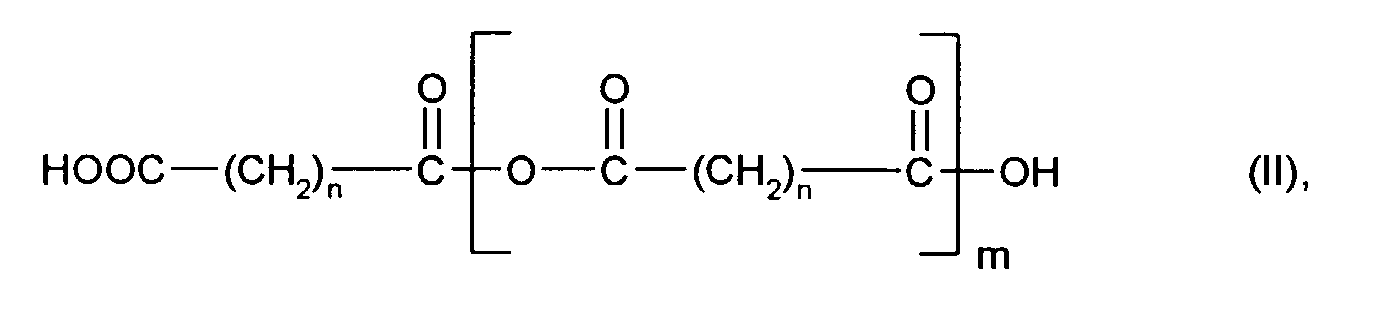
und
wobei
- m
- für eine ganze Zahl von 1 bis 100 und
- n
- für eine ganze Zahl von 4 bis 16 steht.
Gegenstand der Erfindung ist auch die Verwendung der erfindungsgemäßen Polyisocyanat-modifizierten
Dicarbonsäuren als Härter für Lackbindemittel, insbesondere
Pulverlackbindemittel, auf Polyepoxid-Basis.
Typische Beispiele für geeignete Dicarbonsäuren der Formel (I) sind z.B. Adipinsäure,
Azelainsäure, Sebazinsäure oder 1,12-Dodecandisäure. Ganz besonders bevorzugt
sind Adipinsäure und 1,12-Dodecandisäure.
Die diesen Säuren entsprechenden Anhydride der Formel (II) können in an sich
bekannter Weise durch Umsetzung der entsprechenden Dicarbonsäure mit Essigsäureanhydrid
bei 120 bis 150°C unter anschließender destillativer Entfernung von
flüchtigen Bestandteilen aus dem Reaktionsgemisch bei Temperaturen bis 200°C
hergestellt werden. Bei dieser Umsetzung werden die Ausgangsmaterialien in Mengenverhältnissen
eingesetzt, die einem Molverhältnis von Essigsäureanhydrid zu
Dicarbonsäure von mindestens 0,25 : 1, vorzugsweise mindestens 0,5 : 1 und bevorzugt
von 0,5 : 1 bis 0,9 : 1 entsprechen.
Als Polyisocyanatkomponente B) eignen sich beliebige organische Verbindungen, die
mindestens zwei Isocyanatgruppen pro Molekül aufweisen und ansonsten unter den
Reaktionsbedingungen des erfindungsgemäßen Verfahrens inert sind. Geeignet sind
beispielsweise aromatische Polyisocyanate, Umsetzungsprodukte von 2,4- und/oder
2,6-Diisocyanatotoluol mit niedermolekularen Polyolen wie beispielsweise Trimethylolpropan,
Uretdiongruppen aufweisende Diisocyanate auf Basis von 2,4- und/oder
2,6-Diisocyanatotoluol, Isocyanuratgruppen aufweisende Polyisocyanate auf Basis
dieser Diisocyanate, sowie beliebige Gemische der beispielhaft genannten aromatischen
Polyisocyanate.
Bevorzugt handelt es sich bei der Polyisocyanatkomponente B) jedoch um organische
Polyisocyanate mit (cyclo)aliphatisch gebundenen Isocyanatgruppen des Molekulargewichtsbereichs
168 bis 1000, wie z.B. Hexamethylendiisocyanat (HDI), Isophorondiisocyanat
(IPDI), 4,4'-Diisocyanatodicyclohexylmethan oder um bekannte, Biuretgruppen,
Isocyanuratgruppen, Uretdiongruppen, Urethangruppen und/oder Allophanatgruppen
aufweisende Derivate dieser Diisocyanate. Auch Mischtrimere aus aliphatischen
und aromatischen Diisocyanaten, insbesondere aus HDI und 2,4- und/oder
2,6-Diisocyanatotoluol können als erfindungsgemäße Komponente B) eingesetzt
werden. Beliebige Gemische der beispielhaft genannten Polyisocyanate können selbstverständlich
ebenfalls als Komponente B) Verwendung finden.
Bei der Herstellung der erfindungsgemäß zu verwendenden Polyisocyanat-modifizierten
Dicarbonsäurederivaten kommt die Komponente B) in Mengen von 1 bis 60,
vorzugsweise 15 bis 40 Gew.%, bezogen auf das Gesamtgewicht der Komponenten
A) und B), zum Einsatz, mit der Maßgabe, daß das NCO/COOH-Äquivalentverhältnis
bei höchstens 0,9 : 1, vorzugsweise bei 0,2 bis 0,8 liegt. Die Komponente C), das
Wasser, kommt in solchen Mengen zum Einsatz, daß das Molverhältnis Wasser zu
Anhydridgruppen bei höchstens 10 : 1, vorzugsweise bei 0,2 : 1 bis 1 : 1 liegt.
Die Umsetzung zwischen den Komponenten A) und B) erfolgt im allgemeinen in der
Schmelze bei 80 bis 180°C, vorzugsweise bei 95 bis 150°C.
In einem bevorzugten Verfahren wird das in einer Vorlage befindliche Polycarboxyl(poly)anhydrid
A) abwechselnd mit Isocyanat B) und Wasser C) versetzt, wobei
darauf zu achten ist, daß sich die jeweils an Isocyanat oder Wasser zugesetzte Menge
vor einer weiteren Zugabe einer der Komponenten mit dem Polycarboxyl(poly)anhydrid
umgesetzt hat, zu erkennen an der Beendigung der CO2-Entwicklung bzw.
Kondenswasserbildung. Die zugesetzte molare Menge an Wasser sollte vor Zugabe
der Gesamtmenge an Isocyanat den molaren Gehalt an Anhydridgruppen nicht überschreiten.
Der Gehalt des Härters an freier Säure plus der als Anhydridgebundenen Säure, als
Gesamt-Säuregehalt bezeichnet, wird durch Titration nach bekannter Weise in Pyridin
mit 1 n NaOH gegen Nilblauchlorid als Indikator bestimmt.
Der Säureanhydridgehalt wird bestimmt aus der Differenz des Gesamt-Säuregehalts
einer Probe vor und dem Säuregehalt einer Probe nach der Umsetzung mit einer
gegenüber den Anhydridgruppen überschüssigen Menge an n-Propanol bei 110°C.
Der Gehalt an freier Säure im Härter ergibt sich aus der Differenz vom Gesamt-Säuregehalt
und Säureanhydridgehalt.
Auch ist gegegenenenfalls die Mitverwendung von organischen Modifizierungskomponenten
wie Mono- und Dihydroxyverbindungen oder Monoisocyanaten möglich,
die in Mengen von 0 bis 10 Gew.% bezogen auf das Gesamtgewicht der
Komponenten A) und B) mitverwendet werden können und in einem solchen Fall im
allgemeinen in Abmischung mit der Komponente A) zum Einsatz gelangen. Geeignete
Monohydroxyverbindungen sind z.B. Methanol, Ethanol, Butanol, Cyclohexanol,
Oktadecanol, geeignete Dihydroxyverbindungen sind z.B. Ethylenglykol, Propylenglykol,
Polyethylenglykol, Polypropylenglykol, Butylenglykol, Adipol, geeignete
Monoisocyanate sind z.B. Butylisocyanat, Stearylisocyanat, Cyclohexyl-isocyanat.
Die besonders bevorzugten erfindungsgemäßen Verbindungen stellen Reaktionsprodukte
von 50 bis 80 Teilen der Komponente A) mit 20 bis 45 Teilen der Komponente
B) und 0,5 bis 5 Teilen der Komponente C) dar.
Die erfindungsgemäßen Verbindungen sind als Härter für Lackbindemittel auf Epoxidharz-Basis
geeignet. Als Pulverlackhärter für Lackbindemittel auf Epoxidharz-Basis
sind insbesondere solche erfindungsgemäße Verbindungen geeignet, die unterhalb
60°C fest und oberhalb 150°C flüssig sind.
Bei der erfindungsgemäßen Verwendung werden die erfindungsgemäßen Härter in
Lackbindemitteln auf Epoxidharz-Basis eingesetzt. Die hierbei in Betracht kommenden
Lacke bestehen aus diesen Bindemittelkomponenten und können gegebenenfalls
weitere übliche Lackbestandteile, wie z.B. Verlaufsmittel, Katalysatoren, Pigmente,
Mattierungsmittel oder UV-Schutzmittel, enthalten.
Die Lacke bestehen im allgemeinen aus 10 bis 50 Gew.-% an erfindungsgemäßen Härtern
und zu 50 bis 90 Gew.-% aus Epoxidgruppen aufweisenden Bindemitteln, wobei
sich die Summe dieser Prozentangaben auf 100 ergänzt, sowie gegebenenfalls aus zusätzlichen
Hilfsmitteln der beispielhaft genannten Art.
Bevorzugte Epoxidgruppen aufweisende Bindemittel sind Epoxid-funktionelle Acryl-Polymere,
jedoch können auch Polyglycidylether OH-funktioneller Polykondensate
eingesetzt werden. Die Epoxid-funktionellen Acryl-Polymere können Copolymere
ethylenisch ungesättigter Ester oder Ether mit Epoxid-Gruppen, wie z.B. Glycidylacrylat,
Glycidylmethacrylat oder Allylglycidylether mit anderen Estern von Acryl- und
Methacrylsäure mit einwertige C1-18-Alkoholen und anderen Comonomeren sein.
Solche Ester sind z.B. Methyl(meth)acrylat, Ethyl(meth)acrylat, Butyl-(meth)acrylat,
Isobutyl(meth)acrylat, Hexyl(meth)acrylat, 2-Ethylhexyl(meth)acrylat, Stearyl(meth)acrylat
usw.
Andere mögliche Comonomere ohne Epoxidgruppen sind Styrol, α-Methylstyrol,
Vinyltoluol, (Meth)Acrylnitril, Vinyl(iden)halogenide, wie Vinylchlorid, Vinylidenchlorid,
Vinylester wie Vinylacetat, Vinylversatat usw.
Der Anteil der Epoxid-funktionellen Monomeren am Aufbau des Acrylpolymeren
beträgt vorteilhaft etwa 5 bis 60 Gew.-%, insbesondere 20 bis 50 Gew.-%, bezogen
auf die Gesamt-Monomermischung. Das Epoxid-Äquivalentgewicht der Epoxidgruppen
aufweisenden Copolymerisate liegt im allgemeinen bei 250 bis 1000.
Die erfindungsgemäßen Härter können selbstverständlich auch in Kombination mit
Epoxy-funktionellen Polykondensationsharzen zur Anwendung gelangen. Beispiele
hierfür sind die an sich bekannten Umsetzungsprodukte von Epichlorhydrin mit mehrwertigen
Phenolen, insbesondere Bisphenol A, oder mit Novolaken auf Phenolbasis.
Als Lösungsmittel für die Härter-Bindemittel-Kombination bei Anwendungen als
Flüssiglack sind organische Flüssigkeiten geeignet, die weder Säure- noch Amino-Funktionalität
aufweisen, beispielsweise Acetate wie Butylacetat, Hexylacetat, Octylacetat,
Glykolether und Glykoletheracetate wie Propylenglykolether, Propylenglykolmonomethylether-acetat,
Ketone wie Methylpropylketon, Methylbutylketon, Methylhexylketon
oder auch N-Methylpyrrolidon.
Die Lösungen des Lackbindemittels und des erfindungsgemäßen Härters werden
getrennt bevorzugt gelagert um eine vorzeitige Umsetzung zu vermeiden. Die Lösungen
der Komponenten werden dann erst kurz vor der Applikation gemischt.
Das Lacksprühverfahren ist die bevorzugte Methode, die Reaktionskomponenten auf
ein Substrat aufzutragen. Substrate können beispielsweise Metall, Keramik, Glas,
Kunststoff oder Holz sein.
Die Herstellung der Pulverlacke aus den genannten Komponenten kann beispielsweise
durch deren Homogenisierung in einem Extruder, sowie Aufschmelzen und Mahlen
der erstarrten Schmelze erfolgen. Der Auftrag der Pulverlacke erfolgt in an sich bekannter
Weise, beispielsweise mittels einer elektrostatischen Sprüheinrichtung.
Die erfindungsgemäßen Pulverlacke weisen im allgemeinen einen Erweichungsbereich
innerhalb des Temperaturbereichs von 80 bis 120°C auf.
Die Härtungsbedingungen für die erfindungsgemäßen Beschichtungen liegen bei Einbrenntemperaturen
von etwa 120 bis 180°C; bevorzugt werden 130 bis 160°C; die
Einbrennzeiten liegen dann - je nach Einbrenntemperatur - zwischen 10 und 40 Min.,
bevorzugt zwischen 15 und 30 Min.
%-Angaben sind stets Gewichtsprozent, Teile sind Gew.-Teile.
Anschließend werden 50 Teile Wasser untergerührt und nach 2 Stdn. noch 350 Teile HDI-Trimerisat zugetropft. Nachdem die CO2-Entwicklung beendet ist, wird durch das Produkt für 2 Stdn. Stickstoff geleitet und danach für 30 Min. Hochvakuum angelegt.
Das bei 88 bis 97°C schmelzende Produkt hat einen Gehalt an Carboxylgruppen von 17,2 %, an Anhydridgruppen von 3,2 % und an Stickstoff von 2,2 %.
Zu dem aus 1900 Teilen Dodecandisäure nach Beispiel 1a hergestellten Dodecandisäureanhydrid
werden innerhalb von 45 Min. bei 130 - 140°C 700 Teile HDI-Trimerisat
eines NCO-Gehalts von 21 % gegeben und bis zur Beendigung der CO2-Entwicklung
gerührt (bei 140°C sehr viskoses, gummiartiges Produkt). Es werden 40
Teile Wasser und nach ca. 2 Stdn. noch 300 Teile HDI-Trimerisat zugetropft.
Nachdem die CO2-Entwicklung beendet ist, werden noch 20 Teile Wasser zugegeben,
und das Reaktionsprodukt wird 2 Stdn. bei 140°C nachgerührt (bei 140°C
dünnflüssiges Produkt). Es wird 2 Stdn. lang Stickstoff durch das Produkt geleitet
und danach für 30 Min. Hochvakuum angelegt.
Das bei 92 bis 98°C schmelzende Produkt hat einen Gehalt an Carboxylgruppen von
17,1 %, an Anhydridgruppen von 0,8 % und an Stickstoff von 2,6 %.
Zu dem aus 1900 Teilen Dodecandisäure nach Beispiel 1a hergestellten Dodecandisäureanhydrid
werden innerhalb von 45 Min. bei 130°C 450 Teile IPDI-Trimerisat
eines NCO-Gehalts von 17,2 % portionsweise zugegeben und bis zur Beendigung der
CO2-Entwicklung gerührt. Es werden 40 Teile Wasser und nach 2 Stdn. noch 350
Teile IPDI-Trimerisat zugefügt. Nachdem die CO2-Entwicklung beendet ist, werden
noch 10 Teile Wasser zugegeben und das Reaktionsprodukt wird 2 Stdn. bei 140°C
nachgerührt. Es wird 2 Stdn. lang Stickstoff durch das Produkt geleitet und danach
für 30 Min. Hochvakuum angelegt.
Das bei 106 bis 120°C schmelzende Produkt hat einen Gehalt an Carboxylgruppen
von 19,0 %, an Anhydridgruppen von 3,4 % und an Stickstoff von 1,8 %.
Zu dem aus 1900 Teilen Dodecandisäure nach Beispiel 1a hergestellten Dodecandisäureanhydrid
werden innerhalb von 45 Min. bei 130°C 500 Teile 4,4'-Diisocyanatodicyclohexylmethan
gegeben und die Reaktionsmischung bis zur Beendigung der CO2-Entwicklung
gerührt. Es werden 10 Teile Wasser und nach 2 Stdn. noch 100 Teile Dicyclohexylmethan-4,4'-diisocyanat
zugefügt. Nachdem die CO2-Entwicklung beendet
ist, wird durch das Produkt 2 Stdn. lang Stickstoff geleitet und danach für 30 Min.
Hochvakuum angelegt.
Das bei 88 bis 97°C schmelzende Produkt hat einen Gehalt an Carboxylgruppen von
19,3 %, an Anhydridgruppen von 3,2 % und an Stickstoff von 2,8 %.
Zu dem aus 1900 Teilen Dodecandisäure nach Beispiel 1a hergestellten Dodecandisäureanhydrid
werden innerhalb von 45 Min. bei 130°C 500 Teile Isophorondiiso-cyanat
gegeben und die Reaktionsmischung bis zur Beendigung der CO2-Entwicklung gerührt.
Es werden 25 Teile Wasser und nach 2 Stdn. noch 100 Teile Isophorondiisocyanat
zugefügt. Nachdem die CO2-Entwicklung beendet ist, wird durch das Produkt
2 Stdn. lang Stickstoff geleitet und danach für 30 Min. Hochvakuum angelegt.
Das bei 88 bis 97°C schmelzende Produkt hat einen Gehalt an Carboxylgruppen von
12,3 %, an Anhydridgruppen von 8,4 % und an Stickstoff von 3,4 %.
Zu dem aus 1900 Teilen Dodecandisäure nach Beispiel 1a hergestellten Dodecandisäureanhydrid
werden innerhalb von 45 Min. bei 130°C 600 g Dicyclohexylmethan-4,4'-diisocyanat
gegeben und die Reaktionsmischung bis zur Beendigung der CO2-Entwicklung
gerührt. Um die Viskosität zu senken, werden 2 Teile Wasser durch ein
Einleitungsrohr in die Reaktionsmischung gegeben und 1 Stde. bei 140°C nachgerührt.
Es wird 2 Stdn. lang Stickstoff durch das Produkt geleitet und danach für 30
Min. Hochvakuum angelegt.
Das bei 65 bis 81°C schmelzende Produkt hat einen Gehalt an Carboxylgruppen von
8,6 %, an Anhydridgruppen von 12,7 % und an Stickstoff von 2,9 %.
1200 Teile Adipinsäure und 490 Teile Acetanhydrid werden bis 125°C am Rückfluß
gehalten. Anschließend wird bei 125°C die entstandene Essigsäure bei 0,3 mbar abgezogen.
Zu dem aus 1200 Teilen Adipinsäure hergestellten Adipinsäureanhydrid werden
innerhalb von 45 Min. bei 120°C 300 Teile HDI-Trimerisat eines NCO-Gehalts von
21 % gegeben, und die Reaktionsmischung wird bis zur Beendigung der CO2-Entwicklung
gerührt. Anschließend werden 25 Teile Wasser untergerührt. Nach 2 Stdn.
werden noch 300 Teile HDI-Trimerisat zugetropft. Nachdem die CO2-Entwicklung
beendet ist, werden 75 Teile Wasser zugegeben, und das Reaktionsprodukt wird 2
Stdn. bei 120°C nachgerührt. Es wird durch das Produkt für 2 Stdn. Stickstoff geleitet
und danach für 30 Min. Hochvakuum angelegt.
Das bei 80 bis 130°C schmelzende Produkt hat einen Gehalt an Carboxylgruppen von
32 %, an Anhydridgruppen von <1 % und an Stickstoff von 6 %.
Für die Lackprüfung werden 69 Teile Polyepoxidharz (Almatex® PD 7610, Polyacrylat-Copolymerisat
der Fa. Mitsui Toatsu, Epoxid-Äquiv.-Gew. = 526) und 29
Teile des Härters aus Beispiel 1 zusammen mit einem Teil Zinn-II-octoat und einem
Teil Perenol F30P (Verlaufsmittel der Fa. Henkel) gründlich gemischt und anschließend
auf einem Kneter der Fa. Buss AG, Basel, Typ PLK 46, homogenisiert. Dabei
betrug die Gehäusetemperatur 40°C im Einzugsbereich und 50°C im Verfahrensteil.
Die Kneterwelle lief mit 150 U/min. Zur Erzielung optimaler Durchmischung wurde
2 x extrudiert. Die erstarrten Schmelzen wurden mittels einer Sichtermühle, Typ
ACM 2, der Fa. Hosokawa-Mikropul, Köln, zu Pulverlacken mit einer Teilchengröße
<90 µm gemahlen. Mit einer Elektrostatik-Becherpistole der Fa. ESB wurden die
Pulverlacke auf entfettete Stahlbleche gesprüht. Dabei lag eine Hochspannung von
70 kV(-) an. Die Prüfergebnisse der bei 150°C innerhalb von 30 Min. ausgehärteten
Beschichtung sind:
- Glanzwert 20°C / 60°C
- 86 / 106 (%)
- Erichsentiefung (DIN 53156)
- >9 (mm)
- Xylol-Wischtest (50 Doppelhübe)
- ohne Befund
- Aceton-Wischtest (50 Doppelhübe)
- ohne Befund
- 40 Vol.% Schwefelsäure, 20 Min. bei 60°C
- ohne Befund
Claims (6)
- Polyisocyanat-modifizierte Dicarbonsäurederivate, erhältlich durch Umsetzung von organischen Polyisocyanaten mit, bezüglich der NCO/COOH-Reaktion, überschüssigen Mengen an freien Carboxylgruppen aufweisenden Dicarbonsäure-(poly)anhydriden und Wasser.
- Polyisocyanat-modifizierte Dicarbonsäurederivate, dadurch gekennzeichnet, daß sie einen Gehalt an Carboxylgruppen von 2 bis 40 Gew.-%, an Anhydridgruppen (berechnet als C2O3) von 0 bis 20 Gew.-% und an Stickstoff von 0,1 bis 10 Gew.-% aufweisen und daß sie unter Abspaltung von Kohlendioxid und unter Einhaltung eines NCO/COOH-Äquivalentverhältnisses von 0,1:1 bis 0,9:1 hergestellte Umsetzungsprodukte sind ausA) einer Anhydrid-Komponente, bestehend aus mindestens einem, gegebenenfalls im Gemisch mit bis zu 50 Gew.-%, bezogen auf das Gesamtgewicht der Komponente A), Dicarbonsäuren der Formel (I)
 B) einer Polyisocyanat-Komponente, bestehend aus mindestens einem Polyisocyanat
undC) Wasser in einem Molverhältnis zu Anhydridgruppen von 0,1:1 bis 10:1
wobei- m
- für eine ganze Zahl von 1 bis 100 und
- n
- für eine ganze Zahl von 4 bis 16 steht.
- Verfahren zur Herstellung der erfindungsgemäßen Polyisocyanat-modifizierten Dicarbonsäurederivate entsprechend Anspruch 1, dadurch gekennzeichnet, daß Wasser bei >50°C mit dem Umsetzungsprodukt aus Komponente A) und B) so umgesetzt wird, daß das molare Verhältnis von Wasser zu Anhydridgruppen 0,1 bis 10 : 1, bevorzugt 0,2 bis 1 : 1 ist.
- Verfahren zur Herstellung der erfindungsgemäßen Polyisocyanat-modifizierten Dicarbonsäurederivate entsprechend Anspruch 1, dadurch gekennzeichnet, daß die Komponenten B) und Wasser zu A) abwechselnd und portionsweise zugefügt werden und die Zugabe der Teilmenge an Wasser jeweils erst nach der Umsetzung der Teilmenge der Komponente B) erfolgt.
- Verwendung der Polyisocyanat-modifizierten Dicarbonsäurederivate gemäß Anspruch 1 als Härter für Lackbindemittel auf Polyepoxid-Basis.
- Verwendung der Polyisocyanat-modifizierten Dicarbonsäurederivate gemäß Anspruch 1, die unterhalb 60°C fest und oberhalb 150°C flüssig sind, als Härter für Pulverlackbindemittel auf Epoxidharz-Basis.
Applications Claiming Priority (2)
| Application Number | Priority Date | Filing Date | Title |
|---|---|---|---|
| DE19717092 | 1997-04-22 | ||
| DE19717092A DE19717092A1 (de) | 1997-04-22 | 1997-04-22 | Vernetzer für Epoxidharze bzw. neue Polyisocyanat-modifizierte Polycarbonsäuren |
Publications (1)
| Publication Number | Publication Date |
|---|---|
| EP0874010A1 true EP0874010A1 (de) | 1998-10-28 |
Family
ID=7827467
Family Applications (1)
| Application Number | Title | Priority Date | Filing Date |
|---|---|---|---|
| EP98106762A Withdrawn EP0874010A1 (de) | 1997-04-22 | 1998-04-14 | Vernetzer für Epoxidharze bzw. neue Polyisocyanatmodifizierte Polycarbonsäuren |
Country Status (5)
| Country | Link |
|---|---|
| US (1) | US5959060A (de) |
| EP (1) | EP0874010A1 (de) |
| JP (1) | JPH10298259A (de) |
| KR (1) | KR19980081591A (de) |
| DE (1) | DE19717092A1 (de) |
Cited By (1)
| Publication number | Priority date | Publication date | Assignee | Title |
|---|---|---|---|---|
| EP1362875A1 (de) * | 2002-05-11 | 2003-11-19 | Degussa AG | Bifunktionelle Polyadditionsverbindungen als Vernetzer für Polyurethan-Pulverlacke |
Families Citing this family (3)
| Publication number | Priority date | Publication date | Assignee | Title |
|---|---|---|---|---|
| US6777495B2 (en) * | 2002-07-09 | 2004-08-17 | Basf Corporation | Powder coating with tris(hydroxyethyl) isocyanurate-anhydride reaction product crosslinker |
| DE10328663A1 (de) * | 2003-06-26 | 2005-01-13 | Bayer Materialscience Ag | Polyisocyanat-modifizierte Polycarbonsäuren |
| US7623455B2 (en) * | 2005-04-02 | 2009-11-24 | Cisco Technology, Inc. | Method and apparatus for dynamic load balancing over a network link bundle |
Citations (6)
| Publication number | Priority date | Publication date | Assignee | Title |
|---|---|---|---|---|
| JPS5545759A (en) * | 1978-09-27 | 1980-03-31 | Kansai Paint Co Ltd | Powder coating composition of acrylic resin |
| JPS6060127A (ja) * | 1983-09-14 | 1985-04-06 | Hitachi Chem Co Ltd | 粒子状複合樹脂の製造法 |
| WO1994004590A1 (de) * | 1992-08-20 | 1994-03-03 | Basf Lacke + Farben Ag | Verfahren zur herstellung von pulverlacken und nach diesem verfahren hergestellte pulverlacke |
| EP0652263A1 (de) * | 1993-11-05 | 1995-05-10 | Bayer Ag | Pulverlack und seine Verwendung |
| EP0695771A2 (de) * | 1994-08-01 | 1996-02-07 | Bayer Ag | Polyisocyanat-modifizierte Dicarbonsäure(poly)anhydride |
| EP0728782A1 (de) * | 1995-02-24 | 1996-08-28 | Kansai Paint Co., Ltd. | Wärmehärtende Vinylpulverlackezusammensetzung |
Family Cites Families (1)
| Publication number | Priority date | Publication date | Assignee | Title |
|---|---|---|---|---|
| US5371167A (en) * | 1992-01-27 | 1994-12-06 | Basf Corporation | Carboxyl-functional compound for curable coating composition |
-
1997
- 1997-04-22 DE DE19717092A patent/DE19717092A1/de not_active Withdrawn
-
1998
- 1998-04-14 EP EP98106762A patent/EP0874010A1/de not_active Withdrawn
- 1998-04-16 US US09/061,422 patent/US5959060A/en not_active Expired - Fee Related
- 1998-04-20 JP JP10123874A patent/JPH10298259A/ja active Pending
- 1998-04-21 KR KR1019980014211A patent/KR19980081591A/ko not_active Abandoned
Patent Citations (6)
| Publication number | Priority date | Publication date | Assignee | Title |
|---|---|---|---|---|
| JPS5545759A (en) * | 1978-09-27 | 1980-03-31 | Kansai Paint Co Ltd | Powder coating composition of acrylic resin |
| JPS6060127A (ja) * | 1983-09-14 | 1985-04-06 | Hitachi Chem Co Ltd | 粒子状複合樹脂の製造法 |
| WO1994004590A1 (de) * | 1992-08-20 | 1994-03-03 | Basf Lacke + Farben Ag | Verfahren zur herstellung von pulverlacken und nach diesem verfahren hergestellte pulverlacke |
| EP0652263A1 (de) * | 1993-11-05 | 1995-05-10 | Bayer Ag | Pulverlack und seine Verwendung |
| EP0695771A2 (de) * | 1994-08-01 | 1996-02-07 | Bayer Ag | Polyisocyanat-modifizierte Dicarbonsäure(poly)anhydride |
| EP0728782A1 (de) * | 1995-02-24 | 1996-08-28 | Kansai Paint Co., Ltd. | Wärmehärtende Vinylpulverlackezusammensetzung |
Non-Patent Citations (2)
| Title |
|---|
| DATABASE WPI Week 8520, Derwent World Patents Index; AN 19677, XP002071028, "granule composite resin composition preparation" * |
| PATENT ABSTRACTS OF JAPAN vol. 004, no. 081 (C - 014) 11 June 1980 (1980-06-11) * |
Cited By (2)
| Publication number | Priority date | Publication date | Assignee | Title |
|---|---|---|---|---|
| EP1362875A1 (de) * | 2002-05-11 | 2003-11-19 | Degussa AG | Bifunktionelle Polyadditionsverbindungen als Vernetzer für Polyurethan-Pulverlacke |
| US6849705B2 (en) | 2002-05-11 | 2005-02-01 | Degussa Ag | Bifunctional polyaddition compounds as crosslinkers for polyurethane powder coatings |
Also Published As
| Publication number | Publication date |
|---|---|
| JPH10298259A (ja) | 1998-11-10 |
| DE19717092A1 (de) | 1998-10-29 |
| KR19980081591A (ko) | 1998-11-25 |
| US5959060A (en) | 1999-09-28 |
Similar Documents
| Publication | Publication Date | Title |
|---|---|---|
| EP1475399A1 (de) | Feste uretdiongruppenhaltige Polyurethan-Pulverlackzusammensetzungen bei niedriger Temperatur härtbar | |
| EP1745082A1 (de) | Uretdiongruppenhaltige polyurethanzusammensetzungen, welche bei niedriger temperatur härtbar sind und (teil-)kristalline harze enthalten | |
| EP0005230B1 (de) | Bindemittel für pulverförmige Überzugsmittel | |
| DE102008002703A1 (de) | Hochreaktive, Uretdiongruppen haltige Polyurethanzusammensetzungen, die metallfreie Acetylacetonate enthalten | |
| WO1999001499A1 (de) | Wässrige pulverlack-dispersion, verfahren zu ihrer herstellung sowie verwendung der erhaltenen pulverlack-dispersion | |
| EP0104424B1 (de) | Verwendung blockierter Polyisocyanate als Härter für Hydroxylgruppen-haltige Bindemittel | |
| DE102004011005A1 (de) | Bei niedriger Temperatur härtbare uretdiongruppenhaltige Polyurethanzusammensetzungen | |
| EP0051787B1 (de) | Neue Amidine und Amidin/Isocyanat-Addukte, Verfahren zu ihrer Herstellung und ihre Verwendung als Katalysatoren für die Härtung von Epoxidharzen | |
| DE4335845C3 (de) | Wärmehärtende Beschichtungsmasse, deren Herstellung und Verwendung | |
| EP0789043B1 (de) | Polyurethan-Pulvermattlacke | |
| EP0904311B1 (de) | Pulverlack zur herstellung einer mehrschichtlackierung | |
| DE2003411A1 (de) | Einbrennlacke | |
| EP0695771B1 (de) | Polyisocyanat-modifizierte Dicarbonsäure(poly)anhydride | |
| EP0317741B1 (de) | PUR-Pulverlacke für matte Überzüge | |
| EP2084202A1 (de) | Urethanepoxide für die tieftemperaturhärtung von beschichtungen, verfahren zur herstellung sowie verwendung | |
| EP0874010A1 (de) | Vernetzer für Epoxidharze bzw. neue Polyisocyanatmodifizierte Polycarbonsäuren | |
| EP0512213B1 (de) | Verfahren zur Herstellung eines blockierten Lackpolyisocyanats | |
| EP0085913B1 (de) | Reaktive carboxylgruppenhaltige Polymere, Verfahren zu ihrer Herstellung und ihre Verwendung als Bindemittelkomponente für Pulverlacke | |
| EP0694592A2 (de) | Pulverlack und seine Verwendung | |
| EP0538597A1 (de) | Blockierte höherfuntionelle Polyisocyanataddukte, ein Verfahren zu ihrer Herstellung sowie deren Verwendung | |
| EP0475108B1 (de) | Pulverlacke und die Verwendung von ausgewählten Bindemittelkombinationen für Pulverlacke | |
| EP0519186A1 (de) | Pulverlacke | |
| DE19754748B4 (de) | Verfahren zur Herstellung eines blockierten Lackpolyisocyanats und dessen Verwendung für PUR-Lacke | |
| DE3035639A1 (de) | Neue di- und polyamine, verfahren zu ihrer herstellung, und ihre verwendung | |
| EP1491564A2 (de) | Polyisocyanat-modifizierte Polycarbonsäuren |
Legal Events
| Date | Code | Title | Description |
|---|---|---|---|
| PUAI | Public reference made under article 153(3) epc to a published international application that has entered the european phase |
Free format text: ORIGINAL CODE: 0009012 |
|
| AK | Designated contracting states |
Kind code of ref document: A1 Designated state(s): AT DE DK ES FR GB IT NL SE |
|
| AX | Request for extension of the european patent |
Free format text: AL;LT;LV;MK;RO;SI |
|
| 17P | Request for examination filed |
Effective date: 19990428 |
|
| AKX | Designation fees paid |
Free format text: AT DE DK ES FR GB IT NL SE |
|
| STAA | Information on the status of an ep patent application or granted ep patent |
Free format text: STATUS: THE APPLICATION HAS BEEN WITHDRAWN |
|
| 18W | Application withdrawn |
Effective date: 20030226 |