EP0874026A2 - Pigments colorés à effets particuliers et leur utilisaton - Google Patents
Pigments colorés à effets particuliers et leur utilisaton Download PDFInfo
- Publication number
- EP0874026A2 EP0874026A2 EP98810319A EP98810319A EP0874026A2 EP 0874026 A2 EP0874026 A2 EP 0874026A2 EP 98810319 A EP98810319 A EP 98810319A EP 98810319 A EP98810319 A EP 98810319A EP 0874026 A2 EP0874026 A2 EP 0874026A2
- Authority
- EP
- European Patent Office
- Prior art keywords
- coating
- core
- pigment
- composition
- refractive index
- Prior art date
- Legal status (The legal status is an assumption and is not a legal conclusion. Google has not performed a legal analysis and makes no representation as to the accuracy of the status listed.)
- Granted
Links
Images
Classifications
-
- C—CHEMISTRY; METALLURGY
- C09—DYES; PAINTS; POLISHES; NATURAL RESINS; ADHESIVES; COMPOSITIONS NOT OTHERWISE PROVIDED FOR; APPLICATIONS OF MATERIALS NOT OTHERWISE PROVIDED FOR
- C09C—TREATMENT OF INORGANIC MATERIALS, OTHER THAN FIBROUS FILLERS, TO ENHANCE THEIR PIGMENTING OR FILLING PROPERTIES ; PREPARATION OF CARBON BLACK ; PREPARATION OF INORGANIC MATERIALS WHICH ARE NO SINGLE CHEMICAL COMPOUNDS AND WHICH ARE MAINLY USED AS PIGMENTS OR FILLERS
- C09C1/00—Treatment of specific inorganic materials other than fibrous fillers; Preparation of carbon black
- C09C1/0015—Pigments exhibiting interference colours, e.g. transparent platelets of appropriate thinness or flaky substrates, e.g. mica, bearing appropriate thin transparent coatings
- C09C1/0051—Pigments exhibiting interference colours, e.g. transparent platelets of appropriate thinness or flaky substrates, e.g. mica, bearing appropriate thin transparent coatings comprising a stack of coating layers with alternating low and high refractive indices, wherein the first coating layer on the core surface has the low refractive index
-
- C—CHEMISTRY; METALLURGY
- C08—ORGANIC MACROMOLECULAR COMPOUNDS; THEIR PREPARATION OR CHEMICAL WORKING-UP; COMPOSITIONS BASED THEREON
- C08K—Use of inorganic or non-macromolecular organic substances as compounding ingredients
- C08K9/00—Use of pretreated ingredients
- C08K9/02—Ingredients treated with inorganic substances
-
- C—CHEMISTRY; METALLURGY
- C09—DYES; PAINTS; POLISHES; NATURAL RESINS; ADHESIVES; COMPOSITIONS NOT OTHERWISE PROVIDED FOR; APPLICATIONS OF MATERIALS NOT OTHERWISE PROVIDED FOR
- C09C—TREATMENT OF INORGANIC MATERIALS, OTHER THAN FIBROUS FILLERS, TO ENHANCE THEIR PIGMENTING OR FILLING PROPERTIES ; PREPARATION OF CARBON BLACK ; PREPARATION OF INORGANIC MATERIALS WHICH ARE NO SINGLE CHEMICAL COMPOUNDS AND WHICH ARE MAINLY USED AS PIGMENTS OR FILLERS
- C09C1/00—Treatment of specific inorganic materials other than fibrous fillers; Preparation of carbon black
- C09C1/0015—Pigments exhibiting interference colours, e.g. transparent platelets of appropriate thinness or flaky substrates, e.g. mica, bearing appropriate thin transparent coatings
-
- C—CHEMISTRY; METALLURGY
- C09—DYES; PAINTS; POLISHES; NATURAL RESINS; ADHESIVES; COMPOSITIONS NOT OTHERWISE PROVIDED FOR; APPLICATIONS OF MATERIALS NOT OTHERWISE PROVIDED FOR
- C09C—TREATMENT OF INORGANIC MATERIALS, OTHER THAN FIBROUS FILLERS, TO ENHANCE THEIR PIGMENTING OR FILLING PROPERTIES ; PREPARATION OF CARBON BLACK ; PREPARATION OF INORGANIC MATERIALS WHICH ARE NO SINGLE CHEMICAL COMPOUNDS AND WHICH ARE MAINLY USED AS PIGMENTS OR FILLERS
- C09C1/00—Treatment of specific inorganic materials other than fibrous fillers; Preparation of carbon black
- C09C1/0015—Pigments exhibiting interference colours, e.g. transparent platelets of appropriate thinness or flaky substrates, e.g. mica, bearing appropriate thin transparent coatings
- C09C1/0024—Pigments exhibiting interference colours, e.g. transparent platelets of appropriate thinness or flaky substrates, e.g. mica, bearing appropriate thin transparent coatings comprising a stack of coating layers with alternating high and low refractive indices, wherein the first coating layer on the core surface has the high refractive index
-
- C—CHEMISTRY; METALLURGY
- C09—DYES; PAINTS; POLISHES; NATURAL RESINS; ADHESIVES; COMPOSITIONS NOT OTHERWISE PROVIDED FOR; APPLICATIONS OF MATERIALS NOT OTHERWISE PROVIDED FOR
- C09D—COATING COMPOSITIONS, e.g. PAINTS, VARNISHES OR LACQUERS; FILLING PASTES; CHEMICAL PAINT OR INK REMOVERS; INKS; CORRECTING FLUIDS; WOODSTAINS; PASTES OR SOLIDS FOR COLOURING OR PRINTING; USE OF MATERIALS THEREFOR
- C09D5/00—Coating compositions, e.g. paints, varnishes or lacquers, characterised by their physical nature or the effects produced; Filling pastes
- C09D5/36—Pearl essence, e.g. coatings containing platelet-like pigments for pearl lustre
-
- C—CHEMISTRY; METALLURGY
- C01—INORGANIC CHEMISTRY
- C01P—INDEXING SCHEME RELATING TO STRUCTURAL AND PHYSICAL ASPECTS OF SOLID INORGANIC COMPOUNDS
- C01P2006/00—Physical properties of inorganic compounds
- C01P2006/60—Optical properties, e.g. expressed in CIELAB-values
- C01P2006/62—L* (lightness axis)
-
- C—CHEMISTRY; METALLURGY
- C01—INORGANIC CHEMISTRY
- C01P—INDEXING SCHEME RELATING TO STRUCTURAL AND PHYSICAL ASPECTS OF SOLID INORGANIC COMPOUNDS
- C01P2006/00—Physical properties of inorganic compounds
- C01P2006/60—Optical properties, e.g. expressed in CIELAB-values
- C01P2006/65—Chroma (C*)
-
- C—CHEMISTRY; METALLURGY
- C01—INORGANIC CHEMISTRY
- C01P—INDEXING SCHEME RELATING TO STRUCTURAL AND PHYSICAL ASPECTS OF SOLID INORGANIC COMPOUNDS
- C01P2006/00—Physical properties of inorganic compounds
- C01P2006/60—Optical properties, e.g. expressed in CIELAB-values
- C01P2006/66—Hue (H*)
-
- C—CHEMISTRY; METALLURGY
- C08—ORGANIC MACROMOLECULAR COMPOUNDS; THEIR PREPARATION OR CHEMICAL WORKING-UP; COMPOSITIONS BASED THEREON
- C08K—Use of inorganic or non-macromolecular organic substances as compounding ingredients
- C08K2201/00—Specific properties of additives
- C08K2201/014—Additives containing two or more different additives of the same subgroup in C08K
-
- C—CHEMISTRY; METALLURGY
- C09—DYES; PAINTS; POLISHES; NATURAL RESINS; ADHESIVES; COMPOSITIONS NOT OTHERWISE PROVIDED FOR; APPLICATIONS OF MATERIALS NOT OTHERWISE PROVIDED FOR
- C09C—TREATMENT OF INORGANIC MATERIALS, OTHER THAN FIBROUS FILLERS, TO ENHANCE THEIR PIGMENTING OR FILLING PROPERTIES ; PREPARATION OF CARBON BLACK ; PREPARATION OF INORGANIC MATERIALS WHICH ARE NO SINGLE CHEMICAL COMPOUNDS AND WHICH ARE MAINLY USED AS PIGMENTS OR FILLERS
- C09C2200/00—Compositional and structural details of pigments exhibiting interference colours
- C09C2200/10—Interference pigments characterized by the core material
- C09C2200/1004—Interference pigments characterized by the core material the core comprising at least one inorganic oxide, e.g. Al2O3, TiO2 or SiO2
-
- C—CHEMISTRY; METALLURGY
- C09—DYES; PAINTS; POLISHES; NATURAL RESINS; ADHESIVES; COMPOSITIONS NOT OTHERWISE PROVIDED FOR; APPLICATIONS OF MATERIALS NOT OTHERWISE PROVIDED FOR
- C09C—TREATMENT OF INORGANIC MATERIALS, OTHER THAN FIBROUS FILLERS, TO ENHANCE THEIR PIGMENTING OR FILLING PROPERTIES ; PREPARATION OF CARBON BLACK ; PREPARATION OF INORGANIC MATERIALS WHICH ARE NO SINGLE CHEMICAL COMPOUNDS AND WHICH ARE MAINLY USED AS PIGMENTS OR FILLERS
- C09C2200/00—Compositional and structural details of pigments exhibiting interference colours
- C09C2200/10—Interference pigments characterized by the core material
- C09C2200/102—Interference pigments characterized by the core material the core consisting of glass or silicate material like mica or clays, e.g. kaolin
-
- C—CHEMISTRY; METALLURGY
- C09—DYES; PAINTS; POLISHES; NATURAL RESINS; ADHESIVES; COMPOSITIONS NOT OTHERWISE PROVIDED FOR; APPLICATIONS OF MATERIALS NOT OTHERWISE PROVIDED FOR
- C09C—TREATMENT OF INORGANIC MATERIALS, OTHER THAN FIBROUS FILLERS, TO ENHANCE THEIR PIGMENTING OR FILLING PROPERTIES ; PREPARATION OF CARBON BLACK ; PREPARATION OF INORGANIC MATERIALS WHICH ARE NO SINGLE CHEMICAL COMPOUNDS AND WHICH ARE MAINLY USED AS PIGMENTS OR FILLERS
- C09C2200/00—Compositional and structural details of pigments exhibiting interference colours
- C09C2200/10—Interference pigments characterized by the core material
- C09C2200/102—Interference pigments characterized by the core material the core consisting of glass or silicate material like mica or clays, e.g. kaolin
- C09C2200/1025—Interference pigments characterized by the core material the core consisting of glass or silicate material like mica or clays, e.g. kaolin comprising at least one metal layer adjacent to core material, e.g. core-M or M-core-M
-
- C—CHEMISTRY; METALLURGY
- C09—DYES; PAINTS; POLISHES; NATURAL RESINS; ADHESIVES; COMPOSITIONS NOT OTHERWISE PROVIDED FOR; APPLICATIONS OF MATERIALS NOT OTHERWISE PROVIDED FOR
- C09C—TREATMENT OF INORGANIC MATERIALS, OTHER THAN FIBROUS FILLERS, TO ENHANCE THEIR PIGMENTING OR FILLING PROPERTIES ; PREPARATION OF CARBON BLACK ; PREPARATION OF INORGANIC MATERIALS WHICH ARE NO SINGLE CHEMICAL COMPOUNDS AND WHICH ARE MAINLY USED AS PIGMENTS OR FILLERS
- C09C2200/00—Compositional and structural details of pigments exhibiting interference colours
- C09C2200/10—Interference pigments characterized by the core material
- C09C2200/1054—Interference pigments characterized by the core material the core consisting of a metal
-
- C—CHEMISTRY; METALLURGY
- C09—DYES; PAINTS; POLISHES; NATURAL RESINS; ADHESIVES; COMPOSITIONS NOT OTHERWISE PROVIDED FOR; APPLICATIONS OF MATERIALS NOT OTHERWISE PROVIDED FOR
- C09C—TREATMENT OF INORGANIC MATERIALS, OTHER THAN FIBROUS FILLERS, TO ENHANCE THEIR PIGMENTING OR FILLING PROPERTIES ; PREPARATION OF CARBON BLACK ; PREPARATION OF INORGANIC MATERIALS WHICH ARE NO SINGLE CHEMICAL COMPOUNDS AND WHICH ARE MAINLY USED AS PIGMENTS OR FILLERS
- C09C2200/00—Compositional and structural details of pigments exhibiting interference colours
- C09C2200/10—Interference pigments characterized by the core material
- C09C2200/1062—Interference pigments characterized by the core material the core consisting of an organic compound, e.g. Liquid Crystal Polymers [LCP], Polymers or natural pearl essence
-
- C—CHEMISTRY; METALLURGY
- C09—DYES; PAINTS; POLISHES; NATURAL RESINS; ADHESIVES; COMPOSITIONS NOT OTHERWISE PROVIDED FOR; APPLICATIONS OF MATERIALS NOT OTHERWISE PROVIDED FOR
- C09C—TREATMENT OF INORGANIC MATERIALS, OTHER THAN FIBROUS FILLERS, TO ENHANCE THEIR PIGMENTING OR FILLING PROPERTIES ; PREPARATION OF CARBON BLACK ; PREPARATION OF INORGANIC MATERIALS WHICH ARE NO SINGLE CHEMICAL COMPOUNDS AND WHICH ARE MAINLY USED AS PIGMENTS OR FILLERS
- C09C2200/00—Compositional and structural details of pigments exhibiting interference colours
- C09C2200/20—Interference pigments comprising a layer with a concentration gradient or a gradient of the refractive index
-
- C—CHEMISTRY; METALLURGY
- C09—DYES; PAINTS; POLISHES; NATURAL RESINS; ADHESIVES; COMPOSITIONS NOT OTHERWISE PROVIDED FOR; APPLICATIONS OF MATERIALS NOT OTHERWISE PROVIDED FOR
- C09C—TREATMENT OF INORGANIC MATERIALS, OTHER THAN FIBROUS FILLERS, TO ENHANCE THEIR PIGMENTING OR FILLING PROPERTIES ; PREPARATION OF CARBON BLACK ; PREPARATION OF INORGANIC MATERIALS WHICH ARE NO SINGLE CHEMICAL COMPOUNDS AND WHICH ARE MAINLY USED AS PIGMENTS OR FILLERS
- C09C2200/00—Compositional and structural details of pigments exhibiting interference colours
- C09C2200/20—Interference pigments comprising a layer with a concentration gradient or a gradient of the refractive index
- C09C2200/202—Interference pigments comprising a layer with a concentration gradient or a gradient of the refractive index of sub-stoichiometric inorganic compounds
-
- C—CHEMISTRY; METALLURGY
- C09—DYES; PAINTS; POLISHES; NATURAL RESINS; ADHESIVES; COMPOSITIONS NOT OTHERWISE PROVIDED FOR; APPLICATIONS OF MATERIALS NOT OTHERWISE PROVIDED FOR
- C09C—TREATMENT OF INORGANIC MATERIALS, OTHER THAN FIBROUS FILLERS, TO ENHANCE THEIR PIGMENTING OR FILLING PROPERTIES ; PREPARATION OF CARBON BLACK ; PREPARATION OF INORGANIC MATERIALS WHICH ARE NO SINGLE CHEMICAL COMPOUNDS AND WHICH ARE MAINLY USED AS PIGMENTS OR FILLERS
- C09C2200/00—Compositional and structural details of pigments exhibiting interference colours
- C09C2200/30—Interference pigments characterised by the thickness of the core or layers thereon or by the total thickness of the final pigment particle
-
- C—CHEMISTRY; METALLURGY
- C09—DYES; PAINTS; POLISHES; NATURAL RESINS; ADHESIVES; COMPOSITIONS NOT OTHERWISE PROVIDED FOR; APPLICATIONS OF MATERIALS NOT OTHERWISE PROVIDED FOR
- C09C—TREATMENT OF INORGANIC MATERIALS, OTHER THAN FIBROUS FILLERS, TO ENHANCE THEIR PIGMENTING OR FILLING PROPERTIES ; PREPARATION OF CARBON BLACK ; PREPARATION OF INORGANIC MATERIALS WHICH ARE NO SINGLE CHEMICAL COMPOUNDS AND WHICH ARE MAINLY USED AS PIGMENTS OR FILLERS
- C09C2200/00—Compositional and structural details of pigments exhibiting interference colours
- C09C2200/30—Interference pigments characterised by the thickness of the core or layers thereon or by the total thickness of the final pigment particle
- C09C2200/301—Thickness of the core
-
- C—CHEMISTRY; METALLURGY
- C09—DYES; PAINTS; POLISHES; NATURAL RESINS; ADHESIVES; COMPOSITIONS NOT OTHERWISE PROVIDED FOR; APPLICATIONS OF MATERIALS NOT OTHERWISE PROVIDED FOR
- C09C—TREATMENT OF INORGANIC MATERIALS, OTHER THAN FIBROUS FILLERS, TO ENHANCE THEIR PIGMENTING OR FILLING PROPERTIES ; PREPARATION OF CARBON BLACK ; PREPARATION OF INORGANIC MATERIALS WHICH ARE NO SINGLE CHEMICAL COMPOUNDS AND WHICH ARE MAINLY USED AS PIGMENTS OR FILLERS
- C09C2200/00—Compositional and structural details of pigments exhibiting interference colours
- C09C2200/30—Interference pigments characterised by the thickness of the core or layers thereon or by the total thickness of the final pigment particle
- C09C2200/302—Thickness of a layer with high refractive material
-
- C—CHEMISTRY; METALLURGY
- C09—DYES; PAINTS; POLISHES; NATURAL RESINS; ADHESIVES; COMPOSITIONS NOT OTHERWISE PROVIDED FOR; APPLICATIONS OF MATERIALS NOT OTHERWISE PROVIDED FOR
- C09C—TREATMENT OF INORGANIC MATERIALS, OTHER THAN FIBROUS FILLERS, TO ENHANCE THEIR PIGMENTING OR FILLING PROPERTIES ; PREPARATION OF CARBON BLACK ; PREPARATION OF INORGANIC MATERIALS WHICH ARE NO SINGLE CHEMICAL COMPOUNDS AND WHICH ARE MAINLY USED AS PIGMENTS OR FILLERS
- C09C2200/00—Compositional and structural details of pigments exhibiting interference colours
- C09C2200/30—Interference pigments characterised by the thickness of the core or layers thereon or by the total thickness of the final pigment particle
- C09C2200/304—Thickness of intermediate layers adjacent to the core, e.g. metallic layers, protective layers, rutilisation enhancing layers or reflective layers
-
- C—CHEMISTRY; METALLURGY
- C09—DYES; PAINTS; POLISHES; NATURAL RESINS; ADHESIVES; COMPOSITIONS NOT OTHERWISE PROVIDED FOR; APPLICATIONS OF MATERIALS NOT OTHERWISE PROVIDED FOR
- C09C—TREATMENT OF INORGANIC MATERIALS, OTHER THAN FIBROUS FILLERS, TO ENHANCE THEIR PIGMENTING OR FILLING PROPERTIES ; PREPARATION OF CARBON BLACK ; PREPARATION OF INORGANIC MATERIALS WHICH ARE NO SINGLE CHEMICAL COMPOUNDS AND WHICH ARE MAINLY USED AS PIGMENTS OR FILLERS
- C09C2200/00—Compositional and structural details of pigments exhibiting interference colours
- C09C2200/40—Interference pigments comprising an outermost surface coating
- C09C2200/402—Organic protective coating
- C09C2200/405—High molecular weight materials, e.g. polymers
-
- C—CHEMISTRY; METALLURGY
- C09—DYES; PAINTS; POLISHES; NATURAL RESINS; ADHESIVES; COMPOSITIONS NOT OTHERWISE PROVIDED FOR; APPLICATIONS OF MATERIALS NOT OTHERWISE PROVIDED FOR
- C09C—TREATMENT OF INORGANIC MATERIALS, OTHER THAN FIBROUS FILLERS, TO ENHANCE THEIR PIGMENTING OR FILLING PROPERTIES ; PREPARATION OF CARBON BLACK ; PREPARATION OF INORGANIC MATERIALS WHICH ARE NO SINGLE CHEMICAL COMPOUNDS AND WHICH ARE MAINLY USED AS PIGMENTS OR FILLERS
- C09C2220/00—Methods of preparing the interference pigments
- C09C2220/20—PVD, CVD methods or coating in a gas-phase using a fluidized bed
Definitions
- the present invention relates to effect pigments with a flat core and at least a coating that causes light interference and one from the inside out has variable composition so that the refractive indices at the the core facing (inside) and on the side with the medium in which the pigment should be incorporated, the coming (outside) side are different and in a certain relation to the refractive indices of the above core and the above medium.
- the invention also relates to methods of manufacture such pigments, compositions of matter containing such pigments, and the Use of such pigments for pigmenting high molecular organic Material.
- Effect pigments are reflective flat particles whose radiation reflection depends on the angle is differently bright to the flat surface and / or has a different spectrum.
- a surface coated with effect pigments for example, maintain the effect pigment particles to be largely parallel to the surface of the paint, so that the by a fixed white light source illuminated, colored lacquer surface depending on the viewing angle and the nature of the effect pigment can have different colors.
- a high-quality effect pigment should affect the medium in which it is incorporated Give highly saturated colors to viewing angles, the color difference between one shallow and a steep view should be as large as possible visually (high goniochromaticity).
- the visual difference between two colors is best determined by the ⁇ E * value in the L * a * b * color system (CIELAB 1986) is reflected.
- Different types of Effect pigments are able to impart effects of different sizes; so simple result Metal particles, for example aluminum flakes, mainly differences in brightness (large ⁇ L *), which in combination with transparent colored pigments leads to the so-called Metallic effect leads.
- the metal particles with the transparent Colored pigments such as those described, for example, in US Pat. No. 5,037,475 or DE 42 11 560 can be combined on the surface with metal particles covered with colored pigments.
- a Colored paint layer containing metal particles can, for example, also with a additional transparent lacquer layer of complementary color can be combined, whereby as described in EP 0 388 931, particularly interesting effects can be achieved.
- platelet-shaped pigments can also be used to Example bismuth oxychloride (®MEARLITE products, The Mearl Corp.) or the in DE 33 06 400 disclosed colorful ⁇ -copper phthalocyanine pigments. In this case too the colors reflected at different angles, especially the brightness (L *) differently.
- effect pigments whose color is due to interference is caused. These are particles that have a thin layer of a colorless or colored fabric are coated; the color effect depends on the thickness of the Coating layer and can vary in brightness (L *) as well as in color (H *) express. Goniochromaticity comes about because the light path of the Reflection beam through the layer at different angles to the surface is of different lengths, and thus the phases of the core and on the surface reflected rays are different.
- Interference pigments can be produced from any known platelet-shaped particles, for example from platelet-shaped organic or inorganic colored pigments, such as ⁇ -copper phthalocyanine, 3,4,9,10-perylenetetracarboxylic acid diimides, fluororubins or ⁇ -Fe 2 O 3 , from metal flakes, such as aluminum, Copper or bronze scales, or from mica particles. Thin layers are applied thereon, which can consist, for example, of Berlin blue or, in particular, of metal oxides, such as TiO 2 , Fe 2 O 3 , Cr 2 O 3 or mixed metal oxides. Such pigments are well known to the person skilled in the art, for example from DE 32 07 936, EP 0 096 284 or US 5,026,429.
- platelet-shaped organic or inorganic colored pigments such as ⁇ -copper phthalocyanine, 3,4,9,10-perylenetetracarboxylic acid diimides, fluororubins or ⁇ -Fe 2 O 3
- Mica which is coated with colorless metal oxides and, if appropriate, additionally with colored metal oxides, is particularly important in industrial terms.
- the latter products and their use as effect pigments are described for example in EP 0 298 604, EP 0 388 932 and EP 0 402 943.
- Uniformly colored coatings can be sublimed, for example organic pigments on anodized aluminum (JP Kokai Sho 63-118098) or through simultaneous evaporation of a sublimable dye and a colorless one Dielectric on glass (DE 43 41 162) can be achieved, alternating in the latter case Dye in an aggregated form and dielectric layer by layer are evaporated, see above that the dye is stored in the dielectric and has a high mechanical stability arises. However, such coatings also show many of them lying on top of each other Layers essentially no color effect depending on the viewing angle.
- Coatings of variable composition on colorless glass are, for example, from Phys. Stat. Sol. (A) 140, K81 (1993) are known, the optical properties can be tailored. Several layers can be arranged one on top of the other so that a coating with a periodically alternating refractive index is created. Such coatings are suitable as optical filters, a large number of periods being desired so that the orthogonal reflection band becomes as narrow as possible.
- Coating effect pigments are obtained which also meet today's requirements high-quality applications are particularly sufficient.
- the inventive Color effect pigments have superior optical properties, so they are related to Flop, reflectivity, goniochromaticity and saturation improved effect occurs.
- the saturation (C *) in particular is surprisingly high.
- the effect pigments according to the invention are distinguished in that they have a Have coating of variable composition.
- they play Refractive indices of both surfaces of the coating and the ratio of these Refractive indices among themselves, to the surface of the core and, if necessary, to Refractive index of the medium in which the pigments are incorporated in preferred Executions matter.
- An outer coating (c) can additionally be applied to the coating (b).
- the coating of variable composition has two surfaces, one of which with the core, and the other with an outer coating or directly with an outer Medium are in contact.
- the outer medium can be air, for example, if that coated pigment is still stored as such in the container, or can preferably be a be high molecular weight organic material, for the pigmentation of which the invention coated pigments are generally particularly suitable.
- the coating of variable composition consists of at least two different ones Substances, and the refractive index is different on both surfaces of the coating. At least two of the coating materials expediently have different refractive indices, so that by varying the composition a variation in the refractive index arises.
- the difference in refractive index between the two surfaces of the Coating of variable composition is expediently at least 0.20, for example from 0.20 to 2.00, preferably from 0.30 to 1.50, particularly preferably from 0.8 to 1.20. Any of the two surfaces can have the higher refraction.
- composition of the coating (b) is perpendicular to the surface standing axis essentially continuously variable. This means that the Composition of the coating (b) from the surface facing the core (a) to the the surface facing away from the core (a) either continuously, or optionally also changes gradually in small steps, the composition between two neighboring steps changes little, so the refractive index difference between two adjacent steps caused no significant light refraction. Changes the Concentration gradually, the difference in refractive index is between two neighboring stages each preferably at most 0.30, particularly preferably at most 0.20, very particularly preferably at most 0.10.
- the line shape of the concentration gradient [i.e. the course of the variation of the composition] inside the coating (b) is essentially irrelevant, but the Changing the concentration within the coating (b) should not be too abrupt. A regular, continuous or gradual change in concentration is over preferred for practical reasons.
- the area of the concentration gradient can be from Reach surface to surface, or particularly preferably between two each uniform surface areas, which are expediently at least 60 nm are apart. If the concentration gradient is not constant, it should be preferred not exceed the value of a fictitious linear change in concentration would correspond to a layer thickness of 60 nm.
- refractive index difference between the side of the coating (b) facing away from the core (a) and that The external medium surrounding the pigment according to the invention suitably exists also a refractive index difference, the absolute value of which is preferred to be at least 0.05 however should be at least 0.20.
- This refractive index difference is particularly preferably at least 0.30, particularly preferably at least 0.50.
- the refractive index of a high-molecular organic material must always be taken into account as the external medium. If it is known in which high-molecular organic material the pigment according to the invention is to be used, the refractive index of this high-molecular organic material should be noted. If the pigment is intended for use in various polymers, as is usually the case, choose the mean value between the extreme values of the refractive indices of these polymers.
- the surface of the coating (b) applied to the core suitably exists equally a refractive index difference, the absolute value of which is at least 0.05, but should preferably be at least 0.20. It has also been found that the Refractive index differences between the surface of the surface facing away from the core (a) Coating (b) and the outer medium and between the core (a) facing The surface of the coating (b) and the core surface are advantageously mutually coordinated should be.
- Both the refractive index difference are particularly preferably between the surface of the coating (b) facing away from the core (a) and the high molecular weight organic material (d), wherein the pigment according to the invention is embedded, as well as the refractive index difference between that of the core (a) facing surface of the coating (b) and the core surface absolute values of 0.30 to 1.50, with the respective refractive indices of these four surfaces in any Order of values can be related to each other. Both are very particularly preferred Refractive index differences in the absolute value are roughly the same, including one in particular Difference of 0.00 to 0.50 is understood.
- the refractive index n D for the sodium D line 589.3 nm
- the average value counts for optically anisotropic materials are found, for example, in the tables mentioned above or specified by the manufacturer , whereby the average value counts for optically anisotropic materials.
- n PEAK n ⁇ 1 + n ⁇ 2nd + 2n ⁇ Max 4th for which the refractive indices can only be determined at 3 wavelengths.
- ⁇ 1 , ⁇ 2 and ⁇ max should only be values from 400 to 800 nm; any absorptions in the ultraviolet or infrared range are in the determination of n PEAK at least to be neglected.
- the surface of the core consists of a colored pigment, it points out particularly preferably has a refractive index of 1.20 to 1.80 at 800 nm, with very particular prefers the absolute difference between the refractive index of the core surface 400 nm and the refractive index of the surface facing the core that on the core applied coating (b) from 0.00 to 0.50.
- all refractive indications always relate to the values at room temperature (25 ° C). Since the temperature dependence in the range from 0 to 100 ° C for The purpose of the invention is usually negligible, the refractive index colorless materials are usually simply taken from tables. Is for one colorless material no refractive index known, for example with a Abbé refractometers can be determined, or using the Lorentz-Lorentz and Gladstone-Dale Formulas can be calculated. Should absorption spectrum and refractive index of the Surface of a composite core can be determined, it is not appropriate determined on the covered core itself, but separately on the pure covering material.
- the refractive index of a colored material can be determined by ellipsometry, for example, according to those of R.M.A. Azzam and N.M. Bashara [Ellipsometry and Polarized Light, North Holland Press, Amsterdam and New York (1977)] or Harland G. Tompkins [A User's Guide to Ellipsometry, Academic Press, Boston (1993)].
- the refractive indices of those substances from which the coating is more variable Composition can be determined using the same methods. Consist of one or both surfaces of the coating of variable composition a mixture of several substances is usually sufficient instead of an exact one Determination of the refractive index of the mixture after a simple interpolation Volume percentages of the mixture components.
- (c) can be at least partially reflective metal consist, for example, of Ag, Al, Au, Cu, Cr, Ge, Mo, Ni, Si, Ti or their alloys.
- the outer coating (c) can also consist, for example, of any dielectric material, the specific electrical resistance of which is at least 10 10 ⁇ ⁇ cm according to the usual definition.
- the outer coating (c) optionally preferably consists of a metal oxide or metal fluoride, such as, for example, TiO 2 , ZrO 2 , SiO, SiO 2 , SnO 2 , GeO 2 , ZnO, Al 2 O 3 , V 2 O 5 , Fe 2 O 3 , Cr 2 O 3 , MgO, MgF 2 , CuO or PbTiO 3 , or a mixture thereof.
- a metal oxide or metal fluoride such as, for example, TiO 2 , ZrO 2 , SiO, SiO 2 , SnO 2 , GeO 2 , ZnO, Al 2 O 3 , V 2 O 5 , Fe 2 O 3 , Cr 2 O 3 , MgO, MgF 2 , CuO or PbTiO 3 , or a mixture thereof.
- Metal oxides which are neither dissolved nor etched by inert liquids used as solvents in many applications are particularly preferred.
- the outer coating (c) particularly preferably has a refractive index which is as different as possible from that of the coating (b) on the surface facing away from the core (a), but is as similar as possible to that of the outer medium (d), in which the pigment can optionally be embedded.
- the outer coating (c) very particularly preferably has a refractive index of 1.33 to 1.71.
- the outer coating (c) can protect the underlying coatings from chemical ones or protect mechanical influences. But it can also be part of the incident Reflect light, or refract the incident and the light reflected from the core. The person skilled in the art knows which material is suitable for which function.
- the Outside coating (c) should also the coloring properties of the underlying Appropriately not impair the coating system according to the invention, but if possible, maintain or even improve. Therefore, the thickness is preferably External coating (c) at most 50 nm, particularly preferably at most 20 nm.
- the flat core is preferably platelet-shaped with a length of 3 to 200 ⁇ m, a width from 3 to 200 microns and a thickness of 0.1 to 5 microns, particularly preferably with a length from 5 to 100 ⁇ m, a width from 5 to 100 ⁇ m and a thickness up to 2 ⁇ m.
- At the core are known particles or by known methods from known Particles that can be fabricated.
- the flat core consists of all materials such as the known effect pigment types mentioned above, such as reflective metal flakes, colored metallic effect pigments, flat organic pigment particles or mineral flakes, such as, for example, mica particles, which can optionally be coated, can be used as the core.
- the core may be colorless or colored and can consist of a uniform substance or a substance composition.
- the core can be composed of any flat inner core and one or more covering layers applied thereon, the latter preferably consisting of inorganic substances, metals or colored pigment particles.
- a composite core can be a mica with a 10 to 300 nm thick dielectric layer, in particular with a 10 to 30 nm thick layer of TiO 2 or MgF 2 .
- the core is preferably composed of an inner core and one or more covering layers attached thereon, the surface layer consisting of an inorganic substance or of an organic colored pigment.
- known refractive indices are often values at 589.3 nm, which are from the previously defined refractive index, which is only relevant for the present invention, in the range of the visible absorption maximum ( n PEAK ) can be very different.
- Particles can also be used as cores, which by the large, one or multilayer coating of a film-like material with the core Materials and subsequent peeling and crushing of the coating on the desired particle size, as described for example in US 5,135,812 will.
- the at least two components of the coating of variable composition are preferably metal oxides or metal fluorides, such as, for example, TiO 2 , ZrO 2 , SiO, SiO 2 , SnO 2 , GeO 2 , ZnO, Al 2 O 3 , V 2 O 5 , Fe 2 O 3 , Cr 2 O 3 , MgO, MgF 2 , CuO and PbTiO 3 , or their water-containing forms.
- the metal oxides can be in any crystal modifications, for example titanium dioxide as anatase or rutile.
- the layer thickness of the coating of variable composition (b) is independent the absorption color of that which may be present on the core surface Colored pigments depending on the desired reflection color of the effect pigment and is preferably from 60 to 1000 nm, particularly preferably at least 100 nm and entirely particularly preferably from 100 to 500 nm.
- the changes with increasing layer thickness Reflection color in a fixed direction from yellow to red and blue to green. Exceeds that Layer thickness depending on the refractive index 200 to 500 nm, so the most undesirable effect occurs that a particular color can appear from more than one angle. With increasing refractive index decreases the suitable maximum layer thickness.
- Both surfaces of the core are preferably each more variable with a coating Composition (b) coated.
- the coating applied to the surface of the core and consisting of at least two different substances can be applied by methods known in principle, for example by cathodic pulverization, chemical vapor deposition or sol-gel techniques. Such methods are for example in Appl. Phys. Lett. 63 (18) , 2511-2513 (1993), J. Phys. Chem. 99 , 395-401 (1995) or in the publications mentioned in the introduction, for example EP 0 096 284, EP 0 381 047, DE 43 41 162 or Phys. Stat. Sol. (A) 140, K81 (1993), as well as in the further publications cited therein.
- the coating is preferably carried out by cathodic pulverization (sputtering) or chemical vapor deposition (CVD). According to this, the expressions "steam”, “gas” and “vapor deposition”, which are chosen for the sake of clarity, always relate to all processes in a simplified manner, and accordingly also include, for example, plasma or reaction mixtures.
- Coatings with a variable composition can be prepared using the same methods as homogeneous coatings are produced, the only difference to homogeneous coating, however, with variable coating the relative concentration the starting materials necessary for the formation of the coating in the course of the coating operation is changed. This can be done in the simplest way, for example in the starting material for the last substance to be separated is added during the coating, or in a continuous process of flat core during the coating of a first zone, in which the starting materials are in one certain ratio, possibly over one or more intermediate zones a final zone, in which the starting materials are in a different relationship.
- This technique is preferably carried out in such a way that in the vapor deposition process Coating flat core linear or circular on at least two steam sources is led past, the emerging gas mixtures of different compositions have.
- both steam sources should be at such a distance to each other and to the flat cores that both gas clouds are in the area of the Partially overlap coating flat cores.
- Those are particularly preferred coating flat cores moved massively in front of two fixed steam sources to Example on a flowing fluidized bed.
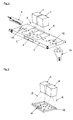
- Figure 1 schematically represents such an arrangement
- Experts will easily recognize countless other equivalent options, such as same function can also be performed in an equivalent manner, such as chemical vapor deposition in a fluidized bed process or the coating of a large sheet-like material with subsequent peeling and crushing the coating to the desired particle size analogous to US 5,135,812.
- the core particles [1A] arrive at the metering [2] Conveyor belt [3] which is in contact with a vibrator [4] in the steaming area. she the gas mixtures generated from two steam sources [5] and [6] [7] and [8] exposed to different compositions, which partially overlap in area [9]. The particles provided with a coating of variable composition [1B] finally removed from the vaporization area by the removal device [10].
- the vaporization conditions pressure, temperature, starting materials, cathode potential, etc. are known per se.
- the compositions of the first and second Gas mixtures escaping from steam sources are to be selected so that the first steam source a coating with the refractive index desired for the interface to the core, and the second vapor source is coated with that for the interface with the environment desired refractive index.
- the coating begins with the Mixture of substances only from this first vapor source, so that the refractive index at the inner interface between the flat core and the coating that one corresponds only to the coating produced from this first steam source.
- the control of the vapor deposition conditions can, for example, be timed and / or done in terms of energy.
- the required evaporation energy can be continuous or pulsed be fed.
- Figure 2 shows schematically a lot of flat core particles [11] on a container [12] with the gas mixtures [15] and [16] generated from two steam sources [13] and [14] vaporize different compositions, whose target areas completely overlap, the number of energy pulses reaching the steam sources [13] and [14] for example from a 2: 8 initial ratio to a 7: 3 final ratio in time controlled is continuously changed.
- the result is the same as in the continuous Method of Figure 1 a coating of variable composition.
- the pigment according to the invention can be embedded with excellent results in any high-molecular organic material (d) for the purpose of pigmentation.
- high molecular weight organic materials are described below.
- the amount of high molecular weight organic material (d) can be arbitrary and is, for example, from 10 -4 to 10 4 parts by weight, preferably from 10 -3 to 10 3 parts by weight, based on 1 part by weight of pigment according to the invention ⁇ ( a) + (b) ⁇ or ⁇ (a) + (b) + (c) ⁇ .
- compositions of matter according to the invention can contain customary further constituents, for example wetting agents or texture-improving agents, the amount of which can be as desired, but is preferably in total from 0 to 30% by weight, based on the total weight of the composition of matter.
- the pigment ⁇ (a) + (b) ⁇ or ⁇ (a) + (b) + (c) ⁇ according to the invention is, for example, by Mixing or dispersing embedded in the high molecular weight organic material (d), optionally in the presence of a suitable inert liquid, which after the Dispersion is removable. If necessary, you can do this as a disperser Example use agitators or rolling mills, or other usual mixing devices.
- Inert liquids are, for example, water or conventional organic solvents for Example ethers, alcohols, ketones, nitriles, nitro compounds, unsubstituted or substituted aliphatic or aromatic hydrocarbons, or mixtures thereof.
- the cationic mixture can also be any cationic, Add anionic, zwitterionic or nonionic wetting agents.
- the Compositions of the invention can from the dispersion mixture to Example can be isolated by filtration or evaporation of the inert liquid.
- the high-molecular organic material, for pigmenting the inventive Pigments or compositions of matter can be used be of natural or artificial origin.
- it can be natural resins, drying oils, rubber or casein or modified natural substances such as Chlorinated rubber, oil-modified alkyd resins, viscose, to cellulose ethers or esters, such as Ethyl cellulose, cellulose acetate, cellulose propionate, cellulose acetobutyrate or nitrocellulose act, but in particular fully synthetic organic polymers (thermosets and Thermoplastics), as obtained by polymerization, polycondensation or polyaddition will.
- polystyrene resins From the class of polymerization resins are primarily polyolefins such as Polyethylene, polypropylene or polyisobutylene, further substituted polyolefins, such as Polymers made from vinyl chloride, vinyl acetate, styrene, acrylonitrile, acrylic acid or Methacrylic acid ester or butadiene, and copolymers of the monomers mentioned, such as especially called ABS or EVA.
- polyolefins such as Polyethylene, polypropylene or polyisobutylene
- further substituted polyolefins such as Polymers made from vinyl chloride, vinyl acetate, styrene, acrylonitrile, acrylic acid or Methacrylic acid ester or butadiene, and copolymers of the monomers mentioned, such as especially called ABS or EVA.
- the condensation products are from the series of polyaddition resins and polycondensation resins of formaldehyde with phenols, the so-called phenoplasts, and the Condensation products of formaldehyde with urea, thiourea and melamine, the so-called aminoplastics, the polyesters used as coating resins, both saturated, such as alkyd resins, as well as unsaturated, such as Maleinate resins, also the linear polyesters and polyamides, polyurethanes or silicones called.
- the high-molecular compounds mentioned can be used individually or in mixtures, as plastic masses or melts are present. They can also be in the form of their monomers or in the polymerized state in dissolved form as film formers or binders for paints or printing inks, such as linseed oil varnish, nitrocellulose, alkyd resins, Melamine resins and urea-formaldehyde resins or acrylic resins.
- the inventive Effect pigments or effect pigment compositions as toners or in the form of To use preparations.
- the effect pigment before certain amounts of texture-improving agents or after the conditioning process, provided that this does not have a negative effect on the Use of the effect pigments for coloring high-molecular organic materials, especially polyethylene.
- fatty acids come along as such at least 18 carbon atoms, for example stearic or behenic acid, or their amides or Metal salts, in particular Mg salts, and plasticizers, waxes, resin acids, such as Abietic acid, rosin soap, alkylphenols or aliphatic alcohols such as stearyl alcohol or aliphatic 1,2-dihydroxy compounds with 8 to 22 carbon atoms, such as 1,2-dodecanediol, also modified rosin maleinate or fumaric rosin in Consideration.
- the texture-improving agents are preferably used in amounts of 0.1 to 30 % By weight, in particular 2 to 15% by weight, based on the end product, is added.
- the invention therefore also relates to a composition of matter containing a pigment defined above ⁇ (a) + (b) ⁇ or ⁇ (a) + (b) + (c) ⁇ as well as (d) a high molecular weight organic material.
- the pigment is in the composition of matter as one Large number of individual pigment particles surrounded by organic material (d).
- the pigment ⁇ (a) + (b) ⁇ or ⁇ (a) + (b) + (c) ⁇ according to the invention can be present in an amount of 0.01 up to 70 wt .-%, based on the high molecular weight organic material (d), in the inventive Substance composition may be included.
- a coating (c) consisting of a high molecular organic material see this and the high molecular weight organic material to be pigmented can differ or preferably be identical. Both are high molecular weight organic materials different, it is advisable to pay attention to the compatibility of the same. Which High-molecular organic materials are compatible with one another is the expert well known. In this case, it is particularly preferred that both have high molecular weight refractive indices similar to organic materials.
- the amount of pigments according to the invention ⁇ (a) + (b) ⁇ or ⁇ (a) + (b) + (c) ⁇ preferably 0.1 to 10% by weight, based on the total weight of the composition of matter according to the invention.
- the composition of matter according to the invention as a masterbatch Pigmentation of another high molecular weight organic material used is the amount of the pigment according to the invention ⁇ (a) + (b) ⁇ or ⁇ (a) + (b) + (c) ⁇ is preferably 10 to 50% by weight, based on the total weight of the composition of matter according to the invention.
- Effect pigments or effect pigment compositions are used alone. It is but also possible to achieve different shades or color effects high molecular weight, organic substances in addition to the effect pigments according to the invention or effect pigment compositions other coloring components such as white, Add colored, black or effect pigments in any quantity. Will Colored pigments in a mixture with the pigments or substance compositions according to the invention used, this is preferably done in a total amount of 0.1 to 10 % By weight, based on the high molecular weight organic material.
- a particularly high one Goniochromaticity has the preferred combination of one according to the invention Effect pigments with a colored pigment of complementary color, with colorations of the Effect pigments and colorations of the colored pigment have a color difference ( ⁇ H *) of 150 to 210.
- Color values refer to the CIE L * a * b * (L * C * H *) color coordinates for standard illuminant D65 and CIE 1964 10 ° observer (D 10 ° / 65). Unless otherwise stated, it is Color coordinates around values, which from the at an angle of 8 ° to the Surface normals in the range between 300 nm and 800 nm in steps of 1 nm, for example measured using a TM Lambda 19 spectrophotometer (Perkin-Elmer) Reflection spectrum can be calculated.
- the pigmentation of the high molecular weight, organic substances with the inventive Pigments or material compositions are, for example, such that such a pigment or substance composition, optionally in the form a masterbatch, these substrates using rolling mills, mixing or Mixing devices mixed.
- the pigmented material is then known per se Processes such as calendering, pressing, extrusion, painting, casting or injection molding brought into the desired final form. All common in the plastics industry Additives such as plasticizers, fillers or stabilizers can be used in usual amounts before or after the pigment is incorporated into the polymers be incorporated. In particular, it is desirable to manufacture non-rigid ones Preforms or to reduce their brittleness before the high molecular compounds deformation plasticizers, for example esters of phosphoric acid, phthalic acid or Sebacic acid to incorporate.
- the high-molecular organic ones are used to pigment paints and printing inks Materials and the effect pigments or effect pigment compositions according to the invention, optionally together with conventional additives such as Fillers, other pigments, siccatives or plasticizers, all in one organic solvent or solvent mixture finely dispersed or dissolved.
- Man can proceed in such a way that the individual components can be used individually or several disperses or dissolves together and only then brings all components together.
- an effect pigment according to the invention When dispersing an effect pigment according to the invention into the pigment to be pigmented high molecular organic material, as well as in the processing of an inventive Substance composition, conditions are preferred, under which only relatively weak shear forces appear so that the effect pigment does not break down into smaller ones Fragments is divided.
- the permissible shear force corresponds approximately to that for the flat core (a) is permissible, its gentle dispersion into a high molecular weight organic material is generally well known to the person skilled in the art.
- the dyeings obtained for example in plastics, paints or prints, are preferred in paints or prints, particularly preferably in paints, are characterized by excellent Characteristics from, in particular through high saturation, high goniochromaticity and excellent fastness properties.
- the invention also relates to the use of a device according to the invention Effect pigments or an effect pigment composition according to the invention for Pigmentation of high molecular organic material.
- the high molecular weight material to be pigmented is a varnish, then it is in particular a special paint, very particularly preferably one Automotive paint.
- the coating of the glass piece has a depth-dependent refractive index.
- the Glass piece appears visually yellow.
- the coating of the glass piece has a depth-dependent refractive index, the from titanium oxide to titanium oxide / silicon oxide to silicon oxide from the inside out changing composition of the coating is due.
- the glass piece appears visually blue.
- the coating of the glass piece has a depth-dependent refractive index, the from titanium oxide to titanium oxide / silicon oxide to silicon oxide from the inside out changing composition of the coating is due.
- the glass piece appears visually red.
- a glass plate In a vacuum chamber containing 3.0 mPa oxygen, a glass plate is rotated above two evaporation sources, consisting of MgF 2 in a thermally heated tungsten crucible, or TiO 2 in a water-cooled copper crucible that can be fired with an electron gun. MgF 2 and TiO 2 are evaporated at the same time, the ratio of the two substances being achieved by gradually controlling the energy supplied.
- Example 7 The procedure is as in Example 7, but first a 30 nm thick layer of titanium dioxide is evaporated onto the glass plate.
- the other 6 layers are identical to those of Example 7.
- Example 15 the procedure is analogous to Example 15 and the layer structure is analogous to Examples 1-5, 9 and 11, but the layers 6 to 1 and 8 to are replaced 13 of Example 15 each symmetrically around the core by coatings analogous to that Examples 1-5, 9 and 11.
- Example 15 the procedure is analogous to Example 15 and the layer structure is analogous to Examples 6, 8, 10, 12, 13 and 14, but layers 6 to 1 are replaced and 8 to 13 of Example 15 each symmetrically around the inner core by coatings analogous to layers 2-7 of examples 6, 8, 10 and 12, or analogous to that Layers 2-8 of Examples 13 and 14, and Layer 7 of Example 15 through the first Layer of Examples 6, 8, 10, 12, 13 and 14.
- lacquer thus obtained is applied to a film puller (wet film thickness 100 ⁇ m) suitable underlay (black / white striped cardboard, Leneta Co.) applied, and after baked for 30 minutes at room temperature for 30 minutes at 130 ° C.
- a film puller wet film thickness 100 ⁇ m
- suitable underlay black / white striped cardboard, Leneta Co.
- a yellow, brilliant color with a goniochromatic effect is obtained excellent light and weather resistance.
Landscapes
- Chemical & Material Sciences (AREA)
- Organic Chemistry (AREA)
- Health & Medical Sciences (AREA)
- Materials Engineering (AREA)
- Wood Science & Technology (AREA)
- Engineering & Computer Science (AREA)
- Life Sciences & Earth Sciences (AREA)
- Chemical Kinetics & Catalysis (AREA)
- Medicinal Chemistry (AREA)
- Polymers & Plastics (AREA)
- Paints Or Removers (AREA)
- Pigments, Carbon Blacks, Or Wood Stains (AREA)
- Compositions Of Macromolecular Compounds (AREA)
- Inks, Pencil-Leads, Or Crayons (AREA)
Priority Applications (1)
| Application Number | Priority Date | Filing Date | Title |
|---|---|---|---|
| EP03010900A EP1335005B1 (fr) | 1997-04-22 | 1998-04-15 | Pigments colorés à effets particuliers et leur utilisaton |
Applications Claiming Priority (3)
| Application Number | Priority Date | Filing Date | Title |
|---|---|---|---|
| CH930/97 | 1997-04-22 | ||
| CH93097 | 1997-04-22 | ||
| CH93097 | 1997-04-22 |
Related Child Applications (1)
| Application Number | Title | Priority Date | Filing Date |
|---|---|---|---|
| EP03010900A Division EP1335005B1 (fr) | 1997-04-22 | 1998-04-15 | Pigments colorés à effets particuliers et leur utilisaton |
Publications (3)
| Publication Number | Publication Date |
|---|---|
| EP0874026A2 true EP0874026A2 (fr) | 1998-10-28 |
| EP0874026A3 EP0874026A3 (fr) | 1999-09-22 |
| EP0874026B1 EP0874026B1 (fr) | 2003-08-06 |
Family
ID=4198481
Family Applications (2)
| Application Number | Title | Priority Date | Filing Date |
|---|---|---|---|
| EP03010900A Expired - Lifetime EP1335005B1 (fr) | 1997-04-22 | 1998-04-15 | Pigments colorés à effets particuliers et leur utilisaton |
| EP98810319A Expired - Lifetime EP0874026B1 (fr) | 1997-04-22 | 1998-04-15 | Procédé de fabrication de pigments colorés à effets particuliers |
Family Applications Before (1)
| Application Number | Title | Priority Date | Filing Date |
|---|---|---|---|
| EP03010900A Expired - Lifetime EP1335005B1 (fr) | 1997-04-22 | 1998-04-15 | Pigments colorés à effets particuliers et leur utilisaton |
Country Status (4)
| Country | Link |
|---|---|
| US (1) | US5855660A (fr) |
| EP (2) | EP1335005B1 (fr) |
| JP (1) | JP4785215B2 (fr) |
| DE (2) | DE59809174D1 (fr) |
Cited By (5)
| Publication number | Priority date | Publication date | Assignee | Title |
|---|---|---|---|---|
| EP1276820A1 (fr) * | 2000-04-14 | 2003-01-22 | BASF Coatings AG | Peinture conferant une couleur et / ou un effet et comportant une couche a effet combine |
| WO2003076526A1 (fr) * | 2002-03-14 | 2003-09-18 | Nittetsu Mining Co., Ltd. | Poudre enrobee, composition de revetement et articles revetus |
| WO2003076520A3 (fr) * | 2002-03-11 | 2004-02-05 | Ciba Sc Holding Ag | Pigments brillants fortement satures |
| EP1582566A3 (fr) * | 1999-03-23 | 2009-04-01 | Shiseido Co., Ltd. | Poudre pleochroique et article imprime pleochroique |
| WO2010086165A1 (fr) * | 2009-01-28 | 2010-08-05 | Eckart Gmbh | Pigment à effet métallique obtenu par dépôt chimique en phase vapeur à gradient sur des nanoparticules métalliques, procédé de production associé et leur utilisation |
Families Citing this family (22)
| Publication number | Priority date | Publication date | Assignee | Title |
|---|---|---|---|---|
| US6238748B1 (en) * | 1995-05-17 | 2001-05-29 | Kansai Paint Co., Ltd. | Multilayer coating film formation process |
| JPH10296170A (ja) * | 1997-04-25 | 1998-11-10 | Kansai Paint Co Ltd | 複層塗膜形成法 |
| JPH10314670A (ja) * | 1997-05-15 | 1998-12-02 | Kansai Paint Co Ltd | 複層塗膜形成方法 |
| DE19817286A1 (de) * | 1998-04-18 | 1999-10-21 | Merck Patent Gmbh | Mehrschichtiges Perlglanzpigment auf Basis eines opaken Substrates |
| ID26212A (id) * | 1998-10-08 | 2000-12-07 | Sicpa Holding Sa | Komposisi tinta yang terdiri dari pigmen-pigmen variabel secara optik pertama dan kedua |
| US6157489A (en) * | 1998-11-24 | 2000-12-05 | Flex Products, Inc. | Color shifting thin film pigments |
| US6369147B1 (en) * | 1999-01-25 | 2002-04-09 | Ciba Specialty Chemicals Corporation | Color effect pigments and method of forming the same |
| US7182981B1 (en) * | 1999-07-06 | 2007-02-27 | Konica Corporation | Cellulose ester film and production method of the same |
| JP2004525195A (ja) * | 2000-10-02 | 2004-08-19 | キンバリー クラーク ワールドワイド インコーポレイテッド | ナノ粒子ベースのインク及びその製造方法 |
| US6663951B2 (en) | 2000-12-18 | 2003-12-16 | Basf Corporation | Two layer coating system having an enhanced visual effect |
| DE10128491A1 (de) * | 2001-06-12 | 2002-12-19 | Merck Patent Gmbh | Mehrschichtsysteme mit optischen Eigenschaften |
| US6830327B2 (en) * | 2001-10-22 | 2004-12-14 | Hewlett-Packard Development Company, L.P. | Secure ink-jet printing for verification of an original document |
| US6780896B2 (en) * | 2002-12-20 | 2004-08-24 | Kimberly-Clark Worldwide, Inc. | Stabilized photoinitiators and applications thereof |
| US8409618B2 (en) | 2002-12-20 | 2013-04-02 | Kimberly-Clark Worldwide, Inc. | Odor-reducing quinone compounds |
| US7666410B2 (en) * | 2002-12-20 | 2010-02-23 | Kimberly-Clark Worldwide, Inc. | Delivery system for functional compounds |
| JP2006517988A (ja) * | 2003-01-23 | 2006-08-03 | チバ スペシャルティ ケミカルズ ホールディング インコーポレーテッド | プレートレット形状顔料 |
| WO2004104110A1 (fr) * | 2003-05-21 | 2004-12-02 | Merck Patent Gmbh | Pigments a effet photostabilises |
| ATE549430T1 (de) * | 2003-06-17 | 2012-03-15 | Basf Se | Verfahren zur mikrowellenbeschichtung eines organischen materials mit metalloxid |
| US20070048247A1 (en) * | 2005-08-31 | 2007-03-01 | Kimberly-Clark Worldwide, Inc. | Deodorizing tablets |
| KR20100066460A (ko) * | 2007-07-31 | 2010-06-17 | 바스프 에스이 | 광학적 가변성 효과 안료 |
| US20090163887A1 (en) * | 2007-12-20 | 2009-06-25 | Arehart Kelly D | Odor control cellulose granules with quinone compounds |
| DE102010049375A1 (de) * | 2010-10-26 | 2012-04-26 | Merck Patent Gmbh | Pigmente |
Family Cites Families (9)
| Publication number | Priority date | Publication date | Assignee | Title |
|---|---|---|---|---|
| US5135812A (en) * | 1979-12-28 | 1992-08-04 | Flex Products, Inc. | Optically variable thin film flake and collection of the same |
| DE3207936A1 (de) * | 1982-03-05 | 1983-09-15 | Herberts Gmbh, 5600 Wuppertal | Lackierungsverfahren unter verwendung von perlglanzpigmenten |
| DE3221045A1 (de) * | 1982-06-04 | 1983-12-08 | Merck Patent Gmbh, 6100 Darmstadt | Perlglanzpigmente, verfahren zu ihrer herstellung und ihrer verwendung |
| JPH0692546B2 (ja) * | 1988-06-16 | 1994-11-16 | 昭和アルミパウダー株式会社 | 着色メタリック顔料およびその製造方法 |
| DE3903023A1 (de) * | 1989-02-02 | 1990-08-09 | Basf Ag | Metalloxidbeschichtete glanzpigmente |
| JPH0676566B2 (ja) * | 1989-06-15 | 1994-09-28 | 日本ペイント株式会社 | 塗料組成物および塗装製品 |
| DE69307501T2 (de) * | 1992-03-26 | 1997-06-12 | Merck Patent Gmbh | Plättchenförmige pigmente und ihr herstellungsverfahren |
| DE4341162C2 (de) * | 1992-12-02 | 1995-08-17 | Fraunhofer Ges Forschung | Verfahren zur Herstellung von verschleißfesten farbigen Schichten und deren Verwendung |
| DE19511697A1 (de) * | 1995-03-30 | 1996-10-02 | Basf Ag | Verfahren zur Herstellung von blaustichigen Glanzpigmenten |
-
1998
- 1998-04-15 EP EP03010900A patent/EP1335005B1/fr not_active Expired - Lifetime
- 1998-04-15 DE DE59809174T patent/DE59809174D1/de not_active Expired - Lifetime
- 1998-04-15 EP EP98810319A patent/EP0874026B1/fr not_active Expired - Lifetime
- 1998-04-15 DE DE59813616T patent/DE59813616D1/de not_active Expired - Lifetime
- 1998-04-22 US US09/064,287 patent/US5855660A/en not_active Expired - Lifetime
- 1998-04-22 JP JP11210898A patent/JP4785215B2/ja not_active Expired - Fee Related
Cited By (8)
| Publication number | Priority date | Publication date | Assignee | Title |
|---|---|---|---|---|
| EP1582566A3 (fr) * | 1999-03-23 | 2009-04-01 | Shiseido Co., Ltd. | Poudre pleochroique et article imprime pleochroique |
| EP1276820A1 (fr) * | 2000-04-14 | 2003-01-22 | BASF Coatings AG | Peinture conferant une couleur et / ou un effet et comportant une couche a effet combine |
| WO2003076520A3 (fr) * | 2002-03-11 | 2004-02-05 | Ciba Sc Holding Ag | Pigments brillants fortement satures |
| US7223472B2 (en) | 2002-03-11 | 2007-05-29 | Ciba Specialty Chemicals Corporation | Gloss pigments having high colour saturation |
| WO2003076526A1 (fr) * | 2002-03-14 | 2003-09-18 | Nittetsu Mining Co., Ltd. | Poudre enrobee, composition de revetement et articles revetus |
| WO2010086165A1 (fr) * | 2009-01-28 | 2010-08-05 | Eckart Gmbh | Pigment à effet métallique obtenu par dépôt chimique en phase vapeur à gradient sur des nanoparticules métalliques, procédé de production associé et leur utilisation |
| CN102365335B (zh) * | 2009-01-28 | 2014-09-17 | 埃卡特有限公司 | 在纳米级金属颗粒上具有梯度的pvd金属效果颜料、其生产方法及其用途 |
| US8864899B2 (en) | 2009-01-28 | 2014-10-21 | Eckart Gmbh | PVD metal effect pigment having gradient on nanoscale metal particles, method for the production thereof and use thereof |
Also Published As
| Publication number | Publication date |
|---|---|
| EP1335005A1 (fr) | 2003-08-13 |
| DE59813616D1 (de) | 2006-08-03 |
| JPH10298449A (ja) | 1998-11-10 |
| EP1335005B1 (fr) | 2006-06-21 |
| US5855660A (en) | 1999-01-05 |
| EP0874026A3 (fr) | 1999-09-22 |
| EP0874026B1 (fr) | 2003-08-06 |
| JP4785215B2 (ja) | 2011-10-05 |
| DE59809174D1 (de) | 2003-09-11 |
Similar Documents
| Publication | Publication Date | Title |
|---|---|---|
| EP0874026B1 (fr) | Procédé de fabrication de pigments colorés à effets particuliers | |
| EP0803549B1 (fr) | Pigments brillants colorés | |
| EP0332071B2 (fr) | Procédé de préparation de pigments nacrés d'un ton bleuâtre spécial | |
| EP0381047B1 (fr) | Pigments brillants recouverts d'une couche d'oxyde métallique | |
| EP0571836B1 (fr) | Pigments brillants à base de substrats métalliques en forme de paillettes portant plusieurs revêtements | |
| EP1213330B1 (fr) | Pigment nacré de couleurs d'argent | |
| EP0045851B1 (fr) | Procédé pour la fabrication de pigments micacés en forme d'écailles recouvertes d'oxydes métalliques et leur utilisation | |
| EP2268746B1 (fr) | Préparations pigmentaires | |
| EP1281732A1 (fr) | Pigments d interferences à couches multiples | |
| DE1165182B (de) | Pigment auf der Basis von durchscheinenden glimmerartigen Schuppen und Verfahren zu dessen Herstellung | |
| DE19618569A1 (de) | Mehrschichtige Interferenzpigmente | |
| DE4437753A1 (de) | Mehrfach beschichtete metallische Glanzpigmente | |
| EP1506262B1 (fr) | Pigments brillants goniochromatiques | |
| WO1998053012A1 (fr) | Pigments de polarisation multicouches | |
| EP0659843A2 (fr) | Pigment non brillant | |
| DE69503035T2 (de) | Auf erdalkalielemente, kupfer und gegebenenfalls titan, basierte silicate, blaue oder purpurfarbene pigmente darauf basierend, verfahren zu deren herstellung und ihre verwendung | |
| EP1683839B1 (fr) | Pigment à effet avec une forte variation de ton | |
| EP1910478B1 (fr) | Système de pigments d'interférence | |
| DE69408177T2 (de) | Neue farbige Mineralpigmente auf der Basis von seltenen Erden, Verfahren zur Herstellung und Verwendung | |
| EP0918075B1 (fr) | Pigments d'oxyde de fer jaune stables à la chaleur | |
| EP0042507B1 (fr) | Forme pigmentaire de la bêta-phtalocyanine de cuivre et son utilisation | |
| DE2546266B2 (de) | Perylen-SAd.lO-tetracarbonsäurediimidpigment, Verfahren zu seiner Herstellung und seine Verwendung | |
| DE2344196C2 (de) | Lasierendes gelbes Eisenoxid-Pigment | |
| DE60200933T2 (de) | Deckendes 2,9-dichlorchinacridonpigment | |
| KR101026337B1 (ko) | 채도가 높은 광택 안료 |
Legal Events
| Date | Code | Title | Description |
|---|---|---|---|
| PUAI | Public reference made under article 153(3) epc to a published international application that has entered the european phase |
Free format text: ORIGINAL CODE: 0009012 |
|
| AK | Designated contracting states |
Kind code of ref document: A2 Designated state(s): CH DE FR GB IT LI |
|
| AX | Request for extension of the european patent |
Free format text: AL;LT;LV;MK;RO;SI |
|
| PUAL | Search report despatched |
Free format text: ORIGINAL CODE: 0009013 |
|
| 17P | Request for examination filed |
Effective date: 19990325 |
|
| AK | Designated contracting states |
Kind code of ref document: A3 Designated state(s): AT BE CH CY DE DK ES FI FR GB GR IE IT LI LU MC NL PT SE |
|
| AX | Request for extension of the european patent |
Free format text: AL;LT;LV;MK;RO;SI |
|
| RIC1 | Information provided on ipc code assigned before grant |
Free format text: 6C 09C 1/00 A, 6C 08K 3/00 B, 6C 09D 7/12 B, 6C 09D 11/00 B, 6C 09D 5/36 B, 6C 08K 9/02 B |
|
| AKX | Designation fees paid |
Free format text: CH DE FR GB IT LI |
|
| 17Q | First examination report despatched |
Effective date: 20010423 |
|
| RTI1 | Title (correction) |
Free format text: METHOD FOR PRODUCING COLOURED EFFECT PIGMENTS |
|
| GRAH | Despatch of communication of intention to grant a patent |
Free format text: ORIGINAL CODE: EPIDOS IGRA |
|
| RTI1 | Title (correction) |
Free format text: METHOD FOR PRODUCING COLOURED EFFECT PIGMENTS |
|
| GRAH | Despatch of communication of intention to grant a patent |
Free format text: ORIGINAL CODE: EPIDOS IGRA |
|
| GRAA | (expected) grant |
Free format text: ORIGINAL CODE: 0009210 |
|
| AK | Designated contracting states |
Designated state(s): CH DE FR GB IT LI |
|
| REG | Reference to a national code |
Ref country code: GB Ref legal event code: FG4D Free format text: NOT ENGLISH |
|
| REG | Reference to a national code |
Ref country code: CH Ref legal event code: EP |
|
| GBT | Gb: translation of ep patent filed (gb section 77(6)(a)/1977) |
Effective date: 20030806 |
|
| REF | Corresponds to: |
Ref document number: 59809174 Country of ref document: DE Date of ref document: 20030911 Kind code of ref document: P |
|
| PGFP | Annual fee paid to national office [announced via postgrant information from national office to epo] |
Ref country code: FR Payment date: 20040319 Year of fee payment: 7 Ref country code: CH Payment date: 20040319 Year of fee payment: 7 |
|
| ET | Fr: translation filed | ||
| PLBE | No opposition filed within time limit |
Free format text: ORIGINAL CODE: 0009261 |
|
| STAA | Information on the status of an ep patent application or granted ep patent |
Free format text: STATUS: NO OPPOSITION FILED WITHIN TIME LIMIT |
|
| 26N | No opposition filed |
Effective date: 20040507 |
|
| PG25 | Lapsed in a contracting state [announced via postgrant information from national office to epo] |
Ref country code: IT Free format text: LAPSE BECAUSE OF NON-PAYMENT OF DUE FEES;WARNING: LAPSES OF ITALIAN PATENTS WITH EFFECTIVE DATE BEFORE 2007 MAY HAVE OCCURRED AT ANY TIME BEFORE 2007. THE CORRECT EFFECTIVE DATE MAY BE DIFFERENT FROM THE ONE RECORDED. Effective date: 20050415 |
|
| PG25 | Lapsed in a contracting state [announced via postgrant information from national office to epo] |
Ref country code: LI Free format text: LAPSE BECAUSE OF NON-PAYMENT OF DUE FEES Effective date: 20050430 Ref country code: CH Free format text: LAPSE BECAUSE OF NON-PAYMENT OF DUE FEES Effective date: 20050430 |
|
| REG | Reference to a national code |
Ref country code: CH Ref legal event code: PL |
|
| PG25 | Lapsed in a contracting state [announced via postgrant information from national office to epo] |
Ref country code: FR Free format text: LAPSE BECAUSE OF NON-PAYMENT OF DUE FEES Effective date: 20051230 |
|
| REG | Reference to a national code |
Ref country code: FR Ref legal event code: ST Effective date: 20051230 |
|
| PGFP | Annual fee paid to national office [announced via postgrant information from national office to epo] |
Ref country code: GB Payment date: 20080325 Year of fee payment: 11 |
|
| GBPC | Gb: european patent ceased through non-payment of renewal fee |
Effective date: 20090415 |
|
| PG25 | Lapsed in a contracting state [announced via postgrant information from national office to epo] |
Ref country code: GB Free format text: LAPSE BECAUSE OF NON-PAYMENT OF DUE FEES Effective date: 20090415 |
|
| PGFP | Annual fee paid to national office [announced via postgrant information from national office to epo] |
Ref country code: DE Payment date: 20140627 Year of fee payment: 17 |
|
| REG | Reference to a national code |
Ref country code: DE Ref legal event code: R119 Ref document number: 59809174 Country of ref document: DE |
|
| PG25 | Lapsed in a contracting state [announced via postgrant information from national office to epo] |
Ref country code: DE Free format text: LAPSE BECAUSE OF NON-PAYMENT OF DUE FEES Effective date: 20151103 |