EP0874036A1 - Feinteiliger Poliermittel, Verfahren zu seiner Herstellung und Verfahren zur Herstellung von Halbleiterbauelementen - Google Patents
Feinteiliger Poliermittel, Verfahren zu seiner Herstellung und Verfahren zur Herstellung von Halbleiterbauelementen Download PDFInfo
- Publication number
- EP0874036A1 EP0874036A1 EP98103574A EP98103574A EP0874036A1 EP 0874036 A1 EP0874036 A1 EP 0874036A1 EP 98103574 A EP98103574 A EP 98103574A EP 98103574 A EP98103574 A EP 98103574A EP 0874036 A1 EP0874036 A1 EP 0874036A1
- Authority
- EP
- European Patent Office
- Prior art keywords
- polishing
- polishing agent
- fine particles
- silicon dioxide
- slurry
- Prior art date
- Legal status (The legal status is an assumption and is not a legal conclusion. Google has not performed a legal analysis and makes no representation as to the accuracy of the status listed.)
- Granted
Links
Images
Classifications
-
- C—CHEMISTRY; METALLURGY
- C09—DYES; PAINTS; POLISHES; NATURAL RESINS; ADHESIVES; COMPOSITIONS NOT OTHERWISE PROVIDED FOR; APPLICATIONS OF MATERIALS NOT OTHERWISE PROVIDED FOR
- C09K—MATERIALS FOR MISCELLANEOUS APPLICATIONS, NOT PROVIDED FOR ELSEWHERE
- C09K3/00—Materials not provided for elsewhere
- C09K3/14—Anti-slip materials; Abrasives
- C09K3/1409—Abrasive particles per se
-
- H—ELECTRICITY
- H10—SEMICONDUCTOR DEVICES; ELECTRIC SOLID-STATE DEVICES NOT OTHERWISE PROVIDED FOR
- H10P—GENERIC PROCESSES OR APPARATUS FOR THE MANUFACTURE OR TREATMENT OF DEVICES COVERED BY CLASS H10
- H10P95/00—Generic processes or apparatus for manufacture or treatments not covered by the other groups of this subclass
- H10P95/06—Planarisation of inorganic insulating materials
- H10P95/062—Planarisation of inorganic insulating materials involving a dielectric removal step
-
- C—CHEMISTRY; METALLURGY
- C01—INORGANIC CHEMISTRY
- C01B—NON-METALLIC ELEMENTS; COMPOUNDS THEREOF; METALLOIDS OR COMPOUNDS THEREOF NOT COVERED BY SUBCLASS C01C
- C01B33/00—Silicon; Compounds thereof
- C01B33/113—Silicon oxides; Hydrates thereof
- C01B33/12—Silica; Hydrates thereof, e.g. lepidoic silicic acid
-
- C—CHEMISTRY; METALLURGY
- C01—INORGANIC CHEMISTRY
- C01F—COMPOUNDS OF THE METALS BERYLLIUM, MAGNESIUM, ALUMINIUM, CALCIUM, STRONTIUM, BARIUM, RADIUM, THORIUM, OR OF THE RARE-EARTH METALS
- C01F17/00—Compounds of rare earth metals
- C01F17/20—Compounds containing only rare earth metals as the metal element
- C01F17/206—Compounds containing only rare earth metals as the metal element oxide or hydroxide being the only anion
- C01F17/224—Oxides or hydroxides of lanthanides
- C01F17/235—Cerium oxides or hydroxides
-
- C—CHEMISTRY; METALLURGY
- C09—DYES; PAINTS; POLISHES; NATURAL RESINS; ADHESIVES; COMPOSITIONS NOT OTHERWISE PROVIDED FOR; APPLICATIONS OF MATERIALS NOT OTHERWISE PROVIDED FOR
- C09G—POLISHING COMPOSITIONS; SKI WAXES
- C09G1/00—Polishing compositions
- C09G1/02—Polishing compositions containing abrasives or grinding agents
-
- C—CHEMISTRY; METALLURGY
- C09—DYES; PAINTS; POLISHES; NATURAL RESINS; ADHESIVES; COMPOSITIONS NOT OTHERWISE PROVIDED FOR; APPLICATIONS OF MATERIALS NOT OTHERWISE PROVIDED FOR
- C09K—MATERIALS FOR MISCELLANEOUS APPLICATIONS, NOT PROVIDED FOR ELSEWHERE
- C09K3/00—Materials not provided for elsewhere
- C09K3/14—Anti-slip materials; Abrasives
- C09K3/1436—Composite particles, e.g. coated particles
-
- C—CHEMISTRY; METALLURGY
- C09—DYES; PAINTS; POLISHES; NATURAL RESINS; ADHESIVES; COMPOSITIONS NOT OTHERWISE PROVIDED FOR; APPLICATIONS OF MATERIALS NOT OTHERWISE PROVIDED FOR
- C09K—MATERIALS FOR MISCELLANEOUS APPLICATIONS, NOT PROVIDED FOR ELSEWHERE
- C09K3/00—Materials not provided for elsewhere
- C09K3/14—Anti-slip materials; Abrasives
- C09K3/1454—Abrasive powders, suspensions and pastes for polishing
-
- C—CHEMISTRY; METALLURGY
- C09—DYES; PAINTS; POLISHES; NATURAL RESINS; ADHESIVES; COMPOSITIONS NOT OTHERWISE PROVIDED FOR; APPLICATIONS OF MATERIALS NOT OTHERWISE PROVIDED FOR
- C09K—MATERIALS FOR MISCELLANEOUS APPLICATIONS, NOT PROVIDED FOR ELSEWHERE
- C09K3/00—Materials not provided for elsewhere
- C09K3/14—Anti-slip materials; Abrasives
- C09K3/1454—Abrasive powders, suspensions and pastes for polishing
- C09K3/1463—Aqueous liquid suspensions
-
- C—CHEMISTRY; METALLURGY
- C01—INORGANIC CHEMISTRY
- C01P—INDEXING SCHEME RELATING TO STRUCTURAL AND PHYSICAL ASPECTS OF SOLID INORGANIC COMPOUNDS
- C01P2004/00—Particle morphology
- C01P2004/60—Particles characterised by their size
- C01P2004/62—Submicrometer sized, i.e. from 0.1-1 micrometer
-
- C—CHEMISTRY; METALLURGY
- C01—INORGANIC CHEMISTRY
- C01P—INDEXING SCHEME RELATING TO STRUCTURAL AND PHYSICAL ASPECTS OF SOLID INORGANIC COMPOUNDS
- C01P2004/00—Particle morphology
- C01P2004/60—Particles characterised by their size
- C01P2004/64—Nanometer sized, i.e. from 1-100 nanometer
Definitions
- the present invention relates to a fine particulate polishing agent comprising fine particles of a solid solution composed of single-crystal ceric oxide and silicon dioxide and fine particles of silicon dioxide; a stable slurry polishing agent comprising the fine particulate polishing agent; a method for producing the slurry polishing agent; and a method for producing a semiconductor device which makes use of the slurry polishing agent.
- the present invention pertains to a fine particulate polishing agent and a slurry polishing agent which are suitable for use in various applications which require extremely high surface polishing accuracy, for instance, polishing of a variety of glass materials which comprise, as principal components, silicon dioxide, polishing of semiconductor materials such as silicon wafers and polishing of interlayer insulating films of silicon dioxide in semiconductor device-manufacturing processes, and which are suitably used for removing a superficial SiO 2 film through polishing while using an Si 3 N 4 layer as a stopper for polishing since they have a high polishing rate for SiO 2 and they have a very low polishing rate for Si 3 N 4 (i.e., a high selective polishing ratio of SiO 2 to Si 3 N 4 ), as well as a method for producing these polishing agents and a method for producing semiconductor devices using the polishing agents.
- glass materials which comprise, as principal components, silicon dioxide, polishing of semiconductor materials such as silicon wafers and polishing of interlayer insulating films of silicon dioxide in semiconductor device-manu
- the polishing with colloidal silica causes a problem of low polishing rate. Therefore, when a large amount of a material must be removed through polishing, the material is polished by a two-stage process. Firstly, it is polished with a polishing agent which mainly comprises ceric oxide and can ensure a high polishing rate and secondly, it is polished with colloidal silica, as disclosed in, for instance, Japanese Un-Examined Patent Publication No. Sho 64-40267.
- Such a two-stage polishing process requires the use of additional polishing installations and a superabundant time for switching over to the polishing with colloidal silica. This accordingly leads to a substantial reduction in the productibility.
- the applicant of this invention has proposed, in Japanese Patent Application Serial No. Hei 6-272761, a polishing agent for use in semiconductor device-manufacturing processes, which comprises ceric oxide having an average particle size of not more than 0.1 ⁇ m.
- the fine particulate polishing agent can ensure a good polishing rate even if the particles thereof have a very small particle size on the order of not more than 0.1 ⁇ m, unlike the conventional ceric oxide polishing agents and the polishing rate is substantially higher than that achieved by using the silica polishing agents.
- the glass surface thus polished has a quite planar surface considerably superior to that achieved by the conventional ceric oxide polishing agents. Nevertheless, the polishing rate is found to be almost comparable to that achieved by the conventional ceric oxide polishing agents. More specifically, the use of ceric oxide fine particles ensures the polishing rate comparable to that observed for the conventional ceric oxide polishing agents, while ensuring the surface planarity approximately identical to that observed for the colloidal silica polishing agents.
- the foregoing fine particulate polishing agent of ceric oxide causes the following problems.
- the ceric oxide particles show poor dispersibility in a medium (water) and this in turn makes it difficult to supply polishing agent fine particles uniformly to a polishing machine and a subject to be polished.
- a polishing agent shows high resistance which requires high torque to rotate the substrate. Therefore, the use thereof becomes a cause of various troubles of the subject when it has a small thickness and any increase in the polishing pressure during polishing cannot be admitted when the polishing machine used has poor rigidity.
- the polishing rate is quite susceptible to the pH value of the polishing liquid used and for this reason, the pH thereof should be maintained at a level of not less than 10 in order to ensure a polishing rate excellent in reproducibility.
- the polishing liquid having a pH of not less than 10 is very difficult for operators engaged in the polishing to handle the same and such a liquid is harmful to the operators.
- the surface thereof when a semiconductor device is produced using a multi layer interconnection circuit, the surface thereof must be processed into a predetermined shape.
- the polishing has widely been used as an effective technique for flattening or planarizing the surface of an insulating film.
- CMP Chemical Mechanical Polishing
- this CMP method it has been known that the polishing rate is accelerated by the polishing effect through chemical reactions.
- a surface film is removed through polishing while using Si 3 N 4 as a stopper for polishing, but this operation requires the use of a polishing agent which has a sufficiently high ratio of the surface film-polishing rate to the stopper-polishing rate (i.e., a high selective polishing ratio of the surface film to the stopper) or a polishing agent which can effectively remove the surface film, but can hardly remove the stopper.
- a polishing agent which has a sufficiently high ratio of the surface film-polishing rate to the stopper-polishing rate (i.e., a high selective polishing ratio of the surface film to the stopper) or a polishing agent which can effectively remove the surface film, but can hardly remove the stopper.
- an object of the present invention to provide a fine particulate polishing agent which can ensure a polishing rate comparable to that observed for the conventional ceric oxide polishing agents, while ensuring the surface planarity comparable to or superior to that achieved by the polishing with the colloidal silica polishing agents; which can ensure a polishing rate excellent in reproducibility even at a pH falling within the neutral range on the order of about 6 to 9; which has good dispersibility in a medium (water) and is stable therein; which requires low torque to rotate the substrate in processing; and which is suitably used for removing a superficial SiO 2 film through polishing while using an Si 3 N 4 layer as a polishing stopper since they have a high polishing rate for SiO 2 to that for Si 3 N 4 (i.e., a high selective polishing ratio of SiO 2 to Si 3 N 4 ).
- Another object of the present invention is to provide a stable polishing agent in the form of a slurry (slurry polishing agent), comprising, as a principal component, the foregoing fine particulate polishing agent.
- a slurry slurry polishing agent
- Still another object of the present invention is to provide a method for preparing such a slurry polishing agent.
- a further object of the present invention is to provide a method for producing a semiconductor device which makes use of the foregoing slurry polishing agent.
- the inventors of this invention have conducted various studies to accomplish the foregoing objects of the present invention, and have found out that a combination of a fine particulate solid solution composed of single-crystal ceric oxide and silicon dioxide and fine particulate silicon dioxide can provide a desired polishing agent.
- a fine particulate polishing agent comprising fine particles of a solid solution composed of single-crystal ceric oxide and silicon dioxide and fine particles of silicon dioxide.
- a polishing agent in the form of a slurry which comprises the foregoing fine particulate polishing agent dispersed in a medium such as water.
- a method for preparing the foregoing slurry polishing agent which comprises fine particles of the foregoing solid solution and fine particles of silicon dioxide.
- the method comprises the steps of mixing, with stirring, single-crystal ceric oxide fine particles, silica sol and a liquid; drying the resulting mixture; subjecting the dried particulate material to a thermal treatment at a high temperature; optionally pulverizing the thermally treated particle material; cooling the powdery solid solution thus formed by the thermal treatment or by the thermal treatment and the pulverization treatment; again mixing the powdery solid solution with silica sol and a liquid; and then subjecting the mixture to deagglomeration using a wet pulverizing mill to give a slurry.
- a method for producing a semiconductor device which comprises the step of polishing the surface of a substrate mainly comprising a silicon dioxide with the foregoing polishing agent.
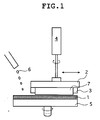
- Fig. 1 is a schematic diagram showing the polishing machine used in Example 2.
- colloidal silica and a slurry of CeO 2 fine particles are mixed with stirring using a stirring machine equipped with blades according to the disclosure of Japanese Examined Patent Publication No. Sho 53-6756 in which silica sol is mixed with a ceric oxide slurry in order to stabilize the polishing rate, but the inventors have failed to stably disperse the solid matter comprising CeO 2 in the liquid phase.
- a stable slurry in which the solid matter is completely dispersed in the liquid phase can be obtained by drying such a stirred mixture, then subjecting the dried particulate material to a thermal treatment at a high temperature and further subjecting the thermally treated particulate material to deagglomeration using a wet pulverizing mill.
- TEM transmission electron microscope
- EDX energy dispersive X-ray
- the polishing agent thus prepared.
- the resulting polishing agent was found to be insufficient in the ratio of the polishing rate for SiO 2 to that for Si 3 N 4 (i.e., the selective polishing ratio of SiO 2 to Si 3 N 4 ).
- the inventors have conducted further investigations on the fine particulate polishing agent prepared by mixing, with stirring, single crystal ceric oxide fine particles, silica sol and a liquid; drying the mixture; subjecting the dried particulate material to a thermal treatment at a high temperature; mixing the powdery solid solution thus formed by the thermal treatment with silica sol; and then subjecting the mixture to deagglomeration using a wet pulverizing mill and have found out that the resulting polishing agent has a sufficiently high ratio of the polishing rate for SiO 2 to that for Si 3 N 4 (i.e., a high selective polishing ratio of SiO 2 to Si 3 N 4 ) within the neutral pH range of from about 6 to 9 and thus permits the achievement of all of the foregoing objects.
- the inventors of this invention have further conducted various investigations to establish conditions for treating CeO 2 with SiO 2 , such as conditions for the reaction between single-crystal ceric oxide and silica sol and mixing ratio of the solid solution to the silica sol, which permit the formation of such solid solutions and the formation of a slurry free of any sedimentation even when allowing it to stand over a long time period.
- a stable slurry can be prepared by a method which comprises the steps of mixing, with stirring, single-crystal ceric oxide fine particles, silica sol and a liquid (such as water); drying the mixture; subjecting the dried powder to a thermal treatment at a high temperature to form the powdery solid solution composed of single-crystal ceric oxide and silicon dioxide; cooling the powdery solid solution thus formed by the thermal treatment; again mixing the powdery solid solution with silica sol and a liquid; and then subjecting the mixture to deagglomeration using a wet pulverizing mill.
- This thermal treatment at a high temperature permits the formation of a solid solution of SiO 2 and CeO 2 and hence a slurry in which the solid content is completely dispersed in the liquid.
- the foregoing slurry polishing agent in a highly dispersed state ensures a stable polishing rate even in the neutral pH range of from about 6 to 9 wherein the polishing rate is unstable when using the conventional colloidal silica and the polishing rate is found to be about 45% higher than that observed for the conventional ceric oxide polishing agents.
- polishing tests carried out using this slurry polishing agent indicate that the torque to rotate the substrate thereof is lower than that observed for the conventional fine particulate ceric oxide polishing agent and there is not observed any trouble such as any vibration of the polishing machine even if carrying out the polishing operation while a high load is applied thereto.
- the polishing agent has a sufficiently high selective polishing ratio of the polishing rate for SiO 2 to that for Si 3 N 4 at a neutral pH region ranging from about 6 to 9.
- the fine particulate polishing agents of the present invention present in the slurry polishing agents which are prepared by the foregoing methods comprise a solid solution of ceric oxide and silicon dioxide as will be proved in Examples given later.
- the fine particulate polishing agent according to the present invention comprises of fine particles of a solid solution composed of single-crystal ceric oxide and silicon dioxide and fine particles of silicon dioxide.
- the polishing agent in the form of a slurry according to the present invention comprises the foregoing fine particulate polishing agent dispersed in a medium.
- the method for preparing the foregoing slurry polishing agent according to the present invention comprises the steps of mixing, with stirring, single-crystal ceric oxide fine particles, silica sol and a liquid; drying the resulting mixture; subjecting the dried powdery material to a thermal treatment at a high temperature; optionally pulverizing the powdery material; cooling the powdery solid solution thus formed by the high temperature thermal treatment or the combination of the high temperature thermal treatment and the pulverization treatment; again mixing the powdery solid solution with silica sol and a liquid; and then subjecting the mixture to deagglomeration using a wet pulverizing mill to give a slurry.
- the method for producing a semiconductor device according to the present invention comprises the step of flattening a semiconductor device through polishing while using the foregoing polishing agent.
- the method can be adopted when a superficial SiO 2 film is removed by polishing using the foregoing polishing agent and an Si 3 N 4 film as a polishing stopper.
- the fine particulate polishing agent of the present invention comprises fine particles of a solid solution composed of ceric oxide and silicon dioxide as well as fine particles of silicon dioxide.
- a "fine particle of the solid solution of ceric oxide and silicon dioxide" herein used may be a particle essentially consisting of the solid solution or a particle which comprises the solid solution at least at the surface layer thereof, depending on the production conditions.
- the weight ratio of the solid solution fine particles to the silicon dioxide fine particles preferably ranges from 100:0.5 to 100:15 and more preferably 100:2 to 100: 8. This is because if the ratio is less than 100:0.5 (i.e., the relative amount of silicon dioxide fine particles is small), the intended effect of improving the ratio (selective polishing ratio) of the polishing rate for SiO 2 to that for Si 3 N 4 cannot be expected, while if it is more than 100:15 (i.e., the relative amount of silicon dioxide fine particles is large), the resulting polishing agent tends to have a rather reduced polishing rate because of the inhibition of the polishing effect of the ceric oxide.
- the weight ratio of ceric oxide to silicon dioxide present in the solid solution preferably ranges from 100:0.1 to 100:10. This is because if the ratio is less than 100:0.1 (i.e., the relative amount of silicon dioxide is small), the intended dispersion effect cannot be expected, while if it is more than 100:10 (i.e., the relative amount of silicon dioxide is large), the resulting polishing agent tends to have a reduced processing rate.
- the average particle size of the solid solution fine particles preferably ranges from 0.01 to 0.5 ⁇ m, more preferably 0.01 to 0.2 ⁇ m and most preferably 0.01 to 0.1 ⁇ m, while taking into consideration the surface planarity achieved by the use of the polishing agent, the polishing rate and the dispersibility thereof in a medium (water). This is because if the average particle size thereof is less than 0.01 ⁇ m, the polishing agent has only a low polishing rate, while if it exceeds 0.5 ⁇ m, the surface planarity achieved by the polishing agent is rough.
- the average particle size of the silicon dioxide fine particles is preferably smaller than that of the solid solution fine particles, in order to eliminate any formation of defects during polishing and is preferably not more than 0.5 ⁇ m, more preferably not more than 0.1 ⁇ m and most preferably not more than 0.03 ⁇ m.
- Such fine particulate silicon dioxide may be obtained by finely pulverizing fused silica, but may likewise be fumed silica obtained by spraying a gas of, for instance, silicon tetrachloride in a high temperature atmosphere; colloidal silica obtained by precipitated from water-glass; or colloidal silica obtained by decomposing an alkoxide of silicon with ammonia.
- the single crystal ceric oxide fine particles used as a starting material in the method for producing the slurry polishing agent according to the present invention can be prepared by, for instance, mixing, with stirring, an aqueous solution of cerous nitrate and a base in such a mixing ratio that the pH of the resulting mixture falls within the range of from 5 to 10, then rapidly heating the mixture up to 70 to 100°C and ripening it at that temperature. If the concentration of the aqueous cerous nitrate solution is extremely low, a desired production efficiency cannot be expected, but it is not restricted to any specific range so far as the production efficiency attained is not extremely impaired. Therefore, the upper limit of concentration may be almost equal to the upper limit of its solubility.
- any known base may be used without any restriction.
- a hydroxide of an alkali metal or alkaline earth metal is used as such a base, the ceric oxide finally obtained would be contaminated with impurities consisting of the corresponding alkali metal or alkaline earth metal.
- impurity-containing ceric oxide cannot be used in the semiconductor device-manufacturing processes as a polishing agent. Accordingly, an aqueous ammonia is preferably used to prepare ceric oxide single crystals completely free of such impurities.
- aqueous cerous nitrate solution and a base are mixed, with stirring, in such a mixing ratio that the pH of the resulting mixture falls within the range of from 5 to 10.
- the pH of the resulting mixture is limited to 5 to 10 since the desired ceric oxide can be obtained by simply ripening the mixture having a pH falling within the range at a temperature ranging from 70 to 100°C. If the pH is less than 5, the cerous hydroxide is dissolved, while if it exceeds 10, the stability of cerous hydroxide increases and accordingly, the amount of ceric oxide produced is reduced. Accordingly, the pH value of the resulting mixture is adjusted to the range of from 5 to 10 and preferably 7 to 9 in the production method of the single crystal ceric oxide fine particles.
- the resulting mixture is rapidly heated up to a temperature ranging from 70 to 100°C and ripened at that temperature.
- the mixed solution thus obtained is heated after allowing it to stand over a long time period, or if the heating thereof to a temperature ranging from 70 to 100°C is carried out slowly, the yield of the resulting single-crystal ceric oxide fine particles is reduced or any desired single-crystal ceric oxide fine particles cannot be obtained. Therefore, the resulting mixture is preferably heated up to a temperature ranging from 70 to 100 °C within 10 minutes subsequent to the mixing step with stirring.
- the ripening step should be carried out in the air while taking into consideration the economic factor and the resulting mixture is more preferably boiled under reflux at 100°C.
- the desired ceric oxide can of course be prepared by heating the mixture at a temperature of higher than 100°C using an autoclave, but ceric oxide particles thus prepared have a large particle size.
- the ripening time may vary depending on the concentration of the cerium compound and the ripening temperature selected. More specifically, the higher the concentration thereof, the longer the ripening time and vice versa. In addition, the higher the ripening temperature, the shorter the ripening time and vice versa. In the production method of the single crystal ceric oxide fine particles, the ripening time preferably ranges from 0.2 to 20 hours and more preferably about 0.5 to 10 hours.
- Cerium (III) hydroxide simultaneously undergoes dehydration and oxidation into cerium (IV) during the ripening step and the oxidation makes use of the oxygen atoms present in the aqueous solution and/or those originated from nitrate ions.
- the presence of cerium (IV) in the aqueous cerous nitrate solution is not accompanied by any trouble, but cerium (IV) forms Ce(OH) 4 which never undergoes dehydration even during the ripening step. Therefore, the amount of cerium (IV) mixed in is desirably not more than 5%.
- the particle size of the resulting ceric oxide varies depending on the mixing speed of the aqueous cerous nitrate solution and a base, preferably aqueous ammonia. If these two components are instantaneously admixed together by continuously introducing them in a small tank under high speed stirring conditions or a static mixer, the ceric oxide particles obtained after the ripening step has a small particle size on the order of 10 to 20 nm. On the other hand, if aqueous ammonia is gradually or slowly added to the aqueous cerous nitrate solution, the ceric oxide particles obtained after the ripening step has an increased particle size. For this reason, if ammonia is added to the aqueous solution in two stages while adjusting the amount thereof and the time required therefor, ceric oxide particles having a desired particle size can be prepared.
- the cerous hydroxide is converted into single crystal ceric oxide and dispersed in the resulting slurry in the form of ultrafine particles at the time of the completion of the ripening step and therefore, the resulting slurry must not be calcined. Then nitrate ions and ions originated from the base component such as ammonium ions are removed from the slurry through washing.
- the means for washing the slurry may be repeated decantation, a repulping means, a rotary filter press which may be referred to as a continuous repulping apparatus or a fine particle-washing device which makes use of a ceramics filter, a hollow fiber membrane or an ultrafiltration membrane.
- the silica sol used, as an ingredient, in the method for preparing the slurry polishing agent according to the invention is not restricted to specific one and may be any commercially available one.
- liquid used in the invention is not likewise limited to any specific one and is in general water.
- the weight ratio: [ceric oxide fine particles plus silica sol (as expressed in terms of the solid content thereof) ]/liquid preferably ranges from 0.2/100 to 20/100 and more preferably 1/100 to 15/100 while taking into consideration, for instance, easiness of the operations for preparing the slurry polishing agent, the dispersion stability of the slurry and the polishing rate obtained by the slurry, as well as the surface planarity and the surface flatness of an article obtained after polishing with the slurry.
- the processes for mixing with stirring, for drying and for deagglomeration with a wet pulverizing mill can be carried out by any means known to those skilled in the art.
- the thermal treatment at a high temperature used in the production method of the present invention is carried out at a temperature preferably ranging from 150 to 1200°C and more preferably 800 to 900 °C, while taking into consideration the reaction rate of the silica with ceric oxide and the production cost. If it is lower than 150 °C, little effect is expected by the thermal treatment while the thermal treatment at a temperature higher than 1200°C would result in strong agglomerations which can never be deagglomerated.
- the mixture of the powdery solid solution, silica sol and a liquid may be obtained by a method in which the powdery solid solution, the silica sol and a liquid are mixed together in the form of slurries, a method in which a slurry of the solid solution, silica sol and liquid are mixed together in the form of slurries, or a method in which a slurry of the solid solution and silica solare mixed together in the form of slurries.
- the solid solution powder may optionally be finely pulverized before or after mixing them.
- the slurry polishing agent of the present invention prepared according to the foregoing production method may be used, as such, as a polishing agent.
- the slurry polishing agent may be, if desired, dried, optionally subjected to deagglomeration and may be redispersed in a medium (water) immediately before the practical use.
- the drying step is preferably carried out using a slurry dryer such as a vacuum dryer or a spray dryer so as not to cause strong agglomerations during the drying step.
- the slurry polishing agent of the present invention has a neutral pH, good dispersibility in a medium (water) and good dispersion stability. If the slurry polishing agent as such is used for polishing quartz glass as a polishing agent, the slurry polishing agent ensures a polishing rate not less than 45% higher than that observed for the conventional fine particulate ceric oxide polishing agent, low torque to rotate the substrate to be polished and surface planarity at least comparable to that achieved by the use of colloidal silica.
- the polishing agent of the present invention is suitable for use in the processes for flattening semiconductor devices through polishing and can ensure a high polishing rate for SiO 2 within the neutral pH region on the order of 6 to 9, while limiting the polishing rate for Si 3 N 4 to a very low level, i.e., a high ratio of the polishing rate for SiO 2 to that for Si 3 N 4 (a high selective polishing ratio of SiO 2 to Si 3 N 4 ). Therefore, the slurry can suitably be used for removing superficial SiO 2 films through polishing while using an Si 3 N 4 film or layer as a stopper for polishing.
- the polishing agent of the invention permits the achievement of the ratio of the polishing rate for SiO 2 to that for Si 3 N 4 , i.e., selective polishing ratio of SiO 2 to Si 3 N 4 , at a neutral pH ranging from about 6 to 9, usually on the order of not less than 20, preferably not less than 50 depending on the conditions for the production or not less than 100 which is observed under optimum conditions.
- the slurry polishing agent of the present invention can ensure the achievement of surface planarity comparable to or superior to that achieved by the colloidal silica polishing agents and a high polishing rate at least comparable to that achieved by the conventional ceric oxide polishing agents.
- the slurry polishing agent of the present invention can ensure good reproducibility in the polishing rate observed at a neutral pH region on the order of about 6 to 9, has good dispersibility in a medium (water) and is stably dispersed in the medium and requires a low torque to rotate the substrate and a high ratio of the polishing rate for SiO 2 to that for Si 3 N 4 , i.e., selective polishing ratio of SiO 2 to Si 3 N 4 at a neutral pH region on the order of about 6 to 9.
- the ceric oxide particle-containing slurry thus prepared was filtered and dried.
- the diameter of the resulting crystal grains was found to be 20 nm as determined on the basis of the peak width at half height.
- the TEM micrograph of the particles indicates that they are composed of monodisperse particles whose sizes are uniform and having an average particle size of about 20 nm. These particles have a specific surface area of 23 m 2 /g and a particle size of about 20 nm as determined on the basis of the specific surface area.
- the ceric oxide particles were heated to determine its weight loss and it was found to be 1.3%. These results would indicate that each particle is a single crystal.
- each particle was found to be an CeO 2 particle containing 0.4 to 1.7% by weight of Si.
- changes in the lattice constants were determined by the X-ray diffraction analysis and the lattice constant of the Si-containing CeO 2 was found to be smaller than that observed for CeO 2 .
- the ionic radius of the six-coordinate Ce 4+ is 0.80 ⁇ and that of the six-coordinate Si 4+ is 0.40 ⁇ . Accordingly, it is clear that Si is occluded in CeO 2 particles.
- the powder prepared by the foregoing method was again dispersed in pure water to give a slurry, followed by addition of 0.4 liter of the foregoing silica sol and deagglomeration using a colloid mill to give a slurry polishing agent.
- the resulting slurry polishing agent was inspected for the sedimentation behavior according to the following method.
- the slurry polishing agent was diluted with water to a solid content of 5% by weight, followed by dispensing one liter of the diluted slurry in a one liter volume graduated cylinder, sufficiently shaking it, then allowing it to stand, and taking 80 cc from the upper part after the lapse of each predetermined time to determine the solid content present therein.
- the results thus obtained are as follows: Elapsed Time 0 30 min 60 min 1 day 3 days 5 days Amount (wt%) 5.0 5.0 4.9 4.5 4.3
- the polishing was carried out using the slurry polishing agent prepared in Example 1 to determine the polishing rate ( ⁇ m/min).
- the pH value of the slurry was changed within the range of from 2 to 12 using hydrochloric acid or potassium hydroxide.
- the concentration of the slurry was set at 10% and the polishing was carried out using a polishing machine as set forth in Fig. 1.
- the reference numeral 1 represents a polishing pad; 2 a holder for a subject to be polished; 3 a tool for pressing the subject to the pad; 4 an air cylinder; 5 a surface plate for polishing; 6 a slurry polishing agent; and 7 a subject to be polished.
- the polishing was repeated 10 times at a pH value at which the polishing agent showed the highest polishing rate in order to confirm the stability of the polishing rate observed for the polishing agent.
- Example 2 The same procedures used in Example 2 were repeated using the slurry polishing agent prepared in Example 1 except that MH Type polishing pad available from Rodale-Nitta was substituted for the polishing pad used in Example 2 and that the polishing pressure was adjusted to 0.4 Kg/cm 2 .
- the torque to rotate the substrate was low enough that there was not observed any vibration of the polishing machine and the polishing rate was found to be high on the order of 2.8 ⁇ m/min.
- the MH Type polishing pain available from Rodale-Nitta usually requires high torque to rotate the substrate when using a ceric oxide polishing agent. For this reason, it can be concluded that the polishing agent requires a torque to rotate the substrate lower than that required for the conventional ceric oxide.
- Polishing operations were carried out under the polishing conditions specified in Example 2 using the slurry polishing agent prepared in Example 1 and then the surface planarity was determined using a surface roughness meter PC-10 available from Tencall ⁇ Japan Co., Ltd.
- polishing was carried out under the polishing conditions specified in Example 2 using colloidal silica: Compol EX available from Fujimi Incorporated Co., Ltd. at a solid content of 30% and then the surface planarity was likewise determined using the same device used above.
- the results thus obtained are as follows: Surface Roughness ( ⁇ ) Ra Rt Slurry Polishing Agent of the Invention 5 14 Colloidal silica Polishing Agent 5 18
- An insulating film comprising an Si 3 N 4 film having a thickness of 10 nm was formed on the surface of a substrate composed of silicon and a shallow trench having a depth of 0.5 ⁇ m was formed on the substrate by etching. Then, SiO 2 layer having a thickness of 1.5 ⁇ m as measured from the bottom of the trench were formed by deposition using the CVD method, on the surface of the substrate provided thereon with the Si 3 N 4 film and the trench.
- the surface of the substrate was polished using the slurry polishing agent prepared in Example 1 at a pH of about 7.
- the polishing was carried out under a polishing load of 0.15 Kg/cm 2 .
- a surface plate for polishing and the polishing agent were maintained at room temperature.
- the relative moving speed of the substrate and the surface plate for polishing was set at about 30 m/min. The polishing was hardly proceed at an instance when the Si 3 N 4 film was exposed and accordingly, the polishing was terminated.
- the polishing rate of the polishing agent for Si 3 N 4 was found to be less than 0.02 ⁇ m/min and that of the agent for Si0 2 was found to be not less than 1.0 ⁇ m/min and thus the selective polishing ratio of SiO 2 to Si 3 N 4 was not less than 50. This value is much greater than that observed for the conventional techniques wherein the selective polishing ratios of SiO 2 to Si 3 N 4 accomplished are on the order of 1 to 5.
- the polishing agent of the present invention is excellent in the ratio of polishing rates, i.e., the selective polishing ratio of SiO 2 to Si 3 N 4 would be as follows. SiO 2 particles do not polish the Si 3 N 4 film at all under a neutral pH on the order of 6 to 9 and are adhered to the surface thereof. On the other hand, the fine particles of the solid solution composed of single-crystal ceric oxide and silicon dioxide can slightly polish the Si 3 N 4 film in the absence of SiO 2 particles, but may inhibit the polishing of the Si 3 N 4 film when SiO 2 particles are, in advance, present on the surface of the film. For this reason, the fine particulate polishing agent of the present invention hardly scrapes away the Si 3 N 4 film.
- the pH of the polishing agent is beyond the range defined above, i.e., about 6 to 9, SiO 2 particles are hardly adhered to the surface of the Si 3 N 4 film and therefore, the polishing of the Si 3 N 4 film proceeds and this results in a reduction of the selective polishing ratio of SiO 2 to Si 3 N 4 .
Landscapes
- Chemical & Material Sciences (AREA)
- Organic Chemistry (AREA)
- Engineering & Computer Science (AREA)
- Materials Engineering (AREA)
- Composite Materials (AREA)
- Inorganic Chemistry (AREA)
- Life Sciences & Earth Sciences (AREA)
- Geology (AREA)
- Mechanical Treatment Of Semiconductor (AREA)
- Finish Polishing, Edge Sharpening, And Grinding By Specific Grinding Devices (AREA)
- Silicon Compounds (AREA)
- Compounds Of Alkaline-Earth Elements, Aluminum Or Rare-Earth Metals (AREA)
Applications Claiming Priority (3)
| Application Number | Priority Date | Filing Date | Title |
|---|---|---|---|
| JP10875597 | 1997-04-25 | ||
| JP10875597A JP3359535B2 (ja) | 1997-04-25 | 1997-04-25 | 半導体装置の製造方法 |
| JP108755/97 | 1997-04-25 |
Publications (2)
| Publication Number | Publication Date |
|---|---|
| EP0874036A1 true EP0874036A1 (de) | 1998-10-28 |
| EP0874036B1 EP0874036B1 (de) | 2003-06-11 |
Family
ID=14492692
Family Applications (1)
| Application Number | Title | Priority Date | Filing Date |
|---|---|---|---|
| EP98103574A Expired - Lifetime EP0874036B1 (de) | 1997-04-25 | 1998-03-02 | Feinteiliges Poliermittel, Verfahren zu seiner Herstellung und Verfahren zur Herstellung von Halbleiterbauelementen |
Country Status (7)
| Country | Link |
|---|---|
| US (1) | US5951724A (de) |
| EP (1) | EP0874036B1 (de) |
| JP (1) | JP3359535B2 (de) |
| KR (1) | KR100372980B1 (de) |
| AT (1) | ATE242792T1 (de) |
| DE (1) | DE69815430D1 (de) |
| TW (1) | TW494134B (de) |
Cited By (9)
| Publication number | Priority date | Publication date | Assignee | Title |
|---|---|---|---|---|
| EP1041129A1 (de) * | 1999-03-31 | 2000-10-04 | Tokuyama Corporation | Suspension zum Polieren und Polierverfahren |
| US6143662A (en) * | 1998-02-18 | 2000-11-07 | Rodel Holdings, Inc. | Chemical mechanical polishing composition and method of polishing a substrate |
| US6159077A (en) * | 1999-07-30 | 2000-12-12 | Corning Incorporated | Colloidal silica polishing abrasive |
| WO2000076920A1 (en) * | 1999-06-16 | 2000-12-21 | Saint-Gobain Ceramics & Plastics, Inc. | Improved ceria powder |
| US6322425B1 (en) | 1999-07-30 | 2001-11-27 | Corning Incorporated | Colloidal polishing of fused silica |
| EP1157975A1 (de) * | 2000-04-28 | 2001-11-28 | Mitsui Mining and Smelting Co., Ltd | Verfahren zur Herstellung eines Glassubstrats für einen magnetischen Aufzeichnungsträger |
| WO2002072726A1 (en) * | 2001-03-09 | 2002-09-19 | Mitsui Mining & Smelting Co., Ltd. | Cerium based abrasive material and abrasive material slurry, and method for producing cerium based abrasive material |
| US6663683B2 (en) | 2000-11-02 | 2003-12-16 | Degussa Ag | Aqueous dispersions, process for their production, and their use |
| CN115386301A (zh) * | 2022-09-17 | 2022-11-25 | 长治市龙晨科技有限公司 | 一种氧化镓单晶片加工用cmp抛光液及其制备方法 |
Families Citing this family (28)
| Publication number | Priority date | Publication date | Assignee | Title |
|---|---|---|---|---|
| JP3604630B2 (ja) * | 1997-07-25 | 2004-12-22 | インフィネオン テクノロジース アクチエンゲゼルシャフト | 半導体基板のための研磨剤 |
| US6572449B2 (en) | 1998-10-06 | 2003-06-03 | Rodel Holdings, Inc. | Dewatered CMP polishing compositions and methods for using same |
| US6241586B1 (en) | 1998-10-06 | 2001-06-05 | Rodel Holdings Inc. | CMP polishing slurry dewatering and reconstitution |
| PL347394A1 (en) * | 1998-10-21 | 2002-04-08 | Grace W R & Co | Slurries of abrasive inorganic oxide particles and method for adjusting the abrasiveness of the particles |
| US6447693B1 (en) * | 1998-10-21 | 2002-09-10 | W. R. Grace & Co.-Conn. | Slurries of abrasive inorganic oxide particles and method for polishing copper containing surfaces |
| JP3516157B2 (ja) * | 1998-12-14 | 2004-04-05 | 松下電器産業株式会社 | 化学的機械研磨用研磨液および研磨方法 |
| KR100754103B1 (ko) | 1998-12-25 | 2007-08-31 | 히다치 가세고교 가부시끼가이샤 | Cmp 연마제, cmp 연마제용 첨가액 및 기판의 연마방법 |
| JP2000301441A (ja) * | 1999-04-19 | 2000-10-31 | Nippon Micro Coating Kk | 化学的機械的テクスチャ加工方法 |
| US6447375B2 (en) | 2000-04-19 | 2002-09-10 | Rodel Holdings Inc. | Polishing method using a reconstituted dry particulate polishing composition |
| US6811470B2 (en) | 2001-07-16 | 2004-11-02 | Applied Materials Inc. | Methods and compositions for chemical mechanical polishing shallow trench isolation substrates |
| KR100507833B1 (ko) * | 2001-08-20 | 2005-08-17 | 삼성코닝 주식회사 | 실리카 코팅된 세리아를 포함하는 연마용 조성물 |
| US6677239B2 (en) | 2001-08-24 | 2004-01-13 | Applied Materials Inc. | Methods and compositions for chemical mechanical polishing |
| US7199056B2 (en) * | 2002-02-08 | 2007-04-03 | Applied Materials, Inc. | Low cost and low dishing slurry for polysilicon CMP |
| US7063597B2 (en) | 2002-10-25 | 2006-06-20 | Applied Materials | Polishing processes for shallow trench isolation substrates |
| JP4574140B2 (ja) * | 2003-08-27 | 2010-11-04 | 株式会社フジミインコーポレーテッド | 研磨用組成物及びそれを用いる研磨方法 |
| US20060088976A1 (en) * | 2004-10-22 | 2006-04-27 | Applied Materials, Inc. | Methods and compositions for chemical mechanical polishing substrates |
| EP1818312A4 (de) * | 2004-11-08 | 2010-09-08 | Asahi Glass Co Ltd | Verfahren zur herstellung von feinen ceo2-teilchen und poliersuspension, die derartige feine teilchen enthält |
| JP2007103514A (ja) * | 2005-09-30 | 2007-04-19 | Fujimi Inc | 研磨用組成物及び研磨方法 |
| KR100819769B1 (ko) * | 2006-12-29 | 2008-04-08 | 제일모직주식회사 | Cmp 슬러리 조성물 및 이를 이용한 연마방법 |
| JPWO2009031447A1 (ja) * | 2007-09-07 | 2010-12-09 | 旭硝子株式会社 | 酸化物結晶微粒子の製造方法 |
| EP2260013B1 (de) * | 2008-02-12 | 2018-12-19 | Saint-Gobain Ceramics & Plastics, Inc. | Ceroxidmaterial und herstellungsverfahren dafür |
| KR101057106B1 (ko) * | 2008-10-21 | 2011-08-16 | 대구텍 유한회사 | 절삭 공구 및 이의 표면 처리방법 |
| SG188935A1 (en) * | 2008-12-31 | 2013-04-30 | Memc Singapore Pte Ltd | Methods to recover and purify silicon particles from saw kerf |
| JP5689324B2 (ja) * | 2011-01-13 | 2015-03-25 | 花王株式会社 | 非晶質ガラス基板用研磨液組成物 |
| JP2015143332A (ja) * | 2013-12-24 | 2015-08-06 | 旭硝子株式会社 | 研磨剤、研磨方法および半導体集積回路装置の製造方法 |
| JP6371193B2 (ja) * | 2014-10-22 | 2018-08-08 | 日揮触媒化成株式会社 | シリカ系複合粒子分散液の製造方法 |
| CN115367806A (zh) * | 2017-02-14 | 2022-11-22 | M技术株式会社 | 硅掺杂金属氧化物粒子、及含有硅掺杂金属氧化物粒子的紫外线吸收用组合物 |
| JP7044510B2 (ja) * | 2017-10-10 | 2022-03-30 | 花王株式会社 | 酸化セリウム含有複合研磨材 |
Citations (5)
| Publication number | Priority date | Publication date | Assignee | Title |
|---|---|---|---|---|
| WO1993022103A1 (en) * | 1992-04-27 | 1993-11-11 | Rodel, Inc. | Compositions and methods for polishing and planarizing surfaces |
| JPH08148455A (ja) * | 1994-08-18 | 1996-06-07 | Sumitomo Metal Ind Ltd | 薄膜の表面平坦化方法 |
| US5543126A (en) * | 1994-07-11 | 1996-08-06 | Nissan Chemical Industries, Ltd. | Process for preparing crystalline ceric oxide |
| JPH0982667A (ja) * | 1995-09-20 | 1997-03-28 | Hitachi Ltd | 研磨剤および研磨平坦化方法 |
| JPH09142840A (ja) * | 1995-11-20 | 1997-06-03 | Mitsui Mining & Smelting Co Ltd | 酸化セリウム超微粒子及びその製造方法 |
Family Cites Families (2)
| Publication number | Priority date | Publication date | Assignee | Title |
|---|---|---|---|---|
| JP2864451B2 (ja) * | 1994-11-07 | 1999-03-03 | 三井金属鉱業株式会社 | 研磨材及び研磨方法 |
| JP3359479B2 (ja) * | 1995-11-07 | 2002-12-24 | 三井金属鉱業株式会社 | 研磨材、その製造方法及び研磨方法 |
-
1997
- 1997-04-25 JP JP10875597A patent/JP3359535B2/ja not_active Expired - Fee Related
-
1998
- 1998-02-26 US US09/030,803 patent/US5951724A/en not_active Expired - Fee Related
- 1998-03-02 EP EP98103574A patent/EP0874036B1/de not_active Expired - Lifetime
- 1998-03-02 DE DE69815430T patent/DE69815430D1/de not_active Expired - Lifetime
- 1998-03-02 AT AT98103574T patent/ATE242792T1/de not_active IP Right Cessation
- 1998-03-16 TW TW087103799A patent/TW494134B/zh not_active IP Right Cessation
- 1998-03-25 KR KR10-1998-0010254A patent/KR100372980B1/ko not_active Expired - Fee Related
Patent Citations (5)
| Publication number | Priority date | Publication date | Assignee | Title |
|---|---|---|---|---|
| WO1993022103A1 (en) * | 1992-04-27 | 1993-11-11 | Rodel, Inc. | Compositions and methods for polishing and planarizing surfaces |
| US5543126A (en) * | 1994-07-11 | 1996-08-06 | Nissan Chemical Industries, Ltd. | Process for preparing crystalline ceric oxide |
| JPH08148455A (ja) * | 1994-08-18 | 1996-06-07 | Sumitomo Metal Ind Ltd | 薄膜の表面平坦化方法 |
| JPH0982667A (ja) * | 1995-09-20 | 1997-03-28 | Hitachi Ltd | 研磨剤および研磨平坦化方法 |
| JPH09142840A (ja) * | 1995-11-20 | 1997-06-03 | Mitsui Mining & Smelting Co Ltd | 酸化セリウム超微粒子及びその製造方法 |
Non-Patent Citations (3)
| Title |
|---|
| PATENT ABSTRACTS OF JAPAN vol. 096, no. 010 31 October 1996 (1996-10-31) * |
| PATENT ABSTRACTS OF JAPAN vol. 097, no. 007 31 July 1997 (1997-07-31) * |
| PATENT ABSTRACTS OF JAPAN vol. 097, no. 010 31 October 1997 (1997-10-31) * |
Cited By (16)
| Publication number | Priority date | Publication date | Assignee | Title |
|---|---|---|---|---|
| US6143662A (en) * | 1998-02-18 | 2000-11-07 | Rodel Holdings, Inc. | Chemical mechanical polishing composition and method of polishing a substrate |
| US6365520B1 (en) | 1998-02-18 | 2002-04-02 | Rodel Holdings Inc. | Small particle size chemical mechanical polishing composition |
| US6340374B1 (en) | 1999-03-13 | 2002-01-22 | Tokuyama Corporation | Polishing slurry and polishing method |
| EP1041129A1 (de) * | 1999-03-31 | 2000-10-04 | Tokuyama Corporation | Suspension zum Polieren und Polierverfahren |
| AU752038B2 (en) * | 1999-06-16 | 2002-09-05 | Saint-Gobain Ceramics And Plastics, Inc. | Improved ceria powder |
| WO2000076920A1 (en) * | 1999-06-16 | 2000-12-21 | Saint-Gobain Ceramics & Plastics, Inc. | Improved ceria powder |
| US6322425B1 (en) | 1999-07-30 | 2001-11-27 | Corning Incorporated | Colloidal polishing of fused silica |
| US6159077A (en) * | 1999-07-30 | 2000-12-12 | Corning Incorporated | Colloidal silica polishing abrasive |
| US6616718B2 (en) | 1999-07-30 | 2003-09-09 | Corning Incorporated | Aqueous solution for colloidal polishing of silicate substrates |
| EP1157975A1 (de) * | 2000-04-28 | 2001-11-28 | Mitsui Mining and Smelting Co., Ltd | Verfahren zur Herstellung eines Glassubstrats für einen magnetischen Aufzeichnungsträger |
| US6663683B2 (en) | 2000-11-02 | 2003-12-16 | Degussa Ag | Aqueous dispersions, process for their production, and their use |
| WO2002072726A1 (en) * | 2001-03-09 | 2002-09-19 | Mitsui Mining & Smelting Co., Ltd. | Cerium based abrasive material and abrasive material slurry, and method for producing cerium based abrasive material |
| US6946009B2 (en) | 2001-03-09 | 2005-09-20 | Mitsui Mining & Smelting Co., Ltd. | Cerium-based abrasive material and abrasive material slurry, and method for producing cerium based abrasive material |
| CN100376652C (zh) * | 2001-03-09 | 2008-03-26 | 三井金属鉱业株式会社 | 铈类研磨材料及研磨材料浆液和铈类研磨材料的制造方法 |
| CN115386301A (zh) * | 2022-09-17 | 2022-11-25 | 长治市龙晨科技有限公司 | 一种氧化镓单晶片加工用cmp抛光液及其制备方法 |
| CN115386301B (zh) * | 2022-09-17 | 2023-10-13 | 长治市龙晨科技有限公司 | 一种氧化镓单晶片加工用cmp抛光液及其制备方法 |
Also Published As
| Publication number | Publication date |
|---|---|
| JP3359535B2 (ja) | 2002-12-24 |
| DE69815430D1 (de) | 2003-07-17 |
| TW494134B (en) | 2002-07-11 |
| KR100372980B1 (ko) | 2003-05-09 |
| JPH10298537A (ja) | 1998-11-10 |
| US5951724A (en) | 1999-09-14 |
| ATE242792T1 (de) | 2003-06-15 |
| EP0874036B1 (de) | 2003-06-11 |
| KR19980080634A (ko) | 1998-11-25 |
Similar Documents
| Publication | Publication Date | Title |
|---|---|---|
| EP0874036B1 (de) | Feinteiliges Poliermittel, Verfahren zu seiner Herstellung und Verfahren zur Herstellung von Halbleiterbauelementen | |
| JP3887230B2 (ja) | 改良セリア粉末 | |
| EP1234801B1 (de) | Kristalline Ceroxidsole und Verfahren zur deren Herstellung | |
| KR100392591B1 (ko) | 연마제,그의제조방법및연마방법 | |
| KR100526915B1 (ko) | 수성 분산액, 이의 제조방법 및 이들 사용하는 기판의 화학 기계적 연마방법 | |
| JP3883969B2 (ja) | 水性分散液、その製造方法及びその使用 | |
| US5264010A (en) | Compositions and methods for polishing and planarizing surfaces | |
| EP1219568B1 (de) | Ceriumoxidsol und Abrasiv | |
| JP3983949B2 (ja) | 研磨用酸化セリウムスラリー、その製造法及び研磨方法 | |
| JP2008199043A (ja) | 酸化物cmpのための組成物 | |
| US6338743B1 (en) | Buffer solutions for suspensions used in chemical-mechanical polishing | |
| KR20010046395A (ko) | 연마용 조성물 | |
| JP2001026771A (ja) | 研磨用組成物の製造方法 | |
| JP4009823B2 (ja) | 酸化セリウムゾル及び研磨剤 | |
| JP2000345144A (ja) | 研磨剤及び研磨方法 | |
| JP4117448B2 (ja) | 結晶性酸化第二セリウムゾル及びその製造方法 | |
| JP2003007660A (ja) | Cmp研磨材および基板の研磨方法 | |
| JPH09286974A (ja) | 研磨剤の製造方法 | |
| JP2001332516A (ja) | Cmp研磨剤及び基板の研磨方法 | |
| KR100366304B1 (ko) | 반도체 웨이퍼 절연층의 화학적 기계적 연마용 조성물 | |
| JP2003347246A (ja) | 半導体絶縁膜用cmp研磨剤及び基板の研磨方法 |
Legal Events
| Date | Code | Title | Description |
|---|---|---|---|
| PUAI | Public reference made under article 153(3) epc to a published international application that has entered the european phase |
Free format text: ORIGINAL CODE: 0009012 |
|
| AK | Designated contracting states |
Kind code of ref document: A1 Designated state(s): AT BE CH DE DK ES FI FR GB GR IE IT LI LU MC NL PT SE |
|
| AX | Request for extension of the european patent |
Free format text: AL;LT;LV;MK;RO;SI |
|
| 17P | Request for examination filed |
Effective date: 19981002 |
|
| AKX | Designation fees paid |
Free format text: AT BE CH DE DK ES FI FR GB GR IE IT LI LU MC NL PT SE |
|
| 17Q | First examination report despatched |
Effective date: 20020521 |
|
| GRAH | Despatch of communication of intention to grant a patent |
Free format text: ORIGINAL CODE: EPIDOS IGRA |
|
| GRAH | Despatch of communication of intention to grant a patent |
Free format text: ORIGINAL CODE: EPIDOS IGRA |
|
| GRAA | (expected) grant |
Free format text: ORIGINAL CODE: 0009210 |
|
| AK | Designated contracting states |
Designated state(s): AT BE CH DE DK ES FI FR GB GR IE IT LI LU MC NL PT SE |
|
| PG25 | Lapsed in a contracting state [announced via postgrant information from national office to epo] |
Ref country code: NL Free format text: LAPSE BECAUSE OF FAILURE TO SUBMIT A TRANSLATION OF THE DESCRIPTION OR TO PAY THE FEE WITHIN THE PRESCRIBED TIME-LIMIT Effective date: 20030611 Ref country code: LI Free format text: LAPSE BECAUSE OF FAILURE TO SUBMIT A TRANSLATION OF THE DESCRIPTION OR TO PAY THE FEE WITHIN THE PRESCRIBED TIME-LIMIT Effective date: 20030611 Ref country code: IT Free format text: LAPSE BECAUSE OF FAILURE TO SUBMIT A TRANSLATION OF THE DESCRIPTION OR TO PAY THE FEE WITHIN THE PRESCRIBED TIME-LIMIT;WARNING: LAPSES OF ITALIAN PATENTS WITH EFFECTIVE DATE BEFORE 2007 MAY HAVE OCCURRED AT ANY TIME BEFORE 2007. THE CORRECT EFFECTIVE DATE MAY BE DIFFERENT FROM THE ONE RECORDED. Effective date: 20030611 Ref country code: FI Free format text: LAPSE BECAUSE OF FAILURE TO SUBMIT A TRANSLATION OF THE DESCRIPTION OR TO PAY THE FEE WITHIN THE PRESCRIBED TIME-LIMIT Effective date: 20030611 Ref country code: CH Free format text: LAPSE BECAUSE OF FAILURE TO SUBMIT A TRANSLATION OF THE DESCRIPTION OR TO PAY THE FEE WITHIN THE PRESCRIBED TIME-LIMIT Effective date: 20030611 Ref country code: BE Free format text: LAPSE BECAUSE OF FAILURE TO SUBMIT A TRANSLATION OF THE DESCRIPTION OR TO PAY THE FEE WITHIN THE PRESCRIBED TIME-LIMIT Effective date: 20030611 Ref country code: AT Free format text: LAPSE BECAUSE OF FAILURE TO SUBMIT A TRANSLATION OF THE DESCRIPTION OR TO PAY THE FEE WITHIN THE PRESCRIBED TIME-LIMIT Effective date: 20030611 |
|
| REG | Reference to a national code |
Ref country code: GB Ref legal event code: FG4D |
|
| REG | Reference to a national code |
Ref country code: CH Ref legal event code: EP |
|
| REG | Reference to a national code |
Ref country code: IE Ref legal event code: FG4D |
|
| REF | Corresponds to: |
Ref document number: 69815430 Country of ref document: DE Date of ref document: 20030717 Kind code of ref document: P |
|
| RAP2 | Party data changed (patent owner data changed or rights of a patent transferred) |
Owner name: MITSUI MINING AND SMELTING CO., LTD |
|
| PG25 | Lapsed in a contracting state [announced via postgrant information from national office to epo] |
Ref country code: SE Free format text: LAPSE BECAUSE OF FAILURE TO SUBMIT A TRANSLATION OF THE DESCRIPTION OR TO PAY THE FEE WITHIN THE PRESCRIBED TIME-LIMIT Effective date: 20030911 Ref country code: PT Free format text: LAPSE BECAUSE OF FAILURE TO SUBMIT A TRANSLATION OF THE DESCRIPTION OR TO PAY THE FEE WITHIN THE PRESCRIBED TIME-LIMIT Effective date: 20030911 Ref country code: GR Free format text: LAPSE BECAUSE OF FAILURE TO SUBMIT A TRANSLATION OF THE DESCRIPTION OR TO PAY THE FEE WITHIN THE PRESCRIBED TIME-LIMIT Effective date: 20030911 Ref country code: DK Free format text: LAPSE BECAUSE OF FAILURE TO SUBMIT A TRANSLATION OF THE DESCRIPTION OR TO PAY THE FEE WITHIN THE PRESCRIBED TIME-LIMIT Effective date: 20030911 |
|
| PG25 | Lapsed in a contracting state [announced via postgrant information from national office to epo] |
Ref country code: DE Free format text: LAPSE BECAUSE OF FAILURE TO SUBMIT A TRANSLATION OF THE DESCRIPTION OR TO PAY THE FEE WITHIN THE PRESCRIBED TIME-LIMIT Effective date: 20030912 |
|
| PG25 | Lapsed in a contracting state [announced via postgrant information from national office to epo] |
Ref country code: ES Free format text: LAPSE BECAUSE OF FAILURE TO SUBMIT A TRANSLATION OF THE DESCRIPTION OR TO PAY THE FEE WITHIN THE PRESCRIBED TIME-LIMIT Effective date: 20030922 |
|
| NLT2 | Nl: modifications (of names), taken from the european patent patent bulletin |
Owner name: MITSUI MINING AND SMELTING CO., LTD |
|
| NLV1 | Nl: lapsed or annulled due to failure to fulfill the requirements of art. 29p and 29m of the patents act | ||
| REG | Reference to a national code |
Ref country code: CH Ref legal event code: PL |
|
| PG25 | Lapsed in a contracting state [announced via postgrant information from national office to epo] |
Ref country code: LU Free format text: LAPSE BECAUSE OF NON-PAYMENT OF DUE FEES Effective date: 20040302 Ref country code: IE Free format text: LAPSE BECAUSE OF NON-PAYMENT OF DUE FEES Effective date: 20040302 |
|
| PG25 | Lapsed in a contracting state [announced via postgrant information from national office to epo] |
Ref country code: MC Free format text: LAPSE BECAUSE OF NON-PAYMENT OF DUE FEES Effective date: 20040331 |
|
| ET | Fr: translation filed | ||
| PLBE | No opposition filed within time limit |
Free format text: ORIGINAL CODE: 0009261 |
|
| STAA | Information on the status of an ep patent application or granted ep patent |
Free format text: STATUS: NO OPPOSITION FILED WITHIN TIME LIMIT |
|
| 26N | No opposition filed |
Effective date: 20040312 |
|
| REG | Reference to a national code |
Ref country code: IE Ref legal event code: MM4A |
|
| PGFP | Annual fee paid to national office [announced via postgrant information from national office to epo] |
Ref country code: GB Payment date: 20090225 Year of fee payment: 12 |
|
| PGFP | Annual fee paid to national office [announced via postgrant information from national office to epo] |
Ref country code: FR Payment date: 20090316 Year of fee payment: 12 |
|
| GBPC | Gb: european patent ceased through non-payment of renewal fee |
Effective date: 20100302 |
|
| REG | Reference to a national code |
Ref country code: FR Ref legal event code: ST Effective date: 20101130 |
|
| PG25 | Lapsed in a contracting state [announced via postgrant information from national office to epo] |
Ref country code: FR Free format text: LAPSE BECAUSE OF NON-PAYMENT OF DUE FEES Effective date: 20100331 |
|
| PG25 | Lapsed in a contracting state [announced via postgrant information from national office to epo] |
Ref country code: GB Free format text: LAPSE BECAUSE OF NON-PAYMENT OF DUE FEES Effective date: 20100302 |