EP0874473A2 - Leistungregelung für eine Funk-Kommunikations-Anordnung - Google Patents
Leistungregelung für eine Funk-Kommunikations-Anordnung Download PDFInfo
- Publication number
- EP0874473A2 EP0874473A2 EP98105998A EP98105998A EP0874473A2 EP 0874473 A2 EP0874473 A2 EP 0874473A2 EP 98105998 A EP98105998 A EP 98105998A EP 98105998 A EP98105998 A EP 98105998A EP 0874473 A2 EP0874473 A2 EP 0874473A2
- Authority
- EP
- European Patent Office
- Prior art keywords
- antenna
- transmission device
- transmission
- connection
- arrangement
- Prior art date
- Legal status (The legal status is an assumption and is not a legal conclusion. Google has not performed a legal analysis and makes no representation as to the accuracy of the status listed.)
- Granted
Links
Images


Classifications
-
- H—ELECTRICITY
- H04—ELECTRIC COMMUNICATION TECHNIQUE
- H04W—WIRELESS COMMUNICATION NETWORKS
- H04W52/00—Power management, e.g. Transmission Power Control [TPC] or power classes
- H04W52/04—Transmission power control [TPC]
- H04W52/38—TPC being performed in particular situations
- H04W52/42—TPC being performed in particular situations in systems with time, space, frequency or polarisation diversity
-
- H—ELECTRICITY
- H01—ELECTRIC ELEMENTS
- H01Q—ANTENNAS, i.e. RADIO AERIALS
- H01Q1/00—Details of, or arrangements associated with, antennas
- H01Q1/52—Means for reducing coupling between antennas; Means for reducing coupling between an antenna and another structure
- H01Q1/521—Means for reducing coupling between antennas; Means for reducing coupling between an antenna and another structure reducing the coupling between adjacent antennas
-
- H—ELECTRICITY
- H01—ELECTRIC ELEMENTS
- H01Q—ANTENNAS, i.e. RADIO AERIALS
- H01Q1/00—Details of, or arrangements associated with, antennas
- H01Q1/52—Means for reducing coupling between antennas; Means for reducing coupling between an antenna and another structure
- H01Q1/521—Means for reducing coupling between antennas; Means for reducing coupling between an antenna and another structure reducing the coupling between adjacent antennas
- H01Q1/525—Means for reducing coupling between antennas; Means for reducing coupling between an antenna and another structure reducing the coupling between adjacent antennas between emitting and receiving antennas
Definitions
- the invention relates to a radio communication arrangement with an antenna arrangement and one between the antenna arrangement and a transceiver inserted transmission device as well as suitable Transmission facilities.
- a transmission device between a transceiver and an antenna is known for example from DE 195 14 993.
- the transmission facility contains a transmit amplifier and a receive amplifier, which can alternatively be connected to a transceiver via two switches are.
- the changeover is controlled by a detector which is controlled by the Signal amplitudes evaluates whether the device sends signals.
- the changeover switch by the transmission signal or controlled by a conventional selection circuit.
- DE 40 25 466 A1 also shows such a transmission device which is switched via controlled PIN diodes. The switch are due to the additionally required control means and / or control signals disadvantageous.
- DE 40 25 466 A1 also shows circuits in which sufficient frequency difference between the transmitted signal and the received signal mutual isolation of a transmission branch and a reception branch with one amplifier each by means of bandpass filters in the two signal branches.
- radio communication systems with restrictions the operating parameters.
- EIRP isotropic lamp permissible radiated power
- the for the operation in such a radio communication system as a transceiver offered radio modems typically have an output power which, when using a dipole antenna as a transmitting antenna, becomes a power radiation close to the limit value.
- directional antennas in particular high gain antennas for signal reception must be ensured be that the emitted signal does not meet the set limit exceeds.
- the double cable routing and the second connection on the device can be avoided are arranged when a switchover device is arranged near the antenna which is controlled by the transceiver and via a relay or an electronic switch alternatively the transmitting antenna or the receiving antenna connects to the device connector. But this is the generation and Transmission of changeover signals from the transceiver to the changeover device required.
- the invention has for its object a radio communication arrangement, which with extensive freedom in the design of the antenna arrangement compliance with specified power restrictions of the transmission signal ensures, and to specify suitable transmission facilities for this.
- the radio communication arrangement according to the invention is in the claim 1, suitable transmission facilities are in the claims 13, 24 and 31.
- the subclaims contain advantageous refinements and developments of the invention.
- the radio communication arrangement provides targeted Use of an intentional transmission signal attenuation and its coordination the output power of the transceiver, the antenna gain Transmitting antenna and the specified limit of the radiated on one Reference emitter-related performance compliance with a predetermined Limit easily safe.
- the freedom of choice remains the appropriate antenna pattern and the make and type of Broadcast reception device largely unrestricted and compliance with Radio system regulations is particularly easy through dimensioning damping guaranteed.
- the transmission signal attenuation is in particular at least 3 dB.
- a fictitious isotropic radiator or a are particularly suitable as reference radiators Dipole radiators in use, the antenna gain of a specific antenna preferably in logarithmic measure in dBi compared to the isotropic Emitter or in dBd compared to the dipole emitter.
- the transmission output power matched to the connection of a dipole antenna Transceiver devices by inserting the transmission signal attenuation in the Transmission device also in connection with more bundling transmitting antennas be allowed.
- the antenna gain is advantageously the Transmitting antenna at least equal to 6 dBi, in particular higher than 12 dBi.
- one Decoupling When using a separate receiving antenna, which is then typically one Decoupling can have a higher antenna gain than the transmitting antenna the receiving antenna from the broadcast signal without the use of controlled Switch by inserting an attenuation of the signal path from device-side connection to the receiving antenna connection.
- the damping preferably acts only in the transmission signal direction, but not or only to a lesser extent in the opposite direction for received signals.
- receiving antennas can in particular advantageously reflector antennas, cascaded dipole antennas or so-called patch antennas with antenna gains of preferably at least 6 dBi, in particular more than 12 dBi be used.
- Antenna forms with structurally combined, but different due to separate feeding Diagrams in the transmission and reception case showing transmission and Receiving antennas are in the sense of the invention as a separate transmitting antenna and receiving antenna treated.
- Such forms are, for example Patch antennas with two separate feeds of different geometric Arrangement.
- the invention is particularly advantageous for radio communication arrangements with a further distance from the transceiver Antenna arrangement, the transmission device advantageously arranged in the antenna arrangement and with the transceiver is connected via a cable.
- the cable can also be a component the transmission device and when dimensioning the damping value the cable loss can be taken into account.
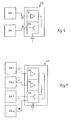
- a transmission device UE which a first Connection AG for a transceiver and a second connection ASE for a transceiver antenna SEA.
- the transmit / receive antenna SEA can in particular be a high gain antenna.
- the transmission device shows good reception behavior for signal transmission from the first connection AG, to which a Transmit signal from the transceiver SEG is fed to the second Connection ASE a smaller transmission dimension than in the opposite direction for a Receiving signal arriving at the second connection ASE to the first connection AG and thus to the SEG transceiver.
- the transmission dimension from the first connection AG to the second connection ASE damping and the transmission dimension in the opposite direction from the second connection ASE be reinforcing to the first connection AG.
- the transmission device UE has two parallel signal paths S1 and S2, which are connected to the first connection AG via a first line branch W1 and to the second connection ASE via a second line branch W2.
- An attenuator D is preferably arranged in the first signal path S1, which can also be adjustable and, in a special case, can also have 0 dB attenuation.
- an amplifier V is arranged in the second signal path, which has an amplifying effect in the direction from the second line branch W2 to the first line branch W1 and shows high reverse insulation in the opposite direction.
- Transmission signal carry the line branch W1, the attenuator D. as well as the W2 shares branch.
- the damping components of the Line branches are usually construction-related and amount to for the execution of the line branches as a power divider, for example 3 dB each.
- the design of the attenuator is then particularly important simple way the total through loss from AG to ASE adjustable and in particular on the transmission output power of the transceiver SEG and antenna gain of the transceiver antenna Customizable SEA.
- the total damping from first connection AG via the line junction W1, the second signal path S2 and the second line branch W2 to the second connection ASE essential is higher than the signal attenuation via signal path S1 and therefore the second signal path has no significant transmission signal component on the Antenna conducts.
- This can be done, for example, by using an amplifier V with high reverse insulation.
- the transmission signal attenuation over the second signal level S2 is preferably at least 6 dB, in particular around more than 10 dB higher than the transmission signal attenuation over the first signal path S1.
- the amplifier's reverse attenuation is typically in the range from 40 dB to 60 dB.
- Line branches circulators Z1, Z2 are used, which are less Forward loss from a to b and from c to a show as the power dividers in an appropriate arrangement. Typical values for transmission loss there is typically less than 1 between these gates dB. The insulation loss in the opposite direction and thus also from the gates c b is much higher and is typically at least 12 dB.
- FIG. 3 shows a special form of the transmission device, in which only a signal path is provided between the first connection AG and the second connection ASE is.
- An amplifier V is arranged in this signal path the signal direction from the second connection ASE to the first connection AG, that is for an incoming reception signal, which has an amplifying effect, but which is at the same time only moderate backward damping, illustrated by the arrow with an interrupted Line R shows and in this way a transmission signal fed into AG attenuated to the second connection ASE and thus to the transceiver antenna SEA forwards.
- the transmission device has UE in turn on a device-side first connection AG, in difference separate connections AE to the previous versions for a receiving antenna EA and AS for an independent of the receiving antenna Transmitting antenna SA.
- two signal paths are provided, which the connection AE or the connection AS via a line branch Connect W to the first connection AG.
- an attenuator may be arranged, which compliance the transmission power restrictions of the radio system are taken into account.
- a unidirectional amplifier V is arranged in the Signal path between AE and the line junction W.
- FIG. 5 the arrangement according to FIG. 4 is expanded in that several Receive antennas EA1 to EAn and several transmit antennas SA1 to SAm are provided. Due to the multiple antennas, several can be targeted Radio equipment that may be at different distances in the radio area and below are oriented at different angles to the station under consideration, capture or aim at the same time. By using several directed Antennas can also be hidden from interference.
- a plurality of directional antennas can also advantageously be used as receiving antennas in connection with an omnidirectional antenna as a transmitting antenna be used.
- the line branch is in the case of several antennas As a rule, the structure is more complex and can also be carried out in several stages. For example in such a way that it is directly connected to the first connection AG is a circulator, which is divided into transmission branches and reception branches causes, and then another in the transmission and / or reception branch Division into several partial routes according to several individual antennas single-stage or multi-stage power dividers.
- the Signal paths of several or all receiving antennas from the connections AE1, ... AEn first combined in a coupler and then via a common one Amplifiers of the line branch are fed.
- FIG. 6 shows a further advantageous embodiment of a transmission device outlines in which instead of the embodiment of FIG. 3 instead of the attenuator in the first signal path in the transmission signal direction acting amplifier VS is arranged.
- Such an embodiment is particular advantageous when using a transmitting antenna with an antenna gain less than 0 dBd, for example an omnidirectional one Cross dipole antenna.
- the transmit signal amplifier too when using such an antenna and a common one, for example one tuned in the transmission power to a dipole antenna with 0 dBd Transceiver the permissible transmission power in a radio system, for example fully according to the European standard mentioned at the beginning exhausted and thus the range can be increased.
- a transmission device is in radio systems with leakage cable antennas or similar weak radiating antennas, for example for Radio communication in buildings, given where by the transmission device 6 the range can be increased.
- Advantageously used can be a transmission device of the type sketched in Fig. 6 finally, generally to increase the transmission range also in systems without restriction of the emitted transmission power.
- 7 is one Another embodiment of a transmission device with a transmission signal amplifier VS for connection to a common transceiver antenna SEA outlined similar to the embodiment of FIG. 2.
- SEA common transceiver antenna
- the transmission device outlined in FIG. 7 is in particular advantageous for increasing the transmission range. It basically applies the same considerations as for the transmission device according to FIG. 6.
- the power supply to the amplifier can be, for example, via a direct current signal on the radio frequency line from the transceiver.
Landscapes
- Engineering & Computer Science (AREA)
- Computer Networks & Wireless Communication (AREA)
- Signal Processing (AREA)
- Transceivers (AREA)
- Transmitters (AREA)
- Mobile Radio Communication Systems (AREA)
- Variable-Direction Aerials And Aerial Arrays (AREA)
Abstract
Description
- Fig. 1
- eine erste Übertragungseinrichtung zum Anschluß an eine Sende-Empfangs-Antenne
- Fig. 2
- eine Abwandlung der Einrichtung nach Fig. 1
- Fig. 3
- eine Sonderform einer Übertragungseinrichtung zum Anschluß an eine Sende-Empfangsantennte
- Fig. 4
- eine Übertragungseinrichtung für getrennte Sende- bzw. Empfangsantennen
- Fig. 5
- eine Erweiterung der Einrichtung nach Fig. 4 auf jeweils mehrere Sende- bzw. Empfangsantennen
- Fig. 6,7
- weitere Ausführungsformen einer Übertragungseinrichtung
Claims (32)
- Funk-Kommunikationsanordnung mit einer Antennenanordnung, einem Sende-Empfangs-Gerät und einer zwischen diesen eingefügten Übertragungseinrichtung in einem Funksystem mit einem vorgegebenen Grenzwert für die von der Antennenanordnung abgestrahlte, auf einen Referenzstrahler bezogene Leistung, wobei die Übertragungseinrichtung für das Sendesignal eine Dämpfung bewirkt und die Sende-Ausgangsleistung des Sende-Empfangs-Gerät, die Sendesignal-Dämpfung der Übertragungseinrichtung und der Sendeantennengewinn der Antennenanordnung so aufeinander abgestimmt sind, daß die abgestrahlte Leistung den vorgegebenen Grenzwert nicht überschreitet.
- Anordnung nach Anspruch 1, dadurch gekennzeichnet, daß die Sendesignal-Dämpfung der Übertragungseinrichtung mindestens 3 dB beträgt.
- Anordnung nach Anspruch 1 oder 2, dadurch gekennzeichnet, daß die Sende-Ausgangsleistung des Sende-Empfangs-Geräts zumindest annähernd gleich der maximalen zulässigen abgestrahlten Leistung einer Dipol-Sendeantenne ist, daß die Sendeantennte einen höheren Gewinn aufweist als eine Dipolantennte und daß die Sendesignal-Dämpfung der Übertragungseinrichtung annähernd gleich oder größer als der Antennengewinn der Sendeantenne gegenüber einer Dipol-Sendeantenne ist.
- Anordnung nach einem der Ansprüche 1 bis 3, dadurch gekennzeichnet, daß die Antennenanordnung eine von der Sendeantenne getrennte Empfangsantenne aufweist, die gleichfalls über die Übertragungseinrichtung mit dem Sende-Empfangs-Gerät verbunden ist, und daß die Dämpfung der Übertragungseinrichtung vom Anschluß des Sende-Empfangs-Gerät zu der Empfangsantenne wesentlich größer ist als der Antennengewinn der Empfangsantenne.
- Anordnung nach einem der Ansprüche 1 bis 4, dadurch gekennzeichnet, daß der Antennengewinn der Sendeantenne mindestens gleich 6 dBi, vorzugsweise höher als 12 dBi ist.
- Anordnung nach Anspruch 4 oder 5, dadurch gekennzeichnet, daß der Antennengewinn der Sendeantenne mindestens gleich 6 dBi, vorzugsweise höher als 12 dBi ist.
- Anordnung nach einem der Ansprüche 1 bis 6, dadurch gekennzeichnet, daß die Sende- und/oder die Empfangsantenne eine Reflektorantenne oder eine kaskadierte Dipolantenne ist.
- Anordnung nach einem der Ansprüche 1 bis 6, dadurch gekennzeichnet, daß die Sende- und/oder die Empfangsantenne eine Patch-Antenne ist.
- Anordnung nach Anspruch 8, dadurch gekennzeichnet, daß Sende- und Empfangsantenne mit unterschiedlichen Antennendiagrammen durch getrennte Speisegeometrien in einem gemeinsamen Antennenpatch realisiert sind.
- Anordnung nach einem der Ansprüche 1 bis 9, dadurch gekennzeichnet, daß die Übertragungseinrichtung bei der Antennenanordnung angeordnet und über ein Kabel mit dem Sende-Empfangs-Gerät verbunden ist.
- Anordnung nach Anspruch 10, dadurch gekennzeichnet, daß das Kabel Bestandteil der Übertragungseinrichtung ist.
- Anordnung nach Anspruch 10 oder 11, dadurch gekennzeichnet, daß die Antennenanordnung und die Übertragungseinrichtung eine bauliche Einheit bilden.
- Übertragungseinrichtung für eine Funk-Kommunikations-Anordnung, insbesondere nach einem der Ansprüche 1 bis 12, mit einem ersten Anschluß für eine Sende-Empfangs-Gerät und einem zweiten Anschluß für eine Sende-Empfangs-Antenne, wobei das Übertragungsmaß vom ersten zum zweiten Anschluß geringer ist als vom zweiten zum ersten Anschluß.
- Übertragungseinrichtung nach Anspruch 13, dadurch gekennzeichnet, daß der Unterschied im Übertragungsmaß der Übertragungseinrichtung in entgegengesetzten Signalrichtungen größer als 6 dB, vorzugsweise größer als 10 dB ist.
- Übertragungseinrichtung nach Anspruch 13 oder 14, dadurch gekennzeichnet, daß die Übertragungseinrichtung eine Verstärkeranordnung für die Signalrichtung vom zweiten Anschluß zum ersten Anschluß aufweist.
- Übertragungseinrichtung nach Anspruch 15, dadurch gekennzeichnet, daß die Signalübertragung vom ersten zum zweiten Anschluß über die Verstärkeranordnung entgegen der Verstärkungsrichtung erfolgt.
- Anordnung nach einem der Ansprüche 13 bis 16, dadurch gekennzeichnet, daß die Übertragungseinrichtung zwei parallele Signalpfade aufweist, die über eine erste Leitungsverzweigung mit dem ersten Anschluß und über eine zweite Leitungsverzweigung mit dem zweiten Anschluß verbunden sind.
- Anordnung nach Anspruch 17, dadurch gekennzeichnet, daß der erste Signalweg ein Dämpfungsglied und der zweite Signalweg einen in Richtung von der zweiten zur ersten Leitungsverzweigung wirkenden Verstärker enthält
- Übertragungseinrichtung nach Anspruch 17 oder 18, gekennzeichnet durch einen Leistungsteiler als Leitungsverzweigung.
- Übertragungseinrichtung nach einem der Ansprüche 17 bis 19, gekennzeichnet durch einen Zirkulator als Leitungsverzweigung.
- Übertragungseinrichtung nach einem der Ansprüche 17 bis 20, dadurch gekennzeichnet, daß die gegenseitige Entkopplung der Signalwege in den Leitungsverzweigungen größer als 10 dB ist.
- Übertragungseinrichtung nach einem der Ansprüche 17 bis 21, dadurch gekennzeichnet, daß das Dämpfungsglied einstellbar ist.
- Übertragungseinrichtung nach einem der Ansprüche 17 bis 22, dadurch gekennzeichnet, daß die Schleifenverstärkung in der aus den beiden Signalwegen und den beiden Leitungsverzweigungen gebildeten Schleife kleiner als 0 dB ist.
- Übertragungseinrichtung für eine Funk-Kommunikationsanordnung, insbesondere nach einem der Ansprüche 1 bis 12, mit einem ersten Anschluß für ein Sende-Empfangs-Gerät und mehreren antennenseitigen Anschlüssen für mindestens eine Sendeantenne und mindestens eine Empfangsantenne sowie mehreren Signalwegen und einer Leitungsverzweigung zur Verbindung der mehreren antennenseitigen Anschlüsse mit dem ersten Anschluß.
- Übertragungseinrichtung nach Anspruch 24, dadurch gekennzeichnet, daß das Übertragungsmaß eines Signalwegs von dem ersten Anschluß zu einem Empfangsantennenanschluß geringer, vorzugsweise um mehr als 6 dB geringer ist als in umgekehrter Signalrichtung.
- Übertragungseinrichtung nach Anspruch 24 oder 25, dadurch gekennzeichnet, daß in einem Signalweg von einem Empfangsantennen-Anschluß zu der Leitungsverzweigung ein Verstärker angeordnet ist.
- Übertragungseinrichtung nach einem der Ansprüche 24 bis 26, dadurch gekennzeichnet, daß in einem Signalweg von dem ersten Anschluß zu einem Sendeantennen-Anschluß ein Dämpfungsglied angeordnet ist.
- Übertragungseinrichtung nach einem der Ansprüche 24 bis 27, dadurch gekennzeichnet, daß die gegenseitige Entkopplung der mehreren Signalwege in der Leitungsverzweigung größer als 10 dB ist.
- Übertragungseinrichtung nach einem der Ansprüche 24 bis 28, dadurch gekennzeichnet, daß die Leitungsverzweigung einen Zirkulator enthält.
- Übertragungseinrichtung nach einem der Ansprüche 24 bis 29, dadurch gekennzeichnet, daß die Leitungsverzweigung mindestens einen Leistungsteiler enthält.
- Übertragungseinrichtung für eine Funk-Kommunikationsanordnung, insbesondere nach einem der Ansprüche 1 bis 12, mit einem ersten Anschluß für ein Sende-Empfangs-Gerät und einem Anschluß für eine Sendeantenne, wobei im Signalweg vom ersten Anschluß zum Anschluß für eine Sendeantenne ein in dieser Signalrichtung wirkender Sendesignal-Verstärker angeordnet ist.
- Übertragungseinrichtung nach Anspruch 31, dadurch gekennzeichnet, daß die Sendeantenne zugleich als Empfangsantenne eingesetzt ist.
Priority Applications (1)
| Application Number | Priority Date | Filing Date | Title |
|---|---|---|---|
| DE29824591U DE29824591U1 (de) | 1997-04-11 | 1998-04-02 | Funk-Kommunikations-Anordnung und Übertragungseinrichtung |
Applications Claiming Priority (4)
| Application Number | Priority Date | Filing Date | Title |
|---|---|---|---|
| DE29706463U DE29706463U1 (de) | 1997-04-11 | 1997-04-11 | Aktiv-Modul zur Entkopplung von Sende- u. Empfangsantenne |
| DE29706463U | 1997-04-11 | ||
| DE19745327A DE19745327A1 (de) | 1997-04-11 | 1997-10-14 | Funk-Kommunikations-Anordnung und Übertragungseinrichtung |
| DE19745327 | 1997-10-14 |
Publications (3)
| Publication Number | Publication Date |
|---|---|
| EP0874473A2 true EP0874473A2 (de) | 1998-10-28 |
| EP0874473A3 EP0874473A3 (de) | 2002-06-26 |
| EP0874473B1 EP0874473B1 (de) | 2005-06-15 |
Family
ID=26040812
Family Applications (1)
| Application Number | Title | Priority Date | Filing Date |
|---|---|---|---|
| EP98105998A Expired - Lifetime EP0874473B1 (de) | 1997-04-11 | 1998-04-02 | Leistungregelung für eine Funk-Kommunikations-Anordnung |
Country Status (2)
| Country | Link |
|---|---|
| EP (1) | EP0874473B1 (de) |
| AT (1) | ATE298152T1 (de) |
Cited By (2)
| Publication number | Priority date | Publication date | Assignee | Title |
|---|---|---|---|---|
| EP0991198A3 (de) * | 1998-10-01 | 2003-05-14 | Matsushita Electric Industrial Co., Ltd. | Sendeempfänger mit eine gemeinsame Antenne für Sendung und empfang |
| WO2024099523A1 (de) * | 2022-11-08 | 2024-05-16 | Continental Automotive Technologies GmbH | Kompensator, insbesondere für ein kraftfahrzeug, kommunikationsmodul, kommunikationssystem und verfahren |
Family Cites Families (4)
| Publication number | Priority date | Publication date | Assignee | Title |
|---|---|---|---|---|
| FI90703C (fi) * | 1992-02-14 | 1994-03-10 | Nokia Mobile Phones Ltd | Diversiteettiboosteri |
| CN1061494C (zh) * | 1993-02-05 | 2001-01-31 | 株式会社东芝 | 无线电话装置 |
| US5737687A (en) * | 1995-03-01 | 1998-04-07 | Qualcomm Incorporated | Self-attenuating RF transceiver system using antenna and modem interfaces and cable link |
| DE19547288C2 (de) * | 1995-12-18 | 1999-03-18 | Siemens Ag | Funkstation mit einer abgesetzten Antenneneinheit |
-
1998
- 1998-04-02 AT AT98105998T patent/ATE298152T1/de not_active IP Right Cessation
- 1998-04-02 EP EP98105998A patent/EP0874473B1/de not_active Expired - Lifetime
Cited By (2)
| Publication number | Priority date | Publication date | Assignee | Title |
|---|---|---|---|---|
| EP0991198A3 (de) * | 1998-10-01 | 2003-05-14 | Matsushita Electric Industrial Co., Ltd. | Sendeempfänger mit eine gemeinsame Antenne für Sendung und empfang |
| WO2024099523A1 (de) * | 2022-11-08 | 2024-05-16 | Continental Automotive Technologies GmbH | Kompensator, insbesondere für ein kraftfahrzeug, kommunikationsmodul, kommunikationssystem und verfahren |
Also Published As
| Publication number | Publication date |
|---|---|
| EP0874473A3 (de) | 2002-06-26 |
| EP0874473B1 (de) | 2005-06-15 |
| ATE298152T1 (de) | 2005-07-15 |
Similar Documents
| Publication | Publication Date | Title |
|---|---|---|
| DE69225510T2 (de) | Modulbauförmiges Antennensystem mit verteilten Elementen | |
| DE69529559T2 (de) | Halbduplexfunkgerät mit niedriger Dämpfung des Sendesignals | |
| DE69934041T2 (de) | Spreizspektrumempfangsgerät mit Pfad- und Raumdiversität | |
| DE19617140C2 (de) | Funkstation zum Senden und Empfangen digitaler Informationen in einem Mobil-Kommunikationssystem | |
| DE69206333T2 (de) | Antennenkombination für den Empfang von Signalen von Satelliten und Bodenstationen, insbesondere für den Empfang von digitalen Ton-Rundfunksignalen. | |
| EP2101279A2 (de) | Einstellbare Schaltung und RFID-Readereinheit | |
| DE69401174T2 (de) | Sende-Empfängermodul mit voneinander elektromagnetisch isolierten Sende-Empfängerbereichen | |
| DE69211330T2 (de) | Funksende- und -empfangsanordnung | |
| DE4322863A1 (de) | Mobilfunkantennenanlage | |
| DE102019104458B4 (de) | Repeater-System | |
| DE2528983C2 (de) | Fernmeldesystem | |
| DE69601044T2 (de) | Sende- und Empfangsgerät | |
| DE69933266T2 (de) | Doppelband Sender-Empfänger mit zwei Antennen | |
| DE19547288C2 (de) | Funkstation mit einer abgesetzten Antenneneinheit | |
| WO2001095507A2 (de) | Anordnung zum betrieb mehrerer endgeräte | |
| EP0874473B1 (de) | Leistungregelung für eine Funk-Kommunikations-Anordnung | |
| DE19913064C1 (de) | Schaltungsanordnung zur Dämpfungskompensation | |
| DE19745327A1 (de) | Funk-Kommunikations-Anordnung und Übertragungseinrichtung | |
| DE29824591U1 (de) | Funk-Kommunikations-Anordnung und Übertragungseinrichtung | |
| EP0438094B1 (de) | Vorrichtung zum Betreiben von schnurlosen Telefonen | |
| EP1932246B1 (de) | Sende-empfangsschaltung für überlappende empfangs- und sende-bänder | |
| DE102010018509B4 (de) | Senden und Empfangen von Funksignalen in verschiedenen Frequenzbereichen | |
| DE1441799A1 (de) | Leitungsnetzwerk zum Einfuegen in eine Antennenleitung | |
| DE102013111798B4 (de) | Duplexer | |
| DE69925218T2 (de) | Sendeempfänger mit einer gemeinsamen Antenne für Sendung und Empfang |
Legal Events
| Date | Code | Title | Description |
|---|---|---|---|
| PUAI | Public reference made under article 153(3) epc to a published international application that has entered the european phase |
Free format text: ORIGINAL CODE: 0009012 |
|
| AK | Designated contracting states |
Kind code of ref document: A2 Designated state(s): AT BE CH CY DE DK ES FI FR GB GR IE IT LI LU MC NL PT SE |
|
| AX | Request for extension of the european patent |
Free format text: AL;LT;LV;MK;RO;SI |
|
| PUAL | Search report despatched |
Free format text: ORIGINAL CODE: 0009013 |
|
| AK | Designated contracting states |
Kind code of ref document: A3 Designated state(s): AT BE CH CY DE DK ES FI FR GB GR IE IT LI LU MC NL PT SE |
|
| AX | Request for extension of the european patent |
Free format text: AL;LT;LV;MK;RO;SI |
|
| RIC1 | Information provided on ipc code assigned before grant |
Free format text: 7H 04B 7/005 A, 7H 03G 3/20 B, 7H 01Q 1/00 B, 7H 01Q 1/52 B |
|
| 17P | Request for examination filed |
Effective date: 20021227 |
|
| AKX | Designation fees paid |
Designated state(s): AT BE CH CY DE DK ES FI FR GB GR IE IT LI LU MC NL PT SE |
|
| 17Q | First examination report despatched |
Effective date: 20030303 |
|
| GRAP | Despatch of communication of intention to grant a patent |
Free format text: ORIGINAL CODE: EPIDOSNIGR1 |
|
| GRAS | Grant fee paid |
Free format text: ORIGINAL CODE: EPIDOSNIGR3 |
|
| GRAA | (expected) grant |
Free format text: ORIGINAL CODE: 0009210 |
|
| AK | Designated contracting states |
Kind code of ref document: B1 Designated state(s): AT BE CH CY DE DK ES FI FR GB GR IE IT LI LU MC NL PT SE |
|
| PG25 | Lapsed in a contracting state [announced via postgrant information from national office to epo] |
Ref country code: NL Free format text: LAPSE BECAUSE OF FAILURE TO SUBMIT A TRANSLATION OF THE DESCRIPTION OR TO PAY THE FEE WITHIN THE PRESCRIBED TIME-LIMIT Effective date: 20050615 Ref country code: IT Free format text: LAPSE BECAUSE OF FAILURE TO SUBMIT A TRANSLATION OF THE DESCRIPTION OR TO PAY THE FEE WITHIN THE PRESCRIBED TIME-LIMIT;WARNING: LAPSES OF ITALIAN PATENTS WITH EFFECTIVE DATE BEFORE 2007 MAY HAVE OCCURRED AT ANY TIME BEFORE 2007. THE CORRECT EFFECTIVE DATE MAY BE DIFFERENT FROM THE ONE RECORDED. Effective date: 20050615 Ref country code: FI Free format text: LAPSE BECAUSE OF FAILURE TO SUBMIT A TRANSLATION OF THE DESCRIPTION OR TO PAY THE FEE WITHIN THE PRESCRIBED TIME-LIMIT Effective date: 20050615 |
|
| REG | Reference to a national code |
Ref country code: GB Ref legal event code: FG4D Free format text: NOT ENGLISH Ref country code: CH Ref legal event code: EP |
|
| REF | Corresponds to: |
Ref document number: 59812860 Country of ref document: DE Date of ref document: 20050721 Kind code of ref document: P |
|
| REG | Reference to a national code |
Ref country code: IE Ref legal event code: FG4D Free format text: LANGUAGE OF EP DOCUMENT: GERMAN |
|
| REG | Reference to a national code |
Ref country code: CH Ref legal event code: NV Representative=s name: RIEDERER HASLER & PARTNER PATENTANWAELTE AG |
|
| PG25 | Lapsed in a contracting state [announced via postgrant information from national office to epo] |
Ref country code: SE Free format text: LAPSE BECAUSE OF FAILURE TO SUBMIT A TRANSLATION OF THE DESCRIPTION OR TO PAY THE FEE WITHIN THE PRESCRIBED TIME-LIMIT Effective date: 20050915 Ref country code: GR Free format text: LAPSE BECAUSE OF FAILURE TO SUBMIT A TRANSLATION OF THE DESCRIPTION OR TO PAY THE FEE WITHIN THE PRESCRIBED TIME-LIMIT Effective date: 20050915 Ref country code: DK Free format text: LAPSE BECAUSE OF FAILURE TO SUBMIT A TRANSLATION OF THE DESCRIPTION OR TO PAY THE FEE WITHIN THE PRESCRIBED TIME-LIMIT Effective date: 20050915 |
|
| GBT | Gb: translation of ep patent filed (gb section 77(6)(a)/1977) |
Effective date: 20050831 |
|
| PG25 | Lapsed in a contracting state [announced via postgrant information from national office to epo] |
Ref country code: ES Free format text: LAPSE BECAUSE OF FAILURE TO SUBMIT A TRANSLATION OF THE DESCRIPTION OR TO PAY THE FEE WITHIN THE PRESCRIBED TIME-LIMIT Effective date: 20050926 |
|
| PG25 | Lapsed in a contracting state [announced via postgrant information from national office to epo] |
Ref country code: PT Free format text: LAPSE BECAUSE OF FAILURE TO SUBMIT A TRANSLATION OF THE DESCRIPTION OR TO PAY THE FEE WITHIN THE PRESCRIBED TIME-LIMIT Effective date: 20051123 |
|
| NLV1 | Nl: lapsed or annulled due to failure to fulfill the requirements of art. 29p and 29m of the patents act | ||
| ET | Fr: translation filed | ||
| PGFP | Annual fee paid to national office [announced via postgrant information from national office to epo] |
Ref country code: FR Payment date: 20060420 Year of fee payment: 9 |
|
| PGFP | Annual fee paid to national office [announced via postgrant information from national office to epo] |
Ref country code: LU Payment date: 20060424 Year of fee payment: 9 |
|
| PGFP | Annual fee paid to national office [announced via postgrant information from national office to epo] |
Ref country code: IE Payment date: 20060426 Year of fee payment: 9 Ref country code: GB Payment date: 20060426 Year of fee payment: 9 Ref country code: BE Payment date: 20060426 Year of fee payment: 9 |
|
| PG25 | Lapsed in a contracting state [announced via postgrant information from national office to epo] |
Ref country code: MC Free format text: LAPSE BECAUSE OF NON-PAYMENT OF DUE FEES Effective date: 20060430 |
|
| PGFP | Annual fee paid to national office [announced via postgrant information from national office to epo] |
Ref country code: DE Payment date: 20060430 Year of fee payment: 9 |
|
| PLBE | No opposition filed within time limit |
Free format text: ORIGINAL CODE: 0009261 |
|
| STAA | Information on the status of an ep patent application or granted ep patent |
Free format text: STATUS: NO OPPOSITION FILED WITHIN TIME LIMIT |
|
| 26N | No opposition filed |
Effective date: 20060316 |
|
| PGFP | Annual fee paid to national office [announced via postgrant information from national office to epo] |
Ref country code: AT Payment date: 20070423 Year of fee payment: 10 |
|
| PGFP | Annual fee paid to national office [announced via postgrant information from national office to epo] |
Ref country code: CH Payment date: 20070424 Year of fee payment: 10 |
|
| GBPC | Gb: european patent ceased through non-payment of renewal fee |
Effective date: 20070402 |
|
| BERE | Be: lapsed |
Owner name: *PAULUS PATRICK Effective date: 20070430 |
|
| PG25 | Lapsed in a contracting state [announced via postgrant information from national office to epo] |
Ref country code: DE Free format text: LAPSE BECAUSE OF NON-PAYMENT OF DUE FEES Effective date: 20071101 |
|
| REG | Reference to a national code |
Ref country code: IE Ref legal event code: MM4A |
|
| PG25 | Lapsed in a contracting state [announced via postgrant information from national office to epo] |
Ref country code: BE Free format text: LAPSE BECAUSE OF NON-PAYMENT OF DUE FEES Effective date: 20070430 |
|
| PG25 | Lapsed in a contracting state [announced via postgrant information from national office to epo] |
Ref country code: GB Free format text: LAPSE BECAUSE OF NON-PAYMENT OF DUE FEES Effective date: 20070402 |
|
| PG25 | Lapsed in a contracting state [announced via postgrant information from national office to epo] |
Ref country code: IE Free format text: LAPSE BECAUSE OF NON-PAYMENT OF DUE FEES Effective date: 20070402 |
|
| PG25 | Lapsed in a contracting state [announced via postgrant information from national office to epo] |
Ref country code: FR Free format text: LAPSE BECAUSE OF NON-PAYMENT OF DUE FEES Effective date: 20070430 |
|
| PG25 | Lapsed in a contracting state [announced via postgrant information from national office to epo] |
Ref country code: CY Free format text: LAPSE BECAUSE OF FAILURE TO SUBMIT A TRANSLATION OF THE DESCRIPTION OR TO PAY THE FEE WITHIN THE PRESCRIBED TIME-LIMIT Effective date: 20050615 |
|
| REG | Reference to a national code |
Ref country code: CH Ref legal event code: PL |
|
| PG25 | Lapsed in a contracting state [announced via postgrant information from national office to epo] |
Ref country code: LI Free format text: LAPSE BECAUSE OF NON-PAYMENT OF DUE FEES Effective date: 20080430 Ref country code: CH Free format text: LAPSE BECAUSE OF NON-PAYMENT OF DUE FEES Effective date: 20080430 |
|
| PG25 | Lapsed in a contracting state [announced via postgrant information from national office to epo] |
Ref country code: AT Free format text: LAPSE BECAUSE OF NON-PAYMENT OF DUE FEES Effective date: 20080402 |
|
| PG25 | Lapsed in a contracting state [announced via postgrant information from national office to epo] |
Ref country code: LU Free format text: LAPSE BECAUSE OF NON-PAYMENT OF DUE FEES Effective date: 20070402 |