EP0875890A2 - Circuit de détection de signal de rappel de dispositif d'enregistrement et de reproduction magnétique - Google Patents
Circuit de détection de signal de rappel de dispositif d'enregistrement et de reproduction magnétique Download PDFInfo
- Publication number
- EP0875890A2 EP0875890A2 EP98107753A EP98107753A EP0875890A2 EP 0875890 A2 EP0875890 A2 EP 0875890A2 EP 98107753 A EP98107753 A EP 98107753A EP 98107753 A EP98107753 A EP 98107753A EP 0875890 A2 EP0875890 A2 EP 0875890A2
- Authority
- EP
- European Patent Office
- Prior art keywords
- signal
- reproduction control
- timing
- cue
- control signal
- Prior art date
- Legal status (The legal status is an assumption and is not a legal conclusion. Google has not performed a legal analysis and makes no representation as to the accuracy of the status listed.)
- Withdrawn
Links
Images





Classifications
-
- G—PHYSICS
- G11—INFORMATION STORAGE
- G11B—INFORMATION STORAGE BASED ON RELATIVE MOVEMENT BETWEEN RECORD CARRIER AND TRANSDUCER
- G11B27/00—Editing; Indexing; Addressing; Timing or synchronising; Monitoring; Measuring tape travel
- G11B27/10—Indexing; Addressing; Timing or synchronising; Measuring tape travel
- G11B27/19—Indexing; Addressing; Timing or synchronising; Measuring tape travel by using information detectable on the record carrier
- G11B27/28—Indexing; Addressing; Timing or synchronising; Measuring tape travel by using information detectable on the record carrier by using information signals recorded by the same method as the main recording
- G11B27/32—Indexing; Addressing; Timing or synchronising; Measuring tape travel by using information detectable on the record carrier by using information signals recorded by the same method as the main recording on separate auxiliary tracks of the same or an auxiliary record carrier
- G11B27/322—Indexing; Addressing; Timing or synchronising; Measuring tape travel by using information detectable on the record carrier by using information signals recorded by the same method as the main recording on separate auxiliary tracks of the same or an auxiliary record carrier used signal is digitally coded
- G11B27/324—Duty cycle modulation of control pulses, e.g. VHS-CTL-coding systems, RAPID-time code, VASS- or VISS-cue signals
-
- G—PHYSICS
- G11—INFORMATION STORAGE
- G11B—INFORMATION STORAGE BASED ON RELATIVE MOVEMENT BETWEEN RECORD CARRIER AND TRANSDUCER
- G11B15/00—Driving, starting or stopping record carriers of filamentary or web form; Driving both such record carriers and heads; Guiding such record carriers or containers therefor; Control thereof; Control of operating function
- G11B15/18—Driving; Starting; Stopping; Arrangements for control or regulation thereof
- G11B15/26—Driving record carriers by members acting directly or indirectly thereon
- G11B15/28—Driving record carriers by members acting directly or indirectly thereon through rollers driving by frictional contact with the record carrier, e.g. capstan; Multiple arrangements of capstans or drums coupled to means for controlling the speed of the drive; Multiple capstan systems alternately engageable with record carrier to provide reversal
-
- G—PHYSICS
- G11—INFORMATION STORAGE
- G11B—INFORMATION STORAGE BASED ON RELATIVE MOVEMENT BETWEEN RECORD CARRIER AND TRANSDUCER
- G11B15/00—Driving, starting or stopping record carriers of filamentary or web form; Driving both such record carriers and heads; Guiding such record carriers or containers therefor; Control thereof; Control of operating function
- G11B15/02—Control of operating function, e.g. switching from recording to reproducing
-
- G—PHYSICS
- G11—INFORMATION STORAGE
- G11B—INFORMATION STORAGE BASED ON RELATIVE MOVEMENT BETWEEN RECORD CARRIER AND TRANSDUCER
- G11B15/00—Driving, starting or stopping record carriers of filamentary or web form; Driving both such record carriers and heads; Guiding such record carriers or containers therefor; Control thereof; Control of operating function
- G11B15/02—Control of operating function, e.g. switching from recording to reproducing
- G11B15/05—Control of operating function, e.g. switching from recording to reproducing by sensing features present on or derived from record carrier or container
- G11B15/087—Control of operating function, e.g. switching from recording to reproducing by sensing features present on or derived from record carrier or container by sensing recorded signals
-
- G—PHYSICS
- G11—INFORMATION STORAGE
- G11B—INFORMATION STORAGE BASED ON RELATIVE MOVEMENT BETWEEN RECORD CARRIER AND TRANSDUCER
- G11B15/00—Driving, starting or stopping record carriers of filamentary or web form; Driving both such record carriers and heads; Guiding such record carriers or containers therefor; Control thereof; Control of operating function
- G11B15/18—Driving; Starting; Stopping; Arrangements for control or regulation thereof
-
- G—PHYSICS
- G11—INFORMATION STORAGE
- G11B—INFORMATION STORAGE BASED ON RELATIVE MOVEMENT BETWEEN RECORD CARRIER AND TRANSDUCER
- G11B15/00—Driving, starting or stopping record carriers of filamentary or web form; Driving both such record carriers and heads; Guiding such record carriers or containers therefor; Control thereof; Control of operating function
- G11B15/18—Driving; Starting; Stopping; Arrangements for control or regulation thereof
- G11B15/46—Controlling, regulating, or indicating speed
-
- G—PHYSICS
- G11—INFORMATION STORAGE
- G11B—INFORMATION STORAGE BASED ON RELATIVE MOVEMENT BETWEEN RECORD CARRIER AND TRANSDUCER
- G11B20/00—Signal processing not specific to the method of recording or reproducing; Circuits therefor
- G11B20/10—Digital recording or reproducing
- G11B20/10009—Improvement or modification of read or write signals
- G11B20/10037—A/D conversion, D/A conversion, sampling, slicing and digital quantisation or adjusting parameters thereof
-
- G—PHYSICS
- G11—INFORMATION STORAGE
- G11B—INFORMATION STORAGE BASED ON RELATIVE MOVEMENT BETWEEN RECORD CARRIER AND TRANSDUCER
- G11B2220/00—Record carriers by type
- G11B2220/90—Tape-like record carriers
-
- G—PHYSICS
- G11—INFORMATION STORAGE
- G11B—INFORMATION STORAGE BASED ON RELATIVE MOVEMENT BETWEEN RECORD CARRIER AND TRANSDUCER
- G11B2220/00—Record carriers by type
- G11B2220/90—Tape-like record carriers
- G11B2220/91—Helical scan format, wherein tracks are slightly tilted with respect to tape direction, e.g. VHS, DAT, DVC, AIT or exabyte
Definitions
- the present invention relates to a cue signal detection circuit mounted on a magnetic recording and reproducing device which reads and writes data from/on a magnetic tape for detecting, from among reproduction control signals recorded on the magnetic tape, a cue signal recorded at a predetermined cue position.
- Magnetic recording and reproducing device which reads and writes data from/on a magnetic tape such as a video equipment has a capstan motor mounted thereon for driving rotation for fast-forwarding and rewind of a magnetic tape.
- Contained for controlling rotation of a capstan motor is a cue signal detection circuit which reads reproduction control signals recorded on a magnetic tape and detects a cue signal from among the signals.
- Reproduction control signal is a signal recorded, at the time of recording of a data signal on a magnetic tape, together with the data signal for the purpose of controlling reproduction of the data signal.
- Cue signal is a reproduction control signal recorded at a predetermined cue position (e.g. at a position of a data signal on a magnetic tape at the start of recording) for the purpose of indicating the cue position.
- a mode control circuit every time a mode control circuit passes a recording position of a cue signal on the tape to detect the cue signal, fast-forwarding and rewind of the magnetic tape are repeated to gradually shorten a travel distance, thereby ultimately reaching the recording position of the cue signal (cue position).
- a pulse signal in accordance with a rotation speed of a capstan motor which is directly detected from the capstan motor by a capstan head (hereinafter referred to as a capstan signal CFG) is counted.
- the counted value corresponds to a travel distance of the magnetic tape and one pulse is equivalent to a travel distance of one centimeter.
- a rotation speed of the capstan motor is controlled. Therefore, a time from when position of a cue signal is specified until when running is stopped is constant, independent of the rotation speed of the capstan motor.
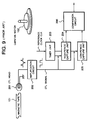
- FIG. 8 shows a relationship between a magnetic tape and a capstan motor in the magnetic recording and reproducing device recited in this Instruction Manual
- Fig. 9 shows structure of a cue signal detection circuit in a block diagram.
- the conventional cue signal detection circuit includes a CTL head 201, an amplification circuit 202, a timer unit 203, a high-period capture unit 204, a low-period capture unit 205 and a comparison circuit 206, with a magnetic tape 101 run at a high speed by a capstan motor 102 which conducts fast-forward and rewind of the magnetic tape 101 to take in a reproduction control signal CTL recorded on the magnetic tape 101 through the CTL head 201.
- the reproduction control signal CTL taken in by the CTL head 201 is sent to the amplification circuit 202, amplified to have an appropriate signal level there and then output as a reproduction control signal CTL converted into a digital signal.
- the high-period capture unit 204 takes in a value of the timer unit 203 on a leading edge of the applied reproduction control signal CTL, as well as initializing the timer unit 203.
- the low-period capture unit 205 takes in a value of the timer 203 on a trailing edge of the reproduction control signal CTL.
- the comparison circuit 206 compares the values of the timer taken in by the high-period capture unit 204 and the low-period capture unit 205 to determine whether a cue signal exists or not based on the comparison results.
- the above-described conventional cue signal detection circuit has a drawback that in cue signal detection made when a magnetic tape travels at a low speed and a high speed, limitations are imposed on a traveling speed of the magnetic tape.
- a frequency of a pulse enabling determination of a duty ratio of a reproduction control signal CTL is dependent on a reference clock CLK supplied to the timer unit 203, the number of CFG signals countable by the timer 203 and a duty ratio determination processing time.
- An object of the present invention is to provide a cue signal detection circuit which eliminates the above described conventional drawbacks and is capable of detecting a cue signal from among reproduction control signals with high precision independently of a frequency of the reproduction control signal even when a magnetic tape travels at a high speed.
- Another object of the present invention is to provide a cue signal detection circuit which achieves the above object by simple circuit structure to allow reduction in circuit scale and costs of a magnetic recording and reproducing device.
- a cue signal detection circuit mounted on a magnetic recording and reproducing device which reads and writes data from/to a magnetic tape on which data is magnetically recorded for detecting, from among reproduction control signals recorded on the magnetic tape together with the data for use in controlling operation of driving means which runs the magnetic tape, a cue signal recorded with a duty ratio different from that of an ordinary reproduction control signal, comprises
- the filter means may be an integration circuit structured by a combination of a resistor element and a capacitor element.
- the driving means is a capstan motor for conducting fast-forward and rewind of the magnetic tape
- the timing signal generation means detects a capstan signal based on a rotation speed of the capstan motor and frequency-divides the detected capstan signal to generate the timing signal synchronized with the reproduction control signal
- the cue signal detection means comprises second analog-to-digital conversion means for taking in a voltage value of the reproduction control signal converted into an analog voltage by the filter means at the timing of the timing signal generated by the timing signal generation means and converting the same into a digital signal, and determination means for comparing a voltage value of a digital signal generated by the second analog-to-digital conversion means and a preset determination reference voltage to determine whether the reproduction control signal is the cue signal or not based on the comparison results.
- the filter means is an integration circuit structured by a combination of a resistor element and a capacitor element
- the cue signal detection means comprises second analog-to-digital conversion means for taking in a voltage value of the reproduction control signal converted into an analog voltage by the filter means at the timing of the timing signal generated by the timing signal generation means and converting the same into a digital signal, and determination means for comparing a voltage value of a digital signal generated by the second analog-to-digital conversion means and a preset determination reference voltage to determine whether the reproduction control signal is the cue signal or not based on the comparison results.
- the driving means is a capstan motor for conducting fast-forward and rewind of the magnetic tape
- the timing signal generation means detects a capstan signal based on a rotation speed of the capstan motor and frequency-divides the detected capstan signal to generate the timing signal synchronized with the reproduction control signal
- the cue signal detection means comprises second analog-to-digital conversion means for taking in a voltage value of the reproduction control signal converted into an analog voltage by the filter means at the timing of the timing signal generated by the timing signal generation means and converting the same into a digital signal, and determination means for comparing a voltage value of a digital signal generated by the second analog-to-digital conversion means and a preset determination reference voltage to determine whether the reproduction control signal is the cue signal or not based on the comparison results.
- the filter means is an integration circuit structured by a combination of a resistor element and a capacitor element
- the driving means is a capstan motor for conducting fast-forward and rewind of the magnetic tape
- the timing signal generation means detects a capstan signal based on a rotation speed of the capstan motor and frequency-divides the detected capstan signal to generate the timing signal synchronized with the reproduction control signal
- the cue signal detection means comprises second analog-to-digital conversion means for taking in a voltage value of the reproduction control signal converted into an analog voltage by the filter means at the timing of the timing signal generated by the timing signal generation means and converting the same into a digital signal
- determination means for comparing a voltage value of a digital signal generated by the second analog-to-digital conversion means and a preset determination reference voltage to determine whether the reproduction control signal is the cue signal or not based on the comparison results.
- the cue signal detection means comprises comparison means for comparing a voltage value of the reproduction control signal converted into an analog voltage by the filter means and a preset determination reference voltage, and determination means for receiving input of comparison results obtained by the comparison means at the timing of the timing signal generated by the timing signal generation means to determine whether the reproduction control signal is the cue signal or not based on the comparison results.
- the filter means is an integration circuit structured by a combination of a resistor element and a capacitor element
- the cue signal detection means comprises comparison means for comparing a voltage value of the reproduction control signal converted into an analog voltage by the filter means and a preset determination reference voltage, and determination means for receiving input of comparison results obtained by the comparison means at the timing of the timing signal generated by the timing signal generation means to determine whether the reproduction control signal is the cue signal or not based on the comparison results.
- the driving means is a capstan motor for conducting fast-forward and rewind of the magnetic tape
- the timing signal generation means detects a capstan signal based on a rotation speed of the capstan motor and frequency-divides the detected capstan signal to generate the timing signal synchronized with the reproduction control signal
- the cue signal detection means comprises comparison means for comparing a voltage value of the reproduction control signal converted into an analog voltage by the filter means and a preset determination reference voltage, and determination means for receiving input of comparison results obtained by the comparison means at the timing of the timing signal generated by the timing signal generation means to determine whether the reproduction control signal is the cue signal or not based on the comparison results.
- the filter means is an integration circuit structured by a combination of a resistor element and a capacitor element
- the driving means is a capstan motor for conducting fast-forward and rewind of the magnetic tape
- the timing signal generation means detects a capstan signal based on a rotation speed of the capstan motor and frequency-divides the detected capstan signal to generate the timing signal synchronized with the reproduction control signal
- the cue signal detection means comprises comparison means for comparing a voltage value of the reproduction control signal converted into an analog voltage by the filter means and a preset determination reference voltage, and determination means for receiving input of comparison results obtained by the comparison means at the timing of the timing signal generated by the timing signal generation means to determine whether the reproduction control signal is the cue signal or not based on the comparison results.
- a cue signal detection circuit of a magnetic recording and reproducing device will be described in outline.
- a reproduction control signal recorded on a magnetic tape is read and digitized to generate a reproduction control signal shaped to have a pulse-like rectangular waveform.
- the digitized reproduction control signal is converted into an analog voltage proportional to a duty ratio.
- a cue signal is detected from among the reproduction control signals.
- the voltage detection from the reproduction control signal converted into the analog voltage is conducted at the timing obtained by frequency-dividing a rotation speed signal (capstan signal CFG) which is directly detected from a capstan motor.
- a magnetic recording and reproducing device As a magnetic recording and reproducing device to which the technique of the present invention is applied, common are video recorders and video reproducing devices and in these cases, a magnetic tape is intended to be a video tape on which picture and voice data are recorded. It is clear, however, that application of the present invention is not limited to video data recording and reproducing devices but is widely possible to devices which record and reproduce data on/from a magnetic tape.
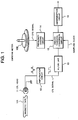
- Fig. 1 is a block diagram showing structure of a cue signal detection circuit according to a first embodiment of the present invention.
- a magnetic tape 101 on which a reproduction control signal CTL is magnetically recorded together with data and a capstan motor 102 for driving the magnetic tape 101.
- the signal detection circuit of the present embodiment includes a CTL head 11 for detecting a cue signal from among reproduction control signals CTL recorded on the magnetic tape 101, an amplification circuit 12, a filter unit 13, an analog-to-digital conversion circuit 15 and a determination circuit 16, and a frequency-dividing circuit 14 for determining operation timing of the analog-to-digital conversion circuit 15.
- illustration is made only of a characteristic part of the structure of the present embodiment and that of the remaining common part is omitted.
- the CTL head 11 reads a reproduction control signal CTL recorded on the magnetic tape 101.
- the amplification circuit 12 appropriately amplifies a reproduction control signal CTL read by the CTL head 11 and converts the same into a digital signal.
- the filter unit 13 converts a reproduction control signal CTL amplified and digitized by the amplification circuit 12 into an analog voltage.
- the frequency-dividing circuit 14 frequency-divides a capstan signal CFG detected from the capstan motor 102 by a frequency-dividing ratio which is a frequency ratio of a reproduction control signal CTL to a rotation speed signal.
- the analog-to-digital conversion circuit 15 converts an analog voltage output from the filter unit 13 into a digital signal according to a step of a pulse signal output from the frequency-dividing circuit 14.
- the determination circuit 16 determines whether a reproduction control signal CTL converted into a digital signal is a cue signal or not.
- Fig. 2 is a circuit diagram of the filter unit 13
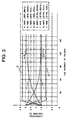
- Fig. 3 is a diagram showing a relationship between the number of pulses and a converted voltage of a reproduction control signal CTL
- Fig. 4 is a timing chart showing timing of converting a reproduction control signal CTL into an analog voltage.
- a reproduction control signal CTL recorded on the magnetic tape 101 is read by the CTL head 11 and then at the amplification circuit 12, it is amplified to have a predetermined signal level and is also shaped to have a rectangular waveform to be converted into a digital signal.
- the reproduction control signal CTL converted into the digital signal by the amplification circuit 12 is converted into an analog voltage proportional to a duty ratio by the filter unit 13. More specifically, the output change is given by the following expression when such an integration-type filter unit 13 is used which is composed of a resistor (R) and a capacitor (C) as shown in Fig. 2.
- V n+1 a (b n -1) / (b-1) + b n ⁇ V 0
- FIG. 3 A relationship between the number of pulses and a converted voltage established when the input signal has a frequency of 1kHz and 20kHz is shown in Fig. 3, with 2.2K ⁇ substituting for R and 1 ⁇ F for C in the above expression.
- a reproduction control signal CTL applied to the filter unit 13 has a frequency of 1kHz to 20Khz
- a cue signal reference voltage to be 2.2V
- an ordinary reproduction control signal CTL (duty ratio of 60 %) is converted into 3V ⁇ 0.3V
- a cue signal (duty ratio of 27.5 %) of a reproduction control signal CTL is converted into 1.35V ⁇ 0.3V as shown in Fig. 3.
- the maximum value and the minimum value of a converted voltage show a waveform gradually rising as the number of pulses increases as denoted by the curve A, B in Fig. 3.
- the voltage reaches 2.2V of the reference voltage at the pulses to the number of 30 and reaches about 2.9V at the pulses to the number of 140.
- the maximum converted voltage as denoted by the curve C in Fig. 3
- the minimum converted voltage attains about 2.6V at the pulses to the number of 10 and thereafter becomes approximately constant at 2.7V irrespective of the number of pulses.
- the maximum value and the minimum value of a converted voltage show a waveform gradually falling as the number of pulses increases as denoted by the curve E, F in Fig. 3.
- the voltage attains 2.2V of the reference voltage at the pulses to the number of 30 and attains about 1.5V at the pulses to the number of 140.
- the maximum converted voltage as denoted by the curve G in Fig. 3, attains about 1.3V at the pulses to the number of 10 and thereafter becomes approximately constant at 1.05V irrespective of the number of pulses.
- the minimum converted voltage as denoted by the curve H in Fig. 3, attains about 1.9V at the pulses to the number of 10 and thereafter becomes approximately constant at 1.65V irrespective of the number of pulses.
- cycle of signal CTL cycle of signal CFG ⁇ n (n ⁇ 1)
- frequency-dividing a capstan signal CFG by the frequency-dividing circuit 14 leads to generation of a timing signal CFT synchronized with a reproduction control signal CTL. This enables a timing signal CFT to be generated at a fixed rate with respect to a reproduction control signal CTL irrespective neither of a rotation speed of the capstan motor 102 nor of a traveling speed of the magnetic tape 101. Generated synchronous timing signal CFT is supplied to the analog-to-digital conversion circuit 15.
- the analog-to-digital conversion circuit 15 takes in a voltage value of a reproduction control signal CTL converted into an analog voltage by the filter unit 13 in response to the timing of a received timing signal CFT.
- the voltage value taken in by the analog-to-digital conversion circuit 15 is converted into a digital signal and is sent to the determination circuit 16.
- the determination circuit 16 which is an arithmetic unit of a CPU built in the magnetic recording and reproducing device, determines based on an applied digital signal whether the reproduction control signal CTL is a cue signal or not. More specifically, the determination circuit 16 compares a determination reference voltage of 2.2V set in advance on a program which controls the CPU with an input voltage to determine, when a digital signal of the input voltage value shows a voltage higher than the determination reference voltage of 2.2V, that the signal has a duty ratio of 60 %, and when the same shows a voltage lower than the determination reference voltage of 2.2 V, determine that the signal has a duty ratio of 27.5 %.
- a reproduction control signal CTL detected from the magnetic tape 101 is thus converted into 3V ⁇ 0.3V during the period in which the signal has the duty ratio of 60 % and into 1.35V ⁇ 0.3V during the period in which the signal has the duty ratio of 27.5 % by the filtering through the filter unit 13.
- the analog voltage is again converted into a digital signal by using a pulse signal obtained by frequency-dividing a capstan signal CFG whose frequency is higher than that of a reproduction control signal CTL. Then, the obtained digital signal is compared with a cue signal voltage as a reference voltage to determine a duty ratio.
- This procedure enables reliable detection of a cue signal in both of the cases where the magnetic tape 101 is running at a low speed and a reproduction control signal CTL has a low frequency of 1kHz and where the magnetic tape 101 is running at a high speed and a reproduction control signal CTL has a high frequency of 20kHz.
- FIG. 5 shows a list of times required for cue signal determination processing in conventional art and the present embodiment, in which Fig. 5(A) is a diagram related to conventional art and Fig. 5(B) is a diagram related to the present embodiment.
- horizontally provided are four columns respectively for a reproduction control signal CTL with a frequency of 1kHz and a pulse width of 1ms, a reproduction control signal CTL with a frequency of 10 kHz and a pulse width of 100 ⁇ s, a reproduction control signal CTL with a frequency of 20kHz and a pulse width of 50 ⁇ s and a reproduction control signal CTL with a frequency of 30kHz and a pulse width of 33 ⁇ s.
- Fig. 5 shows a list of times required for cue signal determination processing in conventional art and the present embodiment, in which Fig. 5(A) is a diagram related to conventional art and Fig. 5(B) is a diagram related to the present embodiment.
- horizontally provided are four columns respectively for a reproduction control signal CTL with a frequency of
- reproduction control signal CTL determination processing time and the number of bits counted by a timer which are indicated in correlation with each other in the Y-axis direction. More specifically, in Fig. 5(A), assuming for example that with a reproduction control signal CTL having a frequency of 1kHz, a reference clock is 2MHz, determination can be made within a determination processing time of 40 to 80 ⁇ s when the number of timer counted bits is 11. With a reproduction control signal CTL having a frequency of 20kHz, assuming that a reference clock is 8MHz, determination can be completely made within a determination processing time of 10 to 20 ⁇ s when the number of timer counted bits is 9. For taking in a reproduction control signal CTL with a frequency of 1kHz to 20kHz, therefore, a reference clock of the timer should be not lower than 8MHz and the number of bits should be not lower than 13 bits.
- Fig. 5(B) showing the present embodiment, vertically indicated for each of the above-described columns provided in horizontal direction are reproduction control signal CTL determination processing times in vertical direction. More specifically, in Fig. 5(B), assuming for example that with a reproduction control signal CTL having a frequency of 1kHz to 30kHz, a sampling clock is 2MHz, determination can be made within a determination processing time of 4 to 8 ⁇ s. Assuming that a sampling clock is 4MHz, determination can be made within a determination processing time of 2 to 4 ⁇ s. Assuming that a sampling clock is 8MHz, determination can be made within a determination processing time of 1 to 2 ⁇ s. This shows that duty ratio determination processing time is reduced to about one-fourth that of conventional art. As a result, a cue signal determination time is reduced to one-fourth that of conventional art to enable high-speed determination processing.
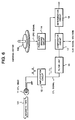
- Fig. 6 is a block diagram showing structure of a cue signal detection circuit according to a second embodiment of the present invention.
- a magnetic tape 101 on which a reproduction control signal CTL is magnetically recorded together with data and a capstan motor 102 for driving the magnetic tape 101.
- the cue signal detection circuit of the present embodiment includes a CTL head 11 for detecting a cue signal from among reproduction control signals CTL recorded on the magnetic tape 101, an amplification circuit 12, a filter unit 13, a comparator circuit 17 and a determination circuit 18, and a frequency-dividing circuit 14 for determining operation timing of the determination circuit 18.
- illustration is made only of a characteristic part of the structure of the present embodiment and that of the remaining common part is omitted.
- the comparator circuit 17 compares an analog voltage output by the filter unit 13 with a predetermined cue signal voltage.
- the determination circuit 18 determines whether a reproduction control signal CTL output from the comparator circuit 17 in accordance with a step of a pulse signal output from the frequency-dividing circuit 14 is a cue signal part or not.
- the difference from the first embodiment is that the comparator circuit 17 is provided in place of the analog-to-digital conversion circuit 15 and a capstan signal CFG supplied to the analog-to-digital conversion circuit 15 in the first embodiment is supplied to the determination circuit 18.
- Fig. 7 is a timing chart showing timing of converting a reproduction control signal CTL into an analog voltage according to the present embodiment.
- the operation of the CTL head 11 to read a reproduction control signal CTL recorded on the magnetic tape 101, of the amplification circuit 12 to amplify and digitize the signal and of the filter unit 13 to convert the digital signal into an analog voltage proportional to a duty ratio is the same as that of the first embodiment described with reference to Figs. 1 to 3.
- the comparator circuit 17 receives input of an analog voltage output from the filter unit 13 and a preset cue signal voltage value of 2.2V and compares the same. Then, only when the analog voltage value applied from the filter unit 13 is lower than the cue signal voltage value of 2.2V, the unit 17 inverts the input voltage and outputs the inverted voltage. More specifically, the unit 17 outputs a low-level signal when a duty ratio is 60 % and a high-level signal when the same is 27.5 % as shown in Fig. 7.
- the frequency-dividing circuit 14 similarly to the above-described first embodiment, frequency-divides a capstan signal CFG to output a timing signal CFT at a fixed rate of timing with respect to a reproduction control signal CTL.
- the determination circuit 18 determines whether a reproduction control signal corresponding to a digital signal as an output of the comparator circuit 17 is a cue signal or not in response to the timing of the timing signal CFT received from the frequency-dividing circuit 14. More specifically, the determination circuit 18 determines, when a digital signal of the applied voltage value is at a high level, that the signal has a duty ratio of 60 % and when the same is at a low level, determines that the signal has a duty ratio of 27.5 %. This makes possible highly precise detection of a cue signal part of a reproduction control signal CTL.
- a reproduction control signal CTL detected from the magnetic tape 101 is thus converted into 3V ⁇ 0.3V during the period in which the signal has the duty ratio of 60 % and into 1.35V ⁇ 0.3V during the period in which the signal has the duty ratio of 27.5 % by the filtering through the filter unit 13.
- the obtained analog voltage is compared with a cue signal voltage as a reference voltage to output a high-level signal when the voltage is lower than the cue signal voltage and output a low-level signal when the same is higher than the cue signal voltage. Then, determination of a duty ratio is made based on a level of the digital signal in question.
- This procedure enables reliable detection of a cue signal in both of the cases where the magnetic tape 101 is running at a low speed and a reproduction control signal CTL has a low frequency of 1kHz and where the magnetic tape 101 is running at a high speed and a reproduction control signal CTL has a high frequency of 20kHz.
- a sampling clock is 2MHz
- determination can be made whether the reproduction control signal CTL is a cue signal or not within a determination processing time of 4 to 8 ⁇ s.
- a sampling clock is 4MHz
- determination can be made within a determination processing time of 2 to 4 ⁇ s.
- a sampling clock is 8MHz
- determination can be made within a determination processing time of 1 to 2 ⁇ s.
- a voltage of a reproduction control signal CTL is detected at the timing obtained by frequency-dividing a rotation speed signal detected from a capstan motor, detection of a cue signal from among reproduction control signals is possible independently of a frequency of the reproduction control signal even when a magnetic tape runs at a high speed. This enables a traveling speed during the fast-forward (FF mode) and the rewind (REW mode) of the magnetic tape to be enhanced.
- smoothing a digitized reproduction control signal by a filter to detect a cue signal based on an analog voltage value not dependent on a frequency of the reproduction control signal and making determination of a cue signal only by comparison operation allow simple circuit structure to facilitate determination of a cue signal even when a magnetic tape runs at a high speed. This enables reduction in a circuit size of an equipment on which the present invention is mounted such as a microcomputer for VTR to cut down costs.
- frequency-dividing a signal synchronized with a reproduction control signal and having a frequency higher than that of the reproduction control signal and using the obtained frequency-divided signal as the analog voltage taking-in timing enables an analog voltage value of every one cycle to be taken in with ease independently of the frequency of the reproduction control signal, determination results of higher precision can be obtained.
- the present invention also allows a cue signal detection circuit to be structured using an analog-to-digital conversion circuit which is used for other purposes in the existing microcomputers, there is no need to add a new circuit.
- a timer circuit dedicated to the detection of a cue signal is therefore unnecessary which is required in a conventional cue signal detection circuit.
- reduction in a circuit size of an equipment on which the present invention is mounted and reduction in costs can be enhanced.
Landscapes
- Engineering & Computer Science (AREA)
- Signal Processing (AREA)
- Indexing, Searching, Synchronizing, And The Amount Of Synchronization Travel Of Record Carriers (AREA)
Applications Claiming Priority (3)
| Application Number | Priority Date | Filing Date | Title |
|---|---|---|---|
| JP11081897 | 1997-04-28 | ||
| JP9110818A JP2937940B2 (ja) | 1997-04-28 | 1997-04-28 | 磁気記録再生装置の頭出し信号検出回路 |
| JP110818/97 | 1997-04-28 |
Publications (2)
| Publication Number | Publication Date |
|---|---|
| EP0875890A2 true EP0875890A2 (fr) | 1998-11-04 |
| EP0875890A3 EP0875890A3 (fr) | 2000-01-19 |
Family
ID=14545445
Family Applications (1)
| Application Number | Title | Priority Date | Filing Date |
|---|---|---|---|
| EP98107753A Withdrawn EP0875890A3 (fr) | 1997-04-28 | 1998-04-28 | Circuit de détection de signal de rappel de dispositif d'enregistrement et de reproduction magnétique |
Country Status (4)
| Country | Link |
|---|---|
| US (1) | US6141171A (fr) |
| EP (1) | EP0875890A3 (fr) |
| JP (1) | JP2937940B2 (fr) |
| KR (1) | KR100276740B1 (fr) |
Families Citing this family (2)
| Publication number | Priority date | Publication date | Assignee | Title |
|---|---|---|---|---|
| JPH11283295A (ja) * | 1998-03-31 | 1999-10-15 | Sanyo Electric Co Ltd | 磁気記録再生装置 |
| KR101718779B1 (ko) | 2014-12-23 | 2017-03-22 | 백종균 | 이동식 홀컵 설치형 퍼팅 연습장치 |
Family Cites Families (18)
| Publication number | Priority date | Publication date | Assignee | Title |
|---|---|---|---|---|
| US3564161A (en) * | 1967-12-14 | 1971-02-16 | Victor Company Of Japan | Cue signal recording and reproducing system for magnetic recording and reproducing apparatus |
| JPS5039517A (fr) * | 1973-08-10 | 1975-04-11 | ||
| JPS5514542A (en) * | 1978-07-19 | 1980-02-01 | Toshiba Corp | Leading-in unit for recording and reproducing unit |
| DE2832337A1 (de) * | 1978-07-22 | 1980-01-31 | Blaupunkt Werke Gmbh | Informationsaufzeichnungs- und informationswiedergabegeraet |
| JPS5733450A (en) * | 1980-07-31 | 1982-02-23 | Olympus Optical Co Ltd | Cue signal recorder |
| JPS5788543A (en) * | 1980-11-19 | 1982-06-02 | Matsushita Electric Ind Co Ltd | Rotary head type magnetic video recorder and reproducer |
| JPS6083243A (ja) * | 1983-10-13 | 1985-05-11 | Sanyo Electric Co Ltd | テ−プレコ−ダの情報識別装置 |
| JPS6161250A (ja) * | 1984-08-31 | 1986-03-29 | Mitsubishi Electric Corp | キユ−信号の再生装置 |
| JPS6190092A (ja) * | 1984-10-11 | 1986-05-08 | 株式会社東芝 | 原子炉ウエルプ−ルの仕切装置 |
| JPH0795390B2 (ja) * | 1985-08-07 | 1995-10-11 | 株式会社日立製作所 | 磁気記録再生装置の制御信号記録装置 |
| US4887172A (en) * | 1987-04-10 | 1989-12-12 | Ampex Corporation | Apparatus and method for cueing a video tape recorder |
| JP2555154B2 (ja) * | 1988-06-15 | 1996-11-20 | 株式会社日立製作所 | 頭出し信号自動記録機能付磁気記録再生装置 |
| US5140435A (en) * | 1988-10-24 | 1992-08-18 | Victor Company Of Japan, Ltd. | Video signal frame search apparatus for selection of a desired frame |
| JPH02134757A (ja) * | 1988-11-14 | 1990-05-23 | Sharp Corp | 磁気記録再生装置 |
| JPH02289951A (ja) * | 1989-02-08 | 1990-11-29 | Sanyo Electric Co Ltd | キュー信号の記録方法及び検出装置 |
| JP2705739B2 (ja) * | 1991-11-11 | 1998-01-28 | シャープ株式会社 | 磁気記録再生装置の頭出し信号検出装置 |
| JPH05211642A (ja) * | 1992-01-31 | 1993-08-20 | Matsushita Electric Ind Co Ltd | 磁気記録再生装置 |
| KR940009869B1 (ko) * | 1992-06-26 | 1994-10-18 | 주식회사금성사 | Vcr 서어보오계에서의 속도/위상 안정화 장치와 안정화 제어방법 |
-
1997
- 1997-04-28 JP JP9110818A patent/JP2937940B2/ja not_active Expired - Lifetime
-
1998
- 1998-04-27 KR KR1019980015017A patent/KR100276740B1/ko not_active Expired - Fee Related
- 1998-04-28 US US09/067,207 patent/US6141171A/en not_active Expired - Fee Related
- 1998-04-28 EP EP98107753A patent/EP0875890A3/fr not_active Withdrawn
Also Published As
| Publication number | Publication date |
|---|---|
| JPH10302343A (ja) | 1998-11-13 |
| EP0875890A3 (fr) | 2000-01-19 |
| JP2937940B2 (ja) | 1999-08-23 |
| KR19980081773A (ko) | 1998-11-25 |
| KR100276740B1 (ko) | 2001-03-02 |
| US6141171A (en) | 2000-10-31 |
Similar Documents
| Publication | Publication Date | Title |
|---|---|---|
| EP0057612B1 (fr) | Circuit de contrôle d'un moteur d'un appareil de reproduction et procédé de contrôle | |
| US6141171A (en) | Cue signal detection circuit of magnetic recording and reproducing device | |
| EP0180174B1 (fr) | Appareil de suivi de piste automatique pour un appareil d'enregistrement/reproduction magnétique | |
| US4891644A (en) | Device for determining pick-up head tracking error in a digital tape player | |
| EP0030113B1 (fr) | Détecteur de mode de temps d'enregistrement et enregistreur ou reproducteur de bande "vidéo" comportant un tel détecteur | |
| KR920009099B1 (ko) | 타코 펄스발생회로 | |
| JP2502275B2 (ja) | 情報信号再生装置 | |
| KR870002147Y1 (ko) | 자기기록 재생장치의 자동탐색회로 | |
| KR870000047B1 (ko) | 비디오 테이프 레코더의 제어신호기록 및 재생시스템 | |
| GB2150734A (en) | Inter-music interval detecting system and method | |
| JP2546198B2 (ja) | 速度制御装置 | |
| KR850002938Y1 (ko) | 비데오 테이프의 비녹화부분 재생시 조속 주행회로 | |
| JP2664068B2 (ja) | 波形整形回路 | |
| JPH0650825Y2 (ja) | ビデオテープレコーダーのデータ信号記録/再生装置 | |
| KR960012999B1 (ko) | 브이씨알의 헬리컬 헤드 트래킹 장치 | |
| KR900008391Y1 (ko) | 영상녹화 재생기의 자동 트래킹회로 | |
| JP2762790B2 (ja) | Atfサーボの同期信号検出回路 | |
| JPS6278921A (ja) | 信号判別方法 | |
| JPH0435821B2 (fr) | ||
| JPH0690855B2 (ja) | 最小ビツト反転周期検出回路 | |
| JPH0546029B2 (fr) | ||
| KR940002804A (ko) | 테이프 레코더 플레이어의 자동선곡 장치 및 방법 | |
| JPH05198088A (ja) | ドロップアウト検出器 | |
| JPH0519774B2 (fr) | ||
| JPH06217258A (ja) | ビデオ信号記録装置 |
Legal Events
| Date | Code | Title | Description |
|---|---|---|---|
| PUAI | Public reference made under article 153(3) epc to a published international application that has entered the european phase |
Free format text: ORIGINAL CODE: 0009012 |
|
| AK | Designated contracting states |
Kind code of ref document: A2 Designated state(s): DE FR GB |
|
| AX | Request for extension of the european patent |
Free format text: AL;LT;LV;MK;RO;SI |
|
| PUAL | Search report despatched |
Free format text: ORIGINAL CODE: 0009013 |
|
| AK | Designated contracting states |
Kind code of ref document: A3 Designated state(s): AT BE CH CY DE DK ES FI FR GB GR IE IT LI LU MC NL PT SE |
|
| AX | Request for extension of the european patent |
Free format text: AL;LT;LV;MK;RO;SI |
|
| 17P | Request for examination filed |
Effective date: 19991208 |
|
| AKX | Designation fees paid |
Free format text: DE FR GB |
|
| 17Q | First examination report despatched |
Effective date: 20021205 |
|
| STAA | Information on the status of an ep patent application or granted ep patent |
Free format text: STATUS: THE APPLICATION HAS BEEN WITHDRAWN |
|
| RAP1 | Party data changed (applicant data changed or rights of an application transferred) |
Owner name: NEC ELECTRONICS CORPORATION |
|
| 18W | Application withdrawn |
Effective date: 20030331 |