EP0877226A2 - Capteur de vitesse de rotation à poutre vibrante monolithique - Google Patents
Capteur de vitesse de rotation à poutre vibrante monolithique Download PDFInfo
- Publication number
- EP0877226A2 EP0877226A2 EP97310093A EP97310093A EP0877226A2 EP 0877226 A2 EP0877226 A2 EP 0877226A2 EP 97310093 A EP97310093 A EP 97310093A EP 97310093 A EP97310093 A EP 97310093A EP 0877226 A2 EP0877226 A2 EP 0877226A2
- Authority
- EP
- European Patent Office
- Prior art keywords
- beams
- angular velocity
- velocity sensor
- sensor
- suspending
- Prior art date
- Legal status (The legal status is an assumption and is not a legal conclusion. Google has not performed a legal analysis and makes no representation as to the accuracy of the status listed.)
- Granted
Links
Images



Classifications
-
- G—PHYSICS
- G01—MEASURING; TESTING
- G01C—MEASURING DISTANCES, LEVELS OR BEARINGS; SURVEYING; NAVIGATION; GYROSCOPIC INSTRUMENTS; PHOTOGRAMMETRY OR VIDEOGRAMMETRY
- G01C19/00—Gyroscopes; Turn-sensitive devices using vibrating masses; Turn-sensitive devices without moving masses; Measuring angular rate using gyroscopic effects
- G01C19/56—Turn-sensitive devices using vibrating masses, e.g. vibratory angular rate sensors based on Coriolis forces
- G01C19/5642—Turn-sensitive devices using vibrating masses, e.g. vibratory angular rate sensors based on Coriolis forces using vibrating bars or beams
- G01C19/5656—Turn-sensitive devices using vibrating masses, e.g. vibratory angular rate sensors based on Coriolis forces using vibrating bars or beams the devices involving a micromechanical structure
Definitions
- the present invention relates to angular velocity sensors. More particularly, this invention pertains to a batch processed silicon beam array angular velocity sensor based upon the Coriolis sensing method.
- Gyroscopes include, for example, complex and difficult-to-manufacture gimballed spinning rotors, strapdown sensors such the ring laser and fiber optic gyroscopes. All of the above-named rate sensing devices are characterized by high cost, large size and power consumption, complexity of manufacture, expense of maintenance.
- the reference motion of the tines of the tuning fork changes the moment of inertia cyclically.
- the rotation rate must change cyclically in a complementary fashion to conserve the angular momentum.
- the physical operation of the tuning fork type sensor is similar to that of a spinning ice skater who spins faster by pulling his arms in and slows down by extending them. Consequently, in a tuning fork sensor the outward-and inward radial vibration of the tines is converted into a rotational vibration whose amplitude is proportional to the input rate.
- a closed loop vibrating rotation rate sensor is disclosed in United States patent 5,056,366 of Samuel N. Fersht et al. entitled "Piezoelectric Vibratory Rate Sensor.”
- a type of angular velocity sensing device of lesser complexity whose operation also is based upon the measurement of Coriolis forces is disclosed in United States patent 3,520,195 of Stephen W. Tehon titled “Solid State Angular Velocity Sensing Device” and discussed by William D. Gates in an article titled “Vibrating Angular Rate Sensor May Threaten the Gyroscope", Electronics , pp. 130-134 (June 10, 1968).
- This device comprises a square metallic rod that is suspended at its nodal supports from a metal frame. The rod is driven at its fundamental frequency by a piezoelectric drive electrode fixed to one surface while a piezoelectric transducer that serves as a output signal pickoff is fixed to an orthogonal surface.
- the piezoelectric elements that serve, inter alia , as drive and pickoff electrodes are bonded to the metallic surfaces of the vibrating rod by organic adhesive.
- Such adhesive materials absorb energy, causing a reduction in the Q of the vibrating rod. As a consequence, more energy must be input into the rod for the purpose of overcoming damping forces that work against vibration driving forces.
- VYRO A variation of the VYRO is disclosed in an article by Brian Dance, "Piezoelectric Ceramic Elements for Compact Gyroscope", Design News , pgs. 113, 114 (9/20/93).
- the device described comprises an angular velocity sensor of Murata Ltd. of the United Kingdom whose sensing element is formed of "ELINVAR", a nickel-chromium steel alloy.
- the bar may be of either circular or equilateral triangle cross section.
- a number of piezoelectric elements are fixed to the sensing element. Again, this device is not suitable for batch processing and is subject to performance degradation due to the presence of organic material for bonding the piezoelectric transducer elements to the vibrating sensor.
- an angular velocity sensor Such sensor includes an elongated beam.
- a frame has an internal aperture for accommodating the beam.
- Means are provided for suspending the beam within the aperture.
- Means, fixed to the beam, is provided for flexibly driving the beam as well as for detecting the presence and amplitude of magnitude of Coriolis force exerted thereupon.
- the beam, the means for suspending and the frame are an integral structure comprising silicon.
- the present invention comprises a monolithic angular velocity sensor.
- a monolithic angular velocity sensor including a plurality of sensor elements formed within a substantially planar silicon substrate.
- Each sensor element includes an elongated beam.
- the major axes of the elongated beam of the sensor elements are aligned parallel to one another.
- the present invention provides a monolithic angular velocity sensor for sensing rotation rates about two orthogonal axes.
- the sensor includes a first sensor element and a second sensor element formed within a silicon substrate.
- Each of such sensor elements includes an elongated beam.
- the major axes of the elongated beams of said sensor elements are aligned orthogonal to one another.
- the present invention provides a monolithic angular velocity sensor array for sensing rotation about two orthogonal axes.
- a first array of sensor elements includes a first plurality of elongated bears aligned parallel to one another.
- a second array comprises a second plurality of elongated beams aligned parallel to one another. The axes of the beams of the first array are aligned orthogonal to those of the second array.
- Each array is integral with a silicon substrate.
- the invention comprises a silicon-based device of the microelectro-mechanical system (MEMS) type. As such, it is inherently suitable for integration with on-chip electronics.
- MEMS microelectro-mechanical system
- devices in accordance with the invention may be formed by means of known bulk and surface micromachining process technology.
- an angular velocity sensor 10 in accordance with the invention comprises a monolithic structure micromachined from a wafer of silicon. Such wafers are conventionally prepared with disk-like surfaces of about six to eight inches or more in diameter. By employing known micromachining techniques, more than 100 angular velocity sensors in accordance with the invention can be formed from a single such wafer. This contrasts significantly with the sizes and yields of angular velocity sensors and manufacturing processes therefor in accordance with the prior art that do not take advantage of the manufacturing efficiencies offered by silicon fabrication technology.
- the sensor 10 comprises an elongated beam 12 that is suspended within an internal aperture 14 of a frame 16.
- Transverse members, aligned in pairs, 18, 18', 20, 20' fixed to the sides of the aperture 14 and the bar 12 support the beam 12 therein.
- Elongated electrodes are fixed to the upper and lower surfaces of the beam 12. Identical arrangements of electrodes are fixed to the top and bottom surfaces of the elongated beam 12, each comprising a central electrode 22, 22' and, spaced therefrom, symmetrically arranged edge electrodes 24, 24' and 26, 26'.
- the central electrodes 22, 22' are provided for receiving electrical signals which act, in conjunction with underlying piezoelectric elements (discussed below), to drive or vibrate the elongated beam 12 at its natural frequency while the edge electrodes 24, 24' and 26, 26' serve as pickoffs for receiving electrical charge generated within underlying piezoelectric elements that results from Coriolis-force induced bending or vibration in the transverse plane.
- Such Coriolis force is occasioned by, and proportional to the existence of an angular rate ⁇ about the sensitive or input axis 28 of the sensor 10.
- the input axis of the angular velocity sensor 10 is aligned with the major or longitudal axis of the beam 12.
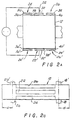
- Figures 2(a) and 2(b) are a cross-sectional view taken at line 2(a)-2(a) and a top planar view of the beam 12 of Figure 1, respectively.
- the electrodes comprise patterned arrangements of metallizations 30, 30', 32, 32' and 34, 34' deposited atop a patterned thin film layer of active pzt electroceramic material comprising underlying segments 36, 36', 38, 38' and 40, 40'.
- the segments of electroceramic material may be deposited upon the silicon beam 12 by a number of processes including, but not limited to, sol-gel deposition and planar magnetron sputtering.
- the electrodes 24 through 26' are fabricated at the top and bottom surfaces of the elongated beam 12. As such, their location facilitates the use of batch processing methods for forming large pluralities of angular velocity sensors.
- Silicon semiconductor processing techniques are essentially "vertical" in nature. That is, various silicon manufacturing processes including, for example, ion etching and photolithography, rely in large measure upon the patterning of horizontal planar surfaces for subsequent processing steps.
- bulk micromachining processing e.g. inductively-coupled plasma reactive ion etching
- silicon-based devices further allows the formation of devices such as the present invention which feature structures having vertically squared-off shapes.
- a top planar view of the elongated beam 12 one may observe that the transverse members or ears 18, 18', 20 and 20' that suspend the elongated bar 12 flexibly within the frame 16 are aligned in pairs 18, 18' and 20, 20' a distance "d" from the opposed ends of the beam 12.
- the distance d is such that the transverse pairs of ears suspend the elongated beam 12 at its nodal points. That is, for a beam 12 of known geometry and material composition, the pairs of aligned ears support the beam 12 at the null or nodal points of beam vibration. By so locating the points of support, maximum Q value is obtained.
- a monolithic device of silicon a high-Q material
- the beam 12 is supported by means of transverse silicon ears 18 through 20' formed integral therewith rather than by means of an organic adhesive, vibrational losses and consequent degradation of Q value is avoided.
- Figures 3(a) and 3(b) are side elevation and top planar views, respectively, of the sensor of Figure 1 for illustrating the vibratory response of the elongated beam 12 to an applied driving signal and the Coriolis force-induced beam vibration experienced by a sensor in accordance with the invention.
- the beam 12 is driven to vibrate at its natural frequency by signals applied to the electrodes 22 and 22' that affect simultaneous contractions and expansions of the segments of electroceramic pzt material 38 and 38' which alternate or oscillate over time.
- the application of the identical waveform to the overlying electrodemetallizations at the top and bottom of the beam 12 will produce the desired tandem of alternating compressions and expansions of the contacting pzt segments to produce bending of the beam 12 within a vertical plane.
- the transverse ears 18 and 20, located at the nodal points of the beam 12 are only minimally stressed by such bending.
- FIG. 3(b) a top planar view of the sensor 10, one can see that the angular velocity-induced deflection of the beam 12 due to Coriolis forces occurs in the horizontal plane, transverse to the plane in which the beam 12 is driven.
- the metallizations 30 and 34 that overlie such electroceramic sections are electrically connected through measuring circuitry (not shown) for measuring the changes in the internal dipole moments of electroceramic segments 36 and 40.
- a similar arrangement measures the stress-induced bending of the electroceramic segments of the pickoff electrodes 24' and 26' located at the bottom of beam 12. Redundant measurement of the angular velocity-induced Coriolis force exerted upon the elongated beam is thereby obtained.
- Figure 4 is a top planar view of a monolithic angular velocity sensor for sensing angular rotation about orthogonal axes 42 and 44.
- the two-axis angular velocity sensor is formed on a silicon substrate 46.
- Orthogonally-directed elongated beams 48 and 50 are suspended within apertures 52 and 54 respectively.
- Each of the elongated beams 48 and 50 includes an arrangement of electrodes of the type described with reference to the single-beam example disclosed above.
- a region 56 indicated by shadow outline, may be provided within the silicon substrate for on-chip integration of both driving and pickoff electronics.
- Figure 5 is a top planar view of a monolithic angular velocity sensor comprising orthogonal arrays of vibrating beam sensors for sensing rotation about orthogonal axes 58 and 60.
- the device is of monolithic design, integral with a silicon substrate 62.
- the array of beams within the aperture 64 is arranged for sensing angular rotation about the axis 58, while those of a second array formed within a second aperture 66 of the substrate 62 are aligned for sensing angular velocity about the axis 60.
- the present invention provides angular velocity sensors based upon MEMS technology that are readily suitable for batch fabrication. As such, they offer much lower production costs than existing devices, making such devices available for applications that have been economically unjustifiable in the past.
- existing silicon device fabrication techniques one may produce angular velocity sensors of substantially-reduced size and cost and high Q with greater sensitivity than the vibrating beam-type angular rotation sensors of the prior art.
- the device is suitable for integration with on-chip electronics, offering the possibility of a self-contained system on a chip.
Landscapes
- Physics & Mathematics (AREA)
- Engineering & Computer Science (AREA)
- General Physics & Mathematics (AREA)
- Radar, Positioning & Navigation (AREA)
- Remote Sensing (AREA)
- Gyroscopes (AREA)
- Pressure Sensors (AREA)
Applications Claiming Priority (2)
| Application Number | Priority Date | Filing Date | Title |
|---|---|---|---|
| US854240 | 1986-04-21 | ||
| US08/854,240 US6250158B1 (en) | 1997-05-09 | 1997-05-09 | Monolithic vibrating beam angular velocity sensor |
Publications (3)
| Publication Number | Publication Date |
|---|---|
| EP0877226A2 true EP0877226A2 (fr) | 1998-11-11 |
| EP0877226A3 EP0877226A3 (fr) | 2000-05-10 |
| EP0877226B1 EP0877226B1 (fr) | 2003-02-12 |
Family
ID=25318130
Family Applications (1)
| Application Number | Title | Priority Date | Filing Date |
|---|---|---|---|
| EP97310093A Expired - Lifetime EP0877226B1 (fr) | 1997-05-09 | 1997-12-15 | Capteur monolithique de vitesse de rotation à barre vibrante |
Country Status (8)
| Country | Link |
|---|---|
| US (1) | US6250158B1 (fr) |
| EP (1) | EP0877226B1 (fr) |
| JP (1) | JP3039860B2 (fr) |
| KR (1) | KR19980086521A (fr) |
| CN (1) | CN1199171A (fr) |
| BR (1) | BR9801582A (fr) |
| DE (1) | DE69719012T2 (fr) |
| NO (1) | NO976138L (fr) |
Cited By (1)
| Publication number | Priority date | Publication date | Assignee | Title |
|---|---|---|---|---|
| RU2219495C1 (ru) * | 2002-07-24 | 2003-12-20 | Федеральное государственное унитарное предприятие "Научно-исследовательский институт прикладной механики им. акад. В.И. Кузнецова" | Вибрационный гироскоп |
Families Citing this family (29)
| Publication number | Priority date | Publication date | Assignee | Title |
|---|---|---|---|---|
| US6639761B1 (en) | 1999-12-02 | 2003-10-28 | Seagate Technology Llc | Micro-actuator damping and humidity protection |
| JP2002286452A (ja) * | 2001-03-26 | 2002-10-03 | Murata Mfg Co Ltd | 振動ジャイロおよびそれを用いた電子装置 |
| JP3687609B2 (ja) * | 2001-04-19 | 2005-08-24 | 株式会社村田製作所 | 振動ジャイロおよびそれを用いた電子装置 |
| AUPR631801A0 (en) * | 2001-07-12 | 2001-08-02 | Luscombe, Andrew | Roadside sensor system |
| USD493416S1 (en) | 2002-06-19 | 2004-07-27 | Viking Technologies, L.C. | Integral actuator with force transfer member |
| USD494923S1 (en) | 2002-06-19 | 2004-08-24 | Viking Technologies, L.C. | Integral force transfer member |
| USD496330S1 (en) | 2002-12-10 | 2004-09-21 | Viking Technologies, L.C. | Integral actuator with hollowed out force transfer member |
| USD493417S1 (en) | 2002-12-10 | 2004-07-27 | Viking Technologies, L.C. | Folded back arm actuator |
| USD493135S1 (en) | 2002-12-10 | 2004-07-20 | Viking Technologies, L.C. | Integral actuator with folded back arms and hollowed out force transfer member |
| USD512085S1 (en) | 2003-06-06 | 2005-11-29 | Viking Technologies, L.C. | Folded back arm actuator with enlarged central anvil |
| US7091451B2 (en) * | 2003-06-20 | 2006-08-15 | Northrop Grumman Corporation | Heating element induction of time-varying thermal gradient in elongated beam to cause one or more elongated beam oscillations |
| CN100559121C (zh) * | 2003-10-20 | 2009-11-11 | 索尼株式会社 | 角速度检测器、利用角速度检测器的角速度检测方法及制造角速度检测器的方法 |
| JP2006214898A (ja) * | 2005-02-04 | 2006-08-17 | Seiko Epson Corp | 圧電デバイス及び電子機器 |
| JP5107399B2 (ja) * | 2005-03-04 | 2012-12-26 | ソニー株式会社 | 振動型ジャイロセンサ |
| JP5037819B2 (ja) * | 2005-03-04 | 2012-10-03 | ソニー株式会社 | 電子機器 |
| US7617728B2 (en) * | 2006-05-17 | 2009-11-17 | Donato Cardarelli | Tuning fork gyroscope |
| US8079259B2 (en) * | 2005-06-27 | 2011-12-20 | Milli Sensor Systems & Actuators | MEMS gyroscope with output oscillation about the normal to the plane |
| US8087296B2 (en) * | 2006-03-15 | 2012-01-03 | Panasonic Corporation | Angular velocity sensor |
| FR2898884B1 (fr) * | 2006-03-27 | 2008-05-02 | Commissariat Energie Atomique | Micro-capteur inertiel resonant a epaisseur variable realise en technologies de surface |
| JP2008076222A (ja) * | 2006-09-21 | 2008-04-03 | Fujitsu Ltd | 音叉型振動ジャイロセンサ |
| US7571648B2 (en) * | 2007-05-23 | 2009-08-11 | Seiko Epson Corporation | Piezoelectric vibration angular velocity sensor |
| JP4509152B2 (ja) * | 2007-08-28 | 2010-07-21 | シャープ株式会社 | 薄膜圧電トランスおよびその製造方法 |
| FI119895B (fi) * | 2007-10-05 | 2009-04-30 | Vti Technologies Oy | Värähtelevä mikromekaaninen kulmanopeusanturi |
| JP2009198493A (ja) * | 2007-12-26 | 2009-09-03 | Rohm Co Ltd | 角速度検出装置 |
| CN102662074B (zh) * | 2012-06-06 | 2014-02-19 | 重庆邮电大学 | 采用摆动质量块的框架式振动角速率传感器及测量系统 |
| CN103063206B (zh) * | 2012-12-19 | 2015-06-24 | 瑞声科技(南京)有限公司 | 压电陀螺仪 |
| US20160349053A1 (en) * | 2015-06-01 | 2016-12-01 | Analog Devices, Inc. | Micromachined Resonating Beam Gyroscopes |
| KR101724332B1 (ko) * | 2015-12-16 | 2017-04-07 | 국방과학연구소 | 관성 측정 장치 |
| CN112953304B (zh) * | 2021-04-22 | 2022-06-17 | 长春工业大学 | 一种骨伞式道路压电发电装置 |
Family Cites Families (12)
| Publication number | Priority date | Publication date | Assignee | Title |
|---|---|---|---|---|
| US3520195A (en) | 1965-10-11 | 1970-07-14 | Gen Electric | Solid state angular velocity sensing device |
| US4305298A (en) * | 1978-08-28 | 1981-12-15 | Itt Industries, Inc. | Mechanical resonator arrangements |
| JPS61114123A (ja) | 1984-11-09 | 1986-05-31 | Hitachi Ltd | 振動ジヤイロ |
| JPH0821722B2 (ja) * | 1985-10-08 | 1996-03-04 | 日本電装株式会社 | 半導体振動・加速度検出装置 |
| US4836023A (en) * | 1988-03-09 | 1989-06-06 | Yazaki Corporation | Vibrational angular rate sensor |
| US5056366A (en) | 1989-12-26 | 1991-10-15 | Litton Systems, Inc. | Piezoelectric vibratory rate sensor |
| US5331852A (en) * | 1991-09-11 | 1994-07-26 | The Charles Stark Draper Laboratory, Inc. | Electromagnetic rebalanced micromechanical transducer |
| JPH05333038A (ja) | 1992-06-03 | 1993-12-17 | Canon Inc | 角速度センサ |
| US5430342A (en) * | 1993-04-27 | 1995-07-04 | Watson Industries, Inc. | Single bar type vibrating element angular rate sensor system |
| JPH07131280A (ja) | 1993-10-28 | 1995-05-19 | Toyota Motor Corp | 振動子の支持構造 |
| JP3291968B2 (ja) * | 1994-12-15 | 2002-06-17 | 株式会社村田製作所 | 振動ジャイロ |
| GB2300047B (en) * | 1995-04-19 | 1999-04-14 | Smiths Industries Plc | Inertial sensor assemblies |
-
1997
- 1997-05-09 US US08/854,240 patent/US6250158B1/en not_active Expired - Fee Related
- 1997-12-15 EP EP97310093A patent/EP0877226B1/fr not_active Expired - Lifetime
- 1997-12-15 DE DE69719012T patent/DE69719012T2/de not_active Expired - Fee Related
- 1997-12-30 NO NO976138A patent/NO976138L/no not_active Application Discontinuation
- 1997-12-31 CN CN97126152.0A patent/CN1199171A/zh active Pending
-
1998
- 1998-02-27 JP JP10046495A patent/JP3039860B2/ja not_active Expired - Fee Related
- 1998-03-06 KR KR1019980007395A patent/KR19980086521A/ko not_active Abandoned
- 1998-05-05 BR BR9801582A patent/BR9801582A/pt not_active Application Discontinuation
Cited By (1)
| Publication number | Priority date | Publication date | Assignee | Title |
|---|---|---|---|---|
| RU2219495C1 (ru) * | 2002-07-24 | 2003-12-20 | Федеральное государственное унитарное предприятие "Научно-исследовательский институт прикладной механики им. акад. В.И. Кузнецова" | Вибрационный гироскоп |
Also Published As
| Publication number | Publication date |
|---|---|
| CN1199171A (zh) | 1998-11-18 |
| US6250158B1 (en) | 2001-06-26 |
| EP0877226A3 (fr) | 2000-05-10 |
| DE69719012D1 (de) | 2003-03-20 |
| NO976138L (no) | 1998-11-10 |
| BR9801582A (pt) | 1999-06-15 |
| NO976138D0 (no) | 1997-12-30 |
| EP0877226B1 (fr) | 2003-02-12 |
| DE69719012T2 (de) | 2003-10-09 |
| KR19980086521A (ko) | 1998-12-05 |
| JP3039860B2 (ja) | 2000-05-08 |
| JPH10318759A (ja) | 1998-12-04 |
Similar Documents
| Publication | Publication Date | Title |
|---|---|---|
| EP0877226B1 (fr) | Capteur monolithique de vitesse de rotation à barre vibrante | |
| US5635639A (en) | Micromechanical tuning fork angular rate sensor | |
| EP0604519B1 (fr) | Capteur de vitesse angulaire a diapason du type micromecanique | |
| US6796179B2 (en) | Split-resonator integrated-post MEMS gyroscope | |
| US6837107B2 (en) | Micro-machined multi-sensor providing 1-axis of acceleration sensing and 2-axes of angular rate sensing | |
| US5203208A (en) | Symmetrical micromechanical gyroscope | |
| US6367786B1 (en) | Micromachined double resonator | |
| US8082790B2 (en) | Solid-state inertial sensor on chip | |
| US7017410B2 (en) | Isolated resonator gyroscope with a drive and sense plate | |
| US5796000A (en) | Vibration angular-velocity sensor and process for producing it | |
| JPH08145683A (ja) | 加速度・角速度検出装置 | |
| JPH11337345A (ja) | 振動するマイクロジャイロメータ | |
| EP0904522A1 (fr) | Gyroscope vibrant monte dans une boite miniature | |
| JP3421340B2 (ja) | 強誘電薄膜進行波回転センサ | |
| Kim et al. | A gyroscope array with linked-beam structure | |
| JPH07190782A (ja) | 振動角速度計 | |
| JPH09325032A (ja) | 角速度センサ | |
| RU2234679C2 (ru) | Микромеханический датчик угловой скорости | |
| JPH07151550A (ja) | 振動角速度計 |
Legal Events
| Date | Code | Title | Description |
|---|---|---|---|
| PUAI | Public reference made under article 153(3) epc to a published international application that has entered the european phase |
Free format text: ORIGINAL CODE: 0009012 |
|
| AK | Designated contracting states |
Kind code of ref document: A2 Designated state(s): DE FR GB SE |
|
| AX | Request for extension of the european patent |
Free format text: AL;LT;LV;MK;RO;SI |
|
| PUAL | Search report despatched |
Free format text: ORIGINAL CODE: 0009013 |
|
| AK | Designated contracting states |
Kind code of ref document: A3 Designated state(s): AT BE CH DE DK ES FI FR GB GR IE IT LI LU MC NL PT SE |
|
| AX | Request for extension of the european patent |
Free format text: AL;LT;LV;MK;RO;SI |
|
| 17P | Request for examination filed |
Effective date: 20001106 |
|
| AKX | Designation fees paid |
Free format text: DE FR GB SE |
|
| 17Q | First examination report despatched |
Effective date: 20011018 |
|
| GRAH | Despatch of communication of intention to grant a patent |
Free format text: ORIGINAL CODE: EPIDOS IGRA |
|
| GRAH | Despatch of communication of intention to grant a patent |
Free format text: ORIGINAL CODE: EPIDOS IGRA |
|
| GRAA | (expected) grant |
Free format text: ORIGINAL CODE: 0009210 |
|
| AK | Designated contracting states |
Designated state(s): DE FR GB SE |
|
| REG | Reference to a national code |
Ref country code: GB Ref legal event code: FG4D |
|
| REF | Corresponds to: |
Ref document number: 69719012 Country of ref document: DE Date of ref document: 20030320 Kind code of ref document: P |
|
| REG | Reference to a national code |
Ref country code: SE Ref legal event code: TRGR |
|
| ET | Fr: translation filed | ||
| PLBE | No opposition filed within time limit |
Free format text: ORIGINAL CODE: 0009261 |
|
| STAA | Information on the status of an ep patent application or granted ep patent |
Free format text: STATUS: NO OPPOSITION FILED WITHIN TIME LIMIT |
|
| 26N | No opposition filed |
Effective date: 20031113 |
|
| PGFP | Annual fee paid to national office [announced via postgrant information from national office to epo] |
Ref country code: FR Payment date: 20061220 Year of fee payment: 10 |
|
| PGFP | Annual fee paid to national office [announced via postgrant information from national office to epo] |
Ref country code: GB Payment date: 20061222 Year of fee payment: 10 |
|
| PGFP | Annual fee paid to national office [announced via postgrant information from national office to epo] |
Ref country code: SE Payment date: 20061227 Year of fee payment: 10 |
|
| PGFP | Annual fee paid to national office [announced via postgrant information from national office to epo] |
Ref country code: DE Payment date: 20070131 Year of fee payment: 10 |
|
| EUG | Se: european patent has lapsed | ||
| GBPC | Gb: european patent ceased through non-payment of renewal fee |
Effective date: 20071215 |
|
| PG25 | Lapsed in a contracting state [announced via postgrant information from national office to epo] |
Ref country code: SE Free format text: LAPSE BECAUSE OF NON-PAYMENT OF DUE FEES Effective date: 20071216 Ref country code: DE Free format text: LAPSE BECAUSE OF NON-PAYMENT OF DUE FEES Effective date: 20080701 |
|
| REG | Reference to a national code |
Ref country code: FR Ref legal event code: ST Effective date: 20081020 |
|
| PG25 | Lapsed in a contracting state [announced via postgrant information from national office to epo] |
Ref country code: GB Free format text: LAPSE BECAUSE OF NON-PAYMENT OF DUE FEES Effective date: 20071215 |
|
| PG25 | Lapsed in a contracting state [announced via postgrant information from national office to epo] |
Ref country code: FR Free format text: LAPSE BECAUSE OF NON-PAYMENT OF DUE FEES Effective date: 20071231 |