EP0877652B1 - Probengefäss zur blutabnahme - Google Patents
Probengefäss zur blutabnahme Download PDFInfo
- Publication number
- EP0877652B1 EP0877652B1 EP97949956A EP97949956A EP0877652B1 EP 0877652 B1 EP0877652 B1 EP 0877652B1 EP 97949956 A EP97949956 A EP 97949956A EP 97949956 A EP97949956 A EP 97949956A EP 0877652 B1 EP0877652 B1 EP 0877652B1
- Authority
- EP
- European Patent Office
- Prior art keywords
- vessel
- blood
- sample
- capillary
- pct
- Prior art date
- Legal status (The legal status is an assumption and is not a legal conclusion. Google has not performed a legal analysis and makes no representation as to the accuracy of the status listed.)
- Expired - Lifetime
Links
Images
Classifications
-
- B—PERFORMING OPERATIONS; TRANSPORTING
- B01—PHYSICAL OR CHEMICAL PROCESSES OR APPARATUS IN GENERAL
- B01L—CHEMICAL OR PHYSICAL LABORATORY APPARATUS FOR GENERAL USE
- B01L3/00—Containers or dishes for laboratory use, e.g. laboratory glassware; Droppers
- B01L3/50—Containers for the purpose of retaining a material to be analysed, e.g. test tubes
- B01L3/508—Rigid containers without fluid transport within
- B01L3/5082—Test tubes per se
-
- B—PERFORMING OPERATIONS; TRANSPORTING
- B01—PHYSICAL OR CHEMICAL PROCESSES OR APPARATUS IN GENERAL
- B01L—CHEMICAL OR PHYSICAL LABORATORY APPARATUS FOR GENERAL USE
- B01L3/00—Containers or dishes for laboratory use, e.g. laboratory glassware; Droppers
- B01L3/50—Containers for the purpose of retaining a material to be analysed, e.g. test tubes
- B01L3/502—Containers for the purpose of retaining a material to be analysed, e.g. test tubes with fluid transport, e.g. in multi-compartment structures
- B01L3/5021—Test tubes specially adapted for centrifugation purposes
Definitions
- the invention relates to a sample vessel for taking small amounts of blood, consisting of an outer vessel having a collar and an inner vessel arranged therein, which is closed at the bottom and at the top on the discharge side with an open, by a stopper closable, formed from the outer vessel blood collection ring.
- EP 0 517 119 B1 and US Pat. No. 5,458,854 A have disclosed such blood collection devices with a collecting tube for the blood.
- the tube or the blood collection vessel has an integrated, vessel-like blood collection chamber with an open-topped and a closed bottom, rounded end.
- the open end of the container is integrally provided with a scoop-shaped lip portion, via the receiving edge of which the discharged blood can drain into the blood collection space, which in contrast is larger in diameter.
- the upper end of the vessel together with the blade-shaped lip part formed thereon can be closed by a cap. This is attached to the lower end of the vessel during blood collection.
- a supplementary vessel is coupled to the bottom of the vessel according to the US patent.
- a scoop-shaped lip portion or a capillary tube serving as a blood-sampling device is an integral part of a cap which can be attached to the blood-collecting vessel.
- This Blutabitate- or blood sampling devices have in common that they must be specifically targeted for collecting and passing the blood into the blood collection vessel, namely exactly with the blade-shaped Lippelteil on the for the blood collection dotted place of the patient. If positioned incorrectly, the blood can not be properly directed into the vessel, with the result that some of the blood may run along the outside of the vessel. The small amount of capillary blood anyway is therefore sometimes reduced sensitively. In addition, the risk of contamination or injection increases for the taking blood Persons and the laboratory staff considerably.
- Another problem in the preparation and analysis of very small amounts of blood in the laboratory is to find such vessels that fit on the one hand due to their external dimensions in the common laboratory equipment, are labeled (eg with barcode labels) and yet at the same time ensure a level of the sample , which is still good to pipette or manageable.
- a capillary blood volume with the volume of one or more droplets has such a low level that the bulk of the blood is distributed over the inner vessel surface and therefore almost no more sample for the analysis is available.
- vessels are used with a smaller diameter ensuring a sufficient fill level, these do not fit into the commercially available devices.
- vessels that have sufficient dimensions in their relevant, relevant for the upper relevant area and taper downwards, the problem arises that this Do not stick the containers with the standard barcode labels.
- vessels are commercially available whose outer contours correspond to the required dimensions of the commercial laboratory equipment and whose inner vessel diameter is as small and narrow.
- these large dimensional differences between the outer and inner diameter are compensated by a relatively large wall thickness.
- the preparation of such vessels then leads to the injection molding specialist well-known technical problems.
- the required, quite expensive injection molding tool for the preparation of these large wall thickness possessing vessels is always suitable only for the production of vessels made of plastics of a genus.
- vessels of different types of plastic are consequently required depending on the requirements of the sample material. This means that each time the preparation or use of another injection molding tool is necessary, resulting in high investment.
- the invention has for its object to provide a sample container for taking smallest amounts of blood, which can be used to remedy the aforementioned disadvantages and facilitates the removal of but easier to manufacture and provides more variable uses.
- a sample vessel in which the inner vessel is arranged in a separate outer vessel with a fixed seat and provided with a round constantly very thin-walled blood collection ring, the collar of the outer vessel both the inner vessel below the Blutab shakingringes and in a centrifuge introduced outer vessel itself supports. Due to the bipartite of the sample vessel according to the invention with the same round constantly very thin-walled Blood collection ring of the inner vessel and the support collar of the separate outer vessel can achieve several advantages simultaneously.
- So can be different than in one-piece blood vessels with much less effort and far less complicated injection molds for the inner vessel any form and in particular to provide such a design, which has an optimized for the good miscibility of the sample vessel geometry and - eg in a conical inner vessel - a high level of serum or plasma after centrifugation, allowing for a good and easy pipetting off of the supernatant.
- different inner vessels of eg 200, 300 or 500 microliters can be inserted into the outer vessel with regard to their filling volume.
- the wall of the inner vessel extension projecting from the outer vessel in the installed position i.
- the blood collection ring makes handling much easier, as it no longer needs to be taken to specifically target the sample vial, because the extremely thin rim of the blood collection ring makes it easy to catch blood at any point without requiring centering of the vial.
- the blood collection ring is also suitable as a seat for a stopper closing the sample vessel.
- the outer vessel can be - because it is not directly involved in the blood collection - provide such a size that it provides a sufficiently large area for attaching a measure or identification carrier (bar code).
- the covenant of the outer vessel fulfills a dual function; it serves both to support the inner vessel which can be introduced into the outer vessel due to an interference fit with a fixed seat or to be pasted or latched therein, and to support it when introduced into any of the centrifuges commonly used on the market.
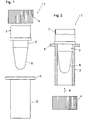
- a sample vessel 1 shown in Fig. 1 consists of a tube-shaped outer vessel 2, an inner vessel 3 and a plug 4.
- the outer vessel 2 is provided with a collar 5, to which in the installation position shown in Fig. 2 with a press fit in the outer vessel 2 inserted inner vessel 3 is supported.
- the bottom closed inner vessel 3 has in the embodiment shown a conical vessel section 6, which still ensures a high level of the serum or plasma after centrifugation, especially in case of a small filling volume, which allows a good and easy pipetting off the desired amount of liquid.
- the inner vessel 3 is formed with an extension in the form of a very thin-walled blood collecting ring 7, which allows an all-round decrease of the collected blood in the inner vessel 3, so that the sample vessel 1 can be attached to any point of the blood collection ring 7; it is thus possible a simple peripheral blood collection by shoveling the exiting blood.
- the plugged in the delivery state on the blood collection ring 7 of the inner vessel 3 plug 4 can be inserted during the blood intake to the lower end of the outer vessel 2, as illustrated in Fig. 2 by the arrow 8.
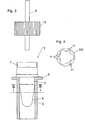
- the two-part sample container 1 according to the modification shown in Fig. 3 in a simple way also the possibility of blood sampling through a capillary 9. This is there arranged in a holding stopper 10, which is attached to the blood collection ring 7, so that the lower end of the capillary in the inner vessel 3 opens and the discharged blood consequently leads into the inner vessel 3.
- a suitable venting of the inner vessel ensures that the blood enters the capillary 9- In the delivery state of the capillary 9 carrying holding plug 10 closes the inner vessel 3, while a as shown in Fig. 2, not shown here sealing plug 4 on the lower end the outer vessel 2 is inserted.
- the empty capillary 9 is removed together with the holding stopper 10 from the sample vessel 1 or the blood withdrawal ring 7 of the inner vessel 3 and disposed of; the stopper 4 is then attached to the blood collection ring 7 and the sample vessel 1 thus closed.
- the inner vessel 3 can be formed with a flow aid 11, the embodiment of the flow aid 11 shown in FIG. 4 a largely simplified production, eg by milling, enabled.
Landscapes
- Health & Medical Sciences (AREA)
- Chemical & Material Sciences (AREA)
- Analytical Chemistry (AREA)
- General Health & Medical Sciences (AREA)
- Hematology (AREA)
- Clinical Laboratory Science (AREA)
- Chemical Kinetics & Catalysis (AREA)
- Investigating Or Analysing Biological Materials (AREA)
- Measurement Of The Respiration, Hearing Ability, Form, And Blood Characteristics Of Living Organisms (AREA)
- Centrifugal Separators (AREA)
- Sampling And Sample Adjustment (AREA)
- Medical Preparation Storing Or Oral Administration Devices (AREA)
Description
- Die Erfindung betrifft ein Probengefäß zur Abnahme kleinster Blutmengen, bestehend aus einem äußeren, einen Bund besitzenden Gefäß und einem darin angeordneten Innengefäß, das unten geschlossen und oben abnahmeseitig mit einem offenen, durch einen Stopfen verschließbaren, aus dem äußeren Gefäß vorstehenden Blutabnahmering ausgebildet ist.
- Durch die EP 0 517 119 B1 und die US 5 458 854 A sind solche Blutentnahmevorrrichtungen mit einem Sammelröhrchen für das Blut bekanntgeworden. Das Röhrchen bzw. das Blutaufnahmegefäß besitzt einen integrierten, gefäßartigen Blutsammelraum mit einem oben offenen und einem unten geschlossenen, gerundeten Ende. Das offene Ende des Behälters ist einstückig mit einem schaufelförmigen Lippenteil versehen, über dessen Aufnahmerand das abgenommene Blut in den demgegenüber im Durchmesser größer bemessenen Blutsammelraum ablaufen kann. Das obere Ende des Gefäßes samt dem daran angeformten schaufelförmigen Lippenteil läßt sich durch eine Kappe verschließen. Diese wird während der Blutabnahme auf das untere Gefäßende aufgesteckt. Um das Blutentnahmegefäß in eine Standard-Klinikzentrifuge einsetzen zu können, wird gemäß der US-Patentschrift an den Boden des Gefäßes ein Ergänzungsgefäß angekoppelt. Eine derartige Vorrichtung zur Abnahme sehr geringer Blutmengen ist auch aus der EP 0 072 006 B2 bekannt. Bei dieser Ausführung ist ein der Blutabnahme dienendes schaufelförmiges Lippenteil oder ein Kapillarröhrchen ein fester Bestandteil einer auf das Blutaufnahmegefäß aufsteckbaren Kappe.
- Diesen Blutabnahme- bzw. Blutentnahmevorrichtungen ist gemeinsam, daß sie zum Auffangen und Überleiten des Blutes in das Blutaufnahmegefäß gezielt angesetzt werden müssen, nämlich exakt mit dem schaufelförmigen Lippelteil an der zur Blutabnahme punktierten Stelle des Patienten. Bei einer nicht präzisen Positionierung kann das Blut nicht ordnungsgemäß in das Gefäß geleitet werden mit der Folge, daß ein Teil des Blutes außen am Gefäß entlanglaufen kann. Die bei Kapillarblut ohnehin geringen Probenmenge wird daher mitunter empfindlich reduziert. Außerdem erhöht sich die Kontaminations- bzw. Injektionsgefahr für die das Blut entnehmenden Personen und das Laborpersonal beträchtlich.
- Zur Vermeidung einer präzisen Positionierung und damit Vereinfachung der Blutabnahme ist es durch die US 5 038 794 A bekanntgeworden, eine Kapillare mit einem schüsselartigen Trichter auszubilden, wobei die Kapillare mit dem Trichter bzw. der Schüssel in ein Probengefäß eingeschraubt wird, das als Sammelgefäß für die abgenommene Kapillarblutmenge dient.
- Aus der DE 24 39 218 A1 ist es bekannt, das Blut in ein speziell gestaltetes Kapillargefäß abzunehmen, bei dem nämlich nur das Mündungsstück die Form einer Kapillare aufweist, während der übrige Bereich so aufgeweitet ist, daß sich eine Mikropipette einsetzen läßt. Das von dem Mündungsstück abgewandte Ende, d.h. zumindest die große Öffnung der Kapillare läßt sich durch einen Stopfen verschließen, und die Kapillare kann dann, wenn notwendig, in ein im wesentlichen zylindrisches Umgefäß gesteckt werden. Statt das Blut nach dem Entfernen aus dem Kapillargefäß zu zentrifugieren, ist es möglich, das Kapillargefäß unmittelbar selbst zum Zentrifugieren zu verwenden.
- Ein weiteres Problem bei der Aufbereitung und Analyse sehr kleiner Blutmengen im Labor besteht darin, solche Gefäße zu finden, die einerseits aufgrund ihrer äußeren Abmessungen in die gängigen Laborgeräte passen, etikettierbar (z.B. mit Barcode-Etiketten) sind und denoch gleichzeitig einen Füllstand der Probe gewährleisten, der noch gut zu pipettieren bzw. handhabbar ist. Wenn somit Gefäße mit einem für handelsübliche Zentrifugen gängigen Außendurchmesser und den üblichen Wandstärken verwendet werden, so hat eine Kapillarblutmenge mit dem Volumen eines bis mehrerer Tröpfchen einen so geringen Füllstand, daß die Hauptmenge des Blutes über die Gefäßinnenoberfläche verteilt ist und daher fast keine Probe mehr für die Analysen zur Verfügung steht. Werden hingegen Gefäße mit einem einen ausreichenden Füllstand gewährleistenden kleineren Durchmesser eingesetzt, so passen diese nicht in die handelsüblichen Geräte. Bei Gefäßen, die in ihrem für die Geräte geeigneten, relevanten oberen Bereich die ausreichenden Maße besitzen und sich nach unten hin verjüngen, tritt das Problem auf, daß sich diese Gefäße nicht mit den handelsüblichen Barcode-Etiketten bekleben lassen. Um diesen gegensätzlichen maßlichen Anforderungen gerecht zu werden, sind im Handel Gefäße erhältlich, deren Außenkonturen den geforderten Maßen der handelsüblichen Laborgeräte entsprechen und deren Gefäßinnendurchmeser möglichst klein und schmal ist. Diese großen maßlichen Unterschiede zwischen dem Außen- und dem Innendurchmesser werden allerdings durch eine verhältnismäßig sehr große Wanddicke ausgeglichen. Die Herstellung solcher Gefäße führt dann zu den dem Spritzgußfachmann hinlänglich bekannten technischen Problemen. Schließlich kommt noch hinzu, daß das erforderliche, recht aufwendige Spritzgußwerkzeug für die Anfertigung dieser eine große Wandstärke besitzenden Gefäße stets nur für die Herstellung von Gefäßen aus Kunststoffen einer Gattung geeignet ist. Da jedoch unterschiedliche Kunststoffgattungen ein unterschiedliches Verhalten gegenüber Blut oder anderem Probengut zeigen, werden folglich je nach Anforderungen an das Probengut auch Gefäße aus verschiedenen Kunststoffgattungen benötigt. Das bedeutet, daß jedesmal die Anfertigung bzw. Verwendung eines weiteren Spritzgußwerkzeuges notwendig ist, was zu hohen Investitionen führt.
- Der Erfindung liegt die Aufgabe zugrunde, ein Probengefäß zur Entnahme kleinster Blutmengen zu schaffen, mit dem sich die vorgenannten Nachteile beheben lassen und das die Butentnahme erleichtert, dabei einfacher herzustellen ist und variablere Einsatzmöglichkeiten bietet.
- Diese Aufgabe wird erfindungsgemäß durch ein Probengefäß gelöst, bei dem das Innengefäß in einem separaten äußeren Gefäß mit festem Sitz angeordnet und mit einem rundumlaufend gleichbleibend sehr dünnwandig ausgebildeten Blutabnahmering versehen ist, wobei der Bund des äußeren Gefäßes sowohl das Innengefäß unterhalb des Blutabnahmeringes als auch das in eine Zentrifuge eingebrachte äußere Gefäß selbst abstützt. Durch die Zweiteiligkeit des erfindungsgemäßen Probengefäßes mit dem rundumlaufend gleichbleibend sehr dünnwandigen Blutabnahmering des Innengefäßes und dem Stützbund des separaten äußeren Gefäßes lassen sich mehrere Vorteile gleichzeitig erreichen. So läßt sich anders als bei einteiligen Blutgefäßen mit sehr viel geringerem Aufwand und weit weniger komplizierten Spritzgießwerkzeugen für das Innengefäß jede beliebige Form und insbesondere eine solche Gestaltung vorsehen, die eine für die gute Mischbarkeit der Proben optimierte Gefäßgeometrie aufweist und - z.B. bei einem konischen Innengefäß - einen hohen Stand des Serums oder Plasmas nach der Zentrifugation ermöglicht, was ein gutes und einfaches Abpipettieren des Überstandes gestattet. Abgesehen von der freien Materialwahl für die beiden Gefäße, lassen sich in das äußere Gefäß hinsichtlich ihres Füllvolumens verschiedene Innengefäße von z.B. 200, 300 oder 500 Mikroliter einsetzen.
- Die Wand des in der Einbaulage aus dem äußeren Gefäß vorstehenden Innengefäßfortsatzes, d.h. des Blutabnahmeringes vereinfacht die Handhabung ganz wesentlich, denn es braucht nicht mehr darauf geachtet zu werden, das Probengefäß gezielt anzusetzen, denn über den extrem dünnen Rand des Blutabnahmeringes läßt sich das Blut an jeder Stelle leicht abfangen, ohne ein Zentrieren des Gefäßes zu erfordern. Der Blutabnahmering eignet sich gleichzeitig als Sitz für einen das Probengefäß verschließenden Stopfen. Das äußere Gefäß läßt sich - da es an der Blutentnahme direkt nicht beteiligt ist - von solcher Größe vorsehen, daß es eine ausreichend große Fläche zur Anbringung eines Maß- bzw. Kennzeichnungsträgers (bar code) bereitstellt. Weiterhin erfüllt der Bund des äußeren Gefäßes eine Doppelfunktion, er dient nämlich sowohl der Abstützung des aufgrund einer Preßpassung mit festem Sitz in das äußere Gefäß einbringbaren oder dort einklebbaren oder einrastbaren Innengefäßes als auch der Abstützung beim Einbringen in eine beliebige der auf dem Markt gängigen Zentrifugen.
- Weitere Merkmale und Vorteile der Erfindung ergeben sich aus der nachfolgenden Beschreibung, in der Ausführungsbeispiele des Gegenstandes der Erfindung näher erläutert sind. Es zeigen:
- Fig. 1
- in explosiver Darstellung die Gesamtansicht der Einzelteile einer ersten Ausführung eines schematisch gezeigten Probengefäßes;
- Fig. 2
- das zur Blutabnahme bereite Probengefäß gemäß Fig. 1;
- Fig. 3
- das Probengefäß gemäß Fig. 2 in einer abgewandelten Ausführung mit einer aufsteckbaren Kapillare; und
- Fig. 4
- einen Schnitt entlang der Linie IV-IV von Fig. 3.
- Ein in Fig. 1 gezeigtes Probengefäß 1 besteht aus einem röhrchenförmigen äußeren Gefäß 2, einem Innengefäß 3 und einem Stopfen 4. Das äußere Gefäß 2 ist mit einem Bund 5 versehen, an den sich in der in Fig. 2 dargestellten Einbaulage das mit einem Preßsitz in das äußere Gefäß 2 eingesteckte Innengefäß 3 abstützt. Das unten geschlossene Innengefäß 3 besitzt in der gezeigten Ausführung einen konischen Gefäßabschnitt 6, der insbesondere bei mit einem geringen Füllvolumen ausgelegten Innengefäßen dennoch einen nach der Zentrifugation hohen Stand des Serums oder Plasmas gewährleistet, was ein gutes und einfaches Abpipettieren der gewünschten Flüssigkeitsmenge erlaubt.
- Das Innengefäß 3 ist mit einem Fortsatz in Form eines sehr dünnwandigen Blutabnahmeringes 7 ausgebildet, der eine Rundum-Abnahme des in dem Innengefäß 3 aufgefangenen Blutes erlaubt, so daß das Probengefäß 1 mit einer beliebigen Stelle des Blutabnahmeringes 7 angesetzt werden kann; es ist somit eine einfache periphere Blutentnahme durch Aufschaufeln des austretenden Blutes möglich. Der im Anlieferungszustand auf den Blutabnahmering 7 des Innengefäßes 3 aufgesteckte Stopfen 4 kann während der Blutaufnahme auf das untere Ende des äußeren Gefäßes 2 gesteckt werden, wie in Fig. 2 durch den Pfeil 8 verdeutlicht.
- Das zweiteilige Probengefäß 1 bietet gemäß der in Fig. 3 gezeigten Abwandlung auf einfache Weise weiterhin auch die Möglichkeit einer Blutabnahme durch eine Kapillare 9. Diese ist dort in einem Haltestopfen 10 angeordnet, der auf den Blutabnahmering 7 aufgesteckt wird, so daß das untere Kapillarenende in das Innengefäß 3 mündet und das abgenommene Blut folglich in das Innengefäß 3 leitet.
- Eine geeignete Entlüftung des Innengefäßes sorgt hierbei dafür, daß das Blut in die Kapillare 9 gelangt- Im Anlieferungszustand verschließt der die Kapillare 9 tragende Haltestopfen 10 das Innengefäß 3, während ein wie in Fig. 2 dargestellter, hier nicht gezeigter Verschlußstopfen 4 auf das untere Ende des äußeren Gefäßes 2 gesteckt ist. Nach der Blutentnahme wird die leere Kapillare 9 zusammen mit dem Haltestopfen 10 von dem Probengefäß 1 bzw. dem Blutabnahmering 7 des Innengefäßes 3 abgenommen und entsorgt; der Stopfen 4 wird danach auf den Blutabnahmering 7 aufgesteckt und das Probengefäß 1 somit verschlossen. Zur Unterstützung des Fließens des entweder von dem Blutabnahmering 7 oder der Kapillare 9 abgenommenen und in das Innengefäß 3 geleiteten Blutes, kann das Innengefäß 3 mit einer Fließhilfe 11 ausgebildet werden, wobei die in Fig. 4 gezeigte Ausführung der Fließhilfe 11 eine weitestgehend vereinfachte Herstellung, z.B. durch Ausfräsen, ermöglicht.
Claims (1)
- Probengefäß (1) zur Abnahme kleinster Blutmengen, bestehend aus einem äußeren, einen Bund (5) besitzenden Gefäß (2) und einem darin angeordneten Innengefäß (3), das unten geschlossen und oben, abnahmeseitig mit einem offenen, durch einen Stopfen (4) verschließbaren, aus dem äußeren Gefäß (2) vorstehenden Blutabnahmering (7) ausgebildet ist,
dadurch gekennzeichnet,
dass das Innengefäß (3) in einem separaten äußeren Gefäß (2) mit festem Sitz angeordnet und mit einem rundumlaufend gleich bleibend sehr dünnwandig ausgebildeten Blutabnahmering (7) versehen ist, wobei der Bund (5) des äußeren Gefäßes (2) sowohl das Innengefäß (3) unterhalb des Blutaufnahmeringes (7) als auch das in eine Zentrifuge eingebrachte äußere Gefäß (2) selbst abstützt.
Applications Claiming Priority (3)
| Application Number | Priority Date | Filing Date | Title |
|---|---|---|---|
| DE19647673 | 1996-11-19 | ||
| DE19647673A DE19647673C2 (de) | 1996-11-19 | 1996-11-19 | Probengefäß zur Blutabnahme |
| PCT/DE1997/002712 WO1998022218A1 (de) | 1996-11-19 | 1997-11-18 | Probengefäss zur blutabnahme |
Publications (2)
| Publication Number | Publication Date |
|---|---|
| EP0877652A1 EP0877652A1 (de) | 1998-11-18 |
| EP0877652B1 true EP0877652B1 (de) | 2007-01-03 |
Family
ID=7812024
Family Applications (1)
| Application Number | Title | Priority Date | Filing Date |
|---|---|---|---|
| EP97949956A Expired - Lifetime EP0877652B1 (de) | 1996-11-19 | 1997-11-18 | Probengefäss zur blutabnahme |
Country Status (10)
| Country | Link |
|---|---|
| US (1) | US6056925A (de) |
| EP (1) | EP0877652B1 (de) |
| JP (1) | JP3853374B2 (de) |
| AT (1) | ATE350165T1 (de) |
| AU (1) | AU719213B2 (de) |
| CA (1) | CA2241792C (de) |
| DE (2) | DE19647673C2 (de) |
| ES (1) | ES2283030T3 (de) |
| PL (1) | PL185194B1 (de) |
| WO (1) | WO1998022218A1 (de) |
Families Citing this family (29)
| Publication number | Priority date | Publication date | Assignee | Title |
|---|---|---|---|---|
| KR100548188B1 (ko) | 2001-05-07 | 2006-02-02 | 가부시기가이샤 교오리스리가꾸겐규우쇼 | 간이분석기 및 이를 제조하기 위한 방법 |
| US6878346B2 (en) * | 2002-05-17 | 2005-04-12 | Bayer Corporation | Serum transfer cup |
| US20060018799A1 (en) * | 2004-07-21 | 2006-01-26 | Wong Cai Ne W | Universal tissue homogenizer device and methods |
| JP2007167123A (ja) * | 2005-12-19 | 2007-07-05 | Fujifilm Corp | 真空採血管 |
| WO2009008358A1 (ja) * | 2007-07-12 | 2009-01-15 | Sysmex Corporation | 検体容器 |
| CA2718060C (en) * | 2008-03-05 | 2015-08-04 | Becton, Dickinson & Company | Co-molded pierceable stopper and method for making same |
| USD640796S1 (en) | 2009-03-05 | 2011-06-28 | Becton, Dickinson And Company | Collection container |
| USD621522S1 (en) | 2009-09-03 | 2010-08-10 | Becton, Dickinson And Company | Pierceable collection container device |
| USD634024S1 (en) | 2010-01-22 | 2011-03-08 | Becton, Dickinson And Company | Closure for a specimen container having an indicator surface |
| USD662216S1 (en) | 2010-01-22 | 2012-06-19 | Becton, Dickinson And Company | Closure or a specimen container having an indicator surface |
| USD640797S1 (en) | 2010-01-25 | 2011-06-28 | Becton, Dickinson And Company | Specimen collection container having a label |
| USD645972S1 (en) | 2010-01-25 | 2011-09-27 | Becton, Dickinson And Company | Specimen collection container having a label |
| US8973293B2 (en) | 2010-11-19 | 2015-03-10 | Becton, Dickinson And Company | Specimen container label for automated clinical laboratory processing systems |
| US8460620B2 (en) * | 2010-12-03 | 2013-06-11 | Becton, Dickinson And Company | Specimen collection container assembly |
| KR101308107B1 (ko) | 2011-01-03 | 2013-09-12 | 이철문 | 체액 보관용 보조용기 |
| EP2892496B1 (de) | 2012-09-06 | 2017-06-28 | Theranos, Inc. | Vorrichtungen zur entnahme von körperflüssigkeitsproben |
| US9636062B2 (en) | 2012-09-06 | 2017-05-02 | Theranos, Inc. | Systems, devices, and methods for bodily fluid sample collection |
| US9427184B2 (en) | 2012-09-06 | 2016-08-30 | Theranos, Inc. | Systems, devices, and methods for bodily fluid sample collection |
| US10248765B1 (en) | 2012-12-05 | 2019-04-02 | Theranos Ip Company, Llc | Systems, devices, and methods for bodily fluid sample collection, transport, and handling |
| US9386948B2 (en) | 2012-12-05 | 2016-07-12 | Theranos, Inc. | Systems, devices, and methods for bodily fluid sample transport |
| EP2972184A4 (de) | 2013-03-15 | 2016-11-30 | Theranos Inc | Verfahren und vorrichtungen zur probenentnahme und -trennung |
| USD754361S1 (en) | 2013-09-06 | 2016-04-19 | Theranos, Inc. | Sample container |
| US10391497B1 (en) * | 2013-09-09 | 2019-08-27 | Theranos Ip Company, Llc | Devices, methods and systems for reducing sample volume |
| CN113331832A (zh) | 2014-03-12 | 2021-09-03 | 赛拉诺斯知识产权有限责任公司 | 用于体液样品收集的装置和方法 |
| US10371606B2 (en) | 2015-07-21 | 2019-08-06 | Theraos IP Company, LLC | Bodily fluid sample collection and transport |
| WO2017044888A1 (en) | 2015-09-09 | 2017-03-16 | Theranos, Inc. | Methods and devices for sample collection and sample separation |
| JP6751779B2 (ja) * | 2016-06-15 | 2020-09-09 | ホプキンズ、マイケル | 体液の捕集及びサンプリングのためのシリンジ・システム及び方法 |
| US11857966B1 (en) | 2017-03-15 | 2024-01-02 | Labrador Diagnostics Llc | Methods and devices for sample collection and sample separation |
| JP6806268B2 (ja) * | 2017-12-01 | 2021-01-06 | 株式会社島津製作所 | 液体クロマトグラフ分析システム |
Family Cites Families (19)
| Publication number | Priority date | Publication date | Assignee | Title |
|---|---|---|---|---|
| US556599A (en) * | 1896-03-17 | Steam-generator | ||
| GB1247520A (en) * | 1967-10-23 | 1971-09-22 | Ole Rues | Container for laboratory use |
| US3754872A (en) * | 1971-03-18 | 1973-08-28 | Siemens Ag | Test tube for body liquids |
| US3807955A (en) * | 1971-04-15 | 1974-04-30 | Becton Dickinson Co | Serum/plasma isolator cup |
| DE2439518A1 (de) * | 1974-08-17 | 1976-03-04 | Salzgitter Maschinen Ag | Einrichtung zum gruenden einer bohrplattform |
| US4214993A (en) * | 1978-04-03 | 1980-07-29 | E. I. Du Pont De Nemours And Company | Apparatus for separating fluids |
| US4411163A (en) * | 1981-07-27 | 1983-10-25 | American Hospital Supply Corporation | Ventable sample collection device |
| US4397318A (en) * | 1981-08-10 | 1983-08-09 | Becton Dickinson And Company | Blood collector for microcollection container |
| DE3541041A1 (de) * | 1985-11-19 | 1987-05-21 | Sarstedt Kunststoff | Blutsammelgefaess |
| US4755356A (en) * | 1986-01-23 | 1988-07-05 | Robbins Scientific Corporation | Locking microcentrifuge tube |
| US4791938A (en) * | 1987-11-16 | 1988-12-20 | Nanci Van Valkenburg | Capillary blood collector and method |
| DE3843610A1 (de) * | 1988-01-13 | 1989-07-27 | Stephan Dr Diekmann | Trenn- oder reaktionssaeuleneinheit |
| US4830217A (en) * | 1988-02-19 | 1989-05-16 | Becton, Dickinson And Company | Body fluid sample collection tube assembly |
| US5038958A (en) * | 1990-03-02 | 1991-08-13 | Norfolk Scientific, Inc. | Vented microscale centrifuge tube |
| US5236604A (en) * | 1991-05-29 | 1993-08-17 | Sherwood Medical Company | Serum separation blood collection tube and the method of using thereof |
| CA2067695C (en) * | 1991-06-06 | 1997-07-08 | James A. Burns | Blood microcollection tube assembly |
| US5556599A (en) * | 1992-06-29 | 1996-09-17 | Ahmed; Syed M. | Blood sample/fluid system |
| US5384096A (en) * | 1993-05-12 | 1995-01-24 | Becton, Dickinson And Company | Microcollection tube assembly |
| DE4332189A1 (de) * | 1993-09-22 | 1995-03-23 | Braun Melsungen Ag | Blutentnahmevorrichtung |
-
1996
- 1996-11-19 DE DE19647673A patent/DE19647673C2/de not_active Expired - Lifetime
-
1997
- 1997-11-18 US US09/101,942 patent/US6056925A/en not_active Expired - Lifetime
- 1997-11-18 AT AT97949956T patent/ATE350165T1/de active
- 1997-11-18 CA CA002241792A patent/CA2241792C/en not_active Expired - Lifetime
- 1997-11-18 PL PL97327663A patent/PL185194B1/pl unknown
- 1997-11-18 JP JP52307798A patent/JP3853374B2/ja not_active Expired - Lifetime
- 1997-11-18 ES ES97949956T patent/ES2283030T3/es not_active Expired - Lifetime
- 1997-11-18 WO PCT/DE1997/002712 patent/WO1998022218A1/de not_active Ceased
- 1997-11-18 DE DE59712791T patent/DE59712791D1/de not_active Expired - Lifetime
- 1997-11-18 EP EP97949956A patent/EP0877652B1/de not_active Expired - Lifetime
- 1997-11-18 AU AU53087/98A patent/AU719213B2/en not_active Expired
Also Published As
| Publication number | Publication date |
|---|---|
| JP2000506419A (ja) | 2000-05-30 |
| US6056925A (en) | 2000-05-02 |
| PL185194B1 (pl) | 2003-03-31 |
| CA2241792A1 (en) | 1998-05-28 |
| PL327663A1 (en) | 1998-12-21 |
| ATE350165T1 (de) | 2007-01-15 |
| DE59712791D1 (de) | 2007-02-15 |
| AU719213B2 (en) | 2000-05-04 |
| ES2283030T3 (es) | 2007-10-16 |
| CA2241792C (en) | 2006-11-07 |
| EP0877652A1 (de) | 1998-11-18 |
| AU5308798A (en) | 1998-06-10 |
| JP3853374B2 (ja) | 2006-12-06 |
| DE19647673A1 (de) | 1998-05-28 |
| DE19647673C2 (de) | 2000-08-24 |
| WO1998022218A1 (de) | 1998-05-28 |
Similar Documents
| Publication | Publication Date | Title |
|---|---|---|
| EP0877652B1 (de) | Probengefäss zur blutabnahme | |
| DE68913626T2 (de) | Integrierte Zentrifugenröhrchen und Objektträger. | |
| EP3579972B1 (de) | Medizinalröhrchen | |
| DE2625876C3 (de) | Vorrichtung zum Zubereiten von Flüssigkeitsproben zwecks Untersuchung und Analyse | |
| DE69827567T2 (de) | Entnahmegefäß-Anordnung | |
| DE69314462T2 (de) | Abdichtbarer behälter zum konservieren und behandeln analytischer proben | |
| EP2398591B1 (de) | Verfahren und vorrichtung zur bereitstellung von blutbestandteilen | |
| DE6913778U (de) | Pipettiervorrichtung. | |
| US4921618A (en) | Inverted separation and transfer device, and process for using same | |
| WO2002002735A1 (en) | Top and bottom open centrifuge tube | |
| DE3415580C2 (de) | ||
| DE2556636A1 (de) | Becher mit deckel | |
| DE2835358C2 (de) | Gefäß für biochemische und immunologische Untersuchungen | |
| EP0907414A1 (de) | Verfahren zur durchführung chemischer, insbesondere biochemischer reaktionen und pipettierspitze mit reaktionsgefäss und ggf. mit zusätzlichem aufnahmeelement für die pipettierspitze | |
| DE2343987C2 (de) | Sammelbehälter für Blutproben | |
| EP1628578A1 (de) | Verfahren und vorrichtung zum entnehmen, transportieren und aufbewahren einer stuhlprobe | |
| DE3305737A1 (de) | Vorrichtung zum bestimmen der senkungsgeschwindigkeit der roten blutkoerperchen | |
| DE20111082U1 (de) | Vorrichtung zur Behandlung von Biomolekülen | |
| DE69230853T2 (de) | Probenuntersuchungseinheit | |
| DE2324080A1 (de) | Dosiervorrichtung | |
| DE3838313C2 (de) | ||
| DE10201414B4 (de) | Vorrichtung zur Abtrennung von Feststoffen aus flüssigen Proben | |
| DE8433270U1 (de) | Vorrichtung zum Trennen von Blutfraktionen | |
| WO2001056696A1 (de) | Dialysestopfen | |
| WO1993018858A1 (de) | Laborröhrchen für die dosierung von flüssigkeiten |
Legal Events
| Date | Code | Title | Description |
|---|---|---|---|
| PUAI | Public reference made under article 153(3) epc to a published international application that has entered the european phase |
Free format text: ORIGINAL CODE: 0009012 |
|
| 17P | Request for examination filed |
Effective date: 19980623 |
|
| AK | Designated contracting states |
Kind code of ref document: A1 Designated state(s): AT BE CH DE ES FR GB IT LI LU NL |
|
| 17Q | First examination report despatched |
Effective date: 20011018 |
|
| GRAP | Despatch of communication of intention to grant a patent |
Free format text: ORIGINAL CODE: EPIDOSNIGR1 |
|
| GRAS | Grant fee paid |
Free format text: ORIGINAL CODE: EPIDOSNIGR3 |
|
| GRAA | (expected) grant |
Free format text: ORIGINAL CODE: 0009210 |
|
| AK | Designated contracting states |
Kind code of ref document: B1 Designated state(s): AT BE CH DE ES FR GB IT LI LU NL |
|
| REG | Reference to a national code |
Ref country code: GB Ref legal event code: FG4D Free format text: NOT ENGLISH |
|
| REF | Corresponds to: |
Ref document number: 59712791 Country of ref document: DE Date of ref document: 20070215 Kind code of ref document: P |
|
| GBT | Gb: translation of ep patent filed (gb section 77(6)(a)/1977) |
Effective date: 20070410 |
|
| REG | Reference to a national code |
Ref country code: CH Ref legal event code: NV Representative=s name: SCHMAUDER & PARTNER AG PATENTANWALTSBUERO |
|
| ET | Fr: translation filed | ||
| REG | Reference to a national code |
Ref country code: ES Ref legal event code: FG2A Ref document number: 2283030 Country of ref document: ES Kind code of ref document: T3 |
|
| PLBE | No opposition filed within time limit |
Free format text: ORIGINAL CODE: 0009261 |
|
| STAA | Information on the status of an ep patent application or granted ep patent |
Free format text: STATUS: NO OPPOSITION FILED WITHIN TIME LIMIT |
|
| 26N | No opposition filed |
Effective date: 20071005 |
|
| REG | Reference to a national code |
Ref country code: CH Ref legal event code: PCAR Free format text: SCHMAUDER & PARTNER AG PATENT- UND MARKENANWAELTE VSP;ZWAENGIWEG 7;8038 ZUERICH (CH) |
|
| PG25 | Lapsed in a contracting state [announced via postgrant information from national office to epo] |
Ref country code: LU Free format text: LAPSE BECAUSE OF NON-PAYMENT OF DUE FEES Effective date: 20071118 |
|
| REG | Reference to a national code |
Ref country code: FR Ref legal event code: PLFP Year of fee payment: 19 |
|
| REG | Reference to a national code |
Ref country code: FR Ref legal event code: PLFP Year of fee payment: 20 |
|
| REG | Reference to a national code |
Ref country code: DE Ref legal event code: R082 Ref document number: 59712791 Country of ref document: DE Representative=s name: GIHSKE GROSSE KLUEPPEL KROSS BUEROGEMEINSCHAFT, DE |
|
| PGFP | Annual fee paid to national office [announced via postgrant information from national office to epo] |
Ref country code: FR Payment date: 20161014 Year of fee payment: 20 Ref country code: CH Payment date: 20161115 Year of fee payment: 20 Ref country code: NL Payment date: 20161110 Year of fee payment: 20 Ref country code: DE Payment date: 20161003 Year of fee payment: 20 Ref country code: GB Payment date: 20161116 Year of fee payment: 20 |
|
| PGFP | Annual fee paid to national office [announced via postgrant information from national office to epo] |
Ref country code: BE Payment date: 20161013 Year of fee payment: 20 Ref country code: IT Payment date: 20161122 Year of fee payment: 20 Ref country code: AT Payment date: 20161025 Year of fee payment: 20 Ref country code: ES Payment date: 20161011 Year of fee payment: 20 |
|
| REG | Reference to a national code |
Ref country code: DE Ref legal event code: R071 Ref document number: 59712791 Country of ref document: DE |
|
| REG | Reference to a national code |
Ref country code: NL Ref legal event code: MK Effective date: 20171117 |
|
| REG | Reference to a national code |
Ref country code: CH Ref legal event code: PL |
|
| REG | Reference to a national code |
Ref country code: GB Ref legal event code: PE20 Expiry date: 20171117 |
|
| REG | Reference to a national code |
Ref country code: AT Ref legal event code: MK07 Ref document number: 350165 Country of ref document: AT Kind code of ref document: T Effective date: 20171118 |
|
| REG | Reference to a national code |
Ref country code: BE Ref legal event code: MK Effective date: 20171118 |
|
| PG25 | Lapsed in a contracting state [announced via postgrant information from national office to epo] |
Ref country code: GB Free format text: LAPSE BECAUSE OF EXPIRATION OF PROTECTION Effective date: 20171117 |
|
| REG | Reference to a national code |
Ref country code: ES Ref legal event code: FD2A Effective date: 20180508 |
|
| PG25 | Lapsed in a contracting state [announced via postgrant information from national office to epo] |
Ref country code: ES Free format text: LAPSE BECAUSE OF EXPIRATION OF PROTECTION Effective date: 20171119 |