EP0878833A2 - Verfahren zur selektiven Herstellung von Salizid über aktiven Oberflächen von MOS-Vorrichtungen - Google Patents
Verfahren zur selektiven Herstellung von Salizid über aktiven Oberflächen von MOS-Vorrichtungen Download PDFInfo
- Publication number
- EP0878833A2 EP0878833A2 EP98830235A EP98830235A EP0878833A2 EP 0878833 A2 EP0878833 A2 EP 0878833A2 EP 98830235 A EP98830235 A EP 98830235A EP 98830235 A EP98830235 A EP 98830235A EP 0878833 A2 EP0878833 A2 EP 0878833A2
- Authority
- EP
- European Patent Office
- Prior art keywords
- layer
- regions
- gate
- source
- sub
- Prior art date
- Legal status (The legal status is an assumption and is not a legal conclusion. Google has not performed a legal analysis and makes no representation as to the accuracy of the status listed.)
- Granted
Links
Images


Classifications
-
- H—ELECTRICITY
- H10—SEMICONDUCTOR DEVICES; ELECTRIC SOLID-STATE DEVICES NOT OTHERWISE PROVIDED FOR
- H10D—INORGANIC ELECTRIC SEMICONDUCTOR DEVICES
- H10D30/00—Field-effect transistors [FET]
- H10D30/01—Manufacture or treatment
- H10D30/021—Manufacture or treatment of FETs having insulated gates [IGFET]
- H10D30/0223—Manufacture or treatment of FETs having insulated gates [IGFET] having source and drain regions or source and drain extensions self-aligned to sides of the gate
- H10D30/0227—Manufacture or treatment of FETs having insulated gates [IGFET] having source and drain regions or source and drain extensions self-aligned to sides of the gate having both lightly-doped source and drain extensions and source and drain regions self-aligned to the sides of the gate, e.g. lightly-doped drain [LDD] MOSFET or double-diffused drain [DDD] MOSFET
-
- H—ELECTRICITY
- H10—SEMICONDUCTOR DEVICES; ELECTRIC SOLID-STATE DEVICES NOT OTHERWISE PROVIDED FOR
- H10D—INORGANIC ELECTRIC SEMICONDUCTOR DEVICES
- H10D30/00—Field-effect transistors [FET]
- H10D30/01—Manufacture or treatment
- H10D30/021—Manufacture or treatment of FETs having insulated gates [IGFET]
- H10D30/0212—Manufacture or treatment of FETs having insulated gates [IGFET] using self-aligned silicidation
-
- H—ELECTRICITY
- H10—SEMICONDUCTOR DEVICES; ELECTRIC SOLID-STATE DEVICES NOT OTHERWISE PROVIDED FOR
- H10D—INORGANIC ELECTRIC SEMICONDUCTOR DEVICES
- H10D30/00—Field-effect transistors [FET]
- H10D30/01—Manufacture or treatment
- H10D30/021—Manufacture or treatment of FETs having insulated gates [IGFET]
- H10D30/0221—Manufacture or treatment of FETs having insulated gates [IGFET] having asymmetry in the channel direction, e.g. lateral high-voltage MISFETs having drain offset region or extended-drain MOSFETs [EDMOS]
-
- H—ELECTRICITY
- H10—SEMICONDUCTOR DEVICES; ELECTRIC SOLID-STATE DEVICES NOT OTHERWISE PROVIDED FOR
- H10D—INORGANIC ELECTRIC SEMICONDUCTOR DEVICES
- H10D64/00—Electrodes of devices having potential barriers
- H10D64/01—Manufacture or treatment
- H10D64/021—Manufacture or treatment using multiple gate spacer layers, e.g. bilayered sidewall spacers
-
- H—ELECTRICITY
- H10—SEMICONDUCTOR DEVICES; ELECTRIC SOLID-STATE DEVICES NOT OTHERWISE PROVIDED FOR
- H10D—INORGANIC ELECTRIC SEMICONDUCTOR DEVICES
- H10D84/00—Integrated devices formed in or on semiconductor substrates that comprise only semiconducting layers, e.g. on Si wafers or on GaAs-on-Si wafers
- H10D84/01—Manufacture or treatment
- H10D84/0123—Integrating together multiple components covered by H10D12/00 or H10D30/00, e.g. integrating multiple IGBTs
- H10D84/0126—Integrating together multiple components covered by H10D12/00 or H10D30/00, e.g. integrating multiple IGBTs the components including insulated gates, e.g. IGFETs
- H10D84/0165—Integrating together multiple components covered by H10D12/00 or H10D30/00, e.g. integrating multiple IGBTs the components including insulated gates, e.g. IGFETs the components including complementary IGFETs, e.g. CMOS devices
- H10D84/017—Manufacturing their source or drain regions, e.g. silicided source or drain regions
-
- H—ELECTRICITY
- H10—SEMICONDUCTOR DEVICES; ELECTRIC SOLID-STATE DEVICES NOT OTHERWISE PROVIDED FOR
- H10D—INORGANIC ELECTRIC SEMICONDUCTOR DEVICES
- H10D84/00—Integrated devices formed in or on semiconductor substrates that comprise only semiconducting layers, e.g. on Si wafers or on GaAs-on-Si wafers
- H10D84/01—Manufacture or treatment
- H10D84/02—Manufacture or treatment characterised by using material-based technologies
- H10D84/03—Manufacture or treatment characterised by using material-based technologies using Group IV technology, e.g. silicon technology or silicon-carbide [SiC] technology
- H10D84/038—Manufacture or treatment characterised by using material-based technologies using Group IV technology, e.g. silicon technology or silicon-carbide [SiC] technology using silicon technology, e.g. SiGe
Definitions
- the present invention relates to a process for the selective formation of salicide on active areas of MOS devices.
- silicides are formed on active areas of MOS transistors for reducing the resistance of the source and drain diffusions, when these extend significantly.
- a known method for forming a silicide layer on the active areas of MOS transistors provides for forming the gate of the transistor, comprising a gate oxide layer and a polysilicon layer, introducing in the silicon a dopant for the formation of the source and drain diffusions of the transistors, and then the deposition, over the whole surface of the silicon, of a transition metal, in particular Ti and Co, and the performing of a thermal process during which the transition metal reacts with the silicon for creating the silicide.
- silicide layer which forms on the active area of the MOS transistor is automatically aligned with the gate, the process is called “self-aligned-salicidation”, shortly “salicidation”, and the layer thus obtained is correspondingly called “salicide”.
- a drawback in the formation of salicide is due to the consumption of part of the silicon at the interface during the reaction between silicon and the transition metal.
- the source and drain diffusions of the MOS transistors comprise a first region, lightly doped and shallow, and a second region, more heavily doped and of greater thickness, connected to the first region.
- a relatively small dose of dopant is introduced in the silicon, respectively of N type for the N-channel transistors and of type P for the P-channel ones, so as to form said first lightly doped regions of the source and drain diffusions which are automatically aligned with the gate.
- a high dose of dopant, of N or P type is selectively implanted by way of a mask covering the gate and extending over the first lightly doped regions.
- a transition metal is then deposited over the whole silicon surface, and there is performed a thermal process.
- the salicide thus forms both over the more heavily doped and deeper regions of the source and drain diffusions, where as already mentioned it does not causes particular problems, and over the more lightly doped and shallower regions of the source and drain diffusions.
- An object of the present invention is that of providing a process of formation of salicide over active areas of MOS transistors, particularly of the type formed by means of the "drain-Extension" technique, allowing to overcome the above-mentioned problems, in particular avoiding to deteriorate existing lightly doped regions of the source and drain diffusions.
- a process for forming salicide on active areas of MOS transistors each comprising a gate and respective source and drain regions comprising each a first lightly doped sub-region near the gate and a second highly doped sub-region spaced apart from the gate, characterized in that the salicide is formed selectively only over said second highly doped sub-regions of the source and drain regions of the MOS transistors.
- the salicide is formed depositing over the whole surface of the semiconductor wafer a layer of a transition metal, but protecting (masking) those regions of the wafer where the salicide is not to be formed, in particular the first sub-regions of the source and drain regions of the MOS transistors, in such a way as the transition metal is in contact with the silicon over said second sub-regions but not over the first sub-regions.
- the layer of transition metal reacts to form the salicide only in the regions where it is deposited directly over the silicon (mono- or poly-crystalline), remaining unmodified in the other regions, from which it can be removed.
- the same mask is used as that used for the selective introduction of dopant for the formation of the second sub-regions.
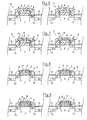
- MOS transistors 10, 11 respectively N-channel and P-channel, formed according to the known technique.
- a gate 2 is formed comprising a gate oxide layer 3 and a polysilicon layer 4.
- the gate 2 there are defined two areas 50 for the formation of first lightly doped N- diffusions 5A of source and drain for MOS transistor 10, obtained by means of implantation and successive diffusion of N type ions in a dose of approximately 10 12 atoms/cm 2 .
- a gate 2 comprising the gate oxide layer 3 and the polysilicon layer 4.
- dielectric material spacers 8 are subsequently formed, by means of conventional techniques, dielectric material spacers 8 on both sides of the gate 2.
- implantations of N type ions at high dose approximately of 10 15 atoms/cm 2 , so to form source and drain sub-regions 12 heavily doped N+.
- source and drain regions 5, 12 for the N-channel transistor 10 each one formed by a first sub-region 5 lightly doped N- and a second sub-regions 12 more heavily doped N+.
- source and drain regions 7, 13 for the P-channel transistor 11 each one composed of a first sub-region 7 lightly doped P- and a second sub-region 13 more heavily doped P+.
- a layer of a transition metal 14 is deposited, for example Ti and Co ( Figure 5), and a thermal process is then executed for the formation of a salicide layer 15.
- the salicide forms only where the transition metal is in contact with the silicon; over the dielectric 9 no salicide is formed; the transition metal is then removed ( Figure 6).
- Figure 6 the presence of the dielectric 9, formed to mask the lightly doped source and drain sub-regions 5 and 7 and the gate 2 of the transistors from the implantations of ions at high dose, is advantageously used to protect regions 5, 7 and the gate 2 from salicidation, thus realizing this process only in the heavily doped sub-regions 12, 13.
- the dielectric layer 9 can comprise a double layer, a first one of SiO 2 18, a second one of Si 3 N 4 19, thus avoiding the direct contact between the silicon and the nitride of said second layer 19. Also in this embodiment the overall thickness of layer 9 ranges from 200 to 500 Angstroms.
- the process according to the invention can also be applied to the salicidation of MOS transistors which, as shown in Figure 8, has a gate 2 comprising, in addition to the gate oxide layer 3 and the polysilicon layer 4, a further dielectric layer 16 suitable for example for improving the lithographic definition process of the gate, so as to avoid the contact between the polysilicon layer 4 and the overlying dielectric layer 9 used for the selective implantation of the high doses of N and P type dopants.
- the process according to the invention can be applied to the salicidation of MOS transistor in which the gate 2, as shown in Figure 9, in addition to the gate oxide layer 3 and the polysilicon layer 4, also comprises a silicide layer 17 formed over the polysilicon layer 4.
- the gate 2 since salicidation 15 cannot be performed over the silicide layer 17, the gate 2 must comprise a further dielectric layer 16 covering the silicide layer 17 where the latter is not protected by the dielectric 9.
- the gate 2 is thus defined leaving on the polysilicon 4 the layer of residual dielectric 16. Once the spacers 8 have been formed, the process according to the invention is performed.
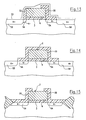
- the insulated gate electrode of the MOSFET comprising the gate oxide 3 and the polysilicon gate 4, and after having formed lightly doped N- source and drain regions by means of a Lightly Doped Drain (LDD) implant (N- for the N-channel MOSFETs, P- for the P-channel MOSFETs, with a dopant dose of approximately 10 12 and, respectively, 10 13 atoms/cm 2 ), the structure shown in Figure 10 is obtained.
- LDD Lightly Doped Drain
- a CVD (Chemical Vapor Deposited) dielectric layer 30 is then deposited over the surface.
- the dielectric layer 30 can be for example an oxide layer formed by TEOS or a layer of nitride, and has preferably a thickness of 150 to 300 nanometers.
- a photoresist mask layer 31 is then formed over the structure.
- a selective etching of the dielectric layer 30 is then performed; where the mask layer 31 is present, the dielectric layer 30 is not removed.
- the mask layer 31 leaves a portion of the N- drain region 5A of the MOSFET covered; at the source side, instead, where the mask layer is not present, during the etching process an insulating sidewall spacer 32 is formed.
- a selective implantation of a high dose of dopants (e.g., 10 15 atoms/cm 2 ) is then performed, so as to form heavily doped N+ source and drain portions 5B. It is to be noted that this selective implant step could as well be performed using a different mask, formed over the structure after the removal of the photoresist layer 31.
- a layer of a transition metal 33 is deposited over the whole surface.
- a thermal process is then performed so as to form, where the transition metal layer is in direct contact with silicon or with polysilicon, a salicide layer, as in the first embodiment previously described.
- the dimension of the N- region 5A at the drain side can be varied as desired.
- the dielectric layer 30 is left over the whole polysilicon gate 4 of the MOSFET, and also covers a portion of the N- source region 5A.
- the salicide layer will only be formed over the heavily doped portions 5B of the source and drain regions of the MOSFET.
- the polysilicon gate 4 of the MOSFETs can comprise a layer of polycide, such as for example Wsi 2 .
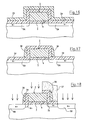
- the process of Figures 10 to 13 also allows for preventing the formation of salicide over the source and drain regions of MOSFETs that do not comprise heavily doped source and drain region portions, as shown in Figure 14.
- the dielectric layer 30 can cover completely the polysilicon gate 4 or, as shown in Figure 14, the polysilicon gate 4 can be left exposed so that a salicide layer is formed over the polysilicon gate 4.
- a fourth embodiment of the invention is shown in Figures 16 to 18.
- two dielectric films 34, 35 are deposited sequentially; the two films preferably have different etch rates.
- the upper film 35 is etched.
- the etching process is stopped when the surface of the lower dielectric film 34 is reached; this can be advantageously achieved if the two films 34, 35 have different etch rates. In this way, as shown in Figure 17, dielectric sidewall spacers 36 are formed.
- a photoresist mask layer 37 is formed over a portion of the N-drain region of the MOSFET, and the lower dielectric film 34 is etched down to the silicon surface where the dielectric film 34 is not covered by either the mask layer 37 or the spacer 36.
- the mask layer 37 could also not be provided with, and in this case a symmetric structure would be obtained, with the N- portion 5A at the drain side having a same extension of the N- portion 5A at the source side.
- the upper film 35 not necessarily is a dielectric film: it could as well be a conductive, which can be selectively removed after the etching processes, before or after the implant steps.
Landscapes
- Insulated Gate Type Field-Effect Transistor (AREA)
- Metal-Oxide And Bipolar Metal-Oxide Semiconductor Integrated Circuits (AREA)
- Electrodes Of Semiconductors (AREA)
Priority Applications (1)
| Application Number | Priority Date | Filing Date | Title |
|---|---|---|---|
| EP98830235A EP0878833B1 (de) | 1997-05-13 | 1998-04-20 | Verfahren zur selektiven Herstellung von Salizid über aktiven Oberflächen von MOS-Vorrichtungen |
Applications Claiming Priority (3)
| Application Number | Priority Date | Filing Date | Title |
|---|---|---|---|
| EP97830219 | 1997-05-13 | ||
| EP97830219 | 1997-05-13 | ||
| EP98830235A EP0878833B1 (de) | 1997-05-13 | 1998-04-20 | Verfahren zur selektiven Herstellung von Salizid über aktiven Oberflächen von MOS-Vorrichtungen |
Publications (3)
| Publication Number | Publication Date |
|---|---|
| EP0878833A2 true EP0878833A2 (de) | 1998-11-18 |
| EP0878833A3 EP0878833A3 (de) | 1999-02-17 |
| EP0878833B1 EP0878833B1 (de) | 2010-06-23 |
Family
ID=26148137
Family Applications (1)
| Application Number | Title | Priority Date | Filing Date |
|---|---|---|---|
| EP98830235A Expired - Lifetime EP0878833B1 (de) | 1997-05-13 | 1998-04-20 | Verfahren zur selektiven Herstellung von Salizid über aktiven Oberflächen von MOS-Vorrichtungen |
Country Status (1)
| Country | Link |
|---|---|
| EP (1) | EP0878833B1 (de) |
Citations (1)
| Publication number | Priority date | Publication date | Assignee | Title |
|---|---|---|---|---|
| US5589423A (en) | 1994-10-03 | 1996-12-31 | Motorola Inc. | Process for fabricating a non-silicided region in an integrated circuit |
Family Cites Families (6)
| Publication number | Priority date | Publication date | Assignee | Title |
|---|---|---|---|---|
| US4868138A (en) * | 1988-03-23 | 1989-09-19 | Sgs-Thomson Microelectronics, Inc. | Method for forming a self-aligned source/drain contact for an MOS transistor |
| DE69224730T2 (de) * | 1991-12-31 | 1998-07-30 | Sgs Thomson Microelectronics | Seitenwand-Abstandsstruktur für Feldeffekttransistor |
| JPH06204173A (ja) * | 1993-01-08 | 1994-07-22 | Nec Corp | 半導体装置の製造方法 |
| US5439839A (en) * | 1994-07-13 | 1995-08-08 | Winbond Electronics Corporation | Self-aligned source/drain MOS process |
| JPH0982949A (ja) * | 1995-09-11 | 1997-03-28 | Denso Corp | 半導体装置及びその製造方法 |
| US5605854A (en) * | 1996-02-20 | 1997-02-25 | Taiwan Semiconductor Manufacturing Company Ltd. | Integrated Ti-W polycide for deep submicron processing |
-
1998
- 1998-04-20 EP EP98830235A patent/EP0878833B1/de not_active Expired - Lifetime
Patent Citations (1)
| Publication number | Priority date | Publication date | Assignee | Title |
|---|---|---|---|---|
| US5589423A (en) | 1994-10-03 | 1996-12-31 | Motorola Inc. | Process for fabricating a non-silicided region in an integrated circuit |
Also Published As
| Publication number | Publication date |
|---|---|
| EP0878833B1 (de) | 2010-06-23 |
| EP0878833A3 (de) | 1999-02-17 |
Similar Documents
| Publication | Publication Date | Title |
|---|---|---|
| US5963803A (en) | Method of making N-channel and P-channel IGFETs with different gate thicknesses and spacer widths | |
| US5583067A (en) | Inverse T-gate semiconductor device with self-aligned punchthrough stops and method of fabrication | |
| US6074915A (en) | Method of making embedded flash memory with salicide and sac structure | |
| US4788160A (en) | Process for formation of shallow silicided junctions | |
| US5933721A (en) | Method for fabricating differential threshold voltage transistor pair | |
| US6528381B2 (en) | Method of forming silicide | |
| US5998849A (en) | Semiconductor device having highly-doped source/drain regions with interior edges in a dislocation-free state | |
| US6096591A (en) | Method of making an IGFET and a protected resistor with reduced processing steps | |
| EP0978141A1 (de) | Herstellungsverfahren für nmos und pmos bauelemente mit reduzierte maskierungsschritten | |
| EP1005081A2 (de) | Halbleiterpermanentspeicher und Verfahren zu dessen Herstellung | |
| US5854115A (en) | Formation of an etch stop layer within a transistor gate conductor to provide for reduction of channel length | |
| US6004849A (en) | Method of making an asymmetrical IGFET with a silicide contact on the drain without a silicide contact on the source | |
| US6207482B1 (en) | Integration method for deep sub-micron dual gate transistor design | |
| US6800901B2 (en) | Process for the selective formation of salicide on active areas of MOS devices | |
| US6008100A (en) | Metal-oxide semiconductor field effect transistor device fabrication process | |
| JPH08213610A (ja) | 電界効果型半導体装置及びその製造方法 | |
| KR100549006B1 (ko) | 완전한 실리사이드 게이트를 갖는 모스 트랜지스터 제조방법 | |
| US6110788A (en) | Surface channel MOS transistors, methods for making the same, and semiconductor devices containing the same | |
| US6780700B2 (en) | Method of fabricating deep sub-micron CMOS source/drain with MDD and selective CVD silicide | |
| JP3518059B2 (ja) | Mis型トランジスタの製造方法 | |
| US6686276B2 (en) | Semiconductor chip having both polycide and salicide gates and methods for making same | |
| US6150244A (en) | Method for fabricating MOS transistor having raised source and drain | |
| KR20010066327A (ko) | 듀얼 게이트전극 제조방법 | |
| EP0878833B1 (de) | Verfahren zur selektiven Herstellung von Salizid über aktiven Oberflächen von MOS-Vorrichtungen | |
| US5976924A (en) | Method of making a self-aligned disposable gate electrode for advanced CMOS design |
Legal Events
| Date | Code | Title | Description |
|---|---|---|---|
| PUAI | Public reference made under article 153(3) epc to a published international application that has entered the european phase |
Free format text: ORIGINAL CODE: 0009012 |
|
| AK | Designated contracting states |
Kind code of ref document: A2 Designated state(s): AT BE CH CY DE DK ES FI FR GB GR IE IT LI LU MC NL PT SE |
|
| AX | Request for extension of the european patent |
Free format text: AL;LT;LV;MK;RO;SI |
|
| PUAL | Search report despatched |
Free format text: ORIGINAL CODE: 0009013 |
|
| AK | Designated contracting states |
Kind code of ref document: A3 Designated state(s): AT BE CH CY DE DK ES FI FR GB GR IE IT LI LU MC NL PT SE |
|
| AX | Request for extension of the european patent |
Free format text: AL;LT;LV;MK;RO;SI |
|
| AKX | Designation fees paid | ||
| REG | Reference to a national code |
Ref country code: DE Ref legal event code: 8566 |
|
| 17P | Request for examination filed |
Effective date: 19990629 |
|
| RBV | Designated contracting states (corrected) |
Designated state(s): DE FR GB IT |
|
| 17Q | First examination report despatched |
Effective date: 20090217 |
|
| GRAP | Despatch of communication of intention to grant a patent |
Free format text: ORIGINAL CODE: EPIDOSNIGR1 |
|
| GRAS | Grant fee paid |
Free format text: ORIGINAL CODE: EPIDOSNIGR3 |
|
| RAP1 | Party data changed (applicant data changed or rights of an application transferred) |
Owner name: STMICROELECTRONICS SRL |
|
| GRAA | (expected) grant |
Free format text: ORIGINAL CODE: 0009210 |
|
| AK | Designated contracting states |
Kind code of ref document: B1 Designated state(s): DE FR GB IT |
|
| REF | Corresponds to: |
Ref document number: 69841732 Country of ref document: DE Date of ref document: 20100805 Kind code of ref document: P |
|
| PLBE | No opposition filed within time limit |
Free format text: ORIGINAL CODE: 0009261 |
|
| STAA | Information on the status of an ep patent application or granted ep patent |
Free format text: STATUS: NO OPPOSITION FILED WITHIN TIME LIMIT |
|
| 26N | No opposition filed |
Effective date: 20110324 |
|
| REG | Reference to a national code |
Ref country code: DE Ref legal event code: R097 Ref document number: 69841732 Country of ref document: DE Effective date: 20110323 |
|
| REG | Reference to a national code |
Ref country code: FR Ref legal event code: PLFP Year of fee payment: 19 |
|
| REG | Reference to a national code |
Ref country code: FR Ref legal event code: PLFP Year of fee payment: 20 |
|
| PGFP | Annual fee paid to national office [announced via postgrant information from national office to epo] |
Ref country code: FR Payment date: 20170322 Year of fee payment: 20 |
|
| PGFP | Annual fee paid to national office [announced via postgrant information from national office to epo] |
Ref country code: GB Payment date: 20170324 Year of fee payment: 20 |
|
| PGFP | Annual fee paid to national office [announced via postgrant information from national office to epo] |
Ref country code: IT Payment date: 20170322 Year of fee payment: 20 |
|
| PGFP | Annual fee paid to national office [announced via postgrant information from national office to epo] |
Ref country code: DE Payment date: 20170321 Year of fee payment: 20 |
|
| REG | Reference to a national code |
Ref country code: DE Ref legal event code: R071 Ref document number: 69841732 Country of ref document: DE |
|
| REG | Reference to a national code |
Ref country code: GB Ref legal event code: PE20 Expiry date: 20180419 |
|
| PG25 | Lapsed in a contracting state [announced via postgrant information from national office to epo] |
Ref country code: GB Free format text: LAPSE BECAUSE OF EXPIRATION OF PROTECTION Effective date: 20180419 |