EP0879643A2 - Bac de lavage centrifuge - Google Patents
Bac de lavage centrifuge Download PDFInfo
- Publication number
- EP0879643A2 EP0879643A2 EP98302825A EP98302825A EP0879643A2 EP 0879643 A2 EP0879643 A2 EP 0879643A2 EP 98302825 A EP98302825 A EP 98302825A EP 98302825 A EP98302825 A EP 98302825A EP 0879643 A2 EP0879643 A2 EP 0879643A2
- Authority
- EP
- European Patent Office
- Prior art keywords
- slurry
- jig
- screen
- zone
- jig screen
- Prior art date
- Legal status (The legal status is an assumption and is not a legal conclusion. Google has not performed a legal analysis and makes no representation as to the accuracy of the status listed.)
- Withdrawn
Links
Images


Classifications
-
- B—PERFORMING OPERATIONS; TRANSPORTING
- B03—SEPARATION OF SOLID MATERIALS USING LIQUIDS OR USING PNEUMATIC TABLES OR JIGS; MAGNETIC OR ELECTROSTATIC SEPARATION OF SOLID MATERIALS FROM SOLID MATERIALS OR FLUIDS; SEPARATION BY HIGH-VOLTAGE ELECTRIC FIELDS
- B03B—SEPARATING SOLID MATERIALS USING LIQUIDS OR USING PNEUMATIC TABLES OR JIGS
- B03B5/00—Washing granular, powdered or lumpy materials; Wet separating
- B03B5/02—Washing granular, powdered or lumpy materials; Wet separating using shaken, pulsated or stirred beds as the principal means of separation
- B03B5/10—Washing granular, powdered or lumpy materials; Wet separating using shaken, pulsated or stirred beds as the principal means of separation on jigs
- B03B5/22—Washing granular, powdered or lumpy materials; Wet separating using shaken, pulsated or stirred beds as the principal means of separation on jigs using pulses generated by liquid injection
Definitions
- This invention relates to jigs utilizing centrifugal force to enhance the separation of heavy and lightweight fractions in a mineral-containing pulp or slurry.
- the present invention pertains to improvements in centrifugal jigs.
- centrifugal jigs are disclosed in U.S. Patent No. 4,279,741 to Campbell, issued July 21, 1981 and titled “Method and Apparatus for Centrifugally Separating a Heavy Fraction From a Light Weight Fraction Within a Pulp Material” and in U.S. Patent No. 4,998,986 to Campbell, issued March 12, 1991 and titled “Centrifugal Jig Pulsing System.” Both patents are hereby incorporated into this disclosure by reference.
- centrifugal jigs can be readily ascertained from the above-referenced patents.
- either the heavy fraction or the lightweight fraction separated by its operation might contain the values desired as an end product.
- a rotor In a centrifugal jig, a rotor is provided to act upon an incoming pulp or slurry.
- the rotor includes a rotating jig screen and a surrounding rotating hutch.
- the hutch is maintained full of fluid during operation.
- Fluid pulses are directed to the interior space of the hutch by a pulsator, such as a rotating supply valve or by pulse blocks which are mounted to the rotor and which spin with it about its central axis.
- a pulsator such as a rotating supply valve or by pulse blocks which are mounted to the rotor and which spin with it about its central axis.
- Other forms of internal or external fluid pulsators may be utilized in conjunction with the improvement of the present disclosure.
- a pre-screened incoming pulp or slurry containing heavy and light fractions in a range of particle sizes is introduced directly onto the separating jig screen.
- the jig screen has openings formed through it of a size sufficient to permit radial outward passage of the particles in the slurry.
- Entrapped lightweight particles are usually discharged along with the heavy particles. Their presence decreases the overall percentage of heavy particles in the resulting recovered fraction. The extent of this problem is a function of the nature of the materials and particle sizes within the incoming slurry and the relative specific gravities of the lightweight and heavy fractions contained within it. In actual practice, the significance of the resulting dilution of recovered material varies substantially from one specific application to another.
- the present disclosure utilizes a split screen to address the problem created by the escape of lightweight particles prior to slurry stratification.
- the incoming slurry is first directed onto a stratification section of the jig screen along which the slurry is radially pulsated. This stratifies the particles according to their respective weights, with the heavier particles being positioned radially outward from those of lesser weight.
- the slurry After being pre-stratified, the slurry is then directed onto a recovery screen section for separation of its lightweight and heavy fractions as detailed in the above-identified patents.
- substantially higher degrees of separation can be achieved by such prestratification.
- the required radial movement of heavier particles that takes place during separation on the jig screen is not accomplished in competition with the stratification of the particles along the same jig screen surface. Lightweight particles are therefore less likely to become entrapped by the outwardly migrating heavy particles.
- the incoming slurry is subjected to centrifugal forces and fluid pulsations to create a fluidic particle bed moving along the axial length of the jig screen.
- the present improvement utilizes an annular jig screen 10 that is formed about a central axis Y-Y for use within the centrifugal jig.
- the improved jig more effectively separates particles within a common size range within a pulp or slurry into a heavy fraction and a lightweight fraction.
- the improved jig screen 10 is a "split screen" that includes a stratification zone 20 and a recovery zone 30 (see Figs. 2 and 3).
- the stratification zone 20 and recovery zone 30 are adjacent to one another. Both are centered along a common central axis Y-Y. They preferably have substantially identical inside diameters.
- Recovery zone 30 extends axially along the central axis Y-Y between a first annular end 11 where slurry enters the recovery zone 30 and a spaced second annular end 12 at the bottom of jig screen 10 where the remaining lightweight fraction of slurry is discharged from within the jig screen 10.
- Stratification zone 20 also extends axially along the central axis Y-Y. It begins at an annular edge 9 at the top end of jig screen 10 and leads to the first annular end 11 at the upper end of recovery zone 30.
- the annular jig screen 10 is cylindrical. In other embodiments of the invention, the inside diameter of annular jig screen 10 varies along central axis Y-Y. Both the stratification zone 20 and the recovery zone 30, along which the particles within the treated slurry axially migrate, are defined along interior cylindrical surfaces of the jig screen.
- Stratification zone 20 is constructed so as to prohibit outward radial passage of particles in the slurry, while permitting fluid pulsations to be imparted to the slurry during rotation of the jig screen. This results in layering of particles within the slurry according to the specific gravity of the particles making up the slurry before the particles reach the recovery zone 30.
- the pulsating action that occurs in the stratification zone can be the result of two different actions. First, it can be produced by pulsating fluid through a rigid permeable layer or membrane containing openings of a size that prohibits outward passage of the slurry particles. Secondly, it can be produced by directing fluid pulsations against the outside surface of a flexible non-permeable membrane that moves inwardly and outwardly in response to the pulses to which it is subjected.
- the stratification zone 20 and recovery zone 30 can be separately formed of differing screen or membrane materials. They also can be formed by simply lining a portion of the interior axial length of the jig screen at its incoming axial end.
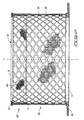
- Figs. 2 and 3 illustrate stratification zones 20 formed within a supporting jig screen.
- zone 20 is formed as a permeable rigid screen 40.
- Fig. 3 it is formed as a flexible non-permeable membrane 41.
- the centrifugal jig includes a rotor 15 movably mounted for rotation about the central axis Y-Y.
- a protruding hollow drive shaft 23 on rotor 15 is powered by a motor and a suitable power transmission apparatus (not shown).
- the hollow drive shaft 23 also serves as a slurry inlet, the slurry being propelled downwardly by gravity. The falling slurry drops onto a circular plate 19, which flings it radially outward to a cylindrical baffle ring 28 leading to the interior of the jig screen 10.
- the rotor includes annular jig screen 10 and a surrounding hollow hutch 13.
- the interior of hutch 13 is normally filled with fluid (gaseous or liquid) during operation of the centrifugal jig. Its interior leads to at least one hutch outlet 14.
- a pulsator 16 is provided on the centrifugal jig to direct periodic fluid pulsations into the rotating hutch 13. Pulsations are imparted radially inward against the circumference of the jig screen 10 as it rotates about the central axis Y-Y. Pulsator 16 might include a conventional pump 17 having an inlet conduit at 24 and multiple outlets 25 leading to an annular hollow pulse ring 18 as detailed in referenced U.S. Patent No. 4,998,986. As radial openings 29 within the pulse ring 18 pass the exit of each outlet 25, the interior of pulse ring 18 will be abruptly subjected to the pressurized fluid flow imparted by pump 17. This will create individual jigging pulses that are then imparted to fluid within the hutch 13 and to the particles within the jig screen 10.
- recovery zone 30 has screen openings formed through the jig screen that permit outward radial passage of slurry particles from the interior rotating slurry.
- the same screen openings also permit fluid pulsations from within hutch 13 to be directed radially inward against the particles within the slurry as the jig screen 10 is rotated at a high speed.
- a stationary casing in the form of a shroud 21 surrounds the rotor 15. It includes a first annular partition 22 that collects the lightweight fraction of the slurry discharged from the end of recovery zone 30 in the jig screen 10. It further includes a second annular partition 36 that collects the heavy fraction of the slurry which passes radially outward through the openings along the recovery zone 30.
- shroud 21 The entire interior volume of shroud 21 is normally maintained full of fluid during machine operation. Excess or return fluid can be delivered from a hutch outlet 27 to the pump inlet 24. Particles within the lightweight fraction are discharged at an outlet 26 at the bottom of the first annular partition 22. Particles within the heavy fraction are discharged at an outlet 37 at the bottom of the second annular partition 36.
- split screen 10 Details with respect to the construction of split screen 10 can be seen in the structural alternatives illustrated in Figs. 2 and 3.
- the jig screens are expendable elements in the centrifugal jig, and are constructed so as to be readily replaceable when required.
- Each jig screen 10 is in the form of a cylindrical drum having an upper support rim 31 and a protruding lower support rim 32. Embedded between them are the screens and supports required to maintain the structural integrity of the jig screen during use.
- the upper support rim 31 is adapted to be bolted or clamped between the baffle ring 28 on rotor 15 and a conical flange 33 that assists in directing radial fluid flow about the exterior of the jig screen.
- the lower support rim 32 is bolted or clamped to the bottom surfaces of hutch 13.
- the jig screen 10 is formed about a cylinder of expanded metal 34 that supports a full length section of jig screening 35 leading between supporting rings 31 and 32.
- a short cylinder of fine screen 40 overlaps a portion of the interior surfaces of the screening material 35.
- the screen 40 leads between the supporting ring 31 and the recovery zone 30. Its lower edge 11 forms the demarcation line between the stratification zone 20 and the recovery zone 30.
- the screening material 35 would be provided with openings of a size permitting radial movement of the prescreened particles within the incoming slurry that is to be separated.
- the screen 40 would have much smaller openings, selected so as to have a size substantially preventing movement of particles through it while permitting movement of liquid.
- liquid pulsations can be transmitted through screen 40 directly to the particles being stratified, but the particles cannot move outwardly beyond the interior screen surface.
- stratification can occur as the slurry moves axially along the screening material 36, but separation of particles will not occur until the particles have axially travelled beyond edge 11.
- the jig screen 10 shown in Fig. 3 is essentially similar to that shown in Fig. 2. Identical reference numerals have been used in both Figs. 2 and 3 to designate corresponding elements within them.
- the one difference presented in Fig. 3 is that the screen 40 of Fig. 2 is replaced by a flexible cylindrical membrane 41.
- the membrane 41 is imperforate. It does not permit any passage of water, but vibrations can be transmitted through membrane 41 in response to fluid pulsations directed into the rotating hutch 13 of rotor 15.
- the method for separating the heavy and lightweight fractions of a slurry during operation of the centrifugal jig can be summarized in the following steps:
- the incoming particles of the homogenous slurry cannot pass radially outward through the initial section of screen 40, or membrane 41, which are labelled as stratification zone 20.
- the incoming particles both lightweight and heavy are subjected to centrifugal forces and to fluid pulsations as the particles migrate axially along the direction of axis Y-Y.
- Stratification of the slurry is achieved before the particles reach the first annular end 11 of the recovery zone 30, where the particles within the slurry first enter the area about jig screen 10 that permits outward passage of particles.
- Recovery zone 30 has screen openings that are larger than the particles within the slurry. But now only the heavy particles will pass through the rotating jig screen because of the stratified nature of the slurry.
- the screen size for screening material 35 in the jig screen was sized as 40 mesh and the screen 40 was sized as 150 mesh.
- Each constituted a single layer of screen. They were both supported by a common network of expanded metal. They were made from conventional woven screen, but screening of a "wedge wire” construction can be used as an alternative. If “wedge wire” screening is used, the slots within it can be vertical or horizontal. When the slots are horizontal, the separation between wires can be different in the two described zones 20 and 30.
- a membrane 41 should be used when the finer screening material might become clogged by particles being prestratified.
- a membrane can be made from any flexible resilient material, such as plastic sheeting, rubber, and reinforced composites such as Tyvek (TM).
Landscapes
- Centrifugal Separators (AREA)
- Separation Of Solids By Using Liquids Or Pneumatic Power (AREA)
Applications Claiming Priority (2)
| Application Number | Priority Date | Filing Date | Title |
|---|---|---|---|
| US862285 | 1997-05-23 | ||
| US08/862,285 US5938043A (en) | 1997-05-23 | 1997-05-23 | Centrifugal jig |
Publications (2)
| Publication Number | Publication Date |
|---|---|
| EP0879643A2 true EP0879643A2 (fr) | 1998-11-25 |
| EP0879643A3 EP0879643A3 (fr) | 1999-09-15 |
Family
ID=25338131
Family Applications (1)
| Application Number | Title | Priority Date | Filing Date |
|---|---|---|---|
| EP98302825A Withdrawn EP0879643A3 (fr) | 1997-05-23 | 1998-04-09 | Bac de lavage centrifuge |
Country Status (6)
| Country | Link |
|---|---|
| US (1) | US5938043A (fr) |
| EP (1) | EP0879643A3 (fr) |
| JP (1) | JPH1142441A (fr) |
| AU (1) | AU723967B2 (fr) |
| CA (1) | CA2234590C (fr) |
| ZA (1) | ZA983443B (fr) |
Cited By (1)
| Publication number | Priority date | Publication date | Assignee | Title |
|---|---|---|---|---|
| CN102189036A (zh) * | 2010-03-15 | 2011-09-21 | 钦州鑫能源科技有限公司 | 离心跳汰机 |
Families Citing this family (4)
| Publication number | Priority date | Publication date | Assignee | Title |
|---|---|---|---|---|
| AUPO869197A0 (en) * | 1997-08-20 | 1997-09-11 | Lowan (Management) Pty Limited | Hutch chamber for jig |
| US6138375A (en) * | 1999-03-01 | 2000-10-31 | Gala Industries, Inc. | Support ring for pellet dryer screen |
| SE9902697D0 (sv) * | 1999-07-14 | 1999-07-14 | Astra Ab | Filter device |
| EP1767273A1 (fr) * | 2005-09-27 | 2007-03-28 | Genimin | Procédé et appareil pour la concentration de matières à l'état de particules solides |
Family Cites Families (18)
| Publication number | Priority date | Publication date | Assignee | Title |
|---|---|---|---|---|
| US1770854A (en) * | 1930-05-14 | 1930-07-15 | Herbert B Johnson | Centrifugal basket and lining therefor |
| DE1209957B (de) * | 1964-06-19 | 1966-01-27 | Salzgitter Maschinen Ag | Vollmantel-Schleudertrommel |
| GB1450634A (en) * | 1974-05-24 | 1976-09-22 | Braunschweigische Masch Bau | Centrifuge for the continuous separation of solids from fluids |
| CH641976A5 (de) * | 1979-01-19 | 1984-03-30 | Buehler Ag Geb | Vorrichtung zur trockenen reinigung von getreide. |
| US4279741A (en) * | 1979-05-07 | 1981-07-21 | Intercontinental Development Corporation | Method and apparatus for centrifugally separating a heavy fraction from a light weight fraction within a pulp material |
| US4247392A (en) * | 1979-06-27 | 1981-01-27 | Goncharov Evgeny S | Screen for vibrating centrifugal separation machines |
| DE3020211A1 (de) * | 1980-05-28 | 1981-12-03 | Krauss-Maffei AG, 8000 München | Verfahren zum entwaessern von in suspensionen enthaltenen farbstoffen |
| ZA821077B (en) * | 1981-02-23 | 1983-04-27 | Lowan Ltd | Apparatus for the separation of particles from a slurry |
| US4515689A (en) * | 1982-12-03 | 1985-05-07 | Clasicon (Proprietary) Limited | Classifying means |
| US4608040A (en) * | 1983-07-05 | 1986-08-26 | Knelson Benjamin V | Centrifugal separator |
| US4574046A (en) * | 1984-09-21 | 1986-03-04 | Sprow Earnest A | Centrifugal jig for ore beneficiation |
| AR240262A1 (es) * | 1985-01-25 | 1990-03-30 | Lowan Management Pty | Criba hidraulica centrifuga. |
| US4776833A (en) * | 1986-03-24 | 1988-10-11 | Knelson Benjamin V | Centrifugal separator |
| IN174814B (fr) * | 1988-07-01 | 1995-03-18 | Lowan Man Pty Ltd | |
| US4998986A (en) * | 1990-01-25 | 1991-03-12 | Trans Mar, Inc. | Centrifugal jig pulsing system |
| GB9026030D0 (en) * | 1990-11-29 | 1991-01-16 | Ecc Int Ltd | A rotary screen device |
| US5361910A (en) * | 1993-05-26 | 1994-11-08 | Westinghouse Electric Corporation | Modified mineral jig |
| US5458776A (en) * | 1993-12-21 | 1995-10-17 | Haahjem North American, Inc. | Sand dewatering centriguse |
-
1997
- 1997-05-23 US US08/862,285 patent/US5938043A/en not_active Expired - Fee Related
-
1998
- 1998-04-09 EP EP98302825A patent/EP0879643A3/fr not_active Withdrawn
- 1998-04-09 CA CA002234590A patent/CA2234590C/fr not_active Expired - Fee Related
- 1998-04-23 ZA ZA983443A patent/ZA983443B/xx unknown
- 1998-05-21 AU AU68018/98A patent/AU723967B2/en not_active Ceased
- 1998-05-22 JP JP10140299A patent/JPH1142441A/ja active Pending
Cited By (2)
| Publication number | Priority date | Publication date | Assignee | Title |
|---|---|---|---|---|
| CN102189036A (zh) * | 2010-03-15 | 2011-09-21 | 钦州鑫能源科技有限公司 | 离心跳汰机 |
| CN102189036B (zh) * | 2010-03-15 | 2013-10-16 | 钦州鑫能源科技有限公司 | 离心跳汰机 |
Also Published As
| Publication number | Publication date |
|---|---|
| JPH1142441A (ja) | 1999-02-16 |
| CA2234590C (fr) | 2006-11-21 |
| ZA983443B (en) | 1999-02-19 |
| CA2234590A1 (fr) | 1998-11-23 |
| AU6801898A (en) | 1998-11-26 |
| AU723967B2 (en) | 2000-09-07 |
| US5938043A (en) | 1999-08-17 |
| EP0879643A3 (fr) | 1999-09-15 |
Similar Documents
| Publication | Publication Date | Title |
|---|---|---|
| CA1159422A (fr) | Methode et appareil pour separer par centrifugation une fraction lourde d'une fraction legere dans une pate | |
| US3899414A (en) | Drilling mud separation system | |
| US4107033A (en) | Apparatus for cleaning fibrous suspensions of low stock consistency | |
| AU767588B2 (en) | Method and apparatus for separating pulp material | |
| US5616245A (en) | High gravity separator | |
| US5366639A (en) | Process of separating using a rotating screen | |
| FI73760C (fi) | Separator foer separation av en blandning av en cellulosamassasuspension och grova, tunga partiklar. | |
| CA2067794C (fr) | Tamis fixe | |
| CA2234590C (fr) | Bac a pistonnage centrifuge | |
| US20190060914A1 (en) | Method and apparatus for centrifugal concentration using vibratory surfaces and rotor bowl for use therein | |
| CN210675855U (zh) | 一种石英砂高效筛分装置 | |
| GB1575312A (en) | Vibratory sifting machines | |
| EP0485153B1 (fr) | Epurateur pour éliminer les noeuds d'une suspension contenant des fibres et des noeuds | |
| EP0511994B1 (fr) | Systeme servant a faire pulser un bac de lavage centrifuge | |
| US2864499A (en) | Heavy media centrifugal separating apparatus and method | |
| US3276591A (en) | Apparatus for treating suspensions | |
| JP3067893B2 (ja) | 製紙用紙料のスクリーニング装置 | |
| US842614A (en) | Apparatus for separating materials. | |
| CA2055025A1 (fr) | Classeur sous pression pour composition de fabrication de papier | |
| JP3710814B2 (ja) | ふるい分け装置 | |
| JPH0418076B2 (fr) | ||
| EP0212785B1 (fr) | Appareil d'épuration pour pâte à papier | |
| GB2343385A (en) | Filter apparatus with tapering filter screen walls | |
| JPH0389960A (ja) | フィルター内蔵型遠心分離機 |
Legal Events
| Date | Code | Title | Description |
|---|---|---|---|
| PUAI | Public reference made under article 153(3) epc to a published international application that has entered the european phase |
Free format text: ORIGINAL CODE: 0009012 |
|
| AK | Designated contracting states |
Kind code of ref document: A2 Designated state(s): AT BE CH CY DE DK ES FI FR GB GR IE IT LI LU MC NL PT SE |
|
| AX | Request for extension of the european patent |
Free format text: AL;LT;LV;MK;RO;SI |
|
| PUAL | Search report despatched |
Free format text: ORIGINAL CODE: 0009013 |
|
| AK | Designated contracting states |
Kind code of ref document: A3 Designated state(s): AT BE CH CY DE DK ES FI FR GB GR IE IT LI LU MC NL PT SE |
|
| AX | Request for extension of the european patent |
Free format text: AL;LT;LV;MK;RO;SI |
|
| AKX | Designation fees paid | ||
| REG | Reference to a national code |
Ref country code: DE Ref legal event code: 8566 |
|
| STAA | Information on the status of an ep patent application or granted ep patent |
Free format text: STATUS: THE APPLICATION IS DEEMED TO BE WITHDRAWN |
|
| 18D | Application deemed to be withdrawn |
Effective date: 20000316 |