EP0879785A2 - Kontainerkran - Google Patents
Kontainerkran Download PDFInfo
- Publication number
- EP0879785A2 EP0879785A2 EP98303465A EP98303465A EP0879785A2 EP 0879785 A2 EP0879785 A2 EP 0879785A2 EP 98303465 A EP98303465 A EP 98303465A EP 98303465 A EP98303465 A EP 98303465A EP 0879785 A2 EP0879785 A2 EP 0879785A2
- Authority
- EP
- European Patent Office
- Prior art keywords
- trolley
- boom
- container
- girder
- stage
- Prior art date
- Legal status (The legal status is an assumption and is not a legal conclusion. Google has not performed a legal analysis and makes no representation as to the accuracy of the status listed.)
- Withdrawn
Links
Images

Classifications
-
- B—PERFORMING OPERATIONS; TRANSPORTING
- B66—HOISTING; LIFTING; HAULING
- B66C—CRANES; LOAD-ENGAGING ELEMENTS OR DEVICES FOR CRANES, CAPSTANS, WINCHES, OR TACKLES
- B66C19/00—Cranes comprising trolleys or crabs running on fixed or movable bridges or gantries
- B66C19/002—Container cranes
-
- B—PERFORMING OPERATIONS; TRANSPORTING
- B66—HOISTING; LIFTING; HAULING
- B66C—CRANES; LOAD-ENGAGING ELEMENTS OR DEVICES FOR CRANES, CAPSTANS, WINCHES, OR TACKLES
- B66C7/00—Runways, tracks or trackways for trolleys or cranes
- B66C7/08—Constructional features of runway rails or rail mountings
-
- B—PERFORMING OPERATIONS; TRANSPORTING
- B66—HOISTING; LIFTING; HAULING
- B66C—CRANES; LOAD-ENGAGING ELEMENTS OR DEVICES FOR CRANES, CAPSTANS, WINCHES, OR TACKLES
- B66C2700/00—Cranes
- B66C2700/01—General aspects of mobile cranes, overhead travelling cranes, gantry cranes, loading bridges, cranes for building ships on slipways, cranes for foundries or cranes for public works
- B66C2700/012—Trolleys or runways
- B66C2700/018—Construction details related to the trolley movement
Definitions
- the present invention relates to a container crane and in particularly to a container crane for handling or loading and unloading a container.
- the container is lifted up from a ship through a trolley at a side of sea, by running one or both of this trolley and a relay use trolley (the central trolley), a stage for receiving the relay use trolley is positioned at a lower portion of the container which is lifted down by the trolley and then the container is loaded on the stage.
- a relay use trolley the central trolley
- the container of the relay use trolley is positioned at a lower portion of the land side trolley and the container is transferred to the land side trolley.
- the land side trolley gets the container off on the land.
- a second girder is provided and this second girder is positioned at a lower portion of a boom to which a trolley runs.
- the second girder has the same length to that of the boom and further in this second girder a vehicle or a carriage on which a container is loaded runs.
- the container is lifted up by the trolley and is loaded on the vehicle.
- the vehicle runs at a side of leg of the container crane and the vehicle is transported at a side of the ground using a lifter.
- the second girder on which the vehicle runs is ascended and descended or is lifted up and down.
- a second girder is provided and this second girder comprises a conveyor at a lower portion of a running range of two trolleys. This second girder is moved toward a running direction of the above two trolleys and is ascended and descended. A tip end of the second girder is positioned at an upper portion of a container on a ship.
- the relay use trolley runs by loading the container, the above stated structure or the above stated steel frame becomes a large size and also has a heavy weight construction.
- the trolley, the girder, the boom and the legs for supporting the structure become large heavy weight constructions.
- a height position of the stage for receiving the relay use trolley of the conventional container crane technique shown in the above stated Japanese patent publication No. Hei 7-68,036 is a higher position from a height portion of the containers which are piled up on a deck of the ship.
- the relay use trolley can be positioned at an upper portion of the ship.
- a height of the stage can not alter or change.
- the stage of the relay use trolley in the conventional container crane technique shown in the above stated Japanese utility model laid-open publication No. Sho 59-149,889 can ascend and descend, however the stage can not descend near to the deck of the ship.
- the landing processing proceeds, it is necessary to arise the lifting devices of the sea side trolley and the land side trolley toward the higher position, it takes a time for landing.
- a case for loading the container to the ship can be adopted similarly.
- a first object of the present invention is to provide a container crane having a relay use trolley wherein the container crane having a light weight structure can be obtained.
- a second object of the present invention is to provide a container crane designed to have a relay use trolley wherein the container crane having a light weight structure can be obtained.
- a third object of the present invention is to provide a container crane designed to have a relay use trolley wherein a handling time or a loading and unloading time of a running container of the relay use trolley can be shortened.
- the first object can be attained by provision of a girder and a boom which have a first rail to which two both sides trolleys run and a second rail to which a central trolley runs, and in a condition where said central trolley is positioned at a tip end of a sea side of said second rail, said sea side tip end of said second rail is positioned where a respective lifting devices of said sea side trolley can be hoisting and lowering.
- the second object can be attained by a provision of a girder and a boom which have a first rail to which a first trolley can run and a second rail to which a second trolley can run, and a sea side tip end of said second rail is positioned at a land side from a sea side tip end of said first rail.
- the third object can be attained by a provision of a stage hanged under the relay use trolley which is raised or lowered by ropes, and said ropes are inclined.
- a container crane 20 loads and unloads between a ship S and a vehicle (not shown in figure) etc. at a side of land.
- the container crane 20 installs horizontally a girder 31 at upper portion of four legs 21 and 22.
- a boom 32 is installed and this boom 32 can be rotated toward an upper portion from a horizontal condition.
- An upper end of a mast 24 which is installed at an upper portion of the leg 22 and the girder 31 at a side of the leg 21 are connected through a tension bar 27 each other.
- the upper end of the mast 24 and the boom 32 are connected by a tension bar 28 and a tension bar 29 each other.
- the respective tension bars 28 and 29 comprises a link member or a rope member. Further, a rope for rotating the boom 32 is installed on but this rope is shown in figure.
- the container crane 20 has three trolleys 41, 45 and 60 which run on the girder 31 and the boom 32.
- the boom 32 is one kind of the girder 31. Further, the boom 32 is called as a beam.
- the trolley 41 is installed at a side of land and loads and unloads a container C between the land side and a stage 61 of the relay use trolley 60.
- the trolley 45 loads and unloads the container C between the ship S and the stage 61 of the relay use trolley 60.
- the trolley 45 runs from a tip end of the sea side of the boom 32 near to a tip end of the land side of the girder 31.
- the trolley 41 can run with a range which is from a handling position or a loading and unloading position at the land side to a relay position of the relay use trolley 60.
- the handling position at the land side is between the land side leg 21 and the sea side leg 22 or is the land side position from the land side leg 21.
- a guide means 35G for guiding an ascent and a descent of a lifting device 42 and the container C is installed on.
- the above stated handing position has a range which is from between the leg 21 and the leg 22 to an upper portion (the position of the boom 32) of the ship S.
- the trolley 45 runs mainly between the upper portion of the ship S (the position of the boom 32) and the relay use trolley 60.
- a range of the relay position of the trolley 45 and the relay use trolley 60 is between the leg 21 and the leg 22 and is a range of the upper portion of the ship S near to the position to the leg 22.
- the trolleys 41 and 45 are lifted down the container C by the lifting devices 42 and 46 which attach and detach the container C through the rope.
- the respective lifting devices 42 and 46 is ascended and descended by a hoisting device (not shown in figure).
- the relay use trolley 60 lifts down the stage 61 for loading the container C through a rope 62.
- the stage 61 can load the container C in a case where the container C attaches a stocking cone at a lower face.
- the stage 61 can be ascended and descended.
- the stage 61 can be carried down on the ground under a consideration of a case of an exchange-over for the rope 62.
- the trolleys 41 and 45 can run on rails 47 which are installed at a side face of an inner side of the boom 32 and the girder 31.
- the respective girder 31 and the respective boom 32 is comprised of two parallel members, respectively.
- the two members are connected with plural lateral beams 33 each other.
- Each of the lower portions of the side faces of the inner sides of the members has a rail 35 on which the trolley 41 and the trolley 45 can run.
- an auxiliary beam 37 for supporting the relay use trolley 60 is fixed.
- rails 38 and 39 are installed.
- the auxiliary beam 37 is formed integrally with the girder 31 and the boom 32, the auxiliary beam 37 can form as the girder 31 and also the auxiliary beam 37 can form as the boom 32, however in this case the auxiliary beam 37, the girder 31 and the boom 32 are called by dividing the respective elements for convenience' sake. Further, the auxiliary beam 37 is called by an inclusion in the girder 31 and the boom 32. The auxiliary beam 37 can be called simply as a beam.
- the relay use trolley 60 installs at an outer side of the auxiliary beam 27 and is divided into toward a left side and a right side.
- the respective relay use trolley 60 runs on the rails 38 and 39.
- the respective relay use trolley 60 has a wheel which is mounted on an upper face of the rail 38, a wheel which contacts to the side face (a face of another relay use trolley 60 side) of an inner side of the rail 38, and a wheel which contacts to the side face of the rail 39 (each of the elements is not shown in figure).
- a frame of the relay use trolley 60 has a L shape longitudinal cross-section.
- the frame comprises a vertical piece 81 which has the wheel etc., a horizontal piece 82 which mounts a following running apparatus and a hoisting device 70, and a slantwise member 83 which connects the vertical piece 81 and the horizontal piece 82.
- the above stated container crane construction can form a cantilever system.
- a large space can be obtained at an upper portion of the horizontal piece 82. Therefore, the machine and apparatus such as the hoisting device 70 etc. can be installed easily.
- the rope can be arranged easily by utilizing the upper portion large space.
- the respective relay use trolley 60 has a running apparatus (in which an electric motor etc. is included) for running the relay use trolley 60 and the hoisting device 70 (in which an electric motor etc. is included) for ascending and descending the lifting device 61.
- a controlling apparatus of the relay use trolleys 60 and 60 is arranged at the machining room 50 which is installed on the girder 31, the running (a standstill is included) of the above stated two relay use trolleys 60 is synchronized and further the ascent and the descent or the lifting of the lifting device 61 is synchronized.
- the relay use trolleys 60 and 60 installs various kinds of detectors.
- detectors are a rotation amount detector of the wheel, a running position detector and a rotation amount detector for the hoisting device 70 etc.
- the relay use trolleys 60 and 60 and the machining room 50 are connected through a festoon cable (not shown in figure) similarly to those of the other trolleys 41 and 45.
- an interval between ropes 62a and 62b of the one relay use trolley 60 and the ropes 62a and 62b of the another relay use trolley 60 is larger than a length of the respective lifting devices 42 and 46 and a length of the container C.
- the two legs 22 and 22 are installed at outer sides of the ropes 62a and 62b.
- the end portions of the ropes 62a and 62b which are drawn out for the hoisting device 70 of the respective relay use trolley 60 are fixed on one point of a respective end portion of the stage 61 through sieves 63a and 63b.
- Angles ⁇ 1 and ⁇ 2 of the respective ropes 62a and 62b for constituting the perpendicular line are the same. Accordingly, it is possible to restrain a sway of the stage 61 according to the wind from a longitudinal direction of the container C.
- An apparatus for carrying out the running of the relay use trolley 60 and the ascent and the descent (the lifting) of the stage 61 is not provided on the relay use trolley 60 but it can be installed in the machining room 50. In this case, the fixture points of the ropes 62a and 62b do not exist on the stage 61.
- the respective apparatus for carrying out the running of the trolley 41 and the trolley 45 and the lifting of the lifting devices 62 and 66 can be installed on the trolley 41 and the trolley 45 and in the machining room 50 of the girder 31.
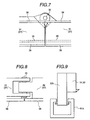
- Fig. 6 is a view taking from a horizontal direction of the right angle direction toward the running direction of the trolley.
- the four ropes 62a, 62b and 62a, 62b which are sent out from the hoisting device 70 are fixed to the stage 61 through the sieves 63a, 63b and 63a, 63b.
- an interval for hanging down the rope from the relay use trolley 60 is sufficiently larger than the interval (the interval for hanging up the stage 61) of the fixture points to the stage 61.
- the inclination angle ⁇ 1 to the respective rope toward the perpendicular line of the respective fixture points is the same.
- the reference numerals "62a, 62b" are expressed by “62” and the reference numerals "63a, 63b” are expressed by "63” case by case in the present specification. Further, the rope 62 can be replaced by the chain.
- the ropes 62a and 62b between the relay use trolley 60 and the stage 61 are inclined, the sway of the stage 61 due to the running of the relay use trolley 60 can be restrained easily. Further, since the ropes 62a and 62b are fixed to the stage 61, the sway of the stage 61 can be restrained easily.
- the sway of the stage 61 can be restrained easily. Further, the inclination angles ⁇ 1 of the respective ropes 62a and 62b are the same, the winding amount of the ropes 62a and 62b by a drum 71 can be formed the same.
- the girders 31, 37 and the booms 32, 37 are connected by a pin 30 each other.
- the bracket which is projected from the girders 31 and 37 and the booms 32 and 37 to an upper portion, is connected by the pin 30. All of the rails 35, 38 and 39 are installed at a lower portion from the installation positions of the pin 30. Since the pin 30 is provided at an upper portion from the installation positions of the rails 35, 38 and 39, the bracket structure can be made simply.
- connection part of the rails 35, 38 and 39 each other can be made vertically.
- the wheels of the relay use trolley 60 are mounted on the horizontal face of the upper surface of the rail 38, however the rail 38 can be inclined toward an inner side.
- the pin 30 can be installed at the lower portion from the installation position of the rail 38.
- the connection part between the rail 31 of the girder 31 and the rail 38 of the boom 32 is installed at the side of the girder 31 from the pin 30 or the side of the boom 32 from the pin 60.
- the connection part is inclined toward the perpendicular line.
- connection part In a case where the connection part is installed at the side of the girder 31, an inclination surface of an end portion of the rail 38 at the side of the girder 31 is positioned at an upper portion from the inclination surface of an end portion of the rail at the side of the boom 32. In a case where the connection part is installed at the side of the boom 32, a relationship of the inclination is formed reversibly.
- the ascent is made to stop.
- the relay use trolley 60 begins to start the running directing for the relay use trolley 60.
- the lifting device 46 is descended to the stage 61 and the container C is unloaded. In a manner stated in above, the transportation of the container C from the ship S in the container crane 20 is carried out.
- the lifting device 46 is ascended a little, the trolley 45 is moved to the sea side directing for the position of a next container C.
- the trolley 45 carries out the lifting (the ascent and the descent) and the running at the same time, such operations will be allowed to carry out.
- the trolley 41 comes to move and is stopped at the position of the relay use trolley 60.
- the trolley 41 is run by holding the height of the lifting device 42 at the height of the upper surface of the container C which is mounted on the stage 61 and the trolley 41 is reached to the upper portion of the stage 61.
- the trolley 41 is descended the lifting device 42 and the lifting device takes hold of the container C of the stage 61. And by ascending and lifting up the container C, the trolley 41 is run directing for the land side. The trolley 41 is descended at the position of the guide means 35G and the container C is unloaded to the vehicle etc. of the ground.
- the standstill position of the relay use trolley 60 and the height position of the stage 61 are determined by making substantially the same the loading time of the trolley 45 from the ship S and the stage 61 and the unloading time of the trolley 41 from the stage 61 to the unloading position at the land side.
- the relay use trolley 60 is positioned at the sea side near the leg 22. In a case of the handling of the container C in the hold of the ship S, the relay use trolley 60 is positioned at the upper portion of the ship S. The standstill position of the relay use trolley 60 is near the position where the lifting device 42 is ascended or descended to the hold of the ship S.
- the standstill position of they relay use trolley 60 and the height position of the stage 61 are calculated and determined by the designation for the next container handling position from an operator of the relay use trolley 60. Or, they are determined successively by the handling schedule at the first time.
- the relay use trolley 60 is carried out automatically.
- the trolley 45 lifts up the container C and is ascended the container C to the height where the relay use trolley 60 can run directing for the stage 61.
- the running height is taken under the consideration about the minimum height as the standard.
- the relay use trolley 60 is run directing for the stage 61.
- the relay use trolley 60 is stopped at the upper portion of the trolley 45 and the lifting device 46 is descended.
- the height position of the stage 61 is the height where the trolley 45 can run at the condition where the container C is hang down and the height of the container C is not changed.
- the height of the stage 61 is lower a little than the lower surface of the lifted up container C.
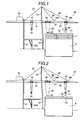
- FIG. 1 shows an initial period condition of the loading, when the container C is loaded at a position of C1 and the container C at the C1 position is lifted up.
- the height position of the stage 61 is a little upper portion higher position than the upper surface of the highest portion container C at a position of C2 at the side of the stage 61 than the container C at the C1 position.
- the lower surface of the container C which has lifted up the lifting device 46 is higher than the stage 61.
- the height of the container C at the position C2 is a height where the running for the trolley 45 becomes obstacle.
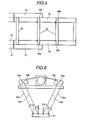
- the height of the pile of the containers C becomes low, and in a case where the container C at the C2 position is loaded, the height position of the stage 61 is a little upper portion higher position than the upper surface of the highest portion container C at a position of C4 at the side of the stage 61 than the container C at a position of C3.
- the height of the container C4 is a height where the running for the trolley 45 becomes obstacle.
- Fig. 2 shows the condition where the container C at the position C3 is lifted up.
- the container C on the deck of the ship S is run out, and a case where the container C at a position of C5 in the hold of the ship S is loaded, the height where the lifted-up container C at the position C5 can be run is a height where the trolley can be run on the deck of the ship S.
- the handling time (the loading and unloading time) using the trolley 41 can be shortened.
- the height of the lifting device 42 of the trolley 41 is substantially the same to the height of the lifting device 46 of the trolley 45. However, the height of the lifting device 42 for taking hold the container C which is mounted on the stage 61 becomes to position at the lower portion in compliance with the taking hold manner.
- the trolley 41 is run directing for the stage 61 and the above stated flipper is contacted with the container C of the stage 61.
- the stage 61 may be swung but the sway can be restrained in accordance with the rope 62 which is stretched slantwise.
- the height position of the stage 61 is higher at the upper portion than the lower surface of the container C where the trolley 45 runs, however it is unnecessary to form so.
- the height position of the stage 61 of the relay use trolley 60 during the handling time is a height in which the running height of the trolley 45 for lifting up the container C directing for the stage 61 is formed as the standard.
- the height position of the stage 61 may be sufficiently positioned at the lower portion than the lower surface of the container C which is loaded by the lifting device 46.
- the trolley 41 for running directing for the stage 61 from the unloading position is ascended the lifting device 42 at the unloading position and such an ascent is stopped at a little upper portion of the height of the stage 61.
- the running of the trolley 41 begins to start and the running is stopped at the upper portion of the stage 61 and the lifting device 42 is descended.
- the trolley 41 for taking hold the container C which is mounted on the stage 61 is ascended a little and is run directing for the unloading position. At the unloading position, the running of the trolley 41 is stopped and then the lifting device 42 is descended.
- the trolley 41 and the trolley 45 are operated manually or automatically.
- the trolley 41 and the trolley 45 can be carried out the running and the ascent and the descent (the lifting) at the same time.
- the control for the sway checking of the lifting device 42 during the running can be carried out easily.
- the relay use trolley 60 can be run automatically and also is ascended and descended automatically.
- the standstill position of the running direction of the relay use trolley 60 is varied or altered in accordance with the position in which the next container C is loaded from the ship S, however it can be set at a single running position against plural containers C. This is performed for the prevention of the sway of the stage 61 .
- the standstill position of the ascent and the descent (the lifting) of the stage 61 can be carried out similarly.
- the stage 61 Since the stage 61 is lifted down from the relay use trolley 60 using the rope 62, in comparison with the structure (the steel frame) it can be made the light weight and the small size structure.
- the stage 61 may be swung according to the sway etc. of the lifting devices 42 and 46. So as to prevent the above stated sway, the stretching angle of the rope 62 for lifting down the stage 61 is formed large.
- the height position of the stage 61 of the relay use trolley 60 during the loading of the container C at the land side to the ship S is formed with the running height of the trolley 45 which lifts up the container C from the stage 61 directing for the ship S is formed as the standard.
- the above stated running height is taken under the consideration about the minimum height.
- the stage 61 is ascended gradually.
- the auxiliary beam 37 (the rails 38 and 39) of the boom 32 exists only at the side of the girder 31 from a vicinity of a connection point 28b between the boom 32 and the tension bar 28.
- the relay use trolley 60 can not run exceeding over the above stated connection point 28b.
- the loads of the auxiliary beam 37 and the relay use trolley 60 are added on the tension bar 28, but they are not added on the tension bar 29. As a result, it is unnecessary to form large the tension bar 29 and therefore it is possible to form with a low cost.
- the relay use trolley 60 is desirable to run by exceeding over the connection point 28b between and the relay use trolley 60 and the tension bar 28. However, at the position of the connection point 28b the handling times of the trolleys 41 and 45 can be made substantially the same.
- connection point 28b is positioned to make substantially the same the handling times of the trolley 41 and the trolley 45. Conversely, the position of the connection point 28b is selected to set substantially the same the handling times of the trolley 41 and the trolley 45.
- a range for burdening the load only on the tension bar 28 is that a central position of the running direction of the relay use trolley 60 is a position where an extension line of the tension bar 28 intersects with the rail 38.
- the position of a tip end at the sea side of the auxiliary beam 37 is a position where, at the condition where the relay use trolley 60 is positioned at the above tip end, the lifting device 46 of the trolley 45 which is positioned at the sea side from the relay use trolley 60 can be ascended and descended.
- auxiliary beam 37 in which the rails 38 and 39 are included, namely the relay use trolley 60 is positioned at the land side from at least the leg 22 at the sea side.
- the auxiliary beam 37 does not exist at the land side from the leg 22 at the land side. Therefore, it can be lessened a possibility about falling down of the container crane 20.
- the relay use trolley 60 does not run, however for the sake of the time shortening the relay use trolley 60 on which the container C is mounted may run.
- the trolley 41 at the land side can employ one in which the trolley 41 is fixed, for example as disclosed in the above stated Japanese utility model laid-open publication No. Sho 59-149,889.
- the girder 31 and the boom 32 within the range where the trolley 41 and the relay use trolley 60 run are installed on the auxiliary beam 37 at a side face of an outer side of the horizontal direction using a welding manner or using bolts.
- the rails 38 and 39 are installed on the auxiliary beam 37.
- the machining room 50 for operating the trolley 41 and the relay use trolley 60 is installed separately on the girder 31. Further, the auxiliary beam 37 is welded to the lower surface of the member, this member is welded to the upper surfaces of the girder 31 and the boom 32 and is projected outwardly.
- the auxiliary beam 37 is one kind of the girder 31 and the boom 32.
- the container crane where the second beam is installed (according to circumstances, the rails 38 and 39 of the relay use trolley 60 are installed) is delivered, then the handling is carried out one trolley. After that, at a time of a second construction stage where the handling amount increases, other two trolleys are added.
- a relay use trolley 60 may employ as a boom supporting type.
- This boom supporting type relay use trolley 60b is lifted down from two rails of an auxiliary beam 37b.
- a lower portion of the auxiliary beam 37b is positioned at the lower portions from the lower portions of the girder 31 and the boom 32 and at this position the rails are installed on.
- the handling manner is carried out substantially similarly.
- the technical range of the present invention is not limited within the wordings which are described in each claim of the what is claimed is item and the wordings which are described in the means for solving the problems item, but it can refer to a range where a man belonged to this technical field can replace easily the elements.
- the light weight structure can be obtained.
- the stage is lifted down from the relay use trolley using the ropes, and since the ropes are inclined, the sway of the stage can be restrained due to the light weight structure, and further the handling time can be shortened.
Landscapes
- Engineering & Computer Science (AREA)
- Mechanical Engineering (AREA)
- Ship Loading And Unloading (AREA)
- Leg Units, Guards, And Driving Tracks Of Cranes (AREA)
- Carriers, Traveling Bodies, And Overhead Traveling Cranes (AREA)
Applications Claiming Priority (3)
| Application Number | Priority Date | Filing Date | Title |
|---|---|---|---|
| JP9133200A JP3039445B2 (ja) | 1997-05-23 | 1997-05-23 | コンテナクレーン |
| JP133200/97 | 1997-05-23 | ||
| JP13320097 | 1997-05-23 |
Publications (2)
| Publication Number | Publication Date |
|---|---|
| EP0879785A2 true EP0879785A2 (de) | 1998-11-25 |
| EP0879785A3 EP0879785A3 (de) | 1999-11-03 |
Family
ID=15099076
Family Applications (1)
| Application Number | Title | Priority Date | Filing Date |
|---|---|---|---|
| EP98303465A Withdrawn EP0879785A3 (de) | 1997-05-23 | 1998-05-01 | Kontainerkran |
Country Status (4)
| Country | Link |
|---|---|
| EP (1) | EP0879785A3 (de) |
| JP (1) | JP3039445B2 (de) |
| KR (1) | KR19980086506A (de) |
| CN (1) | CN1200350A (de) |
Cited By (8)
| Publication number | Priority date | Publication date | Assignee | Title |
|---|---|---|---|---|
| DE10244116A1 (de) * | 2002-09-12 | 2004-03-25 | Gottwald Port Technology Gmbh | Umschlaganlage, insbesondere zum Be- und Entladen von ISO-Containern aus Containerschiffen |
| WO2007132416A3 (en) * | 2006-05-15 | 2008-01-24 | David Peter Dennison | The displacement of containers with respect to a ship |
| ITTV20120116A1 (it) * | 2012-06-13 | 2013-12-14 | Dario Toncelli | Apparato per la movimentazione di lastre e magazzino con tale apparato |
| US9617124B2 (en) | 2011-11-29 | 2017-04-11 | Apm Terminals Bv | Crane |
| CN108584717A (zh) * | 2018-05-22 | 2018-09-28 | 张家港凯斯机械有限公司 | 一种顶吊式集装箱搬运机 |
| CN113415733A (zh) * | 2021-08-24 | 2021-09-21 | 新乡学院 | 一种工业大型储料罐起重吊装设备 |
| CN113979146A (zh) * | 2021-10-27 | 2022-01-28 | 青岛港国际股份有限公司 | 一种与岸桥直接交互的轨道式起重机及其控制方法 |
| CN117166298A (zh) * | 2023-08-16 | 2023-12-05 | 中铁宝桥集团有限公司 | 一种跨坐式单轨道岔尾轴的更换装置及方法 |
Families Citing this family (20)
| Publication number | Priority date | Publication date | Assignee | Title |
|---|---|---|---|---|
| CN1132777C (zh) | 2001-06-13 | 2003-12-31 | 上海振华港口机械股份有限公司 | 无电缆吊具 |
| DE20207072U1 (de) * | 2002-05-03 | 2002-10-10 | Noell Crane Systems GmbH, 97080 Würzburg | Katze an Kranen |
| DE10313769B4 (de) * | 2003-03-22 | 2005-10-06 | Noell Crane Systems Gmbh | Mehrkatzcontainerkran |
| CN1297469C (zh) * | 2003-07-30 | 2007-01-31 | 上海振华港口机械(集团)股份有限公司 | 可吊双40英尺箱的集装箱起重机 |
| CN100341771C (zh) * | 2004-03-31 | 2007-10-10 | 上海振华港口机械(集团)股份有限公司 | 可吊双40英尺箱的双小车集装箱起重机 |
| CN100358796C (zh) * | 2004-04-09 | 2008-01-02 | 上海集装箱码头有限公司 | 吊车运行安全控制装置 |
| KR100683583B1 (ko) * | 2005-03-29 | 2007-02-15 | (주)해우지엘에스 | 하나의 가이드레일 상에 두개의 이동수단이 설치된 크레인 |
| CN100375711C (zh) * | 2005-04-06 | 2008-03-19 | 上海振华港口机械(集团)股份有限公司 | 双40英尺岸边集装箱起重机四卷筒差动式起升机构 |
| CN100375710C (zh) * | 2005-04-06 | 2008-03-19 | 上海振华港口机械(集团)股份有限公司 | 双40英尺岸边集装箱起重机两卷筒差动式起升机构 |
| CN2811252Y (zh) | 2005-04-06 | 2006-08-30 | 上海振华港口机械(集团)股份有限公司 | 双40英尺岸边集装箱起重机双起升机构 |
| CN100545065C (zh) | 2006-04-20 | 2009-09-30 | 上海振华重工(集团)股份有限公司 | 集装箱码头布置方案及装卸流程 |
| CN101229883A (zh) | 2008-01-24 | 2008-07-30 | 上海振华港口机械(集团)股份有限公司 | 集装箱码头装卸系统 |
| CN102173365B (zh) * | 2011-02-24 | 2013-01-09 | 三一集团有限公司 | 集装箱起重机 |
| CN104229630B (zh) * | 2014-09-30 | 2016-03-16 | 华电重工股份有限公司 | 用于岸桥小车的横向平移系统 |
| DE102017105561A1 (de) * | 2017-03-15 | 2018-09-20 | Konecranes Global Corporation | Lager für container und verfahren zum betrieb eines transportfahrzeugs in einem derartigen lager |
| EP3699135B1 (de) * | 2019-02-25 | 2024-07-24 | ABB Schweiz AG | Sensorwagen und entsprechender containerkran |
| ES2860848A1 (es) * | 2020-04-01 | 2021-10-05 | Mayor Juan Carlos Barbera | Grua portico para contenedores y metodo de funcionamiento |
| CN111498692B (zh) * | 2020-04-23 | 2021-12-31 | 青岛港国际股份有限公司 | 自动化码头桥吊安全作业系统及其控制方法 |
| JP7402986B2 (ja) * | 2020-07-15 | 2023-12-21 | 株式会社日立製作所 | コンテナ蔵置計画装置、コンテナ蔵置計画システム、及びコンテナ蔵置計画方法 |
| CN114319966A (zh) * | 2022-01-10 | 2022-04-12 | 成都建工集团有限公司 | 一种适用于城市更新建设的空间布局结构及布局方法 |
Family Cites Families (7)
| Publication number | Priority date | Publication date | Assignee | Title |
|---|---|---|---|---|
| FR1553842A (de) * | 1967-10-04 | 1969-01-17 | ||
| US3630390A (en) * | 1969-02-07 | 1971-12-28 | Hans Tax | Container-loading crane arrangement |
| US4531647A (en) * | 1976-01-14 | 1985-07-30 | Hitachi, Ltd. | Device for stopping the swinging movement of a load hung by a crane |
| DE3826274A1 (de) * | 1988-08-02 | 1990-02-08 | Tax Ingenieurgesellschaft Mbh | Einrichtung zum be- und entladen von containern an schiffen |
| DE4040072A1 (de) * | 1990-12-14 | 1992-08-27 | Technologiepark Clausthal Gmbh | Schwerlast-transportwagen fuer eine schwerlast-verladebruecke |
| DE4307254A1 (de) * | 1993-03-08 | 1994-09-15 | Tax Ingenieurgesellschaft Mbh | Lastenverladekran |
| US5515982A (en) * | 1994-04-11 | 1996-05-14 | Paceco Corp. | Telescoping shuttle for a cargo container handling crane |
-
1997
- 1997-05-23 JP JP9133200A patent/JP3039445B2/ja not_active Expired - Lifetime
-
1998
- 1998-02-18 KR KR1019980004890A patent/KR19980086506A/ko not_active Withdrawn
- 1998-05-01 EP EP98303465A patent/EP0879785A3/de not_active Withdrawn
- 1998-05-22 CN CN98108952A patent/CN1200350A/zh active Pending
Cited By (13)
| Publication number | Priority date | Publication date | Assignee | Title |
|---|---|---|---|---|
| DE10244116A1 (de) * | 2002-09-12 | 2004-03-25 | Gottwald Port Technology Gmbh | Umschlaganlage, insbesondere zum Be- und Entladen von ISO-Containern aus Containerschiffen |
| WO2007132416A3 (en) * | 2006-05-15 | 2008-01-24 | David Peter Dennison | The displacement of containers with respect to a ship |
| US9617124B2 (en) | 2011-11-29 | 2017-04-11 | Apm Terminals Bv | Crane |
| ITTV20120116A1 (it) * | 2012-06-13 | 2013-12-14 | Dario Toncelli | Apparato per la movimentazione di lastre e magazzino con tale apparato |
| WO2013186713A1 (en) * | 2012-06-13 | 2013-12-19 | Dario Toncelli | Apparatus for moving slabs and storage with such apparatus |
| US9950879B2 (en) | 2012-06-13 | 2018-04-24 | Dario Toncelli | Apparatus for moving slabs and storage with such apparatus |
| CN108584717A (zh) * | 2018-05-22 | 2018-09-28 | 张家港凯斯机械有限公司 | 一种顶吊式集装箱搬运机 |
| CN108584717B (zh) * | 2018-05-22 | 2023-10-10 | 江苏凯斯智能装备科技有限公司 | 一种顶吊式集装箱搬运机 |
| CN113415733A (zh) * | 2021-08-24 | 2021-09-21 | 新乡学院 | 一种工业大型储料罐起重吊装设备 |
| CN113415733B (zh) * | 2021-08-24 | 2021-11-02 | 新乡学院 | 一种工业大型储料罐起重吊装设备 |
| CN113979146A (zh) * | 2021-10-27 | 2022-01-28 | 青岛港国际股份有限公司 | 一种与岸桥直接交互的轨道式起重机及其控制方法 |
| CN113979146B (zh) * | 2021-10-27 | 2023-11-03 | 青岛港国际股份有限公司 | 一种与岸桥直接交互的轨道式起重机及其控制方法 |
| CN117166298A (zh) * | 2023-08-16 | 2023-12-05 | 中铁宝桥集团有限公司 | 一种跨坐式单轨道岔尾轴的更换装置及方法 |
Also Published As
| Publication number | Publication date |
|---|---|
| EP0879785A3 (de) | 1999-11-03 |
| JP3039445B2 (ja) | 2000-05-08 |
| KR19980086506A (ko) | 1998-12-05 |
| JPH10324493A (ja) | 1998-12-08 |
| CN1200350A (zh) | 1998-12-02 |
Similar Documents
| Publication | Publication Date | Title |
|---|---|---|
| JP3039445B2 (ja) | コンテナクレーン | |
| US5538382A (en) | Variable level lifting platform for a cargo container handling crane | |
| US4858775A (en) | Personnel trolley and elevator platform for a cargo container handling gantry crane | |
| US4360112A (en) | Two-way extendable crane trolley | |
| EP2694425B1 (de) | Verfahren und system zum heben und handhaben einer last | |
| JP4353343B2 (ja) | 大型昇降ステージとこれを用いた揚重方法および逆打工法 | |
| CN212101728U (zh) | 一种双钢丝绳缠绕的冶金专用起重机 | |
| JP6393954B2 (ja) | クレーンの上架構造体の上架システム及びクレーンの製造方法 | |
| JPH11157777A (ja) | コンテナクレーン | |
| JP3298488B2 (ja) | コンテナクレーン | |
| JPH079156B2 (ja) | セグメント搬送装置 | |
| JPH11189394A (ja) | コンテナクレーン | |
| JP2002060176A (ja) | 吊荷の振れ止め装置 | |
| KR20010016693A (ko) | 고무타이어 부착 다리형 모바일 하버 크레인 | |
| CN216660324U (zh) | 一种集装货物装载装置 | |
| JPWO1999040019A1 (ja) | コンテナクレーン | |
| JP2521455B2 (ja) | 塔状構造物の架設工法 | |
| CN223328952U (zh) | 一种可以移动的提升机构 | |
| JPH0797182A (ja) | ホイスト型タワークレーン | |
| JPH10167668A (ja) | 垂直・水平搬送装置およびその運転方法 | |
| WO1999037572A1 (fr) | Portique a containers | |
| JP2804706B2 (ja) | 天井走行クレーンの揚重ガイド装置 | |
| SU1744047A1 (ru) | Кран | |
| JPH0739917Y2 (ja) | 全天候型船積設備 | |
| KR830001004Y1 (ko) | 선박 기관실용 크레인 설비 |
Legal Events
| Date | Code | Title | Description |
|---|---|---|---|
| PUAI | Public reference made under article 153(3) epc to a published international application that has entered the european phase |
Free format text: ORIGINAL CODE: 0009012 |
|
| 17P | Request for examination filed |
Effective date: 19980522 |
|
| AK | Designated contracting states |
Kind code of ref document: A2 Designated state(s): DE FI IT NL |
|
| AX | Request for extension of the european patent |
Free format text: AL;LT;LV;MK;RO;SI |
|
| PUAL | Search report despatched |
Free format text: ORIGINAL CODE: 0009013 |
|
| AK | Designated contracting states |
Kind code of ref document: A3 Designated state(s): AT BE CH CY DE DK ES FI FR GB GR IE IT LI LU MC NL PT SE |
|
| AX | Request for extension of the european patent |
Free format text: AL;LT;LV;MK;RO;SI |
|
| AKX | Designation fees paid |
Free format text: DE FI IT NL |
|
| STAA | Information on the status of an ep patent application or granted ep patent |
Free format text: STATUS: THE APPLICATION IS DEEMED TO BE WITHDRAWN |
|
| 18D | Application deemed to be withdrawn |
Effective date: 20021203 |