EP0880699B1 - Dosage du type a deplacement sur membrane poreuse - Google Patents
Dosage du type a deplacement sur membrane poreuse Download PDFInfo
- Publication number
- EP0880699B1 EP0880699B1 EP96938636A EP96938636A EP0880699B1 EP 0880699 B1 EP0880699 B1 EP 0880699B1 EP 96938636 A EP96938636 A EP 96938636A EP 96938636 A EP96938636 A EP 96938636A EP 0880699 B1 EP0880699 B1 EP 0880699B1
- Authority
- EP
- European Patent Office
- Prior art keywords
- membrane
- analyte
- labelled
- sample
- target analyte
- Prior art date
- Legal status (The legal status is an assumption and is not a legal conclusion. Google has not performed a legal analysis and makes no representation as to the accuracy of the status listed.)
- Expired - Lifetime
Links
Images



Classifications
-
- G—PHYSICS
- G01—MEASURING; TESTING
- G01N—INVESTIGATING OR ANALYSING MATERIALS BY DETERMINING THEIR CHEMICAL OR PHYSICAL PROPERTIES
- G01N33/00—Investigating or analysing materials by specific methods not covered by groups G01N1/00 - G01N31/00
- G01N33/48—Biological material, e.g. blood, urine; Haemocytometers
- G01N33/50—Chemical analysis of biological material, e.g. blood, urine; Testing involving biospecific ligand binding methods; Immunological testing
- G01N33/53—Immunoassay; Biospecific binding assay; Materials therefor
- G01N33/543—Immunoassay; Biospecific binding assay; Materials therefor with an insoluble carrier for immobilising immunochemicals
- G01N33/54366—Apparatus specially adapted for solid-phase testing
- G01N33/54386—Analytical elements
-
- G—PHYSICS
- G01—MEASURING; TESTING
- G01N—INVESTIGATING OR ANALYSING MATERIALS BY DETERMINING THEIR CHEMICAL OR PHYSICAL PROPERTIES
- G01N33/00—Investigating or analysing materials by specific methods not covered by groups G01N1/00 - G01N31/00
- G01N33/48—Biological material, e.g. blood, urine; Haemocytometers
- G01N33/50—Chemical analysis of biological material, e.g. blood, urine; Testing involving biospecific ligand binding methods; Immunological testing
- G01N33/53—Immunoassay; Biospecific binding assay; Materials therefor
- G01N33/543—Immunoassay; Biospecific binding assay; Materials therefor with an insoluble carrier for immobilising immunochemicals
- G01N33/54366—Apparatus specially adapted for solid-phase testing
- G01N33/54386—Analytical elements
- G01N33/54387—Immunochromatographic test strips
- G01N33/54388—Immunochromatographic test strips based on lateral flow
Definitions
- the present invention relates generally to assays and more specifically to displacement-type assays.
- displacement assays are faster than competitive assays.
- a displacement assay generally provides a smaller signal than a competitive assay.
- the available binding sites of the antibody are saturated or nearly saturated with labelled analyte before the unlabelled analyte is added. Since equilibrium (with labelled analyte and unlabelled analyte continually binding, releasing and competing with each other for rebinding to the available binding sites on the antibody in a steady state) has not been achieved, most of the labelled analyte in a displacement assay remains bound to the antibody and unable to provide a signal.
- the relatively small signal provided by the displacement assay places an additional value on assuring the consistency of assay conditions.
- the bead-containing columns described in USP 5,183,740 for displacement assays must be carefully stored, prepared, and loaded to assure chemical and physical consistency (i.e., porosity, avoidance of channeling) from test to test. The need for this careful preparation and testing increases the labor, skill, and costs needed to perform accurate displacement assays. Additionally, the problems associated with the use of bead-containing columns limit the lower detection limit for displacement assays.
- Kidwell discloses a displacement assay in which samples pass through a membrane having an antibody immobilized thereon. The binding sites of the immobilized antibody are bound to an enzymatically labelled analyte. Analyte from the sample displaces the labelled analyte, causing the labelled analyte and the remainder of the sample to pass into a superabsorbent layer. The superabsorbent layer contains a substrate for the enzymatic label and any needed indicator.
- the Kidwell patent teaches the need for a flow rate of about 0.02 ml/min and interaction times of about 1 to 5 min to assure a detectable interaction between the analyte and the antibody. In many situations, even faster results are desirable. Additionally, the Kidwell microassay card is not reusable.
- bioassays capable of detecting minute quantities of an analyte in under one minute.
- Membranes useful in the present invention are typically non-absorbent (with respect to aqueous materials) materials.
- the non-absorbent membrane assists in providing a fast flow-through rate. Additionally, the use of a non-absorbent membrane allows the membrane, once used, to be readily rinsed of sample and reused. If displacement has occurred, reloading with labelled analyte is an option.
- membranes useful in the present invention have thicknesses, exposed surface areas, and porosities that allow detection of the analyte with an interaction time of about 0.1 sec to about 30 seconds, and typically about 1 sec to about 15 seconds, between a sample suspected of containing of the analyte and the membrane having a labelled analyte of the analyte thereon.
- the pore sizes in the membrane are about 0.2-1.0 microns, and are typically about 0.45 microns. Of course, other pore sizes may be used to achieve the desired interaction time.
- the thickness and surface area of the membrane can be adjusted to provide the desired interaction time.
- any non-absorbent membrane of appropriate pore size and density of sites for immobilizing binding elements for the analyte, may be used.
- the membrane may be a polyamide (e.g., Nylon TM membranes such as Immunodyne ABC TM (a Nylon TM 6,6 membrane made by Pall Biosupport, Port Washington, New York)) or a polyvinylidine fluoride, such as Immobilon TM or Durapore TM membranes made by Millipore, Bedford, Massachusetts.
- suitable membranes include, but are not limited to, cellulose, nitrocellulose, silica fiber, aluminum oxide, and polyvinyl chloride.
- Binding elements may be immobilized on the selected membrane in any manner that assures the availability on the immobilized binding element of at least one binding site for selectively binding the labelled analyte and target analyte in an aqueous medium.
- the binding element may be immobilized either throughout the thickness of the membrane, or on only one or both surfaces thereof.
- the binding element may be any substance that can be immobilized on the membrane and that specifically binds the target analyte and its labelled analog. Binding elements include, but are not limited to, lectins, antibodies, antibiotics, and binding proteins other than antibodies and antibiotics.
- binding elements Once the binding elements have been immobilized on the membrane, their available binding sites for selectively binding with the analyte will usually be essentially saturated with a labelled analog of the analyte (denoted herein as a "labelled analyte"). Saturation of the available binding sites with the labelled analyte enhances sensitivity by assuring that the maximum number of analyte molecules will displace labelled analytes, rather than binding directly to unoccupied binding sites.
- labelled analyte labelled analog of the analyte
- the membrane is oriented in a manner with respect to sample flow that allows the sample to flow past the complex of binding element and labelled analyte on the membrane over the desired interaction time.
- the sample flows through normal to the plane of the membrane.
- the membrane support may be a hollow fiber configured so the sample flows along the hollow center before passing through the membrane.
- the flow of the sample through the membrane may be passive (i.e., gravitational or capillary flow) or active (flow resulting entirely or partly from the action of a flow pump, manual pressure, or vacuum).
- Fluorophores are particularly useful labels. Suitable fluorophores include, but are not limited to Fluorescein, Cadaverine, Texas Red TM (Molecular Probes, Eugene, OR) and Cyanine 5 TM (BDS, Pennsylvania). If used, the fluorophore label is typically one that is detectable in the visible to near infrared range.
- the processed sample e.g., the effluent from a sample column or the portion of the sample that has passed through and beyond the labelled portion of a test strip
- the detection means for this analysis includes a readout for informing the user that a threshold amount of the label has been detected in the sample.
- the detection means also includes a light source for exciting the fluorophore-labelled analytes.
- the detection system can use various methods of optical measurement, including but not limited to a spectrophotometer, infrared spectrometer, fluorimeter, optical biosensor, or the eye.
- the present invention is useful in the detection, in aqueous media, of any analyte that specifically binds to the binding element.
- the invention may be used, for example, to detect the presence of analytes in body fluids (blood, semen, saliva, urine, etc.), water, pharmaceutical preparations, environmental samples, aerosols, foods, and beverages. If the sample suspected of containing the analyte is originally in a viscous liquid, solid, gaseous state, the sample is preferably further dissolved in water before being exposed to the membrane.
- binding elements for multiple analytes can be immobilized on a single membrane.
- Membranes containing the same or a different binding element can be arranged in stacks. Where multiple binding elements for multiple analytes are used, different labels on the labelled analytes can be used to distinguish which analyte is present.
- Fig. 1 schematically shows a device 10 according to the present invention where the membrane is normal to sample flow.
- Membrane 12 with binding elements covalently bound or otherwise immobilized thereto and available binding sites saturated with a labelled analyte of the analyte, is positioned across column 14.
- An aqueous sample entering the top of column 14 flows through membrane 12.
- Analyte in the sample interacts with membrane 12 and displaces the labelled analyte from membrane 12.
- the labelled analyte if it does not displace another labelled analyte or unlabelled analyte from the membrane, joins the effluent from column 14.
- the aqueous sample effluent from column 14 then enters line 16, which carries the effluent to detector 18 for detecting the presence of the labelled analyte in the effluent from column 14.
- Fig. 2 shows an alternative embodiment of the present invention, where the membrane is also normal to sample flow.
- Porous membrane 102 with binding elements covalently bound or otherwise immobilized thereto and available binding sites saturated with a labelled analyte of the analyte, is positioned across column 104 having an open tip.
- the membrane typically extends fully across the width of column 104.
- the open tip of column 104 is inserted into the top of container 106 (typically through a septum (not shown) which holds a sample suspected of containing the analyte.
- Suction means 105 can apply a vacuum to pull sample from container 106 through membrane 102 into column 104.
- Any label in the column may be detected by a detection means external to the column.
- column 104 is preferably transparent to, or includes a suitably placed window transparent to, the energy used for detection.
- FIG. 2 shows the suction means as a plunger and column 104 as the syringe housing the plunger
- Fig. 3 shows a design similar to that used by Vacuutainers TM .
- Evacuated tube 204 has porous membrane 205, with binding elements covalently bound or otherwise immobilized thereto and available binding sites saturated with a labelled analyte of the analyte, thereacross. To prevent the flow of sample between the outer edge of porous membrane 205 and the inner wall of evacuated tube 204, the membrane typically extends fully across the width of evacuated tube 204.
- the open end of evacuated tube 204 is sealed by cap 206 having flange 208 extending about the rim of open end of tube 204.
- Tip 210 extends from cap 206 opposite to hollow needle 212, which also extends from cap 206. Needle 212 extends to near septum 214 when tube 204 is placed, with only slight pressure, within flange 208. Septum 214 maintains the vacuum in the portion 216 of tube 204. Although septum 214 is essentially impermeable to gas or liquid, it is punctured by needle 212 once tube 204 is fully inserted into flange 208.
- portion 216 Upon the puncture of septum 214, the vacuum within portion 216 draws liquid from sample container 218 through tip 210, into hollow needle 212, through membrane 205 and into portion 216. Any label within portion 216 can be detected as with other embodiments of the invention.
- the distance between the bottom of septum 214 and the bottom of membrane 205 should be greater than the height of needle 212. This embodiment of the invention assures that the flow across membrane 205 is consistent from sample to sample.
- the monoclonal 11B3 antibody (mouse lgG 1 ) with specificity for TNT (trinitrotoluene) was immobilized onto the Immunodyne® ABC membrane with a pore size of 0.45 ⁇ m.
- the 11B3 antibody 100 ⁇ l of a 2 nmol/ml solution in phosphate buffered saline (PBS), was attached to the membrane by either placing the solution in a test tube, with subsequent addition of the membrane, or pipetting the antibody into a column that already contained the membrane. Whether in a column or a test tube, membranes were incubated with the antibody for four hours at room temperature. Following incubation, the antibody solution was removed.
- PBS phosphate buffered saline
- Membranes exposed to antibody in a test tube were placed in a column. Any unreacted binding sites on the membrane were blocked with the addition of 100 ⁇ l of 1M Tris for approximately 30 minutes. To reduce nonspecific binding, the membranes were arained and washed three times with PBS containing 0.01% Triton X-100® detergent.
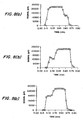
- the labelled analyte was prepared by attaching the fluorophore CY5® (BDS, Pennsylvania) to trinitrobenzyl cadaverine (CY5-TNB). To saturate the antibody binding site with the labelled antigen, a solution of the CY5-TN3 (4 nmoles in 50 ⁇ l PBS) was added to each column, and the columns were placed on a rocking bed overnight. The columns were connected to the fluorimeter and, washed briefly. Samples were introduced at a flow rate of 1 mL/min. Analyte injections were made in triplicate with concentrations ranging between 18.75 ng/mL and 1200 ng/mL. Fig. 2 illustrates data obtained for a membrane assay prepared with the test tube incubation method. A fluorescence signal peak was obtained at all analyte concentrations which was proportional to the amount of analyte added to the column.
- Fig. 3 represents data from a membrane assay prepared by saturating the immobilized antibody with labelled analyte in the column as opposed to in a test tube. Again, an increase in signal intensity with increasing analyte concentration was observed. However, a plateau was seen between an analyte concentration of 700 ng/mL and 1200 ng/mL where a negligible increase in signal intensity was observed despite a two-fold increase in analyte concentration suggesting that there is less labelled analyte on the membrane available for displacement, compared to the membrane prepared in the test tube.
- a monoclonal antibody with specificity for the explosive, cyclonite (RDX) was immobilized onto the membrane.
- the procedure for immobilization was identical to the one used for the anti-TNT antibody.
- 100 ⁇ l of 0.5% casein was used instead of Tris in order to block the remaining binding sites on the membrane.
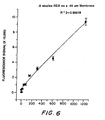
- Fig. 4 represents data from a single membrane assay prepared by saturating the antibody directly in the column. A linear relationship between signal intensity and analyte concentration is observed. The lower limit of detection for this assay is at 5 ng/ml which corresponds to part per billion (ppb) levels.
Landscapes
- Health & Medical Sciences (AREA)
- Immunology (AREA)
- Life Sciences & Earth Sciences (AREA)
- Engineering & Computer Science (AREA)
- Molecular Biology (AREA)
- Biomedical Technology (AREA)
- Chemical & Material Sciences (AREA)
- Hematology (AREA)
- Urology & Nephrology (AREA)
- Biotechnology (AREA)
- Biochemistry (AREA)
- Cell Biology (AREA)
- Food Science & Technology (AREA)
- Medicinal Chemistry (AREA)
- Physics & Mathematics (AREA)
- Analytical Chemistry (AREA)
- Microbiology (AREA)
- General Health & Medical Sciences (AREA)
- General Physics & Mathematics (AREA)
- Pathology (AREA)
- Investigating Or Analysing Biological Materials (AREA)
- Measuring Or Testing Involving Enzymes Or Micro-Organisms (AREA)
- Separation Using Semi-Permeable Membranes (AREA)
Claims (20)
- Méthode d'essai pour détecter un analyte cible, comprenant les étapes de:prévoir une membrane poreuse ayant des éléments de liaison qui y sont immobilisés, chacun desdits éléments de liaison ayant au moins un site de liaison capable de liaison spécifique audit analyte cible;exposer lesdits sites de liaison à un analogue marqué de l'analyte cible pour former des complexes d'éléments de liaison immobilisés sur la membrane et d'analogues marqués;faire s'écouler un fluide aqueux suspecté de contenir l'analyte cible, perpendiculairement à et à travers ladite membrane ayant lesdits complexes, à un débit permettant à l'analyte cible de déplacer l'analyte marqué des complexes en conditions de non équilibre, ledit débit laissant également un temps d'interaction entre ledit analyte et ladite membrane d'environ 0,1 seconde à environ 30 secondes;détecter l'analyte marqué déplacé, la quantité dudit analyte marqué déplacé étant proportionnelle à la concentration dudit analyte cible dans ledit échantillon.
- Méthode de la revendication 1, où l'élément de liaison est un anticorps.
- Méthode de la revendication 1, où l'analogue marqué est marqué par fluorescence.
- Méthode de la revendication 1, où le temps d'interaction est de pas plus d'environ 15 secondes.
- Méthode de la revendication 1, où ladite membrane est non absorbante.
- Méthode de la revendication 5, où ladite membrane est sélectionnée dans le groupe consistant en cellulose, nitrocellulose, fibre de silice, oxyde d'aluminium et chlorure de polyvinyle.
- Méthode de la revendication 5, comprenant de plus, après ladite étape de détection, les étapes de: rincer ledit échantillon de ladite membrane;
faire s'écouler un second échantillon liquide aqueux, suspecté de contenir l'analyte cible, afin de faire s'écouler ledit second échantillon liquide perpendiculairement à et à travers ladite membrane rincée ayant lesdits complexes, à un débit permettant audit analyte cible d ans ledit second échantillon de déplacer l'analogue marqué des complexes en conditions de non équilibre pour former, en aval de ladite membrane , un effluent liquide fluide comprenant ledit analogue marqué déplacé par ledit analyte cible dans ledit second échantillon, ledit débit laissant également un temps d'interaction entre ledit analyte cible dans ledit second échantillon et ladite membrane d'environ 0,1 1 seconde à environ 30 secondes;
détecter l'analyte marqué déplacé, la quantité dudit analyte marqué déplacé étant proportionnelle à la concentration dudit analyte cible dans ledit échantillon. - Dispositif pour l'analyse d'un échantillon aqueux suspecté de contenir un analyte cible, comprenant:une membrane poreuse ayant des éléments de liaison qui y sont immobilisés, chacun desdits éléments de liaison ayant au moins un site de liaison capable de liaison spécifique audit analyte cible, essentiellement tous lesdits sites de liaison sur ladite membrane étant occupés par un analogue marqué de l'analyte cible pour former des complexes des éléments de liaison immobilisés sur la membrane et des analogues marqués;un moyen d'écoulement pour faire s'écouler un échantillon aqueux, suspecté de contenir l'analyte cible, perpendiculairement à et à travers ladite membrane ayant ledit complexe, à un débit permettant à l'analyte cible de déplacer l'analogue marqué des complexes en conditions de non équilibre pour former un échantillon traité, ledit débit laissant également un temps d'interaction entre lesdits analytes et ladite membrane d'environ 0,1 seconde à environ 30 secondes; et un moyen de détection pour détecter la présence dudit analogue marqué dans ledit échantillon traité.
- Dispositif de la revendication 8, où ledit analogue marqué est marqué par fluorescence.
- Dispositif de la revendication 9, où ledit moyen de détection contient de plus une source de lumière pour exciter tout analogue marqué par fluorescence dans ledit échantillon traité.
- Dispositif de la revendication 8, où ledit élément de liaison est un anticorps.
- Dispositif de la revendication 10, où ledit moyen de détection est de plus adapté à déterminer quantitativement la quantité dudit analogue marqué dans ledit échantillon traité.
- Dispositif de la revendication 10, où ledit moyen de détection comprend de plus un spectrophotomètre, un spectromètre à infrarouges, un fluorimètre ou un biocapteur optique.
- Dispositif de la revendication 8, où ledit moyen d'écoulement comprend un conduit à travers lequel s'écoule ledit échantillon par l'action de la gravité ou par une force manuelle.
- Dispositif de la revendication 8, où ladite membrane est non absorbante.
- Dispositif de la revendication 15, où, après avoir utilisé ledit dispositif pour analyser un premier échantillon aqueux suspecté de contenir ledit analyte liquide par une méthode selon la revendication 1, ladite membrane peut être rincée et ledit dispositif peut être réutilisé.
- Dispositif de la revendication 8, où ledit moyen d'écoulement est adapté à laisser un temps d'interaction entre ledit analyte et ladite membrane de pas plus environ 15 secondes.
- Dispositif pour l'analyse d'un échantillon aqueux suspecté de contenir un analyte cible, comprenant:un conteneur, ledit conteneur comprenant une extrémité ouverte pour recevoir un échantillon liquide suspecté de contenir un analyte, une extrémité fermée, une membrane poreuse s'étendant totalement à travers la largeur dudit conteneur et un réservoir entre ladite membrane et ladite extrémité fermée, ladite membrane ayant des éléments de liaison qui y sont immobilisés, chacun desdits éléments de liaison ayant au moins un site de liaison capable de se lier spécifiquement audit analyte cible, essentiellement la totalité des sites de liaison sur ladite membrane étant occupés par un analogue marqué de l'analyte cible pour former des complexes des éléments de liaison immobilisés sur la membrane et des analytes marqués;un moyen d'écoulement pour faire s'écouler un échantillon liquide par l'extrémité ouverte, à travers ladite membrane et dans ledit réservoir, à un débit permettant à l'analyte cible de déplacer l'analyte marqué des complexes en conditions de non équilibre, ledit débit laissant un temps d'interaction entre ledit analyte et ladite membrane d'environ 0,1 seconde à environ 30 secondes;un moyen de détection pour détecter la présence dudit analogue marqué dans ledit réservoir.
- Dispositif pour l'immunoessai d'un échantillon aqueux suspecté de contenir un analyte cible comprenant:un conteneur, ledit conteneur comprenant une extrémité ouverte et une extrémité fermée;un capuchon dans lequel peut s'adapter ladite extrémité ouverte dudit conteneur dans une première position dans laquelle l'extrémité fermée dudit conteneur est à une première distance dudit capuchon et dans une seconde position dans laquelle l'extrémité fermée dudit conteneur était une seconde distance dudit capuchon, ladite seconde distance étant plus petite que ladite première distance;un embout pour recevoir ledit échantillon aqueux, s'étendant vers l'extérieur dudit capuchon;une aiguille creuse s'étendant dudit capuchon dans une direction opposée audit embout;une cloison s'étendant à travers la largeur dudit conteneur, ladite cloison étant placée entre ladite extrémité fermée dudit conteneur et une extrémité de ladite aiguille qui est distale dudit capuchon quand ledit conteneur repose dans ladite première position et ladite cloison étant essentiellement imperméable ou fluide;une membrane poreuse placée entre ladite cloison et ladite extrémité fermée dudit conteneur, ladite membrane s'étendant à travers la largeur dudit conteneur , et un réservoir entre ladite membrane et ladite extrémité fermée, ladite membrane ayant des éléments de liaison qui y sont immobilisés, chacun desdits éléments de liaison ayant au moins un site de liaison capable de se lier spécifiquement audit analyte cible, essentiellement tous lesdits sites de liaison sur ladite membrane étant soit occupés par un analogue marqué de l'analyte cible pour former des complexes des éléments de liaison immobilisés sur la membrane et des analytes marqués:un réservoir évacué entre ladite membrane et ladite extrémité fermée dudit conteneur;un moyen de détection pour détecter la présence dudit analogue marqué dans ledit réservoir;ladite aiguille creuse étant placée afin de percer ladite cloison mais non pas ladite membrane quand ledit conteneur est dans ladite seconde position.
- Dispositif de la revendication 19, comprenant de plus un moyen contenant un échantillon liquide, où ledit percement de ladite membrane force l'échantillon liquide dudit moyen contenant l'échantillon à s'écouler à travers ladite extrémité ouverte à travers ladite membrane et dans ledit réservoir.
Applications Claiming Priority (3)
| Application Number | Priority Date | Filing Date | Title |
|---|---|---|---|
| US583912 | 1996-01-11 | ||
| US08/583,912 US6750031B1 (en) | 1996-01-11 | 1996-01-11 | Displacement assay on a porous membrane |
| PCT/US1996/016981 WO1997025619A1 (fr) | 1996-01-11 | 1996-10-18 | Dosage du type a deplacement sur membrane poreuse |
Publications (3)
| Publication Number | Publication Date |
|---|---|
| EP0880699A1 EP0880699A1 (fr) | 1998-12-02 |
| EP0880699A4 EP0880699A4 (fr) | 2002-04-10 |
| EP0880699B1 true EP0880699B1 (fr) | 2006-05-24 |
Family
ID=24335115
Family Applications (1)
| Application Number | Title | Priority Date | Filing Date |
|---|---|---|---|
| EP96938636A Expired - Lifetime EP0880699B1 (fr) | 1996-01-11 | 1996-10-18 | Dosage du type a deplacement sur membrane poreuse |
Country Status (5)
| Country | Link |
|---|---|
| US (2) | US6750031B1 (fr) |
| EP (1) | EP0880699B1 (fr) |
| AT (1) | ATE327507T1 (fr) |
| DE (1) | DE69636173T2 (fr) |
| WO (1) | WO1997025619A1 (fr) |
Families Citing this family (117)
| Publication number | Priority date | Publication date | Assignee | Title |
|---|---|---|---|---|
| US5891740A (en) * | 1997-04-02 | 1999-04-06 | The Perkin-Elmer Corporation | Detection of low level hydrophobic analytes in environmental samples using agglutination reaction capillary slide test and apparatus therefor |
| US6036924A (en) | 1997-12-04 | 2000-03-14 | Hewlett-Packard Company | Cassette of lancet cartridges for sampling blood |
| GB9726888D0 (en) * | 1997-12-20 | 1998-02-18 | Eev Ltd | Detection |
| US6391005B1 (en) | 1998-03-30 | 2002-05-21 | Agilent Technologies, Inc. | Apparatus and method for penetration with shaft having a sensor for sensing penetration depth |
| US8497131B2 (en) * | 1999-10-06 | 2013-07-30 | Becton, Dickinson And Company | Surface enhanced spectroscopy-active composite nanoparticles comprising Raman-active reporter molecules |
| US7192778B2 (en) * | 1999-10-06 | 2007-03-20 | Natan Michael J | Surface enhanced spectroscopy-active composite nanoparticles |
| WO2002079764A1 (fr) * | 2001-01-26 | 2002-10-10 | Nanoplex Technologies, Inc. | Nanoparticules sandwich a spectrometrie active exaltees de surface |
| US8641644B2 (en) | 2000-11-21 | 2014-02-04 | Sanofi-Aventis Deutschland Gmbh | Blood testing apparatus having a rotatable cartridge with multiple lancing elements and testing means |
| WO2002100252A2 (fr) | 2001-06-12 | 2002-12-19 | Pelikan Technologies, Inc. | Appareil de prelevement sanguin et procede connexe |
| US9795747B2 (en) | 2010-06-02 | 2017-10-24 | Sanofi-Aventis Deutschland Gmbh | Methods and apparatus for lancet actuation |
| US8337419B2 (en) | 2002-04-19 | 2012-12-25 | Sanofi-Aventis Deutschland Gmbh | Tissue penetration device |
| US9226699B2 (en) | 2002-04-19 | 2016-01-05 | Sanofi-Aventis Deutschland Gmbh | Body fluid sampling module with a continuous compression tissue interface surface |
| DE60239132D1 (de) | 2001-06-12 | 2011-03-24 | Pelikan Technologies Inc | Gerät zur erhöhung der erfolgsrate im hinblick auf die durch einen fingerstich erhaltene blutausbeute |
| DE60234598D1 (de) | 2001-06-12 | 2010-01-14 | Pelikan Technologies Inc | Selbstoptimierende lanzettenvorrichtung mit adaptationsmittel für zeitliche schwankungen von hauteigenschaften |
| US9427532B2 (en) | 2001-06-12 | 2016-08-30 | Sanofi-Aventis Deutschland Gmbh | Tissue penetration device |
| AU2002320094A1 (en) | 2001-06-12 | 2002-12-23 | Pelikan Technologies, Inc. | Integrated blood sampling analysis system with multi-use sampling module |
| US7981056B2 (en) | 2002-04-19 | 2011-07-19 | Pelikan Technologies, Inc. | Methods and apparatus for lancet actuation |
| US7025774B2 (en) | 2001-06-12 | 2006-04-11 | Pelikan Technologies, Inc. | Tissue penetration device |
| AU2002315180A1 (en) | 2001-06-12 | 2002-12-23 | Pelikan Technologies, Inc. | Electric lancet actuator |
| EP1404235A4 (fr) | 2001-06-12 | 2008-08-20 | Pelikan Technologies Inc | Procede et appareil pour un dispositif de lancement de lancette integre sur une cartouche de prelevement de sang |
| SE0102922D0 (sv) * | 2001-08-31 | 2001-08-31 | Astrazeneca Ab | Method and apparatus for sample preparation |
| US7344894B2 (en) | 2001-10-16 | 2008-03-18 | Agilent Technologies, Inc. | Thermal regulation of fluidic samples within a diagnostic cartridge |
| US9733234B2 (en) | 2002-03-11 | 2017-08-15 | Jp Scientific Limited | Probe for extraction of molecules of interest from a sample |
| US8598325B2 (en) | 2002-03-11 | 2013-12-03 | Janusz B. Pawliszyn | Solid-phase microextraction coatings and methods for their preparation |
| US7232689B2 (en) * | 2002-03-11 | 2007-06-19 | Pawliszyn Janusz B | Calibration procedure for investigating biological systems |
| WO2017193213A1 (fr) | 2016-05-10 | 2017-11-16 | Jp Scientific Limited | Système et procédé de désorption et de détection d'un analyte adsorbé sur un dispositif de microextraction en phase solide |
| WO2003075772A2 (fr) * | 2002-03-11 | 2003-09-18 | Pawliszyn Janusz B | Microdispositifs et techniques analytiques pour l'investigation de systemes biologiques |
| US20090026122A1 (en) | 2002-03-11 | 2009-01-29 | Janusz | Biocompatible solid-phase microextraction coatings and methods for their preparation |
| US9870907B2 (en) | 2002-03-11 | 2018-01-16 | Jp Scientific Limited | Probe for extraction of molecules of interest from a sample |
| GB2387130A (en) * | 2002-04-04 | 2003-10-08 | Fluid Technologies Plc | Hollow fibre filter membrane unit with microorganism detector, and associated usage |
| US7674232B2 (en) | 2002-04-19 | 2010-03-09 | Pelikan Technologies, Inc. | Method and apparatus for penetrating tissue |
| US7291117B2 (en) | 2002-04-19 | 2007-11-06 | Pelikan Technologies, Inc. | Method and apparatus for penetrating tissue |
| US7491178B2 (en) | 2002-04-19 | 2009-02-17 | Pelikan Technologies, Inc. | Method and apparatus for penetrating tissue |
| US7297122B2 (en) | 2002-04-19 | 2007-11-20 | Pelikan Technologies, Inc. | Method and apparatus for penetrating tissue |
| US7374544B2 (en) | 2002-04-19 | 2008-05-20 | Pelikan Technologies, Inc. | Method and apparatus for penetrating tissue |
| US8784335B2 (en) | 2002-04-19 | 2014-07-22 | Sanofi-Aventis Deutschland Gmbh | Body fluid sampling device with a capacitive sensor |
| US7175642B2 (en) | 2002-04-19 | 2007-02-13 | Pelikan Technologies, Inc. | Methods and apparatus for lancet actuation |
| US8267870B2 (en) | 2002-04-19 | 2012-09-18 | Sanofi-Aventis Deutschland Gmbh | Method and apparatus for body fluid sampling with hybrid actuation |
| US7244265B2 (en) | 2002-04-19 | 2007-07-17 | Pelikan Technologies, Inc. | Method and apparatus for penetrating tissue |
| US8579831B2 (en) | 2002-04-19 | 2013-11-12 | Sanofi-Aventis Deutschland Gmbh | Method and apparatus for penetrating tissue |
| US8360992B2 (en) | 2002-04-19 | 2013-01-29 | Sanofi-Aventis Deutschland Gmbh | Method and apparatus for penetrating tissue |
| US7901362B2 (en) | 2002-04-19 | 2011-03-08 | Pelikan Technologies, Inc. | Method and apparatus for penetrating tissue |
| US7582099B2 (en) | 2002-04-19 | 2009-09-01 | Pelikan Technologies, Inc | Method and apparatus for penetrating tissue |
| US9314194B2 (en) | 2002-04-19 | 2016-04-19 | Sanofi-Aventis Deutschland Gmbh | Tissue penetration device |
| US7485128B2 (en) | 2002-04-19 | 2009-02-03 | Pelikan Technologies, Inc. | Method and apparatus for penetrating tissue |
| US7198606B2 (en) | 2002-04-19 | 2007-04-03 | Pelikan Technologies, Inc. | Method and apparatus for a multi-use body fluid sampling device with analyte sensing |
| US7892185B2 (en) | 2002-04-19 | 2011-02-22 | Pelikan Technologies, Inc. | Method and apparatus for body fluid sampling and analyte sensing |
| US8221334B2 (en) | 2002-04-19 | 2012-07-17 | Sanofi-Aventis Deutschland Gmbh | Method and apparatus for penetrating tissue |
| US7648468B2 (en) | 2002-04-19 | 2010-01-19 | Pelikon Technologies, Inc. | Method and apparatus for penetrating tissue |
| US7371247B2 (en) | 2002-04-19 | 2008-05-13 | Pelikan Technologies, Inc | Method and apparatus for penetrating tissue |
| US9248267B2 (en) | 2002-04-19 | 2016-02-02 | Sanofi-Aventis Deustchland Gmbh | Tissue penetration device |
| US7892183B2 (en) | 2002-04-19 | 2011-02-22 | Pelikan Technologies, Inc. | Method and apparatus for body fluid sampling and analyte sensing |
| US7232451B2 (en) | 2002-04-19 | 2007-06-19 | Pelikan Technologies, Inc. | Method and apparatus for penetrating tissue |
| US8702624B2 (en) | 2006-09-29 | 2014-04-22 | Sanofi-Aventis Deutschland Gmbh | Analyte measurement device with a single shot actuator |
| US7563232B2 (en) | 2002-04-19 | 2009-07-21 | Pelikan Technologies, Inc. | Method and apparatus for penetrating tissue |
| US7141058B2 (en) | 2002-04-19 | 2006-11-28 | Pelikan Technologies, Inc. | Method and apparatus for a body fluid sampling device using illumination |
| US7717863B2 (en) | 2002-04-19 | 2010-05-18 | Pelikan Technologies, Inc. | Method and apparatus for penetrating tissue |
| US7410468B2 (en) | 2002-04-19 | 2008-08-12 | Pelikan Technologies, Inc. | Method and apparatus for penetrating tissue |
| US7331931B2 (en) | 2002-04-19 | 2008-02-19 | Pelikan Technologies, Inc. | Method and apparatus for penetrating tissue |
| US7524293B2 (en) | 2002-04-19 | 2009-04-28 | Pelikan Technologies, Inc. | Method and apparatus for penetrating tissue |
| US7258693B2 (en) | 2002-04-19 | 2007-08-21 | Pelikan Technologies, Inc. | Device and method for variable speed lancet |
| US7909778B2 (en) | 2002-04-19 | 2011-03-22 | Pelikan Technologies, Inc. | Method and apparatus for penetrating tissue |
| US9795334B2 (en) | 2002-04-19 | 2017-10-24 | Sanofi-Aventis Deutschland Gmbh | Method and apparatus for penetrating tissue |
| US7976476B2 (en) | 2002-04-19 | 2011-07-12 | Pelikan Technologies, Inc. | Device and method for variable speed lancet |
| US7229458B2 (en) | 2002-04-19 | 2007-06-12 | Pelikan Technologies, Inc. | Method and apparatus for penetrating tissue |
| US7547287B2 (en) | 2002-04-19 | 2009-06-16 | Pelikan Technologies, Inc. | Method and apparatus for penetrating tissue |
| ATE343789T1 (de) * | 2002-06-03 | 2006-11-15 | Pamgene Bv | Biomolekulares kinetik-messverfahren mit hilfe von einem durchfluss-mikroarray |
| US20040101900A1 (en) * | 2002-11-25 | 2004-05-27 | Mauro J. Mattew | Assay for rapid detection of TNT |
| US8574895B2 (en) | 2002-12-30 | 2013-11-05 | Sanofi-Aventis Deutschland Gmbh | Method and apparatus using optical techniques to measure analyte levels |
| US20040147619A1 (en) * | 2003-01-23 | 2004-07-29 | Conocophillips Company | Chlorine-containing synthesis gas catalyst |
| DE602004028463D1 (de) | 2003-05-30 | 2010-09-16 | Pelikan Technologies Inc | Verfahren und vorrichtung zur injektion von flüssigkeit |
| WO2004107964A2 (fr) | 2003-06-06 | 2004-12-16 | Pelikan Technologies, Inc. | Procede et appareil d'echantillonnage de fluides anatomiques et d'examen de l'analysat |
| WO2006001797A1 (fr) | 2004-06-14 | 2006-01-05 | Pelikan Technologies, Inc. | Element penetrant peu douloureux |
| US7604592B2 (en) | 2003-06-13 | 2009-10-20 | Pelikan Technologies, Inc. | Method and apparatus for a point of care device |
| US8282576B2 (en) | 2003-09-29 | 2012-10-09 | Sanofi-Aventis Deutschland Gmbh | Method and apparatus for an improved sample capture device |
| EP1680014A4 (fr) | 2003-10-14 | 2009-01-21 | Pelikan Technologies Inc | Procede et appareil fournissant une interface-utilisateur variable |
| US7943395B2 (en) * | 2003-11-21 | 2011-05-17 | Kimberly-Clark Worldwide, Inc. | Extension of the dynamic detection range of assay devices |
| EP1706026B1 (fr) | 2003-12-31 | 2017-03-01 | Sanofi-Aventis Deutschland GmbH | Procédé et appareil permettant d'améliorer le flux fluidique et le prélèvement d'échantillons |
| US7822454B1 (en) | 2005-01-03 | 2010-10-26 | Pelikan Technologies, Inc. | Fluid sampling device with improved analyte detecting member configuration |
| JP2007534936A (ja) * | 2004-02-11 | 2007-11-29 | パムジーン ベー.フェー. | 標的分子とプローブ分子の間の相互作用を分析する装置 |
| US8101431B2 (en) | 2004-02-27 | 2012-01-24 | Board Of Regents, The University Of Texas System | Integration of fluids and reagents into self-contained cartridges containing sensor elements and reagent delivery systems |
| US20060257991A1 (en) * | 2004-02-27 | 2006-11-16 | Mcdevitt John T | Integration of fluids and reagents into self-contained cartridges containing particle-based sensor elements and membrane-based sensor elements |
| US8105849B2 (en) | 2004-02-27 | 2012-01-31 | Board Of Regents, The University Of Texas System | Integration of fluids and reagents into self-contained cartridges containing sensor elements |
| US7781226B2 (en) * | 2004-02-27 | 2010-08-24 | The Board Of Regents Of The University Of Texas System | Particle on membrane assay system |
| US20060257941A1 (en) * | 2004-02-27 | 2006-11-16 | Mcdevitt John T | Integration of fluids and reagents into self-contained cartridges containing particle and membrane sensor elements |
| WO2005083423A2 (fr) | 2004-02-27 | 2005-09-09 | Board Of Regents, The University Of Texas System | Systeme et procede d'integration de fluides et de reactifs dans des cartouches autonomes contenant des detecteurs de membrane et de particules |
| WO2006011062A2 (fr) | 2004-05-20 | 2006-02-02 | Albatros Technologies Gmbh & Co. Kg | Hydrogel imprimable pour biocapteurs |
| US9775553B2 (en) | 2004-06-03 | 2017-10-03 | Sanofi-Aventis Deutschland Gmbh | Method and apparatus for a fluid sampling device |
| WO2005120365A1 (fr) | 2004-06-03 | 2005-12-22 | Pelikan Technologies, Inc. | Procede et appareil pour la fabrication d'un dispositif d'echantillonnage de liquides |
| US8652831B2 (en) | 2004-12-30 | 2014-02-18 | Sanofi-Aventis Deutschland Gmbh | Method and apparatus for analyte measurement test time |
| US7189522B2 (en) | 2005-03-11 | 2007-03-13 | Chembio Diagnostic Systems, Inc. | Dual path immunoassay device |
| WO2006098804A2 (fr) | 2005-03-11 | 2006-09-21 | Chembio Diagnostic Systems, Inc. | Dispositif de dosage immunologique a double trajet |
| WO2007053186A2 (fr) | 2005-05-31 | 2007-05-10 | Labnow, Inc. | Méthodes et compositions en rapport avec la détermination et l’utilisation de la numération de globules blancs |
| JP2009523406A (ja) * | 2005-11-15 | 2009-06-25 | オクソニカ・インコーポレーテッド | 生体剤(bioagents)の検出のためのSERSに基づく方法 |
| US8409411B2 (en) | 2005-12-02 | 2013-04-02 | State Of Oregon Acting By And Through The State Board Of Higher Education On Behalf Of Portland State University | Nano-porous membrane based sensors |
| US8409863B2 (en) | 2005-12-14 | 2013-04-02 | Becton, Dickinson And Company | Nanoparticulate chemical sensors using SERS |
| US7723100B2 (en) | 2006-01-13 | 2010-05-25 | Becton, Dickinson And Company | Polymer coated SERS nanotag |
| US20090155811A1 (en) * | 2006-01-27 | 2009-06-18 | Oxonica, Inc. | Lateral Flow Immunoassay With Encapsulated Detection Modality |
| JP5277165B2 (ja) * | 2006-07-24 | 2013-08-28 | ベクトン・ディキンソン・アンド・カンパニー | 分析粒子凝集およびイメージング装置および方法 |
| US7879622B1 (en) * | 2006-08-11 | 2011-02-01 | University Of South Florida | Barrier-permeable proxy reporter analysis |
| WO2008105814A2 (fr) * | 2006-08-22 | 2008-09-04 | Los Alamos National Security, Llc | Dispositif à écoulement latéral miniaturisé pour détection rapide et sensible de protéines ou d'acides nucléiques |
| WO2008043041A1 (fr) | 2006-10-04 | 2008-04-10 | University Of Washington | Procédé et dispositif permettant des analyses par affinité moléculaire microfluidique parallèle rapide |
| US8613214B2 (en) * | 2008-01-09 | 2013-12-24 | Orono Spectral Solutions, Inc. | Apparatus and method for determining analyte content in a fluid |
| WO2009126900A1 (fr) | 2008-04-11 | 2009-10-15 | Pelikan Technologies, Inc. | Procédé et appareil pour dispositif de détection d’analyte |
| EP3067694A1 (fr) | 2008-05-05 | 2016-09-14 | Los Alamos National Security, LLC | Préparation d'échantillons d'acide nucléique à base de flux latéral et régulation d'écoulement de fluide passif |
| US20100022916A1 (en) | 2008-07-24 | 2010-01-28 | Javanbakhsh Esfandiari | Method and Apparatus for Collecting and Preparing Biological Samples for Testing |
| US20110151479A1 (en) * | 2008-08-25 | 2011-06-23 | University Of Washington | Microfluidic systems incorporating flow-through membranes |
| US9375169B2 (en) | 2009-01-30 | 2016-06-28 | Sanofi-Aventis Deutschland Gmbh | Cam drive for managing disposable penetrating member actions with a single motor and motor and control system |
| US8965476B2 (en) | 2010-04-16 | 2015-02-24 | Sanofi-Aventis Deutschland Gmbh | Tissue penetration device |
| GB201017447D0 (en) * | 2010-10-15 | 2010-12-01 | Moorlodge Biotech Ventures Ltd | Assay device |
| US8603835B2 (en) | 2011-02-10 | 2013-12-10 | Chembio Diagnostic Systems, Inc. | Reduced step dual path immunoassay device and method |
| US10519492B2 (en) | 2011-04-20 | 2019-12-31 | Mesa Biotech, Inc. | Integrated device for nucleic acid detection and identification |
| DK3578635T3 (da) | 2014-04-02 | 2022-02-07 | Chembio Diagnostic Systems Inc | Immunoassay, som anvender indfangningskonjugat |
| US20160116466A1 (en) | 2014-10-27 | 2016-04-28 | Chembio Diagnostic Systems, Inc. | Rapid Screening Assay for Qualitative Detection of Multiple Febrile Illnesses |
| US20160310948A1 (en) | 2015-04-24 | 2016-10-27 | Mesa Biotech, Inc. | Fluidic Test Cassette |
| GB201510850D0 (en) * | 2015-06-19 | 2015-08-05 | Cambridge Molecular Diagnositcs Ltd | Nucleic acid amplification and detection assays |
| WO2017147707A1 (fr) | 2016-03-02 | 2017-09-08 | Jp Scientific Limited | Revêtement de micro-extraction en phase solide |
Family Cites Families (18)
| Publication number | Priority date | Publication date | Assignee | Title |
|---|---|---|---|---|
| US3800780A (en) * | 1972-02-23 | 1974-04-02 | Angelika Elliott | Vacuum indicator |
| US4258001A (en) | 1978-12-27 | 1981-03-24 | Eastman Kodak Company | Element, structure and method for the analysis or transport of liquids |
| US4895809A (en) * | 1984-01-09 | 1990-01-23 | Varian Associates, Inc. | Immobilized antigen-antibody displacement process |
| US4859583A (en) | 1985-02-25 | 1989-08-22 | Amoco Corporation | Chemiluminescent immunochemical technique for low molecular weight antigens |
| US4916056A (en) | 1986-02-18 | 1990-04-10 | Abbott Laboratories | Solid-phase analytical device and method for using same |
| US4812293A (en) * | 1986-06-30 | 1989-03-14 | Becton, Dickinson And Company | Vacuum actuated assay device and method of using same |
| US4920046A (en) | 1987-02-20 | 1990-04-24 | Becton, Dickinson And Company | Process, test device, and test kit for a rapid assay having a visible readout |
| US5206177A (en) * | 1988-01-21 | 1993-04-27 | Boehringer Mannheim Corporation | Apparatus for determining an analyte and method therefor |
| US5045479A (en) * | 1988-07-05 | 1991-09-03 | The Johns Hopkins University | Continuous flow competitive assay with reference system |
| US5024238A (en) * | 1989-01-10 | 1991-06-18 | Cancer Diagnostics, Inc. | Blood withdrawing apparatus and antigen testing method |
| US5766933A (en) * | 1989-04-26 | 1998-06-16 | Diagnostic Products Corporation | Method and element for measuring analytes in biological fluids using immobilized binder--analyte labeled complex |
| US5183740A (en) | 1990-02-23 | 1993-02-02 | The United States Of America As Represented By The Secretary Of The Navy | Flow immunosensor method and apparatus |
| EP0467078B1 (fr) * | 1990-07-18 | 1996-05-08 | Abbott Laboratories | Réactif à base de substitution d'une analyte à utiliser dans les essais, les dispositifs et les trousses de liaisons spécifiques |
| US5200321A (en) | 1990-09-07 | 1993-04-06 | The United States Of America As Represented By The Secretary Of The Navy | Microassay on a card |
| DE4229591C1 (de) * | 1992-09-04 | 1994-03-24 | Draegerwerk Ag | Immunologisches Verfahren zur Bestimmung eines Analyten |
| US5354654A (en) * | 1993-07-16 | 1994-10-11 | The United States Of America As Represented By The Secretary Of The Navy | Lyophilized ligand-receptor complexes for assays and sensors |
| US5602037A (en) * | 1994-06-30 | 1997-02-11 | Dade International, Inc. | Combination reagent holding and test device |
| US6016712A (en) * | 1997-09-18 | 2000-01-25 | Accumetrics | Device for receiving and processing a sample |
-
1996
- 1996-01-11 US US08/583,912 patent/US6750031B1/en not_active Expired - Fee Related
- 1996-10-18 AT AT96938636T patent/ATE327507T1/de not_active IP Right Cessation
- 1996-10-18 EP EP96938636A patent/EP0880699B1/fr not_active Expired - Lifetime
- 1996-10-18 DE DE69636173T patent/DE69636173T2/de not_active Expired - Lifetime
- 1996-10-18 WO PCT/US1996/016981 patent/WO1997025619A1/fr not_active Ceased
-
2001
- 2001-07-13 US US09/907,888 patent/US6808937B2/en not_active Expired - Fee Related
Also Published As
| Publication number | Publication date |
|---|---|
| US20020028475A1 (en) | 2002-03-07 |
| DE69636173D1 (de) | 2006-06-29 |
| US6750031B1 (en) | 2004-06-15 |
| EP0880699A1 (fr) | 1998-12-02 |
| WO1997025619A1 (fr) | 1997-07-17 |
| DE69636173T2 (de) | 2007-03-29 |
| US6808937B2 (en) | 2004-10-26 |
| ATE327507T1 (de) | 2006-06-15 |
| EP0880699A4 (fr) | 2002-04-10 |
Similar Documents
| Publication | Publication Date | Title |
|---|---|---|
| EP0880699B1 (fr) | Dosage du type a deplacement sur membrane poreuse | |
| US7910381B2 (en) | Immuno gold lateral flow assay | |
| EP0046004B1 (fr) | Méthode de concentration à zone dans les immuno-essais hétérogènes | |
| KR100513216B1 (ko) | 바이오센서 | |
| US5183740A (en) | Flow immunosensor method and apparatus | |
| FI96639C (fi) | Omavarainen immunokoe-elementti | |
| US7569397B2 (en) | Immunoassay devices and use thereof | |
| US20110097734A1 (en) | Flow Control Technique for Assay Devices | |
| US20070134811A1 (en) | Metering technique for lateral flow assay devices | |
| EP1789793B1 (fr) | Essai combiné pour détection d'alcool et de drogues | |
| EP0274911B1 (fr) | Moyen de diagnostic, sa préparation et son utilisation | |
| US20150017656A1 (en) | Rapid Lateral Flow Assay Method for Detecting Low Quantity Liquid or Dry Samples | |
| EP1491892A1 (fr) | Piece d'essai pour chromatographie et son procede de production | |
| CA1289471C (fr) | Bande d'epreuve a sec pour systeme detecteur a demande d'oxygene | |
| US8142735B2 (en) | Test apparatus | |
| CA1302244C (fr) | Bandelettes reactives seches presentant une couche excluant les erythrocites et empechant que ceux-ci masquent la presence de l'analyte | |
| EP0402023A1 (fr) | Dispositif diagnostique de courant de membrane allongée et méthode | |
| CA2241324C (fr) | Dosage du type a deplacement sur membrane poreuse | |
| JP3007410B2 (ja) | マルチウエルテスト | |
| WO2014168580A1 (fr) | Dispositif à écoulement inversé bidirectionnel à chambre double | |
| JP2002116206A (ja) | 免疫検定装置 | |
| MXPA98005608A (en) | Proof of displacement on a membrane by | |
| US20140134049A1 (en) | Lateral Flow Assay Device for Measuring Low Quantity Sample | |
| KR102015360B1 (ko) | 측방 유동 분석에서의 신호 증폭 키트 및 그의 제작 방법 | |
| JPS63139248A (ja) | 酵素免疫センサ−および抗原あるいは抗体の検知方法 |
Legal Events
| Date | Code | Title | Description |
|---|---|---|---|
| PUAI | Public reference made under article 153(3) epc to a published international application that has entered the european phase |
Free format text: ORIGINAL CODE: 0009012 |
|
| 17P | Request for examination filed |
Effective date: 19980619 |
|
| AK | Designated contracting states |
Kind code of ref document: A1 Designated state(s): AT BE DE ES FR GB IT NL |
|
| A4 | Supplementary search report drawn up and despatched |
Effective date: 20020226 |
|
| AK | Designated contracting states |
Kind code of ref document: A4 Designated state(s): AT BE DE ES FR GB IT NL |
|
| 17Q | First examination report despatched |
Effective date: 20040310 |
|
| GRAP | Despatch of communication of intention to grant a patent |
Free format text: ORIGINAL CODE: EPIDOSNIGR1 |
|
| GRAS | Grant fee paid |
Free format text: ORIGINAL CODE: EPIDOSNIGR3 |
|
| GRAA | (expected) grant |
Free format text: ORIGINAL CODE: 0009210 |
|
| AK | Designated contracting states |
Kind code of ref document: B1 Designated state(s): AT BE DE ES FR GB IT NL |
|
| PG25 | Lapsed in a contracting state [announced via postgrant information from national office to epo] |
Ref country code: NL Free format text: LAPSE BECAUSE OF FAILURE TO SUBMIT A TRANSLATION OF THE DESCRIPTION OR TO PAY THE FEE WITHIN THE PRESCRIBED TIME-LIMIT Effective date: 20060524 Ref country code: IT Free format text: LAPSE BECAUSE OF FAILURE TO SUBMIT A TRANSLATION OF THE DESCRIPTION OR TO PAY THE FEE WITHIN THE PRESCRIBED TIME-LIMIT;WARNING: LAPSES OF ITALIAN PATENTS WITH EFFECTIVE DATE BEFORE 2007 MAY HAVE OCCURRED AT ANY TIME BEFORE 2007. THE CORRECT EFFECTIVE DATE MAY BE DIFFERENT FROM THE ONE RECORDED. Effective date: 20060524 Ref country code: BE Free format text: LAPSE BECAUSE OF FAILURE TO SUBMIT A TRANSLATION OF THE DESCRIPTION OR TO PAY THE FEE WITHIN THE PRESCRIBED TIME-LIMIT Effective date: 20060524 Ref country code: AT Free format text: LAPSE BECAUSE OF FAILURE TO SUBMIT A TRANSLATION OF THE DESCRIPTION OR TO PAY THE FEE WITHIN THE PRESCRIBED TIME-LIMIT Effective date: 20060524 |
|
| REG | Reference to a national code |
Ref country code: GB Ref legal event code: FG4D |
|
| REF | Corresponds to: |
Ref document number: 69636173 Country of ref document: DE Date of ref document: 20060629 Kind code of ref document: P |
|
| PG25 | Lapsed in a contracting state [announced via postgrant information from national office to epo] |
Ref country code: ES Free format text: LAPSE BECAUSE OF FAILURE TO SUBMIT A TRANSLATION OF THE DESCRIPTION OR TO PAY THE FEE WITHIN THE PRESCRIBED TIME-LIMIT Effective date: 20060904 |
|
| NLV1 | Nl: lapsed or annulled due to failure to fulfill the requirements of art. 29p and 29m of the patents act | ||
| ET | Fr: translation filed | ||
| PLBE | No opposition filed within time limit |
Free format text: ORIGINAL CODE: 0009261 |
|
| STAA | Information on the status of an ep patent application or granted ep patent |
Free format text: STATUS: NO OPPOSITION FILED WITHIN TIME LIMIT |
|
| 26N | No opposition filed |
Effective date: 20070227 |
|
| PGFP | Annual fee paid to national office [announced via postgrant information from national office to epo] |
Ref country code: FR Payment date: 20101209 Year of fee payment: 15 |
|
| PGFP | Annual fee paid to national office [announced via postgrant information from national office to epo] |
Ref country code: DE Payment date: 20101129 Year of fee payment: 15 |
|
| PGFP | Annual fee paid to national office [announced via postgrant information from national office to epo] |
Ref country code: GB Payment date: 20101104 Year of fee payment: 15 |
|
| GBPC | Gb: european patent ceased through non-payment of renewal fee |
Effective date: 20111018 |
|
| REG | Reference to a national code |
Ref country code: FR Ref legal event code: ST Effective date: 20120629 |
|
| PG25 | Lapsed in a contracting state [announced via postgrant information from national office to epo] |
Ref country code: DE Free format text: LAPSE BECAUSE OF NON-PAYMENT OF DUE FEES Effective date: 20120501 |
|
| REG | Reference to a national code |
Ref country code: DE Ref legal event code: R119 Ref document number: 69636173 Country of ref document: DE Effective date: 20120501 |
|
| PG25 | Lapsed in a contracting state [announced via postgrant information from national office to epo] |
Ref country code: GB Free format text: LAPSE BECAUSE OF NON-PAYMENT OF DUE FEES Effective date: 20111018 Ref country code: FR Free format text: LAPSE BECAUSE OF NON-PAYMENT OF DUE FEES Effective date: 20111102 |