EP0880712B1 - Systeme de localisation - Google Patents
Systeme de localisation Download PDFInfo
- Publication number
- EP0880712B1 EP0880712B1 EP96931145A EP96931145A EP0880712B1 EP 0880712 B1 EP0880712 B1 EP 0880712B1 EP 96931145 A EP96931145 A EP 96931145A EP 96931145 A EP96931145 A EP 96931145A EP 0880712 B1 EP0880712 B1 EP 0880712B1
- Authority
- EP
- European Patent Office
- Prior art keywords
- signals
- position determining
- cbu
- cru
- receiving
- Prior art date
- Legal status (The legal status is an assumption and is not a legal conclusion. Google has not performed a legal analysis and makes no representation as to the accuracy of the status listed.)
- Expired - Lifetime
Links
Images




Classifications
-
- G—PHYSICS
- G01—MEASURING; TESTING
- G01S—RADIO DIRECTION-FINDING; RADIO NAVIGATION; DETERMINING DISTANCE OR VELOCITY BY USE OF RADIO WAVES; LOCATING OR PRESENCE-DETECTING BY USE OF THE REFLECTION OR RERADIATION OF RADIO WAVES; ANALOGOUS ARRANGEMENTS USING OTHER WAVES
- G01S5/00—Position-fixing by co-ordinating two or more direction or position line determinations; Position-fixing by co-ordinating two or more distance determinations
- G01S5/02—Position-fixing by co-ordinating two or more direction or position line determinations; Position-fixing by co-ordinating two or more distance determinations using radio waves
- G01S5/0284—Relative positioning
-
- G—PHYSICS
- G01—MEASURING; TESTING
- G01S—RADIO DIRECTION-FINDING; RADIO NAVIGATION; DETERMINING DISTANCE OR VELOCITY BY USE OF RADIO WAVES; LOCATING OR PRESENCE-DETECTING BY USE OF THE REFLECTION OR RERADIATION OF RADIO WAVES; ANALOGOUS ARRANGEMENTS USING OTHER WAVES
- G01S1/00—Beacons or beacon systems transmitting signals having a characteristic or characteristics capable of being detected by non-directional receivers and defining directions, positions, or position lines fixed relatively to the beacon transmitters; Receivers co-operating therewith
- G01S1/02—Beacons or beacon systems transmitting signals having a characteristic or characteristics capable of being detected by non-directional receivers and defining directions, positions, or position lines fixed relatively to the beacon transmitters; Receivers co-operating therewith using radio waves
- G01S1/04—Details
- G01S1/045—Receivers
-
- G—PHYSICS
- G01—MEASURING; TESTING
- G01S—RADIO DIRECTION-FINDING; RADIO NAVIGATION; DETERMINING DISTANCE OR VELOCITY BY USE OF RADIO WAVES; LOCATING OR PRESENCE-DETECTING BY USE OF THE REFLECTION OR RERADIATION OF RADIO WAVES; ANALOGOUS ARRANGEMENTS USING OTHER WAVES
- G01S1/00—Beacons or beacon systems transmitting signals having a characteristic or characteristics capable of being detected by non-directional receivers and defining directions, positions, or position lines fixed relatively to the beacon transmitters; Receivers co-operating therewith
- G01S1/02—Beacons or beacon systems transmitting signals having a characteristic or characteristics capable of being detected by non-directional receivers and defining directions, positions, or position lines fixed relatively to the beacon transmitters; Receivers co-operating therewith using radio waves
- G01S1/04—Details
-
- G—PHYSICS
- G01—MEASURING; TESTING
- G01S—RADIO DIRECTION-FINDING; RADIO NAVIGATION; DETERMINING DISTANCE OR VELOCITY BY USE OF RADIO WAVES; LOCATING OR PRESENCE-DETECTING BY USE OF THE REFLECTION OR RERADIATION OF RADIO WAVES; ANALOGOUS ARRANGEMENTS USING OTHER WAVES
- G01S5/00—Position-fixing by co-ordinating two or more direction or position line determinations; Position-fixing by co-ordinating two or more distance determinations
- G01S5/02—Position-fixing by co-ordinating two or more direction or position line determinations; Position-fixing by co-ordinating two or more distance determinations using radio waves
- G01S5/0205—Details
-
- G—PHYSICS
- G01—MEASURING; TESTING
- G01S—RADIO DIRECTION-FINDING; RADIO NAVIGATION; DETERMINING DISTANCE OR VELOCITY BY USE OF RADIO WAVES; LOCATING OR PRESENCE-DETECTING BY USE OF THE REFLECTION OR RERADIATION OF RADIO WAVES; ANALOGOUS ARRANGEMENTS USING OTHER WAVES
- G01S5/00—Position-fixing by co-ordinating two or more direction or position line determinations; Position-fixing by co-ordinating two or more distance determinations
- G01S5/02—Position-fixing by co-ordinating two or more direction or position line determinations; Position-fixing by co-ordinating two or more distance determinations using radio waves
- G01S5/10—Position of receiver fixed by co-ordinating a plurality of position lines defined by path-difference measurements, e.g. omega or decca systems
-
- H—ELECTRICITY
- H04—ELECTRIC COMMUNICATION TECHNIQUE
- H04W—WIRELESS COMMUNICATION NETWORKS
- H04W64/00—Locating users or terminals or network equipment for network management purposes, e.g. mobility management
Definitions
- This invention relates to a position determining system using radio or other broadcast transmissions. More particularly, it relates to a system using the Global System for Mobile Communications (GSM) or other digital transmission systems.
- GSM Global System for Mobile Communications
- the unknown quantities calculated for each new position are the spatial x and y co-ordinates of the rover together with the phase offset between the local oscillators in the equipment of the two receivers.
- a further patent specification, WO 94/28432 shows how the same principles may be applied in tunnels and other shielded spaces such as underground car parks.
- Duffett-Smith and Woan describe a particular implementation of the phase-measuring system in which the signals from three or more medium-wave AM public broadcast stations are used to track the position of a vehicle in and around Cambridge, UK. at speeds up to 110 km h -1 , with a precision of about 5 m.
- One of the advantages of such a system lies in the fact that no additional costly infrastructure of coherent radio transmitters needs to be set up for CURSOR operation. On the contrary, CURSOR is able to use the signals from any independent radio transmitters set up for any purpose.
- EP-B-0 303 371 also explains how the wider bandwidth signals of modulated transmissions may be used to measure the time difference between the signals received from each transmitter at the base station and the rover.
- the position of the peak in the cross correlation can be used as an estimator of the time difference between the two received signals, and hence the difference in distance from the transmitter of the base and rover.
- three such measurements made on three widely-spaced transmitters suffice to calculate the spatial x and y co-ordinates of the rover together with the time offset between the oscillators in the two receiving stations.
- WO-A-95/23981 describes a hyperbolic location determining system using television broadcast signals in which the shifting of the synchronisation error (or time difference) between signals from pairs of transmitters is recorded, the information about the time difference of the signals transmitted by the pair(s) of transmitters being passed to the mobile receiver requiring a location fix.
- a position determining system for receiving broad band signals transmitted by a number of transmission sources equal at least to the number of dimensions in which the movement of a roving object is to be monitored, the system comprising a pair of receiving stations, in use the first of the receiving stations being at a known position and the second being located on the roving object; characterised in that each of the receiving stations is arranged to receive the signals from the respective transmission sources substantially simultaneously, and record a portion of each of the received signals, and each receiving station including means for transmitting a link signal containing information about the recorded portions of the signals received from the transmission sources; and by a position determining processor arranged to receive the link signals and compare the information received from the one receiving station about the recorded portions of the signals received at the one receiving station from the transmission sources with the information received at the other receiving station about the recorded portions of the signals received at the other receiving station from the transmission sources, and to determine the time delay between the respective signal portions received at both receiving stations in order to determine the position of the roving object.
- the receiving stations may receive the signals from the respective transmission sources sequentially and in the same sequence as each other.
- the invention also includes a method of determining the position of a roving object, the method comprising transmitting a broadband signal from a number of transmission sources equal at least to the number of dimensions in which the movement of a roving object is to be monitored; receiving the signals at a pair of receiving stations, in use a first of the receiving stations being at a known position and a second being located on the roving object, characterised in that
- each of the receiving stations is also arranged to receive a second signal from one or more of the transmitters, said second signal being used to enable compensation for changes in equipment offsets during receipt of the sequentially received signals.
- the position determining processor may be co-located with one of the receiving stations or may be located remotely.
- the link signal from one of the receiving stations is passed to the other receiving station and from the other receiving station to the position determining processor.
- a signal providing information about the position of the roving object is passed from the position determining processor to at least one of the receiving stations.
- the system may further comprise one or more monitoring stations and a signal providing information about the position of the roving object may then be passed from the position determining processor to one or more of the monitoring stations.
- a database server may be connected to the position determining processor, the database server containing data elements relating to a plurality of known positions; and the system further comprises means for passing information about the position of the roving object determined by the position determining processor to the database server; means for retrieving data elements related to the position determined by the position determining processor; and means for passing the data elements to one of the receiving stations or to one or more of the monitoring stations.
- the or each receiving station or the or each monitoring station preferably includes a display and the position of the roving object is displayed on the display which may be a dot matrix display.
- the database server may contain graphical information and the graphical information is passed to a receiving station or monitoring station and displayed on the display to indicate the position of the roving object.
- the transmission sources and receiving stations preferably comprise components of a digital cellular telephone network such as a GSM network. It is advantageous if the receiving stations monitor the strength of the signals of plural transmission sources and select a plurality of sufficiently strong signals for reception.
- the quasi-synchronisation between the signals received from the respective transmission sources is preferably achieved by monitoring receipt of a specific portion of the transmitted signals, but may be achieved, alternatively, by means independent of the transmitted signals such as a local clock signal.
- the system preferably includes a series of regionally, nationally, or even internationally networked fixed receiving stations to provide wide coverage and usage of the positioning system.
- the receiving stations may be capable of receiving two or more channels simultaneously and it may be advantageous to repeat the reception of signals from plural transmission sources.
- the description below sets out how the principles of the time-measuring CURSOR system may be applied to a digital radio network.
- a digital radio network such as the GSM telephone system
- the equipment used in such a network already incorporates most of that required for position fixing operation, so that its implementation may be achieved with little extra cost.
- the precision of each position measurement is proportional (amongst other factors) to the inverse of the bandwidth of the signals; for a GSM single channel of 200 KHz bandwidth, the precision is about 50 m.
- a transmitter A
- the signals are received by a fixed base station, O, and a roving receiver, R, as shown in Figure 1.
- Cartesian co-ordinates ( x , y ) with respect to axes centred on the base station, as shown in Figure 2.
- the axes can have any orientation, but might conveniently be set so that the y-axis lies along the local mapping grid north-south direction.
- the vector r - a ( x - a x , y - a y ) completes the triangle OAR.
- Transmitter A transmits signals continuously.
- the radio receivers in O and R begin receiving and recording a short length of the transmissions.
- This moment may for example be signalled by the arrival of a trigger transmitted from A, or a trigger derived from the normal signal traffic radiated by A, or a trigger generated locally.
- the last of these may be achieved, for example, by using a pulse of short duration derived from high-precision clocks at R and O which have been synchronised earlier.
- the signals might first be converted from ⁇ o to baseband, digitised, and then recorded in dynamic memory.
- An estimate of ⁇ t may be obtained from the cross correlation of the recordings made at O and R.
- links, L1 and L2 which represent means of conveying representations of the recordings made at each receiving station to a position determining processor CPP.
- the nature of the links, whether they convey information in near real time or impose delays, is of no consequence in principle. All that matters is that duplicates of the recordings made by each receiving station are assembled together at the position determining processor for comparison with each other.
- the cross correlation of the two recordings is now performed by the position determining processor using any convenient means.
- this may best be carried out by a microprocessor which calculates estimates of the function at discrete intervals of time offset, ⁇ , corresponding to the sampling interval, t s , as shown by the dots in Figure 3. It is unlikely that the peak of the function corresponds with a particular sample, so the microprocessor must also fit an interpolation function, shown by the dashed curve, in order to obtain the best estimate of the position of the peak.
- the value of ⁇ corresponding to the peak is an estimator of ⁇ t .
- the accuracy of the method depends on the error in the estimator of ⁇ t derived from the cross correlation, and there are three main factors.
- the width of the cross correlation affects the accuracy of the result, since a wider function provides a less sharply-defined peak.
- the width is inversely proportional to the bandwidth, ⁇ , of the transmitted signals.
- wider bandwidth transmissions provide for more accurate intrinsic position determination.
- the "bandwidth" could encompass all the signals radiated from a particular radio mast and not just one particular channel.
- the signal-to-noise power ratio, r of the signals is important. Let us assume that we are recording one-bit samples of the received signals converted first to baseband. Each sample is a 'one' or a 'zero' depending on whether the signal is greater than or less than zero at the instant of sampling. We also assume that the signals are contained wholly within a uniform band of frequencies extending from zero to ⁇ , and that they are sampled at the Nyquist rate equal to 2 ⁇ .
- the error in the estimation of the position of the peak, ⁇ is related to the average number, q(r) , of consecutive samples which contains just one error by the approximate expression ⁇ ⁇ 2 q(r)-1 (q(r)-2) ⁇ N where N is the total number of samples used in the cross correlation.
- the minimum value of q is 2 since even when there is no signal, the one-bit samples have an equal chance of being right as wrong.
- the cross correlation function is triangular in shape rather than the sinc-squared function expected for noise signals and square band-pass filters.
- Multipath propagation spreads out the cross correlation, making it harder to estimate the position of the peak. It may also result in a multi-peaked cross correlation with the desired peak having a lower amplitude than others. If all the signals arrive by indirect routes, there may be no peak at all corresponding to the line-of-sight propagation path. It should be noted, however, that multipath propagation always results in a delay of the signals compared to the direct path. Provided that the base station antenna is in the clear above the surrounding clutter so that it receives the most direct signals only, then delayed signals at the rover always appear to the later side of the peak of the cross correlation.
- the signals radiated by the transmitters in a GSM network are complex.
- the flexibility and capacity built into its design are such as to render it difficult, if not impossible, to predict precisely how the allocated spectrum (near 900 MHz and 1800 MHz in Europe) will be used at any moment.
- the frequency band is split into a number of radio frequency (RF) channels of 200 KHz width, each of which carries frequency modulated (FM) signals divided in time into a sequence of frames.
- RF radio frequency
- FM frequency modulated
- the basic unit is the so-called time division multiple access (TDMA) frame lasting 4.615 ms and further divided into 8 time slots.
- Each time slot carries 156.25 bits at a rate of 270 Kbits s -1 and may represent a 'normal burst' of data and training bits, a 'frequency correction burst' of fixed pattern, a 'synchronisation burst' of data and synchronisation bits, or an 'access burst' with a synchronisation sequence and data.
- Each of these bursts also carries header, tail, and guard bits. How many of the time slots are being used at any moment in a given frame, and how many of the RF carriers are being broadcast from a given transmitter, depends on the way the system has been set up and on the amount of traffic at that moment.
- BCCH broadcast control channel
- a regional GSM network incorporating a positioning system according to the present invention might be as shown in Figure 4.
- base receivers hereinafter also referred to by the acronym CBU, labelled CBU A , CBU B , CBU C etc.
- CBU base receivers
- CRU handsets incorporating roving receivers
- FIG. 4 Also shown in Figure 4 are the position determining processor (CPP) and a service provider database (SPD).
- CPP position determining processor
- SPD service provider database
- the position determining processor would compute the user's position and pass it to the service provider database together with the user's request.
- the database would respond with the required list of instructions.
- the position determining processor is a stand-alone remote unit
- the CPP and CRU might be combined together inside the handset so that position processing is carried out by the handset's own computer.
- a trigger code which is broadcast periodically from each transmitter, probably within the BCCH logical channel.
- the arrival of the trigger code causes an active roving receiver (CRU) to begin the process of recording the signals from at least three transmitters.
- CRU active roving receiver
- the trigger code also activates the recording mechanism in the base unit (CBU) attached to the GSM transmitter. Since most GSM handsets can receive only one RF channel at once. the order in which to record the distant signals must first have been established, for example by using cell broadcast or the short message service. We see below that it might also be necessary to record the local transmitter signals a second time in order to take account of drifts over the recording period. If 2048 samples are recorded for each of the two distant transmitters (1024 each of I and Q quadrature-phase signals), and 4096 samples for the local transmitter (two sets of 2048), the whole process can be completed within a few hundred ms including the time taken to switch between the channels and settle on each new frequency.
- CBU base unit
- the recordings made by the roving receiver(CRU) and base receiver (CBU) are then sent by any convenient means to the position determining processor (CPP).
- the roving receiver could use, for example, slots in the GSM signals. or it could set up a data transfer call.
- the base receiver would probably send its recordings by landline to a remote position determining processor.
- the processor receives and assembles in memory its own copies of the signals received by the base and roving receivers for correlation and position processing. It might also use other parameters of the signals recorded by the two receiving stations such as signal strengths.
- Handsets containing multi-channel receivers able to receive all three channels simultaneously do not need to repeat the recording of the signals from transmitter A since the rate of drift between the clocks (measured by ⁇ 1 ) is then of no consequence and does not need to be determined.
- High-quality single-channel handsets may also be able to dispense with the repeated recording if the drift in the clock error is small enough to ignore.
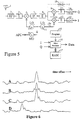
- Figure 5 illustrates a typical implementation.
- the RF signals in the region of 900 MHz or 1800 MHz are received by antenna 1, amplified in the RF amplifier 2, and filtered in the RF bandpass filter 3. before being mixed to the intermediate frequency, IF, in mixer 4 with a local oscillator signal LO 1 , generated by oscillator 5.
- LO 1 already incorporates the necessary channel switching ability. It is important for the present invention that its frequency is phase-locked to that of a master oscillator. MO. usually a crystal oscillator 6. This is also a requirement for normal GSM operation so it imposes no additional costs.
- the IF signals are amplified in amplifier 7, filtered by the bandpass filter 8, and converted to baseband in quadrature mixers 9 and 10 using the signal, LO 2 , from a second local oscillator 11. As with LO 1 , this second oscillator also needs to be phase-locked to the master oscillator. However, fine tuning (automatic frequency control, AFC) is often also incorporated into the loop which must be held constant during the recording process.
- Quadrature outputs are filtered by the lowpass filters 12 and 13, digitised in analogue-to-digital converters 14 and 15, and the bit streams labelled I and Q are produced.
- Position determination then just requires the microprocessor 16 to make recordings of the bit streams in dynamic ram 17 under the control of the program 18. There might be a need for some additional memory.
- the main modification to enable position determination is in the firmware program running on the microprocessor, and it might be necessary to upgrade the processor itself to a faster model. Similar equipment is needed in the base receiving station.
- a commercially limiting element in a system according to the present invention is likely to be the means by which the signals recorded at the base and rover are transferred to the position determining processor for cross correlation. It is therefore important to reduce the number of bits transferred as much as possible.
- one-bit sampling produces adequate results even under conditions of poor signal reception, and although slightly better accuracy can be obtained using, say, two-bit sampling, the increase in the link load is likely to be unattractive. Indeed, it is probably better to double the number of one-bit samples, and hence double the length of the sampling interval, than to use two-bit samples.
- Equations (1) and (2) above show how estimates of the time delays, ⁇ t , may be used to deduce the position ( x , y ) of the rover and the synchronisation error, ⁇ , between the base and rover.
- the accuracy with which estimates of ⁇ t can be obtained from the cross correlations is likely to be caused by multipath propagation of the signals from the GSM transmitter to the rover. It is assumed that the antenna at the base has been installed high enough above surrounding clutter to ensure that multipath propagation is small enough to be ignored. In these circumstances, multipath propagation to the rover causes the cross correlation profile to be spread out towards longer delay times. since the most-direct signals arrive first.
- the preferred method for obtaining an estimate of ⁇ t is based on using auto-correlations (ACF) of the base and rover signals as well as the cross-correlation (CCF) between them.
- ACF auto-correlations
- CCF cross-correlation
- the two auto-correlations, ACF CRU and ACF CBU , together with the cross correlation, CCF. may be obtained by any of the standard means (see for example in "Random Data: analysis and measurement procedures" by J. S. Bendat and A. G. Piersol, Wiley-Interscience, 1971); we prefer the methods which involve fast Fourier transforms.
- the ACF CBU is a good estimate of the 'intrinsic' auto-correlation of the transmitted signals (negligible multipath effect) whilst the ACF CRU is likely to be corrupted by multipath signals, i.e. signals delayed by more than about 30 m equivalent path. This is shown for a particular example in Figure 6. where trace A is ACF CBU and B is ACF CRU .
- the 'template' is constructed by taking the left-hand portion of ACF CBU (i.e. the trace to the left of the central peak in A corresponding to the negative time axis) and joining it to the right-hand portion of ACF CRU (i.e. the trace to the right of the central peak in B corresponding to the positive time axis). This is shown in Figure 6 trace C.
- the measured CCF is shown by trace D, and we can see that the template C reproduces the major features.
- the estimate of the time offset, ⁇ t is then obtained by fitting the template to the measured CCF using any standard method. allowing the amplitudes of the two halves of the template to be free parameters as well as ⁇ t .
- the fitting procedure also produces a 'goodness of fit' parameter which may be used as a basis for rejection or inclusion of the data.
- the goodness of fit parameter can provide a weighting factor for each ⁇ t to be used in evaluating the position.
- GSM handsets incorporate multi-level Analogue-to-Digital Converters (ADCs) and use adaptive processing techniques in order to reduce the errors resulting from multipath propagation. It may therefore be possible to use the demodulated signals themselves for the cross correlation function rather than the raw I and Q data streams from the receivers, depending on the design of the handset. Such extra delay put in by the adaptive processing must be removed of course, and no amount of processing can allow for the unknown extra path length of a wholly-indirect signal, but the demodulated output may nevertheless be better for estimating time-delays than the pre-processed I and Q raw data streams.
- FM discriminator 19 Shown in dotted outline in Figure 5 is an FM discriminator 19 (FMD).
- FM discrimination translates a frequency offset into a steady (DC) shift in the output, so quadrature signals (I and Q) are not needed, but are replaced by a single signal (J in Figure 5).
- This offers two further advantages in that (a) half as much data need be transferred over the links, and (b) it is unnecessary to adjust for the frequency offset at the position determining processor thus reducing the processor overhead.
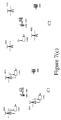
- FIG. 7a shows configuration A in which the CPP and SPD are co-located at a position remote from both the CBU and CRU. This could be the case, for example, when one CPP/SPD combination serves an entire region.
- each BTS has a CBU co-located with it.
- the CBU serving the local cell embraced by the three BTS is shown somewhere within the cell.
- Configurations B1 and B2 are similar to A1 and A2 respectively except that there are now many CPPs.
- each BTS has a CBU attached to it; in B2 each triangle of three BTSs has a CPP within it of which just one is shown in the Figure. The regional SPD remains at a remote location.
- Configurations C1 and C2 are similar to A1 and A2 but with the position processing carried out within each handset. Other configurations are also possible, each having relative advantages making them suited to particular commercial applications.
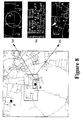
- FIG. 8 it is shown how a map of the local area might be displayed on a screen attached to the position determining processor or at a monitoring station.
- the user has requested directions to a location marked by a filled circle labelled Z. and the position determining processor has computed the user's position to be somewhere within the filled circle labelled W.
- the user's handset includes a liquid crystal dot-matrix display which can display small portions of the larger map as well as character-based information.
- the first screen displayed on the handset might be as shown in the panel marked (a) in Figure 8.
- a prototype test apparatus using a pair of standard hand portable units and some additional recording equipment was set up in Cambridge, UK.
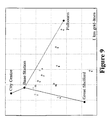
- the base station (CBU) was in a three-storey building near the city centre (see Figure 9) with the antenna fixed on the roof.
- the roving receiver (CRU) was carried in a car to various locations in the south of the city as shown by the crosses in Figure 9.
- Three GSM transmitters (BTSs) were used in the trial, located respectively in the city centre, at Great Shelford to the south, and at Fulbourn to the south east.
- Table 2 gives the mean positional errors in both co-ordinates, i.e. the differences between the averages of about 10 independent position determinations and the true positions as measured on a map.
Landscapes
- Engineering & Computer Science (AREA)
- Physics & Mathematics (AREA)
- General Physics & Mathematics (AREA)
- Radar, Positioning & Navigation (AREA)
- Remote Sensing (AREA)
- Computer Networks & Wireless Communication (AREA)
- Signal Processing (AREA)
- Mobile Radio Communication Systems (AREA)
- Position Fixing By Use Of Radio Waves (AREA)
- Radar Systems Or Details Thereof (AREA)
- Train Traffic Observation, Control, And Security (AREA)
- Paper (AREA)
- Control Of Position Or Direction (AREA)
- Vehicle Body Suspensions (AREA)
Claims (19)
- Système de détermination de position pour recevoir des signaux large bande qui sont émis par un certain nombre de sources d'émission (BTS) selon un nombre égal au moins au nombre de dimensions selon lesquelles le déplacement d'un objet à mobilité aléatoire (R) doit être surveillé, le système comprenant une paire de stations de réception, et en utilisation, la première des stations de réception (CBU) est en une position connue et la seconde (CRU) est située sur l'objet à mobilité aléatoire,
caractérisé en ce que :chacune des stations de réception (CBU, CRU) est agencée pour recevoir les signaux en provenance des sources d'émission respectives (BTS) sensiblement simultanément et pour enregistrer une partie de chacun des signaux reçus, et chaque station de réception inclut un moyen pour transmettre un signal de liaison (L1, L2) qui contient une information concernant les parties enregistrées des signaux reçus depuis les sources d'émission ; et par :un processeur de détermination de position (CPP) qui est agencé pour recevoir les signaux de liaison (L1, L2) et pour comparer l'information reçue depuis l'une des stations de réception en ce qui concerne les parties enregistrées des signaux qui sont reçues au niveau de l'une des stations de réception depuis les sources d'émission à l'information qui est reçue au niveau de l'autre station de réception en ce qui concerne les parties enregistrées des signaux qui sont reçues au niveau de l'autre station de réception depuis les sources d'émission, et pour déterminer le retard temporel entre les parties de signal respectives qui sont reçues au niveau des deux stations de réception afin de déterminer la position de l'objet à mobilité aléatoire (R). - Système de détermination de position selon la revendication 1, dans lequel les stations de réception (CRU, CBU) peuvent recevoir les signaux en provenance des sources d'émission respectives (BTS) séquentiellement et selon la même séquence l'une par rapport à l'autre.
- Système de détermination de position selon la revendication 1 ou 2, dans lequel chacune des stations de réception (CRU, CBU) est également agencée pour recevoir un second signal en provenance d'une ou plus des sources d'émission (BTS)
- Système de détermination de position selon l'une quelconque des revendications 1 à 3, dans lequel le processeur de détermination de position (CPP) est co-situé avec l'une des stations de réception (CBU).
- Système de détermination de position selon la revendication 4, dans lequel le signal de liaison en provenance de l'une des stations de réception (CRU) est passé à l'autre station de réception (CBU) et depuis l'autre station de réception, au processeur de détermination de position (CPP).
- Système de détermination de position selon l'une quelconque des revendications 1 à 3, dans lequel le processeur de détermination de position (CPP) est situé à distance des stations de réception (CBU, CRU).
- Système de détermination de position selon l'une quelconque des revendications 1 à 6, dans lequel un signal fournissant une information concernant la position de l'objet à mobilité aléatoire (R) est passé depuis le processeur de détermination de position (CPP) à au moins l'une des stations de réception (CBU, CRU).
- Système de détermination de position selon l'une quelconque des revendications 1 à 7, comprenant en outre une station de surveillance et dans lequel un signal qui fournit une information concernant la position de l'objet à mobilité aléatoire est passé depuis le processeur de détermination de position (CPP) à la station de surveillance.
- Système de détermination de position selon l'une quelconque des revendications 1 à 8, comprenant en outre :un serveur de base de données (SPD) qui est connecté audit processeur de détermination de position (CPP), ledit serveur de base de données contenant des éléments de données se rapportant à une pluralité de positions connues ;un moyen pour passer une information concernant la position de l'objet à mobilité aléatoire (R) qui est déterminée par le processeur de détermination de position (CPP) au serveur de base de données (SPD) ;un moyen pour retrouver des éléments de données rapportés à la position qui est déterminée par le processeur de détermination de position (CPP) ; etun moyen pour passer les éléments de données à l'une des stations de réception (CBU, CRU) ou à la station de surveillance.
- Système de détermination de position selon l'une quelconque des revendications 1 à 9, dans lequel la station de réception ou chaque station de réception (CBU, CRU) ou la station de surveillance inclut un affichage et la position de l'objet à mobilité aléatoire (R) est affichée sur l'affichage.
- Système de détermination de position selon la revendication 10, dans lequel l'affichage comprend un affichage matriciel à points.
- Système de détermination de position selon la revendication 10 ou 11 lorsqu'elle dépend de la revendication 9, dans lequel le serveur de base de données (SPD) contient une information graphique et ladite information graphique est passée à la station de réception (CBU, CRU) ou à la station de surveillance et est affichée sur l'affichage afin d'indiquer la position de l'objet à mobilité aléatoire (R).
- Système de détermination de position selon l'une quelconque des revendications précédentes, dans lequel les sources d'émission (BTS) et les stations de réception (CBU, CRU) comprennent des composants d'un réseau de téléphone cellulaire numérique.
- Système de détermination de position selon la revendication 13, dans lequel le réseau de téléphone cellulaire numérique est un réseau GSM.
- Système de détermination de position selon l'une quelconque des revendications précédentes, dans lequel les stations de réception (CBU, CRU) surveillent l'intensité des signaux de plusieurs sources d'émission (BTS) et sélectionnent une pluralité de signaux suffisamment forts pour une réception.
- Système de détermination de position selon l'une quelconque des revendications 1 à 15, dans lequel la quasi-synchronisation entre les signaux qui sont reçus depuis les sources d'émission respectives est réalisée en surveillant la réception d'une partie spécifique des signaux émis.
- Système de détermination de position selon la revendication 15, dans lequel la quasi-synchronisation entre les signaux qui sont reçus depuis les sources d'émission respectives est réalisée à l'aide d'un moyen qui est indépendant des signaux émis.
- Procédé de détermination de la position d'un objet à mobilité aléatoire (R), le procédé comprenant l'émission de signaux large bande depuis un certain nombre de sources d'émission (BTS) en un nombre égal au moins au nombre de dimensions selon lesquelles le déplacement d'un objet à mobilité aléatoire (R) doit être surveillé ; la réception des signaux au niveau d'une paire de stations de réception (CBU, CRU), et en utilisation, la première des stations de réception (CBU) est en une position connue et la seconde (CRU) est située sur l'objet à mobilité aléatoire (R) ;
caractérisé en ce que :chacune des stations de réception (CBU, CRU) reçoit les signaux en provenance des sources d'émission respectives (BTS) sensiblement simultanément, enregistre une partie de chacun des signaux reçus et passe un signal de liaison (L1, L2) depuis chacune des stations de réception sur un processeur de détermination de position (CPP), les signaux de liaison contenant une information concernant les parties enregistrées des signaux reçues au niveau de la station de réception respective depuis les sources d'émission ; et en ce que :le processeur de détermination de position (CPP) compare l'information reçue depuis l'une (CRU) des stations de réception en ce qui concerne les parties enregistrées des signaux qui sont reçues au niveau de l'une des stations de réception depuis les sources d'émission (BTS) à l'information qui est reçue au niveau de l'autre station de réception (CBU) en ce qui concerne les parties enregistrées des signaux qui sont reçues au niveau de l'autre station de réception depuis les sources d'émission, et détermine le retard temporel entre les parties de signal respectives qui sont reçues au niveau des stations de réception afin de déterminer la position de l'objet à mobilité aléatoire. - Procédé selon la revendication 18, dans lequel les signaux large bande sont des signaux de transmission de réseau de téléphone cellulaire numérique.
Priority Applications (1)
| Application Number | Priority Date | Filing Date | Title |
|---|---|---|---|
| EP01105348A EP1118871A3 (fr) | 1995-09-19 | 1996-09-19 | Procédé d'estimation du décalage de temps dans un système de détermination de position |
Applications Claiming Priority (3)
| Application Number | Priority Date | Filing Date | Title |
|---|---|---|---|
| GBGB9519087.2A GB9519087D0 (en) | 1995-09-19 | 1995-09-19 | Navigation and tracking system |
| GB9519087 | 1995-09-19 | ||
| PCT/GB1996/002308 WO1997011384A1 (fr) | 1995-09-19 | 1996-09-19 | Systeme de localisation |
Related Child Applications (1)
| Application Number | Title | Priority Date | Filing Date |
|---|---|---|---|
| EP01105348A Division EP1118871A3 (fr) | 1995-09-19 | 1996-09-19 | Procédé d'estimation du décalage de temps dans un système de détermination de position |
Publications (2)
| Publication Number | Publication Date |
|---|---|
| EP0880712A1 EP0880712A1 (fr) | 1998-12-02 |
| EP0880712B1 true EP0880712B1 (fr) | 2001-12-05 |
Family
ID=10780903
Family Applications (2)
| Application Number | Title | Priority Date | Filing Date |
|---|---|---|---|
| EP01105348A Withdrawn EP1118871A3 (fr) | 1995-09-19 | 1996-09-19 | Procédé d'estimation du décalage de temps dans un système de détermination de position |
| EP96931145A Expired - Lifetime EP0880712B1 (fr) | 1995-09-19 | 1996-09-19 | Systeme de localisation |
Family Applications Before (1)
| Application Number | Title | Priority Date | Filing Date |
|---|---|---|---|
| EP01105348A Withdrawn EP1118871A3 (fr) | 1995-09-19 | 1996-09-19 | Procédé d'estimation du décalage de temps dans un système de détermination de position |
Country Status (17)
| Country | Link |
|---|---|
| US (2) | US6094168A (fr) |
| EP (2) | EP1118871A3 (fr) |
| JP (1) | JPH11513482A (fr) |
| KR (1) | KR19990063677A (fr) |
| CN (1) | CN1202968A (fr) |
| AT (1) | ATE210303T1 (fr) |
| AU (1) | AU713289B2 (fr) |
| BR (1) | BR9610493A (fr) |
| CA (1) | CA2230982A1 (fr) |
| DE (1) | DE69617744T2 (fr) |
| DK (1) | DK0880712T3 (fr) |
| ES (1) | ES2165998T3 (fr) |
| GB (1) | GB9519087D0 (fr) |
| IL (1) | IL123599A (fr) |
| PT (1) | PT880712E (fr) |
| RU (1) | RU2137150C1 (fr) |
| WO (1) | WO1997011384A1 (fr) |
Cited By (1)
| Publication number | Priority date | Publication date | Assignee | Title |
|---|---|---|---|---|
| DE10252934A1 (de) * | 2002-10-28 | 2004-05-13 | Fraunhofer-Gesellschaft zur Förderung der angewandten Forschung e.V. | Verfahren zur kontinuierlichen Echtzeitverfolgung der Position von wenigstens einem mobilen Objekt sowie zugehörigen Sendern und Empfängern |
Families Citing this family (185)
| Publication number | Priority date | Publication date | Assignee | Title |
|---|---|---|---|---|
| GB9519087D0 (en) | 1995-09-19 | 1995-11-22 | Cursor Positioning Sys Ltd | Navigation and tracking system |
| JPH1155212A (ja) * | 1997-07-31 | 1999-02-26 | Sony Corp | ディジタル情報信号受信装置 |
| US6560461B1 (en) | 1997-08-04 | 2003-05-06 | Mundi Fomukong | Authorized location reporting paging system |
| EA002006B1 (ru) * | 1997-10-22 | 2001-10-22 | Кэмбридж Позишнинг Системз Лтд. | Система позиционирования для цифровых телефонных сетей |
| GB9722324D0 (en) | 1997-10-22 | 1997-12-17 | Cambridge Positioning Sys Ltd | Positioning system for digital telephone networks |
| FI113896B (fi) | 1997-11-11 | 2004-06-30 | Nokia Corp | Menetelmä matkaviestimen sijainnin hajautetuksi määrittelemiseksi |
| US6009334A (en) * | 1997-11-26 | 1999-12-28 | Telefonaktiebolaget L M Ericsson | Method and system for determining position of mobile radio terminals |
| US6353412B1 (en) * | 1998-03-17 | 2002-03-05 | Qualcomm, Incorporated | Method and apparatus for determining position location using reduced number of GPS satellites and synchronized and unsynchronized base stations |
| US7215967B1 (en) * | 1998-12-22 | 2007-05-08 | Telefonaktiebolaget Lm Ericsson (Publ) | System and method for fast cold start of a GPS receiver in a telecommunications environment |
| US7889133B2 (en) | 1999-03-05 | 2011-02-15 | Itt Manufacturing Enterprises, Inc. | Multilateration enhancements for noise and operations management |
| US7612716B2 (en) | 1999-03-05 | 2009-11-03 | Era Systems Corporation | Correlation of flight track data with other data sources |
| US7570214B2 (en) | 1999-03-05 | 2009-08-04 | Era Systems, Inc. | Method and apparatus for ADS-B validation, active and passive multilateration, and elliptical surviellance |
| US8446321B2 (en) | 1999-03-05 | 2013-05-21 | Omnipol A.S. | Deployable intelligence and tracking system for homeland security and search and rescue |
| US7908077B2 (en) | 2003-06-10 | 2011-03-15 | Itt Manufacturing Enterprises, Inc. | Land use compatibility planning software |
| US7739167B2 (en) | 1999-03-05 | 2010-06-15 | Era Systems Corporation | Automated management of airport revenues |
| US7782256B2 (en) | 1999-03-05 | 2010-08-24 | Era Systems Corporation | Enhanced passive coherent location techniques to track and identify UAVs, UCAVs, MAVs, and other objects |
| US7667647B2 (en) | 1999-03-05 | 2010-02-23 | Era Systems Corporation | Extension of aircraft tracking and positive identification from movement areas into non-movement areas |
| US7777675B2 (en) | 1999-03-05 | 2010-08-17 | Era Systems Corporation | Deployable passive broadband aircraft tracking |
| US8203486B1 (en) | 1999-03-05 | 2012-06-19 | Omnipol A.S. | Transmitter independent techniques to extend the performance of passive coherent location |
| JP3658234B2 (ja) * | 1999-03-17 | 2005-06-08 | 富士通株式会社 | 無線電話システムにおける遅延補正システム |
| GB9912724D0 (en) * | 1999-06-01 | 1999-08-04 | Cambridge Positioning Sys Ltd | Radio positioning system |
| EP1127473A1 (fr) * | 1999-09-07 | 2001-08-29 | Koninklijke Philips Electronics N.V. | Procede de calcule de la position d'une station radio mobile en fonction du temps de propagation le plus court |
| JP2001174537A (ja) * | 1999-12-21 | 2001-06-29 | Hitachi Ltd | 無線端末位置測定方法およびそれを用いた端末装置 |
| US20070124481A1 (en) * | 2000-01-19 | 2007-05-31 | Sony Ericsson Mobile Communications Ab | System and method for sharing event-triggered, location-related information between communication devices |
| US20070129074A1 (en) * | 2000-01-19 | 2007-06-07 | Bloebaum L S | System, Method and Device For Providing Secondary Information To A Communication Device |
| US6977909B2 (en) * | 2000-01-19 | 2005-12-20 | Phonepages Of Sweden, Inc. | Method and apparatus for exchange of information in a communication network |
| US7248862B2 (en) | 2000-01-19 | 2007-07-24 | Sony Ericsson Mobile Communications Ab | Method and apparatus for retrieving calling party information in a mobile communications system |
| US20070127645A1 (en) * | 2000-01-19 | 2007-06-07 | Sony Ericsson Mobile Communications Ab | Technique for providing secondary information to a user equipment |
| US8400946B2 (en) * | 2000-01-19 | 2013-03-19 | Sony Corporation | System and method for sharing common location-related information between communication devices |
| US6996072B1 (en) * | 2000-01-19 | 2006-02-07 | The Phonepages Of Sweden Ab | Method and apparatus for exchange of information in a communication network |
| US6922721B1 (en) * | 2000-10-17 | 2005-07-26 | The Phonepages Of Sweden Ab | Exchange of information in a communication system |
| US7183942B2 (en) | 2000-01-26 | 2007-02-27 | Origin Technologies Limited | Speed trap detection and warning system |
| US7366522B2 (en) | 2000-02-28 | 2008-04-29 | Thomas C Douglass | Method and system for location tracking |
| US7905832B1 (en) | 2002-04-24 | 2011-03-15 | Ipventure, Inc. | Method and system for personalized medical monitoring and notifications therefor |
| US7321774B1 (en) | 2002-04-24 | 2008-01-22 | Ipventure, Inc. | Inexpensive position sensing device |
| US7212829B1 (en) | 2000-02-28 | 2007-05-01 | Chung Lau | Method and system for providing shipment tracking and notifications |
| US7218938B1 (en) | 2002-04-24 | 2007-05-15 | Chung Lau | Methods and apparatus to analyze and present location information |
| US6975941B1 (en) | 2002-04-24 | 2005-12-13 | Chung Lau | Method and apparatus for intelligent acquisition of position information |
| US6826403B1 (en) | 2000-09-12 | 2004-11-30 | Phonepages Of Sweden Ab | Method and system for identifying a user |
| US7228228B2 (en) | 2000-11-15 | 2007-06-05 | Sagentia Limited | Tag tracking |
| US7024331B2 (en) | 2000-11-15 | 2006-04-04 | Scientific Generics Limited | Tag tracking |
| EP2288121A3 (fr) | 2000-11-30 | 2011-06-22 | Intrasonics S.A.R.L. | Dispositif de télécommunication opérant de manière intéractive avec une transmission audio |
| US6492945B2 (en) * | 2001-01-19 | 2002-12-10 | Massachusetts Institute Of Technology | Instantaneous radiopositioning using signals of opportunity |
| US6970132B2 (en) * | 2001-02-02 | 2005-11-29 | Rosum Corporation | Targeted data transmission and location services using digital television signaling |
| US7463195B2 (en) | 2001-06-21 | 2008-12-09 | Rosum Corporation | Position location using global positioning signals augmented by broadcast television signals |
| US8102317B2 (en) * | 2001-02-02 | 2012-01-24 | Trueposition, Inc. | Location identification using broadcast wireless signal signatures |
| US7126536B2 (en) * | 2001-02-02 | 2006-10-24 | Rosum Corporation | Position location using terrestrial digital video broadcast television signals |
| US7042396B2 (en) * | 2001-08-17 | 2006-05-09 | Rosom Corporation | Position location using digital audio broadcast signals |
| US20020184653A1 (en) | 2001-02-02 | 2002-12-05 | Pierce Matthew D. | Services based on position location using broadcast digital television signals |
| US7471244B2 (en) * | 2001-02-02 | 2008-12-30 | Rosum Corporation | Monitor units for television signals |
| US6861984B2 (en) | 2001-02-02 | 2005-03-01 | Rosum Corporation | Position location using broadcast digital television signals |
| US6717547B2 (en) | 2001-06-21 | 2004-04-06 | Rosum Corporation | Position location using broadcast television signals and mobile telephone signals |
| US8677440B2 (en) | 2001-02-02 | 2014-03-18 | Trueposition, Inc. | Position determination using ATSC-M/H signals |
| US6859173B2 (en) * | 2001-06-21 | 2005-02-22 | The Rosum Corporation | Position location using broadcast television signals and mobile telephone signals |
| US20050251844A1 (en) * | 2001-02-02 | 2005-11-10 | Massimiliano Martone | Blind correlation for high precision ranging of coded OFDM signals |
| US6952182B2 (en) * | 2001-08-17 | 2005-10-04 | The Rosom Corporation | Position location using integrated services digital broadcasting—terrestrial (ISDB-T) broadcast television signals |
| US6522297B1 (en) | 2001-02-02 | 2003-02-18 | Rosum Corporation | Position location using ghost canceling reference television signals |
| US6963306B2 (en) * | 2001-02-02 | 2005-11-08 | Rosum Corp. | Position location and data transmission using pseudo digital television transmitters |
| US8233091B1 (en) | 2007-05-16 | 2012-07-31 | Trueposition, Inc. | Positioning and time transfer using television synchronization signals |
| US6753812B2 (en) | 2001-02-02 | 2004-06-22 | Rosum Corporation | Time-gated delay lock loop tracking of digital television signals |
| US6559800B2 (en) | 2001-02-02 | 2003-05-06 | Rosum Corporation | Position location using broadcast analog television signals |
| US20050066373A1 (en) * | 2001-02-02 | 2005-03-24 | Matthew Rabinowitz | Position location using broadcast digital television signals |
| US8754807B2 (en) | 2001-02-02 | 2014-06-17 | Trueposition, Inc. | Time, frequency, and location determination for femtocells |
| US8106828B1 (en) | 2005-11-22 | 2012-01-31 | Trueposition, Inc. | Location identification using broadcast wireless signal signatures |
| EP1235076A1 (fr) * | 2001-02-23 | 2002-08-28 | Cambridge Positioning Systems Limited | Perfectionnements aux procédés et dispositifs de positionnement |
| JP4396801B2 (ja) * | 2001-02-27 | 2010-01-13 | パイオニア株式会社 | 測位装置と測位方法及び測位システム |
| US6925399B2 (en) * | 2001-03-30 | 2005-08-02 | Verizon Laboratories Inc. | Methods and systems for the estimation of the injection point of foreign signals in a network |
| EP1255122A1 (fr) * | 2001-05-04 | 2002-11-06 | Cambridge Positioning Systems Limited | Unité de mesure pour sytème de radiolocalisation |
| US6839024B2 (en) | 2001-06-21 | 2005-01-04 | Rosum Corporation | Position determination using portable pseudo-television broadcast transmitters |
| US6522296B2 (en) | 2001-06-25 | 2003-02-18 | Harris Corporation | Method and system for calibrating wireless location systems |
| US6580393B2 (en) | 2001-06-25 | 2003-06-17 | Harris Corporation | System and method for determining the location of a transmitter using passive reflectors or refractors as proxy receivers and using database querying |
| US6608593B2 (en) | 2001-06-25 | 2003-08-19 | Harris Corporation | System and method for determining the location of a transmitter using passive reflectors or refractors as proxy receivers |
| EP1278074A1 (fr) | 2001-07-17 | 2003-01-22 | Cambridge Positioning Systems Limited | Système de positionement par radio |
| SE0102729D0 (sv) | 2001-08-15 | 2001-08-15 | Phone Pages Sweden Ab | Method and apparatus for exchange of information in a communication network |
| US6914560B2 (en) * | 2001-08-17 | 2005-07-05 | The Rosum Corporation | Position location using broadcast digital television signals comprising pseudonoise sequences |
| US6669125B1 (en) * | 2001-08-22 | 2003-12-30 | Dynacorp Engineering Inc. | Solids reduction processor |
| US7454217B2 (en) * | 2001-10-04 | 2008-11-18 | Stephen William Edge | Method and apparatus for wireless network timekeeping and synchronization |
| EP1301054A1 (fr) * | 2001-10-04 | 2003-04-09 | Cambridge Positioning Systems Limited | Concernant la coordination d'une référence de temps dans un terminal cellulaire ou une station de base |
| US7197092B2 (en) * | 2001-10-25 | 2007-03-27 | Symbol Technologies Inc. | Amplitude-offset invariant template detection for pulse position estimation; methods, systems and program products |
| KR100949616B1 (ko) * | 2001-11-08 | 2010-03-26 | 더 로섬 코퍼레이션 | 디지털 텔레비전 방송 신호를 이용한 위치 결정에 바탕한 내버게이션 서비스 |
| US6937872B2 (en) * | 2002-04-15 | 2005-08-30 | Qualcomm Incorporated | Methods and apparatuses for measuring frequencies of basestations in cellular networks using mobile GPS receivers |
| US9182238B2 (en) | 2002-04-24 | 2015-11-10 | Ipventure, Inc. | Method and apparatus for intelligent acquisition of position information |
| US9049571B2 (en) | 2002-04-24 | 2015-06-02 | Ipventure, Inc. | Method and system for enhanced messaging |
| WO2003096055A2 (fr) * | 2002-05-13 | 2003-11-20 | The Charles Stark Draper Laboratory, Inc. | Systeme de geolocalisation a faible puissance peu onereux |
| US7095813B2 (en) * | 2002-05-16 | 2006-08-22 | Qualcomm Incorporated | System and method for the detection and compensation of radio signal time of arrival errors |
| EP1365613B1 (fr) | 2002-05-22 | 2006-06-21 | Cambridge Positioning Systems Limited | Système de localisation et procédé |
| EP1376150B1 (fr) * | 2002-06-17 | 2009-11-11 | Cambridge Positioning Systems Limited | Système de radiolocalisation avec suppression d'interférence |
| DE60238980D1 (de) * | 2002-08-28 | 2011-03-03 | Cambridge Positioning Sys Ltd | Verbesserungen in Funkortungsystemen |
| US7551675B2 (en) * | 2002-09-27 | 2009-06-23 | Ibiquity Digital Corporation | Method and apparatus for synchronized transmission and reception of data in a digital audio broadcasting system |
| EP1445970B1 (fr) * | 2003-02-05 | 2009-04-01 | Cambridge Positioning Systems Limited | Procédé et système de localisation d'un récepteur radio mobile dans un système radio à émetteurs multiples |
| US20040189515A1 (en) * | 2003-03-31 | 2004-09-30 | Giovanni Vannucci | Hybrid satellite based positioning system |
| US20040259573A1 (en) * | 2003-06-20 | 2004-12-23 | Steven D. Cheng | System and method for providing position alerting with a mobile device |
| AU2003903789A0 (en) * | 2003-07-22 | 2003-08-07 | Seeker Wireless Pty Limited | A method and apparatus for finding a mobile radio terminal |
| US7545326B2 (en) * | 2003-10-22 | 2009-06-09 | Awarepoint Corporation | Wireless tracking system and method with multipath error mitigation |
| WO2005062066A2 (fr) * | 2003-10-22 | 2005-07-07 | Awarepoint Corporation | Systeme sans fil de determination et de suivi de positions |
| EP1692784B1 (fr) * | 2003-12-09 | 2016-06-29 | Awarepoint Corporation | Appareil de reseau enfichable |
| ATE401579T1 (de) * | 2004-01-26 | 2008-08-15 | Cambridge Positioning Sys Ltd | Transfer kalibrierter zeitinformationen in einem mobilen endgerät |
| RU2380832C2 (ru) * | 2004-04-14 | 2010-01-27 | Эл Джи Электроникс Инк. | Система предоставления информации о местоположении, отражающая пользовательские настройки, и соответствующий способ оказания услуг |
| JP4693405B2 (ja) * | 2004-12-17 | 2011-06-01 | 株式会社日立製作所 | ノード位置測位システム、無線基地局及び位置測定方法 |
| US7453961B1 (en) | 2005-01-11 | 2008-11-18 | Itt Manufacturing Enterprises, Inc. | Methods and apparatus for detection of signal timing |
| EP1856550A1 (fr) | 2005-01-19 | 2007-11-21 | The Charles Stark Draper Laboratory, Inc. | Systemes et procedes de positionnement a l'aide de signaux multivoies |
| US8279119B2 (en) * | 2005-01-19 | 2012-10-02 | The Charles Stark Draper Laboratory, Inc. | Systems and methods for transparency mapping using multipath signals |
| US7973716B2 (en) * | 2005-01-19 | 2011-07-05 | The Charles Stark Draper Laboratory, Inc. | Systems and methods for transparency mapping using multipath signals |
| US7974639B2 (en) | 2005-02-04 | 2011-07-05 | Qualcomm Incorporated | Method and apparatus for performing position determination with a short circuit call flow |
| US8792902B2 (en) | 2005-06-21 | 2014-07-29 | Qualcomm Incorporated | Method and apparatus for providing location services with short-circuited message flows |
| US9154907B2 (en) | 2005-06-21 | 2015-10-06 | Qualcomm Incorporated | Efficient periodic location reporting in a radio access network |
| EP1897399B1 (fr) | 2005-06-27 | 2011-10-05 | Cambridge Positioning Systems Limited | Procédé et appareil destinés à déterminer si un terminal mobile se trouve à l extérieur d un lieu donné |
| US7295156B2 (en) * | 2005-08-08 | 2007-11-13 | Trimble Navigation Limited | Cellphone GPS positioning system |
| US7283091B1 (en) | 2005-08-08 | 2007-10-16 | Trimble Navigation Limited | Radio positioning system for providing position and time for assisting GPS signal acquisition in mobile unit |
| RU2302698C2 (ru) * | 2005-08-09 | 2007-07-10 | Федеральное государственное унитарное предприятие "Научно-производственное предприятие "Полет" | Система определения местонахождения подвижных объектов |
| US8068056B2 (en) | 2005-08-25 | 2011-11-29 | Qualcomm Incorporated | Location reporting with secure user plane location (SUPL) |
| RU2389156C2 (ru) * | 2005-08-25 | 2010-05-10 | Квэлкомм Инкорпорейтед | Оповещение о местоположении с помощью надежного определения местоположения в пользовательской плоскости (supl) |
| US8179318B1 (en) | 2005-09-28 | 2012-05-15 | Trueposition, Inc. | Precise position determination using VHF omni-directional radio range signals |
| US7498873B2 (en) | 2005-11-02 | 2009-03-03 | Rosom Corporation | Wide-lane pseudorange measurements using FM signals |
| US20070121555A1 (en) * | 2005-11-08 | 2007-05-31 | David Burgess | Positioning using is-95 cdma signals |
| US7583654B2 (en) * | 2005-12-28 | 2009-09-01 | Honeywell International Inc. | Sub-frame synchronized multiplexing |
| US8149168B1 (en) | 2006-01-17 | 2012-04-03 | Trueposition, Inc. | Position determination using wireless local area network signals and television signals |
| JP2009530625A (ja) | 2006-04-04 | 2009-08-27 | ケンブリッジ ポジショニング システムズ リミテッド | 受信信号に世界時を関連付ける方法 |
| US7719994B2 (en) * | 2006-04-26 | 2010-05-18 | Honeywell International Inc. | Sub-frame synchronized ranging |
| US7965227B2 (en) | 2006-05-08 | 2011-06-21 | Era Systems, Inc. | Aircraft tracking using low cost tagging as a discriminator |
| US7466266B2 (en) * | 2006-06-22 | 2008-12-16 | Rosum Corporation | Psuedo television transmitters for position location |
| US7737893B1 (en) | 2006-06-28 | 2010-06-15 | Rosum Corporation | Positioning in a single-frequency network |
| US7706976B1 (en) * | 2006-07-26 | 2010-04-27 | Trimble Navigation, Ltd. | Position based velocity estimator |
| US7688747B2 (en) * | 2006-08-30 | 2010-03-30 | Honeywell International Inc. | Sub-frame synchronized residual ranging |
| US8374150B2 (en) | 2006-10-03 | 2013-02-12 | Qualcomm Incorporated | Re-synchronization of temporary UE IDs in a wireless communication system |
| US9161212B2 (en) | 2006-10-03 | 2015-10-13 | Qualcomm Incorporated | Method and apparatus for re-synchronizing of temporary UE IDs in a wireless communication system |
| US8682341B1 (en) | 2006-11-22 | 2014-03-25 | Trueposition, Inc. | Blind identification of single-frequency-network transmitters |
| US7920875B2 (en) * | 2006-12-01 | 2011-04-05 | Trueposition, Inc. | Subscriptionless location of wireless devices |
| US7797000B2 (en) | 2006-12-01 | 2010-09-14 | Trueposition, Inc. | System for automatically determining cell transmitter parameters to facilitate the location of wireless devices |
| US8421675B2 (en) * | 2006-12-07 | 2013-04-16 | Digimarc Corporation | Systems and methods for locating a mobile device within a cellular system |
| US8451763B2 (en) * | 2006-12-07 | 2013-05-28 | Digimarc Corporation | Wireless local area network-based position locating systems and methods |
| WO2008073347A1 (fr) * | 2006-12-07 | 2008-06-19 | Venture Ad Astra, Llc | Système et procédé d'étalonnage dans l'espace temps |
| US7515092B2 (en) * | 2007-01-17 | 2009-04-07 | Honeywell International Inc. | Sub-frame synchronized residual radar |
| US8331953B2 (en) * | 2007-05-01 | 2012-12-11 | Andrew Llc | System and method for estimating the location of a mobile device |
| CA2589820A1 (fr) * | 2007-05-24 | 2008-11-24 | Penguin Automated Systems Inc. | Systeme de positionnement souterrain pour surveillance de masse souterraine en mouvement et methode |
| US8098150B2 (en) * | 2007-05-25 | 2012-01-17 | Palo Alto Research Center Incorporated | Method and system for locating devices with embedded location tags |
| US20090070847A1 (en) * | 2007-07-06 | 2009-03-12 | Rosum Corporation | Positioning with Time Sliced Single Frequency Networks |
| FR2918765B1 (fr) * | 2007-07-09 | 2009-10-02 | Sagem Electronique Sa | Procede de determination d'une erreur d'asservissement dans une boucle de poursuite d'un code pseudo-aleatoire. |
| US20090175379A1 (en) * | 2007-12-12 | 2009-07-09 | Rosum Corporation | Transmitter Identification For Wireless Signals Having A Digital Audio Broadcast Physical Layer |
| US7792156B1 (en) | 2008-01-10 | 2010-09-07 | Rosum Corporation | ATSC transmitter identifier signaling |
| US20090199192A1 (en) * | 2008-02-05 | 2009-08-06 | Robert Laithwaite | Resource scheduling apparatus and method |
| US8072383B1 (en) * | 2008-05-30 | 2011-12-06 | The United States Of America As Represented By The Secretary Of The Air Force | Navigation and position determination with a multicarrier modulation signal of opportunity |
| RU2368920C1 (ru) * | 2008-06-23 | 2009-09-27 | Валерий Георгиевич Бондарев | Способ измерения координат мерцающей подвижной точки земной поверхности и устройство для его осуществления |
| US9057606B2 (en) | 2009-09-10 | 2015-06-16 | Nextnav, Llc | Wide area positioning system |
| US8917209B2 (en) | 2009-09-10 | 2014-12-23 | Nextnav, Llc | Coding in a wide area positioning system (WAPS) |
| US9035829B2 (en) | 2008-09-10 | 2015-05-19 | Nextnav, Llc | Wide area positioning systems and methods |
| CN104122563B (zh) | 2008-09-10 | 2018-03-27 | 耐克斯特纳威公司 | 广域定位系统 |
| US8125389B1 (en) | 2008-10-20 | 2012-02-28 | Trueposition, Inc. | Doppler-aided positioning, navigation, and timing using broadcast television signals |
| US7983185B2 (en) * | 2009-02-12 | 2011-07-19 | Zulutime, Llc | Systems and methods for space-time determinations with reduced network traffic |
| US8253627B1 (en) | 2009-02-13 | 2012-08-28 | David Burgess | Position determination with NRSC-5 digital radio signals |
| US8311558B2 (en) * | 2009-03-20 | 2012-11-13 | Buzby Networks, Llc | Real-time network node location system and method |
| US20100287025A1 (en) * | 2009-05-06 | 2010-11-11 | Brian Fletcher | Mobile resource task scheduling |
| US8521092B2 (en) | 2009-05-27 | 2013-08-27 | Echo Ridge Llc | Wireless transceiver test bed system and method |
| US9473963B2 (en) | 2009-05-27 | 2016-10-18 | Echo Ridge Llc | Interactive RF system testing system and method |
| US7994982B2 (en) * | 2009-06-12 | 2011-08-09 | Raytheon Company | Method and apparatus for bounded time delay estimation |
| DE202009009050U1 (de) | 2009-06-30 | 2009-09-03 | Schairer, Lothar | Faltbarer Rahmen für ein Gebäude |
| US9372266B2 (en) | 2009-09-10 | 2016-06-21 | Nextnav, Llc | Cell organization and transmission schemes in a wide area positioning system (WAPS) |
| US9291712B2 (en) | 2009-09-10 | 2016-03-22 | Nextnav, Llc | Cell organization and transmission schemes in a wide area positioning system (WAPS) |
| US9633327B2 (en) | 2009-09-25 | 2017-04-25 | Fedex Corporate Services, Inc. | Sensor zone management |
| US8239169B2 (en) | 2009-09-25 | 2012-08-07 | Gregory Timothy L | Portable computing device and method for asset management in a logistics system |
| US8299920B2 (en) | 2009-09-25 | 2012-10-30 | Fedex Corporate Services, Inc. | Sensor based logistics system |
| US8463290B2 (en) | 2010-07-09 | 2013-06-11 | Digimarc Corporation | Mobile device positioning in dynamic groupings of communication devices |
| US10212687B2 (en) | 2010-09-30 | 2019-02-19 | Echo Ridge Llc | System and method for robust navigation and geolocation using measurements of opportunity |
| US9588218B2 (en) * | 2010-09-30 | 2017-03-07 | Echo Ridge Llc | System and method for robust navigation and geolocation using measurements of opportunity |
| RU2470465C2 (ru) * | 2010-12-20 | 2012-12-20 | Государственное образовательное учреждение высшего профессионального образования "Поволжский государственный университет телекоммуникаций и информатики" (ГОУВПО ПГУТИ) | Способ информационной защиты распределенной случайной антенны |
| RU2454000C1 (ru) * | 2011-05-30 | 2012-06-20 | Закрытое акционерное общество "ИРКОС" | Способ определения местоположения базовой станции |
| US9176217B2 (en) | 2011-08-02 | 2015-11-03 | Nextnav, Llc | Cell organization and transmission schemes in a wide area positioning system (WAPS) |
| US9594170B2 (en) | 2011-09-30 | 2017-03-14 | Echo Ridge Llc | Performance improvements for measurement of opportunity geolocation/navigation systems |
| US9739891B2 (en) | 2011-09-30 | 2017-08-22 | Echo Ridge Llc | System and method of using measurements of opportunity with vector tracking filters for improved navigation |
| US9148808B2 (en) | 2011-12-01 | 2015-09-29 | Echo Ridge Llc | Adaptive RF system testing system and method |
| US9282471B2 (en) | 2012-03-21 | 2016-03-08 | Digimarc Corporation | Positioning systems for wireless networks |
| WO2013184701A1 (fr) | 2012-06-05 | 2013-12-12 | Arun Raghupathy | Systèmes et procédés pour un positionnement de localisation d'un dispositif utilisateur |
| RU2519294C1 (ru) * | 2012-08-15 | 2014-06-10 | Владимир Петрович Панов | Способ передачи и приема радиосигналов |
| RU2519296C1 (ru) * | 2012-08-15 | 2014-06-10 | Владимир Петрович Панов | Способ передачи и приема радиосигналов |
| US9390279B2 (en) | 2012-09-11 | 2016-07-12 | Nextnav, Llc | Systems and methods for providing conditional access to transmitted information |
| US9286490B2 (en) | 2013-09-10 | 2016-03-15 | Nextnav, Llc | Systems and methods for providing conditional access to transmitted information |
| US20140375505A1 (en) * | 2013-06-24 | 2014-12-25 | Trueposition, Inc. | Positioning Using DTV Broadcast Signaling |
| TWI595254B (zh) * | 2014-10-16 | 2017-08-11 | 廖恒俊 | 運用廣播調頻訊號以及相位差運算技術定位之方法 |
| US10775749B2 (en) | 2015-04-17 | 2020-09-15 | The Mitre Corporation | Robust and resilient timing architecture for critical infrastructure |
| KR101693304B1 (ko) * | 2015-11-18 | 2017-01-06 | 한국항공우주연구원 | 정밀위치결정장치 및 이를 이용한 임야에서의 정밀위치결정방법 |
| RU2624451C1 (ru) * | 2016-07-15 | 2017-07-04 | Открытое акционерное общество научно-внедренческое предприятие "ПРОТЕК" | Радиопередающее устройство наземной радионавигационной станции длинноволнового диапазона, обеспечивающее формирование и сложение стандартного сигнала и сигнала повышенной точности для определения координат потребителей |
| KR20190028926A (ko) * | 2017-09-11 | 2019-03-20 | 현대자동차주식회사 | 차량을 이용한 광고 시스템 및 그를 이용한 광고 방법 |
| CN110146905B (zh) * | 2018-02-12 | 2021-06-29 | 清华大学 | 定位信号接收方法和接收机 |
| US12270916B2 (en) | 2019-07-24 | 2025-04-08 | Echo Ridge Llc | System and method for aiding data processing for signals of opportunity-based assured position, navigation and timing (PNT) |
| RU2740514C9 (ru) * | 2020-05-26 | 2021-05-17 | Открытое акционерное общество "Авангард" | Способ мониторинга состояния подземных сооружений метрополитена и система для его реализации |
Family Cites Families (32)
| Publication number | Priority date | Publication date | Assignee | Title |
|---|---|---|---|---|
| FI900645A0 (fi) * | 1987-08-10 | 1990-02-09 | Duffett Smith Peter James | Navigerings- och uppspaoringssystem. |
| US4829543A (en) * | 1987-12-04 | 1989-05-09 | Motorola, Inc. | Phase-coherent TDMA quadrature receiver for multipath fading channels |
| GB2241623A (en) * | 1990-02-28 | 1991-09-04 | Philips Electronic Associated | Vehicle location system |
| US5293642A (en) * | 1990-12-19 | 1994-03-08 | Northern Telecom Limited | Method of locating a mobile station |
| US5208756A (en) * | 1991-01-28 | 1993-05-04 | Song Han L | Vehicle locating and navigating system |
| GB2254508A (en) * | 1991-04-02 | 1992-10-07 | James Collier Mitchinson | Vehicle location determining system |
| JPH0567996A (ja) * | 1991-09-09 | 1993-03-19 | Nec Corp | 自動車電話システム |
| US5293645A (en) * | 1991-10-04 | 1994-03-08 | Sharp Microelectronics Technology, Inc. | Apparatus and method for locating mobile and portable radio terminals in a radio network |
| US5600706A (en) * | 1992-04-08 | 1997-02-04 | U S West, Inc. | Method and system for determining the position of a mobile receiver |
| US5436653A (en) * | 1992-04-30 | 1995-07-25 | The Arbitron Company | Method and system for recognition of broadcast segments |
| US5422813A (en) * | 1992-12-17 | 1995-06-06 | Stanford Telecommunications, Inc. | No-outage GPS/commercial RF positioning system |
| US5365450A (en) * | 1992-12-17 | 1994-11-15 | Stanford Telecommunications, Inc. | Hybrid GPS/data line unit for rapid, precise, and robust position determination |
| US5327144A (en) * | 1993-05-07 | 1994-07-05 | Associated Rt, Inc. | Cellular telephone location system |
| GB9310976D0 (en) * | 1993-05-27 | 1993-07-14 | Lynxvale Ltd | Navigation and tracking system for shielded spaces |
| US5519618A (en) * | 1993-08-02 | 1996-05-21 | Massachusetts Institute Of Technology | Airport surface safety logic |
| FR2711023B1 (fr) * | 1993-10-05 | 1995-12-29 | Cofira Sa | Système de radiocommunication cellulaire permettant l'accès à un service fonction de la localisation, module de prélèvement et module de fourniture d'un service personnalisé correspondants. |
| SE514830C2 (sv) * | 1993-11-17 | 2001-04-30 | Ericsson Telefon Ab L M | Förfarande och anordning för riktningsbestämning |
| SE515200C2 (sv) * | 1993-11-17 | 2001-06-25 | Ericsson Telefon Ab L M | Förfarande för avståndsbestämning |
| US5510801A (en) * | 1994-03-01 | 1996-04-23 | Stanford Telecommunications, Inc. | Location determination system and method using television broadcast signals |
| US5701328A (en) * | 1994-12-23 | 1997-12-23 | Stanford Telecommunications, Inc. | Chirped spread spectrum positioning system |
| US5604765A (en) * | 1994-12-23 | 1997-02-18 | Stanford Telecommunications, Inc. | Position enhanced communication system including system for embedding CDMA navigation beacons under the communications signals of a wireless communication system |
| US5613205A (en) * | 1995-03-31 | 1997-03-18 | Telefonaktiebolaget Lm Ericsson | System and method of locating a mobile terminal within the service area of a cellular telecommunication system |
| US5568153A (en) * | 1995-05-30 | 1996-10-22 | Telefonaktiebolaget Lm Ericsson | Individually defined personal home area for subscribers in a cellular telecommunications network |
| GB2301725B (en) | 1995-05-31 | 2000-02-02 | Gen Electric | A reduced-power GPS-based system for tracking multiple objects from a central location |
| GB9519087D0 (en) | 1995-09-19 | 1995-11-22 | Cursor Positioning Sys Ltd | Navigation and tracking system |
| AUPN733395A0 (en) | 1995-12-22 | 1996-01-25 | University Of Technology, Sydney | Location and tracking system |
| EP0877950A4 (fr) * | 1996-02-01 | 2000-01-26 | Stanford Telecomm Inc | Systeme de radionavigation utilisant des pseudolites hors bande |
| DE69705931T2 (de) * | 1996-02-05 | 2001-11-22 | Ericsson Inc., Research Triangle Park | Positionsbestimmung eines endgerätes mittels mehrerer strahlungskeulen |
| US5729694A (en) * | 1996-02-06 | 1998-03-17 | The Regents Of The University Of California | Speech coding, reconstruction and recognition using acoustics and electromagnetic waves |
| US5960355A (en) | 1996-02-16 | 1999-09-28 | Telefonaktiebolaget Lm Ericsson | Method and an arrangement relating to telecommunication systems |
| WO1998018018A1 (fr) * | 1996-10-24 | 1998-04-30 | Northern Telecom Limited | Determination de la direction de deplacement d'un terminal mobile dans un systeme de communications cellulaire |
| FI103248B1 (fi) * | 1996-10-29 | 1999-05-14 | Nokia Telecommunications Oy | Päätelaitteen sijainnin määrittäminen radiojärjestelmässä |
-
1995
- 1995-09-19 GB GBGB9519087.2A patent/GB9519087D0/en active Pending
-
1996
- 1996-09-16 US US09/043,221 patent/US6094168A/en not_active Expired - Lifetime
- 1996-09-19 EP EP01105348A patent/EP1118871A3/fr not_active Withdrawn
- 1996-09-19 IL IL12359996A patent/IL123599A/en not_active IP Right Cessation
- 1996-09-19 EP EP96931145A patent/EP0880712B1/fr not_active Expired - Lifetime
- 1996-09-19 ES ES96931145T patent/ES2165998T3/es not_active Expired - Lifetime
- 1996-09-19 JP JP9512479A patent/JPH11513482A/ja not_active Withdrawn
- 1996-09-19 RU RU98107160A patent/RU2137150C1/ru not_active IP Right Cessation
- 1996-09-19 AU AU69942/96A patent/AU713289B2/en not_active Ceased
- 1996-09-19 BR BR9610493A patent/BR9610493A/pt not_active IP Right Cessation
- 1996-09-19 CN CN96198421A patent/CN1202968A/zh active Pending
- 1996-09-19 PT PT96931145T patent/PT880712E/pt unknown
- 1996-09-19 KR KR1019980702139A patent/KR19990063677A/ko not_active Abandoned
- 1996-09-19 DE DE69617744T patent/DE69617744T2/de not_active Expired - Lifetime
- 1996-09-19 CA CA002230982A patent/CA2230982A1/fr not_active Abandoned
- 1996-09-19 DK DK96931145T patent/DK0880712T3/da active
- 1996-09-19 WO PCT/GB1996/002308 patent/WO1997011384A1/fr not_active Ceased
- 1996-09-19 AT AT96931145T patent/ATE210303T1/de not_active IP Right Cessation
-
2000
- 2000-02-17 US US09/506,014 patent/US6342854B1/en not_active Expired - Lifetime
Cited By (1)
| Publication number | Priority date | Publication date | Assignee | Title |
|---|---|---|---|---|
| DE10252934A1 (de) * | 2002-10-28 | 2004-05-13 | Fraunhofer-Gesellschaft zur Förderung der angewandten Forschung e.V. | Verfahren zur kontinuierlichen Echtzeitverfolgung der Position von wenigstens einem mobilen Objekt sowie zugehörigen Sendern und Empfängern |
Also Published As
| Publication number | Publication date |
|---|---|
| HK1015884A1 (en) | 1999-10-22 |
| WO1997011384A1 (fr) | 1997-03-27 |
| DE69617744D1 (de) | 2002-01-17 |
| DE69617744T2 (de) | 2002-05-23 |
| US6342854B1 (en) | 2002-01-29 |
| KR19990063677A (ko) | 1999-07-26 |
| ATE210303T1 (de) | 2001-12-15 |
| JPH11513482A (ja) | 1999-11-16 |
| DK0880712T3 (da) | 2002-04-02 |
| CA2230982A1 (fr) | 1997-03-27 |
| BR9610493A (pt) | 1999-04-06 |
| EP0880712A1 (fr) | 1998-12-02 |
| PT880712E (pt) | 2002-05-31 |
| MX9802182A (es) | 1998-08-30 |
| US6094168A (en) | 2000-07-25 |
| AU713289B2 (en) | 1999-11-25 |
| CN1202968A (zh) | 1998-12-23 |
| GB9519087D0 (en) | 1995-11-22 |
| IL123599A (en) | 2001-05-20 |
| IL123599A0 (en) | 1998-10-30 |
| EP1118871A3 (fr) | 2001-09-19 |
| AU6994296A (en) | 1997-04-09 |
| ES2165998T3 (es) | 2002-04-01 |
| EP1118871A2 (fr) | 2001-07-25 |
| RU2137150C1 (ru) | 1999-09-10 |
Similar Documents
| Publication | Publication Date | Title |
|---|---|---|
| US6094168A (en) | Position determining system | |
| EP0752113B1 (fr) | Methode de determination d'une position et son utilisation dans un systeme cellulaire analogique | |
| CA1314964C (fr) | Equipement de radionavigation et de reperage | |
| US8103294B2 (en) | Determining the change in time at a mobile terminal | |
| US8085201B2 (en) | System for determining position over a network | |
| US6167275A (en) | Method and apparatus for determining a location of a communication unit in a wireless communication system | |
| KR100766558B1 (ko) | 개선된 무선 위치결정 시스템 | |
| US5119102A (en) | Vehicle location system | |
| US20110285585A1 (en) | Position Location Using Opportunistic Analog and Digital Radio-Frequency Signals | |
| CA2647555C (fr) | Systeme facilitant la determination de la position gnss dans des environnements de propagation de signal pauvres | |
| CN107645465A (zh) | 对无线电信号进行定时和定位的方法和系统 | |
| KR20010031328A (ko) | 디지털 전화망용 위치결정 시스템 | |
| EP2101518A1 (fr) | Recherche de position d'un terminal mobile | |
| KR20050056688A (ko) | 위치 측정을 위한 기지국 장치 및 단말기, 그 위치 측정방법 | |
| US6816705B1 (en) | Satellite communication system and method | |
| JPH10276467A (ja) | 衛星通信端末捜索システムおよび方法 | |
| JPH11154897A (ja) | ドップラーシフトによって使用者端末の位置を補償する衛星通信システムおよび方法 | |
| HK1015884B (en) | Position determining system | |
| HK1038965A (en) | Method of estimating time offsets in a position determining system | |
| CN101388740A (zh) | 在td-scdma无线通讯系统中获得与传递gps标准时间的方法与系统 | |
| MXPA98002182A (en) | Position determinator system | |
| CN119310589A (zh) | 一种车载定位设备动态定位精度测试系统 | |
| HK1014752B (en) | A position determination method for use with analog cellular system |
Legal Events
| Date | Code | Title | Description |
|---|---|---|---|
| PUAI | Public reference made under article 153(3) epc to a published international application that has entered the european phase |
Free format text: ORIGINAL CODE: 0009012 |
|
| 17P | Request for examination filed |
Effective date: 19980415 |
|
| AK | Designated contracting states |
Kind code of ref document: A1 Designated state(s): AT BE CH DE DK ES FI FR GB GR IE IT LI LU NL PT SE |
|
| RBV | Designated contracting states (corrected) |
Designated state(s): AT BE CH DE DK ES FI FR GB GR IE IT LI LU NL PT SE |
|
| 17Q | First examination report despatched |
Effective date: 19990813 |
|
| GRAG | Despatch of communication of intention to grant |
Free format text: ORIGINAL CODE: EPIDOS AGRA |
|
| GRAG | Despatch of communication of intention to grant |
Free format text: ORIGINAL CODE: EPIDOS AGRA |
|
| GRAH | Despatch of communication of intention to grant a patent |
Free format text: ORIGINAL CODE: EPIDOS IGRA |
|
| GRAH | Despatch of communication of intention to grant a patent |
Free format text: ORIGINAL CODE: EPIDOS IGRA |
|
| GRAA | (expected) grant |
Free format text: ORIGINAL CODE: 0009210 |
|
| AK | Designated contracting states |
Kind code of ref document: B1 Designated state(s): AT BE CH DE DK ES FI FR GB GR IE IT LI LU NL PT SE |
|
| REF | Corresponds to: |
Ref document number: 210303 Country of ref document: AT Date of ref document: 20011215 Kind code of ref document: T |
|
| REG | Reference to a national code |
Ref country code: CH Ref legal event code: EP |
|
| REG | Reference to a national code |
Ref country code: CH Ref legal event code: NV Representative=s name: KIRKER & CIE SA |
|
| REG | Reference to a national code |
Ref country code: GB Ref legal event code: IF02 |
|
| REG | Reference to a national code |
Ref country code: IE Ref legal event code: FG4D |
|
| REF | Corresponds to: |
Ref document number: 69617744 Country of ref document: DE Date of ref document: 20020117 |
|
| REG | Reference to a national code |
Ref country code: ES Ref legal event code: FG2A Ref document number: 2165998 Country of ref document: ES Kind code of ref document: T3 |
|
| REG | Reference to a national code |
Ref country code: DK Ref legal event code: T3 |
|
| ET | Fr: translation filed | ||
| REG | Reference to a national code |
Ref country code: PT Ref legal event code: SC4A Free format text: AVAILABILITY OF NATIONAL TRANSLATION Effective date: 20020305 |
|
| REG | Reference to a national code |
Ref country code: GR Ref legal event code: EP Ref document number: 20020400779 Country of ref document: GR |
|
| PGFP | Annual fee paid to national office [announced via postgrant information from national office to epo] |
Ref country code: AT Payment date: 20020911 Year of fee payment: 7 |
|
| PGFP | Annual fee paid to national office [announced via postgrant information from national office to epo] |
Ref country code: DK Payment date: 20020912 Year of fee payment: 7 |
|
| PGFP | Annual fee paid to national office [announced via postgrant information from national office to epo] |
Ref country code: IE Payment date: 20020924 Year of fee payment: 7 |
|
| PGFP | Annual fee paid to national office [announced via postgrant information from national office to epo] |
Ref country code: LU Payment date: 20020927 Year of fee payment: 7 Ref country code: GR Payment date: 20020927 Year of fee payment: 7 Ref country code: ES Payment date: 20020927 Year of fee payment: 7 |
|
| PGFP | Annual fee paid to national office [announced via postgrant information from national office to epo] |
Ref country code: NL Payment date: 20020930 Year of fee payment: 7 |
|
| PGFP | Annual fee paid to national office [announced via postgrant information from national office to epo] |
Ref country code: CH Payment date: 20021001 Year of fee payment: 7 |
|
| PLBE | No opposition filed within time limit |
Free format text: ORIGINAL CODE: 0009261 |
|
| STAA | Information on the status of an ep patent application or granted ep patent |
Free format text: STATUS: NO OPPOSITION FILED WITHIN TIME LIMIT |
|
| 26N | No opposition filed | ||
| PGFP | Annual fee paid to national office [announced via postgrant information from national office to epo] |
Ref country code: BE Payment date: 20021203 Year of fee payment: 7 |
|
| PG25 | Lapsed in a contracting state [announced via postgrant information from national office to epo] |
Ref country code: PT Free format text: LAPSE BECAUSE OF NON-PAYMENT OF DUE FEES Effective date: 20030331 |
|
| REG | Reference to a national code |
Ref country code: PT Ref legal event code: MM4A Free format text: LAPSE DUE TO NON-PAYMENT OF FEES Effective date: 20030331 |
|
| PGFP | Annual fee paid to national office [announced via postgrant information from national office to epo] |
Ref country code: SE Payment date: 20030904 Year of fee payment: 8 |
|
| PGFP | Annual fee paid to national office [announced via postgrant information from national office to epo] |
Ref country code: FI Payment date: 20030912 Year of fee payment: 8 |
|
| PG25 | Lapsed in a contracting state [announced via postgrant information from national office to epo] |
Ref country code: LU Free format text: LAPSE BECAUSE OF NON-PAYMENT OF DUE FEES Effective date: 20030919 Ref country code: IE Free format text: LAPSE BECAUSE OF NON-PAYMENT OF DUE FEES Effective date: 20030919 Ref country code: AT Free format text: LAPSE BECAUSE OF NON-PAYMENT OF DUE FEES Effective date: 20030919 |
|
| PG25 | Lapsed in a contracting state [announced via postgrant information from national office to epo] |
Ref country code: ES Free format text: LAPSE BECAUSE OF NON-PAYMENT OF DUE FEES Effective date: 20030920 |
|
| PG25 | Lapsed in a contracting state [announced via postgrant information from national office to epo] |
Ref country code: LI Free format text: LAPSE BECAUSE OF NON-PAYMENT OF DUE FEES Effective date: 20030930 Ref country code: DK Free format text: LAPSE BECAUSE OF NON-PAYMENT OF DUE FEES Effective date: 20030930 Ref country code: CH Free format text: LAPSE BECAUSE OF NON-PAYMENT OF DUE FEES Effective date: 20030930 Ref country code: BE Free format text: LAPSE BECAUSE OF NON-PAYMENT OF DUE FEES Effective date: 20030930 |
|
| BERE | Be: lapsed |
Owner name: CAMBRIDGE *POSITIONING SYSTEMS LTD Effective date: 20030930 |
|
| PG25 | Lapsed in a contracting state [announced via postgrant information from national office to epo] |
Ref country code: NL Free format text: LAPSE BECAUSE OF NON-PAYMENT OF DUE FEES Effective date: 20040401 |
|
| PG25 | Lapsed in a contracting state [announced via postgrant information from national office to epo] |
Ref country code: GR Free format text: LAPSE BECAUSE OF NON-PAYMENT OF DUE FEES Effective date: 20040402 |
|
| REG | Reference to a national code |
Ref country code: DK Ref legal event code: EBP |
|
| REG | Reference to a national code |
Ref country code: CH Ref legal event code: PL |
|
| NLV4 | Nl: lapsed or anulled due to non-payment of the annual fee |
Effective date: 20040401 |
|
| REG | Reference to a national code |
Ref country code: IE Ref legal event code: MM4A |
|
| PG25 | Lapsed in a contracting state [announced via postgrant information from national office to epo] |
Ref country code: FI Free format text: LAPSE BECAUSE OF NON-PAYMENT OF DUE FEES Effective date: 20040919 |
|
| PG25 | Lapsed in a contracting state [announced via postgrant information from national office to epo] |
Ref country code: SE Free format text: LAPSE BECAUSE OF NON-PAYMENT OF DUE FEES Effective date: 20040920 |
|
| REG | Reference to a national code |
Ref country code: ES Ref legal event code: FD2A Effective date: 20030920 |
|
| EUG | Se: european patent has lapsed | ||
| PG25 | Lapsed in a contracting state [announced via postgrant information from national office to epo] |
Ref country code: IT Free format text: LAPSE BECAUSE OF NON-PAYMENT OF DUE FEES;WARNING: LAPSES OF ITALIAN PATENTS WITH EFFECTIVE DATE BEFORE 2007 MAY HAVE OCCURRED AT ANY TIME BEFORE 2007. THE CORRECT EFFECTIVE DATE MAY BE DIFFERENT FROM THE ONE RECORDED. Effective date: 20050919 |
|
| PGFP | Annual fee paid to national office [announced via postgrant information from national office to epo] |
Ref country code: FR Payment date: 20130919 Year of fee payment: 18 |
|
| REG | Reference to a national code |
Ref country code: FR Ref legal event code: ST Effective date: 20150529 |
|
| PG25 | Lapsed in a contracting state [announced via postgrant information from national office to epo] |
Ref country code: FR Free format text: LAPSE BECAUSE OF NON-PAYMENT OF DUE FEES Effective date: 20140930 |
|
| PGFP | Annual fee paid to national office [announced via postgrant information from national office to epo] |
Ref country code: DE Payment date: 20150831 Year of fee payment: 20 Ref country code: GB Payment date: 20150827 Year of fee payment: 20 |
|
| REG | Reference to a national code |
Ref country code: DE Ref legal event code: R071 Ref document number: 69617744 Country of ref document: DE |
|
| REG | Reference to a national code |
Ref country code: GB Ref legal event code: PE20 Expiry date: 20160918 |
|
| PG25 | Lapsed in a contracting state [announced via postgrant information from national office to epo] |
Ref country code: GB Free format text: LAPSE BECAUSE OF EXPIRATION OF PROTECTION Effective date: 20160918 |