EP0880809B1 - Outil d'insertion et procede d'utilisation - Google Patents
Outil d'insertion et procede d'utilisation Download PDFInfo
- Publication number
- EP0880809B1 EP0880809B1 EP97903122A EP97903122A EP0880809B1 EP 0880809 B1 EP0880809 B1 EP 0880809B1 EP 97903122 A EP97903122 A EP 97903122A EP 97903122 A EP97903122 A EP 97903122A EP 0880809 B1 EP0880809 B1 EP 0880809B1
- Authority
- EP
- European Patent Office
- Prior art keywords
- connection device
- contact
- tool
- fixture base
- channel
- Prior art date
- Legal status (The legal status is an assumption and is not a legal conclusion. Google has not performed a legal analysis and makes no representation as to the accuracy of the status listed.)
- Expired - Lifetime
Links
Images

Classifications
-
- H—ELECTRICITY
- H01—ELECTRIC ELEMENTS
- H01R—ELECTRICALLY-CONDUCTIVE CONNECTIONS; STRUCTURAL ASSOCIATIONS OF A PLURALITY OF MUTUALLY-INSULATED ELECTRICAL CONNECTING ELEMENTS; COUPLING DEVICES; CURRENT COLLECTORS
- H01R43/00—Apparatus or processes specially adapted for manufacturing, assembling, maintaining, or repairing of line connectors or current collectors or for joining electric conductors
- H01R43/20—Apparatus or processes specially adapted for manufacturing, assembling, maintaining, or repairing of line connectors or current collectors or for joining electric conductors for assembling or disassembling contact members with insulating base, case or sleeve
- H01R43/22—Hand tools
-
- G—PHYSICS
- G02—OPTICS
- G02B—OPTICAL ELEMENTS, SYSTEMS OR APPARATUS
- G02B6/00—Light guides; Structural details of arrangements comprising light guides and other optical elements, e.g. couplings
- G02B6/24—Coupling light guides
- G02B6/36—Mechanical coupling means
- G02B6/38—Mechanical coupling means having fibre to fibre mating means
- G02B6/3807—Dismountable connectors, i.e. comprising plugs
- G02B6/3898—Tools, e.g. handheld; Tuning wrenches; Jigs used with connectors, e.g. for extracting, removing or inserting in a panel, for engaging or coupling connectors, for assembling or disassembling components within the connector, for applying clips to hold two connectors together or for crimping
-
- H—ELECTRICITY
- H01—ELECTRIC ELEMENTS
- H01R—ELECTRICALLY-CONDUCTIVE CONNECTIONS; STRUCTURAL ASSOCIATIONS OF A PLURALITY OF MUTUALLY-INSULATED ELECTRICAL CONNECTING ELEMENTS; COUPLING DEVICES; CURRENT COLLECTORS
- H01R13/00—Details of coupling devices of the kinds covered by groups H01R12/70 or H01R24/00 - H01R33/00
- H01R13/40—Securing contact members in or to a base or case; Insulating of contact members
- H01R13/42—Securing in a demountable manner
- H01R13/426—Securing by a separate resilient retaining piece supported by base or case, e.g. collar or metal contact-retention clip
-
- Y—GENERAL TAGGING OF NEW TECHNOLOGICAL DEVELOPMENTS; GENERAL TAGGING OF CROSS-SECTIONAL TECHNOLOGIES SPANNING OVER SEVERAL SECTIONS OF THE IPC; TECHNICAL SUBJECTS COVERED BY FORMER USPC CROSS-REFERENCE ART COLLECTIONS [XRACs] AND DIGESTS
- Y10—TECHNICAL SUBJECTS COVERED BY FORMER USPC
- Y10T—TECHNICAL SUBJECTS COVERED BY FORMER US CLASSIFICATION
- Y10T29/00—Metal working
- Y10T29/49—Method of mechanical manufacture
- Y10T29/49002—Electrical device making
- Y10T29/49117—Conductor or circuit manufacturing
- Y10T29/49124—On flat or curved insulated base, e.g., printed circuit, etc.
- Y10T29/49147—Assembling terminal to base
- Y10T29/49151—Assembling terminal to base by deforming or shaping
- Y10T29/49153—Assembling terminal to base by deforming or shaping with shaping or forcing terminal into base aperture
-
- Y—GENERAL TAGGING OF NEW TECHNOLOGICAL DEVELOPMENTS; GENERAL TAGGING OF CROSS-SECTIONAL TECHNOLOGIES SPANNING OVER SEVERAL SECTIONS OF THE IPC; TECHNICAL SUBJECTS COVERED BY FORMER USPC CROSS-REFERENCE ART COLLECTIONS [XRACs] AND DIGESTS
- Y10—TECHNICAL SUBJECTS COVERED BY FORMER USPC
- Y10T—TECHNICAL SUBJECTS COVERED BY FORMER US CLASSIFICATION
- Y10T29/00—Metal working
- Y10T29/49—Method of mechanical manufacture
- Y10T29/49002—Electrical device making
- Y10T29/49117—Conductor or circuit manufacturing
- Y10T29/49204—Contact or terminal manufacturing
- Y10T29/49208—Contact or terminal manufacturing by assembling plural parts
-
- Y—GENERAL TAGGING OF NEW TECHNOLOGICAL DEVELOPMENTS; GENERAL TAGGING OF CROSS-SECTIONAL TECHNOLOGIES SPANNING OVER SEVERAL SECTIONS OF THE IPC; TECHNICAL SUBJECTS COVERED BY FORMER USPC CROSS-REFERENCE ART COLLECTIONS [XRACs] AND DIGESTS
- Y10—TECHNICAL SUBJECTS COVERED BY FORMER USPC
- Y10T—TECHNICAL SUBJECTS COVERED BY FORMER US CLASSIFICATION
- Y10T29/00—Metal working
- Y10T29/53—Means to assemble or disassemble
- Y10T29/5313—Means to assemble electrical device
- Y10T29/532—Conductor
- Y10T29/53209—Terminal or connector
-
- Y—GENERAL TAGGING OF NEW TECHNOLOGICAL DEVELOPMENTS; GENERAL TAGGING OF CROSS-SECTIONAL TECHNOLOGIES SPANNING OVER SEVERAL SECTIONS OF THE IPC; TECHNICAL SUBJECTS COVERED BY FORMER USPC CROSS-REFERENCE ART COLLECTIONS [XRACs] AND DIGESTS
- Y10—TECHNICAL SUBJECTS COVERED BY FORMER USPC
- Y10T—TECHNICAL SUBJECTS COVERED BY FORMER US CLASSIFICATION
- Y10T29/00—Metal working
- Y10T29/53—Means to assemble or disassemble
- Y10T29/5313—Means to assemble electrical device
- Y10T29/53261—Means to align and advance work part
Definitions
- This invention relates to a tool for inserting a contact into a connection device and a method of using the tool.
- This tool is particularly useful for inserting a substrate having a contact into the connection device described in U.S. Patent Application US-A-5,824,954.
- Such tool for inserting a contact into a connection device and a method of using such a tool are known from US-A-4.907.470, US-A-5.355.583 and US-A-5.528.821.
- US-A-5.528.821 discloses a tool for inserting a contact into a connection device comprising :
- Wire splicing in automotive electrical harnesses is typically done by crimping or welding wires to be spliced and then covering the joint to insulate and seal. Splicing operations are generally considered to be craft sensitive and, therefore, difficult to control. It is, however, desirable to provide consistent splicing and to ensure that the contact is fully connected to the electrical element and cannot be easily separated therefrom.
- connection device as described in U.S. Patent Application US-A-5,824,954 it may be difficult to properly insert the contact into the connection device because there is no efficient way to hold the substrate close enough to the contact so as to ensure that the contact is fully inserted into the connection device and connected to the electrical element. It is also desirable to provide consistent results. Many substrates, such as wires with small diameters, do not have sufficient rigidity to be capable of holding them the required distance from the contact and still be able to exert an insertion force for proper insertion into the connection device without buckling of the substrate.
- the tool of the present invention avoids exerting an insertion force on the substrate, which might cause the substrate to buckle.
- this tool may be used with any size substrate and contact, but is particularly useful for wires or fiber optic cables having small diameters.
- the tool is designed to ensure that the contact is properly inserted into the connection device and placement of the contact is not sensitive to craftsmanship.
- a first aspect of the invention comprises a method for connecting a substrate having a contact disposed at a distal end of the substrate to a connection device, the method comprising:
- a second aspect of the invention comprises a tool for connecting a substrate having a contact disposed at a distal end of the substrate to a connection device, said tool comprising:
- a further aspect of the invention comprises a kit of parts containing:
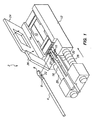
- Figs. 1 and 2 illustrate an insertion tool 2 for connecting a substrate 4 having a contact 6 disposed at a distal end 8 of the substrate to a connection device 10.
- the body of insertion tool 2 is in the form of a fixture base 12.
- Substrate 4 may be any elongate element which is to be inserted into a connection device.
- the substrate may be a wire or optical fiber cable, particularly one having a small diameter which would normally buckle when subjected to an insertion force sufficient to insert the contact into the connection device.
- Contact 6 is affixed to distal end 8 of substrate 4.
- One side of contact 6 protrudes radially outward from the longitudinal axis of the substrate, forming a proximal radial edge 22, as seen in Figs. 1 and 2, the purpose of which is described below.
- Fixture base 12 includes a cavity 14 for receiving connection device 10 in proper position and orientation.
- Cavity 14 is sized such that connection device 10 fits within the cavity, including depressions and protrusions (not shown) which conform to the shape of complementary protrusions and depressions of the connection device.
- Fixture base 12 also includes a channel 16 communicating with cavity 14 for guiding substrate 4 and contact 6 into the connection device.
- Channel 16 is sized such that contact 6 fits therein in proper position and orientation.
- fixture base 12 includes a plurality of channels 16 for simultaneously inserting a plurality of substrates into a connection device.
- a pusher arm 18 is employed to insert contact 6 into connection device 10.
- Pusher arm 18 is elongate and slides through channel 16 into cavity 14.
- the distal end of pusher arm 18 is raised slightly to form a lip 20, as shown in Figs. 1 and 2, for engaging proximal radial edge 22 of contact 6 for exerting a force on the contact and inserting it into connection device 10.
- Pusher arm 18 extends into the proximal end of channel 16.
- the pusher arm is configured such that each channel 16 has a corresponding lip 20 for engaging the contact in that channel.
- connection device cover 24 retains connection device 10 in cavity 14 and establishes that connection device 10 is in its proper position and orientation.
- Connection device cover 24 is movable with respect to fixture base 12 and has a lock for retaining the connection device cover on the fixture base.
- Connection device cover 24 may be hinged to fixture base 12, as shown in Fig. 1, slidable on the fixture base, or removable from the fixture base.
- the lock may be a snap fit connection, or any other positive connection between the connection device cover and the fixture base. Because of the cooperation of the depressions and protrusions of the cavity and connection device, the connection device will properly fit into the cavity only if it is in proper position and orientation. Thus, the connection device cover is incapable of locking to the fixture base when the connection device is improperly received in the cavity.
- a contact cover 26 retains contact 6 in channel 16 and establishes that the contact is in its proper position and orientation.
- Contact cover 26 is movable with respect to fixture base 12 and has a lock for retaining the contact cover on the fixture base.
- Contact cover 26 may be hinged to fixture base 12, as shown in Fig. 1, slidable on the fixture base, or removable from the fixture base.
- the lock may be a snap fit connection, or or any other positive connection between the contact cover and the fixture base. Because the contact is configured to protrude radially from one side of substrate 4 (as discussed above) and pusher arm includes a raised lip 20, proximal radial edge 22 fits into channel 16 with the proximal radial edge extending downwardly, distally of the pusher arm.
- Connection device cover 24 and contact cover 26 may be separate elements, as shown in the drawings, or may be a single cover, securing both the connection device and contact.
- Pusher arm 18 is designed such that it cannot begin to slide and advance into cavity 14 unless covers 24, 26 are closed and locked in place. Additionally, the pusher arm may be designed such that it cannot return to its initial position unless it has been fully advanced.
- Alignment means acting with fixture base 12 and pusher arm 18 maintains alignment between the fixture base and pusher arm.
- the alignment means may have any acceptable configuration.
- the alignment means is in the form of at least one axial rod 28, and more preferably two axial rods 28, 29, slidable relative to one of the pusher arm and fixture base so that as the pusher arm is moved through channel 16 and into cavity 14.
- the axial rod or rods ensure that the force of the pusher arm is directed so as to insert the contact into the connection device.
- the axial rod is attached to fixture base 12, however, it is within the scope of the present invention to construct insertion tool 2 with an axial rod connected to the pusher arm and slidable into the fixture base.
- Biasing means 30 biases the pusher arm in the proximal direction through channel 16 and out of cavity 14.
- the biasing means comprises a spring, more preferably a coil spring, positioned between the fixture base and the pusher arm. It should be noted that any type of biasing means which would urge the fixture base and pusher arm apart may be employed, for example, air or hydraulic pressure.
- a contact test circuit may be included on insertion tool 2 to test the circuit and ensure that the substrate to be inserted into connection device 10 is the desired substrate.
- Connection device 10 may be a sealed interconnection device as described in U.S. Patent US-A-5.824.954 but the connection device need not be a sealed device.
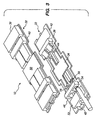
- Connection device 10 is shown in detail in Fig. 3.
- Connection device 10 includes a body 32 and an electrical element 34.
- Body 32 comprises a first section 36 and a second section 38 bonded together along edges 40, 42 to form an enclosure 44 having an open edge 46.
- Enclosure 44 includes passageways 48 extending from open edge 46 for receiving substrate 4, to a retaining portion 50 of the enclosure.
- Electrical element 34 is retained within enclosure 44 in retaining portion 50.
- a sealing member 52 may be located in enclosure 44 adjacent open edge 46, at the opposite end of passageways 48 from the electrical element. It should be noted that the connection device used in conjunction with the present invention need not be sealed.
- Sections 36, 38 are preferably constructed of multiple layers of polymeric film, more preferably expanded film bonded together to form enclosure 44. It should be noted, however, that sections 36, 38 may be a variety of constructions, for example, formed, molded or extruded parts. Prior to securing sections 36, 38 together, electrical element 34 and sealing member 52, if present, are inserted into enclosure 44 so as to be enclosed therein when the sections are secured together. In the preferred embodiment, sections 36, 38 are mirror images of each other, together forming enclosure 44, including passageways 48 and retaining section 50.
- open edge 46 preferably has a configuration such that at least one dimension is smaller than a corresponding dimension of electrical element 34. In this way, the electrical element is retained within enclosure 44.
- connection device 10 has more than one open edge through which substrates may be inserted for connection to the electrical element as seen in Figs. 2 and 3; however, only one edge may be open for receiving substrates.
- Electrical element 34 may be any electrical joining device, such as a splice, a ground, a circuit protection device, a printed circuit device, or any of a number of electrical elements for which it is desirable to connect substrates thereto. Electrical element 34 is placed in retaining portion 50 prior to securing sections 36, 38 together, as discussed above. The configuration of electrical element 34, enclosure 44 and retaining portion 50 are such that once sections 36, 38 are secured together, the electrical element cannot be removed from the enclosure.
- Electrical element 34 is preferably relatively flat when connection device 10 has only a first and second section; however, body 32 may be constructed of more than two sections, such that the electrical element may have a more three dimensional configuration. Additionally, multiple electrical elements may be included in enclosure 44. Multiple electrical elements may or may not be isolated from every other electrical element.
- a locking means may be employed for locking substrates into connection device 10.
- Locking means is preferably a locking element 54 captivated between passageways 48 and electrical element 34 such that when contact 6 is inserted therethrough, the contact cannot be easily removed.
- the element is constructed such that portions 56 of the locking element are forced apart and, once the contact is fully inserted, portions 56 of the locking element return to their original configuration preventing proximal radial edge 22 from returning through locking element portions 56, resulting in a detent action which locks the contact in place.
- Locking element portions 56 are described herein as being a separate mechanical element, however, the locking element portions could be formed as part of body sections 36, 38. Additionally, any locking means may be employed in the present invention, including heat deformation of a portion the body.
- connection device 10 is inserted and located in cavity 14 of insertion tool 2 in proper position and orientation, as described above.
- Connection device cover 24 is closed to ensure that connection device 10 is retained in proper position and orientation.
- One or more contacts 6 is inserted into channels 16 in proper position and orientation, with proximal radial edge 20 extending downwardly, distally of pusher arm 18. No more than one contact is inserted into each channel.
- Contact cover 26 is closed to ensure that contact 6 is retained in proper position and orientation.
- Insertion tool 2 may be a manual hand tool which may include a handle, or may be automated, for example, with air, hydraulic or electric activation. Actuation of insertion tool 2 slides pusher arm 18, forcing contact 6 in a distal direction into connection device 10. As it slides, contact 6 enters into locking element 54 and is locked in place. Pusher arm 18 enters the connection device with contact 6 and, if sealing member 52 is present, through the member. Biasing means 30 biases pusher arm 18 in the proximal direction out of the connection device and cavity, through channel 16 and is thereby removed from the connection device.
- the present invention thus connects substrates to the connection device by exerting a force on the contact rather than the substrate, thus the strength and rigidity of the substrate is not a factor in connecting the contact to the connection device.
Landscapes
- Engineering & Computer Science (AREA)
- Manufacturing & Machinery (AREA)
- Manufacturing Of Electrical Connectors (AREA)
Claims (20)
- Procédé pour connecter un substrat (4) ayant un contact (6) disposé à une extrémité distale (8) du substrat à un dispositif de connexion (10), le procédé comprenant :a) la mise en place du dispositif (10) de connexion en position appropriée et en orientation appropriée à l'intérieur d'une cavité (14) d'une base (12) d'un dispositif de serrage ;b) la mise en place du contact (6) dans une position appropriée et une orientation appropriée à l'intérieur d'une rainure (16) de la base (12) du dispositif de serrage, la rainure (16) communiquant avec la cavité (14) ;c) l'engagement d'un bord proximal (22) du contact (6) avec un bras (18) de poussée ; etd) le coulissement du bras (18) de poussée par rapport à la base (12) du dispositif de serrage pour déplacer le contact dans la rainure (16) et insérer ainsi le contact (6) dans le dispositif de connexion.
- Procédé selon la revendication 1, dans lequel, dans l'étape d), le bras (18) de poussée pénètre dans le dispositif (10) de connexion.
- Procédé selon la revendication 2, comprenant en outre l'étape d'enlèvement du bras (18) de poussée du dispositif (10) de connexion.
- Procédé selon la revendication 1, dans lequel l'étape d) comprend en outre le verrouillage du contact (6) dans le dispositif (10) de connexion.
- Procédé selon la revendication 1, dans lequel plusieurs contacts (6) sont insérés simultanément dans le dispositif (10) de connexion.
- Procédé selon la revendication 1, comprenant en outre l'étape d'établissement du fait que le dispositif (10) de connexion est dans une position et une orientation appropriées et de retenue du dispositif (10) de connexion dans la position et l'orientation.
- Procédé selon la revendication 1, comprenant en outre l'étape d'établissement du fait que le contact (6) est dans une position et une orientation appropriées et de retenue du contact (6) dans la position et l'orientation.
- Outil (2) pour connecter un substrat (4) ayant un contact (6) disposé à une extrémité distale du substrat (4) à un dispositif (10) de connexion, ledit outil comportant :une base (12) d'un dispositif de serrage ayant une cavité (14) destinée à recevoir le dispositif (10) de connexion en position et orientation appropriées à l'intérieur de la cavité (14) ;une rainure (16) dans la base (12) du dispositif de serrage pour guider le substrat (4) et le contact (6) pour une insertion dans le dispositif (10) de connexion, la rainure communiquant avec la cavité (14) ;un bras (18) de poussée destiné à engager un bord proximal (22) du contact (6) ; etun moyen (30) pour faire coulisser le bras (18) de poussée par rapport à la base (12) du dispositif de serrage afin de faire glisser le contact (6) dans la rainure (16) et insérer ainsi le contact (6) dans le dispositif (10) de connexion.
- Outil (2) selon la revendication 8, comportant en outre un premier moyen (24) destiné à établir que le dispositif (10) de connexion est en position et orientation appropriées dans ladite cavité (14).
- Outil (2) selon la revendication 9, dans lequel ledit premier moyen d'établissement comporte un premier capot (24) de dispositif de connexion mobile par rapport à ladite base (12) du dispositif de serrage et comportant un verrou pour verrouiller le premier capot (24) du dispositif de connexion à ladite base (12) du dispositif de serrage, ledit premier capot (24) du dispositif de connexion ne pouvant pas se verrouiller à ladite base du dispositif de serrage lorsque ledit dispositif de connexion est incorrectement reçu dans ladite cavité (14).
- Outil (2) selon la revendication 8, comportant en outre un second moyen (24) pour établir que le contact (6) est en position et en orientation appropriées dans ladite rainure (16).
- Outil (2) selon la revendication 11, dans lequel ledit second moyen d'établissement (26) comporte un second capot (26) de contact mobile par rapport à ladite base (12) du dispositif de serrage et comportant un verrou pour verrouiller le second capot de contact à ladite base du dispositif de serrage, ledit second capot du contact ne pouvant pas se verrouiller à ladite base du dispositif de serrage lorsque ledit contact est incorrectement reçu dans ladite rainure (16).
- Outil (2) selon la revendication 8, comportant en outre plusieurs rainures (16) pour guider plusieurs contacts (6) pour une insertion dans le dispositif (10) de connexion.
- Outil (2) selon la revendication 8, comportant en outre des moyens d'alignement destinés à maintenir un alignement entre ledit bras (18) de poussée et ladite base (12) du dispositif de serrage.
- Outil (2) selon la revendication 14, dans lequel lesdits moyens d'alignement comprennent une tige axiale (28, 29) pouvant coulisser par rapport à l'un dudit bras (18) de poussée et de ladite base (12) du dispositif de serrage.
- Outil (2) selon la revendication 15, comportant en outre un ressort (30) destiné à rappeler ledit bras (18) de poussée dans un sens proximal dans ladite rainure (16) et vers l'extérieur de ladite cavité (14).
- Outil (2) selon la revendication 8, dans lequel ledit bras (18) de poussée peut coulisser dans ladite rainure (16) et pénétrer dans ladite cavité (14).
- Outil (2) selon la revendication 17, comportant en outre un moyen (30) de rappel destiné à rappeler le bras (18) de poussée dans un sens proximal dans ladite rainure (16) et vers l'extérieur de ladite cavité (14).
- Ensemble de pièces contenant :a) un dispositif (10) de connexion comportant :1) un corps (22) comportant :i) une première section (36) et une seconde section (38) liées l'une à l'autre pour former une enceinte ayant un bord ouvert (46) ;ii) un passage (48) s'étendant depuis ledit bord ouvert pour recevoir un substrat (4) ayant un contact (6) disposé à une extrémité distale (8) du substrat (4) ; et2) un élément électrique (34) disposé dans ladite enceinte à l'extrémité dudit passage (48) opposée audit bord ouvert ; et3) un outil (2) selon la revendication 8.
- Ensemble de pièces selon la revendication 19, dans lequel ledit bras (18) de poussée peut coulisser dans ladite rainure (16), pénétrer dans ladite cavité (14) et pénétrer dans ledit dispositif (10) de connexion.
Applications Claiming Priority (3)
| Application Number | Priority Date | Filing Date | Title |
|---|---|---|---|
| US597887 | 1996-02-05 | ||
| US08/597,887 US5806176A (en) | 1996-02-05 | 1996-02-05 | Insertion tool and method of use |
| PCT/US1997/001250 WO1997028583A1 (fr) | 1996-02-05 | 1997-01-29 | Outil d'insertion et procede d'utilisation |
Publications (2)
| Publication Number | Publication Date |
|---|---|
| EP0880809A1 EP0880809A1 (fr) | 1998-12-02 |
| EP0880809B1 true EP0880809B1 (fr) | 2003-10-22 |
Family
ID=24393317
Family Applications (1)
| Application Number | Title | Priority Date | Filing Date |
|---|---|---|---|
| EP97903122A Expired - Lifetime EP0880809B1 (fr) | 1996-02-05 | 1997-01-29 | Outil d'insertion et procede d'utilisation |
Country Status (4)
| Country | Link |
|---|---|
| US (1) | US5806176A (fr) |
| EP (1) | EP0880809B1 (fr) |
| DE (1) | DE69725709T2 (fr) |
| WO (1) | WO1997028583A1 (fr) |
Families Citing this family (2)
| Publication number | Priority date | Publication date | Assignee | Title |
|---|---|---|---|---|
| FI102435B1 (fi) * | 1997-01-24 | 1998-11-30 | Nokia Telecommunications Oy | Koaksiaaliliittimien pidin |
| US8845206B2 (en) | 2011-03-29 | 2014-09-30 | International Business Machines Corporation | Apparatus for plugging multiple connectors with spring loaded sleeves into an adapter simultaneously |
Family Cites Families (14)
| Publication number | Priority date | Publication date | Assignee | Title |
|---|---|---|---|---|
| FR2061855A5 (fr) * | 1969-07-11 | 1971-06-25 | Amp France | |
| US3676912A (en) * | 1971-03-31 | 1972-07-18 | Itt | Electrical contact insertion-extraction tool |
| US3802049A (en) * | 1973-02-27 | 1974-04-09 | Bendix Corp | Contact removal tool for electrical connector contacts |
| DE3434258A1 (de) * | 1984-09-18 | 1986-03-20 | Siemens AG, 1000 Berlin und 8000 München | Stempelartige vorrichtung zum einsetzen von vielpoligen elektrischen bauelementen, insbesondere integrierten schaltkreisen in auf einer traegerplatte befestigten steckfassungen |
| FR2585920A1 (fr) * | 1985-08-02 | 1987-02-06 | Thomas & Betts Corp | Distributeur d'elements de contacts; ensemble de distributeurs, garnis de tels elements |
| JPH0736352B2 (ja) * | 1990-03-23 | 1995-04-19 | 住友電装株式会社 | 電線付端子のコネクタハウジングへの挿入方法および装置 |
| US4967470A (en) * | 1990-04-20 | 1990-11-06 | Amp Incorporated | Alignment apparatus for positioning a connector housing during wire insertion |
| JP2747507B2 (ja) * | 1992-07-28 | 1998-05-06 | 矢崎総業株式会社 | 端子挿入方法 |
| JP2706408B2 (ja) * | 1992-09-02 | 1998-01-28 | 住友電気工業株式会社 | 端子挿入装置 |
| JP2568608Y2 (ja) * | 1992-09-03 | 1998-04-15 | 住友電装株式会社 | コネクタの係止部材挿入治具およびコネクタ検査装置 |
| EP0599332B1 (fr) * | 1992-11-27 | 1997-03-19 | Sumitomo Wiring Systems, Ltd. | Connecteur actionnée par levier |
| US5473816A (en) * | 1994-01-19 | 1995-12-12 | Cray Computer Corporation | Tool and method for maintaining alignment when separating and connecting multi-pin connectors |
| JP2804941B2 (ja) * | 1994-01-24 | 1998-09-30 | 矢崎総業株式会社 | 端子挿入具 |
| US5876237A (en) * | 1994-05-11 | 1999-03-02 | Molex Incorporated | Electrical connector |
-
1996
- 1996-02-05 US US08/597,887 patent/US5806176A/en not_active Expired - Lifetime
-
1997
- 1997-01-29 DE DE69725709T patent/DE69725709T2/de not_active Expired - Lifetime
- 1997-01-29 WO PCT/US1997/001250 patent/WO1997028583A1/fr not_active Ceased
- 1997-01-29 EP EP97903122A patent/EP0880809B1/fr not_active Expired - Lifetime
Also Published As
| Publication number | Publication date |
|---|---|
| DE69725709D1 (de) | 2003-11-27 |
| EP0880809A1 (fr) | 1998-12-02 |
| US5806176A (en) | 1998-09-15 |
| WO1997028583A1 (fr) | 1997-08-07 |
| DE69725709T2 (de) | 2004-07-29 |
Similar Documents
| Publication | Publication Date | Title |
|---|---|---|
| US6089903A (en) | Electrical connector with automatic conductor termination | |
| US20060172571A1 (en) | Compression connector for coaxial cable | |
| US4810208A (en) | Probeable sealed connector | |
| US5315062A (en) | Wire harness connector cover | |
| JP3558719B2 (ja) | クロックスプリング接続器 | |
| US5498176A (en) | System for connecting shielding wire and terminal | |
| CN110945396A (zh) | 具有光学连接端口与固定特征的多端口件和其他装置及其制造方法 | |
| US4253730A (en) | Optical fiber connector | |
| EP0374455A2 (fr) | Construction pour la rétention d'une pièce de connexion | |
| AU649025B2 (en) | Electrical splice assembly | |
| US5690505A (en) | Pressure joint connector and method of assembling wire harness using the same | |
| US20080247710A1 (en) | Optical Connector and Optical Fiber Connecting System | |
| EP1776609A1 (fr) | Connecteur optique et système de connexion de fibre optique | |
| US20050039940A1 (en) | Connection cover | |
| US5685731A (en) | Strain-relief device for use with cable-plug assemblies | |
| GB2130026A (en) | Electric connector | |
| EP1276180B1 (fr) | Assemblage de connexion électrique et connecteur utilisé pour celui-ci | |
| KR19990028509A (ko) | 비피복된 섬유 커넥터 | |
| JPH10319271A (ja) | リボンコードをコネクタに接続するための構造体 | |
| US6095855A (en) | Method of fitting connectors and the connectors for use in the method | |
| GB2294818A (en) | Connector holder with integrally hinged closure parts | |
| US6254430B1 (en) | Coaxial connector | |
| EP0880809B1 (fr) | Outil d'insertion et procede d'utilisation | |
| EP0626101B1 (fr) | Connecteur de cables | |
| CA2016796A1 (fr) | Connecteur electrique |
Legal Events
| Date | Code | Title | Description |
|---|---|---|---|
| PUAI | Public reference made under article 153(3) epc to a published international application that has entered the european phase |
Free format text: ORIGINAL CODE: 0009012 |
|
| 17P | Request for examination filed |
Effective date: 19980731 |
|
| AK | Designated contracting states |
Kind code of ref document: A1 Designated state(s): DE |
|
| GRAH | Despatch of communication of intention to grant a patent |
Free format text: ORIGINAL CODE: EPIDOS IGRA |
|
| RAP1 | Party data changed (applicant data changed or rights of an application transferred) |
Owner name: TYCO ELECTRONICS CORPORATION |
|
| GRAS | Grant fee paid |
Free format text: ORIGINAL CODE: EPIDOSNIGR3 |
|
| GRAA | (expected) grant |
Free format text: ORIGINAL CODE: 0009210 |
|
| AK | Designated contracting states |
Kind code of ref document: B1 Designated state(s): DE |
|
| REF | Corresponds to: |
Ref document number: 69725709 Country of ref document: DE Date of ref document: 20031127 Kind code of ref document: P |
|
| PLBE | No opposition filed within time limit |
Free format text: ORIGINAL CODE: 0009261 |
|
| STAA | Information on the status of an ep patent application or granted ep patent |
Free format text: STATUS: NO OPPOSITION FILED WITHIN TIME LIMIT |
|
| 26N | No opposition filed |
Effective date: 20040723 |
|
| PGFP | Annual fee paid to national office [announced via postgrant information from national office to epo] |
Ref country code: DE Payment date: 20160127 Year of fee payment: 20 |
|
| REG | Reference to a national code |
Ref country code: DE Ref legal event code: R071 Ref document number: 69725709 Country of ref document: DE |