EP0880896A1 - Procede pour fabriquer des gateaux cuits au four moules - Google Patents
Procede pour fabriquer des gateaux cuits au four moules Download PDFInfo
- Publication number
- EP0880896A1 EP0880896A1 EP97912473A EP97912473A EP0880896A1 EP 0880896 A1 EP0880896 A1 EP 0880896A1 EP 97912473 A EP97912473 A EP 97912473A EP 97912473 A EP97912473 A EP 97912473A EP 0880896 A1 EP0880896 A1 EP 0880896A1
- Authority
- EP
- European Patent Office
- Prior art keywords
- heating
- ingredients
- mold
- molded baked
- molding
- Prior art date
- Legal status (The legal status is an assumption and is not a legal conclusion. Google has not performed a legal analysis and makes no representation as to the accuracy of the status listed.)
- Granted
Links
- 238000004519 manufacturing process Methods 0.000 title claims description 30
- 238000010438 heat treatment Methods 0.000 claims abstract description 212
- 235000011888 snacks Nutrition 0.000 claims abstract description 191
- 239000004615 ingredient Substances 0.000 claims abstract description 133
- 239000000203 mixture Substances 0.000 claims description 49
- 229920002472 Starch Polymers 0.000 claims description 23
- 235000019698 starch Nutrition 0.000 claims description 22
- 239000008107 starch Substances 0.000 claims description 21
- 239000007788 liquid Substances 0.000 claims description 17
- 235000000346 sugar Nutrition 0.000 claims description 17
- 235000013312 flour Nutrition 0.000 claims description 16
- 150000003839 salts Chemical class 0.000 claims description 16
- XLYOFNOQVPJJNP-UHFFFAOYSA-N water Substances O XLYOFNOQVPJJNP-UHFFFAOYSA-N 0.000 claims description 16
- 238000000465 moulding Methods 0.000 abstract description 100
- 229910052751 metal Inorganic materials 0.000 abstract description 33
- 239000002184 metal Substances 0.000 abstract description 33
- 230000015556 catabolic process Effects 0.000 abstract description 13
- 238000009413 insulation Methods 0.000 abstract description 13
- 238000009833 condensation Methods 0.000 abstract description 7
- 230000005494 condensation Effects 0.000 abstract description 7
- 238000000034 method Methods 0.000 description 45
- 239000003990 capacitor Substances 0.000 description 17
- 238000002474 experimental method Methods 0.000 description 15
- 239000007787 solid Substances 0.000 description 14
- 238000004040 coloring Methods 0.000 description 11
- 235000012431 wafers Nutrition 0.000 description 11
- 238000011156 evaluation Methods 0.000 description 10
- 238000005259 measurement Methods 0.000 description 10
- 239000003995 emulsifying agent Substances 0.000 description 9
- 239000003921 oil Substances 0.000 description 9
- 235000019198 oils Nutrition 0.000 description 9
- 239000013256 coordination polymer Substances 0.000 description 6
- 238000001035 drying Methods 0.000 description 6
- 238000002156 mixing Methods 0.000 description 5
- 230000007704 transition Effects 0.000 description 5
- WCUXLLCKKVVCTQ-UHFFFAOYSA-M Potassium chloride Chemical compound [Cl-].[K+] WCUXLLCKKVVCTQ-UHFFFAOYSA-M 0.000 description 4
- FAPWRFPIFSIZLT-UHFFFAOYSA-M Sodium chloride Chemical compound [Na+].[Cl-] FAPWRFPIFSIZLT-UHFFFAOYSA-M 0.000 description 4
- 125000003118 aryl group Chemical group 0.000 description 4
- 230000008859 change Effects 0.000 description 4
- 230000003247 decreasing effect Effects 0.000 description 4
- 230000002950 deficient Effects 0.000 description 4
- 238000000151 deposition Methods 0.000 description 4
- 239000000796 flavoring agent Substances 0.000 description 4
- 235000019634 flavors Nutrition 0.000 description 4
- 238000002347 injection Methods 0.000 description 4
- 239000007924 injection Substances 0.000 description 4
- 230000009467 reduction Effects 0.000 description 4
- -1 rice starch Polymers 0.000 description 4
- 238000004904 shortening Methods 0.000 description 4
- DNIAPMSPPWPWGF-UHFFFAOYSA-N Propylene glycol Chemical compound CC(O)CO DNIAPMSPPWPWGF-UHFFFAOYSA-N 0.000 description 3
- 235000013601 eggs Nutrition 0.000 description 3
- NLXLAEXVIDQMFP-UHFFFAOYSA-N Ammonia chloride Chemical compound [NH4+].[Cl-] NLXLAEXVIDQMFP-UHFFFAOYSA-N 0.000 description 2
- PEDCQBHIVMGVHV-UHFFFAOYSA-N Glycerine Chemical compound OCC(O)CO PEDCQBHIVMGVHV-UHFFFAOYSA-N 0.000 description 2
- 244000017020 Ipomoea batatas Species 0.000 description 2
- 235000002678 Ipomoea batatas Nutrition 0.000 description 2
- XEEYBQQBJWHFJM-UHFFFAOYSA-N Iron Chemical compound [Fe] XEEYBQQBJWHFJM-UHFFFAOYSA-N 0.000 description 2
- 240000003183 Manihot esculenta Species 0.000 description 2
- 235000016735 Manihot esculenta subsp esculenta Nutrition 0.000 description 2
- 240000008042 Zea mays Species 0.000 description 2
- 235000005824 Zea mays ssp. parviglumis Nutrition 0.000 description 2
- 235000002017 Zea mays subsp mays Nutrition 0.000 description 2
- 235000014121 butter Nutrition 0.000 description 2
- 235000005822 corn Nutrition 0.000 description 2
- 230000009975 flexible effect Effects 0.000 description 2
- 235000013305 food Nutrition 0.000 description 2
- 238000000227 grinding Methods 0.000 description 2
- 239000002245 particle Substances 0.000 description 2
- 239000001103 potassium chloride Substances 0.000 description 2
- 235000011164 potassium chloride Nutrition 0.000 description 2
- 229920001592 potato starch Polymers 0.000 description 2
- 238000002360 preparation method Methods 0.000 description 2
- 238000012545 processing Methods 0.000 description 2
- 230000035945 sensitivity Effects 0.000 description 2
- 239000002002 slurry Substances 0.000 description 2
- 239000011780 sodium chloride Substances 0.000 description 2
- PZNPLUBHRSSFHT-RRHRGVEJSA-N 1-hexadecanoyl-2-octadecanoyl-sn-glycero-3-phosphocholine Chemical compound CCCCCCCCCCCCCCCCCC(=O)O[C@@H](COP([O-])(=O)OCC[N+](C)(C)C)COC(=O)CCCCCCCCCCCCCCC PZNPLUBHRSSFHT-RRHRGVEJSA-N 0.000 description 1
- MIDXCONKKJTLDX-UHFFFAOYSA-N 3,5-dimethylcyclopentane-1,2-dione Chemical group CC1CC(C)C(=O)C1=O MIDXCONKKJTLDX-UHFFFAOYSA-N 0.000 description 1
- CYDQOEWLBCCFJZ-UHFFFAOYSA-N 4-(4-fluorophenyl)oxane-4-carboxylic acid Chemical compound C=1C=C(F)C=CC=1C1(C(=O)O)CCOCC1 CYDQOEWLBCCFJZ-UHFFFAOYSA-N 0.000 description 1
- MOMKYJPSVWEWPM-UHFFFAOYSA-N 4-(chloromethyl)-2-(4-methylphenyl)-1,3-thiazole Chemical compound C1=CC(C)=CC=C1C1=NC(CCl)=CS1 MOMKYJPSVWEWPM-UHFFFAOYSA-N 0.000 description 1
- 244000144725 Amygdalus communis Species 0.000 description 1
- 244000105624 Arachis hypogaea Species 0.000 description 1
- 244000017106 Bixa orellana Species 0.000 description 1
- 244000060011 Cocos nucifera Species 0.000 description 1
- 235000013162 Cocos nucifera Nutrition 0.000 description 1
- 229920002261 Corn starch Polymers 0.000 description 1
- FBPFZTCFMRRESA-FSIIMWSLSA-N D-Glucitol Natural products OC[C@H](O)[C@H](O)[C@@H](O)[C@H](O)CO FBPFZTCFMRRESA-FSIIMWSLSA-N 0.000 description 1
- FBPFZTCFMRRESA-JGWLITMVSA-N D-glucitol Chemical compound OC[C@H](O)[C@@H](O)[C@H](O)[C@H](O)CO FBPFZTCFMRRESA-JGWLITMVSA-N 0.000 description 1
- 208000002260 Keloid Diseases 0.000 description 1
- UPYKUZBSLRQECL-UKMVMLAPSA-N Lycopene Natural products CC(=C/C=C/C=C(C)/C=C/C=C(C)/C=C/C1C(=C)CCCC1(C)C)C=CC=C(/C)C=CC2C(=C)CCCC2(C)C UPYKUZBSLRQECL-UKMVMLAPSA-N 0.000 description 1
- 240000007594 Oryza sativa Species 0.000 description 1
- 235000007164 Oryza sativa Nutrition 0.000 description 1
- 235000019484 Rapeseed oil Nutrition 0.000 description 1
- UIIMBOGNXHQVGW-DEQYMQKBSA-M Sodium bicarbonate-14C Chemical compound [Na+].O[14C]([O-])=O UIIMBOGNXHQVGW-DEQYMQKBSA-M 0.000 description 1
- 244000061456 Solanum tuberosum Species 0.000 description 1
- 235000002595 Solanum tuberosum Nutrition 0.000 description 1
- 244000299461 Theobroma cacao Species 0.000 description 1
- 235000005764 Theobroma cacao ssp. cacao Nutrition 0.000 description 1
- 235000005767 Theobroma cacao ssp. sphaerocarpum Nutrition 0.000 description 1
- 241000209140 Triticum Species 0.000 description 1
- 235000021307 Triticum Nutrition 0.000 description 1
- 244000290333 Vanilla fragrans Species 0.000 description 1
- 235000009499 Vanilla fragrans Nutrition 0.000 description 1
- 235000012036 Vanilla tahitensis Nutrition 0.000 description 1
- 230000032683 aging Effects 0.000 description 1
- 235000020224 almond Nutrition 0.000 description 1
- 229940037003 alum Drugs 0.000 description 1
- 235000019270 ammonium chloride Nutrition 0.000 description 1
- 229960001040 ammonium chloride Drugs 0.000 description 1
- 235000012665 annatto Nutrition 0.000 description 1
- 239000010362 annatto Substances 0.000 description 1
- 230000033228 biological regulation Effects 0.000 description 1
- 235000012813 breadcrumbs Nutrition 0.000 description 1
- 235000001046 cacaotero Nutrition 0.000 description 1
- 235000013736 caramel Nutrition 0.000 description 1
- 235000012730 carminic acid Nutrition 0.000 description 1
- 239000004106 carminic acid Substances 0.000 description 1
- 150000001746 carotenes Chemical class 0.000 description 1
- 235000005473 carotenes Nutrition 0.000 description 1
- 229940080423 cochineal Drugs 0.000 description 1
- 235000016213 coffee Nutrition 0.000 description 1
- 235000013353 coffee beverage Nutrition 0.000 description 1
- 239000012141 concentrate Substances 0.000 description 1
- 230000001276 controlling effect Effects 0.000 description 1
- 235000005687 corn oil Nutrition 0.000 description 1
- 239000002285 corn oil Substances 0.000 description 1
- 239000008120 corn starch Substances 0.000 description 1
- 229940099112 cornstarch Drugs 0.000 description 1
- 238000005336 cracking Methods 0.000 description 1
- 235000014113 dietary fatty acids Nutrition 0.000 description 1
- 230000000694 effects Effects 0.000 description 1
- 235000013345 egg yolk Nutrition 0.000 description 1
- 210000002969 egg yolk Anatomy 0.000 description 1
- 230000005684 electric field Effects 0.000 description 1
- 239000003792 electrolyte Substances 0.000 description 1
- 238000001704 evaporation Methods 0.000 description 1
- 239000000284 extract Substances 0.000 description 1
- 239000000194 fatty acid Substances 0.000 description 1
- 229930195729 fatty acid Natural products 0.000 description 1
- 238000005187 foaming Methods 0.000 description 1
- 235000015203 fruit juice Nutrition 0.000 description 1
- 238000011990 functional testing Methods 0.000 description 1
- 235000011187 glycerol Nutrition 0.000 description 1
- 235000021552 granulated sugar Nutrition 0.000 description 1
- 235000015243 ice cream Nutrition 0.000 description 1
- 230000006872 improvement Effects 0.000 description 1
- 239000012535 impurity Substances 0.000 description 1
- 230000006698 induction Effects 0.000 description 1
- 239000011810 insulating material Substances 0.000 description 1
- 238000011835 investigation Methods 0.000 description 1
- 229910052742 iron Inorganic materials 0.000 description 1
- 210000001117 keloid Anatomy 0.000 description 1
- 238000012423 maintenance Methods 0.000 description 1
- 235000020429 malt syrup Nutrition 0.000 description 1
- 239000000463 material Substances 0.000 description 1
- 235000013336 milk Nutrition 0.000 description 1
- 239000008267 milk Substances 0.000 description 1
- 210000004080 milk Anatomy 0.000 description 1
- 235000014571 nuts Nutrition 0.000 description 1
- 235000020232 peanut Nutrition 0.000 description 1
- 229940116317 potato starch Drugs 0.000 description 1
- 239000000843 powder Substances 0.000 description 1
- 230000008569 process Effects 0.000 description 1
- 238000000746 purification Methods 0.000 description 1
- 238000007670 refining Methods 0.000 description 1
- 230000001105 regulatory effect Effects 0.000 description 1
- 235000009566 rice Nutrition 0.000 description 1
- 229940100486 rice starch Drugs 0.000 description 1
- 235000020183 skimmed milk Nutrition 0.000 description 1
- 239000001540 sodium lactate Substances 0.000 description 1
- 235000011088 sodium lactate Nutrition 0.000 description 1
- 229940005581 sodium lactate Drugs 0.000 description 1
- 235000019983 sodium metaphosphate Nutrition 0.000 description 1
- 235000019830 sodium polyphosphate Nutrition 0.000 description 1
- 239000001433 sodium tartrate Substances 0.000 description 1
- 229960002167 sodium tartrate Drugs 0.000 description 1
- 239000000600 sorbitol Substances 0.000 description 1
- 235000012424 soybean oil Nutrition 0.000 description 1
- 239000003549 soybean oil Substances 0.000 description 1
- 239000008347 soybean phospholipid Substances 0.000 description 1
- 230000006641 stabilisation Effects 0.000 description 1
- 238000011105 stabilization Methods 0.000 description 1
- 230000000087 stabilizing effect Effects 0.000 description 1
- 229940032147 starch Drugs 0.000 description 1
- 150000005846 sugar alcohols Chemical class 0.000 description 1
- 235000015112 vegetable and seed oil Nutrition 0.000 description 1
- 239000008158 vegetable oil Substances 0.000 description 1
- NCYCYZXNIZJOKI-UHFFFAOYSA-N vitamin A aldehyde Natural products O=CC=C(C)C=CC=C(C)C=CC1=C(C)CCCC1(C)C NCYCYZXNIZJOKI-UHFFFAOYSA-N 0.000 description 1
- 229940100445 wheat starch Drugs 0.000 description 1
- 235000008939 whole milk Nutrition 0.000 description 1
Images










Classifications
-
- A—HUMAN NECESSITIES
- A21—BAKING; EDIBLE DOUGHS
- A21B—BAKERS' OVENS; MACHINES OR EQUIPMENT FOR BAKING
- A21B5/00—Baking apparatus for special goods; Other baking apparatus
- A21B5/02—Apparatus for baking hollow articles, waffles, pastry, biscuits, or the like
-
- A—HUMAN NECESSITIES
- A21—BAKING; EDIBLE DOUGHS
- A21B—BAKERS' OVENS; MACHINES OR EQUIPMENT FOR BAKING
- A21B3/00—Parts or accessories of ovens
- A21B3/13—Baking-tins; Baking forms
-
- A—HUMAN NECESSITIES
- A21—BAKING; EDIBLE DOUGHS
- A21D—TREATMENT OF FLOUR OR DOUGH FOR BAKING, e.g. BY ADDITION OF MATERIALS; BAKING; BAKERY PRODUCTS
- A21D13/00—Finished or partly finished bakery products
-
- F—MECHANICAL ENGINEERING; LIGHTING; HEATING; WEAPONS; BLASTING
- F24—HEATING; RANGES; VENTILATING
- F24C—DOMESTIC STOVES OR RANGES ; DETAILS OF DOMESTIC STOVES OR RANGES, OF GENERAL APPLICATION
- F24C7/00—Stoves or ranges heated by electric energy
- F24C7/08—Arrangement or mounting of control or safety devices
- F24C7/082—Arrangement or mounting of control or safety devices on ranges, e.g. control panels, illumination
- F24C7/085—Arrangement or mounting of control or safety devices on ranges, e.g. control panels, illumination on baking ovens
Definitions
- the present invention relates to a method of manufacturing edible molded objects made of flour, etc.
- An example of edible molded objects made of flour and other ingredients are molded baked snacks such as ice cream cones, monaka , wafers, etc.
- One method of manufacturing this kind of molded baked snack is the external heating method, in which the ingredients are placed into a mold previously heated to a predetermined temperature, and the snack is molded by heat conductivity.
- alternating current is supplied to a metal mold, and internal heating is induced in the ingredients in the mold by electromagnetic wave heating, such as resistance heating or dielectric heating, thereby baking and molding the ingredients.
- electromagnetic wave heating such as resistance heating or dielectric heating
- the metal mold is divided into two mold halves, which are insulated from each other by an insulating material provided therebetween, and an alternating current electrode is connected to each mold half. Then alternating current is applied to the metal mold through these electrodes, and the ingredients in the mold are baked and molded by resistance heating or dielectric heating.
- the object of the present invention is to provide a method of manufacturing molded baked snacks capable of preventing insulation breakdown due to condensation of a large amount of vapor evaporating from the ingredients during heating and molding of the molded baked snacks by resistance heating or dielectric heating.
- a first method of manufacturing molded baked snacks according to the present invention is a method of manufacturing molded baked snacks by placing ingredients in a mold made up of first and second conductive mold halves and an insulating section therebetween, and applying across both mold halves alternating current from an alternating current power source, thus heating and expanding the ingredients by means of resistance heating and/or dielectric heating, in which the insulating section of the mold is provided with a vapor release section, pressure is reduced outside the mold, and the heating is performed while releasing vapor produced thereby through the vapor release section.
- a second method of manufacturing molded baked snacks is a method of manufacturing molded baked snacks by placing ingredients in a mold made up of first and second conductive mold halves and an insulating section therebetween, and applying across both mold halves alternating current from an alternating current power source, thus heating and expanding the ingredients by means of resistance heating and/or dielectric heating, in which the insulating section of the mold is provided with a vapor release section, the vapor release section is heated, and the heating of the ingredients is performed while releasing vapor produced thereby through the vapor release section.
- Figure 1 is an explanatory drawing showing one structural example of a heating device for a method of manufacturing molded baked snacks according to the present invention.
- Figure 2 is an explanatory drawing showing another structural example of a heating device for a method of manufacturing molded baked snacks according to the present invention.
- Figure 3 is an explanatory drawing showing a further structural example of a heating device for a method of manufacturing molded baked snacks according to the present invention.
- Figure 4 is an explanatory drawing showing a further structural example of a heating device for a method of manufacturing molded baked snacks according to the present invention.
- Figure 5 is a graph showing transition in the anode current of an oscillator during heating.
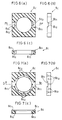
- Figures 6(a) through 6(c) show one structural example of an insulating body;
- Figure 6(a) is a horizontal sectional view,
- Figure 6(b) a side view, and
- Figure 6(c) a cross-sectional view taken along line F-F of Figure 6(a).
- Figures 7(a) through 7(c) show another structural example of an insulating body;
- Figure 7(a) is a horizontal sectional view,
- Figure 7(b) a side view,
- Figure 7(c) a cross-sectional view taken along line G-G of Figure 7(a).
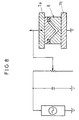
- Figure 8 is an explanatory drawing showing a structural example of a metal mold.
- Figure 9 is an explanatory drawing showing another structural example of a metal mold.
- Figure 10 is a cross-sectional view showing one example of a method of installing an insulating body.
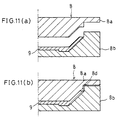
- Figure 11 is a cross-sectional view showing one example of a method of providing an insulating section of air, without installing an insulating body.
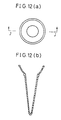
- Figures 12(a) and 12(b) show one structural example of a molded baked snack;
- Figure 12(a) is a plan view, and
- Figure 12(b) a cross-sectional view taken along line J-J of Figure 12(a).
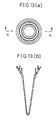
- Figures 13(a) and 13(b) show another structural example of a molded baked snack;
- Figure 13(a) is a plan view, and
- Figure 13(b) a cross-sectional view taken along line K-K of Figure 13(a).
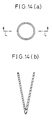
- Figures 14(a) and 14(b) show a further structural example of a molded baked snack;
- Figure 14(a) is a plan view, and
- Figure 14(b) a cross-sectional view taken along line L-L of Figure 14(a).
- Figures 15(a) and 15(b) show a further structural example of a molded baked snack;
- Figure 15(a) is a plan view, and
- Figure 15(b) a cross-sectional view taken along line M-M of Figure 15(a).
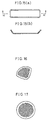
- Figure 16 is a plan view showing a further structural example of a molded baked snack.
- Figure 17 is a plan view showing a further structural example of a molded baked snack.
- Figure 18 is an explanatory drawing showing one example of a method of measuring the strength of a molded baked snack.
- Figure 19 is an explanatory drawing showing another example of a method of measuring the strength of a molded backed snack.
- Figure 20 is an explanatory drawing showing one example of a method of measuring a molded baked snack's consistency when eaten.
- Figures 21(a) and 21(b) show one structural example of a molded baked snack;
- Figure 21(a) is a cross-sectional view, and
- Figure 21(b) a plan view.
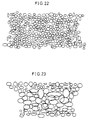
- Figure 22 is an explanatory drawing showing the state of a cross-section of a molded baked snack manufactured by internal heating.
- Figure 23 is an explanatory drawing showing the state of a cross-section of a molded baked snack manufactured by external heating.
- Figure 24 is a graph showing the relationship between amperage and heating time of molded baked snacks.
- Figure 25 is a graph showing the relationship between amperage and heating time of molded baked snacks.
- Figure 26 is a graph showing the relationship between amperage and heating time of molded baked snacks.
- Figure 27 is a graph showing the relationship between amperage and heating time of molded baked snacks.
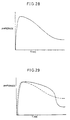
- Figure 28 is a graph showing the relationship between amperage and heating time of molded baked snacks.
- Figure 29 is a graph showing the relationship between amperage and heating time of molded baked snacks.
- Figure 30 is a graph showing the relationship between amperage and heating time of molded baked snacks.
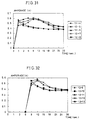
- Figure 31 is a graph showing the relationship between amperage and heating time of molded baked snacks.
- Figure 32 is a graph showing the relationship between amperage and heating time of molded baked snacks.
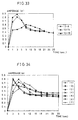
- Figure 33 is a graph showing the relationship between amperage and heating time of molded baked snacks.
- Figure 34 is a graph showing the relationship between amperage and heating time of molded baked snacks.
- Figure 35 is a graph showing the relationship between amperage and heating time of molded baked snacks.
- the molded baked snack produced tends to be harder, with a harder consistency when eaten. Hardness may be varied in keeping with the shape and use of the target molded and baked snack.
- the ingredient mixtures shown in Table 2 include various amounts of water, and have a wide range of viscosities, but, if an appropriate depositing (injection) structure is used, each of these ingredient mixtures can be molded in each of the metal molds used in the present invention.
- Ingredient mixtures No. 1 through No. 36 set forth in Tables 1 through 6 are used as ingredients in the present invention.
- strong flour strong flour, medium flour, weak flour, or a mixture of these is used.
- starch potato starch, wheat starch, rice starch, cornstarch, tapioca starch, sweet potato starch, etc., or a crosslinked starch of these is used.
- Pulverized previously molded snacks are snacks which have already been molded, and have then been refined and ground, or are burrs protruding from between the mold halves, which have been collected and ground.
- any edible salt may be used, and thus NaCl (sodium chloride), KCl (potassium chloride), L-sodium tartrate, ammonium chloride, sodium lactate, sodium polyphosphate, sodium metaphosphate, etc. are used.
- sugar granulated sugar, powdered sugar, brown sugar, malt syrup, sugar alcohol (sorbitol, glycerin, propylene glycol), etc. are used.
- milk products (butter, whole milk, skim milk), eggs (eggs, powdered whole eggs, powdered egg yolks), cacao, coffee, nuts (almonds, peanuts, coconut), bread crumbs, corn grits, fruit juice, etc. are used.
- sodium bicarbonate, alum, any kind of baking powder, etc. are used.
- food colorings such as caramel, cochineal, carotene, annatto, etc. are used.
- food aromatics such as vanilla extract, butter flavoring, etc. are used.
- oils such as soybean oil, rapeseed oil, corn oil, etc.
- emulsifiers such as soy lecithin, fatty acid esters, etc.
- the process of the present invention from preparation of ingredients through molding, is as follows.
- the molded baked snacks are prepared by means of the foregoing steps.
- the molded baked snacks were prepared by placing the foregoing ingredients in a mold to be discussed below, and then heating and expanding in a heating device.
- a heating device a total of four devices were used: three types of electromagnetic wave heating devices (referred to as "HB,” “HC,” and “HD”), and, for purposes of comparison, an external heating device (referred to as "HA").
- HB three types of electromagnetic wave heating devices
- HC HC
- HD an external heating device
- Table 7 The structural details of each of these heating devices are as shown in Table 7 below. Further, the schematic structures of electromagnetic wave heating devices are shown in Figures 1 through 4. Incidentally, the frequency used is not limited to that shown in Table 7; an appropriate frequency within a range from 50Hz through 100MHz may be used.
- Device HB includes three types: HB1, HB2, and HB3.
- Device HC also includes three types: HC1, HC2, and HC3.
- the power source for the devices HA, HB, HC, and HD is an industrial power source with a voltage of 200V and a frequency of 60Hz.
- the output regulators of devices HB, HC, and HD are devices which regulate output to a desired constant output.
- the frequency converters of devices HB, HC, and HD are devices which output frequency converted to a desired frequency within a specified range.
- the oscillators of devices HC and HD are devices which oscillate at a specified frequency only. However, in the case of device HB, there is a frequency zone for which an oscillator is unnecessary. In other words, device HB1 uses a frequency of 60Hz, HB2 a frequency of 200Hz, and HB3 a frequency of 10.0kHz, but an oscillator is unnecessary in each of these cases. Using oscillators, device HC1 uses a frequency of 5.0MHz, HC2 a frequency of 13.56MHz, and HC3 a frequency of 40.68MHz. Device HD uses a combination of the foregoing oscillators.
- the electrodes of devices HB, HC, and HD are devices for supplying high- or low-frequency current to the ingredients through the mold.
- temperature adjustment refers to adjustment of the temperature of the metal mold, prior to molding, using an electric heater installed in the metal mold, or directly heating the metal mold externally using a gas burner, or using IH (induction heating) to heat the metal mold, etc. Without this kind of temperature adjustment, the temperature of the metal mold is within a range up to 100°C.
- an electromagnetic wave heating device 1 includes a power section 2 and a heating section 3 (electrode section). Further, although not shown in the drawing, the heating section 3 includes a vacuum pump, a lock section which fixes the upper and lower mold halves, and an external heating section.
- the power section 2 uses for a power source an oscillator 4 of the vacuum tube type. Energy efficiency is determined by the output of the oscillator 4. Mold halves 8a and 8b (to be discussed below) must not come into direct contact with one another, and thus an insulating section is provided therebetween. An insulating body 8c is used for the insulating section. The insulating section is for preventing the mold halves 8a and 8b from touching one another, and may be provided as a space. In addition, each of the necessary devices should be provided with a ground and an electromagnetic wave shield.
- a variable capacitor (referred to as “C component”) 5 and a variable coil (referred to as “L component”) 6 are provided.
- C component 5 and the L component 6 are provided as a regulating circuit.
- C1 component a manual capacitor C1 (referred to as the "C1 component") is provided.
- the side with the mold half 8a, having more pointed areas such as the apex 8a 1 (in Figure 2, the upper side), is grounded.
- one of the mold halves 8a has pointed areas of this kind, if, as shown in Figure 1, the mold half 8a is connected to the power source and the other mold half 8b is grounded, energy from the power source tends to concentrate in the pointed area, and thus localized heating of an apex area 9c of the ingredients 9 is likely to occur.
- a mold half 8a having a pointed area, as shown in Figure 2 is grounded, energy from the power source can be prevented from concentrating in the pointed area, and it is easier to prevent localized heating than with the device shown in Figure 1.
- an automatic capacitor C2 (referred to as the "C2 component") as a variable capacitor for automatic regulation and tuning, anode current in the oscillator vacuum tube can be controlled to a constant value.
- This anode current is controlled by an automatic tracking circuit.
- the automatic tracking circuit is a circuit which can automatically change an interval between the plates of an air capacitor using a motor, and which maintains a constant anode amperage in accordance with changes in the dielectric constant across the two electrodes of the heating section 3.
- the transition in the anode amperage of the oscillator is as shown at curve A in Figure 5.
- the amperage can be supplied in a constant quantity.
- the automatic function of the automatic capacitor C2 can also be turned off, and the amperage can be set manually.
- the transition is as shown at curve B in Figure 5.
- the amperage changes according to the conductive and dielectric properties of the object to be heated.
- an output regulator 22 is connected to a power source 21 of 200V, and current is supplied to the heating section 3 at a predetermined frequency by a frequency converter 23.
- a transformer can be used as the output regulator 22.
- the heating section 3 includes upper and lower electrodes 7a and 7b.
- To the electrodes 7a and 7b are connected an upper mold half 8a and a lower mold half 8b, respectively.
- the mold halves 8a and 8b are pressed together with the insulating body 8c therebetween, and thus do not touch one another.
- the mold halves 8a and 8b and the insulating body 8c make up a metal mold 8.
- the metal mold 8 and the ingredients 9 will collectively be referred to as the "object to be heated.”
- the object to be heated is placed between the electrodes 7a and 7b, to which current is supplied.
- Figure 6 shows one example of a method of releasing vapor.
- An insulating body 8c is provided with vapor release sections 8c 1 and vapor release sections 8c 2 for releasing vapor produced during heating. Vapor produced by the ingredients 9 (not shown) in the metal mold 8 during heating passes through the vapor release sections 8c 2 to the vapor release sections 8c 1 , from which it is released to the exterior of the metal mold 8.
- a structure like that shown in Figure 7 may also be used, in which a plurality of vapor release sections 8c 2 (for example eight) are provided in a circular vapor release section 8c 1 .
- the number of vapor release sections 8c 2 is usually at least two, for the sake of balance. Further, the size, shape, number, etc. of the vapor release sections 8c 1 and the vapor release sections 8c 2 are adjusted to those most suitable to the molded baked snack to be produced. These must be changed as necessary in keeping with changes in the ingredient mixture and the properties of the molded baked snack to be produced. In the present invention, it is satisfactory if the vapor is released from the ingredients 9 to the exterior of the metal mold 8 in a balanced manner, and thus there is no particular limitation on the shape, size, and number of vapor release sections.
- Figures 6 and 7 show structures in which the vapor release sections 8c 1 and 8c 2 are provided in the insulating section, but, in order to mold the entirety uniformly and efficiently, vapor release sections may also be provided, as necessary, in places other than the insulating section.
- one of the two electrodes 7a and 7b is a feed electrode, and the other a grounding electrode.
- the electrode 7a is the feed electrode
- electrode 7b the grounding electrode.
- the electrodes are connected in the opposite manner.
- the heating section 3 is provided with an electric heater and a temperature regulator, and thus the metal mold 8 can be heated at a predetermined temperature. Incidentally, when using external heating alone, current is not supplied from the power section 2, and heating and molding are performed by this heater alone.
- the entirety of the heating section 3 is a vacuum chamber, and, using the aforementioned vacuum pump, the pressure therein can be reduced.
- the metal mold 8 is fixed between the electrodes 7a and 7b using the vertical press method shown in Figure 8.
- a method may be adopted in which a hinge 25 is provided at one end of the mold, and the other end can be locked (fixed).
- the metal mold 8 is basically divided into two blocks. Although not shown in the drawings, depending on the shape of the molded baked snack and the method of removal, a metal mold made up of three or more parts, such as a split mold or one provided with a knockout pin, may be used, but even in these cases, the parts are grouped into two blocks: a feed electrode side and a grounding electrode side.
- each group has sections which fit together closely when the mold is fixed and molding is performed. Between the one block (the mold half 8a side) and the other block (the mold half 8b side), a space for molding of the molded baked snack and an insulating section (here, the insulating body 8c) are provided. As shown in Figures 10(a) and 10(b), the insulating body 8c can be attached to either block, or it can be attached to both blocks.
- the insulating section may be provided by means of a space 8d between the mold halves 8a and 8b, without using an insulating body.
- the range of the interval of the space 8d is no less than 0.3mm and no more than one-half the thickness of the baked molded snack. If the interval is less than 0.3mm, insulation breakdown is likely, and sparking makes molding impossible. On the other hand, if the interval is more than one-half the thickness of the molded baked snack, the pressure inside the mold is too low, and molding cannot be performed.
- Vapor release sections are provided in order to release to the exterior of the mold large amounts of vapor produced during molding.
- these vapor release sections are provided in the insulating body 8c, or in a surface of the mold half 8a or the mold half 8b which is in contact with the insulating body 8c.
- the space 8d (insulating section) also serves as the vapor release section.
- snack shapes (1) through (4) are shapes like that shown in Figures 12(a) and 12(b).
- a diameter of 54mm, a height of 120mm, and thicknesses of 2.0mm, 5.0mm, and 10.0mm may be used.
- a diameter of 72mm, a height of 150mm, and a thickness of 2.5 mm may be used.
- the snack shape (5), as shown in Figures 13(a) and 13(b), has the shape of snack shape (1), but with ribs added.
- a diameter of 54mm, a height of 120mm, and a thickness of 2.0mm may be used.
- the snack shape (7) is a shape like that shown in Figures 15(a) and 15(b).
- a length of 150mm, a width of 35mm, a height of 12mm, and a thickness of 2.0mm may be used.
- a wafer is first baked in a fan shape like that shown in Figure 16, or a circular shape like that shown in Figure 17, i.e., in the shape of snack shape (6) shown in Table 8. Then, as post-molding, the snack in the shape of snack shape (6) is wrapped around a conical form and cooled, thus producing the final shape.
- the shape of the mold used in baking is that of a mold for baking the wafer like that shown in Figure 16 or Figure 17.
- Snack shape (6) has, for example, a diameter of 50mm, a height of 120mm, and a thickness of 2.5mm.
- the present invention can be used in manufacturing many types of baked snacks, and thus variety can be increased.
- the strength of the molded baked snacks produced was measured and evaluated using the method shown in Table 9 and in Figures 18 and 19.
- a conical molded baked snack 40 was placed on a stand 41, and strength was measured by lowering a plunger 42 from above.
- a molded baked snack 44 was placed on a hollow stand 43, and strength was measured by lowering a plunger 42 from above.
- MEASUREMENT 1 MEASUREMENT 2 SENSITIVITY 10kg 10kg MEASURING PLUNGER SPEED 5cm/MINUTE 5cm/MINUTE PLUNGER CIRCULAR SUS ⁇ 40mm CIRCULAR SUS ⁇ 10mm MEASURED VALUE ADOPTED GREATEST MEASURED STRENGTH GREATEST MEASURED STRENGTH
- the molded baked snacks' consistency when eaten was measured and evaluated using the method shown in Table 10 and in Figure 20. To explain, a conical molded baked snack 40 was placed on a stand 41, and measurement was made by lowering from above a plunger 46 strung with piano wire 45.
- Viscosity of the ingredients was measured using the method shown in Table 13.
- REVOLUTIONS 30 REVOLUTIONS/MINUTE AT TIMES OTHER THAN WHEN IN LIQUID AND SLURRY STATES NOT MEASURED
- Tables 17 and 19 are continuations of Tables 16 and 18, respectively.
- the values under the headings "L,” “C1,” and “C2 OFF” are values for the L component, the C1 component, and the C2 component, respectively, set in order to adjust output during heating by internal heating at a predetermined frequency.
- “C2 OFF” indicates that, although the automatic capacitor C2 usually functions as an automatic capacitor, that function has been turned off here, and the value set manually.
- ingredient mixture No. 1 which contained no salt, i.e., electrolyte, did not heat internally, and there was no difference from heating with external heating alone.
- Figures 21(a) and 21(b) show the appearance of the ingredients 9 during molding.
- there are deposited areas 9a where the ingredients 9 touch the mold at the time of depositing (injection), surrounded by an expanded area 9b, into which the ingredients expand due to foaming.
- the difference in the L values of the deposited areas 9a and the expanded area 9b was only 0 to 1, but with external heating alone, as shown in the first six rows of Table 23, this difference in L values was 3, i.e., the deposited areas 9a and the expanded area 9b had a marked color difference.
- the appearance of the deposited areas 9a was poor.
- With molding by internal heating the deposited areas 9a had an excellent appearance.
- Figure 23 shows the internal texture of a molded baked snack manufactured using external heating. With external heating, only the particles at the surface have small diameters, and those in the interior are coarse.
- Figure 22 shows the internal texture of a molded baked snack manufactured using internal heating. With internal heating, particle diameters both on the surface and in the interior are sufficiently small.
- the heating method was heating with heating device HC2 at a mold temperature of 170°C.
- the results were as shown below.
- Varying the liquid content of the ingredients influenced the properties of the molded baked snacks, but good molding was obtained in each case.
- the properties of the molded baked snacks With regard to the properties of the molded baked snacks, the lower the original liquid content, the harder the consistency when eaten, and the harder the molded baked snack obtained. Applying this principle, it can be seen that the properties of the molded baked snack can be adjusted by varying the liquid content of the ingredients. However, since the ingredients after mixing may be in a dough state, or, even if in a slurry state, may have varying viscosities, the method of depositing the ingredients into the metal mold should make use of a structure in keeping with the ingredient mixture used.
- liquid content of the ingredients was varied widely, but it was sufficient merely to provide a deposit (injection) structure in keeping with the properties of the ingredients; there were no problems with molding or with properties after molding.
- liquid Content may be set in keeping with the desired shape and use of the molded baked snack.
- the heating method was heating with heating device HC2 at a mold temperature of 170°C.
- the results were as shown below.
- Varying the quantity and type of starch in the ingredients influenced the properties of the molded baked snacks, but good molding was obtained in each case.
- Snack shapes (1) through (5) are long in the direction of the axis of the cone, and thus expansion in this direction, i.e., longitudinal expansion, is important.
- Snack shapes (6) and (7) are long in an in-plane direction, like wafers or monaka , and for these shapes, it is preferable to use a starch suited to expansion in this direction, i.e., in-plane expansion.
- thick shapes such as snack shapes (3) and (4), a molded baked snack with better properties can be molded by using a starch able to impart a soft consistency when eaten, and by using ingredients containing more starch, such as ingredient mixture Nos. 17 through 19.
- the heating method was heating with heating device HC2 at a mold temperature of 170°C.
- the results were as shown below.
- burrs produced during molding, and defective molded snacks can be re-used by mixing with the original ingredients after purification and grinding.
- Viscosity of the ingredient mixture was also increased by the addition of the ground matter. However, in comparison with ingredient mixture No. 3, there was almost no significant difference in properties and molding, and both of these were good.
- the heating method was heating with heating device HC2 at a mold temperature of 170°C.
- the results were as shown below.
- Varying the quantity of sugar added to the ingredients influenced the molding of the molded baked snacks, but good molding was obtained in each case.
- molded baked snacks having snack shape (6) showed flexible properties in a high-temperature state immediately after baking. For this reason, these molded baked snacks are initially baked in a wafer shape using two iron plates. Thereafter, the wafer may be wrapped around a conical form, and cooled and formed. With snack shapes (1) and (3), because of a low rate of shrinkage when the mold was opened after molding, and because the molded baked snack was too flexible, mold release was poor. This made molding difficult.
- the heating method was heating with heating device HC2 at a temperature of 170°C.
- the results are shown below.
- EXPERIMENT NO. INGREDIENT MIXTURE NO. HEATING DEVICE PROPERTIES MOLDING NOTE 8-1 24 HC2 o ⁇ o ⁇ 8-2 27 o ⁇ o ⁇ 8-3 28 o ⁇ o ⁇ 8-4 29 o ⁇ o ⁇ 8-5 30 o ⁇ o ⁇
- the heating method was heating with heating device HC2 at a temperature of 170°C.
- the results are shown below.
- EXPERIMENT NO. INGREDIENT MIXTURE NO. HEATING METHOD PROPERTIES MOLDING NOTE 9-1 31 HC2 o ⁇ o ⁇ 9-2 32 o ⁇ o ⁇ 9-3 33 o ⁇ o ⁇ 9-4 34 o ⁇ o ⁇ 9-5 35 ⁇ o ⁇ 9-6 36 ⁇ ⁇
- measures are taken such as decreasing the output (as shown by curve A in Figure 25), making the slope of the increase in current more gradual (as shown by curve B in Figure 25), etc.
- measures may be taken to stabilize the state of the ingredients in the initial stage of heating by adding an ingredient stabilization step C in the initial stage of heating.
- output can be changed by changing the L component and the C component.
- Curve a is a case in which the L component is short, and the C component is narrow.
- Curve c is a case in which the L component is long, and the C component is wide.
- Curve b is a case in which the values of the L component and the C component are intermediate between their respective values in curves a and c. If the L component and the C component are changed, heating conditions can be changed by altering the shape of this graph, and the aforementioned control of amperage can be performed.
- the molded baked snacks will be superior, with soft consistency when eaten, uniform, fine texture, and good appearance. Accordingly, the key is to find optimum settings for mold structure, ingredient mixture, and internal heating conditions.
- the heating method was heating performed according to the molding conditions shown in Tables 31 through 34. The results are shown in Tables 31 through 34.
- burning and sparking are likely to occur in the latter stage of drying when the L component is lengthened, and are likely to occur at the moment of commencement of heating when the L component is shortened.
- the amperage is 1A.
- the range of control of the L component and the C component is narrow, and since the constant amperage is high, sparking is likely to occur.
- the amperage is 0.6A.
- the range of control of the L component and the C Component is wider than in Table 33, and burning and sparking are less likely.
- the heating method was as shown in Tables 35 through 37.
- “AMPERAGE: SETTING 1" and “SETTING 2” indicate that the amperage was set at setting 1 during the initial stage of heating, and was then switched to setting 2 later during heating.
- Example 10 when a constant output is applied, shortening molding time leads to instability such as sparking, etc., but stabilizing molding makes molding time comparatively longer. Accordingly, in the present Example, molding conditions were switched from a high output in the initial stage of heating, when the liquid content remaining in the ingredients is high, to a low output in the latter stage of heating (drying period), when the remaining liquid content is low. As a result, molded baked snacks with good properties could be manufactured stably and more efficiently. In other words, in Tables 35, 36, and 37, stable molded baked snacks were able to be manufactured more efficiently than in Tables 33 and 34 of Example 10.
- the heating method was as shown in Table 38. Control of the output of the oscillator was performed by adjusting the L Component and the C component. Drying was ended when the anode amperage reached a constant level. The results are shown in Tables 38 and 39 and in Figures 31 through 33. Table 39 shows the anode amperage (A) when heating at 13.56MHz (Experiments No. 12-4 through No. 12-15). EXPERIMENT NO.
- the heating method was heating using heating device HC2 under the conditions below.
- the results are shown in Tables 40 and 41, and in Figures 34 and 35.
- Figure 34 is a graph of the same information.
- Figure 35 is a graph of the same information.
- ANODE AMPERAGE (A) SNACK SHAPE MOLDING TIME (sec.) 0 3 6 9 12 15 18 21 24 30 (1) 0 0.80 0.60 0.45 0.40 0.40 0.40 0.40 0.40 0.40 (2) 0 0.65 0.63 0.60 0.55 0.51 0.47 0.43 0.40 0.39 (3) 0 0.50 0.73 0.65 0.48 0.39 0.38 0.37 0.37 0.37 (4) 0 0.45 0.55 0.71 0.65 0.53 0.43 0.38 0.36 0.35 (5) 0 0.78 0.60 0.48 0.42 0.40 0.40 0.40 (6) 0 0.65 0.80 0.65 0.54 0.48 0.46 0.46 0.45 0.45 (7) 0 0.82 0.58 0.45 0.41 0.41 0.41 0.41 0.41 ANODE AMPERAGE (A
- the peak anode amperage for snack shapes (3) and (4) is approximately equal to that with snack shape (1), but since these shapes are thicker than snack shape (1), the rise in anode amperage is slower. Thus molding time for these shapes takes that much longer than for snack shape (1). However, the properties and molding of the molded baked snacks are good, and molded baked snacks can be obtained whose consistency when eaten, chewiness, and flavor are completely different from snack shape (1).
- the first method of manufacturing molded baked snacks according to the present invention is a method of manufacturing molded baked snacks by placing ingredients in a mold made up of first and second conductive mold halves and an insulating section therebetween, and applying across both mold halves alternating current from an alternating current power source, thus heating and expanding the ingredients by means of resistance heating and/or dielectric heating, in which the insulating section of the mold is provided with a vapor release section, pressure is reduced outside the mold, and the heating is performed while releasing vapor produced thereby through the vapor release section.
- the second method of manufacturing molded baked snacks is a method of manufacturing molded baked snacks by placing ingredients in a mold made up of first and second conductive mold halves and an insulating section therebetween, and applying across both mold halves alternating current from an alternating current power source, thus heating and expanding the ingredients by means of resistance heating and/or dielectric heating, in which the insulating section of the mold is provided with vapor release sections, the vapor release section is heated during heating of the ingredients, and the heating of the ingredients is performed while releasing vapor produced thereby through the vapor release section.
- the third method of manufacturing molded baked snacks is either the first or second method above, in which external heating is also used to heat the ingredients.
- molding time can be further shortened, and a roasted flavor can be imparted.
- heating can be performed even when it is difficult to heat using the other heating methods mentioned above because of complicated structures, such as ribs, which make it difficult to provide electrodes opposite one another, and to which, accordingly, it is difficult to apply a voltage.
- the structure of the external heating device can be made simpler than when molding by external heating alone.
- the temperature control conditions for external heating may be more relaxed than when molding by external heating alone.
- the fourth method of manufacturing molded baked snacks is any one of the first through third methods above, in which the ingredients have a composition with a weight ratio of 100 flour, 10 to 150 starch, 0.5 to 10 salt, 2 to 60 sugar, and 70 to 260 water, and water makes up 30% to 70% by weight of the whole.
- water makes up 40% to 60% by weight.
- additional ingredients selected, as necessary, from among flavoring, leavening, coloring, aromatics, oil, emulsifier, etc. may be added with a weight ratio of 3 to 12 parts to the foregoing ingredients.
- the present method of manufacturing molded baked snacks is capable of preventing insulation breakdown caused by condensation of large amounts of vapor produced by ingredients during heating and molding of molded baked snacks by means of resistance heating or dielectric heating.
Landscapes
- Life Sciences & Earth Sciences (AREA)
- Engineering & Computer Science (AREA)
- Food Science & Technology (AREA)
- Bakery Products And Manufacturing Methods Therefor (AREA)
- Confectionery (AREA)
- Formation And Processing Of Food Products (AREA)
- Heating, Cooling, Or Curing Plastics Or The Like In General (AREA)
- Seeds, Soups, And Other Foods (AREA)
Applications Claiming Priority (7)
| Application Number | Priority Date | Filing Date | Title |
|---|---|---|---|
| JP311118/96 | 1996-11-21 | ||
| JP31111896 | 1996-11-21 | ||
| JP31111896 | 1996-11-21 | ||
| JP30904697 | 1997-11-11 | ||
| JP30904697A JP3742204B2 (ja) | 1996-11-21 | 1997-11-11 | 成形焼き菓子の製造方法 |
| JP309046/97 | 1997-11-11 | ||
| PCT/JP1997/004167 WO1998021969A1 (fr) | 1996-11-21 | 1997-11-14 | Procede pour fabriquer des gateaux cuits au four moules |
Publications (3)
| Publication Number | Publication Date |
|---|---|
| EP0880896A1 true EP0880896A1 (fr) | 1998-12-02 |
| EP0880896A4 EP0880896A4 (fr) | 2001-03-14 |
| EP0880896B1 EP0880896B1 (fr) | 2003-02-05 |
Family
ID=26565805
Family Applications (1)
| Application Number | Title | Priority Date | Filing Date |
|---|---|---|---|
| EP97912473A Expired - Lifetime EP0880896B1 (fr) | 1996-11-21 | 1997-11-14 | Procede pour fabriquer des gateaux cuits au four moules |
Country Status (10)
| Country | Link |
|---|---|
| US (1) | US6063422A (fr) |
| EP (1) | EP0880896B1 (fr) |
| JP (1) | JP3742204B2 (fr) |
| KR (1) | KR100277118B1 (fr) |
| AT (1) | ATE232047T1 (fr) |
| AU (1) | AU704468B2 (fr) |
| CA (1) | CA2243156C (fr) |
| DE (1) | DE69718895T2 (fr) |
| NZ (1) | NZ331442A (fr) |
| WO (1) | WO1998021969A1 (fr) |
Cited By (5)
| Publication number | Priority date | Publication date | Assignee | Title |
|---|---|---|---|---|
| EP1648234A4 (fr) * | 2003-06-27 | 2008-08-27 | Biosphere Ind Corp | Procede utilise lors de la cuisson de produits de fabrication et moule utilise dans ce procede |
| US7553363B2 (en) | 2003-08-27 | 2009-06-30 | Biosphere Industries, Llc | Composition for use in biodegradable articles and method of use |
| US8043539B2 (en) | 2002-03-13 | 2011-10-25 | Nissei Company, Ltd. | Process for producing biodegradable molded item and molding dies therefor |
| US8087921B2 (en) | 2003-06-27 | 2012-01-03 | Biosphere Holdings Corporation | Extrusion mold and method of use |
| US8382888B2 (en) | 2003-08-27 | 2013-02-26 | Biosphere Industries, Llc | Composition for use in edible biodegradable articles and method of use |
Families Citing this family (9)
| Publication number | Priority date | Publication date | Assignee | Title |
|---|---|---|---|---|
| US6852957B2 (en) * | 2002-06-28 | 2005-02-08 | Kerry Group Services International, Ltd. | Breadcrumb processing line and method |
| JP2006021356A (ja) * | 2004-07-06 | 2006-01-26 | Sanwa Denpun Kogyo Kk | 澱粉焼成発泡成形物の製造方法 |
| US10863783B2 (en) | 2007-04-16 | 2020-12-15 | Kimberly-Clark Worldwide, Inc. | Protective apparel with angled stretch panel |
| US7989012B2 (en) * | 2007-09-26 | 2011-08-02 | Kellogg Company | Induction cooking structure and system and method of using the same |
| JP2013240303A (ja) * | 2012-05-22 | 2013-12-05 | Nissei Co Ltd | 成形焼き菓子の製造方法およびその製造方法によって製造された成形焼き菓子 |
| JP5961528B2 (ja) * | 2012-10-26 | 2016-08-02 | 日世株式会社 | 成形焼き菓子の製造方法 |
| JP5961527B2 (ja) * | 2012-10-26 | 2016-08-02 | 日世株式会社 | 冷菓等盛り付け用の成形焼き菓子の製造方法 |
| AU2021202440A1 (en) * | 2021-03-29 | 2022-10-13 | James Gordon Cashmore | Biodegradable and/or edible tableware |
| US20230217935A1 (en) * | 2021-12-23 | 2023-07-13 | Antithesis Foods Inc. | Production of legume-based nutrient-dense doughs and food products |
Family Cites Families (10)
| Publication number | Priority date | Publication date | Assignee | Title |
|---|---|---|---|---|
| US4641174A (en) * | 1983-08-08 | 1987-02-03 | General Electric Company | Pinch rectifier |
| JPS6074582U (ja) * | 1983-10-31 | 1985-05-25 | ライオンフーヅ株式会社 | パン類の焼成装置 |
| US5015489A (en) * | 1989-06-07 | 1991-05-14 | Nabisco Brands, Inc. | Production of cookies with extrusion and post extrusion baking |
| US5334402A (en) * | 1990-08-03 | 1994-08-02 | Kansas State University Research Foundation | Heat processing of a product |
| JPH07117246B2 (ja) * | 1991-07-31 | 1995-12-18 | 株式会社フジマック | バッチ型複合加熱装置 |
| JPH0754187B2 (ja) * | 1991-07-31 | 1995-06-07 | 株式会社フジマック | バッチ型の複合加熱装置 |
| JP2953209B2 (ja) * | 1992-08-21 | 1999-09-27 | 石川島播磨重工業株式会社 | 低温ヘリウム圧縮機及びその冷却方法 |
| US5591491A (en) * | 1994-02-04 | 1997-01-07 | Nissei Kabushiki Kaisha | Method for manufacturing biodegradable molded articles |
| US5476600A (en) * | 1994-06-24 | 1995-12-19 | Texaco Inc. | Continuous grease process |
| JP3474031B2 (ja) * | 1994-07-11 | 2003-12-08 | 日世株式会社 | 生分解性成形物の製造方法 |
-
1997
- 1997-11-11 JP JP30904697A patent/JP3742204B2/ja not_active Expired - Fee Related
- 1997-11-14 DE DE69718895T patent/DE69718895T2/de not_active Expired - Lifetime
- 1997-11-14 US US09/101,399 patent/US6063422A/en not_active Expired - Lifetime
- 1997-11-14 NZ NZ331442A patent/NZ331442A/xx not_active IP Right Cessation
- 1997-11-14 EP EP97912473A patent/EP0880896B1/fr not_active Expired - Lifetime
- 1997-11-14 WO PCT/JP1997/004167 patent/WO1998021969A1/fr not_active Ceased
- 1997-11-14 CA CA002243156A patent/CA2243156C/fr not_active Expired - Fee Related
- 1997-11-14 AT AT97912473T patent/ATE232047T1/de active
- 1997-11-14 KR KR1019980705572A patent/KR100277118B1/ko not_active Expired - Fee Related
- 1997-11-14 AU AU49660/97A patent/AU704468B2/en not_active Ceased
Cited By (6)
| Publication number | Priority date | Publication date | Assignee | Title |
|---|---|---|---|---|
| US8043539B2 (en) | 2002-03-13 | 2011-10-25 | Nissei Company, Ltd. | Process for producing biodegradable molded item and molding dies therefor |
| EP1648234A4 (fr) * | 2003-06-27 | 2008-08-27 | Biosphere Ind Corp | Procede utilise lors de la cuisson de produits de fabrication et moule utilise dans ce procede |
| US7481645B2 (en) | 2003-06-27 | 2009-01-27 | Biosphere Industries, Llc | Method for use in baking articles of manufacture and mold for use in said method |
| US8087921B2 (en) | 2003-06-27 | 2012-01-03 | Biosphere Holdings Corporation | Extrusion mold and method of use |
| US7553363B2 (en) | 2003-08-27 | 2009-06-30 | Biosphere Industries, Llc | Composition for use in biodegradable articles and method of use |
| US8382888B2 (en) | 2003-08-27 | 2013-02-26 | Biosphere Industries, Llc | Composition for use in edible biodegradable articles and method of use |
Also Published As
| Publication number | Publication date |
|---|---|
| DE69718895T2 (de) | 2003-11-06 |
| JPH10201411A (ja) | 1998-08-04 |
| ATE232047T1 (de) | 2003-02-15 |
| KR19990081861A (ko) | 1999-11-15 |
| CA2243156C (fr) | 2002-01-22 |
| AU4966097A (en) | 1998-06-10 |
| JP3742204B2 (ja) | 2006-02-01 |
| AU704468B2 (en) | 1999-04-22 |
| EP0880896B1 (fr) | 2003-02-05 |
| US6063422A (en) | 2000-05-16 |
| EP0880896A4 (fr) | 2001-03-14 |
| KR100277118B1 (ko) | 2001-01-15 |
| WO1998021969A1 (fr) | 1998-05-28 |
| NZ331442A (en) | 2000-04-28 |
| CA2243156A1 (fr) | 1998-05-28 |
| DE69718895D1 (de) | 2003-03-13 |
Similar Documents
| Publication | Publication Date | Title |
|---|---|---|
| EP0880896B1 (fr) | Procede pour fabriquer des gateaux cuits au four moules | |
| CN101119641B (zh) | 巧克力和巧克力样糖食产品中耐热性的快速形成 | |
| CA2244788C (fr) | Procede de fabrication d'un article moule biologiquement decomposable constitue d'amidon | |
| US6136255A (en) | Method and device for manufacturing biodegradable molded objects | |
| JPH0342864B2 (fr) | ||
| JP4101832B2 (ja) | 成形焼き菓子の製造方法 | |
| EP1386710B1 (fr) | Procede de fabrication des objets formes a chaud, et dispositif de chauffage continu par haute frequence | |
| JP7715348B2 (ja) | 冷凍パンの加熱方法 | |
| JP2003038106A (ja) | 加熱成形物の製造方法 | |
| SU1215651A1 (ru) | Способ производства тонкого арм нского лаваша | |
| KR101846124B1 (ko) | 두부과자 제조방법 | |
| RU2118094C1 (ru) | Конфеты "нежный сюрприз" с глазированным шоколадной глазурью корпусом, образованным двумя слоями вафель и расположенной между ними крем-шоколадной массой, и способ производства конфет "нежный сюрприз" | |
| KR102473695B1 (ko) | 호두과자의 제조방법. | |
| JPH0685681B2 (ja) | 菓子の製造法 | |
| JP2006289993A (ja) | 澱粉製生分解性成形物の製造方法 | |
| KR102092903B1 (ko) | 쌀프로스팅, 쌀타르트지, 쌀케이크 및 제조방법 | |
| Boukid et al. | Microwave versus convective processing: Characterization of baking conditions and cake quality | |
| JPH0493642A (ja) | 焙煎度測定方法及び焙煎物の製造方法 | |
| JP2632348B2 (ja) | ひび入り煎餅の製造方法 | |
| RU2424701C1 (ru) | Способ производства сахарных вафель | |
| JP2000023622A (ja) | 豆入り糯米菓の製造方法 | |
| JP4955600B2 (ja) | 米粉を原料とした麺類の製造方法 | |
| JP2007075040A (ja) | 揚げ菓子の製造方法 | |
| JP5961528B2 (ja) | 成形焼き菓子の製造方法 | |
| JPS6030486B2 (ja) | 鶏卵等の泡立方法及び泡立用ホイッパ− |
Legal Events
| Date | Code | Title | Description |
|---|---|---|---|
| PUAI | Public reference made under article 153(3) epc to a published international application that has entered the european phase |
Free format text: ORIGINAL CODE: 0009012 |
|
| 17P | Request for examination filed |
Effective date: 19980724 |
|
| AK | Designated contracting states |
Kind code of ref document: A1 Designated state(s): AT DE FR GB IT |
|
| A4 | Supplementary search report drawn up and despatched |
Effective date: 20010129 |
|
| AK | Designated contracting states |
Kind code of ref document: A4 Designated state(s): AT DE FR GB IT |
|
| RIC1 | Information provided on ipc code assigned before grant |
Free format text: 7A 21B 5/00 A, 7A 21B 5/02 B |
|
| GRAG | Despatch of communication of intention to grant |
Free format text: ORIGINAL CODE: EPIDOS AGRA |
|
| 17Q | First examination report despatched |
Effective date: 20020405 |
|
| GRAG | Despatch of communication of intention to grant |
Free format text: ORIGINAL CODE: EPIDOS AGRA |
|
| GRAH | Despatch of communication of intention to grant a patent |
Free format text: ORIGINAL CODE: EPIDOS IGRA |
|
| RAP1 | Party data changed (applicant data changed or rights of an application transferred) |
Owner name: NISSEI KABUSHIKI KAISHA |
|
| GRAH | Despatch of communication of intention to grant a patent |
Free format text: ORIGINAL CODE: EPIDOS IGRA |
|
| GRAA | (expected) grant |
Free format text: ORIGINAL CODE: 0009210 |
|
| AK | Designated contracting states |
Designated state(s): AT DE FR GB IT |
|
| REG | Reference to a national code |
Ref country code: GB Ref legal event code: FG4D |
|
| REF | Corresponds to: |
Ref document number: 69718895 Country of ref document: DE Date of ref document: 20030313 Kind code of ref document: P |
|
| ET | Fr: translation filed | ||
| PLBE | No opposition filed within time limit |
Free format text: ORIGINAL CODE: 0009261 |
|
| STAA | Information on the status of an ep patent application or granted ep patent |
Free format text: STATUS: NO OPPOSITION FILED WITHIN TIME LIMIT |
|
| 26N | No opposition filed |
Effective date: 20031106 |
|
| PGFP | Annual fee paid to national office [announced via postgrant information from national office to epo] |
Ref country code: FR Payment date: 20101123 Year of fee payment: 14 Ref country code: AT Payment date: 20101110 Year of fee payment: 14 |
|
| PGFP | Annual fee paid to national office [announced via postgrant information from national office to epo] |
Ref country code: DE Payment date: 20101110 Year of fee payment: 14 |
|
| PGFP | Annual fee paid to national office [announced via postgrant information from national office to epo] |
Ref country code: GB Payment date: 20101110 Year of fee payment: 14 Ref country code: IT Payment date: 20101115 Year of fee payment: 14 |
|
| GBPC | Gb: european patent ceased through non-payment of renewal fee |
Effective date: 20111114 |
|
| REG | Reference to a national code |
Ref country code: FR Ref legal event code: ST Effective date: 20120731 |
|
| PG25 | Lapsed in a contracting state [announced via postgrant information from national office to epo] |
Ref country code: IT Free format text: LAPSE BECAUSE OF NON-PAYMENT OF DUE FEES Effective date: 20111114 |
|
| REG | Reference to a national code |
Ref country code: DE Ref legal event code: R119 Ref document number: 69718895 Country of ref document: DE Effective date: 20120601 |
|
| PG25 | Lapsed in a contracting state [announced via postgrant information from national office to epo] |
Ref country code: GB Free format text: LAPSE BECAUSE OF NON-PAYMENT OF DUE FEES Effective date: 20111114 |
|
| PG25 | Lapsed in a contracting state [announced via postgrant information from national office to epo] |
Ref country code: FR Free format text: LAPSE BECAUSE OF NON-PAYMENT OF DUE FEES Effective date: 20111130 |
|
| PG25 | Lapsed in a contracting state [announced via postgrant information from national office to epo] |
Ref country code: DE Free format text: LAPSE BECAUSE OF NON-PAYMENT OF DUE FEES Effective date: 20120601 |
|
| REG | Reference to a national code |
Ref country code: AT Ref legal event code: MM01 Ref document number: 232047 Country of ref document: AT Kind code of ref document: T Effective date: 20121114 |
|
| PG25 | Lapsed in a contracting state [announced via postgrant information from national office to epo] |
Ref country code: AT Free format text: LAPSE BECAUSE OF NON-PAYMENT OF DUE FEES Effective date: 20121114 |