EP0880922A2 - Dispositif antibasculement pour support de matelas en porte-a-faux - Google Patents
Dispositif antibasculement pour support de matelas en porte-a-faux Download PDFInfo
- Publication number
- EP0880922A2 EP0880922A2 EP98401178A EP98401178A EP0880922A2 EP 0880922 A2 EP0880922 A2 EP 0880922A2 EP 98401178 A EP98401178 A EP 98401178A EP 98401178 A EP98401178 A EP 98401178A EP 0880922 A2 EP0880922 A2 EP 0880922A2
- Authority
- EP
- European Patent Office
- Prior art keywords
- support
- connecting rod
- supports
- tilting
- mattress
- Prior art date
- Legal status (The legal status is an assumption and is not a legal conclusion. Google has not performed a legal analysis and makes no representation as to the accuracy of the status listed.)
- Withdrawn
Links
Images

Classifications
-
- A—HUMAN NECESSITIES
- A47—FURNITURE; DOMESTIC ARTICLES OR APPLIANCES; COFFEE MILLS; SPICE MILLS; SUCTION CLEANERS IN GENERAL
- A47C—CHAIRS; SOFAS; BEDS
- A47C20/00—Head-, foot- or like rests for beds, sofas or the like
- A47C20/04—Head-, foot- or like rests for beds, sofas or the like with adjustable inclination
Definitions
- the invention relates to box springs and more generally to any mattress support whose parts side are cantilevered to the frame on which it stand for and it relates more specifically to a anti-tip device of the element (s) constituting the support.
- the invention is particularly applicable to box springs flexible support and in particular the slatted bases, which are articulated so that at least the head and foot are liftable in several positions.
- the tilting parts are obviously not attached to the support frame and rest on pivoting rods or levers.
- flexible strips to which the slats are attached rest on lifting devices.
- the articulation and lifting mechanisms are arranged under the sleeping surface and attached to the frame that serves as a support to said tilting parts on which are fixed or the slats rest.
- the parties sides of the box spring in this case the end of the support flexible or support slats, are cantilevered above of the frame.
- the slats rigidly fixed to the support can take the weight of a person while sitting on the edge of the mattress. But in an articulated box spring and in particular the box spring with an ergonomic profile, some slats are only resting on their support and we understand that if there is pressure on one of their ends they can tip, not being retained at their opposite ends.
- the invention aims to overcome this drawback so simple and effective by proposing a device anti-tip suitable for tilting parts of box springs articulated.
- the subject of the invention is therefore a device anti-tip for cantilever mattress support including at least some tilting side parts rest directly on a rigid base, lifting mechanisms able to act on said lateral parts which can be tilted by hinged side supports, device that at least one horizontal connecting rod is held against the tilting surface of the mattress, rod which connects two opposite lateral supports for form a return linkage between them, the connecting rod articulated on the supports by a sliding system. More specifically, the connecting rod ends at each end by a connecting rod and a penetrating guide finger in a groove in the support.
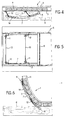
- FIGS. 1 to 6 show a box spring deformable says ergonomic profile of which we see a part liftable bust using articulated parts.
- the frame of the box spring 1 consists of a base rigid 6 with two plates mounted on a base 2, and the the base itself has two side bands at its base flexible or a flexible surface 3 resting directly on the base 6 as seen more precisely Figures 2 and 3.
- the flexible surface receives rows of springs 4, the assembly being capped with a padding or a upholstery fabric 5. Note that the bed base 1 thus carried out overflows on both sides of the base 6, part of the box spring being cantilevered (Figure 3).
- a support 7 with rounded and ergonomic profile is located under the surface 3 of the box spring, along each plate of the base 6.
- One end of each support 7 is fixed to the same pivoting crossbar 8.
- the other end 9 of the support can come to rest on the headrest of the box spring as shown in more detail in Figure 6.
- the profiled support 7 can pivot from the position horizontal of the box spring seen in Figure 4, at the position noted in Figure 6 under the action of mechanisms of motorized lifting not shown which act on said profiled support 7 constituting tilting side part of the bedspring. We understand that thus, during its movement of lifting, the flexible surface 3 of the box spring will marry the rounded contour of the ergonomic support 7.
- Figure 2 shows the previously described assembly, not equipped with the tilting device according to the invention.
- the flexible surface 3 being only in support, in position horizontal, on the base 6, we understand that if we exercise pressure on one side of the bed base 1, as illustrated by the arrow, for example if a person sits on the edge of the bed, the box spring will tip over.
- the proposed anti-tip device includes two rods horizontal linkage 10 maintained under the flexible surface and tilting 3 of the bed base by fixing bearings 11.
- Each end of the rod carries a connecting rod 12 which extends in a vertical plane, parallel to the base plates 6.
- Each connecting rod 12 ends itself with a finger guide 13 which enters a groove 14 provided in the ergonomic support 7.
- the support 7 will gradually apply against the surface flexible 3.
- the connecting rod 10 pivots in its bearings 11 and the fingers 13 slide in the grooves 14. Whatever the position of the bust part of the bed base 1 the fingers 13 allow the attachment of the flexible surface 3 to the supports 7.
- the connecting rod 10 is thus articulated on the supports by a sliding system and constitutes a connecting rod assembly between the two parties sides of the box spring. So any tilting, caused by a cantilevered support on one side will be blocked by fingers 13 on the opposite side, caught in the grooves 14 of the corresponding support.
- the invention also applies to slatted bed bases the end caps of which are fixed from place to place on strips flexible side rests, as in the description previous, on ergonomic supports.
Landscapes
- Health & Medical Sciences (AREA)
- General Health & Medical Sciences (AREA)
- Nursing (AREA)
- Invalid Beds And Related Equipment (AREA)
Abstract
Description
Claims (3)
- Dispositif antibasculement pour support de matelas en porte-à-faux dont au moins certaines parties latérales inclinables reposent directement sur un socle rigide, des mécanismes de relevage pouvant agir sur lesdites parties latérales inclinables par l'intermédiaire de supports latéraux articulés caractérisé en ce qu'il est constitué d'au moins une tige horizontale de liaison (10) maintenue contre la surface inclinable (3) du support de matelas, tige qui relie deux supports latéraux opposés (7) pour former entre eux un embiellage de renvoi, et en ce que la tige de liaison s'articule sur les supports par un système coulissant (12, 13, 14).
- Dispositif antibasculement selon la revendication 1 caractérisé en ce que la tige de liaison (10) se termine à chaque extrémité par une bielle (12) et un doigt de guidage (13) pénétrant dans une rainure (14) du support (7)
- Dispositif antibasculement selon la renvendication 1 caractérisé en ce que la tige de liaison (10) est maintenue sous la surface inclinable (3) du support de matelas par des paliers de fixation (11).
Applications Claiming Priority (2)
| Application Number | Priority Date | Filing Date | Title |
|---|---|---|---|
| FR9706239 | 1997-05-22 | ||
| FR9706239A FR2763491B1 (fr) | 1997-05-22 | 1997-05-22 | Dispositif antibasculement pour support de matelas en porte-a-faux |
Publications (2)
| Publication Number | Publication Date |
|---|---|
| EP0880922A2 true EP0880922A2 (fr) | 1998-12-02 |
| EP0880922A3 EP0880922A3 (fr) | 2000-12-20 |
Family
ID=9507108
Family Applications (1)
| Application Number | Title | Priority Date | Filing Date |
|---|---|---|---|
| EP98401178A Withdrawn EP0880922A3 (fr) | 1997-05-22 | 1998-05-15 | Dispositif antibasculement pour support de matelas en porte-a-faux |
Country Status (2)
| Country | Link |
|---|---|
| EP (1) | EP0880922A3 (fr) |
| FR (1) | FR2763491B1 (fr) |
Cited By (1)
| Publication number | Priority date | Publication date | Assignee | Title |
|---|---|---|---|---|
| FR2824714A1 (fr) * | 2001-05-18 | 2002-11-22 | Michel Carteau | Sommier cintrable |
Family Cites Families (1)
| Publication number | Priority date | Publication date | Assignee | Title |
|---|---|---|---|---|
| NL6700824A (fr) * | 1966-01-24 | 1967-07-25 |
-
1997
- 1997-05-22 FR FR9706239A patent/FR2763491B1/fr not_active Expired - Fee Related
-
1998
- 1998-05-15 EP EP98401178A patent/EP0880922A3/fr not_active Withdrawn
Cited By (1)
| Publication number | Priority date | Publication date | Assignee | Title |
|---|---|---|---|---|
| FR2824714A1 (fr) * | 2001-05-18 | 2002-11-22 | Michel Carteau | Sommier cintrable |
Also Published As
| Publication number | Publication date |
|---|---|
| FR2763491B1 (fr) | 1999-08-20 |
| EP0880922A3 (fr) | 2000-12-20 |
| FR2763491A1 (fr) | 1998-11-27 |
Similar Documents
| Publication | Publication Date | Title |
|---|---|---|
| FR2627684A1 (fr) | Meuble convertible a usage de chalit et de siege de relaxation | |
| BE897046A (fr) | Fauteuil pour vehicule, notamment automobile | |
| FR2725887A1 (fr) | Dispositif de relevage de matelas | |
| CH625689A5 (fr) | ||
| EP0774223B1 (fr) | Sommier déformable à profil ergonomique | |
| EP0880922A2 (fr) | Dispositif antibasculement pour support de matelas en porte-a-faux | |
| FR2602655A1 (fr) | Dispositif de support d'un sommier de lit | |
| FR2822661A1 (fr) | Lit muni d'un releve-dos | |
| FR3006174A1 (fr) | Lit avec un sommier comprenant un releve buste | |
| CH629658A5 (fr) | Siege transformable en lit. | |
| FR2483774A1 (fr) | Support de corps humain | |
| EP1016360B1 (fr) | Lit avec sommier articulé | |
| BE1009880A5 (fr) | Dispositif d'appui reglable en hauteur pour les lames elastiques d'un sommier de lit a lattes. | |
| EP0895738B1 (fr) | Sommier déformable à profil déclive et ergonomique | |
| FR2711521A1 (fr) | Lit pour malade. | |
| FR2621797A1 (fr) | Canape-lit pouvant etre replie partiellement le long d'un mur | |
| CH678693A5 (en) | Anatomical support for sitting patient - comprises frame with two lateral upright members, each having spring-biassed pivotable support arm to rest beneath armpits of patient | |
| EP0891732B1 (fr) | Dispositif destiné à la fixation de lattes transversales d'un sommier de literie | |
| GB2044087A (en) | Support frame for a bed | |
| FR2818104A1 (fr) | Latte perfectionnee pour sommier | |
| FR2675675A1 (fr) | Canape-lit. | |
| FR2883727A1 (fr) | Dispositif d'assisitance permettant a un utilisateur de s'asseoir et de se relever sans effort sur un fauteuil ou une lunette de wc | |
| FR3069153A1 (fr) | Support de lit | |
| CH320570A (fr) | Lit médical | |
| FR2826845A1 (fr) | Sommier a lattes a fermete variable |
Legal Events
| Date | Code | Title | Description |
|---|---|---|---|
| PUAI | Public reference made under article 153(3) epc to a published international application that has entered the european phase |
Free format text: ORIGINAL CODE: 0009012 |
|
| AK | Designated contracting states |
Kind code of ref document: A2 Designated state(s): AT BE CH CY DE DK ES FI FR GB GR IE IT LI LU MC NL PT SE |
|
| AX | Request for extension of the european patent |
Free format text: AL;LT;LV;MK;RO;SI |
|
| PUAL | Search report despatched |
Free format text: ORIGINAL CODE: 0009013 |
|
| AK | Designated contracting states |
Kind code of ref document: A3 Designated state(s): AT BE CH CY DE DK ES FI FR GB GR IE IT LI LU MC NL PT SE |
|
| AX | Request for extension of the european patent |
Free format text: AL;LT;LV;MK;RO;SI |
|
| AKX | Designation fees paid | ||
| REG | Reference to a national code |
Ref country code: DE Ref legal event code: 8566 |
|
| STAA | Information on the status of an ep patent application or granted ep patent |
Free format text: STATUS: THE APPLICATION IS DEEMED TO BE WITHDRAWN |
|
| 18D | Application deemed to be withdrawn |
Effective date: 20010621 |