EP0882011B1 - Procede pour preparer des n-(3-amino-chlorophenyl) acylamides - Google Patents
Procede pour preparer des n-(3-amino-chlorophenyl) acylamides Download PDFInfo
- Publication number
- EP0882011B1 EP0882011B1 EP97905651A EP97905651A EP0882011B1 EP 0882011 B1 EP0882011 B1 EP 0882011B1 EP 97905651 A EP97905651 A EP 97905651A EP 97905651 A EP97905651 A EP 97905651A EP 0882011 B1 EP0882011 B1 EP 0882011B1
- Authority
- EP
- European Patent Office
- Prior art keywords
- alkyl
- substituted
- polar solvent
- aryl
- group
- Prior art date
- Legal status (The legal status is an assumption and is not a legal conclusion. Google has not performed a legal analysis and makes no representation as to the accuracy of the status listed.)
- Expired - Lifetime
Links
- 238000004519 manufacturing process Methods 0.000 title claims description 4
- YXFVVABEGXRONW-UHFFFAOYSA-N Toluene Chemical compound CC1=CC=CC=C1 YXFVVABEGXRONW-UHFFFAOYSA-N 0.000 claims description 48
- 238000000034 method Methods 0.000 claims description 27
- 239000000203 mixture Substances 0.000 claims description 19
- OKKJLVBELUTLKV-UHFFFAOYSA-N Methanol Chemical compound OC OKKJLVBELUTLKV-UHFFFAOYSA-N 0.000 claims description 18
- ZWUBBMDHSZDNTA-UHFFFAOYSA-N 4-Chloro-meta-phenylenediamine Chemical compound NC1=CC=C(Cl)C(N)=C1 ZWUBBMDHSZDNTA-UHFFFAOYSA-N 0.000 claims description 15
- ZMANZCXQSJIPKH-UHFFFAOYSA-N Triethylamine Chemical compound CCN(CC)CC ZMANZCXQSJIPKH-UHFFFAOYSA-N 0.000 claims description 12
- 125000003118 aryl group Chemical group 0.000 claims description 10
- UHOVQNZJYSORNB-UHFFFAOYSA-N Benzene Chemical compound C1=CC=CC=C1 UHOVQNZJYSORNB-UHFFFAOYSA-N 0.000 claims description 9
- 239000002253 acid Substances 0.000 claims description 9
- 125000004642 (C1-C12) alkoxy group Chemical group 0.000 claims description 8
- 239000012454 non-polar solvent Substances 0.000 claims description 8
- 239000002798 polar solvent Substances 0.000 claims description 8
- 125000003837 (C1-C20) alkyl group Chemical group 0.000 claims description 7
- 150000001875 compounds Chemical class 0.000 claims description 7
- 239000002904 solvent Substances 0.000 claims description 7
- JUJWROOIHBZHMG-UHFFFAOYSA-N Pyridine Chemical compound C1=CC=NC=C1 JUJWROOIHBZHMG-UHFFFAOYSA-N 0.000 claims description 6
- 150000001263 acyl chlorides Chemical class 0.000 claims description 6
- -1 nitrogen containing heterocyclic compounds Chemical class 0.000 claims description 6
- 125000001997 phenyl group Chemical group [H]C1=C([H])C([H])=C(*)C([H])=C1[H] 0.000 claims description 6
- OISVCGZHLKNMSJ-UHFFFAOYSA-N 2,6-dimethylpyridine Chemical class CC1=CC=CC(C)=N1 OISVCGZHLKNMSJ-UHFFFAOYSA-N 0.000 claims description 5
- 125000000753 cycloalkyl group Chemical group 0.000 claims description 5
- 229910052736 halogen Inorganic materials 0.000 claims description 5
- 150000002367 halogens Chemical class 0.000 claims description 5
- 125000000449 nitro group Chemical group [O-][N+](*)=O 0.000 claims description 5
- 125000004178 (C1-C4) alkyl group Chemical group 0.000 claims description 4
- YNQLUTRBYVCPMQ-UHFFFAOYSA-N Ethylbenzene Chemical compound CCC1=CC=CC=C1 YNQLUTRBYVCPMQ-UHFFFAOYSA-N 0.000 claims description 4
- RWGFKTVRMDUZSP-UHFFFAOYSA-N cumene Chemical compound CC(C)C1=CC=CC=C1 RWGFKTVRMDUZSP-UHFFFAOYSA-N 0.000 claims description 4
- 125000004209 (C1-C8) alkyl group Chemical group 0.000 claims description 3
- BSKHPKMHTQYZBB-UHFFFAOYSA-N 2-methylpyridine Chemical class CC1=CC=CC=N1 BSKHPKMHTQYZBB-UHFFFAOYSA-N 0.000 claims description 3
- 125000003342 alkenyl group Chemical group 0.000 claims description 3
- 125000004104 aryloxy group Chemical group 0.000 claims description 3
- 125000002887 hydroxy group Chemical group [H]O* 0.000 claims description 3
- 125000000325 methylidene group Chemical group [H]C([H])=* 0.000 claims description 3
- UMJSCPRVCHMLSP-UHFFFAOYSA-N pyridine Natural products COC1=CC=CN=C1 UMJSCPRVCHMLSP-UHFFFAOYSA-N 0.000 claims description 3
- YQTCQNIPQMJNTI-UHFFFAOYSA-N 2,2-dimethylpropan-1-one Chemical group CC(C)(C)[C]=O YQTCQNIPQMJNTI-UHFFFAOYSA-N 0.000 claims description 2
- KWYHDKDOAIKMQN-UHFFFAOYSA-N N,N,N',N'-tetramethylethylenediamine Chemical compound CN(C)CCN(C)C KWYHDKDOAIKMQN-UHFFFAOYSA-N 0.000 claims description 2
- JLTDJTHDQAWBAV-UHFFFAOYSA-N N,N-dimethylaniline Chemical class CN(C)C1=CC=CC=C1 JLTDJTHDQAWBAV-UHFFFAOYSA-N 0.000 claims description 2
- 150000001335 aliphatic alkanes Chemical class 0.000 claims description 2
- 229940111121 antirheumatic drug quinolines Drugs 0.000 claims description 2
- 229910052739 hydrogen Inorganic materials 0.000 claims description 2
- 239000001257 hydrogen Substances 0.000 claims description 2
- 150000002537 isoquinolines Chemical class 0.000 claims description 2
- 229910052757 nitrogen Inorganic materials 0.000 claims description 2
- KHUXNRRPPZOJPT-UHFFFAOYSA-N phenoxy radical Chemical compound O=C1C=C[CH]C=C1 KHUXNRRPPZOJPT-UHFFFAOYSA-N 0.000 claims description 2
- 150000003233 pyrroles Chemical class 0.000 claims description 2
- 150000003248 quinolines Chemical class 0.000 claims description 2
- 150000003512 tertiary amines Chemical class 0.000 claims description 2
- IMFACGCPASFAPR-UHFFFAOYSA-N tributylamine Chemical compound CCCCN(CCCC)CCCC IMFACGCPASFAPR-UHFFFAOYSA-N 0.000 claims description 2
- 239000008096 xylene Substances 0.000 claims description 2
- 150000003738 xylenes Chemical class 0.000 claims description 2
- 125000004435 hydrogen atom Chemical group [H]* 0.000 claims 1
- 239000000047 product Substances 0.000 description 25
- RAXXELZNTBOGNW-UHFFFAOYSA-N imidazole Natural products C1=CNC=N1 RAXXELZNTBOGNW-UHFFFAOYSA-N 0.000 description 12
- 238000005917 acylation reaction Methods 0.000 description 11
- IMNFDUFMRHMDMM-UHFFFAOYSA-N N-Heptane Chemical compound CCCCCCC IMNFDUFMRHMDMM-UHFFFAOYSA-N 0.000 description 10
- 230000010933 acylation Effects 0.000 description 9
- 238000006243 chemical reaction Methods 0.000 description 9
- 239000011541 reaction mixture Substances 0.000 description 9
- XLYOFNOQVPJJNP-UHFFFAOYSA-N water Substances O XLYOFNOQVPJJNP-UHFFFAOYSA-N 0.000 description 9
- 239000010410 layer Substances 0.000 description 8
- XEKOWRVHYACXOJ-UHFFFAOYSA-N Ethyl acetate Chemical compound CCOC(C)=O XEKOWRVHYACXOJ-UHFFFAOYSA-N 0.000 description 6
- 239000000370 acceptor Substances 0.000 description 5
- 238000004128 high performance liquid chromatography Methods 0.000 description 5
- 150000008064 anhydrides Chemical class 0.000 description 4
- MVPPADPHJFYWMZ-UHFFFAOYSA-N chlorobenzene Chemical compound ClC1=CC=CC=C1 MVPPADPHJFYWMZ-UHFFFAOYSA-N 0.000 description 4
- 239000000543 intermediate Substances 0.000 description 4
- 239000012044 organic layer Substances 0.000 description 4
- KFZMGEQAYNKOFK-UHFFFAOYSA-N Isopropanol Chemical compound CC(C)O KFZMGEQAYNKOFK-UHFFFAOYSA-N 0.000 description 3
- 238000005481 NMR spectroscopy Methods 0.000 description 3
- 238000004458 analytical method Methods 0.000 description 3
- 239000007787 solid Substances 0.000 description 3
- 239000004753 textile Substances 0.000 description 3
- 229940086542 triethylamine Drugs 0.000 description 3
- WBQWCMNVBGTAAM-UHFFFAOYSA-N 4-[2,4-bis(2-methylbutan-2-yl)phenoxy]butanoyl chloride Chemical compound CCC(C)(C)C1=CC=C(OCCCC(Cl)=O)C(C(C)(C)CC)=C1 WBQWCMNVBGTAAM-UHFFFAOYSA-N 0.000 description 2
- YYROPELSRYBVMQ-UHFFFAOYSA-N 4-toluenesulfonyl chloride Chemical compound CC1=CC=C(S(Cl)(=O)=O)C=C1 YYROPELSRYBVMQ-UHFFFAOYSA-N 0.000 description 2
- UFWIBTONFRDIAS-UHFFFAOYSA-N Naphthalene Chemical compound C1=CC=CC2=CC=CC=C21 UFWIBTONFRDIAS-UHFFFAOYSA-N 0.000 description 2
- CDBYLPFSWZWCQE-UHFFFAOYSA-L Sodium Carbonate Chemical compound [Na+].[Na+].[O-]C([O-])=O CDBYLPFSWZWCQE-UHFFFAOYSA-L 0.000 description 2
- 230000000052 comparative effect Effects 0.000 description 2
- 239000012043 crude product Substances 0.000 description 2
- 239000000975 dye Substances 0.000 description 2
- 238000001704 evaporation Methods 0.000 description 2
- 239000000835 fiber Substances 0.000 description 2
- YOSVFFVBSPQTTP-UHFFFAOYSA-N hexadecane-1-sulfonyl chloride Chemical compound CCCCCCCCCCCCCCCCS(Cl)(=O)=O YOSVFFVBSPQTTP-UHFFFAOYSA-N 0.000 description 2
- 239000012535 impurity Substances 0.000 description 2
- 125000003170 phenylsulfonyl group Chemical group C1(=CC=CC=C1)S(=O)(=O)* 0.000 description 2
- 150000003254 radicals Chemical class 0.000 description 2
- 238000001953 recrystallisation Methods 0.000 description 2
- 238000004809 thin layer chromatography Methods 0.000 description 2
- 125000004400 (C1-C12) alkyl group Chemical group 0.000 description 1
- 0 *c(cc1*)ccc1Cl Chemical compound *c(cc1*)ccc1Cl 0.000 description 1
- WZCQRUWWHSTZEM-UHFFFAOYSA-N 1,3-phenylenediamine Chemical compound NC1=CC=CC(N)=C1 WZCQRUWWHSTZEM-UHFFFAOYSA-N 0.000 description 1
- BAHPQISAXRFLCL-UHFFFAOYSA-N 2,4-Diaminoanisole Chemical compound COC1=CC=C(N)C=C1N BAHPQISAXRFLCL-UHFFFAOYSA-N 0.000 description 1
- GOJUJUVQIVIZAV-UHFFFAOYSA-N 2-amino-4,6-dichloropyrimidine-5-carbaldehyde Chemical group NC1=NC(Cl)=C(C=O)C(Cl)=N1 GOJUJUVQIVIZAV-UHFFFAOYSA-N 0.000 description 1
- NDYYWMXJZWHRLZ-UHFFFAOYSA-N 2-methoxyethyl carbonochloridate Chemical compound COCCOC(Cl)=O NDYYWMXJZWHRLZ-UHFFFAOYSA-N 0.000 description 1
- QCQCHGYLTSGIGX-GHXANHINSA-N 4-[[(3ar,5ar,5br,7ar,9s,11ar,11br,13as)-5a,5b,8,8,11a-pentamethyl-3a-[(5-methylpyridine-3-carbonyl)amino]-2-oxo-1-propan-2-yl-4,5,6,7,7a,9,10,11,11b,12,13,13a-dodecahydro-3h-cyclopenta[a]chrysen-9-yl]oxy]-2,2-dimethyl-4-oxobutanoic acid Chemical compound N([C@@]12CC[C@@]3(C)[C@]4(C)CC[C@H]5C(C)(C)[C@@H](OC(=O)CC(C)(C)C(O)=O)CC[C@]5(C)[C@H]4CC[C@@H]3C1=C(C(C2)=O)C(C)C)C(=O)C1=CN=CC(C)=C1 QCQCHGYLTSGIGX-GHXANHINSA-N 0.000 description 1
- ZCYVEMRRCGMTRW-UHFFFAOYSA-N 7553-56-2 Chemical compound [I] ZCYVEMRRCGMTRW-UHFFFAOYSA-N 0.000 description 1
- WKBOTKDWSSQWDR-UHFFFAOYSA-N Bromine atom Chemical compound [Br] WKBOTKDWSSQWDR-UHFFFAOYSA-N 0.000 description 1
- 239000004215 Carbon black (E152) Substances 0.000 description 1
- ZAMOUSCENKQFHK-UHFFFAOYSA-N Chlorine atom Chemical compound [Cl] ZAMOUSCENKQFHK-UHFFFAOYSA-N 0.000 description 1
- PXGOKWXKJXAPGV-UHFFFAOYSA-N Fluorine Chemical compound FF PXGOKWXKJXAPGV-UHFFFAOYSA-N 0.000 description 1
- GRHZLQBPAJAHDM-SPRQWYLLSA-N [(3as,4r,6ar)-2,3,3a,4,5,6a-hexahydrofuro[2,3-b]furan-4-yl] n-[(2s,4s,5s)-5-[[2-(2,6-dimethylphenoxy)acetyl]amino]-4-hydroxy-1,6-diphenylhexan-2-yl]carbamate Chemical compound CC1=CC=CC(C)=C1OCC(=O)N[C@H]([C@@H](O)C[C@H](CC=1C=CC=CC=1)NC(=O)O[C@@H]1[C@@H]2CCO[C@@H]2OC1)CC1=CC=CC=C1 GRHZLQBPAJAHDM-SPRQWYLLSA-N 0.000 description 1
- 125000002252 acyl group Chemical group 0.000 description 1
- 150000001266 acyl halides Chemical class 0.000 description 1
- 150000001298 alcohols Chemical class 0.000 description 1
- 125000000217 alkyl group Chemical group 0.000 description 1
- 150000001412 amines Chemical class 0.000 description 1
- 239000000987 azo dye Substances 0.000 description 1
- PASDCCFISLVPSO-UHFFFAOYSA-N benzoyl chloride Chemical compound ClC(=O)C1=CC=CC=C1 PASDCCFISLVPSO-UHFFFAOYSA-N 0.000 description 1
- 125000000051 benzyloxy group Chemical group [H]C1=C([H])C([H])=C(C([H])=C1[H])C([H])([H])O* 0.000 description 1
- GDTBXPJZTBHREO-UHFFFAOYSA-N bromine Substances BrBr GDTBXPJZTBHREO-UHFFFAOYSA-N 0.000 description 1
- 229910052794 bromium Inorganic materials 0.000 description 1
- 125000004432 carbon atom Chemical group C* 0.000 description 1
- 239000003795 chemical substances by application Substances 0.000 description 1
- 229910052801 chlorine Inorganic materials 0.000 description 1
- 239000000460 chlorine Substances 0.000 description 1
- 238000001816 cooling Methods 0.000 description 1
- HPYNZHMRTTWQTB-UHFFFAOYSA-N dimethylpyridine Natural products CC1=CC=CN=C1C HPYNZHMRTTWQTB-UHFFFAOYSA-N 0.000 description 1
- 239000000986 disperse dye Substances 0.000 description 1
- 238000004043 dyeing Methods 0.000 description 1
- OAMZXMDZZWGPMH-UHFFFAOYSA-N ethyl acetate;toluene Chemical compound CCOC(C)=O.CC1=CC=CC=C1 OAMZXMDZZWGPMH-UHFFFAOYSA-N 0.000 description 1
- 230000008020 evaporation Effects 0.000 description 1
- 229910052731 fluorine Inorganic materials 0.000 description 1
- 239000011737 fluorine Substances 0.000 description 1
- 229930195733 hydrocarbon Natural products 0.000 description 1
- 150000002430 hydrocarbons Chemical group 0.000 description 1
- 150000002460 imidazoles Chemical class 0.000 description 1
- 229910052740 iodine Inorganic materials 0.000 description 1
- 239000011630 iodine Substances 0.000 description 1
- 238000002955 isolation Methods 0.000 description 1
- 239000012046 mixed solvent Substances 0.000 description 1
- BKETUCNJDZSSEV-UHFFFAOYSA-N n-(3-amino-4-chlorophenyl)-4-[2,4-bis(2-methylbutan-2-yl)phenoxy]butanamide Chemical compound CCC(C)(C)C1=CC(C(C)(C)CC)=CC=C1OCCCC(=O)NC1=CC=C(Cl)C(N)=C1 BKETUCNJDZSSEV-UHFFFAOYSA-N 0.000 description 1
- ZILOAZTVOLFCRO-UHFFFAOYSA-N n-(3-amino-4-chlorophenyl)hexadecane-1-sulfonamide Chemical compound CCCCCCCCCCCCCCCCS(=O)(=O)NC1=CC=C(Cl)C(N)=C1 ZILOAZTVOLFCRO-UHFFFAOYSA-N 0.000 description 1
- LHHIALSOMNPUOW-UHFFFAOYSA-N n-chloro-n-phenylnitramide Chemical class [O-][N+](=O)N(Cl)C1=CC=CC=C1 LHHIALSOMNPUOW-UHFFFAOYSA-N 0.000 description 1
- 239000000049 pigment Substances 0.000 description 1
- 230000001737 promoting effect Effects 0.000 description 1
- 238000000746 purification Methods 0.000 description 1
- 229910000029 sodium carbonate Inorganic materials 0.000 description 1
- 239000012265 solid product Substances 0.000 description 1
- 239000011877 solvent mixture Substances 0.000 description 1
- 239000007858 starting material Substances 0.000 description 1
- 238000003756 stirring Methods 0.000 description 1
- 238000003828 vacuum filtration Methods 0.000 description 1
- 238000005406 washing Methods 0.000 description 1
Classifications
-
- C—CHEMISTRY; METALLURGY
- C07—ORGANIC CHEMISTRY
- C07C—ACYCLIC OR CARBOCYCLIC COMPOUNDS
- C07C231/00—Preparation of carboxylic acid amides
- C07C231/02—Preparation of carboxylic acid amides from carboxylic acids or from esters, anhydrides, or halides thereof by reaction with ammonia or amines
-
- C—CHEMISTRY; METALLURGY
- C07—ORGANIC CHEMISTRY
- C07C—ACYCLIC OR CARBOCYCLIC COMPOUNDS
- C07C303/00—Preparation of esters or amides of sulfuric acids; Preparation of sulfonic acids or of their esters, halides, anhydrides or amides
- C07C303/36—Preparation of esters or amides of sulfuric acids; Preparation of sulfonic acids or of their esters, halides, anhydrides or amides of amides of sulfonic acids
- C07C303/38—Preparation of esters or amides of sulfuric acids; Preparation of sulfonic acids or of their esters, halides, anhydrides or amides of amides of sulfonic acids by reaction of ammonia or amines with sulfonic acids, or with esters, anhydrides, or halides thereof
Definitions
- This invention relates to an improved process for preparing N-(3-amino-4-chlorophenyl) acylamides which are useful as intermediates for couplers for preparing disperse azo dyes for dyeing textile fibers and for preparing couplers which are useful in color photography.
- the process involves the selective acylation of the 4-amino group in 1-chloro-2,4-diaminobenzene using certain acyl chlorides in the presence of an acid acceptor.
- U.S. Patent 4,283,556 teaches the selective mono acylation of 1-methoxy-2,4-diaminobenzene using anhydrides in alcohols as solvents.
- Using anhydrides to introduce the acyl group is inherently less efficient than acylation with acyl halides, since approximately-one half of the weight of anhydride is lost during the reaction in the form of the corresponding acid. This is particularly disadvantageous in preparing the intermediates for photographic couplers, since the acylating agent is usually used to introduce a complicated and expensive ballast group into the coupler.
- Patent 4,540,815 describes the selective acylation of 1,3-diaminobenzene and 1-C 1 -C 4 alkoxy-2,4-diaminobenzenes using anhydrides in the presence of C 1 -C 4 alkanols and hydrogen halides to precipitate the monoacylated compounds when formed to prevent further acylation.
- This invention relates to a process for preparing N-(3-amino-4-chlorophenyl) acylamides of Formula I: comprising reacting, in a solvent comprising at least one polar solvent selected from the group consisting of C 1 -C 3 alkanols and mixtures thereof in the presence of an acid acceptor, 1-chloro-2,4-diaminobenzene with at least one acyl chloride of formula III: Cl-X-R wherein X is -CO- or -SO 2 -; R is selected from the group C 1 -C 25 alkyl; C 1 -C 25 alkyl substituted with one or more groups selected from C 1 -C 12 alkoxy, aryl, aryloxy and C 5 -C 7 cycloalkyl; aryl; C 5 -C 7 cycloalkyl.
- N-(3-amino-4-chlorophenyl) acylamides I are useful as intermediates for producing disperse textile dyes and couplers for color photography.
- the reaction of 1-chloro-2,4-diaminobenzene with acyl chlorides II is as follows: wherein X and R are as defined above.
- the mixed solvents as described above are particularly useful for promoting the completion of the acylation reaction and further for removing any bis acylated product, which may occur as an undesired impurity, during isolation of the desired product.
- the monoacylation reactions are carried out in the presence of one or more acid acceptors, usually selected from tertiary amines, e.g. triethylamine, tri-n-butylamine, N,N 1 -dialkylpiperazines and N,N,N 1 ,N 1 -tetraalkylethylenediamines; N,N-dialkylanilines, e.g. N,N-dimethylanilines; nitrogen containing heterocyclic compounds, e.g. pyridine, picolines, lutidines, quinolines, isoquinolines, pyrroles, imidazoles and mixtures thereof.
- Preferred acid acceptors are triethylamine, pyridine, picolines, lutidines, imidazole and mixtures thereof.
- the acylation reaction is usually carried out at temperatures ranging from -15 to +75°C, preferably from -5 to +50°C.
- the N-(3-amino-4-chlorophenyl) acylamides were made from chloro nitro anilines via a difficult multi step process (e.g. as disclosed in U.S. 3,265,506, Example 8).
- the selective acylation of 1-chloro-2,4-diaminobenzene according to the process of this invention provides an alternative process which offers high yields of desired products having excellent purity. Since the starting 1-chloro-2,4-diaminobenzene for this method is derived by reduction of l-chloro-2,4-dinitrobenzene, which is readily available and cheap, the method offers improved economics versus previously disclosed methods.
- aryl and aryloxy are used to denote aromatic monovalent radicals selected from the classes of benzene and naphthalene and these radicals substituted with one or more groups selected from C 1 -C 25 alkyl; C 1 -C 12 alkoxy; hydroxy; nitro; halogen; C 5 -C 7 cycloalkyl; C 1 -C 12 alkanoyloxy; C 1 -C 12 alkanoylamino; C 1 -C 12 alkanesulfonamido; phenylsulfonyl and phenylsulfonyl substituted by one or more groups selected from C 1 -C 12 alkoxy, C 1 -C 12 alkanoyloxy, benzyloxy, OR 1 , and OCOR 1 , wherein R 1 is phenyl or phenyl substituted by C 1 -C 12 alkyl, C 1 -C 12 alkoxy or halogen.
- C 1 -C 25 alkyl is used to denote a straight or branched chain hydrocarbon radical having 1 to 25 carbons.
- C 1 -C 12 alkoxy In the terms "C 1 -C 12 alkoxy”, “C 1 -C 12 alkanoyloxy”, “C 1 -C 12 alkanoylamino” and “C 1 -C 12 alkanesulfonamido", the alkyl portion of the group is a straight or branched chain hydrocarbon moiety containing 1 to 12 carbon atoms.
- halogen is used to include fluorine, chlorine, bromine and iodine.
- X is-CO-, and R is preferably C 1 -C 20 alkyl substituted with a phenoxy radical containing one or more groups selected from C 1 -C 20 alkyl, hydroxy, nitro, C 1 -C 12 alkanesulfonamido, C 1 -C 12 alkanoyloxy and halogen.
- X is CO and R is phenyl or phenyl substituted with C 1 -C 20 alkyl, C 1 -C 12 alkoxy or nitro.
- X is -SO 2 - and R is a C 1 -C 20 alkyl radical.
- Typical acyl chlorides III which are useful in the practice of the invention are provided in Table I.
- N-(3-amino-4-chlorophenyl) acylamides of Formula I may be readily converted to provide useful derivatives IV.
- the above reaction may be conducted via a number of methods which are generally known in the art.
- the class of compounds within Formula IV wherein X is CO; R is C 1 -C 4 alkyl, substituted C 1 -C 4 alkyl or aryl; R 2 is unsubstituted or substituted C 1 -C 8 alkyl, or unsubstituted or substituted C 3 -C 4 alkenyl, are known to be useful as couplers for producing azo disperse dyes for textile fibers (U.S. Patent 4,448,719; Dyes and Pigments 4 (1983) 195-211).
- the methanol and hydrochloride salt of the amine were removed by washing the toluene layer with water. After evaporating the toluene layer to dryness the crude product was recrystallized from a solution of 10 mL of heptane and 5 mL of toluene. The yield of solid product was 4.10g.
- Example 2 was repeated using lutidine(1.2g, 0.011 mol) as the acid acceptor to yield 3.38g of product which by HPLC was shown to consist of 96.8% by weight (73.5% of the theoretical yield) of the desired monoacylated product, 0.65% by weight of starting 1-chloro-2,4-diaminobenzene and 0.9% by weight of the bis acylated product.
Landscapes
- Chemical & Material Sciences (AREA)
- Organic Chemistry (AREA)
- Chemical Kinetics & Catalysis (AREA)
- Organic Low-Molecular-Weight Compounds And Preparation Thereof (AREA)
- Low-Molecular Organic Synthesis Reactions Using Catalysts (AREA)
Claims (16)
- Procédé pour préparer des N-(3-amino-4-chlorophényl)acylamides de formule Icomprenant la réaction, dans un solvant comprenant au moins un solvant polaire choisi dans le groupe constitué par les alcanols en C1-C3 et leurs mélanges, en présence d'au moins un accepteur d'acide, du 1-chloro-2,4-diaminobenzène avec au moins un chlorure d'acyle de formule III:

- Procédé selon la revendication 1, dans lequel ledit solvant polaire comprend le méthanol.
- Procédé selon la revendication 1, dans lequel ledit solvant comprend de plus au moins un solvant non polaire.
- Procédé selon la revendication 3, dans lequel ledit solvant non polaire représente au moins 50% en masse du solvant.
- Procédé selon la revendication 3, dans lequel ledit au moins un solvant polaire est choisi dans le groupe constitué par les alcanes en C5-C7, le benzène, le toluène, l'éthylbenzène, le cumène et les xylènes ou leurs mélanges.
- Procédé selon la revendication 3, dans lequel ledit au moins un solvant non polaire comprend le toluène.
- Procédé selon la revendication 1, dans lequel ledit accepteur d'acide est choisi dans le groupe constitué par les amines tertiaires, les N,N,N1,N1-tétraalkyléthylènediamines, les N,N-dialkylanilines, les N,N-diméthylanilines et les composés hétérocycliques contenant de l'azote et leurs mélanges.
- Procédé selon la revendication 7, dans lequel ledit accepteur d'acide est choisi dans le groupe constitué par la triéthylamine, la tri-n-butylamine, les N,N1-dialkylpipérazines, la pyridine, les picolines, les lutidines, les quinoléines, les isoquinoléines, les pyrroles, les imidazoles et leurs mélanges.
- Procédé selon la revendication 1, dans lequel ladite étape de réaction est effectuée à une température comprise entre -15 et +75°C.
- Procédé selon la revendication 1, dans lequel X est -CO- et R est un groupe alkyle en C1-C20 substitué par un radical phénoxy contenant un ou plusieurs groupes choisis parmi les groupes alkyle en C1-C20, hydroxy, nitro, alcanesulfonamido en C1-C12, alcanoyloxy en C1-C12 et halogène; ou un groupe phényle ou phényle substitué par un groupe alkyle en C1-C20, alcoxy en C1-C12 ou nitro.
- Procédé selon la revendication 1, dans lequel X est -SO2- et R est un groupe alkyle en C1-C20.
- Procédé selon la revendication 1 comprenant de plus une étape de réaction desdits N-(3-amino-4-chlorophényl)acylamides selon la formule I de la revendication 1, d'une manière connue en soi pour donner les composés de formule IVdans laquelle R2 est choisi parmi les groupes alkyle en C1-C8 substitués ou non substitués et les groupes alcényle en C3-C4 substitués ou non substitués.
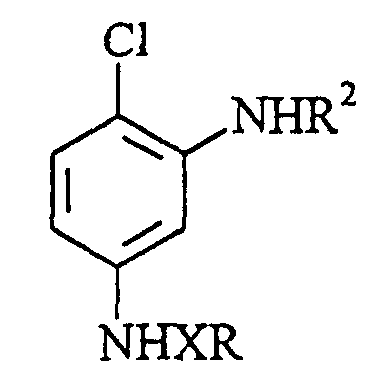
- Procédé selon la revendication 12, dans lequel X est -CO-; R est un groupe alkyle en C1-C4, alkyle en C1-C4 substitué ou aryle; R2 est un groupe alkyle en C1-C8 substitué ou non substitué ou un groupe alcényle en C3-C4 substitué ou non substitué.
- Procédé selon la revendication 12, dans lequel X est -CO- ou -SO2-; R est un groupe alkyle en C1-C25, alkyle en C1-C25 substitué ou aryle; R2 est un reste méthylène activé.
- Procédé selon la revendication 14, dans lequel ledit reste méthylène activé est un groupe 1-aryl-5-pyrazolon-3-yle ou pivaloyle.
- Procédé selon la revendication 1, comprenant de plus une étape de purification desdits N-(3-amino-4-chlorophényl)acylamides par cristallisation dans un solvant non polaire.
Applications Claiming Priority (3)
| Application Number | Priority Date | Filing Date | Title |
|---|---|---|---|
| US08/593,726 US5663434A (en) | 1996-01-29 | 1996-01-29 | Process for preparing N-(3-amino-4-chlorophenyl) acylamides |
| US593726 | 1996-01-29 | ||
| PCT/US1997/001393 WO1997027171A1 (fr) | 1996-01-29 | 1997-01-29 | Procede pour preparer des n-(3-amino-chlorophenyl) acylamides |
Publications (2)
| Publication Number | Publication Date |
|---|---|
| EP0882011A1 EP0882011A1 (fr) | 1998-12-09 |
| EP0882011B1 true EP0882011B1 (fr) | 2002-03-27 |
Family
ID=24375895
Family Applications (1)
| Application Number | Title | Priority Date | Filing Date |
|---|---|---|---|
| EP97905651A Expired - Lifetime EP0882011B1 (fr) | 1996-01-29 | 1997-01-29 | Procede pour preparer des n-(3-amino-chlorophenyl) acylamides |
Country Status (6)
| Country | Link |
|---|---|
| US (1) | US5663434A (fr) |
| EP (1) | EP0882011B1 (fr) |
| JP (1) | JP2000503993A (fr) |
| AU (1) | AU727545B2 (fr) |
| DE (1) | DE69711363T2 (fr) |
| WO (1) | WO1997027171A1 (fr) |
Families Citing this family (4)
| Publication number | Priority date | Publication date | Assignee | Title |
|---|---|---|---|---|
| DE19800531A1 (de) * | 1998-01-09 | 1999-07-15 | Bayer Ag | Verfahren zur Herstellung von N-(3-Amino-4-fluor-phenyl)-sulfonsäureamiden, N-(3-Amino-4-fluor-phenyl)-carbonsäureamiden und N-(3-Amino-4-fluor-phenyl)-carbamaten |
| US6034276A (en) * | 1999-03-22 | 2000-03-07 | Eastman Chemical Company | Process for preparing 1-chloro-2,4-diaminobenzene |
| US6509500B2 (en) * | 2001-05-24 | 2003-01-21 | Eastman Chemical Company | Continuous preparation of incorporated photographic amides |
| CN111757870A (zh) * | 2018-01-18 | 2020-10-09 | Fmc公司 | 合成甲磺草胺的方法 |
Family Cites Families (8)
| Publication number | Priority date | Publication date | Assignee | Title |
|---|---|---|---|---|
| US3265506A (en) * | 1964-05-04 | 1966-08-09 | Eastman Kodak Co | Yellow forming couplers |
| GB1077874A (en) * | 1963-10-01 | 1967-08-02 | Eastman Kodak Co | New open-chain reactive methylene compounds and their use as photographic colour couplers |
| US3920710A (en) * | 1967-05-16 | 1975-11-18 | Oreal | 2-nitro-4-benzenesulfonamido chlorobenzenes |
| US3894875A (en) * | 1973-11-28 | 1975-07-15 | Eastman Kodak Co | Silver halide emulsions containing yellow dye-forming couplers exhibiting very low pH sensitivity |
| US4283556A (en) * | 1978-09-11 | 1981-08-11 | Toms River Chemical Corporation | Process for the manufacture of substantially pure 3-amino-4-alkoxy-acylanilides from 2,4-dinitrochlorobenzene |
| DE3165222D1 (de) * | 1980-06-20 | 1984-09-06 | Ciba Geigy Ag | Monoazo compounds |
| DE3341883A1 (de) * | 1983-11-19 | 1985-05-30 | Hoechst Ag, 6230 Frankfurt | Verfahren zur herstellung von reinen 3-acetylaminoanilinen |
| US5008179A (en) * | 1989-11-22 | 1991-04-16 | Eastman Kodak Company | Increased activity precipitated photographic materials |
-
1996
- 1996-01-29 US US08/593,726 patent/US5663434A/en not_active Expired - Fee Related
-
1997
- 1997-01-29 EP EP97905651A patent/EP0882011B1/fr not_active Expired - Lifetime
- 1997-01-29 JP JP9527098A patent/JP2000503993A/ja active Pending
- 1997-01-29 AU AU22488/97A patent/AU727545B2/en not_active Ceased
- 1997-01-29 DE DE69711363T patent/DE69711363T2/de not_active Expired - Fee Related
- 1997-01-29 WO PCT/US1997/001393 patent/WO1997027171A1/fr not_active Ceased
Also Published As
| Publication number | Publication date |
|---|---|
| WO1997027171A1 (fr) | 1997-07-31 |
| DE69711363D1 (de) | 2002-05-02 |
| AU2248897A (en) | 1997-08-20 |
| AU727545B2 (en) | 2000-12-14 |
| US5663434A (en) | 1997-09-02 |
| EP0882011A1 (fr) | 1998-12-09 |
| JP2000503993A (ja) | 2000-04-04 |
| DE69711363T2 (de) | 2002-08-08 |
Similar Documents
| Publication | Publication Date | Title |
|---|---|---|
| CA1262553A (fr) | Cis-1-aryl-2-(fluoromethyl) oxiranes | |
| US20040024196A1 (en) | Phase transfer catalyzed glycosidation of an indolocarbazole | |
| US6201118B1 (en) | Process for forming an N-acylated, N,N-containing bicyclic ring from piperazic acid or an ester thereof especially useful as an intermediate in the manufacture of a caspase inhibitor | |
| Barlaam et al. | New hydroxylamines for the synthesis of hydroxamic acids | |
| AU727545B2 (en) | Process for preparing N-(3-amino-4-chlorophenyl) acylamides | |
| CN112272665B (zh) | 制备立他司特的方法 | |
| NO800868L (no) | Fremgangsmaate til fremstilling av 2,6-diaminonbularin-forbindelser | |
| EP1104409B1 (fr) | Procede de preparation de l'acide piperazique, et sa transformation en un noyau bicyclique contenant des liaisons n,n acyle, utiles pour la fabrication d'inhibiteurs de la caspase | |
| KR100399854B1 (ko) | 살절지동물성옥사디아진중간체 | |
| US7960553B1 (en) | Reagent for synthesis of para-methoxbenzyl (PMB) ethers and associated methods | |
| KR100281826B1 (ko) | N,n-디아실이미다졸론 유도체를 이용한 아민의 아실화 방법 | |
| AU8435198A (en) | Process for the preparation of a deoxyuridine derivative | |
| US5821367A (en) | Regiospecific process for synthesis of acyclic nucleosides | |
| KR100280423B1 (ko) | 전압레벨변환회로 | |
| KR100281827B1 (ko) | 메틸렌디포스폰산의제조방법 | |
| US6002041A (en) | Process for preparing di-C1 - C4 -alkyl 5-nitro-isophthalates | |
| Mimura et al. | An efficient synthesis of a new class of DNA intercalating antitumor 7, 10-dihydroxy-6H-pyrazolo [4, 5, 1-de] acridin-6-ones | |
| JPS6144854A (ja) | N−ジクロロアルキル安息香酸アミド及びその製造方法 | |
| EP0752407B1 (fr) | Procédé de préparation de produits halogénés de condensation et halogénation simultanée | |
| JPS61158962A (ja) | 1,4−ジヒドロピリジン誘導体の製造法 | |
| US7268234B2 (en) | Method for sulfonation of 1,2-benzisoxazole-3-acetic acid | |
| JPH072809A (ja) | アミノチアゾール酢酸誘導体の新規製造法 | |
| JPH04261193A (ja) | 6−ハロゲノ−2−オキサプレグナ−4,6−ジエン−3−オン化合物の製造方法 | |
| WO2018130942A1 (fr) | Procédé de préparation de phénoxybenzamine | |
| JPS6132314B2 (fr) |
Legal Events
| Date | Code | Title | Description |
|---|---|---|---|
| PUAI | Public reference made under article 153(3) epc to a published international application that has entered the european phase |
Free format text: ORIGINAL CODE: 0009012 |
|
| 17P | Request for examination filed |
Effective date: 19980716 |
|
| AK | Designated contracting states |
Kind code of ref document: A1 Designated state(s): CH DE FR GB LI NL |
|
| 17Q | First examination report despatched |
Effective date: 20000707 |
|
| GRAG | Despatch of communication of intention to grant |
Free format text: ORIGINAL CODE: EPIDOS AGRA |
|
| GRAG | Despatch of communication of intention to grant |
Free format text: ORIGINAL CODE: EPIDOS AGRA |
|
| GRAH | Despatch of communication of intention to grant a patent |
Free format text: ORIGINAL CODE: EPIDOS IGRA |
|
| GRAH | Despatch of communication of intention to grant a patent |
Free format text: ORIGINAL CODE: EPIDOS IGRA |
|
| REG | Reference to a national code |
Ref country code: GB Ref legal event code: IF02 |
|
| GRAA | (expected) grant |
Free format text: ORIGINAL CODE: 0009210 |
|
| AK | Designated contracting states |
Kind code of ref document: B1 Designated state(s): CH DE FR GB LI NL |
|
| PG25 | Lapsed in a contracting state [announced via postgrant information from national office to epo] |
Ref country code: NL Free format text: LAPSE BECAUSE OF FAILURE TO SUBMIT A TRANSLATION OF THE DESCRIPTION OR TO PAY THE FEE WITHIN THE PRESCRIBED TIME-LIMIT Effective date: 20020327 |
|
| REG | Reference to a national code |
Ref country code: CH Ref legal event code: EP |
|
| REG | Reference to a national code |
Ref country code: CH Ref legal event code: NV Representative=s name: KIRKER & CIE SA |
|
| REF | Corresponds to: |
Ref document number: 69711363 Country of ref document: DE Date of ref document: 20020502 |
|
| NLV1 | Nl: lapsed or annulled due to failure to fulfill the requirements of art. 29p and 29m of the patents act | ||
| PG25 | Lapsed in a contracting state [announced via postgrant information from national office to epo] |
Ref country code: LI Free format text: LAPSE BECAUSE OF NON-PAYMENT OF DUE FEES Effective date: 20030131 Ref country code: CH Free format text: LAPSE BECAUSE OF NON-PAYMENT OF DUE FEES Effective date: 20030131 |
|
| PLBE | No opposition filed within time limit |
Free format text: ORIGINAL CODE: 0009261 |
|
| STAA | Information on the status of an ep patent application or granted ep patent |
Free format text: STATUS: NO OPPOSITION FILED WITHIN TIME LIMIT |
|
| 26N | No opposition filed |
Effective date: 20021230 |
|
| REG | Reference to a national code |
Ref country code: CH Ref legal event code: PL |
|
| PGFP | Annual fee paid to national office [announced via postgrant information from national office to epo] |
Ref country code: GB Payment date: 20031211 Year of fee payment: 8 |
|
| PGFP | Annual fee paid to national office [announced via postgrant information from national office to epo] |
Ref country code: FR Payment date: 20040102 Year of fee payment: 8 |
|
| PGFP | Annual fee paid to national office [announced via postgrant information from national office to epo] |
Ref country code: DE Payment date: 20040130 Year of fee payment: 8 |
|
| PG25 | Lapsed in a contracting state [announced via postgrant information from national office to epo] |
Ref country code: GB Free format text: LAPSE BECAUSE OF NON-PAYMENT OF DUE FEES Effective date: 20050129 |
|
| PG25 | Lapsed in a contracting state [announced via postgrant information from national office to epo] |
Ref country code: DE Free format text: LAPSE BECAUSE OF NON-PAYMENT OF DUE FEES Effective date: 20050802 |
|
| GBPC | Gb: european patent ceased through non-payment of renewal fee |
Effective date: 20050129 |
|
| PG25 | Lapsed in a contracting state [announced via postgrant information from national office to epo] |
Ref country code: FR Free format text: LAPSE BECAUSE OF NON-PAYMENT OF DUE FEES Effective date: 20050930 |
|
| REG | Reference to a national code |
Ref country code: FR Ref legal event code: ST |