EP0882825A2 - Housse tricotée - Google Patents
Housse tricotée Download PDFInfo
- Publication number
- EP0882825A2 EP0882825A2 EP98201540A EP98201540A EP0882825A2 EP 0882825 A2 EP0882825 A2 EP 0882825A2 EP 98201540 A EP98201540 A EP 98201540A EP 98201540 A EP98201540 A EP 98201540A EP 0882825 A2 EP0882825 A2 EP 0882825A2
- Authority
- EP
- European Patent Office
- Prior art keywords
- course
- pattern
- courses
- repeat units
- cover
- Prior art date
- Legal status (The legal status is an assumption and is not a legal conclusion. Google has not performed a legal analysis and makes no representation as to the accuracy of the status listed.)
- Granted
Links
Images

Classifications
-
- D—TEXTILES; PAPER
- D04—BRAIDING; LACE-MAKING; KNITTING; TRIMMINGS; NON-WOVEN FABRICS
- D04B—KNITTING
- D04B1/00—Weft knitting processes for the production of fabrics or articles not dependent on the use of particular machines; Fabrics or articles defined by such processes
- D04B1/22—Weft knitting processes for the production of fabrics or articles not dependent on the use of particular machines; Fabrics or articles defined by such processes specially adapted for knitting goods of particular configuration
-
- D—TEXTILES; PAPER
- D10—INDEXING SCHEME ASSOCIATED WITH SUBLASSES OF SECTION D, RELATING TO TEXTILES
- D10B—INDEXING SCHEME ASSOCIATED WITH SUBLASSES OF SECTION D, RELATING TO TEXTILES
- D10B2403/00—Details of fabric structure established in the fabric forming process
- D10B2403/03—Shape features
- D10B2403/033—Three dimensional fabric, e.g. forming or comprising cavities in or protrusions from the basic planar configuration, or deviations from the cylindrical shape as generally imposed by the fabric forming process
- D10B2403/0332—Three dimensional fabric, e.g. forming or comprising cavities in or protrusions from the basic planar configuration, or deviations from the cylindrical shape as generally imposed by the fabric forming process with gussets folding into three dimensional shape, e.g. seat covers
Definitions
- This invention relates to a knitted fabric cover and to a method of producing a knitting pattern for continuously knitting a fabric cover for a three dimensional object, the whole cover being formed in a single operation requiring little, if any, further sewing or processing.
- the invention is useful in machine knitting on a weft knitting machine having independently operable needles disposed in at least two needle beds, for example a flat V-bed machine producing a mainly double jersey structure.
- a weft knitting machine having independently operable needles disposed in at least two needle beds, for example a flat V-bed machine producing a mainly double jersey structure.
- the width of the knitted fabric is restricted by the maximum number of needles available for forming a course across the machine bed.
- Three dimensional fabric structures for covering three dimensional objects are produced from two dimensional material and have in the past been produced by weaving or knitting shaped parts and panels of two dimensional material and sewing them together.
- a continuously weft knitted three-dimensional fabric cover comprising stitches arranged in wales and courses and having two adjacent areas in which the wales in one area are inclined to the wales in the other area, and wales in said one area are each connected to a respective wale in said other area through at least one stitch located in at least one course-wise repeat unit such that said stitches are scattered so that there is no detectable suture line between said areas.
- a course-wise repeat unit may comprise a single face course, or two face courses i.e. two traverses of the yarn carrier on the knitting machine.
- the stitches may be arranged in courses of different lengths scattered randomly according to length, or preferably arranged in a mixed but ordered fashion.
- the wales in one area appear to join the wales in the other area in a gentle sweeping curve. This is achieved by mixing the stitches in sets of courses of progressively changing course length, with the different sets having course lengths that differ from set to set.
- a two dimensional knitting pattern for weft knitting a three dimensional fabric cover having stitches arranged in wales and courses and having two adjacent areas in which the wales in one area are inclined to the wales in the other area, the pattern representing the courses arranged in repeat units, and wales of the knitted fabric, wherein the fabric linking said two areas is represented in the pattern as fabric having an array of edges-to-be-joined in which one half said array is located to one side of a designated course, and the other half of said array is located to the other side of said designated course and is arranged in a similar manner, preferably in mirror image of said one half, and on each side of said designated course a line, interconnecting the innermost end of the edge adjacent the designated course to the outermost end of the edge furthest from said designated course, divides the pattern so that the area of pattern outward of said line is substantially equal to the non-pattern area inward of said line.
- the designated course may comprise a knitted course.
- the pattern represents stitches arranged so that each half of the array comprises sets of course-wise repeat units or courses, of differing lengths.
- the length of the courses in each set increases outwardly from the designated course and generally the course or repeat unit lengths in each set increase set-by-set outwardly from the designated course.
- a method of forming a two dimensional knitting pattern for a three dimensional cover having two adjacent areas with the wales in one area being inclined relative to the wales in the other area comprising forming a two dimensional development of the cover which has at least one pair of edges-to-be-joined in the conversion from two dimensional development to three dimensional cover, determining the walewise and coursewise directions for knitting with the edges being arranged about a course-line passing through the point of intersection of the edges, wherein said edges are broken down into course-wise repeat units, or courses, of progressively changing lengths and the repeat units, or courses, are then rearranged forming new edges-to-be-joined arranged in a similar or complementary manner on each side of said course-line, such that a particular repeat unit or course is not necessarily adjacent its neighbour before rearrangement.
- the courses are arranged on said one side in mirror image to the courses on said other side.
- the covers made according to the invention are particularly suitable for chairs and seats especially automobile seats in which it is particularly useful to reduce the visual impact of suture lines.
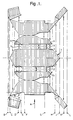
- Figure 1 is a conventional pattern for a seat cover and which would be knitted in a similar manner to a cover described in EP-A-0,361,855.
- a fabric piece for covering a seat base of an automobile seat can be continuously weft- knitted in a single operation.
- the fabric piece is of mainly double jersey structure and is knitted on a flat V-bed knitting machine provided with a conventional presser foot device or other loop hold-down device for holding down the knitted fabric between the opposed needle beds of the machine.
- the fabric piece is knitted from a knitting pattern which is a two dimensional development of a three-dimensional knitted fabric seat cover.
- the direction of knitting, indicated by arrow A is such that the wales of the fabric piece extend in a desired manner across the seat base. This may be dictated by a pattern on the fabric or by other technical considerations.
- the line B-L represents the length of opposed needle beds of the machine on which the piece is knitted.
- the needles operate to form fabric along vertical lines only (that is in wales).
- the knitting begins on a few needles at point D on the needle bed and more needles are brought progressively into action course-by-wale in the direction from D-B and from D-E to begin to define the edges of the material.
- knitting will commence at point K with needles being brought progressively into action from K-H, and from K-L.
- the needles are then made progressively active and/or inactive in order to obtain the required shape of the fabric.
- edges of the fabric between which double-ended arrows are located are knitted together. Taking the two edges indicated by double-headed arrows M and N, for example, this requires that needles made inactive between the point E and C, and H and J respectively, are progressively reactivated to "join" the two edges indicated by M and N along vertical lines.
- Integral open-ended pockets may be formed by knitting areas 2 and 3 on one needle bed only, or alternatively the areas 2 and 3 are utilised by folding along the dotted lines for forming open ended pockets beneath the seat cover for facilitating incorporation of the cover into a seat.
- FIG. 2 there is illustrated a portion 21 of conventional knitting pattern having a pair of edges-to-be-joined 22,23, which preferably have a horizontally equally bisected angle therebetween which is preferably 90 degrees.
- the knitting commences at the set-up course 24 and continues on all needles upto course 25. Needles on the machine are then made progressively inactive course by course from left to right as shown upto the needleline X. This continues upto course 26. After course 26 the needles are then progressively reactivated course by course to the full width of the fabric at course 27. Knitting then continues on all needles upto the finishing course 28.
- the edges 22,23 are joined together along needle lines W, that is along the wales of the fabric.
- FIG 3 The result of this operation is shown in Figure 3.
- the edges 22, 23 are joined through a suture 31 thus shaping the fabric piece.
- the suture 31 is generally visible on both surfaces of the fabric especially if the fabric is a jaquard construction with a regular pattern on its front face.
- the wales 30 in one area 32 are inclined to the wales 34 in the other area 33.
- FIG 4 there is shown a second prior art knitting pattern 41 which is described in detail in EP-A-0,361,854 in which the individual stitches are shown as shaded squares which are arranged in vertical wales and horizontal courses.
- the fabric is a double jersey fabric knitted in a similar manner to that shown in Figure 2.
- Knitting commences at the set-up course 40.
- the pattern 41 discloses edges 42,43 to be knitted together and which comprise steps of two stitches by course and by wale. This is achieved by inactivating and reactivating needles in pairs after two courses of knitting.
- the main difference from Figure 2 is the provision of a two-course wide strip 45, which may be double or single jersey knitting, located at a horizontal course-line that bisects the angle a between the edges 42,43.
- the edges 42,43 on each side of the strip 45 each comprise ten rows of two courses per row which are knitted across 18 wales.
- the strip 45 also extends over 18 wales and each edge 42,43 is knitted to the strip 45 during the knitting process as indicated by the double headed arrows.
- the strip 45 helps reduce the size of holes or apertures that may occur along a suture line.
- the strip 45 is generally more useful where the bisected angle a exceeds 90 degrees.
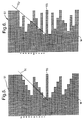
- Knitting patterns 51,61 are shown in Figures 5 & 6. Each pattern 51,61 will after the knitting process produce a fabric of the same shape as the fabric shown in Figure 4 but with no substantially visible suture.
- the invention is more easily understood with reference back to the prior art pattern 41 shown in Figure 4.
- the two edges 42,43 are "formed” by knitting on each side of the strip 45 ten rows of two courses per row.
- the ten rows each comprise two courses of the same length.
- the rows are labelled 1-10 and are of progressively changing lengths. Since the edge 42 is a mirror image of the edge 43 only the rows above the strip 45 are labelled.
- the present invention lies in the realisation that the areas of fabric surrounding the edges 42,43 can be linked together by mixing the courses so that they no longer progressively increase in coursewise length in a wale by wale.
- the pattern 61 has features in common with the pattern 41.
- the coursewise strip 65 is equivalent to the strip 45 and there are ten course-wise repeat units labelled 1 -10 above and below the strip 65 which are arranged in mirror image to each other so only the rows above strip 65 will be described in detail.
- the repeat units 1-10 are randomly mixed to obtain the structure in Figure 6.
- Figure 6 is, of course, only one example of a random mixing of the repeat units.
- Each repeat unit is represented by two face courses, with individual stitches shown as black squares.
- Each course represents one direction of traverse of the cam box of a knitting machine with the cam box having two, three, or four knitting systems.
- the repeat units are arranged in sets such that the repeat units in each set increase in length outwardly of the strip 55.
- the repeat units 1 to 10 are arranged in two sets of five. Mixing rates of five or seven repeat units per set are preferred. Mixing rates of three do not sufficiently break-up any suture, and rates of four or six can lead to phasing of any design knitted into the front face of the fabric. A mixing rate of five is preferred to seven since the larger number is more difficult to handle.
- the repeat units are divided into groups where the number of groups is equal to the mixing rate, and the number of repeat units in each group is given by N/X, where N is the number of repeat units constituting one half of the suture, and X is the selected mixing rate.
- N is the number of repeat units constituting one half of the suture
- X is the selected mixing rate.
- the repeat units assigned to a particular set are determined in an ordered manner.
- the first set comprise rows 1,3,5,7,9 from the five groups, and the second set comprises rows 2,4,6,8,10 from the five groups.
- each of six repeat units that is 1-6, 7-12, 13-18, 19-24, 25-30.
- the repeat units are then assigned to the six sets so that set 1 nearest the strip 55 comprises the first repeat units from each group i.e. 1,7,13,19,25 and set 2 , the next outer set, comprised the second repeat units from the groups i.e. 2,8,14,20,26 .
- This progression continues with the set z being assigned the zth repeat unit from each group, until all the rows have been assigned to the six sets.
- This method joins together areas to shape the fabric cover without forming distinctive suture lines.
- the cover is more homogeneous and is more deformable since suture lines create areas of stiffness.
- the patterns 51 and 61 are arranged so that a straight line S1 or S2 on each side of the strip 55 or 65, drawn from the innermost point on repeat unit 1, adjacent the strip, to the outermost point on the tenth repeat unit, furthest from the strip, divides the edge portion so that the area of pattern to the outside of the line S1 is substantially equal to the area of space inwardly of the line to the edges of the pattern.
Landscapes
- Engineering & Computer Science (AREA)
- Textile Engineering (AREA)
- Knitting Of Fabric (AREA)
- Knitting Machines (AREA)
- Forms Removed On Construction Sites Or Auxiliary Members Thereof (AREA)
Applications Claiming Priority (2)
| Application Number | Priority Date | Filing Date | Title |
|---|---|---|---|
| GB9711297A GB2325941B (en) | 1997-06-03 | 1997-06-03 | A knitted cover |
| GB9711297 | 1997-06-03 |
Publications (3)
| Publication Number | Publication Date |
|---|---|
| EP0882825A2 true EP0882825A2 (fr) | 1998-12-09 |
| EP0882825A3 EP0882825A3 (fr) | 1999-12-08 |
| EP0882825B1 EP0882825B1 (fr) | 2003-08-06 |
Family
ID=10813389
Family Applications (1)
| Application Number | Title | Priority Date | Filing Date |
|---|---|---|---|
| EP98201540A Expired - Lifetime EP0882825B1 (fr) | 1997-06-03 | 1998-05-08 | Housse tricotée |
Country Status (9)
| Country | Link |
|---|---|
| US (1) | US6134923A (fr) |
| EP (1) | EP0882825B1 (fr) |
| JP (1) | JP2863754B2 (fr) |
| KR (1) | KR19990006663A (fr) |
| AU (1) | AU702652B2 (fr) |
| BR (1) | BR9801706A (fr) |
| CA (1) | CA2239631C (fr) |
| DE (1) | DE69816910T2 (fr) |
| GB (1) | GB2325941B (fr) |
Cited By (1)
| Publication number | Priority date | Publication date | Assignee | Title |
|---|---|---|---|---|
| EP1020554B2 (fr) † | 1999-01-16 | 2009-07-22 | H. Stoll GmbH & Co. | Dispositif de conception d'articles à mailles produits dans des machines à tricoter |
Families Citing this family (4)
| Publication number | Priority date | Publication date | Assignee | Title |
|---|---|---|---|---|
| DE19855540A1 (de) * | 1998-12-01 | 2000-08-17 | Keiper Recaro Gmbh Co | Zusatzfunktionselemente |
| ES2969100T3 (es) | 2011-02-02 | 2024-05-16 | Syntorr Inc | Hilo y sutura de denier variable |
| US11116498B2 (en) | 2011-02-02 | 2021-09-14 | Syntorr Inc. | Variable denier yarn and suture |
| US10762595B2 (en) | 2017-11-08 | 2020-09-01 | Steelcase, Inc. | Designated region projection printing of spatial pattern for 3D object on flat sheet in determined orientation |
Family Cites Families (10)
| Publication number | Priority date | Publication date | Assignee | Title |
|---|---|---|---|---|
| GB1069812A (en) * | 1963-05-08 | 1967-05-24 | Giuseppe Benvenuti | Process and arrangement for forming pockets in knitted fabrics on circular knitting machines |
| CS250992B1 (en) * | 1985-12-19 | 1987-05-14 | Bohumil Kejnovsky | Production process of the return heel and apparatus to perform this method |
| GB8822638D0 (en) * | 1988-09-27 | 1988-11-02 | Gen Motors Corp | Knitting method |
| US5326150A (en) * | 1988-09-22 | 1994-07-05 | General Motors Corporation | Upholstery fabric |
| GB8822639D0 (en) * | 1988-09-27 | 1988-11-02 | Gen Motors Corp | Knitting method |
| DE4140282A1 (de) * | 1991-12-06 | 1993-06-09 | H. Stoll Gmbh & Co, 7410 Reutlingen, De | Verfahren zum formstricken von intarsien-jacquardware |
| GB9422674D0 (en) * | 1994-11-10 | 1995-01-04 | Gen Motors Corp | Knitting method |
| GB2297562B (en) * | 1995-02-01 | 1998-07-01 | Gen Motors Corp | Knitting method |
| DE19616003A1 (de) * | 1996-04-18 | 1997-10-23 | Beckmann Wolfgang Dr | Spickeln/Zunehmen/Mindern |
| US5887452A (en) * | 1996-08-29 | 1999-03-30 | Lear Corporation | Knitted cover |
-
1997
- 1997-06-03 GB GB9711297A patent/GB2325941B/en not_active Expired - Fee Related
-
1998
- 1998-05-08 EP EP98201540A patent/EP0882825B1/fr not_active Expired - Lifetime
- 1998-05-08 DE DE69816910T patent/DE69816910T2/de not_active Expired - Lifetime
- 1998-05-13 AU AU64886/98A patent/AU702652B2/en not_active Ceased
- 1998-05-27 BR BR9801706-3A patent/BR9801706A/pt active Search and Examination
- 1998-05-28 US US09/086,222 patent/US6134923A/en not_active Expired - Lifetime
- 1998-06-01 CA CA002239631A patent/CA2239631C/fr not_active Expired - Fee Related
- 1998-06-03 JP JP10154805A patent/JP2863754B2/ja not_active Expired - Fee Related
- 1998-06-03 KR KR1019980020676A patent/KR19990006663A/ko not_active Abandoned
Cited By (1)
| Publication number | Priority date | Publication date | Assignee | Title |
|---|---|---|---|---|
| EP1020554B2 (fr) † | 1999-01-16 | 2009-07-22 | H. Stoll GmbH & Co. | Dispositif de conception d'articles à mailles produits dans des machines à tricoter |
Also Published As
| Publication number | Publication date |
|---|---|
| US6134923A (en) | 2000-10-24 |
| GB2325941A (en) | 1998-12-09 |
| EP0882825B1 (fr) | 2003-08-06 |
| BR9801706A (pt) | 1999-11-03 |
| AU6488698A (en) | 1998-12-10 |
| CA2239631A1 (fr) | 1998-12-03 |
| JP2863754B2 (ja) | 1999-03-03 |
| AU702652B2 (en) | 1999-02-25 |
| GB2325941B (en) | 2001-08-22 |
| JPH10331058A (ja) | 1998-12-15 |
| CA2239631C (fr) | 2002-01-15 |
| GB9711297D0 (en) | 1997-07-30 |
| DE69816910D1 (de) | 2003-09-11 |
| KR19990006663A (ko) | 1999-01-25 |
| DE69816910T2 (de) | 2004-07-15 |
| EP0882825A3 (fr) | 1999-12-08 |
Similar Documents
| Publication | Publication Date | Title |
|---|---|---|
| US5284031A (en) | Knit ply fabric with connecting layer | |
| US6233976B1 (en) | Shaping/augmenting/diminishing knitted fabrics | |
| EP0833001B1 (fr) | Couverture tricotée | |
| JP3744797B2 (ja) | 編地およびその編成方法 | |
| EP0725173B1 (fr) | Procédé de tricotage | |
| JPWO2000063475A1 (ja) | 編地およびその編成方法 | |
| EP0361854B1 (fr) | Procédé de tricotage | |
| JP2958697B2 (ja) | 編物を製造する方法 | |
| US5749247A (en) | Knitted cover and a knitting method | |
| EP0882825B1 (fr) | Housse tricotée | |
| JPH10259553A (ja) | 横編機上で編物を製造する方法 | |
| US6257024B1 (en) | Process for joining several knitted fabrics on a flatbed knitting machine | |
| JP2638414B2 (ja) | 椅子張り布帛 | |
| EP0921222B1 (fr) | Procédé pour obtenir des augmentations dans un tricot à côtes et tricot à côtes comportant des augmentations obtenues ainsi | |
| MXPA98004136A (en) | A cover tej | |
| JP2670665B2 (ja) | リブ編み方法 | |
| JPS584106B2 (ja) | 二面式パイル地の編成方法 | |
| CN1203967A (zh) | 一种针织盖罩 | |
| JP2002146657A (ja) | 形状維持良好な網状立体構造編地 | |
| GB2257441A (en) | Knitting method |
Legal Events
| Date | Code | Title | Description |
|---|---|---|---|
| PUAI | Public reference made under article 153(3) epc to a published international application that has entered the european phase |
Free format text: ORIGINAL CODE: 0009012 |
|
| AK | Designated contracting states |
Kind code of ref document: A2 Designated state(s): BE DE ES FR IT SE |
|
| AX | Request for extension of the european patent |
Free format text: AL;LT;LV;MK;RO;SI |
|
| PUAL | Search report despatched |
Free format text: ORIGINAL CODE: 0009013 |
|
| AK | Designated contracting states |
Kind code of ref document: A3 Designated state(s): AT BE CH CY DE DK ES FI FR GB GR IE IT LI LU MC NL PT SE |
|
| AX | Request for extension of the european patent |
Free format text: AL;LT;LV;MK;RO;SI |
|
| RAP1 | Party data changed (applicant data changed or rights of an application transferred) |
Owner name: LEAR CORPORATION |
|
| 17P | Request for examination filed |
Effective date: 20000519 |
|
| AKX | Designation fees paid |
Free format text: BE DE ES FR IT SE |
|
| GRAH | Despatch of communication of intention to grant a patent |
Free format text: ORIGINAL CODE: EPIDOS IGRA |
|
| GRAH | Despatch of communication of intention to grant a patent |
Free format text: ORIGINAL CODE: EPIDOS IGRA |
|
| GRAA | (expected) grant |
Free format text: ORIGINAL CODE: 0009210 |
|
| AK | Designated contracting states |
Designated state(s): BE DE ES FR IT SE |
|
| PG25 | Lapsed in a contracting state [announced via postgrant information from national office to epo] |
Ref country code: IT Free format text: LAPSE BECAUSE OF FAILURE TO SUBMIT A TRANSLATION OF THE DESCRIPTION OR TO PAY THE FEE WITHIN THE PRESCRIBED TIME-LIMIT;WARNING: LAPSES OF ITALIAN PATENTS WITH EFFECTIVE DATE BEFORE 2007 MAY HAVE OCCURRED AT ANY TIME BEFORE 2007. THE CORRECT EFFECTIVE DATE MAY BE DIFFERENT FROM THE ONE RECORDED. Effective date: 20030806 Ref country code: FR Free format text: LAPSE BECAUSE OF FAILURE TO SUBMIT A TRANSLATION OF THE DESCRIPTION OR TO PAY THE FEE WITHIN THE PRESCRIBED TIME-LIMIT Effective date: 20030806 Ref country code: BE Free format text: LAPSE BECAUSE OF FAILURE TO SUBMIT A TRANSLATION OF THE DESCRIPTION OR TO PAY THE FEE WITHIN THE PRESCRIBED TIME-LIMIT Effective date: 20030806 |
|
| REF | Corresponds to: |
Ref document number: 69816910 Country of ref document: DE Date of ref document: 20030911 Kind code of ref document: P |
|
| PG25 | Lapsed in a contracting state [announced via postgrant information from national office to epo] |
Ref country code: SE Free format text: LAPSE BECAUSE OF FAILURE TO SUBMIT A TRANSLATION OF THE DESCRIPTION OR TO PAY THE FEE WITHIN THE PRESCRIBED TIME-LIMIT Effective date: 20031106 |
|
| PG25 | Lapsed in a contracting state [announced via postgrant information from national office to epo] |
Ref country code: ES Free format text: LAPSE BECAUSE OF FAILURE TO SUBMIT A TRANSLATION OF THE DESCRIPTION OR TO PAY THE FEE WITHIN THE PRESCRIBED TIME-LIMIT Effective date: 20031117 |
|
| PLBE | No opposition filed within time limit |
Free format text: ORIGINAL CODE: 0009261 |
|
| STAA | Information on the status of an ep patent application or granted ep patent |
Free format text: STATUS: NO OPPOSITION FILED WITHIN TIME LIMIT |
|
| 26N | No opposition filed |
Effective date: 20040507 |
|
| EN | Fr: translation not filed | ||
| PGFP | Annual fee paid to national office [announced via postgrant information from national office to epo] |
Ref country code: DE Payment date: 20120529 Year of fee payment: 15 |
|
| PG25 | Lapsed in a contracting state [announced via postgrant information from national office to epo] |
Ref country code: DE Free format text: LAPSE BECAUSE OF NON-PAYMENT OF DUE FEES Effective date: 20131203 |
|
| REG | Reference to a national code |
Ref country code: DE Ref legal event code: R119 Ref document number: 69816910 Country of ref document: DE Effective date: 20131203 |