EP0883256A1 - Soliton faseroptisches Wellenlängenmultiplexiertes Übertragungssystem mit sättigbarem Absorber - Google Patents
Soliton faseroptisches Wellenlängenmultiplexiertes Übertragungssystem mit sättigbarem Absorber Download PDFInfo
- Publication number
- EP0883256A1 EP0883256A1 EP98401334A EP98401334A EP0883256A1 EP 0883256 A1 EP0883256 A1 EP 0883256A1 EP 98401334 A EP98401334 A EP 98401334A EP 98401334 A EP98401334 A EP 98401334A EP 0883256 A1 EP0883256 A1 EP 0883256A1
- Authority
- EP
- European Patent Office
- Prior art keywords
- clock
- saturable
- transmission system
- multiplex
- transmission
- Prior art date
- Legal status (The legal status is an assumption and is not a legal conclusion. Google has not performed a legal analysis and makes no representation as to the accuracy of the status listed.)
- Granted
Links
- 230000005540 biological transmission Effects 0.000 title claims abstract description 65
- 239000006096 absorbing agent Substances 0.000 title claims description 11
- 239000013307 optical fiber Substances 0.000 title description 3
- 230000002745 absorbent Effects 0.000 claims abstract description 53
- 239000002250 absorbent Substances 0.000 claims abstract description 53
- 230000001360 synchronised effect Effects 0.000 claims abstract description 21
- 230000003595 spectral effect Effects 0.000 claims abstract description 10
- 238000000034 method Methods 0.000 claims description 22
- 239000000835 fiber Substances 0.000 claims description 21
- 230000008929 regeneration Effects 0.000 claims description 10
- 238000011069 regeneration method Methods 0.000 claims description 10
- 239000004065 semiconductor Substances 0.000 claims description 10
- 238000011084 recovery Methods 0.000 claims description 9
- 230000000737 periodic effect Effects 0.000 claims description 8
- 230000003287 optical effect Effects 0.000 claims description 7
- 229920006395 saturated elastomer Polymers 0.000 abstract 1
- 239000006185 dispersion Substances 0.000 description 6
- 230000000694 effects Effects 0.000 description 6
- 238000001914 filtration Methods 0.000 description 4
- 238000012935 Averaging Methods 0.000 description 3
- 230000003993 interaction Effects 0.000 description 3
- 239000000463 material Substances 0.000 description 3
- 238000013459 approach Methods 0.000 description 2
- 230000002123 temporal effect Effects 0.000 description 2
- 229910052691 Erbium Inorganic materials 0.000 description 1
- 230000005374 Kerr effect Effects 0.000 description 1
- 238000001069 Raman spectroscopy Methods 0.000 description 1
- 230000002159 abnormal effect Effects 0.000 description 1
- 238000000862 absorption spectrum Methods 0.000 description 1
- 230000001154 acute effect Effects 0.000 description 1
- 230000003321 amplification Effects 0.000 description 1
- 238000010586 diagram Methods 0.000 description 1
- 238000009792 diffusion process Methods 0.000 description 1
- 238000005516 engineering process Methods 0.000 description 1
- UYAHIZSMUZPPFV-UHFFFAOYSA-N erbium Chemical compound [Er] UYAHIZSMUZPPFV-UHFFFAOYSA-N 0.000 description 1
- 238000004519 manufacturing process Methods 0.000 description 1
- 238000003199 nucleic acid amplification method Methods 0.000 description 1
- 230000010287 polarization Effects 0.000 description 1
- 238000009738 saturating Methods 0.000 description 1
- 230000008054 signal transmission Effects 0.000 description 1
- 238000004088 simulation Methods 0.000 description 1
- 230000007704 transition Effects 0.000 description 1
Images
Classifications
-
- H—ELECTRICITY
- H04—ELECTRIC COMMUNICATION TECHNIQUE
- H04B—TRANSMISSION
- H04B10/00—Transmission systems employing electromagnetic waves other than radio-waves, e.g. infrared, visible or ultraviolet light, or employing corpuscular radiation, e.g. quantum communication
- H04B10/25—Arrangements specific to fibre transmission
- H04B10/2507—Arrangements specific to fibre transmission for the reduction or elimination of distortion or dispersion
- H04B10/25077—Arrangements specific to fibre transmission for the reduction or elimination of distortion or dispersion using soliton propagation
-
- H—ELECTRICITY
- H04—ELECTRIC COMMUNICATION TECHNIQUE
- H04J—MULTIPLEX COMMUNICATION
- H04J14/00—Optical multiplex systems
- H04J14/02—Wavelength-division multiplex systems
Definitions
- the present invention relates to a fiber optic transmission system with soliton and wavelength multiplex signals, in which the different wavelengths of the multiplex are chosen so as to ensure, over an interval given, a relative slip between the different channels substantially equal to one multiple of bit time.
- It also relates to a transmission method in such a system.
- soliton or soliton pulses in the part of an optical fiber with abnormal dispersion is a known phenomenon.
- Solitons are pulse signals of sech 2 form. With this pulse shape, the non-linearity in the corresponding part of the fiber compensates for the dispersion of the optical signal.
- the transmission of solitons is modeled in a known manner by the non-linear Schrödinger equation.
- soliton signal optics it has also been proposed to use a multiplexing of wavelength (in English "wavelength division multiplexing" or WDM).
- WDM wavelength division multiplexing
- sliding guiding filters of the type Fabry Perot which are fully compatible with multiplexed signals in wave length.
- the use of synchronous modulators or of saturable absorbents for the regeneration of soliton signals multiplexed into wavelength is problematic, due to the difference in group speed between signals from different channels.
- the present invention provides an original and simple solution to the problem of the modulation of soliton signals multiplexed in wavelength. She permits avoid the disadvantages mentioned above of modulation devices synchronous.
- the invention proposes a fiber optic transmission system with soliton signals and wavelength multiplexing, in which the bit times of the different channels ( ⁇ 1 to ⁇ n ) of the multiplex are substantially synchronous in at least one point, which is characterized by at least one saturable absorbent disposed at said point.
- the useful spectral window of the saturable absorbent covers the different channels of the multiplex.
- the response time of the saturable absorbent is less than a small fraction of the bit time, preferably less than 10% of the bit time.
- the different wavelengths of the channels of the multiplex are chosen so as to ensure, over a given interval Z R , a relative slip between the different channels substantially equal to a multiple of the time bit 1 / B, the system comprising at least two saturable absorbents separated by a distance multiple of said interval Z R.
- the difference ⁇ i between the slip per unit of length on the channel i and on the first channel advantageously satisfies the relation (k i .T - T / 4) ⁇ i .Z R ⁇ (k i .T + T / 4) with k i an integer depending on the channel, and T the bit time.
- the system includes means for synchronization with optical delay lines, compensating for differences between times group associated with the different channels, so as to ensure the synchronicity of channels at least at said point.
- Means of emission or recovery can be provided in the system of transmission of a clock, the power of the clock being chosen so as to ensure complete or almost complete saturation of said saturable absorbent during the clock pulses.
- This clock is advantageously formed by a periodic series of solitons each having a time width of between 0.20 and 0.33 times the period of the signal.
- the saturable absorber may include a gain amplifier. saturable, preferably a semiconductor amplifier.
- the system can also present means of emission or recovery in the transmission system of a black clock, the power of the clock being chosen so as to ensure complete or almost complete saturation of the gain the amplifier outside the clock pulses.
- This black clock is advantageously formed of a periodic series of black solitons each having a time width between 0.20 and 0.33 times the signal period.
- the invention also proposes a transmission method in a fiber optic system with soliton signals and wavelength multiplexing, in which the bit times of the different channels ( ⁇ 1 to ⁇ n ) of the multiplex are substantially synchronous in at least a point, characterized by at least one step of synchronous modulation of the signals of the channels of the multiplex using a saturable absorber disposed at said point.
- the useful spectral window of the saturable absorbent covers the different channels of the multiplex.
- the response time of the saturable absorbent may be less than a small fraction of bit time, preferably less than 10% of bit time.
- the different wavelengths of the channels of the multiplex are chosen so as to ensure, over a given interval Z R , a relative slip between the different channels substantially equal to a multiple of the time bit 1 / B, and the method comprises at least regeneration steps using saturable absorbents separated by a distance multiple of said interval Z R.
- the difference ⁇ i between the slip per unit of length on channel i and on the first channel preferably satisfies the relation (k i .T - T / 4) ⁇ i .Z R ⁇ (k i .T + T / 4) with k i an integer depending on the channel, and T the bit time.
- the method comprises at least one step of synchronization of the bit times of the various channels of the multiplex, by means synchronization with optical delay lines, compensating for the differences between the group times associated with the different channels.
- the method also preferably comprises the emission or the recovery in the clock transmission system, the power of the clock being chosen from so as to ensure complete or almost complete saturation of said saturable absorbent during the clock pulses.
- the clock can be formed of a periodic series of solitons each having a time width of between 0.20 and 0.33 times the period signal
- the saturable absorbent comprises a gain amplifier saturable, preferably a semiconductor amplifier.
- the method advantageously comprises the emission or the recovery in the transmission system of a black clock, the power of the clock being chosen so as to ensure complete or almost complete saturation the gain of the amplifier outside the clock pulses.
- the black clock is preferably formed of a periodic series of solitons blacks each having a time width of between 0.20 and 0.33 times the signal period.
- the invention proposes to use saturable absorbents for a fiber optic transmission with soliton signals and wavelength multiplexing, in which the soliton channels are synchronized at at least one point, and preferably are synchronized at regular intervals; for that, we can use the wavelength or delay line allocation solutions described above. More generally, one can use any solution ensuring synchronization of the modulation point channels.
- the saturable absorber can ensure the regeneration of the signals of the different channels, without the need to provide demultiplexing. Since the flow rate of a channel is lower than the flow rate of the bond, the problem of the response time of the saturable absorbent no longer arises so acute.
- the response time is simply advantageously less than a small fraction, for example 10%, of the bit time of the signal.
- a wavelength allocation scheme ensuring, at regular intervals Z R along the fiber, a relative sliding between the different channels substantially equal to a multiple of the time bit.
- This can be expressed, for each channel, by the formula: (k i .T - T / 4) ⁇ i .Z R ⁇ (k i .T + T / 4) where T is the bit time, k i an integer depending on the channel, and ⁇ i the sliding of the channel i with respect to channel 1.
- This formula translates the fact that at intervals Z R , the shifts between the different channels caused by the slip are, to a quarter of bit time, integer multiples of bit time. An exact or almost exact coincidence of the bit times with an interval of Z R is thus ensured, insofar as the bit times coincide exactly or almost exactly on transmission.
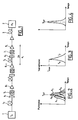
- FIG. 1 shows a first embodiment of the invention, in the case where saturable absorbents are used for the optical modulation, for example based on semiconductor materials or on highly non-linear fiber.
- the different wavelengths are chosen according to a frequency allocation scheme ensuring, for a given interval Z R , a relative slip between the different channels substantially equal to a multiple of the bit time.
- Each section 4 i comprises a length of fiber 5 i , the outlet of which is connected to a saturable absorbent 6 i ; the output of the saturable absorbent constitutes the input of a filter 7 i , the output of which is connected to an amplifier 8 i ; the output of the amplifier is connected to fiber 5 i + 1 of the following section, or for section n, to fiber 3.
- the length of a section preferably corresponds to the interval Z R , so that it can modulate at the end of each section, if necessary.
- the saturable absorbent can be chosen from a variety of components: guide or free optics, semiconductor materials, for example quantum wells, or highly nonlinear cell or fiber in transmission.
- Such saturable absorbents advantageously have a spectral window useful of several nanometers, so as to be able to cover the different channels with a wavelength multiplex.
- the amplifier can be an amplifier of any known type, and for example a doped fiber amplifier, such as an Erbium doped fiber amplifier (acronym EFDA in English).
- a doped fiber amplifier such as an Erbium doped fiber amplifier (acronym EFDA in English).
- each interval Z R ie in the case of FIG. 1, for each section. It is clear that this is not compulsory. We can also vary the relative position of the amplifier 8 i , the saturable absorbent 6 i and the filter 7 i , as will be apparent to those skilled in the art. You can also vary the number of amplifiers, ie do not have an amplifier on each section, or provide more than one per section. Likewise, the number and position of filters and / or saturable absorbents can be varied, depending on the nature of the connection.
- FIG. 2 schematically shows the power as a function of time of the different soliton signals on four channels ⁇ 1 to ⁇ 4 , on arrival on a saturable absorbent.
- the different signals respectively have a relative time offset, and do not arrive at exactly the same time on the saturable absorbent, due to the part of the jitter affecting the different impulses solitons, and on the other hand the game on the constraint of synchronicity of the different channels.
- FIG. 3 shows the response in transmission of a saturable absorbent, receiving the different soliton signals of figure 2, with the ordinate the transmission and abscissa time.
- the saturable absorbent is chosen so that present a useful spectral window covering the different wavelengths of the multiplex
- FIG. 4 shows the effect on the soliton pulses of FIG. 2 of the transition to through the saturable absorbent of FIG. 3.
- the response of the saturable absorber represents a non-linear averaging of all pulses present in each of the channels, at different wavelengths.
- the averaging is nonlinear in that it depends on the sum of all powers incidental.
- This averaging effect induces an envelope in the saturable absorbent of modulation substantially centered on bit time, the jitter of which is substantially lower than that of the channels, due to the random or quasi-random distribution of the jitter on the different channels.
- the intensity modulation induced by the absorbent saturable on each channel produces on each channel a temporal refocusing of soliton impulses.
- the loss of power produced by non-synchronicity random, i.e. by jitter can be compensated for by tight filtering or guiding soliton impulses, due to the intrinsic properties of solitons, by a well-known feedback.
- the filtering can be a guiding filtering, in particular in the case of a system with compensated dispersion slope, insofar as the dispersion is constant and the Synchronicity of the different channels is preserved when the comb filter is shifted.
- the assembly of FIG. 1 thus ensures the regeneration of the soliton signals of the different channels, simultaneously, thanks to saturable absorbents.
- one uses for the control of saturable absorbent an impulse clock whose carrier is in outside the band occupied by the multiplex signals, but in the window useful spectral of the absorbent.
- an impulse clock whose carrier is in outside the band occupied by the multiplex signals, but in the window useful spectral of the absorbent.
- Such a clock makes it possible for the absorbent to pass, in a window centered on bit time, regardless of the soliton signals received. This is particularly advantageous if the number of channels is small, or if the density of 1 transmitted is limited.
- the peak power of the clock or train of solitons is chosen so as to ensure complete or almost complete saturation of the absorbent saturable during periods centered on the clock pulses.
- any online isolators could be short-circuited using dichroic couplers or other similar devices, similarly to what is practiced for remote amplification, where a fiber annex is used to transport the pump signal to the fiber segment doped located online.
- the invention proposes to use, instead of the saturable absorbers 5 i of FIG. 1, saturable gain amplifiers (AGS), and for example semiconductor amplifiers which have this characteristic.
- AGS saturable gain amplifiers
- semiconductor amplifiers well known per se to those skilled in the art, are independent of the signal polarization, reliable, and furthermore have a fast saturation dynamic (less than a nanosecond). It is thus possible to ensure rapid response from the regenerators, and a high speed on each channel of the multiplex.
- the response of such amplifiers can be controlled, from a terminal or the other, like, by a clock made of black solitons.
- a clock made of black solitons.
- Such a clock is described in the patent application 9612746 mentioned above, and is made up of a series uninterrupted black solitons of width between 0.20 and 0.33 times the time bits.
- Such a black clock has the effect of saturating the gain of the amplifier by outside the periods of reception of soliton impulses, i.e. outside of clock pulses, so as to ensure synchronous intensity modulation of the solitons of the multiplex.
- the use of saturable gain amplifiers and such clock has the advantage that the clock can be transmitted in the fiber part optics with normal dispersion, and therefore outside the spectral window possible for the soliton signals.
- the different embodiments of the invention have the advantage to ensure the synchronous regeneration of the solitons in the transmission system, by using only "passive" type line components, i. e. not ordered by a radio frequency signal, of lower cost and more easily qualifiable for a underwater use.
- the invention avoids the problems associated with local recovery clocks, thanks to the use of a remote clock, or, in the case of saturable absorbents, without clock.
- the invention makes it economically possible to transmission system with a short regeneration step, for example of the order of 100 km, which ensures effective control of the quality of the transmission.
- the present invention is not limited to the examples and methods of realization described and represented, but it is susceptible of numerous variants accessible to those skilled in the art. So even if this is not the embodiment currently preferred, it is clear that other types of clocks than those described more top can be used, such as a clock obtained from soliton signals from one of the different channels, for example by means of clock recovery, like a voltage-controlled local oscillator with a phase lock loop, or any other means known per se.
- the scheme wavelength allocation is in no way limited to the examples described. he it should also be noted that it is possible, with respect to the embodiments described, to add or remove filters or amplifiers, as needed.
- the invention has has been described in the case of a one-way transmission. It applies to the obvious to a two-way transmission.
Landscapes
- Engineering & Computer Science (AREA)
- Computer Networks & Wireless Communication (AREA)
- Signal Processing (AREA)
- Physics & Mathematics (AREA)
- Electromagnetism (AREA)
- Optical Communication System (AREA)
- Lasers (AREA)
Applications Claiming Priority (2)
| Application Number | Priority Date | Filing Date | Title |
|---|---|---|---|
| FR9706969A FR2764451B1 (fr) | 1997-06-05 | 1997-06-05 | Systeme de transmission a fibre optique a signaux solitons, a multiplexage de longueur d'onde et a absorbants saturables |
| FR9706969 | 1997-06-05 |
Publications (2)
| Publication Number | Publication Date |
|---|---|
| EP0883256A1 true EP0883256A1 (de) | 1998-12-09 |
| EP0883256B1 EP0883256B1 (de) | 2000-08-23 |
Family
ID=9507644
Family Applications (1)
| Application Number | Title | Priority Date | Filing Date |
|---|---|---|---|
| EP98401334A Expired - Lifetime EP0883256B1 (de) | 1997-06-05 | 1998-06-04 | Soliton faseroptisches Wellenlängenmultiplexiertes Übertragungssystem mit sättigbarem Absorber |
Country Status (7)
| Country | Link |
|---|---|
| US (1) | US6327061B1 (de) |
| EP (1) | EP0883256B1 (de) |
| JP (1) | JPH1117660A (de) |
| AT (1) | ATE195837T1 (de) |
| CA (1) | CA2239083A1 (de) |
| DE (1) | DE69800267T2 (de) |
| FR (1) | FR2764451B1 (de) |
Families Citing this family (10)
| Publication number | Priority date | Publication date | Assignee | Title |
|---|---|---|---|---|
| US6411408B1 (en) * | 1999-06-10 | 2002-06-25 | The United States Of America As Represented By The Secretary Of The Navy | Apparatus and method for high repetition rate optical communication over long unrepeated spans |
| JP2001036476A (ja) * | 1999-07-16 | 2001-02-09 | Sony Corp | 光通信システム、光送信装置、光受信装置及び光通信方法 |
| FR2799011B1 (fr) * | 1999-09-24 | 2001-12-14 | Cit Alcatel | Regenerateur optique pour signaux rz limitant le bruit dans les "zeros" |
| CA2414951C (en) | 2000-07-10 | 2010-09-21 | Mpb Technologies Inc. | Cascaded pumping system and method for producing distributed raman amplification in optical fiber telecommunication systems |
| FR2854289A1 (fr) * | 2003-04-22 | 2004-10-29 | France Telecom | Dispositif de regeneration optique d'impulsions, installation comprenant un tel dispositif et utilisation de ce dispositif |
| FR2882877A1 (fr) * | 2005-03-02 | 2006-09-08 | France Telecom | Dispositif de regeneration optique d'impulsions,installation comprenant un tel dispositif et utilisation de ce dispositif |
| US20090263079A1 (en) * | 2008-01-08 | 2009-10-22 | Yuval Shapira | Optical routers and logical gates based on the propagation of bragg solitons in non-uniform one-dimensional photonic crystals |
| US8275263B1 (en) * | 2009-06-26 | 2012-09-25 | The Boeing Company | Multiplication of phase deviations |
| US9417103B2 (en) * | 2011-09-20 | 2016-08-16 | Schlumberger Technology Corporation | Multiple spectrum channel, multiple sensor fiber optic monitoring system |
| CN110707526A (zh) * | 2019-09-11 | 2020-01-17 | 长沙思木锐信息技术有限公司 | 一种半导体锁模激光器及锁模激光器调谐设置方法 |
Family Cites Families (12)
| Publication number | Priority date | Publication date | Assignee | Title |
|---|---|---|---|---|
| EP0567693A1 (de) * | 1992-04-27 | 1993-11-03 | BRITISH TELECOMMUNICATIONS public limited company | Optische Taktrückgewinnung |
| AU687426B2 (en) * | 1993-08-10 | 1998-02-26 | Ipg Photonics Corporation | Optical system |
| JP3028906B2 (ja) * | 1994-01-27 | 2000-04-04 | ケイディディ株式会社 | ソリトン光通信システム及びその光送信装置と光受信装置 |
| JP2966294B2 (ja) * | 1994-09-12 | 1999-10-25 | ケイディディ株式会社 | 光伝送システム |
| US5802084A (en) * | 1994-11-14 | 1998-09-01 | The Regents Of The University Of California | Generation of high power optical pulses using flared mode-locked semiconductor lasers and optical amplifiers |
| GB9509938D0 (en) * | 1995-05-17 | 1995-07-12 | British Tech Group | Optical communication systems |
| JP3429942B2 (ja) * | 1995-05-24 | 2003-07-28 | Kddi株式会社 | 短光パルス波形整形装置 |
| US5726787A (en) * | 1995-12-28 | 1998-03-10 | Lucent Technologies Inc. | Apparatus and method for improving signal-to-noise ratio in wavelength division multiplexing soliton transmission systems |
| FR2743964B1 (fr) * | 1996-01-23 | 1998-03-13 | Alcatel Submarcom | Methode et dispositif de regeneration en ligne d'un signal transmis par solitons multiplexes en longueur d'onde via la modulation synchrone et systeme de telecommunications optiques utilisant la methode |
| US6011638A (en) * | 1996-02-12 | 2000-01-04 | Lucent Technologies Inc. | Dispersion tapered optical fibers for use in WDM soliton transmission systems |
| JP3464867B2 (ja) * | 1996-02-23 | 2003-11-10 | Kddi株式会社 | 光送信装置およびこれを適用した波長多重光送信装置および光伝送システム |
| JPH11194374A (ja) * | 1998-01-07 | 1999-07-21 | Kdd | 光処理装置 |
-
1997
- 1997-06-05 FR FR9706969A patent/FR2764451B1/fr not_active Expired - Fee Related
-
1998
- 1998-06-03 US US09/089,378 patent/US6327061B1/en not_active Expired - Fee Related
- 1998-06-04 EP EP98401334A patent/EP0883256B1/de not_active Expired - Lifetime
- 1998-06-04 CA CA002239083A patent/CA2239083A1/fr not_active Abandoned
- 1998-06-04 AT AT98401334T patent/ATE195837T1/de not_active IP Right Cessation
- 1998-06-04 DE DE69800267T patent/DE69800267T2/de not_active Expired - Fee Related
- 1998-06-05 JP JP10158189A patent/JPH1117660A/ja active Pending
Non-Patent Citations (4)
| Title |
|---|
| ATKINSON D ET AL: "INCREASED AMPLIFIER SPACING IN A SOLITON SYSTEM WITH QUANTUM-WELL SATURABLE ABSORBERS AND SPECTRAL FILTERING", OPTICS LETTERS, vol. 19, no. 19, 1 October 1994 (1994-10-01), pages 1514 - 1516, XP000466523 * |
| ESSIAMBRE R -J ET AL: "CONTROL OF SOLITON-SOLITON AND SOLITON-DISPERSIVE WAVE INTERACTIONS IN HIGH BIT-RATE COMMUNICATION SYSTEMS", ELECTRONICS LETTERS, vol. 31, no. 17, 17 August 1995 (1995-08-17), pages 1461 - 1463, XP000528981 * |
| LECLERC O ET AL: "ASSESSMENT OF 80GBIT/S (4X20GBIT/S) REGENERATED WDM SOLITON TRANSOCEANIC TRANSMISSION", ELECTRONICS LETTERS, vol. 32, no. 12, 6 June 1996 (1996-06-06), pages 1118 - 1119, XP000620711 * |
| MASAYUKI MATSUMOTO ET AL: "STABLE SOLITON TRANSMISSION IN THE SYSTEM WITH NONLINEAR GAIN", JOURNAL OF LIGHTWAVE TECHNOLOGY, vol. 13, no. 4, 1 April 1995 (1995-04-01), pages 658 - 665, XP000513582 * |
Also Published As
| Publication number | Publication date |
|---|---|
| US6327061B1 (en) | 2001-12-04 |
| DE69800267T2 (de) | 2001-03-01 |
| FR2764451A1 (fr) | 1998-12-11 |
| JPH1117660A (ja) | 1999-01-22 |
| DE69800267D1 (de) | 2000-09-28 |
| FR2764451B1 (fr) | 1999-07-30 |
| EP0883256B1 (de) | 2000-08-23 |
| ATE195837T1 (de) | 2000-09-15 |
| CA2239083A1 (fr) | 1998-12-05 |
Similar Documents
| Publication | Publication Date | Title |
|---|---|---|
| Willner | Mining the optical bandwidth for a terabit per second | |
| Chikama et al. | Modulation and demodulation techniques in optical heterodyne PSK transmission systems | |
| FR2715524A1 (fr) | Système de communication de type soliton optique ainsi qu'émetteur et récepteur optiques pour ce système. | |
| EP0718992B1 (de) | Vorrichtung zum Inline-Regenerieren eines Solitonsignals durch synchrone Modulation der Solitone mit einem nicht-linearen optischen Spiegel | |
| EP0971494A1 (de) | Quasi-verteilte Verstärkung in einer Soliton-WDM Übertragung | |
| EP1969748B1 (de) | Optische übertragung zwischen einem zentralen endgerät und mehreren client-endgeräten über ein optisches netzwerk | |
| EP0763912B1 (de) | Rein optischer Frequenzverdoppler und dieser verwendender Solitonregenerator | |
| EP0883256B1 (de) | Soliton faseroptisches Wellenlängenmultiplexiertes Übertragungssystem mit sättigbarem Absorber | |
| EP0780723A1 (de) | Steuerbarer Amplitude- und Phasenmodulator und Solitonregenerator mit einem solchen Modulator | |
| FR2719957A1 (fr) | Procédé pour la transmission d'informations codées sous forme binaire par un train de solitons. | |
| CA2319961A1 (fr) | Regenerateur de signaux optiques multiplexes en longueur d'onde | |
| EP0818896A1 (de) | Optisches Datenübertragungssystem im Solitonformat | |
| EP0859482B1 (de) | Optischer Regenerator für Soliton faseroptische WDM Systeme | |
| EP1228589B1 (de) | Faseroptisches übertragungssystem mit optischen rz-pulsen | |
| EP0910185B1 (de) | Soliton und WDM faseroptisches Übertragungssystem | |
| CA2270765A1 (fr) | Systeme de transmission a fibre optique a signaux solitons et a double filtrage | |
| EP0849899B1 (de) | Faseroptisches Übertragungssystem mit normalem Dispersionsmodus | |
| EP0924883A1 (de) | Reduktion von kollisionsinduziertem Zeitjitter in einem Wellenlängenmultiplexsolitonübertragungssystem durch Veränderung der Wellenlängen | |
| EP1001564B1 (de) | Kollisionsausgleichung in einem Soliton-Übertragungssystem | |
| EP0849898A1 (de) | Zwischenverstärker für ein faseroptisches Solitonübertragungssystem | |
| CA2216929A1 (fr) | Signal optique pour un systeme de transmission optique a solitons | |
| EP1224756B1 (de) | Alternierende phasenmodulation für nicht-soliton rz optische übertragung | |
| WO1998041900A1 (fr) | Regeneration optique pour des systemes de transmission a fibre optique a signaux solitons | |
| CA2248883A1 (fr) | Reparation de systemes sous-marins de transmission a fibre optique a signaux solitons et a multiplexage de longueur d'onde | |
| BE431106A (de) |
Legal Events
| Date | Code | Title | Description |
|---|---|---|---|
| PUAI | Public reference made under article 153(3) epc to a published international application that has entered the european phase |
Free format text: ORIGINAL CODE: 0009012 |
|
| AK | Designated contracting states |
Kind code of ref document: A1 Designated state(s): AT BE CH DE ES FR GB IT LI NL SE |
|
| AX | Request for extension of the european patent |
Free format text: AL;LT;LV;MK;RO;SI |
|
| RAP3 | Party data changed (applicant data changed or rights of an application transferred) |
Owner name: ALCATEL |
|
| RAP3 | Party data changed (applicant data changed or rights of an application transferred) |
Owner name: ALCATEL |
|
| 17P | Request for examination filed |
Effective date: 19990609 |
|
| AKX | Designation fees paid |
Free format text: AT BE CH DE ES FR GB IT LI NL SE |
|
| GRAG | Despatch of communication of intention to grant |
Free format text: ORIGINAL CODE: EPIDOS AGRA |
|
| 17Q | First examination report despatched |
Effective date: 19991102 |
|
| GRAG | Despatch of communication of intention to grant |
Free format text: ORIGINAL CODE: EPIDOS AGRA |
|
| GRAH | Despatch of communication of intention to grant a patent |
Free format text: ORIGINAL CODE: EPIDOS IGRA |
|
| GRAH | Despatch of communication of intention to grant a patent |
Free format text: ORIGINAL CODE: EPIDOS IGRA |
|
| GRAA | (expected) grant |
Free format text: ORIGINAL CODE: 0009210 |
|
| AK | Designated contracting states |
Kind code of ref document: B1 Designated state(s): AT BE CH DE ES FR GB IT LI NL SE |
|
| PG25 | Lapsed in a contracting state [announced via postgrant information from national office to epo] |
Ref country code: NL Free format text: LAPSE BECAUSE OF FAILURE TO SUBMIT A TRANSLATION OF THE DESCRIPTION OR TO PAY THE FEE WITHIN THE PRESCRIBED TIME-LIMIT Effective date: 20000823 Ref country code: ES Free format text: THE PATENT HAS BEEN ANNULLED BY A DECISION OF A NATIONAL AUTHORITY Effective date: 20000823 Ref country code: AT Free format text: LAPSE BECAUSE OF FAILURE TO SUBMIT A TRANSLATION OF THE DESCRIPTION OR TO PAY THE FEE WITHIN THE PRESCRIBED TIME-LIMIT Effective date: 20000823 |
|
| REF | Corresponds to: |
Ref document number: 195837 Country of ref document: AT Date of ref document: 20000915 Kind code of ref document: T |
|
| REG | Reference to a national code |
Ref country code: CH Ref legal event code: EP |
|
| REF | Corresponds to: |
Ref document number: 69800267 Country of ref document: DE Date of ref document: 20000928 |
|
| ITF | It: translation for a ep patent filed | ||
| GBT | Gb: translation of ep patent filed (gb section 77(6)(a)/1977) |
Effective date: 20001009 |
|
| PG25 | Lapsed in a contracting state [announced via postgrant information from national office to epo] |
Ref country code: SE Free format text: LAPSE BECAUSE OF FAILURE TO SUBMIT A TRANSLATION OF THE DESCRIPTION OR TO PAY THE FEE WITHIN THE PRESCRIBED TIME-LIMIT Effective date: 20001123 |
|
| NLV1 | Nl: lapsed or annulled due to failure to fulfill the requirements of art. 29p and 29m of the patents act | ||
| PLBE | No opposition filed within time limit |
Free format text: ORIGINAL CODE: 0009261 |
|
| STAA | Information on the status of an ep patent application or granted ep patent |
Free format text: STATUS: NO OPPOSITION FILED WITHIN TIME LIMIT |
|
| PG25 | Lapsed in a contracting state [announced via postgrant information from national office to epo] |
Ref country code: BE Free format text: LAPSE BECAUSE OF NON-PAYMENT OF DUE FEES Effective date: 20010630 |
|
| 26N | No opposition filed | ||
| BERE | Be: lapsed |
Owner name: ALCATEL Effective date: 20010630 |
|
| REG | Reference to a national code |
Ref country code: GB Ref legal event code: IF02 |
|
| PG25 | Lapsed in a contracting state [announced via postgrant information from national office to epo] |
Ref country code: LI Free format text: LAPSE BECAUSE OF NON-PAYMENT OF DUE FEES Effective date: 20020630 Ref country code: CH Free format text: LAPSE BECAUSE OF NON-PAYMENT OF DUE FEES Effective date: 20020630 |
|
| REG | Reference to a national code |
Ref country code: CH Ref legal event code: PL |
|
| PGFP | Annual fee paid to national office [announced via postgrant information from national office to epo] |
Ref country code: GB Payment date: 20040524 Year of fee payment: 7 |
|
| PGFP | Annual fee paid to national office [announced via postgrant information from national office to epo] |
Ref country code: DE Payment date: 20040610 Year of fee payment: 7 |
|
| PGFP | Annual fee paid to national office [announced via postgrant information from national office to epo] |
Ref country code: FR Payment date: 20040617 Year of fee payment: 7 |
|
| PG25 | Lapsed in a contracting state [announced via postgrant information from national office to epo] |
Ref country code: IT Free format text: LAPSE BECAUSE OF NON-PAYMENT OF DUE FEES Effective date: 20050604 Ref country code: GB Free format text: LAPSE BECAUSE OF NON-PAYMENT OF DUE FEES Effective date: 20050604 |
|
| PG25 | Lapsed in a contracting state [announced via postgrant information from national office to epo] |
Ref country code: DE Free format text: LAPSE BECAUSE OF NON-PAYMENT OF DUE FEES Effective date: 20060103 |
|
| PG25 | Lapsed in a contracting state [announced via postgrant information from national office to epo] |
Ref country code: FR Free format text: LAPSE BECAUSE OF NON-PAYMENT OF DUE FEES Effective date: 20060228 |
|
| GBPC | Gb: european patent ceased through non-payment of renewal fee |
Effective date: 20050604 |
|
| REG | Reference to a national code |
Ref country code: FR Ref legal event code: ST Effective date: 20060228 |