EP0883286A2 - Rahmenrelais-Kommunikationsverfahren und Netzwerk für Telefonsignale mit fester Bandbreite und Faksimilesignale mit veränderbarer Bandbreite - Google Patents
Rahmenrelais-Kommunikationsverfahren und Netzwerk für Telefonsignale mit fester Bandbreite und Faksimilesignale mit veränderbarer Bandbreite Download PDFInfo
- Publication number
- EP0883286A2 EP0883286A2 EP98110054A EP98110054A EP0883286A2 EP 0883286 A2 EP0883286 A2 EP 0883286A2 EP 98110054 A EP98110054 A EP 98110054A EP 98110054 A EP98110054 A EP 98110054A EP 0883286 A2 EP0883286 A2 EP 0883286A2
- Authority
- EP
- European Patent Office
- Prior art keywords
- frame
- link
- speed
- bandwidth
- signal
- Prior art date
- Legal status (The legal status is an assumption and is not a legal conclusion. Google has not performed a legal analysis and makes no representation as to the accuracy of the status listed.)
- Withdrawn
Links
Images


Classifications
-
- H—ELECTRICITY
- H04—ELECTRIC COMMUNICATION TECHNIQUE
- H04N—PICTORIAL COMMUNICATION, e.g. TELEVISION
- H04N1/00—Scanning, transmission or reproduction of documents or the like, e.g. facsimile transmission; Details thereof
- H04N1/32—Circuits or arrangements for control or supervision between transmitter and receiver or between image input and image output device, e.g. between a still-image camera and its memory or between a still-image camera and a printer device
- H04N1/333—Mode signalling or mode changing; Handshaking therefor
- H04N1/33353—Mode signalling or mode changing; Handshaking therefor according to the available bandwidth used for a single communication, e.g. the number of ISDN channels used
-
- H—ELECTRICITY
- H04—ELECTRIC COMMUNICATION TECHNIQUE
- H04L—TRANSMISSION OF DIGITAL INFORMATION, e.g. TELEGRAPHIC COMMUNICATION
- H04L12/00—Data switching networks
- H04L12/28—Data switching networks characterised by path configuration, e.g. LAN [Local Area Networks] or WAN [Wide Area Networks]
- H04L12/2854—Wide area networks, e.g. public data networks
-
- H—ELECTRICITY
- H04—ELECTRIC COMMUNICATION TECHNIQUE
- H04N—PICTORIAL COMMUNICATION, e.g. TELEVISION
- H04N1/00—Scanning, transmission or reproduction of documents or the like, e.g. facsimile transmission; Details thereof
- H04N1/00095—Systems or arrangements for the transmission of the picture signal
- H04N1/001—Systems or arrangements for the transmission of the picture signal specially adapted for transmission via digital wireline networks
-
- H—ELECTRICITY
- H04—ELECTRIC COMMUNICATION TECHNIQUE
- H04N—PICTORIAL COMMUNICATION, e.g. TELEVISION
- H04N1/00—Scanning, transmission or reproduction of documents or the like, e.g. facsimile transmission; Details thereof
- H04N1/32—Circuits or arrangements for control or supervision between transmitter and receiver or between image input and image output device, e.g. between a still-image camera and its memory or between a still-image camera and a printer device
- H04N1/333—Mode signalling or mode changing; Handshaking therefor
- H04N1/33307—Mode signalling or mode changing; Handshaking therefor prior to start of transmission, input or output of the picture signal only
- H04N1/33323—Mode signalling or mode changing; Handshaking therefor prior to start of transmission, input or output of the picture signal only transmission mode only, e.g. speed
-
- H—ELECTRICITY
- H04—ELECTRIC COMMUNICATION TECHNIQUE
- H04N—PICTORIAL COMMUNICATION, e.g. TELEVISION
- H04N2201/00—Indexing scheme relating to scanning, transmission or reproduction of documents or the like, and to details thereof
- H04N2201/32—Circuits or arrangements for control or supervision between transmitter and receiver or between image input and image output device, e.g. between a still-image camera and its memory or between a still-image camera and a printer device
- H04N2201/333—Mode signalling or mode changing; Handshaking therefor
- H04N2201/33307—Mode signalling or mode changing; Handshaking therefor of a particular mode
- H04N2201/33342—Mode signalling or mode changing; Handshaking therefor of a particular mode of transmission mode
- H04N2201/3335—Speed or rate
Definitions
- the present invention relates generally to communications networks, and more specifically to a telephone and facsimile communication network using the frame relay format.
- Japanese Laid-Open Patent Specification Hei-6-105115 discloses a communications network in which signals from subscriber telephones are assembled at the transmit end of a communication link into 53-byte ATM cells for transmission and disassembled at the receive end into the original format.
- signals from fax terminals are not assembled into the ATM cell format. Instead, they are segmented into blocks of predetermined length and time-division multiplexed with the ATM cells of telephone signals and transmitted.
- the transmitted signals are demultiplexed from each other to recover the original telephone signals and fax data.
- the source frame relay unit determines, in response to a signaling message from a source terminal, whether a communication link between the terminals has a bandwidth sufficient to transmit a sound signal at a predetermined speed in a frame-relay format, and forwards the signaling message to the destination frame relay unit to establish a connection between the source terminal and a destination terminal if the link has a bandwidth sufficient to transmit the sound signal, so that a preamble tone signal is sent from the destination terminal to the source terminal.
- the source frame relay unit returns a busy tone signal to the source terminal if the link has a bandwidth insufficient to transmit the sound signal.
- the destination frame relay unit determines whether the link has a remaining bandwidth sufficient to support the difference between the predetermined speed of the sound signal and a speed requested by the preamble tone signal in order to transmit facsimile signals in the frame-relay format. If the link is capable of supporting the difference speed, the source and destination terminals are allowed to exchange facsimile signals at the requested speed. Otherwise, the source and destination terminals are controlled to exchange facsimile signals at a speed lower than the requested speed.
- the present invention provides a communication network comprising a first frame assembler/disassembler for providing frame assembly and disassembly according to frame-relay format, a first voice-band compander connected between a first telephone switching system and the first frame assembler/disassembler, a first fax transceiver connected between the first telephone switching system and the first frame assembler/disassembler, and a first controller.
- the first controller is responsive to a signaling message from the first telephone switching system for determining whether a communication link has a bandwidth sufficient to transmit a compressed signal from the first voice-band compander, forwarding the signaling message to the communication link if the link has the sufficient bandwidth and returning a busy tone signal to the first telephone switching system if the link has not sufficient bandwidth.
- the network further includes a second frame assembler/disassembler connected to the first frame assembler/disassembler via the communication link for providing frame assembly and disassembly according to the frame-relay format, a second voice-band compander connected between a second telephone switching system and the second frame assembler/disassembler, a second fax transceiver connected between the second telephone switching system and the second frame assembler/disassembler, and a second controller.
- the second controller is responsive to the signaling message from the communication link to establish a connection in the second telephone switching system so that an audio signal can be sent between the first and second voice-band companders and responsive to a preamble tone signal from the second telephone switching system for determining whether the link has a remaining bandwidth which can support the difference between the transmission speed of the compressed signal and a speed requested by the preamble tone signal.
- the second controller allows the first and second fax transceivers to exchange facsimile signals at the requested speed if the link can support the difference speed and causes them to exchange facsimile signals at a speed lower than the requested speed if the link cannot support the difference speed.
- the network generally comprises frame relay units 1A and 1B interconnected by a communication link 7.
- Each frame relay system comprises a voice-band compander (compressor/expander) 2, a controller 3 and a facsimile (fax) transceiver 4, all of which are connected to the communication link 7 via a frame assembly/disassembly unit 5.
- a line interface 6 is provided for interfacing its own controller 3 to an associated telephone switching system 8 which serves a fax terminal 10 through a subscriber loop 9. Communication between the switching system 8 and the interface 6 is carried on a 64-kbps PCM digital channel in each direction of transmission.
- a tone signal from a fax terminal 10 is carried on the 64-kbps channel and compressed by the voice-band compander 2 to an 8-kbps digital signal using CS-ACELP (Conjugate Structure Algebraic Code Excited Linear Prediction) coding technique as recommended by the ITU-T Recommendation G. 729.
- Facsimile data signals are also carried on the 64-kbps channel, but supplied to the fax transceiver 4.
- the preamble tone from a destination fax terminal is received by both voice-band compander 2 and fax transceiver 4. Signaling message from a telephone switching system is received by the associated controller 3 as will be described.
- Each frame assembly/disassembly (FRAD) unit 5 formulates a frame according to the frame-relay format and transmits it to the other frame relay unit.
- Each frame comprises a frame-type indicator and payload bits encapsulated between a frame header and a frame footer.
- Three types of frame are used in the system: control frame, tone frame and data frame.
- the frame-type indicator of each frame is used by the frame disassembler at the receive end of communication link 7 to identify the received frame for coupling to one of voice-band compander 2, controller 3 and fax transceiver 4.
- the control frame carries signaling information associated with call setup and clearing procedures to be exchanged between the controllers 1A and 1B. As will be described in detail later, the control frame further carries available bandwidth information when negotiation is performed between the two controllers.
- the payload bits carried by the analog-data frame include tonal signals such as ringback tone, busy tone and preamble tone.
- Voice-band companders 2A and 2B exchange the analog-data frames.
- the fax-data frame is exchanged between fax transceivers 4A and 4B.
- Each of the frame assembly/disassembly (FRAD) units 5A, 5B includes a first buffer for receiving frames from the communication link 7 and a second buffer for receiving signals from the voice-band compander 2, the controller 3 and the fax transceiver 4, and means for identifying each frame in the first buffer for coupling to appropriate one of the associated units 2, 3 and 4 according to their frame type identifiers.
- each FRAD unit farther includes means for inserting each signal in the second buffer into the payload field of a frame and an appropriate frame type indicator into the frame for transmission.
- Each of the voice-band companders 2A, 2B, the controllers 3A, 3B and fax transceivers 4A, 4B extracts the contents of a supplied frame from its payload field and provides segmentation of signals from the line interface into blocks of size corresponding to the payload field of a frame.
- Each fax transceiver when operating as a destination controller, receives a preamble tone from the destination fax terminal, indicating the operating speed of the fax terminal. When this preamble is received, the fax transceiver applies a bandwidth request to the associated controller 3 asking whether the operating speed (bandwidth) is available in the remaining resource of the communication link 7.
- the fax transceiver has a replica of a fax terminal capable of transmitting signals in a standardized signal format to a destination fax terminal in order to function as a proxy of the source fax terminal when the requested bandwidth is nor available and a fallback proeedure is then initiated.
- fax data from each terminal is relayed through the fax transceivers 4A and 4B by inserting in the payload field of a fax frame and transmitted.
- Fax terminal 10A first sends a call request containing a multi-frequency tone signals to the telephone switching system 8A, which responds to it by establishing a connection between the subscriber loop 9A and the interface 6A and transmitting a signaling message to the controller 3A (see also Fig. 1).
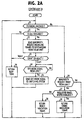
- the operation of the controller 3A begins by looping steps 20 and 25 to detect the arrival of a signaling message from the associated telephone switching system 8A or a bandwidth request frame from the distant frame relay unit 1B for negotiation.
- the controller 3A holds the received signaling message and examines the resource of the communication link 7 as viewed from the frame relay unit 1A and determines whether the 8-kbps band necessary for the transmission of audio signals is available (step 21). If the necessary bandwidth is not available, the controller 3A proceeds to step 29 to return a busy tone to the requesting terminal 10A.
- the controller 3A proceeds to step 22 to formulate a bandwidth request message and a signaling message and forwards them to the frame assembly/disassembly unit 5A so that these messages are placed in the payload fields of respective control frames to produce a bandwidth request frame and a signaling frame. These frames are then transmitted to the frame relay unit 1B, asking it whether the 8-kbps band is also available at the destination side of the link 7.
- controller 3B receives the bandwidth request and signaling frames at step 30 from the link 7, it extracts the messages contained therein and bold the signaling message (Fig. 2B). Controller 3B proceeds to step 31 to determine whether or not the requested 8 kbps is available and returns a reject indication frame to the frame relay unit 1A if the requested resource is not available (step 42). Otherwise, it returns a grant indication frame (step 32).
- the controller 3A checks to see if a grant or reject indication frame is received from the link 7 (step 23). If a reject indication frame is received, the controller 3A applies a reject indication to the voice-band compander 2A. Compander 2A then produces a busy tone signal at 64 kbps and sends it to the telephone switching system 8A. If the source terminal 10A is an analog fax machine, the 64-kbps signal is converted to a corresponding analog signal before being sent to the source terminal 10A. If a grant indication is received, the controller 3A proceeds to step 24.
- the controller 3B forwards the signaling message to the associated telephone switching system 8B via the line interface 6B (step 33).
- Telephone switching system 8B responds to this signaling message by establishing a connection between the interface 6B and the subscriber loop 9B and sends a ringing signal to the fax terminal 10B, while returning a 64-kbps signal of ringback tone toward the source terminal 10A.
- This digital ringback tone signal is received by the voice-band compander 2B, where it is compressed into an 8-kbps signal and assembled by the FRAD unit 5B into a tone frame and transmitted.
- the tone frame is disassembled by the FRAD unit 5A and expanded to the 64-kbps format by the voice-band compander 2A and transmitted via the telephone switching system 8A to the source terminal 10A, so that it hears a ringback tone.
- the fax terminal 10B goes off-hook. This off-hook condition is detected by the switching system 8B. Switching system 8B communicates this off-hook condition to the controller 3B (step 34), which in response sends an off-hook signal to the link 7 (step 35).
- Controller 3A is waiting for an off-hook signal at step 24 after a grant indication frame was received from the frame relay unit 1B at step 23. When this signal is received, it relays it to the switching system 8A to cause it to start a billing operation (step 25) and flow returns to the starting point of the routine.
- a preamble tone is sent from the destination fax terminal 10B to the switching system 8B, which converts this preamble tone to a 64-kbps digital signal and sends it to the voice-band compander 2B as well as to the fax transceiver 4B.
- Voice-band compander 2B compresses the 64-kbps preamble signal to an 8-kbps signal and inserts it into the payload field of a tone frame for transmission to the frame relay unit 1A.
- the tone frame is disassembled by the FRAD unit 5A and expanded to the 64-kbps format by the voice-band compander 2A and transmitted through the telephone switching system 8A to the source terminal 10A, so that it hears the preamble tone.
- Fax transceiver 4B examines the received 64-kbps preamble signal and applies a request to the controller 3B, asking it whether the bandwidth requested by the preamble is available (step 36). If the fax transmission speed requested by the preamble is 14.4 kbps, the controller 3B checks to see if the communication link 7 has an extra bandwidth to support more than 6.4 kbps corresponding to the speed difference between the 8 kbps of tone frames and the 14.4 kbps of data frames.
- the controller 3B examines the resource of the communication link 7 viewed from the frame relay unit 1B and determines whether or not the requested bandwidth is available (step 37). If not, flow proceeds from step 37 to step 39 to instruct the fax transceiver 4B to initiate a fallback procedure by sending to the destination fax terminal 10B a facsimile data signal at a transmission speed which is lower than the speed requested by the preamble. On receiving such a facsimile data signal, the destination fax terminal 10B automatically sets itself to a lower speed (7.2 kbps, for example), recognizing that an error has occurred during transmission, and sends a message at the reduced speed.
- a lower speed 7.2 kbps, for example
- This message is transmitted over the link 7 in a data frame and relayed through the fax transceiver 4A and transmitted to the source terminal 10A, requesting it to transmit its data at the reduced speed.
- the source terminal 10A sets its speed to the speed of the received message and starts sending its fax data at the reduced speed.
- step 37 If the bandwidth requested for the transmission of facsimile data signals is available as viewed from the destination end of the link 7, the controller 3B proceeds from step 37 to step 38 to send a bandwidth request message in a control frame to the frame relay unit 1A, asking whether or not the requested bandwidth is also available at the source end of the communication link 7.
- step 27 the controller 3A examines the resource of the communication link 7 as viewed from the source side and determines whether the requested bandwidth is available. If it is determined that the requested bandwidth is not available, the controller 3A proceeds to step 28 to return a reject indication frame to the destination frame relay unit 1B. Otherwise, the controller 3A proceeds to step 29 to return a grant indication frame.
- step 40 On receiving the reject indication frame at step 39 (Fig. 2B), the controller 3B proceeds to step 40 to instruct the fax transceiver 4B to initiate a fallback procedure as described above. If a grant indication frame is received at step 39, the controller 3B proceeds to step 41 to instruct the fax transceiver 4B to send a preamble tone which is assembled into the payload field of a data frame and transmitted over the link to the fax transceiver 4A. This preamble tone signal is the same as that initially received from the fax terminal 10B. In this case, the fax transceiver 4B functions as a proxy for the fax terminal 10B.
Landscapes
- Engineering & Computer Science (AREA)
- Signal Processing (AREA)
- Multimedia (AREA)
- Computer Networks & Wireless Communication (AREA)
- Facsimiles In General (AREA)
- Data Exchanges In Wide-Area Networks (AREA)
- Telephonic Communication Services (AREA)
- Facsimile Transmission Control (AREA)
- Use Of Switch Circuits For Exchanges And Methods Of Control Of Multiplex Exchanges (AREA)
Applications Claiming Priority (3)
| Application Number | Priority Date | Filing Date | Title |
|---|---|---|---|
| JP145668/97 | 1997-06-04 | ||
| JP14566897A JP3134808B2 (ja) | 1997-06-04 | 1997-06-04 | フレームリレー伝送装置 |
| JP14566897 | 1997-06-04 |
Publications (2)
| Publication Number | Publication Date |
|---|---|
| EP0883286A2 true EP0883286A2 (de) | 1998-12-09 |
| EP0883286A3 EP0883286A3 (de) | 1999-07-28 |
Family
ID=15390331
Family Applications (1)
| Application Number | Title | Priority Date | Filing Date |
|---|---|---|---|
| EP98110054A Withdrawn EP0883286A3 (de) | 1997-06-04 | 1998-06-03 | Rahmenrelais-Kommunikationsverfahren und Netzwerk für Telefonsignale mit fester Bandbreite und Faksimilesignale mit veränderbarer Bandbreite |
Country Status (4)
| Country | Link |
|---|---|
| US (1) | US6359903B1 (de) |
| EP (1) | EP0883286A3 (de) |
| JP (1) | JP3134808B2 (de) |
| CN (1) | CN1201311A (de) |
Families Citing this family (11)
| Publication number | Priority date | Publication date | Assignee | Title |
|---|---|---|---|---|
| US6657965B1 (en) * | 1998-12-15 | 2003-12-02 | Siemens Information & Communication Networks, Inc. | System and method for enhanced routing and reservation protocol |
| US20030084136A1 (en) * | 2001-10-31 | 2003-05-01 | Jayanta Tewari | System and method for device specific identification and management of network devices |
| AU2002239053A1 (en) * | 2002-03-25 | 2003-10-08 | Allied-Telesis, K.K. | Facsimile-communicable voip terminal and communication method thereof |
| JP2005079929A (ja) * | 2003-09-01 | 2005-03-24 | Canon Inc | 通信装置、通信装置の制御方法、および通信装置の制御プログラム |
| CN101009700A (zh) * | 2006-01-27 | 2007-08-01 | 华为技术有限公司 | 在网络中识别用户状态的方法及应用及装置 |
| JP2008072264A (ja) * | 2006-09-13 | 2008-03-27 | Nec Corp | 呼接続システム、端末装置及びそれらに用いる呼接続方法並びにそのプログラム |
| JP4322905B2 (ja) * | 2006-09-25 | 2009-09-02 | Necアクセステクニカ株式会社 | 通信端末装置及びファクシミリ通信方法 |
| US20080205430A1 (en) * | 2007-02-22 | 2008-08-28 | Junichiro Matsui | Bandwidth control apparatus, bandwidth control system, and bandwidth control method |
| WO2009003392A1 (fr) * | 2007-07-02 | 2009-01-08 | Huawei Technologies Co., Ltd. | Procédé de demande de largeur de bande et station relais |
| CN101695102B (zh) * | 2009-09-21 | 2011-12-21 | 华为终端有限公司 | 一种传真的方法和无线网关 |
| JP5379625B2 (ja) | 2009-09-25 | 2013-12-25 | パナソニック株式会社 | 電動工具 |
Family Cites Families (15)
| Publication number | Priority date | Publication date | Assignee | Title |
|---|---|---|---|---|
| JPS5961336A (ja) | 1982-09-30 | 1984-04-07 | Fujitsu Ltd | 網輻「そう」規制方式 |
| JP2528824B2 (ja) * | 1985-12-18 | 1996-08-28 | 株式会社日立製作所 | 音声・デ―タ複合通信方法 |
| JPS631238A (ja) * | 1986-06-20 | 1988-01-06 | Hitachi Denshi Ltd | デイジタル伝送方式 |
| US5351134A (en) * | 1988-04-07 | 1994-09-27 | Canon Kabushiki Kaisha | Image communication system, and image communication apparatus and modem used in the system |
| CA2022584C (en) * | 1989-08-07 | 1995-03-28 | Sadaaki Shimonaga | Facsimile apparatus and facsimile transmission method for digital communication network |
| US5025469A (en) * | 1990-02-06 | 1991-06-18 | Bingham John A C | Method and apparatus for reducing the turn-around time in facsimile transmission |
| JPH04117067A (ja) * | 1990-06-11 | 1992-04-17 | Fujitsu Ltd | ファクシミリ装置 |
| WO1994009595A1 (en) * | 1991-09-20 | 1994-04-28 | Shaw Venson M | Method and apparatus including system architecture for multimedia communications |
| JPH06105115A (ja) | 1992-09-18 | 1994-04-15 | Fujitsu Ltd | ファクシミリデータ伝送方式 |
| US5448698A (en) * | 1993-04-05 | 1995-09-05 | Hewlett-Packard Company | Inter-processor communication system in which messages are stored at locations specified by the sender |
| JPH07245692A (ja) | 1994-03-03 | 1995-09-19 | Fuji Xerox Co Ltd | 通信アダプタ装置 |
| JPH08293885A (ja) | 1995-04-19 | 1996-11-05 | Fujitsu Ltd | フレームリレー網における認定情報速度の決定システム |
| JPH08331171A (ja) | 1995-05-29 | 1996-12-13 | Hitachi Ltd | 帯域割当て制御方法 |
| US6128293A (en) * | 1995-12-20 | 2000-10-03 | Nortel Networks Corporation | Multiservice access management system |
| US6111870A (en) * | 1996-11-07 | 2000-08-29 | Interdigital Technology Corporation | Method and apparatus for compressing and transmitting high speed data |
-
1997
- 1997-06-04 JP JP14566897A patent/JP3134808B2/ja not_active Expired - Fee Related
-
1998
- 1998-06-03 EP EP98110054A patent/EP0883286A3/de not_active Withdrawn
- 1998-06-04 US US09/090,156 patent/US6359903B1/en not_active Expired - Fee Related
- 1998-06-04 CN CN98102343A patent/CN1201311A/zh active Pending
Also Published As
| Publication number | Publication date |
|---|---|
| EP0883286A3 (de) | 1999-07-28 |
| US6359903B1 (en) | 2002-03-19 |
| CN1201311A (zh) | 1998-12-09 |
| JPH10336245A (ja) | 1998-12-18 |
| JP3134808B2 (ja) | 2001-02-13 |
Similar Documents
| Publication | Publication Date | Title |
|---|---|---|
| EP0608405B1 (de) | Faksimileübertragung in einem digitalen zellenfunknetzwerk | |
| AU716363B2 (en) | Implementation of mutual rate adaptations in data services between GSM and DECT | |
| US20010012293A1 (en) | Simultaneous transmission of voice and non-voice data on a single narrowband connection | |
| US20030016643A1 (en) | Simultaneous transmission of speech and data on a mobile communications system | |
| US6201976B1 (en) | Method and apparatus for enabling data transmission between a mobile network and a fixed network having different data rates | |
| US6359903B1 (en) | Frame relay communication method and network for fixed-bandwidth telephone signals and alterable-bandwidth facsimile signals | |
| AU646115B2 (en) | A communication system and a method for controlling a connection in the communication system | |
| US7242943B2 (en) | Method and system for establishing a connection in a telecommunication network having different protocols | |
| JP3083852B2 (ja) | 遠距離リンクを介するリモートボコーディング | |
| US5537391A (en) | Exchange apparatus and method for testing the same | |
| US6366580B1 (en) | Transferring data communications from one ATM SVC to another ATM SVC | |
| US6320862B1 (en) | Mobile communication system for communicating with an integrated services digital network | |
| US6912220B2 (en) | ATM equipment | |
| GB2347305A (en) | Telecommunication services identification | |
| EP1075771B1 (de) | Verfahren und system zur datenübertragung | |
| US20020122110A1 (en) | Method and apparatus for providing a supplementary call service | |
| EP0705052A2 (de) | Kommunikationssystem für digitale Sprechsignale | |
| EP0923229B1 (de) | Faksimilesignalübertragung mit Unterdrückung mehrerer Modulationen und Demodulationen über eine Verbindung | |
| USRE38472E1 (en) | Multiplexing system for ISDN circuits | |
| US6956817B1 (en) | Communication system | |
| EP1116370A1 (de) | Verfahren zur bearbeitung von anrufstellungsanfragen | |
| JPH10294977A (ja) | 音声圧縮ディジタルリンクの接続制御方式 | |
| AU5019399A (en) | Multi-directional multiple communication system for ISDN service | |
| JPH07245691A (ja) | 通信アダプタ装置 | |
| JP2001186143A (ja) | Atm装置、加入者システム、通信システム、及びデータ中継方法 |
Legal Events
| Date | Code | Title | Description |
|---|---|---|---|
| PUAI | Public reference made under article 153(3) epc to a published international application that has entered the european phase |
Free format text: ORIGINAL CODE: 0009012 |
|
| AK | Designated contracting states |
Kind code of ref document: A2 Designated state(s): DE FR GB IT |
|
| AX | Request for extension of the european patent |
Free format text: AL;LT;LV;MK;RO;SI |
|
| K1C1 | Correction of patent application (title page) published |
Effective date: 19981209 |
|
| RIN1 | Information on inventor provided before grant (corrected) |
Inventor name: KOMATSU, MASAKI Inventor name: SHIMADE, HISASHI |
|
| PUAL | Search report despatched |
Free format text: ORIGINAL CODE: 0009013 |
|
| AK | Designated contracting states |
Kind code of ref document: A3 Designated state(s): AT BE CH CY DE DK ES FI FR GB GR IE IT LI LU MC NL PT SE |
|
| AX | Request for extension of the european patent |
Free format text: AL;LT;LV;MK;RO;SI |
|
| 17P | Request for examination filed |
Effective date: 19990615 |
|
| AKX | Designation fees paid |
Free format text: DE FR GB IT |
|
| GRAP | Despatch of communication of intention to grant a patent |
Free format text: ORIGINAL CODE: EPIDOSNIGR1 |
|
| STAA | Information on the status of an ep patent application or granted ep patent |
Free format text: STATUS: THE APPLICATION IS DEEMED TO BE WITHDRAWN |
|
| 18D | Application deemed to be withdrawn |
Effective date: 20040819 |