EP0883696B1 - Acier contenant du vanadium durcissable au four - Google Patents
Acier contenant du vanadium durcissable au four Download PDFInfo
- Publication number
- EP0883696B1 EP0883696B1 EP96913297A EP96913297A EP0883696B1 EP 0883696 B1 EP0883696 B1 EP 0883696B1 EP 96913297 A EP96913297 A EP 96913297A EP 96913297 A EP96913297 A EP 96913297A EP 0883696 B1 EP0883696 B1 EP 0883696B1
- Authority
- EP
- European Patent Office
- Prior art keywords
- vanadium
- steel
- carbon
- weight
- zero
- Prior art date
- Legal status (The legal status is an assumption and is not a legal conclusion. Google has not performed a legal analysis and makes no representation as to the accuracy of the status listed.)
- Revoked
Links
- 229910052720 vanadium Inorganic materials 0.000 title claims abstract description 62
- LEONUFNNVUYDNQ-UHFFFAOYSA-N vanadium atom Chemical compound [V] LEONUFNNVUYDNQ-UHFFFAOYSA-N 0.000 title claims abstract description 61
- 229910000831 Steel Inorganic materials 0.000 title claims description 88
- 239000010959 steel Substances 0.000 title claims description 88
- 229910052799 carbon Inorganic materials 0.000 claims abstract description 44
- OKTJSMMVPCPJKN-UHFFFAOYSA-N Carbon Chemical compound [C] OKTJSMMVPCPJKN-UHFFFAOYSA-N 0.000 claims abstract description 42
- 230000032683 aging Effects 0.000 claims abstract description 24
- 239000000203 mixture Substances 0.000 claims abstract description 16
- 238000004519 manufacturing process Methods 0.000 claims abstract description 13
- IJGRMHOSHXDMSA-UHFFFAOYSA-N Atomic nitrogen Chemical compound N#N IJGRMHOSHXDMSA-UHFFFAOYSA-N 0.000 claims description 50
- 229910052757 nitrogen Inorganic materials 0.000 claims description 27
- 238000000034 method Methods 0.000 claims description 25
- 239000010936 titanium Substances 0.000 claims description 25
- RTAQQCXQSZGOHL-UHFFFAOYSA-N Titanium Chemical compound [Ti] RTAQQCXQSZGOHL-UHFFFAOYSA-N 0.000 claims description 24
- 229910052719 titanium Inorganic materials 0.000 claims description 24
- XEEYBQQBJWHFJM-UHFFFAOYSA-N Iron Chemical compound [Fe] XEEYBQQBJWHFJM-UHFFFAOYSA-N 0.000 claims description 14
- 229910052782 aluminium Inorganic materials 0.000 claims description 13
- XAGFODPZIPBFFR-UHFFFAOYSA-N aluminium Chemical compound [Al] XAGFODPZIPBFFR-UHFFFAOYSA-N 0.000 claims description 13
- 229910001209 Low-carbon steel Inorganic materials 0.000 claims description 8
- 238000000576 coating method Methods 0.000 claims description 8
- 239000012535 impurity Substances 0.000 claims description 8
- 239000004411 aluminium Substances 0.000 claims description 7
- 239000011248 coating agent Substances 0.000 claims description 7
- 238000001816 cooling Methods 0.000 claims description 7
- 229910052742 iron Inorganic materials 0.000 claims description 7
- 229910052748 manganese Inorganic materials 0.000 claims description 7
- 239000011572 manganese Substances 0.000 claims description 7
- PWHULOQIROXLJO-UHFFFAOYSA-N Manganese Chemical compound [Mn] PWHULOQIROXLJO-UHFFFAOYSA-N 0.000 claims description 6
- 229910052710 silicon Inorganic materials 0.000 claims description 6
- 150000004767 nitrides Chemical class 0.000 claims description 5
- 229910052698 phosphorus Inorganic materials 0.000 claims description 5
- 239000010703 silicon Substances 0.000 claims description 5
- OAICVXFJPJFONN-UHFFFAOYSA-N Phosphorus Chemical compound [P] OAICVXFJPJFONN-UHFFFAOYSA-N 0.000 claims description 4
- 238000005266 casting Methods 0.000 claims description 4
- 239000010960 cold rolled steel Substances 0.000 claims description 4
- 238000010438 heat treatment Methods 0.000 claims description 4
- 239000011574 phosphorus Substances 0.000 claims description 4
- ZOXJGFHDIHLPTG-UHFFFAOYSA-N Boron Chemical compound [B] ZOXJGFHDIHLPTG-UHFFFAOYSA-N 0.000 claims description 3
- QCWXUUIWCKQGHC-UHFFFAOYSA-N Zirconium Chemical compound [Zr] QCWXUUIWCKQGHC-UHFFFAOYSA-N 0.000 claims description 3
- 229910052796 boron Inorganic materials 0.000 claims description 3
- 238000005098 hot rolling Methods 0.000 claims description 3
- WPBNNNQJVZRUHP-UHFFFAOYSA-L manganese(2+);methyl n-[[2-(methoxycarbonylcarbamothioylamino)phenyl]carbamothioyl]carbamate;n-[2-(sulfidocarbothioylamino)ethyl]carbamodithioate Chemical compound [Mn+2].[S-]C(=S)NCCNC([S-])=S.COC(=O)NC(=S)NC1=CC=CC=C1NC(=S)NC(=O)OC WPBNNNQJVZRUHP-UHFFFAOYSA-L 0.000 claims description 3
- 239000003973 paint Substances 0.000 claims description 3
- 229910052726 zirconium Inorganic materials 0.000 claims description 3
- 238000007598 dipping method Methods 0.000 claims description 2
- 238000000137 annealing Methods 0.000 abstract description 33
- 229910000851 Alloy steel Inorganic materials 0.000 abstract description 5
- 229910000975 Carbon steel Inorganic materials 0.000 abstract description 4
- 239000000047 product Substances 0.000 description 14
- 229910045601 alloy Inorganic materials 0.000 description 12
- 239000000956 alloy Substances 0.000 description 12
- 238000007792 addition Methods 0.000 description 9
- 238000005275 alloying Methods 0.000 description 8
- 229910052717 sulfur Inorganic materials 0.000 description 8
- NINIDFKCEFEMDL-UHFFFAOYSA-N Sulfur Chemical compound [S] NINIDFKCEFEMDL-UHFFFAOYSA-N 0.000 description 7
- 239000011593 sulfur Substances 0.000 description 7
- 230000000694 effects Effects 0.000 description 5
- 239000010955 niobium Substances 0.000 description 5
- 229910052758 niobium Inorganic materials 0.000 description 5
- GUCVJGMIXFAOAE-UHFFFAOYSA-N niobium atom Chemical compound [Nb] GUCVJGMIXFAOAE-UHFFFAOYSA-N 0.000 description 5
- 238000012545 processing Methods 0.000 description 5
- 238000012360 testing method Methods 0.000 description 5
- 230000006872 improvement Effects 0.000 description 4
- 230000008569 process Effects 0.000 description 4
- 229910004688 Ti-V Inorganic materials 0.000 description 3
- 229910010968 Ti—V Inorganic materials 0.000 description 3
- 238000002474 experimental method Methods 0.000 description 3
- 239000000463 material Substances 0.000 description 3
- 238000001953 recrystallisation Methods 0.000 description 3
- 238000005728 strengthening Methods 0.000 description 3
- NRTOMJZYCJJWKI-UHFFFAOYSA-N Titanium nitride Chemical compound [Ti]#N NRTOMJZYCJJWKI-UHFFFAOYSA-N 0.000 description 2
- 230000015572 biosynthetic process Effects 0.000 description 2
- 238000005097 cold rolling Methods 0.000 description 2
- 239000012467 final product Substances 0.000 description 2
- 238000001556 precipitation Methods 0.000 description 2
- 230000009467 reduction Effects 0.000 description 2
- 230000035882 stress Effects 0.000 description 2
- INZDTEICWPZYJM-UHFFFAOYSA-N 1-(chloromethyl)-4-[4-(chloromethyl)phenyl]benzene Chemical compound C1=CC(CCl)=CC=C1C1=CC=C(CCl)C=C1 INZDTEICWPZYJM-UHFFFAOYSA-N 0.000 description 1
- 229910001335 Galvanized steel Inorganic materials 0.000 description 1
- UFHFLCQGNIYNRP-UHFFFAOYSA-N Hydrogen Chemical compound [H][H] UFHFLCQGNIYNRP-UHFFFAOYSA-N 0.000 description 1
- HCHKCACWOHOZIP-UHFFFAOYSA-N Zinc Chemical compound [Zn] HCHKCACWOHOZIP-UHFFFAOYSA-N 0.000 description 1
- HJIYJLZFNBHCAN-UHFFFAOYSA-N [V].[C] Chemical compound [V].[C] HJIYJLZFNBHCAN-UHFFFAOYSA-N 0.000 description 1
- 238000003483 aging Methods 0.000 description 1
- 230000004075 alteration Effects 0.000 description 1
- 238000010420 art technique Methods 0.000 description 1
- 230000000052 comparative effect Effects 0.000 description 1
- 238000013329 compounding Methods 0.000 description 1
- 150000001875 compounds Chemical class 0.000 description 1
- 230000007797 corrosion Effects 0.000 description 1
- 238000005260 corrosion Methods 0.000 description 1
- 238000011161 development Methods 0.000 description 1
- 230000018109 developmental process Effects 0.000 description 1
- 238000003618 dip coating Methods 0.000 description 1
- 238000005265 energy consumption Methods 0.000 description 1
- 230000002349 favourable effect Effects 0.000 description 1
- 239000008397 galvanized steel Substances 0.000 description 1
- 238000005244 galvannealing Methods 0.000 description 1
- 239000007789 gas Substances 0.000 description 1
- BHEPBYXIRTUNPN-UHFFFAOYSA-N hydridophosphorus(.) (triplet) Chemical compound [PH] BHEPBYXIRTUNPN-UHFFFAOYSA-N 0.000 description 1
- 229910052739 hydrogen Inorganic materials 0.000 description 1
- 239000001257 hydrogen Substances 0.000 description 1
- 239000011159 matrix material Substances 0.000 description 1
- ZLANVVMKMCTKMT-UHFFFAOYSA-N methanidylidynevanadium(1+) Chemical class [V+]#[C-] ZLANVVMKMCTKMT-UHFFFAOYSA-N 0.000 description 1
- 238000012986 modification Methods 0.000 description 1
- 230000004048 modification Effects 0.000 description 1
- 229910017464 nitrogen compound Inorganic materials 0.000 description 1
- 150000002830 nitrogen compounds Chemical class 0.000 description 1
- 229920000642 polymer Polymers 0.000 description 1
- 230000001681 protective effect Effects 0.000 description 1
- 238000005096 rolling process Methods 0.000 description 1
- 230000035945 sensitivity Effects 0.000 description 1
- 238000004088 simulation Methods 0.000 description 1
- 238000010583 slow cooling Methods 0.000 description 1
- 239000007921 spray Substances 0.000 description 1
- 239000010935 stainless steel Substances 0.000 description 1
- 229910001220 stainless steel Inorganic materials 0.000 description 1
- 239000002436 steel type Substances 0.000 description 1
- 238000009628 steelmaking Methods 0.000 description 1
- RCYJPSGNXVLIBO-UHFFFAOYSA-N sulfanylidenetitanium Chemical compound [S].[Ti] RCYJPSGNXVLIBO-UHFFFAOYSA-N 0.000 description 1
- OCDVSJMWGCXRKO-UHFFFAOYSA-N titanium(4+);disulfide Chemical compound [S-2].[S-2].[Ti+4] OCDVSJMWGCXRKO-UHFFFAOYSA-N 0.000 description 1
- 239000013585 weight reducing agent Substances 0.000 description 1
- 239000011701 zinc Substances 0.000 description 1
- 229910052725 zinc Inorganic materials 0.000 description 1
Images
Classifications
-
- C—CHEMISTRY; METALLURGY
- C22—METALLURGY; FERROUS OR NON-FERROUS ALLOYS; TREATMENT OF ALLOYS OR NON-FERROUS METALS
- C22C—ALLOYS
- C22C38/00—Ferrous alloys, e.g. steel alloys
- C22C38/12—Ferrous alloys, e.g. steel alloys containing tungsten, tantalum, molybdenum, vanadium, or niobium
Definitions
- the present invention is directed to a rolled steel article according to the preamble of claim 1 and a method for producing the same, as they are known from WO-A-96/14444.
- bake hardenability refers to the strengthening that occurs in certain steels during the automotive paint baking treatment, typically around 350°F for 20 or 30 minutes. During the paint baking or other suitable treatment, a bake hardenable steel is strengthened to provide the desired dent resistance in the final product.
- ductility and strength are at conflict in a given steel.
- the steel To achieve good formability (such as press formability or press shapability), the steel must be ductile in nature to be formed into the desired shape. Along with this ductility, however, the steel must also retain sufficient strength to resist denting when used in exposed panels such as those found in automobiles.
- United States Patent No. 5,133,815 to Hashimoto et aL discloses a cold-rolled or hot-dipped galvanized steel sheet for deep drawing. Bake hardenability is improved by control of the alloying steel components and a carburization step to obtain the proper concentration of solute carbon in the steel sheet.
- United States Patent No. 4,391,653 to Takechi et al discloses a high strength cold-rolled strip having improved bake hardenability as a result of controlling the nitrogen content of the cold-rolled strip.
- United States Patent No. 4,496,400 to Irie et al. relates to cold-rolled steel sheets suitable for external automotive sheet.
- This patent discloses an effective compounding amount of niobium, which acts to fix C and N in the steel in the presence of a proper amount of aluminum and an annealing condition capable of developing effectively the contribution of niobium. Continuous annealing of this steel requires a detailed heating and cooling regimen to obtain the bake hardening effect.
- United States Patent No. 4,750,952 to Sato et al. also discloses a cold-rolled steel sheet having improved bake hardenability.
- the amount of sulfur and nitrogen is limited and the addition of titanium is restricted to a specific range in consideration of the sulfur and nitrogen amounts.
- This patent also requires "time/energy intensive" annealing (i.e. greater than 300 seconds above recrystallization temperatures).
- coated steels such as hot dipped steels are preferred for their corrosion resistance.
- alloys especially suited for hot-dipped coating often have compositions which render them generally interstitial-free (IF).
- IF interstitial-free
- the alloying components effectively remove all of the carbon from solution which precludes bake hardenability.
- a need has developed to provide improved methods and alloy chemistries which permit the manufacture of hot-dipped coated products which have both acceptable formability and bake hardenability properties. Further, in view of the need for precise chemistry controls with steel compositions utilizing alloying components such as titanium and/or niobium, a need has developed to provide an alloy chemistry suitable for bake hardening which does not require precise and extremely low alloy component limits and energy intensive processing requirements.
- the present invention provides an improved hot-rolled or cold-rolled and annealed low carbon steel product suitable for sheet applications such as automotive sheet which has an alloy chemistry which is more easily controlled than prior art chemistries and also has less energy intensive and less demanding processing requirements.
- the prior art steel articles often do not have a sufficient aging resistance prior to forming to be adapted for use in high technical fields, in particular for use in automobile manufacture.
- the rolled steel article consisting essentially of by weight percent 0.0005 to less than 0.1 % carbon; between zero and up to 2.5 % manganese; between zero and up to 0.5 % aluminium; between zero and up to 0.5 % of a nitride forming element selected from the group consisting of boron, zirconium and titanium; between zero and less than 0.04 % nitrogen; between 0.005 and less than 0.6 % vanadium; between zero and up to 1.0 % silicon and between zero and up to 0.25 % phosphorus; with the balance being iron and inevitable impurities, is characterized in that the ratio of vanadium to carbon is 10 or above. Accordingly the method of producing such a rolled steel article is characterized by maintaining the vanadium/carbon ratio on a value of 10 or above in said steel to improve aging resistance.
- a low carbon steel can be modified with effective amounts of vanadium to produce a bake hardenable hot-rolled or cold-rolled and annealed article especially suitable for automotive sheet in a coated condition.
- the inventive alloy chemistry achieves desirable bake hardenability properties at lower solution annealing temperatures and is more "producer friendly" during article manufacture. That is, using vanadium in the prescribed amounts in the alloy steel chemistry makes it easier to cast the steel within tolerances so as to produce an acceptable product.
- the weight percentage of vanadium extends to levels higher than other prior art alloying components and is more easily controlled during casting.
- the inventive alloy chemistry is less prone to wide variations in the final mechanical properties, since typical variations in vanadium content do not greatly alter the mechanical properties.
- the invention comprises a bake hardenable hot-rolled or cold-rolled and annealed steel article such as a sheet or strip of the low carbon type.
- the rolled steel article consists essentially in weight percent of between 0.0005 and 0.1% carbon, between zero and less than 0.04% nitrogen, between zero and less than 0.5% titanium, between zero and 0.5% aluminum, between zero and up to 2.5% manganese, between 0.005 and 0.6% vanadium with the balance iron and inevitable impurities.
- carbon is up to 0.01%
- nitrogen is up to 0.008%
- titanium is up to 0.05%
- vanadium is up to 0.15%.
- manganese acts as both a strengthening element and combines with sulfur to prevent red-shortness of the steel.
- the hot-rolled or cold-rolled and annealed steels of the invention are killed steels
- aluminum is contained therein for its deoxidation effect.
- the aluminum is limited to 0.08%.
- Nitrogen as stated above, has an upper limit of 0.04% (400ppm). Preferably, the nitrogen is limited to less than 0.008%.
- the low carbon steel of the invention requires a finite amount of carbon in order to achieve the bake hardenability effect. Generally, this lower limit is around 0.0005% carbon (5ppm). The upper limit is preferably 0.005%.
- silicon and phosphorous in these types of low carbon steels are often at residual impurity levels, other specific end uses of the steel product may require higher additions to achieve higher levels of strength.
- silicon and phosphorus could be added separately or in combination in amounts up to 1.0% and 0.25% by weight, respectively.
- Other elements may also contribute to solution strengthening, but Mn, P, and Si are typically used in low carbon sheet steels for this purpose.
- Titanium is added to the steel mainly to remove solute nitrogen though formation of nitrogen compounds such as titanium nitride. This allows control of bake hardenability simply by controlling the level of solute carbon.
- the titanium level should be at least 3.4 times the weight percent concentration of nitrogen. It should be understood that other strong nitride-forming elements, such as boron, zirconium, or even aluminum or vanadium in suitable levels with proper processing, may be substituted for titanium to combine with solute nitrogen.
- Sulfur is not normally added to low carbon sheet steels, but is present in residual amounts which depend on the steelmaking and ladle treatment methods employed. Sulfur in the final product may be typically found in the form of various compounds, including titanium sulfide (TiS). With the above consideration relating to titanium nitride formation, and recognizing that some titanium may react with sulfur to form TiS, the preferred level of titanium is between 3.4N and (3.4N + 1.5S), where N and S are the weight percent concentrations of nitrogen and sulfur, respectively.
- TiS titanium sulfide
- Vanadium is also added to control bake hardenability of the hot-rolled or cold-rolled and annealed steel articles.
- the vanadium preferably ranges between 0.03 and 0.12% and more preferably 0.05 and 0.10%.
- vanadium additions can control bake hardenability and aging resistance, such control not heretofore recognized in the prior art.
- increases in bake hardenability have been shown with the addition of vanadium.
- the inventive cold-rolled and annealed steel can be subsequently processed into a coated steel and press formed into various shapes for any end use.
- these coated products are especially adapted for use as automotive sheet or plate wherein the coated product is subsequently painted and baked to achieve the bake hardenability effect and dent resistance in a vehicle's exposed panels.
- the coating may be any conventional coating typically used in these types of application such as zinc.
- the inventive steel chemistry provides improvement in prior art techniques of cold-rolling and annealing these types of materials.
- a particular steel is cast into either ingot form or continuously cast into slab and hot-rolled and cooled into coil form.
- the hot-rolled products can be used or, alternatively, the coil form is subsequently cleaned, e.g., pickled, and cold-rolled in a number of passes to a desired gauge.
- the cold-rolled steel is then annealed, either in batch form or in a continuous fashion to produce a recrystallized steel article.
- These processes also can include coating the cold-rolled and annealed product by techniques such as electrogalvanizing or hot-dip coating. These coating steps can be done as part of the annealing.
- the invention provides improvements over prior art processes in that the inventive alloy steel chemistry described above permits lower solution annealing temperatures to be utilized, particularly during continuous annealing, than prior art alloying chemistries. For example, in United States Patent No. 4,496,400 to Irie et al., a niobium-containing bake hardenable thin steel sheet is annealed at a minimum of 900°C (1,652°F).
- vanadium in the inventive alloy chemistry permits lowering of the solution annealing temperature because vanadium is more soluble in the steel matrix than alloying components such as titanium or niobium. Consequently, lower solution annealing temperatures can be used for achieving the necessary level of carbon in solute form for bake hardenability.
- the effective annealing temperature range can be as low as around 788°C (1,450°F) and up to about 900°C (1,650°F).
- the solution annealing treatment is within the range of 815°C (1,500) to 843°C (1,550°F) to achieve both adequate recrystallization, bake hardenability, improved product shape/flatness and lower energy costs.
- the hot-rolled ingots were heated to 1260°C (2,300°F) and further rolled from 0.75 inches to 0.12 inches.
- the rolled ingots where quenched in a polymer solution until a conventional coil cooling temperature was reached. At this point, the hot-rolled samples were furnace-cooled to ambient temperature.
- Each hot-rolled sample was then pickled and cold-rolled from 0.12" to 0.03" in a plurality of passes to achieve about a 75% cold reduction.
- the cold-rolled material was then subjected to annealing at temperatures between 788°C (1,450) and 900°C (1,650°F) for times of thirty seconds followed by air cooling and temper rolling(cold reduction of about 1%).
- the temper-rolled steel was subjected to a standard bake hardening simulation, consisting of 2% tensile prestrain followed by treatment at 178°C (350°F) for 30 minutes.
- the bake hardenability increment represents the difference between the yield stress after aging and the 2% flow stress prior to aging.
- the material was also subjected to strain aging index (SAI) testing involving prestraining of 10% followed by treatment at 101°C (212°F) for 60 minutes, to provide an initial indication of the room-temperature aging resistance of the processed steel.
- SAI strain aging index
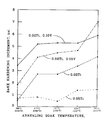
- vanadium additions can be used to control bake hardenability in a low carbon steel.
- the graph shows that adding an amount of vanadium to a titanium containing low carbon steel, for example 0.05% vanadium, improves bake hardenability properties at annealing temperatures above 815°C (1,500°F) up to about 878°C (1600°F) as compared to similar compositions shown without vanadium additions.
- the graph further shows that even more improved bake hardening properties can be achieved when the vanadium additions are increased up to about 0.10%.
- the graph shows that improved bake hardening properties also occur in low carbon vanadium steels at lower annealing temperatures, below a preferred 815°C (1500°F) to 843°C (1550°F) annealing range.
- Bake hardenability is increased up to a range of about 2 KSI to about 5 KSI as compared to a range of about less than 1 KSI to about 2.5 KSI for non-vanadium containing steels at these lower annealing temperatures.
- the results of testing for strain-aging index indicated that these steels exhibit sufficient resistance to aging at ambient temperature prior to forming.
- controlling the vanadium to carbon ratio in the compositions of the vanadium-bearing steels described above produces unexpected improvements in aging resistance. More particularly, maintaining the vanadium to carbon ratio of about 10 or above for these types of steels achieves the resistance to aging described above. It is believed that a broad range of vanadium, i.e., between about 0.005% and less than about 0.6%, as described above, will result in improved aging resistance provided the vanadium and carbon contents are selected to maintain a vanadium/carbon ratio of 10 or above. More preferably, the vanadium lower limit is set at 0.02%. It is believed that the vanadium upper limit is determined by a decrease in bake hardenability to an unacceptable level.
- the resistance to room-temperature aging was determined by measuring the amount of yield-point elongation (YPE) that is observed after an accelerated aging test (101°C) (212°F)/one hour).
- YPE yield-point elongation
- a steel is said to be essentially non-aging if there is no significant evidence of YPE after aging, i.e., if the YPE is less than about 0.2%.
- Our test results indicate that a critical V/C ratio (expressed in terms of weight percentages) of about 10 or more will ensure that the steel is sufficiently aging-resistant over at least the preferred annealing temperature of 788°C-843°C (1450° - 1550°F), and more preferably 815°C-843°C (1500 - 1550°F).
- the level of interstitial solute is an important parameter affecting aging behavior.
- elements which readily combine chemically with carbon or nitrogen tend to reduce the level of solute carbon and, hence, the magnitude of the age-hardening or yield point elongation.
- vanadium which is known to react with carbon in steels to form vanadium carbide, is used to control the level of solute carbon and provide a suitable degree of bake hardening while maintaining resistance to room temperature aging.
- the degree to which vanadium will combine with carbon is found to be expressed by the ratio of the concentrations of vanadium and carbon, V/C.
- V/C concentration ratio is a parameter which is important in capturing the solubility (or, conversely, the stability) of vanadium carbides and, therefore, controls the solute carbon level (according to the ratio V/C). That is, carbide stability is determined by both V and C together, rather than individually.
- compositions falling within the broad ranges discussed above were subjected to simulated batch or box annealing conditions to determine whether these compositions exhibited bake hardenability.
- Box annealing involves placing a cover over one or more stacked coils, introducing a protective atmosphere, and heating so as to achieve a temperature within a prescribed range throughout the coil and thereby effect complete recrystallization. Typically, this range might be about 654°C to 766°C (1,200 to 1,400°F). Because of the potentially large masses of steel involved in coil form, heating and cooling rates are relatively low, typically about only 11°C (50°F) per hour with a cycle time on the order of a few days.
- Tables 3 and 4 depict bake hardening properties after simulated batch annealing and production trial batch annealing, respectively for compositions falling within the broad ranges discussed above. As evident from the tables, and quite surprisingly, these steels exhibit bake hardenability.
- the steel is especially suited for hot-dipped coating processes such as galvannealing or the like.
- the cold-rolled and annealed steel article employing the inventive alloy steel chemistry can be hot-dipped coated in any conventional fashion, preferably in a continuous annealing hot-dipped coating line. Once hot-dipped coated, the coated steel article can be formed in conventional fashion into automotive panels. The panels are easily formed and are subsequently painted and baked, the painted panels showing good dent resistance.
Landscapes
- Chemical & Material Sciences (AREA)
- Engineering & Computer Science (AREA)
- Materials Engineering (AREA)
- Mechanical Engineering (AREA)
- Metallurgy (AREA)
- Organic Chemistry (AREA)
- Heat Treatment Of Sheet Steel (AREA)
- Meat, Egg Or Seafood Products (AREA)
- Materials For Medical Uses (AREA)
- Solid-Sorbent Or Filter-Aiding Compositions (AREA)
- Heat Treatment Of Steel (AREA)
- Reinforcement Elements For Buildings (AREA)
Claims (30)
- Article en acier laminé constitué essentiellement en pourcentage en poids :de 0,0005 à moins de 0,1% de carbone;de zéro jusqu'à 2,5% de manganèse;de zéro jusqu'à 0,5% d'aluminium;de zéro jusqu'à 0,5% d'un élément nitrurant choisi dans le groupe constitué de bore, de zirconium et de titane;de zéro à moins de 0,04% d'azote;de 0,005 à moins de 0,6% de vanadium;de zéro jusqu'à 1,0% de silicium etde zéro jusqu'à 0,25% de phosphore;le reste étant du fer et des impuretés inévitables, caractérisé en ce que le rapport du vanadium au carbone est de 10 ou plus.
- Article en acier laminé selon la revendication 1, dans lequel ledit rapport vanadium/carbone est de 10 jusqu'à 64.
- Article en acier laminé selon la revendication 1 ou 2, dans lequel ladite concentration en vanadium s'échelonne de 0,02 à 0,6% en poids.
- Article en acier laminé selon la revendication 3, dans lequel ladite concentration en vanadium s'échelonne de 0,05 à 0,20% en poids.
- Article en acier laminé selon la revendication 4, dans lequel ladite concentration de vanadium s'échelonne de 0,05 à 0,15% en poids.
- Article en acier laminé selon l'une quelconque des revendications précédentes, dans lequel la teneur en carbone est inférieure à 0,005% en poids.
- Article en acier laminé selon la revendication 6, dans lequel la teneur en carbone est inférieure à 0,0034% en poids et la teneur en vanadium est de 0,05% en poids ou plus.
- Article en acier laminé selon l'une quelconque des revendications précédentes, dans lequel ladite concentration en titane en tant qu'élément nitrurant s'échelonne de 0,015% à 0,025%.
- Article en acier laminé selon l'une quelconque des revendications précédentes, dans lequel le taux de titane est d'au moins 3,4 fois la concentration en pourcentage en poids d'azote.
- Article en acier laminé selon la revendication 1 ou 2, dans lequel ledit acier consiste essentiellement en poids de 0,0018 à 0,0028% de carbone, de 0,18 à 0,22% de manganèse, de 0,024 à 0,040% d'aluminium, de 0,0044 à 0,0065% d'azote, de 0,018 à 0,022% de titane en tant qu'élément nitrurant et de 0,049% à 0,094% de vanadium, le reste étant du fer et des puretés inévitables.
- Article en acier laminé selon la revendication 1 ou 2, dans lequel ladite concentration en carbone s'échelonne de 0,001 à 0,01% en poids, ladite concentration en d'azote s'échelonne de 0,001 à 0,005% en poids, ladite concentration en vanadium s'échelonne de 0,03 à 0,12% en poids, ladite concentration en aluminium s'échelonne de 0,02 à 0,08% en poids, et le titane est présent en tant qu'élément nitrurant en quantité supérieure à 3,4 fois ladite quantité d'azote.
- Article en acier laminé selon l'une quelconque des revendications précédentes, dans lequel ledit article comprend un revêtement en surface.
- Procédé de fabrication d'un article en acier laminé comprenant les étapes de
coulée d'acier à faible teneur en carbone dont la composition consiste essentiellement en pourcentage en poids de0,0005 à moins de 0,1% de carbone;de zéro jusqu'à 2,5% de manganèse;de zéro jusqu'à 0,5% d'aluminium;de zéro jusqu'à 0,5% d'un élément nitrurant;de zéro à 1% de silicium;de zéro à 0,25% de phosphore;de zéro à moins de 0,04% d'azote etde 0,005 à moins de 0,6% de vanadium;le reste étant du fer et des impuretés inévitables,et de laminage à chaud dudit acier, caractérisé en ce que le rapport vanadium/carbone dans ledit acier est maintenu à un niveaude 10 ou plus en vue d'améliorer la résistance au vieillissement. - Procédé selon la revendication 13, dans lequel ledit rapport vanadium/carbone dans ledit acier est maintenu à un niveau compris entre 10 et 64.
- Procédé selon la revendication 13 ou 14, dans lequel ledit acier a une teneur en vanadium comprise entre 0,02 et 0,6% en poids.
- Procédé selon la revendication 15, dans lequel ledit acier a une teneur en vanadium comprise entre 0,05 et 0,20% en poids.
- Procédé selon l'une quelconque des revendications 13 à 16, dans lequel ledit acier a une teneur en carbone inférieure à 0,005% en poids.
- Procédé selon la revendication 17, dans lequel ledit acier a une teneur en carbone d'au plus 0,0034% en poids et une teneur en vanadium supérieure à 0,05% en poids.
- Procédé selon l'une quelconque des revendications 13 à 18, dans lequel le titane est incorporé en tant qu'élément nitrurant à raison de 0,015 à 0,025% en poids.
- Procédé selon l'une quelconque des revendications 13 à 19, dans lequel le titane est incorporé en quantité supérieure à 3,4 fois ladite quantité d'azote.
- Procédé selon la revendication 13 ou 14, dans lequel il y a utilisation d'acier consistant essentiellement en poids de 0,0018 à 0,0028% de carbone, de 0,18 à 0,22% de manganèse, de 0,024 à 0,040% d'aluminium, de 0,0044 à 0,0065% d'azote, de 0,018 à 0,022% de titane en tant qu'élément nitrurant et de 0,049 à 0,094% de vanadium, le reste étant du fer et des impuretés inévitables.
- Procédé selon la revendication 13 ou 14, dans lequel ladite concentration en carbone s'échelonne de 0,001 à 0,01% en poids, ladite concentration en azote s'échelonne de 0,001 à 0,005% en poids, ladite concentration en vanadium s'échelonne de 0,03 à 0,12% en poids, ladite concentration en aluminium s'échelonne de 0,02 à 0,08% en poids et le titane est présent en tant que ledit élément nitrurant en quantité supérieure à 3,4 fois ladite quantité d'azote
- Procédé selon l'une quelconque des revendications 13 à 22, dans lequel l'acier laminé à chaud est laminé à froid et trempé en opérant dans une plage de température prédéterminée.
- Procédé selon la revendication 23, dans lequel la limite inférieure de la plage de température est de 788°C (1450°F).
- Procédé selon l'une quelconque des revendications 13 à 22, dans lequel l'acier laminé à chaud est laminé à froid puis trempé en mode discontinu en chauffant lentement l'acier laminé à froid sous forme enroulée à une température prédéterminée et en maintenant le rouleau à ladite température pour une certaine durée et en refroidissant lentement ledit rouleau à la température ambiante.
- Procédé selon la revendication 25, dans lequel ladite plage de température est comprise entre 654°C et 766°C (1200°F et 1400°F).
- Procédé selon l'une quelconque des revendications 13 à 26, dans lequel ledit acier est revêtu.
- Procédé selon la revendication 27, dans lequel ledit acier est revêtu par immersion à chaud.
- Procédé selon la revendication 27, dans lequel ledit acier est revêtu par électrogalvanisation.
- Procédé selon l'une quelconque des revendications 13 à 29, dans lequel ledit acier est façonné en produit lamellaire et soumis à une étape de cuisson de peinture.
Applications Claiming Priority (3)
| Application Number | Priority Date | Filing Date | Title |
|---|---|---|---|
| US08/607,893 US5656102A (en) | 1996-02-27 | 1996-02-27 | Bake hardenable vanadium containing steel and method thereof |
| US607893 | 1996-02-27 | ||
| PCT/US1996/006074 WO1997032051A1 (fr) | 1996-02-27 | 1996-05-01 | Acier contenant du vanadium durcissable au four |
Publications (2)
| Publication Number | Publication Date |
|---|---|
| EP0883696A1 EP0883696A1 (fr) | 1998-12-16 |
| EP0883696B1 true EP0883696B1 (fr) | 1999-09-01 |
Family
ID=24434143
Family Applications (1)
| Application Number | Title | Priority Date | Filing Date |
|---|---|---|---|
| EP96913297A Revoked EP0883696B1 (fr) | 1996-02-27 | 1996-05-01 | Acier contenant du vanadium durcissable au four |
Country Status (12)
| Country | Link |
|---|---|
| US (1) | US5656102A (fr) |
| EP (1) | EP0883696B1 (fr) |
| JP (1) | JP3601721B2 (fr) |
| KR (1) | KR100339052B1 (fr) |
| CN (1) | CN1082098C (fr) |
| AT (1) | ATE184056T1 (fr) |
| AU (1) | AU716905B2 (fr) |
| BR (1) | BR9612531A (fr) |
| CA (1) | CA2250162C (fr) |
| DE (1) | DE69604092T2 (fr) |
| TW (1) | TW418258B (fr) |
| WO (1) | WO1997032051A1 (fr) |
Families Citing this family (15)
| Publication number | Priority date | Publication date | Assignee | Title |
|---|---|---|---|---|
| US5556485A (en) * | 1994-11-07 | 1996-09-17 | Bethlehem Steel Corporation | Bake hardenable vanadium containing steel and method of making thereof |
| US5853903A (en) * | 1996-05-07 | 1998-12-29 | Nkk Corporation | Steel sheet for excellent panel appearance and dent resistance after panel-forming |
| FR2780984B1 (fr) * | 1998-07-09 | 2001-06-22 | Lorraine Laminage | Tole d'acier laminee a chaud et a froid revetue et comportant une tres haute resistance apres traitement thermique |
| US6143100A (en) * | 1998-09-29 | 2000-11-07 | National Steel Corporation | Bake-hardenable cold rolled steel sheet and method of producing same |
| DE19946889C1 (de) * | 1999-09-30 | 2000-11-09 | Thyssenkrupp Stahl Ag | Verfahren zum Erzeugen von alterungsbeständigen Bändern aus einem aluminiumberuhigten Stahl |
| JP4556363B2 (ja) * | 2001-08-22 | 2010-10-06 | Jfeスチール株式会社 | 成形後強度上昇熱処理能と深絞り性に優れた高張力冷延鋼板およびその製造方法 |
| US6920592B2 (en) * | 2002-08-12 | 2005-07-19 | Broadcom Corporation | System, method, and apparatus for detecting and recovering from false synchronization |
| US20070181232A1 (en) * | 2004-03-25 | 2007-08-09 | Posco | Cold rolled steel sheet and hot dipped steel sheet with superior strength and bake hardenability and method for manufacturing the steel sheets |
| US7717976B2 (en) * | 2004-12-14 | 2010-05-18 | L&P Property Management Company | Method for making strain aging resistant steel |
| KR100685037B1 (ko) * | 2005-09-23 | 2007-02-20 | 주식회사 포스코 | 내시효성이 우수한 고장력 소부경화형 냉간압연강판,용융도금강판 및 냉연강판의 제조방법 |
| EP1937854B1 (fr) * | 2005-09-23 | 2014-11-12 | Posco | Feuille d'acier laminee a froid, durcissable a la cuisson dotee d'une resistance superieure, feuille d'acier galvanisee au moyen de la feuille d'acier laminee a froid et procede de fabrication de cette feuille d'acier laminee a froid |
| CN100436632C (zh) * | 2006-11-10 | 2008-11-26 | 武汉钢铁(集团)公司 | 钒处理烤漆硬化型深冲轿车钢板及制备方法 |
| CN110273107A (zh) * | 2019-06-14 | 2019-09-24 | 河钢股份有限公司承德分公司 | 一种高强度if钢板及其生产方法 |
| CN113549736B (zh) * | 2021-06-22 | 2023-01-03 | 鞍钢蒂森克虏伯(重庆)汽车钢有限公司 | 一种稳定控制烘烤硬化钢bh2的工艺方法 |
| CN117230362B (zh) * | 2023-09-28 | 2025-11-07 | 武汉钢铁有限公司 | 低碳合金钢的制备方法、低碳合金钢 |
Family Cites Families (30)
| Publication number | Priority date | Publication date | Assignee | Title |
|---|---|---|---|---|
| US1420328A (en) * | 1920-06-05 | 1922-06-20 | Interstate Iron And Steel Comp | Process of making alloy steel |
| US1546176A (en) * | 1923-05-17 | 1925-07-14 | Mathesius Walther | Titanium steel |
| US2291842A (en) * | 1940-07-18 | 1942-08-04 | Vanadium Corp | Production of steel |
| US2999749A (en) * | 1958-09-17 | 1961-09-12 | Union Carbide Corp | Method for producing non-aging rimmed steels |
| US3375105A (en) * | 1965-10-22 | 1968-03-26 | Vanadium Corp Of America | Method for the production of fine grained steel |
| US3600160A (en) * | 1968-05-14 | 1971-08-17 | Wallace Murray Corp | Heat and temper resistant alloy steel |
| US3947293A (en) * | 1972-01-31 | 1976-03-30 | Nippon Steel Corporation | Method for producing high-strength cold rolled steel sheet |
| US3897280A (en) * | 1972-12-23 | 1975-07-29 | Nippon Steel Corp | Method for manufacturing a steel sheet and product obtained thereby |
| JPS5157623A (en) * | 1974-11-18 | 1976-05-20 | Nippon Kokan Kk | Takaitosoyakitsukekokaseitosugureta hijikoseiomotsukochoryokureienkohanno seizohoho |
| US4144378A (en) * | 1977-09-02 | 1979-03-13 | Inland Steel Company | Aluminized low alloy steel |
| JPS5531837A (en) * | 1978-08-25 | 1980-03-06 | Sumitomo Chem Co Ltd | Preparation of thermosetting resin aqueous solution |
| US4313770A (en) * | 1979-06-28 | 1982-02-02 | Sumitomo Metal Industries, Ltd. | Method of producing cold rolled steel strip having improved press formability and bake-hardenability |
| US4375376A (en) * | 1979-12-31 | 1983-03-01 | Republic Steel Corporation | Retarded aging, rimmed steel with good surface quality |
| JPS5857492B2 (ja) * | 1980-09-25 | 1983-12-20 | 新日本製鐵株式会社 | 自動車用高強度冷延鋼板の製造方法 |
| WO1982001566A1 (fr) * | 1980-10-18 | 1982-05-13 | Irie Toshio | Plaque en acier mince pour l'etirage possedant d'excellentes proprietes de durcissement au four et procede de fabrication |
| JPS57140868A (en) * | 1981-02-24 | 1982-08-31 | Nisshin Steel Co Ltd | Aluminum hot-dipped steel plate with superior strength and oxidation resistance at high temperature and its manufacture |
| US4398970A (en) * | 1981-10-05 | 1983-08-16 | Bethlehem Steel Corporation | Titanium and vanadium dual-phase steel and method of manufacture |
| CA1259827A (fr) * | 1984-07-17 | 1989-09-26 | Mitsumasa Kurosawa | Toles d'acier laminees a froid, et methode de fabrication connexe |
| JPS61246327A (ja) * | 1985-04-24 | 1986-11-01 | Kobe Steel Ltd | 超深絞り用冷延鋼板の製造方法 |
| JPH0674480B2 (ja) * | 1987-09-03 | 1994-09-21 | 本田技研工業株式会社 | 溶接性、耐糸錆性、成形性及び焼付硬化性に優れた成形用及び溶接用A▲l▼合金板及びその製造法 |
| DE3803064C2 (de) * | 1988-01-29 | 1995-04-20 | Preussag Stahl Ag | Kaltgewalztes Blech oder Band und Verfahren zu seiner Herstellung |
| JPH02194126A (ja) * | 1989-01-20 | 1990-07-31 | Sumitomo Metal Ind Ltd | 焼付硬化性鋼板の製造方法 |
| CA2037316C (fr) * | 1990-03-02 | 1997-10-28 | Shunichi Hashimoto | Toles d'acier a emboutes laminees a froid ou galvanisees par immersion a chaud |
| US5279683A (en) * | 1990-06-20 | 1994-01-18 | Kawasaki Steel Corporation | Method of producing high-strength cold-rolled steel sheet suitable for working |
| JPH04218618A (ja) * | 1990-12-19 | 1992-08-10 | Nippon Steel Corp | 焼付硬化性および加工性の優れた自動車用電縫鋼管の製 造方法 |
| JPH0776410B2 (ja) * | 1991-01-29 | 1995-08-16 | 日本鋼管株式会社 | 焼付硬化性に優れた非時効性深絞り用高強度冷延鋼板およびその製造方法 |
| US5123969A (en) * | 1991-02-01 | 1992-06-23 | China Steel Corp. Ltd. | Bake-hardening cold-rolled steel sheet having dual-phase structure and process for manufacturing it |
| EP0572666B1 (fr) * | 1991-02-20 | 1998-05-06 | Nippon Steel Corporation | Tole d'acier laminee a froid et tole d'acier galvanisee presentant une bonne aptitude au formage et a la trempe au four, et sa production |
| JP2745922B2 (ja) * | 1991-12-25 | 1998-04-28 | 日本鋼管株式会社 | 焼付硬化性に優れた非時効性深絞り用冷延鋼板とその製造方法 |
| US5556485A (en) * | 1994-11-07 | 1996-09-17 | Bethlehem Steel Corporation | Bake hardenable vanadium containing steel and method of making thereof |
-
1996
- 1996-02-27 US US08/607,893 patent/US5656102A/en not_active Expired - Lifetime
- 1996-05-01 AT AT96913297T patent/ATE184056T1/de not_active IP Right Cessation
- 1996-05-01 DE DE69604092T patent/DE69604092T2/de not_active Expired - Fee Related
- 1996-05-01 JP JP53090597A patent/JP3601721B2/ja not_active Expired - Fee Related
- 1996-05-01 CN CN96180128A patent/CN1082098C/zh not_active Expired - Fee Related
- 1996-05-01 WO PCT/US1996/006074 patent/WO1997032051A1/fr not_active Ceased
- 1996-05-01 EP EP96913297A patent/EP0883696B1/fr not_active Revoked
- 1996-05-01 BR BR9612531-4A patent/BR9612531A/pt not_active IP Right Cessation
- 1996-05-01 KR KR1019980706704A patent/KR100339052B1/ko not_active Expired - Fee Related
- 1996-05-01 AU AU56349/96A patent/AU716905B2/en not_active Ceased
- 1996-05-01 CA CA002250162A patent/CA2250162C/fr not_active Expired - Fee Related
- 1996-05-06 TW TW084111852A patent/TW418258B/zh not_active IP Right Cessation
Also Published As
| Publication number | Publication date |
|---|---|
| DE69604092T2 (de) | 2000-03-23 |
| TW418258B (en) | 2001-01-11 |
| JP3601721B2 (ja) | 2004-12-15 |
| CN1082098C (zh) | 2002-04-03 |
| WO1997032051A1 (fr) | 1997-09-04 |
| CA2250162A1 (fr) | 1997-09-04 |
| DE69604092D1 (de) | 1999-10-07 |
| BR9612531A (pt) | 1999-12-28 |
| AU716905B2 (en) | 2000-03-09 |
| CN1209174A (zh) | 1999-02-24 |
| CA2250162C (fr) | 2005-08-09 |
| AU5634996A (en) | 1997-09-16 |
| US5656102A (en) | 1997-08-12 |
| ATE184056T1 (de) | 1999-09-15 |
| EP0883696A1 (fr) | 1998-12-16 |
| JP2001501672A (ja) | 2001-02-06 |
| KR100339052B1 (ko) | 2002-10-25 |
| KR19990087298A (ko) | 1999-12-27 |
Similar Documents
| Publication | Publication Date | Title |
|---|---|---|
| US7442268B2 (en) | Method of manufacturing cold rolled dual-phase steel sheet | |
| EP0608430B1 (fr) | Tole laminee a froid representant une trempabilite pour peinture au four et des caracteristiques de vieillissement et une aptitude au moulage autrement qu'a froid excellentes, et tole zinguee laminee a froid et procede de fabrication | |
| US20090071574A1 (en) | Cold rolled dual phase steel sheet having high formability and method of making the same | |
| AU716905B2 (en) | Bake hardenable vanadium containing steel | |
| EP0024437B1 (fr) | Procede de production des toles en acier laminees a froid, exempt de viellissement | |
| EP1002884B1 (fr) | Plaque d'acier laminee a froid possedant d'excellentes caracteristiques d'aptitude au moulage et de formabilite en panneaux, une bonne resistance a la constriction, plaque d'acier a placage en zinc moule et procede de fabrication de ces plaques | |
| US5556485A (en) | Bake hardenable vanadium containing steel and method of making thereof | |
| MXPA02001880A (es) | Placa de acero para esmaltado que tiene propiedad anti-envejecimiento, formabilidad, mejorada, y propiedades de esmaltado, y proceso para producir la misma. | |
| JPWO1992016668A1 (ja) | 成形性の良好な高強度冷延鋼板と溶融亜鉛メッキ高強度冷延鋼板およびそれらの製造方法 | |
| EP0996750B1 (fr) | Procede de fabrication de t les d'acier laminee a froid, presentant une resistance excellente au vieillissement naturel et une excellente aptitude a la formation de panneaux | |
| RU2233905C1 (ru) | Холоднокатаная сталь для глубокой вытяжки | |
| JPH06116650A (ja) | 焼付硬化性と非時効性とに優れた冷延鋼板あるいは溶融亜鉛メッキ冷延鋼板の製造方法 | |
| JPH0657337A (ja) | 成形性に優れた高強度合金化溶融亜鉛めっき鋼板の製造方法 | |
| JP2689684B2 (ja) | 焼付硬化性を有する深絞り用高強度冷延鋼板の製造方法 | |
| KR101586893B1 (ko) | 강판 및 그 제조 방법 | |
| JP3293190B2 (ja) | 焼付硬化性に優れた薄鋼板の製造方法 | |
| MXPA98006853A (en) | Steel containing hardened vanadium through horne | |
| JPH0250940A (ja) | 耐食性に優れた深絞り用冷延鋼板 | |
| CN118497611A (zh) | 一种冷轧if钢及其制备方法 | |
| HK1018289A (en) | Bake hardenable vanadium containing steel | |
| JPH0681044A (ja) | 疲労特性及び深絞り性に優れた鋼板の製造方法 | |
| MXPA97003183A (en) | Steel containing vanadio, which can temperate drying in ho | |
| JPS6114210B2 (fr) |
Legal Events
| Date | Code | Title | Description |
|---|---|---|---|
| PUAI | Public reference made under article 153(3) epc to a published international application that has entered the european phase |
Free format text: ORIGINAL CODE: 0009012 |
|
| 17P | Request for examination filed |
Effective date: 19980724 |
|
| AK | Designated contracting states |
Kind code of ref document: A1 Designated state(s): AT BE DE DK FI FR GB IT NL SE |
|
| GRAG | Despatch of communication of intention to grant |
Free format text: ORIGINAL CODE: EPIDOS AGRA |
|
| GRAG | Despatch of communication of intention to grant |
Free format text: ORIGINAL CODE: EPIDOS AGRA |
|
| GRAH | Despatch of communication of intention to grant a patent |
Free format text: ORIGINAL CODE: EPIDOS IGRA |
|
| 17Q | First examination report despatched |
Effective date: 19990119 |
|
| GRAH | Despatch of communication of intention to grant a patent |
Free format text: ORIGINAL CODE: EPIDOS IGRA |
|
| GRAA | (expected) grant |
Free format text: ORIGINAL CODE: 0009210 |
|
| AK | Designated contracting states |
Kind code of ref document: B1 Designated state(s): AT BE DE DK FI FR GB IT NL SE |
|
| REF | Corresponds to: |
Ref document number: 184056 Country of ref document: AT Date of ref document: 19990915 Kind code of ref document: T |
|
| REF | Corresponds to: |
Ref document number: 69604092 Country of ref document: DE Date of ref document: 19991007 |
|
| ITF | It: translation for a ep patent filed | ||
| ET | Fr: translation filed | ||
| REG | Reference to a national code |
Ref country code: DK Ref legal event code: T3 |
|
| PLBQ | Unpublished change to opponent data |
Free format text: ORIGINAL CODE: EPIDOS OPPO |
|
| PLBI | Opposition filed |
Free format text: ORIGINAL CODE: 0009260 |
|
| PLBF | Reply of patent proprietor to notice(s) of opposition |
Free format text: ORIGINAL CODE: EPIDOS OBSO |
|
| 26 | Opposition filed |
Opponent name: THYSSEN KRUPP STAHL AG Effective date: 20000602 |
|
| NLR1 | Nl: opposition has been filed with the epo |
Opponent name: THYSSEN KRUPP STAHL AG |
|
| PLBF | Reply of patent proprietor to notice(s) of opposition |
Free format text: ORIGINAL CODE: EPIDOS OBSO |
|
| REG | Reference to a national code |
Ref country code: GB Ref legal event code: IF02 |
|
| PGFP | Annual fee paid to national office [announced via postgrant information from national office to epo] |
Ref country code: DK Payment date: 20020319 Year of fee payment: 7 |
|
| RDAH | Patent revoked |
Free format text: ORIGINAL CODE: EPIDOS REVO |
|
| PGFP | Annual fee paid to national office [announced via postgrant information from national office to epo] |
Ref country code: NL Payment date: 20020325 Year of fee payment: 7 |
|
| PGFP | Annual fee paid to national office [announced via postgrant information from national office to epo] |
Ref country code: AT Payment date: 20020403 Year of fee payment: 7 |
|
| PGFP | Annual fee paid to national office [announced via postgrant information from national office to epo] |
Ref country code: GB Payment date: 20020404 Year of fee payment: 7 |
|
| PGFP | Annual fee paid to national office [announced via postgrant information from national office to epo] |
Ref country code: FI Payment date: 20020426 Year of fee payment: 7 |
|
| PGFP | Annual fee paid to national office [announced via postgrant information from national office to epo] |
Ref country code: SE Payment date: 20020503 Year of fee payment: 7 Ref country code: FR Payment date: 20020503 Year of fee payment: 7 |
|
| PGFP | Annual fee paid to national office [announced via postgrant information from national office to epo] |
Ref country code: DE Payment date: 20020531 Year of fee payment: 7 |
|
| APAC | Appeal dossier modified |
Free format text: ORIGINAL CODE: EPIDOS NOAPO |
|
| PGFP | Annual fee paid to national office [announced via postgrant information from national office to epo] |
Ref country code: BE Payment date: 20020613 Year of fee payment: 7 |
|
| APAC | Appeal dossier modified |
Free format text: ORIGINAL CODE: EPIDOS NOAPO |
|
| PG25 | Lapsed in a contracting state [announced via postgrant information from national office to epo] |
Ref country code: GB Free format text: LAPSE BECAUSE OF NON-PAYMENT OF DUE FEES Effective date: 20030501 Ref country code: FI Free format text: LAPSE BECAUSE OF NON-PAYMENT OF DUE FEES Effective date: 20030501 Ref country code: AT Free format text: LAPSE BECAUSE OF NON-PAYMENT OF DUE FEES Effective date: 20030501 |
|
| PG25 | Lapsed in a contracting state [announced via postgrant information from national office to epo] |
Ref country code: SE Free format text: LAPSE BECAUSE OF NON-PAYMENT OF DUE FEES Effective date: 20030502 |
|
| PG25 | Lapsed in a contracting state [announced via postgrant information from national office to epo] |
Ref country code: BE Free format text: LAPSE BECAUSE OF NON-PAYMENT OF DUE FEES Effective date: 20030531 |
|
| BERE | Be: lapsed |
Owner name: *BETHLEHEM STEEL CORP. Effective date: 20030531 |
|
| PG25 | Lapsed in a contracting state [announced via postgrant information from national office to epo] |
Ref country code: NL Free format text: LAPSE BECAUSE OF NON-PAYMENT OF DUE FEES Effective date: 20031201 Ref country code: DK Free format text: LAPSE BECAUSE OF NON-PAYMENT OF DUE FEES Effective date: 20031201 |
|
| PG25 | Lapsed in a contracting state [announced via postgrant information from national office to epo] |
Ref country code: DE Free format text: LAPSE BECAUSE OF NON-PAYMENT OF DUE FEES Effective date: 20031202 |
|
| GBPC | Gb: european patent ceased through non-payment of renewal fee |
Effective date: 20030501 |
|
| REG | Reference to a national code |
Ref country code: DK Ref legal event code: EBP |
|
| EUG | Se: european patent has lapsed | ||
| PG25 | Lapsed in a contracting state [announced via postgrant information from national office to epo] |
Ref country code: FR Free format text: LAPSE BECAUSE OF NON-PAYMENT OF DUE FEES Effective date: 20040130 |
|
| NLV4 | Nl: lapsed or anulled due to non-payment of the annual fee |
Effective date: 20031201 |
|
| REG | Reference to a national code |
Ref country code: FR Ref legal event code: ST |
|
| APBU | Appeal procedure closed |
Free format text: ORIGINAL CODE: EPIDOSNNOA9O |
|
| RDAG | Patent revoked |
Free format text: ORIGINAL CODE: 0009271 |
|
| STAA | Information on the status of an ep patent application or granted ep patent |
Free format text: STATUS: PATENT REVOKED |
|
| 27W | Patent revoked |
Effective date: 20040728 |
|
| APAA | Appeal reference recorded |
Free format text: ORIGINAL CODE: EPIDOS REFN |
|
| APAH | Appeal reference modified |
Free format text: ORIGINAL CODE: EPIDOSCREFNO |