EP0884663B1 - Uhr mit fühlbares Lesen und Reglen der horometrischen Funktionen - Google Patents
Uhr mit fühlbares Lesen und Reglen der horometrischen FunktionenInfo
- Publication number
- EP0884663B1 EP0884663B1 EP19970109578 EP97109578A EP0884663B1 EP 0884663 B1 EP0884663 B1 EP 0884663B1 EP 19970109578 EP19970109578 EP 19970109578 EP 97109578 A EP97109578 A EP 97109578A EP 0884663 B1 EP0884663 B1 EP 0884663B1
- Authority
- EP
- European Patent Office
- Prior art keywords
- time
- sensors
- watch
- watch according
- finger
- Prior art date
- Legal status (The legal status is an assumption and is not a legal conclusion. Google has not performed a legal analysis and makes no representation as to the accuracy of the status listed.)
- Expired - Lifetime
Links
Images

Classifications
-
- G—PHYSICS
- G04—HOROLOGY
- G04G—ELECTRONIC TIME-PIECES
- G04G21/00—Input or output devices integrated in time-pieces
- G04G21/08—Touch switches specially adapted for time-pieces
-
- G—PHYSICS
- G04—HOROLOGY
- G04C—ELECTROMECHANICAL CLOCKS OR WATCHES
- G04C3/00—Electromechanical clocks or watches independent of other time-pieces and in which the movement is maintained by electric means
- G04C3/001—Electromechanical switches for setting or display
Definitions
- the present invention relates to a watch allowing reading the time in the usual way and including in addition to an arrangement intended to facilitate reading and adjustment of time functions by touch by means of coded non-sound vibrations, such a wristwatch being more particularly intended for a user visually impaired, or to a sighted user placed in circumstances where he cannot, or does not wish check his watch.
- the invention relates more particularly to a wristwatch with analog display whose appearance aesthetic does not differentiate it from usual watches and whose technical characteristics, for example at level of tightness are higher than those of watches currently used by people visually impaired.
- the invention also relates to such a wristwatch. whose arrangement at the bezel allows a more efficient location of a specific tactile area, whose number of manipulations for reading and setting of a time function is reduced, and the coding of sound vibrations is simplified.
- the wristwatch described in the document US 5,559,761 still requires from the user a significant learning, both in terms of correct positioning of a finger on a tactile marker determined, that when it comes to learning the manipulation of control elements and proposed code to deliver information by non-audible vibrations.
- the present invention therefore aims to make the use of a wrist watch of the aforementioned type plus reliable regarding the information it provides and easier to use because it is closer to reflexes already acquired with a usual watch.
- the reliefs arranged on the bezel have for example the shape of bars a little longer than the width of the bezel. An average attention observer can consider that said bars have only one purpose decorative, so that it is not possible, by the simple observation of the watch, to know if whoever door is visually impaired or not.
- the sensors used are of the capacitive type and are arranged under the glass, above each time position, although it it is possible to use other types of sensors according to other arrangements, for example piezoelectric sensors arranged on the bezel. It is further possible to allow the user to have a confirmation the correct positioning of his finger on a sensor in treating a small portion of the outer surface of the ice above each time marker to give it a noticeable low roughness so tactile, but not detectable visually. He is by possible example of forming small pellets by laser treatment.
- the primary function of the controller outside is to allow the passage in reading mode when touching briefly. information horometric is then selected by positioning the finger on the sensor located at 12 o'clock for the current time, and at 6 a.m. for the alarm time.
- the second function of the control unit is the current time setting and setting or changing the alarm time on the contrary, when pulling, handling quite common with most watches.
- the sensors located at 12 p.m., 6 a.m., 3 a.m. and 9 a.m. perform two functions easily storable.
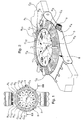
- the watch shown consists of a box 1 formed by a base 2 and a middle part 3, and closed by a crystal 4 arranged above a circular dial 5 of a display analog by needles 6 and 7. Glass 5 is maintained in place by a fixed bezel 8 secured to the box 1.
- a push button 9, on which it is possible to exercise either a pressure or a traction is positioned on the middle 3 to 3 h.
- the assembly means are not shown, as being well known to those skilled in the art.
- the interior space delimited by the dial 5 and the bottom 2 is occupied by a horometric movement, schematically represented by a timepiece circuit 10 and a stepping motor 11, and by a vibrating device 20 powered by a source of energy 24 according to instructions received from a electronic coding circuit 25 subject to the circuit timepiece 10.
- a horometric movement schematically represented by a timepiece circuit 10 and a stepping motor 11, and by a vibrating device 20 powered by a source of energy 24 according to instructions received from a electronic coding circuit 25 subject to the circuit timepiece 10.
- the vibrating device 20 is for example that described in US Pat. No. 5,365,497. It basically consists of an electromagnetic type motor 21 capable of transmitting an oscillatory movement to a mass 23 via an elastic connection 22. The vibration, or the train of vibrations, thus created can be perceived by the user at the wrist, but also anywhere in the box.
- the watch according to the invention allows both a usual reading of the time visually by means of hands 6 and 7 and a tactile reading. This tactile reading is carried out by means of twelve capacitive sensors C 1 to C 12 arranged under the glass above each hour mark on the dial, the section in FIG. 3 showing the sensor C 9 .
- each sensor is identified by reliefs R 1 to R 12 arranged on the bezel between each time marker, and projecting from the periphery of the box 1.
- the reliefs R 1 to R 12 have the form bars slightly enveloping the bezel as it appears for the relief R 5 in Figure 3. These bars can be added elements, for example by welding or gluing, or come in one piece with the bezel.
- the watch structure which has just been described allows simple tactile reading and adjustment by use of vibration coding easily memorable, as will be understood with reference to the description below of the different functions horometrical.
- the user then perceives a rapid vibration confirming that he is in "time reading" mode. He then moves his finger on the surface of the ice near the telescope until he perceives a continuous vibration indicating that he is above the hour hand.
- the number of minutes exceeding a multiple five-minute integer is coded by trains formed of one to four countable vibrations.
- each vibration has a duration of 250 ms, the vibrations forming a train being separated by a silence of 500 ms and each train being separated by a 1'250 ms silence.
- the hands indicate 9:18.
- the user will first perceive a continuous vibration when his finger is positioned on the sensor C 9 , then a train of three vibrations when his finger is positioned on sensor C 3 .
- These codifications are schematically represented in FIG. 4.
- the user will therefore have the knowledge of the hour to the minute, which is sometimes difficult to obtain visually, particularly with watches in which an aesthetic research leads to remove practically all the time marks.
- the procedure is exactly the same as that described above, but by activating sensor C 6 at the start instead of sensor C 12 .
- the rapid vibration is coded to also indicate the state of the alarm.
- the user After briefly pressing the crown 9, the user positions his finger on the sensor C 6 as before , but leaving it for more than two seconds. The user then perceives a train of vibrations formed by the succession of a rapid vibration and two rapid vibrations. To establish the alarm state that suits him, he withdraws his finger when he perceives either one vibration (OFF) or two vibrations (ON).
- the user marks the chosen hour position between two bars R 1 to R 12 and slides his finger over the corresponding sensor. He then perceives a continuous vibration confirming to him that the hour hand has come to occupy the position corresponding to the time difference he has chosen.
- the user simply wishes to make a change time zone, or change from summer time to winter time, it does not perform any other manipulation and the watch will automatically return to "reading" mode after a certain time. If, on the contrary, he wishes also adjust the minute hand it marks at the bars the hour position corresponding to the integer multiple of five minutes equal or immediately less than the number of minutes chosen, then it does slide his finger on the corresponding sensor.
- the circuit management electronics then sends signals to the vibratory device for producing a vibration train coding the values 0 to 4, respectively by a vibration continues then 1, 2, 3 and 4 countable vibrations separated by rests, this sequence, represented at Figure 4 for values 0 to 3, reproducing so many the user keeps his finger on the sensor. The number of minutes will correspond to the last group of vibrations perceived. After removing his finger, the needle of the 7 minutes will occupy the chosen position.
- the user exerts on the crown a long press (more than five seconds) then a pull. He then positions his finger on the sensor C 9 until perception of a continuous vibration confirming that the hour hand occupies the 12 o'clock position. In the same way, he moves the minute hand by positioning his finger on the sensor C 3 .
Landscapes
- Physics & Mathematics (AREA)
- General Physics & Mathematics (AREA)
- Electric Clocks (AREA)
Claims (8)
- Uhr mit visuellen und taktilen Zeitmeßfunktionen, die umfaßt:eine elektronische Kodierschaltung (25), die der Zeitmeßschaltung (10), den Sensoren (C1 bis C12) und dem Organ (9) zur externen Steuerung zugeordnet ist, um die Schwingungserzeugungsvorrichtung (20) zu steuern;ein Gehäuse (1), das durch ein Uhrenglas (4) verschlossen ist, welches über einem Zifferblatt (5) für die analoge Anzeige mittels Zeigern (6, 7) angeordnet und von einem feststehenden Glasreif (8) umgeben ist;eine Zeitmeßschaltung (10) and wenigstens einen Schrittmotor (11) für den Antrieb der Zeiger (6, 7);eine Vorrichtung (20) für die Erzeugung von nicht akustischen Schwingungen;wenigstens eine Energiequelle (24), die die Zeitmeßschaltung (10), den Schrittmotor (11) and die Schwingungserzeugungsvorrichtung (20) versorgt;eine Gesamtheit von zwölf Sensoren (C1 bis C12), die gegenüber zwölf Zeitpositionen angeordnet sind, und wenigstens ein Organ (9) zur externen Steuerung;
dadurch gekennzeichnet, daß der Glasreif (8) mit zwölf Erhöhungen (R1 bis R12) versehen ist, die sich radial über den Glasreif (8) und das Gehäuse (1) hinaus erstrecken, wobei die Erhöhungen (R1 bis R12) zwischen den zwölf Sensoren (C1 bis C12) angeordnet sind, um den Finger eines Benutzers zu einem bestimmten Sensor zu führen. - Uhr nach Anspruch 1, dadurch gekennzeichnet, daß die Sensoren (C1 bis C12) vom kapazitiven Typ sind und sich unter dem Uhrenglas (1) über jeder Zeitposition befinden.
- Uhr nach Anspruch 2, dadurch gekennzeichnet, daß kleine äußere Abschnitte des Uhrenglases gegenüber jeder Zeitposition so bearbeitet sind, daß sie eine geringe Rauheit aufweisen, die fühlbar ist, jedoch visuell nicht bemerkbar ist.
- Uhr nach Anspruch 1, dadurch gekennzeichnet, daß das Organ (9) zur externen Steuerung ein Druckknopf (9) ist, der so beschaffen ist, daß er die Uhr in die Betriebsart für taktiles Lesen versetzt, wenn auf den Druckknopf (9) ein kurzer Druck ausgeübt wird.
- Uhr nach Anspruch 1, dadurch gekennzeichnet, daß die Sensoren (C3, C6, C9 und C12) so beschaffen sind, daß ihre erste Aktivierung durch Auflegen eines Fingers eine bestimmte Zeitmeßinformation auswählt.
- Uhr nach Anspruch 5, dadurch gekennzeichnet, daß die Sensoren (C12 und C6) ermöglichen, die momentane Uhrzeit bzw. die Alarmzeit zum Lesen bzw. Einstellen auszuwählen, sobald der Übergang in die Betriebsart für taktiles Lesen ausgeführt worden ist.
- Uhr nach Anspruch 6, dadurch gekennzeichnet, daß der Druckknopf (9) so beschaffen ist, daß ein auf ihn ausgeübter Zug ermöglicht, die Einstellung der momentanen Uhrzeit und der Alarmzeit vorzunehmen.
- Uhr nach Anspruch 5, dadurch gekennzeichnet, daß die Sensoren (C9 und C3) so beschaffen sind, daß sie, indem sie nacheinander aktiviert werden und indem vorher auf den Druckknopf (9) ein langer Druck und ein Zug ausgeübt worden sind, die Initialisierung der Uhr durch visuelle Steuerung der Überlagerung der Zeiger bei 12 h ermöglichen.
Priority Applications (2)
| Application Number | Priority Date | Filing Date | Title |
|---|---|---|---|
| DE1997612192 DE69712192T2 (de) | 1997-06-12 | 1997-06-12 | Uhr mit fühlbares Lesen und Reglen der horometrischen Funktionen |
| EP19970109578 EP0884663B1 (de) | 1997-06-12 | 1997-06-12 | Uhr mit fühlbares Lesen und Reglen der horometrischen Funktionen |
Applications Claiming Priority (1)
| Application Number | Priority Date | Filing Date | Title |
|---|---|---|---|
| EP19970109578 EP0884663B1 (de) | 1997-06-12 | 1997-06-12 | Uhr mit fühlbares Lesen und Reglen der horometrischen Funktionen |
Publications (2)
| Publication Number | Publication Date |
|---|---|
| EP0884663A1 EP0884663A1 (de) | 1998-12-16 |
| EP0884663B1 true EP0884663B1 (de) | 2002-04-24 |
Family
ID=8226908
Family Applications (1)
| Application Number | Title | Priority Date | Filing Date |
|---|---|---|---|
| EP19970109578 Expired - Lifetime EP0884663B1 (de) | 1997-06-12 | 1997-06-12 | Uhr mit fühlbares Lesen und Reglen der horometrischen Funktionen |
Country Status (2)
| Country | Link |
|---|---|
| EP (1) | EP0884663B1 (de) |
| DE (1) | DE69712192T2 (de) |
Families Citing this family (1)
| Publication number | Priority date | Publication date | Assignee | Title |
|---|---|---|---|---|
| CN104731333B (zh) * | 2015-03-25 | 2018-11-09 | 联想(北京)有限公司 | 一种可穿戴式电子设备 |
Family Cites Families (6)
| Publication number | Priority date | Publication date | Assignee | Title |
|---|---|---|---|---|
| DE7214106U (de) * | 1972-04-14 | 1972-08-10 | Sel Ag | Kommandosignalgebergehaeuse fuer fernsteuereinrichtungen |
| US4257115A (en) * | 1977-02-12 | 1981-03-17 | Citizen Watch Co., Ltd. | Switch structure for electronic timepiece |
| JPS56155882A (en) * | 1980-05-02 | 1981-12-02 | Seiko Instr & Electronics Ltd | Analog alarm watch for blind person |
| GR1000807B (el) * | 1991-08-05 | 1993-01-25 | Panagiotis Anagnostopoulos | Μεθοδος και συσκευες επικοινωνιας δια της αφης. |
| CH688498B5 (fr) * | 1994-11-03 | 1998-04-30 | Asulab Sa | Pièce d'horlogerie avec informations horométriques par vibrations non sonores. |
| CH688600B5 (fr) * | 1994-12-01 | 1998-06-15 | Asulab Sa | Pièce d'horlogerie à affichage analogique comportant des moyens de sélection d'une information numérique. |
-
1997
- 1997-06-12 EP EP19970109578 patent/EP0884663B1/de not_active Expired - Lifetime
- 1997-06-12 DE DE1997612192 patent/DE69712192T2/de not_active Expired - Lifetime
Also Published As
| Publication number | Publication date |
|---|---|
| DE69712192T2 (de) | 2002-12-12 |
| DE69712192D1 (de) | 2002-05-29 |
| EP0884663A1 (de) | 1998-12-16 |
Similar Documents
| Publication | Publication Date | Title |
|---|---|---|
| CH691711A5 (fr) | Montre avec lecture et réglage tactiles des fonctions horométriques. | |
| EP1394640B1 (de) | Uhr mit taktiler Ablesung und Betätigung der Zeitinformation | |
| EP0710899B1 (de) | Uhr mit Zeitangabe durch nicht hörbare Schwingungen | |
| EP0589353B1 (de) | Analoguhr mit der Möglichkeit zur Anzeige von Zusatzinformationen | |
| EP0589465B1 (de) | Analoguhr mit Warnungsmitteln für eine Betriebsartänderung | |
| EP1936450B1 (de) | Elektronische Uhr mit Anzeige der Richtung eines vorprogrammierten geografischen Orts | |
| EP2579186A1 (de) | Verfahren zur Authentifizierung einer elektronischen Armbanduhr, und elektronische Armbanduhr zu dessen Umsetzung | |
| EP0360140B1 (de) | Eine ganz oder teilweise den Aufbau zeigende Skelettuhr | |
| EP3156855B1 (de) | Mechanisches armbanduhr, die mit einer elektronischen funktion assoziert ist | |
| EP0884663B1 (de) | Uhr mit fühlbares Lesen und Reglen der horometrischen Funktionen | |
| EP0644469B1 (de) | Analoguhr mit mindestens einer Universalzeitanzeige | |
| EP0476425B1 (de) | Eine auf verschiedene Arten zu tragende Uhr | |
| EP0644468B1 (de) | Analoguhr zum Anzeigen von einer oder mehreren alphanumerischen Informationen gemäss einer Funktionsart oder einem programmierten Ereignis | |
| EP0060216B1 (de) | Uhr mit Auslösevorrichtung | |
| WO2006027517A2 (fr) | Piece d'horlogerie electronique du type montre multifonctions d'aide a la navigation, notamment pour une mission spatiale | |
| CH672222B5 (de) | ||
| EP0357633B1 (de) | Verfahren zum anzeigen von gespeicherten zeitinformationen auf einer uhrzeigerplatte und eine für ein solches verfahren ausgerüstete uhr | |
| EP4105738A1 (de) | Armbanduhr mit einer hilfsfunktion zur anzeige der sekunden | |
| EP0754989A1 (de) | Elektronische Uhr, insbesondere Armbanduhr | |
| EP1184751A1 (de) | Elektronische Uhr mit Datumanzeige durch ein grosses Fenster | |
| FR2555772A1 (fr) | Mecanisme d'indication de l'heure de sonnerie pour un reveil | |
| CH705613A2 (fr) | Procédé d'authentification d'une montre électronique, et montre électronique pour sa mise en œuvre. | |
| US20060018201A1 (en) | Method of and device for setting and indicating a plurality of alerts using an indicator hand | |
| HK1017447A (en) | Watch with touch reading and setting of time functions | |
| HK1236054B (zh) | 与电子功能相关的机械腕表表链 |
Legal Events
| Date | Code | Title | Description |
|---|---|---|---|
| PUAI | Public reference made under article 153(3) epc to a published international application that has entered the european phase |
Free format text: ORIGINAL CODE: 0009012 |
|
| AK | Designated contracting states |
Kind code of ref document: A1 Designated state(s): CH DE FR GB IT LI SE |
|
| 17P | Request for examination filed |
Effective date: 19990616 |
|
| AKX | Designation fees paid |
Free format text: CH DE FR GB IT LI SE |
|
| GRAG | Despatch of communication of intention to grant |
Free format text: ORIGINAL CODE: EPIDOS AGRA |
|
| 17Q | First examination report despatched |
Effective date: 20010530 |
|
| GRAG | Despatch of communication of intention to grant |
Free format text: ORIGINAL CODE: EPIDOS AGRA |
|
| GRAH | Despatch of communication of intention to grant a patent |
Free format text: ORIGINAL CODE: EPIDOS IGRA |
|
| GRAG | Despatch of communication of intention to grant |
Free format text: ORIGINAL CODE: EPIDOS AGRA |
|
| GRAH | Despatch of communication of intention to grant a patent |
Free format text: ORIGINAL CODE: EPIDOS IGRA |
|
| RAP1 | Party data changed (applicant data changed or rights of an application transferred) |
Owner name: ASULAB S.A. |
|
| REG | Reference to a national code |
Ref country code: GB Ref legal event code: IF02 |
|
| GRAH | Despatch of communication of intention to grant a patent |
Free format text: ORIGINAL CODE: EPIDOS IGRA |
|
| GRAA | (expected) grant |
Free format text: ORIGINAL CODE: 0009210 |
|
| AK | Designated contracting states |
Kind code of ref document: B1 Designated state(s): CH DE FR GB IT LI SE |
|
| REG | Reference to a national code |
Ref country code: GB Ref legal event code: FG4D Free format text: NOT ENGLISH |
|
| REG | Reference to a national code |
Ref country code: CH Ref legal event code: EP |
|
| REF | Corresponds to: |
Ref document number: 69712192 Country of ref document: DE Date of ref document: 20020529 |
|
| PG25 | Lapsed in a contracting state [announced via postgrant information from national office to epo] |
Ref country code: SE Free format text: LAPSE BECAUSE OF FAILURE TO SUBMIT A TRANSLATION OF THE DESCRIPTION OR TO PAY THE FEE WITHIN THE PRESCRIBED TIME-LIMIT Effective date: 20020724 |
|
| REG | Reference to a national code |
Ref country code: CH Ref legal event code: NV Representative=s name: ICB INGENIEURS CONSEILS EN BREVETS SA |
|
| GBT | Gb: translation of ep patent filed (gb section 77(6)(a)/1977) |
Effective date: 20020716 |
|
| PLBE | No opposition filed within time limit |
Free format text: ORIGINAL CODE: 0009261 |
|
| 26N | No opposition filed |
Effective date: 20030127 |
|
| PGFP | Annual fee paid to national office [announced via postgrant information from national office to epo] |
Ref country code: IT Payment date: 20100605 Year of fee payment: 14 |
|
| PGFP | Annual fee paid to national office [announced via postgrant information from national office to epo] |
Ref country code: GB Payment date: 20100527 Year of fee payment: 14 |
|
| GBPC | Gb: european patent ceased through non-payment of renewal fee |
Effective date: 20110612 |
|
| PG25 | Lapsed in a contracting state [announced via postgrant information from national office to epo] |
Ref country code: IT Free format text: LAPSE BECAUSE OF NON-PAYMENT OF DUE FEES Effective date: 20110612 |
|
| PG25 | Lapsed in a contracting state [announced via postgrant information from national office to epo] |
Ref country code: GB Free format text: LAPSE BECAUSE OF NON-PAYMENT OF DUE FEES Effective date: 20110612 |
|
| REG | Reference to a national code |
Ref country code: HK Ref legal event code: WD Ref document number: 1017447 Country of ref document: HK |
|
| REG | Reference to a national code |
Ref country code: FR Ref legal event code: PLFP Year of fee payment: 19 |
|
| PGFP | Annual fee paid to national office [announced via postgrant information from national office to epo] |
Ref country code: DE Payment date: 20150521 Year of fee payment: 19 |
|
| PGFP | Annual fee paid to national office [announced via postgrant information from national office to epo] |
Ref country code: FR Payment date: 20150526 Year of fee payment: 19 |
|
| PGFP | Annual fee paid to national office [announced via postgrant information from national office to epo] |
Ref country code: CH Payment date: 20160523 Year of fee payment: 20 |
|
| REG | Reference to a national code |
Ref country code: DE Ref legal event code: R119 Ref document number: 69712192 Country of ref document: DE |
|
| REG | Reference to a national code |
Ref country code: FR Ref legal event code: ST Effective date: 20170228 |
|
| PG25 | Lapsed in a contracting state [announced via postgrant information from national office to epo] |
Ref country code: DE Free format text: LAPSE BECAUSE OF NON-PAYMENT OF DUE FEES Effective date: 20170103 Ref country code: FR Free format text: LAPSE BECAUSE OF NON-PAYMENT OF DUE FEES Effective date: 20160630 |
|
| REG | Reference to a national code |
Ref country code: CH Ref legal event code: PL |