EP0885926B1 - Mélange de polymères de propylène, procédé pour leur préparation et composition de polymères - Google Patents
Mélange de polymères de propylène, procédé pour leur préparation et composition de polymères Download PDFInfo
- Publication number
- EP0885926B1 EP0885926B1 EP98108923A EP98108923A EP0885926B1 EP 0885926 B1 EP0885926 B1 EP 0885926B1 EP 98108923 A EP98108923 A EP 98108923A EP 98108923 A EP98108923 A EP 98108923A EP 0885926 B1 EP0885926 B1 EP 0885926B1
- Authority
- EP
- European Patent Office
- Prior art keywords
- propylene
- weight
- polymer blend
- bis
- copolymer
- Prior art date
- Legal status (The legal status is an assumption and is not a legal conclusion. Google has not performed a legal analysis and makes no representation as to the accuracy of the status listed.)
- Expired - Lifetime
Links
Images
Classifications
-
- C—CHEMISTRY; METALLURGY
- C08—ORGANIC MACROMOLECULAR COMPOUNDS; THEIR PREPARATION OR CHEMICAL WORKING-UP; COMPOSITIONS BASED THEREON
- C08L—COMPOSITIONS OF MACROMOLECULAR COMPOUNDS
- C08L23/00—Compositions of homopolymers or copolymers of unsaturated aliphatic hydrocarbons having only one carbon-to-carbon double bond; Compositions of derivatives of such polymers
- C08L23/02—Compositions of homopolymers or copolymers of unsaturated aliphatic hydrocarbons having only one carbon-to-carbon double bond; Compositions of derivatives of such polymers not modified by chemical after-treatment
- C08L23/10—Homopolymers or copolymers of propene
- C08L23/14—Copolymers of propene
- C08L23/142—Copolymers of propene at least partially crystalline copolymers of propene with other olefins
-
- C—CHEMISTRY; METALLURGY
- C08—ORGANIC MACROMOLECULAR COMPOUNDS; THEIR PREPARATION OR CHEMICAL WORKING-UP; COMPOSITIONS BASED THEREON
- C08F—MACROMOLECULAR COMPOUNDS OBTAINED BY REACTIONS ONLY INVOLVING CARBON-TO-CARBON UNSATURATED BONDS
- C08F210/00—Copolymers of unsaturated aliphatic hydrocarbons having only one carbon-to-carbon double bond
- C08F210/04—Monomers containing three or four carbon atoms
- C08F210/06—Propene
-
- C—CHEMISTRY; METALLURGY
- C08—ORGANIC MACROMOLECULAR COMPOUNDS; THEIR PREPARATION OR CHEMICAL WORKING-UP; COMPOSITIONS BASED THEREON
- C08F—MACROMOLECULAR COMPOUNDS OBTAINED BY REACTIONS ONLY INVOLVING CARBON-TO-CARBON UNSATURATED BONDS
- C08F4/00—Polymerisation catalysts
- C08F4/06—Metallic compounds other than hydrides and other than metallo-organic compounds; Boron halide or aluminium halide complexes with organic compounds containing oxygen
- C08F4/12—Metallic compounds other than hydrides and other than metallo-organic compounds; Boron halide or aluminium halide complexes with organic compounds containing oxygen of boron, aluminium, gallium, indium, thallium or rare earths
-
- C—CHEMISTRY; METALLURGY
- C08—ORGANIC MACROMOLECULAR COMPOUNDS; THEIR PREPARATION OR CHEMICAL WORKING-UP; COMPOSITIONS BASED THEREON
- C08F—MACROMOLECULAR COMPOUNDS OBTAINED BY REACTIONS ONLY INVOLVING CARBON-TO-CARBON UNSATURATED BONDS
- C08F4/00—Polymerisation catalysts
- C08F4/06—Metallic compounds other than hydrides and other than metallo-organic compounds; Boron halide or aluminium halide complexes with organic compounds containing oxygen
- C08F4/16—Metallic compounds other than hydrides and other than metallo-organic compounds; Boron halide or aluminium halide complexes with organic compounds containing oxygen of silicon, germanium, tin, lead, titanium, zirconium or hafnium
-
- B—PERFORMING OPERATIONS; TRANSPORTING
- B01—PHYSICAL OR CHEMICAL PROCESSES OR APPARATUS IN GENERAL
- B01J—CHEMICAL OR PHYSICAL PROCESSES, e.g. CATALYSIS OR COLLOID CHEMISTRY; THEIR RELEVANT APPARATUS
- B01J2219/00—Chemical, physical or physico-chemical processes in general; Their relevant apparatus
- B01J2219/18—Details relating to the spatial orientation of the reactor
- B01J2219/182—Details relating to the spatial orientation of the reactor horizontal
-
- C—CHEMISTRY; METALLURGY
- C08—ORGANIC MACROMOLECULAR COMPOUNDS; THEIR PREPARATION OR CHEMICAL WORKING-UP; COMPOSITIONS BASED THEREON
- C08L—COMPOSITIONS OF MACROMOLECULAR COMPOUNDS
- C08L2201/00—Properties
- C08L2201/10—Transparent films; Clear coatings; Transparent materials
-
- C—CHEMISTRY; METALLURGY
- C08—ORGANIC MACROMOLECULAR COMPOUNDS; THEIR PREPARATION OR CHEMICAL WORKING-UP; COMPOSITIONS BASED THEREON
- C08L—COMPOSITIONS OF MACROMOLECULAR COMPOUNDS
- C08L2205/00—Polymer mixtures characterised by other features
- C08L2205/02—Polymer mixtures characterised by other features containing two or more polymers of the same C08L -group
-
- C—CHEMISTRY; METALLURGY
- C08—ORGANIC MACROMOLECULAR COMPOUNDS; THEIR PREPARATION OR CHEMICAL WORKING-UP; COMPOSITIONS BASED THEREON
- C08L—COMPOSITIONS OF MACROMOLECULAR COMPOUNDS
- C08L23/00—Compositions of homopolymers or copolymers of unsaturated aliphatic hydrocarbons having only one carbon-to-carbon double bond; Compositions of derivatives of such polymers
- C08L23/02—Compositions of homopolymers or copolymers of unsaturated aliphatic hydrocarbons having only one carbon-to-carbon double bond; Compositions of derivatives of such polymers not modified by chemical after-treatment
- C08L23/10—Homopolymers or copolymers of propene
- C08L23/14—Copolymers of propene
-
- C—CHEMISTRY; METALLURGY
- C08—ORGANIC MACROMOLECULAR COMPOUNDS; THEIR PREPARATION OR CHEMICAL WORKING-UP; COMPOSITIONS BASED THEREON
- C08L—COMPOSITIONS OF MACROMOLECULAR COMPOUNDS
- C08L23/00—Compositions of homopolymers or copolymers of unsaturated aliphatic hydrocarbons having only one carbon-to-carbon double bond; Compositions of derivatives of such polymers
- C08L23/02—Compositions of homopolymers or copolymers of unsaturated aliphatic hydrocarbons having only one carbon-to-carbon double bond; Compositions of derivatives of such polymers not modified by chemical after-treatment
- C08L23/16—Ethylene-propylene or ethylene-propylene-diene copolymers
-
- C—CHEMISTRY; METALLURGY
- C08—ORGANIC MACROMOLECULAR COMPOUNDS; THEIR PREPARATION OR CHEMICAL WORKING-UP; COMPOSITIONS BASED THEREON
- C08L—COMPOSITIONS OF MACROMOLECULAR COMPOUNDS
- C08L2308/00—Chemical blending or stepwise polymerisation process with the same catalyst
Definitions
- Polypropylene resins are relatively cheap and have excellent thermal and mechanical properties, and so have been used in a wide variety of the fields.
- a propylene homopolymer has high rigidity, but is inferior in impact resistance, especially low-temperature impact resistance.
- a composition containing the propylene homopolymer improved in low-temperature impact resistance there has been employed in each of industrial fields including automobiles and household appliances, a propylene block copolymer composition wherein the propylene homopolymer is initially produced and subsequently an ethylene-propylene random copolymer component is produced.
- propylene block copolymer compositions which have been used hitherto are excellent in impact resistance, but inferior in transparency to homopolymer and have a high whitening on impacting.
- a method to improve the disadvantage of whitening on impacting in the propylene block copolymer there have been proposed the method of increasing the ethylene content in the copolymer and the method of adding polyethylene to the propylene block copolymer composition. Both methods are excellent in improving the whitening on impacting, while lowering the transparency of the product.
- JP-A-6-145268 discloses a polymer composition with the specified intrinsic viscosity of a propylene homopolymer component, the specified ratio of the intrinsic viscosity of a propylene homopolymer component to that of an ethylene propylene copolymer component and the specified ethylene content in the ethylene propylene random copolymer component.
- the mixture obtained preferably contains
- the rubbery propylene copolymer formed in the second stage (II) preferably has a propylene content of about 15 to about 85 mole % and an intrinsic viscosity of 1 to 15 dl/g, especially 1.5 to 10 dl/g.
- An object of the invention is to provide a propylene polymer blend having excellent balance of various properties such as transparency, stress-whitening resistance and low-temperature impact resistance, etc., and a process of producing the polymer blend.
- a propylene polymer blend comprising (A) a propylene- ⁇ -olefin random copolymer with a propylene content of 90 to 99% by weight and (B) a propylene- ⁇ -olefin random copolymer with a propylene content of 55 to 90% by weight, wherein the intrinsic viscosity ([ ⁇ B ]) of the copolymer B ranges from 1.3 to 3.5 dl/g, the ratio ([ ⁇ B ]/[ ⁇ A ]) of the intrinsic viscosity ([ ⁇ B ]) of the copolymer B to the intrinsic viscosity ([ ⁇ A ]) of the copolymer A ranges from 0.5 to 1.3 and a product (([ ⁇ B ]/[ ⁇ A ]) x (W A /W B )) of the intrinsic ratio ([ ⁇ B ]/[ ⁇ A ]) of both copolymers and the weight ratio (W A /W B )
- the present invention also provides a process of producing the propylene polymer blend which comprises in sequence:
- the present invention further provides a polypropylene resin composition which comprises 99 to 99.9999% by weight of the propylene polymer blend and 1 to 0.0001% by weight of an ⁇ -crystal nucleating agent.
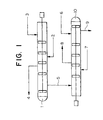
- Fig. 1 is a flow sheet showing a continuous polymerization apparatus used in the examples.
- the propylene- ⁇ -olefin random copolymer (A) comprises a random copolymer of propylene and other olefins than propylene, the propylene content of which is from 90 to 99% by weight. If the propylene content in the copolymer (A) is too low, the heat resistance of the molded articles will lower. If it is too high, the stress-whitening resistance will be insufficient.
- the propylene content in the copolymer (A) is preferably 92 to 99% by weight.
- ⁇ -Olefin components for the propylene- ⁇ -olefin random copolymer (A) can include ethylene, 1-butene, 1-pentene, 1-hexene, 1-octene, 1-decene, 1-dodecene, 4-methyl-1-pentene, 3-methyl-1-pentene and the like. Ethylene is preferable from a viewpoint of manufacturing cost.
- the propylene- ⁇ -olefin random copolymer (B) is a random copolymer of propylene and other ⁇ -olefins than propylene, the propylene content of which is from 55 to 90% by weight. If the propylene content in the copolymer (B) is too high, the low-temperature impact resistance of the molded articles will be insufficient. If it is too low, the transparency will lower.
- the propylene content in the copolymer (B) is preferably from 55 to 85% by weight.
- ⁇ -Olefin components for the propylene- ⁇ -olefin random copolymer (B) can include similar compounds as in the copolymer (A). Ethylene is preferable.
- the propylene polymer blend of the invention comprises 90 to 50% by weight of the propylene- ⁇ -olefin random copolymer (A) and 10 to 50% by weight of the propylene- ⁇ -olefin random copolymer (B) on the weight basis of the polymer blend.
- Preferable polymer blend comprises 80 to 50% by weight of the propylene- ⁇ -olefin random copolymer (A) and 20 to 50% by weight of the propylene- ⁇ -olefin random copolymer (B) on the weight basis of the polymer blend,by which the low-temperature impact resistance of the molded articles can be more improved.
- the propylene polymer blend of the invention satisfying the above-mentioned various properties can be suitably used as a raw material for the manufacture of molded articles which are excellent in transparency, stress-whitening resistance and low-temperature impact resistance.
- the propylene polymer blend of the invention can be produced by any method if it satisfies the above-mentioned various properties, but suitably produced by the two-stage continuous polymerization process in a vapor phase as mentioned above.
- titanium-containing catalyst component are preferable those having the degree of uniformity of not more than 2.0 in the normal distribution. If the degree of uniformity is higher, the powder flowability of the propylene polymer blend is getting worse, so that continuous steady operation becomes difficult.
- organoaluminum compounds can be used those compounds of the formula AlR 1 m X 3-m wherein R 1 is a hydrocarbyl group of 1-20 carbons, X is a halogen atom and m is a positive number of 3 ⁇ m ⁇ 1.5.
- triethylaluminum is used.
- organoaluminum compounds may be used alone or in admixture with two or more kinds.
- methyltrimethoxysilane ethyltrimethoxysilane, n-propyltrimethoxysilane, phenylmethyldimethoxysilane, t-butyltrimethoxysilane, phenyltriethoxysilane, methylethyldimethoxysilane, methylphenyldiethoxysilane, dimethyldimethoxysilane, dimethyldiethoxysilane, diisopropyldimethoxysilane, diisobutyldimethoxysilane, di-t-butyldimethoxysilane, diphenyldimethoxysilane, trimethylmethoxysilane, cyclohexylmethyldimethoxysilane, trimethylethoxysilane, etc.
- diisobutyldimethoxysilane diisopropyldimethoxysilane, di-t-butyldimethoxysilane, cyclohexylmethyldimethoxysilane and diphenyldimethoxysilane are used.
- organosilicon compounds may be used alone or in admixture with two or more kinds.
- the catalysts for a stereoregular olefin polymerization comprising a combination of the titanium-containing solid catalyst component, the organoaluminum compound and the organosilicon compound are used in the copolymerization of propylene with other ⁇ -olefins than propylene in the first polymerization step, but it is preferable to use the titanium-containing solid catalysts which have been preactivated with ⁇ -olefins.
- the preactivation of the titanium-containing solid catalyst component can be conducted in the presence or absence of a similar organoaluminum compoud as used in the first polymerization step.
- the organoaluminum compound is used in the range of 0.1 to 40 mols, preferably 0.3 to 20 mols per mol of a titanium atom in the titanium-containing solid catalyst component, and it is reacted at 10-80°C over a period of 10 minutes to 48 hours with ⁇ -olefin in an amount of 0.1 to 100 grams, preferably 0.5 to 50 grams per gram of the titanium-containing solid catalyst component.
- Preferable organoaluminum compound is triethyl aluminum.
- a similar organosilicon compound as previously used in the first polymerization step may be used in the range of 0.01 to 10 mols, preferably 0.05 to 5 mols per mol of the organoaluminum compound.
- Preferable organosilicon compounds include diisobutyldimethoxysilane, diisopropyldimethoxysilane, di-t-butyldimethoxysilane, cyclohexylmethyldimethoxysilane and diphenyldimethoxysilane.
- ⁇ -olefins used in the preactivation of the titanium-containing solid catalyst component include ethylene, propylene, 1-butene, 1-pentene, 1-hexene, 1-octene, 1-decene, 1-dodecene, 1-tetradecene, 1-hexadecene, 1-octadecene, 1-eicosene, 4-methyl-1-pentene, 3-methyl-1-pentene, etc.
- olefins may be used alone or in admixture with two or more kinds.
- a molecular weight modifier such as hydrogen can be used in combination to modify the molecular weight of the polymer.
- the inert solvents used in the preactivation of the titanium-containing solid catalyst component are those which do not give a remarkable effect on the polymerization reaction, which include liquid saturated hydrocarbons such as hexane, heptane, octane, decane, dodecane and liquid paraffin and a silicone oil having a dimethylpolysiloxane structure.
- These inert solvents may be a single solvent or a mixed solvent of two or more kinds.
- the first polymerization step wherein propylene and other ⁇ -olefins than propylene are copolymerized in a vapor phase in the presence of the preactivated titanium-containing solid catalyst component and then the second polymerization step wherein propylene and ⁇ -olefins are copolymerized with a different propylene content from the first polymerization step.
- the first polymerization step is not limited to a vapor phase polymerization, and may use a slurry polymerization and a bulk polymerization.
- the subsequent second polymerization step is preferably a vapor phase polymerization. Therefore, the present invention uses a vapor phase polymerization also in the first polymerization step. In case where slurry and bulk polymerizations are used as the second polymerization step, the copolymer dissolves out in the solution, which results in the difficulty in the continuation of a stable operation.
- the polymerization conditions for the propylene- ⁇ -olefin random copolymer (A) are varied depending on a polymerization process.
- propylene and other ⁇ -olefins than propylene are fed at a polymerization temperature of 20 to 120°C, preferably 40 to 100°C and at a polymerization pressure of from atmospheric pressure to 9.9 MPa, preferably 0.59 to 5.0 MPa in the presence of a catalyst for stereoregular olefin polymerization comprising a titanium-containing solid catalyst component which has been preactivated by mixing and agitating prescribed amounts of powders, an organoaluminum component and an organosilicon compound, to produce the propylene- ⁇ -olefin random copolymer (A).
- the molar ratio, Al/Ti of the organoaluminum compound used to the titanium-containing solid catalyst component used is 1-500, preferably 10-300.
- the molar number of the titanium-containing solid catalyst component refers to substantially the gram atom number of Ti in the titanium-containing solid catalyst component.
- the molar ratio, Al/Si of the organoaluminum component used to the organosilicon compound used is 1-10, preferably 1.5-8.
- the molar ratio of Al/Si is too high, a low crystalline component in the propylene- ⁇ -olefin random copolymer (A) will increase, the rigidity of the propylene polymer blend will be insufficient and the flowability of the powders will lower, resulting in the difficulty in the continuation of a stable operation. If the molar ratio of Al/Si is too low, the polymerization activity will lower remarkably, resulting in lowered productivity.
- a molecular weight modifier such as hydrogen can be used upon polymerization. It is performed so that the intrinsic viscosity of the propylene- ⁇ -olefin random copolymer (A) can meet the requirements for the present invention. After the propylene- ⁇ -olefin random copolymer (A) was produced, a part of the resultant powders is taken out and used for the measurement of the intrinsic viscosity ([ ⁇ ] A ), melt flow rate (MFR A ) and polymerization yield per weight of catalyst.
- the ⁇ -olefin content in the propylene- ⁇ -olefin random copolymer (B) is controlled so as to provide 10 to 45% by weight, by controlling a gas molar ratio of an ⁇ -olefin monomer to a propylene monomer in the comonomer gas.
- the weight of the propylene- ⁇ -olefin random copolymer (B) relative to the weight of the propylene- ⁇ -olefin random copolymer (A) is adjusted so as to provide 10 to 50% by weight, by control of the polymerization time and using an agent for regulating the polymerization activity of the catalyst such as carbon monoxide and hydrogen sulfide.
- the molecular weight of the propylene- ⁇ -olefin random copolymer (B) is regulated so that the intrinsic viscosity ([ ⁇ B ]) of the propylene- ⁇ -olefin random copolymer (B) can meet the requirements for the propylene polymer blend, by adding a molecular weight modifier such as hydrogen upon the polymerization of the propylene- ⁇ -olefin random copolymer (B).
- the polymerization system may be any of batch, semi-continuous and continuous systems, but a continuous polymerization is industrially preferable.
- the propylene polymer blend of the present invention can be used as a raw material for the molded articles having various shapes formed by a variety of molding methods such as injection, extrusion or the like.
- the propylene polymer blend may be incorporated with known additives used for conventional polyolefins which include antioxidants, neutralizers, antistatic agents, weathering agents, inorganic fillers such as talc, calcium carbonate, silica, mica or the like.
- the polypropylene resin composition of the present invention comprises the propylene polymer blend satisfying the various properties as mentioned above and small amounts of an ⁇ -crystal nucleating agent and can be suitably used as a raw material for the manufacture of the molded articles which are excellent in transparency, stress-whitening resistance and low-temperature impact resistance.
- carboxylic acids can include those excluding aliphatic monocarboxylic acids, such as malonic acid, succinic acid, adipic acid, maleic acid, azelaic acid, sebacic acid, dodecanic diacid, citric acid, butanetricarboxylic acid, butanetetracarboxylic acid, naphthenic acid, cyclopentanecarboxylic acid, 1-methylcyclopentane-carboxylic acid, 2-methylcyclopentanecarboxylic acid, cyclopentanecarboxylic acid, cyclohexanecarboxylic acid, 1-methylcyclohexanecarboxylic acid, 4-methylcyclohexanecarboxylic acid, 3,5-dimethylcyclohexanecarboxylic acid, 4-butylcyclohexanecarboxylic acid, 4-octylcyclohexane-carboxylic acid, cyclohexanecarboxylic acid, 4-cyclohex
- dibenzylidenesorbitol compounds can include 1.3, 2.4-dibenzylidenesorbitol, 1.3-benzylidene-2.4-p-methylbenzylidenesorbitol, 1.3-benzylidene-2.4-p-ethylbenzylidenesorbitol, 1.3-p-methylbenzylidene-2.4-benzylidenesorbitol, 1.3-p-ethylbenzylidene-2.4-benzylidenesorbitol, 1.3-p-methylbenzylidene-2.4-p-ethylbenzylidenesorbitol, 1.3-p-ethylbenzylidene-2.4-p-methylbenzylidenesorbitol, 1.3,2.4-bis(p-methylbenzylidene)sorbitol, 1.3,2.4-bis(p-ethylbenzylidene)sorbitol, 1.3,2.4-bis(p-n-propylbenz
- arylphosphate compounds can include lithium bis(4-t-butylphenyl)phosphate, sodium bis(4-t-butylphenyl)phosphate, lithium bis(4-cumylphenyl)phosphate, sodium bis(4-cumylphenyl)phosphate, potassium bis(4-t-butylphenyl)phosphate, calcium mono(4-t-butylphenyl)phosphate, calcium bis(4-t-butylphenyl)phosphate, magnesium mono(4-t-butylphenyl)phosphate, magnesium bis(4-t-butylphenyl)phosphate, zinc mono(4-t-butylphenyl)phosphate, zinc bis(4-t-butylphenyl)phosphate, aluminum dihydroxy-(4-t-butylphenyl)phosphate, aluminum hydroxy-bis(4-t-butylphenyl)phosphate, aluminum tris(4-t-butylphenyl)phosphate, sodium 2,2'-
- alkali metal salts of aliphatic monocarboxylic acids which are used in admixture with cyclic polyvalent metal aryl phosphate compounds among the said aryl phosphate compounds can include lithium, sodium or potassium salts of acetic acid, lactic acid, propionic acid, acrylic acid, octanoic acid, isooctanoic acid, nonanoic acid, decanoic acid, lauric acid, myristic acid, palmitic acid, stearic acid, oleic acid, linoleic acid, linolenic acid, 12-hydroxystearic acid, ricinolic acid, behenic acid, erucic acid, montanoic acid, melissic acid, stearoyllactic acid, ⁇ -N-laurylaminopropionic acid, ⁇ -N-methyl-N-lauroylaminopropionic acid or the like.
- talc aluminum hydroxy-bis(4-t-butylbenzoate); 1.3,2.4-dibenzylidenesorbitol, 1.3,2.4-bis(p-methylbenzylidene)sorbitol, 1.3,2.4-bis(p-ethylbenzylidene)sorbitol, 1.3,2.4-bis(2',4'-dimethylbenzylidene)sorbitol, 1.3,2.4-bis(3',4'-dimethylbenzylidene)sorbitol, 1.3-p-chlorobenzylidene-2.4-p-methylbenzylidenesorbitol, 1.3,2.4-bis(p-chlorobenzylidene)sorbitol; mixtures with aliphatic monocarboxylic acid alkali metal salts of cyclic polyvalent metal arylphosphate compounds such as sodium bis(4-t-butylphenyl)phosphate, sodium 2,2'-m
- the ⁇ -crystal nucleating agent may be used alone or in combination with two or more kinds.
- the polypropylene resin composition of the present invention comprises 99 to 99.9999% by weight of the propylene polymer blend and 0.0001 to 1%, preferably 0.001 to 0.8% by weight of the ⁇ -crystal nucleating agent.
- the polypropylene resin compositions of the present invention may be incorporated, within the range that would not adversely affect the object of the invention, with various types of additives usually employed for propylene polymer, for example, antioxidants such as phenol-, thioether- or phosphorous-antioxidants; light stabilizers; heavy metal inactivators (copper pollution inhibitors); clarifiers; ⁇ -crystal nucleating agents; lubricants; antistatic agents; anti-fogging agents; anti-blocking agents; anti-dropping agents; radical generators such as peroxides, fire retardants; auxiliaries for fire retardants; pigments; halogen scavengers; dispersing agents or neutralizing agents such as metal soaps; organic or inorganic antibacterial agents; inorganic fillers e.g., talc, mica, clay, wollastonite, zeolite, kaolin, bentonite, perlite, diatomaceous earth, asbestos, calcium carbonate, magnesium carbonate, aluminum hydroxide,
- the polypropylene resin composition of the present invention can be produced, for example by mixing the propylene polymer blend of the invention, the ⁇ -crystal nucleating agents and various additives usually added to the above crystalline propylene polymer in the respective predetermined amounts, using conventional mixing apparatus, e.g., Henschel mixer (trade name), super mixer, ribbon blender, Banbury mixer, etc., and if desired, the resultant resin composition may be melt-kneaded and pelletized at a temperature of 170 to 300°C, preferably 200 to 270°C, using conventional extruders such as a single screw extruder, double-screw extruder, Brabender or roll to form pellets, which are used for the production of a variety of molded articles by various molding processes such as injection, extrusion, blowing or the like.
- conventional mixing apparatus e.g., Henschel mixer (trade name), super mixer, ribbon blender, Banbury mixer, etc.
- the resultant resin composition may be melt-kneaded and
- the dry carrier (20 g), titanium tetrachloride (160 ml) and purified 1,2-dichloroethane (240 ml) were blended in a glass flask, and heated to 100°C with stirring. Then di-isobutylphthalate (6.8 ml) was added. After heating the mixture for additional 2 hours at 100°C, a liquid layer was removed by decantation. Again, titanium tetrachloride (160 ml) and purified 1,2-dichloroethane (320 ml) were added and the resulting mixture was maintained at 100°C by heating for one hour.
- titanium-containing solid catalyst component A-1 A liquid layer was removed by decantation, and the residue was washed with purified hexane and dried to give a titanium-containing solid catalyst component A-1.
- the average particle size of the titanium-containing solid catalyst component A-1 was 115 ⁇ m, and the analytical values were as follows: Mg 19.5 wt.%, Ti 1.6 wt.%, Cl 59.0 wt.%, di-isobutylphthalate 4.5 wt.%.
- the resulting titanium-containing solid catalyst component A-2 had an average particle size of 72 ⁇ m and the following analytical values: Mg 21.1 wt.%, Ti 2.4 wt.%, Cl 64.15 wt.%, di-isobutylphthalate 5.3 wt.%.
Landscapes
- Chemical & Material Sciences (AREA)
- Health & Medical Sciences (AREA)
- Chemical Kinetics & Catalysis (AREA)
- Medicinal Chemistry (AREA)
- Polymers & Plastics (AREA)
- Organic Chemistry (AREA)
- Crystallography & Structural Chemistry (AREA)
- Engineering & Computer Science (AREA)
- Materials Engineering (AREA)
- Compositions Of Macromolecular Compounds (AREA)
Claims (8)
- Mélange de polymères de propylène comprenant (A) un copolymère statistique propylène-α-oléfine présentant une teneur en propylène de 90 à 99 % en poids et (B) un copolymère statistique propylène-α-oléfine présentant une teneur en propylène de 55 à 90 % en poids, où la viscosité intrinsèque ([ηB]) du copolymère B va de 1,3 à 3,5 dl/g, le rapport ([ηB] / [ηA]) de la viscosité intrinsèque ([ηB]) du copolymère B sur la viscosité intrinsèque ([ηA]) du copolymère A va de 0,5 à 1,3 et le produit (ηB/ηA) × (WA/WB) du rapport de viscosité intrinsèque ([ηB] / [ηA]) des deux copolymères et du rapport massique (WA/WB) des deux copolymères va de 1,0 à 4,5, ladite viscosité intrinsèque ([ηB]) du copolymère B étant obtenue à partir de l'équation suivante
- Mélange de polymères selon la revendication 1, dans lequel la teneur en copolymère B va de 10 à 50 % en poids sur la base du poids du mélange de polymères.
- Procédé de fabrication du mélange de polymères de propylène selon la revendication 1 qui comprend en séquence :(a) l'exécution d'une première étape de polymérisation dans laquelle du propylène et d'autres α-oléfines que le propylène sont copolymérisés en phase vapeur en présence d'un catalyseur de polymérisation d'oléfines stéréo-régulières qui comprend une combinaison d'un composant de catalyseur solide contenant du titane présentant une taille moyenne des particules de 20 à 300 µm, un composé organoaluminique de formule AlR 1 / mX3-m dans laquelle R1 est un groupement hydrocarbyle de 1 à 20 carbones, X est un atome d'halogène et m est un nombre positif tel que 3 ≧ m ≧ 1,5, et un composé organosilicique de formule R 2 / XR 3 / YSi(OR4)Z dans laquelle R2 et R4 sont un groupement hydrocarbyle, R3 est un groupement hydrocarbyle ou un groupement hydrocarbyle contenant un hétéroatome, X, Y et Z présentent une relation telle que 0 ≦ X ≦ 2, 1 ≦ Y ≦ 3, 1 ≦ Z ≦ 3, et X+Y+Z=4, pour produire 90 à 50 % en poids d'un copolymère statistique propylène-α-oléfine (A) sur la base du poids total du mélange de polymères et ensuite(b) l'exécution d'une seconde étape de polymérisation dans laquelle du propylène et d'autres α-oléfines que le propylène sont copolymérisés pour produire 10 à 50 % en poids d'un copolymère statistique propylène-α-oléfine (B) présentant une teneur en propylène de 55 à 90 % en poids, sur la base du poids total du mélange de polymères.
- Procédé selon la revendication 3, dans lequel le composant de catalyseur solide contenant du titane présente une uniformité des particules qui n'est pas supérieure à 2,0.
- Procédé selon la revendication 3, dans lequel le rapport molaire du composé organoaluminique sur le composé organosilicique (Al/Si) va de 1 à 10.
- Composition de résine de polypropylène qui comprend 99 à 99,9999 % en poids du mélange de polymères de propylène de la revendication 1 et 1 à 0,0001 % en poids d'un agent de nucléation de cristaux α.
- Composition de résine selon la revendication 6, dans laquelle le mélange de polymères de propylène contient 10 à 50 % en poids d'un copolymère statistique propylène-α-oléfine B sur la base du poids du mélange de polymères.
- Composition de résine selon la revendication 6, dans laquelle l'agent de nucléation de cristaux α est choisi parmi le groupe constitué du talc, de sels métalliques d'acides carboxyliques aromatiques, de composés de dibenzylidène-sorbitol, de sels métalliques d'acides phosphoriques aromatiques, de poly(3-méthyl-1-butène), de polyvinylcyclohexane, de polyallyltriméthylsilane et du mélange de ceux-ci.
Applications Claiming Priority (6)
| Application Number | Priority Date | Filing Date | Title |
|---|---|---|---|
| JP132176/97 | 1997-05-22 | ||
| JP13217797 | 1997-05-22 | ||
| JP13217797A JPH10316727A (ja) | 1997-05-22 | 1997-05-22 | ポリプロピレン系樹脂組成物 |
| JP9132176A JP3024082B2 (ja) | 1997-05-22 | 1997-05-22 | プロピレン系ポリマーブレンドおよびその製造方法 |
| JP132177/97 | 1997-05-22 | ||
| JP13217697 | 1997-05-22 |
Publications (4)
| Publication Number | Publication Date |
|---|---|
| EP0885926A2 EP0885926A2 (fr) | 1998-12-23 |
| EP0885926A3 EP0885926A3 (fr) | 1999-05-19 |
| EP0885926B1 true EP0885926B1 (fr) | 2001-03-21 |
| EP0885926B2 EP0885926B2 (fr) | 2006-08-16 |
Family
ID=26466811
Family Applications (1)
| Application Number | Title | Priority Date | Filing Date |
|---|---|---|---|
| EP98108923A Expired - Lifetime EP0885926B2 (fr) | 1997-05-22 | 1998-05-15 | Mélange de polymères de propylène, procédé pour leur préparation et composition de polymères |
Country Status (7)
| Country | Link |
|---|---|
| US (1) | US6319991B1 (fr) |
| EP (1) | EP0885926B2 (fr) |
| KR (1) | KR100318639B1 (fr) |
| CN (1) | CN1130420C (fr) |
| DE (1) | DE69800610T3 (fr) |
| ID (1) | ID20314A (fr) |
| TW (1) | TW400341B (fr) |
Families Citing this family (40)
| Publication number | Priority date | Publication date | Assignee | Title |
|---|---|---|---|---|
| US6635715B1 (en) | 1997-08-12 | 2003-10-21 | Sudhin Datta | Thermoplastic polymer blends of isotactic polypropylene and alpha-olefin/propylene copolymers |
| US7232871B2 (en) | 1997-08-12 | 2007-06-19 | Exxonmobil Chemical Patents Inc. | Propylene ethylene polymers and production process |
| US6921794B2 (en) | 1997-08-12 | 2005-07-26 | Exxonmobil Chemical Patents Inc. | Blends made from propylene ethylene polymers |
| JP2002519497A (ja) | 1998-07-01 | 2002-07-02 | エクソンモービル・ケミカル・パテンツ・インク | 結晶性プロピレンポリマーと結晶化可能プロピレンポリマーとを含んでなる弾性ブレンド |
| JP2001072815A (ja) * | 1999-09-07 | 2001-03-21 | Chisso Corp | プロピレン系樹脂組成物 |
| ATE272093T1 (de) * | 2000-05-31 | 2004-08-15 | Basell Poliolefine Spa | Propylenpolymerzusammensetzung mit verbesserter schlagzähigkeit und sehr guten optischen eigenschaften |
| JP2001354814A (ja) | 2000-06-16 | 2001-12-25 | Chisso Corp | プロピレン系樹脂シート |
| JP3772648B2 (ja) * | 2000-06-30 | 2006-05-10 | 住友化学株式会社 | ポリプロピレン系樹脂組成物 |
| JP2002018887A (ja) | 2000-07-12 | 2002-01-22 | Chisso Corp | ポリプロピレン樹脂発泡成形体 |
| KR20020041156A (ko) * | 2000-11-27 | 2002-06-01 | 유현식 | 프로필렌-1-부텐 랜덤 공중합체 수지 조성물 |
| DE60238049D1 (de) | 2001-04-12 | 2010-12-02 | Exxonmobil Chem Patents Inc | Verfahren zur Polymerisation von Propylen und Ethylen in Lösung |
| MY132768A (en) * | 2001-10-09 | 2007-10-31 | Basell Poliolefine Italia Spa | Crystalline propylene copolymer compositions having improved sealability and optical properties and reduced solubility. |
| US6927256B2 (en) * | 2001-11-06 | 2005-08-09 | Dow Global Technologies Inc. | Crystallization of polypropylene using a semi-crystalline, branched or coupled nucleating agent |
| US6960635B2 (en) | 2001-11-06 | 2005-11-01 | Dow Global Technologies Inc. | Isotactic propylene copolymers, their preparation and use |
| BR0311862B1 (pt) * | 2002-06-12 | 2013-08-06 | composição copolimérica de propileno, processo para preparar composições copoliméricas de propileno, uso da composição copolimérica de propileno,fibras, filmes, ou artigos moldados. | |
| AU2003245926B2 (en) * | 2002-06-12 | 2007-11-29 | Basell Polyolefine Gmbh | Propylene copolymer compositions having a good low-temperature impact toughness and a high transparency |
| US7541402B2 (en) | 2002-10-15 | 2009-06-02 | Exxonmobil Chemical Patents Inc. | Blend functionalized polyolefin adhesive |
| US7550528B2 (en) | 2002-10-15 | 2009-06-23 | Exxonmobil Chemical Patents Inc. | Functionalized olefin polymers |
| US7700707B2 (en) | 2002-10-15 | 2010-04-20 | Exxonmobil Chemical Patents Inc. | Polyolefin adhesive compositions and articles made therefrom |
| WO2004046214A2 (fr) | 2002-10-15 | 2004-06-03 | Exxonmobil Chemical Patents Inc. | Systeme catalyseur multiple pour la polymerisation d'olefines et polymeres ainsi produits |
| US7579407B2 (en) | 2002-11-05 | 2009-08-25 | Dow Global Technologies Inc. | Thermoplastic elastomer compositions |
| US7459500B2 (en) | 2002-11-05 | 2008-12-02 | Dow Global Technologies Inc. | Thermoplastic elastomer compositions |
| KR100484603B1 (ko) * | 2002-11-11 | 2005-04-20 | 삼성토탈 주식회사 | 내백화성, 내충격성 및 투명성이 우수한 폴리프로필렌수지 조성물 |
| DE602004013277T2 (de) * | 2003-02-12 | 2009-05-28 | Hosokawa Yoko Co., Ltd. | Medizinischer behälter |
| JP3909846B2 (ja) * | 2003-08-01 | 2007-04-25 | 株式会社Adeka | 結晶核剤組成物、その製造方法及び該結晶核剤組成物を含有してなる結晶性高分子組成物 |
| JP2005097358A (ja) * | 2003-09-22 | 2005-04-14 | Showa Denko Plastic Products Co Ltd | ポリプロピレン系成形体及び容器 |
| JP4595316B2 (ja) * | 2003-11-18 | 2010-12-08 | 住友化学株式会社 | プロピレン系重合体、その重合体を含むポリプロピレン系樹脂組成物、および、その組成物からなる射出成形体 |
| JP2008509862A (ja) * | 2004-08-18 | 2008-04-03 | バーゼル・ポリオレフィン・イタリア・ソチエタ・ア・レスポンサビリタ・リミタータ | 改良された赤外線昇温速度を有する透明なポリプロピレン系延伸ブロー成形容器を製造する方法 |
| TW200631965A (en) * | 2004-12-07 | 2006-09-16 | Fina Technology | Random copolymers and formulations useful for thermoforming and blow molding applications |
| DE05010360T1 (de) † | 2005-05-12 | 2006-11-16 | Borealis Technology Oy | Transparente leicht reissbare Folie |
| US20100160518A1 (en) * | 2006-03-21 | 2010-06-24 | Basell Poliolefine Italia S.R.L. | Controlled Nucleated Polymer Composition |
| JP5340909B2 (ja) * | 2007-02-23 | 2013-11-13 | 株式会社大塚製薬工場 | 多層フィルムおよび容器 |
| ES2434738T3 (es) * | 2009-01-23 | 2013-12-17 | Evonik Degussa Gmbh | Polimerización en fase gaseosa de una olefina con alqueno de C4-10 sustituido en 3 |
| WO2011089133A1 (fr) | 2010-01-22 | 2011-07-28 | Borealis Ag | Copolymères de polypropylène présentant une nucléation de cristaux spécifique |
| ES2602161T5 (en) † | 2011-03-18 | 2024-12-17 | Ineos Mfg Belgium Nv | Propylene-ethylene random copolymer |
| US9273200B2 (en) * | 2011-11-30 | 2016-03-01 | Sumitomo Chemical Company, Limited | Propylene polymer composition and molded article thereof |
| ES2569078T3 (es) | 2013-04-22 | 2016-05-06 | Abu Dhabi Polymers Company Limited (Borouge) | Composición de polipropileno multimodal para aplicaciones de tuberías |
| PL2796498T3 (pl) | 2013-04-22 | 2019-03-29 | Abu Dhabi Polymers Company Limited (Borouge) | Multimodalna kompozycja polipropylenowa do zastosowania w rurach |
| KR102187583B1 (ko) * | 2017-03-10 | 2020-12-11 | 현대자동차주식회사 | 폴리프로필렌 수지 조성물 및 이의 성형품 |
| JP7116423B2 (ja) * | 2019-01-31 | 2022-08-10 | 白石カルシウム株式会社 | 樹脂組成物及び射出成形品 |
Family Cites Families (30)
| Publication number | Priority date | Publication date | Assignee | Title |
|---|---|---|---|---|
| JPS5672042A (en) | 1979-11-16 | 1981-06-16 | Sumitomo Chem Co Ltd | Polyolefin resin composition |
| JPS5763350A (en) | 1980-10-03 | 1982-04-16 | Showa Denko Kk | Propylene copolymeric composition |
| JPS5883016A (ja) * | 1981-11-13 | 1983-05-18 | Mitsui Petrochem Ind Ltd | プロピレンブロツク共重合体の製法 |
| US4728705A (en) † | 1986-02-28 | 1988-03-01 | Shell Oil Company | Olefin polymerization catalyst composition |
| JPH0639553B2 (ja) * | 1987-11-11 | 1994-05-25 | 出光石油化学株式会社 | プロピレン重合体組成物 |
| JPH01272612A (ja) | 1988-04-25 | 1989-10-31 | Idemitsu Petrochem Co Ltd | プロピレン共重合体組成物の製造方法 |
| IT1227893B (it) * | 1988-12-14 | 1991-05-14 | Himont Inc Centerville Road Ne | Composizioni polipropileniche aventi buona trasparenza e migliorata resistenza all'urto |
| IT1230133B (it) | 1989-04-28 | 1991-10-14 | Himont Inc | Composizioni polipropileniche plasto-elastiche |
| IT1231768B (it) | 1989-08-02 | 1991-12-21 | Himont Inc | Composizioni polipropileniche adatte alla modifica di bitumi. |
| JP2879347B2 (ja) | 1989-10-02 | 1999-04-05 | チッソ株式会社 | オレフィン重合用触媒の製法 |
| ATE140016T1 (de) † | 1990-05-14 | 1996-07-15 | Shell Oil Co | Polymerzusammensetzungen |
| IT1243188B (it) | 1990-08-01 | 1994-05-24 | Himont Inc | Composizioni poliolefiniche elastoplastiche |
| JP2935878B2 (ja) | 1990-08-22 | 1999-08-16 | チッソ株式会社 | オレフィン重合用触媒成分 |
| JP3198549B2 (ja) | 1991-08-23 | 2001-08-13 | 岩崎電気株式会社 | 送風機構を備えたメタルハライドランプ装置 |
| AU662202B2 (en) * | 1992-02-24 | 1995-08-24 | Montell North America Inc. | Polyolefin compositions having good transparency and impact resistance |
| JP3220251B2 (ja) | 1992-09-10 | 2001-10-22 | ホーチキ株式会社 | 予作動式スプリンクラー消火設備 |
| JPH0693061A (ja) | 1992-09-16 | 1994-04-05 | Sumitomo Chem Co Ltd | ポリプロピレンブロック共重合体及びそのフィルム |
| CA2105834A1 (fr) † | 1992-09-16 | 1994-03-17 | Hajime Sadatoshi | Copolymere avec sequence de polypropylene et pellicule a base de ce copolymere |
| JP2998448B2 (ja) | 1992-09-16 | 2000-01-11 | 住友化学工業株式会社 | ポリプロピレンブロック共重合体及びそのフィルム |
| US5654372A (en) * | 1992-09-16 | 1997-08-05 | Sumitomo Chemical Company Limited | Polypropylene composition and the film thereof |
| JP3163787B2 (ja) | 1992-10-09 | 2001-05-08 | 住友化学工業株式会社 | 改質ポリプロピレンブロック共重合体 |
| JPH06145268A (ja) | 1992-11-06 | 1994-05-24 | Sumitomo Chem Co Ltd | 改質ポリプロピレンブロック共重合体 |
| JP3119003B2 (ja) | 1992-12-21 | 2000-12-18 | 石川島播磨重工業株式会社 | 流動床式廃棄物焼却炉の給塵装置 |
| JP2729346B2 (ja) | 1993-07-08 | 1998-03-18 | 第一工業製薬株式会社 | トリス(トリブロモフェノキシ)−s−トリアジンの製造方法 |
| JP3205439B2 (ja) | 1993-08-04 | 2001-09-04 | 日立建機株式会社 | 作業機の運転室 |
| JP3312801B2 (ja) | 1993-12-21 | 2002-08-12 | 出光石油化学株式会社 | プロピレンエチレン共重合体及びその製造方法 |
| EP0863183B2 (fr) † | 1995-11-24 | 2008-05-28 | Chisso Corporation | Composition de propylene, procede pour la preparer, composition de polypropylene et articles moules |
| JP3656321B2 (ja) | 1996-05-27 | 2005-06-08 | 住友化学株式会社 | オレフィン系ブロック共重合体及びその製造方法 |
| JP3358441B2 (ja) | 1996-06-04 | 2002-12-16 | 住友化学工業株式会社 | ポリプロピレンブロック共重合体 |
| JP3850493B2 (ja) | 1996-09-18 | 2006-11-29 | 住友化学株式会社 | ポリプロピレン系共重合体およびそのフィルム |
-
1998
- 1998-05-12 TW TW087107312A patent/TW400341B/zh not_active IP Right Cessation
- 1998-05-15 DE DE69800610T patent/DE69800610T3/de not_active Expired - Lifetime
- 1998-05-15 EP EP98108923A patent/EP0885926B2/fr not_active Expired - Lifetime
- 1998-05-19 ID IDP980746A patent/ID20314A/id unknown
- 1998-05-19 KR KR1019980017963A patent/KR100318639B1/ko not_active Expired - Lifetime
- 1998-05-20 US US09/081,678 patent/US6319991B1/en not_active Expired - Lifetime
- 1998-05-21 CN CN98108334A patent/CN1130420C/zh not_active Expired - Lifetime
Also Published As
| Publication number | Publication date |
|---|---|
| US6319991B1 (en) | 2001-11-20 |
| DE69800610T2 (de) | 2001-08-02 |
| KR100318639B1 (ko) | 2002-05-09 |
| KR19980087182A (ko) | 1998-12-05 |
| TW400341B (en) | 2000-08-01 |
| CN1130420C (zh) | 2003-12-10 |
| CN1200382A (zh) | 1998-12-02 |
| EP0885926A2 (fr) | 1998-12-23 |
| EP0885926A3 (fr) | 1999-05-19 |
| ID20314A (id) | 1998-11-26 |
| EP0885926B2 (fr) | 2006-08-16 |
| DE69800610D1 (de) | 2001-04-26 |
| DE69800610T3 (de) | 2007-04-05 |
Similar Documents
| Publication | Publication Date | Title |
|---|---|---|
| EP0885926B1 (fr) | Mélange de polymères de propylène, procédé pour leur préparation et composition de polymères | |
| JP4982365B2 (ja) | 高透明性のプロピレンコポリマー組成物 | |
| US4983561A (en) | Process for producing solid catalyst for use in polymerization of olefins | |
| WO1997014725A1 (fr) | Composition de (co)polymere d'olefine, procede de production, catalyseur de (co)polymerisation de l'olefine et procede de production de ce catalyseur | |
| JP6961630B2 (ja) | 核形成ポリオレフィンの調製のための固体触媒 | |
| JPH0782437A (ja) | 剛性および衝撃強度の高度のバランスを有するポリオレフィン組成物 | |
| JP4936885B2 (ja) | マグネシウム化合物、オレフィン重合用触媒及びオレフィン重合体の製造方法 | |
| JP5236481B2 (ja) | 耐衝撃性ポリオレフィン組成物 | |
| US10611864B2 (en) | Synthesis of substituted amidobenzoate compounds, the compounds obtained and the use thereof as phthalate free internal electron donor for polymerization of olefins | |
| KR20240064575A (ko) | 수지 조성물 및 수지 조성물 제조방법 | |
| JPH10316727A (ja) | ポリプロピレン系樹脂組成物 | |
| CN101809043B (zh) | 包括预聚合步骤的制备高度透明的聚丙烯的方法 | |
| JP3443990B2 (ja) | α−オレフィンの重合方法 | |
| EP2029277B1 (fr) | Composant de catalyseur pour la polymérisation d'oléfines | |
| JP4240870B2 (ja) | プロピレン−エチレンランダム共重合体及びその製造方法 | |
| JPH07247311A (ja) | プロピレンブロック共重合体の製造方法 | |
| JP3024082B2 (ja) | プロピレン系ポリマーブレンドおよびその製造方法 | |
| JPH06136054A (ja) | プロピレン系重合体の製造方法 | |
| KR20220056874A (ko) | 헤테로상 프로필렌 공중합체 | |
| EP0759445B1 (fr) | Catalyseur pour la polymérisation d'oléfine et procédé de préparation de polymères d'oléfine utilisant celui-ci | |
| JP2000186109A (ja) | ポリプロピレンの製造方法 | |
| JP3750264B2 (ja) | ポリプロピレン系多層中空成形品 | |
| JP3954830B2 (ja) | プロピレン−エチレンブロック共重合体及びその製造方法 | |
| JP3694929B2 (ja) | プロピレン系共重合体組成物およびその製造方法 | |
| JP2005082773A (ja) | ポリオレフィンの製造方法及び気相重合装置 |
Legal Events
| Date | Code | Title | Description |
|---|---|---|---|
| PUAI | Public reference made under article 153(3) epc to a published international application that has entered the european phase |
Free format text: ORIGINAL CODE: 0009012 |
|
| AK | Designated contracting states |
Kind code of ref document: A2 Designated state(s): BE DE FR |
|
| AX | Request for extension of the european patent |
Free format text: AL;LT;LV;MK;RO;SI |
|
| PUAL | Search report despatched |
Free format text: ORIGINAL CODE: 0009013 |
|
| AK | Designated contracting states |
Kind code of ref document: A3 Designated state(s): AT BE CH CY DE DK ES FI FR GB GR IE IT LI LU MC NL PT SE |
|
| AX | Request for extension of the european patent |
Free format text: AL;LT;LV;MK;RO;SI |
|
| 17P | Request for examination filed |
Effective date: 19990818 |
|
| AKX | Designation fees paid |
Free format text: BE DE FR GB |
|
| 17Q | First examination report despatched |
Effective date: 19991216 |
|
| GRAG | Despatch of communication of intention to grant |
Free format text: ORIGINAL CODE: EPIDOS AGRA |
|
| GRAG | Despatch of communication of intention to grant |
Free format text: ORIGINAL CODE: EPIDOS AGRA |
|
| GRAH | Despatch of communication of intention to grant a patent |
Free format text: ORIGINAL CODE: EPIDOS IGRA |
|
| GRAH | Despatch of communication of intention to grant a patent |
Free format text: ORIGINAL CODE: EPIDOS IGRA |
|
| RBV | Designated contracting states (corrected) |
Designated state(s): BE DE FR |
|
| GRAA | (expected) grant |
Free format text: ORIGINAL CODE: 0009210 |
|
| AK | Designated contracting states |
Kind code of ref document: B1 Designated state(s): BE DE FR |
|
| REF | Corresponds to: |
Ref document number: 69800610 Country of ref document: DE Date of ref document: 20010426 |
|
| ET | Fr: translation filed | ||
| PLBQ | Unpublished change to opponent data |
Free format text: ORIGINAL CODE: EPIDOS OPPO |
|
| PLBI | Opposition filed |
Free format text: ORIGINAL CODE: 0009260 |
|
| 26 | Opposition filed |
Opponent name: THE DOW CHEMICAL COMPANY Effective date: 20011220 |
|
| PLBF | Reply of patent proprietor to notice(s) of opposition |
Free format text: ORIGINAL CODE: EPIDOS OBSO |
|
| PGFP | Annual fee paid to national office [announced via postgrant information from national office to epo] |
Ref country code: FR Payment date: 20020508 Year of fee payment: 5 |
|
| PLBF | Reply of patent proprietor to notice(s) of opposition |
Free format text: ORIGINAL CODE: EPIDOS OBSO |
|
| PLBF | Reply of patent proprietor to notice(s) of opposition |
Free format text: ORIGINAL CODE: EPIDOS OBSO |
|
| PG25 | Lapsed in a contracting state [announced via postgrant information from national office to epo] |
Ref country code: FR Free format text: LAPSE BECAUSE OF NON-PAYMENT OF DUE FEES Effective date: 20040130 |
|
| REG | Reference to a national code |
Ref country code: FR Ref legal event code: ST |
|
| APBP | Date of receipt of notice of appeal recorded |
Free format text: ORIGINAL CODE: EPIDOSNNOA2O |
|
| PLBQ | Unpublished change to opponent data |
Free format text: ORIGINAL CODE: EPIDOS OPPO |
|
| PLAB | Opposition data, opponent's data or that of the opponent's representative modified |
Free format text: ORIGINAL CODE: 0009299OPPO |
|
| R26 | Opposition filed (corrected) |
Opponent name: THE DOW CHEMICAL COMPANY Effective date: 20011220 |
|
| APBQ | Date of receipt of statement of grounds of appeal recorded |
Free format text: ORIGINAL CODE: EPIDOSNNOA3O |
|
| APAA | Appeal reference recorded |
Free format text: ORIGINAL CODE: EPIDOS REFN |
|
| APAH | Appeal reference modified |
Free format text: ORIGINAL CODE: EPIDOSCREFNO |
|
| APBU | Appeal procedure closed |
Free format text: ORIGINAL CODE: EPIDOSNNOA9O |
|
| PUAH | Patent maintained in amended form |
Free format text: ORIGINAL CODE: 0009272 |
|
| STAA | Information on the status of an ep patent application or granted ep patent |
Free format text: STATUS: PATENT MAINTAINED AS AMENDED |
|
| 27A | Patent maintained in amended form |
Effective date: 20060816 |
|
| AK | Designated contracting states |
Kind code of ref document: B2 Designated state(s): BE DE FR |
|
| EN | Fr: translation not filed | ||
| REG | Reference to a national code |
Ref country code: DE Ref legal event code: R082 Ref document number: 69800610 Country of ref document: DE Representative=s name: HOFFMANN - EITLE, DE |
|
| REG | Reference to a national code |
Ref country code: DE Ref legal event code: R082 Ref document number: 69800610 Country of ref document: DE Representative=s name: HOFFMANN - EITLE PATENT- UND RECHTSANWAELTE PA, DE Effective date: 20120117 Ref country code: DE Ref legal event code: R082 Ref document number: 69800610 Country of ref document: DE Representative=s name: HOFFMANN - EITLE, DE Effective date: 20120117 Ref country code: DE Ref legal event code: R081 Ref document number: 69800610 Country of ref document: DE Owner name: JNC CORPORATION, JP Free format text: FORMER OWNER: CHISSO CORP., OSAKA, JP Effective date: 20120117 |
|
| PGFP | Annual fee paid to national office [announced via postgrant information from national office to epo] |
Ref country code: BE Payment date: 20140513 Year of fee payment: 17 |
|
| PG25 | Lapsed in a contracting state [announced via postgrant information from national office to epo] |
Ref country code: BE Free format text: LAPSE BECAUSE OF NON-PAYMENT OF DUE FEES Effective date: 20150531 |
|
| PGFP | Annual fee paid to national office [announced via postgrant information from national office to epo] |
Ref country code: DE Payment date: 20170509 Year of fee payment: 20 |
|
| REG | Reference to a national code |
Ref country code: DE Ref legal event code: R071 Ref document number: 69800610 Country of ref document: DE |