EP0885987A2 - Fibre de polybenzazole à haute module d'élasticité à la traction et son procédé de fabrication - Google Patents
Fibre de polybenzazole à haute module d'élasticité à la traction et son procédé de fabrication Download PDFInfo
- Publication number
- EP0885987A2 EP0885987A2 EP98111194A EP98111194A EP0885987A2 EP 0885987 A2 EP0885987 A2 EP 0885987A2 EP 98111194 A EP98111194 A EP 98111194A EP 98111194 A EP98111194 A EP 98111194A EP 0885987 A2 EP0885987 A2 EP 0885987A2
- Authority
- EP
- European Patent Office
- Prior art keywords
- fiber
- filaments
- polybenzazole
- less
- heat treatment
- Prior art date
- Legal status (The legal status is an assumption and is not a legal conclusion. Google has not performed a legal analysis and makes no representation as to the accuracy of the status listed.)
- Granted
Links
- 239000000835 fiber Substances 0.000 title claims abstract description 161
- 238000000034 method Methods 0.000 title claims abstract description 57
- 230000008569 process Effects 0.000 title claims abstract description 36
- 238000004519 manufacturing process Methods 0.000 title claims abstract description 13
- XLYOFNOQVPJJNP-UHFFFAOYSA-N water Substances O XLYOFNOQVPJJNP-UHFFFAOYSA-N 0.000 claims abstract description 75
- 238000010438 heat treatment Methods 0.000 claims abstract description 43
- 239000013078 crystal Substances 0.000 claims abstract description 39
- 229920000642 polymer Polymers 0.000 claims abstract description 35
- 238000005345 coagulation Methods 0.000 claims abstract description 28
- 230000015271 coagulation Effects 0.000 claims abstract description 28
- 238000000235 small-angle X-ray scattering Methods 0.000 claims abstract description 27
- 238000005406 washing Methods 0.000 claims abstract description 22
- 239000002253 acid Substances 0.000 claims abstract description 11
- 238000004736 wide-angle X-ray diffraction Methods 0.000 claims abstract description 10
- 230000001112 coagulating effect Effects 0.000 claims abstract description 6
- 238000002441 X-ray diffraction Methods 0.000 claims abstract description 5
- 230000003472 neutralizing effect Effects 0.000 claims abstract description 5
- 239000000701 coagulant Substances 0.000 claims description 14
- CSCPPACGZOOCGX-UHFFFAOYSA-N Acetone Chemical compound CC(C)=O CSCPPACGZOOCGX-UHFFFAOYSA-N 0.000 claims description 12
- LFQSCWFLJHTTHZ-UHFFFAOYSA-N Ethanol Chemical compound CCO LFQSCWFLJHTTHZ-UHFFFAOYSA-N 0.000 claims description 12
- LYCAIKOWRPUZTN-UHFFFAOYSA-N Ethylene glycol Chemical compound OCCO LYCAIKOWRPUZTN-UHFFFAOYSA-N 0.000 claims description 12
- OKKJLVBELUTLKV-UHFFFAOYSA-N Methanol Chemical compound OC OKKJLVBELUTLKV-UHFFFAOYSA-N 0.000 claims description 12
- 238000004279 X-ray Guinier Methods 0.000 claims description 10
- LRHPLDYGYMQRHN-UHFFFAOYSA-N N-Butanol Chemical compound CCCCO LRHPLDYGYMQRHN-UHFFFAOYSA-N 0.000 claims description 6
- 239000012046 mixed solvent Substances 0.000 claims description 6
- 150000001299 aldehydes Chemical class 0.000 claims description 3
- 125000004432 carbon atom Chemical group C* 0.000 claims description 3
- 150000002576 ketones Chemical class 0.000 claims description 3
- BDERNNFJNOPAEC-UHFFFAOYSA-N propan-1-ol Chemical compound CCCO BDERNNFJNOPAEC-UHFFFAOYSA-N 0.000 claims description 3
- 239000012770 industrial material Substances 0.000 abstract description 3
- 238000001035 drying Methods 0.000 description 16
- HEMHJVSKTPXQMS-UHFFFAOYSA-M Sodium hydroxide Chemical compound [OH-].[Na+] HEMHJVSKTPXQMS-UHFFFAOYSA-M 0.000 description 15
- NBIIXXVUZAFLBC-UHFFFAOYSA-N Phosphoric acid Chemical compound OP(O)(O)=O NBIIXXVUZAFLBC-UHFFFAOYSA-N 0.000 description 14
- 238000000605 extraction Methods 0.000 description 12
- 238000009987 spinning Methods 0.000 description 12
- 239000000463 material Substances 0.000 description 11
- -1 polyparaphenylene terephthalamide Polymers 0.000 description 10
- 239000000243 solution Substances 0.000 description 9
- 230000000052 comparative effect Effects 0.000 description 8
- 210000001724 microfibril Anatomy 0.000 description 8
- 229920000137 polyphosphoric acid Polymers 0.000 description 8
- 229910000147 aluminium phosphate Inorganic materials 0.000 description 7
- 238000007796 conventional method Methods 0.000 description 7
- AFVFQIVMOAPDHO-UHFFFAOYSA-N Methanesulfonic acid Chemical compound CS(O)(=O)=O AFVFQIVMOAPDHO-UHFFFAOYSA-N 0.000 description 6
- 239000007789 gas Substances 0.000 description 6
- 238000006386 neutralization reaction Methods 0.000 description 6
- 239000002904 solvent Substances 0.000 description 6
- 239000007864 aqueous solution Substances 0.000 description 5
- 239000000203 mixture Substances 0.000 description 5
- 229920000106 Liquid crystal polymer Polymers 0.000 description 4
- PXHVJJICTQNCMI-UHFFFAOYSA-N Nickel Chemical compound [Ni] PXHVJJICTQNCMI-UHFFFAOYSA-N 0.000 description 4
- 235000010724 Wisteria floribunda Nutrition 0.000 description 4
- 238000001816 cooling Methods 0.000 description 4
- 238000003384 imaging method Methods 0.000 description 4
- 238000009826 distribution Methods 0.000 description 3
- 230000000694 effects Effects 0.000 description 3
- 238000005342 ion exchange Methods 0.000 description 3
- 239000002184 metal Substances 0.000 description 3
- 229910052751 metal Inorganic materials 0.000 description 3
- 230000008707 rearrangement Effects 0.000 description 3
- 238000011160 research Methods 0.000 description 3
- 239000000523 sample Substances 0.000 description 3
- DLYUQMMRRRQYAE-UHFFFAOYSA-N tetraphosphorus decaoxide Chemical compound O1P(O2)(=O)OP3(=O)OP1(=O)OP2(=O)O3 DLYUQMMRRRQYAE-UHFFFAOYSA-N 0.000 description 3
- 241000270281 Coluber constrictor Species 0.000 description 2
- RYGMFSIKBFXOCR-UHFFFAOYSA-N Copper Chemical compound [Cu] RYGMFSIKBFXOCR-UHFFFAOYSA-N 0.000 description 2
- QAOWNCQODCNURD-UHFFFAOYSA-N Sulfuric acid Chemical compound OS(O)(=O)=O QAOWNCQODCNURD-UHFFFAOYSA-N 0.000 description 2
- 229920001400 block copolymer Polymers 0.000 description 2
- 229910052802 copper Inorganic materials 0.000 description 2
- 239000010949 copper Substances 0.000 description 2
- 239000004744 fabric Substances 0.000 description 2
- OQZCSNDVOWYALR-UHFFFAOYSA-N flurochloridone Chemical compound FC(F)(F)C1=CC=CC(N2C(C(Cl)C(CCl)C2)=O)=C1 OQZCSNDVOWYALR-UHFFFAOYSA-N 0.000 description 2
- 239000001307 helium Substances 0.000 description 2
- 229910052734 helium Inorganic materials 0.000 description 2
- SWQJXJOGLNCZEY-UHFFFAOYSA-N helium atom Chemical compound [He] SWQJXJOGLNCZEY-UHFFFAOYSA-N 0.000 description 2
- 239000007788 liquid Substances 0.000 description 2
- 238000005259 measurement Methods 0.000 description 2
- 238000000691 measurement method Methods 0.000 description 2
- 229940098779 methanesulfonic acid Drugs 0.000 description 2
- 239000000178 monomer Substances 0.000 description 2
- 229910052759 nickel Inorganic materials 0.000 description 2
- QTWJRLJHJPIABL-UHFFFAOYSA-N 2-methylphenol;3-methylphenol;4-methylphenol Chemical compound CC1=CC=C(O)C=C1.CC1=CC=CC(O)=C1.CC1=CC=CC=C1O QTWJRLJHJPIABL-UHFFFAOYSA-N 0.000 description 1
- COVZYZSDYWQREU-UHFFFAOYSA-N Busulfan Chemical compound CS(=O)(=O)OCCCCOS(C)(=O)=O COVZYZSDYWQREU-UHFFFAOYSA-N 0.000 description 1
- 230000005260 alpha ray Effects 0.000 description 1
- 238000010420 art technique Methods 0.000 description 1
- 230000000386 athletic effect Effects 0.000 description 1
- 230000005540 biological transmission Effects 0.000 description 1
- 239000004566 building material Substances 0.000 description 1
- 238000006243 chemical reaction Methods 0.000 description 1
- 239000003795 chemical substances by application Substances 0.000 description 1
- 239000002131 composite material Substances 0.000 description 1
- 229920001577 copolymer Polymers 0.000 description 1
- 229930003836 cresol Natural products 0.000 description 1
- 230000003247 decreasing effect Effects 0.000 description 1
- 238000009792 diffusion process Methods 0.000 description 1
- 238000011156 evaluation Methods 0.000 description 1
- 238000001704 evaporation Methods 0.000 description 1
- 230000008020 evaporation Effects 0.000 description 1
- 239000002657 fibrous material Substances 0.000 description 1
- 239000000945 filler Substances 0.000 description 1
- 230000009970 fire resistant effect Effects 0.000 description 1
- 125000000623 heterocyclic group Chemical group 0.000 description 1
- 229920001519 homopolymer Polymers 0.000 description 1
- 238000009776 industrial production Methods 0.000 description 1
- 230000008595 infiltration Effects 0.000 description 1
- 238000001764 infiltration Methods 0.000 description 1
- 238000009413 insulation Methods 0.000 description 1
- 230000002535 lyotropic effect Effects 0.000 description 1
- 229920002521 macromolecule Polymers 0.000 description 1
- 230000003287 optical effect Effects 0.000 description 1
- 239000013307 optical fiber Substances 0.000 description 1
- 230000001590 oxidative effect Effects 0.000 description 1
- 239000004014 plasticizer Substances 0.000 description 1
- 229920000904 poly(2,6-benzothiazole) Polymers 0.000 description 1
- 230000001012 protector Effects 0.000 description 1
- 239000012744 reinforcing agent Substances 0.000 description 1
- 239000012779 reinforcing material Substances 0.000 description 1
- 238000007789 sealing Methods 0.000 description 1
- 238000007711 solidification Methods 0.000 description 1
- 230000008023 solidification Effects 0.000 description 1
- 239000000126 substance Substances 0.000 description 1
- 238000012360 testing method Methods 0.000 description 1
- 238000005303 weighing Methods 0.000 description 1
Images

Classifications
-
- D—TEXTILES; PAPER
- D01—NATURAL OR MAN-MADE THREADS OR FIBRES; SPINNING
- D01F—CHEMICAL FEATURES IN THE MANUFACTURE OF ARTIFICIAL FILAMENTS, THREADS, FIBRES, BRISTLES OR RIBBONS; APPARATUS SPECIALLY ADAPTED FOR THE MANUFACTURE OF CARBON FILAMENTS
- D01F6/00—Monocomponent artificial filaments or the like of synthetic polymers; Manufacture thereof
- D01F6/58—Monocomponent artificial filaments or the like of synthetic polymers; Manufacture thereof from homopolycondensation products
- D01F6/74—Monocomponent artificial filaments or the like of synthetic polymers; Manufacture thereof from homopolycondensation products from polycondensates of cyclic compounds, e.g. polyimides, polybenzimidazoles
-
- Y—GENERAL TAGGING OF NEW TECHNOLOGICAL DEVELOPMENTS; GENERAL TAGGING OF CROSS-SECTIONAL TECHNOLOGIES SPANNING OVER SEVERAL SECTIONS OF THE IPC; TECHNICAL SUBJECTS COVERED BY FORMER USPC CROSS-REFERENCE ART COLLECTIONS [XRACs] AND DIGESTS
- Y10—TECHNICAL SUBJECTS COVERED BY FORMER USPC
- Y10T—TECHNICAL SUBJECTS COVERED BY FORMER US CLASSIFICATION
- Y10T428/00—Stock material or miscellaneous articles
- Y10T428/29—Coated or structually defined flake, particle, cell, strand, strand portion, rod, filament, macroscopic fiber or mass thereof
- Y10T428/2913—Rod, strand, filament or fiber
-
- Y—GENERAL TAGGING OF NEW TECHNOLOGICAL DEVELOPMENTS; GENERAL TAGGING OF CROSS-SECTIONAL TECHNOLOGIES SPANNING OVER SEVERAL SECTIONS OF THE IPC; TECHNICAL SUBJECTS COVERED BY FORMER USPC CROSS-REFERENCE ART COLLECTIONS [XRACs] AND DIGESTS
- Y10—TECHNICAL SUBJECTS COVERED BY FORMER USPC
- Y10T—TECHNICAL SUBJECTS COVERED BY FORMER US CLASSIFICATION
- Y10T428/00—Stock material or miscellaneous articles
- Y10T428/29—Coated or structually defined flake, particle, cell, strand, strand portion, rod, filament, macroscopic fiber or mass thereof
- Y10T428/2913—Rod, strand, filament or fiber
- Y10T428/2933—Coated or with bond, impregnation or core
- Y10T428/2964—Artificial fiber or filament
- Y10T428/2967—Synthetic resin or polymer
Definitions
- the present invention relates to a polybenzazole fiber having a markedly superior tensile modulus and an adequate strength as an industrial material.
- the tensile modulus of a high tensile strength polybenzazole fiber prepared by the above-mentioned conventional production method only reaches 290 GPa at most, even by a heat treatment at a temperature of not less than 350°C as disclosed in US Patent No. 5296185.
- yarn (collective filaments) having a tensile strength of not less than 5.0 GPa and a tensile modulus of not less than 290 GPa cannot be readily produced at an industrial level, except for an isolated case where molecular relaxation was suppressed under specific spinning conditions (Japanese Patent Unexamined Publication No. 325840/1996).
- the present invention provides the following.
- the X-ray analysis to determine the fine structure of the inventive polybenzazole fiber may be a wide-angle X-ray diffraction or a small-angle X-ray scattering.
- the polymer concentration of the dope is at least about 7% by weight, more preferably at least 10% by weight, and most preferably at least 14% by weight.
- the maximum concentration thereof is limited by actual handling property such as solubility of polymer and viscosity of the dope. Due to such limiting factors, the polymer concentration of the dope does not generally exceed 20% by weight.
- a suitable polymer, copolymer and dope are synthesized by a known method. For example, the methods described in Wolfe et al., USP 4533693 (August 6, 1985), Sybert et al., USP 4772678 (September 20, 1988), Harris, USP 4847350 (July 11, 1989), and others are used. According to Gregory et al., USP 5089591 (February 18, 1992), a polymer substantially consisting of PBO can be made to have a high molecular weight at a high reaction rate under the conditions of comparatively high temperature and high shear in a dehydrative acid solvent.
- the filaments drawn in the draw zone are then led to an extraction (coagulation) bath.
- the extraction bath may be of any type.
- funnel type, water tank type, aspirator type or waterfall type bath may be used.
- the extraction solution (coagulant) is preferably an aqueous solution of phosphoric acid, water, methanol, ethanol, acetone, ethylene glycol and the like, which have no substantial compatibility with polybenzazole, Ultimately, not less than 99.0%, preferably not less than 99,5%, of the phosphoric acid contained in the filaments is extracted in the extraction bath.
- the filaments after washing with water are immediately dried to adjust water content to not more than 100% and wound up.
- water contained in the filaments is preferably adjusted to 100% - 4%, more preferably 50% - 10%, most preferably 40% - 15%, before heat treatment to achieve high tensile modulus in the next heat treatment.
- the water content of the filaments before heat treatment is adjusted by leaving the filaments in an electric oven, by passing the fiber on a drying roll or other method which is generally known.
- the fiber thus produced surprisingly has a crystal orientation parameter of not more than 0.009, preferably not more than 0.007, and more preferably not more than 0.005, as determined by wide-angle X-ray diffraction.
- the indexing of the diffraction point used in the invention followed the crystal model proposed by Fratini et al. (Material Research Society Symposium Proceedings vol. 134, p.431 (1989)).
- the tension to be applied is not less than 1.0 GPa, preferably not less than 2.8 GPa.
- the tension is applied by a general industrial method. For example, a tension is applied between Godet rolls having different rotation speeds.
- This treatment is effective when applied to a dry fiber completely without water, but more effectively applied to a fiber before drying when the fiber contains water, solvent or non-solvent.
- the treatment is done during or after passage through extraction (coagulation) bath, during or after passage through neutralization bath, during or after passage through a step of washing with water, or during drying step (water content adjustment).
- the time for applying the tension is any as long as it is not less than 0.00001 second. This treatment of an extremely short time is sufficient to exert a superior effect.
- the nonaqueous coagulant is preferably aldehyde, ketone, alcohol having 10 or less carbon atoms or a mixed solvent thereof, and more preferably ethanol, methanol, propanol, butanol, ethylene glycol, acetone or a mixed solvent thereof.
- a tension may be applied to the filaments containing polyphosphoric acid, coagulant, neutralizing agent or water, during or between coagulation, washing with water, neutralization and drying. It is also preferable that a filament bundle be neutralized with an aqueous solution of sodium hydroxide and the like and washed with water.
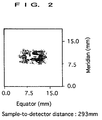
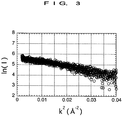
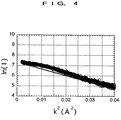
- a nonaqueous coagulation liquid which has no substantial compatibility with polybenzazole makes the inventive process distinct from the conventional methods using water or an aqueous solution of phosphoric acid as a coagulant, in terms of the fine structure of filaments after water washing. That is, when a small-angle X-ray scattering image of filaments after water washing is measured by the method to be mentioned later, an equatorial streak occurs. The dependence of the scattering intensity on the scattering angle is characteristic.
- Fig. 3 shows a Guinier plot showing a dependence on scattering angle in a small-angle X-ray scattering of the polybenzazole fiber prepared by a conventional method after water washing and before drying (water content adjustment), and Fig.
- the crystal orientation of the filaments washed with water was determined and compared by the method to be described later.
- the fiber filament after water washing which was prepared by a conventional method, had a crystal orientation parameter ⁇ sin 2 ⁇ ⁇ of not less than 0.025, whereas that of the fiber filaments prepared by the inventive process was less than 0.025. Therefore, the crystal orientation of the spun filaments prepared by the process of the present invention is higher than by the conventional method.
- the fiber filaments were exposed to X-ray thus taken out.
- the diffracted X-ray from the fiber was detected using an imaging plate (FDL UR-V, Fuji Photo Film Co., Ltd.) placed at 80 mm behind the fiber filament (reverse direction from X-ray source).
- the time necessary for the determination to obtain sufficient intensity of diffraction was 20 min to 120 min.
- the intensity of diffraction detected on the imaging plate was analyzed by PIXsysTEM20 (manufactured by JEOL LTD.) using a digital micrography (FDL5000, Fuji Photo Film Co., Ltd.).
- the scattering intensity recorded on the imaging plate was read by a digital micrography (FDL5000, Fuji Photo Film Co., Ltd.). The obtained data was compensated for the background scattering and the Guinier plot was drawn relative to the intensity (I) of scattering in the equatorial direction. That is, a natural logarithm of intensity of scattering, In(I), alter compensation of background scattering was plotted against the square of scattering vector, k 2 .
- the water content of the fiber was measured using a weight method. That is, the fiber to be the target of the water content measurement was weighed using a chemical balance and the fiber was left in an electric oven adjusted to 230°C for 30 minutes, which was followed by weighing.
- the water content was the proportion (wt%) of water evaporated from the fiber to the fiber weight after evaporation of water.
- the density was measured using a dry type automatic densitometer Accupyc (picnometer using helium gas) manufactured by Micromeritics.
- the temperature was adjusted to 20°C and humidity was set to 65% RH.
- the test fiber (10 m) was wound up on a wrap reel and weighed. This was converted to the weight of 9000 m.
- a spinning dope comprising polyparaphenylene benzobisoxazole (14.0 wt%) and polyphosphoric acid containing phosphorus pentaoxide (83.17%), which was obtained by the method disclosed in US Patent No. 4533693 and which had an intrinsic viscosity as measured using a methanesulfonic add solution at 30°C of 24.4 dL/g, was used.
- the dope was filtered through a metal mesh and kneaded and defoamed in a twin-screw kneader. The pressure was raised and the dope was spun from a spinneret having 34 holes at 170°C while maintaining the dope temperature at 170°C.
- Example 2 In the same manner as in Example 1 except that the water content upon drying was set to 1% and dried, and water was attached to the filament by a kiss roll until the water content was 21%, a fiber was obtained.
- a spinning dope comprising polyparaphenylene benzobisoxazole (14.0 wt%) and polyphosphoric acid containing phosphorus pentaoxide (83.17%), which was obtained by the method disclosed in US Patent No. 4533693 and which had an intrinsic viscosity as measured using a methanesulfonic acid solution at 30°C of 24.4 dL/g, was used.
- the dope was filtered through a metal mesh and kneaded and defoamed in a twin-screw kneader. The pressure was raised and the dope was spun from a spinneret having 166 holes at 170°C while maintaining the dope temperature at 170°C.
- the delivered filaments were cooled with cooling air at 60°C and led into a coagulation bath containing 20% aqueous phosphoric acid solution at 20 ⁇ 2°C.
- the filaments were wound on a Godet roll, given a spinning speed and washed in the second extraction bath containing ion exchange water.
- the filaments were immersed in a 0.1N sodium hydroxide solution for neutralization. During or after water washing the filaments, a tension under the conditions (pretension) shown in Table 2 was applied.
- the filaments were wound up, dried in a dry oven at 80°C to a water content of not more than 2%.
- the fiber was heated at 600°C under a tension of 7.0 g/d for 1.4 seconds to give a fiber.
- Example 2 In the same manner as in Example 4 except that the conditions of application of tension were changed to those in Table 2, a fiber was obtained.
- the properties of the fibers obtained in Examples 4-6 and Comparative Examples 4-7 are shown in Table 2.
- a spinning dope comprising polyparaphenylene benzobisoxazole (14.0 wt%) and polyphosphoric acid containing phosphorus pentaoxide (83.17%), which was obtained by the method disclosed in US Patent No. 4533693 and which had an intrinsic viscosity as measured using a methanesulfonic acid solution at 30°C of 24.4 dL/g, was used.
- the dope was filtered through a metal mesh and kneaded and defoamed in a twin-screw kneader. The pressure was raised and the dope was spun from a spinneret having 34 holes at 170°C while maintaining the dope temperature at 170°C.
- the delivered filaments were cooled with cooling air at 60°C and further cooled naturally to 40°C.
- the filaments were led into a coagulation bath containing coagulants listed in Table 3 at 30 ⁇ 2°C.
- the filaments were led into a coagulation bath containing 20% aqueous phosphoric add solution at 20 ⁇ 2°C.
- the filaments were wound on a Godet roll, given a spinning speed and washed in the second extraction bath containing ion exchange water.
- the filaments were immersed in a 0.1N sodium hydroxide solution for neutralization.
- the filaments were washed with water, wound up, dried in a dry oven at 80°C to a water content of not more than 2%.
- the filaments were heated at 600°C under a tension of 7.0 g/d for 1.4 seconds to give a fiber. The results are shown in Table 3.
- the polybenzazole fiber of the present invention has a specific fine structure of fiber, as mentioned above, and also has a high strength and a high tensile modulus heretofore unavailable.
- the inventive polybenzazole fiber can be manufactured at an industrial scale with ease.
- the inventive fiber is tremendously effective in expanding the field of possible utilization as an industrial material with high practical advantages.
- the fiber can be used for a wide range of uses, inclusive of tension material such as cable, electric wire, optical fiber and rope; aviation and space materials such as rocket insulation, rocket casing, pressure container, string of space suit and planet probe balloon; impact resistant material such as bulletproof material; cutproof materials such as gloves; heat resistant flame resistant material such as fire resistant suit, heat resistant felt, gasket for plant, heat resistant knit fabric, various sealings, heat resistant cushion and filter; rubber reinforcing material for belt, tire, sole, rope, hose and the like; sport-related material such as fishing line, fishing rod, tennis racket, table tennis racket, badminton racket, golf shaft, club head, gut, string, sail cloth, athletic shoes, running shoes, spiked shoes, skating shoes, game bicycle and wheel thereof, road racer, piste racer, mountain bike, composite wheel, disc wheel, tension disc, spoke, braking wire, transmission wire, game wheelchair and wheel thereof, protector, ski, stock, helmet and parachute; friction resistant material and clutch facing; reinforcing agents for various building materials
Landscapes
- Chemical & Material Sciences (AREA)
- Chemical Kinetics & Catalysis (AREA)
- General Chemical & Material Sciences (AREA)
- Engineering & Computer Science (AREA)
- Textile Engineering (AREA)
- Artificial Filaments (AREA)
Applications Claiming Priority (6)
| Application Number | Priority Date | Filing Date | Title |
|---|---|---|---|
| JP16155497 | 1997-06-18 | ||
| JP16155497A JP3801734B2 (ja) | 1997-06-18 | 1997-06-18 | 高弾性率ポリベンザゾール繊維及びその製造法 |
| JP161554/97 | 1997-06-18 | ||
| JP280789/97 | 1997-10-14 | ||
| JP28078997A JP4009885B2 (ja) | 1997-10-14 | 1997-10-14 | 高弾性率ポリベンザゾール繊維及びその製造法 |
| JP28078997 | 1997-10-14 |
Publications (3)
| Publication Number | Publication Date |
|---|---|
| EP0885987A2 true EP0885987A2 (fr) | 1998-12-23 |
| EP0885987A3 EP0885987A3 (fr) | 1999-05-12 |
| EP0885987B1 EP0885987B1 (fr) | 2004-03-24 |
Family
ID=26487641
Family Applications (1)
| Application Number | Title | Priority Date | Filing Date |
|---|---|---|---|
| EP98111194A Expired - Lifetime EP0885987B1 (fr) | 1997-06-18 | 1998-06-18 | Fibre de polybenzazole à haut module d'élasticité à la traction et son procédé de fabrication |
Country Status (4)
| Country | Link |
|---|---|
| US (1) | US6040050A (fr) |
| EP (1) | EP0885987B1 (fr) |
| DE (1) | DE69822556T2 (fr) |
| TW (1) | TW445312B (fr) |
Cited By (3)
| Publication number | Priority date | Publication date | Assignee | Title |
|---|---|---|---|---|
| KR20000061085A (ko) * | 1999-03-23 | 2000-10-16 | 시바타 미노루 | 고탄성율 폴리벤자졸섬유 및 그의 제조법 |
| WO2001083862A1 (fr) * | 2000-04-28 | 2001-11-08 | Toyo Boseki Kabushiki Kaisha | Fibres de polybenzasol et son utilisation |
| EP1884540A4 (fr) * | 2005-05-25 | 2012-10-03 | Asahi Organic Chem Ind | Engrenage en résine pour système de commande d alimentation électrique et système de commande d alimentation électrique l utilisant |
Families Citing this family (30)
| Publication number | Priority date | Publication date | Assignee | Title |
|---|---|---|---|---|
| DE60336140D1 (de) * | 2002-06-27 | 2011-04-07 | Teijin Aramid Bv | Verfahren zur herstellung von synthetisch-organischen fasern mit hoher festigkeit und/oder hohem modul aus aromatischen heterozyklischen steifen polymeren |
| WO2005056893A1 (fr) * | 2003-12-11 | 2005-06-23 | Toyo Boseki Kabushiki Kaisha | Fibre de polybenzole et article comprenant cette fibre |
| US7288493B2 (en) * | 2005-01-18 | 2007-10-30 | Honeywell International Inc. | Body armor with improved knife-stab resistance formed from flexible composites |
| US20100015406A1 (en) | 2005-05-16 | 2010-01-21 | Ashok Bhatnagar | Laminated felt articles |
| US20070293109A1 (en) * | 2005-06-16 | 2007-12-20 | Ashok Bhatnagar | Composite material for stab, ice pick and armor applications |
| US7601416B2 (en) | 2005-12-06 | 2009-10-13 | Honeywell International Inc. | Fragment and stab resistant flexible material with reduced trauma effect |
| US20070202331A1 (en) * | 2006-02-24 | 2007-08-30 | Davis Gregory A | Ropes having improved cyclic bend over sheave performance |
| US7642206B1 (en) | 2006-03-24 | 2010-01-05 | Honeywell International Inc. | Ceramic faced ballistic panel construction |
| US8007202B2 (en) | 2006-08-02 | 2011-08-30 | Honeywell International, Inc. | Protective marine barrier system |
| US7622405B1 (en) | 2006-09-26 | 2009-11-24 | Honeywell International Inc. | High performance same fiber composite hybrids by varying resin content only |
| US8652570B2 (en) * | 2006-11-16 | 2014-02-18 | Honeywell International Inc. | Process for forming unidirectionally oriented fiber structures |
| US7762175B1 (en) | 2006-11-30 | 2010-07-27 | Honeywell International Inc. | Spaced lightweight composite armor |
| US20100203273A1 (en) * | 2006-12-13 | 2010-08-12 | Jhrg, Llc | Anti-chafe cable cover |
| US7794813B2 (en) * | 2006-12-13 | 2010-09-14 | Honeywell International Inc. | Tubular composite structures |
| US8017529B1 (en) | 2007-03-21 | 2011-09-13 | Honeywell International Inc. | Cross-plied composite ballistic articles |
| US7994074B1 (en) | 2007-03-21 | 2011-08-09 | Honeywell International, Inc. | Composite ballistic fabric structures |
| US7993478B2 (en) | 2007-03-28 | 2011-08-09 | Honeywell International, Inc. | Method to apply multiple coatings to a fiber web |
| US8256019B2 (en) | 2007-08-01 | 2012-09-04 | Honeywell International Inc. | Composite ballistic fabric structures for hard armor applications |
| US7994075B1 (en) | 2008-02-26 | 2011-08-09 | Honeywell International, Inc. | Low weight and high durability soft body armor composite using topical wax coatings |
| CN102372252B (zh) * | 2010-08-23 | 2016-06-15 | 清华大学 | 碳纳米管复合线及其制备方法 |
| US20130059496A1 (en) | 2011-09-06 | 2013-03-07 | Honeywell International Inc. | Low bfs composite and process of making the same |
| US9023452B2 (en) | 2011-09-06 | 2015-05-05 | Honeywell International Inc. | Rigid structural and low back face signature ballistic UD/articles and method of making |
| US9023450B2 (en) | 2011-09-06 | 2015-05-05 | Honeywell International Inc. | High lap shear strength, low back face signature UD composite and the process of making |
| US9291433B2 (en) | 2012-02-22 | 2016-03-22 | Cryovac, Inc. | Ballistic-resistant composite assembly |
| US9273418B2 (en) | 2012-05-17 | 2016-03-01 | Honeywell International Inc. | Hybrid fiber unidirectional tape and composite laminates |
| US10132010B2 (en) | 2012-07-27 | 2018-11-20 | Honeywell International Inc. | UHMW PE fiber and method to produce |
| DE102014109671B3 (de) * | 2014-07-10 | 2015-11-05 | Universität Hamburg | Verfahren und Vorrichtung zur Röntgenanalyse |
| US9909240B2 (en) | 2014-11-04 | 2018-03-06 | Honeywell International Inc. | UHMWPE fiber and method to produce |
| US10612189B2 (en) | 2015-04-24 | 2020-04-07 | Honeywell International Inc. | Composite fabrics combining high and low strength materials |
| US20170297295A1 (en) | 2016-04-15 | 2017-10-19 | Honeywell International Inc. | Blister free composite materials molding |
Family Cites Families (7)
| Publication number | Priority date | Publication date | Assignee | Title |
|---|---|---|---|---|
| US5273703A (en) * | 1992-08-13 | 1993-12-28 | The Dow Chemical Company | Process for post-spin finishing of polybenzoxazole fibers |
| US5294390A (en) * | 1992-12-03 | 1994-03-15 | The Dow Chemical Company | Method for rapid spinning of a polybenzazole fiber |
| US5296185A (en) * | 1992-12-03 | 1994-03-22 | The Dow Chemical Company | Method for spinning a polybenzazole fiber |
| US5288445A (en) * | 1992-12-03 | 1994-02-22 | The Dow Chemical Company | Rapid heat-treatment method for polybenzaole fiber |
| JP3480128B2 (ja) * | 1995-05-31 | 2003-12-15 | 東洋紡績株式会社 | 高弾性率ポリパラフエニレンベンゾビスオキサゾールマルチフィラメントの製造法 |
| JP3613719B2 (ja) * | 1994-12-23 | 2005-01-26 | 東洋紡績株式会社 | ポリベンザゾール繊維の製造方法 |
| US5772942A (en) * | 1995-09-05 | 1998-06-30 | Toyo Boseki Kabushiki Kaisha | Processes for producing polybenzazole fibers |
-
1998
- 1998-06-16 US US09/097,997 patent/US6040050A/en not_active Expired - Fee Related
- 1998-06-18 DE DE69822556T patent/DE69822556T2/de not_active Expired - Fee Related
- 1998-06-18 EP EP98111194A patent/EP0885987B1/fr not_active Expired - Lifetime
-
1999
- 1999-04-07 TW TW088105483A patent/TW445312B/zh not_active IP Right Cessation
Cited By (5)
| Publication number | Priority date | Publication date | Assignee | Title |
|---|---|---|---|---|
| KR20000061085A (ko) * | 1999-03-23 | 2000-10-16 | 시바타 미노루 | 고탄성율 폴리벤자졸섬유 및 그의 제조법 |
| WO2001083862A1 (fr) * | 2000-04-28 | 2001-11-08 | Toyo Boseki Kabushiki Kaisha | Fibres de polybenzasol et son utilisation |
| US6673445B2 (en) | 2000-04-28 | 2004-01-06 | Toyo Boseki Kabushiki Kaisha | Polybenzazole fibers and their utilization |
| KR100708791B1 (ko) * | 2000-04-28 | 2007-04-18 | 도요 보세키 가부시키가이샤 | 폴리벤자졸 섬유 및 그의 용도 |
| EP1884540A4 (fr) * | 2005-05-25 | 2012-10-03 | Asahi Organic Chem Ind | Engrenage en résine pour système de commande d alimentation électrique et système de commande d alimentation électrique l utilisant |
Also Published As
| Publication number | Publication date |
|---|---|
| DE69822556T2 (de) | 2005-02-24 |
| TW445312B (en) | 2001-07-11 |
| EP0885987A3 (fr) | 1999-05-12 |
| DE69822556D1 (de) | 2004-04-29 |
| US6040050A (en) | 2000-03-21 |
| EP0885987B1 (fr) | 2004-03-24 |
Similar Documents
| Publication | Publication Date | Title |
|---|---|---|
| EP0885987B1 (fr) | Fibre de polybenzazole à haut module d'élasticité à la traction et son procédé de fabrication | |
| EP0834608B1 (fr) | Fibre de polybenzazole et son procédé de fabrication | |
| US6884506B2 (en) | Polybenzazole fiber | |
| AU2001252627B2 (en) | Polybenzasol fiber and use of the same | |
| JPH0978350A (ja) | ポリベンザゾール繊維の製造方法およびポリベンザゾール中間乾燥繊維 | |
| JP4009885B2 (ja) | 高弾性率ポリベンザゾール繊維及びその製造法 | |
| JP3480128B2 (ja) | 高弾性率ポリパラフエニレンベンゾビスオキサゾールマルチフィラメントの製造法 | |
| GB1590367A (en) | Hygroscopic fibres and filaments | |
| US4180617A (en) | Hygroscopic fibers and filaments | |
| JP3801734B2 (ja) | 高弾性率ポリベンザゾール繊維及びその製造法 | |
| JP3508876B2 (ja) | 高弾性率ポリベンザゾール繊維 | |
| JP3770375B2 (ja) | ポリベンザゾール繊維 | |
| KR20000061085A (ko) | 고탄성율 폴리벤자졸섬유 및 그의 제조법 | |
| JPH11335926A (ja) | 高弾性率ポリベンザゾール繊維及びその製造方法 | |
| KR20240048273A (ko) | 파라계 아라미드 섬유 및 이의 제조 방법 | |
| JP4524060B2 (ja) | 産業資材用制電ポリベンザゾール組成物 | |
| JP3815596B2 (ja) | ポリベンザゾール繊維 | |
| JP3702979B2 (ja) | 黒色ポリベンザゾール繊維 | |
| JP2000096340A (ja) | ポリベンザゾール繊維 | |
| KR20220135879A (ko) | 복합 섬유 | |
| KR20220135880A (ko) | 복합 섬유의 제조 방법 | |
| JP2006057214A (ja) | ポリベンザゾール繊維 | |
| JP2006348442A (ja) | ポリベンザゾール繊維及びその製造方法 | |
| KR20080022832A (ko) | 전방향족 폴리아미드 필라멘트 및 그의 제조방법 | |
| JP2005133220A (ja) | ポリベンザゾ−ル繊維 |
Legal Events
| Date | Code | Title | Description |
|---|---|---|---|
| PUAI | Public reference made under article 153(3) epc to a published international application that has entered the european phase |
Free format text: ORIGINAL CODE: 0009012 |
|
| AK | Designated contracting states |
Kind code of ref document: A2 Designated state(s): DE FR GB NL |
|
| AX | Request for extension of the european patent |
Free format text: AL;LT;LV;MK;RO;SI |
|
| PUAL | Search report despatched |
Free format text: ORIGINAL CODE: 0009013 |
|
| AK | Designated contracting states |
Kind code of ref document: A3 Designated state(s): AT BE CH CY DE DK ES FI FR GB GR IE IT LI LU MC NL PT SE |
|
| AX | Request for extension of the european patent |
Free format text: AL;LT;LV;MK;RO;SI |
|
| 17P | Request for examination filed |
Effective date: 19991105 |
|
| AKX | Designation fees paid |
Free format text: DE FR GB NL |
|
| 17Q | First examination report despatched |
Effective date: 20020531 |
|
| GRAP | Despatch of communication of intention to grant a patent |
Free format text: ORIGINAL CODE: EPIDOSNIGR1 |
|
| GRAS | Grant fee paid |
Free format text: ORIGINAL CODE: EPIDOSNIGR3 |
|
| GRAA | (expected) grant |
Free format text: ORIGINAL CODE: 0009210 |
|
| AK | Designated contracting states |
Kind code of ref document: B1 Designated state(s): DE FR GB NL |
|
| REG | Reference to a national code |
Ref country code: GB Ref legal event code: FG4D |
|
| REF | Corresponds to: |
Ref document number: 69822556 Country of ref document: DE Date of ref document: 20040429 Kind code of ref document: P |
|
| ET | Fr: translation filed | ||
| PLBE | No opposition filed within time limit |
Free format text: ORIGINAL CODE: 0009261 |
|
| STAA | Information on the status of an ep patent application or granted ep patent |
Free format text: STATUS: NO OPPOSITION FILED WITHIN TIME LIMIT |
|
| 26N | No opposition filed |
Effective date: 20041228 |
|
| PGFP | Annual fee paid to national office [announced via postgrant information from national office to epo] |
Ref country code: NL Payment date: 20080603 Year of fee payment: 11 Ref country code: DE Payment date: 20080626 Year of fee payment: 11 |
|
| PGFP | Annual fee paid to national office [announced via postgrant information from national office to epo] |
Ref country code: FR Payment date: 20080617 Year of fee payment: 11 |
|
| PGFP | Annual fee paid to national office [announced via postgrant information from national office to epo] |
Ref country code: GB Payment date: 20080618 Year of fee payment: 11 |
|
| GBPC | Gb: european patent ceased through non-payment of renewal fee |
Effective date: 20090618 |
|
| NLV4 | Nl: lapsed or anulled due to non-payment of the annual fee |
Effective date: 20100101 |
|
| REG | Reference to a national code |
Ref country code: FR Ref legal event code: ST Effective date: 20100226 |
|
| PG25 | Lapsed in a contracting state [announced via postgrant information from national office to epo] |
Ref country code: FR Free format text: LAPSE BECAUSE OF NON-PAYMENT OF DUE FEES Effective date: 20090630 |
|
| PG25 | Lapsed in a contracting state [announced via postgrant information from national office to epo] |
Ref country code: GB Free format text: LAPSE BECAUSE OF NON-PAYMENT OF DUE FEES Effective date: 20090618 |
|
| PG25 | Lapsed in a contracting state [announced via postgrant information from national office to epo] |
Ref country code: DE Free format text: LAPSE BECAUSE OF NON-PAYMENT OF DUE FEES Effective date: 20100101 |
|
| PG25 | Lapsed in a contracting state [announced via postgrant information from national office to epo] |
Ref country code: NL Free format text: LAPSE BECAUSE OF NON-PAYMENT OF DUE FEES Effective date: 20100101 |