EP0886024B1 - Clé électronique - Google Patents
Clé électronique Download PDFInfo
- Publication number
- EP0886024B1 EP0886024B1 EP98110298A EP98110298A EP0886024B1 EP 0886024 B1 EP0886024 B1 EP 0886024B1 EP 98110298 A EP98110298 A EP 98110298A EP 98110298 A EP98110298 A EP 98110298A EP 0886024 B1 EP0886024 B1 EP 0886024B1
- Authority
- EP
- European Patent Office
- Prior art keywords
- key
- state
- activated
- individual code
- code
- Prior art date
- Legal status (The legal status is an assumption and is not a legal conclusion. Google has not performed a legal analysis and makes no representation as to the accuracy of the status listed.)
- Expired - Lifetime
Links
Images


Classifications
-
- B—PERFORMING OPERATIONS; TRANSPORTING
- B60—VEHICLES IN GENERAL
- B60R—VEHICLES, VEHICLE FITTINGS, OR VEHICLE PARTS, NOT OTHERWISE PROVIDED FOR
- B60R25/00—Fittings or systems for preventing or indicating unauthorised use or theft of vehicles
- B60R25/20—Means to switch the anti-theft system on or off
- B60R25/25—Means to switch the anti-theft system on or off using biometry
- B60R25/257—Voice recognition
-
- B—PERFORMING OPERATIONS; TRANSPORTING
- B60—VEHICLES IN GENERAL
- B60R—VEHICLES, VEHICLE FITTINGS, OR VEHICLE PARTS, NOT OTHERWISE PROVIDED FOR
- B60R25/00—Fittings or systems for preventing or indicating unauthorised use or theft of vehicles
- B60R25/01—Fittings or systems for preventing or indicating unauthorised use or theft of vehicles operating on vehicle systems or fittings, e.g. on doors, seats or windscreens
- B60R25/04—Fittings or systems for preventing or indicating unauthorised use or theft of vehicles operating on vehicle systems or fittings, e.g. on doors, seats or windscreens operating on the propulsion system, e.g. engine or drive motor
-
- G—PHYSICS
- G07—CHECKING-DEVICES
- G07C—TIME OR ATTENDANCE REGISTERS; REGISTERING OR INDICATING THE WORKING OF MACHINES; GENERATING RANDOM NUMBERS; VOTING OR LOTTERY APPARATUS; ARRANGEMENTS, SYSTEMS OR APPARATUS FOR CHECKING NOT PROVIDED FOR ELSEWHERE
- G07C9/00—Individual registration on entry or exit
- G07C9/00174—Electronically operated locks; Circuits therefor; Nonmechanical keys therefor, e.g. passive or active electrical keys or other data carriers without mechanical keys
- G07C9/00182—Electronically operated locks; Circuits therefor; Nonmechanical keys therefor, e.g. passive or active electrical keys or other data carriers without mechanical keys operated with unidirectional data transmission between data carrier and locks
-
- G—PHYSICS
- G07—CHECKING-DEVICES
- G07C—TIME OR ATTENDANCE REGISTERS; REGISTERING OR INDICATING THE WORKING OF MACHINES; GENERATING RANDOM NUMBERS; VOTING OR LOTTERY APPARATUS; ARRANGEMENTS, SYSTEMS OR APPARATUS FOR CHECKING NOT PROVIDED FOR ELSEWHERE
- G07C9/00—Individual registration on entry or exit
- G07C9/00174—Electronically operated locks; Circuits therefor; Nonmechanical keys therefor, e.g. passive or active electrical keys or other data carriers without mechanical keys
- G07C9/00857—Electronically operated locks; Circuits therefor; Nonmechanical keys therefor, e.g. passive or active electrical keys or other data carriers without mechanical keys where the code of the data carrier can be programmed
-
- G—PHYSICS
- G07—CHECKING-DEVICES
- G07C—TIME OR ATTENDANCE REGISTERS; REGISTERING OR INDICATING THE WORKING OF MACHINES; GENERATING RANDOM NUMBERS; VOTING OR LOTTERY APPARATUS; ARRANGEMENTS, SYSTEMS OR APPARATUS FOR CHECKING NOT PROVIDED FOR ELSEWHERE
- G07C9/00—Individual registration on entry or exit
- G07C9/00174—Electronically operated locks; Circuits therefor; Nonmechanical keys therefor, e.g. passive or active electrical keys or other data carriers without mechanical keys
- G07C9/00182—Electronically operated locks; Circuits therefor; Nonmechanical keys therefor, e.g. passive or active electrical keys or other data carriers without mechanical keys operated with unidirectional data transmission between data carrier and locks
- G07C2009/00206—Electronically operated locks; Circuits therefor; Nonmechanical keys therefor, e.g. passive or active electrical keys or other data carriers without mechanical keys operated with unidirectional data transmission between data carrier and locks the keyless data carrier being hand operated
- G07C2009/00222—Electronically operated locks; Circuits therefor; Nonmechanical keys therefor, e.g. passive or active electrical keys or other data carriers without mechanical keys operated with unidirectional data transmission between data carrier and locks the keyless data carrier being hand operated by more than one push button
-
- G—PHYSICS
- G07—CHECKING-DEVICES
- G07C—TIME OR ATTENDANCE REGISTERS; REGISTERING OR INDICATING THE WORKING OF MACHINES; GENERATING RANDOM NUMBERS; VOTING OR LOTTERY APPARATUS; ARRANGEMENTS, SYSTEMS OR APPARATUS FOR CHECKING NOT PROVIDED FOR ELSEWHERE
- G07C9/00—Individual registration on entry or exit
- G07C9/00174—Electronically operated locks; Circuits therefor; Nonmechanical keys therefor, e.g. passive or active electrical keys or other data carriers without mechanical keys
- G07C9/00182—Electronically operated locks; Circuits therefor; Nonmechanical keys therefor, e.g. passive or active electrical keys or other data carriers without mechanical keys operated with unidirectional data transmission between data carrier and locks
- G07C2009/00261—Electronically operated locks; Circuits therefor; Nonmechanical keys therefor, e.g. passive or active electrical keys or other data carriers without mechanical keys operated with unidirectional data transmission between data carrier and locks the keyless data carrier having more than one function
-
- G—PHYSICS
- G07—CHECKING-DEVICES
- G07C—TIME OR ATTENDANCE REGISTERS; REGISTERING OR INDICATING THE WORKING OF MACHINES; GENERATING RANDOM NUMBERS; VOTING OR LOTTERY APPARATUS; ARRANGEMENTS, SYSTEMS OR APPARATUS FOR CHECKING NOT PROVIDED FOR ELSEWHERE
- G07C9/00—Individual registration on entry or exit
- G07C9/00174—Electronically operated locks; Circuits therefor; Nonmechanical keys therefor, e.g. passive or active electrical keys or other data carriers without mechanical keys
- G07C2009/00579—Power supply for the keyless data carrier
- G07C2009/00587—Power supply for the keyless data carrier by battery
-
- G—PHYSICS
- G07—CHECKING-DEVICES
- G07C—TIME OR ATTENDANCE REGISTERS; REGISTERING OR INDICATING THE WORKING OF MACHINES; GENERATING RANDOM NUMBERS; VOTING OR LOTTERY APPARATUS; ARRANGEMENTS, SYSTEMS OR APPARATUS FOR CHECKING NOT PROVIDED FOR ELSEWHERE
- G07C9/00—Individual registration on entry or exit
- G07C9/00174—Electronically operated locks; Circuits therefor; Nonmechanical keys therefor, e.g. passive or active electrical keys or other data carriers without mechanical keys
- G07C2009/00753—Electronically operated locks; Circuits therefor; Nonmechanical keys therefor, e.g. passive or active electrical keys or other data carriers without mechanical keys operated by active electrical keys
- G07C2009/00769—Electronically operated locks; Circuits therefor; Nonmechanical keys therefor, e.g. passive or active electrical keys or other data carriers without mechanical keys operated by active electrical keys with data transmission performed by wireless means
-
- G—PHYSICS
- G07—CHECKING-DEVICES
- G07C—TIME OR ATTENDANCE REGISTERS; REGISTERING OR INDICATING THE WORKING OF MACHINES; GENERATING RANDOM NUMBERS; VOTING OR LOTTERY APPARATUS; ARRANGEMENTS, SYSTEMS OR APPARATUS FOR CHECKING NOT PROVIDED FOR ELSEWHERE
- G07C2209/00—Indexing scheme relating to groups G07C9/00 - G07C9/38
- G07C2209/60—Indexing scheme relating to groups G07C9/00174 - G07C9/00944
- G07C2209/62—Comprising means for indicating the status of the lock
Definitions
- the invention relates to an electronic key the preamble of claim 1.
- Electronic keys are used to operate a Locking system.
- a Locking system In particular, it can be a Door locking and / or ignition lock system on a motor vehicle act.
- Such an electronic key is from DE-OS 195 05 190 known.
- the electronic key has the means intended for operation, such as a transmitter and possibly a recipient. With the help of these funds is between the electronic key and the Locking system at least one coded operating signal transferable. Is the subsequent evaluation of the transmitted operating signal positive, so that it is the electronic keys belonging to the locking system acts, corresponding functions of the locking system actuated.
- These functions can be the Access authorization by locking or unlocking the car doors, an immobilizer by enabling the engine control via act the ignition lock or the like.
- Another electronic key for a locking system is known from US 4,786,900 A.
- the electronic Key is in a wristwatch with a keypad arranged, with a light-emitting diode on the wristwatch Sending a code for an electronic lock is used.
- a password is in a register of the electronic Key saved. Sending the code for the Lock is only possible if the correct password is in the key is entered.
- DE 195 11 386 C1 also shows Locking system for a motor vehicle with, for example arranged in a wristwatch, portable transmitter, the Can send code signals to the receiver in the motor vehicle.
- the code signals are triggered by voice recognition by a password spoken by the user.
- the invention has for its object that from US 4 786 900 A known electronic key develop that actuation of the locking system even without expensive additional systems if the associated one is stolen Key can be prevented.
- the key is provided with an additional individual code programmable.
- the key can be by programming the individual code or Reactivating an already programmed individual Put codes in an activated state in which the Intended use of the key is blocked. A stolen key is therefore not for the thief useful. Only if you enter the correct individual The key then goes back to the inactivated code State in which the key is intended is usable. Further refinements of the invention are Subject of the subclaims.
- the individual code is entered using the am Housing of the key located to trigger the Transmission of the coded operating signal Actuators, for example by means of the closing button to lock the car doors, the opening button to Unlock the car doors and the trunk button to open the trunk lid.
- Actuators There are one out of one Existing individual code Actuators corresponding digits in the digits Number code assigned and the number of operations of the assigned actuator codes the respective digit.
- a delay time for activation is expedient the actuators for entering the individual code after triggering the switch command between the activated and inactivated state provided, the expiry of Delay time, for example, by a lamp on Housing of the key can be displayed.
- Switching between the activated and the inactivated state can be done using one of the Actuators can be triggered, preferably the Close button to switch to the activated state and the opening button to switch over to the deactivated Condition used. It can just as well be on the housing additional actuator, in particular a button for Triggering the switchover command between the activated and be arranged in the inactivated state.
- the reactivation of an already programmed individual Codes can also be interrupted by repeated Actuate one of the actuators, for example by pressing the close button three times, respectively.
- During the driving operation of the motor vehicle can by pressing any actuator for a longer time also be reactivated so that the Key after removal from the ignition lock without knowledge of the individual code is not usable.
- the thief steals a robbery of a stopped motor vehicle then only one subsequently no longer in operation removable motor vehicle.
- To find out the Preventing individual codes by trying can be a Game protection through a permanent switch to the activated state with blocking of coded operating signal occur if the wrong number of times individual code is entered. Deactivating the blocked condition is then only in the workshop by a Reset the key using a special code, the related to the respective key or the motor vehicle is possible.
- the key can have an indication.
- This display can be, for example, by high-frequency, flashing continuously for a certain period of time Realize illuminant on the housing of the key, whereby the Flashing when an actuator on the key is pressed in activated state takes place. It is equally possible that at Actuation of an actuator a light emitting diode on the housing in the activated state red and in the deactivated state of the Key lights up green. Can be used as illuminant For example, the battery control lamp on the housing of the Key can be used. Of course, not only the current state of the key also the transition itself between the activated and inactive state are displayed.
- the key is in one activated state switchable, in which the transmission of the coded operating signal only for a limited one Period up to a certain date for a limited period Number of starts in the ignition lock or the like released is. After the period, after reaching the date, Exhaustion of the number of starts or the like The key then automatically switches to the activated state.
- the data is preferably programmed for the unlocked state in the deactivated state, whereby for Entering the data in turn the actuators on the key can be used.
- To determine the course of the limited period or reaching the date for the Activation can have the key a real time clock.
- the time of the real-time clock in the key etc. if required in the ad.
- the key If the key is in the ignition lock, it can be activated at the same time the state of charge of a for the intended operation of the Key-serving battery located in the housing Control can be output in this display. falls below the state of charge a certain limit, the user is through an alarm function alerted to this. It can also for other battery-powered consumers, for example for a cell phone, the charge status is shown in this display become.
- the advantages achieved with the invention are in particular in that an individual security of the key against unauthorized use by the user in a simple manner can be made.
- This individual security exists in a simple additional programming of the key with a multi-digit, especially 2 or 3-digit individual numerical code or a language code. It is particularly advantageous that this backup by the Programming the key only in vulnerable Areas, such as in the hotel, restaurant or the like. Can succeed while otherwise the key is without this individual backups can be used in a conventional manner can.
- the handling of the key with the invention Security function is simple. So they can be Keys already existing keys also for programming or activation as well as for deleting or overwriting or for Use deactivation of the individual coding. Also the Reuse or reactivate those already selected Programming for the individual code through repeated pressing an actuator longer, for example by Pressing the close button 3 times is possible.
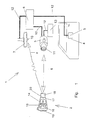
- Fig. 1 is intended for a motor vehicle Locking system 1 schematically according to part of its functions shown.
- the locking system 1 can be remote controlled for access authorization control, in the present case the car doors 4 as well as the trunk lid of the Motor vehicle remotely controllable up to a certain maximum Lock and unlock distance from the motor vehicle, as well possibly further functions on the motor vehicle trigger.
- Actuators 14, 15, 16 on the housing 17 of the key 2 which are operated manually by the user.
- the actuators 14, 15, 16 of the key 2 are designed as keys and with Provide symbols that indicate the corresponding functions.
- the Front part 18 of the housing 17 associated means by one shown schematically in FIG. 3 in the housing 17th located battery 33 or other energy source Energy is supplied, it is a transmitter 22 and possibly a receiver 23, which is shown in more detail in FIG are seen.
- This is between the key 2 and one for example, on the inside mirror 7 centrally in the motor vehicle arranged receiving and transmitting device 10 for the Locking system 1 a coded operating signal 8 can be transmitted, wherein the transmission of the operating signal 8 by means of Actuators 14, 15, 16 can be triggered.
- the transferred Operating signal 8 is one in the motor vehicle Signal processing device 6 supplied and after positive Evaluation of the operating signal 8, i.e.
- the authorized key 2 is, for example, in the respective car door 4 control unit 5, which with the signal processing device 6, for example, via a Bus system 12, such as the known CAN bus, is connected, for locking or unlocking the car doors 4 or Trunk lid operated.
- the control unit 5 can for example, a central locking system known per se act.
- the locking system 1 has an electronic one Ignition lock 3, with an associated operating unit 13 in Connection is established.
- the operating unit 13 can for example, the electronic engine control or the like Act motor vehicle.
- FIG. 2 is a schematic Block diagram for the functions of key 2 shown.
- the key 2 has a circuit 21 for generating the Operating signals 8, 9 for access authorization and Immobilizer.
- the actuators 14, 15, 16 are with the Circuit 21 connected to the generation of the corresponding Trigger operating signals 8, 9.
- operating signals 8, 9 for the key 2 are usually electromagnetic signals, such as RF signals and / or infrared signals or the like.
- the circuit 21 is an IR transmitter diode as transmitter 22 and an IR receiving diode as Receiver 23 connected.
- the electronic Key 2 with an additional, individual code programmable by the user, for which a circuit 24 for Programming is arranged in key 2.
- the key 2 has an activated state in which the transmission of the coded operating signal 8, 9 is locked and thus the intended operation of the key 2 is blocked. Furthermore, the key 2 has an inactivated state, in the transmission of the coded operating signal 8, 9 is released so that the key 2 as intended is operable.
- the Function of the gate 25 in the key 2 also in terms of software be realized.
- the Key 2 switchable Between the activated and inactivated state is the Key 2 switchable, with a transition from the activated State in the deactivated state, however, only after additional entry of the correct individual code on Key 2 is done. Conversely, the transition from inactivated the programming of the in the activated state individual codes, preferably an earlier one programmed, individual code is overwritten. Instead of reprogramming the individual code can also Reactivating an individual previously programmed Codes, especially of the last programmed individual Codes, if the key 2 already exists programmed at least once with an individual code has been.
- the key 2 at will of the User can be switched to the activated state.
- the user is therefore free to choose the key 2 only switch to the activated state if this is actually needed. For example, it can in endangered areas, such as in hotels, restaurants or the like offer to key 2 in the activated state too offset.
- deactivation i.e. the key 2 is in the deactivated state offset when handing over the key 2 in the workshop be made.
- the key 2 is then full functional, without the individual Code should be communicated.
- a for the individual code Number code in the form of a PIN (Personal Identification Number) number used. It is particularly useful a three-digit number code as an individual code use.
- the corresponding digits in the number code one each Actuator 14, 15, 16 are assigned.
- the first digit of the key 14, the second Digit of the opening key 15 and the third digit be assigned to the trunk button 16.
- the number of Actuations of the associated actuating member 14, 15, 16 encodes the respective digit. For example, encodes one five times actuation of the closing button 14 the number "five" in the first digit of the individual code.
- Actuator 19 which can be designed as a button, arranged.
- the actuation of the additional actuator 19 by the user provides a signal to circuit 24 for the programming.
- the key 2 in the activated state the input of the individual codes via the actuators 14, 15, 16 made and this input by the circuit 24 on it checks whether it is the correct individual code is. Switching takes place only if this is the case in the inactivated state, the circuit 24 the Transmission of the operating signal 8, 9 on the gate 25 releases.
- key 2 is in the deactivated state State, the system switches to the activated state and the user can then via the actuators 14, 15, 16 enter a new individual code into the circuit 24 or a previous individual code in circuit 24 reactivate.
- an additional actuator 19 can alternatively switching between the activated and the inactivated state also by means of one of the actuators 14, 15, 16 itself can be triggered.
- Fig. 2 that is Presence of an additional actuator 19 as Alternative indicated by the fact that the connection between the additional actuator 19 and the circuit 24th is shown in dashed lines.
- the Lock button 14 via line 40 for switching to activated state and the opening button 15 via the line 41 used to switch to the inactivated state.
- the switchover can also be carried out by pressing it simultaneously be triggered by two of the three actuators 14, 15, 16. Otherwise the switchover is analogous to the above Description.
- the reactivation of one can already programmed, old individual codes when switching made from the deactivated to the activated state become.
- Such a reactivation can in particular by repeated intermittent actuation of an actuator 14, 15, 16 take place, for example by three times Interrupted pressing of the closing button 14.
- the input of the individual code is thereby Programming of the key 2 saved. Only if the User a new individual code in circuit 24 program the old individual code want to overwrite is a complete new entry required.
- the key 2 with its front part 18 is inserted in the ignition lock 2, the Switching to the activated state while reactivating the old individual codes by holding down one any actuator 14, 15, 16 can be made can.
- the Key 2 inconspicuous for future use be made unusable. Once the thief's engine switches off, the vehicle can no longer be started because the key 2 is then in the activated state.
- the user is in the state of the Key 2 is visualized via a display on the housing 17.
- the key 2 is in the activated state and is one of the actuators 14, 15, 16 actuated or the Key 2 inserted in the ignition lock 3, so this can Display the user to visualize that the transfer of the Operating signals 8, 9 is blocked.
- This display can, for example, by high-frequency flashing of the illuminant 20 on the housing 17 take place, the illuminant 20 for a certain time is controlled by a flashing circuit 27. It offers on, as the lamp 20, the battery control lamp Key 2 to use.
- the battery control light shows the battery charge status in the sense of "OK” or “Not okay "after a corresponding test at the Actuation of one of the actuators 14, 15, 16 performed is.
- the illuminant 20 can also be used as a light emitting diode be formed, which in the activated state red and in inactivated state lights up green. Of course you can the lamp 20 also visualize to the user that a Switching to the activated and / or deactivated state of key 2 has taken place.
- the display can be a display showing the respective number entered.
- Light-emitting diode which is the illuminant 20 can, or to use several light emitting diodes or the like. at each actuation of the actuator 14, 15, 16 for input the respective digit of the individual code lights up Illuminant 20 then on so that the user by counting can determine the number entered in each case.
- Key 2 is used to program the individual code inserted into the ignition lock 3 of the motor vehicle.
- the one at the Programming entered individual code is then in Display 30 output in the motor vehicle and can if necessary still to be corrected.
- one corresponding user guidance in plain text or with symbols in the Display 30 take place. If necessary, it can then offer the actuators 31 assigned to the display 30 instead of the on Key 2 located actuators 14, 15, 16 for the Use input when programming.
- a code for the individual code is also Linguistic encryption is conceivable as a code.
- Fig. 3 is shown alternatively, is available with the circuit 21 Generation of the operating signals 8, 9 a circuit 42 for Speech recognition in connection.
- the circuit 42 can Key 2 itself or in the motor vehicle, for example with the instrument cluster 29, which is why the connecting line 44 between the circuit 42 and the circuit 21 is drawn with dashed lines.
- a microphone 43 is connected to the circuit 42, so that the individual code is spoken by the user can be entered.
- the speech recognition can be dependent on the speaker or also take place independently of the speaker, in particular the "Activate" or "Deactivate" commands from the user via the Microphone 43 can be entered.
- the electronic key is 2 in another state switchable.
- this further condition is the transmission of the coded operating signal 8, 9 only released for a limited period of time, so that in this further state follows as an unlocked state referred to as.
- the Key 2 automatically in the activated state.
- the Holders of the key 2 can prevent the Motor vehicle beyond the limited period of one Third parties can be used, which is particularly the case with Can lend or rent the motor vehicle. Only the owner can, based on the knowledge of the individual codes the key 2 back into the switch inactive state.
- the unlocked state can just as easily be changed by others Data can be characterized, for example a release by a certain date, for a limited number of Starts in ignition lock 3 or the like. Then switches the key 2 after reaching this date or after Exhaustion of the number of starts in the activated Condition around.
- other data stored in the key 2 can also be shown on the display 30 as soon as the key 2 is inserted into the ignition lock 3.
- These other data can be driver and vehicle data stored in key 2, for example. In particular, it can be displayed to which driver key 2 is assigned. With the help of the stored driver data, for example, a mirror and seat adjustment or the like assigned to the respective driver can be carried out automatically in the motor vehicle.
- a real-time clock for determination is located in key 2 the expiry of the limited period or for reaching the Date.
- the respective time of the real-time clock can then Display 30 shown in the instrument cluster 29 and also made become. It is advisable to take over the time of day in Instrument cluster 29 located clock 32 in key 2 switching to the enabled state is possible.
- the state of charge for the intended Operation of the key 2 serving located in the housing 17 Battery 33 or other energy source that has a Connection 28, circuits 21, 24, 26, 27 etc. in key 2 powered, checked by an automatic test and for control for the user in this display 30 in Motor vehicle are issued. Monitoring this Voltage then releases a note for the driver, for example off when the battery 33 is low on charge. Of course, it can also be used for others battery-operated consumers in motor vehicles, such as cell phones or the like. Like., The state of charge is monitored and in the display 30 be issued.
- the invention is not based on that described and illustrated Embodiment limited. Rather, it includes everyone professional training within the framework of the The inventive concept. So the invention can not only Keys for motor vehicles but also on keys for front doors with electronic locks, Find garage doors or the like. Also on Remote controls, for example for televisions or the like, can advocate the invention.
Landscapes
- Engineering & Computer Science (AREA)
- Mechanical Engineering (AREA)
- Physics & Mathematics (AREA)
- General Physics & Mathematics (AREA)
- Human Computer Interaction (AREA)
- Computer Networks & Wireless Communication (AREA)
- Lock And Its Accessories (AREA)
Claims (12)
- Clé électronique destinée à un système de fermeture (1), notamment un système de fermeture de portières et/ou de serrure de contact dans un véhicule automobile, comportant des moyens servant au fonctionnement adapté à la destination de la clé électronique (2), tels qu'un émetteur (22) et, le cas échéant, un récepteur (23), si bien que, dans un fonctionnement adapté à la destination, au moins un signal codé d'actionnement (8, 9) peut être transmis entre la clé électronique (2) et le système de fermeture (1), de telle sorte que, après une évaluation positive du signal d'actionnement (8, 9) transmis, des fonctions du système de fermeture (1) soient déclenchées, par exemple, dans le cas d'un véhicule automobile, l'autorisation d'accès par un verrouillage ou un déverrouillage des portières (4) de l'auto, le blocage automatique par libération de la serrure de contact (3) ou analogues, et dans lequel la clé (2) peut être programmée par l'utilisateur, avec un code individuel supplémentaire, notamment un code numérique ou un code vocal, pour effectuer le lancement de la transmission du signal codé d'actionnement (8, 9),
caractérisée en ce que la clé (2) présente un état actif, dans lequel la transmission du signal codé d'actionnement (8, 9) est bloquée de façon correspondante au fonctionnement adapté à la destination, ainsi qu'un état inactif, dans lequel la transmission du signal codé d'actionnement (8, 9) est autorisée de façon correspondante au fonctionnement adapté à la destination, en ce que la clé (2) peut être commutée entre l'état actif et l'état inactif, en ce qu'un passage de l'état actif à l'état inactif est effectué simplement après l'entrée supplémentaire du code individuel au niveau de la clé (2), et en ce que, lors du passage de l'état actif à l'état inactif, on peut procéder à la programmation du code individuel ou à la réactivation d'un code individuel déjà programmé. - Clé électronique selon la revendication 1,
caractérisée en ce que les moyens servant au fonctionnement adapté à la destination sont disposés dans un boítier (17) de la clé (2), en ce que des organes d'actionnement (14, 15, 16), prévus pour le déclenchement de la transmission du signal codé d'actionnement (8), sont situés au niveau du boítier (17), et en ce que les organes d'actionnement (14, 15, 16) sont, de préférence, des touches, notamment trois touches, à savoir une touche de fermeture (14) pour le verrouillage des portières (4) de l'auto, une touche d'ouverture (15) pour le déverrouillage des portières (4) de l'auto, ainsi qu'une touche de coffre à bagages (16) servant à l'ouverture du couvercle du coffre à bagages. - Clé électronique selon la revendication 1 ou 2,
caractérisée en ce que l'entrée du code individuel est effectuée à l'aide des organes d'actionnement (14, 15, 16) situés au niveau du boítier (17), en ce que, de préférence, dans le cas d'un code individuel consistant en un code numérique, des positions de chiffres correspondants du code numérique sont associées aux organes d'actionnement (14, 15, 16), le nombre des actionnements de l'organe d'actionnement (14, 15, 16) associé ayant pour effet de coder le chiffre correspondant et en ce que, en outre et de préférence, un temps de retard est prévu pour la déconnexion des organes d'actionnement (14, 15, 16) pour l'entrée du code individuel après le déclenchement de l'instruction de commutation, l'écoulement du temps de retard étant indiqué par un moyen lumineux (20) ou analogue, au niveau du boítier (17). - Clé électronique selon la revendication 1, 2 ou 3,
caractérisée en ce qu'un organe d'actionnement (19) supplémentaire, notamment une touche, est disposé au niveau du boítier (17) pour le déclenchement de la commutation entre l'état actif et l'état inactif. - Clé électronique selon la revendication 1, 2 ou 3,
caractérisée en ce que la commutation entre l'état actif et l'état inactif peut être déclenchée à l'aide d'un organe d'actionnement (14, 15, 16) et, de préférence, la touche de fermeture (14) étant utilisée pour le passage à l'état actif, tandis que la touche de fermeture (15) est utilisée pour le passage à l'état inactif, ou en ce que la commutation peut être déclenchée par un actionnement simultané de deux organes d'actionnement (14, 15, 16). - Clé électronique selon l'une des revendications 1 à 5,
caractérisée en ce que la réactivation d'un code individuel déjà programmé, lors de la commutation de l'état inactif à l'état actif, peut être effectuée en actionnant plusieurs fois de façon interrompue un organe d'actionnement (14, 15, 16), notamment en exerçant trois fois une pression interrompue sur la touche de fermeture (14), ou pendant que le véhicule automobile roule, par un actionnement plus long d'un organe d'actionnement (14, 15, 16) quelconque, et en ce que, de préférence, l'état actif est établi de manière permanente avec blocage du signal codé de fonctionnement (8, 9) à la manière d'un dispositif de protection pour les jeux, si un code individuel faux est entré plusieurs fois, la remise à l'état inactif n'étant alors possible qu'à l'aide d'un code spécial, par exemple à l'atelier. - Clé électronique selon l'une des revendications 1 à 6,
caractérisée en ce qu'il est prévu une indication pour l'état actif et/ou pour l'état inactif et/ou pour le passage à l'état actif ou bien à l'état inactif de la clé (2), l'indication pouvant être fournie, par exemple, par un clignotement rapide pendant une durée déterminée, d'un moyen lumineux (20) situé au niveau du boítier (17), notamment du voyant lumineux de vérification de la pile, ou par l'intermédiaire d'une diode luminescente située au niveau du boítier (17), avec une lumière rouge à l'état actif et une lumière verte à l'état inactif. - Clé électronique selon l'une des revendications 1 à 7,
caractérisée en ce que la clé (2) peut être commutée pour prendre un état déconnecté, dans lequel la transmission du signal codé de fonctionnement (8, 9) est possible uniquement pendant un laps de temps limité, jusqu'à une date déterminée, pour un nombre limité d'opérations de démarrage dans la serrure de contact (3) ou analogue et en ce que, après l'écoulement du laps de temps, lorsque la date est atteinte, lorsque le nombre d'opérations de démarrage est épuisé, ou analogues, la clé (2) passe alors automatiquement à l'état actif, tandis que, de préférence, la programmation des données pour l'état déconnecté s'effectue à l'état inactif. - Clé électronique selon la revendication 8,
caractérisée en ce que les organes d'actionnement (14, 15, 16), situés sur la clé (2), servent à l'entrée des données pour l'état déconnecté, par exemple en ce que pour l'entrée du laps de temps limité, on utilise la touche de fermeture (14) pour les heures, la touche d'ouverture (15) pour les jours et la touche de coffre (16) pour les mois et en ce que, de préférence, la clé (2) comporte une horloge en temps réel pour la détermination de l'écoulement du laps de temps limité, l'arrivée à la date déterminée ou analogues. - Clé électronique selon l'une des revendications 1 à 9,
caractérisée en ce qu'il est prévu, au niveau du boítier (17) un dispositif indicateur, tel qu'un afficheur, au moins une diode luminescente ou analogue pour la visualisation de l'entrée du code individuel et/ou pour le guidage de l'utilisateur lors de la programmation de la clé (2), pour la visualisation des données pour l'état déconnecté, pour celle d'autres données mémorisées dans la clé (2), ou analogues. - Clé électronique selon l'une des revendications 1 à 10,
caractérisée en ce qu'un dispositif indicateur (30) situé dans le véhicule automobile, par exemple un afficheur placé au niveau du volant, dans l'instrument combiné (29) sur le tableau de bord ou analogues, est utilisé pour la visualisation de l'entrée du code individuel et/ou pour le guidage de l'utilisateur lors de la programmation de la clé (2), pour la visualisation des données pour l'état déconnecté, pour celle d'autres données mémorisées dans la clé (2), ou analogues, la clé (2) étant alors introduite dans la serrure de contact (3) du véhicule automobile, notamment pour la programmation du code individuel et/ou pour la visualisation des données mémorisées dans la clé (2) pour l'état déconnecté,
ou bien d'autres données, en ce que, le cas échéant, des organes d'actionnement (31) associés au dispositif indicateur (30) sont utilisés pour l'entrée lors de la programmation et en ce que, de préférence, l'état de charge d'une pile (33) servant au fonctionnement adapté à la destination de la clé (2), ou d'une autre source d'énergie, pour le contrôle ainsi que le cas échéant l'état dans lequel se trouve la clé (2), peuvent être fournis au dispositif indicateur (30) ainsi que surveillés, le cas échéant. - Clé électronique selon la revendication 11,
caractérisée en ce que l'horloge en temps réel, située dans la clé (2), peut être visualisée et/ou réglée par l'intermédiaire de l'afficheur (30) au niveau de l'instrument combiné (29) ou analogue et en ce que, de préférence, une prise en charge du temps d'horloge de l'horloge (32) de l'instrument combiné (29) est transférée à la clé (2) lors du passage à l'état déconnecté.
Applications Claiming Priority (2)
| Application Number | Priority Date | Filing Date | Title |
|---|---|---|---|
| DE19725667A DE19725667A1 (de) | 1997-06-18 | 1997-06-18 | Elektronischer Schlüssel |
| DE19725667 | 1997-06-18 |
Publications (3)
| Publication Number | Publication Date |
|---|---|
| EP0886024A2 EP0886024A2 (fr) | 1998-12-23 |
| EP0886024A3 EP0886024A3 (fr) | 1999-11-24 |
| EP0886024B1 true EP0886024B1 (fr) | 2004-08-04 |
Family
ID=7832782
Family Applications (1)
| Application Number | Title | Priority Date | Filing Date |
|---|---|---|---|
| EP98110298A Expired - Lifetime EP0886024B1 (fr) | 1997-06-18 | 1998-06-05 | Clé électronique |
Country Status (3)
| Country | Link |
|---|---|
| US (1) | US6380842B1 (fr) |
| EP (1) | EP0886024B1 (fr) |
| DE (2) | DE19725667A1 (fr) |
Cited By (1)
| Publication number | Priority date | Publication date | Assignee | Title |
|---|---|---|---|---|
| EP4343722A1 (fr) * | 2022-09-21 | 2024-03-27 | dormakaba Schweiz AG | Clé avec dispositif d'éclairage pour un dispositif de verrouillage électromécanique |
Families Citing this family (49)
| Publication number | Priority date | Publication date | Assignee | Title |
|---|---|---|---|---|
| US7106171B1 (en) | 1998-04-16 | 2006-09-12 | Burgess James P | Keyless command system for vehicles and other applications |
| US6031465A (en) | 1998-04-16 | 2000-02-29 | Burgess; James P. | Keyless entry system for vehicles in particular |
| US6518874B2 (en) * | 1998-06-17 | 2003-02-11 | Micron Technology, Inc. | Portable computer supporting paging functions |
| DE19916308A1 (de) * | 1999-04-12 | 2000-10-19 | Bernd Keiderling | Schlüssel/Anhänger und/oder Freigabebauteil zur Bedienung eines Kraftfahrzeuges mit einer Anzeigevorrichtung, Parkautomat sowie Verfahren zu deren Gebrauch |
| IL129563A (en) * | 1999-04-22 | 2000-08-13 | Mul T Lock Technologies Ltd | Anti-theft apparatus |
| DE19929193A1 (de) * | 1999-06-27 | 2000-12-28 | Geze Gmbh | Flucht- und Rettungswegeinrichtung für mindestens eine Tür oder ein Fenster in Flucht- und Rettungswegen |
| US6958702B1 (en) * | 1999-09-09 | 2005-10-25 | Alps Electric Co., Ltd. | Communication apparatus capable of registering ID codes appropriated to portable transmitters by operating the transmitters |
| DE19952575B4 (de) * | 1999-11-02 | 2012-01-26 | Huf Hülsbeck & Fürst Gmbh & Co. Kg | Schließsystem, insbesondere für Kfz |
| GB2358427B (en) * | 2000-01-21 | 2004-01-21 | Roke Manor Research | Automatic locking system |
| DE10025094B4 (de) * | 2000-05-20 | 2013-07-25 | Volkswagen Ag | Anordnung zum Valet-Parken für ein Kraftfahrzeug |
| US7366677B1 (en) * | 2000-08-31 | 2008-04-29 | International Business Machines Corporation | Access control for rental cars |
| DE10064141C2 (de) * | 2000-12-21 | 2003-06-18 | Siemens Ag | Verfahren zum Nachweis einer Berechtigung zum Ver- oder Entriegeln oder der Benutzung eines Objekts sowie Sicherheitsvorrichtung |
| US6998956B2 (en) * | 2000-12-28 | 2006-02-14 | Cnh America Llc | Access control system for a work vehicle |
| US6952156B2 (en) * | 2000-12-28 | 2005-10-04 | Cnh America Llc | Transponder communication and control system for a vehicle |
| US7194412B2 (en) * | 2001-07-19 | 2007-03-20 | Overhead Door Corporation | Speech activated door operator system |
| US6870458B2 (en) * | 2001-07-27 | 2005-03-22 | Magnadyne Corporation | Dealer remote transmitter with time limited operability |
| EP1304658A1 (fr) * | 2001-10-17 | 2003-04-23 | Thomas Prof. Dr. Martinetz | Dispositif de sécurité fixé à un support |
| WO2003042930A1 (fr) * | 2001-11-08 | 2003-05-22 | Vega Elettronica S.R.L. | Systeme de protection accessoire contre l'utilisation non autorisee d'une cle d'acces et/ou de contact |
| DE10202329A1 (de) * | 2002-01-23 | 2003-07-24 | Daimler Chrysler Ag | Schließsystem, insbesondere für ein Kraftfahrzeug |
| DE10202332B4 (de) * | 2002-01-23 | 2011-08-11 | Marquardt GmbH, 78604 | Schließsystem, insbesondere für ein Kraftfahrzeug |
| US6737955B2 (en) | 2002-10-03 | 2004-05-18 | Lear Corporation | Method and system for passive entry and passive anti-theft |
| IL152505A0 (en) * | 2002-10-27 | 2003-05-29 | Fiscal 1998 Ltd | Lock status indicator |
| JP2004312175A (ja) * | 2003-04-03 | 2004-11-04 | Denso Corp | 携帯送信機 |
| US20040263316A1 (en) * | 2003-06-24 | 2004-12-30 | Case, Llc | Reprogrammable vehicle access control system |
| DE10342664B4 (de) * | 2003-09-16 | 2009-06-04 | Daimler Ag | Elektronischer Schlüssel |
| US7042333B2 (en) * | 2003-11-12 | 2006-05-09 | Cnh America Llc | Central access control system |
| US20050122216A1 (en) * | 2003-12-08 | 2005-06-09 | Matz William R. | Key for lock |
| EP1564689A3 (fr) * | 2004-02-17 | 2006-04-26 | Huf Hülsbeck & Fürst GmbH & Co. KG | Procédé de commande de serrure comprenant un dispositif de secours pour déverrouiller et/ou verrouiller la serrure |
| DE102004037707B4 (de) * | 2004-08-04 | 2006-06-14 | Daimlerchrysler Ag | Drahtloses Fernbedienungssystem für Fahrzeugfunktionen |
| US20080024267A1 (en) * | 2005-03-02 | 2008-01-31 | Magnadyne Corporation | Forced arming |
| US20060197650A1 (en) * | 2005-03-02 | 2006-09-07 | Magnadyne Corporation | Passive transmitter |
| AT503301B1 (de) * | 2006-05-04 | 2007-09-15 | Evva Werke | Vorrichtung zur zutrittskontrolle |
| US20080106370A1 (en) * | 2006-11-02 | 2008-05-08 | Viking Access Systems, Llc | System and method for speech-recognition facilitated communication to monitor and control access to premises |
| JP5063150B2 (ja) * | 2007-03-16 | 2012-10-31 | 株式会社ソニー・コンピュータエンタテインメント | データ処理プログラム、データ処理装置、及びデータ処理方法 |
| US20080258886A1 (en) * | 2007-04-17 | 2008-10-23 | Summerlin Pamela L | Key locator and method of use thereof |
| US20100073132A1 (en) * | 2008-09-19 | 2010-03-25 | Delphi Technologies, Inc. | Ignition system for a vehicle |
| DE102009056541B4 (de) * | 2009-12-03 | 2019-11-21 | Carl Fuhr Gmbh & Co. Kg | Schließanlage für eine Tür |
| US8902040B2 (en) | 2011-08-18 | 2014-12-02 | Greisen Enterprises Llc | Electronic lock and method |
| US9442466B2 (en) | 2011-11-03 | 2016-09-13 | 3-East, Llc | System, method and apparatus for creating and maintaining biometric secure safe deposit boxes, and similar containers and facilities |
| US10304266B1 (en) * | 2011-11-03 | 2019-05-28 | 3-East, Llc | System, method and apparatus for creating and maintaining biometric secure safe deposit boxes, and similar containers and facilities |
| US10109124B2 (en) * | 2011-11-03 | 2018-10-23 | 3-East, Llc | Method, system and device for securing and managing access to a lock and providing surveillance |
| DE102011121310A1 (de) * | 2011-12-15 | 2013-06-20 | Gm Global Technology Operations, Llc | Fahrzeugsystem, umfassend mindestens ein elektrisches Zusatzgerät sowie eine elektronische Kontrolleinheit |
| US20150204108A1 (en) * | 2014-07-14 | 2015-07-23 | Lear Corporation | Key Fob Having Electrical Port Concealed by Removable Key |
| US9842440B2 (en) | 2015-08-18 | 2017-12-12 | Honeywell International Inc. | System and method of security enhancement in a security panel |
| CN105957206A (zh) * | 2016-05-26 | 2016-09-21 | 广东文城科技发展有限公司 | 一种基于云端管理的智能钥匙 |
| US9959690B2 (en) | 2016-06-22 | 2018-05-01 | Ford Global Technologies, Llc | Expanding time window for remote commands |
| DE102017206381A1 (de) * | 2017-04-13 | 2018-10-18 | Continental Automotive Gmbh | Verfahren und Vorrichtungen betreffend insbesondere ein Kraftfahrzeugzugangs-und/oder-Start-System |
| US10421432B2 (en) * | 2017-05-30 | 2019-09-24 | Intel Corporation | Tamper resistant lock assembly having physical unclonable functions |
| US10731620B2 (en) * | 2017-10-03 | 2020-08-04 | Polaris Industries Inc. | Battery key, starter and improved crank |
Family Cites Families (21)
| Publication number | Priority date | Publication date | Assignee | Title |
|---|---|---|---|---|
| DE2906665C2 (de) * | 1979-02-21 | 1985-07-04 | Apag Elektronik AG, Grabs, Sankt Gallen | Sicherungsvorrichtung für Kraftfahrzeuge |
| WO1986000108A1 (fr) * | 1984-06-15 | 1986-01-03 | Lowe & Fletcher Limited | Serrure et cle electroniques |
| DE3503933A1 (de) * | 1985-02-06 | 1986-08-07 | Friedrich Merk-Telefonbau GmbH, 8000 München | Sperr- und blockschloss mit integriertem codeschloss |
| DE3624707A1 (de) * | 1985-07-22 | 1987-01-22 | Aisin Seiki | Schlosssteuereinrichtung fuer fahrzeuge |
| US4786900A (en) * | 1985-09-30 | 1988-11-22 | Casio Computer Co. Ltd. | Electronic key apparatus |
| US4881148A (en) * | 1987-05-21 | 1989-11-14 | Wickes Manufacturing Company | Remote control system for door locks |
| JP2546842B2 (ja) * | 1987-06-16 | 1996-10-23 | 日産自動車株式会社 | 車両用施解錠制御装置 |
| US5113182B1 (en) * | 1990-01-19 | 1995-11-07 | Prince Corp | Vehicle door locking system detecting that all doors are closed |
| US5140317A (en) * | 1990-05-11 | 1992-08-18 | Medeco Security Locks, Inc. | Electronic security system |
| AU8532291A (en) * | 1990-08-08 | 1992-03-02 | Trw Inc. | Remote programming of vehicle functions |
| US5198643A (en) * | 1991-02-26 | 1993-03-30 | Computerized Security Systems, Inc. | Adaptable electronic key and lock system |
| DE4117721C1 (en) * | 1991-05-30 | 1992-07-02 | Hans Dr. Dr. 6800 Mannheim De Schreiber | Operating electronically controlled programmable lock - transferring light pulses from key to microprocessor chip via light conductor and photodiode to operate electromagnet(s) via power amplifier(s) |
| GB2261254A (en) * | 1991-11-09 | 1993-05-12 | Christopher Stafford | Electronically reprogrammable key and lock |
| GB2273125B (en) * | 1992-12-05 | 1995-06-21 | Rover Group | A vehicle security system |
| DE4242241A1 (de) * | 1992-12-15 | 1994-06-16 | Schreiber Hans | Vorrichtung zum gesicherten Zuordnen von Schließmechanismen |
| GB9314394D0 (en) | 1993-07-12 | 1993-08-25 | Slater James H | A security device using an ultrasensitive microtrace for protecting materials,articles and items |
| DE4418069C1 (de) * | 1994-05-24 | 1995-08-24 | Daimler Benz Ag | Sicherungseinrichtung mit elektronisch codierter Zugangsberechtigung für ein Fahrzeug |
| DE19505190A1 (de) | 1995-02-16 | 1996-08-22 | Marquardt Gmbh | Elektronischer Schlüssel |
| DE19511386C1 (de) * | 1995-03-28 | 1996-05-23 | Siemens Ag | Diebstahlschutzvorrichtung für ein Kraftfahrzeug |
| DE19513498C1 (de) * | 1995-04-10 | 1996-06-27 | Daimler Benz Ag | Elektronischer Fahrzeugschlüssel |
| DE19522940A1 (de) * | 1995-06-23 | 1997-01-02 | Fraunhofer Ges Forschung | Verfahren zum Identifizieren einer menschlichen Stimme |
-
1997
- 1997-06-18 DE DE19725667A patent/DE19725667A1/de not_active Withdrawn
-
1998
- 1998-06-05 DE DE59811737T patent/DE59811737D1/de not_active Expired - Lifetime
- 1998-06-05 EP EP98110298A patent/EP0886024B1/fr not_active Expired - Lifetime
- 1998-06-18 US US09/099,213 patent/US6380842B1/en not_active Expired - Fee Related
Cited By (2)
| Publication number | Priority date | Publication date | Assignee | Title |
|---|---|---|---|---|
| EP4343722A1 (fr) * | 2022-09-21 | 2024-03-27 | dormakaba Schweiz AG | Clé avec dispositif d'éclairage pour un dispositif de verrouillage électromécanique |
| EP4343721A1 (fr) * | 2022-09-21 | 2024-03-27 | dormakaba Schweiz AG | Clé avec dispositif d'éclairage pour un dispositif de verrouillage électromécanique |
Also Published As
| Publication number | Publication date |
|---|---|
| EP0886024A2 (fr) | 1998-12-23 |
| DE59811737D1 (de) | 2004-09-09 |
| US6380842B1 (en) | 2002-04-30 |
| EP0886024A3 (fr) | 1999-11-24 |
| DE19725667A1 (de) | 1998-12-24 |
Similar Documents
| Publication | Publication Date | Title |
|---|---|---|
| EP0886024B1 (fr) | Clé électronique | |
| DE19725667A9 (de) | Elektronischer Schlüssel | |
| DE69609408T2 (de) | Mit fernbedienungs-echtheitsprüfung versehenes fernbedienungssystem für fahrzeuge | |
| DE10202332B4 (de) | Schließsystem, insbesondere für ein Kraftfahrzeug | |
| DE19539852C1 (de) | Fehlbedienungsgeschützte Zündschlüssel-Fahrzeug-Kommunikationseinrichtung | |
| DE4409559C2 (de) | Schlüssel für Schließsystem | |
| DE102005059061B4 (de) | Verfahren und Vorrichtung zum Öffnen eines Fahrzeugs | |
| DE4402853C1 (de) | Handsender zur Fernbedienung verschiedener Fahrzeugsysteme | |
| DE10341215A1 (de) | Schlüsselloses Schließsystem für ein Fahrzeug, insbesondere ein Kraftfahrzeug | |
| EP0809743A1 (fr) | Cle electronique | |
| DE3740638A1 (de) | Fahrzeugsteuerungs- und sicherheitsgeraet mit betreiberidentifikation | |
| DE3615890A1 (de) | Fahrzeugschlosssystem | |
| EP1563466A1 (fr) | Procede et cle pour regler des parametres specifiques au conducteur dans un vehicule automobile, et vehicule automobile permettant la mise en oeuvre de ce procede | |
| DE19711901C1 (de) | Diebstahlschutzsystem für ein Kraftfahrzeug | |
| EP0313772B1 (fr) | Dispositif combiné de verrouillage central et d'anti-vol pour serrures d'automobiles | |
| DE19939064B4 (de) | Verfahren zur schlüssellosen Betätigung bspw. der Türschließeinrichtung bei Kraftfahrzeugen | |
| EP0682166A1 (fr) | Véhicules à moteur comportant un dispositif de sécurité commandé par radio | |
| DE19907372C1 (de) | Vorrichtung zur Sicherung von Kraftfahrzeugen gegen Diebstahl | |
| EP1331331B1 (fr) | Système de verrouillage, notamment pour un véhicule automobile | |
| DE19941849A1 (de) | Diebstahlschutzsystem für ein Kraftfahrzeug | |
| DE10341456A1 (de) | Manipulationsgeschützter Schlüssel | |
| DE2931988C2 (de) | Diebstahlsicherung für Kraftfahrzeuge | |
| DE19738495B4 (de) | Vorrichtung zur Aktivierung und Deaktivierung einer Diebstahlwarnanlage eines Fahrzeuges | |
| DE102004048983B4 (de) | Verfahren zur Inbetriebnahme eines Kraftfahrzeugs durch einen elektronischen Schlüssel | |
| DE29921946U1 (de) | Schaltvorrichtung für einen Diebstahlsicherungsantrieb eines Kraftfahrzeugtürverschlusses |
Legal Events
| Date | Code | Title | Description |
|---|---|---|---|
| PUAI | Public reference made under article 153(3) epc to a published international application that has entered the european phase |
Free format text: ORIGINAL CODE: 0009012 |
|
| AK | Designated contracting states |
Kind code of ref document: A2 Designated state(s): DE ES FR GB IT |
|
| AX | Request for extension of the european patent |
Free format text: AL;LT;LV;MK;RO;SI |
|
| PUAL | Search report despatched |
Free format text: ORIGINAL CODE: 0009013 |
|
| AK | Designated contracting states |
Kind code of ref document: A3 Designated state(s): AT BE CH CY DE DK ES FI FR GB GR IE IT LI LU MC NL PT SE |
|
| AX | Request for extension of the european patent |
Free format text: AL;LT;LV;MK;RO;SI |
|
| RIC1 | Information provided on ipc code assigned before grant |
Free format text: 6E 05B 49/00 A, 6B 60R 25/04 B |
|
| 17P | Request for examination filed |
Effective date: 20000217 |
|
| AKX | Designation fees paid |
Free format text: DE ES FR GB IT |
|
| 17Q | First examination report despatched |
Effective date: 20030303 |
|
| GRAP | Despatch of communication of intention to grant a patent |
Free format text: ORIGINAL CODE: EPIDOSNIGR1 |
|
| GRAS | Grant fee paid |
Free format text: ORIGINAL CODE: EPIDOSNIGR3 |
|
| GRAA | (expected) grant |
Free format text: ORIGINAL CODE: 0009210 |
|
| AK | Designated contracting states |
Kind code of ref document: B1 Designated state(s): DE ES FR GB IT |
|
| PG25 | Lapsed in a contracting state [announced via postgrant information from national office to epo] |
Ref country code: IT Free format text: LAPSE BECAUSE OF FAILURE TO SUBMIT A TRANSLATION OF THE DESCRIPTION OR TO PAY THE FEE WITHIN THE PRE;WARNING: LAPSES OF ITALIAN PATENTS WITH EFFECTIVE DATE BEFORE 2007 MAY HAVE OCCURRED AT ANY TIME BEFORE 2007. THE CORRECT EFFECTIVE DATE MAY BE DIFFERENT FROM THE ONE RECORDED.SCRIBED TIME-LIMIT Effective date: 20040804 Ref country code: GB Free format text: LAPSE BECAUSE OF FAILURE TO SUBMIT A TRANSLATION OF THE DESCRIPTION OR TO PAY THE FEE WITHIN THE PRESCRIBED TIME-LIMIT Effective date: 20040804 Ref country code: FR Free format text: LAPSE BECAUSE OF FAILURE TO SUBMIT A TRANSLATION OF THE DESCRIPTION OR TO PAY THE FEE WITHIN THE PRESCRIBED TIME-LIMIT Effective date: 20040804 |
|
| REG | Reference to a national code |
Ref country code: GB Ref legal event code: FG4D Free format text: NOT ENGLISH |
|
| RIN1 | Information on inventor provided before grant (corrected) |
Inventor name: MUELLER, KARL Inventor name: MATTES, JOHANNES |
|
| REF | Corresponds to: |
Ref document number: 59811737 Country of ref document: DE Date of ref document: 20040909 Kind code of ref document: P |
|
| PG25 | Lapsed in a contracting state [announced via postgrant information from national office to epo] |
Ref country code: ES Free format text: LAPSE BECAUSE OF FAILURE TO SUBMIT A TRANSLATION OF THE DESCRIPTION OR TO PAY THE FEE WITHIN THE PRESCRIBED TIME-LIMIT Effective date: 20041115 |
|
| GBV | Gb: ep patent (uk) treated as always having been void in accordance with gb section 77(7)/1977 [no translation filed] |
Effective date: 20040804 |
|
| PLBE | No opposition filed within time limit |
Free format text: ORIGINAL CODE: 0009261 |
|
| STAA | Information on the status of an ep patent application or granted ep patent |
Free format text: STATUS: NO OPPOSITION FILED WITHIN TIME LIMIT |
|
| 26N | No opposition filed |
Effective date: 20050506 |
|
| EN | Fr: translation not filed | ||
| PGFP | Annual fee paid to national office [announced via postgrant information from national office to epo] |
Ref country code: DE Payment date: 20140710 Year of fee payment: 17 |
|
| REG | Reference to a national code |
Ref country code: DE Ref legal event code: R119 Ref document number: 59811737 Country of ref document: DE |
|
| PG25 | Lapsed in a contracting state [announced via postgrant information from national office to epo] |
Ref country code: DE Free format text: LAPSE BECAUSE OF NON-PAYMENT OF DUE FEES Effective date: 20160101 |