EP0886640B1 - ANALOGUES D'EPITOPES DE SIALYLE-LEWISa ET DE SIALYLE-LEWISx - Google Patents
ANALOGUES D'EPITOPES DE SIALYLE-LEWISa ET DE SIALYLE-LEWISx Download PDFInfo
- Publication number
- EP0886640B1 EP0886640B1 EP97901546A EP97901546A EP0886640B1 EP 0886640 B1 EP0886640 B1 EP 0886640B1 EP 97901546 A EP97901546 A EP 97901546A EP 97901546 A EP97901546 A EP 97901546A EP 0886640 B1 EP0886640 B1 EP 0886640B1
- Authority
- EP
- European Patent Office
- Prior art keywords
- alkyl
- compound
- mono
- formula
- halogen
- Prior art date
- Legal status (The legal status is an assumption and is not a legal conclusion. Google has not performed a legal analysis and makes no representation as to the accuracy of the status listed.)
- Expired - Lifetime
Links
- 0 C*OC(C([C@@](*)OC1COC(C)=O)NC(OCC=C)=O)[C@@]1OC(C)=O Chemical compound C*OC(C([C@@](*)OC1COC(C)=O)NC(OCC=C)=O)[C@@]1OC(C)=O 0.000 description 12
Classifications
-
- C—CHEMISTRY; METALLURGY
- C07—ORGANIC CHEMISTRY
- C07H—SUGARS; DERIVATIVES THEREOF; NUCLEOSIDES; NUCLEOTIDES; NUCLEIC ACIDS
- C07H3/00—Compounds containing only hydrogen atoms and saccharide radicals having only carbon, hydrogen, and oxygen atoms
- C07H3/06—Oligosaccharides, i.e. having three to five saccharide radicals attached to each other by glycosidic linkages
Definitions
- the invention relates to sialyl-Lewis a and sialyl-Lewis x epitope analogues, their preparation and use, and compositions comprising these compounds.
- Carbohydrate domains and cell surfaces play a role in the treatment of many diseases, for example viral and bacterial infections, inflammatory diseases, rheumatic arthritis, allergies, post-infarction syndromes, septic shock, apoplexy, acute and chronic organ rejections, sepsis and cancer (formation of metastases) [Witczak, Z.J., Current Med. Commun. 1:392-405 (1995)].
- Carbohydrate epitopes on eukaryotic cells are used by viruses, bacteria and toxins as specific adhesion points [Edwards, M., Curr. Op. in Therapeutic Patents 1617-1630 (1991)].
- Carbohydrate domains also function as receptors of roaming malignant cells [Muramatsu, T., Glycobiology 3:294-296 (1993)]. However, they are also specific binding epitopes for certain transmembrane proteins, for example E-, P- and L-selectins. Selectins are found in the surface of both endothelial cells and circulating cells of the haematolymphoid system. They undergo specific interactions with carbohydrates [Lasky, L.A., Ann. Rev. Biochem. 64:113-139 (1995); Nelson, R.M., Dolich, S., Aruffo, A., Cecconi, O., Bevilacqua, M.P., J. Clin. Invest. 91:1157-1166 (1993)].
- Sialylated and/or fucosylated carbohydrate epitopes are chiefly held responsible for such adhesion phenomena [Varki, A., Glycobiology 3:97-130 (1993)].
- WO 94/26.760 discloses that compounds having higher binding affinities for selectins can be obtained if the N-acetyl group of N-acetylglucosamine, which is regarded as a group which is not relevant to binding (EP 671,408), is replaced by aromatic amides.
- the present invention provides sialyl-Lewis x and sialyl-Lewis epitope analogues having an improved binding affinity for the corresponding selectins, in which the naturally occurring N-acetyl group of the N-acetylglucosamine monomer is replaced by various aliphatic and aromatic substituents and the L-fucose naturally present is replaced by various naturally occurring and non-naturally occurring sugars.
- the present invention relates to compounds of the formula I or II in which Z is an ⁇ -bonded pyranose of the formula III
- the pyranose is advantageously D-fucose, D,L-arabinose, D,L-ribose, D,L-xylose, D.L-lyxose.
- D-arabinose L-galactose or L-glucose.
- Preferred compounds are those In which the pyranose is an ⁇ -bonded D-fucose, D-arabinose, L-galactose or L-glucose, in which one or more R 4 independently of one another are hydrogen, halogen, sulfhydryl, a thioalkyl group, an amino group, an aminoalkyl group, a dialkylamino group or an aminoacyl group; and where the alkyl, where appropriate independently of one another, is a linear or branched C 1 -C 18 alkyl.
- the aryl or heteroaryl is a five- or six-membered ring or a bicyclic radical of two fused six- or five-membered rings or one six-membered and one five-membered ring, one or more heteroatoms chosen from the group consisting of the oxygen, nitrogen and sulfur atom being present in the heteroaryl.
- Examples are derived from benzene, pentalene, naphthalene, indene, furan, pyrrole, pyrazole, imidazole, isoxazole, oxazole, furazan, thiadiazole, thiophene, thiazole, oxadiazole, triazole, indole, indazole, purine, benzimidazole, benzoxazole, benzothiazole, pyran, pyridine, pyridazine, triazine, pyrimidine, pyrazine, isoquinoline, cinnoline, phthalazine, quinoline, quinazoline, pteridine, benzotriazine or quinoxaline.
- Halogen is preferably F, Cl or Br.
- alkyl and alkylene can be linear or branched.
- alkyl, alkoxy, thioalkyl and alkylamino which preferably contain 1 to 12 C atoms, are methyl, ethyl and the isomers of propyl, butyl, pentyl, hexyl, heptyl, octyl, nonyl, decyl, undecyl and dodecyl, and corresponding alkoxy, thioalkyl and alkylamino radicals.
- Preferred alkyl, alkoxy, thioalkyl and alkylamino radicals are methyl, ethyl, n- and i-propyl, n-, i- and t-butyl, methoxy, ethoxy, isopropyloxy, methylthio, isopropylthio and ethylthio, aminomethyl, aminoisopropyl and aminoethyl.
- Examples of cycloalkyl are cyclopropyl, cyclobutyl, cyclopentyl, cyclohexyl and cycloheptyl.
- preferred compounds of the formula I or II are those in which R 1 is hydrogen, C 1 -C 20 alkyl or C 1 -C 20 alkenyl, which are unsubstituted or mono- or polysubstituted by a substituent chosen from the group consisting of OH, halogen, halo-C 1 -C 18 alkyl, nitro, C 1 -C 18 alkyl, C 1 -C 18 alkoxy, amino, mono-C 1 -C 18 alkylamino, di-C 1 -C 18 alkylamino, benzylamino, sulfhydryl, thio-C 1 -C 18 alkyl and C 1 -C 18 alkylcarboxamide.
- R 1 is C 1 -C 10 alkyl or C 1 -C 10 alkenyl, which are unsubstituted or mono- or polysubstituted by a substituent chosen from the group consisting of OH, halogen, halo-C 1 -C 18 alkyl, nitro, C 1 -C 18 alkyl, C 1 -C 18 alkoxy, amino, mono-C 1 -C 18 alkylamino, di-C 1 -C 18 alkylamino, benzylamino, sulfhydryl, thio-C 1 -C 18 alkyl and C 1 -C 10 alkylcarboxamide.
- R 1 is a mono- or bicyclic C 6 -C 10 aryl or C 2 -C 9 heteroaryl, which are unsubstituted or mono- or polysubstituted by a substituent chosen from the group consisting of OH, halogen, halo-C 1 -C 18 alkyl, nitro, C 1 -C 18 alkyl, C 1 -C 18 alkoxy, amino, mono-C 1 -C 18 alkylamino, di-C 1 -C 18 alkylamino, benzylamino, sulfhydryl, thio-C 1 -C 18 alkyl and C 1 -C 18 alkylcarboxamide.
- R 1 is a mono- or bicyclic C 6 -C 10 aryl or C 2 -C 9 heteroaryl, which are substituted by at least one OH and are not further substituted or are further mono- or polysubstituted by a substituent chosen from the group consisting of halogen, halo-C 1 -C 18 alkyl, nitro, C 1 -C 18 alkyl, C 1 -C 18 alkoxy, amino, mono-C 1 -C 18 alkylamino, di-C 1 -C 18 alkylamino, benzylamino, sulfhydryl, thio-C 1 -C 18 alkyl and C 1 -C 18 alkylcarboxamide.
- Especially preferred compounds of the formula I or II are those in which R 1 is phenyl or a mono- or bicyclic C 4 -C 9 heteroaryl, which are substituted by at least one OH and are not further substituted or are further substituted by a substituent chosen from the group consisting of halogen, nitro, C 1 -C 18 alkyl and C 1 -C 18 alkoxy.
- Very particularly preferred compounds are those in which R 1 is phenyl, which is substituted by one OH and F, NO 2 , CH 3 or OCH 3 or by two OH; or in which R 1 is a C 4 heteroaryl which is substituted by two OH, or a C 9 heteroaryl which is substituted by one OH.
- preferred compounds of the formula I or II are furthermore those in which R 2 is C 1 -C 18 alkyl, mono- or polysubstituted C 1 -C 18 alkyl, C 3 -C 8 cycloalkyl or mono- or polysubstituted C 3 -C 8 cycloalkyl, where the substituents are chosen from the group consisting of OH, SH, NH 2 , carboxamide, C(O)O and C 1 -C 18 alkoxycarbonyl.
- R 2 is particularly preferably C 1 -C 18 alkyl or C 1 -C 18 alkyl which is mono- or polysubstituted independently of one another by OH, SH, NH 2 , carboxamide, C(O)O or C 1 -C 18 alkoxycarbonyl, R 2 is especially preferably C 1 -C 18 alkyl or C 1 -C 18 alkyl monosubstituted by C(O)O, and R 2 is most preferably -(CH 2 ) 8 COOCH 3 .
- compounds of the formula I or II which are preferred are those in which the individual R 4 independently of one another are hydrogen, OH. C 1 -C 4 alkyl, O-C 1 -C 4 alkyl, halogen, NH 2 or NHC(O)-C 1 -C 8 alkyl.
- Particularly preferred compounds are those in which the individual R 4 independently of one another are OH, halogen or NH 2 , especially those in which all the R 4 are OH or two R 4 are OH and one R 4 is halogen, in particular F, or NH 2 .
- Preferred compounds of the formula I or II are those in which R 5 is (CH 2 ) m OH, in which m is 1.
- X is -C(O)-, -S(O) 2 - or -C(O)Y-, in which Y is -NH-, -S-C 1 -C 6 -alkylene or -O-C 1 -C 6 alkylene, and X is, in particular, -C(O)-, -S(O) 2 -, -C(O)SCH 2 or -C(O)OCH 2 .
- Preferred compounds of the formula I or II are, in particular, those in which R 1 is hydrogen, C 1 -C 20 alkyl or C 1 -C 20 alkenyl, which are unsubstituted or mono- or polysubstituted by a substituent chosen from the group consisting of OH, halogen, halo-C 1 -C 18 alkyl, nitro, C 1 -C 18 alkyl, C 1 -C 18 alkoxy, amino, mono-C 1 -C 18 alkylamino, di-C 1 -C 18 alkylamino, benzylamino, sulfhydryl, thio-C 1 -C 18 alkyl and C 1 -C 18 alkylcarboxamlde;
- R 2 is C 1 -C 18 alkyl, mono- or polysubstituted C 1 -C 18 alkyl, C 3 -C 8 cycloalkyl or mono- or polysubstituted C 3 -C 8
- R 3 is methyl; the individual R 4 independently of one another are hydrogen, OH, C 1 -C 4 alkyl, O-C 1 -C 4 alkyl, halogen, NH 2 or NHC(O)-C 1 -C 8 alkyl; R 5 is (CH 2 ) m OH, in which m is 1; and X is -C(O)-, -S(O) 2 or -C(O)Y , in which Y is -NH-, -S-C 1 -C 6 alkylene or -O-C 1 -C 8 alkylene.
- R 1 is C 1 -C 10 alkyl or C 1 -C 10 alkenyl, which are unsubstituted or mono- or polysubstituted by a substituent chosen from the group consisting of OH, halogen, halo-C 1 -C 18 alkyl, nitro, C 1 -C 18 alkyl, C 1 -C 18 alkoxy, amino, mono-C 1 -C 18 alkylamino, di-C 1 -C 18 alkylamino, benzylamino, sulfhydryl, thio-C 1 -C 18 alkyl and C 1 -C 18 alkylcarboxamide;
- R 2 is C 1 -C 18 alkyl or C 1 -C 18 alkyl which is mono- or polysubstituted independently of one another by OH, SH, NH 2 , carboxamide, C(O)O or C 1 -C 18 alkoxycarbonyl;
- R 1 is C 1 -C 5 alkyl or C 1 -C 5 alkenyl, which are unsubstituted or substituted by OH or halogen
- R 2 is C 1 -C 18 alkyl or C 1 -C 18 alkyl which is monosubstituted by C(O)O
- all the R 4 are OH or two R 4 are OH and one R 4 is halogen or NH 2
- R 5 is CH 2 OH.
- R 1 is -CH 3 .
- -CH 2 -CH CH 2 , -CF 3 or -CH 2 OH;
- R 2 is -(CH 2 ) 8 COOCH 3 ; all the R 4 are OH or two R 4 are OH and one R 4 is F or NH 2 ; and
- R 5 is hydrogen, CH 3 or CH 2 OH.
- R 1 is a mono- or bicyclic C 6 -C 10 aryl or C 2 -C 9 heteroaryl, which are unsubstituted or mono- or polysubstituted by a substituent chosen from the group consisting of OH, halogen, halo-C 1 -C 18 alkyl, nitro, C 1 -C 18 alkyl, C 1 -C 18 alkoxy, amino, mono-C 1 -C 18 alkylamino, di-C 1 -C 18 alkylamino, benzylamino, sulfhydryl, thio-C 1 -C 18 alkyl and C 1 -C 18 alkylcarboxamide:
- R 2 is C 1 -C 18 alkyl, mono- or polysubstituted C 1 -C 18 alkyl, C 3 -C 8 cycloalkyl or mono- or polysubstituted C 3 -C
- R 1 is a mono- or bicyclic C 6 -C 10 aryl or C 2 -C 9 heteroaryl, which are substituted by at least one OH and are not further substituted or are further mono- or polysubstituted by a substituent chosen from the group consisting of halogen, halo-C 1 -C 18 alkyl, nitro, C 1 -C 18 alkyl, C 1 -C 18 alkoxy, amino, mono-C 1 -C 18 alkylamino, di-C 1 -C 18 alkylamino, benzylamino, sulfhydryl, thio-C 1 -C 18 alkyl and C 1 -C 18 alkylcarboxamide;
- R 2 is C 1 -C 18 alkyl or C 1 -C 18 alkyl which is mono- or polysubstituted independently of one another by OH, SH, NH 2 , carboxamide, C(O)O
- R 1 is phenyl or a mono- or bicyclic C 4 -C 9 heteroaryl, which are substituted by at least one OH and are not further substituted or are further substituted by a substituent chosen from the group consisting of halogen, nitro, C 1 -C 18 alkyl and C 1 -C 18 alkoxy;
- R 2 is C 1 -C 18 alkyl or C 1 -C 18 alkyl which is monosubstituted by C(O)O; all the R 4 are OH or two R 4 are OH and one R 4 is halogen or NH 2 ; and
- R 5 is CH 2 OH.
- especially preferred compounds are those in which R 1 is phenyl, which is substituted by one OH and F, NO 2 , CH 3 or OCH 3 or by two OH; or in which R 1 is a C 4 heteroaryl which is substituted by two OH, or a C 9 heteroaryl which is substituted by one OH; R 2 is -(CH 2 ) 8 COOCH 3 ; all the R 4 are OH or two R 4 are OH and one R 4 is F or NH 2 ; and R 5 is CH 2 OH.
- particularly preferred compounds of the formula I are those in which A 2 is -(CH 2 ) 8 COOCH 3 ; R 3 is methyl; Z is an ⁇ -bonded L-galactose: X is -C(O)- and R 1 is hydrogen; 4-hydroxy-3-methoxy-phenyl; 2-hydroxy-5-methyl-phenyl; 2-hydroxy-3-nitrophenyl; 3,5-dihydroxy-phenyl; 3,5-dihydroxy-pyrimidinyl or 2-(8-hydroxy)quinolinyl.
- R 2 is -(CH 2 ) 8 COOCH 3 ;
- R 3 is methyl;
- Z is an ⁇ -bonded L-galactose;
- X is - C(O)- and
- R 1 is 4-hydroxy-3-methoxy-phenyl is especially preferred.
- R 2 is -(CH 2 ) 8 COOCH 3 ;
- R 3 is methyl;
- particularly preferred compounds of the formula II are those in which R 1 is CH 3 ; R 2 is -(CH 2 ) 8 COOCH 3 ; R 3 is methyl; Z is an ⁇ -bonded L-galactose and X is -C(O)- or -C(O)OCH 2 -.
- the present invention furthermore relates to a process for the preparation of compounds of the formula I, which comprises
- the present invention furthermore relates to a process for the preparation of compounds of the formula II, which comprises
- the present invention furthermore relates to a process for the preparation of compounds of the formula II which comprises
- the present invention furthermore relates to a process for the preparation of compounds of the formula II, which comprises
- the present invention furthermore relates to a process for the preparation of compounds of the formula II, which comprises
- the present invention furthermore relates to a process for the preparation of compounds of the formula II, which comprises
- oligosaccharide structures With the enzymatic process according to the invention, it is possible for oligosaccharide structures to be prepared more efficiently compared with the chemical syntheses to date, and for highly modified, non-naturally occurring substrates to be glycosylated enzymatically in a highly regio- and stereoselective manner, it being possible for the compounds according to the invention to be prepared without the use of highly toxic heavy metal promoters (for example Hg 2+ salts), such as are usually employed in chemical glycosylations.
- highly toxic heavy metal promoters for example Hg 2+ salts
- the compounds of the formulae IV, V and IX are known or can be prepared by known processes.
- the compounds of the formula IX can be synthesized by a process of Lemieux et al. and Boullanger et al. [Lemieux, R.U., Bundle, D.R., Baker, D.A., J. Am. Chem. Soc. 97:4076-4083 (1975); Boullanger, P., Banoub, J., Descotes, G., Can. J. Chem. 65:1343-1348 (1987)].
- the amidation can be carried out directly after the compounds of the formula V have first been activated with a diimidazole, for example carbonyldiimidazole (CDI), in a polar non-protic solvent, such as dimethylformamide (DMF) or acetonitrile.
- a diimidazole for example carbonyldiimidazole (CDI)
- CDI carbonyldiimidazole
- a polar non-protic solvent such as dimethylformamide (DMF) or acetonitrile.
- the amide derivatives of the formulae VI and X can be purified by chromatography, for example over silica gel (eluent: for example methylene chloride/methanol mixtures) and then lyophilized.
- the enzymes used for the preparation of compounds of the formulae I and II are commercially obtainable or can be obtained by known processes.
- the galactose transferase used in the present case for the enzymatic ⁇ (1 ⁇ 4)galactosylation can be obtained, for example, from Boehringer. Exclusively ⁇ -specific galactosylation of the 4-OH function of the glucosamine takes place [Palcic, M. M., Methods Enzymol. 230:300-316 (1994)].
- the galactose transferase used for the ⁇ (1 ⁇ 3)galactosylation can be produced, for example, by genetic engineering (JPN 06181759 A2, Application JP 92-336436921216). Exclusively galactosylation on the 3-OH function of the N-acyl-glucosamide takes place.
- the ⁇ (2 ⁇ 3)sialic acid transferase is preferably a microbially produced sialyl transferase (WO 91/06635), the original site of occurrence is the rat liver. A strictly ⁇ -specific sialylation of the 3-OH group of the terminal galactose takes place.
- fucose transferase VI transfers the pyranose ⁇ -specifically to the 3-OH group of the N-acylglucosamine unit.
- fucose transferase III also produced microbially transfers the pyranose ⁇ -specifically to the 4-OH group of the N-acylglucosamine unit (WO 91/12340).
- the enzymatic reactions are advantageously carried out in the presence of 0.1 U to 5 U of the enzyme in question. It has proved favourable to employ the glycosyl donor in excess. Good results are achieved if, for example, 1.2 to 2 equivalents of uridine di-phosphate-galactose, 1.2 to 2.3 equivalents of cytidine mono-phosphate-sialic acid or 1.2 to 2.5 equivalents of guanosine di-phosphate-fucose are employed.
- the UDP-galactose can be obtained commercially or synthesized chemo-enzymatically.
- hydroxyl-protective groups of the formula -C(O)-R of the sugar residue in which R is linear or branched alkyl, preferably C 1 -C 8 alkyl, particularly preferably C 1 -C 4 alkyl, unsubstituted phenyl or phenyl which is substituted by C 1 -C 4 alkyl or C 1 -C 4 alkoxy, are split off enzymatically from a protected UDP-galactose.
- hydroxyl-protective groups are protective groups of the formula -C(O)-R, in which R is methyl, ethyl, n- or i-propyl, n-, i-, s- o-t-butyl or pentyl, hexyl, heptyl or octyl with all the possible isomers, or is unsubstituted phenyl, or is phenyl which is mono- to trisubstituted in an identical or different manner with a substituent chosen from the group consisting of methyl, ethyl, n- and i-propyl, n-, i-, s- and t-butyl, methoxy, ethoxy, n- and i-propoxy and n-, i-, s- and t-butoxy.
- substituted phenyl are derived from toluene, o-, m- and p-xylene, pseudocumene, mesitylene, trimethylbenzene, ethylbenzene, dimethylpropylbenzene and cumene.
- This process can be carried out with soluble or immobilized enzymes.
- the choice of enzyme depends on the nature of the protective groups and the stereochemistry on the sugar. It has proved advantageous here to use a functionally homogeneous enzyme or an enzyme mixture. If the protective group is a radical -C(O)-CH 3 , it is split off with an acetyl-esterase.
- the protective group is split off with an acetyl-esterase, a lipase or a mixture of these two enzymes.
- Lipases are preferably employed for splitting off the radicals -C(O)-C 3 -C 8 alkyl and unsubstituted or substituted -C(O)-phenyl.
- the enzymes can originate from naturally occurring sources, such as animals, microorganisms or plants, or also produced by genetic engineering. Commercially obtainable enzymes, for example plant enzymes, such as the acetyl-esterase from orange peel (EC 3.1.1.6), are of particular advantage. The reaction can be carried out both in the presence and in the absence of buffers.
- buffers are present, these are advantageously electrolytic buffers, such as NaCl, MgHPO 4 , 2-morpholinoethanesulfonic acid monohydrate-NaOH, N-(2-acetamino)-2-aminoethanesulfonic acid NaOH-NaCl, 3-morpholinopropanesulfonic acid NaOH-NaCl, N-tris(hydroxymethyl)methyl-2-aminoethanesulfonic acid NaOH-NaCl, 4-(2-hydroxyethyl)piperazine-1-ethanesulfonic acid NaOH-NaCl and imidazole HCl-NaCl.
- electrolytic buffers such as NaCl, MgHPO 4 , 2-morpholinoethanesulfonic acid monohydrate-NaOH, N-(2-acetamino)-2-aminoethanesulfonic acid NaOH-NaCl, 3-morpholinopropanesulfonic acid NaOH-Na
- the reaction is preferably carried out in a temperature range between room temperature and 40°C, preferably at 37°C.
- the pH is advantageously in a range between pH 6.5 and pH 7.5, and is preferably pH 7, and is advantageously kept constant automatically, for example with the aid of pH probes and automatic metering equipment.
- the choice of buffer, temperature and pH otherwise depend on the particular enzyme used and the substrate to be reacted and in individual cases it is entirely possible for it to lie outside the ranges stated.
- the process can also be carried out by activating either the sugar 1-phosphate or the corresponding nucleoside with a carbonyl-bis-azole before the coupling and, after the coupling, splitting off the protective groups enzymatically.
- carbonyl-bis-azoles examples include carbonyldiimidazole, carbonylditriazole, thiocarbonyldiimidazole and carbonyldioxydibenzotriazole.
- protected monophosphoric acid sugar-esters are reacted with an excess of carbonyl-bis-azole in the presence of a polar solvent.
- the excess carbonyldiazole is then advantageously destroyed with a precisely metered amount of absolute methanol.
- the activated sugar-phosphates are reacted in situ or after isolation with trialkylammonium salts of the nucleotide units to give the protected nucleoside di- or triphosphate-sugars.
- the imidazole salt primarily formed is then filtered over an ion exchanger, to be replaced by any ion Q. Further purification can then be carried out on reversed phase silica gels or by precipitation with suitable precipitants, such as ethanol or ethanol/isopropanol or ethanol/acetone mixtures.
- the reaction is advantageously carried out in the absence of water in a dry, polar, non-hydroxylic solvent in a temperature range between room temperature and 80°C, preferably in a range between 40°C and 50°C, in particular at 40°C. It has proved advantageous to carry out the reaction in an ultrasonic bath.
- polar, non-hydroxylic solvents are dimethylformamide, dimethyl sulfoxide, acetone, dioxane, pyridine and acetonitrile and mixtures thereof.
- the CMP-sialic acid donor where R 3 is methyl is commercially obtainable, but like the corresponding donor where R 3 is hydroxymethyl, can advantageously also be prepared enzymatically [Heidlas, J.E., Williams, K.W., Whitesides, G.M., Acc. Chem. Res. 25:307-314 (1992)].
- the GDP-activated donor of the formula XI for the last preparation step can advantageously be prepared chemo-enzymatically as described above for UDP-galactose.
- the enzymatic transfer of galactose and sialic acid can be carried out both in a single step and in two successive steps.
- amidations can be carried out, depending on the definition of R 1 , R 2 , R 4 , R 7 and X, in accordance with one of the customary specifications [for example Bodansky, M., Principles of Peptide Chemistry, 2nd Edition, 16-61, Springer Berlin (1993)].
- the incubation mixture comprises salts, for example 5 to 40 mM manganese(II) chloride, and auxiliary enzymes, such as alkaline phosphatase from the bovine intestine (16 to 50 U).
- the compounds according to the invention have an improved binding affinity for the corresponding selectins.
- the compounds according to the invention can be employed as anti-adhesion therapeutics. In the case of pathogenic inflammations, they can prevent the selectin receptors from binding to activated endothelial cells on sialyl-Lewis a and/or sialyl-Lewis x structures on the surface of leucocytes. In the case of tissue rejections, they can block corresponding receptors of the haematolymphoid cell system. The adhesion of metastasing cells, bacteria, viruses or other pathogens and toxins can likewise be suppressed by blocking the corresponding receptors on the cell surface.
- the invention also additionally relates to the compounds according to the invention for use in a therapeutic method for the treatment of diseases in warm-blooded animals, including man.
- the dosage on administration to warm-blooded animals of about 70 kg body weight can be, for example, 0.01 to 1000 mg per day.
- the compounds are preferably administered parenterally, for example intravenously or intraperitoneally, in the form of pharmaceutical preparations.
- the invention furthermore relates to a pharmaceutical preparation comprising an active amount of compound according to the invention, by itself or together with other active ingredients, a pharmaceutical carrier, preferably in a significant amount, and, if appropriate, adjuncts.
- the pharmacologically active compounds according to the invention can be used in any form of preparations for parenteral administration or infusion solutions.
- Such solutions are preferably isotonic aqueous solutions or suspensions, it being possible for these to be prepared before use, for example in the case of lyophilized preparations which comprise the active substance by itself or together with a carrier, for example mannitol.
- the pharmaceutical preparations can be sterilized and/or comprise adjuncts, for example preservatives, stabilizers, wetting agents and/or emulsifiers, solubilizing agents, salts for regulating the osmotic pressure and/or buffers.
- the pharmaceutical preparations which can comprise further pharmacologically active substances, for example antibiotics, if desired, are prepared in a manner known per se, for example by means of conventional dissolving or lyophilizing processes, and comprise about 0.1 % to 90%, in particular from about 0.5% to about 30%, for example 1% to 5%, of active substance(s).
- E-selectin/human IgG chimera [doned and expressed according to Kolbinger, F., Patton, J.T., Geisenhoff, G., Aenis, A., Li, X., Katopodis, A., Biochemistry 35:6385-6392 (1996)] are incubated in Falcon probind TM microtiter plate (Plate 1) at a concentration of 200 ng/well in 0.01 M Tris, 0.15 M NaCl, 1 mM CaCl 2 , pH 7.4 (Tris-Ca ++ buffer). Thus the plating solution is dispensed as 100 ⁇ l/well of 2 ⁇ g/ml E-chimera. Row 12 is left blank with only buffer.
- Plate 1 is incubated covered at 37°C for 2 hours. After incubation 100 ⁇ l/well of 2 % BSA in Tris-Ca ++ buffer is added and incubated at RT for 1 hour. During incubation the compounds (2x serial dilution) are titrated in 1 % BSA in Tris-Ca ++ using U-shaped low bind microtiter plates (Plate 2). The rows are serially diluted up to row 9. Rows 10, 11, and 12 are just buffer. Final volume is 60 ⁇ l/well and the first well contains 10 mM of compound with the exception of the positive controls, A (SLe x -Lemieux) and B are used as positive controls for each plate and the first well contains 5 mM of these compounds.
- PolySLe a SA-HRP conjugate is prepared in advance by incubating Sialyl Le a -PAA-biotin (cat #01-044, GlycoTech Corp., Rockville, MD) with Streptavidin-HRP in a molar ratio of 1:2. 60 ⁇ l/well of 1 ng/ ⁇ l of polySLe a SA-HRP conjugate in 1 % BSA in Tris-Ca ++ are added to all wells except row 11 in Plate 2. Plate 1 is washed four times with Tris-Ca ++ in the automatic plate washer. 100 ⁇ l/well are transferred from Plate 2 to Plate 1 starting from lowest concentration of compound. Plate 2 is discarded. The plate is incubated while rocking at RT for 2 hours.
- the plate is washed 4 times with Tris-Ca ++ using automatic plate washer.
- 100 ⁇ l/well of Substrate [Mix 3,3',5,5'-tetramethylbenzidine reagent and H 2 O 2 , at 1:1 ratio] are added with an 8 channel pipettor from right to left.
- the plate is incubated at RT for 2 minutes.
- the reaction is stopped by adding 100 ⁇ l/well of 1 M H 3 PO 4 using the 8 channel pipettor from right to left.
- Absorbance of light at 450nm is measured in a microtiter plate reader.
- IC 50 is calculated by determining the concentration of compound required to inhibit maximal binding of the polySialyILe a HRP conjugate to immobilized E-selectin/human IgG chimera by 50 %.
- the relative IC 50 is calculated by determining the ratio of the IC 50 of an internal control compound to the IC 50 of the test compound.
- RIC 50 means IC 50 Test compound IC 50 Control compound A Table 1: Compound No. RIC 50 Compound No.
Landscapes
- Chemical & Material Sciences (AREA)
- Organic Chemistry (AREA)
- Engineering & Computer Science (AREA)
- Health & Medical Sciences (AREA)
- Biochemistry (AREA)
- Biotechnology (AREA)
- General Health & Medical Sciences (AREA)
- Genetics & Genomics (AREA)
- Molecular Biology (AREA)
- Life Sciences & Earth Sciences (AREA)
- Pharmaceuticals Containing Other Organic And Inorganic Compounds (AREA)
- Saccharide Compounds (AREA)
- Organic Low-Molecular-Weight Compounds And Preparation Thereof (AREA)
- Preparation Of Compounds By Using Micro-Organisms (AREA)
Claims (42)
- Composé de formule I ou II :


 R1 est un atome d'hydrogène, un groupe alkyle en C1-C20, alcényle en C1-C20, cycloalkyle en C3-C15 ou bien aryle en C6-C10 ou hétéroaryle en C2-C9 monocyclique ou bicyclique, dans lequel les groupes alkyle alcényle, cycloalkyle, aryle et hétéroaryle ne sont pas substitués ou bien sont monosubstitués ou polysubstitués par des substituants choisis dans le groupe formé par OH, un halogène, un groupe halogénoalkyle en C1-C18, nitro, alkyle en C1-C18, alcoxy en C1-C18, amino, mono(alkyle en C1-C18)amino, di(alkyle en C1-C18)amino, benzylamino, sulfhydryle, thioalkyle en C1-C18 et (alkyle en C1C18)carboxamide ; R2 est un groupe alkyle en C1-C18, alkyle en C1-C18 monosubstitué ou polysubstitué, cycloalkyle en C3-C8 ou cycloalkyle en C3-C8 monosubstitué ou polysubstitué, dans lequel un ou plusieurs groupes CH2 dans le groupe alkyle et dans le groupe cycloalkyle, le cas échéant, indépendamment les uns des autres, sont remplacés par l'oxygène, le soufre ou un groupe imino et les substituants sont choisis dans le groupe formé par OH, SH, NH2, un groupe carboxamide, C(O)O et un groupe (alcoxy en C1-C18)carbonyle ;R3 est un groupe méthyle ou hydroxyméthyle ;les radicaux R4 individuels, indépendamment les uns des autres, sont un atome d'hydrogène, OH, un groupe alkyle en C1-C8, O-alkyle en C1-C8, un halogène, NH2, SH ou NHC(O)-alkyle en C1-C8 ;R5 est (CH2)mOH, dans lequel m vaut 1 ; etX est -C(O)-, -C(S)-, -S(O)2-, -C(O)Y- ou -C(S)Y-, dans lequel,Y est NH, O, S, S-alkylène en C1-C6, NH-alkylène en C1-C6 ou O-alkylène en C1-C6.
 - Composé selon la revendication 1, dans lequel R1 est un atome d'hydrogène, un groupe alkyle en C1-C20 ou alcényle en C1-C20, qui ne sont pas substitués ou bien qui sont monosubstitués ou polysubstitués par un substituant choisi dans le groupe formé par OH, un halogène, un groupe halogénoalkyle en C1-C18, nitro, alkyle en C1-C18, alcoxy en C1-C18, amino, mono(alkyle en C1-C18)amino, di(alkyle en C1-C18)amino, benzylamino, sulfhydryle, thioalkyle en C1-C18 et (alkyle en C1-C18)carboxamide.
- Composé selon la revendication 2, dans lequel R1 est un groupe alkyle en C1-C10 ou alcényle en C1-C10, qui ne sont pas substitués ou bien qui sont monosubstitués ou polysubstitués par un substituant choisi dans le groupe formé par OH, un halogène, un groupe halogénoalkyle en C1-C18, nitro, alkyle en C1-C18, alcoxy en C1-C18, amino, mono(alkyle en C1-C18)amino, di(alkyle en C1-C18)amino, benzylamino, sulfhydryle, thioalkyle en C1-C18 et (alkyle en C1-C18)carboxamide.
- Composé selon la revendication 3, dans lequel R1 est un groupe alkyle en C1-C8 ou alcényle en C1-C6, qui ne sont pas substitués ou bien qui sont substitués par OH ou un halogène.
- Composé selon la revendication 4, dans lequel R1 est -CH3, -CF3, -CH2-CH=CH2, -CH2OH ou -CH2SH.
- Composé selon la revendication 1, dans lequel R1 est un groupe aryle en C6-C10 ou hétéroaryle en C2-C9 monocycliques ou bicycliques, qui ne sont pas substitués ou bien qui sont monosubstitués ou polysubstitués par des substituants choisis dans le groupe formé par OH, un halogène, un groupe halogénoalkyle en C1-C18, nitro, alkyle en C1-C18, alcoxy en C1-C18, amino, mono(alkyle en C1-C18)amino, di(alkylc en C1-C18)amino, benzylamino, sulfhydryle, thioalkyle en C1-C18 et (alkyle en C1-C18)carboxamide.
- Composé selon la revendication 6, dans lequel R1 est un groupe aryle en C6-C10 ou hétéroaryle en C2-C9 monocyclique ou bicyclique qui sont substitués par au moins un OH et qui ne portent pas d'autres substituants ou bien qui sont en outre monosubstitués ou polysubstitués par des substituants choisis dans le groupe formé par un halogène, un groupe halogénoalkyle en C1-C18, nitro, alkyle en C1-C18, alcoxy en C1-C18, amino, mono(alkyle en C1-C18)amino, di(alkyle en C1-C18)amino, benzylamino, sulfhydryle, thioalkyle en C1-C18 et (alkyle en C1-C18)carboxamide,
- Composé selon la revendication 7, dans lequel R1 est un groupe phényle ou un groupe hétéroaryle en C4-C9 monocyclique ou bicylique, qui sont substitués par au moins un OH et qui ne portent pas d'autres substituants ou bien qui sont en outre substitués par un substituant choisi dans le groupe formé par un halogène, un groupe nitro, alkyle en C1-C18 et alcoxy en C1-C18.
- Composé selon la revendication 8, dans lequel R1 est un groupe phényle, qui est substitué par un OH et par F, NO2, CH3 ou OCH3 ou par deux OH ; ou bien dans lequel R1 est un groupe hétéroaryle en C4 qui est substitué par deux OH ou un groupe hétéroaryle en C9 qui est substitué par un OH.
- Composé selon la revendication 1, dans lequel R2 est un groupe alkyle en C1-C18, un groupe alkyle en C1-C18 monosubstitué ou polysubstitué, cycloalkyle en C3-C8 ou cycloalkyle en C3-C8 monosubstitué ou polysubstitué, dans lequel les substituants sont choisis dans le groupe formé par OH, SH, NH2, un groupe carboxamide, C(O)O et un groupe (alcoxy en C1-C18)carbonyle.
- Composé selon la revendication 10, dans lequel R2 est un groupe alkyle en C1-CI8 ou alkyle en C1-C18 qui est monosubstitué ou polysubstitué, indépendamment l'un de l'autre, par OH, SH, NH2, un groupe carboxamide, C(O)O ou un groupe (alcoxy en C1-C18)carbonyle.
- Composé selon la revendication 11, dans lequel R2 est un groupe alkyle en C1-C18 ou alkyle en C1-C18 qui est monosubstitué par C(O)O.
- Composé selon la revendication 12, dans lequel R2 est -(CH2)8COOCH3.
- Composé selon la revendication 1, dans lequel R3 est un groupe méthyle.
- Composé selon la revendication 1, dans lequel chacun des radicaux R4 représente, indépendamment, un atome d'hydrogène, OH, un groupe alkyle C1-C4, -O-alkyle en C1 -C4, un halogène, NH2 ou NHC(O)-alkyle en C1-C8.
- Composé selon la revendication 15, dans lequel chacun des radicaux R4 représente, indépendamment, OH, un halogène ou NH2.
- Composé selon la revendication 16, dans lequel tous les radicaux R4 sont OH ou deux radicaux R4 sont OH et un radical R4 est un halogène ou NH2.
- Composé selon la revendication 1, dans lequel X est -C(O)-, -S(O)2- ou -C(O)Y-, où Y est -NH-, -S-alkylène en C1-C8 ou -O-alkylène en C1-C6.
- Composé selon la revendication 18, dans lequel X est -C(O)-, -S(O)2-, -C(O)SCH2- ou -C(O)OCH2.
- Composé selon la revendication 1, dans lequel R1 est un atome d'hydrogène, un groupe alkyle en C1-C20 ou alcényle en C1-C20, qui ne sont pas substitués ou bien qui sont monosubstitués ou polysubstitués par des substituants choisis dans le groupe formé par OH, un halogène, un groupe halogénoalkyle en C1-C18, nitro, alkyle en C1-C18, alcoxy en C1-C18, amino, mono(alkyle en C1-C18)amino, di(alkyle en C1-C18)amino, benzylamino, sulfhydryle, thioalkyle en C1-C18 et (alkyle en C1-C18)carboxamide ; R2 est un groupe alkyle en C1-C18, alkyle en C1-C18 monosubstitué ou polysubstitué, cycloalkyle en C3-C8 ou cycloalkyle en C3-C8 monosubstitué ou polysubstitué, dans lequel les substituants sont choisis dans le groupe formé par OH, SH, NH2, un groupe carboxamide, C(O)O et un groupe (alcoxy en C1-C18)carbonyle ; R3 est un groupe méthyle ; chacun des radicaux R4 représente, indépendamment, un atome d'hydrogène, OH, un groupe alkyle en C1-C8, O-alkyle en C1-C8, un halogène, NH2 ou NHC(O)-alkyle en C1-C8 ; R5 est (CH2)mOH, dans lequel m vaut 1 et X est -C(O)-, -S(O)2- ou -C(O)Y, dans lequel Y est -NH, -S-alkylène en C1-C6 ou -O-alkylène en C1-C6.
- Composé selon la revendication 20, dans lequel R1 est un groupe alkyle en C1-C10 ou alcénylc en C1-C10, qui ne sont pas substitués ou bien qui sont monosubstitués ou polysubstitués par des substituants choisis dans le groupe formé par OH, un halogène, un groupe halogénoalkyle en C1-C18, nitro, alkyle en C1-C18, alcoxy en C1-C18, amino, mono-(alkyle en C7-C18)amino, di-(alkyle en C1-C18)amino, benzylamino, sulfhydryle, thioalkyle en C1-C18 et (alkyle en C1-C18)carboxamide ; R2 est un groupe alkyle en C1-C10 ou alkyle en C1-C18 qui est monosubstitué ou polysubstitué indépendamment l'un de l'autre, par OH, SH, NH2, un groupe carboxamide, C(O)O ou un groupe (alcoxy en C1-C18)carbonyle ; R3 est un groupe méthyle ; chacun des radicaux R4 représente indépendamment OH, un halogène ou NH2 ; R4 est (CH2)mOH, dans lequel m vaut 1 ; et X est -C(O)-, -S(O)2-, -C(O)SCH2 ou -C(O)OCH2-.
- Composé selon la revendication 21, dans lequel R1 et un groupe alkyle en C1-C6 ou alcényle en C1-C8, qui ne sont pas substitués ou bien qui sont substitués par OH ou un halogène ; R2 est un groupe alkyle en C1-C10 ou alkyle en C1-C18 qui est monosubstitué par C(O)O; tous les radicaux R4 sont OH ou deux radicaux R4 sont OH et un radical R4 est un halogène ou NH2 ; et R3 est CH2OH.
- Composé selon la revendication 22, dans lequel R1 est -CH3-, -CF3-, -CH2-CH=CH2 ou -CH2OH; R4; est (CH2)8COOCH3; tous les radicaux R4 sont OH ou deux radicaux R4 sont OH et un radical R4 est F ou NH2 ; et R5 est CH2OH.
- Composé selon la revendication 1, dans lequel R1 est un groupe aryle en C8-C10 ou hétéroaryle en C2-C8 monocycliques ou bicycliques, qui ne sont pas substitués ou bien qui sont monosubstitués ou polysubstitués par un substituant choisi dans le groupe formé par OH, un halogène, un groupe halogénoalkyle en C1-C18, nitro, alkyle en C1-C18, alcoxy en C1-C18, amino, mono(alkyle en C1-C18)amino, di(alkyl en C1-C18)amino, benzylamino, sulfhydryle, thioalkylc en C1-C18 et (alkyle en C1-C18)carboxamide ; R2 est un groupe alkyle en C1-C18, alkyle en C1-C18 monosubstitué ou polysubstitué, cycloalkyle en C3-C8 ou cycloalkyle en C3-C8 monosubstitué ou polysubstitué, dans lequel les substituants sont choisis dans le groupe formé par OH, SH, NH2, un groupe carboxamide, C(O)O et un groupe (alcoxy en C1-C18)carbonyle ; R3 est un groupe méthyle ; chacun des radicaux R4 représente, indépendamment, un atome d'hydrogène, OH, un groupe alkyle en C1-C4, O-alkyle en C1-C4, un halogène, NH2 ou NHC(O)-alkyle en C1-C8 ; R5 est (CH2)mOH, dans lequel m vaut 1 et X est - C(O)-, -S(O)2- ou -C(O)Y-, dans lequel Y est -NH-, -S-alkylène en C1-C6 ou -O-alkylène en C1-C6.
- Composé selon la revendication 24, dans lequel R1 est un groupe aryle en C8-C10 ou hétéroaryle en C2-C9 monocyclique ou bicyclique, qui sont substitués par au moins un OH et qui ne portent pas d'autres substituants ou bien qui sont en outre monosubstitués ou polysubstitués par des substituants choisis dans le groupe formé par un halogène, un groupe halogénoalkyle en C1-C18, nitro, alkyle en C1-C18, alcoxy en C1-C18, amino, mono(alkyle en C1-C18)amino, di(alkyle en C1-C18)amino, benzylamino, sulfhydryle, thioalkyle en C1-C18 et (alkyle en C1-C18)carboxamide ; R2 est un groupe alkyle en C1-C18 ou alkyle en C1-C18 qui est monosubstitué ou polysubstitué indépendamment l'un de l'autre, par OH, SH, NH2, un groupe carboxamide, C(O)O ou un groupe (alcoxy en C1-C18)carbonyle ; R3 est un groupe méthyle ; chacun des radicaux R4 représente, indépendamment, OH, un halogène ou NH2 ; R5 est (CH2)mOH, dans lequel m vaut 1 ; et X est -C(O)-, -S(O)2-, -C(O)SCH2 ou -C(O)OCH2.
- Composé selon la revendication 25, dans lequel R1 est un groupe phényle ou hétéroaryle en C4-C9 monocyclique ou bicyclique, qui sont substitués par au moins un OH et qui ne portent pas d'autres substituants ou qui sont en outre substitués par des substituants choisis dans le groupe formé par un halogène, un groupe nitro, alkyle en C1-C18 et alcoxy en C1-C18; R2 est un groupe alkyle en C1-C18 ou alkyle en C1-C18 qui est monosubstitué par C(O)O ; chacun des radicaux R4 représente OH ou deux radicaux R4 sont OH et un radical R4 est un halogène ou NH2 ; et R5 est CH2OH.
- Composé selon la revendication 26, dans lequel R1 est un groupe phényle, qui est substitué par un OH et F, NO2, CH2 ou OCH3 ou par deux OH ; ou dans lequel R1 est un groupe hétéroaryle en C4 qui est substitué par deux OH ou un groupe hétéroaryle en C8 qui est substitué par un OH ; R2 est -(CH2)8COOCH3 ; tous les radicaux R4 sont OH ou deux radicaux R4 sont OH et un radical R4 est F ou NH2 ; et R5 est CH2OH.
- Composé de formule I selon la revendication 1, dans lequel R7 est -(CH2)8COOCH3 ; R3 est un groupe méthyle ; et (a) R1 est un atome d'hydrogène ; Z est un L-galactose à liaison α ; et X est -C(O)- ; (b) R1 est -CH2-CH=CH2 ; Z est un L-galactose à liaison α ; et X est -C(O)OCH2- ; (c) R1 est le 4-hydroxy-3-méthoxyphényle ; Z est un L-galactose à liaison α ; et X est -C(O)- ; (d) R1 est le 2-hydroxy-5-méthyl-phényle ; Z est un L-galactose à liaison α ; et X est -C(O)- ; (e) R1 est le 2-hydroxy-3-nitro-phényle ; Z est un L-galactose à liaison α ; et X est -C(O)- ; (f) R1 est le 3,5-dihydroxy-phényle ; Z est un L-galactose à liaison α ; et X est -C(O)- ; (g) R1 est le 3,6-dihydroxy-pyrimidinyle ; Z est un L-galactose à liaison α ; et X est -C(O)- ; ou (h) R1 est le 2-(8-hydroxy)quinolinyle ; Z est un L-galactose à liaison α ; et X est -C(O)-.
- Composé selon la revendication 28, dans lequel R2 est -(CH2)8COOCH3, R2 est un groupe méthyle ; Z est un L-galactose à liaison α ; X est -C(O)- et R1 est un atome d'hydrogène, un groupe 4-hydroxy-3-méthoxy-phényle, 2-hydroxy-5-méthylphényle, 2-hydroxy-3-nitro-phényle, 3,5-dihydroxy-phényle, le 3,5-dihydroxy-pyrimidinyle ou le 2-(8-hydroxy)quinolinyle.
- Composé selon la revendication 29, dans lequel R2 est -(CH2)8COOCH3 ; R3 est un groupe méthyle ; Z est un L-galactose à liaison α ; X est -C(O)- et R1 est le 4-hydroxy-3-méthoxy-phényle.
- Composé de formule II selon la revendication 1, dans lequel R2 est -(CH2)8COOCH3 ; R3 est un groupe méthyle ; et (a) R1 est CH3 ; Z est un L-galactose à liaison α ; et X est -C(O)- ; (b) R1 est -CH3; Z est un L-glucose à liaison α ; et X est -C(O)- ; (c) R1 est CH3 ; Z est un L-galactose à liaison α ; et X est -C(O)OCH2- ; (d) R1 est CH3 ; Z est un L-glucose à liaison α ; et X est -C(O)OCH2- ; (e) R1 est -CH2-CH=CH2 ; Z est un L-galactose à liaison α ; et X est -C(O)OCH2- ; (f) R1 est un groupe phényle ; Z est un L-galactose à liaison α ; et X est -C(O)OCH2- ; (g) R1 est le 2-hydroxy-5-méthyl-phényle ; Z est un L-galactose à liaison α ; et X est -C(O)- ou (h) R1 est le 3,5-dihydroxy-phényle ; Z est un L-galactose à liaison α ; et X est -C(O)-.
- Composé selon la revendication 31, dans lequel R1 est CH3 ; R2 est -(CH2)8COOCH3 ; R3 est un groupe méthyle ; Z est un L-galactose à liaison α et X est -C(O)-ou -C(O)OCH2-
- Procédé pour la préparation d'un composé de formule I :

 (a) la réaction d'un composé de formule V :
R7-X'-R1 (V)
dans laquelle :(a') R7 est un halogène, X' est tel que défini ci-dessus pour X et R1 est tel que défini ci-dessus, ou(a") R7 est C(O) ou C(S), X' est -N- et R1 est tel que défini ci-dessus, ou(a''') R7 est OH, X' est tel que défini ci-dessus pour X et R1 est tel que défini ci-dessus,
directement après activation in situ, avec un composé de formule IV :
tout groupe acétyle, propionyle, butyryle ou benzoyle présent étant scindé avec une solution basique d'alcool,
pour donner un composé de formule VI : (b) la réaction du composé de formule VI avec de l'uridine diphosphate-galactose en présence de β(1→4)galactose transférase et ensuite avec du cytidine monophosphate-acide sialique en présence de α(2→3)acide sialique transférase pour donner un composé de formule VII :
 (c) la réaction du produit obtenu avec un donneur activé par le guanosine diphosphate de formule XI :dans laquelle R4 et R5 sont tels que définis ci-dessus, en présence de fucose transférase VI pour donner un composé de formule I.
- Procédé pour la préparation d'un composé de formule I selon la revendication 33, qui comprend :(a) la réaction d'un composé de formule VI selon la revendication 33 avec de l'uridine diphosphate-galactose en présence de β(1→4)galactose transférase et ensuite avec du cytidine monophosphate-acide sialique en présence de α(2→3)acide sialique transférase pour donner un composé de formule VII selon la revendication 33 et(b) la réaction du produit obtenu avec un composé de formule XI selon la revendication 33 en présence de fucose transférase pour donner un composé de formule I.
- Procédé pour la préparation d'un composé de formule II :

 (a) la réaction d'un composé de formule IV avec un composé de formule V selon la revendication 33,(b) la réaction du composé de formule VI selon la revendication 33 avec de l'uridine diphosphate-galactose en présence de β(1→3)galactose transférase et ensuite avec du cytidine monophosphate-acidc sialique en présence de α(2→3)acide sialique transférase pour donner un composé de formule VIII :
 (c) la réaction du produit obtenu avec un composé de formule XI selon la revendication 33 en présence de fucose transférase pour donner un composé de formule II.
 - Procédé pour la préparation d'un composé de formule II selon la revendication 35, qui comprend :(a) la réaction d'un composé de formule VI selon la revendication 33 avec de l'uridine diphosphate-galactose en présence de β(1→3)galactose transférase et ensuite avec du cytidine monophosphate-acide sialique en présence de α(2→3)acide sialique transférase pour donner un composé de formule VIII selon la revendication 35 et(b) la réaction du produit obtenu avec un composé de formule XI selon la revendication 33 en présence de fucose transférase pour donner un composé de formule II.
- Procédé de préparation d'un composé de formule II selon la revendication 35, qui comprend :(a) la réaction d'un composé de formule V :
R7-X'-R1 (V)
dans laquelle :(a') R7 est un halogène, X' est tel que défini pour X selon la revendication 33 et R1 est tel que défini selon la revendication 33, ou(a") R7 est C(O) ou C(S), X' est -N= et R1 est tel que défini ci-dessus, ou(a"') R7 est OH, X' est tel que défini ci-dessus pour X et R1 est tel que défini ci-dessus,
directement après activation in situ, avec un composé de formule IX :
tout groupe acétyle, propionyle, butyryle ou benzoyle présent étant scindé avec une solution basique d'alcool,
pour donner un composé de formule X : (b) la réaction du composé de formule X avec du cytidine monophosphate-acide sialique en présence de α(2→3)acide sialique transférase pour donner un composé de formule VIII :
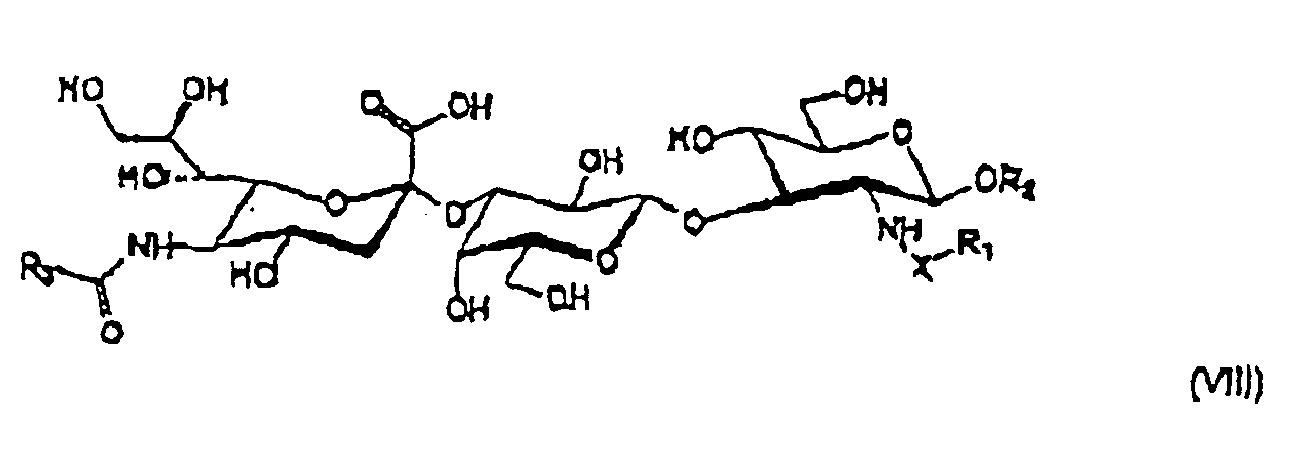 (c) la réaction du produit obtenu avec un composé de formule XI en présence de fucose transférase pour donner un composé de formule II.
 - Procédé pour la préparation d'un composé de formule II selon la revendication 35, qui comprend :(a) la réaction d'un composé de formule X selon la revendication 37 avec du cytidine monophosphate-acide sialique en présence de α(2→3)acide sialique transférase pour donner un composé de formule VIII selon la revendication 37 et(b) la réaction du produit obtenu avec un composé de formule XI selon la revendication 33 en présence de fucose transférase pour donner un composé de formule II.
- Procédé selon l'une quelconque des revendications 33 à 37, dans lequel la galactosylation et la sialylation sont effectuées simultanément.
- Procédé selon l'une quelconque des revendications 33 à 37, dans lequel la galactosylation et la sialylation sont effectuées à la suite.
- Composé selon la revendication 1, destiné à être utilisé dans une méthode thérapeutique pour traiter des maladies chez des animaux à sang chaud, y compris chez l'homme.
- Préparation pharmaceutique comprenant une quantité active d'un composé selon la revendication 37, seule ou conjointement avec d'autres principes actifs, un véhicule pharmaceutique en quantité significative et, le cas échéant, des adjuvants.
Applications Claiming Priority (3)
| Application Number | Priority Date | Filing Date | Title |
|---|---|---|---|
| CH23096 | 1996-01-30 | ||
| CH230/96 | 1996-01-30 | ||
| PCT/EP1997/000222 WO1997028173A1 (fr) | 1996-01-30 | 1997-01-17 | Analogues d'epitopes de sialyle-lewisa et de sialyle-lewis?x¿ |
Publications (2)
| Publication Number | Publication Date |
|---|---|
| EP0886640A1 EP0886640A1 (fr) | 1998-12-30 |
| EP0886640B1 true EP0886640B1 (fr) | 2007-03-21 |
Family
ID=4182259
Family Applications (1)
| Application Number | Title | Priority Date | Filing Date |
|---|---|---|---|
| EP97901546A Expired - Lifetime EP0886640B1 (fr) | 1996-01-30 | 1997-01-17 | ANALOGUES D'EPITOPES DE SIALYLE-LEWISa ET DE SIALYLE-LEWISx |
Country Status (6)
| Country | Link |
|---|---|
| US (1) | US6169077B1 (fr) |
| EP (1) | EP0886640B1 (fr) |
| AT (1) | ATE357452T1 (fr) |
| AU (1) | AU1542397A (fr) |
| DE (1) | DE69737496D1 (fr) |
| WO (1) | WO1997028173A1 (fr) |
Families Citing this family (34)
| Publication number | Priority date | Publication date | Assignee | Title |
|---|---|---|---|---|
| US6756489B1 (en) * | 1997-08-08 | 2004-06-29 | Aventis Pharma Deutschland Gmbh | Substituted tetrahydropyrane derivatives, method for producing same, their use as medicine or diagnostic agent, as well as medicine containing same |
| SE9904581D0 (sv) * | 1999-12-15 | 1999-12-15 | A & Science Invest Ab | A novel helicobacter pylori-binding substance and use thereof |
| US7481790B2 (en) * | 2000-12-27 | 2009-01-27 | Advanced Cardiovascular Systems, Inc. | Vessel enlargement by arteriogenic factor delivery |
| WO2003097658A2 (fr) * | 2002-05-16 | 2003-11-27 | Glycomimetics, Inc. | Composes et procedes d'inhibition des fonctions induites par les selectines |
| JP2006502986A (ja) * | 2002-07-03 | 2006-01-26 | グリコミメティクス, インコーポレイテッド | 新脈管形成に関与する医学的状態の診断および治療のための組成物および方法 |
| AU2003301209A1 (en) * | 2002-12-20 | 2004-07-22 | Glycomimetics, Inc. | Oligosaccharides and conjugates thereof for the treatement of pseudomonas bacteria infection |
| US20040219158A1 (en) * | 2003-05-02 | 2004-11-04 | Glycomimetics, Inc. | Compositions and methods for diagnosis and therapy of medical conditions involving infection with pseudomonas bacteria |
| WO2005054264A2 (fr) * | 2003-11-19 | 2005-06-16 | Glycomimetics, Inc. | Antagonistes glycomimetiques pour les selectines de type e et p |
| EP1763533B1 (fr) * | 2003-11-19 | 2008-01-09 | GlycoMimetics, Inc. | Antagoniste specifique pour e-selectines et p-selectines |
| US8201377B2 (en) * | 2004-11-05 | 2012-06-19 | Faus Group, Inc. | Flooring system having multiple alignment points |
| US20090036386A1 (en) * | 2005-05-25 | 2009-02-05 | Glycomimetics, Inc | Heterobifunctional compounds for selectin inhibition |
| CN101291946B (zh) * | 2005-08-09 | 2011-06-29 | 糖模拟物有限公司 | 对来自假单胞菌的pa-il凝集素、pa-iil凝集素或其两者的糖模拟物抑制剂 |
| PL2264043T3 (pl) | 2005-09-02 | 2018-04-30 | Glycomimetics, Inc. | Heterobifunkcyjne inhibitory pan-selektyny |
| US20090176717A1 (en) * | 2006-06-01 | 2009-07-09 | Glycomimetics, Inc. | Galactosides and thiodigalactosides as inhibitors of pa-il lectin from pseudomonas |
| EP2074132B1 (fr) | 2006-10-12 | 2013-05-15 | GlycoMimetics, Inc. | Replacements glycomimétiques pour des hexoses et des n-acétylhexosamines |
| AU2008216794A1 (en) * | 2007-02-09 | 2008-08-21 | Glycomimetics, Inc. | Methods of use of glycomimetics with replacements for hexoses and N-acetyl hexosamines |
| US8039442B2 (en) | 2007-07-18 | 2011-10-18 | Glycomimetics, Inc. | Compounds and methods for treatment of sickle cell disease or complications associated therewith |
| WO2009126556A1 (fr) | 2008-04-08 | 2009-10-15 | Glycomimetics, Inc. | Inhibiteur de pan-sélectine avec activité pharmacocinétique améliorée |
| CN102088983B (zh) * | 2008-06-13 | 2013-01-30 | 糖模拟物有限公司 | 利用选择的糖模拟化合物的血液癌症的治疗 |
| CA2760292A1 (fr) * | 2009-05-01 | 2010-11-04 | Glycomimetics, Inc. | Inhibiteurs heterobifonctionnels d'e-selectines et de recepteurs aux chimiokines cxcr4 |
| US8921328B2 (en) | 2010-09-14 | 2014-12-30 | Glycomimetics, Inc. | E-selectin antagonists |
| KR102055958B1 (ko) | 2011-12-22 | 2019-12-13 | 글리코미메틱스, 인크. | E-셀렉틴 길항제 화합물, 조성물, 및 이용 방법 |
| GB201214736D0 (en) * | 2012-08-17 | 2012-10-03 | Isis Innovation | Inflammation imaging and therapy |
| US9867841B2 (en) | 2012-12-07 | 2018-01-16 | Glycomimetics, Inc. | Compounds, compositions and methods using E-selectin antagonists for mobilization of hematopoietic cells |
| JP6689854B2 (ja) | 2014-12-03 | 2020-04-28 | グリコミメティクス, インコーポレイテッド | E−セレクチンおよびcxcr4ケモカイン受容体のヘテロ二官能性阻害剤 |
| JP2019502727A (ja) | 2016-01-22 | 2019-01-31 | グリコミメティクス, インコーポレイテッド | Pa−ilおよび/またはpa−iilレクチンの糖模倣体阻害剤 |
| WO2017151708A1 (fr) | 2016-03-02 | 2017-09-08 | Glycomimetics, Inc. | Méthodes pour le traitement et/ou à la prévention de maladies cardiovasculaires par inhibition de la sélectine e |
| US11433086B2 (en) | 2016-08-08 | 2022-09-06 | Glycomimetics, Inc. | Combination of T-cell checkpoint inhibitors with inhibitors of e-selectin or CXCR4, or with heterobifunctional inhibitors of both E-selectin and CXCR4 |
| AU2017341065B2 (en) | 2016-10-07 | 2023-04-06 | Crescent Biopharma, Inc. | Highly potent multimeric E-selectin antagonists |
| EP3596096A1 (fr) | 2017-03-15 | 2020-01-22 | GlycoMimetics, Inc. | Dérivés de galactopyranosyle-cyclohexyle utilisés en tant qu'antagonistes d'e-sélectine |
| JP7275131B2 (ja) | 2017-11-30 | 2023-05-17 | グリコミメティクス, インコーポレイテッド | 骨髄浸潤リンパ球を動員する方法、およびその使用 |
| KR20200104889A (ko) | 2017-12-29 | 2020-09-04 | 글리코미메틱스, 인크. | E-셀렉틴 및 갈렉틴-3의 이종이기능성 억제제 |
| KR20200128025A (ko) | 2018-03-05 | 2020-11-11 | 글리코미메틱스, 인크. | 급성 골수성 백혈병 및 관련 병태의 치료 방법 |
| US11845771B2 (en) | 2018-12-27 | 2023-12-19 | Glycomimetics, Inc. | Heterobifunctional inhibitors of E-selectin and galectin-3 |
Family Cites Families (3)
| Publication number | Priority date | Publication date | Assignee | Title |
|---|---|---|---|---|
| US4925796A (en) * | 1986-03-07 | 1990-05-15 | Massachusetts Institute Of Technology | Method for enhancing glycoprotein stability |
| CZ298895A3 (en) | 1993-05-14 | 1996-04-17 | Cytel Corp | Compound analogous to sialyl lex, pharmaceutical composition containing thereof and process for preparing lactosammonium salt |
| SE9301677L (sv) | 1993-05-14 | 1994-11-18 | Kurt G I Nilsson | Syntesmetod |
-
1997
- 1997-01-17 AT AT97901546T patent/ATE357452T1/de not_active IP Right Cessation
- 1997-01-17 AU AU15423/97A patent/AU1542397A/en not_active Abandoned
- 1997-01-17 US US09/117,482 patent/US6169077B1/en not_active Expired - Lifetime
- 1997-01-17 DE DE69737496T patent/DE69737496D1/de not_active Expired - Lifetime
- 1997-01-17 EP EP97901546A patent/EP0886640B1/fr not_active Expired - Lifetime
- 1997-01-17 WO PCT/EP1997/000222 patent/WO1997028173A1/fr not_active Ceased
Also Published As
| Publication number | Publication date |
|---|---|
| AU1542397A (en) | 1997-08-22 |
| WO1997028173A1 (fr) | 1997-08-07 |
| ATE357452T1 (de) | 2007-04-15 |
| DE69737496D1 (de) | 2007-05-03 |
| US6169077B1 (en) | 2001-01-02 |
| EP0886640A1 (fr) | 1998-12-30 |
Similar Documents
| Publication | Publication Date | Title |
|---|---|---|
| EP0886640B1 (fr) | ANALOGUES D'EPITOPES DE SIALYLE-LEWISa ET DE SIALYLE-LEWISx | |
| EP0886639B1 (fr) | ANALOGUES D'EPITOPES DE SIALYLE-LEWISa ET DE SIALYLE-LEWISx | |
| Wong et al. | Probing the acceptor specificity of. beta.-1, 4-galactosyltransferase for the development of enzymatic synthesis of novel oligosaccharides | |
| US12281135B2 (en) | Synthesis of 6-azido-6-deoxy-2-n-acetyl-hexosamine-nucleoside diphosphate | |
| US5830871A (en) | Inhibitors of E-, P- and L-selectin binding | |
| PL176272B1 (pl) | Analogi sialilowe Le jako inhibitory adhezji komórkowej | |
| US9938312B2 (en) | Compounds and methods for chemical and chemo-enzymatic synthesis of complex glycans | |
| US5426178A (en) | Synthesis of anti-inflammatory compounds, and novel trisaccharides useful in the synthesis of anti-inflammatory compounds | |
| Hribernik et al. | One pot synthesis of thio-glycosides via aziridine opening reactions | |
| JP3058715B2 (ja) | グリコシダーゼ触媒作用による複合糖質の合成法 | |
| Zähringer et al. | Structural and biological characterisation of a novel tetra-acyl lipid A from Escherichia coli F515 lipopolysaccharide acting as endotoxin antagonist in human monocytes | |
| Elling et al. | UDP-N-Acetyl-α-D-glucosamine as acceptor substrate of β-1, 4-galactosyltransferase. Enzymatic synthesis of UDP-N-acetyllactosamine | |
| Baisch et al. | Synthetic potential of cloned fucosyl-transferase III and VI | |
| Baisch et al. | Glycosyl-transferase catalyzed assemblage of sialyl-lewisx-saccharopeptides | |
| Düffels et al. | Chemoenzymatic synthesis of L-galactosylated dimeric sialyl Lewis X structures employing α-1, 3-fucosyltransferase V | |
| US5254676A (en) | Oligosaccharide inhibitors for influenza virus | |
| Ogawa et al. | Synthesis of Ether‐and Imino‐Linked Octyl N‐Acetyl‐5a′‐carba‐β‐lactosaminides and‐isolactosaminides: Acceptor Substrates for α‐(1→ 3/4)‐Fucosyltransferase, and Enzymatic Synthesis of 5a′‐Carbatrisaccharides | |
| Bojarová et al. | N-Acetylhexosamine triad in one molecule: Chemoenzymatic introduction of 2-acetamido-2-deoxy-β-d-galactopyranosyluronic acid residue into a complex oligosaccharide | |
| Yamamoto | N-Acyl specificity of taka-N-acetyl-β-d-glucosaminidase studied by synthetic substrate analogs: I. Preparation of p-nitrophenyl 2-acylamino-2-deoxy-β-d-glucopyranosides and their susceptibility toward enzymatic hydrolysis | |
| Khaled et al. | Exploring specificity of glycosyltransferases: synthesis of new sugar nucleotide related molecules as putative donor substrates | |
| WO1993024506A1 (fr) | COMPOSES LEWISC ET LacNAc MODIFIES A EFFET IMMUNOSUPPRESSEUR ET INDUCTEUR DE TOLERANCE | |
| Baisch et al. | Enzymatic fucosylations of non-natural acceptors with non-natural donor-sugars | |
| Du et al. | A simple access to 3, 6-branched oligosaccharides: Synthesis of a glycopeptide derivative that relates to Lycium barbarum L. | |
| Marchiori et al. | Synthesis of novel triazole-derived glycopeptides as analogs of α-dystroglycan mucins | |
| Attolino et al. | RETRACTED: Improved Preparation of β‐d‐ManNAc‐(1→ 4)‐d‐Glc and β‐d‐TalNAc‐(1→ 4)‐d‐Glc Disaccharides and Evaluation of Their Activating Properties on the Natural Killer Cells NKR‐P1 and CD69 Receptors |
Legal Events
| Date | Code | Title | Description |
|---|---|---|---|
| PUAI | Public reference made under article 153(3) epc to a published international application that has entered the european phase |
Free format text: ORIGINAL CODE: 0009012 |
|
| 17P | Request for examination filed |
Effective date: 19980831 |
|
| AK | Designated contracting states |
Kind code of ref document: A1 Designated state(s): AT BE CH DE DK ES FI FR GB GR IE IT LI LU MC NL PT SE |
|
| 17Q | First examination report despatched |
Effective date: 20001023 |
|
| GRAP | Despatch of communication of intention to grant a patent |
Free format text: ORIGINAL CODE: EPIDOSNIGR1 |
|
| GRAS | Grant fee paid |
Free format text: ORIGINAL CODE: EPIDOSNIGR3 |
|
| RAP1 | Party data changed (applicant data changed or rights of an application transferred) |
Owner name: GLYCOMIMETICS, INC. |
|
| GRAA | (expected) grant |
Free format text: ORIGINAL CODE: 0009210 |
|
| AK | Designated contracting states |
Kind code of ref document: B1 Designated state(s): AT BE CH DE DK ES FI FR GB GR IE IT LI LU MC NL PT SE |
|
| PG25 | Lapsed in a contracting state [announced via postgrant information from national office to epo] |
Ref country code: NL Free format text: LAPSE BECAUSE OF FAILURE TO SUBMIT A TRANSLATION OF THE DESCRIPTION OR TO PAY THE FEE WITHIN THE PRESCRIBED TIME-LIMIT Effective date: 20070321 Ref country code: LI Free format text: LAPSE BECAUSE OF FAILURE TO SUBMIT A TRANSLATION OF THE DESCRIPTION OR TO PAY THE FEE WITHIN THE PRESCRIBED TIME-LIMIT Effective date: 20070321 Ref country code: FI Free format text: LAPSE BECAUSE OF FAILURE TO SUBMIT A TRANSLATION OF THE DESCRIPTION OR TO PAY THE FEE WITHIN THE PRESCRIBED TIME-LIMIT Effective date: 20070321 Ref country code: CH Free format text: LAPSE BECAUSE OF FAILURE TO SUBMIT A TRANSLATION OF THE DESCRIPTION OR TO PAY THE FEE WITHIN THE PRESCRIBED TIME-LIMIT Effective date: 20070321 Ref country code: BE Free format text: LAPSE BECAUSE OF FAILURE TO SUBMIT A TRANSLATION OF THE DESCRIPTION OR TO PAY THE FEE WITHIN THE PRESCRIBED TIME-LIMIT Effective date: 20070321 Ref country code: AT Free format text: LAPSE BECAUSE OF FAILURE TO SUBMIT A TRANSLATION OF THE DESCRIPTION OR TO PAY THE FEE WITHIN THE PRESCRIBED TIME-LIMIT Effective date: 20070321 |
|
| REG | Reference to a national code |
Ref country code: GB Ref legal event code: FG4D |
|
| REG | Reference to a national code |
Ref country code: CH Ref legal event code: EP |
|
| REF | Corresponds to: |
Ref document number: 69737496 Country of ref document: DE Date of ref document: 20070503 Kind code of ref document: P |
|
| REG | Reference to a national code |
Ref country code: IE Ref legal event code: FG4D |
|
| PG25 | Lapsed in a contracting state [announced via postgrant information from national office to epo] |
Ref country code: SE Free format text: LAPSE BECAUSE OF FAILURE TO SUBMIT A TRANSLATION OF THE DESCRIPTION OR TO PAY THE FEE WITHIN THE PRESCRIBED TIME-LIMIT Effective date: 20070621 |
|
| PG25 | Lapsed in a contracting state [announced via postgrant information from national office to epo] |
Ref country code: ES Free format text: LAPSE BECAUSE OF FAILURE TO SUBMIT A TRANSLATION OF THE DESCRIPTION OR TO PAY THE FEE WITHIN THE PRESCRIBED TIME-LIMIT Effective date: 20070702 |
|
| PG25 | Lapsed in a contracting state [announced via postgrant information from national office to epo] |
Ref country code: PT Free format text: LAPSE BECAUSE OF FAILURE TO SUBMIT A TRANSLATION OF THE DESCRIPTION OR TO PAY THE FEE WITHIN THE PRESCRIBED TIME-LIMIT Effective date: 20070821 |
|
| REG | Reference to a national code |
Ref country code: CH Ref legal event code: PL |
|
| NLV1 | Nl: lapsed or annulled due to failure to fulfill the requirements of art. 29p and 29m of the patents act | ||
| EN | Fr: translation not filed | ||
| PLBE | No opposition filed within time limit |
Free format text: ORIGINAL CODE: 0009261 |
|
| STAA | Information on the status of an ep patent application or granted ep patent |
Free format text: STATUS: NO OPPOSITION FILED WITHIN TIME LIMIT |
|
| PG25 | Lapsed in a contracting state [announced via postgrant information from national office to epo] |
Ref country code: DK Free format text: LAPSE BECAUSE OF FAILURE TO SUBMIT A TRANSLATION OF THE DESCRIPTION OR TO PAY THE FEE WITHIN THE PRESCRIBED TIME-LIMIT Effective date: 20070321 Ref country code: DE Free format text: LAPSE BECAUSE OF FAILURE TO SUBMIT A TRANSLATION OF THE DESCRIPTION OR TO PAY THE FEE WITHIN THE PRESCRIBED TIME-LIMIT Effective date: 20070622 |
|
| 26N | No opposition filed |
Effective date: 20071227 |
|
| PG25 | Lapsed in a contracting state [announced via postgrant information from national office to epo] |
Ref country code: IT Free format text: LAPSE BECAUSE OF FAILURE TO SUBMIT A TRANSLATION OF THE DESCRIPTION OR TO PAY THE FEE WITHIN THE PRESCRIBED TIME-LIMIT Effective date: 20070321 Ref country code: GR Free format text: LAPSE BECAUSE OF FAILURE TO SUBMIT A TRANSLATION OF THE DESCRIPTION OR TO PAY THE FEE WITHIN THE PRESCRIBED TIME-LIMIT Effective date: 20070622 Ref country code: FR Free format text: LAPSE BECAUSE OF FAILURE TO SUBMIT A TRANSLATION OF THE DESCRIPTION OR TO PAY THE FEE WITHIN THE PRESCRIBED TIME-LIMIT Effective date: 20071123 |
|
| PG25 | Lapsed in a contracting state [announced via postgrant information from national office to epo] |
Ref country code: MC Free format text: LAPSE BECAUSE OF NON-PAYMENT OF DUE FEES Effective date: 20080131 |
|
| PG25 | Lapsed in a contracting state [announced via postgrant information from national office to epo] |
Ref country code: FR Free format text: LAPSE BECAUSE OF FAILURE TO SUBMIT A TRANSLATION OF THE DESCRIPTION OR TO PAY THE FEE WITHIN THE PRESCRIBED TIME-LIMIT Effective date: 20070321 |
|
| PG25 | Lapsed in a contracting state [announced via postgrant information from national office to epo] |
Ref country code: IE Free format text: LAPSE BECAUSE OF NON-PAYMENT OF DUE FEES Effective date: 20080117 |
|
| PG25 | Lapsed in a contracting state [announced via postgrant information from national office to epo] |
Ref country code: LU Free format text: LAPSE BECAUSE OF NON-PAYMENT OF DUE FEES Effective date: 20080117 |
|
| PGFP | Annual fee paid to national office [announced via postgrant information from national office to epo] |
Ref country code: GB Payment date: 20110125 Year of fee payment: 15 |
|
| GBPC | Gb: european patent ceased through non-payment of renewal fee |
Effective date: 20120117 |
|
| PG25 | Lapsed in a contracting state [announced via postgrant information from national office to epo] |
Ref country code: GB Free format text: LAPSE BECAUSE OF NON-PAYMENT OF DUE FEES Effective date: 20120117 |
|
| P01 | Opt-out of the competence of the unified patent court (upc) registered |
Effective date: 20230514 |