EP0886833B1 - Procede de saisie et de memorisation de donnees personnelles physionomiques et leur utilisation pour identifier des individus ou verifier leur identite - Google Patents
Procede de saisie et de memorisation de donnees personnelles physionomiques et leur utilisation pour identifier des individus ou verifier leur identite Download PDFInfo
- Publication number
- EP0886833B1 EP0886833B1 EP97916342A EP97916342A EP0886833B1 EP 0886833 B1 EP0886833 B1 EP 0886833B1 EP 97916342 A EP97916342 A EP 97916342A EP 97916342 A EP97916342 A EP 97916342A EP 0886833 B1 EP0886833 B1 EP 0886833B1
- Authority
- EP
- European Patent Office
- Prior art keywords
- person
- process according
- data
- feature set
- feature
- Prior art date
- Legal status (The legal status is an assumption and is not a legal conclusion. Google has not performed a legal analysis and makes no representation as to the accuracy of the status listed.)
- Expired - Lifetime
Links
Images


Classifications
-
- G—PHYSICS
- G07—CHECKING-DEVICES
- G07C—TIME OR ATTENDANCE REGISTERS; REGISTERING OR INDICATING THE WORKING OF MACHINES; GENERATING RANDOM NUMBERS; VOTING OR LOTTERY APPARATUS; ARRANGEMENTS, SYSTEMS OR APPARATUS FOR CHECKING NOT PROVIDED FOR ELSEWHERE
- G07C9/00—Individual registration on entry or exit
- G07C9/30—Individual registration on entry or exit not involving the use of a pass
- G07C9/32—Individual registration on entry or exit not involving the use of a pass in combination with an identity check
- G07C9/37—Individual registration on entry or exit not involving the use of a pass in combination with an identity check using biometric data, e.g. fingerprints, iris scans or voice recognition
-
- G—PHYSICS
- G06—COMPUTING OR CALCULATING; COUNTING
- G06V—IMAGE OR VIDEO RECOGNITION OR UNDERSTANDING
- G06V40/00—Recognition of biometric, human-related or animal-related patterns in image or video data
- G06V40/10—Human or animal bodies, e.g. vehicle occupants or pedestrians; Body parts, e.g. hands
- G06V40/16—Human faces, e.g. facial parts, sketches or expressions
Definitions
- These personal characteristics also include the face, the for capturing face-related data from a camera is recorded.
- the digital image data will then be special Characteristics examined and a corresponding graph formed, which is stored in a database, for example and thus for comparison with a newly formed one Graph is available. Is a new one from a person derived graph with a stored within specified Borders, then the person receives the desired one Access.
- KLT Karhunen-Loéve transformation
- ⁇ M is a submatrix of ⁇ that contains the leading M eigenvectors, ie the eigenvectors for the M largest eigenvalues.
- the reconstruction error for a certain pattern x is even
- This size is referred to as "distance from feature space” and to locate the face within an image used.
- Such an Eigenface-based system can be achieved through local variation be deceived.
- the system also requires one Normalization level that the face to a standard size brings. Since the method is also used for the efficient coding of Faces used for video transmission is one Capture multiple images of a face with only one set of features in principle not possible.
- the method for facial recognition described here is essentially based on the use of a 2-camera system for segmentation.
- Direction derivatives of the two-dimensional Gaussian function are used as feature detectors.
- the starting point for the definition and construction of the feature detectors is the well-known Gaussian function
- the system works as an identification system and the association service is distributed by a sparsely occupied topographic memory (SDM) provided.
- SDM sparsely occupied topographic memory
- the system shown can only follow sequences of video images process the detection. Continue as the faces distinguishing features the coefficients of a development the surface of the faces in 3-dimensional own heads used. Thus, the process shows that of the Eigenfaces known advantages and disadvantages.
- the comparison between the one to be recognized Image and the saved image through a flexible Mapping mechanism realized.
- the comparison by non-specific feature detectors extracted local features of the face.
- the grid positions at which the Characteristics extracted are not explicitly specified, but variable, with the lattice distortion in the comparison function is included.
- the method described here extends the one described in (4) Approach to weighting the grid positions.
- This weighting is unique to a particular task and modifies the previous similarity function.
- the weights are therefore not part of the reference data set for a captured person.
- Quality function Q to optimize the weights. It is just indicated that the amount of data T that the optimization is based, only pairs of images of different Contains people. This can at most be a conventional one Detection experiment to be carried out and consideration multiple images in the capture is excluded.
- the grid positions themselves are comparable to that Method according to (4) as the result of a global optimization process, that covers the entire grid. The location of an individual The grid point is therefore not the result of an explicit one Detection process and thus the existence of a local Characteristic bound, but results from the cooperative Behavior of the movable grid.
- the one artificial neural network for classifying faces used is a feed-forward network with an internal node layer and an input node for each the pixel that makes up the input image.
- Such one Input image is made from an image presented to the system Facial obtained through a preprocessing stage, in which are the centers of the eyes and mouth and processed the image through an affine transformation is that these centers are mapped to predefined points become.
- Pre-processing also includes elimination global intensity gradient in the image of the face with the aim of greater independence from the location of the light source to reach.
- Training the neural network requires use of images of every person who is to classify the network.
- the classification function is then for all of these people encoded together in the weights of the network.
- This has, analogously to (1), the disadvantage that the network can be re-trained must as soon as more people are to be admitted. Further In this case, it must maintain an acceptable recognition performance possibly the number of internal nodes increases become; because according to (7) one experiment was sufficient 12 internal knots for 16 people, but it's unclear how the procedure is scaled with the number of people.
- Another The disadvantage is that a person does not have their own reference data record can be assigned and thus an external storage of such a data set - for example on a chip card is possible.
- the invention has a method for detection and storage of face-related personal data and their use for Identification or verification in access control systems to the subject, the characteristics of the aforementioned systems takes up and significantly expanded, as well as a fast and robust recognition of human faces from still images enabled under natural lighting.
- the face-related data is not from one single image, but from a series of images of the one to be captured Person derived.
- each picture it is tried first to locate the face and then the eyes.
- the image is then rotated and scaled that afterwards the eyes within the picture on a horizontal line and have a predetermined distance.
- a fixed grid is superimposed on the image normalized in this way, its position relative to the eye positions from the outset is set.
- size, Shape and - with a regular grid - the mesh size of the Grid always the same.
- the grille is anchored to the eyes, because these are the easiest to locate by the facial features are.
- d specific feature detectors for example those as in (2), are used at each grid point g and for each resolution level k a fixed set of resolution levels of the image, so that d-dimensional vectors m (g, k) / i result.
- a feature here is a component of such a vector and therefore, in contrast to (5), the response of an unspecific feature detector. This means that the features on the face are not clearly localized, but could instead be described as delocalized.
- N q denotes the number of feature vectors.
- V the width of self-similarity
- p ij n i n j of all feature vectors quantified
- the feature set can be found under the feature sets of the captured images as a new representative set of reference features be determined and used by the smallest distance, e.g. the smallest Euclidean distance, to the determined according to one of the methods described above has been.
- the individual weights are not negative and their sum is 1.
- each reference feature vector n q assigned a diagonal matrix C q , the diagonal elements of which are the weights for each component of n q and thus represent for each individual characteristic.
- the weighting is then carried out by multiplying the matrix by the reference feature vector.
- the goal of any verification or identification system is to keep the false rejection rate (FRR, ⁇ (1) ) and false acceptance rate (FAR, ⁇ (2) ) as low as possible.
- FRR, ⁇ (1) false rejection rate
- FAR, ⁇ (2) false acceptance rate
- both are functions of the acceptance threshold ⁇ and are defined as with ⁇ (x) as Heaviside's step function.
- N A is the number of different pictures of person A that are taken during the acquisition
- N B is the number of feature sets of pictures of other people in the background database.
- p i q denotes the similarity of the feature vector n i q of the image i from person A to the reference feature vector n q and r j q the corresponding value for a person B ⁇ A.
- Useful target functions are, for example, the sum of the two error rates (FAR and FRR) or the equal error rate (EER), i.e. the function value for whose argument FAR and FRR are the same.
- the Position of the nose for the determination of the grid point positions be used.
- the preprocessing of the captured images with a low pass filter promotes noise reduction.
- the performance of a detection system in the ongoing operations can be improved by adding pictures to the Attempted verification or identification have been rejected by one external instance, such as a system administrator become. This instance then decides whether to reject rightly done or not. With one not permissible rejection becomes the characteristic set of the associated Image of the quantity of the characteristic sets already available of pictures of the data subject added. After that are the calculation of the reference feature set and the optimization the weights and the threshold value are repeated.
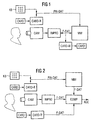
- FIG 1 shows the essential in the lower part Elements for collecting facial data, namely an electronic camera CAM that has a so-called Frame grabber image data in digitized form to a Image processing unit IMPRO delivers.
- This determines with Using the data from a background database for characteristic sets the facial data to be stored in the memory system MM F-DAT and in turn passes this to the storage system MM, where they are stored as reference data in a database.
- the It can also be saved on a personal ID card CARD 'by a card writer CARD-W, see above that the effort for the reference database for the purpose of verification and / or identification is omitted.
- PIN personal identification number
- FIG 2 shows a block diagram for the Personal identification or verification as part of access control for a secured object, where the object can be a room or a measure.
- Essential elements in this case are the electronic camera CAM and the image processing unit IMPRO, which is the same as for the acquisition F-DAT delivers facial data.
- IMPRO image processing unit
- Comparator working control unit COMP Comparator working control unit COMP, the newly acquired Face data F-DAT with the previously acquired and as reference data stored facial data F-DAT 'compares and triggers a control signal ACC if there is sufficient agreement, that allows access to the secured object.
- the stored facial data F-DAT ' e.g. the Database can be taken from the MM storage system. Did that Saving without personal reference, then the entire database can be searched. In the other case delivers the keyboard KB or the personal ID card CARD the card reader CARD-R analogous to the upper part of FIG Address PIN-DAT so that the associated facial data F-DAT ' can be provided immediately without a tedious search process
- the personal ID card CARD ' as a storage medium for the facial data F-DAT ' via the card reader CARD-R 'of the COMP control unit posed.
- FIG 1 and FIG 2 can accordingly the same names in an arrangement be summarized, the new facial data F-DAT output of the image processing unit IMPRO either on the MM storage system or the card writer CARD-W or switchable to the COMP control unit is. Furthermore, it must be taken into account that for registration Always take multiple pictures while at identifying or verifying just one image is needed.
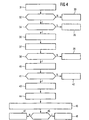
- FIGS. 1 and 2 A possible mode of operation of the arrangements in FIGS. 1 and 2 be based on the flow diagrams of FIG 3 and FIG. 4 explained in more detail.
- FIGS. 1 and 2 A possible mode of operation of the arrangements in FIGS. 1 and 2 be based on the flow diagrams of FIG 3 and FIG. 4 explained in more detail.
- FIG. 4 A possible mode of operation of the arrangements in FIGS. 1 and 2 be based on the flow diagrams of FIG 3 and FIG. 4 explained in more detail.
- FIGS. 1 and 2 A possible mode of operation of the arrangements in FIGS. 1 and 2 be based on the flow diagrams of FIG 3 and FIG. 4 explained in more detail.
- FIG. 4 A possible mode of operation of the arrangements in FIGS. 1 and 2 be based on the flow diagrams of FIG 3 and FIG. 4 explained in more detail.
- Process steps numbered consecutively Process steps numbered consecutively and the following Explanation is structured according to this numbering.
Landscapes
- Engineering & Computer Science (AREA)
- Human Computer Interaction (AREA)
- Physics & Mathematics (AREA)
- General Physics & Mathematics (AREA)
- Health & Medical Sciences (AREA)
- General Health & Medical Sciences (AREA)
- Oral & Maxillofacial Surgery (AREA)
- Multimedia (AREA)
- Theoretical Computer Science (AREA)
- Collating Specific Patterns (AREA)
Claims (12)
- Procédé pour saisir des données relatives au visage de personnes, caractérisé par les étapes suivantes :prise de plusieurs images en pied de la personne à acquérir (1 à 12a),localisation du visage dans les images prises,localisation des yeux dans le visage localisé (1, 5, 9, 13a),normalisation du visage au moyen d'une rotation et d'un redimensionnement de l'image correspondante, jusqu'à ce que les yeux dans l'image soient situés sur une ligne horizontale à une distance déterminée (13b),extraction de caractéristiques par des détecteurs de caractéristiques par rapport à des points de grille d'une grille fixe, dans laquelle les positions des points de grille par rapport à la position des yeux sont prédéterminées, avec rassemblement des caractéristiques en un jeu de caractéristiques pour l'image correspondante (13c),calcul d'un jeu représentatif de caractéristiques de référence qui regroupe d'une manière compacte les jeux de caractéristiques de toutes les images prises (14),optimisation de poids dépendant d'une personne pour chaque jeu de caractéristiques de référence en vue de l'optimisation d'une fonction d'objectif qui représente une fonction de ces poids ainsi que des valeurs de ressemblance entre le jeu de caractéristiques de référence et les jeux de caractéristiques qui ont été acquis à partir des images prises de la même personne et des images d'autre personnes dans une banque de données d'arrière-plan, avec une détermination d'un seuil optimal d'acceptation (15 à 31),stockage des données relatives au visage ainsi obtenues de la personne saisie (22).
- Procédé selon la revendication 1, caractérisé en ce que l'optimisation est seulement effectuée si dans la banque de données d'arrière-plan les jeux de caractéristiques d'un nombre prédéterminé de personnes sont enregistrés.
- Procédé selon la revendication 1 ou 2, caractérisé en ce que le calcul du jeu représentatif de caractéristiques de référence a lieu au moyen d'une détermination de moyenne et d'une normalisation par rapport à toutes les images de la personne saisie (14).
- Procédé selon la revendication 1 ou 2, caractérisé en ce que le calcul du jeu représentatif de caractéristiques de référence a lieu au moyen d'une réorientation du vecteur propre vers la plus grande valeur propre de la matrice de ressemblance.
- Procédé selon la revendication 3 ou 4, caractérisé en ce qu'on détermine, à partir des jeux de caractéristiques des images prises, le jeu S de caractéristiques qui dans l'espace mathématique des jeux de caractéristiques présente la distance la plus courte avec le jeu représentatif de caractéristiques de référence, et que dans une mise en oeuvre ultérieure du procédé ce jeu S de caractéristiques est utilisé comme jeu représentatif de caractéristiques de référence.
- Procédé selon l'une des revendications 1 à 5, caractérisé en ce que lors d'une normalisation du visage la position du nez est en outre prise en compte et que les positions des points de grille sont en outre déterminée par la position du nez.
- Procédé selon l'une des revendications 1 à 6, caractérisé en ce que, pour réduire le bruit, chaque image prise est traité par un filtre passe-bas avant la localisation du visage.
- Procédé selon l'une des revendications 1 à 7, caractérisé en ce qu'en plus des vecteurs de caractéristiques de référence, les caractéristiques individuelles à chaque point de grille et pour chaque étape de discrimination sont pondérées aussi en fonction des caractéristiques propres à une personne, et que ces poids sont aussi soumis à l'optimisation.
- Procédé selon l'une des revendications 1 à 8, caractérisé en ce que les vecteurs de caractéristiques sont calculés séparément selon des étapes de discrimination et que dans l'étape d'optimisation, une étape optimale de discrimination est obtenue aussi (16, 19 à 22).
- Procédé selon l'une des revendications 1 à 9, caractérisé par l'utilisation des données acquises et stockées relatives au visage pour une identification de personne, dans lequel les données correspondantes de caractéristiques nouvellement acquises sont comparées aux données stockées de référence (36 à 48).
- Procédé selon l'une des revendications 1 à 9, caractérisé par l'utilisation des données acquises et stockées relatives au visage pour une identification de personne, dans lequel les données correspondantes de caractéristiques nouvellement acquises sont comparées à des données stockées de référence sélectionnées par une connaissance supplémentaire personnelle (31 à 48).
- Procédé selon la revendication 10 ou 11, caractérisé en ce qu'un jeu de caractéristiques, classé comme un faux rejet par une instance extérieure, d'une image qui a été prise lors d'une tentative infructueuse d'une identification ou d'une vérification de personne, est enregistré en complément dans le jeu de caractéristiques de référence de la personne concernée, et qu'avec ce jeu actualisé de caractéristiques de référence, les étapes d'optimisation du procédé et le stockage de données sont répétés.
Applications Claiming Priority (3)
| Application Number | Priority Date | Filing Date | Title |
|---|---|---|---|
| DE19610066A DE19610066C1 (de) | 1996-03-14 | 1996-03-14 | Verfahren zur Erfassung gesichtsbezogener Personendaten und deren Verwendung zur Identifizierung oder Verifikation von Personen |
| DE19610066 | 1996-03-14 | ||
| PCT/DE1997/000488 WO1997034251A1 (fr) | 1996-03-14 | 1997-03-12 | Procede de saisie et de memorisation de donnees personnelles physionomiques et leur utilisation pour identifier des individus ou verifier leur identite |
Publications (2)
| Publication Number | Publication Date |
|---|---|
| EP0886833A1 EP0886833A1 (fr) | 1998-12-30 |
| EP0886833B1 true EP0886833B1 (fr) | 2000-01-05 |
Family
ID=7788288
Family Applications (1)
| Application Number | Title | Priority Date | Filing Date |
|---|---|---|---|
| EP97916342A Expired - Lifetime EP0886833B1 (fr) | 1996-03-14 | 1997-03-12 | Procede de saisie et de memorisation de donnees personnelles physionomiques et leur utilisation pour identifier des individus ou verifier leur identite |
Country Status (3)
| Country | Link |
|---|---|
| EP (1) | EP0886833B1 (fr) |
| DE (2) | DE19610066C1 (fr) |
| WO (1) | WO1997034251A1 (fr) |
Cited By (1)
| Publication number | Priority date | Publication date | Assignee | Title |
|---|---|---|---|---|
| US7165716B1 (en) | 1999-07-30 | 2007-01-23 | Giesecke & Devrient Gmbh | Method, device and system for biometrically authenticating a person |
Families Citing this family (13)
| Publication number | Priority date | Publication date | Assignee | Title |
|---|---|---|---|---|
| CA2272360A1 (fr) * | 1996-11-19 | 1998-05-28 | Markus Muller | Procede et dispositif d'identification et de reconnaissance d'etres vivants et/ou d'objets |
| DE19810792A1 (de) * | 1998-03-12 | 1999-09-16 | Zentrum Fuer Neuroinformatik G | Verfahren zum Verifizieren der Authentizität eines im Rahmen einer Personenerkennung aufgenommenen Bildes |
| DE19921387C2 (de) * | 1999-05-10 | 2001-07-19 | Infineon Technologies Ag | Anordnung und Verfahren zum Vergleich von Biometrik-Daten |
| DE19936400A1 (de) * | 1999-08-03 | 2001-03-01 | Infineon Technologies Ag | Verfahren zur biometrischen Erkennung |
| DE10022570A1 (de) * | 2000-05-09 | 2001-11-15 | Giesecke & Devrient Gmbh | Verfahren und System zur Generierung eines Schlüsseldatensatzes |
| DE10037742C2 (de) * | 2000-08-02 | 2003-03-27 | Gunter Ritter | System zur Erkennung und Klassifizierung von Objekten |
| US7125335B2 (en) | 2000-12-08 | 2006-10-24 | Igt | Casino gambling system with biometric access control |
| DE102006005617B4 (de) | 2006-02-06 | 2023-10-12 | Bundesdruckerei Gmbh | Verfahren zur Bewertung der Qualität eines Bildes, Verfahren zur Herstellung eines Dokuments, Computerprogrammprodukt und elektronisches Gerät |
| DE102006021518A1 (de) * | 2006-05-04 | 2007-11-15 | LÜTH & DÜMCHEN Automatisierungsprojekt GmbH | Räumlich und zeitlich verteilte Einrichtungen und Verfahren zur Gesichtserkennung zwecks Identifikation oder Verifikation |
| KR101130817B1 (ko) * | 2011-09-27 | 2012-04-16 | (주)올라웍스 | 얼굴 인식 방법, 장치, 및 이 방법을 실행하기 위한 컴퓨터 판독 가능한 기록 매체 |
| EP3610465B1 (fr) | 2017-04-10 | 2025-05-07 | Inventio Ag | Système de contrôle d'accès avec reconnaissance faciale et radioélectrique |
| DE102023119698A1 (de) | 2023-07-25 | 2025-01-30 | Ulrich Wennemann | Identifikationselement zum Digitalisieren und Identifizieren eines Menschen oder eines Tieres und ein Verfahren zur Herstellung eines solchen Identifikationselements |
| DE202023104167U1 (de) | 2023-07-25 | 2023-08-07 | Ulrich Wennemann | Identifikationselement zum Digitalisieren und Identifizieren eines Menschen oder eines Tieres |
Family Cites Families (3)
| Publication number | Priority date | Publication date | Assignee | Title |
|---|---|---|---|---|
| DE69131350T2 (de) * | 1990-07-17 | 1999-12-30 | British Telecommunications P.L.C., London | Verfahren und vorrichtung zur bildverarbeitung |
| US5164992A (en) * | 1990-11-01 | 1992-11-17 | Massachusetts Institute Of Technology | Face recognition system |
| DE4406020C1 (de) * | 1994-02-24 | 1995-06-29 | Zentrum Fuer Neuroinformatik G | Verfahren zur automatisierten Erkennung von Objekten |
-
1996
- 1996-03-14 DE DE19610066A patent/DE19610066C1/de not_active Expired - Lifetime
-
1997
- 1997-03-12 WO PCT/DE1997/000488 patent/WO1997034251A1/fr not_active Ceased
- 1997-03-12 EP EP97916342A patent/EP0886833B1/fr not_active Expired - Lifetime
- 1997-03-12 DE DE59700974T patent/DE59700974D1/de not_active Expired - Fee Related
Cited By (1)
| Publication number | Priority date | Publication date | Assignee | Title |
|---|---|---|---|---|
| US7165716B1 (en) | 1999-07-30 | 2007-01-23 | Giesecke & Devrient Gmbh | Method, device and system for biometrically authenticating a person |
Also Published As
| Publication number | Publication date |
|---|---|
| DE59700974D1 (de) | 2000-02-10 |
| DE19610066C1 (de) | 1997-09-18 |
| WO1997034251A1 (fr) | 1997-09-18 |
| EP0886833A1 (fr) | 1998-12-30 |
Similar Documents
| Publication | Publication Date | Title |
|---|---|---|
| DE60016589T2 (de) | Verfahren und vorrichtung zur erzeugung eines zusammengesetzten fingerabdruckbildes | |
| DE602004005984T2 (de) | Gesichtsidentifikationsverifikation unter verwendung von vorder- und seitenansichten | |
| DE60215743T2 (de) | Verfahren und Rechnerprogrammprodukt zur Lagebestimmung von Gesichtsmerkmalen | |
| EP2584493B1 (fr) | Procédé de distinction entre un visage réel et une représentation bidimensionnelle du visage dans un processus d'enregistrement biométrique | |
| EP0886833B1 (fr) | Procede de saisie et de memorisation de donnees personnelles physionomiques et leur utilisation pour identifier des individus ou verifier leur identite | |
| DE69328982T2 (de) | Gesichtsklassifizierung | |
| DE60207863T2 (de) | Vorrichtung und Verfahren zur Gesichtserkennung | |
| DE69833999T2 (de) | Verfahren zur automatischen erkennung menschlicher augen in digitalbildern | |
| DE60313941T2 (de) | Personendetektion durch Gesichtsdetektion und Bewegungsdetektion | |
| DE69800009T2 (de) | Verfahren und Gerät zur Überprüfung statischer Unterschriften mittels dynamischer Information | |
| DE69810581T2 (de) | Merkmalkorrelator für Fingerabdrücke | |
| DE4406020C1 (de) | Verfahren zur automatisierten Erkennung von Objekten | |
| DE60037919T2 (de) | Verfahren zum Wiederauffinden von Bildtexturen und Vorrichtung dafür | |
| DE60030377T2 (de) | Kennzeichenschilderkennung mit einer intelligenten Kamera | |
| DE602004008872T2 (de) | Vorrichtung zur Verifizierung biometrischer Information | |
| DE102006010607A1 (de) | Wahrscheinlichkeitstheoretischer Verstärkungsbaum-Rahmen zum Lernen von Unterscheidungsmodellen | |
| DE19634769A1 (de) | Neurales Netzwerk zur Lokalisierung und Erkennung eines verformbaren Objekts | |
| DE69623581T2 (de) | Merkmalextrahierung zur Fingerabdruckerkennung | |
| DE112010003796B4 (de) | System und Verfahren zur Erzeugung und Verwendung von Iriscodes geringer Länge | |
| DE19810792A1 (de) | Verfahren zum Verifizieren der Authentizität eines im Rahmen einer Personenerkennung aufgenommenen Bildes | |
| EP2070010A1 (fr) | Procédé et dispositif pour reconnaître un visage et module de reconnaissance de visage | |
| DE10260642B4 (de) | Verfahren zur Erstellung einer Referenz für Fingerprints und zum Vergleich von Fingerprints | |
| DE102020211007A1 (de) | Bildverarbeitungseinrichtung und Bildverarbeitungsverfahren, und Bildverarbeitungsprogramm | |
| DE10260638B4 (de) | Verfahren zur Bestimmung einer Anzahl von übereinstimmenden Minutien zweier Fingerprints | |
| EP1402460B1 (fr) | Identification et/ou verifications automatiques de textures a lignes telles que des empreintes digitales |
Legal Events
| Date | Code | Title | Description |
|---|---|---|---|
| PUAI | Public reference made under article 153(3) epc to a published international application that has entered the european phase |
Free format text: ORIGINAL CODE: 0009012 |
|
| 17P | Request for examination filed |
Effective date: 19980903 |
|
| AK | Designated contracting states |
Kind code of ref document: A1 Designated state(s): DE FR GB IT |
|
| GRAG | Despatch of communication of intention to grant |
Free format text: ORIGINAL CODE: EPIDOS AGRA |
|
| 17Q | First examination report despatched |
Effective date: 19990129 |
|
| GRAG | Despatch of communication of intention to grant |
Free format text: ORIGINAL CODE: EPIDOS AGRA |
|
| GRAH | Despatch of communication of intention to grant a patent |
Free format text: ORIGINAL CODE: EPIDOS IGRA |
|
| RAP1 | Party data changed (applicant data changed or rights of an application transferred) |
Owner name: PLETTAC ELECTRONIC SECURITY GMBH |
|
| GRAH | Despatch of communication of intention to grant a patent |
Free format text: ORIGINAL CODE: EPIDOS IGRA |
|
| GRAA | (expected) grant |
Free format text: ORIGINAL CODE: 0009210 |
|
| AK | Designated contracting states |
Kind code of ref document: B1 Designated state(s): DE FR GB IT |
|
| GBT | Gb: translation of ep patent filed (gb section 77(6)(a)/1977) |
Effective date: 20000106 |
|
| REF | Corresponds to: |
Ref document number: 59700974 Country of ref document: DE Date of ref document: 20000210 |
|
| ET | Fr: translation filed | ||
| ITF | It: translation for a ep patent filed | ||
| PLBE | No opposition filed within time limit |
Free format text: ORIGINAL CODE: 0009261 |
|
| STAA | Information on the status of an ep patent application or granted ep patent |
Free format text: STATUS: NO OPPOSITION FILED WITHIN TIME LIMIT |
|
| 26N | No opposition filed | ||
| REG | Reference to a national code |
Ref country code: GB Ref legal event code: 732E |
|
| REG | Reference to a national code |
Ref country code: GB Ref legal event code: IF02 |
|
| REG | Reference to a national code |
Ref country code: FR Ref legal event code: TP |
|
| PGFP | Annual fee paid to national office [announced via postgrant information from national office to epo] |
Ref country code: DE Payment date: 20020331 Year of fee payment: 6 |
|
| PG25 | Lapsed in a contracting state [announced via postgrant information from national office to epo] |
Ref country code: GB Free format text: LAPSE BECAUSE OF NON-PAYMENT OF DUE FEES Effective date: 20030312 |
|
| PG25 | Lapsed in a contracting state [announced via postgrant information from national office to epo] |
Ref country code: DE Free format text: LAPSE BECAUSE OF NON-PAYMENT OF DUE FEES Effective date: 20031001 |
|
| GBPC | Gb: european patent ceased through non-payment of renewal fee |
Effective date: 20030312 |
|
| REG | Reference to a national code |
Ref country code: GB Ref legal event code: 728V |
|
| REG | Reference to a national code |
Ref country code: FR Ref legal event code: TP Ref country code: FR Ref legal event code: AU |
|
| REG | Reference to a national code |
Ref country code: GB Ref legal event code: 732E |
|
| REG | Reference to a national code |
Ref country code: GB Ref legal event code: 7281 |
|
| PG25 | Lapsed in a contracting state [announced via postgrant information from national office to epo] |
Ref country code: IT Free format text: LAPSE BECAUSE OF NON-PAYMENT OF DUE FEES Effective date: 20080312 |
|
| REG | Reference to a national code |
Ref country code: FR Ref legal event code: PLFP Year of fee payment: 20 |
|
| PGFP | Annual fee paid to national office [announced via postgrant information from national office to epo] |
Ref country code: IT Payment date: 20160225 Year of fee payment: 20 |
|
| PGFP | Annual fee paid to national office [announced via postgrant information from national office to epo] |
Ref country code: FR Payment date: 20160223 Year of fee payment: 20 Ref country code: GB Payment date: 20160224 Year of fee payment: 20 |
|
| REG | Reference to a national code |
Ref country code: GB Ref legal event code: PE20 Expiry date: 20170311 |
|
| PG25 | Lapsed in a contracting state [announced via postgrant information from national office to epo] |
Ref country code: GB Free format text: LAPSE BECAUSE OF EXPIRATION OF PROTECTION Effective date: 20170311 |