EP3610465B1 - Système de contrôle d'accès avec reconnaissance faciale et radioélectrique - Google Patents
Système de contrôle d'accès avec reconnaissance faciale et radioélectrique Download PDFInfo
- Publication number
- EP3610465B1 EP3610465B1 EP18712630.5A EP18712630A EP3610465B1 EP 3610465 B1 EP3610465 B1 EP 3610465B1 EP 18712630 A EP18712630 A EP 18712630A EP 3610465 B1 EP3610465 B1 EP 3610465B1
- Authority
- EP
- European Patent Office
- Prior art keywords
- user
- access
- zone
- identifier
- mobile electronic
- Prior art date
- Legal status (The legal status is an assumption and is not a legal conclusion. Google has not performed a legal analysis and makes no representation as to the accuracy of the status listed.)
- Active
Links
Images

Classifications
-
- G—PHYSICS
- G07—CHECKING-DEVICES
- G07C—TIME OR ATTENDANCE REGISTERS; REGISTERING OR INDICATING THE WORKING OF MACHINES; GENERATING RANDOM NUMBERS; VOTING OR LOTTERY APPARATUS; ARRANGEMENTS, SYSTEMS OR APPARATUS FOR CHECKING NOT PROVIDED FOR ELSEWHERE
- G07C9/00—Individual registration on entry or exit
- G07C9/20—Individual registration on entry or exit involving the use of a pass
- G07C9/22—Individual registration on entry or exit involving the use of a pass in combination with an identity check of the pass holder
- G07C9/25—Individual registration on entry or exit involving the use of a pass in combination with an identity check of the pass holder using biometric data, e.g. fingerprints, iris scans or voice recognition
- G07C9/253—Individual registration on entry or exit involving the use of a pass in combination with an identity check of the pass holder using biometric data, e.g. fingerprints, iris scans or voice recognition visually
-
- B—PERFORMING OPERATIONS; TRANSPORTING
- B66—HOISTING; LIFTING; HAULING
- B66B—ELEVATORS; ESCALATORS OR MOVING WALKWAYS
- B66B1/00—Control systems of elevators in general
- B66B1/34—Details, e.g. call counting devices, data transmission from car to control system, devices giving information to the control system
- B66B1/46—Adaptations of switches or switchgear
- B66B1/468—Call registering systems
-
- G—PHYSICS
- G06—COMPUTING OR CALCULATING; COUNTING
- G06V—IMAGE OR VIDEO RECOGNITION OR UNDERSTANDING
- G06V40/00—Recognition of biometric, human-related or animal-related patterns in image or video data
- G06V40/10—Human or animal bodies, e.g. vehicle occupants or pedestrians; Body parts, e.g. hands
- G06V40/16—Human faces, e.g. facial parts, sketches or expressions
- G06V40/172—Classification, e.g. identification
-
- G—PHYSICS
- G07—CHECKING-DEVICES
- G07C—TIME OR ATTENDANCE REGISTERS; REGISTERING OR INDICATING THE WORKING OF MACHINES; GENERATING RANDOM NUMBERS; VOTING OR LOTTERY APPARATUS; ARRANGEMENTS, SYSTEMS OR APPARATUS FOR CHECKING NOT PROVIDED FOR ELSEWHERE
- G07C9/00—Individual registration on entry or exit
- G07C9/00174—Electronically operated locks; Circuits therefor; Nonmechanical keys therefor, e.g. passive or active electrical keys or other data carriers without mechanical keys
- G07C9/00563—Electronically operated locks; Circuits therefor; Nonmechanical keys therefor, e.g. passive or active electrical keys or other data carriers without mechanical keys using personal physical data of the operator, e.g. finger prints, retinal images, voicepatterns
-
- G—PHYSICS
- G07—CHECKING-DEVICES
- G07C—TIME OR ATTENDANCE REGISTERS; REGISTERING OR INDICATING THE WORKING OF MACHINES; GENERATING RANDOM NUMBERS; VOTING OR LOTTERY APPARATUS; ARRANGEMENTS, SYSTEMS OR APPARATUS FOR CHECKING NOT PROVIDED FOR ELSEWHERE
- G07C9/00—Individual registration on entry or exit
- G07C9/20—Individual registration on entry or exit involving the use of a pass
- G07C9/22—Individual registration on entry or exit involving the use of a pass in combination with an identity check of the pass holder
- G07C9/25—Individual registration on entry or exit involving the use of a pass in combination with an identity check of the pass holder using biometric data, e.g. fingerprints, iris scans or voice recognition
- G07C9/257—Individual registration on entry or exit involving the use of a pass in combination with an identity check of the pass holder using biometric data, e.g. fingerprints, iris scans or voice recognition electronically
-
- G—PHYSICS
- G07—CHECKING-DEVICES
- G07C—TIME OR ATTENDANCE REGISTERS; REGISTERING OR INDICATING THE WORKING OF MACHINES; GENERATING RANDOM NUMBERS; VOTING OR LOTTERY APPARATUS; ARRANGEMENTS, SYSTEMS OR APPARATUS FOR CHECKING NOT PROVIDED FOR ELSEWHERE
- G07C9/00—Individual registration on entry or exit
- G07C9/20—Individual registration on entry or exit involving the use of a pass
- G07C9/27—Individual registration on entry or exit involving the use of a pass with central registration
-
- B—PERFORMING OPERATIONS; TRANSPORTING
- B66—HOISTING; LIFTING; HAULING
- B66B—ELEVATORS; ESCALATORS OR MOVING WALKWAYS
- B66B2201/00—Aspects of control systems of elevators
- B66B2201/40—Details of the change of control mode
- B66B2201/46—Switches or switchgear
- B66B2201/4607—Call registering systems
- B66B2201/4638—Wherein the call is registered without making physical contact with the elevator system
-
- G—PHYSICS
- G07—CHECKING-DEVICES
- G07C—TIME OR ATTENDANCE REGISTERS; REGISTERING OR INDICATING THE WORKING OF MACHINES; GENERATING RANDOM NUMBERS; VOTING OR LOTTERY APPARATUS; ARRANGEMENTS, SYSTEMS OR APPARATUS FOR CHECKING NOT PROVIDED FOR ELSEWHERE
- G07C2209/00—Indexing scheme relating to groups G07C9/00 - G07C9/38
- G07C2209/04—Access control involving a hierarchy in access rights
Definitions
- the technology described here generally relates to an access control system that grants an authorized user access to a restricted zone in a building or premises.
- Embodiments of the technology particularly relate to an access control system with a transmitting and receiving device and a method for operating such an access control system.
- Access control systems can be designed in a variety of ways.
- US 9,077,716 For example, describes an access control system in which a mobile electronic device communicates with an electronic door lock via a Bluetooth or WLAN radio connection and with a web server via a WAN (Wide Area Network) radio connection in order to open the electronic lock.
- the mobile electronic device sends its device identifier and an identifier of the electronic lock entered by a user to the web server, which checks the access authorization and sends a response consisting of a lock command, the lock identifier, and a code pattern to the mobile device.
- the mobile device sends the lock command and the code pattern to the electronic lock. If the lock recognizes the lock command and the code pattern as valid, it is opened.
- WO 2010/112586 A1 Describes an access control system in which a mobile phone carried by a user sends an identification code to an access node. If the identification code is recognized as valid, the access node sends an access code to the mobile phone, which displays the access node on a screen. If the user holds the mobile phone up to a camera so that it can capture the displayed access code, the access control system checks whether the captured access code is valid. If it is valid, the user is granted access.
- the US 2015/221151 A1 relates to an access control system and method based on facial recognition, in which localisation sensors determine the position of mobile electronic devices in an area adjacent to an access area and at least one camera monitors the area adjacent to the access area.
- One aspect of the present invention relates to a system according to claim 12.
- Another aspect relates to a method according to claim 1.
- a first phase of checking whether the user is authorized to access occurs even when the user is still relatively far from the access point. For example, the user can move toward the entrance to the restricted-access zone, while in one embodiment the user's mobile electronic device is already in communication with the transmitting and receiving device of the access control system, or has already been.
- the transmitting and receiving device receives the identifier of the mobile electronic device, which, if the user is registered as authorized to access, is assigned to a stored user profile. Alternatively, the transmitting and receiving device receives the identifier via a communications network.
- the user's facial features are determined from a camera image in a second phase. If the identified facial features match the facial features stored in a user profile to a specified degree, the user is authorized to access the device, and access is granted without the user having to use the mobile electronic device. An authorized user can thus enter the restricted zone virtually seamlessly.
- a large number of users may be authorized to access a restricted zone in a building or area; user profiles are created accordingly.
- the technology described here offers the advantage that the verification for compliance This is done quickly because not all user profiles of authorized users need to be checked for consistency, but only the user profiles of those actually present. A user who is present can thus enter the restricted-access zone without significant delays. This reduces the risk of a queue forming at the entrance, especially during periods of high traffic.
- the technology offers faster verification, it can also be used for high security requirements, for example, because it requires two authentication steps.
- two different channels are used: radio for transmitting an identifier and optical capture of a user's face.
- the identifier must belong to a registered user in the system, and the evaluation of the facial parameters must indicate a registered user.
- fewer user profiles need to be searched or verified, which reduces the frequency of errors (i.e., an authorized user is mistakenly denied access or an unauthorized user is mistakenly granted access).
- the transmitting and receiving device receives a large number of identifiers, which are stored in the storage device. For each stored identifier, it can be determined whether the received identifier is assigned to a reference template in the database. If such assignments exist, a check is carried out to determine whether the real-time template matches one of these reference templates; if there is a match, the system grants the user access to the restricted zone; if there is a mismatch, it denies the user access.
- the aforementioned advantage of rapid verification is thus guaranteed even in high traffic volumes because the match check is restricted to a limited (relatively small) set of user profiles.
- the matching check is limited to a limited set of user profiles. Furthermore, this limited set only includes users with access rights, because only in the case of of a user with access authorization, the identifier of the mobile device is assigned to a stored user profile.
- the degree of match In comparison to an image processing algorithm whose task is to identify a person based on a relatively large number of facial features with a high degree of recognition accuracy (i.e., the degree of match must be relatively high, for example, greater than approximately 90%), with the technology described here it is sufficient to assign relatively few facial features to one of the users with access authorization.
- the degree of match can be set, for example, to between approximately 60% and approximately 90%. A cost-effective image processing algorithm can therefore be used; the security requirements can still be guaranteed.
- checking for compliance includes generating a result signal. If there is a match, it indicates that the user has access to the restricted-access zone, while if there is a mismatch, it indicates that the user does not have access to the restricted-access zone.
- a control signal can be generated to release a (physical) barrier (e.g., barrier, door, or turnstile). A barrier that is not released remains blocked.
- the control signal activates an information device when access is denied.
- the information device can, for example, be used in conjunction with an access without a physical barrier.
- the information device can generate an alarm that is perceptible (acoustically and/or visually) at the access.
- the control signal can alert a security service, which then checks the user identified as not having access.
- the wireless connection between the transmitting and receiving device and a user's mobile electronic device is established according to a Bluetooth standard or a WLAN/WiFi standard. This is advantageous because commercially available mobile phones or smartphones are already equipped with technology according to one of these standards, thus eliminating the need for special devices.
- the technology described here also enables flexibility regarding the identification of a mobile device.
- the identifier of a mobile device can, for example, comprise a device identification number permanently assigned to the device or a telephone number assigned to the mobile device.
- each mobile device is equipped with application-specific software that generates a unique and time-invariant identifier for the mobile device.
- the identifier (regardless of whether it comprises a device identification number or a telephone number or is generated by software) enables the unique identification of a mobile device.
- the image processing device has a modular design.
- An image processing module generates the real-time template from a camera image
- an evaluation module connected to the image processing module and the storage device, generates a result signal indicating whether the real-time template matches this reference template.
- modularity is also provided with respect to a processor connected to the image processing device.
- the processor Depending on the result signal, the processor generates a control signal to control the access control system so that the user is granted or denied access.
- the access may include a physical barrier, such as a gate, door, revolving door, or turnstile, which is either released or remains blocked.
- the access may be designed without such a physical barrier (i.e., as essentially barrier-free access). If an unauthorized user is detected at the access point (with or without a physical barrier) using the technology described here, an alarm can be generated and/or a security service alerted.
- the technology described herein may be used in conjunction with an elevator system.
- a destination floor can be defined, for example, where their workplace or apartment is located.
- a destination call can be generated for the user in question, whereupon an elevator control system of the elevator system moves an elevator car first to a boarding floor and then to a destination floor. This improves user-friendliness because the user can go directly to an assigned elevator car without having to initiate an elevator call themselves.
- Fig. 1 is a schematic representation of an application example of an access control system 1 in connection with a situation in a building, of which only some walls, rooms 4 and zones 8, 10 are shown for illustration purposes.
- the rooms 4 can be, for example, offices, apartments, halls and/or elevator cars of an elevator system.
- zone 10 In the application of the access control system 1 shown, several users 2 are located in zone 10, each carrying mobile electronic devices 6 (hereinafter also referred to as mobile device 6).
- zone 10 is not subject to any access restrictions and is also referred to as public zone 10.
- Public zone 10 can be an area inside or outside the building.
- An access 12 separates public zone 10 from zone 8, which is subject to access restrictions and adjoins rooms 4.
- the access control system 1 is not limited to applications within a building, but can also be used analogously to control access to a restricted-access zone on a site.
- the term "building" in this description includes, for example, residential buildings, commercial buildings, sports arenas, shopping centers, and even ships.
- the access control system 1 monitors the access 12 so that only authorized users 2 can enter zone 8, for example, by blocking or unlocking a door, a barrier, a turnstile, or another physical barrier, by activating an information device 38 in the case of access without a physical barrier when an unauthorized user 2 is detected, or by combining these measures.
- the information device 38 can, for example, trigger a visual and/or acoustic alarm or initiate notification of a security service.
- Fig. 1 For illustrative purposes, the access control system 1 is shown as being arranged in the entrance 12; a turnstile 36 is also indicated as an exemplary physical barrier. However, one skilled in the art will recognize that in a specific implementation, the access control system 1 or its components can be arranged in various ways.
- the access control system 1 is arranged at an access 18 to at least one room 4, possibly at each access 18.
- the access 18 comprises, for example, an office door, a floor door, an apartment door, or an elevator door, each of which then represents a physical barrier.
- each room 4 corresponds to a restricted-access zone 8
- the area in front of an access 18 corresponds to the public zone 10.
- the access control system 1 unlocks, for example, an electronic lock on an office or apartment door.
- the access control system 1 can, for example, prevent the departure of an elevator car if an unauthorized user 2 enters or wishes to enter the car.
- the access control system 1 comprises a transmitting and receiving device 14 (in Fig. 1 shown as TX/RX) and a camera 16 as part an image processing device; further components of the access control system 1 are in Fig. 2 shown.
- the transmitting and receiving device is designed to receive radio signals; it is therefore also referred to below as transceiver 14.
- the transceiver 14 communicates with the mobile electronic devices 6 when they are within radio range of the transceiver 14, i.e. a radio signal transmitted by a mobile device 6 has a signal strength at the location of the transceiver 14 (expressed by an RSSI value (Received Signal Strength Indicator)) that is greater than a threshold value specified for reliable reception.
- RSSI value Receiveived Signal Strength Indicator
- Bluetooth is a standard according to IEEE 802.15.1
- WLAN/WiFi is a standard according to IEEE 802.11
- ZigBee is a standard according to IEEE 802.15.4;
- radio networks according to these standards serve to wirelessly connect devices over a short distance of approximately a few meters to approximately one hundred meters.
- the radio network forms the interface through which the mobile electronic device 6 and the transceiver 14 can communicate with each other.
- the transmitting and receiving device 14 is communicatively coupled to a communications network 38.
- the transmitting and receiving device 14 can receive the device-specific identifier of a mobile device 6 via the communications network 38.
- the mobile device 6 can determine its current location using a position-determining function installed thereon, for example, based on GPS (Global Positioning System).
- GPS Global Positioning System
- the mobile device 6 can transmit the location together with its identifier to the transmitting and receiving device 14.
- the transceiver 14 receives an identifier transmitted by a mobile electronic device 6 via (near-field) radio communication.
- the camera 16 generates a camera image of a user 2 (in particular, their face) who is within the detection range of the camera 16 when the user 2 wishes to enter the restricted access zone 8 at the entrance 12.
- the camera 16 generates a digital camera image (also referred to as a digital image).
- the transceiver 14 and the camera 16 can be housed in a housing, e.g., as shown in Fig. 1 shown arranged in the access 12.
- the transceiver 14 and the camera 16 can also be arranged separately from one another as separate units, for example spatially separated from one another in an area around the access 12, wherein the camera 16 is arranged such that essentially only the user 2 who actually wishes to access is detected.
- Fig. 1 also shows the communication network 38, which in one embodiment is communicatively connected to a host system 36 and the access control system 1. Furthermore, it is indicated that a user 2 can communicate via the communication network 38 by means of a communication connection 40, for example with the host system 36 or a web portal. Exemplary functions of the communication network 38 and the host system 36 are described in connection with Fig. 4 described.
- Fig. 2 shows a schematic representation of an embodiment of the access control system 1.
- the access control system 1 is modular in one embodiment and comprises an image processing device which, in addition to the camera 16, has an image processing module 22 (image processing in Fig. 2 ) and an evaluation module 24 (evaluation in Fig. 2 ).
- the access control system 1 comprises, in addition to the transceiver 14, a processor 20, a memory device 26 (memory in Fig. 2 ) and a buffer device 28 (buffer in Fig. 2 ).
- the memory devices 26, 28 can also be assigned to the image processing device or that the function of the buffer device 28 can be performed by the memory device 26 and thus the buffer device 28 can be omitted in one embodiment.
- the processor 20 has an output 32 for a control signal and an input 30 for a result signal generated by the evaluation module 24. Depending on the result signal, the processor 20 controls the access control system 1 such that access is granted or denied to the user 2. For example, if a physical barrier (e.g. turnstile 36 in Fig. 1 ) zones 8, 10, the control signal releases or blocks the barrier. If, however, the zone separation occurs without a physical barrier, the control signal, in the event of an unauthorized user 2, for example, activates the information device 38 to generate an alarm or alerts a security service. The information device 38 can also be activated in conjunction with a barrier to indicate to the user 2 or a security service that the barrier has been released or blocked.
- a physical barrier e.g. turnstile 36 in Fig. 1
- the camera 16 comprises a digital camera with selectable and/or adjustable properties; camera images in this embodiment are thus available as digital data sets.
- the properties of the digital camera for example, resolution (e.g., specified in megapixels), exposure, and focal length, are selected or adjusted such that a camera image (digital image) can be evaluated and the face of the user 2 can be recognized in the digital image with an analyzable quality.
- the digital image is available, for example, in JPEG format, but it can also be in another format, for example, in BMP or JPEG2000 format.
- the camera 16 can be equipped with a sensor module or connected to a separate sensor module that activates the camera 16 when it detects the presence of a user 2 in the detection range of the camera 16.
- the evaluation module 24 is shown for illustrative purposes as a separate unit connected to the image processing module 22, the processor 20, and the buffer device 28. In one embodiment, the evaluation module 24 and the image processing module form a single unit.
- the storage devices 26, 28 are also shown as separate units for illustrative purposes; depending on the configuration, they may be combined in a storage device, where they occupy separate storage areas, for example. Independently of this, the storage devices 26, 28 may comprise, for example, a hard disk drive (HDD) or CD/DVD drive, a semiconductor drive/solid-state disk (SSD), or combinations thereof, or other storage devices for digital data.
- the said unit comprising evaluation module 24 and image processing module 22 comprises at least one processor unit which implements a computer-assisted method for Image processing methods are known, for example from US 8,494,231 B2 A basic description of image processing for facial recognition is described in the publication "Facial Recognition” by the German Federal Office for Information Security (available under the topic of biometrics at www.bsi.bund.de).
- This publication distinguishes between the three main steps of "generating a template,””generating a reference dataset,” and “comparing facial images.”
- the features of a face are determined and stored in the form of a feature dataset called a "template.”
- a feature dataset called a “template.”
- other features in addition to the eyes, nose, and mouth/chin area, are searched for, measured, and related to each other.
- These extracted features are encoded, compressed, and stored as a feature dataset (template).
- To determine the similarity of the templates of two facial images they are combined using a mathematical algorithm. This results in a degree of similarity between the templates. If the result is within certain tolerance limits, the two templates, and thus the facial images on which they are based, are classified as identical.
- a template is generated for each user 2 upon registration as an authorized user and stored in a user profile of user 2.
- the template can be generated from a digital image showing the face of user 2.
- This template is referred to below as the reference template. It is advantageous if, during registration, the face of user 2 is exposed to similar lighting conditions as on-site in the vicinity of camera 16. This supports the comparison of templates, i.e., the comparison of the reference template with a real-time template that is generated when a user 2 requests access to the restricted-access zone 8.
- Fig. 1 In the situation shown, several users 2 are in the public zone 10; some of them may wish to access the restricted zone 8, some may be on their way from zone 8 to a building exit, and others may be on their way to another part of the building. This means that in the situation shown, not every user 2 who is in the public Zone 10 actually wants to enter Zone 8. However, from the perspective of the access control system 1, all users 2 present are potential users 2 who might wish to gain access sooner or later.
- the access control system 1 determines the present users 2 with the aid of communication between the mobile devices 6 and the transceiver 14.
- a radio module for example a Bluetooth module, is activated in each mobile device 6 in order to be able to communicate with the transceiver 14 as soon as it is within radio range of the transceiver 14.
- an application-specific software application also referred to as an app
- the application-specific software application is used in connection with access control and the use of elevators.
- the application-specific software also generates a unique and time-invariant identifier for the mobile device. Such a software-generated identifier represents an alternative to the aforementioned device identification number and a telephone number.
- the mobile device 6 sends its identifier to the transceiver 14; the access control system 1 thereby updates a database in which the identifiers of all currently present mobile devices 6 are stored.
- These can be mobile devices 6 whose users 2 are registered as authorized users 2 in the access control system 1, as well as mobile devices 6 whose users 2 are not registered.
- the database that stores the identifiers of the present users 2 is located in the buffer 28.
- a user profile is created in the access control system 1, i.e., it is stored as a data record in a database 34.
- the database 34 is set up in the storage device 26.
- the user profile includes personal data of the user 2 (e.g., name, reason for authorization (resident, employee, external service provider), and facial features in the form of a template), access authorizations (e.g., specific rooms 4 and floors), and any time-based access restrictions (e.g., access from Monday to Friday, from 7:00 a.m. to 8:00 p.m.).
- at least one mobile device 6 is also assigned to the user 2.
- the user profile can be created in a database of a building management system, whereby the access control system 1 can access this database via a communication network.
- the camera 16 determines the real-time template from the data set, as explained elsewhere in this description.
- the evaluation module 24 starts a search algorithm to check whether the determined real-time template can be assigned to a registered user 2. Instead of searching all stored user profiles in the storage device 26, the search algorithm only searches the user profiles of the present users 2. The group of present users 2 is stored in the buffer 28, as described above. If the determined facial features match the facial features stored in the user profile of user 2 to a specified degree, the evaluation module 24 generates a result signal indicating that user 2 is authorized to access. If, however, there is no such match, the result signal generated by the evaluation module 24 indicates that user 2 is not authorized to access.
- the mobile device 6 can be, for example, a mobile phone, a smartphone, a tablet PC, or a smartwatch, whereby these devices are usually equipped with hardware that enables communication via a near-field radio network.
- the mobile device 6 can also be glasses with a miniature computer or another computer-based device worn on the body (also referred to as a "wearable device”) if these devices are intended for near-field communication.
- a graphical user interface GUI
- GUI graphical user interface
- a description of an exemplary access control method as one aspect of a method for operating the access control system 1 (another aspect is a method associated with Fig. 4
- the description is made with reference to a user 2 who wishes to enter the restricted-access zone 8 at the entrance 12, for example, to use an elevator there.
- the user 2 carries the mobile device 2 with him and has activated its radio module (e.g., for Bluetooth communication) and possibly an associated software application.
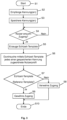
- the method begins in a step S1 and ends in a step S10.
- the transceiver 14 receives an identifier transmitted by the mobile device 6 in a step S2.
- the transceiver 14 and the mobile device 6 communicate according to the same communication standard, in this embodiment via a Bluetooth radio connection.
- the received identifier is stored in a step S3; for example, in the buffer device 28.
- Steps S2 and S3 are carried out for each mobile device 6 that is within radio range of the transceiver 14 and operates according to the same communication standard as the transceiver 14.
- a plurality of identifiers corresponding to a group of present users 2 can be stored in the buffer device 28 at a given time.
- the buffer device 28 is updated when a mobile device 6 is no longer within radio range, e.g., because the associated user 2 has left the public zone 10 without requesting access to the restricted-access zone 8 or because the associated user 2 has already entered the restricted-access zone 8.
- the buffer device 28 thus stores the identifiers of the mobile devices 6 whose users 2 are present in the public zone 10 at a given time.
- step S5 the activated camera 16 generates a digital image depicting at least the face of the detected user 2, and the image processing module generates a real-time template from the digital image, as explained elsewhere in this description.
- each user profile associated with a received identifier is searched in the database 34 using the real-time template determined in step S5.
- a user profile is only searched if it is associated with a present user 2 based on a received identifier. If a registered user 2 requests access, a user profile exists for this user 2 in the database 34, in which the identifier of the mobile device 6 is stored. If the user 2 requesting access is not a registered user 2, no user profile is associated with the identifier of the mobile device 6.
- a check is carried out in step S7 to determine whether the real-time template matches a reference template to a specified degree.
- the real-time template and the reference templates each comprise a specified number of specified facial parameters and their values (e.g., eye distance, mouth width, distance between the upper and lower edges of the lips, distance between the nose and lower edges of the lips, etc.).
- the parameter values of the real-time template are compared with the parameter values of the reference templates. A match exists if the degree of similarity of the templates is at least equal to the specified degree.
- the specified degree indicates a percentage match of the facial parameters of the Real-time templates with the facial parameters of a reference template. Depending on the accuracy requirements, the specified degree can be selected between approximately 60% and approximately 90%.
- the access control system 1 is connected to an elevator system, in particular to an elevator control system. Communication between the access control system 1 and the elevator control system can take place via the network 38. If access control takes place, for example, in the entrance hall of the building, which the users 2 must pass through to reach the elevators, a destination call can be initiated for the respective user 2 each time access is granted.
- the elevator control system of the elevator system processes the destination call and assigns them an elevator.
- the elevator assigned to the destination call can be displayed to the user 2, for example, via a terminal at the entrance 12 and/or communicated by voice. The user 2 can thus go directly to the assigned elevator without having to enter an elevator call.
- each user 2 is registered in the access control system number 1 as an authorized user 2.
- non-registered users 2 may also request access to the restricted zone 8, for example, visitors.
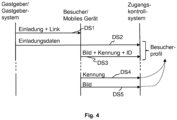
- Fig. 4 shows a signal diagram of an embodiment of a method that allows visitors to conveniently access the restricted zone 8.
- FIG. 4 schematically shows interactions between a host or a host system 36 used by the host, a visitor or their mobile device 6, and the access control system 1 in order to register the visitor by means of a registration procedure in the control system 1.
- the visitor is thus also a user 2 (the reference number 2 will be used below for both the visitor and one or more users).
- the host and visitor 2 agree on an appointment, i.e., a date and time or a period of time at which the host expects visitor 2.
- the host then creates an invitation, for example, using the host system (e.g., PC, notebook, tablet PC, smartphone, or another electronic device) and a software application installed on it (e.g., using Outlook or similar application programs), and sends it to visitor 2, for example, via the communication network 38 and the communication connection 40.
- the communication connection 40 can, for example, be made via a mobile radio communication system.
- the invitation includes an identification number assigned to the invitation (in Fig. 4 referred to as "ID") and also information about a communication channel that the visitor 2 must use to communicate with the access control system 1 for the purpose of registration.
- the communication channel is the Internet; the information about the communication channel therefore includes an Internet address for a web portal (in Fig. 4 referred to as a "link").
- the Internet address can, for example, include a uniform resource locator (URL) that identifies and locates the web portal as a resource via the access method to be used (e.g., a network protocol used such as HTTP or FTP) and the location of the resource in a computer network.
- the web portal is assigned to a computer system of the access control system 1.
- the invitation is transmitted via the communications network 38 using a signal DS1; it can, for example, be sent as a text message to the mobile device 6 of the visitor 2 or as an email to the email address of the visitor 2.
- the host or host system 36 also sends the invitation data to the access control system 1 by means of a signal DS2, for example via the communications network 38, and essentially at the same time as the invitation is sent or at a later time.
- the access control system 1 creates a visitor profile for the received invitation data.
- the invitation data includes, in addition to the appointment details, information about the host, for example, name, telephone number, floor, and/or apartment or office number.
- a time window can be specified within which the visitor 2 is to be granted access. The time window can, for example, specify that the visitor 2 will be granted access approximately half an hour before and after the start of the appointment in case the visitor 2 arrives early or is late.
- the visitor profile can be deleted after the arrival of the visitor 2 or at a later time.
- the invitation prompts visitor 2 to send a digital image, in which visitor 2's face is recognizable, to access control system 1 via the specified communication channel, for example, including the web portal.
- Visitor 2 can, for example, take a recent self-portrait (also known as a "selfie") of themselves using the camera of their mobile device 6 and upload it via the web portal.
- visitor 2 can also upload a saved digital image taken at a previous time.
- An advantage of the technology described here is that visitor 2 can upload the digital image at a time of their choosing, as long as this occurs before the appointment.
- Visitor 2 can be geographically distant from the building or already in or near the building.
- the invitation's identification number is also transmitted so that the access control system 1 can clearly assign the received digital image to the invitation.
- the visitor may be prompted to enter the identifier of the mobile device 6 (for example, telephone number or device identification number). If the visitor uploads the digital image using the mobile device 6, in one embodiment the identifier of the mobile device 6 is also transmitted to the access control system 1, e.g. automatically. If an application-specific The software application installed as described above assists visitor 2 in uploading the digital image.
- the digital image, the identifier, and the invitation identification number are transmitted via a DS3 signal, for example, via the communication network 38 and the communication link 40.
- the DS3 signal can be transmitted according to a known transmission protocol, such as TCP (Transmission Control Protocol), IP (Internet Protocol), and UDP (User Data Protocol).
- TCP Transmission Control Protocol
- IP Internet Protocol
- UDP User Data Protocol
- the invitation can request visitor 2 to transmit the digital image, the identifier, and the identification number of the invitation to a building management office.
- the building management office can, for example, manage the database 34 for the relevant building, in which the user profiles of the authorized users 2 are stored.
- the transmission to the building management office can, for example, be made to an email address of the building management office or telephone number of the building management office specified in the invitation, for example for an SMS or MMS message. Building management staff can then initiate further processing of the received data.
- the Fig. 2 The processor 20 shown receives and further processes the digital image, the identifier, and the identification number of the invitation.
- the access control system 1 generates a reference template from the digital image of the visitor 2 with the aid of the image processing device 22, as in connection with Fig. 2 described, and stores the reference template in the visitor profile.
- the visitor profile is thus complete for the purpose of access control, and the registration process by which visitor 2 is registered in the access control system 1 is completed.
- the reference template and the invitation data can be read.
- Visitor 2 can be assigned according to the terms of use in connection with Fig. 3 Access will be granted to the visitor in the public zone 10 if he or she arrives at the agreed time.
- the transceiver 14 receives the identifier transmitted by the mobile device 6.
- the reception of the identifier of the mobile device 6 takes place as described above and is in Fig. 4 by means of a signal DS4.
- camera 16 generates a digital image showing the visitor's face.
- the generation of the digital image by camera 16 and the subsequent generation of a real-time template are carried out as described above; in Fig. 4 This is represented by a signal DS 5.
- Access control system 1 checks whether the real-time template matches the reference template to the specified degree. Additionally, access control system 1 checks whether the visitor requests access within the time window specified in the visitor profile. If both conditions are met, the visitor is granted access.
- the access control system 1 generates and sends a message to the host informing the host that the visitor has been granted access. The host can thus prepare promptly for the visitor's arrival.
- the access control system 1 can communicate with an elevator control system in order to generate a destination call for visitor 2 upon granting access.
- the elevator control system assigns an elevator to the destination call, whereby the assigned elevator can be communicated to visitor 2 in the area of the access 12 by display or voice.
- the assigned elevator transports visitor 2 to the floor on which the host is located.
- the host's floor is, for example, stored in the visitor profile in conjunction with the invitation data.
- Visitor 2 especially if visiting the building for the first time, therefore does not need to concern themselves with entering the destination floor.
- Visitor 2 can also be provided with further information to enable better orientation in the building. For example, visitor 2 can be informed about which Direction (and possibly also how far) he should walk after disembarking on the floor.
- Such guidance information can be communicated, for example, via the mobile device 6 of visitor 2 and/or displays on the floors or in the elevator car.
Landscapes
- Engineering & Computer Science (AREA)
- Physics & Mathematics (AREA)
- General Physics & Mathematics (AREA)
- Automation & Control Theory (AREA)
- Human Computer Interaction (AREA)
- Computer Networks & Wireless Communication (AREA)
- Health & Medical Sciences (AREA)
- General Health & Medical Sciences (AREA)
- Oral & Maxillofacial Surgery (AREA)
- Multimedia (AREA)
- Theoretical Computer Science (AREA)
- Mobile Radio Communication Systems (AREA)
- Alarm Systems (AREA)
- Telephonic Communication Services (AREA)
Claims (14)
- Procédé permettant de faire fonctionner un système (1) pour le contrôle d'un accès à une zone à accès restreint (8) dans un bâtiment ou sur un terrain, dans lequel le système (1) comprend un dispositif de transmission et de réception (14), un dispositif de mémorisation (26, 28) qui contient une base de données (34) dans laquelle sont créés une pluralité de profils utilisateurs d'utilisateurs (2) ayant le droit à l'accès, un processeur (20) et un dispositif de traitement d'images (16, 22, 24) qui présente une caméra (16) disposée au niveau de l'accès à la zone à accès restreint (8), le procédé comprenant :la réception d'un identifiant spécifique à un appareil d'un appareil électronique (6) mobile d'un utilisateur (2) par le dispositif de transmission et de réception (14) lorsque l'appareil électronique mobile (6) se trouve à portée radio du dispositif de transmission et de réception (14) dans une zone publique (10) à partir de laquelle l'utilisateur (2) présent dans la zone publique (10) peut demander l'accès à la zone à accès restreint (8) ;la mémorisation de l'identifiant reçu de l'appareil électronique mobile (6) dans une autre base de données du dispositif de mémorisation (26, 28) comme appartenant à un utilisateur (2) présent, dans lequel l'autre base de données est configurée pour mémoriser des identifiants d'appareils électroniques mobiles (6) actuellement présents dans la zone publique (10), dans lequel un tel appareil électronique mobile (6) est associé à un utilisateur (2) enregistré ou non enregistré dans le système de contrôle d'accès (1) et dans lequel l'identifiant d'un appareil électronique mobile (6) associé à un utilisateur (2) enregistré est associé à un profil utilisateur de l'utilisateur (2) enregistré, lequel profil utilisateur est mémorisé dans la base de données (34) du dispositif de mémorisation (26, 28) ;la génération d'un modèle en temps réel pour des caractéristiques faciales d'un utilisateur (2) présent à partir d'un enregistrement de caméra de l'utilisateur (2) présent, lequel enregistrement est généré par la caméra (16) du dispositif de traitement d'images (16, 22, 24), lorsqu'une présence de l'utilisateur (2) présent est détectée dans une zone de détection de la caméra (16), lorsque l'utilisateur (2) présent demande l'accès à la zone à accès restreint (8), dans lequel le modèle en temps réel est généré par le dispositif de traitement d'images (16, 22, 24) ;la recherche parmi les profils utilisateurs mémorisés dans la base de données (34) d'un modèle de référence qui correspond, à un degré défini, au modèle en temps réel, dans lequel un profil utilisateur n'est recherché que s'il est associé à un utilisateur (2) présent sur la base d'un identifiant reçu et mémorisé dans l'autre base de données, dans lequel, en cas de correspondance, le système (1) accorde l'accès à la zone à accès restreint (8) à l'utilisateur (2) et refuse l'accès en cas de non-correspondance.
- Procédé selon la revendication 1, dans lequel, lorsqu'une pluralité d'appareils électroniques mobiles (6) se trouvent dans la zone publique (10),- une pluralité d'identifiants reçus sont mémorisés dans l'autre base de données du dispositif de mémorisation (26, 28),- pour chaque identifiant mémorisé, on détermine si, dans la base de données (34), l'identifiant reçu est associé à un profil utilisateur comportant un modèle de référence ; et,- lorsqu'il existe de telles associations, on vérifie si le modèle en temps réel correspond, à un degré défini, à l'un desdits modèles de référence, dans lequel, en cas de correspondance, le système (1) accorde l'accès à la zone à accès restreint (8) à l'utilisateur (2) et refuse l'accès en cas de non-correspondance.
- Procédé selon la revendication 1 ou 2, comprenant en outre la génération d'un signal de résultat qui indique, en cas de correspondance, que l'utilisateur (2) a accès à la zone à accès restreint (8) et qui indique, en cas de non-correspondance, que l'utilisateur (2) n'a pas accès à la zone à accès restreint (8).
- Procédé selon la revendication 3, présentant en outre la génération d'un signal de commande en fonction du signal de résultat afin de débloquer une barrière (18, 36).
- Procédé selon la revendication 3 ou 4, présentant en outre la génération d'un signal de commande en fonction du signal de résultat afin d'activer un dispositif d'information (38) si l'accès est refusé.
- Procédé selon l'une des revendications précédentes, dans lequel le dispositif de transmission et de réception (14) communique avec un appareil électronique mobile (6) à l'aide d'une connexion radio, dans lequel la connexion radio entre le dispositif de transmission et de réception (14) et un appareil électronique mobile (6) d'un utilisateur (2) est effectuée conformément à une norme Bluetooth ou une norme WLAN/Wi-Fi, et dans lequel le dispositif de transmission et de réception (14) reçoit l'identifiant spécifique à l'appareil par l'intermédiaire de la connexion radio lorsque l'appareil électronique mobile (6) se trouve à portée radio du dispositif de transmission et de réception (14).
- Procédé selon l'une des revendications 1 à 6, dans lequel le dispositif de transmission et de réception (14) reçoit l'identifiant spécifique à l'appareil par l'intermédiaire d'un réseau de communication (38).
- Procédé selon l'une des revendications précédentes, dans lequel l'identifiant est généré par un logiciel spécifique à une application, lequel logiciel est actif sur l'appareil mobile (6), dans lequel l'identifiant est invariable dans le temps.
- Procédé selon l'une des revendications 1 à 7, dans lequel l'identifiant comprend un numéro d'identification d'appareil ou un numéro de téléphone associé à un appareil mobile (6).
- Procédé selon l'une des revendications précédentes, dans lequel le modèle en temps réel et les modèles de référence comprennent respectivement un nombre défini de paramètres faciaux définis, et dans lequel le degré défini est compris entre 60 % et 90 %, dans lequel le degré défini indique un pourcentage de correspondance des paramètres faciaux du modèle en temps réel avec les paramètres faciaux d'un modèle de référence.
- Procédé selon l'une des revendications précédentes, présentant en outre la génération d'un appel de destination pour une installation d'ascenseur lorsque l'accès est accordé à l'utilisateur (2).
- Système (1) pour le contrôle d'un accès à une zone à accès restreint (8) dans un bâtiment ou sur un terrain, dans lequel le système (1) comprend :un dispositif de transmission et de réception (14) qui est configuré pour une réception d'un identifiant spécifique à un appareil d'un appareil électronique mobile (6) d'un utilisateur (2) ;un dispositif de mémorisation (26, 28) qui est configuré pour mémoriser l'identifiant de l'appareil électronique mobile (6) reçu par le dispositif de transmission et de réception (14) comme appartenant à un utilisateur (2) présent dans une zone publique (10), lorsque l'appareil électronique mobile (6) se trouve à portée radio du dispositif de transmission et de réception (14) dans une zone publique (10) à partir de laquelle l'utilisateur (2) présent dans la zone publique (10) peut demander l'accès à la zone à accès restreint (8), dans lequel le dispositif de mémorisation (26, 28) contient une base de données (34) dans laquelle sont créés une pluralité de profils utilisateurs d'utilisateurs (2) ayant le droit à l'accès, et contient une autre base de données qui est configurée pour mémoriser des identifiants d'appareils électroniques mobiles (6) actuellement présents dans la zone publique (10), dans lequel un tel appareil électronique mobile (6) est associé à un utilisateur (2) enregistré ou non enregistré dans le système de contrôle d'accès (1) et dans lequel l'identifiant d'un appareil électronique mobile (6) associé à un utilisateur (2) enregistré est associé à un profil utilisateur de l'utilisateur (2) enregistré, lequel profil utilisateur est mémorisé dans la base de données (34) du dispositif de mémorisation (26, 28) ; etun dispositif de traitement d'images (16, 22, 24),- qui présente une caméra (16) disposée au niveau de l'entrée de la zone à accès restreint (8) ;- qui est configuré pour générer, à partir d'un enregistrement de caméra généré par la caméra (16), un modèle en temps réel pour des caractéristiques faciales de l'utilisateur (2) présent lorsque l'utilisateur (2) présent demande l'accès à la zone à accès restreint (8),- qui est configuré pour rechercher parmi les profils utilisateurs mémorisés dans la base de données (34) un modèle de référence qui correspond au modèle en temps réel à un degré défini, dans lequel un profil utilisateur n'est recherché que s'il est associé à un utilisateur présent sur la base d'un identifiant reçu et mémorisé dans l'autre base de données, dans lequel, en cas de correspondance, le système (1) accorde l'accès à l'utilisateur (2) et refuse l'accès en cas de non-correspondance.
- Système (1) selon la revendication 12, dans lequel le dispositif de traitement d'images (16, 22, 24) comprend un module de traitement d'images (22) qui est configuré pour générer le modèle en temps réel à partir de l'enregistrement de caméra, et un module d'évaluation (24) qui est connecté au module de traitement d'images (22) et au dispositif de mémorisation (26, 28), dans lequel le module d'évaluation (24) est configuré pour générer un signal de résultat qui indique si le modèle en temps réel correspond audit modèle de référence.
- Système (1) selon la revendication 13, présentant en outre un processeur (20) qui est connecté au dispositif de traitement d'images (16, 22, 24) et qui est configuré pour générer un signal de commande en fonction du signal de résultat afin de commander le système de contrôle d'accès (1) de manière à autoriser ou à refuser l'accès à l'utilisateur (2).
Applications Claiming Priority (2)
| Application Number | Priority Date | Filing Date | Title |
|---|---|---|---|
| EP17165812 | 2017-04-10 | ||
| PCT/EP2018/057968 WO2018188956A1 (fr) | 2017-04-10 | 2018-03-28 | Système de contrôle d'accès avec détection faciale et radio |
Publications (2)
| Publication Number | Publication Date |
|---|---|
| EP3610465A1 EP3610465A1 (fr) | 2020-02-19 |
| EP3610465B1 true EP3610465B1 (fr) | 2025-05-07 |
Family
ID=58530470
Family Applications (1)
| Application Number | Title | Priority Date | Filing Date |
|---|---|---|---|
| EP18712630.5A Active EP3610465B1 (fr) | 2017-04-10 | 2018-03-28 | Système de contrôle d'accès avec reconnaissance faciale et radioélectrique |
Country Status (7)
| Country | Link |
|---|---|
| US (1) | US11238684B2 (fr) |
| EP (1) | EP3610465B1 (fr) |
| KR (1) | KR102585422B1 (fr) |
| CN (1) | CN110494898B (fr) |
| AU (1) | AU2018251059B2 (fr) |
| MX (1) | MX2019012159A (fr) |
| WO (1) | WO2018188956A1 (fr) |
Families Citing this family (14)
| Publication number | Priority date | Publication date | Assignee | Title |
|---|---|---|---|---|
| US10875742B2 (en) * | 2017-11-09 | 2020-12-29 | Otis Elevator Company | Elevator service request using user device with filtered destination floor selection |
| EP3797378B1 (fr) * | 2018-05-21 | 2026-04-01 | Tyco Fire & Security GmbH | Contrôle d'accès sans contact à reconnaissance faciale |
| US11087577B2 (en) * | 2018-12-14 | 2021-08-10 | Johnson Controls Tyco IP Holdings LLP | Systems and methods of secure pin code entry |
| EP3674240A1 (fr) * | 2018-12-28 | 2020-07-01 | Otis Elevator Company | Système et procédé d'attribution de service d'ascenseur sur la base d'un emplacement souhaité d'une pluralité de passagers |
| CN115515876A (zh) | 2020-05-13 | 2022-12-23 | 通力股份公司 | 用于输送机系统的访问解决方案 |
| KR102352616B1 (ko) * | 2020-06-17 | 2022-01-19 | (주)한우리아이티 | 손동작을 이용한 엘리베이터 입력장치 |
| JP7211399B2 (ja) * | 2020-06-25 | 2023-01-24 | 横河電機株式会社 | 装置、方法およびプログラム |
| US11475596B2 (en) * | 2020-07-23 | 2022-10-18 | Motorola Solutions, Inc. | Device, method and system for adjusting a configuration of a camera device |
| WO2022064566A1 (fr) * | 2020-09-23 | 2022-03-31 | 三菱電機ビルテクノサービス株式会社 | Système de surveillance pour des dispositifs de transport vertical |
| JP7099599B1 (ja) | 2021-07-26 | 2022-07-12 | 三菱電機株式会社 | エレベータのセキュリティシステム、携帯端末、及びセキュリティシステムの制御方法 |
| US12072117B2 (en) * | 2021-09-17 | 2024-08-27 | Airthinx, Inc | Environment management systems and methods |
| CN114476885B (zh) * | 2021-12-06 | 2023-05-09 | 猫岐智能科技(上海)有限公司 | 电梯控制系统及方法 |
| CN119013708A (zh) * | 2022-04-14 | 2024-11-22 | 通力股份公司 | 允许访客访问建筑物 |
| EP4484351A4 (fr) * | 2023-02-27 | 2026-03-11 | Hyundai Elevator Co Ltd | Système de gestion de maintenance d'un dispositif de transfert de passager |
Family Cites Families (47)
| Publication number | Priority date | Publication date | Assignee | Title |
|---|---|---|---|---|
| US4449189A (en) | 1981-11-20 | 1984-05-15 | Siemens Corporation | Personal access control system using speech and face recognition |
| US5012522A (en) | 1988-12-08 | 1991-04-30 | The United States Of America As Represented By The Secretary Of The Air Force | Autonomous face recognition machine |
| US5291560A (en) | 1991-07-15 | 1994-03-01 | Iri Scan Incorporated | Biometric personal identification system based on iris analysis |
| US5432864A (en) | 1992-10-05 | 1995-07-11 | Daozheng Lu | Identification card verification system |
| DE19610066C1 (de) | 1996-03-14 | 1997-09-18 | Siemens Nixdorf Advanced Techn | Verfahren zur Erfassung gesichtsbezogener Personendaten und deren Verwendung zur Identifizierung oder Verifikation von Personen |
| DE19847261A1 (de) | 1998-10-05 | 2000-04-06 | Dcs Dialog Communication Syste | Verfahren und System zur Personenerkennung mit modellbasierter Gesichtsfindung |
| US6690673B1 (en) * | 1999-05-27 | 2004-02-10 | Jeffeerson J. Jarvis | Method and apparatus for a biometric transponder based activity management system |
| US6976269B1 (en) | 2000-08-29 | 2005-12-13 | Equinix, Inc. | Internet co-location facility security system |
| US6963659B2 (en) | 2000-09-15 | 2005-11-08 | Facekey Corp. | Fingerprint verification system utilizing a facial image-based heuristic search method |
| US7079669B2 (en) | 2000-12-27 | 2006-07-18 | Mitsubishi Denki Kabushiki Kaisha | Image processing device and elevator mounting it thereon |
| JP3620499B2 (ja) | 2001-12-12 | 2005-02-16 | セイコーエプソン株式会社 | 多値画像変換装置及び多値画像変換プログラム、並びに多値画像変換方法 |
| US6725383B2 (en) * | 2002-05-15 | 2004-04-20 | Biocom, Llc | Data and image capture, compression and verification system |
| US6972660B1 (en) * | 2002-05-15 | 2005-12-06 | Lifecardid, Inc. | System and method for using biometric data for providing identification, security, access and access records |
| WO2004010365A2 (fr) | 2002-07-19 | 2004-01-29 | Dicut Inc. | Systeme de reconnaissance du visage et procede |
| US20150015365A1 (en) * | 2013-07-09 | 2015-01-15 | Mesa Digital, LLC. | Point of entry authorization utilizing rfid enabled profile and biometric data |
| EP1475754B1 (fr) | 2003-05-05 | 2011-12-07 | Inventio AG | Système de contrôle de sécurité pour le transport de personnes avec un ascenseur et procédé d'utilisation de ce système |
| CH700703B1 (de) * | 2003-11-05 | 2010-10-15 | Fastcom Technology Sa | Einrichtung für Durchgangskontrolle und Personenvereinzelung. |
| US7362210B2 (en) | 2003-09-05 | 2008-04-22 | Honeywell International Inc. | System and method for gate access control |
| EP1647918A1 (fr) * | 2004-10-13 | 2006-04-19 | SkiData AG | Système de contrôle d'accès |
| EP2802144A1 (fr) * | 2004-12-17 | 2014-11-12 | Dai Nippon Printing Co., Ltd. | Système de gestion d'informations d'image et procédé associé et système de recherche d'informations d'image |
| KR100703693B1 (ko) * | 2005-01-13 | 2007-04-05 | 삼성전자주식회사 | 얼굴 인식 시스템 및 방법 |
| JP2007131434A (ja) * | 2005-11-11 | 2007-05-31 | Mitsubishi Electric Corp | エレベータの防犯システム及びその制御方法 |
| KR101328958B1 (ko) | 2007-10-19 | 2013-11-13 | 엘지전자 주식회사 | 이동 단말기 및 이동 단말기의 데이터 업로드 방법 |
| US8779889B2 (en) * | 2008-11-12 | 2014-07-15 | Lo-Q Plc. | System for regulating access to a resource |
| JP4544363B1 (ja) | 2009-03-13 | 2010-09-15 | オムロン株式会社 | 顔認証装置、人物画像検索システム、顔認証装置制御プログラム、コンピュータ読み取り可能な記録媒体、および顔認証装置の制御方法 |
| EP2237234A1 (fr) | 2009-04-03 | 2010-10-06 | Inventio AG | Procédé et dispositif destinés au contrôle d'accès |
| US20100282839A1 (en) | 2009-05-07 | 2010-11-11 | Security Identification Systems Corporation | Method and system for the mobile tracking and accounting of individuals in a closed community |
| WO2011159921A1 (fr) | 2010-06-16 | 2011-12-22 | Delphian Systems, LLC | Système de verrouillage activé par un dispositif sans fil |
| US8494231B2 (en) | 2010-11-01 | 2013-07-23 | Microsoft Corporation | Face recognition in video content |
| BRPI1101789E2 (pt) | 2011-02-14 | 2015-12-22 | Neti Soluções Tecnologicas Ltda | sistema de validação para liberação de acesso pessoas por reconhecimento facial biométrico |
| US8438110B2 (en) * | 2011-03-08 | 2013-05-07 | Bank Of America Corporation | Conducting financial transactions based on identification of individuals in an augmented reality environment |
| US8646686B2 (en) * | 2011-08-11 | 2014-02-11 | Benton William Bullwinkel | Secure system for creating and validating personal identification cards with operator discretion |
| US9055050B2 (en) * | 2012-06-27 | 2015-06-09 | Facebook, Inc. | User authentication of applications on third-party devices via user devices |
| US20140085050A1 (en) * | 2012-09-25 | 2014-03-27 | Aliphcom | Validation of biometric identification used to authenticate identity of a user of wearable sensors |
| US9762865B2 (en) | 2013-03-15 | 2017-09-12 | James Carey | Video identification and analytical recognition system |
| KR20140136350A (ko) | 2013-05-20 | 2014-11-28 | 삼성전자주식회사 | 전자장치의 사용 방법 및 장치 |
| US9988238B2 (en) | 2013-09-03 | 2018-06-05 | Otis Elevator Company | Elevator dispatch using facial recognition |
| US9552684B2 (en) * | 2014-02-04 | 2017-01-24 | Secure Gravity Inc. | Methods and systems configured to detect and guarantee identity for the purpose of data protection and access control |
| KR20150130712A (ko) * | 2014-05-14 | 2015-11-24 | 김경선 | 지능형 디지털 출입문 제어시스템 및 그 방법 |
| CN107000982B (zh) * | 2014-12-03 | 2020-06-09 | 因温特奥股份公司 | 与电梯交替交互的系统和方法 |
| US10934132B2 (en) | 2015-06-10 | 2021-03-02 | Inventio Ag | Lift system with predictive call production |
| JP2017033358A (ja) * | 2015-08-03 | 2017-02-09 | 富士ゼロックス株式会社 | 認証装置 |
| CN105654584B (zh) | 2015-12-24 | 2018-05-08 | 歌尔股份有限公司 | 一种门禁监控方法和系统 |
| CN105741395A (zh) * | 2016-02-03 | 2016-07-06 | 慧锐通智能科技股份有限公司 | 基于二维码和人脸识别的门禁访问方法和系统 |
| CN106296920A (zh) * | 2016-08-11 | 2017-01-04 | 苏州优化智能仪器科技有限公司 | 智能门禁系统 |
| CN106373233A (zh) * | 2016-08-31 | 2017-02-01 | 北京厚文知识产权顾问有限公司 | 远程控制门禁系统 |
| US10850709B1 (en) * | 2019-08-27 | 2020-12-01 | Toyota Motor Engineering & Manufacturing North America, Inc. | Facial recognition and object detection for vehicle unlocking scenarios |
-
2018
- 2018-03-28 EP EP18712630.5A patent/EP3610465B1/fr active Active
- 2018-03-28 CN CN201880024421.4A patent/CN110494898B/zh active Active
- 2018-03-28 WO PCT/EP2018/057968 patent/WO2018188956A1/fr not_active Ceased
- 2018-03-28 US US16/603,932 patent/US11238684B2/en active Active
- 2018-03-28 KR KR1020197028475A patent/KR102585422B1/ko active Active
- 2018-03-28 MX MX2019012159A patent/MX2019012159A/es unknown
- 2018-03-28 AU AU2018251059A patent/AU2018251059B2/en active Active
Also Published As
| Publication number | Publication date |
|---|---|
| AU2018251059B2 (en) | 2021-05-06 |
| MX2019012159A (es) | 2019-11-21 |
| WO2018188956A1 (fr) | 2018-10-18 |
| KR102585422B1 (ko) | 2023-10-05 |
| CN110494898A (zh) | 2019-11-22 |
| AU2018251059A1 (en) | 2019-09-19 |
| EP3610465A1 (fr) | 2020-02-19 |
| KR20190138638A (ko) | 2019-12-13 |
| US20200126337A1 (en) | 2020-04-23 |
| US11238684B2 (en) | 2022-02-01 |
| CN110494898B (zh) | 2023-05-12 |
Similar Documents
| Publication | Publication Date | Title |
|---|---|---|
| EP3610465B1 (fr) | Système de contrôle d'accès avec reconnaissance faciale et radioélectrique | |
| EP3610466B1 (fr) | Procédé d'enregistrement et de contrôle d'accès de visiteurs | |
| EP3729384B1 (fr) | Système de contrôle d'accès avec reconnaissance faciale et radioélectrique | |
| EP3307666B2 (fr) | Systeme d'ascenseur dote d'une generation d'appel predictive | |
| EP3729385B1 (fr) | Système de contrôle d'accès à fonction d'authentification radio et de saisie du mot de passe | |
| EP3542350A1 (fr) | Système de contrôle d'accès avec mise à jour d'état automatique | |
| EP3899881B1 (fr) | Système de contrôle d'accès pourvu de porte coulissante à commande gestuelle | |
| DE102020200557B4 (de) | Zutrittskontrollsystem mit belegungsschätzung | |
| WO2021122462A1 (fr) | Dispositif d'interface homme-machine pour systèmes de construction | |
| DE102012205379A1 (de) | Verfahren und System zur Durchführung einer Gebäudezugangskontrolle | |
| EP4078543A1 (fr) | Système de bâtiment pour une communication d'utilisateur privée | |
| EP3864426B1 (fr) | Système et procédé de détermination de la position dans un bâtiment | |
| EP3611711B1 (fr) | Procédé de classification de données concernant un espace de stationnement pour un véhicule automobile | |
| EP4154224A1 (fr) | Surveillance de zone supplémentaire de porte de bâtiment | |
| DE102015202485A1 (de) | Telekommunikationsverfahren zur Authentifizierung eines Nutzers | |
| DE202026100571U1 (de) | Zugangskontrollsystem für Gebäude mit Anzeigevorrichtung | |
| WO2023052031A1 (fr) | Système de porte de bâtiment avec dispositifs de fonctionnement et d'orientation | |
| DE102024104177A1 (de) | Verfahren und System zum Betätigen eines intelligenten Schlosses sowie Computerprogrammprodukt | |
| WO2024002637A1 (fr) | Système de contrôle d'accès avec accès sans barrière | |
| WO2020074359A1 (fr) | Système de contrôle d'accès et procédé servant à faire fonctionner un système de contrôle d'accès | |
| HK40011232A (en) | Visitor access control system with radio identification and facial recognition | |
| HK40011121A (en) | Access control system having radio and facial recognition | |
| HK40011121B (en) | Access control system having radio and facial recognition |
Legal Events
| Date | Code | Title | Description |
|---|---|---|---|
| STAA | Information on the status of an ep patent application or granted ep patent |
Free format text: STATUS: UNKNOWN |
|
| STAA | Information on the status of an ep patent application or granted ep patent |
Free format text: STATUS: THE INTERNATIONAL PUBLICATION HAS BEEN MADE |
|
| PUAI | Public reference made under article 153(3) epc to a published international application that has entered the european phase |
Free format text: ORIGINAL CODE: 0009012 |
|
| STAA | Information on the status of an ep patent application or granted ep patent |
Free format text: STATUS: REQUEST FOR EXAMINATION WAS MADE |
|
| 17P | Request for examination filed |
Effective date: 20190918 |
|
| AK | Designated contracting states |
Kind code of ref document: A1 Designated state(s): AL AT BE BG CH CY CZ DE DK EE ES FI FR GB GR HR HU IE IS IT LI LT LU LV MC MK MT NL NO PL PT RO RS SE SI SK SM TR |
|
| AX | Request for extension of the european patent |
Extension state: BA ME |
|
| DAV | Request for validation of the european patent (deleted) | ||
| DAX | Request for extension of the european patent (deleted) | ||
| STAA | Information on the status of an ep patent application or granted ep patent |
Free format text: STATUS: EXAMINATION IS IN PROGRESS |
|
| 17Q | First examination report despatched |
Effective date: 20220428 |
|
| RAP3 | Party data changed (applicant data changed or rights of an application transferred) |
Owner name: INVENTIO AG |
|
| GRAP | Despatch of communication of intention to grant a patent |
Free format text: ORIGINAL CODE: EPIDOSNIGR1 |
|
| STAA | Information on the status of an ep patent application or granted ep patent |
Free format text: STATUS: GRANT OF PATENT IS INTENDED |
|
| INTG | Intention to grant announced |
Effective date: 20240920 |
|
| GRAJ | Information related to disapproval of communication of intention to grant by the applicant or resumption of examination proceedings by the epo deleted |
Free format text: ORIGINAL CODE: EPIDOSDIGR1 |
|
| STAA | Information on the status of an ep patent application or granted ep patent |
Free format text: STATUS: EXAMINATION IS IN PROGRESS |
|
| INTC | Intention to grant announced (deleted) | ||
| GRAP | Despatch of communication of intention to grant a patent |
Free format text: ORIGINAL CODE: EPIDOSNIGR1 |
|
| STAA | Information on the status of an ep patent application or granted ep patent |
Free format text: STATUS: GRANT OF PATENT IS INTENDED |
|
| INTG | Intention to grant announced |
Effective date: 20250220 |
|
| GRAS | Grant fee paid |
Free format text: ORIGINAL CODE: EPIDOSNIGR3 |
|
| GRAA | (expected) grant |
Free format text: ORIGINAL CODE: 0009210 |
|
| STAA | Information on the status of an ep patent application or granted ep patent |
Free format text: STATUS: THE PATENT HAS BEEN GRANTED |
|
| AK | Designated contracting states |
Kind code of ref document: B1 Designated state(s): AL AT BE BG CH CY CZ DE DK EE ES FI FR GB GR HR HU IE IS IT LI LT LU LV MC MK MT NL NO PL PT RO RS SE SI SK SM TR |
|
| REG | Reference to a national code |
Ref country code: GB Ref legal event code: FG4D Free format text: NOT ENGLISH |
|
| REG | Reference to a national code |
Ref country code: CH Ref legal event code: EP |
|
| REG | Reference to a national code |
Ref country code: DE Ref legal event code: R096 Ref document number: 502018015790 Country of ref document: DE |
|
| REG | Reference to a national code |
Ref country code: IE Ref legal event code: FG4D Free format text: LANGUAGE OF EP DOCUMENT: GERMAN |
|
| REG | Reference to a national code |
Ref country code: NL Ref legal event code: FP |
|
| PG25 | Lapsed in a contracting state [announced via postgrant information from national office to epo] |
Ref country code: PT Free format text: LAPSE BECAUSE OF FAILURE TO SUBMIT A TRANSLATION OF THE DESCRIPTION OR TO PAY THE FEE WITHIN THE PRESCRIBED TIME-LIMIT Effective date: 20250908 Ref country code: ES Free format text: LAPSE BECAUSE OF FAILURE TO SUBMIT A TRANSLATION OF THE DESCRIPTION OR TO PAY THE FEE WITHIN THE PRESCRIBED TIME-LIMIT Effective date: 20250507 Ref country code: FI Free format text: LAPSE BECAUSE OF FAILURE TO SUBMIT A TRANSLATION OF THE DESCRIPTION OR TO PAY THE FEE WITHIN THE PRESCRIBED TIME-LIMIT Effective date: 20250507 |
|
| REG | Reference to a national code |
Ref country code: LT Ref legal event code: MG9D |
|
| PG25 | Lapsed in a contracting state [announced via postgrant information from national office to epo] |
Ref country code: GR Free format text: LAPSE BECAUSE OF FAILURE TO SUBMIT A TRANSLATION OF THE DESCRIPTION OR TO PAY THE FEE WITHIN THE PRESCRIBED TIME-LIMIT Effective date: 20250808 Ref country code: NO Free format text: LAPSE BECAUSE OF FAILURE TO SUBMIT A TRANSLATION OF THE DESCRIPTION OR TO PAY THE FEE WITHIN THE PRESCRIBED TIME-LIMIT Effective date: 20250807 |
|
| PG25 | Lapsed in a contracting state [announced via postgrant information from national office to epo] |
Ref country code: PL Free format text: LAPSE BECAUSE OF FAILURE TO SUBMIT A TRANSLATION OF THE DESCRIPTION OR TO PAY THE FEE WITHIN THE PRESCRIBED TIME-LIMIT Effective date: 20250507 |
|
| PG25 | Lapsed in a contracting state [announced via postgrant information from national office to epo] |
Ref country code: BG Free format text: LAPSE BECAUSE OF FAILURE TO SUBMIT A TRANSLATION OF THE DESCRIPTION OR TO PAY THE FEE WITHIN THE PRESCRIBED TIME-LIMIT Effective date: 20250507 |
|
| PG25 | Lapsed in a contracting state [announced via postgrant information from national office to epo] |
Ref country code: HR Free format text: LAPSE BECAUSE OF FAILURE TO SUBMIT A TRANSLATION OF THE DESCRIPTION OR TO PAY THE FEE WITHIN THE PRESCRIBED TIME-LIMIT Effective date: 20250507 |
|
| PG25 | Lapsed in a contracting state [announced via postgrant information from national office to epo] |
Ref country code: RS Free format text: LAPSE BECAUSE OF FAILURE TO SUBMIT A TRANSLATION OF THE DESCRIPTION OR TO PAY THE FEE WITHIN THE PRESCRIBED TIME-LIMIT Effective date: 20250807 |
|
| PG25 | Lapsed in a contracting state [announced via postgrant information from national office to epo] |
Ref country code: IS Free format text: LAPSE BECAUSE OF FAILURE TO SUBMIT A TRANSLATION OF THE DESCRIPTION OR TO PAY THE FEE WITHIN THE PRESCRIBED TIME-LIMIT Effective date: 20250907 |
|
| PG25 | Lapsed in a contracting state [announced via postgrant information from national office to epo] |
Ref country code: LV Free format text: LAPSE BECAUSE OF FAILURE TO SUBMIT A TRANSLATION OF THE DESCRIPTION OR TO PAY THE FEE WITHIN THE PRESCRIBED TIME-LIMIT Effective date: 20250507 |
|
| PG25 | Lapsed in a contracting state [announced via postgrant information from national office to epo] |
Ref country code: DK Free format text: LAPSE BECAUSE OF FAILURE TO SUBMIT A TRANSLATION OF THE DESCRIPTION OR TO PAY THE FEE WITHIN THE PRESCRIBED TIME-LIMIT Effective date: 20250507 Ref country code: SM Free format text: LAPSE BECAUSE OF FAILURE TO SUBMIT A TRANSLATION OF THE DESCRIPTION OR TO PAY THE FEE WITHIN THE PRESCRIBED TIME-LIMIT Effective date: 20250507 |
|
| PG25 | Lapsed in a contracting state [announced via postgrant information from national office to epo] |
Ref country code: CZ Free format text: LAPSE BECAUSE OF FAILURE TO SUBMIT A TRANSLATION OF THE DESCRIPTION OR TO PAY THE FEE WITHIN THE PRESCRIBED TIME-LIMIT Effective date: 20250507 |
|
| PG25 | Lapsed in a contracting state [announced via postgrant information from national office to epo] |
Ref country code: EE Free format text: LAPSE BECAUSE OF FAILURE TO SUBMIT A TRANSLATION OF THE DESCRIPTION OR TO PAY THE FEE WITHIN THE PRESCRIBED TIME-LIMIT Effective date: 20250507 |
|
| PG25 | Lapsed in a contracting state [announced via postgrant information from national office to epo] |
Ref country code: RO Free format text: LAPSE BECAUSE OF FAILURE TO SUBMIT A TRANSLATION OF THE DESCRIPTION OR TO PAY THE FEE WITHIN THE PRESCRIBED TIME-LIMIT Effective date: 20250507 Ref country code: SK Free format text: LAPSE BECAUSE OF FAILURE TO SUBMIT A TRANSLATION OF THE DESCRIPTION OR TO PAY THE FEE WITHIN THE PRESCRIBED TIME-LIMIT Effective date: 20250507 |
|
| REG | Reference to a national code |
Ref country code: DE Ref legal event code: R097 Ref document number: 502018015790 Country of ref document: DE |
|
| PLBE | No opposition filed within time limit |
Free format text: ORIGINAL CODE: 0009261 |
|
| STAA | Information on the status of an ep patent application or granted ep patent |
Free format text: STATUS: NO OPPOSITION FILED WITHIN TIME LIMIT |
|
| REG | Reference to a national code |
Ref country code: CH Ref legal event code: L10 Free format text: ST27 STATUS EVENT CODE: U-0-0-L10-L00 (AS PROVIDED BY THE NATIONAL OFFICE) Effective date: 20260318 |
|
| REG | Reference to a national code |
Ref country code: CH Ref legal event code: U11 Free format text: ST27 STATUS EVENT CODE: U-0-0-U10-U11 (AS PROVIDED BY THE NATIONAL OFFICE) Effective date: 20260401 |
|
| PGFP | Annual fee paid to national office [announced via postgrant information from national office to epo] |
Ref country code: GB Payment date: 20260319 Year of fee payment: 9 |
|
| 26N | No opposition filed |
Effective date: 20260210 |
|
| PGFP | Annual fee paid to national office [announced via postgrant information from national office to epo] |
Ref country code: IT Payment date: 20260320 Year of fee payment: 9 |
|
| PGFP | Annual fee paid to national office [announced via postgrant information from national office to epo] |
Ref country code: NL Payment date: 20260323 Year of fee payment: 9 |
|
| PGFP | Annual fee paid to national office [announced via postgrant information from national office to epo] |
Ref country code: FR Payment date: 20260323 Year of fee payment: 9 |