EP0887555B1 - Verfahren zur Bestimmung des Betriebspunktes eines Ventilators und Ventilatoranordnung - Google Patents
Verfahren zur Bestimmung des Betriebspunktes eines Ventilators und Ventilatoranordnung Download PDFInfo
- Publication number
- EP0887555B1 EP0887555B1 EP98107573A EP98107573A EP0887555B1 EP 0887555 B1 EP0887555 B1 EP 0887555B1 EP 98107573 A EP98107573 A EP 98107573A EP 98107573 A EP98107573 A EP 98107573A EP 0887555 B1 EP0887555 B1 EP 0887555B1
- Authority
- EP
- European Patent Office
- Prior art keywords
- pressure
- fan
- measured
- pressure difference
- volume flow
- Prior art date
- Legal status (The legal status is an assumption and is not a legal conclusion. Google has not performed a legal analysis and makes no representation as to the accuracy of the status listed.)
- Expired - Lifetime
Links
- 238000000034 method Methods 0.000 title claims abstract description 28
- 238000005259 measurement Methods 0.000 claims description 17
- 230000003068 static effect Effects 0.000 claims description 14
- 230000006835 compression Effects 0.000 claims description 5
- 238000007906 compression Methods 0.000 claims description 5
- 230000001419 dependent effect Effects 0.000 claims description 5
- 230000008569 process Effects 0.000 claims description 2
- 238000009530 blood pressure measurement Methods 0.000 claims 19
- 238000009434 installation Methods 0.000 description 15
- 210000002445 nipple Anatomy 0.000 description 7
- 238000010079 rubber tapping Methods 0.000 description 5
- 238000001035 drying Methods 0.000 description 3
- 239000000523 sample Substances 0.000 description 3
- 238000012360 testing method Methods 0.000 description 3
- 230000008901 benefit Effects 0.000 description 2
- 238000004364 calculation method Methods 0.000 description 2
- 230000003750 conditioning effect Effects 0.000 description 2
- 239000000428 dust Substances 0.000 description 2
- 230000006870 function Effects 0.000 description 2
- 238000000227 grinding Methods 0.000 description 2
- 238000012545 processing Methods 0.000 description 2
- 239000007787 solid Substances 0.000 description 2
- 238000011144 upstream manufacturing Methods 0.000 description 2
- 206010010774 Constipation Diseases 0.000 description 1
- 230000004323 axial length Effects 0.000 description 1
- 238000011088 calibration curve Methods 0.000 description 1
- 230000008859 change Effects 0.000 description 1
- 238000009833 condensation Methods 0.000 description 1
- 230000005494 condensation Effects 0.000 description 1
- 238000010276 construction Methods 0.000 description 1
- 238000005516 engineering process Methods 0.000 description 1
- 229910052602 gypsum Inorganic materials 0.000 description 1
- 239000010440 gypsum Substances 0.000 description 1
- 238000012423 maintenance Methods 0.000 description 1
- 238000007726 management method Methods 0.000 description 1
- 239000000463 material Substances 0.000 description 1
- 238000000691 measurement method Methods 0.000 description 1
- 230000001404 mediated effect Effects 0.000 description 1
- 238000010327 methods by industry Methods 0.000 description 1
- 238000012546 transfer Methods 0.000 description 1
- 230000007704 transition Effects 0.000 description 1
- XLYOFNOQVPJJNP-UHFFFAOYSA-N water Chemical compound O XLYOFNOQVPJJNP-UHFFFAOYSA-N 0.000 description 1
Images
Classifications
-
- F—MECHANICAL ENGINEERING; LIGHTING; HEATING; WEAPONS; BLASTING
- F04—POSITIVE - DISPLACEMENT MACHINES FOR LIQUIDS; PUMPS FOR LIQUIDS OR ELASTIC FLUIDS
- F04D—NON-POSITIVE-DISPLACEMENT PUMPS
- F04D27/00—Control, e.g. regulation, of pumps, pumping installations or pumping systems specially adapted for elastic fluids
- F04D27/001—Testing thereof; Determination or simulation of flow characteristics; Stall or surge detection, e.g. condition monitoring
-
- F—MECHANICAL ENGINEERING; LIGHTING; HEATING; WEAPONS; BLASTING
- F05—INDEXING SCHEMES RELATING TO ENGINES OR PUMPS IN VARIOUS SUBCLASSES OF CLASSES F01-F04
- F05D—INDEXING SCHEME FOR ASPECTS RELATING TO NON-POSITIVE-DISPLACEMENT MACHINES OR ENGINES, GAS-TURBINES OR JET-PROPULSION PLANTS
- F05D2270/00—Control
- F05D2270/30—Control parameters, e.g. input parameters
- F05D2270/301—Pressure
-
- F—MECHANICAL ENGINEERING; LIGHTING; HEATING; WEAPONS; BLASTING
- F05—INDEXING SCHEMES RELATING TO ENGINES OR PUMPS IN VARIOUS SUBCLASSES OF CLASSES F01-F04
- F05D—INDEXING SCHEME FOR ASPECTS RELATING TO NON-POSITIVE-DISPLACEMENT MACHINES OR ENGINES, GAS-TURBINES OR JET-PROPULSION PLANTS
- F05D2270/00—Control
- F05D2270/30—Control parameters, e.g. input parameters
- F05D2270/301—Pressure
- F05D2270/3015—Pressure differential pressure
Definitions
- the invention relates to a method for determining the operating point of a Fan according to the preamble of claim 1, and a fan arrangement according to the preamble of claim 10.
- the radial fan known from EP-B 0 419 798 has at least one one Flow opening limiting and the associated radial impeller upstream inlet nozzle. At least partially at a measuring point in the area the inner circumference of the inflow nozzle in the area in front of it
- the throughflow opening is designed as a static pressure measuring device Arranged measuring device and a located in the area of the measuring point Nozzle wall opening connected.
- centrifugal fan known from EP-A 0 626 519, they are for measurement the pressure difference points provided in the inlet nozzle in two Layers arranged.
- the object of the invention is a method according to the preamble of claim 1 and a corresponding fan according to the preamble of claim 10 develop a determination of the operating point in the installed state, d. H. without external measuring section and calibration as well as an assessment of the quality of the Enable determination and a high level of reliability and thus a high level Ensure operational security.
- an effective pressure difference ⁇ p M w between two levels in the inflow nozzle or between a level in the inflow nozzle and a location in the vicinity, as well as a total pressure difference ⁇ p M t between the suction side and the pressure side of the Fan measured.
- V ⁇ A ⁇ ((2 / ⁇ ) ⁇ p M W ) the volume flow Mediated, where ⁇ is a nozzle coefficient composed of the flow coefficient ⁇ 'and the expansion number ⁇ , A is the reference cross section of the inflow nozzle and ⁇ is the density of the conveyed gas at the inlet to the fan.
- the setpoint value of the total pressure difference ⁇ p s t belonging to the volume flow V is then determined from an existing operating characteristic curve ⁇ p (V) and compared with the measured total pressure difference ⁇ p M t .
- the operating point and its quality are determined on the basis of the agreement or deviation of the target value ⁇ p s t with the measured value ⁇ p M / t. If the value agrees well with the measured value, the operating point determined from the volume flow V and the total pressure ⁇ p M t is determined with high accuracy. A corresponding accuracy class is assigned.
- the advantage of the method according to the invention is that the operating point of the Fan in the installed state determined with specification of the accuracy classes can be. Unfavorable inflow conditions are considered when determining the Operating point recognized and generally lead to the determination of values less accuracy. Inadmissible operating points can also be used with this Procedures for determining the operating point are determined. It will also gradual failures and total failures of the measuring sensors to Example recognized by clogging measuring points. False alarm is avoided and can be intercepted by qualified warnings.
- the shaft power P M W can also be measured.
- the shaft power P M W is a good measure of the power of the fan impeller applied to convey the gas.
- the motor power P M M of the fan motor can also be measured and converted into the shaft power P M W.
- the setpoint value of the shaft power P S W belonging to the volume flow V is additionally determined from an existing operating characteristic curve P W (V) and compared with the measured shaft power P M W. The agreement or deviation of the setpoint P S W improves the determination of the operating point and its quality.
- the setpoints ⁇ p S t and P S W are according to claim 3 with the aid of transmitted configuration values, such as the nominal diameter D of the fan or dimensions of the inlet nozzle, and measured state values, such as the external pressure Pa, the temperature T, the motor speed n or the speed of the fan wheel n * and determined from model characteristics.
- Model characteristic curves are characteristic curves that are recorded and standardized on a test bench using a fan model, ie they are standardized type characteristic curves. Model characteristics for the pressure figure ⁇ ( ⁇ ), the efficiency ⁇ ( ⁇ ) and possibly the performance figure ⁇ ( ⁇ ) in
- a state variable for example the density p of the conveyed gas
- a state variable for example the density p of the conveyed gas
- the shaft power P M W is also measured in the environment and the total pressure difference ⁇ p M t .
- the determination of the volume flow V and the state value is carried out in iteration steps.
- the comparison of the desired value for the shaft power P S W derived from the determined volume flow V with its measured value P M W enables the assignment of an accuracy class.
- the dependence of the nozzle coefficient ⁇ corresponding to this pressure difference ⁇ p M W on the Reynold number Re in iteration steps can be taken into account when determining the volume flow V from the measured pressure difference ⁇ p M W.
- at least one model characteristic curve ⁇ (Re) measured on a model inflow nozzle installed in a model fan is stored.
- an average nozzle coefficient ⁇ is inserted in the first iteration step.
- a Reynolds number Re can be determined from the volume flow V determined in the first iteration step and a second nozzle coefficient ⁇ can be read from the model characteristic curve ⁇ (Re).
- the second iteration step is carried out with the second nozzle coefficient ⁇ .
- the values determined from the characteristic curves in the form of factors dependent on the operating state of the fan, in particular the factor k to take into account internal losses and / or the factor f can be upgraded or depreciated to take into account the compression of the extracted gas.
- the factors determined from the characteristic curves in the form of factors dependent on the operating state of the fan in particular the factor k to take into account internal losses and / or the factor f can be upgraded or depreciated to take into account the compression of the extracted gas.
- e.g. B. stored on several sizes of the type series of the fan characteristic curves for the factor k depending on the rotational speed u of the fan wheel and characteristic curves or calculation instructions for the factor f depending on the total pressure difference ⁇ p t .
- the consideration of this upgrading or downgrading leads to an even more precise determination of the operating point and is necessary to assign a higher accuracy class.
- a measurement of two differential pressure differences .DELTA.p M w1 / 3 and .DELTA.p M w2 / 3 in the inflow nozzle according to claim 7 enables a check of the quality of the inflow and the measuring points.
- the quality of the inflow is checked by comparing the ratio of the pressure differences ⁇ p M w 1/3 to ⁇ p M w 2/3 with the known value of the square of the reciprocal ratio of the corresponding nozzle coefficients ( ⁇ 2/3 / ⁇ 1/3 ) 2nd
- the operating point can be determined with each of the two pressure differences ⁇ p M w1 / 3 and ⁇ p M w2 / 3 using the assigned flow coefficients ⁇ 1/3 and ⁇ 2/3 determined and stored on the model of a fan with an inflow nozzle . Differences that occur indicate faulty measuring points.
- measuring points can be the mean value for determination the operating point of the fan.
- the character of the inflow by comparing the in the center and at the Inlet nozzle measured pressure and when assigning a Accuracy class are taken into account. If the pressure in the center is less than on the inflow nozzle, the flow is swirling.
- a fan arrangement according to claim 10 is for performing a method according to the Claims 1 to 9, a fan arrangement according to claim 11 is particularly for Implementation of a method according to claim 2 or 3 and fan arrangements according to Claims 13, 14 and 15 are particularly suitable for carrying out processes according to claims 7, 8 and 9 suitable.
- the fan arrangement according to claim 12 simple measuring devices, namely a tachometer, a Temperature sensor and an absolute pressure sensor.
- the inflow nozzle has a further plane A2 Pressure measuring points on and according to claim 14 are in levels A1 to A3 in the Inlet nozzle of the radial fan and in level A4 in the housing of the fan Four pressure measuring points each arranged on a circumference.
- the four Pressure measuring points are, for example, connected to one another by a ring line connected.
- the ring lines are connected to corresponding pressure sensors.
- levels A1, A2 and A3 are static in the center Pressure tapping points, e.g. B. each one attached to three struts static Pressure probe, arranged.
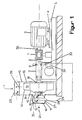
- Figure 1 shows a side view of an arrangement of a Radial fan according to the invention with its motor, being through a housing of the radial fan and a bearing a vertical section through the axis of rotation is placed
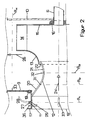
- Figure 2 shows a section perpendicular to the axis of rotation through the Centrifugal fan.
- the inlet nozzle somewhat in FIG. 1 and stronger in FIG. 2 Dimensions stretched parallel to the axis of rotation of the fan wheel.
- Figure 1 shows a one-sided suction radial fan 1 with a bearing 2 and a motor 3.
- the bearing 2 is designed as a bearing block, with a Opening provided plates of a base frame 4 and the motor 3 via a Motor plate 5 attached to this base frame 4.
- a drive shaft 6 starting from the motor 3 is interrupted by a torque measuring device 7 flanged on both sides for measuring the shaft power P M W.
- the drive shaft 6 is guided behind the torque measuring device 7 through the bearing 8 of the bearing 2.
- the radial fan 1 has a housing, one of which is shown in FIGS. 1 and 2
- Lid closure disc 9 and an opposite side wall 10 can be seen are a retracted inflow nozzle with an outer tube section 11 and an inner nozzle section 12 and an impeller with a cover disk 13, Blades 14, a hub disc 15 and a hub 16.
- this hub 16 is inserted through the bearing 8 drive shaft 6 with a snug fit.
- the tube section 11 has an outer connecting flange 17, which Inflow opening 18 limited and its outer diameter also Nominal diameter of the radial fan is called, and an inner Connection flange 19, on which the inflow nozzle on the cover closure disk 9th is attached to.
- the nozzle section 12 of the inflow nozzle is, as in FIG. 2 can be seen more clearly at the inner end of the Pipe section 11 inserted a little into this and seamless with it welded.
- the inflow nozzle is when attaching its inner Connection flange 19 together with the cover plate 13 of the impeller and centered with the impeller.
- the nozzle section 12 of the inflow nozzle starts from the pipe section 11 an inlet cone 20 and a circular arc section 21 which has a nozzle neck and forms a diffuser and its narrowest diameter is approximately in the middle located on.
- the axial extent of the inlet cone 20 is approximately half as large like that of the circular arc section 21.
- the inlet cone 20 connects tangentially the circular arc section 21.
- the inner end of the circular arc section 21 projects into the cover disk 13. Between circular arc section 21 of nozzle section 12 and cover disk 13 remains a small rotating, by centering the inlet nozzle with the Cover plate 13 constant wide air gap 22 free.
- the housing of the radial fan has a rectangular outflow opening 23 on, which is arranged perpendicular to the inflow opening 18 and from the Lid closure disc 9 and the side wall 10 and one not to be seen Housing shell is limited.
- the cross-sectional areas of the rectangular The outflow opening 23 and the round inflow opening 18 are of the same size.
- the tube section 11 of the inlet nozzle are in one in its outer half Level A1 perpendicular to the inflow direction 24 four evenly distributed on the circumference Holes 25.
- the positions of the holes 25 are on the Outflow direction 26 oriented.
- the through holes 25 are either parallel to Outflow direction 26 or arranged perpendicular to it.
- the through holes 25 can also be arranged so that an over an angle of 60 ° extending circumferential area of the inflow nozzle, measured against the Spiral opening starting from the longitudinal axis of the housing outlet crossing at right angles, radially with respect to the longitudinal axis of the nozzle extending radial axis or line remains free of perforations.
- a Bore 25 could be in the circumferential area in the direction of the spiral opening starting from the radial line mentioned above.
- the diameter of the through holes 25 is 2 to 4 mm, here 3 mm.
- the Bores 25 are sharp-edged and deburred to the inner wall.
- the Holes 25 are outside of pipe nipples 27 which are gas-tight with the Pipe section 11 are connected, overhanging.
- the outside diameter of the Pipe nipple 27 is 6 mm, for example.
- the four pipe nipples 27 are interconnected by a ring line 28. From the ring line 28 leads a connecting line 29 to an outside of the inlet nozzle, namely on Base frame 4 below the storage 2 between the two plates in Protected position arranged pressure sensor 30.
- nozzle section 12 In the nozzle section 12 are in a plane A2 parallel to the plane A1, which is in the Inlet cone 20 is located near the transition to the circular arc section 21, and in a plane A3 the narrowest diameter of the circular arc section 21 also four each, at the same angles on the circumference as the through holes 25 arranged through holes 31, 32.
- These through holes 31, 32 are each provided with pipe nipples, a ring line and a connecting line.
- the Pipe nipples, the ring and connecting lines are not shown.
- the connecting line of the through holes 32 of the plane A3 is also at the Differential pressure sensor trained pressure sensor 30 connected.
- the Pressure sensor 30 is another, also as a differential pressure sensor trained (not shown) pressure sensor to which the connecting line of the holes 31 of the level A2 and the connecting line of the Bores 32 of the A3 plane are connected.
- Absolute pressure sensor arranged to measure the ambient pressure Pa.
- a switch box 34 in which a Microcontrollers, signal conditioning devices such as frequency converters and Amplifier, and a power supply, e.g. B. there is a battery, arranged.
- the microcontroller is connected to a via a BUS line Data processing device, for example a PC, connected.
- BUS line Data processing device for example a PC
- the speed sensor 36 can also be on the impeller of the radial fan 1 be arranged.
- the torque measuring device 7 is also via a line (not shown) and the interface connected to the microcontroller.
- the Nominal diameter D of the radial fan 1 is 800 mm
- the diameter of the outer connecting flange 17 is 800 mm
- the inner diameter 788 mm the narrowest diameter of the nozzle section 11,577 mm
- the diameter of the Cover disk 13 of the impeller 629 mm the axial length of the tube section 11 the inflow nozzle 180 mm and that of the nozzle section 12 261 mm.
- the Circular arc section 20 corresponds to an arc of 72 ° with a radius of 150 mm.
- the angle between the pipe section 11 and the inlet cone 20 of the Nozzle section 12 is 36 °.
- the area ratios A1: A2: A3 are 1: 0.81: 0.52
- Static pressure tapping points are located in the center of levels A1 to A3, only the static pressure tapping point 37 of the level A1 in FIG. 2 is located, arranged.
- the static pressure tapping point 37 is on three struts attached static pressure probe.
- the memory of the microcontroller contains standardized type characteristics ⁇ ( ⁇ ), ⁇ ( ⁇ ), if necessary. also ⁇ ( ⁇ ), also called model characteristics, for the type series of Radialventialtors 1.
- ⁇ is the flow number
- ⁇ ( ⁇ ) the pressure number
- ⁇ ( ⁇ ) the Efficiency
- ⁇ ( ⁇ ) the delivery figure.
- the type curves were made Test bench characteristics, for a geometrically similar model radial fan, for example with the nominal diameter of 400 mm.
- the memory of the microcontroller also contains the Reynold number Re dependent dimensionless nozzle coefficients ⁇ (Re) for differential pressures between the Levels A1 and A3 and between levels A2 and A3, and thus characteristic curves for the inlet nozzle.
- These flow coefficients ⁇ (Re) were obtained from measurements in an Model radial fan built-in geometrically similar built-in nozzle derived.
- the memory contains characteristic curves for the factor k to take account of internal losses as a function of the circulation speed of the radial fan 1, which were measured on several sizes of the type series of the radial fan 1, as well as calculation instructions for the factor f to take into account the compression of the delivered gas as a function of the Total pressure difference ⁇ P t deposited.
- the microcontroller memory also contains configuration values such as the Nominal diameter D (800 mm), the installation situation, the gas type and the Solids loading.
- a radial fan according to the invention can in the Levels 1, 2, 3 and 4, instead of four holes, only one hole each to be appropriate. This piercing should, for example, to avoid Constipation due to condensation, at levels 1, 2 and 3 in the upper one Half of the inlet nozzle should be arranged.
- the measured values for the pressure difference ⁇ p M w1 / 3 , optionally the pressure difference ⁇ p M w2 / 3 , the total pressure difference ⁇ p M t and, if appropriate, the shaft power P S W and the measured values of the state values are first, for example of the external pressure Pa, the temperature T, the speed n of the motor 3 or _ of the fan wheel n *.
- the measured value for the shaft power P M W is calculated from the measured torque M M when the torque measuring device 7 is present.
- a second pressure difference ⁇ p M w2 / 3 is also measured, the ratio of the pressure differences ⁇ p M w 1/3 / ⁇ p M w 2/3 with the square of the reciprocal ratio the corresponding mean nozzle coefficients ( ⁇ 2/3 / ⁇ 1/3 ) 2 are compared.
- a match within + -10% indicates a sufficiently undisturbed flow in the inflow nozzle and functioning measuring points, ie here free bores 25, 31, 32.
- the volume flow V is determined according to equation (1) from the differential pressure difference ⁇ p M w 1/3 .
- V ⁇ 1.3 A 3 ⁇ ((2 / ⁇ ) .DELTA.p M w 1/3 )
- ⁇ 1/3 is the nozzle coefficient for the flow conditions between planes A1 and A3 in the inflow nozzle
- a 3 is the cross section of the inflow nozzle in measurement plane A3
- ⁇ is the density of the delivered gas.
- a 3 is known as one of the configuration values.
- the density ⁇ can be determined when air is conveyed from the temperature T measured in the inflow nozzle and the measured external pressure Pa.
- the volume flow V could also be determined from the pressure difference ⁇ p M w 2/3 with the corresponding nozzle coefficient ⁇ 2/3 .
- the dependence of the nozzle coefficients ⁇ 1/3 and ⁇ 2/3 on the Reynolds number Re can be taken into account by starting the determination of the volume flow V with an average nozzle coefficient ⁇ , calculating a Reynolds number Re from the volume flow V determined and the associated nozzle coefficient ⁇ is used to determine the volume flow V again.
- the configuration values inlet cross-section A D , nominal diameter D and the viscosity ⁇ of the pumped gas, here the air are required. After a few iteration steps, the values for the volume flow V and the corresponding nozzle coefficient ⁇ correspond.
- the inlet cross-sectional area A D and the circulation speed u of the fan wheel calculated from the state value of the speed n of the motor 3 or the fan wheel n * and the flow rate figure ⁇ and the pressure figure from the model characteristic curve can be calculated using the configuration value Find ⁇ ( ⁇ ).
- the values of the model characteristic curves can be upgraded or downgraded in order to determine the operating point precisely.
- the measured dependency of an upgrade or depreciation factor k ( ⁇ or> 1) on a variable dependent on the circulation speed u of the fan wheel, the nominal diameter D and the viscosity ⁇ is used.
- an upgrade or depreciation factor f is used depending on the measured total pressure difference ⁇ p M t .
- a value for the efficiency ⁇ ( ⁇ ) can be read from the model characteristic curve from the determined volume flow V and the pressure figure iffer derived from it. This value may also be upgraded or depreciated by the factors k and f.
- the nominal value for the shaft power P S W results from the volume flow V, the total pressure difference ⁇ p M t the value for the efficiency ⁇ ( ⁇ ) and possibly the factors k and f. This value P S W is compared with the measured shaft power P M W to assess the quality of the operating point determination.
- the measured torque M M is converted into the shaft power P M W.
- a good agreement ( ⁇ 2% deviation) indicates a high accuracy class.
- a measuring device for the motor power P M M with devices for measuring the current I M absorbed by the motor 3, the supply voltage U and the power factor cos ⁇ can also be used.
- the measured value for the motor power P M M is calculated from the current consumption I M of the motor 3, the voltage U, the power factor cos ⁇ and the efficiency ⁇ m of the motor 3 and with the aid of an efficiency ⁇ a also stored in the shaft power P M W converted. Because the efficiencies ⁇ m are only approximately known, only a lower accuracy class can be assigned if only the measured and the setpoint values P M W and P S W match.
- a method for determining the operating point and a state variable, namely the density p of the gas conveyed, differs from the method described above in that the determination of the volume flow V and the density ⁇ using one of the pressure differences ⁇ p M w 1/3 or ⁇ p M w 2/3 and the total pressure difference ⁇ p M t is carried out in several iteration steps.
- an initial density p is calculated, for example calculated from the temperature T and the external pressure Pa.
- the dependence of the nozzle coefficient ⁇ 1/3 or ⁇ 1/3 on the Reynolds number Re is taken into account by iteration in each iteration step.
- the result is a volume flow V, a corresponding flow figure ⁇ , factors k, f and the density ⁇ , from which the air humidity can be calculated if necessary.
- the shaft power P s W is determined from the available values and compared with the measured shaft power P M W and an accuracy class is assigned.
- a radial fan according to the invention with a nominal diameter of 800 mm is in a system that sucks up the dust from a planing and grinding line, built-in.
- the radial fan's inlet nozzle is on a straight one Pipe section with a diameter of 800 mm and a length of 5 m flanged.
- In front of the outflow opening 23 is a rectangular channel and over it a transfer element a pipe leading to a filter (with control flap) connected.
- the radial fan has a measuring device for the motor power P M M with devices for measuring the current I, the voltage U and the power factor cos ⁇ instead of a torque measuring device.
- the configuration value efficiency ⁇ m of the motor 3 and the efficiency ⁇ a are stored in the microcontroller to determine the measured shaft power P M W.
- the volume flow V is determined in accordance with equation (1a) from the differential pressure ⁇ p M W1 / 3 , the density ⁇ required for this being calculated from the measured temperature T and the measured external pressure Pa.
- the dependency of the nozzle coefficient ⁇ 1/3 on the Reynolds number Re determined in the model characteristic curve is taken into account by an iterative determination of the volume V and the nozzle coefficient ⁇ 1/3 , starting with an average nozzle coefficient ⁇ 1/3 .
- the flow figure ⁇ is determined from this volume flow V with the aid of configuration and status values and the pressure figure ⁇ ( ⁇ ) from the model characteristic curve. This value is upgraded or depreciated by the determined factors k and f and used to determine the target value of the total pressure difference ⁇ p S t .
- This total pressure difference ⁇ p S t is compared with the measured total pressure difference ⁇ p M t .
- the deviation of the two values is 0.8%.
- a value for the efficiency ⁇ ( ⁇ ) is also read from the model characteristic curve from the flow rate ⁇ determined above and is upgraded or depreciated by the factors k and f.
- the nominal value of the shaft power P S W is calculated from this value and the value for the shaft power P M determined from the measured current consumption I M using the operating voltage U, the power factor cos ⁇ , the efficiency of the motor ⁇ m and the efficiency ⁇ a W compared.
- the measured shaft power P M W is 5.6% above the nominal value of the shaft power P S W derived from the volume flow V.
- the somewhat higher value of the measured shaft power P M W could be due to the additional solids conveyance due to the planing and grinding dust.
- the determination of the measured shaft power P M W via the current consumption M is less precise because of the only approximately known efficiency.
- a radial fan 1 according to the invention also with a nominal diameter of 800 mm is in a drying system to convey exhaust air to one Heat exchanger installed.
- the installation situation leads to a swirl-free attachment and Outflow of the exhaust air, which has a variable water vapor content and a variable Temperature T.
- the speed n * of the fan wheel is one Humidity control set via a frequency converter.
- the radial fan 1 has a torque measuring device 7 and on its motor 3 Current measuring device.
- the ratio of the pressure differences ⁇ p M w 1/3 / ⁇ p M w 2/3 with the known square of the reciprocal ratio of the corresponding nozzle coefficients ( ⁇ 2/3 / ⁇ 1/3 ) is first checked to check the flow and the measuring points. 2 compared. The two values agree within 10%. From this it can be concluded that the measuring points are working and that the inflow, as assumed by the installation situation, is swirl-free.
- the volume flow V and the density p required for this are determined from the pressure difference ⁇ p M w 1/3 with the aid of the measured total pressure difference ⁇ p M t in iteration steps, taking into account the dependence of the nozzle coefficient ⁇ 1/3 on the Reynolds number Re iteratively in each iteration step becomes.
- a value for the density p calculated from the temperature T and the ambient pressure Pa is started.
- a value for the volume flow V and the nozzle coefficient ⁇ 1/3 is determined iteratively from ⁇ p M w 1/3 .
- the flow figure ⁇ is determined from the volume flow V and the value of the pressure figure ⁇ ( ⁇ ) is derived from the model characteristic curve.
- the revaluation or depreciation factors k and f are determined.
- a value for the density ⁇ is calculated, with which the second iteration step is carried out. After a few iteration steps, there are no more deviations in the values of the volume flow V and the density ⁇ .
- the determined value of the flow figure ⁇ is also available.
- the shaft power P S W is calculated from the derived value for the efficiency ⁇ ( ⁇ ), the already known factors k and f and the total pressure difference ⁇ p M t and with the shaft power P determined from the torque M M , ie with the measured one M W compared.
- the measured value P M W is only 3.5% higher than the calculated value P S W. This suggests an exact determination of the volume flow V and the total pressure difference ⁇ p M t .
- the determination of the operating point corresponds to an accuracy class of 0.
- the measured shaft power P M W is determined with the aid of a device for measuring the current consumption P M M from the current consumption of the motor 3 of the radial fan 1, the condition values of operating voltage U and power factor cos ⁇ and the configuration values of efficiency ⁇ m of the motor 3 and efficiency ⁇ a ,
- This measured value P M W is about 10% above the calculated value P S W.
- This deviation and the less precise determination of the measured shaft power P M W with the aid of a current measuring device would assign the operating point determination to an accuracy class of 2 in the case of an exclusive determination of the measured shaft power P M W with the aid of a current measurement I M and a determination of the motor power P M M lead.
- the ratio of the pressure differences ⁇ p M w 1/3 / ⁇ p M w 2/3 is compared with the square of the reciprocal ratio of the corresponding nozzle coefficients ( ⁇ 2/3 / ⁇ 1/3 ) 2 .
- the ratio of the pressure differences ⁇ p M w 2/3 / ⁇ p M w 2/3 is slightly higher than its nominal value, but is within the tolerance range of + -10% deviation. From this it can be concluded that the measuring points are working. A completely swirl-free flow cannot be assumed due to the upstream manifold.
- the volume flow V is determined from the pressure difference ⁇ p M w 1/3 , the dependence of the nozzle coefficient ⁇ 1/3 being taken into account by iteration steps as in the previous examples.
- the flow figure ⁇ , the pressure figure ⁇ ( ⁇ ), the up or down valuation factors k and f and finally the total pressure difference ⁇ p S t are derived from the volume flow V.
- the measured value for the total pressure difference ⁇ p M t is (by about 8.9%) significantly below this calculated value ⁇ p S t .
- the measured value of the shaft power P M W determined from the current consumption I M is (by about 6.5%) lower than that from the volume flow V, the flow rate ⁇ , the efficiency ⁇ ( ⁇ ), the factors k and f and the measured total pressure difference ⁇ p M t calculated setpoint for the power P S W.
- An accuracy class of 2 is assigned to the determined operating point with the calculated volume flow V and the measured total pressure difference ⁇ p M t due to the inaccuracy due to the changed flow profile. Since both setpoints ⁇ p S t and P S W are higher than their measured values, the flow can be described by characteristic curves shifted to lower values. A higher accuracy of the determination of the operating point with V and ⁇ p M t is likely.
- a current measuring device In front of the inflow nozzle of a radial fan 1 according to the invention with a Nominal diameter of 800 mm and a current measuring device is one for one Swirl-free inflow, sufficiently long inflow pipe arranged.
- the ratio of the pressure differences ⁇ p M w1 / 3 / ⁇ p M w2 / 3 is compared with the square of the reciprocal ratio of the corresponding nozzle coefficients ( ⁇ 2/3 / ⁇ 1/2 ) 2 .
- the ratio of the pressure differences ⁇ p M w 1/3 / ⁇ p M w 2/3 is about 20% lower than its setpoint. From this, a fault can already be concluded.
- the volume flow V is also determined from the pressure difference ⁇ p M w 2/3 .
- This volume flow V and the values derived therefrom for the total pressure difference ⁇ p S t and the power P S M agree well with the corresponding measured values ⁇ p M t and P M w .
- the accuracy class from 0 to 1 is assigned to this determination. This information is saved with a corresponding warning and displayed if necessary.
Landscapes
- Engineering & Computer Science (AREA)
- Mechanical Engineering (AREA)
- General Engineering & Computer Science (AREA)
- Control Of Positive-Displacement Air Blowers (AREA)
- Measuring Volume Flow (AREA)
- Control Of Electric Motors In General (AREA)
Description
- 1
- Radialventilator
- 2
- Lagerung
- 3
- Motor
- 4
- Grundrahmen
- 5
- Motorplatte
- 6
- Antriebswelle
- 7
- Drehmomentmeßeinrichtung
- 8
- Lager
- 9
- Deckelverschlußscheibe
- 10
- Seitenwand
- 11
- Rohrabschnitt der Einlaufdüse
- 12
- Düsenabschnitt
- 13
- Deckscheibe
- 14
- Schaufeln
- 15
- Nabenscheibe
- 16
- Nabe
- 17
- äußerer Anschlußflansch
- 18
- Einströmöffnung
- 19
- innere Anschlußflansch
- 20
- Einlaufkegel
- 21
- Kreisbogenabschnitt
- 22
- Luftspalt
- 23
- Ausströmöffnung
- 24
- Einströmrichtung
- 25
- Durchbohrungen A1
- 26
- Ausblasrichtung
- 27
- Rohmippel
- 28
- Ringleitung
- 29
- Verbindungsleitung
- 30
- Drucksensor
- 31
- Durchbohrungen A2
- 32
- Durchbohrungen A3
- 33
- Durchbohrungen A4
- 34
- Schaltkasten
- 35
- Temperatursensor
- 36
- Drehzahlsensor
- 37
- statische Druckentnahmestelle
Claims (15)
- Verfahren zur Bestimmung des Betriebspunktes eines Ventilators, bei dem eine Wirkdruckdifferenz ΔpM w mit mindestens einer Meßstelle an einer Einlaufdüse des Ventilators gemessen und daraus der Volumenstrom V ermittelt wird, wobei
die Wirkdruckdifferenz ΔpM w zwischen zwei Ebenen in der Einströmdüse oder zwischen einer Ebene in der Einströmdüse und einer Stelle in der Umgebung gemessen wird
dadurch gekennzeichnet, daß
zusätzlich eine Gesamtdruckdifferenz ΔpM t zwischen Saugseite und Druckseite des Ventilators gemessen wird,
ein aus dem Volumenstrom V über eine Betriebskennlinie Δpt (V) ermittelter Sollwert für die Gesamtdruckdifferenz Δps t mit der gemessenen Gesamtdruckdifferenz ΔpM t verglichen,
und aus dem Vergleich der Betriebspunkt und seine Güte bestimmt werden. - Verfahren nach Anspruch 1, dadurch gekennzeichnet, daß
zusätzlich die Wellenleistung PM W des Ventilators gemessen,
ein aus dem Volumenstrom V über eine Betriebskennlinie PW (V) ermittelter Sollwert für die Wellenleistung PS W mit der gemessenen Wellenleistung PM W verglichen und
der zusätzliche Vergleich zur Bestimmung des Betriebspunktes und seiner Güte herangezogen wird. - Verfahren nach Anspruch 1 oder 2, dadurch gekennzeichnet, daß der Volumenstrom V und die Sollwerte der Betriebskennlinien Δps t und PS W mit Hilfe von Modellkennlinien ψ(), η() und ggf. λ(), Konfigurationswerten und Zustandswerten des Ventilators ermittelt werden.
- Verfahren nach Anspruch 3 zur Bestimmung des Betriebspunktes eines Ventilators und eines Zustandswert, wie zum Beispiel der Dichte p des geförderten Gases, bei dem eine Wirkdruckdifferenz ΔpM w mit mindestens einer Meßstelle an einer Einlaufdüse des Ventilators gemessen und daraus der Volumenstrom V bestimmt wird, wobeia) die Wirkdruckdifferenz ΔpM w zwischen zwei Ebenen in der Einströmdüse, oder zwischen einer Ebene in der Einströmdüse und einer Stelle in der Umgebung gemessen undb) aus der Wirkdruckdifferenz ΔpM w mit Hilfe von Konfigurations- und am Ventilator gemessenen Zustandswerten der Volumenstrom V ermittelt wird,
dadurch gekennzeichnet, daßc) zusätzlich eine Gesamtdruckdifferenz ΔpM t zwischen Saugseite und Druckseite des Ventilators und die Wellenleistung PM w des Ventilators gemessen,d) aus dem Volumenstrom V ein Wert für die Lieferziffer und daraus ein Wert der Modellkennlinie ψ() ermittelt,e) der zu bestimmenden Zustandswert mit Hilfe des ermittelten Wertes der Modellkennlinie ψ(), ggf. von Konfiguration- und Zustandswerten sowie der gemessenen Gesamtdruckdifferenz ΔpS t ermittelt,f) falls bei der Ermittlung des Volumenstromes V aus der Wirkdruckdifferenz ΔpM W in b) der zu bestimmende Zustandswert notwendig ist, eine Bestimmung des Volumenstromes V und des Zustandswertes durch Iterationsschritte b), d) und e) durchgeführt,g) aus dem unter b), d) und e) ermittelten Volumenstrom V mit Hilfe der Modellkennlinie η () , ggf. von Konfigurations- und Zustandsdaten ein Sollwert für die Wellenleistung PS W ermittelt und mit der gemessenen Leistung PM W verglichen undh) aus dem Ergebnis von b), d) bis f) und dem Vergleich g) der Betriebspunkt und seine Güte bestimmt werden. - Verfahren nach einem der Ansprüche 1 bis 4, dadurch gekennzeichnet, daß bei der Ermittlung des Volumenstromes V aus der Wirkdruckdifferenz ΔpM w die Abhängigkeit des dieser Wirkdruckdifferenz ΔpM w entsprechenden Düsenbeiwertes α von der Reynoldszahl Re mit Hilfe einer Modellkennlinie α(Re) der Einströmdüse im eingebauten Zustand durch Iterationsschritte berücksichtigt wird.
- Verfahren nach einem der Ansprüche 1 bis 5, dadurch gekennzeichnet, daß bei der Ermittlung der Sollwerte der Gesamtdruckdifferenz ΔpS t und ggf. der Wellenleistung PS W die aus den Kennlinien ermittelten Werte in Form von vom Betriebszustand des Ventilators abhängigen Faktoren, insbesondere des Faktors k zur Berücksichtigung interner Verluste und/oder des Faktors f zur Berücksichtigung der Verdichtung, aufoder abgewertet werden.
- Verfahren nach einem der Ansprüche 1 bis 6, dadurch gekennzeichnet, daß eine Wirkdruckdifferenz ΔpM w 1/3 zwischen zwei Ebenen (A1 und A3) und eine Wirkdruckdifferenz ΔpM w 2/3 zwischen einer zwischen den beiden Ebenen (A1 und A3) liegenden Ebene (A2) und der Ebene (A3) gemessen wird, wobei der Volumenstrom V aus der Wirkdruckdifferenz ΔpM w 1/3 oder der Druckdifferenz ΔpM w 2/3 ermittelt wird und gegebenenfalls aus dem Verhältnis der Druckdifferenzen die Güte der Strömung in der Einströmdüse und/oder der Meßstellen abgeleitet wird.
- Verfahren nach einem der Ansprüche 1 bis 7, dadurch gekennzeichnet, daß die Druckdifferenzen an jeweils vier in einer der Ebene (A1 bis A4) senkrecht zur Strömungsrichtung verteilte Meßstellen, deren Werte ermittelt werden, gemessen werden.
- Verfahren nach einem der Ansprüche 1 bis 8, dadurch gekennzeichnet, daß im Zentrum der Ebenen (A1, A2 oder A3) in der Einströmdüse, die zur Messung von Wirkdruckdifferenzen herangezogen werden, der statische Druck gemessen wird.
- Ventilatoranordnung zur Bestimmung des Betriebspunktes eines Ventilators nach einem der Verfahren der Ansprüche 1 bis 9 mit einem Ventilator mit einem Motor, einem Laufrad, einem Gehäuse, einer Einströmdüse, die zur Messung einer Wirkdruckdifferenz ΔpM w mit mindestens einer Meßstelle versehen ist, und mit einer damit verbundenen Einrichtung zur Verarbeitung der Meßwerte, wobei zur Messung einer oder mehrerer Wirkdruckdifferenzen ΔpM w
die Einströmdüse in mindestens zwei Ebenen (A1 und/oder A2, A3) senkrecht zur Strömungrichtung eine oder mehrere Druckmeßstellen aufweist, wobei, ggf. die Druckmeßstellen einer Ebene (A1, A2, A3) untereinander verbunden, und die Druckmeßstelle oder die Druckmeßstellen zweier Ebenen (A1 und/oder A2, A3) an einen Drucksensor (30) angeschlossen sind, oder
die Einströmdüse in mindestens einer Ebene senkrecht zur Strömungsrichtung eine oder mehrere Druckmeßstellen aufweist und an einer Stelle in der Umgebung eine Druckmeßstelle angeordnet ist, wobei, ggf. die Druckmeßstellen einer Ebene untereinander verbunden, und die Druckmeßstelle oder die Druckmeßstellen einer Ebene und die Druckmeßstelle in der Umgebung an einen Drucksensor angeschlossen sind,
dadurch gekennzeichnet, daßzur Messung einer Gesamtdruckdifferenz ΔpM t ein Gehäuse des Ventilators in der Nähe seiner Auströmöffnung in einer Ebene (A4) senkrecht zur Auströmungsrichtung (26) eine oder mehrere Druckmeßstellen aufweist, wobei, ggf. die Druckmeßstellen miteinander verbunden sind und, die Druckmeßstelle oder die Druckmeßstellen an einen an die Druckmeßstellen der Einströmdüse einer der Ebenen (A1 oder A2, A3) angeschlossenen Drucksensor (30) angeschlossen sind. - Ventilatoranordnung nach Anspruch 10 zur Bestimmung des Betriebspunktes des Ventilators und ggf. einer Zustandsgröße, dadurch gekennzeichnet, daß zur Messung einer Wellenleistung PM W eine Leistungsmeßvorrichtung am Ventilator angeordnet ist.
- Ventilatoranordnung nach Anspruch 10 oder 11, gekennzeichnet durch einen Drehzahlmesser (36) zur Messung der Motordrehzahl n, einen Temperatursensor (35) in der Einströmdüse zur Messung der Temperatur T und einem Absolutdrucksensor zur Messung des Umgebungsdruckes Pa.
- Ventilatoranordnung nach einem der Ansprüche 10 bis 12, dadurch gekennzeichnet, daß die Einströmdüse in einer weiteren Ebene (A2) eine oder mehrere Druckmeßstellen, die untereinander verbunden sind und an einen an die Druckmeßstellen einer der Ebenen (A1, A3) der Einströmdüse angeschlossenen Drucksensor (30) angeschlossen sind, aufweist.
- Ventilatoranordnung nach einem der Ansprüche 10 bis 13, dadurch gekennzeichnet, daß in den Ebenen (A1 bis A4) der Einlaufdüse und des Gehäuses jeweils vier gleichmäßig verteilte Druckmeßstellen angeordnet sind.
- Ventilatoranordnung nach einem der Ansprüche 10 bis 14, dadurch gekennzeichnet, daß im Zentrum der Ebenen (A1, A2 oder A3) mit Druckmeßstellen jeweils eine statische Druckentnahmestelle (37) angeordnet ist.
Applications Claiming Priority (2)
| Application Number | Priority Date | Filing Date | Title |
|---|---|---|---|
| DE19726547 | 1997-06-23 | ||
| DE19726547A DE19726547A1 (de) | 1997-06-23 | 1997-06-23 | Verfahren zur Bestimmung des Betriebspunktes eines Ventilators und Ventilator |
Publications (2)
| Publication Number | Publication Date |
|---|---|
| EP0887555A1 EP0887555A1 (de) | 1998-12-30 |
| EP0887555B1 true EP0887555B1 (de) | 2004-04-07 |
Family
ID=7833339
Family Applications (1)
| Application Number | Title | Priority Date | Filing Date |
|---|---|---|---|
| EP98107573A Expired - Lifetime EP0887555B1 (de) | 1997-06-23 | 1998-04-25 | Verfahren zur Bestimmung des Betriebspunktes eines Ventilators und Ventilatoranordnung |
Country Status (4)
| Country | Link |
|---|---|
| US (1) | US6241463B1 (de) |
| EP (1) | EP0887555B1 (de) |
| AT (1) | ATE263926T1 (de) |
| DE (2) | DE19726547A1 (de) |
Families Citing this family (22)
| Publication number | Priority date | Publication date | Assignee | Title |
|---|---|---|---|---|
| JP3546173B2 (ja) | 2000-09-04 | 2004-07-21 | Smc株式会社 | エアブローシステムの機器選定方法及びエアブローシステムの機器選定プログラムを記録した記録媒体 |
| ES2284423T1 (es) * | 2002-07-23 | 2007-11-16 | Mitsubishi Heavy Industries, Ltd. | Recipiente blindado para almacenar materiales radiactivos y procedimiento de produccion del mismo. |
| WO2004016457A2 (en) * | 2002-08-16 | 2004-02-26 | Imperial Sheet Metal Ltd. | Proportional control system for a motor |
| US8977399B2 (en) * | 2009-05-21 | 2015-03-10 | Lennox Industries Inc. | Staggered start-up HVAC system, a method for starting an HVAC unit and an HVAC controller configured for the same |
| WO2011009458A1 (en) * | 2009-07-23 | 2011-01-27 | Skov A/S | Method for determination of air flow, exhaust unit and its application |
| US8366377B2 (en) * | 2010-04-09 | 2013-02-05 | Trane International Inc. | FC fan flow measurement system using a curved inlet cone and pressure sensor |
| EP2620202B1 (de) * | 2012-01-30 | 2014-10-29 | ABB Oy | Verfahren und Vorrichtung zum Überwachen des Luftfilterzustands |
| CN103032359A (zh) * | 2012-12-27 | 2013-04-10 | 上海阿丽贝塑料防腐设备有限公司 | 一种高压全塑风机叶轮动强度测试装置 |
| DE102015000629A1 (de) | 2015-01-22 | 2016-07-28 | Viessmann Werke Gmbh & Co Kg | Turboverdichter |
| CN105736434B (zh) * | 2016-02-02 | 2017-06-30 | 华能国际电力股份有限公司 | 一种电厂风机的性能监控方法与系统 |
| DE102016009598A1 (de) * | 2016-08-09 | 2018-02-15 | Stiebel Eltron Gmbh & Co. Kg | Lüftungsgerät der Haustechnik mit einer Messeinheit |
| DE102016115616A1 (de) * | 2016-08-23 | 2018-03-01 | Ebm-Papst Mulfingen Gmbh & Co. Kg | Strömungsgleichrichter eines Ventilators |
| DE102016118369A1 (de) * | 2016-09-28 | 2018-03-29 | Ebm-Papst Mulfingen Gmbh & Co. Kg | Ansaugdüse und Ausblaseinheit eines Ventilators |
| US10960237B2 (en) * | 2017-07-19 | 2021-03-30 | Honeywell International Inc. | Powered air-purifying respirator (PAPR) with eccentric venturi air flow rate determination |
| DE102017120652A1 (de) | 2017-09-07 | 2019-03-07 | Ebm-Papst Mulfingen Gmbh & Co. Kg | Ventilator mit integrierter Volumenstromregelung |
| DE102018104394A1 (de) * | 2018-02-27 | 2019-08-29 | Ebm-Papst Mulfingen Gmbh & Co. Kg | Arbeitspunktbestimmung |
| DE102020118251A1 (de) * | 2020-07-10 | 2022-01-13 | Ebm-Papst Mulfingen Gmbh & Co. Kg | Verfahren und Ventilatorsystem zur Ermittlung des Zustands eines Filters in einer Ventilatoreinheit |
| PL4185777T3 (pl) | 2020-07-24 | 2025-10-20 | Zehnder Group International Ag | Układ wentylatora odśrodkowego |
| DE102020213419A1 (de) | 2020-10-23 | 2022-04-28 | Ziehl-Abegg Se | Ventilator zum Bestimmen eines durch den Ventilator bewegten Medienstroms und entsprechendes Verfahren |
| CN112780578B (zh) * | 2021-01-22 | 2022-11-15 | 浙江理工大学 | 离心泵环形密封摩擦因子与损失系数测定装置与方法 |
| CN118273979B (zh) * | 2024-06-03 | 2024-09-06 | 江苏考力特节能风机有限公司 | 一种具有变径喷口的风机 |
| CN119957531B (zh) * | 2024-12-25 | 2025-12-26 | 北京科荣达航空科技股份有限公司 | 机载风扇类产品性能试验台 |
Family Cites Families (22)
| Publication number | Priority date | Publication date | Assignee | Title |
|---|---|---|---|---|
| US3292846A (en) * | 1964-03-30 | 1966-12-20 | Phillips Petroleum Co | Centrifugal compressor operation |
| US3630496A (en) * | 1968-01-26 | 1971-12-28 | Babcock & Wilcox Co | Gas-cleaning apparatus |
| US4158527A (en) * | 1976-08-26 | 1979-06-19 | Ecolaire Incorporated | Adjustable speed drive system for centrifugal fan |
| US4164033A (en) * | 1977-09-14 | 1979-08-07 | Sundstrand Corporation | Compressor surge control with airflow measurement |
| US4203701A (en) * | 1978-08-22 | 1980-05-20 | Simmonds Precision Products, Inc. | Surge control for centrifugal compressors |
| US4405290A (en) * | 1980-11-24 | 1983-09-20 | United Technologies Corporation | Pneumatic supply system having variable geometry compressor |
| DE3105376C2 (de) * | 1981-02-14 | 1984-08-23 | M.A.N. Maschinenfabrik Augsburg-Nürnberg AG, 4200 Oberhausen | Verfahren zum Betreiben von Turboverdichtern |
| US4464720A (en) * | 1982-02-12 | 1984-08-07 | The Babcock & Wilcox Company | Centrifugal compressor surge control system |
| DE3402120A1 (de) * | 1984-01-23 | 1985-07-25 | Rheinhütte vorm. Ludwig Beck GmbH & Co, 6200 Wiesbaden | Verfahren und vorrichtung zur regelung verschiedener betriebsparameter bei pumpen und verdichtern |
| US4586870A (en) * | 1984-05-11 | 1986-05-06 | Elliott Turbomachinery Co., Inc. | Method and apparatus for regulating power consumption while controlling surge in a centrifugal compressor |
| DE3540285A1 (de) * | 1985-11-13 | 1987-05-14 | Gutehoffnungshuette Man | Verfahren und einrichtung zum regeln von turbokompressoren |
| DE3544821A1 (de) * | 1985-12-18 | 1987-06-19 | Gutehoffnungshuette Man | Verfahren zum regeln von turbokompressoren zur vermeidung des pumpens |
| DE3544822A1 (de) * | 1985-12-18 | 1987-06-19 | Gutehoffnungshuette Man | Verfahren zur pumpgrenzregelung von turbokomporessoren |
| DE3703401A1 (de) * | 1987-02-05 | 1988-08-18 | Al Ko Polar Maschf Gmbh | Ventilatorteil sowie verfahren zur funktionskontrolle desselben |
| DE3810717A1 (de) * | 1988-03-30 | 1989-10-19 | Gutehoffnungshuette Man | Verfahren zur vermeidung des pumpens eines turboverdichters mittels abblaseregelung |
| DE8911433U1 (de) * | 1989-09-26 | 1989-11-23 | Gebhardt Ventilatoren GmbH & Co, 7112 Waldenburg | Vorrichtung zur Bestimmung des Volumenstroms eines Radialventilators |
| US5050092A (en) * | 1990-02-26 | 1991-09-17 | Perry Robert E | Fan efficiency measuring apparatus |
| SE500539C2 (sv) * | 1991-06-12 | 1994-07-11 | Flaekt Ab | Sätt och anordning för bestämning av genomströmningsflödet i en ventilationsanläggning med en frisugande fläkt |
| US5195875A (en) * | 1991-12-05 | 1993-03-23 | Dresser-Rand Company | Antisurge control system for compressors |
| US5365459A (en) * | 1992-02-25 | 1994-11-15 | Perry Robert E | Continuous stack flow rate monitor |
| CA2123640A1 (en) * | 1993-05-17 | 1994-11-18 | Thomas A. Berger | Airflow measuring centrifugal fan |
| US5743715A (en) * | 1995-10-20 | 1998-04-28 | Compressor Controls Corporation | Method and apparatus for load balancing among multiple compressors |
-
1997
- 1997-06-23 DE DE19726547A patent/DE19726547A1/de not_active Withdrawn
-
1998
- 1998-04-25 EP EP98107573A patent/EP0887555B1/de not_active Expired - Lifetime
- 1998-04-25 AT AT98107573T patent/ATE263926T1/de not_active IP Right Cessation
- 1998-04-25 DE DE59811133T patent/DE59811133D1/de not_active Expired - Fee Related
- 1998-06-22 US US09/102,462 patent/US6241463B1/en not_active Expired - Fee Related
Also Published As
| Publication number | Publication date |
|---|---|
| US6241463B1 (en) | 2001-06-05 |
| ATE263926T1 (de) | 2004-04-15 |
| DE19726547A1 (de) | 1999-01-28 |
| DE59811133D1 (de) | 2004-05-13 |
| EP0887555A1 (de) | 1998-12-30 |
Similar Documents
| Publication | Publication Date | Title |
|---|---|---|
| DE19726547A1 (de) | Verfahren zur Bestimmung des Betriebspunktes eines Ventilators und Ventilator | |
| EP0283543B1 (de) | Lecksuchgerät und Betriebsverfahren dazu | |
| EP2296969B1 (de) | Luftfahrzeugleitungsüberwachungssystem und -verfahren | |
| DE69215222T2 (de) | Vorrichtung zur bestimmung des gesamtdurchflusses in einer belüftungsanlage | |
| DE3703401A1 (de) | Ventilatorteil sowie verfahren zur funktionskontrolle desselben | |
| DE2049117A1 (de) | Gasleckanzeigesystem | |
| EP3184754B1 (de) | Sensoranordnung und messverfahren für eine turbomaschine | |
| EP2580434A1 (de) | Verfahren zur einstellung der zwischen schaufelblattspitzen von laufschaufeln und einer kanalwand vorhandenen radialspalte sowie vorrichtung zur messung eines radialspalts einer axial durchströmbaren turbomaschine | |
| WO1996017237A1 (de) | Lecksuchgerät mit vakuumpumpen und betriebsverfahren dazu | |
| WO2013087708A2 (de) | Flüssigkeitsring-vakuumpumpe mit kavitationsregelung | |
| EP0419798B1 (de) | Vorrichtung zur Bestimmung des Volumenstroms eines Radialventilators | |
| EP4179265B1 (de) | Verfahren und ventilatorsystem zur ermittlung eines aktuellen arbeitspunktes einer ventilatoreinheit | |
| EP1288494A1 (de) | Windvektorbestimmungsgerät | |
| DE102015015153B4 (de) | Verfahren zur Überprüfung einer Pumpeneinrichtung in einem Gasmessystem | |
| DE10327078A1 (de) | Rotationswärmeaustauscher und Verfahren zur Abdichtung eines solchen | |
| DE3855311T2 (de) | Anordnung zur messung des volumenflusses eines ventilators | |
| DE19924400C1 (de) | Brandmelder und Verfahren zur Branddetektion | |
| DE102017210123A1 (de) | Luftleitsystem sowie Messsystem und Verfahren zum Ermitteln von wenigstens einem Parameter eines aus einem Luftausströmer austretenden Luftstroms | |
| DE2821434C2 (de) | Vorrichtung zur Vermeidung des Pumpens in einem Radialverdichter | |
| DE102019125070B4 (de) | Verfahren zur Steuerung eines Kältekreislaufs, Kältekreislauf, Wärmemanagementsystem und Fahrzeug | |
| EP3707386B1 (de) | Parameterkonstanz | |
| EP0344618B1 (de) | Vorrichtung zur Entnahme einer Gasprobe | |
| EP3927977A1 (de) | Verfahren zur quantitativen bestimmung einer aktuellen betriebszustandsabhängigen grösse eines ventilators, insbesondere einer druckänderung oder druckerhöhung, und ventilator | |
| DE102021116154A1 (de) | Überwachungsvorrichtung und Verfahren zur Überwachung der Qualität einer Gasatmosphäre | |
| DE3505385A1 (de) | Kanalgeblaese |
Legal Events
| Date | Code | Title | Description |
|---|---|---|---|
| PUAI | Public reference made under article 153(3) epc to a published international application that has entered the european phase |
Free format text: ORIGINAL CODE: 0009012 |
|
| AK | Designated contracting states |
Kind code of ref document: A1 Designated state(s): AT BE CH DE ES FR GB IT LI NL SE |
|
| AX | Request for extension of the european patent |
Free format text: AL;LT;LV;MK;RO;SI |
|
| 17P | Request for examination filed |
Effective date: 19990630 |
|
| AKX | Designation fees paid |
Free format text: AT BE CH DE ES FR GB IT LI NL SE |
|
| 17Q | First examination report despatched |
Effective date: 20021106 |
|
| RAP1 | Party data changed (applicant data changed or rights of an application transferred) |
Owner name: GRENZEBACH BSH GMBH |
|
| GRAP | Despatch of communication of intention to grant a patent |
Free format text: ORIGINAL CODE: EPIDOSNIGR1 |
|
| RTI1 | Title (correction) |
Free format text: METHOD FOR DETERMINING THE OPERATING POINT OF A FAN AND THE FAN ARRANGEMENT |
|
| GRAS | Grant fee paid |
Free format text: ORIGINAL CODE: EPIDOSNIGR3 |
|
| GRAA | (expected) grant |
Free format text: ORIGINAL CODE: 0009210 |
|
| AK | Designated contracting states |
Kind code of ref document: B1 Designated state(s): AT BE CH DE ES FR GB IT LI NL SE |
|
| PG25 | Lapsed in a contracting state [announced via postgrant information from national office to epo] |
Ref country code: NL Free format text: LAPSE BECAUSE OF FAILURE TO SUBMIT A TRANSLATION OF THE DESCRIPTION OR TO PAY THE FEE WITHIN THE PRESCRIBED TIME-LIMIT Effective date: 20040407 Ref country code: IT Free format text: LAPSE BECAUSE OF FAILURE TO SUBMIT A TRANSLATION OF THE DESCRIPTION OR TO PAY THE FEE WITHIN THE PRESCRIBED TIME-LIMIT;WARNING: LAPSES OF ITALIAN PATENTS WITH EFFECTIVE DATE BEFORE 2007 MAY HAVE OCCURRED AT ANY TIME BEFORE 2007. THE CORRECT EFFECTIVE DATE MAY BE DIFFERENT FROM THE ONE RECORDED. Effective date: 20040407 Ref country code: GB Free format text: LAPSE BECAUSE OF FAILURE TO SUBMIT A TRANSLATION OF THE DESCRIPTION OR TO PAY THE FEE WITHIN THE PRESCRIBED TIME-LIMIT Effective date: 20040407 Ref country code: FR Free format text: LAPSE BECAUSE OF FAILURE TO SUBMIT A TRANSLATION OF THE DESCRIPTION OR TO PAY THE FEE WITHIN THE PRESCRIBED TIME-LIMIT Effective date: 20040407 Ref country code: ES Free format text: LAPSE BECAUSE OF FAILURE TO SUBMIT A TRANSLATION OF THE DESCRIPTION OR TO PAY THE FEE WITHIN THE PRESCRIBED TIME-LIMIT Effective date: 20040407 |
|
| REG | Reference to a national code |
Ref country code: GB Ref legal event code: FG4D Free format text: NOT ENGLISH |
|
| REG | Reference to a national code |
Ref country code: CH Ref legal event code: EP |
|
| PG25 | Lapsed in a contracting state [announced via postgrant information from national office to epo] |
Ref country code: AT Free format text: LAPSE BECAUSE OF NON-PAYMENT OF DUE FEES Effective date: 20040425 |
|
| PG25 | Lapsed in a contracting state [announced via postgrant information from national office to epo] |
Ref country code: LI Free format text: LAPSE BECAUSE OF NON-PAYMENT OF DUE FEES Effective date: 20040430 Ref country code: CH Free format text: LAPSE BECAUSE OF NON-PAYMENT OF DUE FEES Effective date: 20040430 Ref country code: BE Free format text: LAPSE BECAUSE OF NON-PAYMENT OF DUE FEES Effective date: 20040430 |
|
| REF | Corresponds to: |
Ref document number: 59811133 Country of ref document: DE Date of ref document: 20040513 Kind code of ref document: P |
|
| PG25 | Lapsed in a contracting state [announced via postgrant information from national office to epo] |
Ref country code: SE Free format text: LAPSE BECAUSE OF FAILURE TO SUBMIT A TRANSLATION OF THE DESCRIPTION OR TO PAY THE FEE WITHIN THE PRESCRIBED TIME-LIMIT Effective date: 20040707 |
|
| NLV1 | Nl: lapsed or annulled due to failure to fulfill the requirements of art. 29p and 29m of the patents act | ||
| GBV | Gb: ep patent (uk) treated as always having been void in accordance with gb section 77(7)/1977 [no translation filed] |
Effective date: 20040407 |
|
| BERE | Be: lapsed |
Owner name: GRENZEBACH BSH G.M.B.H. Effective date: 20040430 |
|
| PG25 | Lapsed in a contracting state [announced via postgrant information from national office to epo] |
Ref country code: DE Free format text: LAPSE BECAUSE OF NON-PAYMENT OF DUE FEES Effective date: 20041103 |
|
| REG | Reference to a national code |
Ref country code: CH Ref legal event code: PL |
|
| PLBE | No opposition filed within time limit |
Free format text: ORIGINAL CODE: 0009261 |
|
| STAA | Information on the status of an ep patent application or granted ep patent |
Free format text: STATUS: NO OPPOSITION FILED WITHIN TIME LIMIT |
|
| EN | Fr: translation not filed | ||
| 26N | No opposition filed |
Effective date: 20050110 |