EP0888371B1 - 4,7-dialkoxy-n-acetylneuraminsaurederivate und methoden zur erkennung von influenza typ a und b in klinischen proben - Google Patents
4,7-dialkoxy-n-acetylneuraminsaurederivate und methoden zur erkennung von influenza typ a und b in klinischen proben Download PDFInfo
- Publication number
- EP0888371B1 EP0888371B1 EP97940823A EP97940823A EP0888371B1 EP 0888371 B1 EP0888371 B1 EP 0888371B1 EP 97940823 A EP97940823 A EP 97940823A EP 97940823 A EP97940823 A EP 97940823A EP 0888371 B1 EP0888371 B1 EP 0888371B1
- Authority
- EP
- European Patent Office
- Prior art keywords
- bromo
- indolyl
- viruses
- dialkoxy
- group
- Prior art date
- Legal status (The legal status is an assumption and is not a legal conclusion. Google has not performed a legal analysis and makes no representation as to the accuracy of the status listed.)
- Expired - Lifetime
Links
- 241000700605 Viruses Species 0.000 title claims abstract description 86
- 206010022000 influenza Diseases 0.000 title claims abstract description 45
- 238000000034 method Methods 0.000 title claims description 25
- 238000001514 detection method Methods 0.000 title description 6
- 239000000758 substrate Substances 0.000 claims abstract description 60
- 102000005348 Neuraminidase Human genes 0.000 claims abstract description 53
- 108010006232 Neuraminidase Proteins 0.000 claims abstract description 53
- 125000004432 carbon atom Chemical group C* 0.000 claims abstract description 17
- -1 3-cyanoumbelliferyl Chemical group 0.000 claims description 81
- SQVRNKJHWKZAKO-UHFFFAOYSA-N beta-N-Acetyl-D-neuraminic acid Natural products CC(=O)NC1C(O)CC(O)(C(O)=O)OC1C(O)C(O)CO SQVRNKJHWKZAKO-UHFFFAOYSA-N 0.000 claims description 17
- 125000000217 alkyl group Chemical group 0.000 claims description 13
- SQVRNKJHWKZAKO-PFQGKNLYSA-N N-acetyl-beta-neuraminic acid Chemical compound CC(=O)N[C@@H]1[C@@H](O)C[C@@](O)(C(O)=O)O[C@H]1[C@H](O)[C@H](O)CO SQVRNKJHWKZAKO-PFQGKNLYSA-N 0.000 claims description 12
- 150000003839 salts Chemical class 0.000 claims description 11
- 125000002496 methyl group Chemical group [H]C([H])([H])* 0.000 claims description 10
- 230000015572 biosynthetic process Effects 0.000 claims description 9
- 125000004207 3-methoxyphenyl group Chemical group [H]C1=C([H])C(*)=C([H])C(OC([H])([H])[H])=C1[H] 0.000 claims description 7
- PSGQCCSGKGJLRL-UHFFFAOYSA-N 4-methyl-2h-chromen-2-one Chemical group C1=CC=CC2=C1OC(=O)C=C2C PSGQCCSGKGJLRL-UHFFFAOYSA-N 0.000 claims description 7
- 125000000636 p-nitrophenyl group Chemical group [H]C1=C([H])C(=C([H])C([H])=C1*)[N+]([O-])=O 0.000 claims description 7
- 239000003086 colorant Substances 0.000 claims description 6
- 206010062106 Respiratory tract infection viral Diseases 0.000 claims description 4
- 125000001495 ethyl group Chemical group [H]C([H])([H])C([H])([H])* 0.000 claims 3
- 208000002606 Paramyxoviridae Infections Diseases 0.000 abstract description 13
- 230000009257 reactivity Effects 0.000 abstract description 11
- 238000002405 diagnostic procedure Methods 0.000 abstract description 10
- 208000005647 Mumps Diseases 0.000 abstract description 5
- 208000010805 mumps infectious disease Diseases 0.000 abstract description 5
- 239000000203 mixture Substances 0.000 description 48
- OKKJLVBELUTLKV-UHFFFAOYSA-N Methanol Chemical compound OC OKKJLVBELUTLKV-UHFFFAOYSA-N 0.000 description 45
- 238000006243 chemical reaction Methods 0.000 description 21
- 210000004027 cell Anatomy 0.000 description 18
- SQVRNKJHWKZAKO-LUWBGTNYSA-N N-acetylneuraminic acid Chemical compound CC(=O)N[C@@H]1[C@@H](O)CC(O)(C(O)=O)O[C@H]1[C@H](O)[C@H](O)CO SQVRNKJHWKZAKO-LUWBGTNYSA-N 0.000 description 16
- 239000000047 product Substances 0.000 description 16
- 239000000872 buffer Substances 0.000 description 15
- HEMHJVSKTPXQMS-UHFFFAOYSA-M Sodium hydroxide Chemical compound [OH-].[Na+] HEMHJVSKTPXQMS-UHFFFAOYSA-M 0.000 description 14
- 230000000007 visual effect Effects 0.000 description 13
- YMWUJEATGCHHMB-UHFFFAOYSA-N Dichloromethane Chemical compound ClCCl YMWUJEATGCHHMB-UHFFFAOYSA-N 0.000 description 12
- 238000003556 assay Methods 0.000 description 12
- QTBSBXVTEAMEQO-UHFFFAOYSA-N Acetic acid Chemical compound CC(O)=O QTBSBXVTEAMEQO-UHFFFAOYSA-N 0.000 description 10
- 230000000694 effects Effects 0.000 description 10
- 230000003612 virological effect Effects 0.000 description 10
- CSCPPACGZOOCGX-UHFFFAOYSA-N Acetone Chemical compound CC(C)=O CSCPPACGZOOCGX-UHFFFAOYSA-N 0.000 description 9
- YOMWLCGPHJBDTL-YZMNKZFSSA-N CO[C@@]1(O)[C@](NC(C)=O)(Br)[C@H]([C@](O)([C@H](O)CO)OC)OC(O)(C(O)=O)C1C1=CC2=CC=CC=C2N1 Chemical compound CO[C@@]1(O)[C@](NC(C)=O)(Br)[C@H]([C@](O)([C@H](O)CO)OC)OC(O)(C(O)=O)C1C1=CC2=CC=CC=C2N1 YOMWLCGPHJBDTL-YZMNKZFSSA-N 0.000 description 9
- 238000011282 treatment Methods 0.000 description 9
- 239000000706 filtrate Substances 0.000 description 8
- 239000003550 marker Substances 0.000 description 8
- 239000002244 precipitate Substances 0.000 description 8
- 239000011347 resin Substances 0.000 description 8
- 229920005989 resin Polymers 0.000 description 8
- 239000000243 solution Substances 0.000 description 7
- WEVYAHXRMPXWCK-UHFFFAOYSA-N Acetonitrile Chemical compound CC#N WEVYAHXRMPXWCK-UHFFFAOYSA-N 0.000 description 6
- IJGRMHOSHXDMSA-UHFFFAOYSA-N Atomic nitrogen Chemical compound N#N IJGRMHOSHXDMSA-UHFFFAOYSA-N 0.000 description 6
- VEXZGXHMUGYJMC-UHFFFAOYSA-M Chloride anion Chemical compound [Cl-] VEXZGXHMUGYJMC-UHFFFAOYSA-M 0.000 description 6
- UIDGLYUNOUKLBM-UHFFFAOYSA-N Keioside Chemical compound C1=C(O)C(OC)=CC(C2=C(C(=O)C3=C(O)C=C(O)C=C3O2)OC2C(C(O)C(O)C(COC3C(C(O)C(O)C(C)O3)O)O2)O)=C1 UIDGLYUNOUKLBM-UHFFFAOYSA-N 0.000 description 6
- VYPSYNLAJGMNEJ-UHFFFAOYSA-N Silicium dioxide Chemical compound O=[Si]=O VYPSYNLAJGMNEJ-UHFFFAOYSA-N 0.000 description 6
- WQDUMFSSJAZKTM-UHFFFAOYSA-N Sodium methoxide Chemical compound [Na+].[O-]C WQDUMFSSJAZKTM-UHFFFAOYSA-N 0.000 description 6
- 230000001580 bacterial effect Effects 0.000 description 6
- 239000013553 cell monolayer Substances 0.000 description 6
- 229940125782 compound 2 Drugs 0.000 description 6
- 238000010828 elution Methods 0.000 description 6
- 125000002887 hydroxy group Chemical group [H]O* 0.000 description 6
- JOXIMZWYDAKGHI-UHFFFAOYSA-N toluene-4-sulfonic acid Chemical compound CC1=CC=C(S(O)(=O)=O)C=C1 JOXIMZWYDAKGHI-UHFFFAOYSA-N 0.000 description 6
- 241000701161 unidentified adenovirus Species 0.000 description 6
- 125000003545 alkoxy group Chemical group 0.000 description 5
- 239000002168 alkylating agent Substances 0.000 description 5
- 229940100198 alkylating agent Drugs 0.000 description 5
- 230000029936 alkylation Effects 0.000 description 5
- 238000005804 alkylation reaction Methods 0.000 description 5
- 239000007853 buffer solution Substances 0.000 description 5
- 239000003593 chromogenic compound Substances 0.000 description 5
- 229940126214 compound 3 Drugs 0.000 description 5
- 150000001875 compounds Chemical class 0.000 description 5
- 239000011541 reaction mixture Substances 0.000 description 5
- 125000006853 reporter group Chemical group 0.000 description 5
- 230000000241 respiratory effect Effects 0.000 description 5
- 239000003381 stabilizer Substances 0.000 description 5
- 241000712461 unidentified influenza virus Species 0.000 description 5
- HSHNITRMYYLLCV-UHFFFAOYSA-N 4-methylumbelliferone Chemical compound C1=C(O)C=CC2=C1OC(=O)C=C2C HSHNITRMYYLLCV-UHFFFAOYSA-N 0.000 description 4
- 102000004190 Enzymes Human genes 0.000 description 4
- 108090000790 Enzymes Proteins 0.000 description 4
- 241000711386 Mumps virus Species 0.000 description 4
- 241000725643 Respiratory syncytial virus Species 0.000 description 4
- DTQVDTLACAAQTR-UHFFFAOYSA-N Trifluoroacetic acid Chemical compound OC(=O)C(F)(F)F DTQVDTLACAAQTR-UHFFFAOYSA-N 0.000 description 4
- 239000002253 acid Substances 0.000 description 4
- 238000003271 compound fluorescence assay Methods 0.000 description 4
- 230000000120 cytopathologic effect Effects 0.000 description 4
- 238000003745 diagnosis Methods 0.000 description 4
- 239000012954 diazonium Substances 0.000 description 4
- 150000001989 diazonium salts Chemical class 0.000 description 4
- 238000001914 filtration Methods 0.000 description 4
- 208000037797 influenza A Diseases 0.000 description 4
- 208000037798 influenza B Diseases 0.000 description 4
- 230000011987 methylation Effects 0.000 description 4
- 238000007069 methylation reaction Methods 0.000 description 4
- 229910052757 nitrogen Inorganic materials 0.000 description 4
- 229920001467 poly(styrenesulfonates) Polymers 0.000 description 4
- 238000012360 testing method Methods 0.000 description 4
- 230000009385 viral infection Effects 0.000 description 4
- 210000002845 virion Anatomy 0.000 description 4
- 208000035473 Communicable disease Diseases 0.000 description 3
- 208000036142 Viral infection Diseases 0.000 description 3
- 239000003377 acid catalyst Substances 0.000 description 3
- 238000012790 confirmation Methods 0.000 description 3
- 238000005859 coupling reaction Methods 0.000 description 3
- 239000003599 detergent Substances 0.000 description 3
- 238000010790 dilution Methods 0.000 description 3
- 239000012895 dilution Substances 0.000 description 3
- VAYGXNSJCAHWJZ-UHFFFAOYSA-N dimethyl sulfate Chemical compound COS(=O)(=O)OC VAYGXNSJCAHWJZ-UHFFFAOYSA-N 0.000 description 3
- 238000006200 ethylation reaction Methods 0.000 description 3
- MHMNJMPURVTYEJ-UHFFFAOYSA-N fluorescein-5-isothiocyanate Chemical compound O1C(=O)C2=CC(N=C=S)=CC=C2C21C1=CC=C(O)C=C1OC1=CC(O)=CC=C21 MHMNJMPURVTYEJ-UHFFFAOYSA-N 0.000 description 3
- 208000015181 infectious disease Diseases 0.000 description 3
- 239000000463 material Substances 0.000 description 3
- 239000012528 membrane Substances 0.000 description 3
- JPXMTWWFLBLUCD-UHFFFAOYSA-N nitro blue tetrazolium(2+) Chemical compound COC1=CC(C=2C=C(OC)C(=CC=2)[N+]=2N(N=C(N=2)C=2C=CC=CC=2)C=2C=CC(=CC=2)[N+]([O-])=O)=CC=C1[N+]1=NC(C=2C=CC=CC=2)=NN1C1=CC=C([N+]([O-])=O)C=C1 JPXMTWWFLBLUCD-UHFFFAOYSA-N 0.000 description 3
- 239000000741 silica gel Substances 0.000 description 3
- 229910002027 silica gel Inorganic materials 0.000 description 3
- 239000002904 solvent Substances 0.000 description 3
- XLYOFNOQVPJJNP-UHFFFAOYSA-N water Substances O XLYOFNOQVPJJNP-UHFFFAOYSA-N 0.000 description 3
- ASHGTJPOSUFTGB-UHFFFAOYSA-N 3-methoxyphenol Chemical compound COC1=CC=CC(O)=C1 ASHGTJPOSUFTGB-UHFFFAOYSA-N 0.000 description 2
- LVSPDZAGCBEQAV-UHFFFAOYSA-N 4-chloronaphthalen-1-ol Chemical compound C1=CC=C2C(O)=CC=C(Cl)C2=C1 LVSPDZAGCBEQAV-UHFFFAOYSA-N 0.000 description 2
- AXCKOXONHIRKQP-UHFFFAOYSA-N 5-bromo-4-chloro-3-hydroxyindole Chemical compound C1=C(Br)C(Cl)=C2C(O)=CNC2=C1 AXCKOXONHIRKQP-UHFFFAOYSA-N 0.000 description 2
- OKTJSMMVPCPJKN-UHFFFAOYSA-N Carbon Chemical compound [C] OKTJSMMVPCPJKN-UHFFFAOYSA-N 0.000 description 2
- FBPFZTCFMRRESA-KVTDHHQDSA-N D-Mannitol Chemical compound OC[C@@H](O)[C@@H](O)[C@H](O)[C@H](O)CO FBPFZTCFMRRESA-KVTDHHQDSA-N 0.000 description 2
- VZCYOOQTPOCHFL-OWOJBTEDSA-N Fumaric acid Chemical compound OC(=O)\C=C\C(O)=O VZCYOOQTPOCHFL-OWOJBTEDSA-N 0.000 description 2
- PEDCQBHIVMGVHV-UHFFFAOYSA-N Glycerine Chemical compound OCC(O)CO PEDCQBHIVMGVHV-UHFFFAOYSA-N 0.000 description 2
- VEXZGXHMUGYJMC-UHFFFAOYSA-N Hydrochloric acid Chemical compound Cl VEXZGXHMUGYJMC-UHFFFAOYSA-N 0.000 description 2
- 229930195725 Mannitol Natural products 0.000 description 2
- 125000003047 N-acetyl group Chemical group 0.000 description 2
- XINRYKXXTWADCP-NCCGYJHYSA-N OC(=O)C1(O)O[C@@H]([C@H](O)[C@H](O)CO)[C@@](NC(C)=O)(Br)[C@@](OC)(O)C1C1=CC2=CC=CC=C2N1 Chemical class OC(=O)C1(O)O[C@@H]([C@H](O)[C@H](O)CO)[C@@](NC(C)=O)(Br)[C@@](OC)(O)C1C1=CC2=CC=CC=C2N1 XINRYKXXTWADCP-NCCGYJHYSA-N 0.000 description 2
- JUJWROOIHBZHMG-UHFFFAOYSA-N Pyridine Chemical class C1=CC=NC=C1 JUJWROOIHBZHMG-UHFFFAOYSA-N 0.000 description 2
- LCTONWCANYUPML-UHFFFAOYSA-N Pyruvic acid Chemical compound CC(=O)C(O)=O LCTONWCANYUPML-UHFFFAOYSA-N 0.000 description 2
- KEAYESYHFKHZAL-UHFFFAOYSA-N Sodium Chemical compound [Na] KEAYESYHFKHZAL-UHFFFAOYSA-N 0.000 description 2
- FAPWRFPIFSIZLT-UHFFFAOYSA-M Sodium chloride Chemical compound [Na+].[Cl-] FAPWRFPIFSIZLT-UHFFFAOYSA-M 0.000 description 2
- 238000002835 absorbance Methods 0.000 description 2
- 239000002250 absorbent Substances 0.000 description 2
- 230000002745 absorbent Effects 0.000 description 2
- 239000008351 acetate buffer Substances 0.000 description 2
- WETWJCDKMRHUPV-UHFFFAOYSA-N acetyl chloride Chemical compound CC(Cl)=O WETWJCDKMRHUPV-UHFFFAOYSA-N 0.000 description 2
- 239000012346 acetyl chloride Substances 0.000 description 2
- 238000006640 acetylation reaction Methods 0.000 description 2
- 238000005903 acid hydrolysis reaction Methods 0.000 description 2
- 239000006227 byproduct Substances 0.000 description 2
- 239000011575 calcium Substances 0.000 description 2
- 229910052799 carbon Inorganic materials 0.000 description 2
- 229940125898 compound 5 Drugs 0.000 description 2
- 230000008878 coupling Effects 0.000 description 2
- 238000010168 coupling process Methods 0.000 description 2
- 239000012043 crude product Substances 0.000 description 2
- 239000012531 culture fluid Substances 0.000 description 2
- 230000007850 degeneration Effects 0.000 description 2
- 238000011161 development Methods 0.000 description 2
- 230000004069 differentiation Effects 0.000 description 2
- 150000002016 disaccharides Chemical class 0.000 description 2
- 239000006185 dispersion Substances 0.000 description 2
- 230000006203 ethylation Effects 0.000 description 2
- 238000001704 evaporation Methods 0.000 description 2
- 230000008020 evaporation Effects 0.000 description 2
- 230000005284 excitation Effects 0.000 description 2
- VZCYOOQTPOCHFL-OWOJBTEDSA-L fumarate(2-) Chemical compound [O-]C(=O)\C=C\C([O-])=O VZCYOOQTPOCHFL-OWOJBTEDSA-L 0.000 description 2
- 229930182478 glucoside Natural products 0.000 description 2
- KDCIHNCMPUBDKT-UHFFFAOYSA-N hexane;propan-2-one Chemical compound CC(C)=O.CCCCCC KDCIHNCMPUBDKT-UHFFFAOYSA-N 0.000 description 2
- 238000004128 high performance liquid chromatography Methods 0.000 description 2
- 238000011534 incubation Methods 0.000 description 2
- 230000003993 interaction Effects 0.000 description 2
- 210000003734 kidney Anatomy 0.000 description 2
- 229940049920 malate Drugs 0.000 description 2
- BJEPYKJPYRNKOW-UHFFFAOYSA-N malic acid Chemical compound OC(=O)C(O)CC(O)=O BJEPYKJPYRNKOW-UHFFFAOYSA-N 0.000 description 2
- 239000000594 mannitol Substances 0.000 description 2
- 235000010355 mannitol Nutrition 0.000 description 2
- 238000005259 measurement Methods 0.000 description 2
- HEBKCHPVOIAQTA-UHFFFAOYSA-N meso ribitol Natural products OCC(O)C(O)C(O)CO HEBKCHPVOIAQTA-UHFFFAOYSA-N 0.000 description 2
- 150000004702 methyl esters Chemical class 0.000 description 2
- LXCFILQKKLGQFO-UHFFFAOYSA-N methylparaben Chemical compound COC(=O)C1=CC=C(O)C=C1 LXCFILQKKLGQFO-UHFFFAOYSA-N 0.000 description 2
- 239000007758 minimum essential medium Substances 0.000 description 2
- 239000000546 pharmaceutical excipient Substances 0.000 description 2
- 229920001223 polyethylene glycol Polymers 0.000 description 2
- 230000000750 progressive effect Effects 0.000 description 2
- 229920006395 saturated elastomer Polymers 0.000 description 2
- 230000035945 sensitivity Effects 0.000 description 2
- 210000002966 serum Anatomy 0.000 description 2
- BHZOKUMUHVTPBX-UHFFFAOYSA-M sodium acetic acid acetate Chemical compound [Na+].CC(O)=O.CC([O-])=O BHZOKUMUHVTPBX-UHFFFAOYSA-M 0.000 description 2
- UPMFZISCCZSDND-JJKGCWMISA-M sodium gluconate Chemical compound [Na+].OC[C@@H](O)[C@@H](O)[C@H](O)[C@@H](O)C([O-])=O UPMFZISCCZSDND-JJKGCWMISA-M 0.000 description 2
- 239000012312 sodium hydride Substances 0.000 description 2
- 229910000104 sodium hydride Inorganic materials 0.000 description 2
- 159000000000 sodium salts Chemical class 0.000 description 2
- 238000010186 staining Methods 0.000 description 2
- 150000005846 sugar alcohols Chemical class 0.000 description 2
- 238000003786 synthesis reaction Methods 0.000 description 2
- 238000004809 thin layer chromatography Methods 0.000 description 2
- XPFJYKARVSSRHE-UHFFFAOYSA-K trisodium;2-hydroxypropane-1,2,3-tricarboxylate;2-hydroxypropane-1,2,3-tricarboxylic acid Chemical compound [Na+].[Na+].[Na+].OC(=O)CC(O)(C(O)=O)CC(O)=O.[O-]C(=O)CC(O)(CC([O-])=O)C([O-])=O XPFJYKARVSSRHE-UHFFFAOYSA-K 0.000 description 2
- SXFBQAMLJMDXOD-UHFFFAOYSA-N (+)-hydrogentartrate bitartrate salt Chemical compound OC(=O)C(O)C(O)C(O)=O.OC(=O)C(O)C(O)C(O)=O SXFBQAMLJMDXOD-UHFFFAOYSA-N 0.000 description 1
- YKYIFUROKBDHCY-ONEGZZNKSA-N (e)-4-ethoxy-1,1,1-trifluorobut-3-en-2-one Chemical group CCO\C=C\C(=O)C(F)(F)F YKYIFUROKBDHCY-ONEGZZNKSA-N 0.000 description 1
- VXXVUHAXJHEYFH-SEPHDYHBSA-N (e)-but-2-enedioic acid;sodium Chemical compound [Na].[Na].OC(=O)\C=C\C(O)=O VXXVUHAXJHEYFH-SEPHDYHBSA-N 0.000 description 1
- 0 *[C@]([C@@](CO)O)C(C(*)C(C1)O)OC1(C(O)=O)O* Chemical compound *[C@]([C@@](CO)O)C(C(*)C(C1)O)OC1(C(O)=O)O* 0.000 description 1
- WOLVOYIZHIXSSE-UHFFFAOYSA-N 1-(5-bromo-3-hydroxyindol-1-yl)ethanone Chemical compound BrC1=CC=C2N(C(=O)C)C=C(O)C2=C1 WOLVOYIZHIXSSE-UHFFFAOYSA-N 0.000 description 1
- IHPYMWDTONKSCO-UHFFFAOYSA-N 2,2'-piperazine-1,4-diylbisethanesulfonic acid Chemical compound OS(=O)(=O)CCN1CCN(CCS(O)(=O)=O)CC1 IHPYMWDTONKSCO-UHFFFAOYSA-N 0.000 description 1
- SXGZJKUKBWWHRA-UHFFFAOYSA-N 2-(N-morpholiniumyl)ethanesulfonate Chemical compound [O-]S(=O)(=O)CC[NH+]1CCOCC1 SXGZJKUKBWWHRA-UHFFFAOYSA-N 0.000 description 1
- KMNUICNHXIGHME-UHFFFAOYSA-N 2-[(2-hydroxyphenyl)diazenyl]-4-nitro-3-phenylphenol Chemical compound OC1=CC=CC=C1N=NC1=C(O)C=CC([N+]([O-])=O)=C1C1=CC=CC=C1 KMNUICNHXIGHME-UHFFFAOYSA-N 0.000 description 1
- BYPIKLIXBPMDBY-UHFFFAOYSA-N 2-hydroxypropanoic acid;potassium Chemical compound [K].CC(O)C(O)=O BYPIKLIXBPMDBY-UHFFFAOYSA-N 0.000 description 1
- IQUPABOKLQSFBK-UHFFFAOYSA-N 2-nitrophenol Chemical compound OC1=CC=CC=C1[N+]([O-])=O IQUPABOKLQSFBK-UHFFFAOYSA-N 0.000 description 1
- DVLFYONBTKHTER-UHFFFAOYSA-N 3-(N-morpholino)propanesulfonic acid Chemical compound OS(=O)(=O)CCCN1CCOCC1 DVLFYONBTKHTER-UHFFFAOYSA-N 0.000 description 1
- MESJRHHDBDCQTH-UHFFFAOYSA-N 3-(dimethylamino)phenol Chemical compound CN(C)C1=CC=CC(O)=C1 MESJRHHDBDCQTH-UHFFFAOYSA-N 0.000 description 1
- NUFBIAUZAMHTSP-UHFFFAOYSA-N 3-(n-morpholino)-2-hydroxypropanesulfonic acid Chemical compound OS(=O)(=O)CC(O)CN1CCOCC1 NUFBIAUZAMHTSP-UHFFFAOYSA-N 0.000 description 1
- RZQXOGQSPBYUKH-UHFFFAOYSA-N 3-[[1,3-dihydroxy-2-(hydroxymethyl)propan-2-yl]azaniumyl]-2-hydroxypropane-1-sulfonate Chemical compound OCC(CO)(CO)NCC(O)CS(O)(=O)=O RZQXOGQSPBYUKH-UHFFFAOYSA-N 0.000 description 1
- BTJIUGUIPKRLHP-UHFFFAOYSA-N 4-nitrophenol Chemical compound OC1=CC=C([N+]([O-])=O)C=C1 BTJIUGUIPKRLHP-UHFFFAOYSA-N 0.000 description 1
- LBXRGISCDMNDSD-UHFFFAOYSA-N 5-bromo-3-hydroxyindole Chemical compound C1=C(Br)C=C2C(O)=CNC2=C1 LBXRGISCDMNDSD-UHFFFAOYSA-N 0.000 description 1
- JMHJTELEAIHBJT-UHFFFAOYSA-N 5-bromo-4-chloro-1h-indole Chemical compound ClC1=C(Br)C=CC2=C1C=CN2 JMHJTELEAIHBJT-UHFFFAOYSA-N 0.000 description 1
- YLDFTMJPQJXGSS-UHFFFAOYSA-N 6-bromo-2-naphthol Chemical compound C1=C(Br)C=CC2=CC(O)=CC=C21 YLDFTMJPQJXGSS-UHFFFAOYSA-N 0.000 description 1
- FSUYQOYAPVYVHS-UHFFFAOYSA-N 6-bromonaphthalen-1-ol Chemical compound BrC1=CC=C2C(O)=CC=CC2=C1 FSUYQOYAPVYVHS-UHFFFAOYSA-N 0.000 description 1
- IJQYTHQDUDCJEQ-UHFFFAOYSA-N 7-hydroxy-2-oxochromene-3-carbonitrile Chemical compound C1=C(C#N)C(=O)OC2=CC(O)=CC=C21 IJQYTHQDUDCJEQ-UHFFFAOYSA-N 0.000 description 1
- XDARAEPREYFQTE-AADXMLHVSA-N C1=C(Br)C=C2C(O)=CNC2=C1.OC[C@@H](O)[C@](O)(OC)[C@@H]1OC(O)(C(=O)OCOC(C)=O)C[C@@](O)(OC)[C@H]1NC(C)=O Chemical compound C1=C(Br)C=C2C(O)=CNC2=C1.OC[C@@H](O)[C@](O)(OC)[C@@H]1OC(O)(C(=O)OCOC(C)=O)C[C@@](O)(OC)[C@H]1NC(C)=O XDARAEPREYFQTE-AADXMLHVSA-N 0.000 description 1
- XJAKKVPLKLNDAC-CLLZQFASSA-N CO[C@]1(O)CC(O)(C(O)=O)O[C@@H]([C@H](O)[C@H](O)CO)[C@@H]1NC(C)=O Chemical compound CO[C@]1(O)CC(O)(C(O)=O)O[C@@H]([C@H](O)[C@H](O)CO)[C@@H]1NC(C)=O XJAKKVPLKLNDAC-CLLZQFASSA-N 0.000 description 1
- UXVMQQNJUSDDNG-UHFFFAOYSA-L Calcium chloride Chemical compound [Cl-].[Cl-].[Ca+2] UXVMQQNJUSDDNG-UHFFFAOYSA-L 0.000 description 1
- 241000282552 Chlorocebus aethiops Species 0.000 description 1
- FBPFZTCFMRRESA-FSIIMWSLSA-N D-Glucitol Natural products OC[C@H](O)[C@H](O)[C@@H](O)[C@H](O)CO FBPFZTCFMRRESA-FSIIMWSLSA-N 0.000 description 1
- HEBKCHPVOIAQTA-QWWZWVQMSA-N D-arabinitol Chemical compound OC[C@@H](O)C(O)[C@H](O)CO HEBKCHPVOIAQTA-QWWZWVQMSA-N 0.000 description 1
- FBPFZTCFMRRESA-JGWLITMVSA-N D-glucitol Chemical compound OC[C@H](O)[C@@H](O)[C@H](O)[C@H](O)CO FBPFZTCFMRRESA-JGWLITMVSA-N 0.000 description 1
- RGHNJXZEOKUKBD-SQOUGZDYSA-M D-gluconate Chemical compound OC[C@@H](O)[C@@H](O)[C@H](O)[C@@H](O)C([O-])=O RGHNJXZEOKUKBD-SQOUGZDYSA-M 0.000 description 1
- FEWJPZIEWOKRBE-JCYAYHJZSA-N Dextrotartaric acid Chemical compound OC(=O)[C@H](O)[C@@H](O)C(O)=O FEWJPZIEWOKRBE-JCYAYHJZSA-N 0.000 description 1
- 239000004386 Erythritol Substances 0.000 description 1
- UNXHWFMMPAWVPI-UHFFFAOYSA-N Erythritol Natural products OCC(O)C(O)CO UNXHWFMMPAWVPI-UHFFFAOYSA-N 0.000 description 1
- 229930091371 Fructose Natural products 0.000 description 1
- 239000005715 Fructose Substances 0.000 description 1
- RFSUNEUAIZKAJO-ARQDHWQXSA-N Fructose Chemical compound OC[C@H]1O[C@](O)(CO)[C@@H](O)[C@@H]1O RFSUNEUAIZKAJO-ARQDHWQXSA-N 0.000 description 1
- WQZGKKKJIJFFOK-GASJEMHNSA-N Glucose Natural products OC[C@H]1OC(O)[C@H](O)[C@@H](O)[C@@H]1O WQZGKKKJIJFFOK-GASJEMHNSA-N 0.000 description 1
- 229910021578 Iron(III) chloride Inorganic materials 0.000 description 1
- 102100020870 La-related protein 6 Human genes 0.000 description 1
- 108050008265 La-related protein 6 Proteins 0.000 description 1
- JVTAAEKCZFNVCJ-UHFFFAOYSA-M Lactate Chemical compound CC(O)C([O-])=O JVTAAEKCZFNVCJ-UHFFFAOYSA-M 0.000 description 1
- 206010023825 Laryngeal cancer Diseases 0.000 description 1
- 241000282560 Macaca mulatta Species 0.000 description 1
- 241000701076 Macacine alphaherpesvirus 1 Species 0.000 description 1
- 108010090054 Membrane Glycoproteins Proteins 0.000 description 1
- 102000012750 Membrane Glycoproteins Human genes 0.000 description 1
- OVRNDRQMDRJTHS-ZTVVOAFPSA-N N-acetyl-D-mannosamine Chemical compound CC(=O)N[C@@H]1C(O)O[C@H](CO)[C@@H](O)[C@@H]1O OVRNDRQMDRJTHS-ZTVVOAFPSA-N 0.000 description 1
- JOCBASBOOFNAJA-UHFFFAOYSA-N N-tris(hydroxymethyl)methyl-2-aminoethanesulfonic acid Chemical compound OCC(CO)(CO)NCCS(O)(=O)=O JOCBASBOOFNAJA-UHFFFAOYSA-N 0.000 description 1
- QADZSQKMCOHYAY-ZYYQGTOUSA-N OC[C@@H](O)[C@](O)(OC)[C@@H]1OC(O)(C(O)=O)C[C@@](O)(OC)[C@H]1NC(C)=O Chemical compound OC[C@@H](O)[C@](O)(OC)[C@@H]1OC(O)(C(O)=O)C[C@@](O)(OC)[C@H]1NC(C)=O QADZSQKMCOHYAY-ZYYQGTOUSA-N 0.000 description 1
- MUBZPKHOEPUJKR-UHFFFAOYSA-N Oxalic acid Chemical compound OC(=O)C(O)=O MUBZPKHOEPUJKR-UHFFFAOYSA-N 0.000 description 1
- 101100272976 Panax ginseng CYP716A53v2 gene Proteins 0.000 description 1
- 206010035148 Plague Diseases 0.000 description 1
- 229920001213 Polysorbate 20 Polymers 0.000 description 1
- 229930006000 Sucrose Natural products 0.000 description 1
- CZMRCDWAGMRECN-UGDNZRGBSA-N Sucrose Chemical compound O[C@H]1[C@H](O)[C@@H](CO)O[C@@]1(CO)O[C@@H]1[C@H](O)[C@@H](O)[C@H](O)[C@@H](CO)O1 CZMRCDWAGMRECN-UGDNZRGBSA-N 0.000 description 1
- 239000013504 Triton X-100 Substances 0.000 description 1
- 229920004890 Triton X-100 Polymers 0.000 description 1
- 108010003533 Viral Envelope Proteins Proteins 0.000 description 1
- TVXBFESIOXBWNM-UHFFFAOYSA-N Xylitol Natural products OCCC(O)C(O)C(O)CCO TVXBFESIOXBWNM-UHFFFAOYSA-N 0.000 description 1
- 241000607479 Yersinia pestis Species 0.000 description 1
- OMVYECGHSJWVAQ-UHFFFAOYSA-N [N+](=O)([O-])C=1C(=C(C(=C(O)C=1)N=NC1=C(O)C=CC=C1O)O)C1=CC=CC=C1 Chemical compound [N+](=O)([O-])C=1C(=C(C(=C(O)C=1)N=NC1=C(O)C=CC=C1O)O)C1=CC=CC=C1 OMVYECGHSJWVAQ-UHFFFAOYSA-N 0.000 description 1
- PTDQUWYFMZSJJM-UHFFFAOYSA-K [Na+].[Na+].[Na+].[Cl-].OP([O-])([O-])=O Chemical compound [Na+].[Na+].[Na+].[Cl-].OP([O-])([O-])=O PTDQUWYFMZSJJM-UHFFFAOYSA-K 0.000 description 1
- 230000021736 acetylation Effects 0.000 description 1
- 150000007513 acids Chemical class 0.000 description 1
- 230000009471 action Effects 0.000 description 1
- 230000001154 acute effect Effects 0.000 description 1
- 229910052784 alkaline earth metal Inorganic materials 0.000 description 1
- 238000004458 analytical method Methods 0.000 description 1
- 239000000427 antigen Substances 0.000 description 1
- 102000036639 antigens Human genes 0.000 description 1
- 108091007433 antigens Proteins 0.000 description 1
- 239000012062 aqueous buffer Substances 0.000 description 1
- 125000004429 atom Chemical group 0.000 description 1
- WQZGKKKJIJFFOK-VFUOTHLCSA-N beta-D-glucose Chemical compound OC[C@H]1O[C@@H](O)[C@H](O)[C@@H](O)[C@@H]1O WQZGKKKJIJFFOK-VFUOTHLCSA-N 0.000 description 1
- OWMVSZAMULFTJU-UHFFFAOYSA-N bis-tris Chemical compound OCCN(CCO)C(CO)(CO)CO OWMVSZAMULFTJU-UHFFFAOYSA-N 0.000 description 1
- HHKZCCWKTZRCCL-UHFFFAOYSA-N bis-tris propane Chemical compound OCC(CO)(CO)NCCCNC(CO)(CO)CO HHKZCCWKTZRCCL-UHFFFAOYSA-N 0.000 description 1
- 230000006208 butylation Effects 0.000 description 1
- 229910052791 calcium Inorganic materials 0.000 description 1
- 239000001110 calcium chloride Substances 0.000 description 1
- 229910001628 calcium chloride Inorganic materials 0.000 description 1
- 125000003178 carboxy group Chemical group [H]OC(*)=O 0.000 description 1
- 239000007795 chemical reaction product Substances 0.000 description 1
- 239000003795 chemical substances by application Substances 0.000 description 1
- 239000007979 citrate buffer Substances 0.000 description 1
- 238000003776 cleavage reaction Methods 0.000 description 1
- 238000007398 colorimetric assay Methods 0.000 description 1
- 238000004440 column chromatography Methods 0.000 description 1
- 239000012141 concentrate Substances 0.000 description 1
- 235000008504 concentrate Nutrition 0.000 description 1
- 238000002425 crystallisation Methods 0.000 description 1
- 230000008025 crystallization Effects 0.000 description 1
- 238000010511 deprotection reaction Methods 0.000 description 1
- 230000010460 detection of virus Effects 0.000 description 1
- LMEDOLJKVASKTP-UHFFFAOYSA-N dibutyl sulfate Chemical class CCCCOS(=O)(=O)OCCCC LMEDOLJKVASKTP-UHFFFAOYSA-N 0.000 description 1
- DENRZWYUOJLTMF-UHFFFAOYSA-N diethyl sulfate Chemical compound CCOS(=O)(=O)OCC DENRZWYUOJLTMF-UHFFFAOYSA-N 0.000 description 1
- 229940008406 diethyl sulfate Drugs 0.000 description 1
- KNKDZWFHOIKECV-UHFFFAOYSA-L dipotassium 2,3,4-trihydroxy-4-oxobutanoate Chemical compound [K+].[K+].OC(=O)C(O)C(O)C(O)=O.[O-]C(=O)C(O)C(O)C([O-])=O KNKDZWFHOIKECV-UHFFFAOYSA-L 0.000 description 1
- OQOQSRMIBLJVHE-UHFFFAOYSA-L dipotassium 2-hydroxy-2-oxoacetate Chemical compound [K+].[K+].OC(=O)C(O)=O.[O-]C(=O)C([O-])=O OQOQSRMIBLJVHE-UHFFFAOYSA-L 0.000 description 1
- JYCKNDWZDXGNBW-UHFFFAOYSA-N dipropyl sulfate Chemical class CCCOS(=O)(=O)OCCC JYCKNDWZDXGNBW-UHFFFAOYSA-N 0.000 description 1
- WGFMTHGYKYEDHF-UHFFFAOYSA-L disodium 2-hydroxy-2-oxoacetate Chemical compound [Na+].[Na+].OC(=O)C(O)=O.[O-]C(=O)C([O-])=O WGFMTHGYKYEDHF-UHFFFAOYSA-L 0.000 description 1
- SILCDLWESNHZKB-UHFFFAOYSA-L disodium 4-hydroxy-4-oxobutanoate Chemical compound [Na+].[Na+].OC(=O)CCC([O-])=O.OC(=O)CCC([O-])=O SILCDLWESNHZKB-UHFFFAOYSA-L 0.000 description 1
- LVXHNCUCBXIIPE-UHFFFAOYSA-L disodium;hydrogen phosphate;hydrate Chemical compound O.[Na+].[Na+].OP([O-])([O-])=O LVXHNCUCBXIIPE-UHFFFAOYSA-L 0.000 description 1
- 229940079593 drug Drugs 0.000 description 1
- 239000003814 drug Substances 0.000 description 1
- 230000002255 enzymatic effect Effects 0.000 description 1
- 238000006911 enzymatic reaction Methods 0.000 description 1
- 238000001952 enzyme assay Methods 0.000 description 1
- UNXHWFMMPAWVPI-ZXZARUISSA-N erythritol Chemical compound OC[C@H](O)[C@H](O)CO UNXHWFMMPAWVPI-ZXZARUISSA-N 0.000 description 1
- 235000019414 erythritol Nutrition 0.000 description 1
- 229940009714 erythritol Drugs 0.000 description 1
- 150000002148 esters Chemical class 0.000 description 1
- 125000001301 ethoxy group Chemical group [H]C([H])([H])C([H])([H])O* 0.000 description 1
- 238000011156 evaluation Methods 0.000 description 1
- GNBHRKFJIUUOQI-UHFFFAOYSA-N fluorescein Chemical compound O1C(=O)C2=CC=CC=C2C21C1=CC=C(O)C=C1OC1=CC(O)=CC=C21 GNBHRKFJIUUOQI-UHFFFAOYSA-N 0.000 description 1
- 238000007421 fluorometric assay Methods 0.000 description 1
- 239000011521 glass Substances 0.000 description 1
- 229940050410 gluconate Drugs 0.000 description 1
- 239000008103 glucose Substances 0.000 description 1
- 235000011187 glycerol Nutrition 0.000 description 1
- 229930182470 glycoside Natural products 0.000 description 1
- 150000002338 glycosides Chemical class 0.000 description 1
- 150000002402 hexoses Chemical class 0.000 description 1
- 230000007062 hydrolysis Effects 0.000 description 1
- 238000006460 hydrolysis reaction Methods 0.000 description 1
- 238000003018 immunoassay Methods 0.000 description 1
- 238000010166 immunofluorescence Methods 0.000 description 1
- PCKPVGOLPKLUHR-UHFFFAOYSA-N indoxyl Chemical compound C1=CC=C2C(O)=CNC2=C1 PCKPVGOLPKLUHR-UHFFFAOYSA-N 0.000 description 1
- 238000011081 inoculation Methods 0.000 description 1
- 238000004255 ion exchange chromatography Methods 0.000 description 1
- RBTARNINKXHZNM-UHFFFAOYSA-K iron trichloride Chemical compound Cl[Fe](Cl)Cl RBTARNINKXHZNM-UHFFFAOYSA-K 0.000 description 1
- 230000001788 irregular Effects 0.000 description 1
- 125000000654 isopropylidene group Chemical group C(C)(C)=* 0.000 description 1
- BQINXKOTJQCISL-GRCPKETISA-N keto-neuraminic acid Chemical compound OC(=O)C(=O)C[C@H](O)[C@@H](N)[C@@H](O)[C@H](O)[C@H](O)CO BQINXKOTJQCISL-GRCPKETISA-N 0.000 description 1
- 229940001447 lactate Drugs 0.000 description 1
- 201000005264 laryngeal carcinoma Diseases 0.000 description 1
- 231100000225 lethality Toxicity 0.000 description 1
- 239000012669 liquid formulation Substances 0.000 description 1
- 229910052749 magnesium Inorganic materials 0.000 description 1
- 239000002609 medium Substances 0.000 description 1
- 210000004779 membrane envelope Anatomy 0.000 description 1
- 125000000956 methoxy group Chemical group [H]C([H])([H])O* 0.000 description 1
- QABLOFMHHSOFRJ-UHFFFAOYSA-N methyl 2-chloroacetate Chemical class COC(=O)CCl QABLOFMHHSOFRJ-UHFFFAOYSA-N 0.000 description 1
- 239000004292 methyl p-hydroxybenzoate Substances 0.000 description 1
- 235000010270 methyl p-hydroxybenzoate Nutrition 0.000 description 1
- 229960002216 methylparaben Drugs 0.000 description 1
- 244000005700 microbiome Species 0.000 description 1
- 238000002156 mixing Methods 0.000 description 1
- 230000004048 modification Effects 0.000 description 1
- 238000012986 modification Methods 0.000 description 1
- 150000002772 monosaccharides Chemical class 0.000 description 1
- 239000012120 mounting media Substances 0.000 description 1
- 210000005088 multinucleated cell Anatomy 0.000 description 1
- 239000013642 negative control Substances 0.000 description 1
- CERZMXAJYMMUDR-UHFFFAOYSA-N neuraminic acid Natural products NC1C(O)CC(O)(C(O)=O)OC1C(O)C(O)CO CERZMXAJYMMUDR-UHFFFAOYSA-N 0.000 description 1
- 238000006386 neutralization reaction Methods 0.000 description 1
- 125000002347 octyl group Chemical group [H]C([*])([H])C([H])([H])C([H])([H])C([H])([H])C([H])([H])C([H])([H])C([H])([H])C([H])([H])[H] 0.000 description 1
- 150000007524 organic acids Chemical class 0.000 description 1
- 235000005985 organic acids Nutrition 0.000 description 1
- 229940039748 oxalate Drugs 0.000 description 1
- 125000001997 phenyl group Chemical group [H]C1=C([H])C([H])=C(*)C([H])=C1[H] 0.000 description 1
- 239000008363 phosphate buffer Substances 0.000 description 1
- 229920001983 poloxamer Polymers 0.000 description 1
- 239000000256 polyoxyethylene sorbitan monolaurate Substances 0.000 description 1
- 235000010486 polyoxyethylene sorbitan monolaurate Nutrition 0.000 description 1
- 239000000244 polyoxyethylene sorbitan monooleate Substances 0.000 description 1
- 235000010482 polyoxyethylene sorbitan monooleate Nutrition 0.000 description 1
- 229940068977 polysorbate 20 Drugs 0.000 description 1
- 229920000053 polysorbate 80 Polymers 0.000 description 1
- 229940068968 polysorbate 80 Drugs 0.000 description 1
- 239000004224 potassium gluconate Substances 0.000 description 1
- 229960003189 potassium gluconate Drugs 0.000 description 1
- 238000001556 precipitation Methods 0.000 description 1
- 238000002360 preparation method Methods 0.000 description 1
- 230000003449 preventive effect Effects 0.000 description 1
- 230000008569 process Effects 0.000 description 1
- 238000011321 prophylaxis Methods 0.000 description 1
- 230000006207 propylation Effects 0.000 description 1
- ZDYVRSLAEXCVBX-UHFFFAOYSA-N pyridinium p-toluenesulfonate Chemical compound C1=CC=[NH+]C=C1.CC1=CC=C(S([O-])(=O)=O)C=C1 ZDYVRSLAEXCVBX-UHFFFAOYSA-N 0.000 description 1
- 229940107700 pyruvic acid Drugs 0.000 description 1
- 230000035484 reaction time Effects 0.000 description 1
- GHMLBKRAJCXXBS-UHFFFAOYSA-N resorcinyl group Chemical group C1(O)=CC(O)=CC=C1 GHMLBKRAJCXXBS-UHFFFAOYSA-N 0.000 description 1
- HSSLDCABUXLXKM-UHFFFAOYSA-N resorufin Chemical compound C1=CC(=O)C=C2OC3=CC(O)=CC=C3N=C21 HSSLDCABUXLXKM-UHFFFAOYSA-N 0.000 description 1
- 230000007017 scission Effects 0.000 description 1
- 230000028327 secretion Effects 0.000 description 1
- 238000000926 separation method Methods 0.000 description 1
- SQVRNKJHWKZAKO-OQPLDHBCSA-N sialic acid Chemical compound CC(=O)N[C@@H]1[C@@H](O)C[C@@](O)(C(O)=O)OC1[C@H](O)[C@H](O)CO SQVRNKJHWKZAKO-OQPLDHBCSA-N 0.000 description 1
- 125000005629 sialic acid group Chemical group 0.000 description 1
- 239000000377 silicon dioxide Substances 0.000 description 1
- KYOYLUVYCHVYGC-BUOKYLHBSA-M sodium (E)-but-2-enedioic acid (E)-4-hydroxy-4-oxobut-2-enoate Chemical compound [Na+].OC(=O)\C=C\C(O)=O.OC(=O)\C=C\C([O-])=O KYOYLUVYCHVYGC-BUOKYLHBSA-M 0.000 description 1
- 239000011780 sodium chloride Substances 0.000 description 1
- 239000000176 sodium gluconate Substances 0.000 description 1
- 229940005574 sodium gluconate Drugs 0.000 description 1
- LLVQEXSQFBTIRD-UHFFFAOYSA-M sodium;2,3,4-trihydroxy-4-oxobutanoate;hydrate Chemical compound O.[Na+].OC(=O)C(O)C(O)C([O-])=O LLVQEXSQFBTIRD-UHFFFAOYSA-M 0.000 description 1
- KMPHTYSTEHXSTL-UHFFFAOYSA-M sodium;2-hydroxypropanoate;2-hydroxypropanoic acid Chemical compound [Na+].CC(O)C(O)=O.CC(O)C([O-])=O KMPHTYSTEHXSTL-UHFFFAOYSA-M 0.000 description 1
- VDZDAHYKYRVHJR-UHFFFAOYSA-M sodium;2-hydroxypropanoate;hydrate Chemical compound [OH-].[Na+].CC(O)C(O)=O VDZDAHYKYRVHJR-UHFFFAOYSA-M 0.000 description 1
- OESFSXYRSCBAQJ-UHFFFAOYSA-M sodium;3-carboxy-3,5-dihydroxy-5-oxopentanoate;2-hydroxypropane-1,2,3-tricarboxylic acid Chemical compound [Na+].OC(=O)CC(O)(C(O)=O)CC(O)=O.OC(=O)CC(O)(C(O)=O)CC([O-])=O OESFSXYRSCBAQJ-UHFFFAOYSA-M 0.000 description 1
- DGPIGKCOQYBCJH-UHFFFAOYSA-M sodium;acetic acid;hydroxide Chemical compound O.[Na+].CC([O-])=O DGPIGKCOQYBCJH-UHFFFAOYSA-M 0.000 description 1
- VBGUQBPWJMPQBI-UHFFFAOYSA-M sodium;butanedioic acid;4-hydroxy-4-oxobutanoate Chemical compound [Na+].OC(=O)CCC(O)=O.OC(=O)CCC([O-])=O VBGUQBPWJMPQBI-UHFFFAOYSA-M 0.000 description 1
- JISIBLCXFLGVJX-UHFFFAOYSA-M sodium;butanedioic acid;hydroxide Chemical compound [OH-].[Na+].OC(=O)CCC(O)=O JISIBLCXFLGVJX-UHFFFAOYSA-M 0.000 description 1
- KIJIBEBWNNLSKE-UHFFFAOYSA-M sodium;oxalic acid;hydroxide Chemical compound [OH-].[Na+].OC(=O)C(O)=O KIJIBEBWNNLSKE-UHFFFAOYSA-M 0.000 description 1
- 239000000600 sorbitol Substances 0.000 description 1
- 235000010356 sorbitol Nutrition 0.000 description 1
- 238000011895 specific detection Methods 0.000 description 1
- 239000007858 starting material Substances 0.000 description 1
- 238000003756 stirring Methods 0.000 description 1
- 239000008362 succinate buffer Substances 0.000 description 1
- 239000005720 sucrose Substances 0.000 description 1
- 239000000725 suspension Substances 0.000 description 1
- 230000002194 synthesizing effect Effects 0.000 description 1
- 239000006188 syrup Substances 0.000 description 1
- 235000020357 syrup Nutrition 0.000 description 1
- 229940095064 tartrate Drugs 0.000 description 1
- DKVBOUDTNWVDEP-NJCHZNEYSA-N teicoplanin aglycone Chemical compound N([C@H](C(N[C@@H](C1=CC(O)=CC(O)=C1C=1C(O)=CC=C2C=1)C(O)=O)=O)[C@H](O)C1=CC=C(C(=C1)Cl)OC=1C=C3C=C(C=1O)OC1=CC=C(C=C1Cl)C[C@H](C(=O)N1)NC([C@H](N)C=4C=C(O5)C(O)=CC=4)=O)C(=O)[C@@H]2NC(=O)[C@@H]3NC(=O)[C@@H]1C1=CC5=CC(O)=C1 DKVBOUDTNWVDEP-NJCHZNEYSA-N 0.000 description 1
- 239000012085 test solution Substances 0.000 description 1
- 230000001225 therapeutic effect Effects 0.000 description 1
- 238000002560 therapeutic procedure Methods 0.000 description 1
- VZCYOOQTPOCHFL-UHFFFAOYSA-N trans-butenedioic acid Natural products OC(=O)C=CC(O)=O VZCYOOQTPOCHFL-UHFFFAOYSA-N 0.000 description 1
- LEAHFJQFYSDGGP-UHFFFAOYSA-K trisodium;dihydrogen phosphate;hydrogen phosphate Chemical compound [Na+].[Na+].[Na+].OP(O)([O-])=O.OP([O-])([O-])=O LEAHFJQFYSDGGP-UHFFFAOYSA-K 0.000 description 1
- 230000002477 vacuolizing effect Effects 0.000 description 1
- 239000000811 xylitol Substances 0.000 description 1
- 235000010447 xylitol Nutrition 0.000 description 1
- HEBKCHPVOIAQTA-SCDXWVJYSA-N xylitol Chemical compound OC[C@H](O)[C@@H](O)[C@H](O)CO HEBKCHPVOIAQTA-SCDXWVJYSA-N 0.000 description 1
- 229960002675 xylitol Drugs 0.000 description 1
- 239000011592 zinc chloride Substances 0.000 description 1
- JIAARYAFYJHUJI-UHFFFAOYSA-L zinc dichloride Chemical compound [Cl-].[Cl-].[Zn+2] JIAARYAFYJHUJI-UHFFFAOYSA-L 0.000 description 1
Classifications
-
- C—CHEMISTRY; METALLURGY
- C07—ORGANIC CHEMISTRY
- C07H—SUGARS; DERIVATIVES THEREOF; NUCLEOSIDES; NUCLEOTIDES; NUCLEIC ACIDS
- C07H7/00—Compounds containing non-saccharide radicals linked to saccharide radicals by a carbon-to-carbon bond
- C07H7/02—Acyclic radicals
- C07H7/027—Keto-aldonic acids
-
- C—CHEMISTRY; METALLURGY
- C12—BIOCHEMISTRY; BEER; SPIRITS; WINE; VINEGAR; MICROBIOLOGY; ENZYMOLOGY; MUTATION OR GENETIC ENGINEERING
- C12Q—MEASURING OR TESTING PROCESSES INVOLVING ENZYMES, NUCLEIC ACIDS OR MICROORGANISMS; COMPOSITIONS OR TEST PAPERS THEREFOR; PROCESSES OF PREPARING SUCH COMPOSITIONS; CONDITION-RESPONSIVE CONTROL IN MICROBIOLOGICAL OR ENZYMOLOGICAL PROCESSES
- C12Q1/00—Measuring or testing processes involving enzymes, nucleic acids or microorganisms; Compositions therefor; Processes of preparing such compositions
- C12Q1/34—Measuring or testing processes involving enzymes, nucleic acids or microorganisms; Compositions therefor; Processes of preparing such compositions involving hydrolase
-
- G—PHYSICS
- G01—MEASURING; TESTING
- G01N—INVESTIGATING OR ANALYSING MATERIALS BY DETERMINING THEIR CHEMICAL OR PHYSICAL PROPERTIES
- G01N33/00—Investigating or analysing materials by specific methods not covered by groups G01N1/00 - G01N31/00
- G01N33/48—Biological material, e.g. blood, urine; Haemocytometers
- G01N33/50—Chemical analysis of biological material, e.g. blood, urine; Testing involving biospecific ligand binding methods; Immunological testing
- G01N33/53—Immunoassay; Biospecific binding assay; Materials therefor
- G01N33/569—Immunoassay; Biospecific binding assay; Materials therefor for microorganisms, e.g. protozoa, bacteria, viruses
- G01N33/56983—Viruses
-
- C—CHEMISTRY; METALLURGY
- C12—BIOCHEMISTRY; BEER; SPIRITS; WINE; VINEGAR; MICROBIOLOGY; ENZYMOLOGY; MUTATION OR GENETIC ENGINEERING
- C12Q—MEASURING OR TESTING PROCESSES INVOLVING ENZYMES, NUCLEIC ACIDS OR MICROORGANISMS; COMPOSITIONS OR TEST PAPERS THEREFOR; PROCESSES OF PREPARING SUCH COMPOSITIONS; CONDITION-RESPONSIVE CONTROL IN MICROBIOLOGICAL OR ENZYMOLOGICAL PROCESSES
- C12Q2334/00—O-linked chromogens for determinations of hydrolase enzymes, e.g. glycosidases, phosphatases, esterases
- C12Q2334/50—Indoles
-
- G—PHYSICS
- G01—MEASURING; TESTING
- G01N—INVESTIGATING OR ANALYSING MATERIALS BY DETERMINING THEIR CHEMICAL OR PHYSICAL PROPERTIES
- G01N2333/00—Assays involving biological materials from specific organisms or of a specific nature
- G01N2333/90—Enzymes; Proenzymes
- G01N2333/914—Hydrolases (3)
- G01N2333/924—Hydrolases (3) acting on glycosyl compounds (3.2)
Definitions
- the present invention provides chromogenic and fluorogenic 4,7-dialkoxy-N-acetylneuraminic acid substrates which can be used to detect influenza types A and B in clinical samples or specimens. More particularly, the present invention provides 4,7-dialkoxy-N-acetylneuraminic acid substrates which can be used to distinguish between various viruses having neuraminidase reactivity.
- influenza type A and B viruses can be distinguished from parainfluenza type 1, 2, 3, and 4 and mumps viruses using the 4,7-dialkoxy-N-acezylneuraminic acid derivatives of this invention.
- Infectious diseases are the single most common reason for physician office visits. Viruses are responsible for more of these infections than all other groups of microorganisms combined. Of all the various infections caused by viruses, the respiratory viruses (influenza A and B; parainfluenza 1, 2, 3, and 4; respiratory syncytial virus; and adenovirus) are the most prevalent as a group. The lethality of the influenza virus was discovered in as early as 430 BC in the plague of Athens (Langmuir et al., New Engl. J. Medicine, 313 (1985) 1027). Influenza is the number one cause of acute respiratory illness and a contributor to the sixth leading cause of death in the United States annually ( Monthly Vital Statistics Report , Vol.43, No. 6 (1995)). As a result, the development of diagnostic methods for viruses and viral infections has become increasingly important.
- influenza viruses express surface glycoproteins having neuraminidase (sialidase) activity.
- the neuraminidase enzyme hydrolyzes substrates that contain 2-ketosidically linked N-acetylneuraminic acid (Neu5Ac, also known as sialic acid).
- Neu5Ac consists of a backbone of nine carbon atoms, a carboxyl group and an N-acetyl group.
- the enzyme When a virion with neuraminidase activity is incubated with a chromogenic or fluorogenic glycoside of Neu5Ac, the enzyme will cleave the chromogenic or fluorogenic aglycon from the substrate, and the reaction product will indicate the presence of a virion.
- the N-acetyl group attached to the 5-position carbon in the above formula will be denoted as AcHN.
- Pachucki et al. J. Clinical Microbiology, 26 (1986; 2654-2666) tested the 4-methylumbelliferyl-2-ketoside of Neu5Ac on clinical specimens collected from influenza patients. Due to its low sensitivity, the assay was not useful in detecting neuraminidase directly and rapidly in clinical specimens. The assay did, however, identify 91% of virus-positive isolates 25 hours after inoculation of tissue cultures.
- modified Neu5Ac substrates can increase the specificity of the neuraminidase assay.
- the 4-position carbon (C-4) has been reported to play an important role in enzyme-substrate interactions.
- salivary bacterial enzymes exhibit neuraminidase activity (Varki et al., J. Biol. Chem., 258 (1983) 12465-12471), it is essential to eliminate these undesired interactions.
- ketosides of 4-methoxy-Neu5Ac are resistant towards certain bacterial sialidases, but are cleaved rapidly by certain viral sialidases (Beau et al., Eur. J. Biochem ., 106 (1980) 531-540).
- Chromogenic derivatives of N-acetylneuraminic acid modified in the 4-position are used as substrates to detect influenza infection according to WO-A-9109972.
- N-acetylneuraminic acids Although modification of the 4-position of N-acetylneuraminic acids provides specificity between certain viral and certain bacterial neuraminidase reactivity, it would still be desirable to obtain substrates which allow further specificity or differentiation between the various viral neuraminidase reactivities while maintaining the specificity between viral and bacterial neuraminidase reactivities.
- substrates would allow, for example, high specificity for particular types of neuraminidase-containing viruses and allow better and more directed treatment regimes. Such substrates would also allow for more accurate surveillance of viral infections and more focused medical intervention as appropriate.
- the chromogenic and fluorogenic 4,7-modified N-acetylneuraminic acid substrates of the present invention allows for further specificity or differentiation between the various viral neuraminidase reactivities while maintaining the specificity between viral and bacterial neuraminidase reactivities.
- This invention relates to chromogenic and fluorogenic 4,7-modified N-acetylneuraminic acid substrates which can be used for the detection and identification of influenza viruses in clinical specimens. More specifically, this invention relates to chromogenic and fluorogenic 4,7-dialkoxy N-acetylneuraminic acid substrates which can be used for the detection and identification of influenza viruses in clinical specimens. These 4,7-modified N-acetylneuraminic acid substrates can be used in diagnostic tests to distinguish between influenza type A and B viruses and other viruses possessing neuraminidase enzymes in clinical specimens. This invention also relates to diagnostic methods employing such substrates.
- chromogenic or fluorogenic group and “marker or reporter group” are intended to include, without limitation, molecules that exhibit absorbance or fluorescence.
- color is likewise intended to include, without limitation, absorbance and fluorescence.
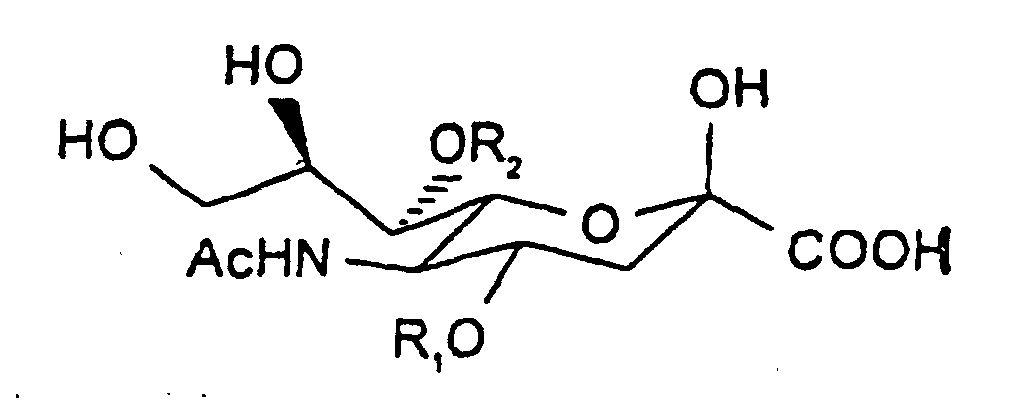
- Still another object of this invention is to provide a 4,7-dialkoxy-N-acetylneuraminic acid of the general formula wherein R 1 and R 2 are alkyl groups containing 1 to 4 carbon atoms. Preferably, both R 1 and R 2 are methyl groups.
- Still another object of this invention is to provide a 4,7-dialkoxy-N-acetylneuraminic acid substrate of the general formula wherein R 1 and R 2 are alkyl groups containing 1 to 4 carbon atoms and R 3 is a chromogenic or fluorogenic group. Preferably, both R 1 and R 2 are methyl groups and R 3 is a chromogenic group.
- Still another object of this invention is to provide a method for detecting influenza type A and B viruses in a clinical sample from an individual suspected of having a respiratory viral infection, said method comprising:
- Still another object of this invention is to provide a method for detecting influenza type A and B viruses in a clinical sample from an individual suspected of having a respiratory viral infection, said method comprising:
- the present invention relates to a 4,7-dialkoxy-N-acetylneuraminic acid of the general formula wherein R 1 and R 2 are alkyl groups containing 1 to 4 carbon atoms.
- R 1 and R 2 may be the same or different alkyl groups.
- the higher alkyl groups i.e., when R contains 3 to 4 carbon atoms
- R 1 and R 2 are alkyl groups containing 1 or 2 carbons atoms; more preferably R 1 and R 2 are both methyl groups.
- the 4,7-dialkoxy-N-acetylneuraminic acid of the present invention can be prepared using the following general reaction scheme:
- the starting material 1 (8,9-O-isopropylidine-methyl ester-methyl ketoside derivative of NeuSAc) is prepared from NeuSAc as generally described in our U.S. Patent 5,556,963 issued September 17, 1996 (application Serial Number 08/286,573 filed August 5, 1994), which is hereby incorporated by reference.
- Neu5Ac is commercially available (MediHerb Inc., 4540 S. Navajo #1, Englewood, Co. 80110). It may also be synthesized enzymatically from N-acetyl-D-mannosamine and pyruvic acid using the procedure described by Kim et al., J. Am. Chem. Soc. , 110 (1988) 6481, and illustrated by the following equation:
- the enzymatic reaction can be monitored by thin layer chromatography (TLC) and the product can be purified by ion exchange
- Neu5Ac is first converted into an alkyl ester alkyl ketoside of general formula as described in U.S. Patent 5,556,963.
- the vicinal hydroxyl groups at C-8 and C-9 of this methyl ester methyl ketoside are protected by the formation of a ketal ( 1 ) by treatment with effective amounts of acetone and an acid catalyst to form the ketal.
- Suitable acid catalysts include p-toluenesulfonic acid, salts of p-toluenesulfonic acid such as the pyridinium salt (PPTS and other salts, ZnCl 2 , FeCl 3 , and the like.
- the preferred acid catalyst is the non-hygroscopic pyridinium salt of p-toluenesulfonic acid.
- the protected methyl ester methyl keioside ( 1 is then alkylated to form a mixture of compound 2 containing an alkoxy group at the 4-position and compound 3 with alkoxy groups at both the 4- and 7-positions.
- Alkylation of the hydroxyl group at C-4 and C-7 may be methylation, ethylation, propylation, or butylation, whereby the hydroxy group at C-4 in 2 is converted to a -OR group and, the hydroxy groups at C-4 and C-7 in 3 are converted to -OR groups where R is an alkyl radical containing 1 to 4 carbon atoms.
- the alkylation at C-4 and/or C-7 is methylation or ethylation, whereby 4-methoxy or 4-ethoxy derivatives or 4,7-dimethoxy or 4,7-diethoxy derivatives are obtained. More preferably, the alkylation at C-4 and/or C-7 is methylation, whereby 4-methoxy or 4,7-dimethoxy derivatives are obtained.
- Introduction of higher alkyl groups at the C-4 and C-7 positions is generally slower than methylation and the yields are somewhat lower.
- chromogenic substrates with higher alkyl groups tend to be less susceptible to enzymatic cleavage than 4,7-dimethoxy-Neu5Ac, thereby resulting in less sensitive assays. Nonetheless, for some specific applications and assays, such higher alkyl groups at C-4 and C-7 may be useful and even preferred.
- intermediate 1 is created with an excess (generally greater than about 1.5 molar equivalents) of an alkylating agent in about an 80% dispersion of sodium hydride.
- the alkylating agent is selected from the group consisting of dimethyl sulfate, diethyl sulfate, dipropyl sulfates, and dibutyl sulfates.
- the reaction is generally conducted at a temperature of from about 0°C to about 30°C for about 10 minutes to about 48 hours. Preferably the reaction temperature is in the range of about 0°C to about 22°C.
- a mechylacion reaction to form methoxy groups at C-4 and C-7 is conducted at a temperature of from about 0°C to about 30°C, more preferably from about 0°C to about 22°C, for about 10 minutes to about 30 minutes.
- an ethylation reaction to form ethoxy groups at C-4 and C-7 is conducted at a temperature of from about 0°C to about 30°C, more preferably from about 0°C to about 22°C, for about 1 hour to about 24 hours.
- alkylating agent e.g., dimethyl sulfate
- Treatment of the protected methyl ester methyl ketoside 1 with excess alkylating agent produces a mixture of compound 2 containing an alkoxy group at the 4-position and compound 3 with alkoxy groups at both the 4- and 7-positions.
- an excess of about 1.5 molar equivalents of alkylating agent is used.
- Preferably about 1.5 to about 2.0 molar equivalents of alkylating agent is used.
- the amount of the desired compound 3 is increased relative to compound 2 as the amount of alkylation agent increases.
- the reaction mixture resulting from such treatment generally contains the 4-alkoxy compound 2 as the major product and about 10 to 20 weight percent of the 4,7-dialkoxy compound 3 .
- Partial separation of the compounds 2 and 3 can be obtained, for example, by column chromatography and subsequent crystallization from an acetone-hexane mixture which preferentially removes the 4-alkoxy compound 2 .
- the resulting residue contains a mixture of the two compounds enriched with the 4,7-dialkoxy material; generally the molar ratio of the two compounds is increased to at least about 1:1.
- Removal of the ketal group from compound 3 is achieved by treatment with about 80% acetic acid.
- Acetic acid hydrolysis can also result in partial acetylation at the C-9 hydroxyl group.
- the hydrolysis product can be treated with sodium methoxide to remove any acetate groups on C-9.
- Final deprotection of 4 is performed by alkaline treatment and subsequent acid hydrolysis to give the final 4,7-dialkoxy-Neu5Ac product ( 5 ).
- the 4-alkoxy compound 2 present in the mixture will also be treated in a similar manner to yield the corresponding 4-alkoxy-Neu5Ac compound.
- the resulting 4,7-dialkoxy-Neu5Ac can be further utilized through coupling to any suitable marker or reporter group, including for example, a chromogenic or fluorogenic marker group.
- the preferred marker or reporter group is a chromogenic group, including, for example, 4-chloro-1-naphthol, 6-bromo-1-naphthol, and 5-bromo-4-chloro-indole.
- Chromogenic modified 4,7-dialkoxy-Neu5Ac can be incorporated into a neuraminidase assay useful for detecting viral neuraminidase activity from influenza type A and B in clinical samples or specimens.
- the chromogenic or fluorogenic marker group can be incorporated into the 4,7-dialkoxy-Neu5Ac ( 5 ) using the following reaction scheme (using 5-bromo-3-indolyl as an example marker group) : Compound 5 is first converted into the corresponding methyl ester derivative by treatment with concentrated trifluoroacetic acid and methanol, and the ester is then reacted with excess acetyl chloride to form the chloroacetate-methyl ester derivative of 4,7-dialkoxy-Neu5Ac ( 6 ).
- the coupled 4,7-dialkoxy derivative 9 is then separated from the mixture of the two coupled compounds (i.e., the 4-alkoxy and 4,7-dialkoxy derivatives) by high performance liquid chromatography (HPLC) using, for example, a C18 reverse-plate silica column.
- HPLC high performance liquid chromatography
- the mixture of the coupled products can be dissolved in water and loaded onto the column.
- the products are separated by an increasing gradient of methanol with the appropriate fractions collected and pooled.
- the resulting purified 5-bromo-3-indolyl-4,7-dimethoxy-N-acetylneuraminic acid ( 9 ) can be dried and stored until use.
- the resulting product is essentially free of the 4-methoxy derivative. It is important that this mixture be essentially free of the 4-methoxy derivative since it is highly reactive wich mumps virus and other neuraminidase-containing viruses.
- the chromogenic or fluorogenic 4,7-dialkoxy derivatives of this invention are of the general formula wherein R 1 and R 2 are alkyl groups containing 1 to 4 carbon atoms and R 3 is a chromogenic or fluorogenic group.
- R 1 and R 2 may be the same or different alkyl groups.
- both R 1 and R 2 are methyl groups and R 3 is a chromogenic group.
- R 3 is 4-methylumbellifery;, 3-cyanoumbelliferyl, 2-nitrophenyl, 4-nitrophenyl, 3-resorufin, 5-bromo-4-chloro-3-indolyl, 5-bromo-3-indolyl, 3-indolyl, nitrophenylazophenyl, nitrophenylazoresorcinyl, 3-methoxyphenyl, 3-dimethylaminophenyl, 4-chloro-1-naphthyl, or 6-bromo-2-naphthyl.
- R 3 is 4-methylumbelliferyl, 5-bromo-4-chloro-3-indolyl, or 5-bromo-3-indolyl.
- the most preferred R 3 is 5-bromo-3-indolyl.
- Simple salts of these substrates such as the Na + , K + , and NH 4 + salts, may also be used.
- 4,7-dialkoxy chromogenic Neu5Ac derivatives falling within the above formula include 4-methylumbelliferyl-4,7-dimethoxy-N-acetylneuraminic acid-alpha-ketoside, 2-nitrophenyl-4,7-dimethoxy-N-acetylneuraminic acid-alpha-ketoside, 4-nitrophenyl-4,7-methoxy-N-acetylneuraminic acid-alpha-ketoside, 3-cyanoumbelliferyl-4,7-dimethoxy-N-acetylneuraminic acid-alpha-ketoside, 3-resorufin-4,7-dimethoxy-N-acetylneuraminic acid-alpha-ketoside, 5-bromo-4-chloro-3-indolyl-4,7-dimethoxy-N-acetylneuraminic acid-alpha-ketoside, 5-bromo-3-indolyl-4,7-dimethoxy-
- the chromogenic or fluorogenic 4,7-dialkoxy derivatives can be used in diagnostic tests for influenza type A and B viruses in clinical samples.
- the clinical samples that are tested in the invention will typically be pharyngeal, nasopharyngeal, or respiratory secretions collected from patients suffering, or suspected of suffering, from influenza as wash, swab, or expectorate specimens.
- the wash, expectorate, or swab will preferably be combined with an aqueous buffer solution containing a stabilizer prior to mixing with the substrate.
- the buffer solution generally contains a buffer that maintains the pH at about 4 to 7, preferably 5.5 to 6.5, optionally about 0.1% to 10% by weight nonionic detergent, a small amount (1-20 mM) of alkaline earth metal cation (Ca, Mg, preferably Ca), and a sufficient amount of a stabilizer selected from the group consisting of alditols, monosaccharides, and disaccharides to enhance the thermal stability of the neuraminic acid in the sample.
- a buffer that maintains the pH at about 4 to 7, preferably 5.5 to 6.5, optionally about 0.1% to 10% by weight nonionic detergent, a small amount (1-20 mM) of alkaline earth metal cation (Ca, Mg, preferably Ca), and a sufficient amount of a stabilizer selected from the group consisting of alditols, monosaccharides, and disaccharides to enhance the thermal stability of the neuraminic acid in the sample.
- the volume of buffer solution combined with the specimen will normally be 0.1 to 2 ml.
- the buffer may be organic or inorganic.
- Suitable buffers include, for example, conventional buffers of organic acids and salts thereof such as citrate buffers (e.g., monosodium citrate-disodium citrate mixture, citric acid-trisodium citrate mixture, citric acid-monosodium citrate mixture, etc.), acetate buffers (e.g., acetic acid-sodium acetate mixture), succinate buffers (e.g., succinic acid-monosodium succinate mixture, succinic acid-sodium hydroxide mixture, succinic acid-disodium succinate mixture, etc.), tartrate buffers (e.g., tartaric acid-tartrate mixture, tartaric acid-potassium tartrate mixture, tartaric acid-sodium hydroxide mixture etc.), fumarate buffers (e.g., fumaric acid-monosodium fum
- Non-ionic detergents useful in the buffer solution include, for example, the Pluronics, such as Polysorbate 20 or Polysorbate 80, Triton X-100, NP-40, and alkyl glucosides such as C 8 and C 9 alkyl glucosides.
- the detergent is an optional component and facilitates release of the neuraminidase from the viral envelope.
- Stabilizers that are used in the buffer solution include, for example, trihydric or higher alditols, such as glycerin, erythritol, arabitol, xylitol, sorbitol, mannitol, the hexoses glucose and fructose and the disaccharide sucrose.
- the stabilizers can be used alone or in combination.
- the stabilizers are added to the liquid formulation/excipient system in an amount from 0.2 M to 2.1 M and preferably, 0.6 M to 2.0 M.
- the sample Once mixed with the buffer solution, the sample may be stored for prolonged periods, preferably at 2°C to 8°C, without significant loss of neuraminidase activity.
- the substrate will normally be added to the buffered, stabilized sample in amounts ranging between C.05 mM and 0.5 mM.
- the mixture is incubated at ambient temperature to physiological temperature (i.e., about 18°C to 40°C) for a time sufficient to permit any neuraminidase in the sample to react with the substrate. That time will normally be in the range of 1 minute to 4 hours, usually at 5 to 120 minutes, and more usually 30 to 60 minutes. If there is neuraminidase activity in the sample, the marker or reporter group will be released from the substrate and the liberated marker or reporter precipitate will impart a characteristic color to the mixture.
- the resulting reaction mixture is preferably transferred to a collection device containing a porous membrane filter and an absorbent pad to wick away the solution.
- a collection device containing a porous membrane filter and an absorbent pad to wick away the solution.
- the reporter group on the 4,7-modified Neu5Ac is released by the action of neuraminidase and the resulting reporter molecule is collected as a colored precipitate on the porous filter membrane.
- the presence of such a colored product indicates a positive diagnosis for influenza types A and B: the absence of such a colored product indicates a negative diagnosis for influenza types A and B. Concentration or collection of the colored precipitate increases the sensitivity of the diagnostic test.
- Such collection devices are not, however, necessary for the practice of the invention.
- the following table indicates the characteristic color generated when neuraminidase reacts with various chromogenic or fluorogenic 4,7-modified Neu5Ac derivatives and releases the reporter molecule.
- Released Reporter Molecule Type of Detection Color 5-bromo-4-chloro-3-indolol colorimetric/ visual blue/purple in the presence of nitroblue tetrazolium 5-bromo-3-indolol colorimetric/ visual blue/purple in the presence of nitroblue tetrazolium 3-indolol colorimetric/ visual blue/purple in the presence of nitroblue tetrazolium 4-methylumbelliferone fluorometric fluorescent emission at 454 nm after excitation at 360 nm 3-cyanoumbelliferone fluorometric fluorescent emission at 454 nm after excitation at 415 nm resorufin colorimetric/ visual pink/red 2-nitrophenol colorimetric/ visual yellow 4-nitrophenol colorimetric/ visual yellow
- the present chromogenic and fluorogenic 4,7-dialkoxy Neu5Ac derivatives only exhibit the characteristic color in the presence of influenza type A and B virus. They do not exhibit the characteristic color (i.e., no release of the reporter molecule occurs) in the presence of parainfluenza types 1, 2, 3, and 4, mumps, respiratory syncytial viruses, and/or adenoviruses. Moreover, the chromogenic and fluorogenic 4,7-dialkoxy Neu5Ac derivatives do not exhibit bacterial neuraminidase reactivity. To maintain the desired degree of selectivity, the 4,7-dialkoxy Neu5Ac derivatives should be essentially free of the corresponding 4-alkoxy Neu5Ac derivatives.
- the maximum levels of the 4-alkoxy Neu5Ac derivatives which allow acceptable selectivity can be determined experimentally using known strains of the various types of viruses. Generally, the levels of 4-alkoxy Neu5Ac derivatives should be less than about 5 weight percent, and preferably less than about 0.5 weight percent.
- a potentially more informative diagnostic test can be obtained by combining the neuraminidase reactivity and selectivity of the present chromogenic and fluorogenic 4,7-dialkoxy Neu5Ac derivatives and the chromogenic and fluorogenic 4-alkoxy Neu5Ac derivatives in a single test.
- the clinical sample is divided into two portions which are then incubated separately with the 4,7-dialkoxy and the 4-alkoxy Neu5Ac derivatives, respectively.
- the presence and/or absence of characteristic color in the two incubated samples can be used to more closely determine the type of virus, if any, present in the clinical sample.
- both the 4-alkoxy and the 4,7-dialkoxy derivatives will exhibit their characteristic colors of their reporter molecules. If both influenza type A or B viruses and neuraminidase reactive viruses other than influenza type A and B viruses are present in the clinical sample, then each portion will exhibit the characteristic color of its reporter molecule. If only neuraminidase reactive viruses other than influenza type A and B viruses are present in the clinical sample, then only the 4-alkoxy derivative will exhibit the characteristic color of its reporter molecule. If no neuraminidase reactive viruses are present in the clinical sample, then neither portion will exhibit the characteristic color of its reporter molecule.
- the present invention provides simple and rapid techniques for selectively diagnosing influenza -- especially types A and B -- that may be carried out in the clinic or physician's office and enable the physician to prescribe the appropriate therapy to treat the infection and/or the appropriate prophylactic treatment to persons in close contact with the infected patient.
- Example 1 The synthesis of 4,7-dimechoxy-Neu5Ac was carried out using the reactions shown in Scheme 1.
- Sodium hydride (270 mg; 80% dispersion in oil) was added and the mixture stirred for 20 minutes.
- Dimethyl sulfate (1 ml) was added and the stirring continued for an additional 30 minutes using an ice bath to cool the mixture.
- the resulting mixture was filtered through celite and the precipitate was washed with dry acetonitrile. The filtrate was evaporated and the residue was dried and extracted with acetone. After filtration, the filtrate was again evaporated.
- Example 2 The synthesis of 5-bromo-3-indolyl-4, 7-dimethoxy-Neu5Ac was carried out using the reactions shown in Scheme 2.
- Compound 5 (1.0 g) was treated with trifluoroacetic acid (0.2 ml) in methanol (25 ml) overnight at room temperature. The mixture was evaporated. The residue was dried and treated with acetyl chloride (5 ml) in methylene chloride (5 ml). The reaction mixture was stirred overnight at room temperature and then evaporated. The residue was dried co provide the crude chloride 6 (1.36 g). The crude product 6 was not further purified because of its instability.
- the coupled product 7 (0.114 g) was treated with 1 M sodium methoxide in methanol (0.1 ml) for 30 minutes at room temperature. After neutralization with Dowex 50 (H + ) resin, the resin was removed and washed with methanol. The combined filtrate was evaporated. The residue was dried and chromatographed on silica gel. Fractions containing mainly the coupled product 8 were pooled and evaporated to give about 60 mg of 8 .
- the coupled product 8 (60 mg) was treated with 1 M sodium hydroxide (0.5 ml) in 50% aqueous methanol (5 ml) for 30 minutes at room temperature. The mixture was neutralized with Dowex 50 (H + ) resin. The resin was removed by filtration and washed with methanol. The combined filtrate was evaporated and the residue was purified by HPLC. The first fractions contained an uncoupled product.
- the coupled material appeared as a broad peak which consisted of both coupled 4-methoxy-Neu5Ac and coupled 4,7-dimethoxy-Neu5Ac product 9 . Since minor amount of the coupled 4-methoxy derivative could render the diagnostic analysis unspecific, only highly pure fractions containing 9 were pooled. Upon evaporation, highly purified 9 (4 mg) was collected; the collected material contained less than about 5 weight percent of the corresponding 4-alkoxy derivative.
- Example 3 This example demonstrates the specificity of the 5-bromo-3-indolyl-4,7-dimethoxy-Neu5Ac ( 9 ) of Example 2 in diagnostic tests for influenza A and B in cultured viruses.
- Viruses were grown from fresh patient isolates or frozen stock cultures using the appropriate cell line, medium, and incubation conditions suitable for the growth and culture of the particular virus. The following cells were used: (1) RMK (Rhesus monkey kidney) cells for influenza and parainfluenza viruses; (2) HEp-2 (human larynx carcinoma) cells for respiratory syncycial virus and adenovirus; and (3) VERC (African Green monkey kidney) cells for mumps. All cells were grown to near-confluent monolayers in tubes or flasks with minimum essential medium with 5-10 percent serum at 37°C. Virus infections were carried out in the appropriate cell lines with minimum essential medium without serum at 37°C.
- Virus-infected cultures were monitored and confirmed by observing the appearance of characteristic cytopathic effects and by testing with immunofluorescence assays using virus-type specific monoclonal antibodies.
- the following characteristic cytopathic effects were observed for each of the viruses used as follows: (1) Influenza A and B: areas of large, irregularly shaped, granular, or vaculated cells with progressive degeneration of the cell monolayer; (2) Parainfluenza 1: small rounded cells throughout the cell monolayer; (3) Parainfluenza 2: dark, granular, and irregular syncytia which retract from the cell monolayer; (4) Parainfluenza 3: elongated, fusiform cells that eventually retract and pull away from the cell monolayer; (5) Respiratory syncytial virus: large, irregularly shaped syncytia that appear as large multinucleated cells with indistinct borders throughout the cell monolayer; (6) Adenovirus: large, rounded pycnotic cells which eventually aggregate into rounded
- the fixed, virus infected cells were incubated for 30 minutes with virus type-specific, unlabeled monoclonal antibodies, followed by incubation for an additional 30 minutes with secondary FITC-labeled monoclonal antibodies.
- the slides or coverslips were overlaid with mounting medium and examined using a fluorescent microscope. A positive virus result was verified by the presence of a characteristic, virus-specific, apple-green staining. The presence of progressive and characteristic cytopathic effects (along with accompanying specific virus confirmation with fluorescence assay) was an indication that the particular inoculated virus had proliferated maximally.
- the culture fluids were harvested for evaluation with the 4-methoxy-N-acetylneuraminic acid and 4,7-dimethoxy-N-acetylneuraminic acid chromogenic substrates.
- Virus-containing culture fluids (0.1 ml) were mixed with the chromogenic substrates in a 1 or 2 ml solution containing excipents and buffer designed to achieve optimal pH and neuraminidase activity.
- the buffer/excipient solution contained 35 mM malic/malate buffer with 10 mM calcium chloride, 0.85 percent sodium chloride, 0.1 percent mannitol, 0.5 percent methanol, and 0.1 percent methyl paraben.
- the substrate and buffer combination at a pH of about 5.4 was determined to provide specific detection of neuraminidase-producing viruses with clearly negative results for non-neuraminidase-producing viruses and virus-negative cultures.
- test solutions were incubated at 37°C for about one hour after which the reaction was stopped by the addition of 0.2 ml of a buffer concentrate which changed the pH to about 9 and helped increase the precipitation of the released chromogen.
- the completed reaction mixture was then transferred to a collection device containing a selectively porous membrane filter and an absorbent pad to wick away the solution whereby the precipitate is concentrated.
- the appearance of an appropriately colored precipitate indicated a positive reaction whereas the absence of such an appropriately colored precipitate indicated a negative reaction.
- the characteristic color of the precipitate for a positive test was blue..
- the following viruses were used to test the 5-bromo-3-indolyl-4-methoxy-N-acetylneuraminic acid substrate (BI-4-MeONeu5Ac) and the 5-bromo-3-indolyl-4, 7-dimethoxy-N-acetylneuraminic acid substrate (BI-4,7-(MeO) 2 Neu5Ac).
- the virus cultures were grown to their maximal titers (as determined by observance of extensive -- about 90 to 100 percent -- virus-characteristic cytopathic effects in the cell sheet and confirmation with fluorescence assays of bright apple-green, virus-specific staining in the majority of cells) to insure that any reaction differences were not due to undetectable viral concentrations.
- the rating colors were matched to color samples from a standard reference source (The Pantone® Color Specific Book 747XR).
- a rating of 1+ (light color) indicates a low positive
- 2+ (moderate color) indicates a moderate positive
- 3+ (deep color) indicates a high positive.
- a negative result is indicated by the absence of the characteristic color.
- An indeterminate result is indicated if a very faint trace or suggestion of the characteristic color may be present by visual observation.
- viruses containing influenza type A and B neuraminidase were the only tested organisms which gave a positive reaction with both the 4-methoxy-Neu5Ac and the 4,7-dimethoxy-Neu5Ac substrates undiluted and at all dilutions tested.
- the 4-mechoxy-Neu5Ac substrate gave both negative and positive reactions depending on the dilution.
- the 4,7-dimethoxy-Neu5Ac substrate gave a negative reaction with parainfluenza types 1, 2, and 3 and the mumps virus undiluted and at all dilutions.
- Non-neuraminidase containing viruses i.e., respiratory syncytial virus and adenovirus
- virus negative controls without virsu were appropriately negative.
- Example 4 Similar results as reported in Example 3 were obtained using 5-bromo-4-chloro-indol-3-ol and 4-methylumbelliferone as reporter molecules on 4-methoxy-Neu5Ac and 4,7-dimethoxy-Neu5Ac.
Landscapes
- Health & Medical Sciences (AREA)
- Life Sciences & Earth Sciences (AREA)
- Chemical & Material Sciences (AREA)
- Engineering & Computer Science (AREA)
- Organic Chemistry (AREA)
- Immunology (AREA)
- Molecular Biology (AREA)
- Biochemistry (AREA)
- Biotechnology (AREA)
- General Health & Medical Sciences (AREA)
- Microbiology (AREA)
- Analytical Chemistry (AREA)
- Virology (AREA)
- Biomedical Technology (AREA)
- Zoology (AREA)
- Hematology (AREA)
- Genetics & Genomics (AREA)
- Urology & Nephrology (AREA)
- Wood Science & Technology (AREA)
- Proteomics, Peptides & Aminoacids (AREA)
- Physics & Mathematics (AREA)
- Pathology (AREA)
- Bioinformatics & Cheminformatics (AREA)
- Tropical Medicine & Parasitology (AREA)
- Biophysics (AREA)
- Medicinal Chemistry (AREA)
- Food Science & Technology (AREA)
- Cell Biology (AREA)
- General Physics & Mathematics (AREA)
- General Engineering & Computer Science (AREA)
- Measuring Or Testing Involving Enzymes Or Micro-Organisms (AREA)
- Saccharide Compounds (AREA)
- Investigating Or Analysing Biological Materials (AREA)
- Pharmaceuticals Containing Other Organic And Inorganic Compounds (AREA)
- Investigating Or Analyzing Materials By The Use Of Fluid Adsorption Or Reactions (AREA)
Claims (21)
- 4,7-Dialkoxy-N-acetylneuraminsäure der allgemeinen Formel:worin R1 und R2 Alkyl-Gruppen sind, die 1 bis 4 Kohlenstoffatome enthalten.
- 4,7-Dialkoxy-N-acetylneuraminsäure gemäß Anspruch 1, worin sowohl R1 als auch R2 Methyl-Gruppen sind.
- 4,7-Dialkoxy-N-acetylneuraminsäure gemäß Anspruch 1, worin sowohl R1 als auch R2 Ethyl-Gruppen sind.
- 4,7-Dialkoxy-N-acetylneuraminsäure-Substrat der allgemeinen Formel:worin R1 und R2 Alkyl-Gruppen sind, die 1 bis 4 Kohlenstoffatome enthalten, und R3 eine chromogene oder fluorogene Gruppe ist.

- 4,7-Dialkoxy-N-acetylneuraminsäure-Substrat gemäß Anspruch 4, worin sowohl R1 als auch R2 Methyl-Gruppen sind und R3 eine chromogene Gruppe ist.
- 4,7-Dialkoxy-N-acetylneuraminsäure-Substrat gemäß Anspruch 5, worin R3 ausgewählt ist aus der Gruppe bestehend aus 4-Methylumbelliferyl,
3-Cyanoumbelliferyl, 2-Nitrophenyl, 4-Nitrophenyl, 3-Resorufin, 5-Brom-4-chlor-3-indolyl, 5-Brom-3-indolyl, 3-Indolyl, Nitrophenylazophenyl, Nitrophenylazoresorcinyl, 3-Methoxyphenyl, 3-Dimethylaminophenyl, 4-Chlor-1-naphthyl und 6-Brom-2-naphthyl. - 4,7-Dialkoxy-N-acetylneuraminsäure-Substrat gemäß Anspruch 6, worin R3 5-Brom-3-indolyl ist.
- 4,7-Dialkoxy-N-acetylneuraminsäure-Substrat gemäß Anspruch 4, worin sowohl R1 als auch R2 Ethyl-Gruppen sind und R3 eine chromogene Gruppe ist.
- 4,7-Dialkoxy-N-acetylneuraminsäure-Substrat gemäß Anspruch 8, worin R3 ausgewählt ist aus der Gruppe bestehend aus 4-Methylumbelliferyl,
3-Cyanoumbelliferyl, 2-Nitrophenyl, 4-Nitrophenyl, 3-Resorufin, 5-Brom-4-chlor-3-indolyl, 5-Brom-3-indolyl, 3-Indolyl, Nitrophenylazophenyl, Nitrophenylazoresorcinyl, 3-Methoxyphenyl, 3-Dimethylaminophenyl, 4-Chlor-1-naphthyl und 6-Brom-2-naphthyl. - Verfahren zum Nachweis von Influenza-Viren vom Typ A und B in einer klinischen Probe von einer Einzelperson, die im Verdacht steht, eine virale Infektion der Atemwege zu haben, wobei das Verfahren umfaßt:(1) Inkubieren der klinischen Probe mit einem chromogenen oder fluorogenen 4,7-Dialkoxy-N-acetylneuraminsäure-Substrat der allgemeinen Formel:worin R1 und R2 Alkyl-Reste sind, die 1 bis 4 Kohlenstoffatome enthalten, und R3 eine chromogene oder fluorogene Gruppe ist, die eine deutliche und charakteristische Farbe zeigt, wenn sie von dem Substrat oder einem Salz des Substrats abgespalten wird;
 (2) Beobachten der inkubierten klinischen Probe, um zu bestimmen, ob die deutliche und charakteristische Farbe gebildet wird, wobei die Bildung der deutlichen und charakteristischen Farbe auf die Anwesenheit von Influenza-Viren vom Typ A oder B in der klinischen Probe hinweist.
 - Verfahren gemäß Anspruch 10, worin sowohl R1 als auch R2 Methyl-Gruppen sind und eine R3 eine chromogene Gruppe ist.
- Verfahren gemäß Anspruch 11, worin R3 ausgewählt ist aus der Gruppe bestehend aus 4-Methylumbelliferyl, 3-Cyanoumbelliferyl, 2-Nitrophenyl, 4-Nitrophenyl, 3-Resorufin, 5-Brom-4-chlor-3-indolyl, 5-Brom-3-indolyl, 3-Indolyl, Nitrophenylazophenyl, Nitrophenylazoresorcinyl, 3-Methoxyphenyl, 3-Dimethylaminophenyl, 4-Chlor-1-naphthyl und 6-Brom-2-naphthyl.
- Verfahren gemäß Anspruch 12, worin R3 5-Brom-3-indolyl ist.
- Verfahren gemäß Anspruch 10, worin sowohl R1 als auch R2 Ethyl-Gruppen sind und R3 eine chromogene Gruppe ist.
- Verfahren gemäß Anspruch 14, worin R3 ausgewählt ist aus der Gruppe bestehend aus 4-Methylumbelliferyl, 3-Cyanoumbelliferyl, 2-Nitrophenyl, 4-Nitrophenyl, 3-Resorufin, 5-Brom-4-chlor-3-indolyl, 5-Brom-3-indolyl, 3-Indolyl, Nitrophenylazophenyl, Nitrophenylazoresorcinyl, 3-Methoxyphenyl, 3-Dimethylaminophenyl, 4-Chlor-1-naphthyl und 6-Brom-2-naphthyl.
- Verfahren zum Nachweis von Influenza-Viren vom Typ A und B in einer klinischen Probe von einer Einzelperson, die im Verdacht steht, eine virale Infektion der Atemwege zu haben, wobei das Verfahren umfaßt:wobei die Anwesenheit der ersten und zweiten Farbe auf die Anwesenheit von Influenza-Viren vom Typ A oder B allein oder in Kombination mit Neuraminidase reaktiven Viren, andere als Influenza-Viren vom Typ A und B, in der klinischen Probe hinweist;(1) Teilen der klinischen Probe in einen ersten Teil und einen zweiten Teil;(2) Inkubieren des ersten Teils mit einem chromogenen oder fluorogenen ersten 4,7-Dialkoxy-N-acetylneuraminsäure-Substrat der allgemeinen Formel:worin R1 und R2 Alkyl-Reste sind, die 1 bis 4 Kohlenstoffatome enthalten, und R3 eine erste chromogene oder fluorogene Gruppe ist, die eine deutliche und charakteristische erste Farbe zeigt, wenn sie von dem ersten Substrat oder einem Salz des ersten Substrats abgespalten wird;
 (3) Beobachten des inkubierten ersten Teils, um zu bestimmen, ob die deutliche und charakteristische erste Farbe gebildet wird, wobei die Bildung der deutlichen und charakteristischen ersten Farbe auf die Anwesenheit von Influenza-Viren vom Typ A oder B in der klinischen Probe hinweist;(4) Inkubieren des zweiten Teils mit einem chromogenen oder fluorogenen zweiten 4-Alkoxy-N-acetylneuraminsäure-Substrat der allgemeinen Formel:worin R4 ein Alkyl-Rest ist, der 1 bis 4 Kohlenstoffatome enthält, und R5 eine zweite chromogene oder fluorogene Gruppe ist, die eine deutliche und charakteristische zweite Farbe zeigt, wenn sie von dem zweiten Substrat oder einem Salz des zweiten Substrats abgespalten wird; und
 (5) Beobachten des inkubierten zweiten Teils, um zu bestimmen, ob die deutliche und charakteristische zweite Farbe gebildet wird, wobei die Bildung der deutlichen und charakteristischen zweiten Farbe auf die Anwesenheit von Neuraminidase reaktiven Viren in der klinischen Probe hinweist;
wobei die Anwesenheit der zweiten Farbe und das Fehlen der ersten Farbe auf Neuraminidase reaktive Viren, andere als Influenza-Viren vom Typ A und B in der klinischen Probe hinweist; und
wobei die Abwesenheit der ersten und zweiten Farbe auf die Abwesenheit von Neuraminidase reaktiven Viren in der klinischen Probe hinweist. - Verfahren gemäß Anspruch 16, worin sowohl R1 als auch R2 Methyl-Gruppen sind und R3 eine erste chromogene Gruppe ist.
- Verfahren gemäß Anspruch 17, worin R4 eine Methyl-Gruppe ist und R5 eine zweite chromogene Gruppe ist.
- Verfahren gemäß Anspruch 17, worin R3 und R4 unabhängig ausgewählt sind aus der Gruppe bestehend aus
4-Methylumbelliferyl, 3-Cyanoumbelliferyl, 2-Nitrophenyl, 4-Nitrophenyl, 3-Resorufin, 5-Brom-4-chlor-3-indolyl, 5-Brom-3-indolyl, 3-Indolyl, Nitrophenylazophenyl, Nitrophenylazoresorcinyl, 3-Methoxyphenyl, 3-Dimethylaminophenyl, 4-Chlor-1-naphthyl und 6-Brom-2-naphthyl. - Verfahren gemäß Anspruch 19, worin R3 5-Brom-3-indolyl ist.
- Verfahren gemäß Anspruch 18, worin R3 und R4 unabhängig ausgewählt sind aus der Gruppe bestehend aus
4-Methylubelliferyl, 3-Cyanoumbelliferyl, 2-Nitrophenyl, 4-Nitrophenyl, 3-Resorufin, 5-Brom-4-chlor-3-indolyl, 5-Brom-3-indolyl, 3-Indolyl, Nitrophenylazophenyl, Nitrophenylazoresorcinyl, 3-Methoxyphenyl, 3-Dimethylaminophenyl, 4-Chlor-1-naphthyl und 6-Brom-2-naphthyl.
Applications Claiming Priority (3)
| Application Number | Priority Date | Filing Date | Title |
|---|---|---|---|
| US718666 | 1985-04-01 | ||
| US08/718,666 US5719020A (en) | 1996-09-25 | 1996-09-25 | 4,7-dialkoxy N-acetylneuraminic acid derivatives and methods for detection of influenza type A and B viruses in clinical specimens |
| PCT/US1997/015602 WO1998013372A1 (en) | 1996-09-25 | 1997-09-05 | 4,7-dialkoxy-n-acetylneuraminic acid derivatives and methods for detection of influenza type a and b viruses in clinical specimens |
Publications (2)
| Publication Number | Publication Date |
|---|---|
| EP0888371A1 EP0888371A1 (de) | 1999-01-07 |
| EP0888371B1 true EP0888371B1 (de) | 2002-05-22 |
Family
ID=24886990
Family Applications (1)
| Application Number | Title | Priority Date | Filing Date |
|---|---|---|---|
| EP97940823A Expired - Lifetime EP0888371B1 (de) | 1996-09-25 | 1997-09-05 | 4,7-dialkoxy-n-acetylneuraminsaurederivate und methoden zur erkennung von influenza typ a und b in klinischen proben |
Country Status (15)
| Country | Link |
|---|---|
| US (1) | US5719020A (de) |
| EP (1) | EP0888371B1 (de) |
| JP (1) | JP4070817B2 (de) |
| CN (2) | CN1091447C (de) |
| AT (1) | ATE217879T1 (de) |
| AU (1) | AU716275B2 (de) |
| BR (1) | BR9706776A (de) |
| CA (1) | CA2237790A1 (de) |
| DE (1) | DE69712747T2 (de) |
| ES (1) | ES2173481T3 (de) |
| IL (1) | IL124511A (de) |
| NO (1) | NO310822B1 (de) |
| NZ (1) | NZ330443A (de) |
| PL (1) | PL327109A1 (de) |
| WO (1) | WO1998013372A1 (de) |
Families Citing this family (30)
| Publication number | Priority date | Publication date | Assignee | Title |
|---|---|---|---|---|
| US6667161B1 (en) * | 1997-10-27 | 2003-12-23 | Ibbex, Inc. | Chromogenic substrates of sialidase of bacterial, viral, protozoa, and vertebrate origin and methods of making and using the same |
| AU1927899A (en) * | 1997-12-18 | 1999-07-05 | Sepracor, Inc. | Screening assays for the detection and diagnosis of influenza virus |
| US6303764B1 (en) | 1998-09-24 | 2001-10-16 | Zymetx, Inc. | Synthesis of 4,7-dialkyl chromogenic glycosides of N-acetylneuraminic acids |
| US6555698B1 (en) * | 1998-11-17 | 2003-04-29 | Tropix, Inc. | Chemiluminescent substrates for neuraminidase, assays for detection of neuraminidase and kits therefor |
| JP2002541858A (ja) * | 1999-04-16 | 2002-12-10 | ザイメテックス インコーポレイテッド | ウイルス由来の酵素および化学発光基質を用いるウイルス検出法 |
| US6420552B1 (en) | 1999-09-10 | 2002-07-16 | Zymetx, Inc. | Syntheses of 4-alkyl chromogenic glycosides and 7-alkyl chromogenic glycosides of N-acetylneuraminic acids |
| US6627396B1 (en) * | 1999-10-28 | 2003-09-30 | The Regents Of The University Of California | Influenza sensor |
| SE9904289D0 (sv) * | 1999-11-26 | 1999-11-26 | Niklas Arnberg | Method and camposition for the treatment of adenovairal ocular infections |
| IL164079A0 (en) | 2002-03-15 | 2005-12-18 | Us Dept Veterans Affairs | Methods and compositions using cellular asialodeterminants and glycoconjugates for targeting cells to tissues and organs |
| KR20050062605A (ko) * | 2002-10-10 | 2005-06-23 | 디파트먼트 오브 베테랑스 어페어스 오피스 오브 더 제네럴 카운셀 (024) | 종양 특이적 에피토프에 대해 지정된 표지된 활성화임파구를 이용한 종양의 검출, 위치결정 및 병기결정 |
| MX2008014529A (es) * | 2006-05-18 | 2009-01-28 | Veterinaermedizinische Uni Wie | Metodo de deteccion para virus de influenza. |
| US8097419B2 (en) | 2006-09-12 | 2012-01-17 | Longhorn Vaccines & Diagnostics Llc | Compositions and method for rapid, real-time detection of influenza A virus (H1N1) swine 2009 |
| US9481912B2 (en) | 2006-09-12 | 2016-11-01 | Longhorn Vaccines And Diagnostics, Llc | Compositions and methods for detecting and identifying nucleic acid sequences in biological samples |
| US8652782B2 (en) | 2006-09-12 | 2014-02-18 | Longhorn Vaccines & Diagnostics, Llc | Compositions and methods for detecting, identifying and quantitating mycobacterial-specific nucleic acids |
| US20090098527A1 (en) * | 2006-09-12 | 2009-04-16 | Fischer Gerald W | Biological organism identification product and methods |
| US8080645B2 (en) | 2007-10-01 | 2011-12-20 | Longhorn Vaccines & Diagnostics Llc | Biological specimen collection/transport compositions and methods |
| US9683256B2 (en) | 2007-10-01 | 2017-06-20 | Longhorn Vaccines And Diagnostics, Llc | Biological specimen collection and transport system |
| US11041215B2 (en) | 2007-08-24 | 2021-06-22 | Longhorn Vaccines And Diagnostics, Llc | PCR ready compositions and methods for detecting and identifying nucleic acid sequences |
| US10004799B2 (en) | 2007-08-27 | 2018-06-26 | Longhorn Vaccines And Diagnostics, Llc | Composite antigenic sequences and vaccines |
| AU2008293504B2 (en) | 2007-08-27 | 2012-04-12 | Longhorn Vaccines & Diagnostics, Llc | Immunogenic compositions and methods |
| CA2861667C (en) | 2007-10-01 | 2017-06-13 | Longhorn Vaccines And Diagnostics, Llc | Biological specimen collection and transport system and methods of use |
| US11041216B2 (en) | 2007-10-01 | 2021-06-22 | Longhorn Vaccines And Diagnostics, Llc | Compositions and methods for detecting and quantifying nucleic acid sequences in blood samples |
| US9119866B2 (en) * | 2008-04-08 | 2015-09-01 | Huiru Wang | Glycan-based drugs, therapies and biomarkers |
| WO2013112916A1 (en) | 2012-01-26 | 2013-08-01 | Longhorn Vaccines And Diagnostics, Llc | Composite antigenic sequences and vaccines |
| WO2014165536A1 (en) | 2013-04-01 | 2014-10-09 | Becton, Dickinson And Company | Methods and kits for the diagnosis of influenza |
| WO2016183292A1 (en) | 2015-05-14 | 2016-11-17 | Longhorn Vaccines And Diagnostics, Llc | Rapid methods for the extraction of nucleic acids from biological samples |
| WO2018050429A1 (de) | 2016-09-19 | 2018-03-22 | Julius-Maximilians-Universität Würzburg | Diagnostischer sensor und kaugummi umfassend den diagnostischen sensor zum geschmacklichen nachweis von viren |
| TWI631340B (zh) * | 2017-06-16 | 2018-08-01 | 國立臺北科技大學 | 檢測神經胺酸酶活性的方法 |
| CN107446004B (zh) * | 2017-08-10 | 2020-05-01 | 济南山目生物医药科技有限公司 | 一种2-(4’-甲基伞形酮)-alpha-N-乙酰基神经氨酸钠的合成方法 |
| US12371752B2 (en) | 2019-03-05 | 2025-07-29 | Japan Science And Technology Agency | Method and kit for detecting influenza virus, and method for diagnosing influenza virus infection |
Family Cites Families (15)
| Publication number | Priority date | Publication date | Assignee | Title |
|---|---|---|---|---|
| US3950322A (en) * | 1973-08-27 | 1976-04-13 | Research Corporation | Fluorogenic substrate glycosides |
| JPS5925699A (ja) * | 1982-08-03 | 1984-02-09 | Torii Yakuhin Kk | 酵素活性測定方法 |
| JPS60164499A (ja) * | 1984-02-07 | 1985-08-27 | Kyowa Medetsukusu Kk | 酵素活性測定法 |
| US4632901A (en) * | 1984-05-11 | 1986-12-30 | Hybritech Incorporated | Method and apparatus for immunoassays |
| US5081017A (en) * | 1986-02-18 | 1992-01-14 | Texas Bioresource Corporation | Method and apparatus for detection and quantitation of bacteria |
| US4810636A (en) * | 1986-12-09 | 1989-03-07 | Miles Inc. | Chromogenic acridinone enzyme substrates |
| AU656721B2 (en) * | 1989-12-29 | 1995-02-16 | Symex Corp. | Methods for diagnosting human influenza and 4-position modified chromogenic N-acetylneuraminic acid substrates for use therein |
| AU7176191A (en) * | 1990-01-05 | 1991-07-24 | Symex Corp. | Chromogenic 5-position modified neuraminic acid substrates and methods for diagnosing human influenza therewith |
| AU7150891A (en) * | 1990-01-10 | 1991-08-05 | Symex Corp. | Chromogenic 9-position modified n-acetylneuraminic acid substrates and methods for diagnosing human influenza therewith |
| CZ288492B6 (en) * | 1990-04-24 | 2001-06-13 | Biota Scient Management | Derivatives of alpha-D-neuraminic acid, process of their preparation, their use and pharmaceutical preparations based thereon |
| US5252485A (en) * | 1990-08-10 | 1993-10-12 | Savant Instruments, Inc. | Unit for hydrolyzing amino-acid containing specimens |
| WO1992006691A1 (en) * | 1990-10-19 | 1992-04-30 | Biota Scientific Management Pty. Ltd. | Anti-viral compounds that bind the active site of influenza neuramidase and display in vivo activity against orthomyxovirus and paramyxovirus |
| US5252458A (en) * | 1990-12-31 | 1993-10-12 | Symex Corp. | Method for visually detecting the presence of a virus in a clinical specimen |
| US5489675A (en) * | 1992-06-25 | 1996-02-06 | E. I. Du Pont De Nemours And Company | Disaccharide sialidase substrates and inhibitors |
| US5556963A (en) * | 1994-08-05 | 1996-09-17 | Oklahoma Medical Research Foundation | Synthesis of 4-alkoxy-N-acetylneuraminic acid |
-
1996
- 1996-09-25 US US08/718,666 patent/US5719020A/en not_active Expired - Lifetime
-
1997
- 1997-09-05 IL IL12451197A patent/IL124511A/en not_active IP Right Cessation
- 1997-09-05 ES ES97940823T patent/ES2173481T3/es not_active Expired - Lifetime
- 1997-09-05 EP EP97940823A patent/EP0888371B1/de not_active Expired - Lifetime
- 1997-09-05 DE DE69712747T patent/DE69712747T2/de not_active Expired - Fee Related
- 1997-09-05 AU AU42512/97A patent/AU716275B2/en not_active Ceased
- 1997-09-05 CA CA002237790A patent/CA2237790A1/en not_active Abandoned
- 1997-09-05 JP JP51565598A patent/JP4070817B2/ja not_active Expired - Fee Related
- 1997-09-05 CN CN97191313A patent/CN1091447C/zh not_active Expired - Fee Related
- 1997-09-05 AT AT97940823T patent/ATE217879T1/de not_active IP Right Cessation
- 1997-09-05 BR BR9706776A patent/BR9706776A/pt not_active IP Right Cessation
- 1997-09-05 PL PL97327109A patent/PL327109A1/xx unknown
- 1997-09-05 NZ NZ330443A patent/NZ330443A/xx unknown
- 1997-09-05 WO PCT/US1997/015602 patent/WO1998013372A1/en not_active Ceased
-
1998
- 1998-05-22 NO NO19982343A patent/NO310822B1/no unknown
-
2001
- 2001-04-18 CN CNB011166940A patent/CN1147589C/zh not_active Expired - Fee Related
Also Published As
| Publication number | Publication date |
|---|---|
| CA2237790A1 (en) | 1998-04-02 |
| JP4070817B2 (ja) | 2008-04-02 |
| NO982343D0 (no) | 1998-05-22 |
| IL124511A (en) | 2002-08-14 |
| EP0888371A1 (de) | 1999-01-07 |
| JP2000501748A (ja) | 2000-02-15 |
| AU4251297A (en) | 1998-04-17 |
| ES2173481T3 (es) | 2002-10-16 |
| US5719020A (en) | 1998-02-17 |
| CN1205011A (zh) | 1999-01-13 |
| AU716275B2 (en) | 2000-02-24 |
| DE69712747T2 (de) | 2002-11-21 |
| CN1091447C (zh) | 2002-09-25 |
| PL327109A1 (en) | 1998-11-23 |
| CN1147589C (zh) | 2004-04-28 |
| CN1324954A (zh) | 2001-12-05 |
| NO310822B1 (no) | 2001-09-03 |
| BR9706776A (pt) | 1999-05-18 |
| HK1016988A1 (en) | 1999-11-12 |
| DE69712747D1 (de) | 2002-06-27 |
| IL124511A0 (en) | 1998-12-06 |
| NO982343L (no) | 1998-07-01 |
| NZ330443A (en) | 1998-12-23 |
| WO1998013372A1 (en) | 1998-04-02 |
| ATE217879T1 (de) | 2002-06-15 |
Similar Documents
| Publication | Publication Date | Title |
|---|---|---|
| EP0888371B1 (de) | 4,7-dialkoxy-n-acetylneuraminsaurederivate und methoden zur erkennung von influenza typ a und b in klinischen proben | |
| US5663055A (en) | Methods for diagnosing human influenza and 4-position modified chromogenic N-acetylneuraminic acid substrated for use therein | |
| US7081352B2 (en) | Chemiluminescent influenza diagnostic kit | |
| US5556963A (en) | Synthesis of 4-alkoxy-N-acetylneuraminic acid | |
| AU656721B2 (en) | Methods for diagnosting human influenza and 4-position modified chromogenic N-acetylneuraminic acid substrates for use therein | |
| WO1991009975A1 (en) | Chromogenic 7- or 8-position modified n-acetylneuraminic acid substrates and methods for diagnosing human influenza therewith | |
| AU781391B2 (en) | Chromogenic substrates of sialidase of bacterial, viral, protozoa, and vertebrate origin and methods of making and using the same | |
| HK1016988B (en) | 4,7-dialkoxy-n-acetylneuraminic acid derivatives and methods for detection of influenza type a and b viruses in clinical specimens | |
| EP0566633B1 (de) | Verfahren zum visuellen nachweis der anwesenheit eines virus in einer klinischen probe | |
| MXPA98004081A (en) | 4,7-dialkoxy-n-acetylneuraminic acid derivatives and methods for detection of influenza type a and b viruses in clinical specimens | |
| WO1991010744A1 (en) | Chromogenic 9-position modified n-acetylneuraminic acid substrates and methods for diagnosing human influenza therewith | |
| WO1991009971A1 (en) | Chromogenic 5-position modified neuraminic acid substrates and methods for diagnosing human influenza therewith | |
| US6420552B1 (en) | Syntheses of 4-alkyl chromogenic glycosides and 7-alkyl chromogenic glycosides of N-acetylneuraminic acids | |
| US6303764B1 (en) | Synthesis of 4,7-dialkyl chromogenic glycosides of N-acetylneuraminic acids |
Legal Events
| Date | Code | Title | Description |
|---|---|---|---|
| PUAI | Public reference made under article 153(3) epc to a published international application that has entered the european phase |
Free format text: ORIGINAL CODE: 0009012 |
|
| 17P | Request for examination filed |
Effective date: 19980930 |
|
| AK | Designated contracting states |
Kind code of ref document: A1 Designated state(s): AT BE CH DE DK ES FI FR GB GR IE IT LI LU MC NL PT SE |
|
| GRAG | Despatch of communication of intention to grant |
Free format text: ORIGINAL CODE: EPIDOS AGRA |
|
| 17Q | First examination report despatched |
Effective date: 20010718 |
|
| GRAG | Despatch of communication of intention to grant |
Free format text: ORIGINAL CODE: EPIDOS AGRA |
|
| GRAH | Despatch of communication of intention to grant a patent |
Free format text: ORIGINAL CODE: EPIDOS IGRA |
|
| GRAH | Despatch of communication of intention to grant a patent |
Free format text: ORIGINAL CODE: EPIDOS IGRA |
|
| GRAA | (expected) grant |
Free format text: ORIGINAL CODE: 0009210 |
|
| PG25 | Lapsed in a contracting state [announced via postgrant information from national office to epo] |
Ref country code: NL Free format text: LAPSE BECAUSE OF FAILURE TO SUBMIT A TRANSLATION OF THE DESCRIPTION OR TO PAY THE FEE WITHIN THE PRESCRIBED TIME-LIMIT Effective date: 20020522 Ref country code: LI Free format text: LAPSE BECAUSE OF FAILURE TO SUBMIT A TRANSLATION OF THE DESCRIPTION OR TO PAY THE FEE WITHIN THE PRESCRIBED TIME-LIMIT Effective date: 20020522 Ref country code: GR Free format text: LAPSE BECAUSE OF FAILURE TO SUBMIT A TRANSLATION OF THE DESCRIPTION OR TO PAY THE FEE WITHIN THE PRESCRIBED TIME-LIMIT Effective date: 20020522 Ref country code: FI Free format text: LAPSE BECAUSE OF FAILURE TO SUBMIT A TRANSLATION OF THE DESCRIPTION OR TO PAY THE FEE WITHIN THE PRESCRIBED TIME-LIMIT Effective date: 20020522 Ref country code: CH Free format text: LAPSE BECAUSE OF FAILURE TO SUBMIT A TRANSLATION OF THE DESCRIPTION OR TO PAY THE FEE WITHIN THE PRESCRIBED TIME-LIMIT Effective date: 20020522 Ref country code: BE Free format text: LAPSE BECAUSE OF FAILURE TO SUBMIT A TRANSLATION OF THE DESCRIPTION OR TO PAY THE FEE WITHIN THE PRESCRIBED TIME-LIMIT Effective date: 20020522 Ref country code: AT Free format text: LAPSE BECAUSE OF FAILURE TO SUBMIT A TRANSLATION OF THE DESCRIPTION OR TO PAY THE FEE WITHIN THE PRESCRIBED TIME-LIMIT Effective date: 20020522 |
|
| REF | Corresponds to: |
Ref document number: 217879 Country of ref document: AT Date of ref document: 20020615 Kind code of ref document: T |
|
| REG | Reference to a national code |
Ref country code: GB Ref legal event code: FG4D |
|
| REG | Reference to a national code |
Ref country code: CH Ref legal event code: EP |
|
| REG | Reference to a national code |
Ref country code: IE Ref legal event code: FG4D |
|
| REF | Corresponds to: |
Ref document number: 69712747 Country of ref document: DE Date of ref document: 20020627 |
|
| PG25 | Lapsed in a contracting state [announced via postgrant information from national office to epo] |
Ref country code: SE Free format text: LAPSE BECAUSE OF FAILURE TO SUBMIT A TRANSLATION OF THE DESCRIPTION OR TO PAY THE FEE WITHIN THE PRESCRIBED TIME-LIMIT Effective date: 20020822 Ref country code: PT Free format text: LAPSE BECAUSE OF FAILURE TO SUBMIT A TRANSLATION OF THE DESCRIPTION OR TO PAY THE FEE WITHIN THE PRESCRIBED TIME-LIMIT Effective date: 20020822 Ref country code: DK Free format text: LAPSE BECAUSE OF FAILURE TO SUBMIT A TRANSLATION OF THE DESCRIPTION OR TO PAY THE FEE WITHIN THE PRESCRIBED TIME-LIMIT Effective date: 20020822 |
|
| PG25 | Lapsed in a contracting state [announced via postgrant information from national office to epo] |
Ref country code: LU Free format text: LAPSE BECAUSE OF NON-PAYMENT OF DUE FEES Effective date: 20020905 Ref country code: IE Free format text: LAPSE BECAUSE OF NON-PAYMENT OF DUE FEES Effective date: 20020905 |
|
| REG | Reference to a national code |
Ref country code: ES Ref legal event code: FG2A Ref document number: 2173481 Country of ref document: ES Kind code of ref document: T3 |
|
| NLV1 | Nl: lapsed or annulled due to failure to fulfill the requirements of art. 29p and 29m of the patents act | ||
| ET | Fr: translation filed | ||
| REG | Reference to a national code |
Ref country code: CH Ref legal event code: PL |
|
| PLBE | No opposition filed within time limit |
Free format text: ORIGINAL CODE: 0009261 |
|
| STAA | Information on the status of an ep patent application or granted ep patent |
Free format text: STATUS: NO OPPOSITION FILED WITHIN TIME LIMIT |
|
| PG25 | Lapsed in a contracting state [announced via postgrant information from national office to epo] |
Ref country code: MC Free format text: LAPSE BECAUSE OF NON-PAYMENT OF DUE FEES Effective date: 20030401 |
|
| 26N | No opposition filed |
Effective date: 20030225 |
|
| REG | Reference to a national code |
Ref country code: IE Ref legal event code: MM4A |
|
| PGFP | Annual fee paid to national office [announced via postgrant information from national office to epo] |
Ref country code: ES Payment date: 20040915 Year of fee payment: 8 |
|
| PG25 | Lapsed in a contracting state [announced via postgrant information from national office to epo] |
Ref country code: IT Free format text: LAPSE BECAUSE OF NON-PAYMENT OF DUE FEES Effective date: 20050905 |
|
| PG25 | Lapsed in a contracting state [announced via postgrant information from national office to epo] |
Ref country code: ES Free format text: LAPSE BECAUSE OF NON-PAYMENT OF DUE FEES Effective date: 20050906 |
|
| REG | Reference to a national code |
Ref country code: ES Ref legal event code: FD2A Effective date: 20050906 |
|
| PGFP | Annual fee paid to national office [announced via postgrant information from national office to epo] |
Ref country code: FR Payment date: 20080915 Year of fee payment: 12 |
|
| PGFP | Annual fee paid to national office [announced via postgrant information from national office to epo] |
Ref country code: GB Payment date: 20080910 Year of fee payment: 12 |
|
| PGFP | Annual fee paid to national office [announced via postgrant information from national office to epo] |
Ref country code: DE Payment date: 20080919 Year of fee payment: 12 |
|
| GBPC | Gb: european patent ceased through non-payment of renewal fee |
Effective date: 20090905 |
|
| REG | Reference to a national code |
Ref country code: FR Ref legal event code: ST Effective date: 20100531 |
|
| PG25 | Lapsed in a contracting state [announced via postgrant information from national office to epo] |
Ref country code: FR Free format text: LAPSE BECAUSE OF NON-PAYMENT OF DUE FEES Effective date: 20090930 Ref country code: DE Free format text: LAPSE BECAUSE OF NON-PAYMENT OF DUE FEES Effective date: 20100401 |
|
| PG25 | Lapsed in a contracting state [announced via postgrant information from national office to epo] |
Ref country code: GB Free format text: LAPSE BECAUSE OF NON-PAYMENT OF DUE FEES Effective date: 20090905 |