EP0888894A2 - Drucker und Ansteuerungsverfahren dafür - Google Patents
Drucker und Ansteuerungsverfahren dafür Download PDFInfo
- Publication number
- EP0888894A2 EP0888894A2 EP98401629A EP98401629A EP0888894A2 EP 0888894 A2 EP0888894 A2 EP 0888894A2 EP 98401629 A EP98401629 A EP 98401629A EP 98401629 A EP98401629 A EP 98401629A EP 0888894 A2 EP0888894 A2 EP 0888894A2
- Authority
- EP
- European Patent Office
- Prior art keywords
- signal
- input signal
- ink
- printing
- Prior art date
- Legal status (The legal status is an assumption and is not a legal conclusion. Google has not performed a legal analysis and makes no representation as to the accuracy of the status listed.)
- Withdrawn
Links
Images






Classifications
-
- B—PERFORMING OPERATIONS; TRANSPORTING
- B41—PRINTING; LINING MACHINES; TYPEWRITERS; STAMPS
- B41J—TYPEWRITERS; SELECTIVE PRINTING MECHANISMS, i.e. MECHANISMS PRINTING OTHERWISE THAN FROM A FORME; CORRECTION OF TYPOGRAPHICAL ERRORS
- B41J2/00—Typewriters or selective printing mechanisms characterised by the printing or marking process for which they are designed
- B41J2/005—Typewriters or selective printing mechanisms characterised by the printing or marking process for which they are designed characterised by bringing liquid or particles selectively into contact with a printing material
- B41J2/01—Ink jet
- B41J2/21—Ink jet for multi-colour printing
- B41J2/2107—Ink jet for multi-colour printing characterised by the ink properties
- B41J2/211—Mixing of inks, solvent or air prior to paper contact
-
- G—PHYSICS
- G06—COMPUTING OR CALCULATING; COUNTING
- G06K—GRAPHICAL DATA READING; PRESENTATION OF DATA; RECORD CARRIERS; HANDLING RECORD CARRIERS
- G06K15/00—Arrangements for producing a permanent visual presentation of the output data, e.g. computer output printers
- G06K15/02—Arrangements for producing a permanent visual presentation of the output data, e.g. computer output printers using printers
- G06K15/10—Arrangements for producing a permanent visual presentation of the output data, e.g. computer output printers using printers by matrix printers
- G06K15/102—Arrangements for producing a permanent visual presentation of the output data, e.g. computer output printers using printers by matrix printers using ink jet print heads
Definitions
- the present invention relates to a printer apparatus, a printer system, and a driving method of a printer apparatus in which ink and a diluent (liquid) are mixed with each other immediately before being jetted onto a recording medium.
- an on-demand printer apparatus which performs recording by jetting ink droplets from nozzles only when necessary during printing in accordance with control signals that correspond to recording signals, to thereby deposit the ink droplets on a recording medium such as a sheet or a film has spread at high speed because it is suitable for miniaturisation and cost reduction.
- the gradation is expressed by controlling the size of a jetted droplet by varying the amplitude or pulse width of a voltage applied to a piezoelectric element or a heating element and thereby making the printing dot diameter variable.
- the minimum droplet diameter has a certain limit, which causes a problem that the number of expressible gradation levels is small and particularly a problem that it is very difficult to express low-density levels. The first method is thus insufficient for printing of a photo-like image.
- each pixel is formed by a matrix of, for instance, 4 x 4 dots without varying the dot diameter and the gradation is expressed by performing image processing of what is called a dither method or an error diffusion method on a matrix-by-matrix basis.
- the second method although densities of 17 gradation levels can be expressed when each pixel is formed by a 4 x 4 matrix, the resolution is lowered to 1/4 if, for instance, printing is performed with the same dot density as in the first method, in which case a resulting image may have marked roughness. Therefore, the second method is also insufficient for printing of a natural image.
- the present inventors proposed a printer apparatus having an external mixing type printer head which performs recording by forming an ink liquid by mixing ink and a transparent solvent as a dilute at a given mixing ratio and jetting the ink liquid immediately thereafter to deposit it on a recording medium (for example, refer to Japanese Unexamined Patent Publication Nos. Hei. 5-201024 and Hei. 7-195682).
- a quantifying nozzle is provided adjacent to a jetting nozzle and a quantified ink liquid is deposited on a recording medium in the following manner.
- ink of a predetermined amount flows out of the quantifying nozzle and moves to the jetting nozzle and its vicinity.
- a dilute is jetted from the jetting nozzle and mixed with the ink existing at the jetting nozzle and its vicinity at this time, to form an ink liquid having a desired-ink density.
- a droplet of the thus-mixed ink liquid is jetted toward a recording medium and deposited thereon.
- the density of a mixed solution that is jetted is controlled by varying the mixing ratio between ink and a dilute by changing the amount of a quantifying medium that is the ink or the dilute. In this manner, the density can be varied on a printed dot basis. Therefore, it is possible to print out a photo-like image with many intermediate gradation levels without lowering the resolution.
- the relationship between a drive signal that is applied to a quantifying-medium-side or jetting-medium-side pressure generating section, particularly the quantifying-medium-side pressure generating section, and the density of an ink liquid formed by quantifying and then mixing a quantifying medium and a jetting medium is not a simple relationship such as a proportional relationship.
- the printer head of the carrier jet printer apparatus there may occur an event that when a drive voltage is applied to the quantifying-medium-side pressure generating section based on a drive signal obtained by converting a print signal, if the drive voltage is low particularly a quantified ink is pushed out from the quantifying nozzle only to inflate and does not reach the vicinity of the jetting nozzle.
- the drive voltage is low particularly a quantified ink is pushed out from the quantifying nozzle only to inflate and does not reach the vicinity of the jetting nozzle.
- a dilute is jetted from the jetting nozzle, it cannot be mixed with the ink. In this case, only the dilute is deposited on a recording medium.
- the above mentioned printer apparatus has a problem that gradation levels cannot be expressed in a desired manner when the printer head is driven by using drive signals obtained by converting print signals.
- the present invention has been made in view of the above circumstances in the art, and an object of the invention is therefore to provide a printer apparatus, a printer system, and a driving method of a printer apparatus which can control, with high accuracy, the density of an ink liquid that is a mixture of ink and a dilute so that it becomes a desired value, and which can therefore express gradation levels in a desired manner.
- the converting section converts the input signal into the print signal so that the dot printing means mixes the ink into the dilute even in a case where printing is performed based on an input signal that includes a dot information which is below a threshold density determined by the dot printing means.
- the converting section that converts the input signal into the print signal so that the dot printing means mixes the ink into the dilute even in a case where printing is performed based on an input signal that includes information on a dot of the lowest density
- ink of a correct amount can be mixed into a dilute even when printing is performed based on an input signal of a low density. Therefore, correct gradation expression is enabled, and there can be avoided a phenomenon that quantified ink is not mixed with a dilute even if the dot printing means is driven.
- the converting section need not always be provided in the printer apparatus, and may be provided outside the printer apparatus and connected to it as in the case of a printer system according to the invention.
- the printer system comprises a converting section for converting an input signal that includes information on dots to be printed into a print signal that is necessary for printing by performing predetermined conversion processing on the input signal; and a printer apparatus comprising dot printing means for printing dots on a recording medium by forming an ink liquid for each dot by mixing ink and a dilute in a predetermined ratio based on the print signal, and jetting the ink liquid onto the recording medium.
- the converting section converts the input signal into the print signal so that the dot printing means mixes the ink into the dilute even in a case where printing is performed based on an input signal that includes a dot information which is a threshold density determined by the dot printing means.
- ink of a correct amount can be mixed into a dilute even when printing is performed based on an input signal of a low density. Therefore, correct gradation expression is enabled, and there can be avoided a phenomenon that quantified ink is not mixed with a dilute even if the dot printing means is driven.
- a driving method of a printer apparatus comprises the steps of converting an input signal that includes information on dots to be printed into a print signal that is necessary for printing by performing predetermined conversion processing on the input signal; and printing dots on a recording medium by forming an ink liquid for each dot by mixing ink and a dilute in a predetermined ratio based on the print signal, and jetting the ink liquid onto the recording medium.
- the input signal is converted into the print signal so that the ink is mixed into the dilute even in a case where printing is performed based on an input signal that includes information on a dot of the lowest density.
- a printer apparatus to which the invention is applied is an ink jet printer having an external mixing type printer head, that is, a carrier jet printer apparatus (hereinafter referred to as a carrier jet printer).
- a carrier jet printer apparatus hereinafter referred to as a carrier jet printer.
- a digital signal is used as an example of an input signal including information on dots to be printed, it may be an analog signal.
- Fig. 1 is a block diagram showing the entire configuration of a printer system.
- the printer system is composed of an image memory 10 that stores a plurality of image files 10a, a host computer 20 for converting colour signals of R (red), G (green), and B (blue) into dot-information-inclusive input signals of C (cyan), M (magenta), Y (yellow), and K (black) and a carrier jet printer 40 that performs recording by performing signal processing on the input signals by using an output characteristic conversion circuit 41, a head driving circuit 42, and a printer head 30.
- the output characteristic conversion circuit 41 is an example of converting means and the printer head 30 is an example of dot printing means.
- a parallel interface such as IEEE Std 1284 (bi-Centronics) or SCSI-2 is employed as an interface for connecting the host computer 20 and the carrier jet printer 40, because it has a large number of transfer signals.
- a serial interface such as RS-232C or RS-422 may be used as the interface for connecting the host computer 20 and the carrier jet printer 40.
- the host computer 20 is composed of a CPU (central processing unit), a flash memory, a RAM (random access memory), and other known components.
- the host computer 20 reads an image file 10a from the image memory 10, performs various kinds of signal processing (described later), and then outputs signals including information on dots to be printed that are necessary for scanning of the printer head 30 to the carrier jet printer 40.
- the carrier jet printer 40 performs various kinds of signal processing on the input signals including dot information that have been received from the host computer 20, and performs printing on a recording sheet based on the signals obtained by the signal processing.
- the image memory 10 is constituted of hard disks, a CD-ROM, or the like.
- the configuration of the carrier jet printer 40 will be described later.
- Fig. 2 shows another preferable configuration of a printer system according to the invention in which a converting means 43 is implemented by software in the host computer 20 rather than provided in the carrier jet printer 40.
- Fig. 3 is a block diagram showing a configuration of the host computer 20.
- the host computer 20 is configured by connecting, in the following order, a colour separation processing section 21, a black extraction/under colour removal section 22, a colour and gradation correction section 23, a sharpness correction section 24, and a multi-valuing/dither processing section 25.
- the colour separation processing section 21 converts R, G, and B signals of an image file 10a that has been read from the image memory 10 into C, M, and Y signals.
- the R, G, and B signals are 8-bit signals.
- the black extraction/under colour removal section 22 extracts a black (K) component from the C, M, and Y signals that have been obtained by the colour separation processing section 21 through conversion in the above manner, and generates and output new C, M, Y, and K signals.
- the colour and gradation correction section 23 performs, when necessary, colour and gradation correction on the C, M, Y, and K signals that have been generated by the black extraction/under colour removal section 22 in the above manner, and outputs corrected C, M, Y, and K signals.
- the sharpness correction section 24 performs image sharpening processing such as high-frequency emphasis, MTF correction, and blur correction and noise removal processing such as smoothing and texture removal on the corrected C, M, Y, and K signals that have been obtained by the colour and gradation correction section 23 in the above manner.
- the multi-valuing/dither processing section 25 performs multi-gradation dither processing of, for instance, a multi-gradation error diffusion method to reproduce gradation levels that cannot be expressed with the maximum dot gradation number of the carrier jet printer 40 on the C, M, Y, and K signals that have been processed by the sharpness correction section 24 in the above manner, and employs resulting signals as signals including information on dots to be printed.
- the host computer 20 transfers the signals including dot information that have been obtained by the various kinds of processing described above to the carrier jet printer 40 in synchronism with its actual printing operation.
- the output characteristic conversion circuit 41 converts the input signals including dot information that have been input from the host computer20 so that printing can be performed more effectively, to produce print signals.
- the head driving circuit 42 converts the print signals that have been obtained by the output characteristic conversion circuit 41 through conversion, into drive signals by performing signal processing on the print signals, and actually drives the printer head 30.
- the output characteristic conversion circuit 41 that is used in the invention performs signal conversion so that gradation levels are expressed most effectively based on the print signals. Details of the conversion by the output characteristic conversion circuit 41 will be described later.
- an ink jetting mechanism for jetting ink droplets is configured as shown in Fig. 4.
- the printer head 30 performs halftone printing by using an ink liquid that is a mixture of ink whose amount has been measured in accordance with a drive signal and a dilute of a predetermined amount.
- Fig. 4 shows the structure of the entire ink jetting mechanism and Fig. 5 shows the structure of its main part.
- An orifice plate 301 is provided with a quantifying nozzle302 and a jetting nozzle 303.
- An ink introduction hole 304 and a dilute introduction hole 305 are connected to the respective nozzles 302 and 303 from the back side.
- the introduction holes 304 and 305 communicate with a quantifying-side cavity 306 and a jetting-side cavity 307, respectively.
- a vibration plate 308 is provided in the rear of the cavities 306 and 307, and is driven by a quantifying-side piezoelectric element 309 and a jetting-side piezoelectric element 310.
- Figs. 6A and 6B are timing charts showing temporal variations of drive voltages that are applied to the jetting-side piezoelectric element 310 and the quantifying-side piezoelectric element 309, respectively.
- the jetting nozzle 303 is charged with a dilute.
- ink 100 and a dilute 101 are in a waiting state as shown in Fig. 7.
- the ink 100 is pushed out from the quantifying nozzle 302 toward the opening of the jetting nozzle 303 by increasing the drive voltage for the quantifying-side piezoelectric element 309 to a predetermined value.
- the ink 100 is pulled into the ink introduction hole 304 so that the portion of the ink 100 that is in contact with and is mixed with the dilute 101 is left.
- ink 100 is again supplied from the quantifying-side cavity 306 to the ink introduction hole 304.
- the ink 100 and the dilute 101 that are mixed over the opening of the jetting nozzle 303 are pushed out from over the jetting nozzle 303 as shown in Fig. 9 by increasing the drive voltage for the jetting-side piezoelectric element 310 to a predetermined value.
- the mixed liquid of the ink 100 and the dilute 101 thus pushed out is jetted as an ink droplet 312 toward a recording medium and deposited thereon.
- the drive voltage applied to the jetting-side piezoelectric element 310 is kept at the same value.
- the dilute 101 is pulled into the dilute introduction hole 305.
- a dilute 101 is again supplied from the jetting-side cavity 307 to the dilute introduction hole 305.
- the interval from one jetting of the dilute 101 to the next is set at 1 msec, for instance.
- a drive voltage of 9 V is applied to the jetting-side piezoelectric element 310 and a dilute is jetted by a mechanical displacement of the voltage-applied jetting-side piezoelectric element 310.
- the ink 100 and a dilute 101 are mixed with each other immediately before their jetting and an ink droplet 312 of a resulting ink liquid is jetted from the jetting nozzle 303 onto a recording medium and deposited thereon.
- the amount of ink to be pushed out can be adjusted whereby the ink density of a jetted ink droplet 312 can be controlled arbitrarily.
- the interval from time b 1 to time c 1 shown in Fig. 6B is set at 150 ⁇ sec and drive voltages at time b 1 and time b 2 are set at 7 V and 3 V, respectively, ink liquid densities at time b 1 and time b 2 are different from each other. Printing at a desired halftone level can be performed in this manner.
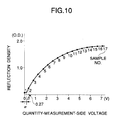
- Fig. 10 is a graph plotting the relationship of Table 1 in which the horizontal axis represents the quantifying-side voltage and the vertical axis represents the average reflection density.
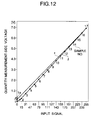
- Fig. 11 is a graph plotting the relationship of Table 1 in which the horizontal axis represents the input signal and the vertical axis represents the average reflection density.
- the point of the input signal sample No. 1 is not located on the curve determined by the average reflection densities of the other input signal samples. That is, it has been found that the quantifying mixing operation of ink, that is, the operation that ink is pushed out from the quantifying nozzle 302 and mixed with a dilute, starts only after the quantifying-side drive voltage exceeds a certain minimum necessary value rather than from 0 V.
- the output characteristic conversion circuit 41 is provided in the carrier jet printer 40 to which the invention is applied.
- the output characteristic conversion circuit 41 converts input signals including dot information that are input from the outside so that the quantifying-side drive voltage can be used most effectively, to enable correct halftone expression.
- the output characteristic conversion circuit 41 that is used in the invention converts received input signals including dot information into print signals so that the printer head 30 can mix ink 100 into a dilute 101 even when printing is performed based on an input signal including dot information of the lowest density which is below the threshold density determined by the printer head.
- the printer head 30 can mix ink 100 into a dilute 101 even when printing is performed based on an input signal including dot information of the lowest density. Therefore, there can be avoided the phenomenon of the conventional apparatus that when a desired density is low, ink 100 is not mixed with a dilute 101 and only the dilute 101 is jetted, that is, an ink liquid is not jetted.
- the output characteristic conversion circuit 41 that is used in the invention, an input signal is converted into a print signal corresponding to a drive voltage higher than the minimum necessary voltage ⁇ . Therefore, the output characteristic conversion circuit 41 provides a straight line ⁇ rather than the folded line ⁇ of the conventional printer head.
- the quantifying-side drive voltage can be used most effectively. Further, since this linear relationship facilitates the control to obtain a desired gradation level through a quantifying-side drive voltage, halftone expression can be performed with higher accuracy.
- the conversion of the output characteristic conversion circuit 41 is such that the relationship between the input signal including information on dots to be printed that is input from the outside and the converted print signal and the relationship between those signals and the quantifying-side drive voltage are as shown in Fig. 13.
- the input signal that is input from the outside has 256 gradation levels of 0-255 and a print signal to be output as corresponding to the minimum necessary voltage ⁇ is level 10 among 0-255
- the portion of level 10 or less of the input signal levels 0-255 is converted into a portion of level 10 or more of the print signal levels 0-255.
- the other portion of the input signal levels is converted into a portion in a range 10-255 of the print signal levels 0-255.
- the converted print signal is not necessarily divided equally in the above range.
- Fig. 13 is of a case in which multi-gradation dithering is not used.
- Examples of factors relating to the phenomenon that ink does not start to be pushed out from the point where the quantifying-side drive voltage is 0 V in the ordinary carrier jet printer are the shape of the quantifying nozzle 302, the angle of the quantifying nozzle 302 with respect to the orifice plate 301, the shape of the jetting nozzle 303, the distance between the quantifying nozzle 302 and the jetting nozzle 303, surface properties of the portion of the orifice plate 301 between the quantifying nozzle 302 and the jetting nozzle 303, physical properties such as viscosity, surface tension, and easiness of mixing of the ink and the dilute, the timing of pushing out ink, and the timing of jetting a dilute. Therefore, it is necessary to determine the manner of conversion of the converting means in advance by performing experiments or simulations.
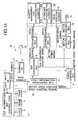
- Fig. 14 is a block diagram showing a configuration of a control system of the carrier jet printer 40.
- the control system of the carrier jet printer 40 includes a data input interface 1 that is connected to a system bus 2, the output characteristic conversion circuit 41 that is composed of a CPU 3, a ROM (read-only memory) 4, and a RAM 5 and that receives input signals from the host computer 20, a sensor interface 17 that connects a temperature sensor 16 to the system bus 2, the head driving circuit 42 that is supplied with print signals from the output characteristic conversion circuit 41, and the printer head 30 having the piezoelectric elements 309 and 310 to which drive voltages are applied based on drive signals that are supplied from the head driving circuit 42.
- the output characteristic conversion circuit 41 that is composed of a CPU 3, a ROM (read-only memory) 4, and a RAM 5 and that receives input signals from the host computer 20, a sensor interface 17 that connects a temperature sensor 16 to the system bus 2, the head driving circuit 42 that is supplied with print signals from the output characteristic conversion circuit 41, and the printer head 30 having the piezoelectric elements 309 and 310 to which drive voltages are applied based on drive signals that are supplied
- a head position sensor 15 and a sheet feed motor/head feed motor 14 are connected to the head driving circuit 42.
- the head driving circuit 42 includes a print information processing section 21, a D/A conversion section 6, a timing control section 9, a motor control section 12, a motor driving section 13, and driving sections 7 and 10.
- the quantifying-side piezoelectric elements 309 are connected to the driving section 7 and the jetting-side piezoelectric elements 310 are connected to the driving section 10.
- the quantifying-side piezoelectric elements 309 and the jetting-side piezoelectric elements 310 are provided on the printer head 30.
- the data input interface 1 connects the host computer 20 and the output characteristic conversion circuit 41 including the CPU 3.
- the data input interface 1 supplies the system bus 2 with input signals including information on dots to be printed and control signals that are sent from the host computer 20.
- Examples of the data input interface 1 are parallel interfaces such as bi-Centronics and SCSI-2 and serial interfaces such as RS-232C and RS-422.
- the CPU 3 that is provided in the output characteristic conversion circuit 41 supplies input signals that are sent from the host computer 20 via the data input interface 1 to the head driving circuit 42 via the system bus 2. At this time, the CPU 3 converts, in a manner described later, the input signals into print signals by referring to a conversion table that is stored in the ROM 4 or the RAM 5 of the output characteristic conversion circuit 41, and supplies the print signals to the head driving circuit 42.
- the CPU 3 supplies a print control signal and a motor drive control signal to the timing control section 9 and the motor control section 12, respectively. In this manner, in driving the nozzles 302 and 303 of the printer head 30 for each scan according to a print process, the CPU 3 controls both of line-by-line mixing and jetting operations of each nozzle of the carrier jet printer 40.
- the ROM 4 stores control programs and data that are necessary for the processing of the CPU 3. As described later, the ROM 4 may store a conversion table that shows the relationship between the input signal and the print signal.
- the RAM 5 has an area for temporarily storing signals that are read out from the ROM 4 and is rewritable. As described later, the RAM 5 may store a conversion table that shows the relationship between the input signal and the print signal.
- the print information processing section 21 is connected to the output characteristic conversion circuit 41 via the system bus 2.
- the print information processing section 21 is also connected to the D/A conversion section 6.
- the print information processing section 21 receives print signals that have been subjected to the conversion of the output characteristic conversion circuit 41, performs signal processing on the received print signals, and supplies resulting print signals to the D/A conversion section 6.
- the D/A conversion section 6 is connected to the print information processing section 21 to which print signals are input from the output characteristic conversion circuit 41.
- the D/A conversion section 6 is also connected to the driving section 7 and the timing control section 9.
- the D/A conversion section 6 converts print signals that are supplied from the print information processing section 21 into analog signals and supplies the analog signals to the driving section 7.
- the driving section 7 is connected to the D/A conversion section 6 and the quantifying-side piezoelectric elements 309.
- the driving section 7 receives the analog signals that have been produced by the D/A conversion section 6 through conversion.
- the driving section 7 performs signal processing on the received analog signals and supplies resulting drive signals to the quantifying-side piezoelectric elements 309.
- the quantifying-side piezoelectric elements 309 of the printer head 30 receives the above drive signals and the amount of ink is measured in accordance with the received drive signals.
- the timing control section 9 is connected to the head position sensor 15, the motor control section 12, the D/A conversion section 6, and the driving section 10.
- the timing control section 9 receives a position detection signal and a print control signal that are output from the head position sensor 15 and the CPU 3 of the output characteristic conversion circuit 41, respectively. At this time, the timing control section 9 detects the position of the printer head 30 based on the position detection signal.
- the timing control section 9 supplies a motor drive trigger signal, a D/A conversion trigger signal, and a timing signal to the motor control section 12, the D/A conversion section 6, and the driving section 10, respectively.
- the driving section 10 which is connected to the jetting-side piezoelectric elements 310, performs signal processing on the timing signal and supplies drive signals to the jetting-side piezoelectric elements 310.
- the jetting-side piezoelectric elements 310 in the printer head 30 jet dilutes based on the drive signals.
- the motor control section 12 is connected to the CPU 3 via the system bus 2, and is also connected to the timing control section 9 and the motor driving section 13. Receiving a motor drive control signal from the CPU 3 via the system bus 2 and a motor drive trigger signal from the timing control section 9, the motor control section 12 supplies a motor drive signal to the motor driving section 13.
- the motor driving section 13 drives the sheet feed/head heed motor 14 connected thereto.
- the temperature sensor 16 that is provided in the vicinity of the nozzles of the printer head 30 is connected to the sensor interface 17.
- the head driving circuit 42 of Fig. 14 is shown as if to have the configuration for driving only one nozzle, actually the D/A conversion section 6, the driving sections 7 and 10, the quantifying-side piezoelectric element 309, and the jetting-side piezoelectric elements 310 are provided in a number corresponding to the number of nozzles.
- the quantifying-side piezoelectric elements 309 and the jetting-side piezoelectric elements 310 are driven while receiving drive voltages that are produced based on the drive signals that are output from the driving sections 7 and 10, and the amount of ink is measured in accordance with each drive signal and a predetermined amount of dilution is jetted.
- the sheet feed/head feed motor 14 is driven based on the motor drive signal that is supplied via the motor control section 12 and the motor driving section 13 and that has been produced based on the motor drive control signal supplied from the CPU 3.
- signals are read out and signal processing is performed in the following manner.
- input signals including dot information that have been input from the host computer 20 via the data input interface 1 are converted by the output characteristic conversion circuit 41 into print signals, which are supplied to the head driving circuit 42.
- the print signals that have been input to the head driving circuit 42 are then input to the print information processing section 21, where they are subjected to signal processing.
- the print signals are then output from the print information processing section 21 and supplied to the D/A conversion section 6.
- the print signals that have been input to the D/A conversion section 6 and a D/A conversion trigger signal produced by the timing control section 9 by performing signal processing on a print control signal that is supplied from the CPU 3 are converted by the D/A conversion section 6 into analog signals, which are supplied to the driving section 7.
- drive signals are produced by the driving section 7 by performing signal processing on the analog signals, and are supplied to the quantifying-side piezoelectric elements 309.
- Drive voltages are applied to the quantifying-side piezoelectric elements 309 based on the drive signals that have been input thereto in the above manner, and the amount of ink is measured.
- drive signals are produced by the driving section 10 by performing signal processing on a jetting timing signal that is supplied from the timing control section 9, and are output to the jetting-side piezoelectric elements 310.
- Drive voltages are applied to the jetting-side piezoelectric elements 310 based on the drive signals that have been input thereto in the above manner, and dilutes are jetted.
- a position detection signal that has been input from the head position sensor 15 is supplied to the timing control section 9.
- the timing control section 9 supplies a motor drive trigger signal to the motor control section 12.
- a motor drive control signal that has been input from the CPU 3 is also supplied to the motor control section 12.
- a motor drive signal is supplied from the motor control section 12 to the motor driving section 13, then to the sheet feed/head feed motor 14.
- the sheet feed/head feed motor 14 is driven based on the motor drive signal that has been input to the motor driving section 13 in the above manner.
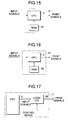
- the output characteristic conversion circuit 41 that is used in the invention has the CPU 3 and a ROM 54.
- a conversion table for performing conversion according to the output characteristic shown in Fig. 13 is input in advance to the ROM 54 in the carrier jet printer 40.
- the CPU 3 converts printing-related input signals that are input from the host computer 20 into print signals by referring to the conversion table in the ROM 54, and supplies the print signals to the head driving circuit 42.
- the ROM 54 may be part of the ROM 4.
- an output characteristic conversion circuit 61 may be provided in the carrier jet printer 40, and may be composed of the CPU 3 and a RAM 55 as shown in Fig. 16.
- a conversion table for performing conversion according to the output characteristic shown in Fig. 13 is input in advance to the RAM 55 in the carrier jet printer 40.
- the CPU 3 converts input signals including information on dots to be printed that are input from the host computer 20 into print signals by referring to the conversion table in the RAM 55, and supplies the print signals to the head driving circuit 42.
- the RAM 55 may be part of the RAM 5.
- the conversion table in the RAM 55 be controlled in accordance with environmental conditions such as the temperature and the humidity around the printer head 30 and the carrier jet printer 40, printing mode conditions such as selection between a high image quality mode and a draft mode and the kind of recording sheet, and other conditions.
- an output characteristic conversion circuit 71 may be provided in the carrier jet printer 40, and may be composed of the CPU 3 and a logic circuit 56 as shown in Fig. 17.
- the conversion of the output characteristic conversion circuit 71 is performed by the logic circuit 56 that is a combination of logic elements etc. rather than by referring to a conversion table as in the cases of Figs. 15 and 16.
- the logic circuit 56 converts the input signals into print signals, which are supplied to the head driving circuit 42.
- this type of conversion method can easily be implemented by incorporating it in a dedicated integrated circuit such as a programmable logic array (PLA), a gate array, or a standard cell.
- PLA programmable logic array
- a configuration is possible in which plural patterns of conversion methods are prepared in the logic circuit 56 and the CPU 3 selects one of those that is suitable for printing conditions etc. based on a control signal.
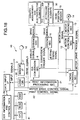
- the logic circuit 56 be provided at a relay position between the system bus 2 and the head driving circuit 42 as shown in Fig. 18.
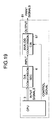
- an output characteristic conversion circuit 81 may be provided in the carrier jet printer 40, and may be composed of the CPU 3, the D/A conversion section 6, and an analog conversion circuit 57 as shown in Fig. 19.
- the analog conversion circuit 57 having a non-linear conversion function is provided rather than a conversion table is used as in the cases of Figs. 15 and 16.
- the conversion method of the output characteristic conversion circuit 81 first, input signals are input from the host computer 20 to the D/A conversion circuit 6 via the CPU 3 and the D/A conversion circuit 6 converts the digital signals into analog signals.
- the analog conversion circuit 57 converts, according to the above-described output characteristic, the analog signals into print signals, which are supplied to the head driving circuit 42 and finally output therefrom.
- a configuration is possible in which plural patterns of conversion methods are prepared in the analog conversion circuit 57 and the CPU 3 selects one of those that is suitable for printing conditions etc. based on a control signal.
- the analog conversion circuit 57 for performing the output characteristic conversion be provided at a relay position between the D/A conversion section 6 in the head driving circuit 42 and the driving section 7 as shown in Fig. 20.
- the output characteristic conversion circuit may be provided in the host computer 20 and may operate as software in the host computer 20 as shown in Fig. 2 rather than provided in the carrier jet printer 40 as in the cases of Figs. 15, 16, 17 and 19.
- the output characteristic conversion circuit performs the above-described conversion processing in such a manner that it is added to the processing of a printer driver, and transfers resulting signals to the carrier jet printer 40.
- the conversion method of this output characteristic conversion circuit enables cost reduction because no additional circuit is needed in the carrier jet printer 40.
- the output characteristic conversion processing in the printer driver may use a conversion-table-based technique or a calculation-based technique.
- a configuration is possible in which a plurality of converting means are provided in the printer driver and one of those converting means suitable for printing image conditions is selected. Another configuration is possible in which instead of this type of selection, a user selects a converting means freely on a printer setting picture.
- the interface between the host computer 20 and the carrier jet printer 40 is of a type capable of bi-directional communication such as bi-Centronics
- a configuration is possible in which conditions of the carrier jet printer 40 such as the environment temperature at the time of printing are transferred from the carrier jet printer 40 to the host computer 20 and the printer driver selects a most suitable output characteristic conversion circuit 41 from among a plurality of converting means based on that information.
- the conversion method of the output characteristic conversion circuit 41 is determined at the development stage of the carrier jet printer and the printer head 30. It is possible for a user to update the conversion method to a most suitable one at the time of version-up of the printer driver.
- a dither-method-based multi-gradation dither control means that reproduces gradation levels through multi-valuing with a plurality of constant threshold values by performing dithering on a data value of one pixel may be provided in addition to the output characteristic conversion circuit 41. This enables stable multi-gradation output.
- reproduction is enabled by additionally using the multi-gradation dither method.
- Fig. 21 illustrates a multi-gradation dither method employed in the invention, which specifically uses a multi-gradation error diffusion method. This method will be described below.
- the input level X is input image data itself and may be one of 256 gradation levels or more, usually the level X' that can be taken in actual printing is one of only several levels such as 4th, 6th, 8th, and 16 th levels. Therefore, the error y exists between the input level X and the actual level X'. Where the error y of pixel G is distributed to pixels around pixel G so as to be added to their levels, there are many ways of determining surrounding pixels for distribution and their distribution ratios.
- Fig. 21 shows an example of distribution ratios that are set at 7/16, 3/16, 5/16, 1/16, etc. for respective positions around the subject pixel G.
- multi-gradation dither control means is additionally used in the carrier jet printer 40 to which the invention is applied, it is preferable to incorporate the multi-gradation dither control means at the stage immediately before the output characteristic conversion circuit 41.
- optimum gradation expression can be attained by incorporating the multi-gradation dither control means in a printer driver, converting dither-processed data with the converting means in the printer driver or in the printer apparatus, and driving the printer head 30 by using that data.
- FIG. 22 is a perspective view of a printer head mechanism of the carrier jet printer 40.
- a recording sheet 210 is fed in a state that it is wound around the circumferential surface of a platen 211, and the platen 211 is rotationally driven by a sheet feed motor 212 via pulleys 213 and 214 and a belt 215.
- the printer head 30 is mounted, via a head feed mechanism 217, on a feed screw 218 that is provided parallel with the circumferential surface of the platen 211, whereby the printer head 30 is moved parallel with the circumferential surface of the platen 211 by the head feed mechanism 217.
- the head feed mechanism 217 is provided with a tongue 201.
- the tongue 201 is detected by the head position sensor 15 that is provided in the movement path of the head feed mechanism 217, whereby the operating position of the printer head 30 is detected.
- the printer head mixes ink 100 and a dilute 101 and jets a resulting mixture.
- the printer head 30 has the quantifying nozzle 302, the jetting nozzle 303, the ink introduction hole 304, the dilute introduction hole 305, the quantifying-side cavity 306, the jetting-side cavity 307, the quantifying-side piezoelectric element 309, and the jetting-side piezoelectric element 310.
- the printer head 30 used in the invention has a single recording head or a plurality of recording heads.
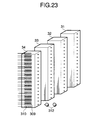
- Fig. 23 illustrates the configuration of each recording head provided in the printer head 30.
- the body of each of recording heads 31-34 is provided with 16 nozzles.
- Each nozzle is provided with the piezoelectric elements 309 and 310, whereby ink droplets are jetted.
- the converting means that converts an input signal into a print signal so that the dot printing means mixes ink into a dilute even in a case where printing is performed based on an input signal that includes a dot information which is below threshold density determined by the dot printing means, ink of a correct amount can be mixed into a dilute even when printing is performed based on an input signal of a low density. Therefore, correct gradation expression is enabled, and there can be avoided a phenomenon that quantified ink is not mixed with a dilute even if the dot printing means is driven. Therefore, according to the printer apparatus of the invention, gradation levels can be expressed in a desired manner and high-quality density gradation can be attained.
- the converting means need not always be provided in the printer apparatus, and may be provided outside the printer apparatus and connected to it as in the case of a printer system according to the invention.
- gradation levels can be expressed in a desired manner and high-quality density gradation can be attained.
Landscapes
- Physics & Mathematics (AREA)
- Engineering & Computer Science (AREA)
- Mathematical Physics (AREA)
- General Engineering & Computer Science (AREA)
- General Physics & Mathematics (AREA)
- Theoretical Computer Science (AREA)
- Particle Formation And Scattering Control In Inkjet Printers (AREA)
- Ink Jet (AREA)
- Facsimile Image Signal Circuits (AREA)
- Fax Reproducing Arrangements (AREA)
Applications Claiming Priority (3)
| Application Number | Priority Date | Filing Date | Title |
|---|---|---|---|
| JP9174796A JPH1120200A (ja) | 1997-06-30 | 1997-06-30 | プリンタ装置、プリンタシステム及びプリンタ装置の駆動方法 |
| JP174796/97 | 1997-06-30 | ||
| JP17479697 | 1997-06-30 |
Publications (2)
| Publication Number | Publication Date |
|---|---|
| EP0888894A2 true EP0888894A2 (de) | 1999-01-07 |
| EP0888894A3 EP0888894A3 (de) | 1999-08-11 |
Family
ID=15984827
Family Applications (1)
| Application Number | Title | Priority Date | Filing Date |
|---|---|---|---|
| EP98401629A Withdrawn EP0888894A3 (de) | 1997-06-30 | 1998-06-30 | Drucker und Ansteuerungsverfahren dafür |
Country Status (5)
| Country | Link |
|---|---|
| US (1) | US6341832B1 (de) |
| EP (1) | EP0888894A3 (de) |
| JP (1) | JPH1120200A (de) |
| KR (1) | KR19990007426A (de) |
| AU (1) | AU740608B2 (de) |
Families Citing this family (5)
| Publication number | Priority date | Publication date | Assignee | Title |
|---|---|---|---|---|
| JP4269332B2 (ja) * | 2000-03-31 | 2009-05-27 | 富士フイルム株式会社 | オンデマンド・インクジェットプリンタ及びその駆動方法、駆動装置 |
| US6814510B1 (en) * | 2000-08-02 | 2004-11-09 | Xerox Corporation | Method and apparatus for automatic update of a printer driver configuration and status |
| US6712441B2 (en) * | 2001-02-16 | 2004-03-30 | Seiko Epson Corporation | Printing apparatus and method implementing smooth outline |
| JP2022103943A (ja) * | 2020-12-28 | 2022-07-08 | セイコーエプソン株式会社 | 液体吐出ヘッド、液体吐出装置、液体吐出方法 |
| WO2026055690A1 (en) * | 2024-09-09 | 2026-03-12 | M&R Printing Equipment, Inc. | Digital pretreatment of textile or garment system and method |
Citations (2)
| Publication number | Priority date | Publication date | Assignee | Title |
|---|---|---|---|---|
| JPH05201024A (ja) | 1991-10-17 | 1993-08-10 | Sony Corp | インクジェットプリントヘッド及びインクジェットプリンタ |
| JPH07195682A (ja) | 1993-11-26 | 1995-08-01 | Sony Corp | インクジエツトプリントヘツド、インクジエツトプリンタ及びインクジエツトプリントヘツド製造方法 |
Family Cites Families (4)
| Publication number | Priority date | Publication date | Assignee | Title |
|---|---|---|---|---|
| JPH02274550A (ja) | 1989-04-17 | 1990-11-08 | Komori Corp | 画像記録装置のヘッド制御方法 |
| DE69418674T2 (de) * | 1993-10-28 | 1999-10-21 | Canon K.K., Tokio/Tokyo | Verfahren und Vorrichtung zur Tintenstrahlaufzeichnung |
| US6036295A (en) * | 1993-11-26 | 2000-03-14 | Sony Corporation | Ink jet printer head and method for manufacturing the same |
| US6030068A (en) * | 1996-04-05 | 2000-02-29 | Sony Corporation | Recording method and recording apparatus |
-
1997
- 1997-06-30 JP JP9174796A patent/JPH1120200A/ja not_active Withdrawn
-
1998
- 1998-06-24 AU AU73130/98A patent/AU740608B2/en not_active Ceased
- 1998-06-25 US US09/104,284 patent/US6341832B1/en not_active Expired - Fee Related
- 1998-06-29 KR KR1019980024902A patent/KR19990007426A/ko not_active Withdrawn
- 1998-06-30 EP EP98401629A patent/EP0888894A3/de not_active Withdrawn
Patent Citations (2)
| Publication number | Priority date | Publication date | Assignee | Title |
|---|---|---|---|---|
| JPH05201024A (ja) | 1991-10-17 | 1993-08-10 | Sony Corp | インクジェットプリントヘッド及びインクジェットプリンタ |
| JPH07195682A (ja) | 1993-11-26 | 1995-08-01 | Sony Corp | インクジエツトプリントヘツド、インクジエツトプリンタ及びインクジエツトプリントヘツド製造方法 |
Also Published As
| Publication number | Publication date |
|---|---|
| AU7313098A (en) | 1999-01-07 |
| JPH1120200A (ja) | 1999-01-26 |
| AU740608B2 (en) | 2001-11-08 |
| US6341832B1 (en) | 2002-01-29 |
| EP0888894A3 (de) | 1999-08-11 |
| KR19990007426A (ko) | 1999-01-25 |
Similar Documents
| Publication | Publication Date | Title |
|---|---|---|
| US6102513A (en) | Ink jet printing apparatus and method using timing control of electronic waveforms for variable gray scale printing without artifacts | |
| US5975672A (en) | Ink jet printing apparatus and method accommodating printing mode control | |
| US5847724A (en) | Method for diffusing errors according to spot size in a printed liquid ink image | |
| JPH06340094A (ja) | インクジェット記録装置およびインクジェット記録方法 | |
| US7059699B2 (en) | Ink tank with data storage for drive signal data and printing apparatus with the same | |
| US6341832B1 (en) | Printer apparatus, printer system, and driving method of printer apparatus | |
| US6003972A (en) | Printer apparatus and printer head | |
| JP2003237115A (ja) | 印刷制御装置、印刷制御方法、印刷システム、印刷制御プログラムおよび印刷制御プログラムを記録した媒体 | |
| JP3687381B2 (ja) | 印刷装置、印刷方法および記録媒体 | |
| US6731398B1 (en) | Printing apparatus, method of printing, and recording medium to actualize the method | |
| JP4206588B2 (ja) | 印刷装置および印刷方法ならびに印刷装置の調整方法、更にそのためのプログラムを記録した記録媒体 | |
| US6530636B1 (en) | Ink jet recording apparatus and ink jet recording method | |
| JP2000071439A (ja) | 画像処理装置および方法並びに記録媒体 | |
| JP2003054015A (ja) | インクジェット式記録ヘッドの駆動装置及び駆動方法 | |
| JPH0939274A (ja) | インクジェットプリンタ装置 | |
| JP4243836B2 (ja) | 印刷制御装置、印刷制御プログラムおよび印刷制御方法 | |
| JPH0994983A (ja) | プリンタ装置 | |
| JP2001054943A (ja) | インクジェット記録装置 | |
| JPH11334055A (ja) | 双方向印刷方法および装置 | |
| JP4041954B2 (ja) | 印刷制御装置、印刷制御方法、印刷システムおよび印刷制御プログラム | |
| JPH10100391A (ja) | プリンタ装置 | |
| JP2007118380A (ja) | 印刷装置及び印刷方法 | |
| JP2001158116A (ja) | 印刷装置の調整方法、調整方法を記録した記録媒体、および印刷装置 | |
| JP2003291327A5 (de) | ||
| JP2000318144A (ja) | 印刷装置、印刷方法、および記録媒体 |
Legal Events
| Date | Code | Title | Description |
|---|---|---|---|
| PUAI | Public reference made under article 153(3) epc to a published international application that has entered the european phase |
Free format text: ORIGINAL CODE: 0009012 |
|
| AK | Designated contracting states |
Kind code of ref document: A2 Designated state(s): DE FR GB IT |
|
| AX | Request for extension of the european patent |
Free format text: AL;LT;LV;MK;RO;SI |
|
| PUAL | Search report despatched |
Free format text: ORIGINAL CODE: 0009013 |
|
| AK | Designated contracting states |
Kind code of ref document: A3 Designated state(s): AT BE CH CY DE DK ES FI FR GB GR IE IT LI LU MC NL PT SE |
|
| AX | Request for extension of the european patent |
Free format text: AL;LT;LV;MK;RO;SI |
|
| 17P | Request for examination filed |
Effective date: 20000209 |
|
| AKX | Designation fees paid |
Free format text: DE FR GB IT |
|
| STAA | Information on the status of an ep patent application or granted ep patent |
Free format text: STATUS: THE APPLICATION IS DEEMED TO BE WITHDRAWN |
|
| 18D | Application deemed to be withdrawn |
Effective date: 20030101 |