EP0889357A1 - Pellicule de contrÔle de lumière et procédé de fabrication de celle-ci - Google Patents
Pellicule de contrÔle de lumière et procédé de fabrication de celle-ci Download PDFInfo
- Publication number
- EP0889357A1 EP0889357A1 EP98111793A EP98111793A EP0889357A1 EP 0889357 A1 EP0889357 A1 EP 0889357A1 EP 98111793 A EP98111793 A EP 98111793A EP 98111793 A EP98111793 A EP 98111793A EP 0889357 A1 EP0889357 A1 EP 0889357A1
- Authority
- EP
- European Patent Office
- Prior art keywords
- control film
- light
- light control
- silver
- image
- Prior art date
- Legal status (The legal status is an assumption and is not a legal conclusion. Google has not performed a legal analysis and makes no representation as to the accuracy of the status listed.)
- Withdrawn
Links
- 238000004519 manufacturing process Methods 0.000 title description 11
- 229910052709 silver Inorganic materials 0.000 claims abstract description 48
- 239000004332 silver Substances 0.000 claims abstract description 48
- GGCZERPQGJTIQP-UHFFFAOYSA-N sodium;9,10-dioxoanthracene-2-sulfonic acid Chemical compound [Na+].C1=CC=C2C(=O)C3=CC(S(=O)(=O)O)=CC=C3C(=O)C2=C1 GGCZERPQGJTIQP-UHFFFAOYSA-N 0.000 claims abstract description 23
- 239000000463 material Substances 0.000 claims abstract description 12
- -1 silver halide Chemical class 0.000 claims description 34
- 238000000034 method Methods 0.000 claims description 31
- BQCADISMDOOEFD-UHFFFAOYSA-N Silver Chemical compound [Ag] BQCADISMDOOEFD-UHFFFAOYSA-N 0.000 claims description 23
- 238000002834 transmittance Methods 0.000 claims description 19
- 238000002360 preparation method Methods 0.000 claims description 4
- 239000010410 layer Substances 0.000 description 39
- 239000000839 emulsion Substances 0.000 description 34
- 239000003795 chemical substances by application Substances 0.000 description 16
- 150000001875 compounds Chemical class 0.000 description 16
- 238000007689 inspection Methods 0.000 description 12
- 206010070834 Sensitisation Diseases 0.000 description 11
- 230000008313 sensitization Effects 0.000 description 11
- 239000000203 mixture Substances 0.000 description 9
- 230000008569 process Effects 0.000 description 9
- 238000012545 processing Methods 0.000 description 9
- 238000011161 development Methods 0.000 description 8
- 239000011248 coating agent Substances 0.000 description 7
- 238000000576 coating method Methods 0.000 description 7
- 238000003475 lamination Methods 0.000 description 7
- 239000000126 substance Substances 0.000 description 7
- 239000000654 additive Substances 0.000 description 6
- 239000008199 coating composition Substances 0.000 description 6
- 239000000975 dye Substances 0.000 description 6
- 229920003229 poly(methyl methacrylate) Polymers 0.000 description 6
- 239000004926 polymethyl methacrylate Substances 0.000 description 6
- 239000010944 silver (metal) Substances 0.000 description 6
- 238000005516 engineering process Methods 0.000 description 5
- 239000011347 resin Substances 0.000 description 5
- 229920005989 resin Polymers 0.000 description 5
- 239000003381 stabilizer Substances 0.000 description 5
- 239000004094 surface-active agent Substances 0.000 description 5
- 229910000510 noble metal Chemical class 0.000 description 4
- 230000005070 ripening Effects 0.000 description 4
- 150000003839 salts Chemical class 0.000 description 4
- 239000011593 sulfur Substances 0.000 description 4
- 229910052717 sulfur Inorganic materials 0.000 description 4
- QTBSBXVTEAMEQO-UHFFFAOYSA-N Acetic acid Chemical compound CC(O)=O QTBSBXVTEAMEQO-UHFFFAOYSA-N 0.000 description 3
- NINIDFKCEFEMDL-UHFFFAOYSA-N Sulfur Chemical compound [S] NINIDFKCEFEMDL-UHFFFAOYSA-N 0.000 description 3
- 239000006096 absorbing agent Substances 0.000 description 3
- 239000002253 acid Substances 0.000 description 3
- 230000015572 biosynthetic process Effects 0.000 description 3
- 230000007547 defect Effects 0.000 description 3
- 239000004816 latex Substances 0.000 description 3
- 229920000126 latex Polymers 0.000 description 3
- 239000004848 polyfunctional curative Substances 0.000 description 3
- 230000009467 reduction Effects 0.000 description 3
- 238000011160 research Methods 0.000 description 3
- 229910052724 xenon Inorganic materials 0.000 description 3
- FHNFHKCVQCLJFQ-UHFFFAOYSA-N xenon atom Chemical compound [Xe] FHNFHKCVQCLJFQ-UHFFFAOYSA-N 0.000 description 3
- YXIWHUQXZSMYRE-UHFFFAOYSA-N 1,3-benzothiazole-2-thiol Chemical compound C1=CC=C2SC(S)=NC2=C1 YXIWHUQXZSMYRE-UHFFFAOYSA-N 0.000 description 2
- GGZHVNZHFYCSEV-UHFFFAOYSA-N 1-Phenyl-5-mercaptotetrazole Chemical compound SC1=NN=NN1C1=CC=CC=C1 GGZHVNZHFYCSEV-UHFFFAOYSA-N 0.000 description 2
- INVVMIXYILXINW-UHFFFAOYSA-N 5-methyl-1h-[1,2,4]triazolo[1,5-a]pyrimidin-7-one Chemical compound CC1=CC(=O)N2NC=NC2=N1 INVVMIXYILXINW-UHFFFAOYSA-N 0.000 description 2
- QGZKDVFQNNGYKY-UHFFFAOYSA-N Ammonia Chemical compound N QGZKDVFQNNGYKY-UHFFFAOYSA-N 0.000 description 2
- VYZAMTAEIAYCRO-UHFFFAOYSA-N Chromium Chemical compound [Cr] VYZAMTAEIAYCRO-UHFFFAOYSA-N 0.000 description 2
- 108010010803 Gelatin Proteins 0.000 description 2
- QIGBRXMKCJKVMJ-UHFFFAOYSA-N Hydroquinone Chemical compound OC1=CC=C(O)C=C1 QIGBRXMKCJKVMJ-UHFFFAOYSA-N 0.000 description 2
- KDLHZDBZIXYQEI-UHFFFAOYSA-N Palladium Chemical compound [Pd] KDLHZDBZIXYQEI-UHFFFAOYSA-N 0.000 description 2
- 239000003513 alkali Substances 0.000 description 2
- 125000000129 anionic group Chemical group 0.000 description 2
- 239000002216 antistatic agent Substances 0.000 description 2
- JEHKKBHWRAXMCH-UHFFFAOYSA-N benzenesulfinic acid Chemical compound O[S@@](=O)C1=CC=CC=C1 JEHKKBHWRAXMCH-UHFFFAOYSA-N 0.000 description 2
- 230000005540 biological transmission Effects 0.000 description 2
- 239000013078 crystal Substances 0.000 description 2
- 238000009826 distribution Methods 0.000 description 2
- 238000001035 drying Methods 0.000 description 2
- 229920000159 gelatin Polymers 0.000 description 2
- 239000008273 gelatin Substances 0.000 description 2
- 235000019322 gelatine Nutrition 0.000 description 2
- 235000011852 gelatine desserts Nutrition 0.000 description 2
- 239000011521 glass Substances 0.000 description 2
- 150000004820 halides Chemical class 0.000 description 2
- 229910052736 halogen Inorganic materials 0.000 description 2
- 230000001678 irradiating effect Effects 0.000 description 2
- 239000000314 lubricant Substances 0.000 description 2
- 229920003023 plastic Polymers 0.000 description 2
- 239000004033 plastic Substances 0.000 description 2
- 239000004014 plasticizer Substances 0.000 description 2
- BASFCYQUMIYNBI-UHFFFAOYSA-N platinum Chemical compound [Pt] BASFCYQUMIYNBI-UHFFFAOYSA-N 0.000 description 2
- 229920000515 polycarbonate Polymers 0.000 description 2
- 239000004417 polycarbonate Substances 0.000 description 2
- 229920000139 polyethylene terephthalate Polymers 0.000 description 2
- 239000005020 polyethylene terephthalate Substances 0.000 description 2
- 230000000379 polymerizing effect Effects 0.000 description 2
- 230000005855 radiation Effects 0.000 description 2
- 239000011342 resin composition Substances 0.000 description 2
- 239000004065 semiconductor Substances 0.000 description 2
- 230000001235 sensitizing effect Effects 0.000 description 2
- 238000003860 storage Methods 0.000 description 2
- 230000002459 sustained effect Effects 0.000 description 2
- 239000002562 thickening agent Substances 0.000 description 2
- 150000003852 triazoles Chemical class 0.000 description 2
- LUMLZKVIXLWTCI-NSCUHMNNSA-N (e)-2,3-dichloro-4-oxobut-2-enoic acid Chemical class OC(=O)C(\Cl)=C(/Cl)C=O LUMLZKVIXLWTCI-NSCUHMNNSA-N 0.000 description 1
- BAXOFTOLAUCFNW-UHFFFAOYSA-N 1H-indazole Chemical compound C1=CC=C2C=NNC2=C1 BAXOFTOLAUCFNW-UHFFFAOYSA-N 0.000 description 1
- JAAIPIWKKXCNOC-UHFFFAOYSA-N 1h-tetrazol-1-ium-5-thiolate Chemical class SC1=NN=NN1 JAAIPIWKKXCNOC-UHFFFAOYSA-N 0.000 description 1
- LHPPDQUVECZQSW-UHFFFAOYSA-N 2-(benzotriazol-2-yl)-4,6-ditert-butylphenol Chemical compound CC(C)(C)C1=CC(C(C)(C)C)=CC(N2N=C3C=CC=CC3=N2)=C1O LHPPDQUVECZQSW-UHFFFAOYSA-N 0.000 description 1
- WXHVQMGINBSVAY-UHFFFAOYSA-N 2-(benzotriazol-2-yl)-4-tert-butylphenol Chemical compound CC(C)(C)C1=CC=C(O)C(N2N=C3C=CC=CC3=N2)=C1 WXHVQMGINBSVAY-UHFFFAOYSA-N 0.000 description 1
- CDAWCLOXVUBKRW-UHFFFAOYSA-N 2-aminophenol Chemical class NC1=CC=CC=C1O CDAWCLOXVUBKRW-UHFFFAOYSA-N 0.000 description 1
- JKFYKCYQEWQPTM-UHFFFAOYSA-N 2-azaniumyl-2-(4-fluorophenyl)acetate Chemical compound OC(=O)C(N)C1=CC=C(F)C=C1 JKFYKCYQEWQPTM-UHFFFAOYSA-N 0.000 description 1
- OWIRCRREDNEXTA-UHFFFAOYSA-N 3-nitro-1h-indazole Chemical class C1=CC=C2C([N+](=O)[O-])=NNC2=C1 OWIRCRREDNEXTA-UHFFFAOYSA-N 0.000 description 1
- OCVLSHAVSIYKLI-UHFFFAOYSA-N 3h-1,3-thiazole-2-thione Chemical class SC1=NC=CS1 OCVLSHAVSIYKLI-UHFFFAOYSA-N 0.000 description 1
- QROGOPRRETUDKB-UHFFFAOYSA-N 4-butyl-2-tert-butyl-6-(5-chlorobenzotriazol-2-yl)phenol Chemical compound CC(C)(C)C1=CC(CCCC)=CC(N2N=C3C=C(Cl)C=CC3=N2)=C1O QROGOPRRETUDKB-UHFFFAOYSA-N 0.000 description 1
- ZFIQGRISGKSVAG-UHFFFAOYSA-N 4-methylaminophenol Chemical compound CNC1=CC=C(O)C=C1 ZFIQGRISGKSVAG-UHFFFAOYSA-N 0.000 description 1
- UWSMKYBKUPAEJQ-UHFFFAOYSA-N 5-Chloro-2-(3,5-di-tert-butyl-2-hydroxyphenyl)-2H-benzotriazole Chemical compound CC(C)(C)C1=CC(C(C)(C)C)=CC(N2N=C3C=C(Cl)C=CC3=N2)=C1O UWSMKYBKUPAEJQ-UHFFFAOYSA-N 0.000 description 1
- NOWKCMXCCJGMRR-UHFFFAOYSA-N Aziridine Chemical class C1CN1 NOWKCMXCCJGMRR-UHFFFAOYSA-N 0.000 description 1
- PTBDVNJJFXCYQJ-UHFFFAOYSA-N C=1C=CC=CC=1N1C(S)=CC=C1C1=NC=CC1=C1C=CC=N1 Chemical compound C=1C=CC=CC=1N1C(S)=CC=C1C1=NC=CC1=C1C=CC=N1 PTBDVNJJFXCYQJ-UHFFFAOYSA-N 0.000 description 1
- 229920002284 Cellulose triacetate Polymers 0.000 description 1
- 239000004129 EU approved improving agent Substances 0.000 description 1
- 239000004593 Epoxy Substances 0.000 description 1
- 239000004952 Polyamide Substances 0.000 description 1
- 239000004743 Polypropylene Substances 0.000 description 1
- 239000004793 Polystyrene Substances 0.000 description 1
- 239000004372 Polyvinyl alcohol Substances 0.000 description 1
- 229920001328 Polyvinylidene chloride Polymers 0.000 description 1
- 229910021607 Silver chloride Inorganic materials 0.000 description 1
- 229910021612 Silver iodide Inorganic materials 0.000 description 1
- SMEGJBVQLJJKKX-HOTMZDKISA-N [(2R,3S,4S,5R,6R)-5-acetyloxy-3,4,6-trihydroxyoxan-2-yl]methyl acetate Chemical compound CC(=O)OC[C@@H]1[C@H]([C@@H]([C@H]([C@@H](O1)O)OC(=O)C)O)O SMEGJBVQLJJKKX-HOTMZDKISA-N 0.000 description 1
- NNLVGZFZQQXQNW-ADJNRHBOSA-N [(2r,3r,4s,5r,6s)-4,5-diacetyloxy-3-[(2s,3r,4s,5r,6r)-3,4,5-triacetyloxy-6-(acetyloxymethyl)oxan-2-yl]oxy-6-[(2r,3r,4s,5r,6s)-4,5,6-triacetyloxy-2-(acetyloxymethyl)oxan-3-yl]oxyoxan-2-yl]methyl acetate Chemical compound O([C@@H]1O[C@@H]([C@H]([C@H](OC(C)=O)[C@H]1OC(C)=O)O[C@H]1[C@@H]([C@@H](OC(C)=O)[C@H](OC(C)=O)[C@@H](COC(C)=O)O1)OC(C)=O)COC(=O)C)[C@@H]1[C@@H](COC(C)=O)O[C@@H](OC(C)=O)[C@H](OC(C)=O)[C@H]1OC(C)=O NNLVGZFZQQXQNW-ADJNRHBOSA-N 0.000 description 1
- SJOOOZPMQAWAOP-UHFFFAOYSA-N [Ag].BrCl Chemical compound [Ag].BrCl SJOOOZPMQAWAOP-UHFFFAOYSA-N 0.000 description 1
- XCFIVNQHHFZRNR-UHFFFAOYSA-N [Ag].Cl[IH]Br Chemical compound [Ag].Cl[IH]Br XCFIVNQHHFZRNR-UHFFFAOYSA-N 0.000 description 1
- HOLVRJRSWZOAJU-UHFFFAOYSA-N [Ag].ICl Chemical compound [Ag].ICl HOLVRJRSWZOAJU-UHFFFAOYSA-N 0.000 description 1
- XEIPQVVAVOUIOP-UHFFFAOYSA-N [Au]=S Chemical compound [Au]=S XEIPQVVAVOUIOP-UHFFFAOYSA-N 0.000 description 1
- 229940081735 acetylcellulose Drugs 0.000 description 1
- NIXOWILDQLNWCW-UHFFFAOYSA-N acrylic acid group Chemical group C(C=C)(=O)O NIXOWILDQLNWCW-UHFFFAOYSA-N 0.000 description 1
- 230000000996 additive effect Effects 0.000 description 1
- 150000001298 alcohols Chemical class 0.000 description 1
- 150000001299 aldehydes Chemical class 0.000 description 1
- 125000001931 aliphatic group Chemical group 0.000 description 1
- 125000005250 alkyl acrylate group Chemical group 0.000 description 1
- AZDRQVAHHNSJOQ-UHFFFAOYSA-N alumane Chemical class [AlH3] AZDRQVAHHNSJOQ-UHFFFAOYSA-N 0.000 description 1
- 150000001412 amines Chemical class 0.000 description 1
- 229910021529 ammonia Inorganic materials 0.000 description 1
- 239000002518 antifoaming agent Substances 0.000 description 1
- 150000003851 azoles Chemical class 0.000 description 1
- 150000001556 benzimidazoles Chemical class 0.000 description 1
- IOJUPLGTWVMSFF-UHFFFAOYSA-N benzothiazole Chemical class C1=CC=C2SC=NC2=C1 IOJUPLGTWVMSFF-UHFFFAOYSA-N 0.000 description 1
- 150000001565 benzotriazoles Chemical class 0.000 description 1
- 239000011230 binding agent Substances 0.000 description 1
- 150000001718 carbodiimides Chemical class 0.000 description 1
- 125000003178 carboxy group Chemical group [H]OC(*)=O 0.000 description 1
- 238000009125 cardiac resynchronization therapy Methods 0.000 description 1
- 239000005018 casein Substances 0.000 description 1
- BECPQYXYKAMYBN-UHFFFAOYSA-N casein, tech. Chemical compound NCCCCC(C(O)=O)N=C(O)C(CC(O)=O)N=C(O)C(CCC(O)=N)N=C(O)C(CC(C)C)N=C(O)C(CCC(O)=O)N=C(O)C(CC(O)=O)N=C(O)C(CCC(O)=O)N=C(O)C(C(C)O)N=C(O)C(CCC(O)=N)N=C(O)C(CCC(O)=N)N=C(O)C(CCC(O)=N)N=C(O)C(CCC(O)=O)N=C(O)C(CCC(O)=O)N=C(O)C(COP(O)(O)=O)N=C(O)C(CCC(O)=N)N=C(O)C(N)CC1=CC=CC=C1 BECPQYXYKAMYBN-UHFFFAOYSA-N 0.000 description 1
- 235000021240 caseins Nutrition 0.000 description 1
- 125000002091 cationic group Chemical group 0.000 description 1
- 229920002301 cellulose acetate Polymers 0.000 description 1
- 230000008859 change Effects 0.000 description 1
- 238000007796 conventional method Methods 0.000 description 1
- 229920001577 copolymer Polymers 0.000 description 1
- 229960000633 dextran sulfate Drugs 0.000 description 1
- 239000006185 dispersion Substances 0.000 description 1
- AFOSIXZFDONLBT-UHFFFAOYSA-N divinyl sulfone Chemical class C=CS(=O)(=O)C=C AFOSIXZFDONLBT-UHFFFAOYSA-N 0.000 description 1
- 238000004043 dyeing Methods 0.000 description 1
- 238000010894 electron beam technology Methods 0.000 description 1
- 239000003995 emulsifying agent Substances 0.000 description 1
- 239000010946 fine silver Substances 0.000 description 1
- 150000002343 gold Chemical class 0.000 description 1
- PCHJSUWPFVWCPO-UHFFFAOYSA-N gold Chemical class [Au] PCHJSUWPFVWCPO-UHFFFAOYSA-N 0.000 description 1
- 229910052737 gold Inorganic materials 0.000 description 1
- 239000010931 gold Substances 0.000 description 1
- 150000002367 halogens Chemical class 0.000 description 1
- 150000002391 heterocyclic compounds Chemical class 0.000 description 1
- 150000002429 hydrazines Chemical class 0.000 description 1
- 230000002209 hydrophobic effect Effects 0.000 description 1
- AKCUHGBLDXXTOM-UHFFFAOYSA-N hydroxy-oxo-phenyl-sulfanylidene-$l^{6}-sulfane Chemical class SS(=O)(=O)C1=CC=CC=C1 AKCUHGBLDXXTOM-UHFFFAOYSA-N 0.000 description 1
- 150000002460 imidazoles Chemical class 0.000 description 1
- 238000010348 incorporation Methods 0.000 description 1
- 230000002401 inhibitory effect Effects 0.000 description 1
- 150000002503 iridium Chemical class 0.000 description 1
- 229910052741 iridium Inorganic materials 0.000 description 1
- GKOZUEZYRPOHIO-UHFFFAOYSA-N iridium atom Chemical compound [Ir] GKOZUEZYRPOHIO-UHFFFAOYSA-N 0.000 description 1
- 239000012948 isocyanate Substances 0.000 description 1
- 150000002513 isocyanates Chemical class 0.000 description 1
- 229940057995 liquid paraffin Drugs 0.000 description 1
- 230000014759 maintenance of location Effects 0.000 description 1
- QSHDDOUJBYECFT-UHFFFAOYSA-N mercury Chemical compound [Hg] QSHDDOUJBYECFT-UHFFFAOYSA-N 0.000 description 1
- 229910052753 mercury Inorganic materials 0.000 description 1
- 229910052751 metal Inorganic materials 0.000 description 1
- 239000002184 metal Substances 0.000 description 1
- 150000002736 metal compounds Chemical class 0.000 description 1
- 150000002739 metals Chemical class 0.000 description 1
- 238000002156 mixing Methods 0.000 description 1
- 230000007935 neutral effect Effects 0.000 description 1
- 239000006179 pH buffering agent Substances 0.000 description 1
- 229910052763 palladium Inorganic materials 0.000 description 1
- 230000035515 penetration Effects 0.000 description 1
- 230000000737 periodic effect Effects 0.000 description 1
- CMCWWLVWPDLCRM-UHFFFAOYSA-N phenidone Chemical compound N1C(=O)CCN1C1=CC=CC=C1 CMCWWLVWPDLCRM-UHFFFAOYSA-N 0.000 description 1
- 230000000704 physical effect Effects 0.000 description 1
- 239000002985 plastic film Substances 0.000 description 1
- 229920006255 plastic film Polymers 0.000 description 1
- 229910052697 platinum Inorganic materials 0.000 description 1
- 229920002239 polyacrylonitrile Polymers 0.000 description 1
- 229920002647 polyamide Polymers 0.000 description 1
- 229920000642 polymer Polymers 0.000 description 1
- 229920001155 polypropylene Polymers 0.000 description 1
- 229920001296 polysiloxane Polymers 0.000 description 1
- 229920002223 polystyrene Polymers 0.000 description 1
- 229920002451 polyvinyl alcohol Polymers 0.000 description 1
- 229920000915 polyvinyl chloride Polymers 0.000 description 1
- 239000004800 polyvinyl chloride Substances 0.000 description 1
- 239000005033 polyvinylidene chloride Substances 0.000 description 1
- 239000003755 preservative agent Substances 0.000 description 1
- 238000003672 processing method Methods 0.000 description 1
- 239000011241 protective layer Substances 0.000 description 1
- NDGRWYRVNANFNB-UHFFFAOYSA-N pyrazolidin-3-one Chemical class O=C1CCNN1 NDGRWYRVNANFNB-UHFFFAOYSA-N 0.000 description 1
- WHMDPDGBKYUEMW-UHFFFAOYSA-N pyridine-2-thiol Chemical class SC1=CC=CC=N1 WHMDPDGBKYUEMW-UHFFFAOYSA-N 0.000 description 1
- 230000002441 reversible effect Effects 0.000 description 1
- 150000003283 rhodium Chemical class 0.000 description 1
- 230000035945 sensitivity Effects 0.000 description 1
- 150000004756 silanes Chemical class 0.000 description 1
- ADZWSOLPGZMUMY-UHFFFAOYSA-M silver bromide Chemical compound [Ag]Br ADZWSOLPGZMUMY-UHFFFAOYSA-M 0.000 description 1
- ZUNKMNLKJXRCDM-UHFFFAOYSA-N silver bromoiodide Chemical compound [Ag].IBr ZUNKMNLKJXRCDM-UHFFFAOYSA-N 0.000 description 1
- 229940045105 silver iodide Drugs 0.000 description 1
- HKZLPVFGJNLROG-UHFFFAOYSA-M silver monochloride Chemical compound [Cl-].[Ag+] HKZLPVFGJNLROG-UHFFFAOYSA-M 0.000 description 1
- AKHNMLFCWUSKQB-UHFFFAOYSA-L sodium thiosulfate Chemical compound [Na+].[Na+].[O-]S([O-])(=O)=S AKHNMLFCWUSKQB-UHFFFAOYSA-L 0.000 description 1
- 235000019345 sodium thiosulphate Nutrition 0.000 description 1
- 230000003595 spectral effect Effects 0.000 description 1
- 230000000087 stabilizing effect Effects 0.000 description 1
- 239000000758 substrate Substances 0.000 description 1
- 150000003900 succinic acid esters Chemical class 0.000 description 1
- 125000001174 sulfone group Chemical group 0.000 description 1
- 150000003459 sulfonic acid esters Chemical class 0.000 description 1
- 150000003463 sulfur Chemical class 0.000 description 1
- 239000002344 surface layer Substances 0.000 description 1
- 150000003557 thiazoles Chemical class 0.000 description 1
- 150000003567 thiocyanates Chemical class 0.000 description 1
- 150000003568 thioethers Chemical class 0.000 description 1
- 125000005323 thioketone group Chemical group 0.000 description 1
- 125000003396 thiol group Chemical group [H]S* 0.000 description 1
- 150000004764 thiosulfuric acid derivatives Chemical class 0.000 description 1
- 150000003585 thioureas Chemical class 0.000 description 1
- WFKWXMTUELFFGS-UHFFFAOYSA-N tungsten Chemical compound [W] WFKWXMTUELFFGS-UHFFFAOYSA-N 0.000 description 1
- 229910052721 tungsten Inorganic materials 0.000 description 1
- 239000010937 tungsten Substances 0.000 description 1
- 238000005406 washing Methods 0.000 description 1
- XLYOFNOQVPJJNP-UHFFFAOYSA-N water Substances O XLYOFNOQVPJJNP-UHFFFAOYSA-N 0.000 description 1
Images


Classifications
-
- G—PHYSICS
- G03—PHOTOGRAPHY; CINEMATOGRAPHY; ANALOGOUS TECHNIQUES USING WAVES OTHER THAN OPTICAL WAVES; ELECTROGRAPHY; HOLOGRAPHY
- G03C—PHOTOSENSITIVE MATERIALS FOR PHOTOGRAPHIC PURPOSES; PHOTOGRAPHIC PROCESSES, e.g. CINE, X-RAY, COLOUR, STEREO-PHOTOGRAPHIC PROCESSES; AUXILIARY PROCESSES IN PHOTOGRAPHY
- G03C7/00—Multicolour photographic processes or agents therefor; Regeneration of such processing agents; Photosensitive materials for multicolour processes
- G03C7/04—Additive processes using colour screens; Materials therefor; Preparing or processing such materials
- G03C7/06—Manufacture of colour screens
- G03C7/10—Manufacture of colour screens with regular areas of colour, e.g. bands, lines, dots
- G03C7/12—Manufacture of colour screens with regular areas of colour, e.g. bands, lines, dots by photo-exposure
-
- H—ELECTRICITY
- H01—ELECTRIC ELEMENTS
- H01J—ELECTRIC DISCHARGE TUBES OR DISCHARGE LAMPS
- H01J29/00—Details of cathode-ray tubes or of electron-beam tubes of the types covered by group H01J31/00
- H01J29/86—Vessels; Containers; Vacuum locks
- H01J29/89—Optical or photographic arrangements structurally combined or co-operating with the vessel
- H01J29/896—Anti-reflection means, e.g. eliminating glare due to ambient light
-
- H—ELECTRICITY
- H01—ELECTRIC ELEMENTS
- H01J—ELECTRIC DISCHARGE TUBES OR DISCHARGE LAMPS
- H01J2229/00—Details of cathode ray tubes or electron beam tubes
- H01J2229/89—Optical components associated with the vessel
- H01J2229/8909—Baffles, shutters, apertures or the like against external light
Definitions
- the present invention relates to a light control film which is employed to shield external light incident on the image surface of CRTs, and a production method of the same.
- This film exhibits properties which can selectively scatter light having a predetermined incident angle.
- the representative production methods are disclosed in Japanese Patent Publication No. 47-43845, and Japanese Patent Publication Open to Public Inspection Nos. 51-44186 and 50-92751, in which production methods associated with a louvered plastic are described; thin transparent plates and thin translucent or opaque plates are alternatively laminated; when the desired thickness is obtained, the louvered plastic film is produced by slicing the resultant assemblage into a film-like form in the vertical direction against the lamination direction.
- the resulting film transmits light parallel to the lamination direction, while shielding oblique light to the lamination direction. Namely, vertical incident light can be transmitted.
- the light at more than a predetermined angle is shielded and cannot be transmitted because the opaque area works as a kind of a blind.
- Japanese Patent Publication No. 2-19449 and Japanese Patent Publication Open to Public Inspection No. 58-215880 disclose that a photosensitive resin is coated on a transparent support; relief of dots, stripes or a checkered pattern is formed employing light irradiation and a light control film is produced by dyeing the relief with a dye.
- Japanese Patent Publication Open to Public Inspection No. 6-11606 describes that a resin composition comprising a plurality of compounds having a polymerizing double bond in a molecule with different refractive index is sustained in a film-like form and a light control film is produced in such a manner that in a first process, the composition is hardened by irradiating ultraviolet radiation from a first direction and in a second process, the above-mentioned resin composition is sustained in a film-like form on the resulting hardened composition and is hardened by irradiating it with ultraviolet radiation from a second direction.
- the production methods according to the conventional technology exhibit the following problems.
- opaque portions and transparent portions are laminated to a predetermined thickness and when the lamination reaches the predetermined thickness, a light control film is produced by slicing the resultant assemblage to a film-like form.
- a desired film is produced employing another process. This causes the process to become excessively complex which markedly increases the cost.
- Japanese Patent Publication No. 2-19449 and Japanese Patent Publication Open to Public Inspection No. 58-215880 is that a relief image is formed employing the photosensitive resin on a transparent support and a predetermined incident light can be shielded by the relief image.
- the relief image is finely structured, it results in defects such as low mechanical strength.
- Japanese Patent Publication Open to Public Inspection No. 6-11606 depends on shielding of oblique incident light formed by reflection and scattering to result in defects such that light cannot be perfectly shielded.
- the light control film can be produced by: (1) a skiving method in which thin transparent plates and thin translucent or opaque plates are alternatively laminated and when the desired thickness is obtained, the resulting lamination is sliced into a film-like form in the vertical direction against the lamination direction; (2) a method in which a relief image is formed employing a photosensitive resin on a transparent support; or (3) a method in which polymerizing compounds having differing refractive indexes are formed into a film-like form and is subjected to light irradiation from two directions.
- the light control films produced by these methods result in defects such that firstly, production is rather complicated; secondly, the mechanical strength is low, and thirdly, shielding predetermined incident light is not sufficient and other shortcomings.
- An object of the present invention is to provide a light control film which, firstly, is readily produced; secondly, is excellent in mechanical strength; thirdly, is excellent in shielding of predetermined incident light and exhibits a clear facing scene observed through transmission, and fourthly, enables formation of patterns such as dots, stripes, checks or honeycomb, and a production method of the same.
- a light control film comprises a transparent support and a layer having silver image.
- the light control film may be produced employing a photosensitive material having a transparent support comprising thereon a silver salt photosensitive layer.
- transmittance of vertical incident light is preferably not less than 40% and transmittance of 30° oblique light is preferably not more than 20%.
- the light control film has preferably dots, stripes, a checkered pattern or a honeycomb pattern.
- the light control film has the dots, stripes, checkered pattern or honeycomb pattern preferably formed with silver.
- the light control film is prepared by exposing a silver salt photosensitive material through a mask or exposing imagewise using laser light, and processing the exposed silver salt photosensitive material of development and fixing.
- a silver salt photosensitive layer is coated on a transparent support plate, and is subjected to light exposure of dots, stripes or a checkered pattern, followed by development and fixing to obtain a light control film having a silver image on the transparent support plate.
- the light control film composed of the silver salt photosensitive layer when compared to the skiving method, shows that the production is easy and a pattern such as dots, stripes, or a checkered pattern is readily prepared. Furthermore, the light control film exhibits a feature of higher mechanical strength than the light control film produced employing a relief image made of a photosensitive resin.
- the light control film produced by forming a relief image employing a photosensitive resin has a finely structured relief image and when force is applied to the relief image, the relief image is collapsed or crushed, On the contrary, when silver salt photosensitive layer is employed the silver salt photosensitive layer, the relief image is not collapsed nor crushed.
- the specified incident light can be shielded completely.
- the light control film employing the sliver halide photosensitive layer exhibits excellent advantages which can not be obtained by the conventional technology.
- Materials for the transparent support include transparent glass, polymethyl methacrylate (PMMA), triacetyl cellulose, polystyrene, polyvinyl chloride, polycarbonate, polypropylene, polyethylene terephthalate, acetyl cellulose, polyvinylidene chloride, polyethylene vinyl acetate, polyacrylonitrile, polyamide, polyvinyl alcohol, etc.
- the thickness is generally between 1 to 10 mm.
- a film or sheet generally having a thickness of not less than 20 ⁇ and preferably a thickness of not less than 50 ⁇ can be employed.
- silver salt emulsion to form the silver salt photosensitive layer
- silver chloride emulsion silver chlorobromide emulsion, silver chloroiodide emulsion, silver iodobromide emulsion, silver chloroiodobromide emulsion, etc. are available.
- the grain size of the silver halide grain is not more than 0.5 ⁇ m and preferably not more than 0.2 ⁇ m. Furthermore, the distribution of the grain size is preferably as narrow as possible.
- so-called Lippmann type emulsions or photosensitive materials for graphic art there exist emulsions suitably used.
- Transmittance of vertical incident light is not less than 40%
- Transmittance of 30° oblique light is not more than 20%
- the transmittance of the light is not more than 20%.
- this value varies in accordance with the direction of the incident light
- the minimum transmittance should be not more than 20%. Still further, as mentioned below, it is possible to intentionally change the light transmittance from such oblique direction by varying the stripe width formed on the surface of a light control film in the upward or downward direction or in the right or left direction.
- pattern exposure is carried out through a mask or a pattern is drawn employing laser beam exposure to form a latent image of these patterns.
- the prepared latent image pattern is visualized through development and fixing followed by washing and drying, and thus a light control film can be prepared.
- photographic processes various types of modified processes, such as a monobath processing method, a washless method, etc. may be employed, if the transparency, storage stability, etc. are assured.
- Silver halide emulsions employed for the silver salt photosensitive layer may be prepared employing any of several methods such as: acid methods, neutral methods, or ammonia methods.
- the grain size is preferably between 0.02 and 0.2 ⁇ m.
- the silver halide grain of the emulsion may be subjected to incorporation in the interior of the grain and/or on the surface of the grain, of water-soluble rhodium salts and water-soluble iridium salts which are added during the grain forming process.
- the added amount is preferably between 10 -6 and 10 -9 mole per mole of silver halide.
- silver halide dissolving agents such as thioether, etc. or crystal habit control agents such as mercapto group-containing compounds or sensitizing dyes may be employed.
- the silver halide grains may be those having a uniform silver halide composition distribution in the grain or core/shell grains having the silver halide composition of the interior of the grain different from that of the surface layer.
- the shape of the silver halide grain is optional.
- One of the preferred examples is a cubic form having a (100) plane as the crystal surface.
- Japanese Patent Publication Open to Public Inspection No. 55-26589 Japanese Patent Publication No. 55-42737, etc. and publications such as The Journal of Photographic Science, Volume 21, page 39 (1973), etc.
- octahedron, tetradecahedron, dodecahedron, etc. grains can be prepared and employed.
- grains having twin planes may also be employed.
- the silver halide grains consisting of a single shape may be employed or a mixture of grains having various shapes are acceptable.
- Silver halide emulsions are individually prepared and two or more emulsions may be mixed and employed. Howeve, a monodispersed emulsion is preferably employed.
- a silver halide weight contained in the range of ⁇ 20% of the average grain size "r" is preferably not less than 60%, more preferably not less than 70%, and still more preferably not less than 80%.
- the grain size herein designates, when the silver grain is spherical, the diameter, and when the silver grain is not spherical, the diameter of the circle obtained by converting the projected image to an equivalent circular area image.
- the grain size may be obtained, for example, by enlarging the above-mentioned grain from 10,000 to 50,000 times employing an electron microscope and practically measuring the diameter of the circular grain image on a photographic print or calculating the diameter from the area of the projected grain image.
- the particularly preferred high grade monodispersed emulsion exhibits a degree of monodispersibility of not more than 20 and more preferably not more than 15, which is defined by the following formula.
- Degree of monodispersibility standard deviation of grain size/average grain size
- the monosispersed emulsion can be prepared in reference to Japanese Patent Publication Open to Public Inspection Nos. 54-48521, 58-49938, and 60-122935.
- the photosensitive silver halide emulsion may undergo no chemical ripening and may be employed as being a so-called primitive emulsion. However, the emulsion generally undergoes chemical ripening.
- sulfur sensitization utilizing compounds comprising sulfur capable of reacting with silver ions and active gelatin; reduction sensitization utilizing reducing compounds; and a method utilizing gold and other noble metal compounds.
- sulfur sensitization thiosulfate salts, thioureas, thiazoles, rhodanines and other compounds can be employed. These specific examples are described in U.S. Pat. Nos. 1,574,944, 2,410,689, 2,278,947, 2,728,668, and 3,656,955.
- Employed as the reduction sensitizers can be stannous salts, amines, hydrazine derivatives, formamidisulfinic acid, silane compounds, etc.
- pH is preferably kept to be between 4 and 9; more preferably between 5 and 8, while pAg is kept to be between 5 and 11, and preferably between 7 and 9.
- the desirable temperature is between 40 and 90 °C and preferably between 45 and 75 °C.
- the photographic emulsion may undergo combinations of the above mentioned sulfur sensitization, gold-sulfur sensitization, reduction sensitization employing reducing compounds, noble metal sensitization, employing noble metals, etc.
- various stabilizers such as, for example, 4-hydroxy-6-methyl-1,3,3a,7-tetraazaindene, 5-mercapto-1-phenylterazole, 2-mercaptobenzothiazole, etc.
- the emulsion may be subjected to either removal or retention of unnecessary water-soluble salts after completing the growth of silver halide grains.
- the removal of the above-mentioned salts can be carried out based on the method described in Research Disclosure No. 17643.
- various additive can be added to the photographic emulsion.
- various compounds known as stabilizers such as, azoles, for example, benzothiazolium salts; nitroindazoles; triazoles; benzotriazoles; benzimidazoles (especially, nitro- or halogen substituents); heterocyclic mercapto compounds such as, for example, mercaptothiazoles; mercaptonenzimidazoles; mercaptotetrazoles (especially, 1-phenyl-5-mercaptotetrazole); mercaptopyridines; the above-mentioned heterocyclic compounds having a water-soluble group such as a carboxyl group, a sulfone group, etc.; mercapto compounds; thioketo compounds such as, for example, oxazolithion; azaindenes
- stabilizers such as, azoles, for example, benzothiazolium salts; nitroindazoles; triazoles; benzo
- the light control film can be comprised, in a photographic constitution layer, of alkylacrylate series latex described in U.S. Pat. Nos. 3,411,911, 3,411,912 and Japanese Patent Publication No. 45-5331.
- the silver salt photosensitive layer may be comprised of various kinds of additives such as mentioned below.
- Thickening agents or plasticizers include, for example, styrene-sodium maleate copolymers, dextran sulfate, etc. which are, for example, described in U.S. Pat. No. 2,960,404; Japanese Patent Publication No. 43-4939; West German Patent Publication No. 1,904,604; Japanese Patent Publication Open to Public Inspection No. 48-63715; Belgian Patent No. 762,833; U.S. Pat. No. 3,767,410; Belgian Patent No. 588,143.
- Hardening agents include various types of hardening agents such as the aldehyde series, epoxy series, ethyleneimine series, active halogen series, vinylsulfone series, isocyanate series, sulfonic acid ester series, carbodiimide series, mucochloric acid series, acyloyl series, etc.
- UV absorbers include compounds described in, for example, U.S. Pat. No. 3253,921 and U.K. Patent No.
- 1,309,349 such as, particularly, 2-(2'-hydroxy-5-tertiarybutylphenyl)benzotriazole, 2-(2'-hydroxy-3',5'-ditertiarybutylphenyl)benzotriazole, 2-(2-hydroxy-3'-tertiarybutyl-5'-butylphenyl)-5-chlorobenzotriazole, 2-(2'-hydroxy-3',5'-di-tertiarybutylphenyl)-5-chlorobenzotriazole, etc.
- Surface active agents employed as coating aids, emulsifying agents, penetration improving agents for processing solutions etc., anti-forming agents, or agents employed to improve various physical properties of photosensitive materials include anionic, cationic, nonionic or amphoteric compounds described in U.K. Patent Nos. 548,532, and 1,216,389; U.S. Pat. Nos. 2,026,202 and 3,514,293; Japanese Patent Publication Nos. 44-26580, 43-17922, 43-17926, 43-3166, and 48-20785; French Patent No. 202,588; Belgian Patent No. 773,459; Japanese Patent Publication Open to Public Inspection No.
- antistatic agents include compounds described in Japanese Patent Publication No. 46-24159; Japanese Patent Publication Open to Public Inspection No. 48-89979; U.S. Pat. Nos. 2,882,157 and 2,972,535; Japanese Patent Publication Open to Public Inspection Nos. 48-20785, 48-43130, and 48-90391; Japanese Patent Publication Nos. 46-24159, 46-39312, 48-43809, and 47-33627.
- the pH of the coating composition is preferably 5.3 to 7.5.
- the pH of the coating composition prepared by mixing each coating composition in the ratio of the coated amounts is preferably 5.3 to 7.5, in view of suitable speed of hardening and desirable photographic performance.
- the layer of the light control film may comprise lubricants such as, for example, higher aliphatic higher alcohol esters described in U.S. Pat. Nos. 2,588,756, and 3,121,060; casein described in U.S. Pat. No. 3,295,979; higher aliphatic calcium salts described in U.K. Patent No. 1,263,722; silicone compounds described in U.K. Patent No. 1,313,384, and U.S. Pat. Nos. 3,042,522 and 3,489,567. Liquid paraffin dispersion and the like may be employed for this purpose.
- lubricants such as, for example, higher aliphatic higher alcohol esters described in U.S. Pat. Nos. 2,588,756, and 3,121,060; casein described in U.S. Pat. No. 3,295,979; higher aliphatic calcium salts described in U.K. Patent No. 1,263,722; silicone compounds described in U.K. Patent No. 1,313,384, and U.S
- the light control film can furthermore comprise various additives in order to meet the specified requirements. These additives are described in more detail in Research Disclosure (RD) Volume 176, Item 17643 (December 1978) and Volume 187, Item 18716 (November 1979). The corresponding items are summarized below.
- Type of Additives RD Item 17643 RD Item 18716 1. Chemical Sensitizers page 23 page 648 right column 2. Sensitizers page 648 right column 3. Spectral Sensitizers, Super Sensitizers pages 23-24 page 648 right column - page 649 right column 4. Brighteners page 24 5. Antifoggants and Stabilizers pages 24-25 page 649 right column 6.
- the light control film exposed to image pattern is processed in usual developing process and various methods can be employed. It is processed at generally 18 to 50 °C.
- dihydroxybenzens e.g. hydroquinone
- 3-pyrazolidones e.g. 1-phenyl-3-pyrazolidone
- aminophenols e.g. N-metyl-p-aminophenol
- the silver salt photosensitive layer can be constituted with at least one silver halide emulsion layer on a transparent support, and other suitable layers, if desired, for example, a protective layer, etc., on the silver halide emulsion layer.
- a backing layer comprising a light-absorbing dye can be provided on the reverse surface of the silver halide emulsion layer.
- the light-absorbing dye can be selected from optional dyes.
- the layer can be processed by a developer comprising any of imidazoles as a silver halide-dissolving agent. Furthermore, it can be processed by a developer comprising additives such as indazole, triazole, etc., together with the silver halide-dissolving agent.
- the developer generally comprises various types of preserving agents, alkali agents, pH buffering agents, antifoggants, etc. and further, may comprise dissolving aids, toning agents, development accelerators, surface active agents, antifoaming agents, water softeners, hardeners, thickeners, etc., if desired.
- a so-called "lith type” photographic processing can be carried out.
- a developing agent is incorporated in a photosensitive material, for example in an emulsion layer, and development may be carried out employing an aqueous alkali solution.
- hydrophobic ones can be incorporated in the emulsion layer employing methods described in Research Disclosure Item 169, etc.
- Such development processing may be combined with a silver salt stabilizing processing utilizing thiocyanate salts.
- fixer those having compositions used in general practices can be employed.
- the fixer may comprise water-soluble aluminum salts as a hardening agent.
- Exposure on the photographic emulsion depends on the chemical sensitization status, purposes, etc. Many types of light sources are adequately employed such as tungsten lamps, fluorescent lamps, arc lamps, mercury lamps, xenon sun light lamps, xenon flash lamps, cathode-ray tube flying spot, laser beam sources, electron beam tubes, X-ray tubes, fluorescent screens used for X-ray exposure, and the like.
- Ordinary exposure time is between 1/1,000 to 100 seconds.
- short exposure time between 1/10 -4 and 1/10 -9 is available with xenon flash lamps, cathode ray tubes, and laser beam sources.
- a Lippmann type silver halide emulsion with an average grain size of 0.05 ⁇ m, composed of 4 mole percent silver iodide and 96 mole percent silver bromide underwent physical ripening and salt removal according to a conventional method and underwent chemical ripening with the addition of 1.0 ⁇ 10 -4 mole of sodium thiosulfate and 1.0 ⁇ 10 -4 mole of chloroauric acid per mole of Ag at 60 °C for 60 minutes.
- An emulsion layer coating composition was prepared by the addition of 500 mg of S-1 as a sensitizing dye per mole of Ag; 1.0 g and 0.2 g of F-1 and F-2 respectively as antiirradiation agents per mole of Ag; 10 mg and 1 g of H-1 and H-1 respectively as hardeners per g of gelatin; 2 g of 4-hydroxy-6-methyl-1,3,3a,7-tetraazaindene as a stabilizer per mole of Ag; 200 mg of 1-phenyl-5-mercaptotetrazole as an antifoggant per mole of Ag; 2 g of C-1 as a surface active agent per mole of Ag, and a polymer latex.
- the backing layer was formed by coating the backing composition on an acrylic substrate plate (PMMA plate) of a thickness of 1 mm employing a napkin coater so as to obtain a thickness of 8 ⁇ m.
- PMMA plate acrylic substrate plate
- the emulsion coating composition was coated employing a curtain coater so as to obtain a dry thickness of 30 ⁇ m, while controlling the emulsion layer thickness. Further, prior to coating of the emulsion layer, a latex subbing composition was coated as an anchor layer.
- the resulting sample was brought into contact with a chrome plate negative original having a line pattern with a line width of 5 ⁇ m and lines spaced at 15 ⁇ m so that the line width of each surface becomes 1 : 1; was subjected to contact exposure employing a Dark-room Printer P-605 (manufactured by Dainippon Screen Seizo Co., Ltd.), and was processed under the conditions listed below. After drying, a tomographic picture was taken employing an electron microscope and the layer thickness was measured.
- Fig. 1 (Fig. 1 (a) is a sectional view and Fig. 1 (b) is a top view). Stripes, composed of silver image with a line width of 5 ⁇ m and a depth of 30 ⁇ m, were regularly arranged at an interval of 15 ⁇ m.
- numeral 1 is a silver image
- 2 is a transparent support of a PMMA plate (1 mm thickness)
- 3 is a backing layer
- 4 is an anchor layer.
- the transmittance of vertical incident light at a 90° angle to the support was 60%, while the transmittance of oblique light at a 30° angle to the support was 1%.
- Fig. 2 shows the relationship between a light incident angle to the 90° direction (vertical direction in Fig. 1) against the stripe of the above-mentioned light control film and the resultant light transmittance.
- the light control film having a striped silver image is readily prepared by forming a silver salt photosensitive layer on a support followed by exposure through a striped original and development.
- a silver salt photosensitive layer was coated on a transparent support and dried in the same manner as for Example 1.
- the resulting sample was exposed and processed in the same manner as for Example 1, except that instead of the striped original employed in Example 1, a negative original of a checkered pattern having a line width of 5 ⁇ m and a lines spaced at 15 ⁇ m, shown in Fig. 3, was employed, and a light control film having a checkered pattern silver image was thereby prepared.
- Fig. 4(a) and 4(b) shows the relationships between light transmittance in the vertical direction and in the horizontal direction of the checkered type light control film and the light incident angles.
- a silver salt photosensitive layer was coated on a transparent support and dried in the same manner as for Example 1.
- the resulting sample was exposed and processed in the same manner as for Example 1, except that instead of the striped original employed in Example 1, a negative original of a dot pattern shown in Fig. 5, was employed, and a light control film having a dot pattern silver image was thereby prepared.
- Figs. 6(a) and 6(b) show the relationships between light transmittance in the vertical direction and in the horizontal direction of the dot type light control film and the light incident angles, respectively.
- a silver salt photosensitive layer was coated on a transparent support and dried in the same manner as for Example 1.
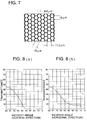
- the resulting sample was exposed and processed in the same manner as for Example 1, except that instead of the striped original employed in Example 1, a negative original of a honeycomb pattern shown in Fig. 7, was employed, and a light control film having a honeycomb pattern silver image was thereby prepared.
- Figs. 8(a) and 6(b) show the relationships between light transmittance in the vertical direction and in the horizontal direction of the honeycomb type light control film and the light incident angles, respectively.
- a silver salt photosensitive layer was coated on a transparent support and dried in the same manner as for Example 1.
- the resulting sample was exposed and processed in the same manner as for Example 1, except that instead of exposing through chrome plate negative original employing a Dark-room Printer P-605, stripes were exposed by a semi-conductor laser KX-J4012 (manufactured by Matsushita Electric Co., Ltd.) to obtain a light control film having stripes.
- the similar a light control film having stripes was obtained by employing He-Ne laser GENASET (manufactured by Dainippon Screen Seizo Co., Ltd.), as an exposing means instead of the semi-conductor laser.
- He-Ne laser GENASET manufactured by Dainippon Screen Seizo Co., Ltd.
- the present invention can provide a light control film which (1) is readily produced; (2) is excellent in mechanical strength; (3) is excellent in shielding predetermined incident light and gives a clear facing scene observed through transmission; (4) enables the formation of dots, stripes, checkered or honeycomb pattern, and also a production method of the same.
Landscapes
- Engineering & Computer Science (AREA)
- Manufacturing & Machinery (AREA)
- Physics & Mathematics (AREA)
- General Physics & Mathematics (AREA)
- Silver Salt Photography Or Processing Solution Therefor (AREA)
Applications Claiming Priority (2)
| Application Number | Priority Date | Filing Date | Title |
|---|---|---|---|
| JP173855/97 | 1997-06-30 | ||
| JP17385597 | 1997-06-30 |
Publications (1)
| Publication Number | Publication Date |
|---|---|
| EP0889357A1 true EP0889357A1 (fr) | 1999-01-07 |
Family
ID=15968405
Family Applications (1)
| Application Number | Title | Priority Date | Filing Date |
|---|---|---|---|
| EP98111793A Withdrawn EP0889357A1 (fr) | 1997-06-30 | 1998-06-26 | Pellicule de contrÔle de lumière et procédé de fabrication de celle-ci |
Country Status (1)
| Country | Link |
|---|---|
| EP (1) | EP0889357A1 (fr) |
Cited By (3)
| Publication number | Priority date | Publication date | Assignee | Title |
|---|---|---|---|---|
| FR2806243A1 (fr) * | 2000-03-09 | 2001-09-14 | Francois Giry | Ecran de diffusion de la lumiere pour l'image |
| EP1781077A4 (fr) * | 2004-06-23 | 2010-09-29 | Fujifilm Corp | Pellicule de protection electromagnetique transparente et procede de fabrication |
| CN113994241A (zh) * | 2019-06-12 | 2022-01-28 | 3M创新有限公司 | 包括导电粒子和有机聚合物的干燥含水分散体的涂覆基板 |
Citations (5)
| Publication number | Priority date | Publication date | Assignee | Title |
|---|---|---|---|---|
| US3037419A (en) * | 1958-03-13 | 1962-06-05 | Hazeltine Research Inc | Directional light-transmissive screen |
| FR2366688A1 (fr) * | 1976-09-30 | 1978-04-28 | Siemens Ag | Micro-trame pour ecrans d'affichage de tubes cathodiques |
| FR2534032A1 (en) * | 1982-10-05 | 1984-04-06 | Thomson Csf | Directional optical filter, method for obtaining it and use on an airborne indicating instrument. |
| GB2188446A (en) * | 1986-03-24 | 1987-09-30 | Slettemoen Gudmunn | Image detector with wave-front converter to reduce undesirable reflections |
| EP0615161A1 (fr) * | 1993-03-11 | 1994-09-14 | Agfa-Gevaert N.V. | Dispositif d'affichage à cristal liquide multicolore et la production dudite |
-
1998
- 1998-06-26 EP EP98111793A patent/EP0889357A1/fr not_active Withdrawn
Patent Citations (5)
| Publication number | Priority date | Publication date | Assignee | Title |
|---|---|---|---|---|
| US3037419A (en) * | 1958-03-13 | 1962-06-05 | Hazeltine Research Inc | Directional light-transmissive screen |
| FR2366688A1 (fr) * | 1976-09-30 | 1978-04-28 | Siemens Ag | Micro-trame pour ecrans d'affichage de tubes cathodiques |
| FR2534032A1 (en) * | 1982-10-05 | 1984-04-06 | Thomson Csf | Directional optical filter, method for obtaining it and use on an airborne indicating instrument. |
| GB2188446A (en) * | 1986-03-24 | 1987-09-30 | Slettemoen Gudmunn | Image detector with wave-front converter to reduce undesirable reflections |
| EP0615161A1 (fr) * | 1993-03-11 | 1994-09-14 | Agfa-Gevaert N.V. | Dispositif d'affichage à cristal liquide multicolore et la production dudite |
Cited By (4)
| Publication number | Priority date | Publication date | Assignee | Title |
|---|---|---|---|---|
| FR2806243A1 (fr) * | 2000-03-09 | 2001-09-14 | Francois Giry | Ecran de diffusion de la lumiere pour l'image |
| EP1781077A4 (fr) * | 2004-06-23 | 2010-09-29 | Fujifilm Corp | Pellicule de protection electromagnetique transparente et procede de fabrication |
| US7934966B2 (en) | 2004-06-23 | 2011-05-03 | Fujifilm Corporation | Light-transmitting electromagnetic wave shielding film and process for producing the same |
| CN113994241A (zh) * | 2019-06-12 | 2022-01-28 | 3M创新有限公司 | 包括导电粒子和有机聚合物的干燥含水分散体的涂覆基板 |
Similar Documents
| Publication | Publication Date | Title |
|---|---|---|
| US3206313A (en) | Chemically sensitized emulsions having low surface sensitivity and high internal sensitivity | |
| CA1183381A (fr) | Matiere photosensible a base d'halogenure d'argent, ayant des couches tabulaires et non tabulaires desdits halogenures et une couche superficielle de protection | |
| US4731322A (en) | Light-sensitive silver halide photographic material for X-ray photography | |
| AU771218B2 (en) | High contrast visually adaptive radiographic film and imaging assembly | |
| US5965337A (en) | Element for industrial radiography | |
| US4521508A (en) | Silver halide photographic light-sensitive materials | |
| EP0267483B1 (fr) | Procédé et élément pour l'obtention d'une image photographique | |
| US5051344A (en) | Silver halide photographic material | |
| JPH0690447B2 (ja) | ハロゲン化銀写真感光材料 | |
| US4659646A (en) | Silver salt diffusion transfer photographic material | |
| JPH01152446A (ja) | ネガ型ハロゲン化銀写真乳剤 | |
| JP2001264919A (ja) | ハロゲン化銀放射線写真フィルム | |
| US4656120A (en) | Silver halide photographic light-sensitive materials | |
| EP0889357A1 (fr) | Pellicule de contrÔle de lumière et procédé de fabrication de celle-ci | |
| US4952484A (en) | Silver halide photographic material | |
| JPH1172603A (ja) | ライトコントロールフィルム及びその製造方法 | |
| US4506008A (en) | Silver halide photographic light-sensitive materials | |
| JPH0640200B2 (ja) | 放射線用ハロゲン化銀写真感光材料 | |
| US6528227B2 (en) | Film/screen system and image-forming system for use in direct X-ray applications | |
| EP0359483B1 (fr) | Elément photographique traité ultrarapide | |
| JPH01179145A (ja) | ハロゲン化銀写真感光材料 | |
| JPS63259652A (ja) | 黒白用ハロゲン化銀写真感光材料及びその現像処理方法 | |
| JP2001255622A (ja) | 直接放射線写真フィルム | |
| US5516627A (en) | Method of processing silver halide light-sensitive photographic material | |
| JPH09251199A (ja) | 透過型ホログラム用ハロゲン化銀感光材料及びその画像形成方法 |
Legal Events
| Date | Code | Title | Description |
|---|---|---|---|
| PUAI | Public reference made under article 153(3) epc to a published international application that has entered the european phase |
Free format text: ORIGINAL CODE: 0009012 |
|
| AK | Designated contracting states |
Kind code of ref document: A1 Designated state(s): DE GB |
|
| AX | Request for extension of the european patent |
Free format text: AL;LT;LV;MK;RO;SI |
|
| 17P | Request for examination filed |
Effective date: 19990618 |
|
| AKX | Designation fees paid |
Free format text: DE GB |
|
| 17Q | First examination report despatched |
Effective date: 20020618 |
|
| STAA | Information on the status of an ep patent application or granted ep patent |
Free format text: STATUS: THE APPLICATION IS DEEMED TO BE WITHDRAWN |
|
| 18D | Application deemed to be withdrawn |
Effective date: 20021029 |