EP0889362B1 - Composition photopolymérisable et film sec de photoréserve - Google Patents
Composition photopolymérisable et film sec de photoréserve Download PDFInfo
- Publication number
- EP0889362B1 EP0889362B1 EP98111662A EP98111662A EP0889362B1 EP 0889362 B1 EP0889362 B1 EP 0889362B1 EP 98111662 A EP98111662 A EP 98111662A EP 98111662 A EP98111662 A EP 98111662A EP 0889362 B1 EP0889362 B1 EP 0889362B1
- Authority
- EP
- European Patent Office
- Prior art keywords
- cation
- ultraviolet
- visible light
- composition according
- group
- Prior art date
- Legal status (The legal status is an assumption and is not a legal conclusion. Google has not performed a legal analysis and makes no representation as to the accuracy of the status listed.)
- Expired - Lifetime
Links
- 239000000203 mixture Substances 0.000 title claims description 51
- -1 styrene compound Chemical class 0.000 claims description 92
- 239000000178 monomer Substances 0.000 claims description 44
- 150000001875 compounds Chemical class 0.000 claims description 33
- 239000003999 initiator Substances 0.000 claims description 32
- 229920001169 thermoplastic Polymers 0.000 claims description 26
- 239000000975 dye Substances 0.000 claims description 22
- 206010034972 Photosensitivity reaction Diseases 0.000 claims description 18
- 125000004432 carbon atom Chemical group C* 0.000 claims description 18
- 230000036211 photosensitivity Effects 0.000 claims description 18
- 125000000217 alkyl group Chemical group 0.000 claims description 17
- 238000004132 cross linking Methods 0.000 claims description 16
- 230000001235 sensitizing effect Effects 0.000 claims description 15
- 125000003178 carboxy group Chemical group [H]OC(*)=O 0.000 claims description 14
- PPBRXRYQALVLMV-UHFFFAOYSA-N Styrene Natural products C=CC1=CC=CC=C1 PPBRXRYQALVLMV-UHFFFAOYSA-N 0.000 claims description 13
- 125000002723 alicyclic group Chemical group 0.000 claims description 9
- 125000003710 aryl alkyl group Chemical group 0.000 claims description 9
- 125000000623 heterocyclic group Chemical group 0.000 claims description 9
- 125000003342 alkenyl group Chemical group 0.000 claims description 7
- 125000003118 aryl group Chemical group 0.000 claims description 7
- 229910052751 metal Inorganic materials 0.000 claims description 6
- 239000002184 metal Substances 0.000 claims description 6
- 125000003545 alkoxy group Chemical group 0.000 claims description 5
- 125000002091 cationic group Chemical group 0.000 claims description 5
- 150000001768 cations Chemical class 0.000 claims description 5
- 229910052739 hydrogen Inorganic materials 0.000 claims description 5
- 239000001257 hydrogen Substances 0.000 claims description 5
- XYFCBTPGUUZFHI-UHFFFAOYSA-O phosphonium Chemical compound [PH4+] XYFCBTPGUUZFHI-UHFFFAOYSA-O 0.000 claims description 5
- JUJWROOIHBZHMG-UHFFFAOYSA-O pyridinium Chemical group C1=CC=[NH+]C=C1 JUJWROOIHBZHMG-UHFFFAOYSA-O 0.000 claims description 5
- 125000001453 quaternary ammonium group Chemical group 0.000 claims description 5
- 238000007334 copolymerization reaction Methods 0.000 claims description 4
- 125000002768 hydroxyalkyl group Chemical group 0.000 claims description 4
- 125000005250 alkyl acrylate group Chemical group 0.000 claims description 3
- 125000005843 halogen group Chemical group 0.000 claims description 3
- 150000002431 hydrogen Chemical group 0.000 claims description 3
- 125000001624 naphthyl group Chemical group 0.000 claims description 3
- UFHFLCQGNIYNRP-UHFFFAOYSA-N Hydrogen Chemical compound [H][H] UFHFLCQGNIYNRP-UHFFFAOYSA-N 0.000 claims description 2
- 239000012986 chain transfer agent Substances 0.000 claims description 2
- 230000007935 neutral effect Effects 0.000 claims description 2
- NIXOWILDQLNWCW-UHFFFAOYSA-M Acrylate Chemical compound [O-]C(=O)C=C NIXOWILDQLNWCW-UHFFFAOYSA-M 0.000 description 23
- 238000001723 curing Methods 0.000 description 18
- XKRFYHLGVUSROY-UHFFFAOYSA-N Argon Chemical compound [Ar] XKRFYHLGVUSROY-UHFFFAOYSA-N 0.000 description 12
- 238000000034 method Methods 0.000 description 12
- 230000035945 sensitivity Effects 0.000 description 12
- DZLFLBLQUQXARW-UHFFFAOYSA-N tetrabutylammonium Chemical compound CCCC[N+](CCCC)(CCCC)CCCC DZLFLBLQUQXARW-UHFFFAOYSA-N 0.000 description 11
- BAPJBEWLBFYGME-UHFFFAOYSA-N Methyl acrylate Chemical compound COC(=O)C=C BAPJBEWLBFYGME-UHFFFAOYSA-N 0.000 description 10
- 239000003513 alkali Substances 0.000 description 10
- 239000000243 solution Substances 0.000 description 10
- 238000011161 development Methods 0.000 description 9
- 239000011347 resin Substances 0.000 description 8
- 229920005989 resin Polymers 0.000 description 8
- 238000007747 plating Methods 0.000 description 7
- CDBYLPFSWZWCQE-UHFFFAOYSA-L Sodium Carbonate Chemical compound [Na+].[Na+].[O-]C([O-])=O CDBYLPFSWZWCQE-UHFFFAOYSA-L 0.000 description 6
- 229910052786 argon Inorganic materials 0.000 description 6
- 150000003839 salts Chemical class 0.000 description 6
- 230000001681 protective effect Effects 0.000 description 5
- 238000012360 testing method Methods 0.000 description 5
- 125000000391 vinyl group Chemical group [H]C([*])=C([H])[H] 0.000 description 5
- 229920002554 vinyl polymer Polymers 0.000 description 5
- RYGMFSIKBFXOCR-UHFFFAOYSA-N Copper Chemical compound [Cu] RYGMFSIKBFXOCR-UHFFFAOYSA-N 0.000 description 4
- PEDCQBHIVMGVHV-UHFFFAOYSA-N Glycerine Chemical compound OCC(O)CO PEDCQBHIVMGVHV-UHFFFAOYSA-N 0.000 description 4
- VVQNEPGJFQJSBK-UHFFFAOYSA-N Methyl methacrylate Chemical compound COC(=O)C(C)=C VVQNEPGJFQJSBK-UHFFFAOYSA-N 0.000 description 4
- ATUOYWHBWRKTHZ-UHFFFAOYSA-N Propane Chemical compound CCC ATUOYWHBWRKTHZ-UHFFFAOYSA-N 0.000 description 4
- ZJCCRDAZUWHFQH-UHFFFAOYSA-N Trimethylolpropane Chemical compound CCC(CO)(CO)CO ZJCCRDAZUWHFQH-UHFFFAOYSA-N 0.000 description 4
- 229910052802 copper Inorganic materials 0.000 description 4
- 239000010949 copper Substances 0.000 description 4
- 239000000758 substrate Substances 0.000 description 4
- TXBCBTDQIULDIA-UHFFFAOYSA-N 2-[[3-hydroxy-2,2-bis(hydroxymethyl)propoxy]methyl]-2-(hydroxymethyl)propane-1,3-diol Chemical compound OCC(CO)(CO)COCC(CO)(CO)CO TXBCBTDQIULDIA-UHFFFAOYSA-N 0.000 description 3
- CERQOIWHTDAKMF-UHFFFAOYSA-N Methacrylic acid Chemical compound CC(=C)C(O)=O CERQOIWHTDAKMF-UHFFFAOYSA-N 0.000 description 3
- HEMHJVSKTPXQMS-UHFFFAOYSA-M Sodium hydroxide Chemical compound [OH-].[Na+] HEMHJVSKTPXQMS-UHFFFAOYSA-M 0.000 description 3
- 239000007983 Tris buffer Substances 0.000 description 3
- 150000001252 acrylic acid derivatives Chemical class 0.000 description 3
- 239000000654 additive Substances 0.000 description 3
- 150000001450 anions Chemical class 0.000 description 3
- 238000005530 etching Methods 0.000 description 3
- 238000003384 imaging method Methods 0.000 description 3
- QSHDDOUJBYECFT-UHFFFAOYSA-N mercury Chemical compound [Hg] QSHDDOUJBYECFT-UHFFFAOYSA-N 0.000 description 3
- 125000002496 methyl group Chemical group [H]C([H])([H])* 0.000 description 3
- PGSADBUBUOPOJS-UHFFFAOYSA-N neutral red Chemical compound Cl.C1=C(C)C(N)=CC2=NC3=CC(N(C)C)=CC=C3N=C21 PGSADBUBUOPOJS-UHFFFAOYSA-N 0.000 description 3
- WXZMFSXDPGVJKK-UHFFFAOYSA-N pentaerythritol Chemical compound OCC(CO)(CO)CO WXZMFSXDPGVJKK-UHFFFAOYSA-N 0.000 description 3
- 125000001997 phenyl group Chemical group [H]C1=C([H])C([H])=C(*)C([H])=C1[H] 0.000 description 3
- 229920006267 polyester film Polymers 0.000 description 3
- 229910000029 sodium carbonate Inorganic materials 0.000 description 3
- 229910000679 solder Inorganic materials 0.000 description 3
- 239000002904 solvent Substances 0.000 description 3
- 239000000126 substance Substances 0.000 description 3
- JOXIMZWYDAKGHI-UHFFFAOYSA-N toluene-4-sulfonic acid Chemical compound CC1=CC=C(S(O)(=O)=O)C=C1 JOXIMZWYDAKGHI-UHFFFAOYSA-N 0.000 description 3
- VZCYOOQTPOCHFL-UHFFFAOYSA-N trans-butenedioic acid Natural products OC(=O)C=CC(O)=O VZCYOOQTPOCHFL-UHFFFAOYSA-N 0.000 description 3
- LORKUZBPMQEQET-UHFFFAOYSA-M (2e)-1,3,3-trimethyl-2-[(2z)-2-(1-methyl-2-phenylindol-1-ium-3-ylidene)ethylidene]indole;chloride Chemical compound [Cl-].CC1(C)C2=CC=CC=C2N(C)\C1=C/C=C(C1=CC=CC=C1[N+]=1C)/C=1C1=CC=CC=C1 LORKUZBPMQEQET-UHFFFAOYSA-M 0.000 description 2
- ZOMLUNRKXJYKPD-UHFFFAOYSA-N 1,3,3-trimethyl-2-[2-(2-methylindol-3-ylidene)ethylidene]indole;hydrochloride Chemical compound [Cl-].C1=CC=C2C(C)(C)C(/C=C/C=3C4=CC=CC=C4NC=3C)=[N+](C)C2=C1 ZOMLUNRKXJYKPD-UHFFFAOYSA-N 0.000 description 2
- YXIWHUQXZSMYRE-UHFFFAOYSA-N 1,3-benzothiazole-2-thiol Chemical compound C1=CC=C2SC(S)=NC2=C1 YXIWHUQXZSMYRE-UHFFFAOYSA-N 0.000 description 2
- AZQWKYJCGOJGHM-UHFFFAOYSA-N 1,4-benzoquinone Chemical compound O=C1C=CC(=O)C=C1 AZQWKYJCGOJGHM-UHFFFAOYSA-N 0.000 description 2
- GOXQRTZXKQZDDN-UHFFFAOYSA-N 2-Ethylhexyl acrylate Chemical compound CCCCC(CC)COC(=O)C=C GOXQRTZXKQZDDN-UHFFFAOYSA-N 0.000 description 2
- HCLJOFJIQIJXHS-UHFFFAOYSA-N 2-[2-[2-(2-prop-2-enoyloxyethoxy)ethoxy]ethoxy]ethyl prop-2-enoate Chemical compound C=CC(=O)OCCOCCOCCOCCOC(=O)C=C HCLJOFJIQIJXHS-UHFFFAOYSA-N 0.000 description 2
- WDQMWEYDKDCEHT-UHFFFAOYSA-N 2-ethylhexyl 2-methylprop-2-enoate Chemical compound CCCCC(CC)COC(=O)C(C)=C WDQMWEYDKDCEHT-UHFFFAOYSA-N 0.000 description 2
- 125000004204 2-methoxyphenyl group Chemical group [H]C1=C([H])C(*)=C(OC([H])([H])[H])C([H])=C1[H] 0.000 description 2
- 125000000094 2-phenylethyl group Chemical group [H]C1=C([H])C([H])=C(C([H])=C1[H])C([H])([H])C([H])([H])* 0.000 description 2
- GOLORTLGFDVFDW-UHFFFAOYSA-N 3-(1h-benzimidazol-2-yl)-7-(diethylamino)chromen-2-one Chemical compound C1=CC=C2NC(C3=CC4=CC=C(C=C4OC3=O)N(CC)CC)=NC2=C1 GOLORTLGFDVFDW-UHFFFAOYSA-N 0.000 description 2
- NJIRSTSECXKPCO-UHFFFAOYSA-M 3-[n-methyl-4-[2-(1,3,3-trimethylindol-1-ium-2-yl)ethenyl]anilino]propanenitrile;chloride Chemical compound [Cl-].C1=CC(N(CCC#N)C)=CC=C1\C=C\C1=[N+](C)C2=CC=CC=C2C1(C)C NJIRSTSECXKPCO-UHFFFAOYSA-M 0.000 description 2
- 125000004860 4-ethylphenyl group Chemical group [H]C1=C([H])C(=C([H])C([H])=C1*)C([H])([H])C([H])([H])[H] 0.000 description 2
- 125000004217 4-methoxybenzyl group Chemical group [H]C1=C([H])C(=C([H])C([H])=C1OC([H])([H])[H])C([H])([H])* 0.000 description 2
- 125000004172 4-methoxyphenyl group Chemical group [H]C1=C([H])C(OC([H])([H])[H])=C([H])C([H])=C1* 0.000 description 2
- SOGAXMICEFXMKE-UHFFFAOYSA-N Butylmethacrylate Chemical compound CCCCOC(=O)C(C)=C SOGAXMICEFXMKE-UHFFFAOYSA-N 0.000 description 2
- JIGUQPWFLRLWPJ-UHFFFAOYSA-N Ethyl acrylate Chemical compound CCOC(=O)C=C JIGUQPWFLRLWPJ-UHFFFAOYSA-N 0.000 description 2
- VZCYOOQTPOCHFL-OWOJBTEDSA-N Fumaric acid Chemical compound OC(=O)\C=C\C(O)=O VZCYOOQTPOCHFL-OWOJBTEDSA-N 0.000 description 2
- NPKSPKHJBVJUKB-UHFFFAOYSA-N N-phenylglycine Chemical compound OC(=O)CNC1=CC=CC=C1 NPKSPKHJBVJUKB-UHFFFAOYSA-N 0.000 description 2
- 206010034960 Photophobia Diseases 0.000 description 2
- 239000004698 Polyethylene Substances 0.000 description 2
- OFOBLEOULBTSOW-UHFFFAOYSA-N Propanedioic acid Natural products OC(=O)CC(O)=O OFOBLEOULBTSOW-UHFFFAOYSA-N 0.000 description 2
- 239000002318 adhesion promoter Substances 0.000 description 2
- 125000001797 benzyl group Chemical group [H]C1=C([H])C([H])=C(C([H])=C1[H])C([H])([H])* 0.000 description 2
- 230000015572 biosynthetic process Effects 0.000 description 2
- IISBACLAFKSPIT-UHFFFAOYSA-N bisphenol A Chemical compound C=1C=C(O)C=CC=1C(C)(C)C1=CC=C(O)C=C1 IISBACLAFKSPIT-UHFFFAOYSA-N 0.000 description 2
- 150000001639 boron compounds Chemical class 0.000 description 2
- WERYXYBDKMZEQL-UHFFFAOYSA-N butane-1,4-diol Chemical compound OCCCCO WERYXYBDKMZEQL-UHFFFAOYSA-N 0.000 description 2
- 125000004369 butenyl group Chemical group C(=CCC)* 0.000 description 2
- CQEYYJKEWSMYFG-UHFFFAOYSA-N butyl acrylate Chemical compound CCCCOC(=O)C=C CQEYYJKEWSMYFG-UHFFFAOYSA-N 0.000 description 2
- 125000000484 butyl group Chemical group [H]C([*])([H])C([H])([H])C([H])([H])C([H])([H])[H] 0.000 description 2
- IWWWBRIIGAXLCJ-BGABXYSRSA-N chembl1185241 Chemical compound C1=2C=C(C)C(NCC)=CC=2OC2=C\C(=N/CC)C(C)=CC2=C1C1=CC=CC=C1C(=O)OCC IWWWBRIIGAXLCJ-BGABXYSRSA-N 0.000 description 2
- 239000013078 crystal Substances 0.000 description 2
- 125000000582 cycloheptyl group Chemical group [H]C1([H])C([H])([H])C([H])([H])C([H])([H])C([H])(*)C([H])([H])C1([H])[H] 0.000 description 2
- 125000000113 cyclohexyl group Chemical group [H]C1([H])C([H])([H])C([H])([H])C([H])(*)C([H])([H])C1([H])[H] 0.000 description 2
- 125000001511 cyclopentyl group Chemical group [H]C1([H])C([H])([H])C([H])([H])C([H])(*)C1([H])[H] 0.000 description 2
- 125000005066 dodecenyl group Chemical group C(=CCCCCCCCCCC)* 0.000 description 2
- 125000001495 ethyl group Chemical group [H]C([H])([H])C([H])([H])* 0.000 description 2
- 235000011187 glycerol Nutrition 0.000 description 2
- 229910052736 halogen Inorganic materials 0.000 description 2
- 238000010438 heat treatment Methods 0.000 description 2
- 125000003187 heptyl group Chemical group [H]C([*])([H])C([H])([H])C([H])([H])C([H])([H])C([H])([H])C([H])([H])C([H])([H])[H] 0.000 description 2
- 125000006038 hexenyl group Chemical group 0.000 description 2
- 125000004051 hexyl group Chemical group [H]C([H])([H])C([H])([H])C([H])([H])C([H])([H])C([H])([H])C([H])([H])* 0.000 description 2
- 125000001041 indolyl group Chemical group 0.000 description 2
- 230000000977 initiatory effect Effects 0.000 description 2
- 125000000959 isobutyl group Chemical group [H]C([H])([H])C([H])(C([H])([H])[H])C([H])([H])* 0.000 description 2
- 125000001449 isopropyl group Chemical group [H]C([H])([H])C([H])(*)C([H])([H])[H] 0.000 description 2
- 208000013469 light sensitivity Diseases 0.000 description 2
- VZCYOOQTPOCHFL-UPHRSURJSA-N maleic acid Chemical compound OC(=O)\C=C/C(O)=O VZCYOOQTPOCHFL-UPHRSURJSA-N 0.000 description 2
- 239000011976 maleic acid Substances 0.000 description 2
- 238000004519 manufacturing process Methods 0.000 description 2
- 239000000463 material Substances 0.000 description 2
- 238000005259 measurement Methods 0.000 description 2
- 229910001507 metal halide Inorganic materials 0.000 description 2
- 150000005309 metal halides Chemical class 0.000 description 2
- 125000006384 methylpyridyl group Chemical group 0.000 description 2
- PSZYNBSKGUBXEH-UHFFFAOYSA-N naphthalene-1-sulfonic acid Chemical class C1=CC=C2C(S(=O)(=O)O)=CC=CC2=C1 PSZYNBSKGUBXEH-UHFFFAOYSA-N 0.000 description 2
- SLCVBVWXLSEKPL-UHFFFAOYSA-N neopentyl glycol Chemical compound OCC(C)(C)CO SLCVBVWXLSEKPL-UHFFFAOYSA-N 0.000 description 2
- 229940117969 neopentyl glycol Drugs 0.000 description 2
- 125000003261 o-tolyl group Chemical group [H]C1=C([H])C(*)=C(C([H])=C1[H])C([H])([H])[H] 0.000 description 2
- 125000004365 octenyl group Chemical group C(=CCCCCCC)* 0.000 description 2
- 125000002347 octyl group Chemical group [H]C([*])([H])C([H])([H])C([H])([H])C([H])([H])C([H])([H])C([H])([H])C([H])([H])C([H])([H])[H] 0.000 description 2
- 125000002255 pentenyl group Chemical group C(=CCCC)* 0.000 description 2
- 125000001147 pentyl group Chemical group C(CCCC)* 0.000 description 2
- PNJWIWWMYCMZRO-UHFFFAOYSA-N pent‐4‐en‐2‐one Natural products CC(=O)CC=C PNJWIWWMYCMZRO-UHFFFAOYSA-N 0.000 description 2
- 229920002120 photoresistant polymer Polymers 0.000 description 2
- 229920000573 polyethylene Polymers 0.000 description 2
- 238000006116 polymerization reaction Methods 0.000 description 2
- 125000001844 prenyl group Chemical group [H]C([*])([H])C([H])=C(C([H])([H])[H])C([H])([H])[H] 0.000 description 2
- 239000001294 propane Substances 0.000 description 2
- 125000004368 propenyl group Chemical group C(=CC)* 0.000 description 2
- 125000001436 propyl group Chemical group [H]C([*])([H])C([H])([H])C([H])([H])[H] 0.000 description 2
- 125000004076 pyridyl group Chemical group 0.000 description 2
- 125000005493 quinolyl group Chemical group 0.000 description 2
- 238000011160 research Methods 0.000 description 2
- 125000002914 sec-butyl group Chemical group [H]C([H])([H])C([H])([H])C([H])(*)C([H])([H])[H] 0.000 description 2
- 239000007921 spray Substances 0.000 description 2
- 125000005017 substituted alkenyl group Chemical group 0.000 description 2
- 125000003107 substituted aryl group Chemical group 0.000 description 2
- 125000003944 tolyl group Chemical group 0.000 description 2
- LLWJPGAKXJBKKA-UHFFFAOYSA-N victoria blue B Chemical compound [Cl-].C1=CC(N(C)C)=CC=C1C(C=1C=CC(=CC=1)N(C)C)=C(C=C1)C2=CC=CC=C2C1=[NH+]C1=CC=CC=C1 LLWJPGAKXJBKKA-UHFFFAOYSA-N 0.000 description 2
- 229910052724 xenon Inorganic materials 0.000 description 2
- FHNFHKCVQCLJFQ-UHFFFAOYSA-N xenon atom Chemical compound [Xe] FHNFHKCVQCLJFQ-UHFFFAOYSA-N 0.000 description 2
- 125000005023 xylyl group Chemical group 0.000 description 2
- QGKMIGUHVLGJBR-UHFFFAOYSA-M (4z)-1-(3-methylbutyl)-4-[[1-(3-methylbutyl)quinolin-1-ium-4-yl]methylidene]quinoline;iodide Chemical compound [I-].C12=CC=CC=C2N(CCC(C)C)C=CC1=CC1=CC=[N+](CCC(C)C)C2=CC=CC=C12 QGKMIGUHVLGJBR-UHFFFAOYSA-M 0.000 description 1
- WBYWAXJHAXSJNI-VOTSOKGWSA-M .beta-Phenylacrylic acid Natural products [O-]C(=O)\C=C\C1=CC=CC=C1 WBYWAXJHAXSJNI-VOTSOKGWSA-M 0.000 description 1
- YHMYGUUIMTVXNW-UHFFFAOYSA-N 1,3-dihydrobenzimidazole-2-thione Chemical compound C1=CC=C2NC(S)=NC2=C1 YHMYGUUIMTVXNW-UHFFFAOYSA-N 0.000 description 1
- ILIMOFAFBPEQAT-UHFFFAOYSA-N 1,5,5-trimethyl-1,3-diazinane-2,4,6-trione Chemical compound CN1C(=O)NC(=O)C(C)(C)C1=O ILIMOFAFBPEQAT-UHFFFAOYSA-N 0.000 description 1
- GGZHVNZHFYCSEV-UHFFFAOYSA-N 1-Phenyl-5-mercaptotetrazole Chemical compound SC1=NN=NN1C1=CC=CC=C1 GGZHVNZHFYCSEV-UHFFFAOYSA-N 0.000 description 1
- LMAUULKNZLEMGN-UHFFFAOYSA-N 1-ethyl-3,5-dimethylbenzene Chemical compound CCC1=CC(C)=CC(C)=C1 LMAUULKNZLEMGN-UHFFFAOYSA-N 0.000 description 1
- 125000001637 1-naphthyl group Chemical group [H]C1=C([H])C([H])=C2C(*)=C([H])C([H])=C([H])C2=C1[H] 0.000 description 1
- IYPXPGSELZFFMI-UHFFFAOYSA-N 1-phenyltetrazole Chemical compound C1=NN=NN1C1=CC=CC=C1 IYPXPGSELZFFMI-UHFFFAOYSA-N 0.000 description 1
- KJUGUADJHNHALS-UHFFFAOYSA-N 1H-tetrazole Substances C=1N=NNN=1 KJUGUADJHNHALS-UHFFFAOYSA-N 0.000 description 1
- QAMCXJOYXRSXDU-UHFFFAOYSA-N 2,4-dimethoxy-n-[2-(1,3,3-trimethylindol-1-ium-2-yl)ethenyl]aniline;chloride Chemical compound [Cl-].COC1=CC(OC)=CC=C1NC=CC1=[N+](C)C2=CC=CC=C2C1(C)C QAMCXJOYXRSXDU-UHFFFAOYSA-N 0.000 description 1
- SMZOUWXMTYCWNB-UHFFFAOYSA-N 2-(2-methoxy-5-methylphenyl)ethanamine Chemical compound COC1=CC=C(C)C=C1CCN SMZOUWXMTYCWNB-UHFFFAOYSA-N 0.000 description 1
- JAHNSTQSQJOJLO-UHFFFAOYSA-N 2-(3-fluorophenyl)-1h-imidazole Chemical compound FC1=CC=CC(C=2NC=CN=2)=C1 JAHNSTQSQJOJLO-UHFFFAOYSA-N 0.000 description 1
- GEJKTZQVPRSZAN-UHFFFAOYSA-N 2-(dimethylamino)anthracene-9,10-dione Chemical compound C1=CC=C2C(=O)C3=CC(N(C)C)=CC=C3C(=O)C2=C1 GEJKTZQVPRSZAN-UHFFFAOYSA-N 0.000 description 1
- NIXOWILDQLNWCW-UHFFFAOYSA-N 2-Propenoic acid Natural products OC(=O)C=C NIXOWILDQLNWCW-UHFFFAOYSA-N 0.000 description 1
- LTHJXDSHSVNJKG-UHFFFAOYSA-N 2-[2-[2-[2-(2-methylprop-2-enoyloxy)ethoxy]ethoxy]ethoxy]ethyl 2-methylprop-2-enoate Chemical compound CC(=C)C(=O)OCCOCCOCCOCCOC(=O)C(C)=C LTHJXDSHSVNJKG-UHFFFAOYSA-N 0.000 description 1
- OMIGHNLMNHATMP-UHFFFAOYSA-N 2-hydroxyethyl prop-2-enoate Chemical compound OCCOC(=O)C=C OMIGHNLMNHATMP-UHFFFAOYSA-N 0.000 description 1
- VHSHLMUCYSAUQU-UHFFFAOYSA-N 2-hydroxypropyl methacrylate Chemical compound CC(O)COC(=O)C(C)=C VHSHLMUCYSAUQU-UHFFFAOYSA-N 0.000 description 1
- GWZMWHWAWHPNHN-UHFFFAOYSA-N 2-hydroxypropyl prop-2-enoate Chemical compound CC(O)COC(=O)C=C GWZMWHWAWHPNHN-UHFFFAOYSA-N 0.000 description 1
- FLFWJIBUZQARMD-UHFFFAOYSA-N 2-mercapto-1,3-benzoxazole Chemical compound C1=CC=C2OC(S)=NC2=C1 FLFWJIBUZQARMD-UHFFFAOYSA-N 0.000 description 1
- PCGDWIWUQDHQLK-UHFFFAOYSA-N 2-morpholin-4-yl-5-nitrobenzaldehyde Chemical compound O=CC1=CC([N+](=O)[O-])=CC=C1N1CCOCC1 PCGDWIWUQDHQLK-UHFFFAOYSA-N 0.000 description 1
- 125000001622 2-naphthyl group Chemical group [H]C1=C([H])C([H])=C2C([H])=C(*)C([H])=C([H])C2=C1[H] 0.000 description 1
- CCGRYVAYKAMETC-UHFFFAOYSA-N 2-phenyltetrazol-5-amine Chemical compound N1=C(N)N=NN1C1=CC=CC=C1 CCGRYVAYKAMETC-UHFFFAOYSA-N 0.000 description 1
- BCHZICNRHXRCHY-UHFFFAOYSA-N 2h-oxazine Chemical compound N1OC=CC=C1 BCHZICNRHXRCHY-UHFFFAOYSA-N 0.000 description 1
- ULRPISSMEBPJLN-UHFFFAOYSA-N 2h-tetrazol-5-amine Chemical compound NC1=NN=NN1 ULRPISSMEBPJLN-UHFFFAOYSA-N 0.000 description 1
- AGIJRRREJXSQJR-UHFFFAOYSA-N 2h-thiazine Chemical compound N1SC=CC=C1 AGIJRRREJXSQJR-UHFFFAOYSA-N 0.000 description 1
- ACNUVXZPCIABEX-UHFFFAOYSA-N 3',6'-diaminospiro[2-benzofuran-3,9'-xanthene]-1-one Chemical compound O1C(=O)C2=CC=CC=C2C21C1=CC=C(N)C=C1OC1=CC(N)=CC=C21 ACNUVXZPCIABEX-UHFFFAOYSA-N 0.000 description 1
- BEYOBVMPDRKTNR-BUHFOSPRSA-N 4-Hydroxyazobenzene Chemical compound C1=CC(O)=CC=C1\N=N\C1=CC=CC=C1 BEYOBVMPDRKTNR-BUHFOSPRSA-N 0.000 description 1
- AXDJCCTWPBKUKL-UHFFFAOYSA-N 4-[(4-aminophenyl)-(4-imino-3-methylcyclohexa-2,5-dien-1-ylidene)methyl]aniline;hydron;chloride Chemical compound Cl.C1=CC(=N)C(C)=CC1=C(C=1C=CC(N)=CC=1)C1=CC=C(N)C=C1 AXDJCCTWPBKUKL-UHFFFAOYSA-N 0.000 description 1
- YFVXLROHJBSEDW-UHFFFAOYSA-N 4-[(4-nitrophenyl)diazenyl]-n-phenylaniline Chemical compound C1=CC([N+](=O)[O-])=CC=C1N=NC(C=C1)=CC=C1NC1=CC=CC=C1 YFVXLROHJBSEDW-UHFFFAOYSA-N 0.000 description 1
- AXZVOQSFGVEZNX-UHFFFAOYSA-N 4-[2-(3-ethyl-1,3-benzothiazol-2-ylidene)ethylidene]-3-phenyl-1,2-oxazol-5-one Chemical compound S1C2=CC=CC=C2N(CC)C1=CC=C1C(=O)ON=C1C1=CC=CC=C1 AXZVOQSFGVEZNX-UHFFFAOYSA-N 0.000 description 1
- GJCOSYZMQJWQCA-UHFFFAOYSA-N 9H-xanthene Chemical compound C1=CC=C2CC3=CC=CC=C3OC2=C1 GJCOSYZMQJWQCA-UHFFFAOYSA-N 0.000 description 1
- JUQPZRLQQYSMEQ-UHFFFAOYSA-N CI Basic red 9 Chemical compound [Cl-].C1=CC(N)=CC=C1C(C=1C=CC(N)=CC=1)=C1C=CC(=[NH2+])C=C1 JUQPZRLQQYSMEQ-UHFFFAOYSA-N 0.000 description 1
- OYPRJOBELJOOCE-UHFFFAOYSA-N Calcium Chemical compound [Ca] OYPRJOBELJOOCE-UHFFFAOYSA-N 0.000 description 1
- WBYWAXJHAXSJNI-SREVYHEPSA-N Cinnamic acid Chemical compound OC(=O)\C=C/C1=CC=CC=C1 WBYWAXJHAXSJNI-SREVYHEPSA-N 0.000 description 1
- 239000004593 Epoxy Substances 0.000 description 1
- JOYRKODLDBILNP-UHFFFAOYSA-N Ethyl urethane Chemical compound CCOC(N)=O JOYRKODLDBILNP-UHFFFAOYSA-N 0.000 description 1
- VEXZGXHMUGYJMC-UHFFFAOYSA-N Hydrochloric acid Chemical compound Cl VEXZGXHMUGYJMC-UHFFFAOYSA-N 0.000 description 1
- CPELXLSAUQHCOX-UHFFFAOYSA-N Hydrogen bromide Chemical compound Br CPELXLSAUQHCOX-UHFFFAOYSA-N 0.000 description 1
- WOBHKFSMXKNTIM-UHFFFAOYSA-N Hydroxyethyl methacrylate Chemical compound CC(=C)C(=O)OCCO WOBHKFSMXKNTIM-UHFFFAOYSA-N 0.000 description 1
- DGAQECJNVWCQMB-PUAWFVPOSA-M Ilexoside XXIX Chemical compound C[C@@H]1CC[C@@]2(CC[C@@]3(C(=CC[C@H]4[C@]3(CC[C@@H]5[C@@]4(CC[C@@H](C5(C)C)OS(=O)(=O)[O-])C)C)[C@@H]2[C@]1(C)O)C)C(=O)O[C@H]6[C@@H]([C@H]([C@@H]([C@H](O6)CO)O)O)O.[Na+] DGAQECJNVWCQMB-PUAWFVPOSA-M 0.000 description 1
- 235000000177 Indigofera tinctoria Nutrition 0.000 description 1
- WHXSMMKQMYFTQS-UHFFFAOYSA-N Lithium Chemical compound [Li] WHXSMMKQMYFTQS-UHFFFAOYSA-N 0.000 description 1
- FYYHWMGAXLPEAU-UHFFFAOYSA-N Magnesium Chemical compound [Mg] FYYHWMGAXLPEAU-UHFFFAOYSA-N 0.000 description 1
- CERQOIWHTDAKMF-UHFFFAOYSA-M Methacrylate Chemical compound CC(=C)C([O-])=O CERQOIWHTDAKMF-UHFFFAOYSA-M 0.000 description 1
- AFVFQIVMOAPDHO-UHFFFAOYSA-M Methanesulfonate Chemical compound CS([O-])(=O)=O AFVFQIVMOAPDHO-UHFFFAOYSA-M 0.000 description 1
- YNAVUWVOSKDBBP-UHFFFAOYSA-N Morpholine Natural products C1COCCN1 YNAVUWVOSKDBBP-UHFFFAOYSA-N 0.000 description 1
- WRUZLCLJULHLEY-UHFFFAOYSA-N N-(p-hydroxyphenyl)glycine Chemical compound OC(=O)CNC1=CC=C(O)C=C1 WRUZLCLJULHLEY-UHFFFAOYSA-N 0.000 description 1
- 239000002202 Polyethylene glycol Substances 0.000 description 1
- 239000004743 Polypropylene Substances 0.000 description 1
- ZLMJMSJWJFRBEC-UHFFFAOYSA-N Potassium Chemical compound [K] ZLMJMSJWJFRBEC-UHFFFAOYSA-N 0.000 description 1
- DAKWPKUUDNSNPN-UHFFFAOYSA-N Trimethylolpropane triacrylate Chemical compound C=CC(=O)OCC(CC)(COC(=O)C=C)COC(=O)C=C DAKWPKUUDNSNPN-UHFFFAOYSA-N 0.000 description 1
- 238000010521 absorption reaction Methods 0.000 description 1
- 239000002253 acid Substances 0.000 description 1
- 125000002252 acyl group Chemical group 0.000 description 1
- 239000000853 adhesive Substances 0.000 description 1
- 230000001070 adhesive effect Effects 0.000 description 1
- 125000005907 alkyl ester group Chemical group 0.000 description 1
- 150000008064 anhydrides Chemical class 0.000 description 1
- 125000005428 anthryl group Chemical group [H]C1=C([H])C([H])=C2C([H])=C3C(*)=C([H])C([H])=C([H])C3=C([H])C2=C1[H] 0.000 description 1
- 239000007864 aqueous solution Substances 0.000 description 1
- 150000004982 aromatic amines Chemical class 0.000 description 1
- 125000000751 azo group Chemical group [*]N=N[*] 0.000 description 1
- 229940077388 benzenesulfonate Drugs 0.000 description 1
- DBDNZCBRIPTLJF-UHFFFAOYSA-N boron(1-) monohydride Chemical compound [BH-] DBDNZCBRIPTLJF-UHFFFAOYSA-N 0.000 description 1
- 229960001506 brilliant green Drugs 0.000 description 1
- HXCILVUBKWANLN-UHFFFAOYSA-N brilliant green cation Chemical compound C1=CC(N(CC)CC)=CC=C1C(C=1C=CC=CC=1)=C1C=CC(=[N+](CC)CC)C=C1 HXCILVUBKWANLN-UHFFFAOYSA-N 0.000 description 1
- 239000011575 calcium Substances 0.000 description 1
- 229910052791 calcium Inorganic materials 0.000 description 1
- 239000003795 chemical substances by application Substances 0.000 description 1
- 229930016911 cinnamic acid Natural products 0.000 description 1
- 235000013985 cinnamic acid Nutrition 0.000 description 1
- 239000011248 coating agent Substances 0.000 description 1
- 238000000576 coating method Methods 0.000 description 1
- LDHQCZJRKDOVOX-NSCUHMNNSA-N crotonic acid Chemical compound C\C=C\C(O)=O LDHQCZJRKDOVOX-NSCUHMNNSA-N 0.000 description 1
- ZXJXZNDDNMQXFV-UHFFFAOYSA-M crystal violet Chemical compound [Cl-].C1=CC(N(C)C)=CC=C1[C+](C=1C=CC(=CC=1)N(C)C)C1=CC=C(N(C)C)C=C1 ZXJXZNDDNMQXFV-UHFFFAOYSA-M 0.000 description 1
- 238000002425 crystallisation Methods 0.000 description 1
- 230000008025 crystallization Effects 0.000 description 1
- 238000000354 decomposition reaction Methods 0.000 description 1
- 238000004090 dissolution Methods 0.000 description 1
- 230000000694 effects Effects 0.000 description 1
- 238000005516 engineering process Methods 0.000 description 1
- 150000002148 esters Chemical class 0.000 description 1
- BEFDCLMNVWHSGT-UHFFFAOYSA-N ethenylcyclopentane Chemical compound C=CC1CCCC1 BEFDCLMNVWHSGT-UHFFFAOYSA-N 0.000 description 1
- SUPCQIBBMFXVTL-UHFFFAOYSA-N ethyl 2-methylprop-2-enoate Chemical compound CCOC(=O)C(C)=C SUPCQIBBMFXVTL-UHFFFAOYSA-N 0.000 description 1
- FKIRSCKRJJUCNI-UHFFFAOYSA-N ethyl 7-bromo-1h-indole-2-carboxylate Chemical compound C1=CC(Br)=C2NC(C(=O)OCC)=CC2=C1 FKIRSCKRJJUCNI-UHFFFAOYSA-N 0.000 description 1
- 239000000945 filler Substances 0.000 description 1
- 239000001530 fumaric acid Substances 0.000 description 1
- 125000000524 functional group Chemical group 0.000 description 1
- 150000002367 halogens Chemical class 0.000 description 1
- XXMIOPMDWAUFGU-UHFFFAOYSA-N hexane-1,6-diol Chemical compound OCCCCCCO XXMIOPMDWAUFGU-UHFFFAOYSA-N 0.000 description 1
- 239000000852 hydrogen donor Substances 0.000 description 1
- 229940097275 indigo Drugs 0.000 description 1
- COHYTHOBJLSHDF-UHFFFAOYSA-N indigo powder Natural products N1C2=CC=CC=C2C(=O)C1=C1C(=O)C2=CC=CC=C2N1 COHYTHOBJLSHDF-UHFFFAOYSA-N 0.000 description 1
- 239000003112 inhibitor Substances 0.000 description 1
- XMBWDFGMSWQBCA-UHFFFAOYSA-M iodide Chemical compound [I-] XMBWDFGMSWQBCA-UHFFFAOYSA-M 0.000 description 1
- 150000002500 ions Chemical class 0.000 description 1
- ZFSLODLOARCGLH-UHFFFAOYSA-N isocyanuric acid Chemical compound OC1=NC(O)=NC(O)=N1 ZFSLODLOARCGLH-UHFFFAOYSA-N 0.000 description 1
- 238000010030 laminating Methods 0.000 description 1
- 238000003475 lamination Methods 0.000 description 1
- QDLAGTHXVHQKRE-UHFFFAOYSA-N lichenxanthone Natural products COC1=CC(O)=C2C(=O)C3=C(C)C=C(OC)C=C3OC2=C1 QDLAGTHXVHQKRE-UHFFFAOYSA-N 0.000 description 1
- 239000004973 liquid crystal related substance Substances 0.000 description 1
- 229910052744 lithium Inorganic materials 0.000 description 1
- 239000011777 magnesium Substances 0.000 description 1
- 229910052749 magnesium Inorganic materials 0.000 description 1
- 229940107698 malachite green Drugs 0.000 description 1
- FDZZZRQASAIRJF-UHFFFAOYSA-M malachite green Chemical compound [Cl-].C1=CC(N(C)C)=CC=C1C(C=1C=CC=CC=1)=C1C=CC(=[N+](C)C)C=C1 FDZZZRQASAIRJF-UHFFFAOYSA-M 0.000 description 1
- 229910052753 mercury Inorganic materials 0.000 description 1
- 238000005555 metalworking Methods 0.000 description 1
- WBYWAXJHAXSJNI-UHFFFAOYSA-N methyl p-hydroxycinnamate Natural products OC(=O)C=CC1=CC=CC=C1 WBYWAXJHAXSJNI-UHFFFAOYSA-N 0.000 description 1
- LVHBHZANLOWSRM-UHFFFAOYSA-N methylenebutanedioic acid Natural products OC(=O)CC(=C)C(O)=O LVHBHZANLOWSRM-UHFFFAOYSA-N 0.000 description 1
- QFVDKARCPMTZCS-UHFFFAOYSA-N methylrosaniline Chemical compound C1=CC(N(C)C)=CC=C1C(O)(C=1C=CC(=CC=1)N(C)C)C1=CC=C(N(C)C)C=C1 QFVDKARCPMTZCS-UHFFFAOYSA-N 0.000 description 1
- 238000002156 mixing Methods 0.000 description 1
- JQZWHMOVSQRYRN-UHFFFAOYSA-M n-(2-chloroethyl)-n-ethyl-3-methyl-4-[2-(1,3,3-trimethylindol-1-ium-2-yl)ethenyl]aniline;chloride Chemical compound [Cl-].CC1=CC(N(CCCl)CC)=CC=C1C=CC1=[N+](C)C2=CC=CC=C2C1(C)C JQZWHMOVSQRYRN-UHFFFAOYSA-M 0.000 description 1
- ZTBANYZVKCGOKD-UHFFFAOYSA-M n-(2-chloroethyl)-n-methyl-4-[2-(1,3,3-trimethylindol-1-ium-2-yl)ethenyl]aniline;chloride Chemical compound [Cl-].C1=CC(N(CCCl)C)=CC=C1C=CC1=[N+](C)C2=CC=CC=C2C1(C)C ZTBANYZVKCGOKD-UHFFFAOYSA-M 0.000 description 1
- NTPMRTUYLKDNSS-UHFFFAOYSA-N night blue Chemical compound [Cl-].C1=CC(N(CC)CC)=CC=C1C(C=1C2=CC=CC=C2C(NC=2C=CC=CC=2)=CC=1)=C1C=CC(=[N+](CC)CC)C=C1 NTPMRTUYLKDNSS-UHFFFAOYSA-N 0.000 description 1
- 125000000449 nitro group Chemical group [O-][N+](*)=O 0.000 description 1
- 230000003287 optical effect Effects 0.000 description 1
- 229920000620 organic polymer Polymers 0.000 description 1
- 238000005192 partition Methods 0.000 description 1
- 125000005561 phenanthryl group Chemical group 0.000 description 1
- 238000000016 photochemical curing Methods 0.000 description 1
- IEQIEDJGQAUEQZ-UHFFFAOYSA-N phthalocyanine Chemical compound N1C(N=C2C3=CC=CC=C3C(N=C3C4=CC=CC=C4C(=N4)N3)=N2)=C(C=CC=C2)C2=C1N=C1C2=CC=CC=C2C4=N1 IEQIEDJGQAUEQZ-UHFFFAOYSA-N 0.000 description 1
- 230000000704 physical effect Effects 0.000 description 1
- 239000002985 plastic film Substances 0.000 description 1
- 229920006255 plastic film Polymers 0.000 description 1
- 239000004014 plasticizer Substances 0.000 description 1
- 229920000728 polyester Polymers 0.000 description 1
- 229920001223 polyethylene glycol Polymers 0.000 description 1
- 229920000642 polymer Polymers 0.000 description 1
- 229920001155 polypropylene Polymers 0.000 description 1
- 229910052700 potassium Inorganic materials 0.000 description 1
- 239000011591 potassium Substances 0.000 description 1
- 238000002360 preparation method Methods 0.000 description 1
- 238000007639 printing Methods 0.000 description 1
- AZIQALWHRUQPHV-UHFFFAOYSA-N prop-2-eneperoxoic acid Chemical compound OOC(=O)C=C AZIQALWHRUQPHV-UHFFFAOYSA-N 0.000 description 1
- BOQSSGDQNWEFSX-UHFFFAOYSA-N propan-2-yl 2-methylprop-2-enoate Chemical compound CC(C)OC(=O)C(C)=C BOQSSGDQNWEFSX-UHFFFAOYSA-N 0.000 description 1
- LYBIZMNPXTXVMV-UHFFFAOYSA-N propan-2-yl prop-2-enoate Chemical compound CC(C)OC(=O)C=C LYBIZMNPXTXVMV-UHFFFAOYSA-N 0.000 description 1
- NHARPDSAXCBDDR-UHFFFAOYSA-N propyl 2-methylprop-2-enoate Chemical compound CCCOC(=O)C(C)=C NHARPDSAXCBDDR-UHFFFAOYSA-N 0.000 description 1
- PNXMTCDJUBJHQJ-UHFFFAOYSA-N propyl prop-2-enoate Chemical compound CCCOC(=O)C=C PNXMTCDJUBJHQJ-UHFFFAOYSA-N 0.000 description 1
- UORVCLMRJXCDCP-UHFFFAOYSA-N propynoic acid Chemical compound OC(=O)C#C UORVCLMRJXCDCP-UHFFFAOYSA-N 0.000 description 1
- 238000009877 rendering Methods 0.000 description 1
- OARRHUQTFTUEOS-UHFFFAOYSA-N safranin Chemical compound [Cl-].C=12C=C(N)C(C)=CC2=NC2=CC(C)=C(N)C=C2[N+]=1C1=CC=CC=C1 OARRHUQTFTUEOS-UHFFFAOYSA-N 0.000 description 1
- 229910052708 sodium Inorganic materials 0.000 description 1
- 239000011734 sodium Substances 0.000 description 1
- 239000004334 sorbic acid Substances 0.000 description 1
- 229940075582 sorbic acid Drugs 0.000 description 1
- 235000010199 sorbic acid Nutrition 0.000 description 1
- 150000005846 sugar alcohols Polymers 0.000 description 1
- 230000008961 swelling Effects 0.000 description 1
- SJMYWORNLPSJQO-UHFFFAOYSA-N tert-butyl 2-methylprop-2-enoate Chemical compound CC(=C)C(=O)OC(C)(C)C SJMYWORNLPSJQO-UHFFFAOYSA-N 0.000 description 1
- 125000000999 tert-butyl group Chemical group [H]C([H])([H])C(*)(C([H])([H])[H])C([H])([H])[H] 0.000 description 1
- ISXSCDLOGDJUNJ-UHFFFAOYSA-N tert-butyl prop-2-enoate Chemical compound CC(C)(C)OC(=O)C=C ISXSCDLOGDJUNJ-UHFFFAOYSA-N 0.000 description 1
- 150000003536 tetrazoles Chemical class 0.000 description 1
- LDHQCZJRKDOVOX-UHFFFAOYSA-N trans-crotonic acid Natural products CC=CC(O)=O LDHQCZJRKDOVOX-UHFFFAOYSA-N 0.000 description 1
- 238000012546 transfer Methods 0.000 description 1
- QXJQHYBHAIHNGG-UHFFFAOYSA-N trimethylolethane Chemical compound OCC(C)(CO)CO QXJQHYBHAIHNGG-UHFFFAOYSA-N 0.000 description 1
- ROVRRJSRRSGUOL-UHFFFAOYSA-N victoria blue bo Chemical compound [Cl-].C12=CC=CC=C2C(NCC)=CC=C1C(C=1C=CC(=CC=1)N(CC)CC)=C1C=CC(=[N+](CC)CC)C=C1 ROVRRJSRRSGUOL-UHFFFAOYSA-N 0.000 description 1
Classifications
-
- G—PHYSICS
- G03—PHOTOGRAPHY; CINEMATOGRAPHY; ANALOGOUS TECHNIQUES USING WAVES OTHER THAN OPTICAL WAVES; ELECTROGRAPHY; HOLOGRAPHY
- G03F—PHOTOMECHANICAL PRODUCTION OF TEXTURED OR PATTERNED SURFACES, e.g. FOR PRINTING, FOR PROCESSING OF SEMICONDUCTOR DEVICES; MATERIALS THEREFOR; ORIGINALS THEREFOR; APPARATUS SPECIALLY ADAPTED THEREFOR
- G03F7/00—Photomechanical, e.g. photolithographic, production of textured or patterned surfaces, e.g. printing surfaces; Materials therefor, e.g. comprising photoresists; Apparatus specially adapted therefor
- G03F7/004—Photosensitive materials
- G03F7/027—Non-macromolecular photopolymerisable compounds having carbon-to-carbon double bonds, e.g. ethylenic compounds
- G03F7/028—Non-macromolecular photopolymerisable compounds having carbon-to-carbon double bonds, e.g. ethylenic compounds with photosensitivity-increasing substances, e.g. photoinitiators
- G03F7/029—Inorganic compounds; Onium compounds; Organic compounds having hetero atoms other than oxygen, nitrogen or sulfur
-
- C—CHEMISTRY; METALLURGY
- C08—ORGANIC MACROMOLECULAR COMPOUNDS; THEIR PREPARATION OR CHEMICAL WORKING-UP; COMPOSITIONS BASED THEREON
- C08L—COMPOSITIONS OF MACROMOLECULAR COMPOUNDS
- C08L31/00—Compositions of homopolymers or copolymers of compounds having one or more unsaturated aliphatic radicals, each having only one carbon-to-carbon double bond, and at least one being terminated by an acyloxy radical of a saturated carboxylic acid, of carbonic acid or of a haloformic acid; Compositions of derivatives of such polymers
- C08L31/06—Homopolymers or copolymers of esters of polycarboxylic acids
-
- C—CHEMISTRY; METALLURGY
- C08—ORGANIC MACROMOLECULAR COMPOUNDS; THEIR PREPARATION OR CHEMICAL WORKING-UP; COMPOSITIONS BASED THEREON
- C08F—MACROMOLECULAR COMPOUNDS OBTAINED BY REACTIONS ONLY INVOLVING CARBON-TO-CARBON UNSATURATED BONDS
- C08F2/00—Processes of polymerisation
- C08F2/46—Polymerisation initiated by wave energy or particle radiation
- C08F2/48—Polymerisation initiated by wave energy or particle radiation by ultraviolet or visible light
- C08F2/50—Polymerisation initiated by wave energy or particle radiation by ultraviolet or visible light with sensitising agents
-
- C—CHEMISTRY; METALLURGY
- C08—ORGANIC MACROMOLECULAR COMPOUNDS; THEIR PREPARATION OR CHEMICAL WORKING-UP; COMPOSITIONS BASED THEREON
- C08F—MACROMOLECULAR COMPOUNDS OBTAINED BY REACTIONS ONLY INVOLVING CARBON-TO-CARBON UNSATURATED BONDS
- C08F218/00—Copolymers of compounds having one or more unsaturated aliphatic radicals, each having only one carbon-to-carbon double bond, and at least one being terminated by an acyloxy radical of a saturated carboxylic acid, of carbonic acid or of a haloformic acid
- C08F218/14—Esters of polycarboxylic acids
-
- G—PHYSICS
- G03—PHOTOGRAPHY; CINEMATOGRAPHY; ANALOGOUS TECHNIQUES USING WAVES OTHER THAN OPTICAL WAVES; ELECTROGRAPHY; HOLOGRAPHY
- G03F—PHOTOMECHANICAL PRODUCTION OF TEXTURED OR PATTERNED SURFACES, e.g. FOR PRINTING, FOR PROCESSING OF SEMICONDUCTOR DEVICES; MATERIALS THEREFOR; ORIGINALS THEREFOR; APPARATUS SPECIALLY ADAPTED THEREFOR
- G03F7/00—Photomechanical, e.g. photolithographic, production of textured or patterned surfaces, e.g. printing surfaces; Materials therefor, e.g. comprising photoresists; Apparatus specially adapted therefor
- G03F7/004—Photosensitive materials
-
- C—CHEMISTRY; METALLURGY
- C08—ORGANIC MACROMOLECULAR COMPOUNDS; THEIR PREPARATION OR CHEMICAL WORKING-UP; COMPOSITIONS BASED THEREON
- C08J—WORKING-UP; GENERAL PROCESSES OF COMPOUNDING; AFTER-TREATMENT NOT COVERED BY SUBCLASSES C08B, C08C, C08F, C08G or C08H
- C08J2300/00—Characterised by the use of unspecified polymers
- C08J2300/22—Thermoplastic resins
Definitions
- the present invention relates to an ultraviolet and/or visible light curing photopolymerizable composition and a dry film resist and, more specifically, it relates to an ultraviolet and/or visible light curing photopolymerizable composition which can serve as a material for etching or plating resists, solder mask resists, and dry film resists as photosensitive organic films used in the formation of partitions for plasma display panels, and in the production of color filters employed in liquid crystal displays, as well as in the fields of printed circuit board production, metal working and printing plate making; it more particularly relates to an ultraviolet and/or visible light curing photopolymerizable composition which is highly sensitive to ultraviolet light, visible light or light in the wavelength range from ultraviolet light to visible light, and has excellent properties as a resist, as well as to a dry film resist employing it.
- ultraviolet and/or visible light curing photopolymerizable composition which is highly sensitive to ultraviolet light, visible light or light in the wavelength range from ultraviolet light to visible light, and has excellent properties as a resist, as well as to a dry film
- Ultraviolet and/or visible light sensitivity means both photosensitivity to either ultraviolet or visible light and photosensitivity to both ultraviolet and visible light
- an "ultraviolet and/or visible light curing photopolymerizable composition” means a composition which can be cured by light irradiation in the wavelength range of either ultraviolet or visible light, or both.
- Recent photoresists widely used for the preparation of printed circuit boards are the so-called "dry film photoresists" which are produced by sandwiching a photopolymerizable resin between a support film and a protective film.
- the photopolymerizable resin is usually an alkali developing type, with the unexposed portions are removed with an aqueous alkali solution upon development.
- the method for using alkali developing dry film resists involves first releasing the protective film from the dry film while thermally laminating the photopolymerizable resin side onto a copper-clad laminate sheet, and then adhering a phototool to the support film side of the resist film and curing the sections to be cured by exposure to ultraviolet light rays or the like. Then, after releasing the support film, the unexposed portions are removed by development with a weak aqueous alkali solution of sodium carbonate or the like, to obtain a circuit pattern in the resist.
- the copper is subsequently etched, and the cured resist is released with a strong aqueous alkali solution of sodium hydroxide or the like to obtain a printed circuit board.
- the solder throughhole method after copper plating or solder plating is accomplished the cured resist is released with a strong aqueous alkali solution, and the exposed copper is etched to obtain a printed circuit board.
- the dry film resist must of course have adequate properties as an etching resist, and therefore much research has been carried out in order to improve its resistance.
- Japanese Unexamined Patent Publication No. 3-126708 describes ultraviolet sensitivity of a crosslinked curable composition comprising a specific thermoplastic polymer and a crosslinking monomer with at least 2 ethylenic unsaturated groups per molecule, but the photosensitivity to lasers and light-emitting diodes is not investigated, nor is any indication given of the visible light photosensitivity.
- Japanese Unexamined Patent Publication No. 7-261407 describes a method of curing a visible light-curing resist and mentions a number of photopolymerization initiators used in compositions, but the systems do not include organic boron compounds.
- photopolymerizable compositions containing photopolymerizable compounds with ethylenic unsaturated groups and linear organic polymers which also contain organic cationic dyes and organic boron compounds, but, in order to exhibit their effect, it has been necessary to further include a photopolymerization initiating triazine compound or morpholine compound.
- an ultraviolet and/or visible light curing photopolymerizable composition comprising as essential components: (a) a thermoplastic polymer obtained by copolymerization of at least one monomer selected from among ⁇ , ⁇ -unsaturated carboxyl group-containing monomers and one or more other monomers including at least one styrene compound selected from the group consisting of compounds represented by the following general formula (3) wherein R 7 is hydrogen, an alkyl group having 1 - 6 carbon atoms or a halogen atom, and their ring-substituted derivatives, wherein the at least one styrene compound comprises 2 - 25% by weight based on the total weight of the monomers constituting the thermoplastic polymer, (b) a crosslinking monomer with 2 or more ethy
- thermoplastic polymer (a) in the photopolymerizable composition of the invention is obtained by copolymerization of at least one ⁇ , ⁇ -unsaturated carboxyl group-containing monomer (a-1) having preferably 3-15 carbon atoms, with another monomer (a-2), to allow its development in an aqueous alkali solution of sodium carbonate.
- the ⁇ , ⁇ -unsaturated carboxyl group-containing monomer (a-1) component is preferably present in the thermoplastic polymer (a) at a content of 15-30 wt% and the other monomer (a-2) at 85-70 wt%, or more preferably the ⁇ , ⁇ -unsaturated carboxyl group-containing monomer (a-1) is in the range of 15-25 wt% and the other monomer (a-2) in the range of 85-75 wt%.
- the content of the ⁇ , ⁇ -unsaturated carboxyl group-containing monomer (a-1) in the thermoplastic polymer (a) is less than 15 wt%, development in aqueous alkali solutions may not be possible, or too much time may be required for development thus lowering the productivity.
- the content of the ⁇ , ⁇ -unsaturated carboxyl group-containing monomer (a-1) exceeds 30 wt%, the developing time may be too short thus rendering development control more difficult for high resolution patterns, while the moisture resistance of the curing sections may also be lowered.
- Preferred for use as the other monomer (a-2) in the thermoplastic polymer (a) are one or more polymerizable components selected from among the polymerizable component (a-2-1), polymerizable component (a-2-2) and polymerizable component (a-2-3) indicated below, and more preferably the three types of polymerizable components (a-2-1), (a-2-2) and (a-2-3) may be used together with the ⁇ , ⁇ -unsaturated carboxyl group-containing monomer (a-1).
- polymerizable component (a-2-1) Used as the polymerizable component (a-2-1) are polymerizable components selected from the group consisting of compounds represented by general formula (3) below and their ring-substituted derivatives. wherein R 7 is hydrogen, an alkyl group having 1-6 carbon atoms, or a halogen atom.
- the benzene ring of the compound represented by general formula (3) may be substituted with a functional group such as an alkyl, nitro, alkoxy or acyl group or a halogen, with benzene ring alkyl substituents including methyl, tert-butyl.
- a functional group such as an alkyl, nitro, alkoxy or acyl group or a halogen
- benzene ring alkyl substituents including methyl, tert-butyl.
- styrene is the most preferred.
- the content of the polymerizable component (a-2-1) in the thermoplastic polymer (a) obtained using the 3 polymerizable components (a-2-1), (a-2-2) and (a-2-3) copolymerized together with the ⁇ , ⁇ -unsaturated carboxyl group-containing monomer (a-1) is in the range of 2-25 wt%. If the content of the polymerizable component (a-2-1) is less than 2 wt% it may be difficult to obtain a resist material with excellent chemical resistance, and especially plating resistance, while if the content exceeds 25 wt% the resist resin layer of the resulting dry film resist may be too hard, and the platelike resist tends to peel.
- Preferred for use as the polymerizable component (a-2-2) are alkyl acrylates with alkyl groups of 1-8 carbon atoms and hydroxyalkyl acrylates with hydroxyalkyl groups of 2-8 carbon atoms.
- the polymerizable component (a-2-2) there may be mentioned methyl acrylate, ethyl acrylate, n-propyl acrylate, isopropyl acrylate, n-butyl acrylate, sec-butyl acrylate, tert-butyl acrylate, 2-hydroxyethyl acrylate, 2-hydroxypropyl acrylate and 2-ethylhexyl acrylate.
- Most preferred among these compounds for the polymerizable component (a-2-2) are methyl acrylate, ethyl acrylate, n-butyl acrylate and 2-ethylhexyl acrylate.
- the content of the polymerizable component (a-2-2) in the thermoplastic polymer (a) obtained using the 3 polymerizable components (a-2-1), (a-2-2) and (a-2-3) copolymerized together with the ⁇ , ⁇ -unsaturated carboxyl group-containing monomer (a-1) is preferably in the range of 10-40 wt%, considering the aspect of achieving adequate plasticity for the photopolymerizable composition of the invention.
- the content of the polymerizable component (a-2-2) is less than 10 wt% it may be difficult to obtain a dry film resist with sufficient plasticity, while the adhesion to substrates and the ability of the resist resin to fill in the pits of substrate surfaces may be inadequate, and the plating resistance of the resist may thus be lowered.
- the content exceeds 40 wt% the resist resin will instead be too soft, so that when the resulting dry film resist is stored as a wound roll, the resist resin tends to ooze out from between the support film with time, resulting in the "cold flow" phenomenon.
- Preferred for use as the polymerizable component (a-2-3) are alkyl methacrylates with alkyl groups of 1-8 carbon atoms and hydroxyalkyl methacrylates with hydroxyalkyl groups of 2-8 carbon atoms.
- the polymerizable component (a-2-3) there may be mentioned methyl methacrylate, ethyl methacrylate, n-propyl methacrylate, isopropyl methacrylate, n-butyl methacrylate, sec-butyl methacrylate, tert-butyl methacrylate, 2-hydroxyethyl methacrylate, 2-hydroxypropyl methacrylate and 2-ethylhexyl methacrylate.
- Methyl methacrylate is most preferred among these compounds for the polymerizable component (a-2-3).
- the polymerizable component (a-2-3) is copolymerized with the alkyl acrylate or hydroxy acrylate of the polymerizable component (a-2-2) to provide a suitable crystallization temperature for the thermoplastic polymer (a), and the content of the polymerizable component (a-2-3) in the thermoplastic polymer (a) obtained using the 3 polymerizable components (a-2-1), (a-2-2) and (a-2-3) copolymerized together with the ⁇ , ⁇ -unsaturated carboxyl group-containing monomer (a-1) is preferably in the range of 30-65 wt%.
- the weight average molecular weight of the thermoplastic polymer (a) used according to the invention is preferably in the range of 40,000 to 500,000. Polymers of weight average molecular weight less than 40,000 tend to produce a cold flow phenomenon when made into dry film resists, whereas those of weight average molecular weight greater than 500,000 may have insufficient solubility of the unexposed portions in alkali developing solutions, which results in a poor developing property with a much longer development time, and consequently lower resolution and lower productivity for circuit patterns.
- thermoplastic polymer (a) used according to the invention is preferably added at 40-70 wt%, and more preferably 50-70 wt%, with respect to the photopolymerizable composition of the invention.
- thermoplastic polymer (a) may have stronger adhesion as dry film resists and poorer handling because of their adhesion to substrates at room temperature even without pressure, while their film formability may be poor and cold flow tends to occur due to insufficient film strength.
- the content of the thermoplastic polymer (a) exceeds 70 wt%, the adhesion of the resulting dry film resist may be lowered, so that complete adhesion cannot be achieved even after lamination, while the photocured film may be brittle thus impairing the adhesive strength with substrates, and making it impossible to obtain sufficient chemical resistance, especially plating resistance and etching resistance.
- the crosslinking monomer (b) having at least 2 ethylenic unsaturated groups per molecule, as a structural component of the ultraviolet and/or visible light curing photopolymerizable composition of the invention, is preferably a compound represented by general formula (4) below and/or a compound represented by general formula (5) below.
- the content of the compound represented by general formula (4) in the crosslinking monomer (b) is preferably from 15 wt% to 100 wt%, and more preferably 20-40 wt%.
- the content of the compound represented by general formula (5) is preferably from 5 wt% to 85 wt%, and more preferably 20-60 wt%.
- the content of the crosslinking monomer (b) as a structural component of the ultraviolet and/or visible light curing photopolymerizable composition of the invention is preferably 25-50 wt%, and more preferably 30-45 wt%, with respect to the photopolymerizable composition of the invention. If the content of the crosslinking monomer (b) is less than 25 wt%, the photopolymerizable composition of the invention may not sufficiently harden under ultraviolet light and/or visible light, while the chemical resistance may be lower, and swelling may occur during the development process, resulting in inadequate development. Conversely, when a dry film resist is made with a crosslinking monomer (b) content of greater than 50 wt%, cold flow tends to occur and the peeling property of the cured product in aqueous alkali solutions may be inferior.
- the content of the crosslinking monomer (b) is at least 65 wt% with respect to the thermoplastic polymer (a).
- the content of the crosslinking monomer (b) is less than 65 wt%, the dry film resist may have lower photosensitivity to visible light.
- the crosslinking monomer (b) is not particularly restricted so long as it is a compound with at least 2 ethylenic unsaturated groups per molecule.
- (meth)acrylates of polyhydric alcohols such as bisphenol A di(meth)acrylate, polyethylene glycol di(meth)acrylate, 1,4-butanediol di(meth)acrylate, dicyclopentanyl di(meth)acrylate, 1,6-hexanediol di(meth)acrylate, neopentylglycol di(meth)acrylate, 2,2-bis-[4-(meth)acryloxypolyethoxyphenyl] propane, 2,2-bis-[4-(meth)acryloxypolypropyleneoxyphenyl] propane, hydroxypivalic neopentylglycol di(meth)acrylate, glycerin di(meth)acrylate, glycerin tri(meth)acrylate, trimethylole
- (meth)acrylate used here means either “acrylate” or “methacrylate”.
- the ultraviolet and/or visible light sensitive photopolymerization initiator (c) component of the photopolymerizable composition of the invention comprises a compound (c-1) represented by general formula (1) above and a sensitizing dye (c-2).
- a compound (c-1) represented by general formula (I) with a suitable sensitizing dye (c-2) causes decomposition of the initiator upon light irradiation, thus initiating the polymerization.
- R 1 , R 2 , R 3 and R 4 in general formula (1) above may be the same or different, and each independently represents an alkyl, alkenyl, aryl, aralkyl, heterocyclic or alicyclic group.
- alkyl groups are substituted or non-substituted linear or branched alkyl groups of 1 to 10 carbon atoms, among which there may be specifically mentioned methyl, ethyl, propyl, isopropyl, butyl, isobutyl, sec-butyl, pentyl, hexyl, heptyl, octyl, 3-methoxypropyl, 4-chlorobutyl and 2-diethylaminoethyl.
- alkenyl groups are substituted or non-substituted alkenyl groups of 2 to 12 carbon atoms, among which there may be specifically mentioned vinyl, propenyl, butenyl, pentenyl, hexenyl, heptenyl, octenyl, dodecenyl and prenyl.
- the aryl groups may be substituted or non-substituted aryl groups, among which there may be specifically mentioned phenyl, tolyl, xylyl, 4-ethylphenyl, 4-butylphenyl, 4-tert-butylphenyl, 4-methoxyphenyl, 4-diethylaminophenyl, 2-methylphenyl, 2-methoxyphenyl, 1-naphthyl, 2-naphthyl, 6-methoxy-2-naphthyl, 4-methyl-1-naphthyl, phenanthryl and anthryl.
- the aralkyl groups may be substituted or non-substituted aralkyl groups, among which there may be specifically mentioned benzyl, phenethyl, propiophenyl, 1-naphthylmethyl, 2-naphthylmethyl and 4-methoxybenzyl.
- the heterocyclic groups may be substituted or non-substituted heterocyclic groups, among which there may be specifically mentioned pyridyl, quinolyl, methylpyridyl and indolyl.
- the alicyclic groups may be substituted or non-substituted alicyclic groups, among which there may be specifically mentioned cyclohexyl, 4-methylcyclohexyl, cyclopentyl and cycloheptyl.
- cationic portion Z + of the compound (c-1) represented by general formula (1) above there may be specifically mentioned quaternary ammonium cation, quaternary pyridinium cation, quaternary quinolinium cation, phosphonium cation, sulfonium cation, oxonium cation, sodium, potassium, lithium, magnesium, calcium, and other metal cations.
- an ultraviolet and/or visible light sensitive photopolymerization initiator comprising, particularly, a compound represented by general formula (2) above among the compounds (c-1) represented by general formula (1), and a suitable sensitizing dye (c-2); remarkably high photosensitivity to ultraviolet light and/or visible light is exhibited by using a composition which is a combination of the aforementioned thermoplastic polymer (a) with the crosslinking monomer (b) having at least 2 ethylenic unsaturated groups per molecule.
- the ultraviolet and/or visible light sensitive photopolymerization initiator in the composition of the invention preferably comprises a compound represented by general formula (2) below with a sensitizing dye.
- R 5 and R 6 may be the same or different and each independently represents hydrogen or an alkyl, alkenyl, alkoxyl, aryl, aralkyl, heterocyclic or alicyclic group, R 5 may be at any positions on the naphthalene rings, and Z + represents a quaternary ammonium cation, quaternary pyridinium cation, quaternary quinolinium cation, phosphonium cation, sulfonium cation, oxonium cation, iodonium cation or metal cation.
- alkyl groups in general formula (2) above are substituted or non-substituted linear or branched alkyl groups of 1 to 10 carbon atoms, among which there may be specifically mentioned methyl, ethyl, propyl, isopropyl, butyl, isobutyl, sec-butyl, pentyl, hexyl, heptyl, octyl, 3-methoxypropyl, 4-chlorobutyl and 2-diethylaminoethyl.
- the alkenyl groups may be substituted or non-substituted alkenyl groups of 2 to 12 carbon atoms, among which there may be specifically mentioned vinyl, propenyl, butenyl, pentenyl, hexenyl, heptenyl, octenyl, dodecenyl and prenyl.
- alkoxyl groups are substituted or non-substituted linear or branched alkoxyl groups of 1 to 10 carbon atoms, among which there may be specifically mentioned methoxy, ethoxy, propoxy, isopropoxy, butoxy, isobutoxy, sec-butoxy, pentyloxy, hexyloxy, tert-butoxy, 2-methoxypropoxy and 3-diethylaminobutoxy.
- the aryl groups may be substituted or non-substituted aryl groups, among which there may be specifically mentioned phenyl, tolyl, xylyl, 4-ethylphenyl, 4-butylphenyl, 4-tert-butylphenyl, 4-methoxyphenyl, 4-diethylaminophenyl, 2-methylphenyl, 2-methoxyphenyl, naphthyl and 4-methylnaphthyl.
- the aralkyl groups may be substituted or non-substituted aralkyl groups, among which there may be specifically mentioned benzyl, phenethyl, propiophenyl, 1-naphthylmethyl, 2-naphthylmethyl and 4-methoxybenzyl.
- the heterocyclic groups may be substituted or non-substituted heterocyclic groups, among which there may be specifically mentioned pyridyl, quinolyl, methylpyridyl and indolyl.
- the alicyclic groups may be substituted or non-substituted alicyclic groups, among which there may be specifically mentioned cyclohexyl, 4-methylcyclohexyl, cyclopentyl and cycloheptyl.
- sensitizing dyes (c-2) used according to the invention there may be mentioned cationic dyes such as cyanine, xanthene, oxazine, thiazine, diarylmethane, triarylmethane and pyrilium, or electrically neutral dyes, i.e. organic dyes without counter ions but having + and - in the same molecule due to resonance, such types include melocyanine, coumarin, indigo, aromatic amine, phthalocyanine, azo and quinone dyes.
- cationic dyes such as cyanine, xanthene, oxazine, thiazine, diarylmethane, triarylmethane and pyrilium
- electrically neutral dyes i.e. organic dyes without counter ions but having + and - in the same molecule due to resonance
- such types include melocyanine, coumarin, indigo, aromatic amine, phthalocyanine, azo and quinone dye
- the counter anion for a cationic dye may be any desired anion, for example a halogen anion such as chloride, bromide or iodide anion, or benzenesulfonate anion, p-toluenesulfonate anion, methanesulfonate anion, PF 6 anion or an organic boron anion.
- a halogen anion such as chloride, bromide or iodide anion, or benzenesulfonate anion, p-toluenesulfonate anion, methanesulfonate anion, PF 6 anion or an organic boron anion.
- the sensitizing dye (c-2) there may be mentioned crystal violet (C.I.42555), methyl violet (C.I.42535), malachite green (C.I.42000), fuchsin (C.I.42510), crystal violet-carbinol base (C.I.42555:1), parafuchsin (C.I.42500), rhodamin B (C.I.45170), victoria blue B (C.I.44045), victoria pure blue BOH (C.I.42595), brilliant green (C.I.42040), night blue BX (C.I.51185), neutral red (C.I.50040), safranine O (C.I.50240), basic orange 21 (C.I.48035), basic orange 22, basic yellow 11, basic yellow 22, basic yellow 36, basic red 1 (C.I.45160), basic red 5 (C.I.50040), basic red 13 (C.I.48015), basic red 14, basic violet 7 (C.
- sensitizing dyes (c-2) may be used in mixtures of 2 or more as necessary.
- the sensitizing dye (c-2) may be present in the photopolymerizable composition of the invention in any desired content, but preferably at 0.01-5 wt% with respect to the photopolymerizable composition of the invention.
- the amount of the photopolymerization initiator (c) contained in the photopolymerizable composition of the invention is preferably 0.1-10 wt%, and more preferably 0.3-5 wt% with respect to photopolymerizable composition of the invention.
- Compositions with less than a 0.1 wt% content of the photopolymerization initiator (c) may have lower photosensitivity.
- a chain transfer agent comprising an active hydrogen donor, for example an N-phenylglycine based compound such as N-phenylglycine or N-p-hydroxyphenylglycine, or phenyoxyacetic acid, trimethylbarbituric acid, 2-mercaptobenzimidazol, 2-mercaptobenzothiazole, 2-mercaptobenzooxazole, N,N-dialkylbenzoic alkyl ester or N,N-dialkylaniline.
- an active hydrogen donor for example an N-phenylglycine based compound such as N-phenylglycine or N-p-hydroxyphenylglycine, or phenyoxyacetic acid, trimethylbarbituric acid, 2-mercaptobenzimidazol, 2-mercaptobenzothiazole, 2-mercaptobenzooxazole, N,N-dialkylbenzoic alkyl ester or N,N-dialkylaniline.
- the ultraviolet and/or visible light curing photopolymerizable composition of the invention contains the essential components described above, i.e. the thermoplastic polymer (a), the crosslinking monomer with 2 or more ethylenic unsaturated groups per molecule (b) and the ultraviolet and/or visible light sensitive photopolymerization initiator (c), but if further required it may also contain other additives.
- the additives may be any of a variety of additives for improved plating resistance, such as adhesion promoters, polymerization inhibitors, fillers and plasticizers.
- adhesion promoters there are specifically preferred tetrazoles and their derivatives, which can provide better adhesion to metal surfaces in small amounts, and examples thereof include 1-phenyltetrazole, 5-aminotetrazole, 1-amino-1-methyltetrazole, 5-amino-2-phenyltetrazole and 5-mercapto-1-phenyltetrazole. These may be used alone or in combinations of 2 or more.
- the application may be made using a blade coater, rod coater, knife coater, rolled coater, roll doctor coater, transfer rolled coater, gravure coater, kiss-roll coater or curtain coater, and when a solvent is used in the photopolymerizable composition of the invention the solvent must be evaporated off.
- a polyester or other type of plastic film is generally used as the support for the photopolymerizable composition of the invention.
- the drier used may be one equipped with a heating source based on a steam air heating system, from the standpoint of safety when a solvent is used, and the dried resist may be laminated with a protective film of polyethylene or polypropylene if necessary.
- the dry film resist produced in this manner can be cured with a light source such as ultraviolet rays or a mercury vapor lamp, metal halide lamp or xenon lamp, but since the photopolymerizable composition of the invention is characterized by having high photosensitivity to the emission wavelength of visible light lasers such as argon lasers with a wavelength of 488 nm and YAG lasers with a wavelength of 532 nm, and to GaN light-emitting diodes of wavelength 478 nm, it is preferred to use such visible light lasers such as argon lasers and YAG lasers and light-emitting diodes such as GaN for the scanning exposure.
- a light source such as ultraviolet rays or a mercury vapor lamp, metal halide lamp or xenon lamp
- the photopolymerizable composition of the invention is characterized by having high photosensitivity to the emission wavelength of visible light lasers such as argon lasers with a wavelength of 488 nm and YAG lasers with
- thermoplastic polymer (a) tetraethylene glycol diacrylate, tetraethylene glycol dimethacrylate or trimethylolpropane triacrylate was used as the crosslinking monomer (b), and one of the photopolymerizable initiators (1) to (7) listed below was used as the ultraviolet and/or visible light sensitive photopolymerization initiator (c), to prepare solutions of ultraviolet and/or visible light curing photopolymerizable compositions according to the invention, having the compositions (wt%) listed in Table 1.
- Each of the resulting photopolymerizable composition solutions of the invention was coated onto a polyester film of a thickness of 25 ⁇ m using a blade coater, and then dried in a drier at 50°C to obtain a photopolymerizable composition layer (photosensitive layer) according to the invention with a thickness of 30 ⁇ m. This was then laminated with a polyethylene film of a thickness of 30 ⁇ m as a protective film.
- Each resulting dry film resist was heat laminated onto a copper-clad laminate sheet while releasing the protective film, to make a test panel.
- the sensitivity (mJ/cm 2 ) of each test panel was determined by measurement of the scanning exposure sensitivity of according to the following method. The results are shown in Table 2.
- a 1% aqueous solution of sodium carbonate was used for dissolution and removal of the uncured portions to obtain a scanning exposure pattern.
- the spray pressure was 1.4 kg/cm 2
- the distance between spray and panel was 10 cm
- the treatment was carried out for 40 seconds at a temperature of 30°C.
- the scanning exposure speed was incrementally varied while measuring the line width of the cured portion of the scanning pattern, and the irradiation energy per unit area was calculated at the scanning exposure speed which gave the same line width as the scanning line width, to thus determine the sensitivity.
- Method of measuring ultraviolet sensitivity Method of measuring ultraviolet sensitivity.
- a step tablet gray scale manufactured by Eastman Kodak Co. was mounted on each of the prepared test panels, for light exposure using an ultra high-pressure mercury lamp (USH-200DP) by Ushio Inc.
- USH-200DP ultra high-pressure mercury lamp
- the polyester film was peeled off, and the exposed side was contacted with a coating sheet and transferred with a calender roll.
- the sensitivity was read as the number of rows in which an image was formed with minimum exposure from the obtained image.
- Examples 1-10 are results with an argon laser
- Examples 11-17 are results with a YAG laser
- Table 3 confirm that the use of ultraviolet and/or visible light curing photopolymerizable compositions according to the invention (Examples 1-17) can give dry film resists with high sensitivity to ultraviolet and/or visible light.
- An ultraviolet and/or visible light curing photopolymerizable composition according to the present invention has high photosensitivity to ultraviolet or visible light rays, and exhibits excellent properties as a resist.
- Dry film resists obtained using ultraviolet and/or visible light curing photopolymerizable compositions according to the invention can be cured with light sources such as ultraviolet rays, mercury vapor lamps, metal halide lamps and xenon lamps, and because they have high photosensitivity to the transmitting wavelengths of visible lasers such as argon lasers and YAG lasers, as well as light-emitting diodes such as GaN light-emitting diodes, they can be used for high speed scanning exposure.
- light sources such as ultraviolet rays, mercury vapor lamps, metal halide lamps and xenon lamps, and because they have high photosensitivity to the transmitting wavelengths of visible lasers such as argon lasers and YAG lasers, as well as light-emitting diodes such as GaN light-emitting diodes, they can be used for high speed scanning exposure.
Landscapes
- Chemical & Material Sciences (AREA)
- Health & Medical Sciences (AREA)
- Chemical Kinetics & Catalysis (AREA)
- Medicinal Chemistry (AREA)
- Polymers & Plastics (AREA)
- Organic Chemistry (AREA)
- Physics & Mathematics (AREA)
- General Physics & Mathematics (AREA)
- Inorganic Chemistry (AREA)
- Spectroscopy & Molecular Physics (AREA)
- Polymerisation Methods In General (AREA)
- Materials For Photolithography (AREA)
Claims (11)
- Composition photopolymérisable durcissant à la lumière visible et/ou ultraviolette comprenant comme composants essentiels : (a) un polymère thermoplastique obtenu par copolymérisation d'au moins un monomère sélectionné parmi des monomères contenant un groupe carboxyle α,β-non saturé et un ou plusieurs autres monomère(s) incluant au moins un composé styrène sélectionné dans le groupe consistant en composés représentés par la formule générale suivante (3)dans laquelle R7 est l'hydrogène, un groupe alkyle ayant 1 à 6 atomes de carbone ou un atome d'halogène, et leurs dérivés à noyau substitué, dans lequel le au moins un composé styrène comprend 2 à 25 % en poids par rapport au poids total des monomères constituant le polymère thermoplastique, (b) un monomère de réticulation ayant 2 groupes non saturés éthyléniques ou plus par molécule et (c) un initiateur de photopolymérisation sensible à la lumière visible et/ou ultraviolette, dans lequel ledit initiateur de photopolymérisation sensible à la lumière visible et/ou ultraviolette comprend un composé représenté par la formule (1) ci-dessous et un colorant sensibilisateur,
 dans laquelle R1, R2, R3 et R4 peuvent être les mêmes ou différents, et chacun représente indépendamment un groupe alicyclique, hétérocyclique, aralkyle, aryle, alkényle ou alkyle, et Z+ représente un cation ammonium quaternaire, un cation pyridinium quaternaire, un cation quinolinium quaternaire, un cation phosphonium, un cation sulfonium, un cation oxonium, un cation iodonium ou un cation métallique.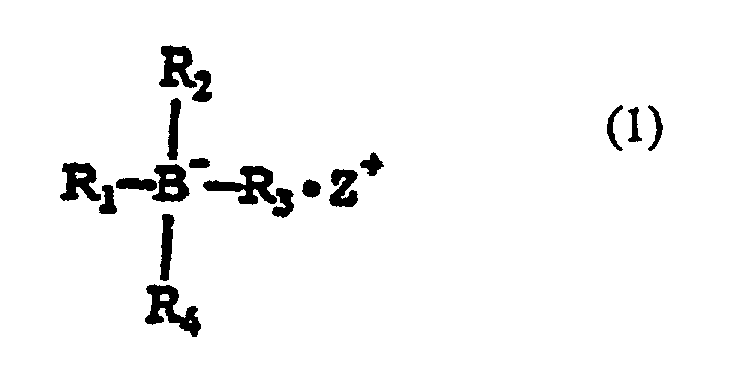
- Composition selon la revendication 1, dans laquelle le colorant sensibilisateur est sélectionné dans le groupe consistant en colorants cationiques et colorants neutres électriquement.
- Composition selon l'une quelconque des revendications précédentes, dans laquelle les autres monomères comprennent, à la différence du au moins un composé styrène, au moins un composé sélectionné dans le groupe consistant en acrylates d'alkyle avec des groupes alkyle de 1 à 8 atomes de carbone et en acrylates d'hydroxyalkyle avec des groupes hydroxyalkyle de 2 à 8 atomes de carbone et au moins un composé sélectionné dans le groupe consistant en méthacrylates d'alkyle avec des groupes alkyle de 1 à 8 atomes de carbone et en méthacrylates d'hydroxyalkyle avec des groupes hydroxyalkyle de 2 à 8 atomes de carbone.
- Composition selon l'une quelconque des revendications précédentes, dans laquelle le monomère contenant un groupe carboxyle α,β-non saturé est un monomère avec 3 à 15 atomes de carbone.
- Composition selon l'une quelconque des revendications précédentes, dans laquelle le polymère thermoplastique est un polymère thermoplastique obtenu par copolymérisation de 15 à 30 % en poids d'un ou de plusieurs composé(s) sélectionné(s) parmi des monomères contenant un groupe carboxy α,β-non saturé et de 85 à 70 % en poids d'un autre monomère.
- Composition selon l'une quelconque des revendications précédentes, qui contient (a) de 40 à 70 % en poids du polymère thermoplastique, (b) de 25 à 50 % en poids du monomère de réticulation et de 0,1 à 10 % en poids de l'initiateur photopolymérisable sensible à la lumière visible et/ou ultraviolette.
- Composition selon la revendication 6, dans laquelle le contenu du monomère de réticulation est au moins de 65 % en poids par rapport au polymère thermoplastique.
- Composition selon l'une quelconque des revendications précédentes, dans laquelle l'initiateur photopolymérisable sensible à la lumière visible et/ou ultraviolette comprend un composé représenté par la formule générale (2) ci-dessous et un colorant sensibilisateurdans laquelle R5 et R6 peuvent être les mêmes ou différents et chacun représente indépendamment l'hydrogène ou un groupe alicyclique, hétérocyclique, aralkyle, aryle, alkoxyle, alkényle ou alkyle, R5 peut être à des positions quelconques sur les noyaux de naphtalène, et Z+ représente un cation ammonium quaternaire, un cation pyridinium quaternaire, un cation quinolinium quaternaire, un cation phosphonium, un cation sulfonium, un cation oxonium, un cation iodonium ou un cation métallique.

- Composition selon l'une quelconque des revendications précédentes, dans laquelle un agent de transfert de chaíne est ajouté à l'initiateur photopolymérisable sensible à la lumière visible et/ou ultraviolette.
- Film photosensible sec dont le composant principal est une composition selon l'une quelconque des revendications précédentes.
- Film photosensible sec selon la revendication 10, dans lequel l'initiateur photopolymérisable sensible à la lumière visible et/ou ultraviolette est un initiateur photopolymérisable avec une photosensibilité à la lumière de 478, 488 ou 532 nm.
Applications Claiming Priority (3)
| Application Number | Priority Date | Filing Date | Title |
|---|---|---|---|
| JP174171/97 | 1997-06-30 | ||
| JP17417197 | 1997-06-30 | ||
| JP17417197 | 1997-06-30 |
Publications (2)
| Publication Number | Publication Date |
|---|---|
| EP0889362A1 EP0889362A1 (fr) | 1999-01-07 |
| EP0889362B1 true EP0889362B1 (fr) | 2003-08-27 |
Family
ID=15973955
Family Applications (1)
| Application Number | Title | Priority Date | Filing Date |
|---|---|---|---|
| EP98111662A Expired - Lifetime EP0889362B1 (fr) | 1997-06-30 | 1998-06-24 | Composition photopolymérisable et film sec de photoréserve |
Country Status (4)
| Country | Link |
|---|---|
| EP (1) | EP0889362B1 (fr) |
| KR (1) | KR19990007428A (fr) |
| DE (1) | DE69817471T2 (fr) |
| TW (1) | TW561309B (fr) |
Families Citing this family (2)
| Publication number | Priority date | Publication date | Assignee | Title |
|---|---|---|---|---|
| EP1031579B1 (fr) * | 1999-02-26 | 2005-07-27 | Showa Denko Kabushiki Kaisha | Initiateur de photopolymérisation pour filtre coloré, composition colorante et filtre coloré |
| KR100873268B1 (ko) * | 2005-08-17 | 2008-12-11 | 제이에스알 가부시끼가이샤 | 감광성 수지 조성물, 표시 패널용 스페이서 및 표시 패널 |
Family Cites Families (5)
| Publication number | Priority date | Publication date | Assignee | Title |
|---|---|---|---|---|
| JP2571115B2 (ja) * | 1989-01-17 | 1997-01-16 | 富士写真フイルム株式会社 | 感光性組成物の増感方法及び増感された感光性組成物 |
| CA2053761A1 (fr) * | 1990-10-25 | 1992-04-26 | Gregory C. Weed | Co-initiateurs a base de borate pour compositions photopolymerisables |
| US5143818A (en) * | 1991-02-01 | 1992-09-01 | E. I. Du Pont De Nemours And Company | Borate coinitiators for photopolymerizable compositions |
| US5346801A (en) * | 1992-04-01 | 1994-09-13 | Konica Corporation | Method of forming images |
| AU717137B2 (en) * | 1995-11-24 | 2000-03-16 | Ciba Specialty Chemicals Holding Inc. | Borate coinitiators for photopolymerization |
-
1998
- 1998-06-24 DE DE69817471T patent/DE69817471T2/de not_active Expired - Lifetime
- 1998-06-24 EP EP98111662A patent/EP0889362B1/fr not_active Expired - Lifetime
- 1998-06-29 KR KR1019980024972A patent/KR19990007428A/ko not_active Ceased
- 1998-06-29 TW TW087110466A patent/TW561309B/zh not_active IP Right Cessation
Also Published As
| Publication number | Publication date |
|---|---|
| KR19990007428A (ko) | 1999-01-25 |
| DE69817471D1 (de) | 2003-10-02 |
| EP0889362A1 (fr) | 1999-01-07 |
| DE69817471T2 (de) | 2004-07-01 |
| TW561309B (en) | 2003-11-11 |
Similar Documents
| Publication | Publication Date | Title |
|---|---|---|
| JP4586919B2 (ja) | 感光性エレメント、レジストパターンの形成方法及びプリント配線板の製造方法 | |
| EP0566353B1 (fr) | Composition photopolymérisable | |
| JP4924230B2 (ja) | 感光性樹脂組成物、これを用いた感光性エレメント、レジストパターンの形成方法及びプリント配線板の製造方法 | |
| JPH11174464A (ja) | 樹脂スペーサー形成用感光性フィルム | |
| WO2009116182A1 (fr) | Composition de résine photosensible, élément photosensible, procédé de formation d'un motif de réserve et procédé de production d'un tableau de connexions imprimées | |
| JPWO2003073168A1 (ja) | 感光性樹脂組成物、これを用いた感光性エレメント、レジストパターンの形成方法及びプリント配線板の製造方法 | |
| JP2002220409A (ja) | 光重合性組成物及びドライフィルム、それらを用いたプリント配線板の製造方法 | |
| JP5376043B2 (ja) | 感光性樹脂組成物並びにこれを用いた感光性エレメント、レジストパターンの形成方法及びプリント配線板の製造方法 | |
| JP4752656B2 (ja) | 感光性樹脂組成物、感光性エレメント、これらを用いたレジストパターンの形成方法及びプリント配線板の製造方法 | |
| US6033829A (en) | Photopolymerizable composition and dry film resist | |
| EP0889362B1 (fr) | Composition photopolymérisable et film sec de photoréserve | |
| JP2008304527A (ja) | 感光性樹脂組成物、これを用いた感光性エレメント、レジストパターンの形成方法及びプリント配線板の製造方法 | |
| US5153100A (en) | Borate coinitiators for photopolymerizable compositions | |
| JP2004326084A (ja) | 感光性エレメント、これを用いたレジストパターンの形成方法及びプリント配線板の製造方法 | |
| JP3736654B2 (ja) | 感光性樹脂組成物及びこれを用いた感光性エレメント | |
| JP4887965B2 (ja) | 感光性樹脂組成物、これを用いた感光性エレメント、レジストパターンの形成方法及びプリント配線板の製造方法 | |
| JPH1172915A (ja) | 光重合性組成物及びドライフィルムレジスト | |
| JPH0756334A (ja) | 感光性樹脂組成物及びこれを用いた感光性エレメント | |
| JP2015197656A (ja) | レーザー直描露光用感光性樹脂組成物、並びにこれを用いた感光性エレメント、レジストパターンの形成方法及びプリント配線板の製造法 | |
| JP2006071916A (ja) | 青紫色レーザー感光性組成物、並びにそれを用いた画像形成材料、画像形成材、及び画像形成方法 | |
| JPH0667425A (ja) | 可視光線硬化型光重合性組成物 | |
| JP2005128300A (ja) | 感光性樹脂組成物及びこれを用いた感光性エレメント、レジストパターンの製造方法、プリント配線板、ディスプレイ板の製造方法 | |
| WO2025115821A1 (fr) | Composition de résine photosensible, élément photosensible, procédé de formation de motif de résine photosensible et procédé de production de carte de circuit imprimé | |
| JP2003177526A (ja) | 感光性エレメント、感光性エレメントの製造法、これを用いたレジストパターンの製造法及びプリント配線板の製造法 | |
| JPS604940A (ja) | 光重合可能な画像形成用組成物 |
Legal Events
| Date | Code | Title | Description |
|---|---|---|---|
| PUAI | Public reference made under article 153(3) epc to a published international application that has entered the european phase |
Free format text: ORIGINAL CODE: 0009012 |
|
| AK | Designated contracting states |
Kind code of ref document: A1 Designated state(s): AT BE CH CY DE DK ES FI FR GB GR IE IT LI LU MC NL PT SE |
|
| AX | Request for extension of the european patent |
Free format text: AL;LT;LV;MK;RO;SI |
|
| 17P | Request for examination filed |
Effective date: 19990701 |
|
| AKX | Designation fees paid |
Free format text: AT BE CH CY DE DK ES FI FR GB GR IE IT LI LU MC NL PT SE |
|
| 17Q | First examination report despatched |
Effective date: 20001228 |
|
| GRAH | Despatch of communication of intention to grant a patent |
Free format text: ORIGINAL CODE: EPIDOS IGRA |
|
| GRAH | Despatch of communication of intention to grant a patent |
Free format text: ORIGINAL CODE: EPIDOS IGRA |
|
| RBV | Designated contracting states (corrected) |
Designated state(s): DE FR GB |
|
| GRAA | (expected) grant |
Free format text: ORIGINAL CODE: 0009210 |
|
| AK | Designated contracting states |
Designated state(s): DE FR GB |
|
| REG | Reference to a national code |
Ref country code: GB Ref legal event code: FG4D |
|
| REG | Reference to a national code |
Ref country code: IE Ref legal event code: FG4D |
|
| REF | Corresponds to: |
Ref document number: 69817471 Country of ref document: DE Date of ref document: 20031002 Kind code of ref document: P |
|
| ET | Fr: translation filed | ||
| PLBE | No opposition filed within time limit |
Free format text: ORIGINAL CODE: 0009261 |
|
| STAA | Information on the status of an ep patent application or granted ep patent |
Free format text: STATUS: NO OPPOSITION FILED WITHIN TIME LIMIT |
|
| 26N | No opposition filed |
Effective date: 20040528 |
|
| REG | Reference to a national code |
Ref country code: IE Ref legal event code: MM4A |
|
| PGFP | Annual fee paid to national office [announced via postgrant information from national office to epo] |
Ref country code: FR Payment date: 20110621 Year of fee payment: 14 |
|
| PGFP | Annual fee paid to national office [announced via postgrant information from national office to epo] |
Ref country code: GB Payment date: 20110622 Year of fee payment: 14 |
|
| PGFP | Annual fee paid to national office [announced via postgrant information from national office to epo] |
Ref country code: DE Payment date: 20110622 Year of fee payment: 14 |
|
| GBPC | Gb: european patent ceased through non-payment of renewal fee |
Effective date: 20120624 |
|
| REG | Reference to a national code |
Ref country code: FR Ref legal event code: ST Effective date: 20130228 |
|
| REG | Reference to a national code |
Ref country code: DE Ref legal event code: R119 Ref document number: 69817471 Country of ref document: DE Effective date: 20130101 |
|
| PG25 | Lapsed in a contracting state [announced via postgrant information from national office to epo] |
Ref country code: FR Free format text: LAPSE BECAUSE OF NON-PAYMENT OF DUE FEES Effective date: 20120702 Ref country code: GB Free format text: LAPSE BECAUSE OF NON-PAYMENT OF DUE FEES Effective date: 20120624 Ref country code: DE Free format text: LAPSE BECAUSE OF NON-PAYMENT OF DUE FEES Effective date: 20130101 |