EP0889522A2 - Keramikgehäuse und Verfahren zu seiner Herstellung - Google Patents
Keramikgehäuse und Verfahren zu seiner Herstellung Download PDFInfo
- Publication number
- EP0889522A2 EP0889522A2 EP98110855A EP98110855A EP0889522A2 EP 0889522 A2 EP0889522 A2 EP 0889522A2 EP 98110855 A EP98110855 A EP 98110855A EP 98110855 A EP98110855 A EP 98110855A EP 0889522 A2 EP0889522 A2 EP 0889522A2
- Authority
- EP
- European Patent Office
- Prior art keywords
- weight
- glass solder
- mixture
- ceramic
- temperature
- Prior art date
- Legal status (The legal status is an assumption and is not a legal conclusion. Google has not performed a legal analysis and makes no representation as to the accuracy of the status listed.)
- Withdrawn
Links
Images
Classifications
-
- H—ELECTRICITY
- H10—SEMICONDUCTOR DEVICES; ELECTRIC SOLID-STATE DEVICES NOT OTHERWISE PROVIDED FOR
- H10W—GENERIC PACKAGES, INTERCONNECTIONS, CONNECTORS OR OTHER CONSTRUCTIONAL DETAILS OF DEVICES COVERED BY CLASS H10
- H10W76/00—Containers; Fillings or auxiliary members therefor; Seals
- H10W76/60—Seals
-
- H—ELECTRICITY
- H10—SEMICONDUCTOR DEVICES; ELECTRIC SOLID-STATE DEVICES NOT OTHERWISE PROVIDED FOR
- H10W—GENERIC PACKAGES, INTERCONNECTIONS, CONNECTORS OR OTHER CONSTRUCTIONAL DETAILS OF DEVICES COVERED BY CLASS H10
- H10W72/00—Interconnections or connectors in packages
- H10W72/50—Bond wires
- H10W72/531—Shapes of wire connectors
- H10W72/536—Shapes of wire connectors the connected ends being ball-shaped
-
- H—ELECTRICITY
- H10—SEMICONDUCTOR DEVICES; ELECTRIC SOLID-STATE DEVICES NOT OTHERWISE PROVIDED FOR
- H10W—GENERIC PACKAGES, INTERCONNECTIONS, CONNECTORS OR OTHER CONSTRUCTIONAL DETAILS OF DEVICES COVERED BY CLASS H10
- H10W72/00—Interconnections or connectors in packages
- H10W72/50—Bond wires
- H10W72/531—Shapes of wire connectors
- H10W72/5363—Shapes of wire connectors the connected ends being wedge-shaped
-
- H—ELECTRICITY
- H10—SEMICONDUCTOR DEVICES; ELECTRIC SOLID-STATE DEVICES NOT OTHERWISE PROVIDED FOR
- H10W—GENERIC PACKAGES, INTERCONNECTIONS, CONNECTORS OR OTHER CONSTRUCTIONAL DETAILS OF DEVICES COVERED BY CLASS H10
- H10W72/00—Interconnections or connectors in packages
- H10W72/851—Dispositions of multiple connectors or interconnections
- H10W72/874—On different surfaces
- H10W72/884—Die-attach connectors and bond wires
-
- H—ELECTRICITY
- H10—SEMICONDUCTOR DEVICES; ELECTRIC SOLID-STATE DEVICES NOT OTHERWISE PROVIDED FOR
- H10W—GENERIC PACKAGES, INTERCONNECTIONS, CONNECTORS OR OTHER CONSTRUCTIONAL DETAILS OF DEVICES COVERED BY CLASS H10
- H10W90/00—Package configurations
- H10W90/701—Package configurations characterised by the relative positions of pads or connectors relative to package parts
- H10W90/731—Package configurations characterised by the relative positions of pads or connectors relative to package parts of die-attach connectors
- H10W90/736—Package configurations characterised by the relative positions of pads or connectors relative to package parts of die-attach connectors between a chip and a stacked lead frame, conducting package substrate or heat sink
-
- H—ELECTRICITY
- H10—SEMICONDUCTOR DEVICES; ELECTRIC SOLID-STATE DEVICES NOT OTHERWISE PROVIDED FOR
- H10W—GENERIC PACKAGES, INTERCONNECTIONS, CONNECTORS OR OTHER CONSTRUCTIONAL DETAILS OF DEVICES COVERED BY CLASS H10
- H10W90/00—Package configurations
- H10W90/701—Package configurations characterised by the relative positions of pads or connectors relative to package parts
- H10W90/751—Package configurations characterised by the relative positions of pads or connectors relative to package parts of bond wires
- H10W90/756—Package configurations characterised by the relative positions of pads or connectors relative to package parts of bond wires between a chip and a stacked lead frame, conducting package substrate or heat sink
Definitions
- the invention relates to a ceramic housing for encapsulating electronic components and a method of manufacturing a ceramic package.
- Suitable Ceramic materials are in particular aluminum oxide or aluminum nitride.
- the assembly the ceramic housing is made by gluing or soldering for use at low Operating temperatures up to 200 ° C.
- the adhesive or the lanyard decomposes between the ceramic parts.
- active soldering with a metal can be used as a connecting means.
- the process temperature required for this is above 900 ° C the electronics to be encapsulated are destroyed.
- the invention has for its object a ceramic housing, in particular made of aluminum nitride, specify which hermetic encapsulation of electronic components is suitable for elevated operating temperatures, and a process for its production.
- the ceramic parts to be joined are soldered with a glass connected, which can be processed at temperatures necessary for the electronic materials to be encapsulated are still compatible and a hermetically sealed connection of the ceramic joining parts enable.
- the processing temperature is advantageously only slightly above the maximum Operating temperature that reaches up to 700 ° C without the adhesion of the parts to be joined, the strength and / or the hermeticity of the connection point is deteriorated.
- Joined parts connected with the glass solder can advantageously permanently up to close to the processing temperature of the glass solder at elevated Temperature should be maintained without the joint being soft or leaking becomes.
- Glass solders are particularly preferably used, in particular glass solders with a composition no gas-forming reactions with the ceramic joining parts in the processing area evokes.
- the composition of the glass solder has a lead oxide concentration of less than 1 percent by weight. It is particularly advantageous that the glass solder essentially is free from alkali metal oxides and has a thermal expansion coefficient, which largely corresponds to that of the ceramic parts to be joined.
- the glass solder particularly preferably has a sample weight composition of 62.5% ZnO, 25% B 2 O 3 , 12.5% SiO 2 .
- a further preferred composition contains 60% ZnO, 10% SiO 2 , 25% B 2 O 3 , 3% Ta 2 O 5 , 1% Al 2 O 3 in the sample .
- parts to be joined are joined by a homogeneous Glass frit paste is applied to a first part to be joined, the paste after it has been driven out of the organic component with the first joining part at a first temperature for pre-glazed for a first time, then the first part to be fitted with a glass frit coating and a second joining part is brought to a second elevated temperature for one second period heated and the first is connected to the second joining part.
- one or both parts to be joined are made with paste coated, assembled, heated and connected to the pre-glazed glass solder.
- crystallization nuclei are added to the glass frit.
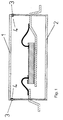
- FIG. 1 shows an inventive housing for encapsulating electronic semiconductor components.
- Fig. 1 shows a ceramic housing according to the invention with a built-in electronic Component.
- a joining part 1 is adapted to a joining part 2 with a connecting means 3 Connection points 4 connected.
- This is located inside the ceramic housing protective electronic component, which is preferably made of a high temperature material, in particular silicon carbide or the like.
- the ceramic housing according to the invention for microelectronic high temperature components is for an application temperature suitable up to 700 ° C.
- the manufacturing method according to the invention is particularly suitable for aluminum nitride housings, however, the invention is not limited to this ceramic material.
- Aluminum nitride housings have the problem that above 500 ° C between the Ceramic and the connecting agent can develop gas-forming reactions, so that the Connection point is leaking or the connection is completely detached.
- the connecting means according to the invention prevents gas-forming reactions at the connection point the parts to be joined.
- the connecting means does not grip the ceramic of the parts to be joined corrosive.
- the ceramic joining parts are connected with a glaze.
- the mixture of the glass solder preferably has an initial weight content of 12.5% SiO 2 , 25% B 2 O 3 and 62.5% ZnO in weight percent.
- the components Si, Zn and B are effective as glass formers.
- the glass solder of this composition already has a crystallization of the glass solder during the joining process, which has the advantage that the glass solder can be thermally stressed permanently up to its processing temperature without the connection point becoming leaky.
- the mixture of the glass solder has an initial weight content of 3% Ta 2 O 5 , 1% Al 2 O 3 , 10% SiO 2 , 25% B 2 O 3 and 60% ZnO in percent by weight.
- the addition of Al 2 O 3 advantageously improves the chemical resistance of the glass solder.
- the addition of Ta 2 O 5 advantageously slows down the rate of crystallization during the joining process, so that this process can be controlled and also advantageously improves the wetting properties of the glass solder on the ceramic.
- the lead oxide content is low, at least less than 1 percent by weight, it is particularly preferred that the glass solder has no lead oxide content. Even at outsourcing a component soldered to it for several hundred hours A component temperature of around 650 ° C showed no discernible at the joints Pore formation.
- Dispensing with lead oxide in a glass solder in itself means a greatly increased processing temperature, those for the permitted maximum processing temperatures below about 800 ° C is too high.
- the composition of the glass solder according to the invention nevertheless allows one reduced processing temperature of below 800 ° C, especially 700-750 ° C.
- the alkali metal oxide content of the glass solder is low as possible. Although an alkali metal oxide content lowers the melting temperature of the glass frit, this leads to undesirable contamination with alkali metals in the case of an electronic semiconductor component that is to be encapsulated, which contaminate quickly in the semiconductor body and can form undesirable doping in the semiconductor component.
- the thermal expansion coefficient of the glass solder increases with the alkali metal oxide content. In the case of glass solder free of alkali metal oxide, the coefficient of thermal expansion is approximately 3.5 ⁇ 10 -6 to 4 ⁇ 10 -6 1 / K.
- a mixture is first of all used to connect ceramic joining parts according to the invention from lead oxide-free, preferably additionally alkali metal oxide-free, oxide powders into a homogeneous Melt transformed.
- the oxide mixture is preferably placed in a platinum crucible heated to preferably 1300 ° C until a homogeneous melt is formed.
- the melt is quenched, care must be taken to ensure that the melt is not mixed with water comes into contact to avoid hydrolytic attack.
- the resulting Glass is then finely ground into a glass frit, preferably with a medium one Grain size of at most 12 microns, especially at most about 5 microns.
- crystal nuclei can be added to the finely ground glass frit, in particular about 2 percent by weight, which improve the crystallization behavior of the glass solder.
- the crystal nuclei preferably have different contents of boron oxide and / or silicon oxide, in particular ZnO. 2B 2 O 3 , ZnO. B 2 O 3 , 3ZnO. B 2 O 3 and / or 2 ZnO. SiO 2 . Since these components also subsequently crystallize out of the glass solder in the joining process, the crystallization behavior can be controlled favorably by adding the crystallization nuclei.
- the frit then becomes an homogeneous paste with an organic component processed.
- the organic component is in particular a mixture of iso- or ⁇ -terpineol and an isobutyl methacrylate (e.g. Elvacite 2045 from DuPont).
- the paste forms the connecting means 3, which in particular on a first joining part 1 to be connected a ceramic housing cover is applied.
- the application can be done by brushing on, preferably done by doctor blade or screen printing.
- the housing itself can preferably already have gas-tight electrical feedthroughs. However, it is also possible to make electrical feedthroughs gas-tight by means of the glass solder Glue or solder in any housing bushings.
- the organic component is expelled by heating the paste and then pre-glazed.
- the first part to be joined is slowly heated to a first temperature above 600 ° C, in particular heated to 650 ° C. and held there for a first time, preferably longer than 10 minutes, particularly preferably 20 minutes. Forms by densifying the glass grains there is a compact glass layer at the junction, which is easy to handle.
- the first joining part and / or a second joining part, in particular a lower part of a ceramic housing in which an electronic semiconductor component is inserted by reheat and melt the glass solder to a second temperature above the first Temperature heated, for a predetermined second period of time at the second elevated temperature held and the first joining part 1 connected to the second joining part 2.
- the second temperature is preferably about 700 ° C, the second time is preferably longer than 15 minutes, preferably 30 minutes.
- the joining time can be increased by increasing the joining temperature advantageously be shortened.
- the joining temperature and the joining time are expediently so coordinated that the component to be encapsulated treats as gently as possible becomes.
- first and / or second joining part are joined with the Spread the paste, put it together and then heat it up, the organic component Expelled from the paste, the glass solder pre-glazed and the parts to be joined joined together become.
- the addition of the crystallization nuclei in the preparation of the glass frit is particularly advantageous, since the connection can be permanently loaded even near the processing temperature without softening or loosening.
- the crystallization nuclei lead to the controlled conversion of the glass solder to a glass ceramic that is particularly strong. While the pure glass solder crystallizes very slowly and in an uncontrolled manner and already becomes soft at higher temperatures above 600 ° C, the crystallization of the glass solder, which was initiated by the crystallization nuclei, in particular zinc borate and / or zinc silicate, leads to a drastic reduction in the flowability of the glass .
- the crystallized components also have an advantageous coefficient of thermal expansion in the range from 3.5 ⁇ 10 -6 to 4 ⁇ 10 -6 1 / K.
Landscapes
- Glass Compositions (AREA)
- Ceramic Products (AREA)
- Casings For Electric Apparatus (AREA)
Abstract
Description
Claims (22)
- Keramikbauelement, insbesondere zum Kapseln von elektronischen Bauelementen, welches ein Verbindungsmaterial und zu verbindende Keramik-Fügeteile aufweist, dadurch gekennzeichnet,
daß die Fügeteile (1, 2) durch ein Glaslot (3) mit einer Verarbeitungstemperatur von mehr als 500°C und weniger als 800°C verbunden sind. - Keramikgehäuse nach Anspruch 1,
dadurch gekennzeichnet,
daß das Gemenge des Glaslots einen PbO-Anfangsgehalt der Einwaage von weniger als 1 Gewichtsprozent aufweist. - Keramikgehäuse nach Anspruch 1 oder 2,
dadurch gekennzeichnet,
daß das Gemenge des Glaslots einen Alkalioxid-Anfangsgehalt der Einwaage von weniger als 0,5 Gewichtsprozent aufweist. - Keramikgehäuse nach einem oder mehreren der vorausgegangenen Ansprüche,
dadurch gekennzeichnet,
daß das Gemenge des Glaslots einen ZnO-Anfangsgehalt der Einwaage von mehr als 40 Gewichtsprozent aufweist. - Keramikgehäuse nach einem oder mehreren der vorausgegangenen Ansprüche,
dadurch gekennzeichnet,
daß das Gemenge des Glaslots einen SiO2-Anfangsgehalt der Einwaage von mehr als 5 Gewichtsprozent aufweist. - Keramikgehäuse nach einem oder mehreren der vorausgegangenen Ansprüche,
dadurch gekennzeichnet,
daß das Gemenge des Glaslots einen Ta2O5-Anfangsgehalt der Einwaage von mehr als 0,5 Gewichtsprozent aufweist. - Keramikgehäuse nach einem oder mehreren der vorausgegangenen Ansprüche,
dadurch gekennzeichnet,
daß das Gemenge des Glaslots einen Al2O3-Anfangsgehalt der Einwaage von mehr als 0,5 Gewichtsprozent aufweist. - Keramikgehäuse nach einem oder mehreren der vorausgegangenen Ansprüche,
dadurch gekennzeichnet,
daß das Gemenge des Glaslots einen B2O3-Anfangsgehalt der Einwaage von mehr als 10 Gewichtsprozent aufweist. - Keramikgehäuse nach einem oder mehreren der vorausgegangenen Ansprüche,
dadurch gekennzeichnet,
daß das Gemenge des Glaslots jeweils einen Anfangsgehalt in der Einwaage von 3% Ta2O5, 1% Al2O3 , 10% SiO2, 25% B2O3, und 60% ZnO in Gewichtsprozent aufweist. - Keramikgehäuse nach einem oder mehreren der vorausgegangenen Ansprüche 1-8,
dadurch gekennzeichnet,
daß das Gemenge des Glaslots jeweils einen Anfangsgehalt in der Einwaage von 12,5% SiO2, 25% B2O3, und 62,5% ZnO in Gewichtsprozent aufweist. - Keramikgehäuse nach einem oder mehreren der vorausgegangenen Ansprüche,
dadurch gekennzeichnet,
daß das Glaslot einen thermischen Ausdehnungskoeffizienten von weniger als 5·10-6/K aufweist. - Keramikgehäuse nach einem oder mehreren der vorausgegangenen Ansprüche,
dadurch gekennzeichnet,
daß das Gehäuse Aluminiumnitrid aufweist. - Verfahren zum Verbinden von Fügeteilen aus Keramik, insbesondere nach Anspruch 1 oder einen oder mehreren der folgenden,
dadurch gekennzeichnet,
daß eine Paste aus einer Mischung aus Glasfritte und organischer Komponente auf ein erstes zu verbindendes Fügeteil aufgebracht wird, daß die Paste nach Austreiben der organischen Komponente vorverglast wird, indem das erste Fügeteil auf eine erste Temperatur über 600°C aufgeheizt und dort eine erste Zeitdauer gehalten wird, anschließend das erste Fügeteil mit einem zweiten Fügeteil auf Anschlag gebracht, auf eine zweite Temperatur über der ersten Temperatur erhitzt, für eine vorgegebene zweite Zeitdauer bei der zweiten Temperatur gehalten wird und dabei das erste Fügeteil mit dem zweiten Fügeteil verbunden wird. - Verfahren nach Anspruch 13,
dadurch gekennzeichnet,
daß das erste und/oder das zweite Fügeteil mit der Paste bestrichen, auf Anschlag gebracht, auf eine erste Temperatur über 600°C aufgeheizt und dort eine erste Zeitdauer gehalten wird, anschließend auf eine zweite Temperatur über der ersten Temperatur erhitzt, für eine vorgegebene zweite Zeitdauer bei der zweiten Temperatur gehalten und dabei das erste Fügeteil mit dem zweiten Fügeteil verbunden wird. - Verfahren nach Anspruch 13 oder 14,
dadurch gekennzeichnet,
daß die Glasfritte aus einer Mischung von bleioxidfreien Oxidpulvern hergestellt wird, welche in eine homogene Schmelze verwandelt und abgeschreckt und anschließend das entstandene Glas anschließend fein zur Glasfritte gemahlen wird. - Verfahren nach Anspruch 13, 14 oder 15,
dadurch gekennzeichnet,
daß der Glasfritte Kristallkeime zugegebene werden. - Verfahren nach einem oder mehreren der vorausgegangenen Ansprüche 13 bis 16,
dadurch gekennzeichnet,
daß die erste Temperatur zwischen 600°C und 700°C liegt. - Verfahren nach einem oder mehreren der vorausgegangenen Ansprüche 13 bis 17,
dadurch gekennzeichnet,
daß die zweite Temperatur zwischen 650°C und 800°C liegt. - Verfahren nach einem oder mehreren der vorausgegangenen Ansprüche 13 bis 18,
dadurch gekennzeichnet,
daß die erste Zeitdauer länger als 10 Minuten dauert. - Verfahren nach einem oder mehreren der vorausgegangenen Ansprüche 13 bis 19,
dadurch gekennzeichnet,
daß die zweite Zeitdauer länger als 15 Minuten dauert. - Verfahren nach einem oder mehreren der vorausgegangenen Ansprüche 13 bis 20,
dadurch gekennzeichnet,
daß beim Verbinden des ersten mit dem zweiten Fügeteil ein Druck auf die beiden Fügeteile ausgeübt wird. - Verfahren nach Anspruch 21,
dadurch gekennzeichnet,
daß der Druck im Bereich zwischen 10 und 100 kPa ausgeübt wird.
Applications Claiming Priority (2)
| Application Number | Priority Date | Filing Date | Title |
|---|---|---|---|
| DE19727913 | 1997-07-01 | ||
| DE19727913A DE19727913A1 (de) | 1997-07-01 | 1997-07-01 | Keramikgehäuse und Verfahren zu seiner Herstellung |
Publications (2)
| Publication Number | Publication Date |
|---|---|
| EP0889522A2 true EP0889522A2 (de) | 1999-01-07 |
| EP0889522A3 EP0889522A3 (de) | 1999-12-08 |
Family
ID=7834203
Family Applications (1)
| Application Number | Title | Priority Date | Filing Date |
|---|---|---|---|
| EP98110855A Withdrawn EP0889522A3 (de) | 1997-07-01 | 1998-06-13 | Keramikgehäuse und Verfahren zu seiner Herstellung |
Country Status (2)
| Country | Link |
|---|---|
| EP (1) | EP0889522A3 (de) |
| DE (1) | DE19727913A1 (de) |
Cited By (2)
| Publication number | Priority date | Publication date | Assignee | Title |
|---|---|---|---|---|
| DE102010000042A1 (de) * | 2010-01-11 | 2011-07-14 | HE System Electronic GmbH & Co. KG, 90587 | Elektrisches Heizungselement und ein Verfahren zu dessen Herstellung |
| CN118894648A (zh) * | 2023-05-05 | 2024-11-05 | 中国科学院上海硅酸盐研究所 | 一种连接氮化铝陶瓷用玻璃焊料及其制备方法和应用 |
Families Citing this family (2)
| Publication number | Priority date | Publication date | Assignee | Title |
|---|---|---|---|---|
| DE10132578B4 (de) * | 2001-07-10 | 2007-04-26 | Forschungszentrum Jülich GmbH | Verfahren zum Verbinden von metallischen und/oder keramischen Formteilen |
| DE10219951A1 (de) | 2002-05-03 | 2003-11-13 | Patent Treuhand Ges Fuer Elektrische Gluehlampen Mbh | Verfahren zur Verkapselung eines Bauelements auf Basis organischer Halbleiter |
Family Cites Families (15)
| Publication number | Priority date | Publication date | Assignee | Title |
|---|---|---|---|---|
| NL109459C (de) * | 1960-01-26 | |||
| NL7106531A (de) * | 1970-05-14 | 1971-11-16 | ||
| US3697666A (en) * | 1971-09-24 | 1972-10-10 | Diacon | Enclosure for incapsulating electronic components |
| JPS6011467B2 (ja) * | 1976-08-11 | 1985-03-26 | 株式会社日立製作所 | ガラス被覆半導体装置およびその製法 |
| US4328022A (en) * | 1979-02-12 | 1982-05-04 | Corning Glass Works | Composite article and method of sealing |
| NL7908501A (nl) * | 1979-11-22 | 1981-06-16 | Philips Nv | Lichamen samengesteld uit ten minste twee delen, verbindingsglas en werkwijze voor het aan elkaar hechten van delen. |
| JPS6066843A (ja) * | 1983-09-22 | 1985-04-17 | Hitachi Ltd | 集積回路パツケ−ジ |
| JP2572823B2 (ja) * | 1988-09-22 | 1997-01-16 | 日本碍子株式会社 | セラミック接合体 |
| JP2952303B2 (ja) * | 1988-11-15 | 1999-09-27 | 旭テクノグラス株式会社 | 複合型回路装置 |
| JPH02174144A (ja) * | 1988-12-26 | 1990-07-05 | Sumitomo Electric Ind Ltd | 半導体装置用パッケージ |
| US5168126A (en) * | 1989-08-25 | 1992-12-01 | Kyocera Corporation | Container package for semiconductor element |
| US5140109A (en) * | 1989-08-25 | 1992-08-18 | Kyocera Corporation | Container package for semiconductor element |
| JP3080772B2 (ja) * | 1992-05-20 | 2000-08-28 | 鹿島建設株式会社 | トンネル掘削装置 |
| JPH06112339A (ja) * | 1992-09-29 | 1994-04-22 | Toshiba Corp | セラミックパッケージ |
| DE4308361C2 (de) * | 1993-03-16 | 1998-12-10 | Siemens Ag | Verfahren zur Herstellung einer Verbindung zweier Keramikteile bzw. eines Metall- und eines Keramikteils |
-
1997
- 1997-07-01 DE DE19727913A patent/DE19727913A1/de not_active Withdrawn
-
1998
- 1998-06-13 EP EP98110855A patent/EP0889522A3/de not_active Withdrawn
Cited By (2)
| Publication number | Priority date | Publication date | Assignee | Title |
|---|---|---|---|---|
| DE102010000042A1 (de) * | 2010-01-11 | 2011-07-14 | HE System Electronic GmbH & Co. KG, 90587 | Elektrisches Heizungselement und ein Verfahren zu dessen Herstellung |
| CN118894648A (zh) * | 2023-05-05 | 2024-11-05 | 中国科学院上海硅酸盐研究所 | 一种连接氮化铝陶瓷用玻璃焊料及其制备方法和应用 |
Also Published As
| Publication number | Publication date |
|---|---|
| DE19727913A1 (de) | 1999-01-07 |
| EP0889522A3 (de) | 1999-12-08 |
Similar Documents
| Publication | Publication Date | Title |
|---|---|---|
| DE2533687C2 (de) | Gemisch von Bleiborat-Lötglaspartikeln und einem hochschmelzenden Füllstoff niedrigerer Wärmeausdehnung und seine Verwendung | |
| DE10157443B4 (de) | Glas-Keramikzusammensetzung für ein elektronisches Keramikbauteil, Verwendung der Glas-Keramikzusammensetzung für ein elektronisches Keramikbauteil und Vefahren zur Herstellung eines elektronischen Vielschicht-Keramikbauteils | |
| DE2453665C3 (de) | Fur Körper aus Keramik, Glas oder Metall geeignetes pulverformiges Dichtungsmaterial, bestehend aus der Mischung zweier Pulverkomponenten | |
| DE69015491T2 (de) | Wärmeleitpaste mit Flüssigmetallmatrix. | |
| CH399280A (de) | Metallisierter Keramikkörper, Verfahren zu seiner Herstellung und Verwendung desselben | |
| DE3873938T2 (de) | Laminiertes substrat fuer integrierte schaltungen. | |
| DE1179277B (de) | Beschichtung elektrischer Schaltelemente mit Glas | |
| DE2636580A1 (de) | Oberflaechengeschuetzter, verkapselter halbleiter und verfahren zu seiner herstellung | |
| DE60313222T2 (de) | Verfahren zur herstellung eines zerstäubungstargets | |
| DE2610303C2 (de) | Siebdruckpaste für dicke, elektrisch leitende, Leiterbahnen bildende Schichten auf einem keramischen Substrat | |
| EP0889522A2 (de) | Keramikgehäuse und Verfahren zu seiner Herstellung | |
| DE3509955A1 (de) | Niedrigtemperatur-abdichtungszusammensetzung | |
| DE1471415B2 (de) | Verfahren zur herstellung eines metallueberzugs auf einem keramikkoerper | |
| DE1596949B2 (de) | Schnell und bei relativ niedriger temperatur entglasende loetglaszusammensetzungen | |
| DE3877370T2 (de) | Gesinterter aluminiumnitridkoerper mit metallhaltiger schicht und verfahren zu seiner herstellung. | |
| DE2915631A1 (de) | In glas eingekapselte halbleiteranordnung und verfahren zu ihrer herstellung | |
| DE4308361C2 (de) | Verfahren zur Herstellung einer Verbindung zweier Keramikteile bzw. eines Metall- und eines Keramikteils | |
| DE68910045T2 (de) | Oxid-Gläser mit niedrigen Glas-Transformationstemperaturen. | |
| DE102011080352A1 (de) | Hochtemperatur-Glaslot und dessen Verwendung | |
| DE1812733C (de) | Glaswerkstoff zum Überziehen , Abdichten oder Verbinden von Gegenstanden mit einem linearen Wärmeausdehnungskoeffizienten von weniger als 50 χ 10 hoch 7 / Grad C | |
| DE2700273A1 (de) | Koerniges fuellmaterial fuer einen glaskeramischen werkstoff | |
| AT202056B (de) | Verfahren zum Verbinden keramischer Gegenstände meteinander oder mit Metallgegenständen | |
| DE1471415C (de) | Verfahren zur Herstellung eines Metallüberzugs auf einem Keramikkörper | |
| DE2628823C3 (de) | Glaskeramischer Werkstoff zur Verkapselung von Halbleiterbauelementen | |
| DE1421829C (de) | Schmelzabdichtmasse aus einer keramischen Grundmasse und einem Glasbindemittel, deren Anteile zur Einstellung des Ausdehnungskoeffizienten dosiert sind, für vorgeformte Bauteile |
Legal Events
| Date | Code | Title | Description |
|---|---|---|---|
| PUAI | Public reference made under article 153(3) epc to a published international application that has entered the european phase |
Free format text: ORIGINAL CODE: 0009012 |
|
| AK | Designated contracting states |
Kind code of ref document: A2 Designated state(s): CH DE ES FR GB IT LI NL SE |
|
| AX | Request for extension of the european patent |
Free format text: AL;LT;LV;MK;RO;SI |
|
| RAP1 | Party data changed (applicant data changed or rights of an application transferred) |
Owner name: DAIMLERCHRYSLER AG |
|
| PUAL | Search report despatched |
Free format text: ORIGINAL CODE: 0009013 |
|
| AK | Designated contracting states |
Kind code of ref document: A3 Designated state(s): AT BE CH CY DE DK ES FI FR GB GR IE IT LI LU MC NL PT SE |
|
| AX | Request for extension of the european patent |
Free format text: AL;LT;LV;MK;RO;SI |
|
| 17P | Request for examination filed |
Effective date: 20000114 |
|
| AKX | Designation fees paid |
Free format text: CH DE ES FR GB IT LI NL SE |
|
| STAA | Information on the status of an ep patent application or granted ep patent |
Free format text: STATUS: THE APPLICATION IS DEEMED TO BE WITHDRAWN |
|
| 18D | Application deemed to be withdrawn |
Effective date: 20030103 |