EP0889860B1 - Zementzusätze - Google Patents
Zementzusätze Download PDFInfo
- Publication number
- EP0889860B1 EP0889860B1 EP97908283A EP97908283A EP0889860B1 EP 0889860 B1 EP0889860 B1 EP 0889860B1 EP 97908283 A EP97908283 A EP 97908283A EP 97908283 A EP97908283 A EP 97908283A EP 0889860 B1 EP0889860 B1 EP 0889860B1
- Authority
- EP
- European Patent Office
- Prior art keywords
- polyether
- carboxylic acid
- cement
- cement additive
- group
- Prior art date
- Legal status (The legal status is an assumption and is not a legal conclusion. Google has not performed a legal analysis and makes no representation as to the accuracy of the status listed.)
- Expired - Lifetime
Links
- 239000004568 cement Substances 0.000 title claims abstract description 94
- 239000000654 additive Substances 0.000 title claims abstract description 80
- 229920000570 polyether Polymers 0.000 claims abstract description 117
- 239000004721 Polyphenylene oxide Substances 0.000 claims abstract description 86
- 239000000203 mixture Substances 0.000 claims abstract description 70
- XLYOFNOQVPJJNP-UHFFFAOYSA-N water Substances O XLYOFNOQVPJJNP-UHFFFAOYSA-N 0.000 claims abstract description 49
- 229920000642 polymer Polymers 0.000 claims abstract description 44
- -1 poly(acrylic acid) Polymers 0.000 claims abstract description 43
- 150000001732 carboxylic acid derivatives Chemical class 0.000 claims abstract description 42
- 238000003776 cleavage reaction Methods 0.000 claims abstract description 35
- 230000007017 scission Effects 0.000 claims abstract description 35
- 150000002924 oxiranes Chemical class 0.000 claims abstract description 32
- 238000005886 esterification reaction Methods 0.000 claims abstract description 26
- 230000032050 esterification Effects 0.000 claims abstract description 24
- 238000006243 chemical reaction Methods 0.000 claims abstract description 18
- LSNNMFCWUKXFEE-UHFFFAOYSA-M Bisulfite Chemical compound OS([O-])=O LSNNMFCWUKXFEE-UHFFFAOYSA-M 0.000 claims abstract description 4
- 239000002253 acid Substances 0.000 claims description 71
- 230000000996 additive effect Effects 0.000 claims description 64
- 238000000034 method Methods 0.000 claims description 23
- 239000000178 monomer Substances 0.000 claims description 23
- GOOHAUXETOMSMM-UHFFFAOYSA-N Propylene oxide Chemical compound CC1CO1 GOOHAUXETOMSMM-UHFFFAOYSA-N 0.000 claims description 16
- 125000002887 hydroxy group Chemical group [H]O* 0.000 claims description 12
- 150000003839 salts Chemical group 0.000 claims description 12
- 125000003178 carboxy group Chemical group [H]OC(*)=O 0.000 claims description 10
- IAYPIBMASNFSPL-UHFFFAOYSA-N Ethylene oxide Chemical compound C1CO1 IAYPIBMASNFSPL-UHFFFAOYSA-N 0.000 claims description 9
- 150000007513 acids Chemical class 0.000 claims description 9
- 230000000379 polymerizing effect Effects 0.000 claims description 9
- 125000004178 (C1-C4) alkyl group Chemical group 0.000 claims description 8
- 239000003999 initiator Substances 0.000 claims description 7
- SMZOUWXMTYCWNB-UHFFFAOYSA-N 2-(2-methoxy-5-methylphenyl)ethanamine Chemical compound COC1=CC=C(C)C=C1CCN SMZOUWXMTYCWNB-UHFFFAOYSA-N 0.000 claims description 6
- NIXOWILDQLNWCW-UHFFFAOYSA-N 2-Propenoic acid Natural products OC(=O)C=C NIXOWILDQLNWCW-UHFFFAOYSA-N 0.000 claims description 6
- 125000002843 carboxylic acid group Chemical group 0.000 claims description 6
- 125000004435 hydrogen atom Chemical group [H]* 0.000 claims description 6
- 239000003377 acid catalyst Substances 0.000 claims description 5
- 150000001244 carboxylic acid anhydrides Chemical class 0.000 claims description 5
- 150000001733 carboxylic acid esters Chemical group 0.000 claims description 5
- 230000021615 conjugation Effects 0.000 claims description 5
- BAPJBEWLBFYGME-UHFFFAOYSA-N Methyl acrylate Chemical compound COC(=O)C=C BAPJBEWLBFYGME-UHFFFAOYSA-N 0.000 claims description 4
- OFOBLEOULBTSOW-UHFFFAOYSA-N Propanedioic acid Natural products OC(=O)CC(O)=O OFOBLEOULBTSOW-UHFFFAOYSA-N 0.000 claims description 4
- 229920001519 homopolymer Polymers 0.000 claims description 4
- 239000001257 hydrogen Substances 0.000 claims description 4
- 229910052739 hydrogen Inorganic materials 0.000 claims description 4
- VZCYOOQTPOCHFL-UPHRSURJSA-N maleic acid Chemical compound OC(=O)\C=C/C(O)=O VZCYOOQTPOCHFL-UPHRSURJSA-N 0.000 claims description 4
- 239000011976 maleic acid Substances 0.000 claims description 4
- VZCYOOQTPOCHFL-UHFFFAOYSA-N trans-butenedioic acid Natural products OC(=O)C=CC(O)=O VZCYOOQTPOCHFL-UHFFFAOYSA-N 0.000 claims description 4
- 239000011396 hydraulic cement Substances 0.000 claims description 3
- VVQNEPGJFQJSBK-UHFFFAOYSA-N Methyl methacrylate Chemical compound COC(=O)C(C)=C VVQNEPGJFQJSBK-UHFFFAOYSA-N 0.000 claims description 2
- 239000003456 ion exchange resin Substances 0.000 claims description 2
- 229920003303 ion-exchange polymer Polymers 0.000 claims description 2
- FPYJFEHAWHCUMM-UHFFFAOYSA-N maleic anhydride Chemical compound O=C1OC(=O)C=C1 FPYJFEHAWHCUMM-UHFFFAOYSA-N 0.000 claims description 2
- 238000004519 manufacturing process Methods 0.000 claims 1
- 239000000376 reactant Substances 0.000 abstract description 14
- 229920002125 Sokalan® Polymers 0.000 abstract description 13
- 229920001451 polypropylene glycol Polymers 0.000 abstract description 12
- 229920001577 copolymer Polymers 0.000 abstract description 7
- 239000000126 substance Substances 0.000 abstract description 6
- 239000008030 superplasticizer Substances 0.000 abstract description 5
- KWYUFKZDYYNOTN-UHFFFAOYSA-M Potassium hydroxide Chemical compound [OH-].[K+] KWYUFKZDYYNOTN-UHFFFAOYSA-M 0.000 description 30
- 239000007795 chemical reaction product Substances 0.000 description 25
- 239000000047 product Substances 0.000 description 14
- 239000004567 concrete Substances 0.000 description 11
- RTZKZFJDLAIYFH-UHFFFAOYSA-N Diethyl ether Chemical compound CCOCC RTZKZFJDLAIYFH-UHFFFAOYSA-N 0.000 description 10
- 239000003054 catalyst Substances 0.000 description 10
- JOXIMZWYDAKGHI-UHFFFAOYSA-N toluene-4-sulfonic acid Chemical compound CC1=CC=C(S(O)(=O)=O)C=C1 JOXIMZWYDAKGHI-UHFFFAOYSA-N 0.000 description 10
- OKKJLVBELUTLKV-UHFFFAOYSA-N Methanol Chemical compound OC OKKJLVBELUTLKV-UHFFFAOYSA-N 0.000 description 9
- 239000007864 aqueous solution Substances 0.000 description 9
- 239000011541 reaction mixture Substances 0.000 description 9
- 239000004570 mortar (masonry) Substances 0.000 description 7
- STCOOQWBFONSKY-UHFFFAOYSA-N tributyl phosphate Chemical compound CCCCOP(=O)(OCCCC)OCCCC STCOOQWBFONSKY-UHFFFAOYSA-N 0.000 description 7
- 239000003638 chemical reducing agent Substances 0.000 description 6
- 238000002360 preparation method Methods 0.000 description 6
- 159000000000 sodium salts Chemical class 0.000 description 6
- LYCAIKOWRPUZTN-UHFFFAOYSA-N Ethylene glycol Chemical compound OCCO LYCAIKOWRPUZTN-UHFFFAOYSA-N 0.000 description 5
- 229910052783 alkali metal Inorganic materials 0.000 description 5
- 230000000052 comparative effect Effects 0.000 description 5
- 239000013530 defoamer Substances 0.000 description 5
- QGZKDVFQNNGYKY-UHFFFAOYSA-O Ammonium Chemical group [NH4+] QGZKDVFQNNGYKY-UHFFFAOYSA-O 0.000 description 4
- IJGRMHOSHXDMSA-UHFFFAOYSA-N Atomic nitrogen Chemical compound N#N IJGRMHOSHXDMSA-UHFFFAOYSA-N 0.000 description 4
- HCHKCACWOHOZIP-UHFFFAOYSA-N Zinc Chemical compound [Zn] HCHKCACWOHOZIP-UHFFFAOYSA-N 0.000 description 4
- 239000012615 aggregate Substances 0.000 description 4
- 150000001340 alkali metals Chemical group 0.000 description 4
- 229910052784 alkaline earth metal Inorganic materials 0.000 description 4
- MTHSVFCYNBDYFN-UHFFFAOYSA-N diethylene glycol Chemical compound OCCOCCO MTHSVFCYNBDYFN-UHFFFAOYSA-N 0.000 description 4
- KJIFKLIQANRMOU-UHFFFAOYSA-N oxidanium;4-methylbenzenesulfonate Chemical compound O.CC1=CC=C(S(O)(=O)=O)C=C1 KJIFKLIQANRMOU-UHFFFAOYSA-N 0.000 description 4
- 229910052725 zinc Inorganic materials 0.000 description 4
- 239000011701 zinc Substances 0.000 description 4
- QGZKDVFQNNGYKY-UHFFFAOYSA-N Ammonia Chemical compound N QGZKDVFQNNGYKY-UHFFFAOYSA-N 0.000 description 3
- LFQSCWFLJHTTHZ-UHFFFAOYSA-N Ethanol Chemical compound CCO LFQSCWFLJHTTHZ-UHFFFAOYSA-N 0.000 description 3
- 239000011398 Portland cement Substances 0.000 description 3
- DNIAPMSPPWPWGF-UHFFFAOYSA-N Propylene glycol Chemical compound CC(O)CO DNIAPMSPPWPWGF-UHFFFAOYSA-N 0.000 description 3
- HEMHJVSKTPXQMS-UHFFFAOYSA-M Sodium hydroxide Chemical compound [OH-].[Na+] HEMHJVSKTPXQMS-UHFFFAOYSA-M 0.000 description 3
- 150000008044 alkali metal hydroxides Chemical class 0.000 description 3
- 150000001342 alkaline earth metals Chemical group 0.000 description 3
- 150000008064 anhydrides Chemical class 0.000 description 3
- 150000001875 compounds Chemical class 0.000 description 3
- 238000001723 curing Methods 0.000 description 3
- 150000002148 esters Chemical class 0.000 description 3
- 230000007062 hydrolysis Effects 0.000 description 3
- 238000006460 hydrolysis reaction Methods 0.000 description 3
- 229910052751 metal Inorganic materials 0.000 description 3
- 239000002184 metal Substances 0.000 description 3
- 238000002156 mixing Methods 0.000 description 3
- 239000006072 paste Substances 0.000 description 3
- 239000004584 polyacrylic acid Substances 0.000 description 3
- 239000000243 solution Substances 0.000 description 3
- WAEVWDZKMBQDEJ-UHFFFAOYSA-N 2-[2-(2-methoxypropoxy)propoxy]propan-1-ol Chemical compound COC(C)COC(C)COC(C)CO WAEVWDZKMBQDEJ-UHFFFAOYSA-N 0.000 description 2
- XFXPMWWXUTWYJX-UHFFFAOYSA-N Cyanide Chemical compound N#[C-] XFXPMWWXUTWYJX-UHFFFAOYSA-N 0.000 description 2
- WSFSSNUMVMOOMR-UHFFFAOYSA-N Formaldehyde Chemical compound O=C WSFSSNUMVMOOMR-UHFFFAOYSA-N 0.000 description 2
- VEXZGXHMUGYJMC-UHFFFAOYSA-N Hydrochloric acid Chemical compound Cl VEXZGXHMUGYJMC-UHFFFAOYSA-N 0.000 description 2
- AFVFQIVMOAPDHO-UHFFFAOYSA-N Methanesulfonic acid Chemical compound CS(O)(=O)=O AFVFQIVMOAPDHO-UHFFFAOYSA-N 0.000 description 2
- FAPWRFPIFSIZLT-UHFFFAOYSA-M Sodium chloride Chemical compound [Na+].[Cl-] FAPWRFPIFSIZLT-UHFFFAOYSA-M 0.000 description 2
- WYURNTSHIVDZCO-UHFFFAOYSA-N Tetrahydrofuran Chemical compound C1CCOC1 WYURNTSHIVDZCO-UHFFFAOYSA-N 0.000 description 2
- GSEJCLTVZPLZKY-UHFFFAOYSA-N Triethanolamine Chemical compound OCCN(CCO)CCO GSEJCLTVZPLZKY-UHFFFAOYSA-N 0.000 description 2
- 230000008901 benefit Effects 0.000 description 2
- 230000015572 biosynthetic process Effects 0.000 description 2
- WERYXYBDKMZEQL-UHFFFAOYSA-N butane-1,4-diol Chemical compound OCCCCO WERYXYBDKMZEQL-UHFFFAOYSA-N 0.000 description 2
- 150000001768 cations Chemical class 0.000 description 2
- 239000003623 enhancer Substances 0.000 description 2
- 235000019441 ethanol Nutrition 0.000 description 2
- 238000010438 heat treatment Methods 0.000 description 2
- 239000004615 ingredient Substances 0.000 description 2
- 239000000463 material Substances 0.000 description 2
- 125000002496 methyl group Chemical group [H]C([H])([H])* 0.000 description 2
- 229910052757 nitrogen Inorganic materials 0.000 description 2
- 125000006353 oxyethylene group Chemical group 0.000 description 2
- 239000004014 plasticizer Substances 0.000 description 2
- 230000008569 process Effects 0.000 description 2
- BDERNNFJNOPAEC-UHFFFAOYSA-N propan-1-ol Chemical compound CCCO BDERNNFJNOPAEC-UHFFFAOYSA-N 0.000 description 2
- 229920005989 resin Polymers 0.000 description 2
- 239000011347 resin Substances 0.000 description 2
- 239000004576 sand Substances 0.000 description 2
- VWDWKYIASSYTQR-UHFFFAOYSA-N sodium nitrate Chemical compound [Na+].[O-][N+]([O-])=O VWDWKYIASSYTQR-UHFFFAOYSA-N 0.000 description 2
- 239000007787 solid Substances 0.000 description 2
- 238000012360 testing method Methods 0.000 description 2
- 229960004418 trolamine Drugs 0.000 description 2
- RPAJSBKBKSSMLJ-DFWYDOINSA-N (2s)-2-aminopentanedioic acid;hydrochloride Chemical class Cl.OC(=O)[C@@H](N)CCC(O)=O RPAJSBKBKSSMLJ-DFWYDOINSA-N 0.000 description 1
- DNIAPMSPPWPWGF-GSVOUGTGSA-N (R)-(-)-Propylene glycol Chemical compound C[C@@H](O)CO DNIAPMSPPWPWGF-GSVOUGTGSA-N 0.000 description 1
- RBACIKXCRWGCBB-UHFFFAOYSA-N 1,2-Epoxybutane Chemical compound CCC1CO1 RBACIKXCRWGCBB-UHFFFAOYSA-N 0.000 description 1
- YZUPZGFPHUVJKC-UHFFFAOYSA-N 1-bromo-2-methoxyethane Chemical compound COCCBr YZUPZGFPHUVJKC-UHFFFAOYSA-N 0.000 description 1
- ARXJGSRGQADJSQ-UHFFFAOYSA-N 1-methoxypropan-2-ol Chemical compound COCC(C)O ARXJGSRGQADJSQ-UHFFFAOYSA-N 0.000 description 1
- LCZVSXRMYJUNFX-UHFFFAOYSA-N 2-[2-(2-hydroxypropoxy)propoxy]propan-1-ol Chemical compound CC(O)COC(C)COC(C)CO LCZVSXRMYJUNFX-UHFFFAOYSA-N 0.000 description 1
- GICQWELXXKHZIN-UHFFFAOYSA-N 2-[2-[(2-methylpropan-2-yl)oxy]ethoxy]ethanol Chemical compound CC(C)(C)OCCOCCO GICQWELXXKHZIN-UHFFFAOYSA-N 0.000 description 1
- UXVMQQNJUSDDNG-UHFFFAOYSA-L Calcium chloride Chemical compound [Cl-].[Cl-].[Ca+2] UXVMQQNJUSDDNG-UHFFFAOYSA-L 0.000 description 1
- VGGSQFUCUMXWEO-UHFFFAOYSA-N Ethene Chemical compound C=C VGGSQFUCUMXWEO-UHFFFAOYSA-N 0.000 description 1
- 239000005977 Ethylene Substances 0.000 description 1
- 229920001732 Lignosulfonate Polymers 0.000 description 1
- CERQOIWHTDAKMF-UHFFFAOYSA-N Methacrylic acid Chemical compound CC(=C)C(O)=O CERQOIWHTDAKMF-UHFFFAOYSA-N 0.000 description 1
- 229920000557 Nafion® Polymers 0.000 description 1
- 229920002176 Pluracol® Polymers 0.000 description 1
- 239000004698 Polyethylene Substances 0.000 description 1
- 229920005830 Polyurethane Foam Polymers 0.000 description 1
- 229910001294 Reinforcing steel Inorganic materials 0.000 description 1
- PMZURENOXWZQFD-UHFFFAOYSA-L Sodium Sulfate Chemical compound [Na+].[Na+].[O-]S([O-])(=O)=O PMZURENOXWZQFD-UHFFFAOYSA-L 0.000 description 1
- 229920002472 Starch Polymers 0.000 description 1
- SLINHMUFWFWBMU-UHFFFAOYSA-N Triisopropanolamine Chemical compound CC(O)CN(CC(C)O)CC(C)O SLINHMUFWFWBMU-UHFFFAOYSA-N 0.000 description 1
- 238000007605 air drying Methods 0.000 description 1
- 150000001298 alcohols Chemical class 0.000 description 1
- 150000003973 alkyl amines Chemical class 0.000 description 1
- 125000005907 alkyl ester group Chemical group 0.000 description 1
- PNEYBMLMFCGWSK-UHFFFAOYSA-N aluminium oxide Inorganic materials [O-2].[O-2].[O-2].[Al+3].[Al+3] PNEYBMLMFCGWSK-UHFFFAOYSA-N 0.000 description 1
- 150000001412 amines Chemical class 0.000 description 1
- 229910021529 ammonia Inorganic materials 0.000 description 1
- 238000004458 analytical method Methods 0.000 description 1
- 239000002518 antifoaming agent Substances 0.000 description 1
- 239000007900 aqueous suspension Substances 0.000 description 1
- 125000000484 butyl group Chemical group [H]C([*])([H])C([H])([H])C([H])([H])C([H])([H])[H] 0.000 description 1
- 239000006227 byproduct Substances 0.000 description 1
- 239000001110 calcium chloride Substances 0.000 description 1
- 229910001628 calcium chloride Inorganic materials 0.000 description 1
- AXCZMVOFGPJBDE-UHFFFAOYSA-L calcium dihydroxide Chemical compound [OH-].[OH-].[Ca+2] AXCZMVOFGPJBDE-UHFFFAOYSA-L 0.000 description 1
- 239000000920 calcium hydroxide Substances 0.000 description 1
- 229910001861 calcium hydroxide Inorganic materials 0.000 description 1
- 125000004432 carbon atom Chemical group C* 0.000 description 1
- 238000006555 catalytic reaction Methods 0.000 description 1
- 239000001913 cellulose Substances 0.000 description 1
- 229920002678 cellulose Polymers 0.000 description 1
- 235000010980 cellulose Nutrition 0.000 description 1
- 239000003153 chemical reaction reagent Substances 0.000 description 1
- 239000013256 coordination polymer Substances 0.000 description 1
- 238000005260 corrosion Methods 0.000 description 1
- 230000007797 corrosion Effects 0.000 description 1
- 238000004132 cross linking Methods 0.000 description 1
- 150000004292 cyclic ethers Chemical class 0.000 description 1
- 125000004122 cyclic group Chemical group 0.000 description 1
- 150000001991 dicarboxylic acids Chemical class 0.000 description 1
- 238000004821 distillation Methods 0.000 description 1
- 239000012153 distilled water Substances 0.000 description 1
- 125000004185 ester group Chemical group 0.000 description 1
- 125000001495 ethyl group Chemical group [H]C([H])([H])C([H])([H])* 0.000 description 1
- 229920005648 ethylene methacrylic acid copolymer Polymers 0.000 description 1
- 238000001914 filtration Methods 0.000 description 1
- 239000012467 final product Substances 0.000 description 1
- NVVZQXQBYZPMLJ-UHFFFAOYSA-N formaldehyde;naphthalene-1-sulfonic acid Chemical compound O=C.C1=CC=C2C(S(=O)(=O)O)=CC=CC2=C1 NVVZQXQBYZPMLJ-UHFFFAOYSA-N 0.000 description 1
- 230000034659 glycolysis Effects 0.000 description 1
- 229920000578 graft copolymer Polymers 0.000 description 1
- 238000000227 grinding Methods 0.000 description 1
- WGCNASOHLSPBMP-UHFFFAOYSA-N hydroxyacetaldehyde Natural products OCC=O WGCNASOHLSPBMP-UHFFFAOYSA-N 0.000 description 1
- 230000006872 improvement Effects 0.000 description 1
- 238000011065 in-situ storage Methods 0.000 description 1
- 238000010348 incorporation Methods 0.000 description 1
- 239000011261 inert gas Substances 0.000 description 1
- 239000003112 inhibitor Substances 0.000 description 1
- 230000003993 interaction Effects 0.000 description 1
- 238000009884 interesterification Methods 0.000 description 1
- 238000005259 measurement Methods 0.000 description 1
- 230000007246 mechanism Effects 0.000 description 1
- 229910001510 metal chloride Inorganic materials 0.000 description 1
- 229940098779 methanesulfonic acid Drugs 0.000 description 1
- 230000004048 modification Effects 0.000 description 1
- 238000012986 modification Methods 0.000 description 1
- 238000012544 monitoring process Methods 0.000 description 1
- 150000002762 monocarboxylic acid derivatives Chemical class 0.000 description 1
- 125000004108 n-butyl group Chemical group [H]C([H])([H])C([H])([H])C([H])([H])C([H])([H])* 0.000 description 1
- PSZYNBSKGUBXEH-UHFFFAOYSA-N naphthalene-1-sulfonic acid Chemical compound C1=CC=C2C(S(=O)(=O)O)=CC=CC2=C1 PSZYNBSKGUBXEH-UHFFFAOYSA-N 0.000 description 1
- 238000006386 neutralization reaction Methods 0.000 description 1
- 150000007524 organic acids Chemical class 0.000 description 1
- 235000005985 organic acids Nutrition 0.000 description 1
- 150000002921 oxetanes Chemical class 0.000 description 1
- 125000005702 oxyalkylene group Chemical group 0.000 description 1
- 229910001562 pearlite Inorganic materials 0.000 description 1
- RAFRTSDUWORDLA-UHFFFAOYSA-N phenyl 3-chloropropanoate Chemical compound ClCCC(=O)OC1=CC=CC=C1 RAFRTSDUWORDLA-UHFFFAOYSA-N 0.000 description 1
- IYDGMDWEHDFVQI-UHFFFAOYSA-N phosphoric acid;trioxotungsten Chemical compound O=[W](=O)=O.O=[W](=O)=O.O=[W](=O)=O.O=[W](=O)=O.O=[W](=O)=O.O=[W](=O)=O.O=[W](=O)=O.O=[W](=O)=O.O=[W](=O)=O.O=[W](=O)=O.O=[W](=O)=O.O=[W](=O)=O.OP(O)(O)=O IYDGMDWEHDFVQI-UHFFFAOYSA-N 0.000 description 1
- 229920002502 poly(methyl methacrylate-co-methacrylic acid) Polymers 0.000 description 1
- 229920000058 polyacrylate Polymers 0.000 description 1
- 229920000573 polyethylene Polymers 0.000 description 1
- 229920001223 polyethylene glycol Polymers 0.000 description 1
- 238000006116 polymerization reaction Methods 0.000 description 1
- 239000011496 polyurethane foam Substances 0.000 description 1
- 229910052700 potassium Inorganic materials 0.000 description 1
- 239000002243 precursor Substances 0.000 description 1
- 150000003141 primary amines Chemical group 0.000 description 1
- 125000001436 propyl group Chemical group [H]C([*])([H])C([H])([H])C([H])([H])[H] 0.000 description 1
- 239000008262 pumice Substances 0.000 description 1
- 238000000746 purification Methods 0.000 description 1
- 125000001453 quaternary ammonium group Chemical group 0.000 description 1
- 230000035484 reaction time Effects 0.000 description 1
- 230000009467 reduction Effects 0.000 description 1
- 239000002893 slag Substances 0.000 description 1
- 239000011734 sodium Substances 0.000 description 1
- 239000011780 sodium chloride Substances 0.000 description 1
- 239000004317 sodium nitrate Substances 0.000 description 1
- 235000010344 sodium nitrate Nutrition 0.000 description 1
- 229910052938 sodium sulfate Inorganic materials 0.000 description 1
- 235000011152 sodium sulphate Nutrition 0.000 description 1
- 239000006104 solid solution Substances 0.000 description 1
- 238000005507 spraying Methods 0.000 description 1
- 239000008107 starch Substances 0.000 description 1
- 235000019698 starch Nutrition 0.000 description 1
- 239000007858 starting material Substances 0.000 description 1
- 235000000346 sugar Nutrition 0.000 description 1
- 150000008163 sugars Chemical class 0.000 description 1
- 150000003467 sulfuric acid derivatives Chemical class 0.000 description 1
- QAOWNCQODCNURD-UHFFFAOYSA-N sulfuric acid group Chemical class S(O)(O)(=O)=O QAOWNCQODCNURD-UHFFFAOYSA-N 0.000 description 1
- 230000002459 sustained effect Effects 0.000 description 1
- 238000003786 synthesis reaction Methods 0.000 description 1
- YLQBMQCUIZJEEH-UHFFFAOYSA-N tetrahydrofuran Natural products C=1C=COC=1 YLQBMQCUIZJEEH-UHFFFAOYSA-N 0.000 description 1
- 150000007984 tetrahydrofuranes Chemical class 0.000 description 1
- 125000005208 trialkylammonium group Chemical group 0.000 description 1
- ITMCEJHCFYSIIV-UHFFFAOYSA-N triflic acid Chemical compound OS(=O)(=O)C(F)(F)F ITMCEJHCFYSIIV-UHFFFAOYSA-N 0.000 description 1
- RKBCYCFRFCNLTO-UHFFFAOYSA-N triisopropylamine Chemical compound CC(C)N(C(C)C)C(C)C RKBCYCFRFCNLTO-UHFFFAOYSA-N 0.000 description 1
- 239000011800 void material Substances 0.000 description 1
- CITILBVTAYEWKR-UHFFFAOYSA-L zinc trifluoromethanesulfonate Chemical compound [Zn+2].[O-]S(=O)(=O)C(F)(F)F.[O-]S(=O)(=O)C(F)(F)F CITILBVTAYEWKR-UHFFFAOYSA-L 0.000 description 1
Classifications
-
- C—CHEMISTRY; METALLURGY
- C04—CEMENTS; CONCRETE; ARTIFICIAL STONE; CERAMICS; REFRACTORIES
- C04B—LIME, MAGNESIA; SLAG; CEMENTS; COMPOSITIONS THEREOF, e.g. MORTARS, CONCRETE OR LIKE BUILDING MATERIALS; ARTIFICIAL STONE; CERAMICS; REFRACTORIES; TREATMENT OF NATURAL STONE
- C04B24/00—Use of organic materials as active ingredients for mortars, concrete or artificial stone, e.g. plasticisers
- C04B24/24—Macromolecular compounds
- C04B24/26—Macromolecular compounds obtained by reactions only involving carbon-to-carbon unsaturated bonds
- C04B24/2641—Polyacrylates; Polymethacrylates
- C04B24/2647—Polyacrylates; Polymethacrylates containing polyether side chains
-
- C—CHEMISTRY; METALLURGY
- C04—CEMENTS; CONCRETE; ARTIFICIAL STONE; CERAMICS; REFRACTORIES
- C04B—LIME, MAGNESIA; SLAG; CEMENTS; COMPOSITIONS THEREOF, e.g. MORTARS, CONCRETE OR LIKE BUILDING MATERIALS; ARTIFICIAL STONE; CERAMICS; REFRACTORIES; TREATMENT OF NATURAL STONE
- C04B24/00—Use of organic materials as active ingredients for mortars, concrete or artificial stone, e.g. plasticisers
- C04B24/24—Macromolecular compounds
- C04B24/26—Macromolecular compounds obtained by reactions only involving carbon-to-carbon unsaturated bonds
- C04B24/2664—Macromolecular compounds obtained by reactions only involving carbon-to-carbon unsaturated bonds of ethylenically unsaturated dicarboxylic acid polymers, e.g. maleic anhydride copolymers
- C04B24/267—Macromolecular compounds obtained by reactions only involving carbon-to-carbon unsaturated bonds of ethylenically unsaturated dicarboxylic acid polymers, e.g. maleic anhydride copolymers containing polyether side chains
-
- C—CHEMISTRY; METALLURGY
- C08—ORGANIC MACROMOLECULAR COMPOUNDS; THEIR PREPARATION OR CHEMICAL WORKING-UP; COMPOSITIONS BASED THEREON
- C08F—MACROMOLECULAR COMPOUNDS OBTAINED BY REACTIONS ONLY INVOLVING CARBON-TO-CARBON UNSATURATED BONDS
- C08F8/00—Chemical modification by after-treatment
- C08F8/14—Esterification
-
- C—CHEMISTRY; METALLURGY
- C08—ORGANIC MACROMOLECULAR COMPOUNDS; THEIR PREPARATION OR CHEMICAL WORKING-UP; COMPOSITIONS BASED THEREON
- C08L—COMPOSITIONS OF MACROMOLECULAR COMPOUNDS
- C08L71/00—Compositions of polyethers obtained by reactions forming an ether link in the main chain; Compositions of derivatives of such polymers
- C08L71/02—Polyalkylene oxides
Definitions
- the present invention relates to the use of polymeric additives comprised of the reaction product of a carboxylic acid polymer such as polyacrylic acid and at least one polyether of one or more C 2 -C 4 epoxides as additives for cement.
- the invention also pertains to cement compositions containing these additives.
- the additives function as water reducers and super plasticizers.
- Additives for cement to increase the fluidity of cement paste, mortars and concretes have been known and in use for many years. These additives are also known as water reducers because they allow less water to be used in a mortar or concrete without loss of slump (a measure of consistency or workability). This class of cement additives permits the use of less water to obtain the same slump, or the attainment of a higher slump at a given water content, or the use of less portland cement to realize the same compressive strength.
- the performance requirements for water reducing admixtures are specified in ASTM Method C494-92, "Standard Specifications for Chemical Admixtures for Concrete.”
- a water reducing admixture is defined as an admixture that reduces the quantity of mixing water required to produce concrete of a given consistency by at least 5%.
- a high range water reducing admixture also known as a superplasticizer, reduces the quantity of mixing water required to produce concrete of a given consistency by 12% or greater.
- Commercial water reducing admixtures include lignin sulfonates and naphthalene sulfonate-formaldehyde condensates. More recently, new classes of flow enhancers or water reducers have been described. U.S.
- Patent 4,814,014 describes a cement composition containing a graft co-polymer containing a polymeric backbone moiety and polymeric side chain moieties wherein one of the polymeric moieties is a polyether moiety and the other is a non-polyether formed by polymerization of ethylenically unsaturated monomers.
- U.S. Patent 5,393,343 describes a cement composition containing an imidized acrylic polymer made, for example, by reacting a polyacrylic acid of 2000 molecular weight with a polyethylene polypropylene oxide polymer of 2000 molecular weight terminated at one end by a primary amine group and at the other end by a methyl group.
- compositions of the prior art have not, however, been entirely satisfactory leaving much room for improvement.
- reaction products of certain carboxylic acid polymers and certain polyethers are unexpectedly effective as water reducing additives or superplasticizers in cement.
- the reaction products of the present invention perform well even at dosages as low as 0.1 weight % on cement, do not strongly entrain air, and are not substantially reduced in performance even when used in coordination with a defoamer.
- the time to total slump loss is much longer using the additive of the present invention as compared to conventional superplasticizers. This is an important advantage, as the cement thereby remains workable over a greater period. A cementitious composition may set up before the composition is in place if sufficient slump cannot be sustained over a sufficiently long period, with unfortunate consequences.
- a mixture of certain polyethers is employed.
- a reduction of air entrainment in the cement is achievable as compared with the use of a single polyether as described above.
- the carboxylic acid polymers utilized in the preparation of the cement additives of the invention are comprised, in whole or in part, of one or more polymerizable acid monomers characterized by the presence of at least one polymerizable ethylenically unsaturated group in conjugation with a carboxylic acid, carboxylic anhydride or carboxylic ester group.
- “Acid” in this context thus refers to any moiety capable of functioning as an equivalent to or precursor of a free carboxylic acid group.
- Such monomers include monomers corresponding to the structure wherein R 1 and R 2 are each independently hydrogen or C 1 -C 4 alkyl (e.g., methyl, ethyl, propyl, butyl).
- Suitable monomers include cyclic unsaturated anhydrides and unsaturated dicarboxylic acids and C 1 -C 4 alkyl esters thereof.
- Preferred acid monomers include, but are not limited to, acrylic acid, methacrylic acid, methyl methacrylate, methyl acrylate, maleic acid, maleic anhydride and combinations thereof.
- the carboxylic acid may be present in salt form, i.e., where R 2 is replaced with alkali metal, alkaline earth metal, ammonium, or the like.
- the carboxylic acid polymer thus may be in acid, partially neutralized, or fully neutralized salt form.
- the polymer is comprised of repeating units having the structure wherein R 1 is H or C 1 -C 4 alkyl and R 2 is H, C 1 -C 4 alkyl, alkali metal (e.g., Na,K), alkaline earth metal, or ammonium (e.g., NH 4 , mono-, di-, or trialkylammonium, or quaternary ammonium); or wherein R 3 and R 4 are the same or different and have the same meaning as R 2 above; or
- the carboxylic acid polymer consists essentially of the acid monomer(s) in polymerized form (i.e., the acid monomer may comprise up to 100% of the polymer).
- the acid monomer may comprise up to 100% of the polymer.
- the acid monomer is copolymerized with a different type of polymerizable monomer such as ethylene, or other ethylenically unsaturated compound.
- ethylene ethylene
- Acrylic acid homopolymer is particularly useful in the present invention.
- Aqueous solutions of poly(acrylic acid) containing from 30 to 70% solids and having molecular weights of between 1000 and 4,000,000 are available from commercial sources such as BASF (under the trademark "Sokalan PA”) and Aldrich Chemical Company. Poly(acrylic acid) is also commercially available in solid form.
- a copolymer of maleic acid and acrylic acid is utilized.
- carboxylic acid polymers suitable for use in the present invention include, but are not limited to, poly(ethylene-co-acrylic acid), poly(ethylene-co-methacrylic acid), poly(ethylene-co-maleic anhydride), and poly(methylmethacrylate-co-methacrylic acid).
- the precise molecular weight of the carboxylic acid polymer is not particularly critical and may be varied as desired to control the properties of the resulting cement additive. Typically, however, the polymer has a number average molecular weight of from 500 to 2,000,000. In one preferred embodiment of the invention, the number average molecular weight ranges from 500 to 10,000.
- the other reactant utilized in the synthesis of the cement additives of the present invention is a polyether comprised of, in polymerized form, one or more C 2 -C 4 epoxides.
- the polyether may thus be any homopolymer or copolymer having repeating units linked by ether linkages with two carbon atoms separating each ether linkage.
- Preferred polyethers are polyethers containing one or more terminal hydroxyl groups. Preferably, however, the polyether does not have a functionality greater than 2. That is, the use of polyethers having one or two terminal hydroxyl groups is desirable. Monofunctional polyethers are most preferred for use since problems with undesirable gelling of the reaction product are thereby minimized.
- the precise molecular weight of the polyether reactant is not considered critical, but may typically range from 500 to 10,000 (number average). Suitable polyethers thus include, but are not limited to, mono- and di- functional polypropylene glycols, polyethylene glycols, and ethylene oxide-propylene oxide copolymers.
- the composition and molecular weight of the polyether are desirably selected such that the cement additive obtained from the polyether is water-soluble.
- a mixture of polyethers is employed, each of which is comprised of, in polymerized form, one or more C 2 -C 4 epoxides.
- One polyether is monofunctional (i.e., contains one hydroxyl group per molecule), while the other polyether is difunctional (i.e., contains two hydroxyl groups per molecule).
- the polyethers may be derived from the same C 2 -C 4 epoxide or mixture of C 2 -C 4 epoxides; alternatively, different C 2 -C 4 epoxides may be used to prepare the monofunctional and difunctional polyethers.
- the precise molecular weights of the polyether reactants are not considered critical, but may typically range from 500 to 20,000 (number average).
- the compositions and molecular weights of the polyethers in the mixture are desirably selected such that the cement additive obtained from the polyether is water-soluble. It is desirable to control the amount of difunctional polyether relative to monofunctional polyether in order to avoid excessive crosslinking, which tends to reduce the solubility of the product derived therefrom in water.
- the weight ratio of monofunctional to difunctional polyether thus is typically maintained in the range 3:1 to 25:1.
- preferred C 2 -C 4 epoxides include propylene oxide, ethylene oxide, and mixtures thereof.
- the mole ratio of oxyethylene to oxypropylene repeating units in the polyethers may vary from 1:99 to 99:1.
- the incorporation of higher proportions of oxyethylene repeating units in the polyether mixture will tend to increase the water solubility of the resulting cement additive.
- the use of oxyalkylene repeating units derived from substituted epoxides such as propylene oxide and 1-butene oxide tends to increase the susceptibility of the polyethers to undergo the desired partial cleavage during reaction with the carboxylic acid polymer.
- the polyether may additionally contain repeating units other than those derived from C 2 -C 4 epoxides. Copolymers of C 2 -C 4 epoxides with other cyclic ethers such as oxetanes, oxolanes (e.g., tetrahydrofuran), and the like may be used to advantage, for example.
- the difunctional polyether is a homopolymer of propylene oxide (i.e., polypropylene glycol).
- Polyethers corresponding to the foregoing description are well-known in the art and may be readily obtained from a number of commercial sources. Methods for their preparation include, for example, the base-catalyzed or double metal cyanide complex-catalyzed reaction of C 2 -C 4 epoxide(s) with a suitable initiator having one or two active hydrogen atoms.
- the monofunctional polyether may be obtained by polymerizing a C 2 -C 4 epoxide onto a mono-functional initiator (i.e., a compound having a single active hydrogen atom such as a mono-alcohol) such as a C 1 -C 10 aliphatic alcohol (e.g., methanol, ethanol, n-propanol), glycol ether (e.g., propylene glycol monomethyl ether, diethylene glycol mono-t-butyl ether, tripropylene glycol monomethyl ether) or the like.
- a mono-functional initiator i.e., a compound having a single active hydrogen atom such as a mono-alcohol
- a mono-functional initiator i.e., a compound having a single active hydrogen atom such as a mono-alcohol
- a mono-functional initiator i.e., a compound having a single active hydrogen atom such as a mono-alcohol
- the difunctional polyether may be prepared by polymerizing a C 2 -C 4 epoxide onto a difunctional initiator (i.e., a compound having two active hydrogen atoms such as a di-alcohol) such as a glycol (e.g., propylene glycol, ethylene glycol, 1,4-butanediol and the like) and oligomers thereof (e.g., tripropylene glycol, diethylene glycol).
- a difunctional initiator i.e., a compound having two active hydrogen atoms such as a di-alcohol
- a glycol e.g., propylene glycol, ethylene glycol, 1,4-butanediol and the like
- oligomers thereof e.g., tripropylene glycol, diethylene glycol
- the number of equivalents of polyether or polyether mixture reacted should be less than the number of equivalents of the carboxyl groups in the carboxylic acid polymer. That is, the number of hydroxyl groups in the former reactant per carboxyl group in the latter reactant is selected to be less than 1, more preferably, less than 0.5, most preferably, less than 0.3.
- the equivalent ratio of carboxyl groups in the carboxylic acid polymer to hydroxyl groups in the polyether or polyether mixture is preferably from 20:1 to 2:1.
- polyether, or polyether mixture, and carboxylic acid polymer are reacted under conditions effective to achieve partial cleavage of the polyether or polyethers and esterification of the polyether or polyethers and cleavage products thereof by the latter reactant. While the precise mechanism of said reaction and chemical structure of the resulting product are not known, it is believed that cleavage of some, but not all, of the ether linkages of the polyether or polyethers takes place and that the resulting cleavage products ultimately participate in the desired esterification of the acid groups originally present in the carboxylic acid polymer.
- the esterification process may be alternatively described as interesterification wherein the C 1 -C 4 alkyl group is displaced by the polyether or cleavage products thereof. It is preferred that the majority of the ether linkages in the starting polyethers remain uncleaved. In one embodiment of the invention, only from about 1 to 25% of such linkages undergo cleavage.
- Suitable protic acids are those substances having a pKa less than 0. Generally, the acid will be a stronger acid than a carboxylic acid.
- Preferred strong protic acids include arylsulfonic acids, alkylsulfonic acids, and sulfonic acid ion exchange resins. Inorganic as well organic acids may be utilized; the acid may be soluble or insoluble in the reaction mixture.
- Other suitable acids are hydrogen halides, halosulfonic acids, tetrafluoroboric acid, heteropolyacids, and sulfuric acids. Mixtures of different acids can be used.
- acids useful in the present invention include, but are not limited to, p-toluene sulfonic acid, trifluoromethanesulfonic acid, methane sulfonic acid, hydrochloric acid, phosphotungstic acid, "Nafion” resins, “Amberlyst 15” resin, and the like.
- the protic acid may be added in salt form (e.g., zinc triflate), such that the acid is generated in situ by interaction with the carboxylic acid polymer.
- the protic acid is used in an amount effective to promote the aforedescribed cleavage and esterification reactions.
- the preferred amount to be employed depends upon many factors, including the desired reaction rate, the types of reactants and catalyst used, reaction temperature, and other considerations.
- suitable amounts of protic acid are within the range of about 0.01 to 1 weight percent based on the quantity of polyether or polyether mixture to be reacted.
- the process of the invention is conveniently performed by combining the polyether or polyether mixture, carboxylic acid polymer, and strong protic acid catalyst in any desired order or manner and heating the mixture at a temperature sufficient to cause the desired cleavage and esterification to proceed at sufficiently rapid rates.
- the progress of the esterification reaction can be followed by measuring the acid number, which will decrease as esterification proceeds, by conventional wet chemical analytical techniques. Generally, it will be advantageous to conduct said reaction until from 1 to 50% (more typically, 2 to 20%) of the carboxyl groups initially present in the carboxylic acid polymer are esterified.
- the extent of polyether cleavage may be conveniently checked by monitoring the level of head-to-head ether linkages in the polyether by NMR. Such head-to-head linkages are apparently more susceptible to cleavage than head-to-tail linkages.
- the extent of reaction i.e., esterification plus cleavage
- the acid number will typically be less than the theoretical acid number (calculated from the relative proportions and functionalities of the starting materials) which would be attained if esterification of the original polyethers, but not any cleavage products thereof, had been completed.
- the temperature selected should be sufficiently high so as to promote both the desired cleavage and esterification. While the minimum temperature required for such purpose will vary depending upon a number of factors, it has been found that where the polyether or mixture of polyethers is derived in whole or in part from propylene oxide, the carboxylic acid polymer is derived in whole or in part from acrylic acid, and the strong protic acid is a sulfonic acid, temperatures in excess of 140°C (more preferably, 150°C to 250°C) are needed.
- the reaction mixture is first heated to a somewhat lower temperature (e.g., 75°C to 140°C) for a period of time sufficient to accomplish substantial esterification (but not a significant amount of cleavage) of the initially charged polyether or polyether mixture, followed by heating at a temperature effective to cause polyether cleavage.
- a somewhat lower temperature e.g., 75°C to 140°C
- Esterification may be favored by removing the water or other by-products formed as a result of esterification from the reaction mixture (as well as any water present in the reactants initially) by appropriate means such as distillation or the like. Application of vacuum or an inert gas sparge may be helpful.
- purification or further modification of the reaction product may be performed prior to its use as a cement additive.
- the strong protic acid may be removed by any suitable method such as filtration, neutralization, or the like.
- the residual carboxylic acid groups in the additive may be either left in the acid form, or, if so desired, converted in whole or part to the salt form by reaction with a suitable source of alkali metal (e.g., sodium hydroxide, potassium hydroxide), alkaline earth metal (e.g., calcium hydroxide), ammonium (e.g., ammonia, alkyl amines such as triethanol amine and triisopropanol amine) or the like.
- alkali metal e.g., sodium hydroxide, potassium hydroxide
- alkaline earth metal e.g., calcium hydroxide
- ammonium e.g., ammonia, alkyl amines such as triethanol amine and triisopropanol amine
- the cation in the resulting salt thus may be an alkali metal cation. Ammonium as well as alkaline earth metal cations may also serve as the cation for such purpose.
- the acid monomer used to prepare the carboxylic acid polymer was in anhydride form, some or all of the anhydride groups which may still be present in the polymer after reaction with the polyether may be converted into free acid or salt form by hydrolysis or other such means using methods conventional in the art. Cleavage or hydrolysis of the ester linkages between the polyether and the carboxylic acid polymer should, however, be minimized by careful selection of the conversion conditions utilized.
- the cements with which the additives of the invention may be used are hydraulic cements, meaning cements which, when made into a paste with water, set and harden as a result of chemical reactions between the water and cement.
- Suitable cements include ordinary, quick-hardening, and moderate-heat portland cements, alumina cement, blast-furnace slag cement, and flash cement. Of these, portland cements of the ordinary and quick-hardening types are particularly desirable.
- the quantity of additive used may vary with factors such as the degree of esterification and polyether cleavage attained and the relative amount of polyether or polyether mixture reacted with the monocarboxylic acid polymer.
- the additive quantity to be used in accordance with the invention is usually in the range of 0.01-10%, preferably 0.05 to 2%, based on the weight of dry cement.
- the quantity of water to be used for setting the cement is not critical; generally weight ratios of water to cement in the range 0.25:1 to 0.7:1, preferably 0.3:1 to 0.5:1 are satisfactory.
- an aggregate such as pebbles, gravel, sand, pumice, or fired pearlite or mixtures thereof may be employed in conventional amounts.
- the amount of aggregate for example, may typically comprise from about 40 to 80 percent by volume of the total cement composition.
- the additives of this invention which function as water reducing agents and/or superplasticizers, are used in combination with other known cement additives.
- optionally employable additional additives are: conventional hardening accelerators, e.g., metal chlorides such as calcium chloride and sodium chloride, metal sulfates, such as sodium sulfate, and organic amines such as triethanol-amine; ordinary hardening retarders, e.g., metal chlorides such as calcium chloride and sodium chloride, metal sulfates, such as sodium sulfate, and organic amines such as triethanol-amine; ordinary hardening retarders, e.g.
- reinforcing-steel corrosion inhibitors such as sodium nitrate and calcium nitrite; other water reducing agents such as ligninsulfonic acid salts, as well as salts of oxycarboxylic acid and formalin condensates of naphthalenesulfonic acid; air entrainers; other super plasticizers; shrinkage reducing agents; strength enhancers such as triisopropylamine; antifoaming agents such as tributyl phosphate; air entraining admixtures; and the like.
- the quantity of such an optional ingredient or ingredients is usually 0.1-6% by weight of the cement.
- the manner of adding the additive of the invention to the cement may be the same as with ordinary cement admixtures.
- the additive can be admixed with a suitable proportion of water and the resulting solution is mixed with cement and aggregate.
- a suitable amount of the additive may be added when cement, aggregate and water are mixed.
- Another method of introducing the additive is to add it to the dry cement prior to or after grinding. The additive can be added prior to, along with or subsequent to addition of the other components of the cement composition.
- the concrete and the like incorporating the additive according to the invention may be applied in conventional ways. For example, it may be trowelled, filled in forms, applied by spraying, or injected by means of a caulking gun. Hardening or curing of the concrete and the like may be by any of the air drying, wet air, water and assisted (steam, autoclave, etc.) curing techniques. If desired, two or more such techniques may be combined. The respective curing conditions may be the same as in the past.
- Poly(acrylic acid) (200 g) having a number average molecular weight of approximately 2000 was dissolved in 200g distilled water and then mixed with a monofunctional polyether (800 g) having a number average molecular weight of approximately 2000 and p-toluene sulfonic acid (8g).
- the monofunctional polyether was prepared by reacting methanol with ethylene oxide and propylene oxide (70:30 molar ratio) in the presence of an alkali metal catalyst. The reaction mixture was heated to 180°C while water was taken overhead and then held at 180°C for 3 hours.
- the resulting reaction product had an acid number of 77 and was found to be useful as a cement additive to increase the fluidity of cement paste, mortar, or concrete either in acid form or as an aqueous solution of the sodium salt.
- Example 1 For comparative purposes, the procedure of Example 1 was repeated except that the reaction mixture was heated to 140°C over 4 hours while water was distilled overhead and then held at 140°C for another hour. The resulting reaction product had an acid number of 121, indicating that a lower degree of esterification was achieved than in Example 1.
- Example 1 The reaction product of Example 1 was tested in sodium salt form in a concrete mix.
- the performance of the reaction product as a cement additive as compared to a control (no additive) and a commercially available superplasticizer is summarized in the following table. Adjusting for the differences in air content, the reaction product of Example 1 gave comparable slump to the commercial superplastizer at one-half the dosage level. The Example 1 reaction product also held its slump with time more effectively than the commercial superplasticizer. Set times with the Example 1 reaction product were comparable to the control (no additive) trials, but compressive strength was much improved.
- a 3000 molecular weight copolymer of acrylic acid and maleic acid (50g of a 50% aqueous solution was combined with the monofunctional polyether used in Example 1 (100g) and p-toluene sulfonic acid (1g).
- the reaction mixture was heated to 110°C to drive off water overhead and then held at 150°C for 1 hour.
- the resulting reaction product had an acid number of 133.
- the acid number value was somewhat lower than the theoretical acid number (139) calculated based on the relative proportions of the reactants and the assumption that complete esterification (but no cleavage) of the monofunctional polyether had taken place.
- the lower acid number confirms that partial cleavage of the monofunctional polymer and esterification of the resulting cleavage products by the acrylic acid-maleic acid copolymer occurred.
- the product obtained had an acid number of 107 and produced a slump of 65 mm at an air content of 7.2%.
- a 2000 molecular weight polyacrylic acid (39g of a 65 % aqueous solution) was combined with "Pluracol W5100N" (a 3600 number average molecular weight n-butyl terminated monofunctional polyether comprised of about 58% ethylene oxide and 42% propylene oxide sold by BASF; 100g) and p-toluene sulfonic acid (lg).
- the reaction mixture was heated to 110°C to drive off water, then held at 180°C for 2 hours.
- the resulting reaction product had an acid number of 70.
- the acid number value was substantially lower than the theoretical acid number (114) calculated based on the relative proportions of the reactants and the assumption that complete esterification of the original monofunctional polyether had taken place.
- This example demonstrates the preparation of a cement additive in accordance with the present invention using a mixture of monofunctional and difunctional polyethers.
- a mixture containing (a) 309 g of a 65 weight % aqueous solution of poly(acrylic acid) having a number average molecular weight of approximately 2000 and an acid number, measured for the solution, of 388 mg KOH/g solution, (b) 800 g of a monofunctional polyether ("MPI") having a number average molecular weight of about 2000 corresponding to a hydroxyl number of 28 mg KOH/g, (c) 80 g of a difunctional poly(propylene glycol) having a number average molecular weight of about 4200, and (d) 8.6 g of p-toluene sulfonic acid monohydrate was heated in a 2L reaction kettle equipped with a mechanical stirrer and an overhead takeoff with a condenser.
- MPI monofunctional polyether
- MPI had been prepared by reacting methanol with ethylene oxide and propylene oxide (70:30 weight ratio) in the presence of an alkali metal hydroxide catalyst.
- the difunctional poly(propylene glycol) had been prepared using a double metal cyanide complex catalyst.
- the mixture was heated to 125°C over 2 hours while passing a stream of nitrogen through the kettle and while water was taken overhead. The mixture was thereafter heated at 170°C for 5.5 hours.
- the product obtained had an acid number of 77 mg KOH/g. This compares to the initial acid number of 112 mg KOH/g for the mixture after the water had been removed and a calculated acid number of 90 mg KOH/g if it is assumed that all of the hydroxyl groups initially present on the MPI and the poly(propylene glycol) had reacted to form esters.
- Example 7 also demonstrates the preparation of a cement additive in accordance with the present invention using a mixture of polyethers.
- a difunctional poly(propylene glycol) having a number average molecular weight of about 4000 prepared using an alkali metal hydroxide catalyst was utilized.
- a mixture containing 309 g of 65 weight % aqueous solution of a 2000 molecular weight poly(acrylic acid), 800 g of the MPI monofunctional polyether described in Example 7, and 8.6 g of p-toluene sulfonic acid was heated to 120°C for 3 hours to remove water, then heated for 13 hours at 170°C.
- Intermediate samples were taken while the mixture was being heated at 170°C, with the sample taken at 7 hours having an acid number of 80 mg KOH/g and the sample taken at 10 hours having an acid number of 73 mg KOH/g.
- the final product had an acid number of 68 mg KOH/g.
- reaction products were prepared using the general procedures and reagents described in Example 7, but utilizing different monofunctional and difunctional polyethers. Details of the preparation are provided in Table 1. In each case, the reaction mixture was heated to about 140°C to drive off the water and then heated to the indicated temperature for the time shown.
- MP2 was a monofunctional polyether having a number average molecular weight of about 2000 made by polymerizing a mixture of ethylene oxide and propylene oxide (30:70 weight ratio) onto tripropylene glycol methyl ether using a zinc hexacyanocobaltate complex catalyst.
- DP1 was a 2200 number average molecular weight difunctional poly(propylene glycol) made using a zinc hexacyanocobaltate complex catalyst.
- DP2 was a 4200 number average molecular weight difunctional poly(propylene glycol) made using a zinc hexacyanocobaltate complex catalyst.
- DP3 was an 8200 number average molecular weight difunctional poly(propylene glycol) made using a zinc hexacyanocobaltate complex catalyst.
- DP4 was a 4000 number average molecular weight difunctional poly(propylene glycol) made using an alkali metal hydroxide catalyst.
- This example demonstrates the preparation of a cement additive using only a monofunctional polyether.
- a mixture was made of 38.5 g of a 65 weight % aqueous solution of poly(acrylic acid) having a number average molecular weight of 2000 with 100 g of monofunctional polyether MP1 and 1 g p-toluene sulfonic acid monohydrate.
- the mixture was heated to 130°C over 2.5 hours to drive off water and then heated to 170°C - 180°C for 3.5 hours to complete the reaction. Nitrogen flow through the reactor was used to help remove the water, which was then condensed and collected in an overhead receiver.
- the resulting product had a final acid number of 69mg KOH/g. This compares to the initial acid number of 121 on a water-free basis assuming no ester formation and an acid number of 99 on a water-free basis if all the hydroxyl groups initially present on the MP1 had reacted to form ester groups.
- a larger batch of product was prepared using the procedures and reactants (including reactant ratios) described in Example 18. The reaction mixture was heated to 180°C-190°C and water was taken overhead.
- reaction products obtained in Examples 7-19 were tested in mortar mixes. Slump was measured using a half-size slump cone; air content was determined using ASTM method C185. The results obtained using Essroc cement are summarized in Table 2. The results obtained using Saylor's cement are summarized in Table 3. To prepare these mixes, the required amounts of water and reaction product (test sample) were weighed into a mixing bowl; 1200 g cement and 2700 g sand (ASTM C778 graded) were added in accordance with the mix procedures of ASTM C305. All of the reaction products tested were capable of greatly increasing the slump of the mortar mix at a given water/cement ratio over the slump observed in the absence of the additive.
- the reaction products of Examples 7 and 19 were tested in a concrete mix.
- the cement additive performance of these reaction products as compared to a control (no additive) and a commercially available superplasticizer is summarized in Table 4.
- An air entraining admixture (“AEA") was also utilized in these tests.
- the ability to control air is necessary to obtain concrete with good freeze-thaw resistance.
- the reaction product from Example 19 entrained some air on its own. In this instance, no defoamer was needed to keep the entrained air level within the desired range, although varying the cement used or the additive level could result in excessive air entrainment. Additionally, the air void size distribution may not be the same as that provided by a conventional air entraining admixture.
- Example 7 The reaction product from Example 7 did not by itself entrain air; however, it was found to be fully compatible with the commercial air entraining admixture so that the desirable level of entrained air could be readily achieved.
- Additive Water/ Cement wt% additive on dry cement Defoamer (% of additive) Slump, mm % Air None 0.50 ---- none 72 4 None 0.48 ---- none 49 8 None 0.42 ---- none 20 9
- Example 9 0.42 0.2 none 100 8
- Example 10 0.42 0.2 none 106 8
- Example 13 0.42 0.2 none 95 8
- Example 14 0.42 0.2 none 102 6
- Example 15 0.42 0.2 none 86 6
- Example 17 0.42 0.2 none 86 10 Example 16 0.42 0.2 none 133 26
- Example 16 0.42 0.2 TBP (8%) 117 13
Landscapes
- Chemical & Material Sciences (AREA)
- Organic Chemistry (AREA)
- Engineering & Computer Science (AREA)
- Chemical Kinetics & Catalysis (AREA)
- Ceramic Engineering (AREA)
- Polymers & Plastics (AREA)
- Health & Medical Sciences (AREA)
- Medicinal Chemistry (AREA)
- Materials Engineering (AREA)
- Structural Engineering (AREA)
- General Chemical & Material Sciences (AREA)
- Polyethers (AREA)
- Curing Cements, Concrete, And Artificial Stone (AREA)
- Soil Conditioners And Soil-Stabilizing Materials (AREA)
- Other Resins Obtained By Reactions Not Involving Carbon-To-Carbon Unsaturated Bonds (AREA)
Claims (31)
- Zementadditiv enthaltend Carbonsäuregruppen, erhältlich durch Umsetzung eines Carbonsäurepolymeren, umfassend in polymerisierter Form ein polymerisierbares Säuremonomer, gekennzeichnet durch die Anwesenheit mindestens einer ethylenisch ungesättigten Gruppe in Verbindung mit einer Carboxylgruppe, ausgewählt aus der Gruppe bestehend aus Carbonsäure, Carbonsäureanhydrid und Carbonsäureestergruppen, mit einem Polyether, umfassend in polymerisierter Form ein C2-C4-Epoxid, unter Bedingungen, die geeignet sind, eine teilweise Spaltung des Polyethers und eine Veresterung des Polyethers und seiner Spaltprodukte durch das Carbonsäurepolymer zu bewirken.
- Zementadditiv nach Anspruch 1, dadurch gekennzeichnet, daß das C2-C4-Epoxid aus der Gruppe bestehend aus Ethylenoxid, Propylenoxid und deren Gemische ausgewählt ist.
- Zementadditiv nach Anspruch 1 oder Anspruch 2, dadurch gekennzeichnet, daß der Polyether eine Hydroxylzahl von 1 oder 2 hat.
- Zementadditiv nach einem der Ansprüche 1 bis 3, dadurch gekennzeichnet, daß der Polyether ein Molekulargewichtszahlenmittel von 200 bis 10 000 hat.
- Zementadditiv nach Anspruch 1, dadurch gekennzeichnet, daß es hergestellt wird durch Umsetzung eines (a) Carbonsäurepolymeren, hergestellt durch Polymerisation eines polymerisierbaren Säuremonomeren, enthaltend mindestens eine ethylenisch ungesättigte Gruppe in Verbindung mit einer Carboxylgruppe, ausgewählt aus der Gruppe bestehend aus Carbonsäure, Carbonsäureanhydrid und Carbonsäureestergruppen mit (b) einem Polyethergemisch, umfassend (i) einen monofunktionellen Polyether, hergestellt durch Polymerisation eines ersten Epoxids, ausgewählt aus der Gruppe bestehend aus C2-C4-Epoxiden und deren Gemischen in Anwesenheit eines monofunktionellen Initiators und ii) einen difunktionellen Polyether, hergestellt durch Polymerisation eines zweiten Epoxids, ausgewählt aus der Gruppe bestehend aus C2-C4-Epoxiden und deren Gemische, die gleich oder vom ersten Epoxid verschieden sein können, in Anwesenheit eines difunktionellen Initiators, wobei (a) und (b) unter Bedingungen zur Umsetzung gebracht werden, die geeignet sind, eine teilweise Spaltung des Polyethergemisches und Veresterung des Polyethergemisches und dessen Spaltprodukte durch das Carbonsäurepolymer zu erzielen.
- Zementadditiv nach Anspruch 5, dadurch gekennzeichnet, daß das erste Epoxid aus der Gruppe ausgewählt wird, bestehend aus Ethylenoxid, Propylenoxid und deren Gemische und das zweite Epoxid aus der Gruppe ausgewählt wird, bestehend aus Ethylenoxid, Propylenoxid und deren Gemische, die gleich oder verschieden vom ersten Epoxid sein können.
- Zementadditiv nach Anspruch 5 oder Anspruch 6, dadurch gekennzeichnet, daß das zweite Epoxid Propylenoxid ist.
- Zementadditiv nach Anspruch 5, Anspruch 6 oder Anspruch 7, dadurch gekennzeichnet, daß das erste Epoxid ein Gemisch aus Ethylenoxid und Propylenoxid ist.
- Zementadditiv nach einem der Ansprüche 5 bis 7, wobei der monofunktionelle Polyether ein Molekulargewichtszahlenmittel von 500 bis 20 000 und der difunktionelle Polyether ein Molekulargewichtszahlenmittel von 200 bis 20 000 aufweist.
- Zementadditiv nach einem der Ansprüche 5 bis 9, dadurch gekennzeichnet, daß das Gewichtsverhältnis des monofunktionellen Polyethers zum difunktionellen Polyether 3 : 1 bis 25 : 1 beträgt.
- Zementadditiv nach einem der Ansprüche 5 bis 10, dadurch gekennzeichnet, daß das polymerisierbare Säuremonomer Acrylsäure umfaßt, und (a) und (b) in Anwesenheit eines sauren Katalysators mit einem pKa von weniger als 0 zur Umsetzung gebracht werden.
- Zementadditiv nach einem der vorstehenden Ansprüche, dadurch gekennzeichnet, daß das Säuremonomer mindestens 25 Mol-% des Carbonsäurepolymeren umfaßt.
- Zementadditiv nach Anspruch 12, dadurch gekennzeichnet, daß das Carbonsäurepolymer im wesentlichen aus dem polymerisierbaren Säuremonomer in polymerisierter Form besteht.
- Zementadditiv nach Anspruch 13, dadurch gekennzeichnet, daß das Carbonsäurepolymer ein Homopolymer ist.
- Zementadditiv nach einem der vorstehenden Ansprüche, dadurch gekennzeichnet, daß mindestens ein Teil der Carbonsäuregruppen in Salzform vorliegen.
- Zementadditiv nach einem der vorstehenden Ansprüche, dadurch gekennzeichnet, daß das polymerisierbare Säuremonomer ausgewählt ist aus der Gruppe bestehend aus Methylacrylat, Methylmethacrylat, Maleinsäure, Maleinsäureanhydrid und Monomeren der Strukturin der R1 Wasserstoff oder C1-C4-Alkyl und deren Gemische bedeutet.
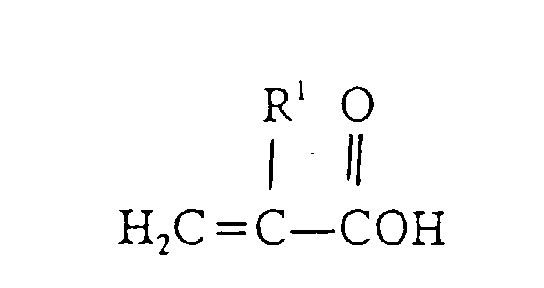
- Zementadditiv nach einem der vorstehenden Ansprüche, dadurch gekennzeichnet, daß das Carbonsäurepolymer ein zahlenmittleres Molekulargewicht von 500 bis 2 000 000 aufweist.
- Zementadditiv nach einem der vorstehenden Ansprüche, dadurch gekennzeichnet, daß das Carbonsäurepolymer ein Molekulargewichtszahlenmittel von 500 bis 10 000 aufweist.
- Zementadditiv nach einem der vorstehenden Ansprüche, dadurch gekennzeichnet, daß das Äquivalentverhältnis der Carboxylgruppen im Carbonsäurepolymer zu den Hydroxylgruppen im Polyether 20 : 1 bis 2 : 1 beträgt.
- Verfahren zur Herstellung eines Carbonsäuregruppen enthaltenden Zementadditivs, bei dem man ein Carbonsäurepolymer, umfassend in polymerisierter Form ein polymerisierbares Säuremonomer, dadurch gekennzeichnet, daß mindestens eine ethylenisch ungesättigte Gruppe in Verbindung mit einer Carbonsäuregruppe vorhanden ist, ausgewählt aus der Gruppe bestehend aus Carbonsäure, Carbonsäureanhydrid und Carbonsäureestergruppen mit einem Polyether, umfassend in polymerisierbarer Form ein C2-C4-Epoxid, in Gegenwart eines starken protischen sauren Katalysators während einer Zeitdauer und einer Temperatur, die ausreicht, um eine partielle Spaltung des Polyethers und Veresterung des Polyethers und seiner Spaltprodukte durch das Carbonsäurepolymer unter Bildung des Zementadditivs zu erreichen, zur Umsetzung bringt.
- Verfahren nach Anspruch 20, umfassend die Umsetzungin Gegenwart eines sauren Katalysators mit einem pKa von weniger als 0 bei einer Temperatur, die ausreicht, um eine teilweise Spaltung des Polyethergemisches und Veresterung des Polyethergemisches und dessen Spaltprodukte durch das Carbonsäurepolymer zu erzielen.(a) eines Carbonsäurepolymeren, hergestellt durch Polymerisation eines polymerisierbaren Säuremonomeren, enthaltend mindestens eine ethylenisch ungesättigte Gruppe in Verbindung mit einer Carbonsäuregruppe, ausgewählt aus der Gruppe bestehend aus Carbonsäure, Carbonsäureanhydrid und Carbonsäureestergruppen; und(b) einem Polyethergemisch, umfassend(i) einen monofunktionellen Polyether, hergestellt durch Polymerisation eines ersten Epoxids, ausgewählt aus der Gruppe bestehend aus C2-C4-Epoxiden und deren Gemischen in Anwesenheit eines monofunktionellen Initiators;
und(ii) einen difunktionellen Polyether, hergestellt durch Polymerisation eines zweiten Epoxids, ausgewählt aus der Gruppe bestehend aus C2-C4-Epoxiden und deren Gemisch, die gleich oder vom ersten Epoxid verschieden sein können, mit einem difunktionellen Initiator; - Verfahren nach Anspruch 20 oder Anspruch 21, dadurch gekennzeichnet, daß der saure Katalysator ausgewählt wird aus der Gruppe bestehend aus Arylsulfonsäuren, Alkylsulfonsäuren, Sulfonsäureionenaustaucherharze und deren Salze.
- Verfahren nach einem der Ansprüche 20 bis 22, dadurch gekennzeichnet, daß die Temperatur mehr als 140 °C beträgt.
- Verfahren nach einem der Ansprüche 20 bis 23, dadurch gekennzeichnet, daß es den zusätzlichen Schritt der Umwandlung mindestens eines Teils der Carbonsäuregruppen in die Salzform umfaßt.
- Verfahren nach einem der Ansprüche 20 bis 24, dadurch gekennzeichnet, daß das Äquivalenzverhältnis der Carbonsäuregruppen in dem Carbonsäurepolymeren zu Hydroxylgruppen im Polyether 20 : 1 bis 2 : 1 beträgt.
- Verfahren nach einem der Ansprüche 20 bis 25, dadurch gekennzeichnet, daß das polymerisierbare saure Monomer die Strukturaufweist, wobei R1 Wasserstoff oder C1-C4-Alkyl bedeutet.

- Zementzusammensetzung umfassend Zement und ein Zementadditiv nach einem der Ansprüche 1 bis 19 oder erhalten nach einem Verfahren nach einem der Ansprüche 20 bis 26.
- Zementzusammensetzung nach Anspruch 27, dadurch gekennzeichnet, daß sie 0,05 bis 2 Gew.-%, bezogen auf das Trockengewicht des Zements, Zementadditiv enthält.
- Zementzusammensetzung nach Anspruch 27 und Anspruch 28, die zusätzlich Wasser umfaßt.
- Zementzusammensetzung nach Anspruch 27, Anspruch 28 oder Anspruch 29, die zusätzlich Aggregat umfaßt.
- Verfahren zur Erhöhung der Fließfähigkeit einer hydraulischen Zementzusammensetzung, bei der man der hydraulischen Zementzusammensetzung 0,01 bis 10 Gew.-%, bezogen auf den trockenen Zement, ein Zementadditiv nach einem der Ansprüche 1 bis 19 oder erhalten nach einem Verfahren gemäß einem der Ansprüche 20 bis 26 zusetzt.
Applications Claiming Priority (5)
| Application Number | Priority Date | Filing Date | Title |
|---|---|---|---|
| US762581 | 1985-08-02 | ||
| US621669 | 1996-03-26 | ||
| US08/621,669 US5614017A (en) | 1996-03-26 | 1996-03-26 | Cement additives |
| US08/762,581 US5670578A (en) | 1996-12-10 | 1996-12-10 | Cement additives |
| PCT/EP1997/001445 WO1997035814A1 (en) | 1996-03-26 | 1997-03-21 | Cement additives |
Publications (2)
| Publication Number | Publication Date |
|---|---|
| EP0889860A1 EP0889860A1 (de) | 1999-01-13 |
| EP0889860B1 true EP0889860B1 (de) | 2000-05-10 |
Family
ID=27089020
Family Applications (1)
| Application Number | Title | Priority Date | Filing Date |
|---|---|---|---|
| EP97908283A Expired - Lifetime EP0889860B1 (de) | 1996-03-26 | 1997-03-21 | Zementzusätze |
Country Status (13)
| Country | Link |
|---|---|
| EP (1) | EP0889860B1 (de) |
| JP (1) | JP2001501570A (de) |
| CN (1) | CN1096436C (de) |
| AT (1) | ATE192729T1 (de) |
| AU (1) | AU704736B2 (de) |
| CA (1) | CA2250139C (de) |
| DE (1) | DE69701975T2 (de) |
| ES (1) | ES2146087T3 (de) |
| GR (1) | GR3033603T3 (de) |
| ID (1) | ID16487A (de) |
| TR (1) | TR199801911T2 (de) |
| TW (1) | TW387867B (de) |
| WO (1) | WO1997035814A1 (de) |
Cited By (3)
| Publication number | Priority date | Publication date | Assignee | Title |
|---|---|---|---|---|
| WO2011076655A1 (en) * | 2009-12-21 | 2011-06-30 | Mapei S.P.A. | Superplasticizers for concrete and cement materials and process for producing the same |
| US8008374B2 (en) | 2006-10-26 | 2011-08-30 | Sika Technology Ag | Process for producing polymers having amide and ester groups in the solid state |
| US11447579B2 (en) | 2017-08-04 | 2022-09-20 | Roehm Gmbh | Concrete flow improvers and water reducers |
Families Citing this family (28)
| Publication number | Priority date | Publication date | Assignee | Title |
|---|---|---|---|---|
| JP2002530498A (ja) * | 1998-11-24 | 2002-09-17 | ダブリュ・アール・グレイス・アンド・カンパニー・コネテイカット | 互いの非共有結合性基を有する1番目と2番目のポリマーに結合している粒子 |
| DE60134190D1 (de) | 2000-04-28 | 2008-07-10 | Nippon Catalytic Chem Ind | Zementzusatzmittel und Zementzusammensetzung, die dieses enthält |
| FR2811995B1 (fr) | 2000-07-21 | 2003-06-06 | Oreal | Polymere comprenant des unites hydrosolubles et des unites a lcst, et composition aqueuse le comprenant |
| EP1577327A1 (de) | 2004-03-19 | 2005-09-21 | Sika Technology AG | Amid-und Estergruppen aufweisendes Polymer, dessen Herstellung und Verwendung |
| ES2359347T3 (es) | 2007-10-29 | 2011-05-20 | Sika Technology Ag | Agentes dispersantes para sistemas que fraguan por medios hidráulicos. |
| ATE496875T1 (de) | 2007-10-29 | 2011-02-15 | Sika Technology Ag | Dispergiermittel für hydraulisch abbindende systeme |
| EP2154118A1 (de) | 2008-07-30 | 2010-02-17 | Sika Technology AG | Dispergiermittel für Gipszusammensetzungen |
| EP2159203A1 (de) | 2008-08-26 | 2010-03-03 | Sika Technology AG | Zusatzmittel für hydraulisch abbindende Systeme mit verbesserter Verarbeitbarkeit und geringer Wasserreduktionsrate |
| EP2161247B1 (de) | 2008-09-05 | 2012-10-24 | Sika Technology AG | Verfahren zur Stabilisierung von Polycarboxylaten |
| EP2368863A1 (de) | 2010-03-22 | 2011-09-28 | Sika Technology AG | Zusatzmittel für hydraulisch abbindende Systeme mit verbesserter Verarbeitbarkeit |
| EP2426095A1 (de) | 2010-09-03 | 2012-03-07 | Sika Technology AG | Dispergiermittel für Gipszusammensetzungen |
| WO2013020862A1 (en) | 2011-08-10 | 2013-02-14 | Sika Technology Ag | Process for drying concrete dispersants |
| CN102875797A (zh) * | 2012-10-19 | 2013-01-16 | 大连广汇科技有限公司 | 聚醚型消泡剂的一种合成方法 |
| ES2617431T3 (es) | 2012-11-09 | 2017-06-19 | Sika Technology Ag | Poli(carboxilato-éteres) como agentes dispersivos para resinas epoxídicas |
| EP3060531A1 (de) | 2013-10-25 | 2016-08-31 | Sika Technology AG | Karamellisierter zucker als verflüssiger für mineralische bindemittelzusammensetzungen |
| KR20170080628A (ko) * | 2014-10-31 | 2017-07-10 | 다우 글로벌 테크놀로지스 엘엘씨 | 시멘트 혼화제에 사용하기 위한 합성 수분 보유제 및 유동성 개질제 |
| CN104945576B (zh) * | 2015-07-03 | 2018-01-05 | 上海台界化工有限公司 | 一种高效减水剂的制备方法、产品及应用 |
| EP3368493B1 (de) | 2015-10-26 | 2024-07-31 | Sika Technology AG | Inertisierung von tonmineralien und verbesserung der wirkung von verflüssigern in tonhaltigen mineralischen bindemittelzusammensetzungen |
| EP3548446A1 (de) * | 2016-12-01 | 2019-10-09 | Huntsman International LLC | Funktionalisierte polyacrylatpolymerzusammensetzungen |
| DE102017213600A1 (de) | 2017-08-04 | 2019-02-07 | Evonik Röhm Gmbh | Beton-Fließverbesserer |
| EP3549961A1 (de) | 2018-04-03 | 2019-10-09 | Evonik Röhm GmbH | Beton-fliessverbesserer und wasserreduktionsmittel |
| DE102017213607A1 (de) | 2017-08-04 | 2019-02-07 | Evonik Röhm Gmbh | Fließverbesserer und Wasserreduktionsmittel |
| EP3768647A4 (de) | 2018-03-21 | 2021-11-10 | Sika Technology Ag | Epoxidharzzusammensetzung zur unterwasserverfugung |
| CN112672985A (zh) | 2018-10-05 | 2021-04-16 | Sika技术股份公司 | 作为膨胀粘土的封闭添加剂的梳型聚合物 |
| EP3789359A1 (de) | 2019-09-03 | 2021-03-10 | Sika Technology AG | Verwendung von kammpolymeren als inertisierungsmittel für quellfeste schichtsilikate |
| EP3939947A1 (de) | 2020-07-15 | 2022-01-19 | Sika Technology Ag | Tonblockende additive für gipszusammensetzungen |
| CN112708140B (zh) * | 2020-11-30 | 2022-04-22 | 科之杰新材料集团福建有限公司 | 一种早强型水泥分散聚合物及其制备方法 |
| EP4299547A1 (de) | 2022-06-28 | 2024-01-03 | Sika Technology AG | Umweltfreundliche mörtelzusammensetzungen |
Family Cites Families (8)
| Publication number | Priority date | Publication date | Assignee | Title |
|---|---|---|---|---|
| US543616A (en) * | 1895-07-30 | Internal illuminator and probe | ||
| JPS60161363A (ja) * | 1984-01-26 | 1985-08-23 | 花王株式会社 | セメント分散剤 |
| JPS6131333A (ja) * | 1984-07-20 | 1986-02-13 | 花王株式会社 | セメント混和剤 |
| US4960465A (en) * | 1986-12-09 | 1990-10-02 | W. R. Grace & Co. | Hydraulic cement additives and hydraulic cement compositions containing same |
| JP2628363B2 (ja) * | 1988-12-15 | 1997-07-09 | 日本化薬株式会社 | 染料の結晶変態及びその製造法 |
| CH689118A5 (de) * | 1993-06-11 | 1998-10-15 | Nippon Catalytic Chem Ind | Zusatzmittel zur Kontrolle des Fliessverhaltens von zementartigen Zusammensetzungen. |
| EP0639592A1 (de) * | 1993-08-18 | 1995-02-22 | Nippon Shokubai Co., Ltd. | Wasserlösliche Pfropfcopolymerisate und Verfahren zur Herstellung davon |
| US5436314A (en) * | 1994-04-18 | 1995-07-25 | Arco Chemical Technology, L.P. | Process for making a polyetherester by insertion of a carboxylic acid into a polyether |
-
1997
- 1997-03-21 ES ES97908283T patent/ES2146087T3/es not_active Expired - Lifetime
- 1997-03-21 AU AU20291/97A patent/AU704736B2/en not_active Ceased
- 1997-03-21 WO PCT/EP1997/001445 patent/WO1997035814A1/en not_active Ceased
- 1997-03-21 TR TR1998/01911T patent/TR199801911T2/xx unknown
- 1997-03-21 CA CA002250139A patent/CA2250139C/en not_active Expired - Fee Related
- 1997-03-21 CN CN97193443A patent/CN1096436C/zh not_active Expired - Lifetime
- 1997-03-21 AT AT97908283T patent/ATE192729T1/de not_active IP Right Cessation
- 1997-03-21 DE DE69701975T patent/DE69701975T2/de not_active Expired - Lifetime
- 1997-03-21 EP EP97908283A patent/EP0889860B1/de not_active Expired - Lifetime
- 1997-03-21 JP JP09534018A patent/JP2001501570A/ja active Pending
- 1997-03-25 TW TW086103781A patent/TW387867B/zh not_active IP Right Cessation
- 1997-03-26 ID IDP970996A patent/ID16487A/id unknown
-
2000
- 2000-06-06 GR GR20000401289T patent/GR3033603T3/el not_active IP Right Cessation
Cited By (3)
| Publication number | Priority date | Publication date | Assignee | Title |
|---|---|---|---|---|
| US8008374B2 (en) | 2006-10-26 | 2011-08-30 | Sika Technology Ag | Process for producing polymers having amide and ester groups in the solid state |
| WO2011076655A1 (en) * | 2009-12-21 | 2011-06-30 | Mapei S.P.A. | Superplasticizers for concrete and cement materials and process for producing the same |
| US11447579B2 (en) | 2017-08-04 | 2022-09-20 | Roehm Gmbh | Concrete flow improvers and water reducers |
Also Published As
| Publication number | Publication date |
|---|---|
| GR3033603T3 (en) | 2000-10-31 |
| CN1275966A (zh) | 2000-12-06 |
| WO1997035814A1 (en) | 1997-10-02 |
| EP0889860A1 (de) | 1999-01-13 |
| TW387867B (en) | 2000-04-21 |
| ES2146087T3 (es) | 2000-07-16 |
| ATE192729T1 (de) | 2000-05-15 |
| ID16487A (id) | 1997-10-02 |
| DE69701975D1 (de) | 2000-06-15 |
| AU704736B2 (en) | 1999-05-06 |
| CA2250139C (en) | 2005-09-13 |
| DE69701975T2 (de) | 2000-10-26 |
| TR199801911T2 (en) | 1999-01-18 |
| CA2250139A1 (en) | 1997-10-02 |
| JP2001501570A (ja) | 2001-02-06 |
| CN1096436C (zh) | 2002-12-18 |
| AU2029197A (en) | 1997-10-17 |
Similar Documents
| Publication | Publication Date | Title |
|---|---|---|
| US5670578A (en) | Cement additives | |
| AU704736B2 (en) | Cement additives | |
| US5614017A (en) | Cement additives | |
| EP1015399B1 (de) | Verfahren zur herstellung eines wasserreduzierenden zusatzmittels für zement | |
| US6034208A (en) | Copolymers useful as cement additives and a process for their preparation | |
| EP2516344B1 (de) | Starke weichmacher für beton- und zementmaterialien und herstellungsverfahren dafür | |
| JP2001514280A (ja) | 官能化ポリエーテルの製造 | |
| CA1277999C (en) | Hydraulic cement additives and hydraulic cement compositions containing same | |
| JP3181226B2 (ja) | 水硬性セメント組成物用流動性低下防止剤及び水硬性セメント組成物の流動性低下防止方法 | |
| EP0986522B1 (de) | Zementzusammensetzung | |
| JP3293230B2 (ja) | セメント用添加剤 | |
| JP3306983B2 (ja) | セメント用添加剤 | |
| JP3226125B2 (ja) | セメント分散剤 | |
| JP2006199953A (ja) | 未燃カーボンを高濃度で含有するフライアッシュ用の混和剤及びコンクリート | |
| US5565027A (en) | Cement composition | |
| JP6182333B2 (ja) | グリセリン類含有重合体及びその製造方法 | |
| MXPA98007883A (en) | Additives of ceme | |
| JP3239531B2 (ja) | セメント用添加剤 | |
| JP2021188014A (ja) | 水硬性組成物用液状分散剤組成物 | |
| JP2004256320A (ja) | 水硬性組成物用混和剤 | |
| JPH06107446A (ja) | セメント混和剤 | |
| JPH0688818B2 (ja) | セメント用添加剤 | |
| KR20030068997A (ko) | 폴리 에스테르계 고성능 콘크리트 유동화제 조성물 | |
| HK1004402B (en) | Air controlling superplasticizers |
Legal Events
| Date | Code | Title | Description |
|---|---|---|---|
| PUAI | Public reference made under article 153(3) epc to a published international application that has entered the european phase |
Free format text: ORIGINAL CODE: 0009012 |
|
| 17P | Request for examination filed |
Effective date: 19980917 |
|
| AK | Designated contracting states |
Kind code of ref document: A1 Designated state(s): AT BE CH DE DK ES FI FR GB GR IE IT LI LU MC NL PT SE |
|
| GRAG | Despatch of communication of intention to grant |
Free format text: ORIGINAL CODE: EPIDOS AGRA |
|
| 17Q | First examination report despatched |
Effective date: 19990610 |
|
| GRAG | Despatch of communication of intention to grant |
Free format text: ORIGINAL CODE: EPIDOS AGRA |
|
| GRAH | Despatch of communication of intention to grant a patent |
Free format text: ORIGINAL CODE: EPIDOS IGRA |
|
| GRAH | Despatch of communication of intention to grant a patent |
Free format text: ORIGINAL CODE: EPIDOS IGRA |
|
| GRAA | (expected) grant |
Free format text: ORIGINAL CODE: 0009210 |
|
| AK | Designated contracting states |
Kind code of ref document: B1 Designated state(s): AT BE CH DE DK ES FI FR GB GR IE IT LI LU MC NL PT SE |
|
| PG25 | Lapsed in a contracting state [announced via postgrant information from national office to epo] |
Ref country code: FI Free format text: LAPSE BECAUSE OF FAILURE TO SUBMIT A TRANSLATION OF THE DESCRIPTION OR TO PAY THE FEE WITHIN THE PRESCRIBED TIME-LIMIT Effective date: 20000510 |
|
| REF | Corresponds to: |
Ref document number: 192729 Country of ref document: AT Date of ref document: 20000515 Kind code of ref document: T |
|
| REG | Reference to a national code |
Ref country code: CH Ref legal event code: EP |
|
| REG | Reference to a national code |
Ref country code: IE Ref legal event code: FG4D |
|
| ITF | It: translation for a ep patent filed | ||
| REF | Corresponds to: |
Ref document number: 69701975 Country of ref document: DE Date of ref document: 20000615 |
|
| REG | Reference to a national code |
Ref country code: CH Ref legal event code: NV Representative=s name: ISLER & PEDRAZZINI AG |
|
| REG | Reference to a national code |
Ref country code: ES Ref legal event code: FG2A Ref document number: 2146087 Country of ref document: ES Kind code of ref document: T3 |
|
| ET | Fr: translation filed | ||
| REG | Reference to a national code |
Ref country code: DK Ref legal event code: T3 |
|
| PG25 | Lapsed in a contracting state [announced via postgrant information from national office to epo] |
Ref country code: PT Free format text: LAPSE BECAUSE OF FAILURE TO SUBMIT A TRANSLATION OF THE DESCRIPTION OR TO PAY THE FEE WITHIN THE PRESCRIBED TIME-LIMIT Effective date: 20000810 |
|
| PGFP | Annual fee paid to national office [announced via postgrant information from national office to epo] |
Ref country code: DK Payment date: 20010305 Year of fee payment: 5 Ref country code: CH Payment date: 20010305 Year of fee payment: 5 |
|
| PGFP | Annual fee paid to national office [announced via postgrant information from national office to epo] |
Ref country code: AT Payment date: 20010306 Year of fee payment: 5 |
|
| PLBE | No opposition filed within time limit |
Free format text: ORIGINAL CODE: 0009261 |
|
| STAA | Information on the status of an ep patent application or granted ep patent |
Free format text: STATUS: NO OPPOSITION FILED WITHIN TIME LIMIT |
|
| PG25 | Lapsed in a contracting state [announced via postgrant information from national office to epo] |
Ref country code: LU Free format text: LAPSE BECAUSE OF NON-PAYMENT OF DUE FEES Effective date: 20010321 Ref country code: IE Free format text: LAPSE BECAUSE OF NON-PAYMENT OF DUE FEES Effective date: 20010321 |
|
| PG25 | Lapsed in a contracting state [announced via postgrant information from national office to epo] |
Ref country code: MC Free format text: LAPSE BECAUSE OF NON-PAYMENT OF DUE FEES Effective date: 20010331 |
|
| 26N | No opposition filed | ||
| REG | Reference to a national code |
Ref country code: GB Ref legal event code: IF02 |
|
| REG | Reference to a national code |
Ref country code: IE Ref legal event code: MM4A |
|
| PG25 | Lapsed in a contracting state [announced via postgrant information from national office to epo] |
Ref country code: AT Free format text: LAPSE BECAUSE OF NON-PAYMENT OF DUE FEES Effective date: 20020321 |
|
| PG25 | Lapsed in a contracting state [announced via postgrant information from national office to epo] |
Ref country code: LI Free format text: LAPSE BECAUSE OF NON-PAYMENT OF DUE FEES Effective date: 20020331 Ref country code: CH Free format text: LAPSE BECAUSE OF NON-PAYMENT OF DUE FEES Effective date: 20020331 |
|
| PG25 | Lapsed in a contracting state [announced via postgrant information from national office to epo] |
Ref country code: DK Free format text: LAPSE BECAUSE OF NON-PAYMENT OF DUE FEES Effective date: 20020402 |
|
| REG | Reference to a national code |
Ref country code: CH Ref legal event code: PL |
|
| REG | Reference to a national code |
Ref country code: DK Ref legal event code: EBP |
|
| PGFP | Annual fee paid to national office [announced via postgrant information from national office to epo] |
Ref country code: GR Payment date: 20030327 Year of fee payment: 7 |
|
| PGFP | Annual fee paid to national office [announced via postgrant information from national office to epo] |
Ref country code: ES Payment date: 20030408 Year of fee payment: 7 |
|
| PG25 | Lapsed in a contracting state [announced via postgrant information from national office to epo] |
Ref country code: ES Free format text: LAPSE BECAUSE OF NON-PAYMENT OF DUE FEES Effective date: 20040322 |
|
| PG25 | Lapsed in a contracting state [announced via postgrant information from national office to epo] |
Ref country code: GR Free format text: LAPSE BECAUSE OF NON-PAYMENT OF DUE FEES Effective date: 20041006 |
|
| PGFP | Annual fee paid to national office [announced via postgrant information from national office to epo] |
Ref country code: SE Payment date: 20050321 Year of fee payment: 9 |
|
| PGFP | Annual fee paid to national office [announced via postgrant information from national office to epo] |
Ref country code: BE Payment date: 20050429 Year of fee payment: 9 |
|
| REG | Reference to a national code |
Ref country code: ES Ref legal event code: FD2A Effective date: 20040322 |
|
| PG25 | Lapsed in a contracting state [announced via postgrant information from national office to epo] |
Ref country code: SE Free format text: LAPSE BECAUSE OF NON-PAYMENT OF DUE FEES Effective date: 20060322 |
|
| PG25 | Lapsed in a contracting state [announced via postgrant information from national office to epo] |
Ref country code: BE Free format text: LAPSE BECAUSE OF NON-PAYMENT OF DUE FEES Effective date: 20060331 |
|
| EUG | Se: european patent has lapsed | ||
| BERE | Be: lapsed |
Owner name: *ARCO CHEMICAL TECHNOLOGY L.P. Effective date: 20060331 |
|
| REG | Reference to a national code |
Ref country code: GB Ref legal event code: 732E Free format text: REGISTERED BETWEEN 20090326 AND 20090401 |
|
| REG | Reference to a national code |
Ref country code: FR Ref legal event code: TP Ref country code: FR Ref legal event code: CD |
|
| NLS | Nl: assignments of ep-patents |
Owner name: COATEX S.A.S. Effective date: 20091030 |
|
| NLT1 | Nl: modifications of names registered in virtue of documents presented to the patent office pursuant to art. 16 a, paragraph 1 |
Owner name: LYONDELL CHEMICAL TECHNOLOGY, L.P. |
|
| PGFP | Annual fee paid to national office [announced via postgrant information from national office to epo] |
Ref country code: NL Payment date: 20100304 Year of fee payment: 14 |
|
| REG | Reference to a national code |
Ref country code: NL Ref legal event code: V1 Effective date: 20111001 |
|
| PG25 | Lapsed in a contracting state [announced via postgrant information from national office to epo] |
Ref country code: NL Free format text: LAPSE BECAUSE OF NON-PAYMENT OF DUE FEES Effective date: 20111001 |
|
| PGFP | Annual fee paid to national office [announced via postgrant information from national office to epo] |
Ref country code: GB Payment date: 20140319 Year of fee payment: 18 |
|
| REG | Reference to a national code |
Ref country code: FR Ref legal event code: PLFP Year of fee payment: 19 |
|
| GBPC | Gb: european patent ceased through non-payment of renewal fee |
Effective date: 20150321 |
|
| PG25 | Lapsed in a contracting state [announced via postgrant information from national office to epo] |
Ref country code: GB Free format text: LAPSE BECAUSE OF NON-PAYMENT OF DUE FEES Effective date: 20150321 |
|
| REG | Reference to a national code |
Ref country code: FR Ref legal event code: PLFP Year of fee payment: 20 |
|
| PGFP | Annual fee paid to national office [announced via postgrant information from national office to epo] |
Ref country code: DE Payment date: 20160315 Year of fee payment: 20 |
|
| PGFP | Annual fee paid to national office [announced via postgrant information from national office to epo] |
Ref country code: FR Payment date: 20160208 Year of fee payment: 20 |
|
| PGFP | Annual fee paid to national office [announced via postgrant information from national office to epo] |
Ref country code: IT Payment date: 20160324 Year of fee payment: 20 |
|
| REG | Reference to a national code |
Ref country code: DE Ref legal event code: R071 Ref document number: 69701975 Country of ref document: DE |