EP0890369A2 - Alarmsystem - Google Patents
Alarmsystem Download PDFInfo
- Publication number
- EP0890369A2 EP0890369A2 EP98305370A EP98305370A EP0890369A2 EP 0890369 A2 EP0890369 A2 EP 0890369A2 EP 98305370 A EP98305370 A EP 98305370A EP 98305370 A EP98305370 A EP 98305370A EP 0890369 A2 EP0890369 A2 EP 0890369A2
- Authority
- EP
- European Patent Office
- Prior art keywords
- pressure
- patient
- parameter
- sound
- providing
- Prior art date
- Legal status (The legal status is an assumption and is not a legal conclusion. Google has not performed a legal analysis and makes no representation as to the accuracy of the status listed.)
- Withdrawn
Links
- 206010002091 Anaesthesia Diseases 0.000 claims description 12
- 230000037005 anaesthesia Effects 0.000 claims description 12
- 238000012544 monitoring process Methods 0.000 claims description 6
- 238000000034 method Methods 0.000 claims 3
- 230000029058 respiratory gaseous exchange Effects 0.000 abstract description 21
- 230000007423 decrease Effects 0.000 abstract description 9
- 238000009423 ventilation Methods 0.000 abstract description 9
- 239000007789 gas Substances 0.000 description 33
- 230000000007 visual effect Effects 0.000 description 7
- 230000003434 inspiratory effect Effects 0.000 description 6
- 239000006096 absorbing agent Substances 0.000 description 5
- GQPLMRYTRLFLPF-UHFFFAOYSA-N Nitrous Oxide Chemical compound [O-][N+]#N GQPLMRYTRLFLPF-UHFFFAOYSA-N 0.000 description 4
- 238000010586 diagram Methods 0.000 description 4
- 239000003193 general anesthetic agent Substances 0.000 description 4
- 230000003444 anaesthetic effect Effects 0.000 description 2
- QVGXLLKOCUKJST-UHFFFAOYSA-N atomic oxygen Chemical compound [O] QVGXLLKOCUKJST-UHFFFAOYSA-N 0.000 description 2
- 239000003795 chemical substances by application Substances 0.000 description 2
- 238000005399 mechanical ventilation Methods 0.000 description 2
- 239000001272 nitrous oxide Substances 0.000 description 2
- 239000001301 oxygen Substances 0.000 description 2
- 229910052760 oxygen Inorganic materials 0.000 description 2
- 230000000717 retained effect Effects 0.000 description 2
- 239000006200 vaporizer Substances 0.000 description 2
- 239000011358 absorbing material Substances 0.000 description 1
- 239000007788 liquid Substances 0.000 description 1
- HUAUNKAZQWMVFY-UHFFFAOYSA-M sodium;oxocalcium;hydroxide Chemical compound [OH-].[Na+].[Ca]=O HUAUNKAZQWMVFY-UHFFFAOYSA-M 0.000 description 1
- 230000002269 spontaneous effect Effects 0.000 description 1
- 230000009466 transformation Effects 0.000 description 1
Images

Classifications
-
- A—HUMAN NECESSITIES
- A61—MEDICAL OR VETERINARY SCIENCE; HYGIENE
- A61M—DEVICES FOR INTRODUCING MEDIA INTO, OR ONTO, THE BODY; DEVICES FOR TRANSDUCING BODY MEDIA OR FOR TAKING MEDIA FROM THE BODY; DEVICES FOR PRODUCING OR ENDING SLEEP OR STUPOR
- A61M16/00—Devices for influencing the respiratory system of patients by gas treatment, e.g. ventilators; Tracheal tubes
- A61M16/10—Preparation of respiratory gases or vapours
- A61M16/104—Preparation of respiratory gases or vapours specially adapted for anaesthetics
-
- A—HUMAN NECESSITIES
- A61—MEDICAL OR VETERINARY SCIENCE; HYGIENE
- A61M—DEVICES FOR INTRODUCING MEDIA INTO, OR ONTO, THE BODY; DEVICES FOR TRANSDUCING BODY MEDIA OR FOR TAKING MEDIA FROM THE BODY; DEVICES FOR PRODUCING OR ENDING SLEEP OR STUPOR
- A61M16/00—Devices for influencing the respiratory system of patients by gas treatment, e.g. ventilators; Tracheal tubes
- A61M16/0051—Devices for influencing the respiratory system of patients by gas treatment, e.g. ventilators; Tracheal tubes with alarm devices
-
- A—HUMAN NECESSITIES
- A61—MEDICAL OR VETERINARY SCIENCE; HYGIENE
- A61M—DEVICES FOR INTRODUCING MEDIA INTO, OR ONTO, THE BODY; DEVICES FOR TRANSDUCING BODY MEDIA OR FOR TAKING MEDIA FROM THE BODY; DEVICES FOR PRODUCING OR ENDING SLEEP OR STUPOR
- A61M16/00—Devices for influencing the respiratory system of patients by gas treatment, e.g. ventilators; Tracheal tubes
- A61M16/021—Devices for influencing the respiratory system of patients by gas treatment, e.g. ventilators; Tracheal tubes operated by electrical means
- A61M16/022—Control means therefor
- A61M16/024—Control means therefor including calculation means, e.g. using a processor
-
- A—HUMAN NECESSITIES
- A61—MEDICAL OR VETERINARY SCIENCE; HYGIENE
- A61M—DEVICES FOR INTRODUCING MEDIA INTO, OR ONTO, THE BODY; DEVICES FOR TRANSDUCING BODY MEDIA OR FOR TAKING MEDIA FROM THE BODY; DEVICES FOR PRODUCING OR ENDING SLEEP OR STUPOR
- A61M16/00—Devices for influencing the respiratory system of patients by gas treatment, e.g. ventilators; Tracheal tubes
- A61M16/0057—Pumps therefor
- A61M16/0081—Bag or bellow in a bottle
-
- A—HUMAN NECESSITIES
- A61—MEDICAL OR VETERINARY SCIENCE; HYGIENE
- A61M—DEVICES FOR INTRODUCING MEDIA INTO, OR ONTO, THE BODY; DEVICES FOR TRANSDUCING BODY MEDIA OR FOR TAKING MEDIA FROM THE BODY; DEVICES FOR PRODUCING OR ENDING SLEEP OR STUPOR
- A61M2205/00—General characteristics of the apparatus
- A61M2205/58—Means for facilitating use, e.g. by people with impaired vision
- A61M2205/581—Means for facilitating use, e.g. by people with impaired vision by audible feedback
-
- A—HUMAN NECESSITIES
- A61—MEDICAL OR VETERINARY SCIENCE; HYGIENE
- A61M—DEVICES FOR INTRODUCING MEDIA INTO, OR ONTO, THE BODY; DEVICES FOR TRANSDUCING BODY MEDIA OR FOR TAKING MEDIA FROM THE BODY; DEVICES FOR PRODUCING OR ENDING SLEEP OR STUPOR
- A61M2230/00—Measuring parameters of the user
- A61M2230/40—Respiratory characteristics
Definitions
- This invention relates to the use of audio sounds to indicate a monitored parameter, and, more particularly, to a preferred use audio system where an audio sound conveys information relating to a waveform, preferably a pressure waveform representative of the pressure within the airway of a patient undergoing ventilation in a hospital environment.
- One parameter that is almost always monitored in administering breaths to the patient is the pressure in the patient airway and that pressure follows a certain waveform that would indicate that the patient is receiving a breath and exhaling under the desired conditions. While the monitoring of that pressure is an easy task for the ventilator, the difficulty is in communicating that information to the clinician in an easy, convenient manner and which does not take too much of the clinician's attention and thus divert that attention from other important matters at hand.
- the present invention is particularly adapted to be used in monitoring one or more parameters relating to a patient undergoing ventilation and which may be interpreted by the clinician as indicating a certain ventilation to the patient without requiring a visual monitor.
- the present invention provides an audible indication of a monitored parameter and specifically, the pressure of the gas in the patient's airway during ventilation. Accordingly, the clinician can pay more attention to the other patient conditions indicated on the ventilator or anesthesia machine and yet can listen to the audible tones from the present invention and continually monitor the overall ventilation of the patient.
- One of the advantages is that the sounds are not continual and only are activated in changing conditions, thus if there is no actual change in the parameter, the audible sound is not active and the clinician does not have an additional sound to hear and interpret. Absence of sound may also indicate an important clinical condition when the value of the parameter is expected to change on a regular basis, as is the case with airway pressure during mechanical ventilation of a patient.
- the present invention provides a sound of a short duration in the form of a burst when the particular parameter being monitored changes by a predetermined incremental amount, that is, as the pressure in the patient circuit rises, a sound occurs of a short duration based on a certain increment of pressure rise.
- each increment of pressure has its own identifiable frequency and quality so that the clinician can merely listen to the audio output and be assured that the ventilator is providing a breath to the patient of the correct pressure and that a proper waveform of that pressure is being administered.
- the ventilator provides a breath to the patient and thus the pressure in the patient airway increases during an inhalation cycle and then decreases as the ventilator enters the exhalation cycle and the patient exhales.
- the short bursts of sound increase in frequency at each incremental increase in pressure during the inhalation cycle and then decrease in the same manner during exhalation as the airway pressure decreases.
- the bursts of sound may be emitted, for example, every 2 cm.H 2 O as the pressure changes during inhalation and exhalation and by listening, the clinician will know that a proper inhalation and exhalation has been achieved without being distracted or taking attention away from the visible monitors or carrying out the visual monitoring of the patient.
- the frequency of the audible bursts are proportional to the airway pressure so that a particular audible burst will be at the same frequency at the same pressure, that is, the clinician will hear the same sound at a particular specific airway pressure whether in the inhalation cycle or the exhalation cycle.
- the sounds will increase in frequency as the patient airway pressure increases and will decrease in frequency as the patient airway pressure decreases, yet at any particular pressure, the burst of audible sound will be at the same frequency.
- any attempt to inhale by the patient is significant and with the present audible waveform, the drawing of a breath by the patient creates a slight negative pressure in the airway.
- a smaller incremental change may be detected to be able to sense that small negative pressure and, due to the flexibility of assigning a variety of sounds to the reaching of any incremental change in pressure, the sound assigned may be of a higher volume and an appropriate frequency to indicate to the clinician the fact that the patient is trying to breath spontaneously.
- the sound itself may be chosen, for example, as a clarinet at low frequencies and at higher volume so that such important information can easily be heard and interpreted by the clinician.
- FIG. 1 there is shown a block diagram of an anesthesia system including the audible waveform system of the present invention.
- the audible waveform is preferably used in a ventilation system for a patient in a hospital environment and will be described as such for the preferred embodiment, however, it will be understood that the audible waveform of the present invention described herein can be used for considerable other purposes and with other systems.
- a ventilator 10 is provided and which may be of the type shown and described in U.S. Patent 5,315,989 assigned to the present applicant and the disclosure of which is incorporated herein by reference. That ventilator 10 of the aforementioned U.S. Patent has an inhalation cycle and an exhalation cycle controlled by a CPU.
- the ventilator 10 provides gas to the patient during the inhalation cycle via a conduit 12 to the patient breathing circuit 14 where it is delivered to the patient 16.
- the ventilator 10 typically includes a bellows assembly 18 and air or other powering gas is supplied to the bellows assembly 18 exterior of the bellows 20 by the ventilator 10 via a conduit 11 and which then collapses the bellows 20 to force gases within the bellows 20 to the patient 16.
- the patient breathing circuit 14 itself conventionally includes an inspiratory limb 22 and an expiratory limb 24 and the patient is connected to a wye connection 26 located intermediate the inspiratory and the expiratory limbs 22,24.
- the means of connection may be an endotracheal tube, face mask or other interface between the patient 16 and the patient breathing circuit 14.
- gas is delivered to the patient 16 by means of a powering gas that collapses the bellows 20 to drive the gas into conduit 12 and then into the tee 28 where the gas enters a conduit 30 and passes through an absorber 32. After passing through the absorber 32, the gas enters the inspiratory limb 22 of the patient breathing circuit 14 to be administered to the patient 16. As the patient exhales, that exhalation, now laden with CO 2 , passes through the expiratory limb 24 where it again passes through the tee 28 and continues to the absorber 32 where the CO 2 is eliminated by a CO 2 absorbing material, such as soda lime.
- a CO 2 absorbing material such as soda lime.
- a pair of check valves 34 and 36 are positioned in the patient breathing circuit 14 in the expiratory and inspiratory limbs 24 and 22, respectively, to maintain the flow of gas in the proper direction around the circle patient breathing circuit 14.
- a flow of fresh gas is also introduced into the patient breathing circuit 14 and, as shown, is added at a tee 38 and thus into the inspiratory limb 22 of the patient breathing circuit 14.
- That flow of fresh gas is provided from a source of gas, typically oxygen and air, and may include nitrous oxide to aid in anesthetizing the patient.
- a source of gas typically oxygen and air
- nitrous oxide to aid in anesthetizing the patient.
- there is a supply of oxygen 40, nitrous oxide 42 and air 44 and such supply may be through a central piping system of a hospital or may be through the use of individual cylinders of such gases.
- the gases are mixed in a gas mixer 46 in the proportion desired by the user.
- the actual control of the proportions and the flow through the gas mixer 46 is, in the preferred embodiment, controlled by a central processing unit (CPU) 48.
- the mixed gases from the gas mixer 46 then pass through an agent vaporizer 50 where liquid anesthetic agent is vaporized and added to the stream of gas such that anesthetic laden gas continues into a conduit 52 and enters the patient breathing circuit 14 at the tee 38.
- the CPU 48 controls the agent vaporizer 50 and which determines the percentage concentration of anesthetic agent that is in the gas that enters the patient breathing circuit 14 and thus that is supplied to the patient to induce and maintain anesthesia.
- the CPU 48 is, in turn, controlled by an input device 54 provided so that the clinician can input the data needed to determine the various parameters to provide the flow and anesthetic concentration desired to anesthetize the patient.
- the gas is forced by the ventilator 10 into conduit 12 in accordance with the arrow A during the inhalation cycle of the patient 16. That air thus passes through the tee 28 and through absorber 32 where it further passes through tee 38 and into the inspiratory limb 22 of the patient breathing circuit 14. At that tee 38, fresh gas containing a predetermined concentration of an anesthetic agent is joined with the gases from the ventilator and proceeds with the gases already circulating in patient breathing circuit 14 and administered to the patient 16.
- the exhaled gases pass through the expiratory limb 24 of the patient breathing circuit 14 through tee 28 and continue through the circuit, passing though the absorber 32 where the gases are scrubbed to eliminate the CO 2 that is exhaled by the patient 16.
- the anesthesia system is basically a circle system where the gases continue to pass in a circle as shown by the arrows B with the addition of fresh gas and the anesthetic agent added to those gases in the direction of Arrow C as the gases pass around the circle portion of the circle system.
- a pressure monitor 56 is provided to detect the pressure of the gas in the patient breathing circuit 14. That pressure is monitored continuously and is normally displayed on the anesthesia machine by means of a visual display such as a pressure gauge.
- the signals from pressure monitor 56 representative of the monitored pressure within the patient breathing circuit 14 are transmitted to CPU 48 where they are further processed in carrying out the present invention.
- signals are sent by CPU 48 to an audio output device 58 where certain sounds are generated or, alternatively, the sounds are retained in a memory 60 and provided to audio output device 58 so that certain well recognized sounds can be used.
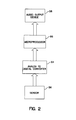
- FIG. 2 there is shown a block diagram of the audio waveform system of the present invention.
- the signals from the pressure transducer 56 representative of the particular parameter being monitored in the preferred embodiment, the pressure within the patient breathing circuit 14 are sent to an analog to digital converter 64 where the signals are digitized. Those digital signals are then sent to a microprocessor 66 where the signals are analyzed and a further signal generated each time the digitized signals indicate that the pressure within the patient breathing circuit 14 has changed by a predetermined increment, such as every 2 cm.H 2 O in either direction, i.e. increase or decrease in pressure.
- That signal is thus transmitted to the audio output device 58 where a burst of sound of a particular frequency is emitted to be heard by the clinician.
- the burst of sound may be generated by a tone generator embodied in the audio output device 58 or, alternatively, the particular sounds may be stored in a memory 60 (FIG. 1) where any particular representative frequency or sound quality may be used.
- the sounds of a particular musical instrument, such as a flute may be stored at differing frequencies in the memory 60 and as each pressure increment change occurs, the sound of a flute may emanate from the audio output device 58 of the particular frequency for that particular pressure.
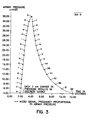
- FIG. 3 there is shown a typical representative waveform of the pressure in the patient circuit during a full breath cycle delivered by a ventilator.
- the pressure rises as the breath is delivered and certain increments of pressure are reached, indicated generally by the points a through q. After pressure reaches a maximum at [point q, the pressure declines during the exhalation cycle and again, the points are indicated as r through gg.
- a short burst of sound is emitted by the audio output device 58 and more preferable, the frequency of the sounds increases as the pressure increases, thus, the frequency is proportional to the pressure and follows the waveform of the pressure in the patient circuit.
- the particular frequency is preferably the same, that is, at, for example, the point g where the pressure in the patient breathing circuit is 20 cm.H 2 O, a particular frequency burst of sound is emitted.
- the same frequency is preferably used.
- the sound itself may be chosen from any variety of sounds contained in memory and the sounds may differ by instrument voice, as between a flute or a clarinet, timbre, amplitude, frequency and stepwise per burst, that is, the incremental change that must be reached to activate the burst of sound.
- the change in pressure as a slight negative pressure is drawn by the patient within the airway can thus be assigned a unique sound that may be more readily picked up by the clinician and the incremental change that causes that burst of sound to be a smaller increment than in sensing the positive pressure portions of the waveform.
- the invention may use low frequencies sounds of a clarinet and the volume increased. In that way, the clinician can readily distinguish the sounds of the patient attempting to breath and take the appropriate action.
Landscapes
- Health & Medical Sciences (AREA)
- Heart & Thoracic Surgery (AREA)
- Life Sciences & Earth Sciences (AREA)
- Engineering & Computer Science (AREA)
- Anesthesiology (AREA)
- Biomedical Technology (AREA)
- Emergency Medicine (AREA)
- Hematology (AREA)
- Pulmonology (AREA)
- Animal Behavior & Ethology (AREA)
- General Health & Medical Sciences (AREA)
- Public Health (AREA)
- Veterinary Medicine (AREA)
- Measurement Of The Respiration, Hearing Ability, Form, And Blood Characteristics Of Living Organisms (AREA)
- Percussion Or Vibration Massage (AREA)
Applications Claiming Priority (2)
| Application Number | Priority Date | Filing Date | Title |
|---|---|---|---|
| US889911 | 1997-07-10 | ||
| US08/889,911 US5836302A (en) | 1996-10-10 | 1997-07-10 | Breath monitor with audible signal correlated to incremental pressure change |
Publications (2)
| Publication Number | Publication Date |
|---|---|
| EP0890369A2 true EP0890369A2 (de) | 1999-01-13 |
| EP0890369A3 EP0890369A3 (de) | 2000-10-04 |
Family
ID=25395983
Family Applications (1)
| Application Number | Title | Priority Date | Filing Date |
|---|---|---|---|
| EP98305370A Withdrawn EP0890369A3 (de) | 1997-07-10 | 1998-07-06 | Alarmsystem |
Country Status (2)
| Country | Link |
|---|---|
| US (1) | US5836302A (de) |
| EP (1) | EP0890369A3 (de) |
Cited By (2)
| Publication number | Priority date | Publication date | Assignee | Title |
|---|---|---|---|---|
| CN109009128A (zh) * | 2018-08-09 | 2018-12-18 | 深圳市大耳马科技有限公司 | 呼吸方式检测方法、装置、处理设备和系统 |
| US11382563B2 (en) | 2019-03-01 | 2022-07-12 | Respiration AI, LLC | System and method for detecting ventilatory depression and for prompting a patient to breathe |
Families Citing this family (19)
| Publication number | Priority date | Publication date | Assignee | Title |
|---|---|---|---|---|
| US6283122B1 (en) * | 1999-03-10 | 2001-09-04 | Flight Medical Ltd. | Exhalation valve for respirator |
| US6159158A (en) * | 1999-07-06 | 2000-12-12 | Lowe; Michael W. | Diagnostic catheter system for nasopharyngeal obstructions |
| SE0000205D0 (sv) * | 2000-01-25 | 2000-01-25 | Siemens Elema Ab | Ventilator |
| US6863068B2 (en) * | 2002-07-25 | 2005-03-08 | Draeger Medical, Inc. | Ventilation sound detection system |
| US7138575B2 (en) * | 2002-07-29 | 2006-11-21 | Accentus Llc | System and method for musical sonification of data |
| US7135635B2 (en) * | 2003-05-28 | 2006-11-14 | Accentus, Llc | System and method for musical sonification of data parameters in a data stream |
| JP2008516701A (ja) * | 2004-10-19 | 2008-05-22 | ザ・ユニバーシティ・オブ・クイーンズランド | 生理学的モニタリング方法および装置 |
| US8061360B2 (en) | 2006-09-19 | 2011-11-22 | Kci Licensing, Inc. | System and method for locating fluid leaks at a drape of a reduced pressure delivery system |
| US7908991B2 (en) * | 2008-12-19 | 2011-03-22 | Woodscan Industries, Inc. | Air powered signaling system |
| JP5609194B2 (ja) * | 2010-03-23 | 2014-10-22 | セイコーエプソン株式会社 | 液体噴射装置 |
| US8247677B2 (en) * | 2010-06-17 | 2012-08-21 | Ludwig Lester F | Multi-channel data sonification system with partitioned timbre spaces and modulation techniques |
| CN103908714B (zh) * | 2012-12-29 | 2016-04-20 | 北京谊安医疗系统股份有限公司 | 一种监视系统的波形绘制方法及应用该方法的监视设备 |
| US9539406B2 (en) * | 2013-09-10 | 2017-01-10 | General Electric Company | Interface device and method for supplying gas flow for subject breathing and apparatus for supplying anesthetic agent to the interface device |
| EP3360118B1 (de) | 2015-10-07 | 2021-03-31 | Michael D. Velez | Strömungsalarm |
| US11185254B2 (en) * | 2017-08-21 | 2021-11-30 | Muvik Labs, Llc | Entrainment sonification techniques |
| WO2019040524A1 (en) * | 2017-08-21 | 2019-02-28 | Muvik Labs, Llc | METHOD AND SYSTEM FOR MUSIC COMMUNICATION |
| WO2020021060A1 (en) * | 2018-07-27 | 2020-01-30 | CSL Behring Lengnau AG | Infusion device having a syringe plunger control comprising a joystick |
| USD887549S1 (en) | 2018-09-10 | 2020-06-16 | Masino Corporation | Cap for a flow alarm device |
| USD887548S1 (en) | 2018-09-10 | 2020-06-16 | Masimo Corporation | Flow alarm device housing |
Citations (1)
| Publication number | Priority date | Publication date | Assignee | Title |
|---|---|---|---|---|
| US5315989A (en) | 1991-12-09 | 1994-05-31 | Boc Health Care, Inc. | Medical ventilator |
Family Cites Families (20)
| Publication number | Priority date | Publication date | Assignee | Title |
|---|---|---|---|---|
| US2376971A (en) * | 1943-03-18 | 1945-05-29 | Morris W Kleit | Sonant respiration indicator |
| US2904033A (en) * | 1957-03-04 | 1959-09-15 | Sylvan M Shane | Breathing indicator |
| US3830227A (en) * | 1966-05-17 | 1974-08-20 | H Green | Hand-held cardiac sound tone diagnostic device and method |
| US3565058A (en) * | 1967-10-04 | 1971-02-23 | Peter B Mansfield | Monitoring apparatus with audio output frequency responsive to ekg signal amplitude |
| US3648686A (en) * | 1969-07-03 | 1972-03-14 | Burlyl R Payne | Audible psychogalvonometer |
| US3611178A (en) * | 1969-10-13 | 1971-10-05 | Bourns Inc | Pressure-sensing signal generator |
| US3689832A (en) * | 1970-05-01 | 1972-09-05 | Western Technical Products Inc | Resistance tester for producing an audible tone that varies with the resistance |
| US3760100A (en) * | 1971-07-30 | 1973-09-18 | Us Army | Audio electrocardiogram monitor |
| US3867934A (en) * | 1973-05-04 | 1975-02-25 | Veriflo Corp | Pressure monitor for a lung ventilator |
| US4063550A (en) * | 1976-05-28 | 1977-12-20 | Tiep Brian L | Method and apparatus for treating bronchial asthma |
| US4074710A (en) * | 1976-05-28 | 1978-02-21 | City Of Hope National Medical Center | Intrathoracic pressure biofeedback method |
| US4269194A (en) * | 1978-02-13 | 1981-05-26 | Rayburn Robert L | Carbon dioxide measurement from expired gases in a partial rebreathing anesthesia circuit |
| US4383534A (en) * | 1980-06-05 | 1983-05-17 | Peters Jeffrey L | Vital signs monitoring apparatus |
| US4502490A (en) * | 1980-10-28 | 1985-03-05 | Antec Systems Limited | Patient monitoring equipment, probe for use therewith, and method of measuring anesthesia based on oesophagal contractions |
| US4602644A (en) * | 1982-08-18 | 1986-07-29 | Plasmedics, Inc. | Physiological detector and monitor |
| US4576178A (en) * | 1983-03-28 | 1986-03-18 | David Johnson | Audio signal generator |
| IL71468A (en) * | 1984-04-08 | 1988-06-30 | Dan Atlas | Apnea monitoring method and apparatus |
| US4651746A (en) * | 1984-05-08 | 1987-03-24 | Wall William H | Oral airway and endotrachial monitor |
| US5095900A (en) * | 1991-01-22 | 1992-03-17 | Mine Safety Appliances Company | Respiration monitor |
| US5095896A (en) * | 1991-07-10 | 1992-03-17 | Sota Omoigui | Audio-capnometry apparatus |
-
1997
- 1997-07-10 US US08/889,911 patent/US5836302A/en not_active Expired - Fee Related
-
1998
- 1998-07-06 EP EP98305370A patent/EP0890369A3/de not_active Withdrawn
Patent Citations (1)
| Publication number | Priority date | Publication date | Assignee | Title |
|---|---|---|---|---|
| US5315989A (en) | 1991-12-09 | 1994-05-31 | Boc Health Care, Inc. | Medical ventilator |
Cited By (3)
| Publication number | Priority date | Publication date | Assignee | Title |
|---|---|---|---|---|
| CN109009128A (zh) * | 2018-08-09 | 2018-12-18 | 深圳市大耳马科技有限公司 | 呼吸方式检测方法、装置、处理设备和系统 |
| CN109009128B (zh) * | 2018-08-09 | 2020-11-27 | 深圳市大耳马科技有限公司 | 呼吸方式检测方法、装置、处理设备和系统 |
| US11382563B2 (en) | 2019-03-01 | 2022-07-12 | Respiration AI, LLC | System and method for detecting ventilatory depression and for prompting a patient to breathe |
Also Published As
| Publication number | Publication date |
|---|---|
| US5836302A (en) | 1998-11-17 |
| EP0890369A3 (de) | 2000-10-04 |
Similar Documents
| Publication | Publication Date | Title |
|---|---|---|
| US5836302A (en) | Breath monitor with audible signal correlated to incremental pressure change | |
| US6863068B2 (en) | Ventilation sound detection system | |
| JP2702675B2 (ja) | 酸化窒素送出装置 | |
| US5107831A (en) | Ventilator control system using sensed inspiratory flow rate | |
| EP1450886B1 (de) | Verfahren und gerät zum erkennen von schnarchen | |
| US4444201A (en) | Respiration monitoring apparatus and method | |
| US6544192B2 (en) | Patient monitor and method of using same | |
| US6095139A (en) | Ventilator suitable for miniaturization | |
| EP1058570B1 (de) | Patientenmonitor | |
| US5720278A (en) | Inverse proportional assist ventilation apparatus | |
| US20060249155A1 (en) | Portable non-invasive ventilator with sensor | |
| US7172557B1 (en) | Spirometer, display and method | |
| US20040243016A1 (en) | Method and means of physiological monitoring using sonification | |
| CN102762248B (zh) | 一种用于提供支持治疗并同时确定由接受压力支持治疗的受试者呼出的气体分子的浓度的系统 | |
| US5778874A (en) | Anesthesia machine output monitor | |
| US5603316A (en) | Disabling apnea volume software | |
| US10821247B2 (en) | Ventilator and operating method for a ventilator with a determination of cough attacks | |
| JPH0580214B2 (de) | ||
| AU713184B2 (en) | Disease management system | |
| US20070208267A1 (en) | Device for acoustically reproducing the respiratory function for a respirator | |
| JPH0975459A (ja) | 医療用ガスブレンダ及び医療用ガス供給方法及びシステム | |
| JP3534613B2 (ja) | ガス供給制御装置 | |
| JP4440439B2 (ja) | 人工呼吸装置およびそのモニタ装置 | |
| AU2002325076B2 (en) | Method and means of physiological monitoring using sonification | |
| MILLS | Problems with mechanical ventilators |
Legal Events
| Date | Code | Title | Description |
|---|---|---|---|
| PUAI | Public reference made under article 153(3) epc to a published international application that has entered the european phase |
Free format text: ORIGINAL CODE: 0009012 |
|
| AK | Designated contracting states |
Kind code of ref document: A2 Designated state(s): AT BE CH CY DE DK ES FI FR GB GR IE IT LI LU MC NL PT SE |
|
| AX | Request for extension of the european patent |
Free format text: AL;LT;LV;MK;RO;SI |
|
| RAP1 | Party data changed (applicant data changed or rights of an application transferred) |
Owner name: DATEX-OHMEDA, INC. |
|
| PUAL | Search report despatched |
Free format text: ORIGINAL CODE: 0009013 |
|
| AK | Designated contracting states |
Kind code of ref document: A3 Designated state(s): AT BE CH CY DE DK ES FI FR GB GR IE IT LI LU MC NL PT SE |
|
| AX | Request for extension of the european patent |
Free format text: AL;LT;LV;MK;RO;SI |
|
| RIC1 | Information provided on ipc code assigned before grant |
Free format text: 7A 61M 16/00 A, 7A 61B 5/08 B, 7A 61B 5/00 B |
|
| AKX | Designation fees paid | ||
| REG | Reference to a national code |
Ref country code: DE Ref legal event code: 8566 |
|
| STAA | Information on the status of an ep patent application or granted ep patent |
Free format text: STATUS: THE APPLICATION IS DEEMED TO BE WITHDRAWN |
|
| 18D | Application deemed to be withdrawn |
Effective date: 20010404 |