EP0890864A1 - Affichage a cristaux liquides - Google Patents
Affichage a cristaux liquides Download PDFInfo
- Publication number
- EP0890864A1 EP0890864A1 EP97908510A EP97908510A EP0890864A1 EP 0890864 A1 EP0890864 A1 EP 0890864A1 EP 97908510 A EP97908510 A EP 97908510A EP 97908510 A EP97908510 A EP 97908510A EP 0890864 A1 EP0890864 A1 EP 0890864A1
- Authority
- EP
- European Patent Office
- Prior art keywords
- liquid crystal
- ferroelectric
- sheet polarizer
- backlight
- amount
- Prior art date
- Legal status (The legal status is an assumption and is not a legal conclusion. Google has not performed a legal analysis and makes no representation as to the accuracy of the status listed.)
- Withdrawn
Links
Images








Classifications
-
- G—PHYSICS
- G02—OPTICS
- G02F—OPTICAL DEVICES OR ARRANGEMENTS FOR THE CONTROL OF LIGHT BY MODIFICATION OF THE OPTICAL PROPERTIES OF THE MEDIA OF THE ELEMENTS INVOLVED THEREIN; NON-LINEAR OPTICS; FREQUENCY-CHANGING OF LIGHT; OPTICAL LOGIC ELEMENTS; OPTICAL ANALOGUE/DIGITAL CONVERTERS
- G02F1/00—Devices or arrangements for the control of the intensity, colour, phase, polarisation or direction of light arriving from an independent light source, e.g. switching, gating or modulating; Non-linear optics
- G02F1/01—Devices or arrangements for the control of the intensity, colour, phase, polarisation or direction of light arriving from an independent light source, e.g. switching, gating or modulating; Non-linear optics for the control of the intensity, phase, polarisation or colour
- G02F1/13—Devices or arrangements for the control of the intensity, colour, phase, polarisation or direction of light arriving from an independent light source, e.g. switching, gating or modulating; Non-linear optics for the control of the intensity, phase, polarisation or colour based on liquid crystals, e.g. single liquid crystal display cells
- G02F1/133—Constructional arrangements; Operation of liquid crystal cells; Circuit arrangements
- G02F1/1333—Constructional arrangements; Manufacturing methods
- G02F1/1335—Structural association of cells with optical devices, e.g. polarisers or reflectors
- G02F1/133528—Polarisers
-
- G—PHYSICS
- G02—OPTICS
- G02F—OPTICAL DEVICES OR ARRANGEMENTS FOR THE CONTROL OF LIGHT BY MODIFICATION OF THE OPTICAL PROPERTIES OF THE MEDIA OF THE ELEMENTS INVOLVED THEREIN; NON-LINEAR OPTICS; FREQUENCY-CHANGING OF LIGHT; OPTICAL LOGIC ELEMENTS; OPTICAL ANALOGUE/DIGITAL CONVERTERS
- G02F1/00—Devices or arrangements for the control of the intensity, colour, phase, polarisation or direction of light arriving from an independent light source, e.g. switching, gating or modulating; Non-linear optics
- G02F1/01—Devices or arrangements for the control of the intensity, colour, phase, polarisation or direction of light arriving from an independent light source, e.g. switching, gating or modulating; Non-linear optics for the control of the intensity, phase, polarisation or colour
- G02F1/13—Devices or arrangements for the control of the intensity, colour, phase, polarisation or direction of light arriving from an independent light source, e.g. switching, gating or modulating; Non-linear optics for the control of the intensity, phase, polarisation or colour based on liquid crystals, e.g. single liquid crystal display cells
- G02F1/137—Devices or arrangements for the control of the intensity, colour, phase, polarisation or direction of light arriving from an independent light source, e.g. switching, gating or modulating; Non-linear optics for the control of the intensity, phase, polarisation or colour based on liquid crystals, e.g. single liquid crystal display cells characterised by the electro-optical or magneto-optical effect, e.g. field-induced phase transition, orientation effect, guest-host interaction or dynamic scattering
- G02F1/139—Devices or arrangements for the control of the intensity, colour, phase, polarisation or direction of light arriving from an independent light source, e.g. switching, gating or modulating; Non-linear optics for the control of the intensity, phase, polarisation or colour based on liquid crystals, e.g. single liquid crystal display cells characterised by the electro-optical or magneto-optical effect, e.g. field-induced phase transition, orientation effect, guest-host interaction or dynamic scattering based on orientation effects in which the liquid crystal remains transparent
- G02F1/141—Devices or arrangements for the control of the intensity, colour, phase, polarisation or direction of light arriving from an independent light source, e.g. switching, gating or modulating; Non-linear optics for the control of the intensity, phase, polarisation or colour based on liquid crystals, e.g. single liquid crystal display cells characterised by the electro-optical or magneto-optical effect, e.g. field-induced phase transition, orientation effect, guest-host interaction or dynamic scattering based on orientation effects in which the liquid crystal remains transparent using ferroelectric liquid crystals
-
- G—PHYSICS
- G09—EDUCATION; CRYPTOGRAPHY; DISPLAY; ADVERTISING; SEALS
- G09G—ARRANGEMENTS OR CIRCUITS FOR CONTROL OF INDICATING DEVICES USING STATIC MEANS TO PRESENT VARIABLE INFORMATION
- G09G3/00—Control arrangements or circuits, of interest only in connection with visual indicators other than cathode-ray tubes
- G09G3/20—Control arrangements or circuits, of interest only in connection with visual indicators other than cathode-ray tubes for presentation of an assembly of a number of characters, e.g. a page, by composing the assembly by combination of individual elements arranged in a matrix no fixed position being assigned to or needed to be assigned to the individual characters or partial characters
- G09G3/34—Control arrangements or circuits, of interest only in connection with visual indicators other than cathode-ray tubes for presentation of an assembly of a number of characters, e.g. a page, by composing the assembly by combination of individual elements arranged in a matrix no fixed position being assigned to or needed to be assigned to the individual characters or partial characters by control of light from an independent source
- G09G3/3406—Control of illumination source
-
- G—PHYSICS
- G02—OPTICS
- G02F—OPTICAL DEVICES OR ARRANGEMENTS FOR THE CONTROL OF LIGHT BY MODIFICATION OF THE OPTICAL PROPERTIES OF THE MEDIA OF THE ELEMENTS INVOLVED THEREIN; NON-LINEAR OPTICS; FREQUENCY-CHANGING OF LIGHT; OPTICAL LOGIC ELEMENTS; OPTICAL ANALOGUE/DIGITAL CONVERTERS
- G02F1/00—Devices or arrangements for the control of the intensity, colour, phase, polarisation or direction of light arriving from an independent light source, e.g. switching, gating or modulating; Non-linear optics
- G02F1/01—Devices or arrangements for the control of the intensity, colour, phase, polarisation or direction of light arriving from an independent light source, e.g. switching, gating or modulating; Non-linear optics for the control of the intensity, phase, polarisation or colour
- G02F1/13—Devices or arrangements for the control of the intensity, colour, phase, polarisation or direction of light arriving from an independent light source, e.g. switching, gating or modulating; Non-linear optics for the control of the intensity, phase, polarisation or colour based on liquid crystals, e.g. single liquid crystal display cells
- G02F1/133—Constructional arrangements; Operation of liquid crystal cells; Circuit arrangements
- G02F1/1333—Constructional arrangements; Manufacturing methods
- G02F1/1335—Structural association of cells with optical devices, e.g. polarisers or reflectors
- G02F1/133528—Polarisers
- G02F1/133531—Polarisers characterised by the arrangement of polariser or analyser axes
-
- G—PHYSICS
- G02—OPTICS
- G02F—OPTICAL DEVICES OR ARRANGEMENTS FOR THE CONTROL OF LIGHT BY MODIFICATION OF THE OPTICAL PROPERTIES OF THE MEDIA OF THE ELEMENTS INVOLVED THEREIN; NON-LINEAR OPTICS; FREQUENCY-CHANGING OF LIGHT; OPTICAL LOGIC ELEMENTS; OPTICAL ANALOGUE/DIGITAL CONVERTERS
- G02F1/00—Devices or arrangements for the control of the intensity, colour, phase, polarisation or direction of light arriving from an independent light source, e.g. switching, gating or modulating; Non-linear optics
- G02F1/01—Devices or arrangements for the control of the intensity, colour, phase, polarisation or direction of light arriving from an independent light source, e.g. switching, gating or modulating; Non-linear optics for the control of the intensity, phase, polarisation or colour
- G02F1/13—Devices or arrangements for the control of the intensity, colour, phase, polarisation or direction of light arriving from an independent light source, e.g. switching, gating or modulating; Non-linear optics for the control of the intensity, phase, polarisation or colour based on liquid crystals, e.g. single liquid crystal display cells
- G02F1/137—Devices or arrangements for the control of the intensity, colour, phase, polarisation or direction of light arriving from an independent light source, e.g. switching, gating or modulating; Non-linear optics for the control of the intensity, phase, polarisation or colour based on liquid crystals, e.g. single liquid crystal display cells characterised by the electro-optical or magneto-optical effect, e.g. field-induced phase transition, orientation effect, guest-host interaction or dynamic scattering
- G02F1/139—Devices or arrangements for the control of the intensity, colour, phase, polarisation or direction of light arriving from an independent light source, e.g. switching, gating or modulating; Non-linear optics for the control of the intensity, phase, polarisation or colour based on liquid crystals, e.g. single liquid crystal display cells characterised by the electro-optical or magneto-optical effect, e.g. field-induced phase transition, orientation effect, guest-host interaction or dynamic scattering based on orientation effects in which the liquid crystal remains transparent
- G02F1/141—Devices or arrangements for the control of the intensity, colour, phase, polarisation or direction of light arriving from an independent light source, e.g. switching, gating or modulating; Non-linear optics for the control of the intensity, phase, polarisation or colour based on liquid crystals, e.g. single liquid crystal display cells characterised by the electro-optical or magneto-optical effect, e.g. field-induced phase transition, orientation effect, guest-host interaction or dynamic scattering based on orientation effects in which the liquid crystal remains transparent using ferroelectric liquid crystals
- G02F1/1412—Antiferroelectric liquid crystals
-
- G—PHYSICS
- G09—EDUCATION; CRYPTOGRAPHY; DISPLAY; ADVERTISING; SEALS
- G09G—ARRANGEMENTS OR CIRCUITS FOR CONTROL OF INDICATING DEVICES USING STATIC MEANS TO PRESENT VARIABLE INFORMATION
- G09G2320/00—Control of display operating conditions
- G09G2320/04—Maintaining the quality of display appearance
- G09G2320/041—Temperature compensation
-
- G—PHYSICS
- G09—EDUCATION; CRYPTOGRAPHY; DISPLAY; ADVERTISING; SEALS
- G09G—ARRANGEMENTS OR CIRCUITS FOR CONTROL OF INDICATING DEVICES USING STATIC MEANS TO PRESENT VARIABLE INFORMATION
- G09G2320/00—Control of display operating conditions
- G09G2320/06—Adjustment of display parameters
- G09G2320/0626—Adjustment of display parameters for control of overall brightness
-
- G—PHYSICS
- G09—EDUCATION; CRYPTOGRAPHY; DISPLAY; ADVERTISING; SEALS
- G09G—ARRANGEMENTS OR CIRCUITS FOR CONTROL OF INDICATING DEVICES USING STATIC MEANS TO PRESENT VARIABLE INFORMATION
- G09G3/00—Control arrangements or circuits, of interest only in connection with visual indicators other than cathode-ray tubes
- G09G3/20—Control arrangements or circuits, of interest only in connection with visual indicators other than cathode-ray tubes for presentation of an assembly of a number of characters, e.g. a page, by composing the assembly by combination of individual elements arranged in a matrix no fixed position being assigned to or needed to be assigned to the individual characters or partial characters
- G09G3/34—Control arrangements or circuits, of interest only in connection with visual indicators other than cathode-ray tubes for presentation of an assembly of a number of characters, e.g. a page, by composing the assembly by combination of individual elements arranged in a matrix no fixed position being assigned to or needed to be assigned to the individual characters or partial characters by control of light from an independent source
- G09G3/36—Control arrangements or circuits, of interest only in connection with visual indicators other than cathode-ray tubes for presentation of an assembly of a number of characters, e.g. a page, by composing the assembly by combination of individual elements arranged in a matrix no fixed position being assigned to or needed to be assigned to the individual characters or partial characters by control of light from an independent source using liquid crystals
- G09G3/3611—Control of matrices with row and column drivers
- G09G3/3622—Control of matrices with row and column drivers using a passive matrix
- G09G3/3629—Control of matrices with row and column drivers using a passive matrix using liquid crystals having memory effects, e.g. ferroelectric liquid crystals
- G09G3/3633—Control of matrices with row and column drivers using a passive matrix using liquid crystals having memory effects, e.g. ferroelectric liquid crystals with transmission/voltage characteristic comprising multiple loops, e.g. antiferroelectric liquid crystals
Definitions
- the present invention relates to a liquid crystal display. More particularly, the first aspect of the present invention is concerned with an antiferroelectric liquid crystal panel having an antiferroelectric liquid crystal as a liquid crystal layer, and a backlight for illuminating the panel.
- the second aspect of the present invention is concerned with adjustment of an angle of rotation by which sheet polarizers included in a liquid crystal panel, which has an antiferroelectric liquid crystal or ferroelectric liquid crystal as a liquid crystal layer, are turned.
- the third aspect of the present invention is concerned with arrangement of sheet polarizers, and with a ferroelectric liquid crystal panel having a ferroelectric liquid crystal as a liquid crystal layer and a backlight for illuminating the panel.
- a liquid crystal is broadly divided into a dielectrically anisotropic type and ferroelectric type in terms of an electro-optic effect (phenomenon where when one aligned state of liquid crystalline molecules is changed into another with application of an electric field, an optical property of a liquid crystal panel is varied to electrically cause light modulation).
- a typical liquid crystal of the former type is a super-twisted nematic (STN) liquid crystal, and a liquid crystal of the latter type is subdivided into a memory type and non-memory type.
- STN super-twisted nematic
- a liquid crystal unit is composed of a liquid crystal panel having an antiferroelectric liquid crystal or ferroelectric liquid crystal as a liquid crystal layer, and a backlight for illuminating the liquid crystal panel.
- an amount of light output from the backlight is adjusted according to a change in conical angle, a change in temperature of use or temperature at which the liquid crystal panel is usable, a change in polarization reverse current, or a change in transmitted light. Furthermore, an angle at which two sheet polarizers are arranged is adjusted according to the change.
- the first object of the present invention is to provide an antiferroelectric liquid crystal unit.
- a change in conical angle, a change in temperature of use or temperature at which a liquid crystal panel is usable, a change in polarization reverse current, or a change in transmitted light may occur in a liquid crystal panel having an antiferroelectric liquid crystal.
- an amount of light output from a backlight is adjusted in order to minimize a change in contrast ratio for display, and to prevent a power consumption of the backlight from increasing.
- the second object of the present invention is to provide a liquid crystal unit.
- a change in conical angle, a change in temperature of use or temperature at which a liquid crystal is usable, a change in polarization reverse current, or a change in transmission light may occur in a liquid crystal panel having an antiferroelectric liquid crystal or ferroelectric liquid crystal
- an angle at which sheet polarizers are arranged is adjusted in order to attain a maximum contrast ratio.
- the third object of the present invention is to provide a ferroelectric liquid crystal unit.
- a change in conical angle, a change in temperature of use or temperature at which a liquid crystal panel is usable, a change in polarization reverse current, or a change in transmission light may occur in a liquid crystal panel having a ferroelectric liquid crystal.
- an amount of light output from a backlight is adjusted in order to minimize a change in contrast ratio for display and to prevent the power consumption of the backlight from increasing.
- the first aspect of the present invention is realized in the forms described below.
- the present invention provides an antiferroelectric liquid crystal unit composed of an antiferroelectric liquid crystal panel having an antiferroelectric liquid crystal sandwiched between a pair of substrates, and a backlight for illuminating the antiferroelectric liquid crystal panel.
- the antiferroelectric liquid crystal assumes a first ferroelectric state, a second ferroelectric state that is a ferroelectric state resulting from application of a voltage whose polarity is opposite to the polarity of a voltage applied to attain the first ferroelectric state, and an antiferroelectric state.
- An amount of light output from the backlight is adjusted according to a change in angle defined between a direction in which the major axis of an average molecule of the antiferroelectric liquid crystal is oriented in the first ferroelectric state, and a direction in which the major axis of the average molecule thereof is oriented in the second ferroelectric state.
- the present invention provides an antiferroelectric liquid crystal unit composed of an antiferroelectric liquid crystal panel having an antiferroelectric liquid crystal sandwiched between a pair of substrates, and a backlight for illuminating the liquid crystal panel.
- the antiferroelectric liquid crystal unit has a structure for adjusting an amount of light output from the backlight according to a change in temperature of use or temperature at which the antiferroelectric liquid crystal panel is usable.
- the present invention provides an antiferroelectric liquid crystal unit composed of an antiferroelectric liquid crystal panel having an antiferroelectric liquid crystal sandwiched between a pair of substrates, and a backlight for illuminating the liquid crystal panel.
- the antiferroelectric liquid crystal unit has a structure for adjusting an amount of light output from the backlight according to a change in polarization reverse current flowing in the antiferroelectric liquid crystal.
- the present invention provides an antiferroelectric liquid crystal unit composed of an antiferroelectric liquid crystal panel having an antiferroelectric liquid crystal sandwiched between a pair of substrates, and a backlight for illuminating the liquid crystal panel.
- the antiferroelectric liquid crystal assumes a first ferroelectric state, a second ferroelectric state that is a ferroelectric state resulting from application of a voltage whose polarity is opposite to the polarity of a voltage applied to attain the first ferroelectric state, and an antiferroelectric state.
- the antiferroelectric liquid crystal unit comprises: a transmission light sensor for measuring a luminance level of transmission light that has passed through the antiferroelectric liquid crystal panel and has been output from the backlight; and a memory means for storing a correlation between an angle, which is defined by a direction in which the major axis of an average molecule of an antiferroelectric liquid crystal is oriented in the first ferroelectric state, and a direction in which the major axis of the average molecule thereof is oriented in the second ferroelectric state, and a luminance level of transmission light.
- an amount of light output from the backlight is adjusted.
- the second aspect of the present invention is realized in the forms described below.
- the present invention provides a liquid crystal panel composed of a liquid crystal, which assumes at least a first ferroelectric state and second ferroelectric state, sandwiched between a pair of substrates, and first and second sheet polarizers.
- the first sheet polarizer and second sheet polarize are arranged to interpose the pair of substrates between them.
- a plane of polarization produced by the first sheet polarizer and a plane of polarization produced by the second sheet polarizer are fixed at an angle of substantially 90°.
- the first sheet polarizer and second sheet polarizer share the same axis of rotation.
- the first sheet polarizer and second sheet polarizer are turned with the shared axis of rotation as a center.
- the present invention provides a liquid crystal panel having a liquid crystal, which assumes at least a first ferroelectric state and a second ferroelectric state, sandwiched between a pair of substrates, and a first sheet polarizer and second sheet polarizer.
- the first sheet polarizer and second sheet polarizer are arranged to interpose the pair of substrates between them.
- the plane of polarization produced by the first sheet polarizer and the plane of polarization produced by the second sheet polarizer are fixed at an angle of substantially 90°.
- the first sheet polarizer and second sheet polarizer share the same axis of rotation.
- the first sheet polarizer and second sheet polarizer has a structure for adjusting an angle of rotation with the shared axis of rotation as a center according to a change in use temperature or temperature at which the liquid crystal panel is usable.
- the present invention provides a liquid crystal panel composed of a liquid crystal, which assumes at least a first ferroelectric state and second ferroelectric state, sandwiched between a pair of substrates, and a first sheet polarizer and second sheet polarizer.
- the first sheet polarizer and second sheet polarizer are arranged to interpose the pair of substrates between them.
- a plane of polarization produced by the first sheet polarizer and a plane of polarization produced by the second sheet polarizer are fixed at an angle of substantially 90°.
- the first sheet polarizer and second sheet polarizer share the same axis of rotation.
- the first sheet polarizer and second sheet polarizer have a structure for adjusting an angle of rotation with the shared axis of rotation as a center according to a change in polarization reverse current in the liquid crystal.
- the present invention provides a liquid crystal panel composed of a liquid crystal, which assumes at least a first ferroelectric state and second ferroelectric state, sandwiched between a pair of substrates, and a first sheet polarizer and second sheet polarizer.
- the first sheet polarizer and second sheet polarizer are arranged to interpose the pair of substrates between them.
- a plane of polarization produced by the first sheet polarize and a plane of polarization produced by the second sheet polarizer are fixed at an angle of substantially 90°.
- the first sheet polarizer and second sheet polarizer share the same axis of rotation.
- the first sheet polarizer and second sheet polarizer have a structure for adjusting an angle of rotation with the shared axis of rotation as a center according to a change in amount of transmission light in the liquid crystal panel.
- the third aspect of the present invention is realized in the forms described below.
- the present invention provides a liquid crystal panel having a liquid crystal, which assumes at least first and second ferroelectric states, sandwiched between a pair of substrates, having a first sheet polarizer and second sheet polarizer arranged to interpose the pair of substrates between them, and having a plane of polarization produced by the first sheet polarizer and a plane of polarization produced by the second sheet polarizer fixed at an angle of substantially 90°.
- Two planes are located at angles that are halves of angles defined by the plane of polarization produced by the first sheet polarizer and the plane of polarization produced by the second sheet polarizer.
- One of the planes is regarded as a first intermediate plane, and the other thereof is regarded as a second intermediate plane.
- the first and second sheet polarizers are arranged so that: a direction in which the major axis of an average molecule of the liquid crystal is oriented in one of the first and second ferroelectric states will always be located between the plane of polarization produced by the first sheet polarizer and the first intermediate plane at a temperature falling within a range of temperature of use within which the liquid crystal panel is usable; and
- the present invention provides a liquid crystal panel having a liquid crystal, which assumes at least first and second ferroelectric states, sandwiched between a pair of substrates, having a first sheet polarizer and second sheet polarizer arranged to interpose the pair of substrates between them, and having a plane of polarization produced by the first sheet polarizer and a plane of polarization produced by the second sheet polarizer fixed at an angle of substantially 90°.
- Two planes are located at angles that are halves of angles defined by the plane of polarization produced by the first sheet polarizer and the plane of polarization produced by the second sheet polarizer.
- One of the planes is regarded as a first intermediate plane, and the other thereof is regarded as a second intermediate plane.
- the first and second sheet polarizers are arranged so that: a direction in which the major axis of an average molecule of the liquid crystal is oriented in one of the first and second states will always be located between the plane of polarization produced by the second sheet polarizer and the first intermediate plane at a temperature falling within a range of temperature of use within which the liquid crystal panel is usable; and
- the present invention provides a liquid crystal panel having a liquid crystal, which assumes at least first and second ferroelectric states, sandwiched between a pair of substrates, having a first sheet polarizer and second sheet polarizer arranged to interpose the pair of substrates between them, having the plane of polarization produced by the first sheet polarizer and the plane of polarization produced by the second sheet polarizer fixed at an angle of substantially 90°.
- Two planes are located at angles that are halves of angles defined by the plane of polarization produced by the first sheet polarizer and the plane of polarization produced by the second sheet polarizer.
- One of the planes is regarded as a first intermediate plane, and the other thereof is regarded as a second intermediate plane.
- the first and second sheet polarizers are arranged so that: a direction in which the major axis of an average molecule of the liquid crystal is oriented in one of the first and second ferroelectric states will always be located between the plane of polarization produced by the first sheet polarizer and the first intermediate plane at a temperature falling within a range of temperature of use within which the liquid crystal panel is usable; and
- the present invention provides a ferroelectric liquid crystal unit composed of a ferroelectric liquid crystal panel having a ferroelectric liquid crystal sandwiched between a pair of substrates, and a backlight for illuminating the liquid crystal panel.
- An amount of light output from the backlight is adjusted according to a change in angle defined between a direction, in which the major axis of an average molecule of the ferroelectric liquid crystal is oriented in one of first and second ferroelectric states, and a direction in which the major axis of the average molecule thereof is oriented in the other ferroelectric state.
- the present invention provides a ferroelectric liquid crystal unit composed of a ferroelectric liquid crystal panel having a ferroelectric liquid crystal sandwiched between a pair of substrates, and a backlight for illuminating the liquid crystal panel.
- the ferroelectric liquid crystal unit has a structure for adjusting an amount of light output from the backlight according to a change in temperature of use or temperature at which the ferroelectric liquid crystal panel is usable.
- the present invention provides a ferroelectric liquid crystal unit composed of a ferroelectric liquid crystal panel having a ferroelectric liquid crystal sandwiched between a pair of substrates, and a backlight for illuminating the liquid crystal panel.
- the ferroelectric liquid crystal unit has a structure for adjusting an amount of light output from the backlight according to a change in polarization reverse current flowing through the ferroelectric liquid crystal.
- the present invention provides a ferroelectric liquid crystal unit composed of a ferroelectric liquid crystal panel having a ferroelectric liquid crystal sandwiched between a pair of substrates, and a backlight for illuminating the ferroelectric liquid crystal panel.
- the ferroelectric liquid crystal unit comprises a transmission light sensor for measuring a luminance level of transmission light that has been output from the backlight and has passed through the ferroelectric liquid crystal panel; and a memory means for storing a correlation between an angle, which is defined by a direction in which the major axis of an average molecule of the ferroelectric liquid crystal is oriented in the first ferroelectric state and a direction in which the major axis of the average molecule thereof is oriented in the second ferroelectric state, and a luminance level of transmission light.
- an amount of light output from the backlight is adjusted.
- a liquid crystal panel formed using an antiferroelectric liquid crystal has been studied in earnest since disclosure of, for example, Japanese Unexamined Patent Publication No. 2-173724.
- the patent publication reported that the liquid crystal panel can provide a large angle for a field of view, can respond fast, and can be multiplexed satisfactorily.
- Fig. 2 is a diagram showing the structure of an antiferroelectric liquid crystal panel of a liquid crystal display having an antiferroelectric liquid crystal.
- a liquid crystal panel 2 has an antiferroelectric liquid crystal 26 sandwiched between a pair of substrates 23a and 23b.
- the antiferroelectric liquid crystal 26 is placed between sheet polarizers 21a and 21b that are arranged in the form of cross-nicol.
- the sheet polarizers are arranged so that the major axis of an average molecule of the antiferroelectric liquid crystal will be parallel to a plane of polarization, which is produced by either of the sheet polarizers, in the absence of an electric field.
- Fig. 3 shows a relationship of an applied voltage to be applied to the antiferroelectric liquid crystal panel having the structure shown in Fig. 2 to an amount of transmission light required by the antiferroelectric liquid crystal panel at that time.
- the axis of ordinates indicates an amount of transmission light
- the axis of abscissas indicates an applied voltage.
- the applied voltage is applied with the polarity thereof set to a positive or negative polarity.
- the antiferroelectric liquid crystal assumes three stable states: an antiferroelectric state in which no light is passed; a first ferroelectric state in which light is transmitted with application of a positive voltage of a certain value or more (+V2); and a second ferroelectric state in which light is transmitted with application of a negative voltage of a certain value or more (-V4).
- the antiferroelectric liquid crystal unit has a backlight located on one side of the antiferroelectric liquid crystal panel.
- the antiferroelectric liquid crystalline molecules are placed in the antiferroelectric state.
- the major axis of an average molecule is aligned with a plane of polarization produced by a sheet polarizer. Light emanating from the backlight will therefore not be transmitted.
- the antiferroelectric liquid crystal is, as shown in Fig. 3, brought to the first or second ferroelectric state according to the polarity of an applied voltage. Accordingly, the major axis of the average molecule varies its direction.
- the molecules of the antiferroelectric liquid crystal tilt at a certain angle with respect to the plane of polarization. The light emanating from the backlight is therefore transmitted by the antiferroelectric liquid crystal panel. This results in a larger amount of transmission light.
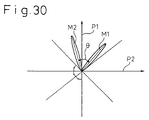
- an amount of transmission light is, as shown in Fig. 4, determined with an angle (referred to as a conical angle) ( ⁇ ) between a direction M1 in which the major axis of an average molecule of the antiferroelectric liquid crystal is oriented in the first ferroelectric state, and a direction M2 in which the major axis of the average molecule is oriented in the second ferroelectric state.
- a conical angle gets larger to approach 90°, the amount of transmission light required for white display increases.
- the conical angle gets smaller the amount of transmission light required for white display decreases.
- the conical angle of an antiferroelectric liquid crystalline molecule is not always constant.
- the conical angle depends greatly on, for example, a use temperature, that is, a temperature at which the antiferroelectric liquid crystal unit is driven to become usable for display (that is, an ambient temperature at which the liquid crystal device is usable).
- a use temperature that is, a temperature at which the antiferroelectric liquid crystal unit is driven to become usable for display
- the axis of ordinates indicates a contrast ratio for display (amount of transmission light for white display / amount of transmission light for black display)
- the axis of abscissas indicates the use temperature.
- the temperature of use is varied within a range of temperature of use, that is, a range from 15°C to 50°C within which the antiferroelectric liquid crystal is usually used.
- the contrast ratio for display of the antiferroelectric liquid crystal unit is measured at each temperature of use. As illustrated, as the temperature of use rises, the contrast ratio for display decrease
- the axis of ordinates indicates the conical angle
- the axis of abscissas indicates the temperature of use.
- the conical angle decreases.
- This relationship agrees with the relationship shown in Fig. 5. That is to say, as the temperature rises of use, the conical angle decreases, and the tilt of the antiferroelectric liquid crystalline molecules relative to a plane of polarization gets smaller. Consequently, the amount of transmission light decreases.
- the contrast ratio for display of the antiferroelectric liquid crystal unit is thus deeply temperature-dependent. This poses a problem that the antiferroelectric liquid crystal unit cannot achieve satisfactory display in a use environment suffering from a great temperature change.
- Japanese Unexamined Patent Publication No. 7-230079 discloses a technology of stabilizing the temperature of use of an antiferroelectric liquid crystal unit using a heater all the time for improving the efficiency of response at a low temperature.
- this technology is intended to improve the response efficiency of the antiferroelectric liquid crystalline molecules.
- Nothing is disclosed concerning the temperature-dependency of the conical angle of the antiferroelectric liquid crystalline molecules.
- problems concerning a contrast ratio for display and a change in luminance have not been discussed at all.
- the Japanese Unexamined Patent Publication No. 7-230079 is accompanied by an increase in power consumption deriving from the use of the heater.
- an object of the present invention is to solve the foregoing problems, and to provide an antiferroelectric liquid crystal unit in which a change in contrast ratio for display will remain small despite a change in temperature of use, and a power consumption of a backlight will not rise.
- the liquid crystal 26 is an antiferroelectric liquid crystal.
- either the antiferroelectric liquid crystal or a ferroelectric liquid crystal can be adopted as the liquid crystal 26. Consequently, the term "liquid crystal” refers to either the antiferroelectric liquid crystal or ferroelectric liquid crystal.
- the antiferroelectric liquid crystal panel shown in Fig. 2 will be further described.
- a spacer used to keep the spacing constant and the liquid crystal 26 are sandwiched between sealing compounds 22a and 22b.
- a plane of polarization produced by the first sheet polarizer 21a and a plane of polarization produced by the second sheet polarizer 21b lie substantially at an angle of 90°.
- a ferroelectric liquid crystal is used as a liquid crystal, a direction in which the major axis of an average molecule is oriented in the first or second ferroelectric state is aligned with either the plane of polarization produced by the first sheet polarizer 21a or second sheet polarizer 21b.
- Figs. 23a and 23b show illustratively a liquid crystalline molecule of the liquid crystal panel 2 seen from above.
- a direction in which the major axis of an average molecule of a liquid crystal is oriented will be described in conjunction with the drawings.
- an electric field E is applied in a direction from the face of she drawing (upper glass substrate of the liquid crystal panel) to the back thereof (lower glass substrate thereof) (Fig. 23a).
- the major axis of the average liquid crystalline molecule LCM tilts by an angle " ⁇ 1" with an axis of orientation OA set by an orientation film, and stays stable in a direction M2.
- a liquid crystalline molecule LCM shifts along the lateral surface of a cone defined by a segment in the direction M of the major axis thereof.
- a sum ( ⁇ 1+ ⁇ 2) of the angle ⁇ 1 and angle ⁇ 2 refers to an angle between the direction in which the major axis of the average molecule of the liquid crystal is oriented in the first ferroelectric state and the direction in which the major axis thereof is oriented in the second ferroelectric state, that is, a central angle ⁇ (that is, a conical angle) of a cone.
- a state of a ferroelectric liquid crystal in which the major axis of an average molecule is oriented in the direction shown in Fig. 23a is referred to as the first ferroelectric state.
- a state thereof in which the major axis of the average molecule is oriented in the direction shorn in Fig. 23b is referred to as the second ferroelectric stage.
- the major axis of the average molecule allegedly shifts over the lateral surface of a cone.
- the antiferroelectric liquid crystal assumes, as mentioned previously, an antiferroelectric state in addition to the first ferroelectric state and second ferroelectric state.
- the major axis of the average molecule is oriented alternately in the directions shown in Figs. 23a and 23b in the absence of an electric field.
- a mean direction of all directions in which the major axis of the average molecule is oriented is aligned with the axis of orientation OA.
- Fig. 24 shows an example of a positional relationship between the major axis of a liquid crystalline molecule and a plane of polarization produced by a sheet polarizer.
- This example is concerned with a ferroelectric liquid crystal.
- a ferroelectric liquid crystal when a ferroelectric liquid crystal is employed, either of a plane of polarization P1 produced by the first sheet polarizer and a plane of polarization P2 produced by the second sheet polarizer is aligned with the direction M2 in which the major axis of a molecule is oriented in the first or second ferroelectric state (in this example, the direction M2 is aligned with the plane of polarization P1).
- the plane of polarization P1 produced by the first sheet polarizer and the plane of polarization P2 produced by the second sheet polarizer lie at an angle of substantially 90°. This arrangement leads to a minimum amount of transmission light required for dark display.
- a liquid crystalline molecule LCM moves with the axis of orientation OA as an axis of symmetry. This results in a maximum amount of transmission light.
- the first sheet polarizer and second sheet polarizer are fixed to glass substrates using an adhesive or the like.
- a temperature observed when the sheet polarizers of a liquid crystal unit are assembled or a temperature observed when an angle at which the sheet polarizers are bonded is determined may be different from a temperature at the time of use.
- an angle between the direction M2 of the major axis of a liquid crystalline molecule LCM and the axis of orientation OA (angle ⁇ 1 or ⁇ 2) changes.
- axis of ordinates indicates an amount of transmission light
- the axis of abscissas indicates a temperature of use.
- This graph is concerned with a sheet polarizer bonded to a glass substrate so that the direction M2 in which the major axis of a liquid crystalline molecule LCM is oriented in the first ferroelectric state will be aligned with the plane of polarization P1 produced by the sheet polarizer.
- the amount of transmission light required for dark display at a temperature falling within a range of temperature of use varies greatly.
- An amount of transmission light observed at a temperature of use of 40°C is a minimum value.
- an object of the present invention is to provide a liquid crystal unit capable of offering a maximum contrast ratio even when a conical angle of a liquid crystalline molecule varies with a change in temperature occurring at a temperature that falls within a range of temperatures of use.
- a ferroelectric liquid crystal is generally known as a liquid crystal that assumes first and second ferroelectric states.
- a ferroelectric liquid crystal panel having the ferroelectric liquid crystal has been studied in earnest since it was revealed by Clerk et al. in U.S. Patent No. 4367924. The report reads that the ferroelectric liquid crystal panel exerts a memory effect and responds at a high speed, and the ferroelectric liquid crystal panel can be multiplexed satisfactorily.
- a liquid crystalline molecule of a ferroelectric liquid crystal moves, as mentioned previously, over the lateral surface of a cone according to a change in applied electric field.
- a ferroelectric liquid crystalline molecule is switched from one state to another or moved over the lateral surface only when a given pulsating wave is applied to the liquid crystalline molecule.
- a product of the pulse duration of the pulsating wave by a voltage is equal to or larger than a threshold voltage.
- an applied voltage has an opposite polarity, the first or second of the two ferroelectric states is selected.
- a ferroelectric liquid crystal is adopted as a liquid crystal.
- sheet polarizers are arranged so that the direction M2 in which the major axis of an average molecule of the liquid crystal is oriented in the second ferroelectric state will be aligned with the plane of polarization P produced by one of the sheet polarizers.
- a conical angle ( ⁇ ) defined between a direction in which the major axis of an average molecule of a liquid crystal is oriented in the first ferroelectric state and a direction in which the major axis thereof is oriented in the second ferroelectric state changes with a temperature.
- a temperature of use of a liquid crystal panel is not always constant. Consequently, the direction in which the major axis of the average molecule of the liquid crystal is oriented in the first or second ferroelectric state changes with the temperature of use.
- An amount of transmission light required by a liquid crystal panel having a ferroelectric liquid crystal changes with the use temperature irrespective of whether white display or black display is under way. This poses a problem that a contrast ratio for display that is a ratio of an amount of transmission light for white display to an amount of transmission light for black display changes with the use temperature.
- the temperature of use has a maximum value.
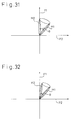
- the direction in which the major axis of an average molecule of a ferroelectric liquid crystal is oriented in one of the two ferroelectric states is aligned with a plane of polarization produced by one sheet polarizer. That is to say, sheet polarizers are arranged so that a state shown in Fig. 31 will be established. Thereafter, when the temperature of use decreases, the conical angle becomes smaller.
- the direction in which the major axis of an average molecule of a ferroelectric liquid crystal is oriented changes from the direction shown in Fig. 31 to the one shown in Fig. 32. Fig.
- FIG. 33 graphically shows the results of measuring an amount of transmission light required for white display and an amount of transmission light required for black display at a temperature falling within a range of temperature of use (T1 denotes a minimum temperature of use, and T2 denotes a maximum use temperature).
- T1 denotes a minimum temperature of use
- T2 denotes a maximum use temperature.
- the amount of transmission light for black display (e) increases (solid line) with a drop in temperature of use.
- the amount of transmission light for white display decreases (dashed line) with a drop in temperature of use.
- the contrast ratio for display therefore varies depending on the temperature of use as shown in Fig. 32. When this ferroelectric liquid crystal panel is used for display, the contrast ratio varies depending on the temperature of use. This poses a problem of impaired display quality.
- an object of the present invention is to provide a ferroelectric liquid crystal unit in which even when a temperature of use of a liquid crystal panel having a ferroelectric liquid crystal changes, a change in contrast ratio for display will be limited, and in which a power consumption required by a backlight will not increase.
- an amount of transmission light depends on a conical angle of a ferroelectric liquid crystal molecule.
- a maximum value of the conical angle is substantially 90°.
- the amount of transmission light decreases.
- the amount of transmission light remains constant but does not depend on the conical angle.
- the amount of transmission light is zero. Consequently, when the conical angle is held constant, the amount of light transmitted for white display is held constant all the time. High-quality display is enabled.
- the conical angle depends on a temperature. For example, when an antiferroelectric liquid crystal is heated, the antiferroelectric liquid crystal makes a transition to an SmA phase depending on the ferroelectric liquid crystal phase or material thereof. At a transition temperature or a temperature at which the ferroelectric liquid crystal phase or SmA phase appears, the conical angle is minimized. As the temperature gets lower than the transition temperature, the conical angle increases. The amount of transmission light for white display gets smaller with a higher temperature. As the temperature recedes from the transition temperature or gets lower, the amount of transmission light for white display increases.
- a contrast ratio for display permitted by an antiferroelectric liquid crystal unit used for display is a ratio of an amount of transmission light for white display to an amount of transmission light for black display.
- the contrast ratio therefore changes with a change in amount of transmission light for white display.
- the contrast ratio for display has a minimum value. As the temperature of the antiferroelectric liquid crystal changes from the transition temperature to a lower temperature, the contrast ratio for display increases.
- a change in contrast ratio for display is a change in amount of transmission light for white.
- a change in contrast ratio for display can therefor be avoided by compensating for the magnitude of the change.
- the amount of transmission light for white can be adjusted by varying an amount of light that falls on an antiferroelectric liquid crystal panel and is output from a backlight.
- sheet polarizers are arranged so that planes of polarization produced thereby will lie at an angle of substantially 90°, and the plane of polarization produced by one of the sheet polarizers will be aligned with the direction in which the major axis of an average molecule of an antiferroelectric liquid crystal is oriented in an antiferroelectric state.
- an antiferroelectric liquid crystal possesses a spontaneous polarization.
- a polarization reverse current flows.
- the polarization reverse current is directly proportional to the magnitude of the spontaneous polarization.
- the spontaneous polarization of the antiferroelectric liquid crystal varies, as shown in Fig. 7, depending on a change in use temperature.
- the axis of ordinates indicates the spontaneous polarization
- the axis of abscissas indicates the use temperature.
- the spontaneous polarization can be estimated based on the polarization reverse current flowing through pixels in a liquid crystal.
- the temperature of an antiferroelectric liquid crystal panel may not be actually measured. As long as the polarization reverse current can be measured, the temperature of the antiferroelectric liquid crystal panel can be estimated. The magnitude of a change in conical angle can be calculated. Consequently, an amount of light output from a backlight can be adjusted based on a change in polarization reverse current.
- An electrode on which a polarization reverse current is measured is formed on a substrate according to the same procedure as a procedure of forming electrodes used as pixels. This facilitates measuring of the polarization reverse current.
- a transmission light sensor may be included for measuring a luminance level of transmission light output from the backlight and passed through the antiferroelectric liquid crystal panel.
- a memory may be included for storing a correlation between a conical angle and a luminance level of transmission light. In this case, an amount of light output from the backlight can be adjusted without the necessity of measuring the temperature of the antiferroelectric liquid crystal panel or a polarization reverse current.
- a correlation between a luminance level detected by the transmission light sensor and a conical angle of an antiferroelectric liquid crystalline molecule is checked before the antiferroelectric liquid crystal panel is actually activated. The correlation is stored in the memory.
- the amount of light output from the backlight is adjusted based on the luminance level detected by the transmission light sensor and the correlation stored in the memory. Light is then re-output from the backlight.
- Fig. 2 is a diagram showing the structure of an antiferroelectric liquid crystal panel 2 of this embodiment.
- the antiferroelectric liquid crystal panel 2 of this embodiment is composed of a pair of glass substrates 23a and 23b having an antiferroelectric liquid crystal layer 26 approximately 2 ⁇ m thick between them.
- Display electrodes 24a and 24b are formed on opposed surfaces of the glass substrates.
- Orientation films 25a and 25b are applied over the display electrodes, and rubbed.
- a first sheet polarizer 21a is placed on the outer surface of one glass substrate 23a so that a plane of polarization produced by the sheet polarizer will be parallel to a direction in which the major axis of an antiferroelectric liquid crystalline molecule is oriented in the first ferroelectric state.
- a second sheet polarizer 21b is placed on the outer surface of the other glass substrate 23b so that a plane of polarization produced by the second sheet polarizer 21b will be deviated by substantially 90° from the plane of polarization produced by the first sheet polarizer 21a.
- Fig. 6 is a graph indicating a relationship between a use temperature of an antiferroelectric liquid crystal of this embodiment and a conical angle of a molecule thereof. Fig. 6 demonstrates that the conical angle of a molecule of the antiferroelectric liquid crystal gets smaller with an increase in use temperature.
- a graph shown in Fig. 8 represents relationships of an amount of transmission light for white display (b) and an amount of transmission light for black display (a) to a temperature of use or a temperature at which a conventional antiferroelectric liquid crystal unit having an antiferroelectric liquid crystal is used.
- the antiferroelectric liquid crystal panel shown in Fig. 2 is provided with a backlight alone. An amount of light emanating from the backlight is not controlled.
- the amount of transmission light for white display decreases, as shown in Fig. 8b, with a rise in temperature.
- the amount of transmission light for black display hardly changes as shown in Fig. 8a.
- a contrast ratio (amount of transmission light for white display / amount of transmission light for black display) decreases with a rise in use temperature.
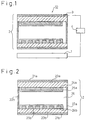
- Fig. 1 is a diagram schematically showing an antiferroelectric liquid crystal unit of an embodiment of the first aspect and an amount-of-output light control unit connected to a backlight.
- a liquid crystal unit 10 has an antiferroelectric liquid crystal panel 2 having the structure shown in Fig. 2 and a backlight 1.
- a temperature sensor 3 is placed on a glass substrate. The backlight 1 and temperature sensor 3 are electrically coupled and interlocked with each other via the amount-of-output light control unit 4.
- the ordinate indicates an amount of light output from the backlight, and the abscissa indicates a temperature of use.
- the ordinate indicates an amount of transmission light and the abscissa indicates the temperature of use.
- the antiferroelectric liquid crystal unit 10 having the structure shown in Fig. 1 carries out display, and the temperature sensor 3 samples a temperature of use. The amount of light output from the backlight is, as shown in Fig. 9, increased with a rise in temperature of use.
- Fig. 10 indicates the results of measuring an amount of transmission light for white display (d) (dashed line) and an amount of transmission light for black display (c) (solid line) in relation to a change in temperature occurring in the antiferroelectric liquid crystal unit 10 having the structure shown in Fig. 1.
- the amount of transmission light for white display (d) does not depend on the temperature of use and remains substantially constant. This means that a change in contrast ratio for display dependent on a temperature is resolved substantially.
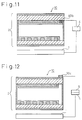
- Fig. 11 is a diagram showing schematically an antiferroelectric liquid crystal unit of another embodiment of the first aspect of the present invention, and an amount-of-output light control unit connected to a backlight.
- a liquid crystal unit 10 has an antiferroelectric liquid crystal panel 2 having the structure shown in Fig. 2, and a backlight 1.
- An electrode 40b is placed on a glass substrate.
- the electrode 40b is made of the same material as the material of display electrodes, and produced according to the same process as the process for producing the display electrodes.
- the electrode 40b is used to measure a polarization reverse current.
- the backlight 1 and electrode 40b are electrically coupled and interlocked with each other via the amount-of-output light control unit 4.
- the antiferroelectric liquid crystal unit having the structure shown in Fig. 11 carries out display, and the electrode 40b is used to measure a polarization reverse current.
- An amount of light output from the backlight is varied by the amount-of-output light control unit 4 according to a polarization reverse current.
- the polarization reverse current gets larger, the amount of light output from the backlight is decreased.
- the polarization reverse current gets smaller, the amount of light output from the backlight is increased.
- the amounts of transmission light required for white display and black display by the antiferroelectric liquid crystal unit 10 having the structure shown in Fig. 11 were measured in relation to a change in temperature. The results of the measurement demonstrate that the amount of transmission light for white display does not depend on the temperature of use but remains substantially constant. This means that a change in contrast ratio dependent on a temperature is resolved substantially.
- Fig. 12 is a diagram schematically showing an antiferroelectric liquid crystal unit of yet another embodiment of the first aspect, and an amount-of-output light control unit connected to a backlight.
- a liquid crystal unit 10 has an antiferroelectric liquid crystal panel 2 having the structure shown in Fig. 2, and a backlight 1.
- a transmission light sensor 30c for measuring a luminance level of transmission light having output from the backlight and passed through an antiferroelectric liquid crystal panel is placed on a glass substrate. As illustrated, the backlight 1 and transmission sensor 30c are electrically coupled and interlocked with each other via the amount-of-output light control unit 4.
- the liquid crystal unit 10 is provided with a memory 5 for storing a correlation between a conical angle of an antiferroelectric liquid crystalline molecule and a luminance level of transmission light. Based on the luminance level measured by the transmission light sensor 30c and the correlation stored in the memory, the amount of light output from the backlight is adjusted and light is re-output therefrom.
- the amounts of transmission light required for white display and black display by the antiferroelectric liquid crystal unit 10 having the structure shown in Fig. 12 were measured in relation to a change in temperature.
- the results of the measurement demonstrate that the amount of transmission light for white display does not depend on a temperature of use but remains substantially constant. This means that a change in contrast ratio for display dependent on a temperature is substantially resolved.
- Fig. 13 is a sectional view of a liquid crystal unit in accordance with the second aspect.
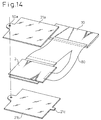
- Fig. 14 is an overall exploded view.
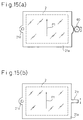
- Figs. 15a and 15b are plan views of a liquid crystal display that is seen from above.
- the liquid crystal panel 2 shown in Fig. 2 is used as a liquid crystal unit 10.
- the liquid crystal panel 2 has glass substrates, on which display electrodes and orientation films are formed, arranged so that the orientation films will be opposed to each other.
- a liquid crystal is clamped using a sealing compound.
- sheet polarizers are fixed to substrates using an adhesive or the like.
- a first sheet polarizer 21a and second sheet polarizer 21b that are not fixed to the liquid crystal panel 2 are placed outside the glass substrates.
- the first and second sheet polarizers share the same axis of rotation 50a.
- a drive circuit 70 for inputting a driving wave is constructed by connecting a flexible printed-circuit (FPC) board 80 to the liquid crystal panel 2 of the liquid crystal display.
- FPC flexible printed-circuit
- the sheet polarizers 21a and 21b can be turned arbitrarily with an axis-of-rotation hole 21d, into which the axis of rotation 50 is inserted, as a center.
- both or either of planes of polarization produced by the first sheet polarizer 21a and second sheet polarizer 21b is aligned with the major axis of an average molecule of a liquid crystal irrespective of whether the liquid crystal is brought to the first ferroelectric state or second ferroelectric state.
- a sheet polarizer turning dial 60 to be turned may be adopted.
- a sheet polarizer turning lever 21c to be moved may be adopted.
- the sheet polarizer is shaped so that the effective display portion of a glass substrate or liquid crystal panel 2 will not come out after the sheet polarizer is turned.
- the shape of the sheet polarizer may be a rectangle or sector.
- the plane of polarization P1 produced by the first sheet polarizer 21a and the plane of polarization P2 produced by the second sheet polarizer 21b are fixed at an angle of 90°.
- Figs. 16a and 16b the angle of the first sheet polarizer 21a relative to the liquid crystal panel 2 is adjusted.
- the sheet polarizer turning lever 21 is moved up and down (See an arrow).
- the first sheet polarizer 21a and second sheet polarizer 21b located as indicated with an alternate long and two short dashes line are then positioned as indicated with a solid line.
- the plane of polarization P1 produced by the first sheet polarizer 21a and the plane of polarization P2 produced by the second sheet polarizer 21b can thus be tilted relative to the major axis of an average molecule of a liquid crystal staying in the first or second ferroelectric state.
- a method of turning the sheet polarizer As a method of turning the sheet polarizer, a method of manually turning them by moving the sheet polarizer turning dial 60 or sheet polarizer turning lever 21c has been described in conjunction with Figs. 15a and 15b.
- Another method is a method in which a micro stepper motor 50 is, as shown in Fig. 19, used as a turning control unit and engaged with an axis of rotation 50a.
- the micro stepper motor 50 is engaged with the axis of rotation 50a, and used to turn both sheet polarizers according to a change in conical angle of a liquid crystalline molecule.
- the sheet polarizers are located at an angle of substantially 90°. Planes of polarization produced by the sheet polarizers are aligned with each other so that an amount of transmission light required for dark display will be minimized.
- Fig. 20 is a diagram showing the structure of a liquid crystal panel of this embodiment, that is, the liquid crystal panel 2 shown in Fig. 2.
- a temperature sensor 30b is placed on a glass substrate.
- a stepper motor 50 serving as a control unit for controlling turning of the sheet polarizers 21a and 21b is engaged with an axis of rotation.
- the stepper motor 50 and temperature sensor 30b are electrically coupled and interlocked with each other.
- the liquid crystal unit having the structure shown in Fig. 20 is used to carry out display.
- the temperature sensor 30b is used to sample a temperature of use.
- An angle of rotation by which the sheet polarizers are turned is varied depending on a temperature by means of the stepper motor 50.
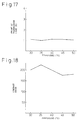
- Fig. 17 shows the results of measuring an amount of transmission light required for dark display in relation to a change in temperature, wherein the liquid crystal unit shown in Fig. 20 is taken for instance.
- an amount of transmission light for dark display does not depend on a temperature but remains substantially constant.
- a change in contrast ratio for display dependent on a temperature is reduced.
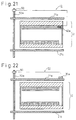
- Fig. 21 is a diagram showing a structure of another embodiment of the second aspect.
- a stepper motor 50 is engaged with an axis of rotation 50a.
- An electrode 40a is placed on a glass substrate.
- the electrode 40a is made of the same material as display electrodes and produced according to the same process as they are produced.
- the axis of rotation 50a and electrode 40a are electrically coupled and interlocked with each other via the stepper motor 50.
- the liquid crystal unit having the structure shown in Fig. 21 is used for display.
- the electrode 40a is used to measure a polarization reverse current.
- An angle of rotation by which the sheet polarizers are turned is varied depending on a polarization reverse current.
- the amounts of transmission light required by the liquid crystal unit having the structure shown in Fig. 21 were measured. The results of the measurement demonstrate that the amount of transmission light for dark display does not depend on a temperature but remains substantially constant. A change in contrast ratio for display dependent on a temperature is resolved substantially.
- Fig. 22 is a diagram showing yet another embodiment of the second aspect of the present invention.
- a stepper motor 50 is engaged with an axis of rotation 50a.
- a transmission light sensor 30a for measuring an amount of transmission light, which has passed through a liquid crystal panel, is placed on a glass substrate.
- the axis of rotation 50a and light transmission sensor 30a are electrically coupled and interlocked with each other via the stepper motor 50.
- an angle of rotation by which the sheet polarizers are turned is varied depending on a change in amount of transmission light for dark display, which is detected by the transmission light sensor 30a, by means of the stepper motor.
- the amount of transmission light for dark display does not depend on a temperature of use but remains substantially constant. A change in contrast ratio for display dependent on a temperature is resolved.
- the major axis of an average molecule of a liquid crystal staying in a ferroelectric state is always aligned with a plane of polarization produced by either of the sheet polarizers. This means that a transmittance of light for dark display remains almost constant irrespective of a temperature. Consequently, a contrast ratio for display that is a ratio of an amount of transmission light for dark display to an amount of transmission light for bright display can always be set to a high value.
- a liquid crystal panel has a liquid crystal, which assumes at least first and second ferroelectric states, sandwiched between a pair of substrates.
- First and second sheet polarizers are placed to interpose the pair of substrates between them.
- a plane of polarization produced by the first sheet polarizer and a plane of polarization produced by the second sheet polarizer are fixed at an angle of substantially 90°.
- Two planes are defined at angles that are halves of angles defined by the plane of polarization produced by the first sheet polarizer and the plane of polarization produced by the second sheet polarizer.
- One of the planes is regarded as a first intermediate plane, and the other is regarded as a second intermediate plane.
- the sheet polarizers are arranged so that: a direction in which the major axis of an average molecule of a ferroelectric liquid crystal is oriented in one of the first and second ferroelectric states will always be located between the plane of polarization produced by the second sheet polarizer and the first intermediate plane at a temperature falling within a use temperature range within which the ferroelectric liquid crystal panel is usable; and a direction in which the major axis of the average molecule of the ferroelectric liquid crystal is oriented in the other ferroelectric state will always be located between the plane of polarization produced by the first sheet polarizer and the first intermediate plane.
- the sheet polarizers are arranged so that: a direction in which the major axis of the average molecule of the ferroelectric liquid crystal is oriented in one ferroelectric state will always be located between the plane of polarization produced by the second sheet polarizer and the second intermediate plane; and a direction in which the major axis of the average molecule of the ferroelectric liquid crystal is oriented in the other ferroelectric state will always be located between the plane of polarization produced by the second sheet polarizer and the first intermediate plane.
- the sheet polarizers are arranged so that: a direction in which the major axis of the average molecule of the ferroelectric liquid crystal is oriented in one ferroelectric state will always be located between the plane of polarization produced by the first sheet polarizer and the first intermediate plane; and a direction in which the major axis of the average molecule of the ferroelectric liquid crystal is oriented in the other ferroelectric state will always be located between the plane of polarization produced by the first sheet polarizer and the second intermediate plane.
- the change curve exhibits a monotonous decrease or monotonous increase.
- a curve indicating a change in amount of transmission light relative to a change in temperature which occurs at a temperature within a range of temperature of use within which black display is achieved, has neither a maximal value nor a minimal value.
- the change curve exhibits a monotonous decrease or a monotonous increase.
- a differential coefficient of a function represented by a curve indicating a change in amount of transmission light due to a change in conical angle, which occurs at a temperature within a range of temperature of use within which white display is achieved has the same property as a differential coefficient of a function represented by a curve indicating a change in amount of transmission light due to a change in temperature of use which occurs at a temperature within a temperature of use range within which black display is achieved.
- a contrast ratio for display is a ratio of an amount of transmission light required for white display to an amount of transmission light required for black display. Even if the amount of transmission light for white display decreases depending on a temperature of use, since the amount of transmission light for black display decreases, a change in contrast ratio for display will be substantially resolved. Moreover, even when the amount of transmission light for white display increases, the amount of transmission light for black display increases. The same effect can be exerted.
- a ferroelectric liquid crystal unit when a ferroelectric liquid crystal unit is provided with a backlight, an amount of light output from the backlight is varied depending on a conical angle of a ferroelectric liquid crystalline molecule.
- a function represented by a curve indicating a change in amount of light output from the backlight is determined so that a differential coefficient of the function will exhibit a property opposite to the property of a differential coefficient of a function represented by a curve indicating a change in amount of transmission light for white display or black display.
- the amounts of transmission light required for white display and black display increase, the amount of light output from the backlight is decreased.
- the amounts of transmission light for white display and black display decrease, the amount of light output from the backlight is increased.
- a contrast ratio for display can be kept constant and at a better value.
- a conical angle of a liquid crystalline molecule changes according to a use temperature.
- a temperature sensor is placed on a substrate of a ferroelectric liquid crystal panel in order to measure the temperature of liquid crystalline molecules.
- the temperature sensor and backlight are electrically coupled and interlocked with each other. An amount of light output from the backlight may thus be adjusted.
- a conical angle of a liquid crystalline molecule can be calculated by measuring a polarization reverse current instead of a use temperature.
- a ferroelectric liquid crystal is switched from one ferroelectric state to the other ferroelectric state, a spontaneous polarization is reversed.
- the level of the polarization reverse current is directly proportional to the magnitude of the spontaneous polarization.
- the magnitude of the spontaneous polarization changes with a temperature.
- a change in temperature can therefore be calculated by calculating a change in polarization reverse current.
- a change in conical angle of a liquid crystalline molecule can be worked out by checking the change in polarization reverse current.
- another electrode different from electrodes forming pixels may be included.
- a change in polarization reverse current is checked, and the electrode and backlight are electrically coupled and interlocked with each other. An amount of light output from the backlight is thus varied.
- a transmission sensor inclusion of a transmission sensor is conceivable.
- a luminance level of transmission light transmitted by a liquid crystal panel is measured using a photodiode or the like.
- a luminance level permitted by a backlight is varied depending on a change in amount of transmission light.
- the liquid crystal panel 2 shown in Fig. 2 can be used as it is.
- the structure shown in Fig. 2 has already been described and a reiteration will be omitted.
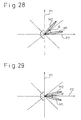
- planes named as intermediate planes are located at angles that are halves of angles defined by a plane of polarization produced by a first sheet polarizer and a plane of polarization produced by a second sheet polarizer. Since two intermediate planes exist, one of the two intermediate planes is regarded as a first intermediate plane, and the other is regarded as a second intermediate plane.
- sheet polarizers are arranged so that: a direction in which the major axis of an average molecule of a light crystal is oriented in one ferroelectric state will always be located between a plane of polarization produced by the second sheet polarizer and the first intermediate plane; and a direction in which the major axis of the average molecule of the liquid crystal is oriented in the other ferroelectric state will always be located between the first sheet polarizer and first intermediate plane.
- This embodiment will be described by taking a ferroelectric liquid crystal as a liquid crystal, though this embodiment can be adapted to an antiferroelectric liquid crystal alike.
- a minimum use temperature or a minimum temperature at which a ferroelectric liquid crystal unit is usable is 10°C, and a maximum use temperature is 40°C.
- a range of temperature of use is a range from 10°C to 40°C or the minimum use temperature to maximum temperature of use.
- a temperature of use of a ferroelectric liquid crystal and a conical angle have such a relationship that the conical angle of a ferroelectric liquid crystalline molecule gets smaller with a rise in temperature.
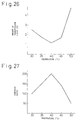
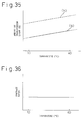
- Fig. 35 is a graph indicating relationships of an amount of transmission light for white display (h) and an amount of transmission light for black display (g) to a temperature of use.
- the liquid crystal unit of this embodiment having the ferroelectric liquid crystal carries out display. As the temperature of use rises, the amounts of transmission light increase.
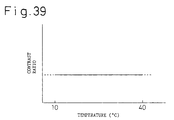
- a contrast ratio for display that is, a ratio of the amount of transmission light for white display to the amount of transmission light for black display does not depend on the temperature of use as seen from Fig. 36. The contrast ratio for display remains constant and a satisfactory display state can be realized.
- the structure shown in Fig. 1 can be employed in a liquid crystal unit of the third aspect of the present invention.
- the liquid crystal unit comprises a liquid crystal panel 2 having the structure shown in Fig. 2 and a backlight 1.
- a temperature sensor 3 is placed on a glass substrate.
- the backlight 1 and temperature sensor 3 are electrically coupled and interlocked with each other via an amount-of-output light control unit 4.
- the liquid crystal unit having the structure shown in Fig. 1 carries out display, and the temperature sensor 3 samples a temperature of use.
- the output control unit varies an amount of light output from the backlight for each temperature.
- the amount of light output from the backlight is increased as the temperature of use drops.
- Fig 37 indicates the results of measuring an amount of transmission light for white display (j) and an amount of transmission light for black display (i) relative to a change in temperature of the ferroelectric liquid crystal unit. Note that the amount of light output from the backlight in the ferroelectric liquid crystal unit has been adjusted.
- the amounts of transmission light for white display and black display do not depend on the temperature of use but remain substantially constant. Compared with the graph in Fig. 35 indicating amounts of transmission light required when an amount of light output from a backlight is not adjusted, a better display quality can be realized.
- the structure shown in Fig. 11 can be adapted to the liquid crystal unit of this embodiment.
- a ferroelectric liquid crystal panel 2 having the structure shown in Fig. 2 is provided with a backlight 1.
- An electrode 40b is placed on a glass substrate.
- the electrode 40b is made of the same material as display electrodes, and produced according to a similar process.
- the backlight 1 and electrode 40b are electrically coupled and interlocked with each other via an amount-of-output light control unit 4.
- the ferroelectric liquid crystal unit having the structure shown in Fig. 11 carries out display, and the electrode 40b is used to measure a polarization reverse current.
- the output control unit varies an amount of light output from the backlight according to a polarization reverse current. When the polarization reverse current gets larger, the amount of light output from the backlight is increased. When the polarization reverse current gets smaller, the amount of light output from the backlight is decreased.
- the amounts of transmission light required for white display and black display by the ferroelectric liquid crystal panel having the structure shown in Fig. 11 were measured in relation to a change in temperature. The results of the measurement are the same as the results graphically shown in Fig. 37. That is to say, the amounts of transmission light do not depend on the temperature of use but remain substantially constant. A difference in contrast ratio for display between temperatures is substantially resolved. Satisfactory display quality is realized.
- a ferroelectric liquid crystal panel 2 having the structure shown in Fig. 2 is provided with a backlight 1.
- a transmission light sensor 30c for measuring a luminance level of transmission light that has been output from the backlight and passed through the ferroelectric liquid crystal panel is placed on a glass substrate.
- the backlight 1 and transmission light sensor 30c are electrically coupled and interlocked with each other via an amount-of-output light control unit 4.
- the liquid crystal unit is provided with a memory 5 for storing a correlation between a conical angle of a ferroelectric liquid crystalline molecule and a luminance level of transmission light. Based on the luminance level measured by the transmission light sensor 30c and the correlation stored in the memory 5, an amount of light output from the backlight is adjusted and light is re-output therefrom.
- the amounts of transmission light required for white display and black display by the ferroelectric liquid crystal unit having the structure shown in Fig. 12 were measured in relation to a change in temperature. The results of the measurement are identical to those graphically shown in Fig. 37. Namely, the amounts of transmission light do not depend on the temperature of use but remain substantially constant. A difference in contrast ratio for display between temperatures is substantially resolved, and satisfactory display quality is realized.
- sheet polarizers are arranged so that: a direction in which the major axis of an average molecule of a ferroelectric liquid crystal is oriented in one ferroelectric state will always be located between a plane of polarization produced by a second sheet polarizer and a second intermediate plane; and a direction in which the major axis of the average molecule of the ferroelectric liquid crystal is oriented in the other ferroelectric state will always be located between the second sheet polarizer and a first intermediate plane.
- the sheet polarizers are, as shown in Fig. 30, arranged so that: a direction in which the major axis of the average molecule of the ferroelectric liquid crystal is oriented in one ferroelectric state will always be located between the plane of polarization produced by the first sheet polarizer and the first intermediate plane; and a direction in which the major axis of the average molecule of the ferroelectric liquid crystal is oriented in the other ferroelectric state will always be located between the first sheet polarizer and the second intermediate plane.
- a minimum temperature of use or a minimum temperature at which the ferroelectric liquid crystal panel of this embodiment can be usable is 10°C, and a maximum temperature of use thereof is 40°C. What is referred to as a use temperature range is a range from the minimum temperature of use to the maximum temperature of use.
- the ferroelectric liquid crystal employed in this embodiment is made of the same material as the one in the previous embodiment.
- a conical angle of a ferroelectric liquid crystalline molecule gets smaller with a rise in temperature.
- Fig. 38 is a graph indicating relationships of an amount of transmission light for white display (l) and an amount of transmission light for black display (k) to a temperature of use.
- the ferroelectric liquid crystal panel of this embodiment having the above ferroelectric liquid crystal is used for display.
- a contrast ratio for display that is, a ratio of the amount of transmission light for white display to the amount of transmission light for black display does not, as shown in Fig. 39, depend on the temperature of use.
- the contrast ratio for display remains constant, and a satisfactory display state can be realized.
- a ferroelectric liquid crystal unit having the structure shown in Fig. 1 is adopted.
- the ferroelectric liquid crystal unit having the structure shown in Fig. 1 carries out display and the temperature sensor 3 samples a temperature of use.
- the output control unit 4 varies an amount of light output from the backlight according to each temperature.
- the amount of light output from the backlight is increased with a rise in temperature of use.
- the amounts of transmission light required for white display and black display by a ferroelectric liquid crystal panel were measured in relation to a change in temperature. The results of the measurement are identical to those graphically shown in Fig. 37. As shown in Fig.
- the amounts of transmission light for white display and black display do not depend on the temperature of use but remain substantially constant. Compared with the results of a measurement shown in Fig. 38 for which the amount of light output from the backlight has not been adjusted, the results of the measurement shown in Fig. 37 demonstrate better display quality.
- a ferroelectric liquid crystal having the structure shown in Fig. 11 is used to carry out display.
- the electrode 40b is used to measure a polarization reverse current.
- the output control unit varies an amount of light output from the backlight according to a polarization reverse current. When the polarization reverse current gets larger, the amount of light output from the backlight is decreased. When the polarization reverse current gets smaller, the amount of light output from the backlight is increased.
- the amounts of transmission light required for white display and black display by the ferroelectric liquid crystal panel having the structure shown in Fig. 11 were measured in relation to a change in temperature. The results of the measurement are identical to those graphically shown in Fig. 37.
- the amounts of transmission light do not depend on the temperature of use but remain substantially constant. Consequently, a different in contrast ratio for display between temperatures is resolved substantially. Satisfactory display quality is realized.
- a ferroelectric liquid crystal unit having the structure shown in Fig. 12 is used for display.
- the results of measuring the amounts of transmission light required for white display and black display by a ferroelectric liquid crystal panel in relation to a change in temperature are identical to those graphically shown in Fig. 37.
- the amounts of transmission light do not depend on the temperature of use but remain substantially constant.
- a difference in contrast ratio for display between temperatures is substantially resolved. Satisfactory display quality is realized.
- sheet polarizers may be arranged so that a direction in which the major axis of an average molecule of a ferroelectric liquid crystal is oriented in either of ferroelectric states will be aligned with a plane of polarization produced by a sheet polarizer or with an intermediate plane. Nevertheless, good results are obtained.
- a range of temperature of use is defined as a range from 10°C to 40°C.
- the range of temperature of use is not limited to this range.
- an antiferroelectric liquid crystal unit in which a contrast ratio for display is devoid of temperature dependency irrespective of a temperature, and an amount of light output from a backlight can be adjusted with a small power consumption. At whatever temperature of use the liquid crystal unit is used, a satisfactory display can be achieved all the time.
- a structure making it possible to turn sheet polarizers at a desired angle is included. Owing to this structure, as long as a change in temperature is limited to a range permitting operations, an amount of transmission light for dark display can be optimized. A high contrast ratio for display can be attained. Otherwise, a decrease in contrast ratio for display occurs during dark display because of misalignment between the major axis of a molecule of an antiferroelectric liquid crystal or ferroelectric liquid crystal and a plane of polarization produced by a sheet polarizer. The misalignment is caused by a change in conical angle deriving from a change in temperature.
- a ferroelectric liquid crystal unit can attain a certain contrast ratio for display at a temperature within a range of temperature of use because first and second sheet polarizers can be arranged properly. Moreover, an amount of light output from a backlight can be adjusted. Consequently, at whatever temperature within a use temperature range the ferroelectric liquid crystal unit is used, satisfactory display quality can be attained all the time.
- an antiferroelectric liquid crystal unit having a liquid crystal panel in which an antiferroelectric liquid crystal is employed In the antiferroelectric liquid crystal unit, despite a change in temperature of use, a change in contrast ratio for display will be limited, and a power consumption of a backlight will not increase.
- a liquid crystal unit having a liquid crystal panel in which an antiferroelectric liquid crystal or ferroelectric liquid crystal is employed In the liquid crystal unit, even when a change in conical angle of a liquid crystalline molecule occurs due to a change in temperature of use, sheet polarizers can be positioned so that a maximum contrast ratio can be attained at each use temperature.
- a ferroelectric liquid crystal unit having a liquid crystal panel in which a ferroelectric liquid crystal is employed.
- a change in contrast ratio for display will be limited and a power consumption of a backlight will not increase.
- a liquid crystal unit having a liquid crystal panel capable of offering good image quality and a backlight can be provided.
- the industrial applicability of the present invention covers a very wide range of fields.
Landscapes
- Physics & Mathematics (AREA)
- Nonlinear Science (AREA)
- Chemical & Material Sciences (AREA)
- Crystallography & Structural Chemistry (AREA)
- General Physics & Mathematics (AREA)
- Optics & Photonics (AREA)
- Engineering & Computer Science (AREA)
- Mathematical Physics (AREA)
- Computer Hardware Design (AREA)
- Theoretical Computer Science (AREA)
- Liquid Crystal (AREA)
Applications Claiming Priority (7)
| Application Number | Priority Date | Filing Date | Title |
|---|---|---|---|
| JP7549996 | 1996-03-29 | ||
| JP75499/96 | 1996-03-29 | ||
| JP9998296 | 1996-04-22 | ||
| JP99982/96 | 1996-04-22 | ||
| JP155094/96 | 1996-06-17 | ||
| JP15509496 | 1996-06-17 | ||
| PCT/JP1997/001022 WO1997037270A1 (fr) | 1996-03-29 | 1997-03-26 | Affichage a cristaux liquides |
Publications (2)
| Publication Number | Publication Date |
|---|---|
| EP0890864A1 true EP0890864A1 (fr) | 1999-01-13 |
| EP0890864A4 EP0890864A4 (fr) | 2000-08-09 |
Family
ID=27301848
Family Applications (1)
| Application Number | Title | Priority Date | Filing Date |
|---|---|---|---|
| EP97908510A Withdrawn EP0890864A4 (fr) | 1996-03-29 | 1997-03-26 | Affichage a cristaux liquides |
Country Status (4)
| Country | Link |
|---|---|
| US (1) | US6115091A (fr) |
| EP (1) | EP0890864A4 (fr) |
| JP (1) | JP3736856B2 (fr) |
| WO (1) | WO1997037270A1 (fr) |
Cited By (3)
| Publication number | Priority date | Publication date | Assignee | Title |
|---|---|---|---|---|
| WO2002025363A1 (fr) * | 2000-09-20 | 2002-03-28 | Wlodzimierz Myslowski | Dispositif afficheur, en particulier pour telephone mobile |
| EP2014738A1 (fr) | 2007-07-13 | 2009-01-14 | Cheil Industries Inc. | Composition adhésive et élément optique |
| EP2124092A4 (fr) * | 2007-02-07 | 2010-08-04 | Nano Loa Inc | Dispositif à cristaux liquides |
Families Citing this family (14)
| Publication number | Priority date | Publication date | Assignee | Title |
|---|---|---|---|---|
| EP0919849A4 (fr) * | 1997-06-20 | 2000-09-13 | Citizen Watch Co Ltd | Afficheur a cristaux liquides anti-ferroelectriques et son procede de commande |
| US6309469B2 (en) * | 1999-03-15 | 2001-10-30 | Shop Vac Corporation | Debris access door |
| US6519012B1 (en) * | 1999-10-28 | 2003-02-11 | Hewlett-Packard Company | Liquid crystal light valve system with contrast control |
| US6642977B2 (en) * | 2001-06-20 | 2003-11-04 | 3M Innovative Properties Company | Liquid crystal displays with repositionable front polarizers |
| US20030017856A1 (en) * | 2001-06-20 | 2003-01-23 | 3M Innovative Properties Company | Method for altering the appearance of liquid crystal displays using exchangable front polarizers |
| JP2003029288A (ja) * | 2001-07-12 | 2003-01-29 | Denso Corp | 表示装置およびその製造方法、この表示装置を用いたメータパネル。 |
| CN100406991C (zh) * | 2003-12-24 | 2008-07-30 | 西铁城控股株式会社 | 液晶显示屏及使用它的条形码读取系统 |
| US8378963B2 (en) * | 2004-12-09 | 2013-02-19 | Sony Ericsson Mobile Communications Ab | Photosensors for displays and related devices |
| JP4787506B2 (ja) * | 2005-01-18 | 2011-10-05 | シチズンホールディングス株式会社 | 半透過反射型強誘電性液晶表示装置 |
| TWI337672B (en) * | 2006-10-27 | 2011-02-21 | Chimei Innolux Corp | Liquid crystal display |
| EP2075787A3 (fr) * | 2007-12-26 | 2010-07-07 | TPO Displays Corp. | Dispositifs d'affichage avec detection de la lumière ambiante |
| JP2013160502A (ja) * | 2012-02-01 | 2013-08-19 | Panasonic Liquid Crystal Display Co Ltd | 温度センサを備える表示装置 |
| US8970808B2 (en) * | 2012-09-11 | 2015-03-03 | Apple Inc. | Display with temperature sensors |
| TWI875378B (zh) * | 2023-12-14 | 2025-03-01 | 技嘉科技股份有限公司 | 調整場景亮度的計算機、調整方法與建立調整場景亮度的處理方法 |
Family Cites Families (17)
| Publication number | Priority date | Publication date | Assignee | Title |
|---|---|---|---|---|
| US4941736A (en) * | 1985-04-23 | 1990-07-17 | Canon Kabushiki Kaisha | Ferroelectric liquid crystal device and driving method therefor |
| JPS62204229A (ja) * | 1986-03-04 | 1987-09-08 | Casio Comput Co Ltd | 液晶装置 |
| JPS62210421A (ja) * | 1986-03-11 | 1987-09-16 | Canon Inc | 光学変調素子 |
| JPS62247333A (ja) * | 1986-04-21 | 1987-10-28 | Seiko Epson Corp | 強誘電性液晶光学表示装置 |
| JPH07120143B2 (ja) * | 1986-06-04 | 1995-12-20 | キヤノン株式会社 | 表示パネルの情報読出し法及び表示パネルの情報読出し装置 |
| JPH07113723B2 (ja) * | 1987-06-29 | 1995-12-06 | ホシデン株式会社 | 液晶表示装置 |
| JP2815415B2 (ja) * | 1989-09-18 | 1998-10-27 | 松下電器産業株式会社 | 強誘電性液晶パネルの製造方法 |
| US5182662A (en) * | 1989-12-01 | 1993-01-26 | Canon Kabushiki Kaisha | Liquid crystal device |
| JPH0414013A (ja) * | 1990-05-08 | 1992-01-20 | Fujitsu Ltd | 液晶表示装置および液晶表示方法 |
| JP2772582B2 (ja) * | 1990-11-21 | 1998-07-02 | キヤノン株式会社 | 光学変調素子 |
| JP3033257B2 (ja) * | 1991-07-11 | 2000-04-17 | セイコーエプソン株式会社 | 液晶表示装置 |
| GB9127316D0 (en) * | 1991-12-23 | 1992-02-19 | Secr Defence | Ferroelectric liquid crystal display device(improved contrast) |
| JPH05303081A (ja) * | 1992-04-24 | 1993-11-16 | Semiconductor Energy Lab Co Ltd | 液晶電気光学装置 |
| JPH0667159A (ja) * | 1992-08-25 | 1994-03-11 | Nec Shizuoka Ltd | 液晶表示装置 |
| JPH06175589A (ja) * | 1992-12-11 | 1994-06-24 | Zanabui Infuomateikusu:Kk | 液晶ディスプレイ装置 |
| JPH07311373A (ja) * | 1994-05-16 | 1995-11-28 | Citizen Watch Co Ltd | 反強誘電性液晶素子およびその駆動方法 |
| US5623351A (en) * | 1995-06-07 | 1997-04-22 | Citizen Watch Co., Ltd. | Antiferroelectric liquid crystal panel capable of displaying images without flickering |
-
1997
- 1997-03-26 EP EP97908510A patent/EP0890864A4/fr not_active Withdrawn
- 1997-03-26 WO PCT/JP1997/001022 patent/WO1997037270A1/fr not_active Ceased
- 1997-03-26 JP JP53511697A patent/JP3736856B2/ja not_active Expired - Fee Related
- 1997-03-26 US US09/155,054 patent/US6115091A/en not_active Expired - Fee Related
Cited By (3)
| Publication number | Priority date | Publication date | Assignee | Title |
|---|---|---|---|---|
| WO2002025363A1 (fr) * | 2000-09-20 | 2002-03-28 | Wlodzimierz Myslowski | Dispositif afficheur, en particulier pour telephone mobile |
| EP2124092A4 (fr) * | 2007-02-07 | 2010-08-04 | Nano Loa Inc | Dispositif à cristaux liquides |
| EP2014738A1 (fr) | 2007-07-13 | 2009-01-14 | Cheil Industries Inc. | Composition adhésive et élément optique |
Also Published As
| Publication number | Publication date |
|---|---|
| JP3736856B2 (ja) | 2006-01-18 |
| WO1997037270A1 (fr) | 1997-10-09 |
| EP0890864A4 (fr) | 2000-08-09 |
| US6115091A (en) | 2000-09-05 |
Similar Documents
| Publication | Publication Date | Title |
|---|---|---|
| US6115091A (en) | Liquid crystal device with adjustable light throughput | |
| EP0376278B1 (fr) | Dispositif d'affichage à cristal liquide | |
| KR930002917B1 (ko) | 액정 표시소자 | |
| EP0616240B1 (fr) | Affichage et dispositif à cristal liquide | |
| EP0622656A1 (fr) | Compensateur optique pour dispositif d'affichage à cristaux liquides | |
| US5495351A (en) | Liquid crystal device with two monostable liquid crystal cells | |
| JPWO1997037270A1 (ja) | 液晶表示装置 | |
| US6760088B2 (en) | Ferroelectric liquid crystal display | |
| EP0312297A2 (fr) | Panneau d'affichage à cristal liquide | |
| EP2124092A1 (fr) | Dispositif à cristaux liquides | |
| EP0487047B1 (fr) | Dispositif de modulation optique | |
| JP2001083479A (ja) | 液晶表示装置及びその製造方法、並びに液晶表示装置の駆動方法 | |
| EP0475401B1 (fr) | Elément de modulation optique | |
| JP2767382B2 (ja) | 光学補償シート | |
| EP0352792A2 (fr) | Dispositif à cristal liquide | |
| JPH04324422A (ja) | 液晶表示装置 | |
| US20060268209A1 (en) | Transmission liquid crystal display operable in optically compensated bend mode | |
| JPS62204229A (ja) | 液晶装置 | |
| JPH05264956A (ja) | 二層stn型液晶表示装置 | |
| JPH04324421A (ja) | 液晶表示装置 | |
| US7307678B2 (en) | Liquid crystal display and fabricating method thereof | |
| JPH04324420A (ja) | 液晶表示装置 | |
| WO1998059275A1 (fr) | Dispositif a cristaux liquides | |
| JPH1164824A (ja) | 反強誘電性液晶ディスプレイ及びその駆動方法 | |
| JP2000314866A (ja) | Stn型液晶表示装置 |
Legal Events
| Date | Code | Title | Description |
|---|---|---|---|
| PUAI | Public reference made under article 153(3) epc to a published international application that has entered the european phase |
Free format text: ORIGINAL CODE: 0009012 |
|
| 17P | Request for examination filed |
Effective date: 19980922 |
|
| AK | Designated contracting states |
Kind code of ref document: A1 Designated state(s): DE FR GB NL |
|
| A4 | Supplementary search report drawn up and despatched |
Effective date: 20000623 |
|
| AK | Designated contracting states |
Kind code of ref document: A4 Designated state(s): DE FR GB NL |
|
| RIC1 | Information provided on ipc code assigned before grant |
Free format text: 7G 02F 1/133 A, 7G 02F 1/1335 B, 7G 02F 1/137 B, 7G 02F 1/141 B, 7G 09G 3/34 B |
|
| RAP1 | Party data changed (applicant data changed or rights of an application transferred) |
Owner name: CITIZEN WATCH CO. LTD. |
|
| 17Q | First examination report despatched |
Effective date: 20050411 |
|
| RAP1 | Party data changed (applicant data changed or rights of an application transferred) |
Owner name: CITIZEN HOLDINGS CO., LTD. |
|
| STAA | Information on the status of an ep patent application or granted ep patent |
Free format text: STATUS: THE APPLICATION IS DEEMED TO BE WITHDRAWN |
|
| 18D | Application deemed to be withdrawn |
Effective date: 20120914 |