EP0891403B1 - Melanges de polymeres cristallins liquides - Google Patents
Melanges de polymeres cristallins liquides Download PDFInfo
- Publication number
- EP0891403B1 EP0891403B1 EP97914267A EP97914267A EP0891403B1 EP 0891403 B1 EP0891403 B1 EP 0891403B1 EP 97914267 A EP97914267 A EP 97914267A EP 97914267 A EP97914267 A EP 97914267A EP 0891403 B1 EP0891403 B1 EP 0891403B1
- Authority
- EP
- European Patent Office
- Prior art keywords
- mol
- aromatic
- polymer
- crystalline
- liquid
- Prior art date
- Legal status (The legal status is an assumption and is not a legal conclusion. Google has not performed a legal analysis and makes no representation as to the accuracy of the status listed.)
- Expired - Lifetime
Links
- 239000000203 mixture Substances 0.000 title claims abstract description 108
- 229920000106 Liquid crystal polymer Polymers 0.000 claims abstract description 77
- 230000003098 cholesteric effect Effects 0.000 claims abstract description 37
- 239000000463 material Substances 0.000 claims abstract description 13
- 230000000694 effects Effects 0.000 claims abstract description 10
- 239000000049 pigment Substances 0.000 claims abstract description 9
- 229920002959 polymer blend Polymers 0.000 claims abstract description 7
- -1 aromatic hydroxycarboxylic acids Chemical class 0.000 claims description 38
- FJKROLUGYXJWQN-UHFFFAOYSA-N 4-hydroxybenzoic acid Chemical compound OC(=O)C1=CC=C(O)C=C1 FJKROLUGYXJWQN-UHFFFAOYSA-N 0.000 claims description 26
- 239000005267 main chain polymer Substances 0.000 claims description 22
- KKEYFWRCBNTPAC-UHFFFAOYSA-N Terephthalic acid Chemical compound OC(=O)C1=CC=C(C(O)=O)C=C1 KKEYFWRCBNTPAC-UHFFFAOYSA-N 0.000 claims description 20
- 238000002156 mixing Methods 0.000 claims description 16
- 150000001875 compounds Chemical class 0.000 claims description 15
- KAUQJMHLAFIZDU-UHFFFAOYSA-N 6-Hydroxy-2-naphthoic acid Chemical compound C1=C(O)C=CC2=CC(C(=O)O)=CC=C21 KAUQJMHLAFIZDU-UHFFFAOYSA-N 0.000 claims description 14
- 229940090248 4-hydroxybenzoic acid Drugs 0.000 claims description 13
- 125000000524 functional group Chemical group 0.000 claims description 10
- GHMLBKRAJCXXBS-UHFFFAOYSA-N resorcinol Chemical compound OC1=CC=CC(O)=C1 GHMLBKRAJCXXBS-UHFFFAOYSA-N 0.000 claims description 10
- QQVIHTHCMHWDBS-UHFFFAOYSA-N isophthalic acid Chemical compound OC(=O)C1=CC=CC(C(O)=O)=C1 QQVIHTHCMHWDBS-UHFFFAOYSA-N 0.000 claims description 9
- QIGBRXMKCJKVMJ-UHFFFAOYSA-N Hydroquinone Chemical compound OC1=CC=C(O)C=C1 QIGBRXMKCJKVMJ-UHFFFAOYSA-N 0.000 claims description 8
- 238000000034 method Methods 0.000 claims description 8
- 125000001997 phenyl group Chemical group [H]C1=C([H])C([H])=C(*)C([H])=C1[H] 0.000 claims description 8
- 150000004984 aromatic diamines Chemical class 0.000 claims description 7
- 230000001588 bifunctional effect Effects 0.000 claims description 7
- 238000004519 manufacturing process Methods 0.000 claims description 7
- VCCBEIPGXKNHFW-UHFFFAOYSA-N biphenyl-4,4'-diol Chemical group C1=CC(O)=CC=C1C1=CC=C(O)C=C1 VCCBEIPGXKNHFW-UHFFFAOYSA-N 0.000 claims description 6
- BVKZGUZCCUSVTD-UHFFFAOYSA-N carbonic acid Chemical class OC(O)=O BVKZGUZCCUSVTD-UHFFFAOYSA-N 0.000 claims description 6
- 150000001991 dicarboxylic acids Chemical class 0.000 claims description 6
- 150000002009 diols Chemical class 0.000 claims description 6
- 238000001429 visible spectrum Methods 0.000 claims description 6
- 125000004169 (C1-C6) alkyl group Chemical group 0.000 claims description 5
- RXOHFPCZGPKIRD-UHFFFAOYSA-N naphthalene-2,6-dicarboxylic acid Chemical compound C1=C(C(O)=O)C=CC2=CC(C(=O)O)=CC=C21 RXOHFPCZGPKIRD-UHFFFAOYSA-N 0.000 claims description 5
- 238000000576 coating method Methods 0.000 claims description 4
- 239000000155 melt Substances 0.000 claims description 4
- 125000003118 aryl group Chemical group 0.000 claims description 3
- 239000000843 powder Substances 0.000 claims description 3
- 239000007858 starting material Substances 0.000 claims description 3
- 238000002360 preparation method Methods 0.000 claims 1
- 229920000642 polymer Polymers 0.000 description 61
- IJGRMHOSHXDMSA-UHFFFAOYSA-N Atomic nitrogen Chemical compound N#N IJGRMHOSHXDMSA-UHFFFAOYSA-N 0.000 description 60
- 239000004977 Liquid-crystal polymers (LCPs) Substances 0.000 description 38
- WFDIJRYMOXRFFG-UHFFFAOYSA-N Acetic anhydride Chemical compound CC(=O)OC(C)=O WFDIJRYMOXRFFG-UHFFFAOYSA-N 0.000 description 33
- 101100181504 Mus musculus Clc gene Proteins 0.000 description 32
- QTBSBXVTEAMEQO-UHFFFAOYSA-N Acetic acid Chemical compound CC(O)=O QTBSBXVTEAMEQO-UHFFFAOYSA-N 0.000 description 30
- 229910052757 nitrogen Inorganic materials 0.000 description 30
- KLDXJTOLSGUMSJ-JGWLITMVSA-N Isosorbide Chemical compound O[C@@H]1CO[C@@H]2[C@@H](O)CO[C@@H]21 KLDXJTOLSGUMSJ-JGWLITMVSA-N 0.000 description 15
- 230000015572 biosynthetic process Effects 0.000 description 14
- 238000003786 synthesis reaction Methods 0.000 description 13
- 238000009833 condensation Methods 0.000 description 10
- 230000005494 condensation Effects 0.000 description 10
- 238000010926 purge Methods 0.000 description 10
- 239000000523 sample Substances 0.000 description 10
- 239000000178 monomer Substances 0.000 description 9
- 229960002479 isosorbide Drugs 0.000 description 8
- 238000003756 stirring Methods 0.000 description 8
- 239000003086 colorant Substances 0.000 description 7
- 238000001816 cooling Methods 0.000 description 6
- 239000010981 turquoise Substances 0.000 description 6
- FFRBMBIXVSCUFS-UHFFFAOYSA-N 2,4-dinitro-1-naphthol Chemical compound C1=CC=C2C(O)=C([N+]([O-])=O)C=C([N+]([O-])=O)C2=C1 FFRBMBIXVSCUFS-UHFFFAOYSA-N 0.000 description 5
- SGHZXLIDFTYFHQ-UHFFFAOYSA-L Brilliant Blue Chemical compound [Na+].[Na+].C=1C=C(C(=C2C=CC(C=C2)=[N+](CC)CC=2C=C(C=CC=2)S([O-])(=O)=O)C=2C(=CC=CC=2)S([O-])(=O)=O)C=CC=1N(CC)CC1=CC=CC(S([O-])(=O)=O)=C1 SGHZXLIDFTYFHQ-UHFFFAOYSA-L 0.000 description 5
- 238000006068 polycondensation reaction Methods 0.000 description 5
- CDAWCLOXVUBKRW-UHFFFAOYSA-N 2-aminophenol Chemical class NC1=CC=CC=C1O CDAWCLOXVUBKRW-UHFFFAOYSA-N 0.000 description 4
- 238000004132 cross linking Methods 0.000 description 4
- 125000002496 methyl group Chemical group [H]C([H])([H])* 0.000 description 4
- ARCGXLSVLAOJQL-UHFFFAOYSA-N trimellitic acid Chemical compound OC(=O)C1=CC=C(C(O)=O)C(C(O)=O)=C1 ARCGXLSVLAOJQL-UHFFFAOYSA-N 0.000 description 4
- JOMNTHCQHJPVAZ-RXMQYKEDSA-N (2r)-2-methylpiperazine Chemical compound C[C@@H]1CNCCN1 JOMNTHCQHJPVAZ-RXMQYKEDSA-N 0.000 description 3
- 150000004985 diamines Chemical class 0.000 description 3
- 239000008240 homogeneous mixture Substances 0.000 description 3
- 125000002887 hydroxy group Chemical group [H]O* 0.000 description 3
- 239000004922 lacquer Substances 0.000 description 3
- RUAIJHHRCIHFEV-UHFFFAOYSA-N methyl 4-amino-5-chlorothiophene-2-carboxylate Chemical compound COC(=O)C1=CC(N)=C(Cl)S1 RUAIJHHRCIHFEV-UHFFFAOYSA-N 0.000 description 3
- 238000010422 painting Methods 0.000 description 3
- WQGWDDDVZFFDIG-UHFFFAOYSA-N pyrogallol Chemical class OC1=CC=CC(O)=C1O WQGWDDDVZFFDIG-UHFFFAOYSA-N 0.000 description 3
- 239000000126 substance Substances 0.000 description 3
- JOMNTHCQHJPVAZ-YFKPBYRVSA-N (2s)-2-methylpiperazine Chemical compound C[C@H]1CNCCN1 JOMNTHCQHJPVAZ-YFKPBYRVSA-N 0.000 description 2
- LSPHULWDVZXLIL-LDWIPMOCSA-N (?)-Camphoric acid Chemical compound CC1(C)[C@@H](C(O)=O)CC[C@@]1(C)C(O)=O LSPHULWDVZXLIL-LDWIPMOCSA-N 0.000 description 2
- CBCKQZAAMUWICA-UHFFFAOYSA-N 1,4-phenylenediamine Chemical compound NC1=CC=C(N)C=C1 CBCKQZAAMUWICA-UHFFFAOYSA-N 0.000 description 2
- LSPHULWDVZXLIL-UHFFFAOYSA-N Camphoric acid Natural products CC1(C)C(C(O)=O)CCC1(C)C(O)=O LSPHULWDVZXLIL-UHFFFAOYSA-N 0.000 description 2
- KXDHJXZQYSOELW-UHFFFAOYSA-N Carbamic acid Chemical class NC(O)=O KXDHJXZQYSOELW-UHFFFAOYSA-N 0.000 description 2
- 229960001506 brilliant green Drugs 0.000 description 2
- JGGQWILNAAODRS-UHFFFAOYSA-N n-methyl-4-[4-(methylamino)phenyl]aniline Chemical compound C1=CC(NC)=CC=C1C1=CC=C(NC)C=C1 JGGQWILNAAODRS-UHFFFAOYSA-N 0.000 description 2
- 230000005855 radiation Effects 0.000 description 2
- 230000000717 retained effect Effects 0.000 description 2
- 239000002904 solvent Substances 0.000 description 2
- BYEAHWXPCBROCE-UHFFFAOYSA-N 1,1,1,3,3,3-hexafluoropropan-2-ol Chemical compound FC(F)(F)C(O)C(F)(F)F BYEAHWXPCBROCE-UHFFFAOYSA-N 0.000 description 1
- ARRQNZZBVOIEQQ-UHFFFAOYSA-N 1,3-dioxoisoindole-5-carboxylic acid Chemical compound OC(=O)C1=CC=C2C(=O)NC(=O)C2=C1 ARRQNZZBVOIEQQ-UHFFFAOYSA-N 0.000 description 1
- PXGZQGDTEZPERC-UHFFFAOYSA-N 1,4-cyclohexanedicarboxylic acid Chemical compound OC(=O)C1CCC(C(O)=O)CC1 PXGZQGDTEZPERC-UHFFFAOYSA-N 0.000 description 1
- XBNGYFFABRKICK-UHFFFAOYSA-N 2,3,4,5,6-pentafluorophenol Chemical compound OC1=C(F)C(F)=C(F)C(F)=C1F XBNGYFFABRKICK-UHFFFAOYSA-N 0.000 description 1
- WXTMDXOMEHJXQO-UHFFFAOYSA-N 2,5-dihydroxybenzoic acid Chemical compound OC(=O)C1=CC(O)=CC=C1O WXTMDXOMEHJXQO-UHFFFAOYSA-N 0.000 description 1
- PQOPJKRIAWTTJQ-UHFFFAOYSA-N 2-phenyl-1h-benzimidazole-4,5-diamine Chemical compound N=1C2=C(N)C(N)=CC=C2NC=1C1=CC=CC=C1 PQOPJKRIAWTTJQ-UHFFFAOYSA-N 0.000 description 1
- NEQFBGHQPUXOFH-UHFFFAOYSA-N 4-(4-carboxyphenyl)benzoic acid Chemical compound C1=CC(C(=O)O)=CC=C1C1=CC=C(C(O)=O)C=C1 NEQFBGHQPUXOFH-UHFFFAOYSA-N 0.000 description 1
- 125000004203 4-hydroxyphenyl group Chemical group [H]OC1=C([H])C([H])=C(*)C([H])=C1[H] 0.000 description 1
- HBAQYPYDRFILMT-UHFFFAOYSA-N 8-[3-(1-cyclopropylpyrazol-4-yl)-1H-pyrazolo[4,3-d]pyrimidin-5-yl]-3-methyl-3,8-diazabicyclo[3.2.1]octan-2-one Chemical class C1(CC1)N1N=CC(=C1)C1=NNC2=C1N=C(N=C2)N1C2C(N(CC1CC2)C)=O HBAQYPYDRFILMT-UHFFFAOYSA-N 0.000 description 1
- 239000004986 Cholesteric liquid crystals (ChLC) Substances 0.000 description 1
- OFOBLEOULBTSOW-UHFFFAOYSA-N Malonic acid Chemical compound OC(=O)CC(O)=O OFOBLEOULBTSOW-UHFFFAOYSA-N 0.000 description 1
- 239000004988 Nematic liquid crystal Substances 0.000 description 1
- YHOQWECNFRORSW-FPYGCLRLSA-N OC(/C=C/c(cc1)ccc1N(C(c(c1c2)ccc2C(O)=O)=O)C1=O)=O Chemical compound OC(/C=C/c(cc1)ccc1N(C(c(c1c2)ccc2C(O)=O)=O)C1=O)=O YHOQWECNFRORSW-FPYGCLRLSA-N 0.000 description 1
- HAEJSGLKJYIYTB-UTCJRWHESA-N OC(/C=C\c(cc1)ccc1C(O)=O)=O Chemical compound OC(/C=C\c(cc1)ccc1C(O)=O)=O HAEJSGLKJYIYTB-UTCJRWHESA-N 0.000 description 1
- JEIZSSDRUFZAOY-UHFFFAOYSA-N OC(=O)O.OC1=CC=C(C(=O)O)C=C1 Chemical compound OC(=O)O.OC1=CC=C(C(=O)O)C=C1 JEIZSSDRUFZAOY-UHFFFAOYSA-N 0.000 description 1
- MFIIQDFVCCVGNO-UHFFFAOYSA-N OC(C(C=C1)C=[N]=C1C(O)=O)=O Chemical compound OC(C(C=C1)C=[N]=C1C(O)=O)=O MFIIQDFVCCVGNO-UHFFFAOYSA-N 0.000 description 1
- CULWHZJWAKFHMK-UHFFFAOYSA-N OC(c(cc1)ccc1Oc1cccc(C(O)=O)c1)=O Chemical compound OC(c(cc1)ccc1Oc1cccc(C(O)=O)c1)=O CULWHZJWAKFHMK-UHFFFAOYSA-N 0.000 description 1
- BYKFTVGUFZBOOO-UHFFFAOYSA-N OC1C(OCC2O)[I]2OC1 Chemical compound OC1C(OCC2O)[I]2OC1 BYKFTVGUFZBOOO-UHFFFAOYSA-N 0.000 description 1
- FVIAPUZAEIMEEW-UHFFFAOYSA-N Oc(cc1)ccc1-c(cc1)ccc1-c(cc1)ccc1O Chemical compound Oc(cc1)ccc1-c(cc1)ccc1-c(cc1)ccc1O FVIAPUZAEIMEEW-UHFFFAOYSA-N 0.000 description 1
- JPICKYUTICNNNJ-UHFFFAOYSA-N Oc(cccc1C(c(c2ccc3)c3O)=O)c1C2=O Chemical compound Oc(cccc1C(c(c2ccc3)c3O)=O)c1C2=O JPICKYUTICNNNJ-UHFFFAOYSA-N 0.000 description 1
- CBENFWSGALASAD-UHFFFAOYSA-N Ozone Chemical compound [O-][O+]=O CBENFWSGALASAD-UHFFFAOYSA-N 0.000 description 1
- 239000004952 Polyamide Substances 0.000 description 1
- UCKMPCXJQFINFW-UHFFFAOYSA-N Sulphide Chemical compound [S-2] UCKMPCXJQFINFW-UHFFFAOYSA-N 0.000 description 1
- 241001106476 Violaceae Species 0.000 description 1
- 239000002253 acid Substances 0.000 description 1
- 239000003570 air Substances 0.000 description 1
- 239000012080 ambient air Substances 0.000 description 1
- 238000013459 approach Methods 0.000 description 1
- 238000000149 argon plasma sintering Methods 0.000 description 1
- 239000011230 binding agent Substances 0.000 description 1
- 125000003178 carboxy group Chemical group [H]OC(*)=O 0.000 description 1
- 150000001732 carboxylic acid derivatives Chemical class 0.000 description 1
- 150000001733 carboxylic acid esters Chemical class 0.000 description 1
- 150000001735 carboxylic acids Chemical class 0.000 description 1
- 238000006243 chemical reaction Methods 0.000 description 1
- 150000001805 chlorine compounds Chemical class 0.000 description 1
- 238000005520 cutting process Methods 0.000 description 1
- 230000006866 deterioration Effects 0.000 description 1
- 150000005169 dihydroxybenzoic acids Chemical class 0.000 description 1
- 229910001254 electrum Inorganic materials 0.000 description 1
- 150000002148 esters Chemical class 0.000 description 1
- 238000002474 experimental method Methods 0.000 description 1
- 238000001125 extrusion Methods 0.000 description 1
- 239000000835 fiber Substances 0.000 description 1
- 239000011888 foil Substances 0.000 description 1
- 239000010940 green gold Substances 0.000 description 1
- 229910052736 halogen Inorganic materials 0.000 description 1
- 150000002367 halogens Chemical class 0.000 description 1
- 150000002440 hydroxy compounds Chemical class 0.000 description 1
- 125000004464 hydroxyphenyl group Chemical group 0.000 description 1
- 238000010348 incorporation Methods 0.000 description 1
- 238000002347 injection Methods 0.000 description 1
- 239000007924 injection Substances 0.000 description 1
- 238000007689 inspection Methods 0.000 description 1
- 239000004973 liquid crystal related substance Substances 0.000 description 1
- 238000002844 melting Methods 0.000 description 1
- 230000008018 melting Effects 0.000 description 1
- 125000000956 methoxy group Chemical group [H]C([H])([H])O* 0.000 description 1
- 230000006855 networking Effects 0.000 description 1
- 238000005457 optimization Methods 0.000 description 1
- 230000003647 oxidation Effects 0.000 description 1
- 238000007254 oxidation reaction Methods 0.000 description 1
- 239000003973 paint Substances 0.000 description 1
- 239000008188 pellet Substances 0.000 description 1
- IZUPBVBPLAPZRR-UHFFFAOYSA-N pentachloro-phenol Natural products OC1=C(Cl)C(Cl)=C(Cl)C(Cl)=C1Cl IZUPBVBPLAPZRR-UHFFFAOYSA-N 0.000 description 1
- 229920003055 poly(ester-imide) Polymers 0.000 description 1
- 229920002647 polyamide Polymers 0.000 description 1
- 229920000728 polyester Polymers 0.000 description 1
- 229920006149 polyester-amide block copolymer Polymers 0.000 description 1
- 238000006116 polymerization reaction Methods 0.000 description 1
- 239000002243 precursor Substances 0.000 description 1
- 125000001436 propyl group Chemical group [H]C([*])([H])C([H])([H])C([H])([H])[H] 0.000 description 1
- 229910001112 rose gold Inorganic materials 0.000 description 1
- 239000000243 solution Substances 0.000 description 1
- 210000002023 somite Anatomy 0.000 description 1
- 238000001228 spectrum Methods 0.000 description 1
- 125000001424 substituent group Chemical group 0.000 description 1
- 230000008961 swelling Effects 0.000 description 1
- 238000012360 testing method Methods 0.000 description 1
- 125000000101 thioether group Chemical group 0.000 description 1
- 150000003568 thioethers Chemical class 0.000 description 1
- SRPWOOOHEPICQU-UHFFFAOYSA-N trimellitic anhydride Chemical compound OC(=O)C1=CC=C2C(=O)OC(=O)C2=C1 SRPWOOOHEPICQU-UHFFFAOYSA-N 0.000 description 1
- 229910001097 yellow gold Inorganic materials 0.000 description 1
- 239000010930 yellow gold Substances 0.000 description 1
Classifications
-
- C—CHEMISTRY; METALLURGY
- C09—DYES; PAINTS; POLISHES; NATURAL RESINS; ADHESIVES; COMPOSITIONS NOT OTHERWISE PROVIDED FOR; APPLICATIONS OF MATERIALS NOT OTHERWISE PROVIDED FOR
- C09K—MATERIALS FOR MISCELLANEOUS APPLICATIONS, NOT PROVIDED FOR ELSEWHERE
- C09K19/00—Liquid crystal materials
- C09K19/04—Liquid crystal materials characterised by the chemical structure of the liquid crystal components, e.g. by a specific unit
- C09K19/38—Polymers
-
- C—CHEMISTRY; METALLURGY
- C08—ORGANIC MACROMOLECULAR COMPOUNDS; THEIR PREPARATION OR CHEMICAL WORKING-UP; COMPOSITIONS BASED THEREON
- C08L—COMPOSITIONS OF MACROMOLECULAR COMPOUNDS
- C08L101/00—Compositions of unspecified macromolecular compounds
- C08L101/12—Compositions of unspecified macromolecular compounds characterised by physical features, e.g. anisotropy, viscosity or electrical conductivity
-
- C—CHEMISTRY; METALLURGY
- C09—DYES; PAINTS; POLISHES; NATURAL RESINS; ADHESIVES; COMPOSITIONS NOT OTHERWISE PROVIDED FOR; APPLICATIONS OF MATERIALS NOT OTHERWISE PROVIDED FOR
- C09B—ORGANIC DYES OR CLOSELY-RELATED COMPOUNDS FOR PRODUCING DYES, e.g. PIGMENTS; MORDANTS; LAKES
- C09B67/00—Influencing the physical, e.g. the dyeing or printing properties of dyestuffs without chemical reactions, e.g. by treating with solvents grinding or grinding assistants, coating of pigments or dyes; Process features in the making of dyestuff preparations; Dyestuff preparations of a special physical nature, e.g. tablets, films
- C09B67/0098—Organic pigments exhibiting interference colours, e.g. nacrous pigments
-
- C—CHEMISTRY; METALLURGY
- C09—DYES; PAINTS; POLISHES; NATURAL RESINS; ADHESIVES; COMPOSITIONS NOT OTHERWISE PROVIDED FOR; APPLICATIONS OF MATERIALS NOT OTHERWISE PROVIDED FOR
- C09D—COATING COMPOSITIONS, e.g. PAINTS, VARNISHES OR LACQUERS; FILLING PASTES; CHEMICAL PAINT OR INK REMOVERS; INKS; CORRECTING FLUIDS; WOODSTAINS; PASTES OR SOLIDS FOR COLOURING OR PRINTING; USE OF MATERIALS THEREFOR
- C09D5/00—Coating compositions, e.g. paints, varnishes or lacquers, characterised by their physical nature or the effects produced; Filling pastes
- C09D5/36—Pearl essence, e.g. coatings containing platelet-like pigments for pearl lustre
-
- C—CHEMISTRY; METALLURGY
- C09—DYES; PAINTS; POLISHES; NATURAL RESINS; ADHESIVES; COMPOSITIONS NOT OTHERWISE PROVIDED FOR; APPLICATIONS OF MATERIALS NOT OTHERWISE PROVIDED FOR
- C09K—MATERIALS FOR MISCELLANEOUS APPLICATIONS, NOT PROVIDED FOR ELSEWHERE
- C09K19/00—Liquid crystal materials
-
- C—CHEMISTRY; METALLURGY
- C08—ORGANIC MACROMOLECULAR COMPOUNDS; THEIR PREPARATION OR CHEMICAL WORKING-UP; COMPOSITIONS BASED THEREON
- C08L—COMPOSITIONS OF MACROMOLECULAR COMPOUNDS
- C08L2205/00—Polymer mixtures characterised by other features
- C08L2205/12—Polymer mixtures characterised by other features containing additives being liquid crystalline or anisotropic in the melt
-
- Y—GENERAL TAGGING OF NEW TECHNOLOGICAL DEVELOPMENTS; GENERAL TAGGING OF CROSS-SECTIONAL TECHNOLOGIES SPANNING OVER SEVERAL SECTIONS OF THE IPC; TECHNICAL SUBJECTS COVERED BY FORMER USPC CROSS-REFERENCE ART COLLECTIONS [XRACs] AND DIGESTS
- Y10—TECHNICAL SUBJECTS COVERED BY FORMER USPC
- Y10T—TECHNICAL SUBJECTS COVERED BY FORMER US CLASSIFICATION
- Y10T428/00—Stock material or miscellaneous articles
- Y10T428/29—Coated or structually defined flake, particle, cell, strand, strand portion, rod, filament, macroscopic fiber or mass thereof
-
- Y—GENERAL TAGGING OF NEW TECHNOLOGICAL DEVELOPMENTS; GENERAL TAGGING OF CROSS-SECTIONAL TECHNOLOGIES SPANNING OVER SEVERAL SECTIONS OF THE IPC; TECHNICAL SUBJECTS COVERED BY FORMER USPC CROSS-REFERENCE ART COLLECTIONS [XRACs] AND DIGESTS
- Y10—TECHNICAL SUBJECTS COVERED BY FORMER USPC
- Y10T—TECHNICAL SUBJECTS COVERED BY FORMER US CLASSIFICATION
- Y10T428/00—Stock material or miscellaneous articles
- Y10T428/31504—Composite [nonstructural laminate]
- Y10T428/31786—Of polyester [e.g., alkyd, etc.]
Definitions
- the invention relates to liquid-crystalline mixtures (blends) of cholesteric Polymers with nematic and / or cholesteric polymers, process for their manufacture and their use as polymeric materials and Effect pigments.
- Cholesteric main chain polymers can be nematic analog Backbone polymers are made using an additional chiral Comonomer is used (US 4,412,059; EP 0 196 785 B1; EP 0 608 991 A1; EP 0 391 368 B1) or by using nematic main chain polymers (LCP) additional chiral comonomers are implemented (EP 0 283 273 A2).
- LCP nematic main chain polymers
- Main chain cholesteric polymers are characterized by a helical Superstructure.
- the material shows pronounced Color effects based on the selective reflection on the helical superstructure are based. The exact reflection color depends on the viewing angle and especially on the pitch of the helix. For anyone Viewing angle - for example a vertical view of a test specimen - appears as a reflection color a color with a wavelength that the Pitch corresponds to the helical superstructure. This means that reflected light has a shorter wavelength, the shorter the pitch of the Helix is.
- the developing pitch of the helix essentially depends on the proportion of the chiral comonomer, the type of incorporation into the polymer, the Degree of polymerization and the structure of the chiral comonomer ("helical twisting power "). Many systems also show one more or less pronounced temperature dependence of the pitch in the cholesteric phase and thus also a variation of the coloristic Characteristics. So it is possible to change the proportion of the chiral comonomer a polymer with a blue or a green To produce a color effect.
- a disadvantage of these colored polymers is that the color does not change can be reproduced identically directly in the synthesis. It leads Repeating the synthesis of a blue polymer usually turns back into one blue polymer, but these differ visibly in color, see above that they are not considered to be the same color in standard color inspection processes can be what stands in the way of their use as a pigment.
- DE-A-44 16 993 attempts to solve the problem of precise color adjustment solve by changing the temperature dependence of a cholesteric Main chain polymer is used.
- the polymers described, these Show temperature dependency, but have many disadvantages afflicted. So the exact color setting appears, which is usually only on the painted surface of the commodity, for example car, due to an exact temperature control as very difficult and under Car serial painting conditions not feasible at all, since small ones Temperature gradients lead to color changes.
- the polymer described in DE-A-44 16 993 is based on 4- (Hydroxyphenyl) - (1- [3-hydroxy-2-methyl] propyl) sulfide as chiral Component, which has to be produced in a complex synthesis.
- the liquid crystal polymers are soluble in solvents, so that here too Swelling problems with a clear coat occur, which also leads to a Changing the pitch and thus changing the color. It these are also not pigments such as those used by a person skilled in the art are usually understood because they are soluble in many solvents.
- the use of polymers containing thioether groups is another Disadvantage associated that such thioethers are very easily oxidized and thus the structure of the liquid crystals is destroyed.
- DE-A1-42 40 743 and US-A-4,410,570 are applications of networked cholesteric liquid crystals described as a pigment. But this too Systems have disadvantages. For one thing, they don't show the in the usual series painting conditions necessary temperature stability and others swell in the lacquer, which leads to a color change. When branding of the paint is then in turn a shrinkage of the helix and one with it associated further color change linked so that an accurate Color adjustment is very difficult. They also show those described above Systems where the color has a temperature treatment or a special temperature program was set, not the desired one Repairability.
- the object of the present invention is that in the prior art to avoid the disadvantages listed and to provide a material, which is a reproducible coloristic that is used for car serial painting necessary temperature stability and high chemical resistance (Insolubility).
- the mixtures described above are not two Mixture components limited. It is also possible to make mixtures several, e.g. B. 2 to 10, advantageously 2 to 5 components to produce not all of them have to come from one of the categories a.) to e.). That's the way it is for example possible a mixture consisting of two different ones LCPs, one colorless cLCP, several colored cLCPs and one very strong to produce twisted cLCP. A mixture will usually become one result in averaged pitch for the pitch of the individual components. It is expedient that the individual mixture components are selected so that the resulting coloristic is in the desired range. The Fine adjustment of the color tone is then carried out via the mixing ratio of Components.
- the LCP blends according to the invention also make it possible to use only two different mixture components the complete color spectrum to cover. It is then not necessary to have a different one for each shade To look for the component of the mixture, but a polymer is sufficient shows strong twisting, which then with a weak or not at all twisted polymer can be mixed to any desired coloristic.
- the mixtures also allow differences in the coloristics of to balance different polymer approaches. For example, at the manufacture of a green product coloristic differences that result from have not produced optimally reproduced manufacturing conditions, by equalize the corresponding mixing.
- polymer blends containing are preferred one or more cholesteric liquid crystalline polymers with a Selective reflection in the visible wavelength range of light and one or several cholesteric liquid crystalline polymers with a selective reflection in the invisible wavelength range of light.
- polymer blends are also preferred, containing at least two different cholesteric liquid crystalline Polymers, each with a selective reflection in the visible wavelength range of light.
- polymer blends are also preferred, containing at least two different cholesteric liquid crystalline Polymers, each with a selective reflection in the invisible Wavelength range of light, but on different sides of the visible Spectrum.
- the mixing ratios of LCP to cLCP, or cLCP to cLCP in the Liquid-crystalline polymer blends according to the invention can be any and are determined by the desired shade.
- the ratios range, for example, from 1 to 99% by weight to 99 to 1% by weight, preferably 10 to 90% by weight to 90 to 10% by weight of the respective components.
- LCP main group nematic polymers
- Preferred LCPs are those which contain monomers from the group of aromatic hydroxycarboxylic acids and / or aromatic dicarboxylic acids and aromatic diols.
- aromatic hydroxycarboxylic acids can cycloaliphatic hydroxycarboxylic acids or aromatic aminocarboxylic acids, aromatic dicarboxylic acids by cycloaliphatic dicarboxylic acids, and aromatic diols by aromatic diamines, aminophenols and / or cycloaliphatic diols to be replaced.
- the polymers can also contain components with more than two functional groups, such as, for example, dihydroxybenzoic acids, trihydroxybenzenes or trimellitic acid. These components act as a branching point in the polymer and may only be added in small concentrations, for example 0 to 5 mol%, in order to avoid crosslinking of the material.
- LCPs are nematic main group polymers which consist of the following building blocks of the individual monomer groups are constructed:
- Aromatic hydroxycarboxylic acids, aminocarboxylic acids :
- Aromatic dicarboxylic acids aliphatic dicarboxylic acids:
- Aromatic diols, aminophenols, aromatic diamines are aromatic diols, aminophenols, aromatic diamines:
- LCP Very particularly preferred as LCP are compounds that are aromatic Hydroxycarboxylic acid p-hydroxybenzoic acid and / or 2-hydroxy-6-naphthoic acid, as aromatic dicarboxylic acid 2,6-naphthalenedicarboxylic acid, Terephthalic acid and / or isophthalic acid and as an aromatic diol Contain hydroquinone, resorcinol and / or 4,4'-dihydroxybiphenyl.
- the polymers can also contain components with more than two functional groups, such as, for example, dihydroxybenzoic acid: Contain trihydroxybenzene or trimellitic acid. These components act as a branching point in the polymer and may only be added in small concentrations, for example 0 to 5 mol%, in order to avoid crosslinking of the material.
- Polymers containing camphoric acid are particularly preferred as cLCP or / and isosorbide as a chiral component and p-hydroxybenzoic acid and / or 2-hydroxy-6-naphthoic acid and / or terephthalic acid and / or Isophthalic acid and / or hydroquinone and / or resorcinol and / or 4,4'-dihydroxybiphenyl and / or 2,6-naphthalenedicarboxylic acid.
- the chiral comonomers are preferably enantiomerically pure Form used. When using enantiomer mixtures one It is important to ensure that an enantiomer form in one effective excess is present.
- the monomers used according to the invention can either be direct be used, or appropriate precursors can also be used be, which under the following reaction conditions to the implement desired monomers.
- appropriate precursors can also be used be, which under the following reaction conditions to the implement desired monomers.
- N- (4-hydroxyphenyl) trimellitimide Aminophenol and trimellitic anhydride used become.
- the polycondensation can be carried out via all known to those skilled in the art Polycondensation processes are carried out. For example, is suitable melt condensation with acetic anhydride described in EP-A-0 391 368 is.
- the monomers are preferably linked via ester bonds (polyester) and / or via amide bonds (polyesteramide / polyamide), but the linkage can also take place via other types of linkage known to the person skilled in the art, for example polyesterimide.
- care must be taken to ensure that the stoichiometry of the functional groups known to the person skilled in the art is ensured, ie that functional groups which react with one another in the polycondensation reaction are used in appropriate proportions. For example, when using dicarboxylic acids and diols, a number of hydroxyl groups corresponding to the number of carboxyl groups must be present.
- carboxylic acid derivatives such as for example, acid chlorides or carboxylic acid esters can be used.
- hydroxy components corresponding ones can also be used Hydroxy derivatives, such as the acetylated hydroxy compounds, be used.
- the polymer building blocks described can have further substituents such as for example methyl, methoxy or halogen.
- the polymers to be mixed can also contain crosslinkable groups, so that it is possible to mix the liquid crystal polymers by for example to fix a photo crosslinking.
- both the cLCPs and the LCPs have a very low solubility, so their molecular weights do not match otherwise usual methods (GPC, light scattering) can be determined.
- the intrinsic viscosity of the polymers can measure the molecular weight a solution of pentafluorophenol / hexafluoroisopropanol can be used. Polymers with are particularly suitable for the purposes of the present invention an intrinsic viscosity between 0.1 dl / g and 10 dl / g.
- the intrinsic Viscosity and thus the molecular weight of the cLCP and the LCP can vary distinguish, however, it is advantageous if both in a comparable Order of magnitude.
- cLCPs and LCPs can be done in conventional devices such as for example kneaders, extruders, mixing and melting reactors, high-shear mixers or roller mills in the melt.
- a Extruder is preferred here because of a variation in the polymer content the desired color can be set directly. For example, too as much LCP is added to an ongoing extrusion of blue cLCP until the mixture the desired color - for example a green color - having. The exact color can be determined directly on the extruder strand.
- the polymers can also be pre-mixed as powders or pellets are then extruded.
- the mixture behaves like a new polymer, which like that Starting polymers can be processed as a material, for example.
- a material is a shaped structure, such as an injection molded article, extruded profiles or tubes, tapes, foils or fibers.
- the blend obtained is suitable as a base material for production platelet-like effect pigments, which are characterized in particular by the Characterize the reproducibility of the color.
- The are also suitable Polymer blends according to the invention as a starting material for the production of Effect coatings or powder effect coatings.
- parts mean parts by weight.
- the polymer has a dark purple, dirty-looking color.
- the color occurs already during the condensation in a vacuum and only remains after rapid Preserve cooling, the color disappears when the sample cools slowly and you get a gray-beige polymer, which when heated again dark purple color.
- the polymer has a dark purple, dirty-looking color. The color occurs already during the condensation in a vacuum.
- the polymer has a beige, slightly shimmering color. The color is already coming during the condensation in a vacuum and remains after cooling receive.
- the polymer When viewed vertically, the polymer shows a gold-greenish, brilliant color. The color already appears during the condensation in a vacuum and remains there obtained after cooling.
- the polymer has a purple color. The color already occurs during the Condensation in a vacuum and is retained even after cooling.
- the polymer has a very brilliant, yellow-gold greenish color. The color occurs already during the condensation in vacuum and remains after the Get cool.
- the polymer has a red-gold, brilliant color. The color already occurs during condensation in a vacuum.
- the polymer has a greenish blue color. The color already occurs during the Condensation in a vacuum and is retained even after cooling. The Material is very brittle.
- the polymer has a beige, slightly shimmering color. The color is already coming during the condensation in vacuum and remains even after cooling receive.
- Example 11 Mixture from an LCP with a cLCP
- the mixture shows a brilliant blue color.
- Example 12 Mixture from an LCP with a cLCP
- the mixture shows a brilliant green color.
- Example 13 Mixture of an LCP with a cLCP
- the mixture shows a brilliant golden yellow color.
- Example 14 Mixture of a cLCP with a cLCP
- Example 3 20 parts of the cLCP produced in Example 3 are on a cutting mill a grain fineness of ⁇ 5 mm was ground and with 10 parts of that in Example 4 prepared cLCP, which was ground in the same way, mixed. The mixture is then added to a single-screw extruder Temperatures between 250 ° C and 350 ° C extruded as a strand, with air cooled and granulated. You get a blend, which is under vertical Viewing angle a brilliant blue color and oblique Viewing angle shows a brilliant reddish blue color. Will this blend with a spatula on a preheated, black primed sheet, so you get a brilliant blue film from a vertical viewing angle, which is a brilliant reddish blue from an oblique viewing angle Selective reflection shows.
- Example 15 Mixture of a cLCP with a cLCP
- Example 14 is made with a mixture of 15 parts of that prepared in Example 3 cLCP and 15 parts of the cLCP prepared in Example 4 are repeated. It will be a Obtain blend, which is brilliant under a vertical viewing angle green-blue color and a brilliant reddish when viewed at an oblique angle shows blue color. If this blend is applied to a preheated, black primed sheet applied, so you get under vertical Viewing angle a brilliant green-blue film, which under oblique Viewing angle shows a brilliant blue selective reflection.
- Example 16 Mixture of a cLCP with a cLCP
- Example 14 is made with a mixture of 10 parts of that prepared in Example 3 cLCP and 20 parts of the cLCP prepared in Example 4 are repeated. It will be a Obtain blend, which is brilliant under a vertical viewing angle green-golden color and brilliant from an oblique viewing angle shows bluish green color. This blend is applied with a spatula on a Preheated, black primed sheet applied, so you get under vertical viewing angle a brilliant green gold film, which a brilliant bluish green from an oblique viewing angle Selective reflection shows.
- Example 17 Mixture from a cLCP / LCP blend with a cLCP
- the mixture from Example 11 is with the cLCP from Example 5 in Weight ratio 1: 2 in a kneader at temperatures between 300 ° C and kneaded at 350 ° C for 10 minutes.
- a blend is obtained which is below vertical viewing angle a brilliant light blue and turquoise color below oblique viewing angle shows a brilliant deep blue color.
- Example 18 Mixture of a cLCP with a cLCP
- the cLCP from Example 6 is compared with the cLCP from Example 7 in Weight ratio 1: 2 in a kneader at temperatures between 300 ° C and kneaded at 350 ° C for 10 minutes.
- a blend is obtained which is below vertical viewing angle a brilliant turquoise color and under oblique viewing angle shows a brilliant azure color.
- Example 19 Mixture from a cLCP with a cLCP
- the cLCP from Example 8 is compared with the cLCP from Example 9 in Weight ratio 1: 1 in a twin-screw extruder at temperatures extruded between 250 ° C and 350 ° C.
- a blend is obtained, which from a vertical viewing angle a brilliant yellowish green color and shows a brilliant green-blue color from an oblique viewing angle.
- Example 20 Mixture from a cLCP with a cLCP
- the cLCP from Example 9 is compared with the cLCP from Example 10 in Weight ratio 3: 2 in a twin-screw extruder at temperatures extruded between 285 ° C and 350 ° C.
- a blend is obtained, which a brilliant yellow-green color when viewed vertically and under oblique viewing angle shows a brilliant greenish turquoise color.
- a spatula on a preheated, black primed sheet plotted you get one under a vertical viewing angle brilliant yellow-green film, which from an oblique viewing angle a shows brilliant greenish turquoise selective reflection.
Landscapes
- Chemical & Material Sciences (AREA)
- Organic Chemistry (AREA)
- Engineering & Computer Science (AREA)
- Materials Engineering (AREA)
- Crystallography & Structural Chemistry (AREA)
- Chemical Kinetics & Catalysis (AREA)
- Health & Medical Sciences (AREA)
- Wood Science & Technology (AREA)
- Life Sciences & Earth Sciences (AREA)
- Medicinal Chemistry (AREA)
- Polymers & Plastics (AREA)
- Polyesters Or Polycarbonates (AREA)
- Compositions Of Macromolecular Compounds (AREA)
- Liquid Crystal Substances (AREA)
- Paints Or Removers (AREA)
- Processes Of Treating Macromolecular Substances (AREA)
Abstract
Claims (9)
- Procédé de réglage de la couleur de polymères à chaínes principales cristaux liquides, caractérisé en ce que l'on mélange à l'état fondu et éventuellement on extrude au moins un polymère à chaíne principale cristal liquide cholestérique ayant une réflexion sélective dans le domaine de longueurs d'onde visible de la lumière et au moins un polymère à chaíne principale cristal liquide cholestérique ayant une réflexion sélective dans le domaine de longueurs d'onde non visible de la lumière; ou au moins deux polymères à chaínes principales cristaux liquides cholestériques différents présentant chacun une réflexion sélective dans le domaine des longueurs d'onde visible de la lumière; ou au moins deux polymères à chaínes principales cristaux liquides cholestériques différents présentant chacun une réflexion sélective dans un domaine de longueurs d'onde non visible de la lumière, mais sur les côtés opposés du spectre visible, ou au moins un polymère cristal liquide nématique et au moins un polymère à chaíne principale cristal liquide cholestérique, et
caractérisé en ce que le polymère à chaíne principale cholestérique contient0 à 99,9 % en mol d'au moins un composé du groupe des acides hydroxycarboxyliques aromatiques, des acides hydroxycarboxyliques cycloaliphatiques et des acides aminocarboxyliques aromatiques;0 à 49,95 % en mol d'au moins un composé du groupe des acides dicarboxyliques aromatiques et des acides dicarboxyliques cycloaliphatiques;0 à 49,95 % en mol d'au moins un composé du groupe des diols aromatiques, des diols cycloaliphatiques ou des diamines aromatiques;0,1 à 40 % en mol, de préférence 1 à 25 % en mol, de comonomères bifonctionnels chiraux, et0 à 5 % en mol d'un constituant réticulable ayant plus de deux groupes fonctionnels, la somme étant égale à 100 % en mol, et le comonomère bifonctionnel étant au moins un composé de formule
 où R et R' représentent chacun, indépendamment l'un de l'autre, H ou un groupe alkyle en C1-C6 ou phényle, de préférence H ou CH3.
- Procédé selon la revendication 1, caractérisé en ce que le polymère à chaíne principale cristal liquide contient de l'acide p-hydroxybenzoïque, de l'acide 2-hydroxy-6-naphtoïque, de l'acide téréphtalique, de l'acide isophtalique, de l'acide 2,6-naphtalènedicarboxylique, de l'hydroquinone, du résorcinol, du 4,4'-dihydroxybiphényle ou une de leurs combinaisons.
- Procédé selon l'une quelconque des revendications 1 ou 2, caractérisé en ce que le polymère cristal liquide nématique contient des acides hydroxycarboxyliques aromatiques et/ou des acides dicarboxyliques aromatiques et des diols aromatiques.
- Mélange de polymères cristaux liquides, contenant au moins deux polymères cristaux liquides cholestériques, ou au moins un polymère cristal liquide nématique et au moins un polymère cristal liquide cholestérique, caractérisé en ce que le polymère cristal liquide cholestérique est un polymère à chaíne principale contenant0 à 99,9 % en mol d'au moins un composé du groupe des acides hydroxycarboxyliques aromatiques, des acides hydroxycarboxyliques cycloaliphatiques et des acides aminocarboxyliques aromatiques;0 à 49,95 % en mol d'au moins un composé du groupe des acides dicarboxyliques aromatiques et des acides dicarboxyliques cycloaliphatiques;0 à 49,95 % en mol d'au moins un composé du groupe des diols aromatiques, des diols cycloaliphatiques ou des diamines aromatiques;0,1 à 40 % en mol, de préférence 1 à 25 % en mol, de comonomères bifonctionnels chiraux du groupe constitué par
 où R et R' représentent chacun, indépendamment l'un de l'autre, H ou un groupe alkyle en C1-C6 ou phényle, de préférence H ou CH3, et
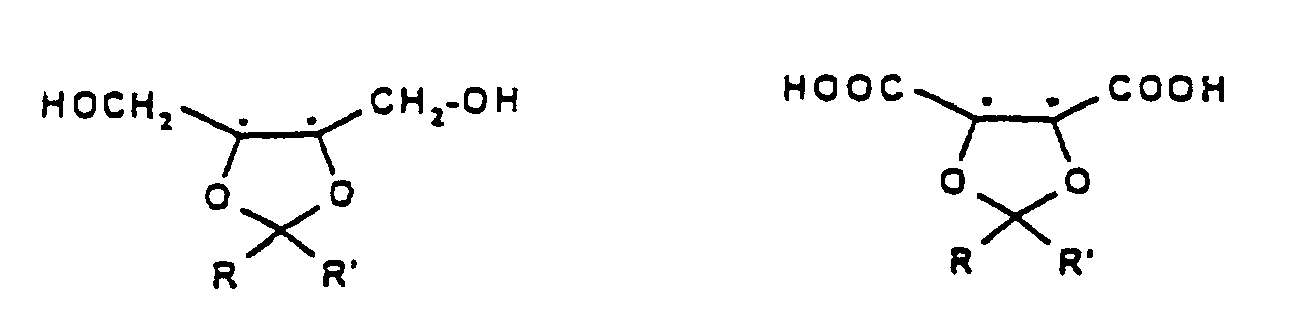 0 à 5 % en mol d'un constituant réticulable ayant plus de deux groupes fonctionnels, la somme étant égale à 100 % en mol.
 - Mélange de polymères selon la revendication 4, caractérisé en ce qu'il contient de l'acide p-hydroxybenzoïque, de l'acide 2-hydroxy-6-naphtoïque, de l'acide téréphtalique, de l'acide isophtalique, de l'acide 2,6-naphtalènedicarboxylique, de l'hydroquinone, du résorcinol, du 4,4'-dihydroxybiphényle ou une de leurs combinaisons.
- Mélange de polymères selon l'une des revendications 4 ou 5, caractérisé en ce que le polymère cristal liquide nématique contient des acides hydroxycarboxyliques aromatiques et/ou des acides dicarboxyliques aromatiques et des diols aromatiques.
- Utilisation d'un mélange de polymères cristaux liquides selon l'une ou plusieurs des revendications 4 à 6 comme matériau.
- Utilisation d'un mélange de polymères cristaux liquides selon l'une ou plusieurs des revendications 4 à 6 comme produit de départ pour la préparation de pigments à effets.
- Utilisation d'un mélange de polymères cristaux liquides selon l'une ou plusieurs des revendications 4 à 6 comme produit de départ pour la préparation de revêtements à effets ou de revêtement à effets en poudre.
Applications Claiming Priority (3)
| Application Number | Priority Date | Filing Date | Title |
|---|---|---|---|
| DE19612973A DE19612973A1 (de) | 1996-04-01 | 1996-04-01 | LCP-Blends |
| DE19612973 | 1996-04-01 | ||
| PCT/EP1997/001367 WO1997036969A1 (fr) | 1996-04-01 | 1997-03-19 | Melanges de polymeres cristallins liquides |
Publications (2)
| Publication Number | Publication Date |
|---|---|
| EP0891403A1 EP0891403A1 (fr) | 1999-01-20 |
| EP0891403B1 true EP0891403B1 (fr) | 2001-10-31 |
Family
ID=7790132
Family Applications (1)
| Application Number | Title | Priority Date | Filing Date |
|---|---|---|---|
| EP97914267A Expired - Lifetime EP0891403B1 (fr) | 1996-04-01 | 1997-03-19 | Melanges de polymeres cristallins liquides |
Country Status (10)
| Country | Link |
|---|---|
| US (1) | US5747175A (fr) |
| EP (1) | EP0891403B1 (fr) |
| JP (1) | JP2000507624A (fr) |
| KR (1) | KR20000005152A (fr) |
| CN (1) | CN1215425A (fr) |
| BR (1) | BR9708471A (fr) |
| CA (1) | CA2250778A1 (fr) |
| CZ (1) | CZ316798A3 (fr) |
| DE (2) | DE19612973A1 (fr) |
| WO (1) | WO1997036969A1 (fr) |
Families Citing this family (33)
| Publication number | Priority date | Publication date | Assignee | Title |
|---|---|---|---|---|
| JP3574547B2 (ja) * | 1997-05-23 | 2004-10-06 | ナトコ株式会社 | 液晶用遮光スペーサーおよび液晶表示素子 |
| DE19738642A1 (de) * | 1997-09-04 | 1999-03-11 | Clariant Gmbh | Farbmittel mit optisch variablen Eigenschaften |
| DE19756974C2 (de) * | 1997-12-20 | 2001-04-19 | Clariant Gmbh | Organisches Material mit metallischem Glanz |
| DE19817069A1 (de) | 1998-04-17 | 1999-10-21 | Clariant Gmbh | Infrarotstrahlung reflektierende Farbmittel |
| US6063495A (en) * | 1998-04-23 | 2000-05-16 | Hna Holdings, Inc. | Polyester fiber and methods for making same |
| US6063465A (en) * | 1998-04-23 | 2000-05-16 | Hna Holdings, Inc. | Polyester container and method for making same |
| US6126992A (en) * | 1998-04-23 | 2000-10-03 | E.I. Dupont De Nemours And Company | Optical articles comprising isosorbide polyesters and method for making same |
| US6063464A (en) * | 1998-04-23 | 2000-05-16 | Hna Holdings, Inc. | Isosorbide containing polyesters and methods for making same |
| US6140422A (en) * | 1998-04-23 | 2000-10-31 | E.I. Dupont De Nemours And Company | Polyesters including isosorbide as a comonomer blended with other thermoplastic polymers |
| US5958581A (en) * | 1998-04-23 | 1999-09-28 | Hna Holdings, Inc. | Polyester film and methods for making same |
| US6025061A (en) * | 1998-04-23 | 2000-02-15 | Hna Holdings, Inc. | Sheets formed from polyesters including isosorbide |
| US5959066A (en) * | 1998-04-23 | 1999-09-28 | Hna Holdings, Inc. | Polyesters including isosorbide as a comonomer and methods for making same |
| DE19836885A1 (de) * | 1998-08-14 | 2000-02-17 | Clariant Gmbh | Lasermarkierung von Effektbeschichtungen |
| DE19848130A1 (de) * | 1998-10-19 | 2000-04-20 | Basf Ag | Verwendung von cholesterisch-flüssigkristallinen Polymeren als UV-Filter in kosmetischen und pharmazeutischen Zubereitungen |
| US6207790B1 (en) * | 2000-01-14 | 2001-03-27 | Ticona Llc | Process for producing amorphous anisotropic melt-forming polymers having a high degree of stretchability and polymers produced by same |
| US6132884A (en) * | 2000-01-14 | 2000-10-17 | Ticona Llc | Process for producing amorphous anisotrophic melt-forming polymers having a high degree of stretchability and polymers produced by same |
| TW538094B (en) * | 2000-04-20 | 2003-06-21 | Ueno Seiyaku Oyo Kenkyujo Kk | Liquid crystal polyester resin composition |
| TWI295298B (en) | 2000-08-29 | 2008-04-01 | Sumitomo Chemical Co | Liquid crystalline polyester and method for producing the same |
| JP2005022292A (ja) * | 2003-07-03 | 2005-01-27 | Nippon Oil Corp | 対象物の識別構造およびその構造が設けられた対象物 |
| US7652126B2 (en) * | 2003-10-07 | 2010-01-26 | General Electric Company | Monomers and polymers comprising conjugated groups and methods for making thereof |
| US7138479B2 (en) * | 2003-12-31 | 2006-11-21 | General Electric Company | Aliphatic diol polycarbonates and their preparation |
| CN100339461C (zh) * | 2004-06-10 | 2007-09-26 | 上海广电液晶显示器有限公司 | 液晶材料配比方法 |
| KR101111645B1 (ko) * | 2009-06-17 | 2012-03-13 | 삼성정밀화학 주식회사 | 용융점도가 일정한 전방향족 액정 폴리에스테르 수지의 제조방법 및 전방향족 액정 폴리에스테르 수지 컴파운드의 제조방법 |
| JP5726610B2 (ja) * | 2011-04-15 | 2015-06-03 | Jx日鉱日石エネルギー株式会社 | 液晶ポリエステルの製造方法 |
| JP5753143B2 (ja) * | 2012-09-21 | 2015-07-22 | ポリプラスチックス株式会社 | 全芳香族ポリエステル及びポリエステル樹脂組成物、並びにポリエステル成形品 |
| JP5753144B2 (ja) * | 2012-09-21 | 2015-07-22 | ポリプラスチックス株式会社 | 全芳香族ポリエステル及びポリエステル樹脂組成物、並びにポリエステル成形品 |
| CN105647545B (zh) | 2016-03-04 | 2018-09-18 | 京东方科技集团股份有限公司 | 胆甾相液晶组合物、液晶显示面板及其制备方法 |
| JP7795290B2 (ja) * | 2017-06-07 | 2026-01-07 | エスケー ケミカルズ カンパニー リミテッド | 液晶高分子合成用組成物、これを用いた電気電子製品用液晶高分子、高分子樹脂組成物および成形品 |
| KR102466501B1 (ko) * | 2017-12-06 | 2022-11-10 | 에스케이케미칼 주식회사 | 전기전자제품용 액정고분자, 이를 이용한 고분자 수지 조성물 및 성형품 |
| JP7174640B2 (ja) * | 2019-01-31 | 2022-11-17 | 上野製薬株式会社 | 液晶ポリマー |
| JP7798886B2 (ja) | 2020-12-02 | 2026-01-14 | 住友化学株式会社 | 低い誘電率(Dk)及び誘電正接(Df)を有する液晶ポリエステル(LCP)及び熱可塑性組成物 |
| CN113896877A (zh) * | 2021-10-18 | 2022-01-07 | 辽宁大学 | 一种基于季膦离子的主链型离子液晶聚合物及其制备方法和在抗菌中的应用 |
| CN118290712B (zh) * | 2024-06-06 | 2024-08-16 | 北京大学 | 一种具有低力学各向异性的液晶高分子及其制备方法和应用 |
Family Cites Families (15)
| Publication number | Priority date | Publication date | Assignee | Title |
|---|---|---|---|---|
| US4412059A (en) * | 1980-08-20 | 1983-10-25 | Duke University | High modulus cholesteric mesophase polymers |
| DE3110048A1 (de) * | 1981-03-16 | 1982-09-30 | Consortium für elektrochemische Industrie GmbH, 8000 München | "fluessigkristalline phasen aufweisende zusammensetzungen auf basis cyclischer organopolysiloxane, ihre herstellung und deren verwendung" |
| EP0154953B1 (fr) * | 1984-03-12 | 1991-01-30 | Matsushita Electric Industrial Co., Ltd. | Filtre optique et méthode de fabrication |
| JPS61197629A (ja) * | 1985-02-28 | 1986-09-01 | Nippon Oil Co Ltd | コレステリック液晶性ポリエステルの製造法 |
| JPS63229611A (ja) * | 1987-03-19 | 1988-09-26 | Nippon Oil Co Ltd | 高密度磁気記録媒体用フイルム |
| US5093025A (en) * | 1989-04-07 | 1992-03-03 | Tosoh Corporation | Cholesteric liquid crystal polyester containing optically active group |
| DE4240743A1 (de) * | 1992-12-03 | 1994-06-09 | Consortium Elektrochem Ind | Pigmente mit vom Betrachtungswinkel abhängiger Farbigkeit, ihre Herstellung und Verwendung |
| DE69403232T2 (de) * | 1993-01-27 | 1997-09-25 | Nippon Oil Co Ltd | Flüssigkristalline Polyester |
| DE4314736A1 (de) * | 1993-05-04 | 1994-11-10 | Hoechst Ag | Oxidation von Polyarylensulfiden |
| US5460748A (en) * | 1993-06-02 | 1995-10-24 | Nippon Oil Company, Limited | Liquid crystalline polymer film, process for producing same, and utilization thereof |
| GB2282145A (en) * | 1993-09-22 | 1995-03-29 | Central Research Lab Ltd | Coloured material comprising aligned liquid crystal laminae |
| DE4418075C2 (de) * | 1994-05-24 | 2000-06-29 | Daimler Chrysler Ag | Effektlack bzw. Effektlackierung, insbesondere für Fahrzeugkarosserien, unter Verwendung von flüssigkristallinen Interferenzpigmenten |
| DE4416191A1 (de) * | 1994-05-06 | 1995-11-09 | Consortium Elektrochem Ind | Interferenzpigmente aus in cholesterischer Anordnung fixierten Molekülen sowie deren Verwendung |
| DE4416993C2 (de) * | 1994-05-13 | 2002-12-12 | Daimler Chrysler Ag | Thermisch farb-beinflußbare Lackierung |
| CA2143573A1 (fr) * | 1995-02-28 | 1996-08-29 | Jennifer Eleda Trimmel | Dispositif de contention |
-
1996
- 1996-04-01 DE DE19612973A patent/DE19612973A1/de not_active Withdrawn
-
1997
- 1997-03-19 CN CN97193560A patent/CN1215425A/zh active Pending
- 1997-03-19 CA CA002250778A patent/CA2250778A1/fr not_active Abandoned
- 1997-03-19 BR BR9708471A patent/BR9708471A/pt not_active Application Discontinuation
- 1997-03-19 CZ CZ983167A patent/CZ316798A3/cs unknown
- 1997-03-19 EP EP97914267A patent/EP0891403B1/fr not_active Expired - Lifetime
- 1997-03-19 JP JP9534864A patent/JP2000507624A/ja active Pending
- 1997-03-19 KR KR1019980707819A patent/KR20000005152A/ko not_active Withdrawn
- 1997-03-19 WO PCT/EP1997/001367 patent/WO1997036969A1/fr not_active Ceased
- 1997-03-19 DE DE59705192T patent/DE59705192D1/de not_active Expired - Fee Related
- 1997-04-01 US US08/825,601 patent/US5747175A/en not_active Expired - Fee Related
Also Published As
| Publication number | Publication date |
|---|---|
| DE19612973A1 (de) | 1997-10-02 |
| WO1997036969A1 (fr) | 1997-10-09 |
| KR20000005152A (ko) | 2000-01-25 |
| CA2250778A1 (fr) | 1997-10-09 |
| CZ316798A3 (cs) | 1999-02-17 |
| BR9708471A (pt) | 1999-04-13 |
| DE59705192D1 (en) | 2001-12-06 |
| EP0891403A1 (fr) | 1999-01-20 |
| US5747175A (en) | 1998-05-05 |
| CN1215425A (zh) | 1999-04-28 |
| MX9808066A (en) | 1999-02-01 |
| JP2000507624A (ja) | 2000-06-20 |
Similar Documents
| Publication | Publication Date | Title |
|---|---|---|
| EP0891403B1 (fr) | Melanges de polymeres cristallins liquides | |
| EP0856025B1 (fr) | Polymeres formant des phases cholesteriques et leur utilisation | |
| EP0950701A1 (fr) | Produits colorants réfléchissant le rayonnenment infrarouge | |
| EP0980907A1 (fr) | Marquage laser pour revêtements à effets | |
| EP1144547B1 (fr) | Utilisation de substances polymerisables a cristaux liquides pour la fabrication de composants optiques | |
| EP0891397B1 (fr) | Procede pour la production de revetements a effets avec lesquels la perception de la couleur depend de l'angle d'observation | |
| DE4240743A1 (de) | Pigmente mit vom Betrachtungswinkel abhängiger Farbigkeit, ihre Herstellung und Verwendung | |
| EP0809667B1 (fr) | Polyesters nematiques chiralement | |
| DE19704506A1 (de) | Chiral nematische Polyester | |
| DE19715993A1 (de) | Polymerlaminate mit erhöhtem Deckvermögen | |
| EP0946670B1 (fr) | Polymeres a cristaux liquides cholesteriques teintes presentant des proprietes optiquement variables | |
| EP0949287A2 (fr) | Polymères cholestériquesà cristaux liquides résistants aux intempéries | |
| EP2243808A1 (fr) | Pâte pigmentée | |
| WO1997036962A1 (fr) | Revetements en poudre avec effet colore dependant de l'angle d'observation | |
| EP0951520B2 (fr) | Element plat ayant une structure a cristaux cholesteriques | |
| DE19756974C2 (de) | Organisches Material mit metallischem Glanz | |
| DE19739263A1 (de) | Verfahren zur Herstellung von dünnen Filmen aus nicht-wäßriger Dispersion und daraus hergestellte Effektpigmente mit vom Betrachtungswinkel abhängiger Farbigkeit | |
| DE19715995A1 (de) | Effektbeschichtungen mit vom Betrachtungswinkel abhängigem Farbeindruck | |
| DE19739262A1 (de) | Verfahren zur Herstellung von dünnen Filmen aus wäßriger Dispersion und daraus hergestellte Effektpigmente mit vom Betrachtungswinkel abhängiger Farbigkeit | |
| WO1999013012A1 (fr) | Revetements en poudre a impression de couleur dependant de l'angle d'observation | |
| EP0872326A1 (fr) | Procédé pour fabriquer des laminés de polymères | |
| MXPA98008066A (en) | Mixes of liqui crystal polymers |
Legal Events
| Date | Code | Title | Description |
|---|---|---|---|
| PUAI | Public reference made under article 153(3) epc to a published international application that has entered the european phase |
Free format text: ORIGINAL CODE: 0009012 |
|
| 17P | Request for examination filed |
Effective date: 19981102 |
|
| AK | Designated contracting states |
Kind code of ref document: A1 Designated state(s): DE FR GB |
|
| 17Q | First examination report despatched |
Effective date: 20000313 |
|
| GRAG | Despatch of communication of intention to grant |
Free format text: ORIGINAL CODE: EPIDOS AGRA |
|
| GRAG | Despatch of communication of intention to grant |
Free format text: ORIGINAL CODE: EPIDOS AGRA |
|
| GRAH | Despatch of communication of intention to grant a patent |
Free format text: ORIGINAL CODE: EPIDOS IGRA |
|
| RBV | Designated contracting states (corrected) |
Designated state(s): DE FR GB |
|
| GRAH | Despatch of communication of intention to grant a patent |
Free format text: ORIGINAL CODE: EPIDOS IGRA |
|
| GRAA | (expected) grant |
Free format text: ORIGINAL CODE: 0009210 |
|
| AK | Designated contracting states |
Kind code of ref document: B1 Designated state(s): DE FR GB |
|
| REF | Corresponds to: |
Ref document number: 59705192 Country of ref document: DE Date of ref document: 20011206 |
|
| REG | Reference to a national code |
Ref country code: GB Ref legal event code: IF02 |
|
| GBT | Gb: translation of ep patent filed (gb section 77(6)(a)/1977) |
Effective date: 20020125 |
|
| PG25 | Lapsed in a contracting state [announced via postgrant information from national office to epo] |
Ref country code: GB Free format text: LAPSE BECAUSE OF NON-PAYMENT OF DUE FEES Effective date: 20020319 |
|
| ET | Fr: translation filed | ||
| PLBE | No opposition filed within time limit |
Free format text: ORIGINAL CODE: 0009261 |
|
| STAA | Information on the status of an ep patent application or granted ep patent |
Free format text: STATUS: NO OPPOSITION FILED WITHIN TIME LIMIT |
|
| PG25 | Lapsed in a contracting state [announced via postgrant information from national office to epo] |
Ref country code: DE Free format text: LAPSE BECAUSE OF NON-PAYMENT OF DUE FEES Effective date: 20021001 |
|
| 26N | No opposition filed | ||
| GBPC | Gb: european patent ceased through non-payment of renewal fee |
Effective date: 20020319 |
|
| PG25 | Lapsed in a contracting state [announced via postgrant information from national office to epo] |
Ref country code: FR Free format text: LAPSE BECAUSE OF NON-PAYMENT OF DUE FEES Effective date: 20021129 |
|
| REG | Reference to a national code |
Ref country code: FR Ref legal event code: ST |