EP0891973B1 - Verbesserungen bezüglich auf Theaflavin Erzeugung - Google Patents
Verbesserungen bezüglich auf Theaflavin Erzeugung Download PDFInfo
- Publication number
- EP0891973B1 EP0891973B1 EP98305399A EP98305399A EP0891973B1 EP 0891973 B1 EP0891973 B1 EP 0891973B1 EP 98305399 A EP98305399 A EP 98305399A EP 98305399 A EP98305399 A EP 98305399A EP 0891973 B1 EP0891973 B1 EP 0891973B1
- Authority
- EP
- European Patent Office
- Prior art keywords
- theaflavin
- tea
- slurry
- dhool
- liquor
- Prior art date
- Legal status (The legal status is an assumption and is not a legal conclusion. Google has not performed a legal analysis and makes no representation as to the accuracy of the status listed.)
- Expired - Lifetime
Links
- 235000014620 theaflavin Nutrition 0.000 title claims description 212
- IPMYMEWFZKHGAX-ZKSIBHASSA-N theaflavin Chemical compound C1=C2C([C@H]3OC4=CC(O)=CC(O)=C4C[C@H]3O)=CC(O)=C(O)C2=C(O)C(=O)C=C1[C@@H]1[C@H](O)CC2=C(O)C=C(O)C=C2O1 IPMYMEWFZKHGAX-ZKSIBHASSA-N 0.000 title claims description 197
- IPMYMEWFZKHGAX-UHFFFAOYSA-N Isotheaflavin Natural products OC1CC2=C(O)C=C(O)C=C2OC1C(C1=C2)=CC(O)=C(O)C1=C(O)C(=O)C=C2C1C(O)CC2=C(O)C=C(O)C=C2O1 IPMYMEWFZKHGAX-UHFFFAOYSA-N 0.000 title claims description 196
- UXRMWRBWCAGDQB-UHFFFAOYSA-N Theaflavin Natural products C1=CC(C2C(CC3=C(O)C=C(O)C=C3O2)O)=C(O)C(=O)C2=C1C(C1OC3=CC(O)=CC(O)=C3CC1O)=CC(O)=C2O UXRMWRBWCAGDQB-UHFFFAOYSA-N 0.000 title claims description 196
- 229940026509 theaflavin Drugs 0.000 title claims description 196
- 230000006872 improvement Effects 0.000 title description 2
- 238000000855 fermentation Methods 0.000 claims description 89
- 230000004151 fermentation Effects 0.000 claims description 89
- XLYOFNOQVPJJNP-UHFFFAOYSA-N water Substances O XLYOFNOQVPJJNP-UHFFFAOYSA-N 0.000 claims description 81
- 239000002002 slurry Substances 0.000 claims description 80
- 108010038851 tannase Proteins 0.000 claims description 80
- 239000000843 powder Substances 0.000 claims description 56
- 238000000034 method Methods 0.000 claims description 37
- 239000000284 extract Substances 0.000 claims description 34
- 239000000203 mixture Substances 0.000 claims description 31
- 238000000605 extraction Methods 0.000 claims description 24
- 230000000694 effects Effects 0.000 claims description 19
- 238000001035 drying Methods 0.000 claims description 12
- 239000002904 solvent Substances 0.000 claims description 11
- 239000007787 solid Substances 0.000 claims description 9
- 238000002156 mixing Methods 0.000 claims description 8
- 238000000638 solvent extraction Methods 0.000 claims description 8
- 239000003960 organic solvent Substances 0.000 claims description 7
- 241001122767 Theaceae Species 0.000 claims 26
- 244000269722 Thea sinensis Species 0.000 description 60
- 235000013616 tea Nutrition 0.000 description 50
- XMOCLSLCDHWDHP-IUODEOHRSA-N epi-Gallocatechin Chemical compound C1([C@H]2OC3=CC(O)=CC(O)=C3C[C@H]2O)=CC(O)=C(O)C(O)=C1 XMOCLSLCDHWDHP-IUODEOHRSA-N 0.000 description 47
- LNTHITQWFMADLM-UHFFFAOYSA-N gallic acid Chemical group OC(=O)C1=CC(O)=C(O)C(O)=C1 LNTHITQWFMADLM-UHFFFAOYSA-N 0.000 description 40
- PFTAWBLQPZVEMU-UKRRQHHQSA-N (-)-epicatechin Chemical compound C1([C@H]2OC3=CC(O)=CC(O)=C3C[C@H]2O)=CC=C(O)C(O)=C1 PFTAWBLQPZVEMU-UKRRQHHQSA-N 0.000 description 24
- PFTAWBLQPZVEMU-ZFWWWQNUSA-N (+)-epicatechin Natural products C1([C@@H]2OC3=CC(O)=CC(O)=C3C[C@@H]2O)=CC=C(O)C(O)=C1 PFTAWBLQPZVEMU-ZFWWWQNUSA-N 0.000 description 23
- XMOCLSLCDHWDHP-UHFFFAOYSA-N L-Epigallocatechin Natural products OC1CC2=C(O)C=C(O)C=C2OC1C1=CC(O)=C(O)C(O)=C1 XMOCLSLCDHWDHP-UHFFFAOYSA-N 0.000 description 23
- ADRVNXBAWSRFAJ-UHFFFAOYSA-N catechin Natural products OC1Cc2cc(O)cc(O)c2OC1c3ccc(O)c(O)c3 ADRVNXBAWSRFAJ-UHFFFAOYSA-N 0.000 description 23
- 235000005487 catechin Nutrition 0.000 description 23
- LPTRNLNOHUVQMS-UHFFFAOYSA-N epicatechin Natural products Cc1cc(O)cc2OC(C(O)Cc12)c1ccc(O)c(O)c1 LPTRNLNOHUVQMS-UHFFFAOYSA-N 0.000 description 23
- 235000012734 epicatechin Nutrition 0.000 description 23
- DZYNKLUGCOSVKS-UHFFFAOYSA-N epigallocatechin Natural products OC1Cc2cc(O)cc(O)c2OC1c3cc(O)c(O)c(O)c3 DZYNKLUGCOSVKS-UHFFFAOYSA-N 0.000 description 23
- 239000000047 product Substances 0.000 description 23
- LFQSCWFLJHTTHZ-UHFFFAOYSA-N Ethanol Chemical compound CCO LFQSCWFLJHTTHZ-UHFFFAOYSA-N 0.000 description 20
- 238000011282 treatment Methods 0.000 description 20
- 150000001765 catechin Chemical class 0.000 description 19
- 235000004515 gallic acid Nutrition 0.000 description 19
- 229940074391 gallic acid Drugs 0.000 description 19
- OKKJLVBELUTLKV-UHFFFAOYSA-N Methanol Chemical compound OC OKKJLVBELUTLKV-UHFFFAOYSA-N 0.000 description 18
- 230000015572 biosynthetic process Effects 0.000 description 16
- XEKOWRVHYACXOJ-UHFFFAOYSA-N Ethyl acetate Chemical compound CCOC(C)=O XEKOWRVHYACXOJ-UHFFFAOYSA-N 0.000 description 15
- 238000004128 high performance liquid chromatography Methods 0.000 description 15
- 239000000463 material Substances 0.000 description 15
- 238000004519 manufacturing process Methods 0.000 description 13
- 230000003647 oxidation Effects 0.000 description 13
- 238000007254 oxidation reaction Methods 0.000 description 13
- RYYVLZVUVIJVGH-UHFFFAOYSA-N caffeine Chemical compound CN1C(=O)N(C)C(=O)C2=C1N=CN2C RYYVLZVUVIJVGH-UHFFFAOYSA-N 0.000 description 12
- LSHVYAFMTMFKBA-TZIWHRDSSA-N (-)-epicatechin-3-O-gallate Chemical compound O([C@@H]1CC2=C(O)C=C(C=C2O[C@@H]1C=1C=C(O)C(O)=CC=1)O)C(=O)C1=CC(O)=C(O)C(O)=C1 LSHVYAFMTMFKBA-TZIWHRDSSA-N 0.000 description 10
- LSHVYAFMTMFKBA-UHFFFAOYSA-N ECG Natural products C=1C=C(O)C(O)=CC=1C1OC2=CC(O)=CC(O)=C2CC1OC(=O)C1=CC(O)=C(O)C(O)=C1 LSHVYAFMTMFKBA-UHFFFAOYSA-N 0.000 description 10
- WMBWREPUVVBILR-UHFFFAOYSA-N GCG Natural products C=1C(O)=C(O)C(O)=CC=1C1OC2=CC(O)=CC(O)=C2CC1OC(=O)C1=CC(O)=C(O)C(O)=C1 WMBWREPUVVBILR-UHFFFAOYSA-N 0.000 description 9
- LPHGQDQBBGAPDZ-UHFFFAOYSA-N Isocaffeine Natural products CN1C(=O)N(C)C(=O)C2=C1N(C)C=N2 LPHGQDQBBGAPDZ-UHFFFAOYSA-N 0.000 description 9
- 235000009569 green tea Nutrition 0.000 description 9
- IJGRMHOSHXDMSA-UHFFFAOYSA-N Atomic nitrogen Chemical compound N#N IJGRMHOSHXDMSA-UHFFFAOYSA-N 0.000 description 8
- 230000003078 antioxidant effect Effects 0.000 description 8
- 238000009835 boiling Methods 0.000 description 8
- WMBWREPUVVBILR-WIYYLYMNSA-N (-)-Epigallocatechin-3-o-gallate Chemical compound O([C@@H]1CC2=C(O)C=C(C=C2O[C@@H]1C=1C=C(O)C(O)=C(O)C=1)O)C(=O)C1=CC(O)=C(O)C(O)=C1 WMBWREPUVVBILR-WIYYLYMNSA-N 0.000 description 7
- 229930014124 (-)-epigallocatechin gallate Natural products 0.000 description 7
- KOXRJHMEFYNYME-VBKZILBWSA-N Theaflagallin Natural products C1=C2C=C(O)C(O)=C(O)C2=C(O)C(=O)C=C1[C@H]1OC2=CC(O)=CC(O)=C2C[C@@H]1O KOXRJHMEFYNYME-VBKZILBWSA-N 0.000 description 7
- SDSXQESYQIRNNR-UHFFFAOYSA-N Theaflavinsaeure Natural products O=C1C=C(C(O)=O)C=C2C(C3OC4=CC(O)=CC(O)=C4CC3O)=CC(O)=C(O)C2=C1O SDSXQESYQIRNNR-UHFFFAOYSA-N 0.000 description 7
- 238000005119 centrifugation Methods 0.000 description 7
- 150000001875 compounds Chemical class 0.000 description 7
- QTBSBXVTEAMEQO-UHFFFAOYSA-N Acetic acid Chemical compound CC(O)=O QTBSBXVTEAMEQO-UHFFFAOYSA-N 0.000 description 6
- CSCPPACGZOOCGX-UHFFFAOYSA-N Acetone Chemical compound CC(C)=O CSCPPACGZOOCGX-UHFFFAOYSA-N 0.000 description 6
- WEVYAHXRMPXWCK-UHFFFAOYSA-N Acetonitrile Chemical compound CC#N WEVYAHXRMPXWCK-UHFFFAOYSA-N 0.000 description 6
- 108010031396 Catechol oxidase Proteins 0.000 description 6
- 102000030523 Catechol oxidase Human genes 0.000 description 6
- HEDRZPFGACZZDS-UHFFFAOYSA-N Chloroform Chemical compound ClC(Cl)Cl HEDRZPFGACZZDS-UHFFFAOYSA-N 0.000 description 6
- 229960001948 caffeine Drugs 0.000 description 6
- VJEONQKOZGKCAK-UHFFFAOYSA-N caffeine Natural products CN1C(=O)N(C)C(=O)C2=C1C=CN2C VJEONQKOZGKCAK-UHFFFAOYSA-N 0.000 description 6
- VLKZOEOYAKHREP-UHFFFAOYSA-N n-Hexane Chemical compound CCCCCC VLKZOEOYAKHREP-UHFFFAOYSA-N 0.000 description 6
- 230000001590 oxidative effect Effects 0.000 description 6
- 238000011084 recovery Methods 0.000 description 6
- PFTAWBLQPZVEMU-DZGCQCFKSA-N (+)-3',4',5,7-Tetrahydroxy-2,3-trans-flavan-3-ol Natural products C1([C@H]2OC3=CC(O)=CC(O)=C3C[C@@H]2O)=CC=C(O)C(O)=C1 PFTAWBLQPZVEMU-DZGCQCFKSA-N 0.000 description 5
- 235000006468 Thea sinensis Nutrition 0.000 description 5
- 239000002253 acid Substances 0.000 description 5
- 239000003963 antioxidant agent Substances 0.000 description 5
- 235000006708 antioxidants Nutrition 0.000 description 5
- 239000012223 aqueous fraction Substances 0.000 description 5
- 235000020279 black tea Nutrition 0.000 description 5
- 238000006243 chemical reaction Methods 0.000 description 5
- 239000006071 cream Substances 0.000 description 5
- 230000001965 increasing effect Effects 0.000 description 5
- 239000000725 suspension Substances 0.000 description 5
- CIWBSHSKHKDKBQ-JLAZNSOCSA-N Ascorbic acid Chemical compound OC[C@H](O)[C@H]1OC(=O)C(O)=C1O CIWBSHSKHKDKBQ-JLAZNSOCSA-N 0.000 description 4
- 229950001002 cianidanol Drugs 0.000 description 4
- 239000003086 colorant Substances 0.000 description 4
- 238000001802 infusion Methods 0.000 description 4
- 239000004615 ingredient Substances 0.000 description 4
- 229910052757 nitrogen Inorganic materials 0.000 description 4
- 235000008118 thearubigins Nutrition 0.000 description 4
- 102000004190 Enzymes Human genes 0.000 description 3
- 108090000790 Enzymes Proteins 0.000 description 3
- 102000003992 Peroxidases Human genes 0.000 description 3
- 229920005654 Sephadex Polymers 0.000 description 3
- 239000012507 Sephadex™ Substances 0.000 description 3
- HEMHJVSKTPXQMS-UHFFFAOYSA-M Sodium hydroxide Chemical compound [OH-].[Na+] HEMHJVSKTPXQMS-UHFFFAOYSA-M 0.000 description 3
- 150000007513 acids Chemical class 0.000 description 3
- 238000004458 analytical method Methods 0.000 description 3
- 229960005070 ascorbic acid Drugs 0.000 description 3
- 239000011668 ascorbic acid Substances 0.000 description 3
- 230000036983 biotransformation Effects 0.000 description 3
- 238000009826 distribution Methods 0.000 description 3
- 239000002038 ethyl acetate fraction Substances 0.000 description 3
- 235000013305 food Nutrition 0.000 description 3
- 150000002632 lipids Chemical class 0.000 description 3
- 230000008569 process Effects 0.000 description 3
- 239000002994 raw material Substances 0.000 description 3
- 239000000126 substance Substances 0.000 description 3
- 238000003786 synthesis reaction Methods 0.000 description 3
- 239000004552 water soluble powder Substances 0.000 description 3
- CURLTUGMZLYLDI-UHFFFAOYSA-N Carbon dioxide Chemical compound O=C=O CURLTUGMZLYLDI-UHFFFAOYSA-N 0.000 description 2
- KCXVZYZYPLLWCC-UHFFFAOYSA-N EDTA Chemical compound OC(=O)CN(CC(O)=O)CCN(CC(O)=O)CC(O)=O KCXVZYZYPLLWCC-UHFFFAOYSA-N 0.000 description 2
- MHAJPDPJQMAIIY-UHFFFAOYSA-N Hydrogen peroxide Chemical compound OO MHAJPDPJQMAIIY-UHFFFAOYSA-N 0.000 description 2
- 108010029541 Laccase Proteins 0.000 description 2
- CSNNHWWHGAXBCP-UHFFFAOYSA-L Magnesium sulfate Chemical compound [Mg+2].[O-][S+2]([O-])([O-])[O-] CSNNHWWHGAXBCP-UHFFFAOYSA-L 0.000 description 2
- 229910019142 PO4 Inorganic materials 0.000 description 2
- GPLOTACQBREROW-UHFFFAOYSA-N Phlegmanol A-acetat Natural products OC1CC2=C(O)C=C(O)C=C2OC1C(=CC1=2)C=C(O)C(=O)C1=C(O)C(O)=CC=2C1OC2=CC(O)=CC(O)=C2CC1OC(=O)C1=CC(O)=C(O)C(O)=C1 GPLOTACQBREROW-UHFFFAOYSA-N 0.000 description 2
- FAPWRFPIFSIZLT-UHFFFAOYSA-M Sodium chloride Chemical compound [Na+].[Cl-] FAPWRFPIFSIZLT-UHFFFAOYSA-M 0.000 description 2
- KMJPKUVSXFVQGZ-UHFFFAOYSA-N TF2B Natural products OC1CC2=C(O)C=C(O)C=C2OC1C(C1=C2)=CC(O)=C(O)C1=C(O)C(=O)C=C2C1OC2=CC(O)=CC(O)=C2CC1OC(=O)C1=CC(O)=C(O)C(O)=C1 KMJPKUVSXFVQGZ-UHFFFAOYSA-N 0.000 description 2
- 235000010323 ascorbic acid Nutrition 0.000 description 2
- 230000008901 benefit Effects 0.000 description 2
- 235000011089 carbon dioxide Nutrition 0.000 description 2
- 239000007979 citrate buffer Substances 0.000 description 2
- 238000010668 complexation reaction Methods 0.000 description 2
- 239000012153 distilled water Substances 0.000 description 2
- 239000000839 emulsion Substances 0.000 description 2
- 238000002474 experimental method Methods 0.000 description 2
- 238000001914 filtration Methods 0.000 description 2
- 238000005259 measurement Methods 0.000 description 2
- 239000012071 phase Substances 0.000 description 2
- NBIIXXVUZAFLBC-UHFFFAOYSA-K phosphate Chemical compound [O-]P([O-])([O-])=O NBIIXXVUZAFLBC-UHFFFAOYSA-K 0.000 description 2
- 239000008363 phosphate buffer Substances 0.000 description 2
- 150000008442 polyphenolic compounds Chemical class 0.000 description 2
- 235000013824 polyphenols Nutrition 0.000 description 2
- 239000001253 polyvinylpolypyrrolidone Substances 0.000 description 2
- 235000013809 polyvinylpolypyrrolidone Nutrition 0.000 description 2
- 229920000523 polyvinylpolypyrrolidone Polymers 0.000 description 2
- 238000002360 preparation method Methods 0.000 description 2
- 230000002035 prolonged effect Effects 0.000 description 2
- 238000000746 purification Methods 0.000 description 2
- 239000002195 soluble material Substances 0.000 description 2
- 239000007858 starting material Substances 0.000 description 2
- 239000006228 supernatant Substances 0.000 description 2
- FJYGFTHLNNSVPY-BBXLVSEPSA-N theaflavin digallate Chemical compound C1=C([C@@H]2[C@@H](CC3=C(O)C=C(O)C=C3O2)O)C=C(OC(=O)C=2C=C(O)C(O)=C(O)C=2)C(=O)C2=C1C([C@H]1OC3=CC(O)=CC(O)=C3C[C@H]1O)=CC(O)=C2OC(=O)C1=CC(O)=C(O)C(O)=C1 FJYGFTHLNNSVPY-BBXLVSEPSA-N 0.000 description 2
- XMOCLSLCDHWDHP-SWLSCSKDSA-N (+)-Epigallocatechin Natural products C1([C@H]2OC3=CC(O)=CC(O)=C3C[C@@H]2O)=CC(O)=C(O)C(O)=C1 XMOCLSLCDHWDHP-SWLSCSKDSA-N 0.000 description 1
- 229930013783 (-)-epicatechin Natural products 0.000 description 1
- 235000007355 (-)-epicatechin Nutrition 0.000 description 1
- ZEASWHWETFMWCV-UHFFFAOYSA-N 7-O-(2-O-Acetyl-6-O-Methyl-beta-D-glucuronoside)-4',5,7-Trihydroxyflavone Natural products C=1C(O)=C(O)C2=C(O)C(=O)C=C(C3C(CC4=C(O)C=C(O)C=C4O3)OC(=O)C=3C=C(O)C(O)=C(O)C=3)C=C2C=1C1OC2=CC(O)=CC(O)=C2CC1OC(=O)C1=CC(O)=C(O)C(O)=C1 ZEASWHWETFMWCV-UHFFFAOYSA-N 0.000 description 1
- 241000251468 Actinopterygii Species 0.000 description 1
- 241000209507 Camellia Species 0.000 description 1
- 235000014143 Camellia sinensis var assamica Nutrition 0.000 description 1
- 240000008441 Camellia sinensis var. assamica Species 0.000 description 1
- 241000196324 Embryophyta Species 0.000 description 1
- 108090000371 Esterases Proteins 0.000 description 1
- OEIJRRGCTVHYTH-UHFFFAOYSA-N Favan-3-ol Chemical compound OC1CC2=CC=CC=C2OC1C1=CC=CC=C1 OEIJRRGCTVHYTH-UHFFFAOYSA-N 0.000 description 1
- CITFYDYEWQIEPX-UHFFFAOYSA-N Flavanol Natural products O1C2=CC(OCC=C(C)C)=CC(O)=C2C(=O)C(O)C1C1=CC=C(O)C=C1 CITFYDYEWQIEPX-UHFFFAOYSA-N 0.000 description 1
- 241000287828 Gallus gallus Species 0.000 description 1
- 244000068988 Glycine max Species 0.000 description 1
- 235000010469 Glycine max Nutrition 0.000 description 1
- 241001465754 Metazoa Species 0.000 description 1
- 108700020962 Peroxidase Proteins 0.000 description 1
- 235000002595 Solanum tuberosum Nutrition 0.000 description 1
- 244000061456 Solanum tuberosum Species 0.000 description 1
- BVMDSEFJGKQBKJ-UHFFFAOYSA-N Theaflavin 3'-gallate Natural products O1C(C(O)=O)C(O)C(O)C(O)C1OC1=C(O)C=C(O)C2=C1OC(C=1C=C(O)C(O)=CC=1)=CC2=O BVMDSEFJGKQBKJ-UHFFFAOYSA-N 0.000 description 1
- 229920004890 Triton X-100 Polymers 0.000 description 1
- 239000013504 Triton X-100 Substances 0.000 description 1
- KMJPKUVSXFVQGZ-WQLSNUALSA-N [(2r,3r)-5,7-dihydroxy-2-[3,4,5-trihydroxy-6-oxo-1-[(2r,3r)-3,5,7-trihydroxy-3,4-dihydro-2h-chromen-2-yl]benzo[7]annulen-8-yl]-3,4-dihydro-2h-chromen-3-yl] 3,4,5-trihydroxybenzoate Chemical class O([C@@H]1CC2=C(O)C=C(O)C=C2O[C@@H]1C1=CC(=O)C(O)=C2C(O)=C(O)C=C(C2=C1)[C@H]1OC2=CC(O)=CC(O)=C2C[C@H]1O)C(=O)C1=CC(O)=C(O)C(O)=C1 KMJPKUVSXFVQGZ-WQLSNUALSA-N 0.000 description 1
- 238000009825 accumulation Methods 0.000 description 1
- 238000013019 agitation Methods 0.000 description 1
- 239000008346 aqueous phase Substances 0.000 description 1
- 239000007864 aqueous solution Substances 0.000 description 1
- 239000007900 aqueous suspension Substances 0.000 description 1
- 235000019606 astringent taste Nutrition 0.000 description 1
- QVGXLLKOCUKJST-UHFFFAOYSA-N atomic oxygen Chemical compound [O] QVGXLLKOCUKJST-UHFFFAOYSA-N 0.000 description 1
- 235000015173 baked goods and baking mixes Nutrition 0.000 description 1
- 238000010923 batch production Methods 0.000 description 1
- 230000005587 bubbling Effects 0.000 description 1
- 239000000872 buffer Substances 0.000 description 1
- 230000001413 cellular effect Effects 0.000 description 1
- 235000013339 cereals Nutrition 0.000 description 1
- 230000008859 change Effects 0.000 description 1
- 238000012512 characterization method Methods 0.000 description 1
- 235000013351 cheese Nutrition 0.000 description 1
- 239000007795 chemical reaction product Substances 0.000 description 1
- 238000003776 cleavage reaction Methods 0.000 description 1
- 239000000549 coloured material Substances 0.000 description 1
- 235000018597 common camellia Nutrition 0.000 description 1
- 230000000295 complement effect Effects 0.000 description 1
- 238000009833 condensation Methods 0.000 description 1
- 230000005494 condensation Effects 0.000 description 1
- 239000007859 condensation product Substances 0.000 description 1
- 238000007796 conventional method Methods 0.000 description 1
- 230000003247 decreasing effect Effects 0.000 description 1
- 238000011033 desalting Methods 0.000 description 1
- 238000001514 detection method Methods 0.000 description 1
- 238000010828 elution Methods 0.000 description 1
- 230000002708 enhancing effect Effects 0.000 description 1
- 150000002148 esters Chemical class 0.000 description 1
- CCIVGXIOQKPBKL-UHFFFAOYSA-N ethanesulfonic acid Chemical compound CCS(O)(=O)=O CCIVGXIOQKPBKL-UHFFFAOYSA-N 0.000 description 1
- 239000002024 ethyl acetate extract Substances 0.000 description 1
- 239000000706 filtrate Substances 0.000 description 1
- 235000019688 fish Nutrition 0.000 description 1
- 235000011987 flavanols Nutrition 0.000 description 1
- 238000004108 freeze drying Methods 0.000 description 1
- 235000012396 frozen pizza Nutrition 0.000 description 1
- -1 gallate ester Chemical class 0.000 description 1
- 239000008187 granular material Substances 0.000 description 1
- 238000000227 grinding Methods 0.000 description 1
- 230000036541 health Effects 0.000 description 1
- 238000011534 incubation Methods 0.000 description 1
- 230000001939 inductive effect Effects 0.000 description 1
- 239000002198 insoluble material Substances 0.000 description 1
- 235000008446 instant noodles Nutrition 0.000 description 1
- 238000011835 investigation Methods 0.000 description 1
- 238000002955 isolation Methods 0.000 description 1
- 239000007788 liquid Substances 0.000 description 1
- 229910052943 magnesium sulfate Inorganic materials 0.000 description 1
- 235000013310 margarine Nutrition 0.000 description 1
- 239000003264 margarine Substances 0.000 description 1
- 235000010746 mayonnaise Nutrition 0.000 description 1
- 239000008268 mayonnaise Substances 0.000 description 1
- 235000013372 meat Nutrition 0.000 description 1
- 230000007246 mechanism Effects 0.000 description 1
- 230000001404 mediated effect Effects 0.000 description 1
- 229910021645 metal ion Inorganic materials 0.000 description 1
- 238000003808 methanol extraction Methods 0.000 description 1
- XELZGAJCZANUQH-UHFFFAOYSA-N methyl 1-acetylthieno[3,2-c]pyrazole-5-carboxylate Chemical compound CC(=O)N1N=CC2=C1C=C(C(=O)OC)S2 XELZGAJCZANUQH-UHFFFAOYSA-N 0.000 description 1
- 235000013336 milk Nutrition 0.000 description 1
- 239000008267 milk Substances 0.000 description 1
- 210000004080 milk Anatomy 0.000 description 1
- SNICXCGAKADSCV-UHFFFAOYSA-N nicotine Chemical compound CN1CCCC1C1=CC=CN=C1 SNICXCGAKADSCV-UHFFFAOYSA-N 0.000 description 1
- 239000003921 oil Substances 0.000 description 1
- 235000014593 oils and fats Nutrition 0.000 description 1
- 239000001301 oxygen Substances 0.000 description 1
- 229910052760 oxygen Inorganic materials 0.000 description 1
- 108040007629 peroxidase activity proteins Proteins 0.000 description 1
- 238000011020 pilot scale process Methods 0.000 description 1
- 238000002203 pretreatment Methods 0.000 description 1
- 150000004053 quinones Chemical class 0.000 description 1
- 230000009467 reduction Effects 0.000 description 1
- 235000021067 refined food Nutrition 0.000 description 1
- 239000012508 resin bead Substances 0.000 description 1
- 229920006395 saturated elastomer Polymers 0.000 description 1
- 235000013580 sausages Nutrition 0.000 description 1
- 230000007017 scission Effects 0.000 description 1
- 239000011780 sodium chloride Substances 0.000 description 1
- 238000010563 solid-state fermentation Methods 0.000 description 1
- 239000000243 solution Substances 0.000 description 1
- 239000007921 spray Substances 0.000 description 1
- 239000000758 substrate Substances 0.000 description 1
- IKLDTEFDTLKDRK-UHFFFAOYSA-N theaflavin 3'-gallate Natural products OC1Cc2c(O)cc(O)cc2OC1c3cc4C=C(C=C(O)C(=O)c4c(O)c3O)C5Oc6cc(O)cc(O)c6CC5OC(=O)c7cc(O)c(O)c(O)c7 IKLDTEFDTLKDRK-UHFFFAOYSA-N 0.000 description 1
- DZGQZNRJDFZFLV-UHFFFAOYSA-N theaflavin 3,3'-digallate Natural products OC1=CC(=Cc2cc(C3Oc4cc(O)cc(O)c4CC3OC(=O)c5cc(O)c(O)c(O)c5)c(O)c(O)c2C1=O)C6Oc7cc(O)cc(O)c7CC6OC(=O)c8cc(O)c(O)c(O)c8 DZGQZNRJDFZFLV-UHFFFAOYSA-N 0.000 description 1
- AATSUYYYTHJRJO-UHFFFAOYSA-N theaflavin 3-gallate Natural products OC1CC2=C(O)C=C(O)C=C2OC1C(=CC(=O)C(O)=C1C(O)=C2O)C=C1C=C2C1OC2=CC(O)=CC(O)=C2CC1OC(=O)C1=CC(O)=C(O)C(O)=C1 AATSUYYYTHJRJO-UHFFFAOYSA-N 0.000 description 1
- 235000002365 theaflavin-3'-gallate Nutrition 0.000 description 1
- 235000008230 theaflavin-3,3'-digallate Nutrition 0.000 description 1
- 235000007900 theaflavin-3-gallate Nutrition 0.000 description 1
- AATSUYYYTHJRJO-RZYARBFNSA-N theaflavin-3-gallate Chemical compound O([C@@H]1CC2=C(O)C=C(O)C=C2O[C@@H]1C1=C(O)C(O)=C2C(=O)C(O)=CC(=CC2=C1)[C@H]1OC2=CC(O)=CC(O)=C2C[C@H]1O)C(=O)C1=CC(O)=C(O)C(O)=C1 AATSUYYYTHJRJO-RZYARBFNSA-N 0.000 description 1
- 230000007306 turnover Effects 0.000 description 1
Images



Classifications
-
- A—HUMAN NECESSITIES
- A23—FOODS OR FOODSTUFFS; TREATMENT THEREOF, NOT COVERED BY OTHER CLASSES
- A23F—COFFEE; TEA; THEIR SUBSTITUTES; MANUFACTURE, PREPARATION, OR INFUSION THEREOF
- A23F3/00—Tea; Tea substitutes; Preparations thereof
- A23F3/06—Treating tea before extraction; Preparations produced thereby
- A23F3/08—Oxidation; Fermentation
- A23F3/10—Fermentation with addition of microorganisms or enzymes
-
- C—CHEMISTRY; METALLURGY
- C07—ORGANIC CHEMISTRY
- C07D—HETEROCYCLIC COMPOUNDS
- C07D311/00—Heterocyclic compounds containing six-membered rings having one oxygen atom as the only hetero atom, condensed with other rings
- C07D311/02—Heterocyclic compounds containing six-membered rings having one oxygen atom as the only hetero atom, condensed with other rings ortho- or peri-condensed with carbocyclic rings or ring systems
- C07D311/04—Benzo[b]pyrans, not hydrogenated in the carbocyclic ring
- C07D311/58—Benzo[b]pyrans, not hydrogenated in the carbocyclic ring other than with oxygen or sulphur atoms in position 2 or 4
- C07D311/60—Benzo[b]pyrans, not hydrogenated in the carbocyclic ring other than with oxygen or sulphur atoms in position 2 or 4 with aryl radicals attached in position 2
- C07D311/62—Benzo[b]pyrans, not hydrogenated in the carbocyclic ring other than with oxygen or sulphur atoms in position 2 or 4 with aryl radicals attached in position 2 with oxygen atoms directly attached in position 3, e.g. anthocyanidins
Definitions
- This invention concerns the production of theaflavin, one of a class of coloured polyphenols that are produced during the oxidative fermentation of green tea leaf.
- the invention provides a method for making theaflavin and a method for making cold water soluble tea powders that have enhanced levels of theaflavin.
- Green tea leaf contains colourless polyphenols known as catechins.
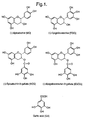
- the four major catechins in green tea leaf are epicatechin (EC) and epigallocatechin (EGC) and the gallated forms of these catechins (bearing a gallic acid (GA) residue), epicatechin-3-gallate (ECG) and epigallocatechin-3-gallate (EGCG).
- EC epicatechin
- ECG epigallocatechin-3-gallate
- Figure 1 The structures of these compounds are shown in Figure 1.
- TFs dimeric compounds known as theaflavins (TFs) and higher molecular weight compounds known as thearubigins (TRs).
- TRs are responsible for the orange and brown colours of black tea infusions and products as well as making significant contributions to the astringency and body of the made tea. TRs are larger in size and darker in colour than TFs.
- the oxidative polymerisations are a combination of biochemical oxidations mediated by polyphenol oxidase and/or peroxidase enzymes present in the leaf and chemical reactions of reactive species.
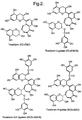
- TFs include theaflavin (TF or TF1) and a range of related gallated derivatives, the structures of some of which are shown in Figure 2.
- Theaflavin and theaflavins have been recognised as providing the "brightness” and “briskness” quality attributes of tea. They also affect tea colour. Most theaflavins have antioxidant properties and are therefore of great interest to the food and health industries.
- US Patent No. 4051264 (Sanderson et al) discloses a cold water extractable tea leaf that is prepared by treating fresh green tea with tannase under anaerobic conditions.
- European Patent specification EP 760213A discloses a method of inducing the formation of colour in a tea based product that involves treating tea leaves with tannase and an exogenous laccase, polyphenol oxidase or peroxidase.
- US Patent No. 5532012 (Ballentine et al) describes extraction from tea cream (cold water insoluble material resulting from infusion of black tea with hot water) of a mixture of theaflavins closely approximating the natural mixture of theaflavins found in tea cream.
- the mixture of theaflavins extracted comprises theaflavin, theaflavin monogallates and theaflavin digallate.
- the present invention is concerned with producing theaflavin by slurry fermenation and cold water soluble tea powders that have enhanced theaflavin levels.
- the present invention relates to a method for making a theaflavin-rich cold water soluble tea product.
- the method comprises treating a slurry of green leaf tea with tannase, fermenting the slurry, deleafing the slurry to give a theaflavin-rich tea liquor and spent dhool, drying the tea liquor to yield a liquor-derived theaflavin-rich cold water soluble tea powder, performing one or more solvent extractions of the spent dhool, drying the extract or extractions to form a dhool-derived theaflavin-rich powder or powders, and mixing the liquor-derived theaflavin-rich cold water soluble tea powder with the dhool-derived theaflavin-rich powder or powders to yield a theaflavin-rich cold water soluble tea product.
- the solvent is water or an organic solvent. Sequential washes of cold water (15 to 25°C), hot water (90 to 100°C) and methanol are especially preferred.
- the present invention relates to a method for purifying theaflavin.
- the method comprises treating a slurry of green leaf tea with tannase, fermenting the slurry, deleafing the slurry to give a theaflavin-rich tea liquor and spent dhool, drying the tea liquor to yield a liquor-derived theaflavin-rich cold water soluble tea powder, performing one or more solvent extractions of the spent dhool, drying the extract or extractions to form a dhool-derived theaflavin-rich powder or powders, mixing the liquor-derived theaflavin-rich cold water soluble tea powder with the dhool-derived theaflavin-rich powder or powders to give a theaflavin-rich cold water soluble tea product, resuspending the tea product in water, extracting the resuspended product with an organic solvent, and passing the extracted product through a chromatographic column that elutes the
- Tea for the purposes of the present invention means leaf material from Camellia sinsensis or Camellia assamica. "Tea is also intended to include the product of blending leaf material from these plants.
- Leaf tea means a tea product that contains one or more tea origins in an uninfused form.
- Theaflavin is a chemical compound that is the oxidation and condensation product of (-)-epicatechin and (-)-epigallocatechin. It is also known as TF1 or simply TF. "Theaflavins” collectively describes those compounds (including theaflavin) that are formed by the enzymic oxidation and condensation of tea catechins with di- and trihydroxylated B rings. Some of these compounds are illustrated in Figure 2. The present invention concerns making extracts, powders and products that are rich in theaflavin rather than theaflavins.
- the present invention arose from work by the present inventors investigating oxidative biotransformations occurring during tea fermentation, particularly with regard to generation of colour in tea products.
- tannase flanol gallate esterase
- the general reaction catalysed by tannase is the cleavage of gallate ester linkages, both on gallated catechins and also from other gallated compounds within the leaf.
- Tannase is well known to improve the clarity of tea products since galloyl groups are important in cream formation and tannase has been used extensively for the degallation and solubilisation of black tea cream.
- the use of tannase for pretreatment of green tea prior to slurry fermentations is also disclosed, e.g. in US Patent No. 3812266 (Sanderson et al), where tannase is used with the primary aim of reducing the amount of tea cream in liquors. Improved colours generated by the process were also noted.
- Epigallocatechin-3-gallate (EGCG) and epicatechin-3-gallate (ECG) are the most abundant catechins in fresh tea leaves and their gallate ester linkages are cleaved by tannase treatment to yield EGC, EC and gallic acid.
- the overall effect of tannase pretreatment before slurry fermentation is therefore to simplify the mixture of catechins present at the start of fermentation. It has generally been assumed hitherto that during subsequent oxidation the increased levels of gallic acid combine with simple (dihydroxy B-ring) catechins (e.g. EC) to give rise to high levels of theaflavic acids.
- gallic acid acts as the gallocatechin (trihydroxy B-ring) in the synthesis of these TF analogues.
- Gallic acid will not react with other gallocatechins (ie. EGCG and EGC) to form benzotropolone ring structures.
- Theaflavic acids are characteristically bright red in colour, so significantly better coloured liquors would be produced as a result of their accumulation.
- enhanced production of epitheaflavic acid (which has a bright reddish black tea-like colour) is proposed as the explanation for the improved colours generated with tannase pretreatment.
- the tannase treatment is therefore preferably such as to cause substantially complete degallation of the gallated catechins in the dhool, in order to maximise production of theaflavin.
- theaflavin is conveniently separated from the slurry fermentation product by solvent extraction, suitably using ethyl acetate, followed by elution from a chromatographic column with ethanol.
- solvent extraction suitably using ethyl acetate
- elution from a chromatographic column with ethanol.
- Theaflavin-rich fractions can be identified by colour.
- the slurry fermentation product is typically in the form of a powder.
- the powder is conveniently mixed with water to form an aqueous solution/suspension that can undergo solvent extraction.
- Initial extraction is preferably with chloroform, to remove caffeine and lipids, followed by ethyl acetate, to remove theaflavin.
- Ethyl acetate extracts are typically then washed with water and dried.
- the dried material may then be dissolved in ethanol and loaded onto a chromatographic column of suitable resin beads, e.g. SEPHADEX (SEPHADEX is a Trade Mark) pre-equilibrated with ethanol, and fractions eluted with ethanol.
- SEPHADEX SEPHADEX is a Trade Mark
- the slurry fermentation product may be produced by generally conventional techniques, as are well known to those skilled in the art, e.g. generally as disclosed in the US Patent No. 3812266.
- Slurry fermentation typically involves treating dhool (a slurry of macerated withered green tea leaf) by bubbling air or oxygen through the slurry for a controlled time at a controlled temperature, e.g. 25 °C, resulting in oxidative biotransformations taking place as described above.
- Solids are removed from the slurry (deleafing), optionally concentrated, and the liquid is then dried, e.g. spray or freeze dried, to produce a powder or granules.
- the dhool Prior to slurry fermentation, the dhool is treated with tannase. This is conveniently effected by mixing the dhool and tannase in suspension in an atmosphere of nitrogen (to prevent fermentation occurring) for a suitable time at a suitable temperature. Suitable conditions can be readily determined by experiment. Good results have been obtained with KIKKOMAN's tannase (KIKKOMAN is a trade mark) in an amount of at least about 0.0064% by weight of the weight of tea solids (i.e. 3200 tannase activity units (T.A.U.)/kg tea solids wherein tea leaf solids content is determined after measuring the moisture content of the leaf. KIKKOMAN's tannase has 50,000 T.A.U/gram) for 60 minutes at 25 °C, which results in quantitative degallation of gallated catechins.
- KIKKOMAN's tannase has 50,000 T.A.U/gram) for 60 minutes at
- the slurry fermentation conditions are preferably adjusted to maximise production of theaflavin as far as possible.
- Fermentation is preferably carried out at a pH in the range of 4.0 to 5.5.
- the fermentation temperature is preferably in the range 15 to 35 °C.
- Fermentation is preferably carried out for a time in the range 30 to 120 minutes, more preferably 30 to 75 minutes.
- Fermentation should also be carried out without addition of hydrogen peroxide (as is used in US Patent No. 3812266) as this destroys theaflavin (while enhancing overall colour).
- enzymes such as exogenous peroxidases, laccases and polyphenol oxidases should not be present as these would reduce theaflavin levels.
- the green leaf starting material may also be selected to optimise theaflavin production.
- the preferred starting material has an EGC(G) : EC(G) ratio of about 3 : 1 (See Example 3). Although 1 mole of EGC reacts with 1 mole or EC (after degallation), differential oxidation rates mean that 3:1 is the preferred molar ratio. Tea clones having a suitable molar ratio can be selected with this requirement in mind.
- the present invention can enable production of substantially pure theaflavin in high yields.
- Theaflavin yields at least 11 times those obtained without tannase treatment have been achieved in accordance with the method of the invention in its simplest form.
- Theaflavin yields of at least 11 g TF/kg dhool are achievable by that method.
- the improved extraction procedure showed that considerable additional TF could be obtained from tannase-treated slurries by employing a combination of cold and hot water washes of the dhool, after removal of the liquor.
- Cold water means water having a temperature between 15 and 25 °C, this could preferably be room temperature.
- Hot water means water having a temperature between 90 and 100 °C, preferably freshly boiled water. Overall about 90 % of TF could be recovered by combining the liquor with the cold and hot water washes, compared to only 30 % in the liquor alone.
- the improved extraction method was used to optimise fermentation conditions (temperature - see Example 5, and pH - see Example 6) in order to maximise TF yield from tannase-treated slurry fermentation.
- pH 4.0 and 15 °C were found to be the optimum operating conditions, although the benefit gained under these conditions was minor compared to 'natural' fermentation conditions.
- temperature did effect the amount of theaflavin present in the liquor phase of the slurry, the proportion increasing with fermentation temperature.
- the additional material that can be released from the spent dhool with cold and hot water is intensely coloured and proportionally much higher in TF content than the liquor.
- This material can be used to blend into powder products to add more/different colour or be combined with the slurry liquor to produce a cold water-soluble powder which is considerably darker and redder than that produced from liquor alone. Slurry fermentation thus provides a means of producing cost-effective, natural cold and hot water-soluble tea powders.
- theaflavin is known to affect the colour, "brightness” and “briskness” of tea. Because of its antioxidant properties, theaflavin (and perhaps other theaflavins) has potential uses including as an antioxidant ingredient in foodstuffs such as processed foods and oils, as an ingredient in health-promoting products, and as ingredient in tea products for colour properties as well as antioxidant properties.
- food materials that may to advantage incorporate theaflavin produced by the method of the invention as an antioxidant ingredient include frying oils and fats, potato flakes, bakery products, meat emulsions, precooked cereals, instant noodles, soy bean milk, chicken products, emulsion products such as sausage, mayonnaise and margarine, frozen fish, frozen pizza, cheese and animal foods.
- Fresh Kenyan tea (Clone BBK 35) was plucked and withered overnight, then frozen in dry ice and transported to UK.
- the fermentation liquor was deleafed by passage through 4 layers of muslin.
- the residual dhool was washed with 500 ml distilled water, and the wash and liquor combined, cooled to 4 °C, centrifuged and the supernatant freeze-dried using a pilot scale freeze dryer. This yielded approximately 25 g of powder.
- Lab scale TF purification was as follows. 5 g of the powder were resuspended in 100 ml water, and stirred until completely dissolved. The aqueous fraction was then extracted successively with 100 ml hexane, 2 x 100 ml chloroform and 4 x 100 ml ethyl acetate. The hexane removes lipid. The chloroform removes caffeine and any residual lipid. The ethyl acetate fractions were combined and reextracted with an equal volume of water. The ethyl acetate fraction was then dried over approximately 2 g anhydrous MgSO 4 , then dried down, resuspended in 50 ml water and freeze dried. This batch process can be repeated for the entire 25 g of freeze dried slurry liquor.
- TF was further purified as follows. A column of SEPHADEX LH20 (SEPHADEX is a trade mark) was washed with one litre of aqueous acetone, followed by one litre absolute alcohol. Approximately 1 g of ethyl acetate soluble material was dissolved in 100% ethanol and loaded onto the column, then eluted with 100% ethanol. Fifty 100 ml fractions were collected. TF containing fractions were identified from their colour (fractions 33-50) and analysed by HPLC.
- SEPHADEX LH20 SEPHADEX is a trade mark
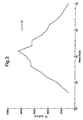
- Figure 3 is a graph illustrating the amount of TF in fractions 33 to 50, measured in mAU*s. This unit represents the peak area of theaflavin in each fraction as determined by HPLC analysis. The peak height is recorded in milliabsorbance units (mAU) and the peak width in seconds, giving an area in mAU*s.
- mAU milliabsorbance units
- the fermentation process was not fully optimised for TF production. Only the tannase treatment was optimised to obtain quantitative degallation of catechins. It is possible that other process parameters such as fermentation time, temperature, pH, raw material (in terms of initial catechin composition) could be optimised to maximise TF yield. The yields of TF obtained should therefore be treated as illustrative only. The TF extraction procedure is very efficient.
- Dhool was prepared from frozen withered leaf of BBK clone 35 with four passes through the CTC machine and stored frozen at -80 °C.
- Shake flask slurry fermentations were carried out as follows. Dhool (8 g) was added to 42 ml H 2 O in a shake flask and allowed to thaw under a stream of N 2 for 10 minutes, with agitation on a magnetic stirrer. KIKKOMAN's (TM) tannase (1 mg/flask) was added and the slurry incubated for a further 60 minutes under N 2 . After that the flask was transferred to a shaking incubator table and fermented for 75 minutes at 200 rpm. Standard fermentations were carried out in the same way, but without tannase addition or incubation under N 2 .
- Samples (1 ml) were taken from the slurry at the beginning and end of tannase treatment and at 15 minute intervals during the fermentation. These were immediately centrifuged and 200 ⁇ l of the supernatant added to 800 ⁇ l antioxidant solvent (15 % (v/v) acetonitrile, 1.7 % (v/v) acetic acid, 1 mM EDTA, 21.2 mM-ascorbic acid prior to HPLC analysis.
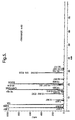
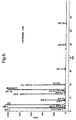
- Figures 5 and 6 are respective traces after 60 minutes suspension with nitrogen sparge, without and with tannase treatment. In the absence of tannase there is little change in the peaks identified in Figure 4. In contrast, after tannase treatment there is no ECG or EGCG apparent, but increased peaks for EC, EGC and GA. These results show that complete degallation of the gallated catechins (ECG to EC and EGCG to EGC) is achieved by the tannase treatment used.
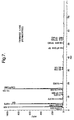
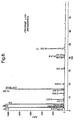
- Figures 7 and 8 are further traces taken after 75 minutes fermentation following the initial 60 minutes suspension, with Figure 7 showing results without tannase treatment and Figure 8 showing results with tannase treatment prior to fermentation.
- the TF is also present in much higher amounts than in the no tannase treatment sample.
- Large amounts of gallic acid (GA) are also present after fermentation following tannase treatment.
- the mixture was incubated at 30 °C at 200 rpm on an orbital shaker. Samples were taken at appropriate intervals and reaction terminated by addition into 400 ⁇ l antioxidant solvent (15% (v/v) acetonitrile, 1.7% (v/v) acetic acid, 250 ppm ascorbic acid, 250 ppm EDTA). Theaflavin and epitheaflavic acid production was then assayed via rp-HPLC.
- the slurry was deleafed through 4 layers of muslin, using a Buchner funnel, the volume of the liquor recorded, and a sample taken for HPLC analysis as described above.
- the residual dhool was then extracted as follows: The dhool was scraped from the muslin, and infused in 100 ml room-temperature water for 10 minutes. This slurry was then filtered through the muslin, the volume of this "cold water” extract recorded and a sample taken for HPLC analysis. The dhool was again scraped from the dhool and infused for 10 minutes in 100 ml boiling water then filtered and this "hot water” extract sampled in the same way as the cold extract. The residual dhool was finally extracted in boiling 70 % (v/v) aqueous methanol as described in Example 2.
- the optimised extraction protocol was then used in a study on the effect of fermentation temperature on the formation of theaflavin in tannase-treated slurry.
- Samples of the slurry liquor were taken at 15 minute intervals during a 75 minute fermentation to monitor the TF levels in the liquor (See Figure 12).
- the slurry was extracted, as described above, and the total amount of theaflavin in the various fractions determined (See Figure 13).
- theaflavin levels in the liquor increased rapidly during the first 30 minutes of fermentation, reaching higher levels at the higher temperatures. Beyond 30 minutes there appeared to be a marked difference between fermentations carried out at 15 - 25 °C and those at 30 to 40 °C. At the lower temperatures, and particularly at 25 °C, the theaflavin level in the liquor started to fall rapidly from this peak. In contrast, at higher temperatures, 30 and 35 °C, the theaflavin level remained constant until 60 minutes when it started to fall. At 40 °C, theaflavin started to fall from 45 minutes and the final liquor level was similar to that found at 30 and 35 °C. These results appear to indicate that, at the higher temperatures, theaflavin synthesis is greatest and turnover is lowest, neither of which would be expected.
- the pH of the slurry was around 4.7, and this was adjusted by addition of HCl or NaOH.
- Altering the fermentation pH from 4.0 to 5.4 had little effect on levels of TF present in the liquor (See Figure 14), but levels were somewhat lower at pH 5.6 (at pH 4.0 the TF peak occurred at 45 minutes rather than 30 minutes).
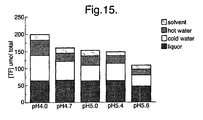
- total extractable TF See Figure 15
- there was little difference between pH 4.7 and 5.4 but levels were somewhat reduced at pH 5.6.
- lowering the pH to 4.0 enhanced total theaflavin yield compared to the 'standard' pH 4.7, with the additional TF being present in the cold/hot washes.
- the material in the cold and hot water extracts contains a higher proportion of theaflavin than the liquor, for example, the hot water extracts contained about 2.5 fold higher levels of TF, on a percentage basis, than the liquors.
- the absolute amounts of solids in the cold and hot water extracts are lower than that in the liquor, they are still very significant, representing an additional 35 % for the 15 °C tannase fermentation and 25 % for the 35 °C tannase fermentation.
- Table 5 shows that, at equivalent solids levels, the cold and hot water fractions are markedly darker (lower L* value), redder (higher a* value) and more yellow (higher b* value) than their corresponding liquors.
- the colour values show that recovery of the additional coloured material does make a substantial difference (L 10 units darker, a* 14 units redder and b* 19 units yellower) to the colour of the cold water soluble powder that can be prepared from slurry fermentation.
- the compositional data show that there is appreciable loss of material during tea powder preparation (4 °C chill overnight, centrifugation at 4 °C and freeze dry) e.g. 40 % TF for the mixture.
- the powder prepared from the mixed fraction still contains 9 % TF compared to 4 % TF in the liquor only powder. It is therefore evident that addition of the cold and hot water washes to the slurry liquor itself can make a substantial difference to the final characteristics, and probable cost effectiveness, of powders prepared via slurry fermentation.
- the inventors determined the effect of time at 4 °C prior to centrifugation in order to investigate whether prolonged, overnight, chill was leading to unnecessary losses of TF during standard decream. Aliquots from an extracted slurry were either centrifuged immediately at 4 °C or chilled for 1 hour, or overnight, prior to centrifugation. Although the differences between the treatments were small (See Table 8 below), immediate centrifugation gave a cold water soluble powder with higher a*, and highest TF content (11.7 % by mass of powder). The recovery of TF from the extract in the powder was 91 % if centrifuged immediately compared to 77 % following overnight chill.
Landscapes
- Chemical & Material Sciences (AREA)
- Life Sciences & Earth Sciences (AREA)
- Engineering & Computer Science (AREA)
- Organic Chemistry (AREA)
- Biotechnology (AREA)
- Microbiology (AREA)
- Food Science & Technology (AREA)
- Polymers & Plastics (AREA)
- Preparation Of Compounds By Using Micro-Organisms (AREA)
Claims (11)
- Verfahren zum Herstellen eines theaflavinreichen, in kaltem Wasser löslichen Teeprodukts, umfassend Behandeln einer Aufschlämmung aus grünem Blatttee mit Tannase, Fermentieren besagter Aufschlämmung, Entfernen der Blätter aus der Aufschlämmung, um eine theaflavinreiche Teeflüssigkeit und gebrauchten Dhool zu ergeben, Trocknen der Teeflüssigkeit, um ein aus Flüssigkeit hergeleitetes, theaflavinreiches, in kaltem Wasser lösliches Teepulver zu erbringen, Ausführen von einer oder mehreren Solventextraktionen des gebrauchten Dhools, Trocknen von besagtem Extrakt oder Extraktionen, um (ein) aus Dhool hergeleitete(s), theaflavinreiche(s) Pulver oder Pulver zu bilden und Mischen des aus Flüssigkeit hergeleiteten, theaflavinreichen, in kaltem Wasser löslichen Teepulvers mit dem/den aus Dhool hergeleiteten Pulver oder Pulvern, um das theaflavinreiche, in kaltem Wasser lösliches Teeprodukt zu ergeben.
- Verfahren zum Herstellen eines theaflavinreichen, in kaltem Wasser löslichen Teeprodukts, umfassend Behandeln einer Aufschlämmung aus grünem Blatttee mit Tannase, Fermentieren besagter Aufschlämmung, Entfernen der Blätter aus der Aufschlämmung, um eine theaflavinreiche Teeflüssigkeit und gebrauchten Dhool zu ergeben, Ausführen von einer oder mehreren Solventextraktionen des gebrauchten Dhools, Mischen der theaflavinreichen Teeflüssigkeit mit dem Extrakt oder den Extrakten des gebrauchten Dhools und Trocknen dieses Gemisches, um das theaflavinreiche, in kaltem Wasser lösliche Teeprodukt zu bilden.
- Verfahren zum Reinigen von Theaflavin, umfassend Behandeln einer Aufschlämmung aus grünem Blatttee mit Tannase, Fermentieren der Aufschlämmung, Entfernen der Blätter aus der Aufschlämmung, um eine theaflavinreiche Teeflüssigkeit und gebrauchten Dhool zu ergeben, Trocknen der Teeflüssigkeit, um ein aus Flüssigkeit hergeleitetes, theaflavinreiches, in kaltem Wasser lösliches Teepulver zu erbringen, Ausführen von einer oder mehreren Solventextraktionen des gebrauchten Dhools, Trocknen von besagtem Extrakt oder Extraktionen, um (ein) aus Dhool hergeleitete(s), theaflavinreiche(s) Pulver oder Pulver zu bilden, Mischen des aus Flüssigkeit hergeleiteten, theaflavinreichen, in kaltem Wasser löslichen Teepulvers mit dem/den aus Dhool hergeleiteten Pulver oder Pulvern, um ein theaflavinreiches, in kaltem Wasser lösliches Teeprodukt zu ergeben, Resuspendieren des Teeprodukts in Wasser, Extrahieren des resuspendierten Produkts mit einem organischen Lösungsmittel und Passieren des extrahierten Produkts durch eine Chromatographiesäule, die Theaflavin eluiert.
- Verfahren zum Reinigen von Theaflavin, umfassend Behandeln einer Aufschlämmung aus grünem Blatttee mit Tannase, Fermentieren der Aufschlämmung, Entfernen der Blätter aus der Aufschlämmung, um eine theaflavinreiche Teeflüssigkeit und gebrauchten Dhool zu ergeben, Ausführen von einer oder mehreren Solventextraktionen des gebrauchten Dhools, Mischen theaflavinreichen Teeflüssigkeit mit dem Extrakt oder den Extrakten des gebrauchten Dhool, Trocknen dieses Gemisches, um das in kaltem Wasser lösliche Teeprodukt zu bilden, Resuspendieren des Teeprodukts in Wasser, Extrahieren des resuspendierten Produkts mit einem organischen Lösungsmittel und Passieren des extrahierten Produkts durch eine Chromatographiesäule, die Theaflavin eluiert.
- Verfahren gemäß einem der vorhergehenden Ansprüche, wobei die Aufschlämmung mit Tannase in einer Menge von mindestens etwa 3200 Tannase-Wirkungseinheiten/kg Teefeststoffe für etwa 60 Minuten bei etwa 25°C behandelt wird.
- Verfahren gemäß einem der vorhergehenden Ansprüche, wobei die Aufschlämmungsfermentierung bei einem pH im Bereich von 4,0 bis 5,5, bei einer Temperatur im Bereich von 15 bis 30°C für einen Zeitraum im Bereich von 30 bis 75 Minuten durchgeführt wird.
- Verfahren gemäß einem der vorhergehenden Ansprüche, wobei der grüne Blatttee ein EGC(G):EC(G) Verhältnis von 3:1 hat.
- Verfahren gemäß Anspruch 1 oder 3, wobei des Lösungsmittel ausgewählt wird aus Wasser und organischen Lösungsmitteln.
- Verfahren gemäß Anspruch 8, wobei das Lösungsmittel Wasser mit einer Temperatur zwischen 15 und 25°C ist.
- Verfahren gemäß Anspruch 8, wobei das Lösungsmittel Wasser mit einer Temperatur zwischen 90 und 100°C ist.
- Verfahren gemäß Anspruch 1 oder 3, wobei der gebrauchte Dhool für ein erstes Mal unter Verwendung von Wasser mit einer Temperatur zwischen 15 und 25°C, für ein zweites Mal unter Verwendung von Wasser mit einer Temperatur zwischen 90 und 100°C und für ein drittes Mal unter Verwendung eines organischen Lösungsmittels extrahiert wird.
Priority Applications (1)
| Application Number | Priority Date | Filing Date | Title |
|---|---|---|---|
| EP98305399A EP0891973B1 (de) | 1997-07-15 | 1998-07-07 | Verbesserungen bezüglich auf Theaflavin Erzeugung |
Applications Claiming Priority (3)
| Application Number | Priority Date | Filing Date | Title |
|---|---|---|---|
| EP97305259 | 1997-07-15 | ||
| EP97305259 | 1997-07-15 | ||
| EP98305399A EP0891973B1 (de) | 1997-07-15 | 1998-07-07 | Verbesserungen bezüglich auf Theaflavin Erzeugung |
Publications (2)
| Publication Number | Publication Date |
|---|---|
| EP0891973A1 EP0891973A1 (de) | 1999-01-20 |
| EP0891973B1 true EP0891973B1 (de) | 2001-10-17 |
Family
ID=26147518
Family Applications (1)
| Application Number | Title | Priority Date | Filing Date |
|---|---|---|---|
| EP98305399A Expired - Lifetime EP0891973B1 (de) | 1997-07-15 | 1998-07-07 | Verbesserungen bezüglich auf Theaflavin Erzeugung |
Country Status (1)
| Country | Link |
|---|---|
| EP (1) | EP0891973B1 (de) |
Cited By (1)
| Publication number | Priority date | Publication date | Assignee | Title |
|---|---|---|---|---|
| US10131727B2 (en) | 2006-03-31 | 2018-11-20 | Council Of Scientific And Industrial Research | Solid state matrix, process of preparation thereof, and process of preparation of theaflavins |
Families Citing this family (9)
| Publication number | Priority date | Publication date | Assignee | Title |
|---|---|---|---|---|
| CN101541184A (zh) * | 2006-12-01 | 2009-09-23 | 荷兰联合利华有限公司 | 产生茶黄素的方法 |
| PL2192844T3 (pl) * | 2007-09-28 | 2011-07-29 | Unilever Nv | Sposób ekstrahowania teaflawin z herbaty |
| US20100086645A1 (en) * | 2008-10-02 | 2010-04-08 | Conopco, Inc., D/B/A Unilever | Process for manufacturing tea products |
| CN102164500B (zh) * | 2008-10-02 | 2014-08-20 | 荷兰联合利华有限公司 | 生产茶产品的方法 |
| DE102008059676A1 (de) * | 2008-11-26 | 2010-05-27 | Bayer Schering Pharma Aktiengesellschaft | Arzneimittelspender und dessen Verwendung |
| CN103535461A (zh) * | 2013-10-11 | 2014-01-29 | 集美大学 | 茶叶的酶法二次加工方法 |
| CN107494794A (zh) * | 2017-09-29 | 2017-12-22 | 遵义林仙康茶旅有限公司 | 一种红茶的加工工艺 |
| CN108684888B (zh) * | 2018-05-07 | 2021-07-20 | 阳江喜之郎果冻制造有限公司 | 一种热溶型速溶红茶粉的生产工艺 |
| CN110452941B (zh) * | 2019-08-24 | 2022-10-14 | 西南大学 | 一种提高茶黄素类物质合成产率的方法 |
Citations (1)
| Publication number | Priority date | Publication date | Assignee | Title |
|---|---|---|---|---|
| JPH09110615A (ja) * | 1995-10-17 | 1997-04-28 | Mitsui Norin Kk | カテキン類配合消毒剤 |
Family Cites Families (4)
| Publication number | Priority date | Publication date | Assignee | Title |
|---|---|---|---|---|
| US4051264A (en) * | 1975-09-05 | 1977-09-27 | Thomas J. Lipton, Inc. | Cold water extractable tea leaf and process |
| US4748033A (en) * | 1986-05-07 | 1988-05-31 | The Procter & Gamble Company | Tea concentrate having freeze thaw stability and enhanced cold water solubility |
| US5532012A (en) * | 1995-06-02 | 1996-07-02 | Thomas J. Lipton Co., Division Of Conopco, Inc. | Process for preparation of purified tea components using preconcentration by cream separation and solubilization followed by medium pressure chromatography and/or preparative HPLC |
| ES2153939T3 (es) * | 1995-09-04 | 2001-03-16 | Unilever Nv | Procedimiento para intensificar el color de un producto alimentario a base de te. |
-
1998
- 1998-07-07 EP EP98305399A patent/EP0891973B1/de not_active Expired - Lifetime
Patent Citations (1)
| Publication number | Priority date | Publication date | Assignee | Title |
|---|---|---|---|---|
| JPH09110615A (ja) * | 1995-10-17 | 1997-04-28 | Mitsui Norin Kk | カテキン類配合消毒剤 |
Cited By (1)
| Publication number | Priority date | Publication date | Assignee | Title |
|---|---|---|---|---|
| US10131727B2 (en) | 2006-03-31 | 2018-11-20 | Council Of Scientific And Industrial Research | Solid state matrix, process of preparation thereof, and process of preparation of theaflavins |
Also Published As
| Publication number | Publication date |
|---|---|
| EP0891973A1 (de) | 1999-01-20 |
Similar Documents
| Publication | Publication Date | Title |
|---|---|---|
| US6113965A (en) | Producing theaflavin | |
| JP4981211B2 (ja) | 冷水浸出葉茶 | |
| US20080131558A1 (en) | Process for producing theaflavins | |
| EP2096937B1 (de) | Verfahren zur herstellung von mit theaflavin angereicherten teeprodukten | |
| US20100086642A1 (en) | Process for manufacturing tea products | |
| CA2403396C (en) | Cold water soluble tea | |
| CA2585863C (en) | Consumable composition with antioxidants | |
| EP2192844B1 (de) | Verfahren zum extrahieren von theaflavinen aus tee | |
| EP0891973A1 (de) | Verbesserungen bezüglich auf Theaflavin Erzeugung | |
| US20080254190A1 (en) | Extraction of theaflavins | |
| EP2549880B1 (de) | Verfahren zur Herstellung von Teeprodukten |
Legal Events
| Date | Code | Title | Description |
|---|---|---|---|
| PUAI | Public reference made under article 153(3) epc to a published international application that has entered the european phase |
Free format text: ORIGINAL CODE: 0009012 |
|
| AK | Designated contracting states |
Kind code of ref document: A1 Designated state(s): AT BE CH DE DK ES FR GB GR IE IT LI NL PT SE |
|
| AX | Request for extension of the european patent |
Free format text: AL;LT;LV;MK;RO;SI |
|
| 17P | Request for examination filed |
Effective date: 19990118 |
|
| AKX | Designation fees paid |
Free format text: AT BE CH CY DE DK ES FI FR GB GR IE IT LI LU |
|
| RBV | Designated contracting states (corrected) |
Designated state(s): AT BE CH DE DK ES FR GB GR IE IT LI NL PT SE |
|
| 17Q | First examination report despatched |
Effective date: 20000606 |
|
| GRAG | Despatch of communication of intention to grant |
Free format text: ORIGINAL CODE: EPIDOS AGRA |
|
| GRAG | Despatch of communication of intention to grant |
Free format text: ORIGINAL CODE: EPIDOS AGRA |
|
| GRAH | Despatch of communication of intention to grant a patent |
Free format text: ORIGINAL CODE: EPIDOS IGRA |
|
| RAP1 | Party data changed (applicant data changed or rights of an application transferred) |
Owner name: UNILEVER N.V. Owner name: UNILEVER PLC |
|
| GRAH | Despatch of communication of intention to grant a patent |
Free format text: ORIGINAL CODE: EPIDOS IGRA |
|
| GRAA | (expected) grant |
Free format text: ORIGINAL CODE: 0009210 |
|
| AK | Designated contracting states |
Kind code of ref document: B1 Designated state(s): AT BE CH DE DK ES FR GB GR IE IT LI NL PT SE |
|
| PG25 | Lapsed in a contracting state [announced via postgrant information from national office to epo] |
Ref country code: NL Free format text: LAPSE BECAUSE OF FAILURE TO SUBMIT A TRANSLATION OF THE DESCRIPTION OR TO PAY THE FEE WITHIN THE PRESCRIBED TIME-LIMIT Effective date: 20011017 Ref country code: LI Free format text: LAPSE BECAUSE OF FAILURE TO SUBMIT A TRANSLATION OF THE DESCRIPTION OR TO PAY THE FEE WITHIN THE PRESCRIBED TIME-LIMIT Effective date: 20011017 Ref country code: CH Free format text: LAPSE BECAUSE OF FAILURE TO SUBMIT A TRANSLATION OF THE DESCRIPTION OR TO PAY THE FEE WITHIN THE PRESCRIBED TIME-LIMIT Effective date: 20011017 Ref country code: AT Free format text: LAPSE BECAUSE OF FAILURE TO SUBMIT A TRANSLATION OF THE DESCRIPTION OR TO PAY THE FEE WITHIN THE PRESCRIBED TIME-LIMIT Effective date: 20011017 |
|
| REF | Corresponds to: |
Ref document number: 207068 Country of ref document: AT Date of ref document: 20011115 Kind code of ref document: T |
|
| REG | Reference to a national code |
Ref country code: CH Ref legal event code: EP |
|
| REG | Reference to a national code |
Ref country code: IE Ref legal event code: FG4D |
|
| REF | Corresponds to: |
Ref document number: 69802046 Country of ref document: DE Date of ref document: 20011122 |
|
| REG | Reference to a national code |
Ref country code: GB Ref legal event code: IF02 |
|
| REG | Reference to a national code |
Ref country code: ES Ref legal event code: FG2A Ref document number: 2163234 Country of ref document: ES Kind code of ref document: T3 |
|
| PG25 | Lapsed in a contracting state [announced via postgrant information from national office to epo] |
Ref country code: PT Free format text: LAPSE BECAUSE OF FAILURE TO SUBMIT A TRANSLATION OF THE DESCRIPTION OR TO PAY THE FEE WITHIN THE PRESCRIBED TIME-LIMIT Effective date: 20020117 Ref country code: DK Free format text: LAPSE BECAUSE OF FAILURE TO SUBMIT A TRANSLATION OF THE DESCRIPTION OR TO PAY THE FEE WITHIN THE PRESCRIBED TIME-LIMIT Effective date: 20020117 |
|
| PG25 | Lapsed in a contracting state [announced via postgrant information from national office to epo] |
Ref country code: GR Free format text: LAPSE BECAUSE OF FAILURE TO SUBMIT A TRANSLATION OF THE DESCRIPTION OR TO PAY THE FEE WITHIN THE PRESCRIBED TIME-LIMIT Effective date: 20020118 |
|
| ET | Fr: translation filed | ||
| NLV1 | Nl: lapsed or annulled due to failure to fulfill the requirements of art. 29p and 29m of the patents act | ||
| REG | Reference to a national code |
Ref country code: CH Ref legal event code: PL |
|
| PGFP | Annual fee paid to national office [announced via postgrant information from national office to epo] |
Ref country code: FR Payment date: 20020619 Year of fee payment: 5 |
|
| PGFP | Annual fee paid to national office [announced via postgrant information from national office to epo] |
Ref country code: SE Payment date: 20020620 Year of fee payment: 5 |
|
| PGFP | Annual fee paid to national office [announced via postgrant information from national office to epo] |
Ref country code: GB Payment date: 20020703 Year of fee payment: 5 |
|
| PGFP | Annual fee paid to national office [announced via postgrant information from national office to epo] |
Ref country code: IE Payment date: 20020705 Year of fee payment: 5 |
|
| PG25 | Lapsed in a contracting state [announced via postgrant information from national office to epo] |
Ref country code: ES Free format text: LAPSE BECAUSE OF NON-PAYMENT OF DUE FEES Effective date: 20020708 |
|
| PGFP | Annual fee paid to national office [announced via postgrant information from national office to epo] |
Ref country code: BE Payment date: 20020724 Year of fee payment: 5 |
|
| PGFP | Annual fee paid to national office [announced via postgrant information from national office to epo] |
Ref country code: DE Payment date: 20020730 Year of fee payment: 5 |
|
| PLBE | No opposition filed within time limit |
Free format text: ORIGINAL CODE: 0009261 |
|
| STAA | Information on the status of an ep patent application or granted ep patent |
Free format text: STATUS: NO OPPOSITION FILED WITHIN TIME LIMIT |
|
| 26N | No opposition filed | ||
| PG25 | Lapsed in a contracting state [announced via postgrant information from national office to epo] |
Ref country code: IE Free format text: LAPSE BECAUSE OF NON-PAYMENT OF DUE FEES Effective date: 20030707 Ref country code: GB Free format text: LAPSE BECAUSE OF NON-PAYMENT OF DUE FEES Effective date: 20030707 |
|
| PG25 | Lapsed in a contracting state [announced via postgrant information from national office to epo] |
Ref country code: SE Free format text: LAPSE BECAUSE OF NON-PAYMENT OF DUE FEES Effective date: 20030708 |
|
| PG25 | Lapsed in a contracting state [announced via postgrant information from national office to epo] |
Ref country code: BE Free format text: LAPSE BECAUSE OF NON-PAYMENT OF DUE FEES Effective date: 20030731 |
|
| BERE | Be: lapsed |
Owner name: *UNILEVER N.V. Effective date: 20030731 |
|
| PG25 | Lapsed in a contracting state [announced via postgrant information from national office to epo] |
Ref country code: DE Free format text: LAPSE BECAUSE OF NON-PAYMENT OF DUE FEES Effective date: 20040203 |
|
| GBPC | Gb: european patent ceased through non-payment of renewal fee |
Effective date: 20030707 |
|
| EUG | Se: european patent has lapsed | ||
| PG25 | Lapsed in a contracting state [announced via postgrant information from national office to epo] |
Ref country code: FR Free format text: LAPSE BECAUSE OF NON-PAYMENT OF DUE FEES Effective date: 20040331 |
|
| REG | Reference to a national code |
Ref country code: FR Ref legal event code: ST |
|
| REG | Reference to a national code |
Ref country code: IE Ref legal event code: MM4A |
|
| REG | Reference to a national code |
Ref country code: ES Ref legal event code: FD2A Effective date: 20030811 |
|
| PG25 | Lapsed in a contracting state [announced via postgrant information from national office to epo] |
Ref country code: IT Free format text: LAPSE BECAUSE OF NON-PAYMENT OF DUE FEES;WARNING: LAPSES OF ITALIAN PATENTS WITH EFFECTIVE DATE BEFORE 2007 MAY HAVE OCCURRED AT ANY TIME BEFORE 2007. THE CORRECT EFFECTIVE DATE MAY BE DIFFERENT FROM THE ONE RECORDED. Effective date: 20050707 |