EP0891993B1 - Copolymères insaturés, procédés de fabrication et compositions les contenant - Google Patents
Copolymères insaturés, procédés de fabrication et compositions les contenant Download PDFInfo
- Publication number
- EP0891993B1 EP0891993B1 EP98305662A EP98305662A EP0891993B1 EP 0891993 B1 EP0891993 B1 EP 0891993B1 EP 98305662 A EP98305662 A EP 98305662A EP 98305662 A EP98305662 A EP 98305662A EP 0891993 B1 EP0891993 B1 EP 0891993B1
- Authority
- EP
- European Patent Office
- Prior art keywords
- copolymer
- unsaturated
- ethylene
- olefin
- double bonds
- Prior art date
- Legal status (The legal status is an assumption and is not a legal conclusion. Google has not performed a legal analysis and makes no representation as to the accuracy of the status listed.)
- Expired - Lifetime
Links
- 229920001577 copolymer Polymers 0.000 title claims description 509
- 239000000203 mixture Substances 0.000 title claims description 107
- 238000000034 method Methods 0.000 title claims description 64
- 230000008569 process Effects 0.000 title claims description 37
- VGGSQFUCUMXWEO-UHFFFAOYSA-N Ethene Chemical compound C=C VGGSQFUCUMXWEO-UHFFFAOYSA-N 0.000 claims description 162
- 239000005977 Ethylene Substances 0.000 claims description 160
- 239000004711 α-olefin Substances 0.000 claims description 142
- -1 aromatic vinyl compound Chemical class 0.000 claims description 115
- 239000000178 monomer Substances 0.000 claims description 109
- 150000001993 dienes Chemical class 0.000 claims description 105
- KAKZBPTYRLMSJV-UHFFFAOYSA-N Butadiene Chemical group C=CC=C KAKZBPTYRLMSJV-UHFFFAOYSA-N 0.000 claims description 92
- PPBRXRYQALVLMV-UHFFFAOYSA-N Styrene Chemical compound C=CC1=CC=CC=C1 PPBRXRYQALVLMV-UHFFFAOYSA-N 0.000 claims description 75
- 229920001971 elastomer Polymers 0.000 claims description 73
- 150000001875 compounds Chemical class 0.000 claims description 70
- 125000004432 carbon atom Chemical group C* 0.000 claims description 67
- 239000003054 catalyst Substances 0.000 claims description 61
- 238000004132 cross linking Methods 0.000 claims description 60
- 238000011925 1,2-addition Methods 0.000 claims description 59
- NNBZCPXTIHJBJL-UHFFFAOYSA-N decalin Chemical compound C1CCCC2CCCCC21 NNBZCPXTIHJBJL-UHFFFAOYSA-N 0.000 claims description 50
- 229920002554 vinyl polymer Polymers 0.000 claims description 49
- RRHGJUQNOFWUDK-UHFFFAOYSA-N Isoprene Chemical group CC(=C)C=C RRHGJUQNOFWUDK-UHFFFAOYSA-N 0.000 claims description 43
- 239000000470 constituent Substances 0.000 claims description 39
- ZCYVEMRRCGMTRW-UHFFFAOYSA-N 7553-56-2 Chemical compound [I] ZCYVEMRRCGMTRW-UHFFFAOYSA-N 0.000 claims description 36
- 229910052740 iodine Inorganic materials 0.000 claims description 36
- 239000011630 iodine Substances 0.000 claims description 36
- 230000009477 glass transition Effects 0.000 claims description 32
- 229910052717 sulfur Inorganic materials 0.000 claims description 32
- 239000003446 ligand Substances 0.000 claims description 31
- 239000000806 elastomer Substances 0.000 claims description 30
- 150000001451 organic peroxides Chemical class 0.000 claims description 25
- PXXNTAGJWPJAGM-UHFFFAOYSA-N vertaline Natural products C1C2C=3C=C(OC)C(OC)=CC=3OC(C=C3)=CC=C3CCC(=O)OC1CC1N2CCCC1 PXXNTAGJWPJAGM-UHFFFAOYSA-N 0.000 claims description 25
- 239000003431 cross linking reagent Substances 0.000 claims description 21
- 239000000945 filler Substances 0.000 claims description 20
- 125000003118 aryl group Chemical group 0.000 claims description 19
- 229910052757 nitrogen Inorganic materials 0.000 claims description 19
- 125000000217 alkyl group Chemical group 0.000 claims description 18
- 150000003624 transition metals Chemical class 0.000 claims description 18
- 238000004519 manufacturing process Methods 0.000 claims description 17
- 229910052723 transition metal Inorganic materials 0.000 claims description 17
- 229910052799 carbon Inorganic materials 0.000 claims description 16
- 229910052719 titanium Inorganic materials 0.000 claims description 16
- 150000001732 carboxylic acid derivatives Chemical class 0.000 claims description 15
- 125000000058 cyclopentadienyl group Chemical group C1(=CC=CC1)* 0.000 claims description 14
- 125000004435 hydrogen atom Chemical group [H]* 0.000 claims description 14
- 229910052796 boron Inorganic materials 0.000 claims description 13
- 238000002844 melting Methods 0.000 claims description 12
- 230000008018 melting Effects 0.000 claims description 12
- 125000000129 anionic group Chemical group 0.000 claims description 11
- 229910052760 oxygen Inorganic materials 0.000 claims description 11
- 229910052726 zirconium Inorganic materials 0.000 claims description 11
- 150000001735 carboxylic acids Chemical class 0.000 claims description 10
- 229910052735 hafnium Inorganic materials 0.000 claims description 10
- 229910052710 silicon Inorganic materials 0.000 claims description 10
- 239000002879 Lewis base Substances 0.000 claims description 9
- 125000004429 atom Chemical group 0.000 claims description 9
- 125000003983 fluorenyl group Chemical group C1(=CC=CC=2C3=CC=CC=C3CC12)* 0.000 claims description 9
- 229910052732 germanium Inorganic materials 0.000 claims description 9
- 125000003454 indenyl group Chemical group C1(C=CC2=CC=CC=C12)* 0.000 claims description 9
- 150000007527 lewis bases Chemical class 0.000 claims description 9
- 230000007935 neutral effect Effects 0.000 claims description 9
- 229910052718 tin Inorganic materials 0.000 claims description 9
- 229910052779 Neodymium Inorganic materials 0.000 claims description 7
- 229910052772 Samarium Inorganic materials 0.000 claims description 7
- 229910052704 radon Inorganic materials 0.000 claims description 7
- 229910052707 ruthenium Inorganic materials 0.000 claims description 7
- 125000004433 nitrogen atom Chemical group N* 0.000 claims description 6
- 125000004430 oxygen atom Chemical group O* 0.000 claims description 6
- 125000004437 phosphorous atom Chemical group 0.000 claims description 6
- 229910052698 phosphorus Inorganic materials 0.000 claims description 6
- 125000004434 sulfur atom Chemical group 0.000 claims description 6
- 229920005604 random copolymer Polymers 0.000 claims description 5
- 239000001257 hydrogen Substances 0.000 claims description 3
- 229910052739 hydrogen Inorganic materials 0.000 claims description 3
- 239000000047 product Substances 0.000 description 68
- 229920000642 polymer Polymers 0.000 description 55
- 229920005989 resin Polymers 0.000 description 45
- 239000011347 resin Substances 0.000 description 45
- YXFVVABEGXRONW-UHFFFAOYSA-N Toluene Chemical compound CC1=CC=CC=C1 YXFVVABEGXRONW-UHFFFAOYSA-N 0.000 description 42
- 239000005060 rubber Substances 0.000 description 42
- 238000000576 coating method Methods 0.000 description 39
- 229920000089 Cyclic olefin copolymer Polymers 0.000 description 36
- 239000011248 coating agent Substances 0.000 description 36
- 239000004816 latex Substances 0.000 description 30
- 229920000126 latex Polymers 0.000 description 30
- 239000000243 solution Substances 0.000 description 30
- 239000003921 oil Substances 0.000 description 29
- 235000019198 oils Nutrition 0.000 description 29
- HQQADJVZYDDRJT-UHFFFAOYSA-N ethene;prop-1-ene Chemical group C=C.CC=C HQQADJVZYDDRJT-UHFFFAOYSA-N 0.000 description 27
- 238000012360 testing method Methods 0.000 description 27
- 125000004805 propylene group Chemical group [H]C([H])([H])C([H])([*:1])C([H])([H])[*:2] 0.000 description 25
- 229920000573 polyethylene Polymers 0.000 description 24
- 230000000694 effects Effects 0.000 description 22
- 238000006116 polymerization reaction Methods 0.000 description 21
- XLYOFNOQVPJJNP-UHFFFAOYSA-N water Substances O XLYOFNOQVPJJNP-UHFFFAOYSA-N 0.000 description 21
- RGSFGYAAUTVSQA-UHFFFAOYSA-N Cyclopentane Chemical group C1CCCC1 RGSFGYAAUTVSQA-UHFFFAOYSA-N 0.000 description 20
- QQONPFPTGQHPMA-UHFFFAOYSA-N propylene Natural products CC=C QQONPFPTGQHPMA-UHFFFAOYSA-N 0.000 description 20
- NINIDFKCEFEMDL-UHFFFAOYSA-N Sulfur Chemical compound [S] NINIDFKCEFEMDL-UHFFFAOYSA-N 0.000 description 19
- 125000001559 cyclopropyl group Chemical group [H]C1([H])C([H])([H])C1([H])* 0.000 description 19
- 229920000098 polyolefin Polymers 0.000 description 19
- CSCPPACGZOOCGX-UHFFFAOYSA-N Acetone Chemical compound CC(C)=O CSCPPACGZOOCGX-UHFFFAOYSA-N 0.000 description 18
- OKKJLVBELUTLKV-UHFFFAOYSA-N Methanol Chemical compound OC OKKJLVBELUTLKV-UHFFFAOYSA-N 0.000 description 18
- 238000006243 chemical reaction Methods 0.000 description 18
- IJGRMHOSHXDMSA-UHFFFAOYSA-N nitrogen Substances N#N IJGRMHOSHXDMSA-UHFFFAOYSA-N 0.000 description 18
- 239000011593 sulfur Substances 0.000 description 18
- 239000004831 Hot glue Substances 0.000 description 15
- 239000004698 Polyethylene Substances 0.000 description 15
- 230000006835 compression Effects 0.000 description 15
- 238000007906 compression Methods 0.000 description 15
- 150000002430 hydrocarbons Chemical group 0.000 description 15
- 229920001155 polypropylene Polymers 0.000 description 15
- 239000000126 substance Substances 0.000 description 15
- 239000010936 titanium Substances 0.000 description 15
- 239000006229 carbon black Substances 0.000 description 14
- 125000002887 hydroxy group Chemical group [H]O* 0.000 description 14
- XLOMVQKBTHCTTD-UHFFFAOYSA-N Zinc monoxide Chemical compound [Zn]=O XLOMVQKBTHCTTD-UHFFFAOYSA-N 0.000 description 13
- 229920005601 base polymer Polymers 0.000 description 13
- 238000007334 copolymerization reaction Methods 0.000 description 13
- 150000008040 ionic compounds Chemical class 0.000 description 13
- 239000007787 solid Substances 0.000 description 13
- XMNIXWIUMCBBBL-UHFFFAOYSA-N 2-(2-phenylpropan-2-ylperoxy)propan-2-ylbenzene Chemical compound C=1C=CC=CC=1C(C)(C)OOC(C)(C)C1=CC=CC=C1 XMNIXWIUMCBBBL-UHFFFAOYSA-N 0.000 description 12
- 235000021355 Stearic acid Nutrition 0.000 description 12
- 150000001336 alkenes Chemical class 0.000 description 12
- 239000004088 foaming agent Substances 0.000 description 12
- 239000011521 glass Substances 0.000 description 12
- FPYJFEHAWHCUMM-UHFFFAOYSA-N maleic anhydride Chemical compound O=C1OC(=O)C=C1 FPYJFEHAWHCUMM-UHFFFAOYSA-N 0.000 description 12
- 230000004048 modification Effects 0.000 description 12
- 238000012986 modification Methods 0.000 description 12
- QIQXTHQIDYTFRH-UHFFFAOYSA-N octadecanoic acid Chemical compound CCCCCCCCCCCCCCCCCC(O)=O QIQXTHQIDYTFRH-UHFFFAOYSA-N 0.000 description 12
- OQCDKBAXFALNLD-UHFFFAOYSA-N octadecanoic acid Natural products CCCCCCCC(C)CCCCCCCCC(O)=O OQCDKBAXFALNLD-UHFFFAOYSA-N 0.000 description 12
- 150000002978 peroxides Chemical class 0.000 description 12
- 239000008117 stearic acid Substances 0.000 description 12
- 239000011787 zinc oxide Substances 0.000 description 12
- 235000014692 zinc oxide Nutrition 0.000 description 12
- MYRTYDVEIRVNKP-UHFFFAOYSA-N 1,2-Divinylbenzene Chemical compound C=CC1=CC=CC=C1C=C MYRTYDVEIRVNKP-UHFFFAOYSA-N 0.000 description 11
- 238000001644 13C nuclear magnetic resonance spectroscopy Methods 0.000 description 11
- QWSRVJGBAIRGMP-UHFFFAOYSA-N n-(3',6'-dihydroxy-3-oxospiro[2-benzofuran-1,9'-xanthene]-5-yl)hexadecanamide Chemical compound C12=CC=C(O)C=C2OC2=CC(O)=CC=C2C21OC(=O)C1=CC(NC(=O)CCCCCCCCCCCCCCC)=CC=C21 QWSRVJGBAIRGMP-UHFFFAOYSA-N 0.000 description 11
- JRZJOMJEPLMPRA-UHFFFAOYSA-N 1-nonene Chemical compound CCCCCCCC=C JRZJOMJEPLMPRA-UHFFFAOYSA-N 0.000 description 10
- DMEGYFMYUHOHGS-UHFFFAOYSA-N heptamethylene Natural products C1CCCCCC1 DMEGYFMYUHOHGS-UHFFFAOYSA-N 0.000 description 10
- 239000010410 layer Substances 0.000 description 10
- 238000003756 stirring Methods 0.000 description 10
- 239000004094 surface-active agent Substances 0.000 description 10
- 230000008961 swelling Effects 0.000 description 10
- 238000004073 vulcanization Methods 0.000 description 10
- 238000005160 1H NMR spectroscopy Methods 0.000 description 9
- WSSSPWUEQFSQQG-UHFFFAOYSA-N 4-methyl-1-pentene Chemical compound CC(C)CC=C WSSSPWUEQFSQQG-UHFFFAOYSA-N 0.000 description 9
- 230000000052 comparative effect Effects 0.000 description 9
- 235000014113 dietary fatty acids Nutrition 0.000 description 9
- 239000000194 fatty acid Substances 0.000 description 9
- 229930195729 fatty acid Natural products 0.000 description 9
- 125000001424 substituent group Chemical group 0.000 description 9
- 229920001897 terpolymer Polymers 0.000 description 9
- 239000001993 wax Substances 0.000 description 9
- VXNZUUAINFGPBY-UHFFFAOYSA-N 1-Butene Chemical compound CCC=C VXNZUUAINFGPBY-UHFFFAOYSA-N 0.000 description 8
- AFFLGGQVNFXPEV-UHFFFAOYSA-N 1-decene Chemical compound CCCCCCCCC=C AFFLGGQVNFXPEV-UHFFFAOYSA-N 0.000 description 8
- LIKMAJRDDDTEIG-UHFFFAOYSA-N 1-hexene Chemical compound CCCCC=C LIKMAJRDDDTEIG-UHFFFAOYSA-N 0.000 description 8
- KWKAKUADMBZCLK-UHFFFAOYSA-N 1-octene Chemical compound CCCCCCC=C KWKAKUADMBZCLK-UHFFFAOYSA-N 0.000 description 8
- IUVCFHHAEHNCFT-INIZCTEOSA-N 2-[(1s)-1-[4-amino-3-(3-fluoro-4-propan-2-yloxyphenyl)pyrazolo[3,4-d]pyrimidin-1-yl]ethyl]-6-fluoro-3-(3-fluorophenyl)chromen-4-one Chemical compound C1=C(F)C(OC(C)C)=CC=C1C(C1=C(N)N=CN=C11)=NN1[C@@H](C)C1=C(C=2C=C(F)C=CC=2)C(=O)C2=CC(F)=CC=C2O1 IUVCFHHAEHNCFT-INIZCTEOSA-N 0.000 description 8
- 239000005062 Polybutadiene Substances 0.000 description 8
- XUIMIQQOPSSXEZ-UHFFFAOYSA-N Silicon Chemical compound [Si] XUIMIQQOPSSXEZ-UHFFFAOYSA-N 0.000 description 8
- XAGFODPZIPBFFR-UHFFFAOYSA-N aluminium Chemical compound [Al] XAGFODPZIPBFFR-UHFFFAOYSA-N 0.000 description 8
- 125000000118 dimethyl group Chemical group [H]C([H])([H])* 0.000 description 8
- 239000000155 melt Substances 0.000 description 8
- 239000012968 metallocene catalyst Substances 0.000 description 8
- 239000003607 modifier Substances 0.000 description 8
- 239000003208 petroleum Substances 0.000 description 8
- 125000001302 tertiary amino group Chemical group 0.000 description 8
- CBENFWSGALASAD-UHFFFAOYSA-N Ozone Chemical compound [O-][O+]=O CBENFWSGALASAD-UHFFFAOYSA-N 0.000 description 7
- 239000004743 Polypropylene Substances 0.000 description 7
- 239000004793 Polystyrene Substances 0.000 description 7
- 239000000654 additive Substances 0.000 description 7
- 150000004665 fatty acids Chemical class 0.000 description 7
- 125000005843 halogen group Chemical group 0.000 description 7
- 230000001976 improved effect Effects 0.000 description 7
- 239000007791 liquid phase Substances 0.000 description 7
- 239000012071 phase Substances 0.000 description 7
- 229920002857 polybutadiene Polymers 0.000 description 7
- 229920002223 polystyrene Polymers 0.000 description 7
- 150000003839 salts Chemical class 0.000 description 7
- 239000002904 solvent Substances 0.000 description 7
- ZWYDDDAMNQQZHD-UHFFFAOYSA-L titanium(ii) chloride Chemical compound [Cl-].[Cl-].[Ti+2] ZWYDDDAMNQQZHD-UHFFFAOYSA-L 0.000 description 7
- VZCYOOQTPOCHFL-UHFFFAOYSA-N trans-butenedioic acid Natural products OC(=O)C=CC(O)=O VZCYOOQTPOCHFL-UHFFFAOYSA-N 0.000 description 7
- HFDVRLIODXPAHB-UHFFFAOYSA-N 1-tetradecene Chemical compound CCCCCCCCCCCCC=C HFDVRLIODXPAHB-UHFFFAOYSA-N 0.000 description 6
- LYCAIKOWRPUZTN-UHFFFAOYSA-N Ethylene glycol Chemical compound OCCO LYCAIKOWRPUZTN-UHFFFAOYSA-N 0.000 description 6
- VZCYOOQTPOCHFL-OWOJBTEDSA-N Fumaric acid Chemical compound OC(=O)\C=C\C(O)=O VZCYOOQTPOCHFL-OWOJBTEDSA-N 0.000 description 6
- VEXZGXHMUGYJMC-UHFFFAOYSA-N Hydrochloric acid Chemical compound Cl VEXZGXHMUGYJMC-UHFFFAOYSA-N 0.000 description 6
- CERQOIWHTDAKMF-UHFFFAOYSA-N Methacrylic acid Chemical compound CC(=C)C(O)=O CERQOIWHTDAKMF-UHFFFAOYSA-N 0.000 description 6
- DNIAPMSPPWPWGF-UHFFFAOYSA-N Propylene glycol Chemical compound CC(O)CO DNIAPMSPPWPWGF-UHFFFAOYSA-N 0.000 description 6
- RTAQQCXQSZGOHL-UHFFFAOYSA-N Titanium Chemical group [Ti] RTAQQCXQSZGOHL-UHFFFAOYSA-N 0.000 description 6
- 239000000969 carrier Substances 0.000 description 6
- 239000003795 chemical substances by application Substances 0.000 description 6
- 238000000354 decomposition reaction Methods 0.000 description 6
- 238000010438 heat treatment Methods 0.000 description 6
- 229930195733 hydrocarbon Natural products 0.000 description 6
- 238000002156 mixing Methods 0.000 description 6
- VLKZOEOYAKHREP-UHFFFAOYSA-N n-Hexane Chemical compound CCCCCC VLKZOEOYAKHREP-UHFFFAOYSA-N 0.000 description 6
- QJGQUHMNIGDVPM-UHFFFAOYSA-N nitrogen group Chemical group [N] QJGQUHMNIGDVPM-UHFFFAOYSA-N 0.000 description 6
- CCCMONHAUSKTEQ-UHFFFAOYSA-N octadec-1-ene Chemical compound CCCCCCCCCCCCCCCCC=C CCCMONHAUSKTEQ-UHFFFAOYSA-N 0.000 description 6
- XNGIFLGASWRNHJ-UHFFFAOYSA-N phthalic acid Chemical compound OC(=O)C1=CC=CC=C1C(O)=O XNGIFLGASWRNHJ-UHFFFAOYSA-N 0.000 description 6
- 229920002050 silicone resin Polymers 0.000 description 6
- 150000003464 sulfur compounds Chemical class 0.000 description 6
- 229920002803 thermoplastic polyurethane Polymers 0.000 description 6
- 239000004636 vulcanized rubber Substances 0.000 description 6
- OJOWICOBYCXEKR-KRXBUXKQSA-N (5e)-5-ethylidenebicyclo[2.2.1]hept-2-ene Chemical compound C1C2C(=C/C)/CC1C=C2 OJOWICOBYCXEKR-KRXBUXKQSA-N 0.000 description 5
- ZOXJGFHDIHLPTG-UHFFFAOYSA-N Boron Chemical compound [B] ZOXJGFHDIHLPTG-UHFFFAOYSA-N 0.000 description 5
- 239000006238 High Abrasion Furnace Substances 0.000 description 5
- 229920000877 Melamine resin Polymers 0.000 description 5
- 238000005481 NMR spectroscopy Methods 0.000 description 5
- 238000005299 abrasion Methods 0.000 description 5
- 229940048053 acrylate Drugs 0.000 description 5
- 125000001931 aliphatic group Chemical group 0.000 description 5
- 239000007795 chemical reaction product Substances 0.000 description 5
- 238000013329 compounding Methods 0.000 description 5
- 230000003247 decreasing effect Effects 0.000 description 5
- 150000002148 esters Chemical class 0.000 description 5
- 238000005187 foaming Methods 0.000 description 5
- 239000007789 gas Substances 0.000 description 5
- 229920001519 homopolymer Polymers 0.000 description 5
- 239000003999 initiator Substances 0.000 description 5
- 239000012212 insulator Substances 0.000 description 5
- 230000005865 ionizing radiation Effects 0.000 description 5
- 125000002496 methyl group Chemical group [H]C([H])([H])* 0.000 description 5
- 230000000704 physical effect Effects 0.000 description 5
- 229920001225 polyester resin Polymers 0.000 description 5
- 239000004645 polyester resin Substances 0.000 description 5
- 229920001195 polyisoprene Polymers 0.000 description 5
- 239000011342 resin composition Substances 0.000 description 5
- 229920003048 styrene butadiene rubber Polymers 0.000 description 5
- KUAZQDVKQLNFPE-UHFFFAOYSA-N thiram Chemical compound CN(C)C(=S)SSC(=S)N(C)C KUAZQDVKQLNFPE-UHFFFAOYSA-N 0.000 description 5
- YXIWHUQXZSMYRE-UHFFFAOYSA-N 1,3-benzothiazole-2-thiol Chemical compound C1=CC=C2SC(S)=NC2=C1 YXIWHUQXZSMYRE-UHFFFAOYSA-N 0.000 description 4
- NIXOWILDQLNWCW-UHFFFAOYSA-N 2-Propenoic acid Natural products OC(=O)C=C NIXOWILDQLNWCW-UHFFFAOYSA-N 0.000 description 4
- QGZKDVFQNNGYKY-UHFFFAOYSA-O Ammonium Chemical compound [NH4+] QGZKDVFQNNGYKY-UHFFFAOYSA-O 0.000 description 4
- 239000004640 Melamine resin Substances 0.000 description 4
- BAPJBEWLBFYGME-UHFFFAOYSA-N Methyl acrylate Chemical compound COC(=O)C=C BAPJBEWLBFYGME-UHFFFAOYSA-N 0.000 description 4
- VVQNEPGJFQJSBK-UHFFFAOYSA-N Methyl methacrylate Chemical compound COC(=O)C(C)=C VVQNEPGJFQJSBK-UHFFFAOYSA-N 0.000 description 4
- 241000428199 Mustelinae Species 0.000 description 4
- 239000006057 Non-nutritive feed additive Substances 0.000 description 4
- BLRPTPMANUNPDV-UHFFFAOYSA-N Silane Chemical compound [SiH4] BLRPTPMANUNPDV-UHFFFAOYSA-N 0.000 description 4
- VYPSYNLAJGMNEJ-UHFFFAOYSA-N Silicium dioxide Chemical compound O=[Si]=O VYPSYNLAJGMNEJ-UHFFFAOYSA-N 0.000 description 4
- XTXRWKRVRITETP-UHFFFAOYSA-N Vinyl acetate Chemical compound CC(=O)OC=C XTXRWKRVRITETP-UHFFFAOYSA-N 0.000 description 4
- NWBSMOHZFZYBLB-UHFFFAOYSA-L [Cl-].[Cl-].C1=CC2=CC=CC=C2C1[Zr+2](=C(C)C)C1C2=CC=CC=C2C=C1 Chemical compound [Cl-].[Cl-].C1=CC2=CC=CC=C2C1[Zr+2](=C(C)C)C1C2=CC=CC=C2C=C1 NWBSMOHZFZYBLB-UHFFFAOYSA-L 0.000 description 4
- 229910052782 aluminium Inorganic materials 0.000 description 4
- 239000012736 aqueous medium Substances 0.000 description 4
- QVGXLLKOCUKJST-UHFFFAOYSA-N atomic oxygen Chemical compound [O] QVGXLLKOCUKJST-UHFFFAOYSA-N 0.000 description 4
- 230000015572 biosynthetic process Effects 0.000 description 4
- BXOUVIIITJXIKB-UHFFFAOYSA-N ethene;styrene Chemical compound C=C.C=CC1=CC=CC=C1 BXOUVIIITJXIKB-UHFFFAOYSA-N 0.000 description 4
- IPCSVZSSVZVIGE-UHFFFAOYSA-N hexadecanoic acid Chemical compound CCCCCCCCCCCCCCCC(O)=O IPCSVZSSVZVIGE-UHFFFAOYSA-N 0.000 description 4
- 239000004615 ingredient Substances 0.000 description 4
- 238000004898 kneading Methods 0.000 description 4
- VZCYOOQTPOCHFL-UPHRSURJSA-N maleic acid Chemical compound OC(=O)\C=C/C(O)=O VZCYOOQTPOCHFL-UPHRSURJSA-N 0.000 description 4
- 239000000463 material Substances 0.000 description 4
- TVMXDCGIABBOFY-UHFFFAOYSA-N n-Octanol Natural products CCCCCCCC TVMXDCGIABBOFY-UHFFFAOYSA-N 0.000 description 4
- 239000001301 oxygen Substances 0.000 description 4
- 239000002245 particle Substances 0.000 description 4
- 239000002685 polymerization catalyst Substances 0.000 description 4
- 238000002360 preparation method Methods 0.000 description 4
- 239000012763 reinforcing filler Substances 0.000 description 4
- 238000010058 rubber compounding Methods 0.000 description 4
- 229910000077 silane Inorganic materials 0.000 description 4
- 239000007858 starting material Substances 0.000 description 4
- 238000003786 synthesis reaction Methods 0.000 description 4
- IMNIMPAHZVJRPE-UHFFFAOYSA-N triethylenediamine Chemical compound C1CN2CCN1CC2 IMNIMPAHZVJRPE-UHFFFAOYSA-N 0.000 description 4
- BSSNZUFKXJJCBG-UPHRSURJSA-N (z)-but-2-enediamide Chemical compound NC(=O)\C=C/C(N)=O BSSNZUFKXJJCBG-UPHRSURJSA-N 0.000 description 3
- SMZOUWXMTYCWNB-UHFFFAOYSA-N 2-(2-methoxy-5-methylphenyl)ethanamine Chemical compound COC1=CC=C(C)C=C1CCN SMZOUWXMTYCWNB-UHFFFAOYSA-N 0.000 description 3
- 239000004925 Acrylic resin Substances 0.000 description 3
- 229920000178 Acrylic resin Polymers 0.000 description 3
- BTBUEUYNUDRHOZ-UHFFFAOYSA-N Borate Chemical compound [O-]B([O-])[O-] BTBUEUYNUDRHOZ-UHFFFAOYSA-N 0.000 description 3
- VTYYLEPIZMXCLO-UHFFFAOYSA-L Calcium carbonate Chemical class [Ca+2].[O-]C([O-])=O VTYYLEPIZMXCLO-UHFFFAOYSA-L 0.000 description 3
- 239000004215 Carbon black (E152) Substances 0.000 description 3
- LVZWSLJZHVFIQJ-UHFFFAOYSA-N Cyclopropane Chemical compound C1CC1 LVZWSLJZHVFIQJ-UHFFFAOYSA-N 0.000 description 3
- IEPRKVQEAMIZSS-UHFFFAOYSA-N Di-Et ester-Fumaric acid Natural products CCOC(=O)C=CC(=O)OCC IEPRKVQEAMIZSS-UHFFFAOYSA-N 0.000 description 3
- IEPRKVQEAMIZSS-WAYWQWQTSA-N Diethyl maleate Chemical compound CCOC(=O)\C=C/C(=O)OCC IEPRKVQEAMIZSS-WAYWQWQTSA-N 0.000 description 3
- PEEHTFAAVSWFBL-UHFFFAOYSA-N Maleimide Chemical compound O=C1NC(=O)C=C1 PEEHTFAAVSWFBL-UHFFFAOYSA-N 0.000 description 3
- SJRJJKPEHAURKC-UHFFFAOYSA-N N-Methylmorpholine Chemical compound CN1CCOCC1 SJRJJKPEHAURKC-UHFFFAOYSA-N 0.000 description 3
- LGRFSURHDFAFJT-UHFFFAOYSA-N Phthalic anhydride Natural products C1=CC=C2C(=O)OC(=O)C2=C1 LGRFSURHDFAFJT-UHFFFAOYSA-N 0.000 description 3
- OFOBLEOULBTSOW-UHFFFAOYSA-N Propanedioic acid Natural products OC(=O)CC(O)=O OFOBLEOULBTSOW-UHFFFAOYSA-N 0.000 description 3
- ZMANZCXQSJIPKH-UHFFFAOYSA-N Triethylamine Chemical compound CCN(CC)CC ZMANZCXQSJIPKH-UHFFFAOYSA-N 0.000 description 3
- 239000002253 acid Substances 0.000 description 3
- 125000003545 alkoxy group Chemical group 0.000 description 3
- 229920000180 alkyd Polymers 0.000 description 3
- 239000004566 building material Substances 0.000 description 3
- HNEGQIOMVPPMNR-IHWYPQMZSA-N citraconic acid Chemical compound OC(=O)C(/C)=C\C(O)=O HNEGQIOMVPPMNR-IHWYPQMZSA-N 0.000 description 3
- 230000001627 detrimental effect Effects 0.000 description 3
- MTHSVFCYNBDYFN-UHFFFAOYSA-N diethylene glycol Chemical compound OCCOCCO MTHSVFCYNBDYFN-UHFFFAOYSA-N 0.000 description 3
- 239000012153 distilled water Substances 0.000 description 3
- 239000000839 emulsion Substances 0.000 description 3
- 125000001495 ethyl group Chemical group [H]C([H])([H])C([H])([H])* 0.000 description 3
- 239000001530 fumaric acid Substances 0.000 description 3
- NKHAVTQWNUWKEO-UHFFFAOYSA-N fumaric acid monomethyl ester Natural products COC(=O)C=CC(O)=O NKHAVTQWNUWKEO-UHFFFAOYSA-N 0.000 description 3
- 230000006870 function Effects 0.000 description 3
- 230000004927 fusion Effects 0.000 description 3
- 238000005227 gel permeation chromatography Methods 0.000 description 3
- 150000003949 imides Chemical class 0.000 description 3
- 230000006872 improvement Effects 0.000 description 3
- 238000003402 intramolecular cyclocondensation reaction Methods 0.000 description 3
- VTHJTEIRLNZDEV-UHFFFAOYSA-L magnesium dihydroxide Chemical compound [OH-].[OH-].[Mg+2] VTHJTEIRLNZDEV-UHFFFAOYSA-L 0.000 description 3
- 239000000347 magnesium hydroxide Substances 0.000 description 3
- 229910001862 magnesium hydroxide Inorganic materials 0.000 description 3
- FSQQTNAZHBEJLS-UPHRSURJSA-N maleamic acid Chemical compound NC(=O)\C=C/C(O)=O FSQQTNAZHBEJLS-UPHRSURJSA-N 0.000 description 3
- 239000011976 maleic acid Substances 0.000 description 3
- 238000005259 measurement Methods 0.000 description 3
- 230000007246 mechanism Effects 0.000 description 3
- 229910052751 metal Inorganic materials 0.000 description 3
- 239000002184 metal Substances 0.000 description 3
- 239000011259 mixed solution Substances 0.000 description 3
- 238000000465 moulding Methods 0.000 description 3
- 239000000049 pigment Substances 0.000 description 3
- 230000000379 polymerizing effect Effects 0.000 description 3
- 229920006300 shrink film Polymers 0.000 description 3
- 239000003381 stabilizer Substances 0.000 description 3
- 125000003011 styrenyl group Chemical group [H]\C(*)=C(/[H])C1=C([H])C([H])=C([H])C([H])=C1[H] 0.000 description 3
- YBRBMKDOPFTVDT-UHFFFAOYSA-N tert-butylamine Chemical compound CC(C)(C)N YBRBMKDOPFTVDT-UHFFFAOYSA-N 0.000 description 3
- 229920002725 thermoplastic elastomer Polymers 0.000 description 3
- 229920001187 thermosetting polymer Polymers 0.000 description 3
- 229920000428 triblock copolymer Polymers 0.000 description 3
- 125000000391 vinyl group Chemical group [H]C([*])=C([H])[H] 0.000 description 3
- 238000009736 wetting Methods 0.000 description 3
- OGQVROWWFUXRST-FNORWQNLSA-N (3e)-hepta-1,3-diene Chemical compound CCC\C=C\C=C OGQVROWWFUXRST-FNORWQNLSA-N 0.000 description 2
- AHAREKHAZNPPMI-AATRIKPKSA-N (3e)-hexa-1,3-diene Chemical compound CC\C=C\C=C AHAREKHAZNPPMI-AATRIKPKSA-N 0.000 description 2
- RIPYNJLMMFGZSX-UHFFFAOYSA-N (5-benzoylperoxy-2,5-dimethylhexan-2-yl) benzenecarboperoxoate Chemical compound C=1C=CC=CC=1C(=O)OOC(C)(C)CCC(C)(C)OOC(=O)C1=CC=CC=C1 RIPYNJLMMFGZSX-UHFFFAOYSA-N 0.000 description 2
- PMJHHCWVYXUKFD-SNAWJCMRSA-N (E)-1,3-pentadiene Chemical compound C\C=C\C=C PMJHHCWVYXUKFD-SNAWJCMRSA-N 0.000 description 2
- 229920002818 (Hydroxyethyl)methacrylate Polymers 0.000 description 2
- RFFLAFLAYFXFSW-UHFFFAOYSA-N 1,2-dichlorobenzene Chemical compound ClC1=CC=CC=C1Cl RFFLAFLAYFXFSW-UHFFFAOYSA-N 0.000 description 2
- QTYUSOHYEPOHLV-FNORWQNLSA-N 1,3-Octadiene Chemical compound CCCC\C=C\C=C QTYUSOHYEPOHLV-FNORWQNLSA-N 0.000 description 2
- OWRCNXZUPFZXOS-UHFFFAOYSA-N 1,3-diphenylguanidine Chemical compound C=1C=CC=CC=1NC(=N)NC1=CC=CC=C1 OWRCNXZUPFZXOS-UHFFFAOYSA-N 0.000 description 2
- RXYPXQSKLGGKOL-UHFFFAOYSA-N 1,4-dimethylpiperazine Chemical compound CN1CCN(C)CC1 RXYPXQSKLGGKOL-UHFFFAOYSA-N 0.000 description 2
- ZGEGCLOFRBLKSE-UHFFFAOYSA-N 1-Heptene Chemical compound CCCCCC=C ZGEGCLOFRBLKSE-UHFFFAOYSA-N 0.000 description 2
- KPAPHODVWOVUJL-UHFFFAOYSA-N 1-benzofuran;1h-indene Chemical compound C1=CC=C2CC=CC2=C1.C1=CC=C2OC=CC2=C1 KPAPHODVWOVUJL-UHFFFAOYSA-N 0.000 description 2
- KTZVZZJJVJQZHV-UHFFFAOYSA-N 1-chloro-4-ethenylbenzene Chemical compound ClC1=CC=C(C=C)C=C1 KTZVZZJJVJQZHV-UHFFFAOYSA-N 0.000 description 2
- CRSBERNSMYQZNG-UHFFFAOYSA-N 1-dodecene Chemical compound CCCCCCCCCCC=C CRSBERNSMYQZNG-UHFFFAOYSA-N 0.000 description 2
- VTPNYMSKBPZSTF-UHFFFAOYSA-N 1-ethenyl-2-ethylbenzene Chemical compound CCC1=CC=CC=C1C=C VTPNYMSKBPZSTF-UHFFFAOYSA-N 0.000 description 2
- NVZWEEGUWXZOKI-UHFFFAOYSA-N 1-ethenyl-2-methylbenzene Chemical compound CC1=CC=CC=C1C=C NVZWEEGUWXZOKI-UHFFFAOYSA-N 0.000 description 2
- XHUZSRRCICJJCN-UHFFFAOYSA-N 1-ethenyl-3-ethylbenzene Chemical compound CCC1=CC=CC(C=C)=C1 XHUZSRRCICJJCN-UHFFFAOYSA-N 0.000 description 2
- JZHGRUMIRATHIU-UHFFFAOYSA-N 1-ethenyl-3-methylbenzene Chemical compound CC1=CC=CC(C=C)=C1 JZHGRUMIRATHIU-UHFFFAOYSA-N 0.000 description 2
- WHFHDVDXYKOSKI-UHFFFAOYSA-N 1-ethenyl-4-ethylbenzene Chemical compound CCC1=CC=C(C=C)C=C1 WHFHDVDXYKOSKI-UHFFFAOYSA-N 0.000 description 2
- UAJRSHJHFRVGMG-UHFFFAOYSA-N 1-ethenyl-4-methoxybenzene Chemical compound COC1=CC=C(C=C)C=C1 UAJRSHJHFRVGMG-UHFFFAOYSA-N 0.000 description 2
- WAUKBOOEPYNAGU-UHFFFAOYSA-N 1-phenylprop-2-enyl acetate Chemical compound CC(=O)OC(C=C)C1=CC=CC=C1 WAUKBOOEPYNAGU-UHFFFAOYSA-N 0.000 description 2
- DCTOHCCUXLBQMS-UHFFFAOYSA-N 1-undecene Chemical compound CCCCCCCCCC=C DCTOHCCUXLBQMS-UHFFFAOYSA-N 0.000 description 2
- OZAIFHULBGXAKX-UHFFFAOYSA-N 2-(2-cyanopropan-2-yldiazenyl)-2-methylpropanenitrile Chemical compound N#CC(C)(C)N=NC(C)(C)C#N OZAIFHULBGXAKX-UHFFFAOYSA-N 0.000 description 2
- JAHNSTQSQJOJLO-UHFFFAOYSA-N 2-(3-fluorophenyl)-1h-imidazole Chemical compound FC1=CC=CC(C=2NC=CN=2)=C1 JAHNSTQSQJOJLO-UHFFFAOYSA-N 0.000 description 2
- SJIXRGNQPBQWMK-UHFFFAOYSA-N 2-(diethylamino)ethyl 2-methylprop-2-enoate Chemical compound CCN(CC)CCOC(=O)C(C)=C SJIXRGNQPBQWMK-UHFFFAOYSA-N 0.000 description 2
- ISRGONDNXBCDBM-UHFFFAOYSA-N 2-chlorostyrene Chemical compound ClC1=CC=CC=C1C=C ISRGONDNXBCDBM-UHFFFAOYSA-N 0.000 description 2
- XUDBVJCTLZTSDC-UHFFFAOYSA-N 2-ethenylbenzoic acid Chemical compound OC(=O)C1=CC=CC=C1C=C XUDBVJCTLZTSDC-UHFFFAOYSA-N 0.000 description 2
- FZHNODDFDJBMAS-UHFFFAOYSA-N 2-ethoxyethenylbenzene Chemical compound CCOC=CC1=CC=CC=C1 FZHNODDFDJBMAS-UHFFFAOYSA-N 0.000 description 2
- CTHJQRHPNQEPAB-UHFFFAOYSA-N 2-methoxyethenylbenzene Chemical compound COC=CC1=CC=CC=C1 CTHJQRHPNQEPAB-UHFFFAOYSA-N 0.000 description 2
- JJRDRFZYKKFYMO-UHFFFAOYSA-N 2-methyl-2-(2-methylbutan-2-ylperoxy)butane Chemical compound CCC(C)(C)OOC(C)(C)CC JJRDRFZYKKFYMO-UHFFFAOYSA-N 0.000 description 2
- XLLXMBCBJGATSP-UHFFFAOYSA-N 2-phenylethenol Chemical compound OC=CC1=CC=CC=C1 XLLXMBCBJGATSP-UHFFFAOYSA-N 0.000 description 2
- BIISIZOQPWZPPS-UHFFFAOYSA-N 2-tert-butylperoxypropan-2-ylbenzene Chemical compound CC(C)(C)OOC(C)(C)C1=CC=CC=C1 BIISIZOQPWZPPS-UHFFFAOYSA-N 0.000 description 2
- 238000005084 2D-nuclear magnetic resonance Methods 0.000 description 2
- AYKYXWQEBUNJCN-UHFFFAOYSA-N 3-methylfuran-2,5-dione Chemical compound CC1=CC(=O)OC1=O AYKYXWQEBUNJCN-UHFFFAOYSA-N 0.000 description 2
- DQZUBYCLWSJCMM-UHFFFAOYSA-N 3-methylidenedec-1-ene Chemical compound CCCCCCCC(=C)C=C DQZUBYCLWSJCMM-UHFFFAOYSA-N 0.000 description 2
- UIUAYGPSOKPOKY-UHFFFAOYSA-N 3-methylidenehept-1-ene Chemical compound CCCCC(=C)C=C UIUAYGPSOKPOKY-UHFFFAOYSA-N 0.000 description 2
- CWAOVKFGVZXUNW-UHFFFAOYSA-N 3-methylidenehex-1-ene Chemical compound CCCC(=C)C=C CWAOVKFGVZXUNW-UHFFFAOYSA-N 0.000 description 2
- ODQYTRCIWIIIFM-UHFFFAOYSA-N 3-methylidenenon-1-ene Chemical compound CCCCCCC(=C)C=C ODQYTRCIWIIIFM-UHFFFAOYSA-N 0.000 description 2
- SEQMGTVQPVODRS-UHFFFAOYSA-N 3-methylideneoct-1-ene Chemical compound CCCCCC(=C)C=C SEQMGTVQPVODRS-UHFFFAOYSA-N 0.000 description 2
- OFNISBHGPNMTMS-UHFFFAOYSA-N 3-methylideneoxolane-2,5-dione Chemical compound C=C1CC(=O)OC1=O OFNISBHGPNMTMS-UHFFFAOYSA-N 0.000 description 2
- IGLWCQMNTGCUBB-UHFFFAOYSA-N 3-methylidenepent-1-ene Chemical compound CCC(=C)C=C IGLWCQMNTGCUBB-UHFFFAOYSA-N 0.000 description 2
- QTDJGMASLANMQP-UHFFFAOYSA-N 3-methylideneundec-1-ene Chemical compound CCCCCCCCC(=C)C=C QTDJGMASLANMQP-UHFFFAOYSA-N 0.000 description 2
- JLBJTVDPSNHSKJ-UHFFFAOYSA-N 4-Methylstyrene Chemical compound CC1=CC=C(C=C)C=C1 JLBJTVDPSNHSKJ-UHFFFAOYSA-N 0.000 description 2
- TXQHJLUVWZNSLH-UHFFFAOYSA-N 5-ethenyl-2,5-dimethylcyclohexa-1,3-diene Chemical compound CC1(C=C)CC=C(C=C1)C TXQHJLUVWZNSLH-UHFFFAOYSA-N 0.000 description 2
- NIXOWILDQLNWCW-UHFFFAOYSA-M Acrylate Chemical compound [O-]C(=O)C=C NIXOWILDQLNWCW-UHFFFAOYSA-M 0.000 description 2
- NLHHRLWOUZZQLW-UHFFFAOYSA-N Acrylonitrile Chemical compound C=CC#N NLHHRLWOUZZQLW-UHFFFAOYSA-N 0.000 description 2
- ATRRKUHOCOJYRX-UHFFFAOYSA-N Ammonium bicarbonate Chemical compound [NH4+].OC([O-])=O ATRRKUHOCOJYRX-UHFFFAOYSA-N 0.000 description 2
- SOGAXMICEFXMKE-UHFFFAOYSA-N Butylmethacrylate Chemical compound CCCCOC(=O)C(C)=C SOGAXMICEFXMKE-UHFFFAOYSA-N 0.000 description 2
- ODINCKMPIJJUCX-UHFFFAOYSA-N Calcium oxide Chemical compound [Ca]=O ODINCKMPIJJUCX-UHFFFAOYSA-N 0.000 description 2
- OKTJSMMVPCPJKN-UHFFFAOYSA-N Carbon Chemical compound [C] OKTJSMMVPCPJKN-UHFFFAOYSA-N 0.000 description 2
- RWNKSTSCBHKHTB-UHFFFAOYSA-N Hexachloro-1,3-butadiene Chemical compound ClC(Cl)=C(Cl)C(Cl)=C(Cl)Cl RWNKSTSCBHKHTB-UHFFFAOYSA-N 0.000 description 2
- UFHFLCQGNIYNRP-UHFFFAOYSA-N Hydrogen Chemical compound [H][H] UFHFLCQGNIYNRP-UHFFFAOYSA-N 0.000 description 2
- WOBHKFSMXKNTIM-UHFFFAOYSA-N Hydroxyethyl methacrylate Chemical compound CC(=C)C(=O)OCCO WOBHKFSMXKNTIM-UHFFFAOYSA-N 0.000 description 2
- 239000002841 Lewis acid Substances 0.000 description 2
- CPLXHLVBOLITMK-UHFFFAOYSA-N Magnesium oxide Chemical compound [Mg]=O CPLXHLVBOLITMK-UHFFFAOYSA-N 0.000 description 2
- HXKCUQDTMDYZJD-UHFFFAOYSA-N Methyl selenac Chemical compound CN(C)C(=S)S[Se](SC(=S)N(C)C)(SC(=S)N(C)C)SC(=S)N(C)C HXKCUQDTMDYZJD-UHFFFAOYSA-N 0.000 description 2
- LRHPLDYGYMQRHN-UHFFFAOYSA-N N-Butanol Chemical compound CCCCO LRHPLDYGYMQRHN-UHFFFAOYSA-N 0.000 description 2
- 235000021314 Palmitic acid Nutrition 0.000 description 2
- 239000004952 Polyamide Substances 0.000 description 2
- CDBYLPFSWZWCQE-UHFFFAOYSA-L Sodium Carbonate Chemical compound [Na+].[Na+].[O-]C([O-])=O CDBYLPFSWZWCQE-UHFFFAOYSA-L 0.000 description 2
- 239000002174 Styrene-butadiene Substances 0.000 description 2
- 239000004809 Teflon Substances 0.000 description 2
- 229920006362 Teflon® Polymers 0.000 description 2
- GWEVSGVZZGPLCZ-UHFFFAOYSA-N Titan oxide Chemical compound O=[Ti]=O GWEVSGVZZGPLCZ-UHFFFAOYSA-N 0.000 description 2
- 238000002441 X-ray diffraction Methods 0.000 description 2
- QCWXUUIWCKQGHC-UHFFFAOYSA-N Zirconium Chemical compound [Zr] QCWXUUIWCKQGHC-UHFFFAOYSA-N 0.000 description 2
- MCMNRKCIXSYSNV-UHFFFAOYSA-N Zirconium dioxide Chemical compound O=[Zr]=O MCMNRKCIXSYSNV-UHFFFAOYSA-N 0.000 description 2
- XZKRXPZXQLARHH-XVNBXDOJSA-N [(1e)-buta-1,3-dienyl]benzene Chemical compound C=C\C=C\C1=CC=CC=C1 XZKRXPZXQLARHH-XVNBXDOJSA-N 0.000 description 2
- XIKDQDXWYVAHNF-HWKANZROSA-N [(2e)-penta-2,4-dienyl]benzene Chemical compound C=C\C=C\CC1=CC=CC=C1 XIKDQDXWYVAHNF-HWKANZROSA-N 0.000 description 2
- UKLDJPRMSDWDSL-UHFFFAOYSA-L [dibutyl(dodecanoyloxy)stannyl] dodecanoate Chemical compound CCCCCCCCCCCC(=O)O[Sn](CCCC)(CCCC)OC(=O)CCCCCCCCCCC UKLDJPRMSDWDSL-UHFFFAOYSA-L 0.000 description 2
- ZVQOOHYFBIDMTQ-UHFFFAOYSA-N [methyl(oxido){1-[6-(trifluoromethyl)pyridin-3-yl]ethyl}-lambda(6)-sulfanylidene]cyanamide Chemical compound N#CN=S(C)(=O)C(C)C1=CC=C(C(F)(F)F)N=C1 ZVQOOHYFBIDMTQ-UHFFFAOYSA-N 0.000 description 2
- 230000004913 activation Effects 0.000 description 2
- 239000000853 adhesive Substances 0.000 description 2
- 230000001070 adhesive effect Effects 0.000 description 2
- WNLRTRBMVRJNCN-UHFFFAOYSA-N adipic acid Chemical compound OC(=O)CCCCC(O)=O WNLRTRBMVRJNCN-UHFFFAOYSA-N 0.000 description 2
- 125000002723 alicyclic group Chemical group 0.000 description 2
- XYLMUPLGERFSHI-UHFFFAOYSA-N alpha-Methylstyrene Chemical compound CC(=C)C1=CC=CC=C1 XYLMUPLGERFSHI-UHFFFAOYSA-N 0.000 description 2
- WNROFYMDJYEPJX-UHFFFAOYSA-K aluminium hydroxide Chemical compound [OH-].[OH-].[OH-].[Al+3] WNROFYMDJYEPJX-UHFFFAOYSA-K 0.000 description 2
- 150000001408 amides Chemical class 0.000 description 2
- 239000001099 ammonium carbonate Substances 0.000 description 2
- 150000003863 ammonium salts Chemical class 0.000 description 2
- 150000008064 anhydrides Chemical class 0.000 description 2
- 230000003712 anti-aging effect Effects 0.000 description 2
- 239000003963 antioxidant agent Substances 0.000 description 2
- 230000003078 antioxidant effect Effects 0.000 description 2
- 239000002216 antistatic agent Substances 0.000 description 2
- 150000001540 azides Chemical class 0.000 description 2
- AGXUVMPSUKZYDT-UHFFFAOYSA-L barium(2+);octadecanoate Chemical compound [Ba+2].CCCCCCCCCCCCCCCCCC([O-])=O.CCCCCCCCCCCCCCCCCC([O-])=O AGXUVMPSUKZYDT-UHFFFAOYSA-L 0.000 description 2
- IOJUPLGTWVMSFF-UHFFFAOYSA-N benzothiazole Chemical compound C1=CC=C2SC=NC2=C1 IOJUPLGTWVMSFF-UHFFFAOYSA-N 0.000 description 2
- 229920001400 block copolymer Polymers 0.000 description 2
- UORVGPXVDQYIDP-BJUDXGSMSA-N borane Chemical class [10BH3] UORVGPXVDQYIDP-BJUDXGSMSA-N 0.000 description 2
- IAQRGUVFOMOMEM-UHFFFAOYSA-N but-2-ene Chemical compound CC=CC IAQRGUVFOMOMEM-UHFFFAOYSA-N 0.000 description 2
- PBGVMIDTGGTBFS-UHFFFAOYSA-N but-3-enylbenzene Chemical compound C=CCCC1=CC=CC=C1 PBGVMIDTGGTBFS-UHFFFAOYSA-N 0.000 description 2
- IMJGQTCMUZMLRZ-UHFFFAOYSA-N buta-1,3-dien-2-ylbenzene Chemical compound C=CC(=C)C1=CC=CC=C1 IMJGQTCMUZMLRZ-UHFFFAOYSA-N 0.000 description 2
- JHIWVOJDXOSYLW-UHFFFAOYSA-N butyl 2,2-difluorocyclopropane-1-carboxylate Chemical compound CCCCOC(=O)C1CC1(F)F JHIWVOJDXOSYLW-UHFFFAOYSA-N 0.000 description 2
- LUZSPGQEISANPO-UHFFFAOYSA-N butyltin Chemical compound CCCC[Sn] LUZSPGQEISANPO-UHFFFAOYSA-N 0.000 description 2
- CJZGTCYPCWQAJB-UHFFFAOYSA-L calcium stearate Chemical compound [Ca+2].CCCCCCCCCCCCCCCCCC([O-])=O.CCCCCCCCCCCCCCCCCC([O-])=O CJZGTCYPCWQAJB-UHFFFAOYSA-L 0.000 description 2
- 239000008116 calcium stearate Substances 0.000 description 2
- 235000013539 calcium stearate Nutrition 0.000 description 2
- 239000004359 castor oil Substances 0.000 description 2
- 235000019438 castor oil Nutrition 0.000 description 2
- 230000015556 catabolic process Effects 0.000 description 2
- 239000011280 coal tar Substances 0.000 description 2
- 239000003240 coconut oil Substances 0.000 description 2
- 235000019864 coconut oil Nutrition 0.000 description 2
- 230000008878 coupling Effects 0.000 description 2
- 238000010168 coupling process Methods 0.000 description 2
- 238000005859 coupling reaction Methods 0.000 description 2
- 125000000753 cycloalkyl group Chemical group 0.000 description 2
- 238000006731 degradation reaction Methods 0.000 description 2
- 238000006356 dehydrogenation reaction Methods 0.000 description 2
- 230000006866 deterioration Effects 0.000 description 2
- LSXWFXONGKSEMY-UHFFFAOYSA-N di-tert-butyl peroxide Chemical compound CC(C)(C)OOC(C)(C)C LSXWFXONGKSEMY-UHFFFAOYSA-N 0.000 description 2
- 125000005131 dialkylammonium group Chemical group 0.000 description 2
- 150000004985 diamines Chemical class 0.000 description 2
- 239000000539 dimer Substances 0.000 description 2
- 239000006185 dispersion Substances 0.000 description 2
- AUZONCFQVSMFAP-UHFFFAOYSA-N disulfiram Chemical compound CCN(CC)C(=S)SSC(=S)N(CC)CC AUZONCFQVSMFAP-UHFFFAOYSA-N 0.000 description 2
- POULHZVOKOAJMA-UHFFFAOYSA-N dodecanoic acid Chemical compound CCCCCCCCCCCC(O)=O POULHZVOKOAJMA-UHFFFAOYSA-N 0.000 description 2
- 238000001035 drying Methods 0.000 description 2
- STVZJERGLQHEKB-UHFFFAOYSA-N ethylene glycol dimethacrylate Chemical compound CC(=C)C(=O)OCCOC(=O)C(C)=C STVZJERGLQHEKB-UHFFFAOYSA-N 0.000 description 2
- 238000001125 extrusion Methods 0.000 description 2
- 239000004744 fabric Substances 0.000 description 2
- 229910052731 fluorine Inorganic materials 0.000 description 2
- 125000001153 fluoro group Chemical group F* 0.000 description 2
- 239000011888 foil Substances 0.000 description 2
- 125000000524 functional group Chemical group 0.000 description 2
- GNPVGFCGXDBREM-UHFFFAOYSA-N germanium atom Chemical compound [Ge] GNPVGFCGXDBREM-UHFFFAOYSA-N 0.000 description 2
- ZEMPKEQAKRGZGQ-XOQCFJPHSA-N glycerol triricinoleate Natural products CCCCCC[C@@H](O)CC=CCCCCCCCC(=O)OC[C@@H](COC(=O)CCCCCCCC=CC[C@@H](O)CCCCCC)OC(=O)CCCCCCCC=CC[C@H](O)CCCCCC ZEMPKEQAKRGZGQ-XOQCFJPHSA-N 0.000 description 2
- 125000003055 glycidyl group Chemical group C(C1CO1)* 0.000 description 2
- 230000005484 gravity Effects 0.000 description 2
- 239000012760 heat stabilizer Substances 0.000 description 2
- VKYKSIONXSXAKP-UHFFFAOYSA-N hexamethylenetetramine Chemical compound C1N(C2)CN3CN1CN2C3 VKYKSIONXSXAKP-UHFFFAOYSA-N 0.000 description 2
- 239000012456 homogeneous solution Substances 0.000 description 2
- XLYOFNOQVPJJNP-UHFFFAOYSA-M hydroxide Chemical compound [OH-] XLYOFNOQVPJJNP-UHFFFAOYSA-M 0.000 description 2
- 238000007654 immersion Methods 0.000 description 2
- 229920003049 isoprene rubber Polymers 0.000 description 2
- 150000007517 lewis acids Chemical class 0.000 description 2
- 239000007788 liquid Substances 0.000 description 2
- 239000000314 lubricant Substances 0.000 description 2
- 150000002688 maleic acid derivatives Chemical class 0.000 description 2
- MPHUYCIKFIKENX-UHFFFAOYSA-N methyl 2-ethenylbenzoate Chemical compound COC(=O)C1=CC=CC=C1C=C MPHUYCIKFIKENX-UHFFFAOYSA-N 0.000 description 2
- NKHAVTQWNUWKEO-IHWYPQMZSA-N methyl hydrogen fumarate Chemical compound COC(=O)\C=C/C(O)=O NKHAVTQWNUWKEO-IHWYPQMZSA-N 0.000 description 2
- LVHBHZANLOWSRM-UHFFFAOYSA-N methylenebutanedioic acid Natural products OC(=O)CC(=C)C(O)=O LVHBHZANLOWSRM-UHFFFAOYSA-N 0.000 description 2
- JESXATFQYMPTNL-UHFFFAOYSA-N mono-hydroxyphenyl-ethylene Natural products OC1=CC=CC=C1C=C JESXATFQYMPTNL-UHFFFAOYSA-N 0.000 description 2
- MUMVIYLVHVCYGI-UHFFFAOYSA-N n,n,n',n',n",n"-hexamethylmethanetriamine Chemical compound CN(C)C(N(C)C)N(C)C MUMVIYLVHVCYGI-UHFFFAOYSA-N 0.000 description 2
- DEQZTKGFXNUBJL-UHFFFAOYSA-N n-(1,3-benzothiazol-2-ylsulfanyl)cyclohexanamine Chemical compound C1CCCCC1NSC1=NC2=CC=CC=C2S1 DEQZTKGFXNUBJL-UHFFFAOYSA-N 0.000 description 2
- DZCCLNYLUGNUKQ-UHFFFAOYSA-N n-(4-nitrosophenyl)hydroxylamine Chemical class ONC1=CC=C(N=O)C=C1 DZCCLNYLUGNUKQ-UHFFFAOYSA-N 0.000 description 2
- WQEPLUUGTLDZJY-UHFFFAOYSA-N n-Pentadecanoic acid Natural products CCCCCCCCCCCCCCC(O)=O WQEPLUUGTLDZJY-UHFFFAOYSA-N 0.000 description 2
- 239000012299 nitrogen atmosphere Substances 0.000 description 2
- 150000002832 nitroso derivatives Chemical class 0.000 description 2
- 230000001590 oxidative effect Effects 0.000 description 2
- 239000005022 packaging material Substances 0.000 description 2
- 239000012188 paraffin wax Substances 0.000 description 2
- 239000008188 pellet Substances 0.000 description 2
- YWAKXRMUMFPDSH-UHFFFAOYSA-N pentene Chemical compound CCCC=C YWAKXRMUMFPDSH-UHFFFAOYSA-N 0.000 description 2
- 230000000737 periodic effect Effects 0.000 description 2
- 230000002093 peripheral effect Effects 0.000 description 2
- PMJHHCWVYXUKFD-UHFFFAOYSA-N piperylene Natural products CC=CC=C PMJHHCWVYXUKFD-UHFFFAOYSA-N 0.000 description 2
- 229920003251 poly(α-methylstyrene) Polymers 0.000 description 2
- 229920002647 polyamide Polymers 0.000 description 2
- 229920005668 polycarbonate resin Polymers 0.000 description 2
- 239000004431 polycarbonate resin Substances 0.000 description 2
- 150000007519 polyprotic acids Polymers 0.000 description 2
- 239000010734 process oil Substances 0.000 description 2
- HJWLCRVIBGQPNF-UHFFFAOYSA-N prop-2-enylbenzene Chemical group C=CCC1=CC=CC=C1 HJWLCRVIBGQPNF-UHFFFAOYSA-N 0.000 description 2
- 230000035484 reaction time Effects 0.000 description 2
- 230000009257 reactivity Effects 0.000 description 2
- 230000003014 reinforcing effect Effects 0.000 description 2
- WBHHMMIMDMUBKC-QJWNTBNXSA-N ricinoleic acid Chemical compound CCCCCC[C@@H](O)C\C=C/CCCCCCCC(O)=O WBHHMMIMDMUBKC-QJWNTBNXSA-N 0.000 description 2
- 229960003656 ricinoleic acid Drugs 0.000 description 2
- FEUQNCSVHBHROZ-UHFFFAOYSA-N ricinoleic acid Natural products CCCCCCC(O[Si](C)(C)C)CC=CCCCCCCCC(=O)OC FEUQNCSVHBHROZ-UHFFFAOYSA-N 0.000 description 2
- YGSDEFSMJLZEOE-UHFFFAOYSA-N salicylic acid Chemical compound OC(=O)C1=CC=CC=C1O YGSDEFSMJLZEOE-UHFFFAOYSA-N 0.000 description 2
- 239000010703 silicon Substances 0.000 description 2
- 239000000377 silicon dioxide Substances 0.000 description 2
- 238000003860 storage Methods 0.000 description 2
- 150000003440 styrenes Chemical class 0.000 description 2
- 150000005846 sugar alcohols Polymers 0.000 description 2
- 230000008093 supporting effect Effects 0.000 description 2
- 239000000454 talc Substances 0.000 description 2
- 229910052623 talc Inorganic materials 0.000 description 2
- 239000003784 tall oil Substances 0.000 description 2
- OPQYOFWUFGEMRZ-UHFFFAOYSA-N tert-butyl 2,2-dimethylpropaneperoxoate Chemical compound CC(C)(C)OOC(=O)C(C)(C)C OPQYOFWUFGEMRZ-UHFFFAOYSA-N 0.000 description 2
- CIHOLLKRGTVIJN-UHFFFAOYSA-N tert‐butyl hydroperoxide Chemical compound CC(C)(C)OO CIHOLLKRGTVIJN-UHFFFAOYSA-N 0.000 description 2
- 229960002447 thiram Drugs 0.000 description 2
- XOLBLPGZBRYERU-UHFFFAOYSA-N tin dioxide Chemical compound O=[Sn]=O XOLBLPGZBRYERU-UHFFFAOYSA-N 0.000 description 2
- 150000003623 transition metal compounds Chemical class 0.000 description 2
- 125000004665 trialkylsilyl group Chemical group 0.000 description 2
- JNZRDLWZFWFSBK-UHFFFAOYSA-N tribenzyltin Chemical compound C=1C=CC=CC=1C[Sn](CC=1C=CC=CC=1)CC1=CC=CC=C1 JNZRDLWZFWFSBK-UHFFFAOYSA-N 0.000 description 2
- MCULRUJILOGHCJ-UHFFFAOYSA-N triisobutylaluminium Chemical compound CC(C)C[Al](CC(C)C)CC(C)C MCULRUJILOGHCJ-UHFFFAOYSA-N 0.000 description 2
- 150000003672 ureas Chemical class 0.000 description 2
- 229910052720 vanadium Inorganic materials 0.000 description 2
- LEONUFNNVUYDNQ-UHFFFAOYSA-N vanadium atom Chemical compound [V] LEONUFNNVUYDNQ-UHFFFAOYSA-N 0.000 description 2
- WRXCBRHBHGNNQA-UHFFFAOYSA-N (2,4-dichlorobenzoyl) 2,4-dichlorobenzenecarboperoxoate Chemical compound ClC1=CC(Cl)=CC=C1C(=O)OOC(=O)C1=CC=C(Cl)C=C1Cl WRXCBRHBHGNNQA-UHFFFAOYSA-N 0.000 description 1
- FVQMJJQUGGVLEP-UHFFFAOYSA-N (2-methylpropan-2-yl)oxy 2-ethylhexaneperoxoate Chemical compound CCCCC(CC)C(=O)OOOC(C)(C)C FVQMJJQUGGVLEP-UHFFFAOYSA-N 0.000 description 1
- QEQBMZQFDDDTPN-UHFFFAOYSA-N (2-methylpropan-2-yl)oxy benzenecarboperoxoate Chemical compound CC(C)(C)OOOC(=O)C1=CC=CC=C1 QEQBMZQFDDDTPN-UHFFFAOYSA-N 0.000 description 1
- KDGNCLDCOVTOCS-UHFFFAOYSA-N (2-methylpropan-2-yl)oxy propan-2-yl carbonate Chemical compound CC(C)OC(=O)OOC(C)(C)C KDGNCLDCOVTOCS-UHFFFAOYSA-N 0.000 description 1
- KMOUUZVZFBCRAM-OLQVQODUSA-N (3as,7ar)-3a,4,7,7a-tetrahydro-2-benzofuran-1,3-dione Chemical compound C1C=CC[C@@H]2C(=O)OC(=O)[C@@H]21 KMOUUZVZFBCRAM-OLQVQODUSA-N 0.000 description 1
- OXYKVVLTXXXVRT-UHFFFAOYSA-N (4-chlorobenzoyl) 4-chlorobenzenecarboperoxoate Chemical compound C1=CC(Cl)=CC=C1C(=O)OOC(=O)C1=CC=C(Cl)C=C1 OXYKVVLTXXXVRT-UHFFFAOYSA-N 0.000 description 1
- BEWIWYDBTBVVIA-SNAWJCMRSA-N (e)-4-(butylamino)-4-oxobut-2-enoic acid Chemical compound CCCCNC(=O)\C=C\C(O)=O BEWIWYDBTBVVIA-SNAWJCMRSA-N 0.000 description 1
- OZMRKDKXIMXNRP-BQYQJAHWSA-N (e)-4-(dibutylamino)-4-oxobut-2-enoic acid Chemical compound CCCCN(CCCC)C(=O)\C=C\C(O)=O OZMRKDKXIMXNRP-BQYQJAHWSA-N 0.000 description 1
- BZVFXWPGZHIDSJ-AATRIKPKSA-N (e)-4-(diethylamino)-4-oxobut-2-enoic acid Chemical compound CCN(CC)C(=O)\C=C\C(O)=O BZVFXWPGZHIDSJ-AATRIKPKSA-N 0.000 description 1
- HBQGCOWNLUOCBU-ONEGZZNKSA-N (e)-4-(ethylamino)-4-oxobut-2-enoic acid Chemical compound CCNC(=O)\C=C\C(O)=O HBQGCOWNLUOCBU-ONEGZZNKSA-N 0.000 description 1
- FSQQTNAZHBEJLS-OWOJBTEDSA-N (e)-4-amino-4-oxobut-2-enoic acid Chemical compound NC(=O)\C=C\C(O)=O FSQQTNAZHBEJLS-OWOJBTEDSA-N 0.000 description 1
- BSSNZUFKXJJCBG-OWOJBTEDSA-N (e)-but-2-enediamide Chemical compound NC(=O)\C=C\C(N)=O BSSNZUFKXJJCBG-OWOJBTEDSA-N 0.000 description 1
- ZXAXEQVNDPYIHT-XDHAFBLBSA-L (z)-2,3-bis[(z)-octadec-9-enyl]but-2-enedioate;dibutyltin(2+) Chemical compound CCCC[Sn+2]CCCC.CCCCCCCC\C=C/CCCCCCCC\C(C([O-])=O)=C(C([O-])=O)/CCCCCCCC\C=C/CCCCCCCC ZXAXEQVNDPYIHT-XDHAFBLBSA-L 0.000 description 1
- BEWIWYDBTBVVIA-PLNGDYQASA-N (z)-4-(butylamino)-4-oxobut-2-enoic acid Chemical compound CCCCNC(=O)\C=C/C(O)=O BEWIWYDBTBVVIA-PLNGDYQASA-N 0.000 description 1
- OZMRKDKXIMXNRP-FPLPWBNLSA-N (z)-4-(dibutylamino)-4-oxobut-2-enoic acid Chemical compound CCCCN(CCCC)C(=O)\C=C/C(O)=O OZMRKDKXIMXNRP-FPLPWBNLSA-N 0.000 description 1
- BZVFXWPGZHIDSJ-WAYWQWQTSA-N (z)-4-(diethylamino)-4-oxobut-2-enoic acid Chemical compound CCN(CC)C(=O)\C=C/C(O)=O BZVFXWPGZHIDSJ-WAYWQWQTSA-N 0.000 description 1
- HBQGCOWNLUOCBU-ARJAWSKDSA-N (z)-4-(ethylamino)-4-oxobut-2-enoic acid Chemical compound CCNC(=O)\C=C/C(O)=O HBQGCOWNLUOCBU-ARJAWSKDSA-N 0.000 description 1
- RQHGZNBWBKINOY-PLNGDYQASA-N (z)-4-tert-butylperoxy-4-oxobut-2-enoic acid Chemical compound CC(C)(C)OOC(=O)\C=C/C(O)=O RQHGZNBWBKINOY-PLNGDYQASA-N 0.000 description 1
- KYVBNYUBXIEUFW-UHFFFAOYSA-N 1,1,3,3-tetramethylguanidine Chemical compound CN(C)C(=N)N(C)C KYVBNYUBXIEUFW-UHFFFAOYSA-N 0.000 description 1
- JAEZSIYNWDWMMN-UHFFFAOYSA-N 1,1,3-trimethylthiourea Chemical compound CNC(=S)N(C)C JAEZSIYNWDWMMN-UHFFFAOYSA-N 0.000 description 1
- HSLFISVKRDQEBY-UHFFFAOYSA-N 1,1-bis(tert-butylperoxy)cyclohexane Chemical compound CC(C)(C)OOC1(OOC(C)(C)C)CCCCC1 HSLFISVKRDQEBY-UHFFFAOYSA-N 0.000 description 1
- FUPAJKKAHDLPAZ-UHFFFAOYSA-N 1,2,3-triphenylguanidine Chemical compound C=1C=CC=CC=1NC(=NC=1C=CC=CC=1)NC1=CC=CC=C1 FUPAJKKAHDLPAZ-UHFFFAOYSA-N 0.000 description 1
- KTRQRAQRHBLCSQ-UHFFFAOYSA-N 1,2,4-tris(ethenyl)cyclohexane Chemical compound C=CC1CCC(C=C)C(C=C)C1 KTRQRAQRHBLCSQ-UHFFFAOYSA-N 0.000 description 1
- GIWQSPITLQVMSG-UHFFFAOYSA-N 1,2-dimethylimidazole Chemical compound CC1=NC=CN1C GIWQSPITLQVMSG-UHFFFAOYSA-N 0.000 description 1
- JSCFNQDWXBNVBP-UHFFFAOYSA-N 1,2-diphenylguanidine;phthalic acid Chemical compound OC(=O)C1=CC=CC=C1C(O)=O.C=1C=CC=CC=1N=C(N)NC1=CC=CC=C1 JSCFNQDWXBNVBP-UHFFFAOYSA-N 0.000 description 1
- PQUXFUBNSYCQAL-UHFFFAOYSA-N 1-(2,3-difluorophenyl)ethanone Chemical compound CC(=O)C1=CC=CC(F)=C1F PQUXFUBNSYCQAL-UHFFFAOYSA-N 0.000 description 1
- AYMDJPGTQFHDSA-UHFFFAOYSA-N 1-(2-ethenoxyethoxy)-2-ethoxyethane Chemical compound CCOCCOCCOC=C AYMDJPGTQFHDSA-UHFFFAOYSA-N 0.000 description 1
- IPJGAEWUPXWFPL-UHFFFAOYSA-N 1-[3-(2,5-dioxopyrrol-1-yl)phenyl]pyrrole-2,5-dione Chemical compound O=C1C=CC(=O)N1C1=CC=CC(N2C(C=CC2=O)=O)=C1 IPJGAEWUPXWFPL-UHFFFAOYSA-N 0.000 description 1
- UJPKMTDFFUTLGM-UHFFFAOYSA-N 1-aminoethanol Chemical class CC(N)O UJPKMTDFFUTLGM-UHFFFAOYSA-N 0.000 description 1
- JNPCNDJVEUEFBO-UHFFFAOYSA-N 1-butylpyrrole-2,5-dione Chemical compound CCCCN1C(=O)C=CC1=O JNPCNDJVEUEFBO-UHFFFAOYSA-N 0.000 description 1
- CQSQUYVFNGIECQ-UHFFFAOYSA-N 1-n,4-n-dimethyl-1-n,4-n-dinitrosobenzene-1,4-dicarboxamide Chemical compound O=NN(C)C(=O)C1=CC=C(C(=O)N(C)N=O)C=C1 CQSQUYVFNGIECQ-UHFFFAOYSA-N 0.000 description 1
- HIDBROSJWZYGSZ-UHFFFAOYSA-N 1-phenylpyrrole-2,5-dione Chemical compound O=C1C=CC(=O)N1C1=CC=CC=C1 HIDBROSJWZYGSZ-UHFFFAOYSA-N 0.000 description 1
- CWJHMZONBMHMEI-UHFFFAOYSA-N 1-tert-butylperoxy-3-propan-2-ylbenzene Chemical compound CC(C)C1=CC=CC(OOC(C)(C)C)=C1 CWJHMZONBMHMEI-UHFFFAOYSA-N 0.000 description 1
- RNFJDJUURJAICM-UHFFFAOYSA-N 2,2,4,4,6,6-hexaphenoxy-1,3,5-triaza-2$l^{5},4$l^{5},6$l^{5}-triphosphacyclohexa-1,3,5-triene Chemical compound N=1P(OC=2C=CC=CC=2)(OC=2C=CC=CC=2)=NP(OC=2C=CC=CC=2)(OC=2C=CC=CC=2)=NP=1(OC=1C=CC=CC=1)OC1=CC=CC=C1 RNFJDJUURJAICM-UHFFFAOYSA-N 0.000 description 1
- SNWUQAWOYHWYRJ-UHFFFAOYSA-L 2,2-bis(sulfanyl)propanoate;dibutyltin(2+) Chemical compound CC(S)(S)C([O-])=O.CC(S)(S)C([O-])=O.CCCC[Sn+2]CCCC SNWUQAWOYHWYRJ-UHFFFAOYSA-L 0.000 description 1
- GQHTUMJGOHRCHB-UHFFFAOYSA-N 2,3,4,6,7,8,9,10-octahydropyrimido[1,2-a]azepine Chemical compound C1CCCCN2CCCN=C21 GQHTUMJGOHRCHB-UHFFFAOYSA-N 0.000 description 1
- ZMZGFLUUZLELNE-UHFFFAOYSA-N 2,3,5-triiodobenzoic acid Chemical compound OC(=O)C1=CC(I)=CC(I)=C1I ZMZGFLUUZLELNE-UHFFFAOYSA-N 0.000 description 1
- PUGOMSLRUSTQGV-UHFFFAOYSA-N 2,3-di(prop-2-enoyloxy)propyl prop-2-enoate Chemical compound C=CC(=O)OCC(OC(=O)C=C)COC(=O)C=C PUGOMSLRUSTQGV-UHFFFAOYSA-N 0.000 description 1
- YQNVPNRHJFZONU-UHFFFAOYSA-N 2,3-dimethylbutan-2-amine Chemical compound CC(C)C(C)(C)N YQNVPNRHJFZONU-UHFFFAOYSA-N 0.000 description 1
- BJELTSYBAHKXRW-UHFFFAOYSA-N 2,4,6-triallyloxy-1,3,5-triazine Chemical compound C=CCOC1=NC(OCC=C)=NC(OCC=C)=N1 BJELTSYBAHKXRW-UHFFFAOYSA-N 0.000 description 1
- ODBCKCWTWALFKM-UHFFFAOYSA-N 2,5-bis(tert-butylperoxy)-2,5-dimethylhex-3-yne Chemical compound CC(C)(C)OOC(C)(C)C#CC(C)(C)OOC(C)(C)C ODBCKCWTWALFKM-UHFFFAOYSA-N 0.000 description 1
- DMWVYCCGCQPJEA-UHFFFAOYSA-N 2,5-bis(tert-butylperoxy)-2,5-dimethylhexane Chemical compound CC(C)(C)OOC(C)(C)CCC(C)(C)OOC(C)(C)C DMWVYCCGCQPJEA-UHFFFAOYSA-N 0.000 description 1
- 150000003923 2,5-pyrrolediones Chemical class 0.000 description 1
- GSFSVEDCYBDIGW-UHFFFAOYSA-N 2-(1,3-benzothiazol-2-yl)-6-chlorophenol Chemical compound OC1=C(Cl)C=CC=C1C1=NC2=CC=CC=C2S1 GSFSVEDCYBDIGW-UHFFFAOYSA-N 0.000 description 1
- JDICEKWSLNPYSN-UHFFFAOYSA-N 2-(2,4-dinitrophenyl)-1,3-benzothiazole-4-thiol Chemical compound [O-][N+](=O)C1=CC([N+](=O)[O-])=CC=C1C1=NC2=C(S)C=CC=C2S1 JDICEKWSLNPYSN-UHFFFAOYSA-N 0.000 description 1
- QHTUMQYGZQYEOZ-UHFFFAOYSA-N 2-(4-methylpiperazin-1-yl)ethanol Chemical compound CN1CCN(CCO)CC1 QHTUMQYGZQYEOZ-UHFFFAOYSA-N 0.000 description 1
- UATUCIKYJLUTBD-UHFFFAOYSA-N 2-(dibutylamino)ethyl 2-methylprop-2-enoate Chemical compound CCCCN(CCCC)CCOC(=O)C(C)=C UATUCIKYJLUTBD-UHFFFAOYSA-N 0.000 description 1
- UOZJCRSVUOQDNJ-UHFFFAOYSA-N 2-(dibutylamino)ethyl prop-2-enoate Chemical compound CCCCN(CCCC)CCOC(=O)C=C UOZJCRSVUOQDNJ-UHFFFAOYSA-N 0.000 description 1
- QHVBLSNVXDSMEB-UHFFFAOYSA-N 2-(diethylamino)ethyl prop-2-enoate Chemical compound CCN(CC)CCOC(=O)C=C QHVBLSNVXDSMEB-UHFFFAOYSA-N 0.000 description 1
- DPBJAVGHACCNRL-UHFFFAOYSA-N 2-(dimethylamino)ethyl prop-2-enoate Chemical compound CN(C)CCOC(=O)C=C DPBJAVGHACCNRL-UHFFFAOYSA-N 0.000 description 1
- KKFDCBRMNNSAAW-UHFFFAOYSA-N 2-(morpholin-4-yl)ethanol Chemical compound OCCN1CCOCC1 KKFDCBRMNNSAAW-UHFFFAOYSA-N 0.000 description 1
- GTEXIOINCJRBIO-UHFFFAOYSA-N 2-[2-(dimethylamino)ethoxy]-n,n-dimethylethanamine Chemical compound CN(C)CCOCCN(C)C GTEXIOINCJRBIO-UHFFFAOYSA-N 0.000 description 1
- YSAANLSYLSUVHB-UHFFFAOYSA-N 2-[2-(dimethylamino)ethoxy]ethanol Chemical compound CN(C)CCOCCO YSAANLSYLSUVHB-UHFFFAOYSA-N 0.000 description 1
- LSYBWANTZYUTGJ-UHFFFAOYSA-N 2-[2-(dimethylamino)ethyl-methylamino]ethanol Chemical compound CN(C)CCN(C)CCO LSYBWANTZYUTGJ-UHFFFAOYSA-N 0.000 description 1
- CKEUSTRYGVZRLN-UHFFFAOYSA-N 2-[tris(dimethylamino)methyl]phenol Chemical compound CN(C)C(N(C)C)(N(C)C)C1=CC=CC=C1O CKEUSTRYGVZRLN-UHFFFAOYSA-N 0.000 description 1
- AJKLVSRUKOZBMY-UHFFFAOYSA-N 2-ethylhexoxy 2-ethylhexyl carbonate Chemical compound CCCCC(CC)COOC(=O)OCC(CC)CCCC AJKLVSRUKOZBMY-UHFFFAOYSA-N 0.000 description 1
- OMIGHNLMNHATMP-UHFFFAOYSA-N 2-hydroxyethyl prop-2-enoate Chemical compound OCCOC(=O)C=C OMIGHNLMNHATMP-UHFFFAOYSA-N 0.000 description 1
- TVWBTVJBDFTVOW-UHFFFAOYSA-N 2-methyl-1-(2-methylpropylperoxy)propane Chemical compound CC(C)COOCC(C)C TVWBTVJBDFTVOW-UHFFFAOYSA-N 0.000 description 1
- AQZWEFBJYQSQEH-UHFFFAOYSA-N 2-methyloxaluminane Chemical compound C[Al]1CCCCO1 AQZWEFBJYQSQEH-UHFFFAOYSA-N 0.000 description 1
- ZAYGISOXMIXWHX-UHFFFAOYSA-N 2-methylpropoxycarbonyloxy 2-methylpropyl carbonate Chemical compound CC(C)COC(=O)OOC(=O)OCC(C)C ZAYGISOXMIXWHX-UHFFFAOYSA-N 0.000 description 1
- VAPQAGMSICPBKJ-UHFFFAOYSA-N 2-nitroacridine Chemical compound C1=CC=CC2=CC3=CC([N+](=O)[O-])=CC=C3N=C21 VAPQAGMSICPBKJ-UHFFFAOYSA-N 0.000 description 1
- 125000003903 2-propenyl group Chemical group [H]C([*])([H])C([H])=C([H])[H] 0.000 description 1
- KRPRVQWGKLEFKN-UHFFFAOYSA-N 3-(3-aminopropoxy)propan-1-amine Chemical compound NCCCOCCCN KRPRVQWGKLEFKN-UHFFFAOYSA-N 0.000 description 1
- BXAAQNFGSQKPDZ-UHFFFAOYSA-N 3-[1,2,2-tris(prop-2-enoxy)ethoxy]prop-1-ene Chemical compound C=CCOC(OCC=C)C(OCC=C)OCC=C BXAAQNFGSQKPDZ-UHFFFAOYSA-N 0.000 description 1
- CPGFMWPQXUXQRX-UHFFFAOYSA-N 3-amino-3-(4-fluorophenyl)propanoic acid Chemical compound OC(=O)CC(N)C1=CC=C(F)C=C1 CPGFMWPQXUXQRX-UHFFFAOYSA-N 0.000 description 1
- BUZICZZQJDLXJN-UHFFFAOYSA-N 3-azaniumyl-4-hydroxybutanoate Chemical compound OCC(N)CC(O)=O BUZICZZQJDLXJN-UHFFFAOYSA-N 0.000 description 1
- OLGHJTHQWQKJQQ-UHFFFAOYSA-N 3-ethylhex-1-ene Chemical compound CCCC(CC)C=C OLGHJTHQWQKJQQ-UHFFFAOYSA-N 0.000 description 1
- YHQXBTXEYZIYOV-UHFFFAOYSA-N 3-methylbut-1-ene Chemical compound CC(C)C=C YHQXBTXEYZIYOV-UHFFFAOYSA-N 0.000 description 1
- LDTAOIUHUHHCMU-UHFFFAOYSA-N 3-methylpent-1-ene Chemical compound CCC(C)C=C LDTAOIUHUHHCMU-UHFFFAOYSA-N 0.000 description 1
- SUJVAMIXNUAJEY-UHFFFAOYSA-N 4,4-dimethylhex-1-ene Chemical compound CCC(C)(C)CC=C SUJVAMIXNUAJEY-UHFFFAOYSA-N 0.000 description 1
- KLCNJIQZXOQYTE-UHFFFAOYSA-N 4,4-dimethylpent-1-ene Chemical compound CC(C)(C)CC=C KLCNJIQZXOQYTE-UHFFFAOYSA-N 0.000 description 1
- MHKLKWCYGIBEQF-UHFFFAOYSA-N 4-(1,3-benzothiazol-2-ylsulfanyl)morpholine Chemical compound C1COCCN1SC1=NC2=CC=CC=C2S1 MHKLKWCYGIBEQF-UHFFFAOYSA-N 0.000 description 1
- XSKWWSQTDWPIHX-UHFFFAOYSA-N 4-(dimethylamino)-2-methylidenepentanamide Chemical compound CN(C)C(C)CC(=C)C(N)=O XSKWWSQTDWPIHX-UHFFFAOYSA-N 0.000 description 1
- HLBZWYXLQJQBKU-UHFFFAOYSA-N 4-(morpholin-4-yldisulfanyl)morpholine Chemical compound C1COCCN1SSN1CCOCC1 HLBZWYXLQJQBKU-UHFFFAOYSA-N 0.000 description 1
- NBOCQTNZUPTTEI-UHFFFAOYSA-N 4-[4-(hydrazinesulfonyl)phenoxy]benzenesulfonohydrazide Chemical compound C1=CC(S(=O)(=O)NN)=CC=C1OC1=CC=C(S(=O)(=O)NN)C=C1 NBOCQTNZUPTTEI-UHFFFAOYSA-N 0.000 description 1
- DBCAQXHNJOFNGC-UHFFFAOYSA-N 4-bromo-1,1,1-trifluorobutane Chemical compound FC(F)(F)CCCBr DBCAQXHNJOFNGC-UHFFFAOYSA-N 0.000 description 1
- OPMUAJRVOWSBTP-UHFFFAOYSA-N 4-ethyl-1-hexene Chemical compound CCC(CC)CC=C OPMUAJRVOWSBTP-UHFFFAOYSA-N 0.000 description 1
- OIYTYGOUZOARSH-UHFFFAOYSA-N 4-methoxy-2-methylidene-4-oxobutanoic acid Chemical compound COC(=O)CC(=C)C(O)=O OIYTYGOUZOARSH-UHFFFAOYSA-N 0.000 description 1
- SUWJESCICIOQHO-UHFFFAOYSA-N 4-methylhex-1-ene Chemical compound CCC(C)CC=C SUWJESCICIOQHO-UHFFFAOYSA-N 0.000 description 1
- JHWGFJBTMHEZME-UHFFFAOYSA-N 4-prop-2-enoyloxybutyl prop-2-enoate Chemical compound C=CC(=O)OCCCCOC(=O)C=C JHWGFJBTMHEZME-UHFFFAOYSA-N 0.000 description 1
- CBNXGQUIJRGZRX-UHFFFAOYSA-N 5-[4-fluoro-3-(trifluoromethyl)phenyl]furan-2-carbaldehyde Chemical compound C1=C(C(F)(F)F)C(F)=CC=C1C1=CC=C(C=O)O1 CBNXGQUIJRGZRX-UHFFFAOYSA-N 0.000 description 1
- WIYVVIUBKNTNKG-UHFFFAOYSA-N 6,7-dimethoxy-3,4-dihydronaphthalene-2-carboxylic acid Chemical compound C1CC(C(O)=O)=CC2=C1C=C(OC)C(OC)=C2 WIYVVIUBKNTNKG-UHFFFAOYSA-N 0.000 description 1
- YPMOAQISONSSNL-UHFFFAOYSA-N 8-hydroxyoctyl 2-methylprop-2-enoate Chemical compound CC(=C)C(=O)OCCCCCCCCO YPMOAQISONSSNL-UHFFFAOYSA-N 0.000 description 1
- JSCDRVVVGGYHSN-UHFFFAOYSA-N 8-hydroxyoctyl prop-2-enoate Chemical compound OCCCCCCCCOC(=O)C=C JSCDRVVVGGYHSN-UHFFFAOYSA-N 0.000 description 1
- KNDQHSIWLOJIGP-UHFFFAOYSA-N 826-62-0 Chemical compound C1C2C3C(=O)OC(=O)C3C1C=C2 KNDQHSIWLOJIGP-UHFFFAOYSA-N 0.000 description 1
- HRPVXLWXLXDGHG-UHFFFAOYSA-N Acrylamide Chemical compound NC(=O)C=C HRPVXLWXLXDGHG-UHFFFAOYSA-N 0.000 description 1
- 229920002126 Acrylic acid copolymer Polymers 0.000 description 1
- 229910000013 Ammonium bicarbonate Inorganic materials 0.000 description 1
- 241000370685 Arge Species 0.000 description 1
- 239000004156 Azodicarbonamide Substances 0.000 description 1
- 229910011255 B2O3 Inorganic materials 0.000 description 1
- 239000004342 Benzoyl peroxide Substances 0.000 description 1
- OMPJBNCRMGITSC-UHFFFAOYSA-N Benzoylperoxide Chemical group C=1C=CC=CC=1C(=O)OOC(=O)C1=CC=CC=C1 OMPJBNCRMGITSC-UHFFFAOYSA-N 0.000 description 1
- XNCOSPRUTUOJCJ-UHFFFAOYSA-N Biguanide Chemical compound NC(N)=NC(N)=N XNCOSPRUTUOJCJ-UHFFFAOYSA-N 0.000 description 1
- 229940123208 Biguanide Drugs 0.000 description 1
- LSNNMFCWUKXFEE-UHFFFAOYSA-M Bisulfite Chemical compound OS([O-])=O LSNNMFCWUKXFEE-UHFFFAOYSA-M 0.000 description 1
- OPAPUPILMMWMGE-UHFFFAOYSA-N C1(CCCCC1)=C[Zr](C)(C1C=CC2=CC=CC=C12)C1C=CC2=CC=CC=C12 Chemical compound C1(CCCCC1)=C[Zr](C)(C1C=CC2=CC=CC=C12)C1C=CC2=CC=CC=C12 OPAPUPILMMWMGE-UHFFFAOYSA-N 0.000 description 1
- XTMQGEKNOXMSJQ-UHFFFAOYSA-L C1=CC(C(=CC=C2C)C)=C2C1[Zr](Cl)(Cl)(=[Si](C)C)C1C(C(C)=CC=C2C)=C2C=C1 Chemical compound C1=CC(C(=CC=C2C)C)=C2C1[Zr](Cl)(Cl)(=[Si](C)C)C1C(C(C)=CC=C2C)=C2C=C1 XTMQGEKNOXMSJQ-UHFFFAOYSA-L 0.000 description 1
- OJVWBQRZCJLURF-UHFFFAOYSA-L C1=CC=C2C(C3=CC=CC4=C3C=C(C)C4[Zr](Cl)(Cl)(C3C4=C(C(=CC=C4)C=4C5=CC=CC=C5C=CC=4)C=C3C)=[Si](C)C)=CC=CC2=C1 Chemical compound C1=CC=C2C(C3=CC=CC4=C3C=C(C)C4[Zr](Cl)(Cl)(C3C4=C(C(=CC=C4)C=4C5=CC=CC=C5C=CC=4)C=C3C)=[Si](C)C)=CC=CC2=C1 OJVWBQRZCJLURF-UHFFFAOYSA-L 0.000 description 1
- FLFNHHSXSLXYQB-UHFFFAOYSA-L CC1=CC(C(=CC=C2)C=3C=CC=CC=3)=C2C1[Zr](Cl)(Cl)(=[Si](C)C)C1C(C)=CC2=C1C=CC=C2C1=CC=CC=C1 Chemical compound CC1=CC(C(=CC=C2)C=3C=CC=CC=3)=C2C1[Zr](Cl)(Cl)(=[Si](C)C)C1C(C)=CC2=C1C=CC=C2C1=CC=CC=C1 FLFNHHSXSLXYQB-UHFFFAOYSA-L 0.000 description 1
- QBPATROIDJMBJY-UHFFFAOYSA-L CC1=Cc2c(cccc2-c2ccc3ccccc3c2)C1[Zr](Cl)(Cl)(C1C(C)=Cc2c1cccc2-c1ccc2ccccc2c1)=[Si](C)C Chemical compound CC1=Cc2c(cccc2-c2ccc3ccccc3c2)C1[Zr](Cl)(Cl)(C1C(C)=Cc2c1cccc2-c1ccc2ccccc2c1)=[Si](C)C QBPATROIDJMBJY-UHFFFAOYSA-L 0.000 description 1
- ANIWEWASFGWKQO-UHFFFAOYSA-L CC1=Cc2c(cccc2-c2cccc3cc4ccccc4cc23)C1[Zr](Cl)(Cl)(C1C(C)=Cc2c1cccc2-c1cccc2cc3ccccc3cc12)=[Si](C)C Chemical compound CC1=Cc2c(cccc2-c2cccc3cc4ccccc4cc23)C1[Zr](Cl)(Cl)(C1C(C)=Cc2c1cccc2-c1cccc2cc3ccccc3cc12)=[Si](C)C ANIWEWASFGWKQO-UHFFFAOYSA-L 0.000 description 1
- QUSKGIHCGDQWRI-UHFFFAOYSA-K CCCC[Sn](O)(Cl)Cl Chemical compound CCCC[Sn](O)(Cl)Cl QUSKGIHCGDQWRI-UHFFFAOYSA-K 0.000 description 1
- UGFAIRIUMAVXCW-UHFFFAOYSA-N Carbon monoxide Chemical compound [O+]#[C-] UGFAIRIUMAVXCW-UHFFFAOYSA-N 0.000 description 1
- VEXZGXHMUGYJMC-UHFFFAOYSA-M Chloride anion Chemical compound [Cl-] VEXZGXHMUGYJMC-UHFFFAOYSA-M 0.000 description 1
- JYAYLYXWYDYTFY-UHFFFAOYSA-L Cl[Zr](Cl)(C1C=Cc2ccccc12)(C1C=Cc2ccccc12)=[Si](c1ccccc1)c1ccccc1 Chemical compound Cl[Zr](Cl)(C1C=Cc2ccccc12)(C1C=Cc2ccccc12)=[Si](c1ccccc1)c1ccccc1 JYAYLYXWYDYTFY-UHFFFAOYSA-L 0.000 description 1
- 239000004641 Diallyl-phthalate Substances 0.000 description 1
- 238000005698 Diels-Alder reaction Methods 0.000 description 1
- RPNUMPOLZDHAAY-UHFFFAOYSA-N Diethylenetriamine Chemical compound NCCNCCN RPNUMPOLZDHAAY-UHFFFAOYSA-N 0.000 description 1
- BWGNESOTFCXPMA-UHFFFAOYSA-N Dihydrogen disulfide Chemical compound SS BWGNESOTFCXPMA-UHFFFAOYSA-N 0.000 description 1
- 239000004593 Epoxy Substances 0.000 description 1
- JIGUQPWFLRLWPJ-UHFFFAOYSA-N Ethyl acrylate Chemical compound CCOC(=O)C=C JIGUQPWFLRLWPJ-UHFFFAOYSA-N 0.000 description 1
- XLYMOEINVGRTEX-ARJAWSKDSA-N Ethyl hydrogen fumarate Chemical compound CCOC(=O)\C=C/C(O)=O XLYMOEINVGRTEX-ARJAWSKDSA-N 0.000 description 1
- JOYRKODLDBILNP-UHFFFAOYSA-N Ethyl urethane Chemical compound CCOC(N)=O JOYRKODLDBILNP-UHFFFAOYSA-N 0.000 description 1
- PIICEJLVQHRZGT-UHFFFAOYSA-N Ethylenediamine Chemical compound NCCN PIICEJLVQHRZGT-UHFFFAOYSA-N 0.000 description 1
- PDQAZBWRQCGBEV-UHFFFAOYSA-N Ethylenethiourea Chemical compound S=C1NCCN1 PDQAZBWRQCGBEV-UHFFFAOYSA-N 0.000 description 1
- OAKJQQAXSVQMHS-UHFFFAOYSA-N Hydrazine Chemical compound NN OAKJQQAXSVQMHS-UHFFFAOYSA-N 0.000 description 1
- 239000006237 Intermediate SAF Substances 0.000 description 1
- 229920002633 Kraton (polymer) Polymers 0.000 description 1
- 239000004166 Lanolin Substances 0.000 description 1
- 239000005639 Lauric acid Substances 0.000 description 1
- JHWNWJKBPDFINM-UHFFFAOYSA-N Laurolactam Chemical compound O=C1CCCCCCCCCCCN1 JHWNWJKBPDFINM-UHFFFAOYSA-N 0.000 description 1
- 238000006845 Michael addition reaction Methods 0.000 description 1
- FLVIGYVXZHLUHP-UHFFFAOYSA-N N,N'-diethylthiourea Chemical compound CCNC(=S)NCC FLVIGYVXZHLUHP-UHFFFAOYSA-N 0.000 description 1
- FCSHMCFRCYZTRQ-UHFFFAOYSA-N N,N'-diphenylthiourea Chemical compound C=1C=CC=CC=1NC(=S)NC1=CC=CC=C1 FCSHMCFRCYZTRQ-UHFFFAOYSA-N 0.000 description 1
- KWYHDKDOAIKMQN-UHFFFAOYSA-N N,N,N',N'-tetramethylethylenediamine Chemical compound CN(C)CCN(C)C KWYHDKDOAIKMQN-UHFFFAOYSA-N 0.000 description 1
- UEEJHVSXFDXPFK-UHFFFAOYSA-N N-dimethylaminoethanol Chemical compound CN(C)CCO UEEJHVSXFDXPFK-UHFFFAOYSA-N 0.000 description 1
- 229920000299 Nylon 12 Polymers 0.000 description 1
- ISWSIDIOOBJBQZ-UHFFFAOYSA-N Phenol Chemical compound OC1=CC=CC=C1 ISWSIDIOOBJBQZ-UHFFFAOYSA-N 0.000 description 1
- 239000002202 Polyethylene glycol Substances 0.000 description 1
- 239000004721 Polyphenylene oxide Substances 0.000 description 1
- 235000019484 Rapeseed oil Nutrition 0.000 description 1
- 239000006087 Silane Coupling Agent Substances 0.000 description 1
- UIIMBOGNXHQVGW-DEQYMQKBSA-M Sodium bicarbonate-14C Chemical compound [Na+].O[14C]([O-])=O UIIMBOGNXHQVGW-DEQYMQKBSA-M 0.000 description 1
- ATJFFYVFTNAWJD-UHFFFAOYSA-N Tin Chemical compound [Sn] ATJFFYVFTNAWJD-UHFFFAOYSA-N 0.000 description 1
- DAKWPKUUDNSNPN-UHFFFAOYSA-N Trimethylolpropane triacrylate Chemical compound C=CC(=O)OCC(CC)(COC(=O)C=C)COC(=O)C=C DAKWPKUUDNSNPN-UHFFFAOYSA-N 0.000 description 1
- 229920001807 Urea-formaldehyde Polymers 0.000 description 1
- BZHJMEDXRYGGRV-UHFFFAOYSA-N Vinyl chloride Chemical compound ClC=C BZHJMEDXRYGGRV-UHFFFAOYSA-N 0.000 description 1
- ISKQADXMHQSTHK-UHFFFAOYSA-N [4-(aminomethyl)phenyl]methanamine Chemical compound NCC1=CC=C(CN)C=C1 ISKQADXMHQSTHK-UHFFFAOYSA-N 0.000 description 1
- AHSOXAGSIAQQOB-UHFFFAOYSA-L [Cl-].[Cl-].C(C)(C)=[Zr+2]C1=C(C=CC=2C3=CC=CC=C3CC1=2)C1C=CC=C1 Chemical compound [Cl-].[Cl-].C(C)(C)=[Zr+2]C1=C(C=CC=2C3=CC=CC=C3CC1=2)C1C=CC=C1 AHSOXAGSIAQQOB-UHFFFAOYSA-L 0.000 description 1
- NWSFGQHZCFKWMU-UHFFFAOYSA-L [Cl-].[Cl-].C1CCC(CC1)=[Zr++](C1C=Cc2ccccc12)C1C=Cc2ccccc12 Chemical compound [Cl-].[Cl-].C1CCC(CC1)=[Zr++](C1C=Cc2ccccc12)C1C=Cc2ccccc12 NWSFGQHZCFKWMU-UHFFFAOYSA-L 0.000 description 1
- UVVHOKMKYKTWHC-UHFFFAOYSA-L [Cl-].[Cl-].CC1=Cc2c([C@H]1[Zr++]([C@@H]1C(C)=Cc3c1c(C)ccc3C)=[Si](C)C)c(C)ccc2C Chemical compound [Cl-].[Cl-].CC1=Cc2c([C@H]1[Zr++]([C@@H]1C(C)=Cc3c1c(C)ccc3C)=[Si](C)C)c(C)ccc2C UVVHOKMKYKTWHC-UHFFFAOYSA-L 0.000 description 1
- YVQPUXMWIMJFBY-UHFFFAOYSA-L [Cl-].[Cl-].CC1=Cc2c(cc(C)cc2C)C1[Zr++](C1C(C)=Cc2c1cc(C)cc2C)=[Si](C)C Chemical compound [Cl-].[Cl-].CC1=Cc2c(cc(C)cc2C)C1[Zr++](C1C(C)=Cc2c1cc(C)cc2C)=[Si](C)C YVQPUXMWIMJFBY-UHFFFAOYSA-L 0.000 description 1
- CGELJBSWQTYCIY-UHFFFAOYSA-L [Cl-].[Cl-].CC1=Cc2ccccc2[C@H]1[Zr++]([C@@H]1C(C)=Cc2ccccc12)=[Si](C)C Chemical compound [Cl-].[Cl-].CC1=Cc2ccccc2[C@H]1[Zr++]([C@@H]1C(C)=Cc2ccccc12)=[Si](C)C CGELJBSWQTYCIY-UHFFFAOYSA-L 0.000 description 1
- PKAJKNBISDSNCS-UHFFFAOYSA-L [Cl-].[Cl-].C[Si](C)=[Zr++]([C@H]1C=Cc2c1cccc2-c1ccccc1)[C@@H]1C=Cc2c1cccc2-c1ccccc1 Chemical compound [Cl-].[Cl-].C[Si](C)=[Zr++]([C@H]1C=Cc2c1cccc2-c1ccccc1)[C@@H]1C=Cc2c1cccc2-c1ccccc1 PKAJKNBISDSNCS-UHFFFAOYSA-L 0.000 description 1
- DCKOKMGFOVDANR-UHFFFAOYSA-L [Cl-].[Cl-].C[Si](c1ccccc1)=[Zr++](C1C=Cc2ccccc12)C1C=Cc2ccccc12 Chemical compound [Cl-].[Cl-].C[Si](c1ccccc1)=[Zr++](C1C=Cc2ccccc12)C1C=Cc2ccccc12 DCKOKMGFOVDANR-UHFFFAOYSA-L 0.000 description 1
- FKXJWELJXMKBDI-UHFFFAOYSA-K [butyl-di(dodecanoyloxy)stannyl] dodecanoate Chemical compound CCCCCCCCCCCC(=O)O[Sn](CCCC)(OC(=O)CCCCCCCCCCC)OC(=O)CCCCCCCCCCC FKXJWELJXMKBDI-UHFFFAOYSA-K 0.000 description 1
- NBJODVYWAQLZOC-UHFFFAOYSA-L [dibutyl(octanoyloxy)stannyl] octanoate Chemical compound CCCCCCCC(=O)O[Sn](CCCC)(CCCC)OC(=O)CCCCCCC NBJODVYWAQLZOC-UHFFFAOYSA-L 0.000 description 1
- XQBCVRSTVUHIGH-UHFFFAOYSA-L [dodecanoyloxy(dioctyl)stannyl] dodecanoate Chemical compound CCCCCCCCCCCC(=O)O[Sn](CCCCCCCC)(CCCCCCCC)OC(=O)CCCCCCCCCCC XQBCVRSTVUHIGH-UHFFFAOYSA-L 0.000 description 1
- 231100000987 absorbed dose Toxicity 0.000 description 1
- 230000001133 acceleration Effects 0.000 description 1
- PVMNBWXRCLEDCL-UHFFFAOYSA-N acetaldehyde;aniline Chemical compound CC=O.NC1=CC=CC=C1 PVMNBWXRCLEDCL-UHFFFAOYSA-N 0.000 description 1
- 150000007513 acids Chemical class 0.000 description 1
- 230000003213 activating effect Effects 0.000 description 1
- 239000012790 adhesive layer Substances 0.000 description 1
- 239000001361 adipic acid Substances 0.000 description 1
- 235000011037 adipic acid Nutrition 0.000 description 1
- 230000032683 aging Effects 0.000 description 1
- PNEYBMLMFCGWSK-UHFFFAOYSA-N aluminium oxide Inorganic materials [O-2].[O-2].[O-2].[Al+3].[Al+3] PNEYBMLMFCGWSK-UHFFFAOYSA-N 0.000 description 1
- 235000012538 ammonium bicarbonate Nutrition 0.000 description 1
- 235000012501 ammonium carbonate Nutrition 0.000 description 1
- CAMXVZOXBADHNJ-UHFFFAOYSA-N ammonium nitrite Chemical compound [NH4+].[O-]N=O CAMXVZOXBADHNJ-UHFFFAOYSA-N 0.000 description 1
- 238000004458 analytical method Methods 0.000 description 1
- 150000001450 anions Chemical class 0.000 description 1
- 239000002518 antifoaming agent Substances 0.000 description 1
- 239000004599 antimicrobial Substances 0.000 description 1
- 239000003125 aqueous solvent Substances 0.000 description 1
- 125000004104 aryloxy group Chemical group 0.000 description 1
- 239000010426 asphalt Substances 0.000 description 1
- 125000000751 azo group Chemical class [*]N=N[*] 0.000 description 1
- XOZUGNYVDXMRKW-AATRIKPKSA-N azodicarbonamide Chemical compound NC(=O)\N=N\C(N)=O XOZUGNYVDXMRKW-AATRIKPKSA-N 0.000 description 1
- 235000019399 azodicarbonamide Nutrition 0.000 description 1
- 229910052788 barium Inorganic materials 0.000 description 1
- QVQLCTNNEUAWMS-UHFFFAOYSA-N barium oxide Inorganic materials [Ba]=O QVQLCTNNEUAWMS-UHFFFAOYSA-N 0.000 description 1
- 239000011324 bead Substances 0.000 description 1
- 235000013871 bee wax Nutrition 0.000 description 1
- 239000012166 beeswax Substances 0.000 description 1
- VJRITMATACIYAF-UHFFFAOYSA-N benzenesulfonohydrazide Chemical compound NNS(=O)(=O)C1=CC=CC=C1 VJRITMATACIYAF-UHFFFAOYSA-N 0.000 description 1
- 235000019400 benzoyl peroxide Nutrition 0.000 description 1
- IHWUGQBRUYYZNM-UHFFFAOYSA-N bicyclo[2.2.1]hept-2-ene-3,4-dicarboxylic acid Chemical compound C1CC2(C(O)=O)C(C(=O)O)=CC1C2 IHWUGQBRUYYZNM-UHFFFAOYSA-N 0.000 description 1
- NIDNOXCRFUCAKQ-UHFFFAOYSA-N bicyclo[2.2.1]hept-5-ene-2,3-dicarboxylic acid Chemical compound C1C2C=CC1C(C(=O)O)C2C(O)=O NIDNOXCRFUCAKQ-UHFFFAOYSA-N 0.000 description 1
- QUDWYFHPNIMBFC-UHFFFAOYSA-N bis(prop-2-enyl) benzene-1,2-dicarboxylate Chemical compound C=CCOC(=O)C1=CC=CC=C1C(=O)OCC=C QUDWYFHPNIMBFC-UHFFFAOYSA-N 0.000 description 1
- 229910000085 borane Inorganic materials 0.000 description 1
- WTEOIRVLGSZEPR-UHFFFAOYSA-N boron trifluoride Chemical compound FB(F)F WTEOIRVLGSZEPR-UHFFFAOYSA-N 0.000 description 1
- 230000001680 brushing effect Effects 0.000 description 1
- PZGVVCOOWYSSGB-UHFFFAOYSA-L but-2-enedioate;dioctyltin(2+) Chemical compound CCCCCCCC[Sn]1(CCCCCCCC)OC(=O)C=CC(=O)O1 PZGVVCOOWYSSGB-UHFFFAOYSA-L 0.000 description 1
- MTAZNLWOLGHBHU-UHFFFAOYSA-N butadiene-styrene rubber Chemical compound C=CC=C.C=CC1=CC=CC=C1 MTAZNLWOLGHBHU-UHFFFAOYSA-N 0.000 description 1
- CQEYYJKEWSMYFG-UHFFFAOYSA-N butyl acrylate Chemical compound CCCCOC(=O)C=C CQEYYJKEWSMYFG-UHFFFAOYSA-N 0.000 description 1
- 125000000484 butyl group Chemical group [H]C([*])([H])C([H])([H])C([H])([H])C([H])([H])[H] 0.000 description 1
- UETLMBWMVIQIGU-UHFFFAOYSA-N calcium azide Chemical compound [Ca+2].[N-]=[N+]=[N-].[N-]=[N+]=[N-] UETLMBWMVIQIGU-UHFFFAOYSA-N 0.000 description 1
- 229910000019 calcium carbonate Inorganic materials 0.000 description 1
- AXCZMVOFGPJBDE-UHFFFAOYSA-L calcium dihydroxide Chemical compound [OH-].[OH-].[Ca+2] AXCZMVOFGPJBDE-UHFFFAOYSA-L 0.000 description 1
- 239000000920 calcium hydroxide Substances 0.000 description 1
- 229910001861 calcium hydroxide Inorganic materials 0.000 description 1
- 150000001721 carbon Chemical group 0.000 description 1
- 239000011203 carbon fibre reinforced carbon Substances 0.000 description 1
- 229910002091 carbon monoxide Inorganic materials 0.000 description 1
- 150000001244 carboxylic acid anhydrides Chemical class 0.000 description 1
- 150000001733 carboxylic acid esters Chemical class 0.000 description 1
- 239000004203 carnauba wax Substances 0.000 description 1
- 235000013869 carnauba wax Nutrition 0.000 description 1
- 125000002091 cationic group Chemical group 0.000 description 1
- 239000001913 cellulose Substances 0.000 description 1
- 229920002678 cellulose Polymers 0.000 description 1
- 230000008859 change Effects 0.000 description 1
- 150000001805 chlorine compounds Chemical class 0.000 description 1
- 229940018557 citraconic acid Drugs 0.000 description 1
- 239000004927 clay Substances 0.000 description 1
- 229910052570 clay Inorganic materials 0.000 description 1
- 239000003245 coal Substances 0.000 description 1
- 239000011294 coal tar pitch Substances 0.000 description 1
- 229910052681 coesite Inorganic materials 0.000 description 1
- 239000003086 colorant Substances 0.000 description 1
- 238000010924 continuous production Methods 0.000 description 1
- 229910052593 corundum Inorganic materials 0.000 description 1
- 229910052906 cristobalite Inorganic materials 0.000 description 1
- 229920006037 cross link polymer Polymers 0.000 description 1
- 238000005520 cutting process Methods 0.000 description 1
- IFDVQVHZEKPUSC-UHFFFAOYSA-N cyclohex-3-ene-1,2-dicarboxylic acid Chemical compound OC(=O)C1CCC=CC1C(O)=O IFDVQVHZEKPUSC-UHFFFAOYSA-N 0.000 description 1
- 238000013016 damping Methods 0.000 description 1
- 229960002887 deanol Drugs 0.000 description 1
- 210000003298 dental enamel Anatomy 0.000 description 1
- 230000002542 deteriorative effect Effects 0.000 description 1
- AFZSMODLJJCVPP-UHFFFAOYSA-N dibenzothiazol-2-yl disulfide Chemical compound C1=CC=C2SC(SSC=3SC4=CC=CC=C4N=3)=NC2=C1 AFZSMODLJJCVPP-UHFFFAOYSA-N 0.000 description 1
- JKWMSGQKBLHBQQ-UHFFFAOYSA-N diboron trioxide Chemical compound O=BOB=O JKWMSGQKBLHBQQ-UHFFFAOYSA-N 0.000 description 1
- PGAXJQVAHDTGBB-UHFFFAOYSA-N dibutylcarbamothioylsulfanyl n,n-dibutylcarbamodithioate Chemical compound CCCCN(CCCC)C(=S)SSC(=S)N(CCCC)CCCC PGAXJQVAHDTGBB-UHFFFAOYSA-N 0.000 description 1
- AYOHIQLKSOJJQH-UHFFFAOYSA-N dibutyltin Chemical compound CCCC[Sn]CCCC AYOHIQLKSOJJQH-UHFFFAOYSA-N 0.000 description 1
- 239000012975 dibutyltin dilaurate Substances 0.000 description 1
- YPTCITLUAFBFTK-FGSKAQBVSA-L dibutyltin(2+);(z)-2,3-dimethylbut-2-enedioate Chemical compound CCCC[Sn+2]CCCC.[O-]C(=O)C(/C)=C(/C)C([O-])=O YPTCITLUAFBFTK-FGSKAQBVSA-L 0.000 description 1
- NPIPHAWEFUEGCP-IJRZPAASSA-L dibutyltin(2+);(z)-2,3-dioctylbut-2-enedioate Chemical compound CCCC[Sn+2]CCCC.CCCCCCCC\C(C([O-])=O)=C(C([O-])=O)/CCCCCCCC NPIPHAWEFUEGCP-IJRZPAASSA-L 0.000 description 1
- SVRPXPBLAPPCNR-FHJHGPAASA-L dibutyltin(2+);(z)-2-(dimethoxymethyl)but-2-enedioate Chemical compound CCCC[Sn+2]CCCC.COC(OC)C(\C([O-])=O)=C\C([O-])=O SVRPXPBLAPPCNR-FHJHGPAASA-L 0.000 description 1
- CHNPVIBKPFVVQK-UHFFFAOYSA-L dibutyltin(2+);2-octyl-2-sulfanyldecanoate Chemical compound CCCC[Sn+2]CCCC.CCCCCCCCC(S)(C([O-])=O)CCCCCCCC.CCCCCCCCC(S)(C([O-])=O)CCCCCCCC CHNPVIBKPFVVQK-UHFFFAOYSA-L 0.000 description 1
- RMZUWHQRMFNPLM-UHFFFAOYSA-L dibutyltin(2+);dodecanedithioate Chemical compound CCCC[Sn+2]CCCC.CCCCCCCCCCCC([S-])=S.CCCCCCCCCCCC([S-])=S RMZUWHQRMFNPLM-UHFFFAOYSA-L 0.000 description 1
- PTOBSBNNHQGRNH-UHFFFAOYSA-L dibutyltin(2+);ethanedithioate Chemical compound CC([S-])=S.CC([S-])=S.CCCC[Sn+2]CCCC PTOBSBNNHQGRNH-UHFFFAOYSA-L 0.000 description 1
- LABIPFCUUOFSIO-UHFFFAOYSA-L dibutyltin(2+);octanedithioate Chemical compound CCCC[Sn+2]CCCC.CCCCCCCC([S-])=S.CCCCCCCC([S-])=S LABIPFCUUOFSIO-UHFFFAOYSA-L 0.000 description 1
- 239000010710 diesel engine oil Substances 0.000 description 1
- YPTLFOZCUOHVFO-SREVYHEPSA-N diethyl (z)-2-methylbut-2-enedioate Chemical compound CCOC(=O)\C=C(\C)C(=O)OCC YPTLFOZCUOHVFO-SREVYHEPSA-N 0.000 description 1
- ZEFVHSWKYCYFFL-UHFFFAOYSA-N diethyl 2-methylidenebutanedioate Chemical compound CCOC(=O)CC(=C)C(=O)OCC ZEFVHSWKYCYFFL-UHFFFAOYSA-N 0.000 description 1
- IEPRKVQEAMIZSS-AATRIKPKSA-N diethyl fumarate Chemical compound CCOC(=O)\C=C\C(=O)OCC IEPRKVQEAMIZSS-AATRIKPKSA-N 0.000 description 1
- PQZTVWVYCLIIJY-UHFFFAOYSA-N diethyl(propyl)amine Chemical compound CCCN(CC)CC PQZTVWVYCLIIJY-UHFFFAOYSA-N 0.000 description 1
- 239000003085 diluting agent Substances 0.000 description 1
- ZWWQRMFIZFPUAA-UHFFFAOYSA-N dimethyl 2-methylidenebutanedioate Chemical compound COC(=O)CC(=C)C(=O)OC ZWWQRMFIZFPUAA-UHFFFAOYSA-N 0.000 description 1
- VGQLNJWOULYVFV-UHFFFAOYSA-N dimethyl bicyclo[2.2.1]hept-5-ene-2,3-dicarboxylate Chemical compound C1C2C=CC1C(C(=O)OC)C2C(=O)OC VGQLNJWOULYVFV-UHFFFAOYSA-N 0.000 description 1
- IBZFNIMEOXVZMC-UHFFFAOYSA-N dimethyl cyclohex-3-ene-1,2-dicarboxylate Chemical compound COC(=O)C1CCC=CC1C(=O)OC IBZFNIMEOXVZMC-UHFFFAOYSA-N 0.000 description 1
- LDCRTTXIJACKKU-ONEGZZNKSA-N dimethyl fumarate Chemical compound COC(=O)\C=C\C(=O)OC LDCRTTXIJACKKU-ONEGZZNKSA-N 0.000 description 1
- 229960004419 dimethyl fumarate Drugs 0.000 description 1
- LDCRTTXIJACKKU-ARJAWSKDSA-N dimethyl maleate Chemical compound COC(=O)\C=C/C(=O)OC LDCRTTXIJACKKU-ARJAWSKDSA-N 0.000 description 1
- XNMQEEKYCVKGBD-UHFFFAOYSA-N dimethylacetylene Natural products CC#CC XNMQEEKYCVKGBD-UHFFFAOYSA-N 0.000 description 1
- MZGNSEAPZQGJRB-UHFFFAOYSA-N dimethyldithiocarbamic acid Chemical compound CN(C)C(S)=S MZGNSEAPZQGJRB-UHFFFAOYSA-N 0.000 description 1
- HGQSXVKHVMGQRG-UHFFFAOYSA-N dioctyltin Chemical compound CCCCCCCC[Sn]CCCCCCCC HGQSXVKHVMGQRG-UHFFFAOYSA-N 0.000 description 1
- BCNXNMBJSQUKIB-UHFFFAOYSA-L dioctyltin(2+) dodecanedithioate Chemical compound CCCCCCCCCCCC([S-])=S.CCCCCCCCCCCC([S-])=S.CCCCCCCC[Sn++]CCCCCCCC BCNXNMBJSQUKIB-UHFFFAOYSA-L 0.000 description 1
- DKCFPRIRHWNCIX-UHFFFAOYSA-L dioctyltin(2+);2-octyl-2-sulfanyldecanoate Chemical compound CCCCCCCC[Sn+2]CCCCCCCC.CCCCCCCCC(S)(C([O-])=O)CCCCCCCC.CCCCCCCCC(S)(C([O-])=O)CCCCCCCC DKCFPRIRHWNCIX-UHFFFAOYSA-L 0.000 description 1
- 125000004119 disulfanediyl group Chemical group *SS* 0.000 description 1
- PXJJSXABGXMUSU-UHFFFAOYSA-N disulfur dichloride Chemical compound ClSSCl PXJJSXABGXMUSU-UHFFFAOYSA-N 0.000 description 1
- 229940069096 dodecene Drugs 0.000 description 1
- 239000000975 dye Substances 0.000 description 1
- 239000012777 electrically insulating material Substances 0.000 description 1
- 238000007720 emulsion polymerization reaction Methods 0.000 description 1
- 230000002708 enhancing effect Effects 0.000 description 1
- 125000003700 epoxy group Chemical group 0.000 description 1
- 239000003822 epoxy resin Substances 0.000 description 1
- RTZKZFJDLAIYFH-UHFFFAOYSA-N ether Substances CCOCC RTZKZFJDLAIYFH-UHFFFAOYSA-N 0.000 description 1
- ZOOODBUHSVUZEM-UHFFFAOYSA-N ethoxymethanedithioic acid Chemical class CCOC(S)=S ZOOODBUHSVUZEM-UHFFFAOYSA-N 0.000 description 1
- SUPCQIBBMFXVTL-UHFFFAOYSA-N ethyl 2-methylprop-2-enoate Chemical compound CCOC(=O)C(C)=C SUPCQIBBMFXVTL-UHFFFAOYSA-N 0.000 description 1
- 125000000816 ethylene group Chemical group [H]C([H])([*:1])C([H])([H])[*:2] 0.000 description 1
- 238000011156 evaluation Methods 0.000 description 1
- 239000010685 fatty oil Substances 0.000 description 1
- 238000011049 filling Methods 0.000 description 1
- 239000003063 flame retardant Substances 0.000 description 1
- 239000011737 fluorine Substances 0.000 description 1
- 239000006260 foam Substances 0.000 description 1
- 238000010097 foam moulding Methods 0.000 description 1
- 235000013305 food Nutrition 0.000 description 1
- 238000010528 free radical solution polymerization reaction Methods 0.000 description 1
- XLYMOEINVGRTEX-UHFFFAOYSA-N fumaric acid monoethyl ester Natural products CCOC(=O)C=CC(O)=O XLYMOEINVGRTEX-UHFFFAOYSA-N 0.000 description 1
- 125000003800 germyl group Chemical group [H][Ge]([H])([H])[*] 0.000 description 1
- VOZRXNHHFUQHIL-UHFFFAOYSA-N glycidyl methacrylate Chemical compound CC(=C)C(=O)OCC1CO1 VOZRXNHHFUQHIL-UHFFFAOYSA-N 0.000 description 1
- 229920000578 graft copolymer Polymers 0.000 description 1
- 238000000227 grinding Methods 0.000 description 1
- 150000002357 guanidines Chemical class 0.000 description 1
- VBJZVLUMGGDVMO-UHFFFAOYSA-N hafnium atom Chemical group [Hf] VBJZVLUMGGDVMO-UHFFFAOYSA-N 0.000 description 1
- 239000004312 hexamethylene tetramine Substances 0.000 description 1
- 235000010299 hexamethylene tetramine Nutrition 0.000 description 1
- 229920001903 high density polyethylene Polymers 0.000 description 1
- 239000004700 high-density polyethylene Substances 0.000 description 1
- 150000004679 hydroxides Chemical class 0.000 description 1
- 150000002462 imidazolines Chemical class 0.000 description 1
- 238000009776 industrial production Methods 0.000 description 1
- 230000000977 initiatory effect Effects 0.000 description 1
- 239000011810 insulating material Substances 0.000 description 1
- 238000009413 insulation Methods 0.000 description 1
- 229920000554 ionomer Polymers 0.000 description 1
- 235000014413 iron hydroxide Nutrition 0.000 description 1
- NCNCGGDMXMBVIA-UHFFFAOYSA-L iron(ii) hydroxide Chemical compound [OH-].[OH-].[Fe+2] NCNCGGDMXMBVIA-UHFFFAOYSA-L 0.000 description 1
- 239000012948 isocyanate Substances 0.000 description 1
- 150000002513 isocyanates Chemical class 0.000 description 1
- 239000002655 kraft paper Substances 0.000 description 1
- 239000004922 lacquer Substances 0.000 description 1
- 235000019388 lanolin Nutrition 0.000 description 1
- 229940039717 lanolin Drugs 0.000 description 1
- 150000002603 lanthanum Chemical class 0.000 description 1
- 229920000092 linear low density polyethylene Polymers 0.000 description 1
- 239000004707 linear low-density polyethylene Substances 0.000 description 1
- 125000005647 linker group Chemical group 0.000 description 1
- 239000000944 linseed oil Substances 0.000 description 1
- 235000021388 linseed oil Nutrition 0.000 description 1
- 229940057995 liquid paraffin Drugs 0.000 description 1
- 229920001684 low density polyethylene Polymers 0.000 description 1
- 239000004702 low-density polyethylene Substances 0.000 description 1
- 239000010687 lubricating oil Substances 0.000 description 1
- 229920002521 macromolecule Polymers 0.000 description 1
- JDSHMPZPIAZGSV-UHFFFAOYSA-N melamine Chemical compound NC1=NC(N)=NC(N)=N1 JDSHMPZPIAZGSV-UHFFFAOYSA-N 0.000 description 1
- 150000007974 melamines Chemical class 0.000 description 1
- 150000002734 metacrylic acid derivatives Chemical class 0.000 description 1
- FQPSGWSUVKBHSU-UHFFFAOYSA-N methacrylamide Chemical compound CC(=C)C(N)=O FQPSGWSUVKBHSU-UHFFFAOYSA-N 0.000 description 1
- 239000004200 microcrystalline wax Substances 0.000 description 1
- NKHAVTQWNUWKEO-NSCUHMNNSA-N monomethyl fumarate Chemical compound COC(=O)\C=C\C(O)=O NKHAVTQWNUWKEO-NSCUHMNNSA-N 0.000 description 1
- 229940005650 monomethyl fumarate Drugs 0.000 description 1
- TXXWBTOATXBWDR-UHFFFAOYSA-N n,n,n',n'-tetramethylhexane-1,6-diamine Chemical compound CN(C)CCCCCCN(C)C TXXWBTOATXBWDR-UHFFFAOYSA-N 0.000 description 1
- DMQSHEKGGUOYJS-UHFFFAOYSA-N n,n,n',n'-tetramethylpropane-1,3-diamine Chemical compound CN(C)CCCN(C)C DMQSHEKGGUOYJS-UHFFFAOYSA-N 0.000 description 1
- ZUHZZVMEUAUWHY-UHFFFAOYSA-N n,n-dimethylpropan-1-amine Chemical compound CCCN(C)C ZUHZZVMEUAUWHY-UHFFFAOYSA-N 0.000 description 1
- ILSQBBRAYMWZLQ-UHFFFAOYSA-N n-(1,3-benzothiazol-2-ylsulfanyl)-n-propan-2-ylpropan-2-amine Chemical compound C1=CC=C2SC(SN(C(C)C)C(C)C)=NC2=C1 ILSQBBRAYMWZLQ-UHFFFAOYSA-N 0.000 description 1
- 125000004108 n-butyl group Chemical group [H]C([H])([H])C([H])([H])C([H])([H])C([H])([H])* 0.000 description 1
- 229940032017 n-oxydiethylene-2-benzothiazole sulfenamide Drugs 0.000 description 1
- 230000003472 neutralizing effect Effects 0.000 description 1
- BFDHFSHZJLFAMC-UHFFFAOYSA-L nickel(ii) hydroxide Chemical compound [OH-].[OH-].[Ni+2] BFDHFSHZJLFAMC-UHFFFAOYSA-L 0.000 description 1
- 239000002667 nucleating agent Substances 0.000 description 1
- 229920001778 nylon Polymers 0.000 description 1
- ZMHZSHHZIKJFIR-UHFFFAOYSA-N octyltin Chemical compound CCCCCCCC[Sn] ZMHZSHHZIKJFIR-UHFFFAOYSA-N 0.000 description 1
- 150000007524 organic acids Chemical class 0.000 description 1
- 235000005985 organic acids Nutrition 0.000 description 1
- 150000002894 organic compounds Chemical class 0.000 description 1
- 239000003960 organic solvent Substances 0.000 description 1
- YBSLUBPQYDULIZ-UHFFFAOYSA-N oxalic acid;urea Chemical compound NC(N)=O.OC(=O)C(O)=O YBSLUBPQYDULIZ-UHFFFAOYSA-N 0.000 description 1
- RPQRDASANLAFCM-UHFFFAOYSA-N oxiran-2-ylmethyl prop-2-enoate Chemical compound C=CC(=O)OCC1CO1 RPQRDASANLAFCM-UHFFFAOYSA-N 0.000 description 1
- 150000002927 oxygen compounds Chemical class 0.000 description 1
- 239000003002 pH adjusting agent Substances 0.000 description 1
- 238000004806 packaging method and process Methods 0.000 description 1
- 238000012856 packing Methods 0.000 description 1
- FJKROLUGYXJWQN-UHFFFAOYSA-N papa-hydroxy-benzoic acid Natural products OC(=O)C1=CC=C(O)C=C1 FJKROLUGYXJWQN-UHFFFAOYSA-N 0.000 description 1
- 238000009304 pastoral farming Methods 0.000 description 1
- 230000035515 penetration Effects 0.000 description 1
- PNJWIWWMYCMZRO-UHFFFAOYSA-N pent‐4‐en‐2‐one Natural products CC(=O)CC=C PNJWIWWMYCMZRO-UHFFFAOYSA-N 0.000 description 1
- 230000035699 permeability Effects 0.000 description 1
- 125000000864 peroxy group Chemical group O(O*)* 0.000 description 1
- 229920001568 phenolic resin Polymers 0.000 description 1
- 239000005011 phenolic resin Substances 0.000 description 1
- 125000001997 phenyl group Chemical group [H]C1=C([H])C([H])=C(*)C([H])=C1[H] 0.000 description 1
- XPPWLXNXHSNMKC-UHFFFAOYSA-N phenylboron Chemical compound [B]C1=CC=CC=C1 XPPWLXNXHSNMKC-UHFFFAOYSA-N 0.000 description 1
- 239000004014 plasticizer Substances 0.000 description 1
- 229920003229 poly(methyl methacrylate) Polymers 0.000 description 1
- 238000006068 polycondensation reaction Methods 0.000 description 1
- 229920000647 polyepoxide Polymers 0.000 description 1
- 229920000728 polyester Polymers 0.000 description 1
- 229920006267 polyester film Polymers 0.000 description 1
- 229920001223 polyethylene glycol Polymers 0.000 description 1
- 229920001228 polyisocyanate Polymers 0.000 description 1
- 239000005056 polyisocyanate Substances 0.000 description 1
- 229920005862 polyol Polymers 0.000 description 1
- 229920005672 polyolefin resin Polymers 0.000 description 1
- 229920006380 polyphenylene oxide Polymers 0.000 description 1
- 229920005606 polypropylene copolymer Polymers 0.000 description 1
- 229920005629 polypropylene homopolymer Polymers 0.000 description 1
- 239000005077 polysulfide Substances 0.000 description 1
- 229920001021 polysulfide Polymers 0.000 description 1
- 150000008117 polysulfides Polymers 0.000 description 1
- 229920002635 polyurethane Polymers 0.000 description 1
- 239000004814 polyurethane Substances 0.000 description 1
- 229920001289 polyvinyl ether Polymers 0.000 description 1
- XAEFZNCEHLXOMS-UHFFFAOYSA-M potassium benzoate Chemical compound [K+].[O-]C(=O)C1=CC=CC=C1 XAEFZNCEHLXOMS-UHFFFAOYSA-M 0.000 description 1
- LLLCSBYSPJHDJX-UHFFFAOYSA-M potassium;2-methylprop-2-enoate Chemical compound [K+].CC(=C)C([O-])=O LLLCSBYSPJHDJX-UHFFFAOYSA-M 0.000 description 1
- 239000000843 powder Substances 0.000 description 1
- 125000001436 propyl group Chemical group [H]C([*])([H])C([H])([H])C([H])([H])[H] 0.000 description 1
- 238000010526 radical polymerization reaction Methods 0.000 description 1
- 238000007761 roller coating Methods 0.000 description 1
- 238000005096 rolling process Methods 0.000 description 1
- 229960004889 salicylic acid Drugs 0.000 description 1
- 229920006395 saturated elastomer Polymers 0.000 description 1
- 239000003566 sealing material Substances 0.000 description 1
- 238000000926 separation method Methods 0.000 description 1
- 238000010008 shearing Methods 0.000 description 1
- 125000003808 silyl group Chemical group [H][Si]([H])([H])[*] 0.000 description 1
- 229940047670 sodium acrylate Drugs 0.000 description 1
- 229910000029 sodium carbonate Inorganic materials 0.000 description 1
- 235000017550 sodium carbonate Nutrition 0.000 description 1
- SONHXMAHPHADTF-UHFFFAOYSA-M sodium;2-methylprop-2-enoate Chemical compound [Na+].CC(=C)C([O-])=O SONHXMAHPHADTF-UHFFFAOYSA-M 0.000 description 1
- 239000003549 soybean oil Substances 0.000 description 1
- 235000012424 soybean oil Nutrition 0.000 description 1
- 238000005507 spraying Methods 0.000 description 1
- 230000003068 static effect Effects 0.000 description 1
- 229910052682 stishovite Inorganic materials 0.000 description 1
- FWMUJAIKEJWSSY-UHFFFAOYSA-N sulfur dichloride Chemical compound ClSCl FWMUJAIKEJWSSY-UHFFFAOYSA-N 0.000 description 1
- 229940052367 sulfur,colloidal Drugs 0.000 description 1
- 229910052714 tellurium Inorganic materials 0.000 description 1
- PORWMNRCUJJQNO-UHFFFAOYSA-N tellurium atom Chemical compound [Te] PORWMNRCUJJQNO-UHFFFAOYSA-N 0.000 description 1
- 238000009864 tensile test Methods 0.000 description 1
- 150000003505 terpenes Chemical class 0.000 description 1
- 235000007586 terpenes Nutrition 0.000 description 1
- ROEHNQZQCCPZCH-UHFFFAOYSA-N tert-butyl 2-tert-butylperoxycarbonylbenzoate Chemical compound CC(C)(C)OOC(=O)C1=CC=CC=C1C(=O)OC(C)(C)C ROEHNQZQCCPZCH-UHFFFAOYSA-N 0.000 description 1
- NMOALOSNPWTWRH-UHFFFAOYSA-N tert-butyl 7,7-dimethyloctaneperoxoate Chemical compound CC(C)(C)CCCCCC(=O)OOC(C)(C)C NMOALOSNPWTWRH-UHFFFAOYSA-N 0.000 description 1
- SWAXTRYEYUTSAP-UHFFFAOYSA-N tert-butyl ethaneperoxoate Chemical compound CC(=O)OOC(C)(C)C SWAXTRYEYUTSAP-UHFFFAOYSA-N 0.000 description 1
- 150000003512 tertiary amines Chemical group 0.000 description 1
- UFDHBDMSHIXOKF-UHFFFAOYSA-N tetrahydrophthalic acid Natural products OC(=O)C1=C(C(O)=O)CCCC1 UFDHBDMSHIXOKF-UHFFFAOYSA-N 0.000 description 1
- 125000003698 tetramethyl group Chemical group [H]C([H])([H])* 0.000 description 1
- 238000005979 thermal decomposition reaction Methods 0.000 description 1
- 229920005992 thermoplastic resin Polymers 0.000 description 1
- 150000003557 thiazoles Chemical class 0.000 description 1
- 239000002562 thickening agent Substances 0.000 description 1
- 150000003585 thioureas Chemical class 0.000 description 1
- NDLIRBZKZSDGSO-UHFFFAOYSA-N tosyl azide Chemical compound CC1=CC=C(S(=O)(=O)[N-][N+]#N)C=C1 NDLIRBZKZSDGSO-UHFFFAOYSA-N 0.000 description 1
- LDHQCZJRKDOVOX-UHFFFAOYSA-N trans-crotonic acid Natural products CC=CC(O)=O LDHQCZJRKDOVOX-UHFFFAOYSA-N 0.000 description 1
- 229910052905 tridymite Inorganic materials 0.000 description 1
- ZIBGPFATKBEMQZ-UHFFFAOYSA-N triethylene glycol Chemical compound OCCOCCOCCO ZIBGPFATKBEMQZ-UHFFFAOYSA-N 0.000 description 1
- 125000002023 trifluoromethyl group Chemical group FC(F)(F)* 0.000 description 1
- UORVGPXVDQYIDP-UHFFFAOYSA-N trihydridoboron Substances B UORVGPXVDQYIDP-UHFFFAOYSA-N 0.000 description 1
- MXSVLWZRHLXFKH-UHFFFAOYSA-N triphenylborane Chemical compound C1=CC=CC=C1B(C=1C=CC=CC=1)C1=CC=CC=C1 MXSVLWZRHLXFKH-UHFFFAOYSA-N 0.000 description 1
- YFDAMRSZJLWUSQ-UHFFFAOYSA-N tris(2-methylphenyl)borane Chemical compound CC1=CC=CC=C1B(C=1C(=CC=CC=1)C)C1=CC=CC=C1C YFDAMRSZJLWUSQ-UHFFFAOYSA-N 0.000 description 1
- AGOOAFIKKUZTEB-UHFFFAOYSA-N tris(3,5-difluorophenyl)borane Chemical compound FC1=CC(F)=CC(B(C=2C=C(F)C=C(F)C=2)C=2C=C(F)C=C(F)C=2)=C1 AGOOAFIKKUZTEB-UHFFFAOYSA-N 0.000 description 1
- OHSAEOPCBBOWPU-UHFFFAOYSA-N tris(3,5-dimethylphenyl)borane Chemical compound CC1=CC(C)=CC(B(C=2C=C(C)C=C(C)C=2)C=2C=C(C)C=C(C)C=2)=C1 OHSAEOPCBBOWPU-UHFFFAOYSA-N 0.000 description 1
- YPVVTWIAXFPZLS-UHFFFAOYSA-N tris(4-fluorophenyl)borane Chemical compound C1=CC(F)=CC=C1B(C=1C=CC(F)=CC=1)C1=CC=C(F)C=C1 YPVVTWIAXFPZLS-UHFFFAOYSA-N 0.000 description 1
- LEIHCYASDULBKZ-UHFFFAOYSA-N tris(4-methylphenyl)borane Chemical compound C1=CC(C)=CC=C1B(C=1C=CC(C)=CC=1)C1=CC=C(C)C=C1 LEIHCYASDULBKZ-UHFFFAOYSA-N 0.000 description 1
- OBAJXDYVZBHCGT-UHFFFAOYSA-N tris(pentafluorophenyl)borane Chemical compound FC1=C(F)C(F)=C(F)C(F)=C1B(C=1C(=C(F)C(F)=C(F)C=1F)F)C1=C(F)C(F)=C(F)C(F)=C1F OBAJXDYVZBHCGT-UHFFFAOYSA-N 0.000 description 1
- OSMBUUFIZBTSNO-UHFFFAOYSA-N tris[4-(fluoromethyl)phenyl]borane Chemical compound C1=CC(CF)=CC=C1B(C=1C=CC(CF)=CC=1)C1=CC=C(CF)C=C1 OSMBUUFIZBTSNO-UHFFFAOYSA-N 0.000 description 1
- 239000002383 tung oil Substances 0.000 description 1
- 229930195735 unsaturated hydrocarbon Natural products 0.000 description 1
- 229920006305 unsaturated polyester Polymers 0.000 description 1
- 238000005292 vacuum distillation Methods 0.000 description 1
- 150000003682 vanadium compounds Chemical class 0.000 description 1
- 239000002966 varnish Substances 0.000 description 1
- 229940099259 vaseline Drugs 0.000 description 1
- 229910001845 yogo sapphire Inorganic materials 0.000 description 1
- BOXSVZNGTQTENJ-UHFFFAOYSA-L zinc dibutyldithiocarbamate Chemical compound [Zn+2].CCCCN(C([S-])=S)CCCC.CCCCN(C([S-])=S)CCCC BOXSVZNGTQTENJ-UHFFFAOYSA-L 0.000 description 1
- RKQOSDAEEGPRER-UHFFFAOYSA-L zinc diethyldithiocarbamate Chemical compound [Zn+2].CCN(CC)C([S-])=S.CCN(CC)C([S-])=S RKQOSDAEEGPRER-UHFFFAOYSA-L 0.000 description 1
- 229940098697 zinc laurate Drugs 0.000 description 1
- XOOUIPVCVHRTMJ-UHFFFAOYSA-L zinc stearate Chemical compound [Zn+2].CCCCCCCCCCCCCCCCCC([O-])=O.CCCCCCCCCCCCCCCCCC([O-])=O XOOUIPVCVHRTMJ-UHFFFAOYSA-L 0.000 description 1
- NEYNBSGIXOOZGZ-UHFFFAOYSA-L zinc;butoxymethanedithioate Chemical compound [Zn+2].CCCCOC([S-])=S.CCCCOC([S-])=S NEYNBSGIXOOZGZ-UHFFFAOYSA-L 0.000 description 1
- GPYYEEJOMCKTPR-UHFFFAOYSA-L zinc;dodecanoate Chemical compound [Zn+2].CCCCCCCCCCCC([O-])=O.CCCCCCCCCCCC([O-])=O GPYYEEJOMCKTPR-UHFFFAOYSA-L 0.000 description 1
- LAGTXXPOZSLGSF-UHFFFAOYSA-L zinc;n-butyl-n-phenylcarbamodithioate Chemical compound [Zn+2].CCCCN(C([S-])=S)C1=CC=CC=C1.CCCCN(C([S-])=S)C1=CC=CC=C1 LAGTXXPOZSLGSF-UHFFFAOYSA-L 0.000 description 1
- KMNUDJAXRXUZQS-UHFFFAOYSA-L zinc;n-ethyl-n-phenylcarbamodithioate Chemical compound [Zn+2].CCN(C([S-])=S)C1=CC=CC=C1.CCN(C([S-])=S)C1=CC=CC=C1 KMNUDJAXRXUZQS-UHFFFAOYSA-L 0.000 description 1
- DUBNHZYBDBBJHD-UHFFFAOYSA-L ziram Chemical compound [Zn+2].CN(C)C([S-])=S.CN(C)C([S-])=S DUBNHZYBDBBJHD-UHFFFAOYSA-L 0.000 description 1
Classifications
-
- C—CHEMISTRY; METALLURGY
- C08—ORGANIC MACROMOLECULAR COMPOUNDS; THEIR PREPARATION OR CHEMICAL WORKING-UP; COMPOSITIONS BASED THEREON
- C08F—MACROMOLECULAR COMPOUNDS OBTAINED BY REACTIONS ONLY INVOLVING CARBON-TO-CARBON UNSATURATED BONDS
- C08F210/00—Copolymers of unsaturated aliphatic hydrocarbons having only one carbon-to-carbon double bond
- C08F210/16—Copolymers of ethene with alpha-alkenes, e.g. EP rubbers
- C08F210/18—Copolymers of ethene with alpha-alkenes, e.g. EP rubbers with non-conjugated dienes, e.g. EPT rubbers
-
- C—CHEMISTRY; METALLURGY
- C08—ORGANIC MACROMOLECULAR COMPOUNDS; THEIR PREPARATION OR CHEMICAL WORKING-UP; COMPOSITIONS BASED THEREON
- C08F—MACROMOLECULAR COMPOUNDS OBTAINED BY REACTIONS ONLY INVOLVING CARBON-TO-CARBON UNSATURATED BONDS
- C08F210/00—Copolymers of unsaturated aliphatic hydrocarbons having only one carbon-to-carbon double bond
-
- C—CHEMISTRY; METALLURGY
- C08—ORGANIC MACROMOLECULAR COMPOUNDS; THEIR PREPARATION OR CHEMICAL WORKING-UP; COMPOSITIONS BASED THEREON
- C08F—MACROMOLECULAR COMPOUNDS OBTAINED BY REACTIONS ONLY INVOLVING CARBON-TO-CARBON UNSATURATED BONDS
- C08F210/00—Copolymers of unsaturated aliphatic hydrocarbons having only one carbon-to-carbon double bond
- C08F210/02—Ethene
-
- C—CHEMISTRY; METALLURGY
- C08—ORGANIC MACROMOLECULAR COMPOUNDS; THEIR PREPARATION OR CHEMICAL WORKING-UP; COMPOSITIONS BASED THEREON
- C08F—MACROMOLECULAR COMPOUNDS OBTAINED BY REACTIONS ONLY INVOLVING CARBON-TO-CARBON UNSATURATED BONDS
- C08F4/00—Polymerisation catalysts
- C08F4/42—Metals; Metal hydrides; Metallo-organic compounds; Use thereof as catalyst precursors
- C08F4/44—Metals; Metal hydrides; Metallo-organic compounds; Use thereof as catalyst precursors selected from light metals, zinc, cadmium, mercury, copper, silver, gold, boron, gallium, indium, thallium, rare earths or actinides
- C08F4/60—Metals; Metal hydrides; Metallo-organic compounds; Use thereof as catalyst precursors selected from light metals, zinc, cadmium, mercury, copper, silver, gold, boron, gallium, indium, thallium, rare earths or actinides together with refractory metals, iron group metals, platinum group metals, manganese, rhenium technetium or compounds thereof
- C08F4/62—Refractory metals or compounds thereof
- C08F4/64—Titanium, zirconium, hafnium or compounds thereof
- C08F4/659—Component covered by group C08F4/64 containing a transition metal-carbon bond
- C08F4/65908—Component covered by group C08F4/64 containing a transition metal-carbon bond in combination with an ionising compound other than alumoxane, e.g. (C6F5)4B-X+
-
- C—CHEMISTRY; METALLURGY
- C08—ORGANIC MACROMOLECULAR COMPOUNDS; THEIR PREPARATION OR CHEMICAL WORKING-UP; COMPOSITIONS BASED THEREON
- C08F—MACROMOLECULAR COMPOUNDS OBTAINED BY REACTIONS ONLY INVOLVING CARBON-TO-CARBON UNSATURATED BONDS
- C08F4/00—Polymerisation catalysts
- C08F4/42—Metals; Metal hydrides; Metallo-organic compounds; Use thereof as catalyst precursors
- C08F4/44—Metals; Metal hydrides; Metallo-organic compounds; Use thereof as catalyst precursors selected from light metals, zinc, cadmium, mercury, copper, silver, gold, boron, gallium, indium, thallium, rare earths or actinides
- C08F4/60—Metals; Metal hydrides; Metallo-organic compounds; Use thereof as catalyst precursors selected from light metals, zinc, cadmium, mercury, copper, silver, gold, boron, gallium, indium, thallium, rare earths or actinides together with refractory metals, iron group metals, platinum group metals, manganese, rhenium technetium or compounds thereof
- C08F4/62—Refractory metals or compounds thereof
- C08F4/64—Titanium, zirconium, hafnium or compounds thereof
- C08F4/659—Component covered by group C08F4/64 containing a transition metal-carbon bond
- C08F4/65912—Component covered by group C08F4/64 containing a transition metal-carbon bond in combination with an organoaluminium compound
-
- C—CHEMISTRY; METALLURGY
- C08—ORGANIC MACROMOLECULAR COMPOUNDS; THEIR PREPARATION OR CHEMICAL WORKING-UP; COMPOSITIONS BASED THEREON
- C08F—MACROMOLECULAR COMPOUNDS OBTAINED BY REACTIONS ONLY INVOLVING CARBON-TO-CARBON UNSATURATED BONDS
- C08F4/00—Polymerisation catalysts
- C08F4/42—Metals; Metal hydrides; Metallo-organic compounds; Use thereof as catalyst precursors
- C08F4/44—Metals; Metal hydrides; Metallo-organic compounds; Use thereof as catalyst precursors selected from light metals, zinc, cadmium, mercury, copper, silver, gold, boron, gallium, indium, thallium, rare earths or actinides
- C08F4/60—Metals; Metal hydrides; Metallo-organic compounds; Use thereof as catalyst precursors selected from light metals, zinc, cadmium, mercury, copper, silver, gold, boron, gallium, indium, thallium, rare earths or actinides together with refractory metals, iron group metals, platinum group metals, manganese, rhenium technetium or compounds thereof
- C08F4/62—Refractory metals or compounds thereof
- C08F4/64—Titanium, zirconium, hafnium or compounds thereof
- C08F4/659—Component covered by group C08F4/64 containing a transition metal-carbon bond
- C08F4/6592—Component covered by group C08F4/64 containing a transition metal-carbon bond containing at least one cyclopentadienyl ring, condensed or not, e.g. an indenyl or a fluorenyl ring
- C08F4/65922—Component covered by group C08F4/64 containing a transition metal-carbon bond containing at least one cyclopentadienyl ring, condensed or not, e.g. an indenyl or a fluorenyl ring containing at least two cyclopentadienyl rings, fused or not
- C08F4/65927—Component covered by group C08F4/64 containing a transition metal-carbon bond containing at least one cyclopentadienyl ring, condensed or not, e.g. an indenyl or a fluorenyl ring containing at least two cyclopentadienyl rings, fused or not two cyclopentadienyl rings being mutually bridged
Definitions
- the present invention relates to unsaturated copolymers, processes for preparing the copolymers and compositions containing the copolymers. More particularly, the invention relates to unsaturated copolymers having excellent weathering resistance, heat resistance, low-temperature resistance, crosslinking efficiency and oil resistance, and also relates to processes for preparing the copolymers and to compositions containing the copolymers.
- Soft resins such as butadiene rubber (BR), isoprene rubber (IR) and styrene-butadiene rubber (SBR) have been hitherto used for molded articles such as tires.
- BR butadiene rubber
- IR isoprene rubber
- SBR styrene-butadiene rubber
- the soft resins such as SBR, EPR and ethylene/propylene/nonconjugated diene copolymer (EPT) are used for rubber molded articles, they are subjected to peroxide crosslinking or radical modification. Therefore, elastomers having high crosslinking efficiency and high reaction efficiency, being almost free from lowering of properties after reaction and being inexpensive are desired.
- a large amount of a peroxide is necessary if the crosslinking efficiency of the soft resin is low.
- Use of a large amount of a peroxide occasionally causes decomposition reaction of the main chain of the soft resin. Additionally, use of a large amount of a peroxide may cause a problem of remaining of the peroxide in the resulting crosslinked product.
- the conventional EPT is still insufficient in the crosslinking efficiency, and especially when it is subjected to peroxide crosslinking, the properties of the resulting crosslinked product are not always satisfactory. Therefore, further improvement of the properties such as compression set is desired.
- an unsaturated copolymer which is obtained by random copolymerizing an ⁇ -olefin, a specific conjugated diene monomer and optionally an aromatic vinyl compound and which has such properties that: the content of 1,2-addition units (including 3,4-addition units) derived from the diene is high, double bonds are present in the main chain and the side chain of the copolymer in a specific ratio, five-membered rings are present in the copolymer, and the double bonds and the five-membered rings are present in a specific ratio, is excellent in compatibility, weathering resistance, heat resistance, low-temperature resistance, crosslinking efficiency and modification efficiency.
- the present inventors have also found that the above copolymer has a low glass transition temperature and is capable of being industrially produced efficiently. Based on the finding, the present invention has been accomplished.
- the present invention is intended to solve such problems associated with the prior art as described above, and it is an object of the invention to provide unsaturated copolymers which show excellent compatibility with other polar group-containing resins, are excellent in weathering resistance, heat resistance, low-temperature resistance, crosslinking efficiency and modification efficiency, have low glass transition temperature and are economically advantageous.
- the first unsaturated copolymer (sometimes referred to as "first copolymer” simply) according to the invention is a copolymer of an ⁇ -olefin of 2 to 12 carbon atoms and a conjugated diene monomer represented by the following formula (I-a) and has the following properties:
- the conjugated diene monomer is desirably 1,3-butadiene.
- the ⁇ -olefin is ethylene or a combination of ethylene and an ⁇ -olefin of 3 to 12 carbon atoms, and in case of said combination, the molar ratio of ethylene to the ⁇ -olefin of 3 to 12 carbon atoms is in the range of 99/1 to 40/60.
- cyclopropane rings are further present in the main chain of the copolymer.
- the constituent units derived from the conjugated diene monomer are contained in the copolymer in the total amount of 0.01 to 30 % by mol.
- the copolymer has an iodine value of 1 to 50 g/100 g, an intrinsic viscosity ( ⁇ ), as measured in decalin at 135 °C, of 0.01 to 10 dl/g and a glass transition temperature Tg of not higher than 25 °C.
- the first modified unsaturated copolymer according to the invention is a modified unsaturated copolymer obtained by graft modifying the above-described copolymer with at least one compound selected from the group consisting of (i) an unsaturated carboxylic acid or its derivative and (ii) an aromatic vinyl compound, in which the graft ratio of the unsaturated carboxylic acid or its derivative is in the range of 0.01 to 30 % by weight.
- the first unsaturated copolymer-containing elastomer composition comprises:
- the process for preparing an unsaturated copolymer according to the invention is a process comprising copolymerizing an ⁇ -olefin of 2 to 12 carbon atoms and at least one conjugated diene monomer represented by the above formula (I-a) in the presence of a catalyst to prepare the first unsaturated copolymer, in which at least one catalyst system comprising the following component (a) and at least one compound selected from the following components (b), (c) and (d) is used as the catalyst;
- the second unsaturated copolymer according to the invention is a copolymer of an ⁇ -olefin of 2 to 12 carbon atoms and a conjugated diene monomer represented by the following formula (I-b): wherein R 1 is an alkyl group of 1 to 8 carbon atoms or an aryl group, the copolymer having the following properties:
- the copolymer is a copolymer of an ⁇ -olefin of 2 to 12 carbon atoms and a conjugated diene monomer represented by the above formula (I-b) and has the following properties:
- the conjugated diene monomer is desirably isoprene.
- the ⁇ -olefin is ethylene or a combination of ethylene and an ⁇ -olefin of 3 to 12 carbon atoms, and in case of said combination, the molar ratio of ethylene to the ⁇ -olefin of 3 to 12 carbon atoms is in the range of 99/1 to 40/60.
- cyclopropane rings are further present in the main chain of the copolymer.
- the constituent units derived from the conjugated diene monomer are contained in the total amount of 0.01 to 30 % by mol.
- the copolymer has an iodine value of 1 to 50 g/100 g, an intrinsic viscosity ( ⁇ ), as measured in decalin at 135 °C, of 0.01 to 10 dl/g and a glass transition temperature Tg, as measured by DSC, of not higher than 25 °C.
- the second unsaturated copolymer-containing elastomer composition according to the invention comprises:
- the process for preparing an unsaturated copolymer according to the invention is a process comprising copolymerizing an ⁇ -olefin of 2 to 12 carbon atoms and at least one conjugated diene monomer represented by the above formula (I-b) in the presence of a catalyst to prepare the second unsaturated copolymer, in which the aforesaid catalyst system is used as the catalyst.
- the third unsaturated (random) copolymer according to the invention is a copolymer of an ⁇ -olefin of 2 to 12 carbon atoms, an aromatic vinyl compound and a conjugated diene monomer.
- the copolymer is a copolymer of an ⁇ -olefin of 2 to 12 carbon atoms, an aromatic vinyl compound and a conjugated diene monomer represented by the following formula (I) and has the following properties:
- the copolymer is a copolymer of an ⁇ -olefin of 2 to 12 carbon atoms, an aromatic vinyl compound and a conjugated diene monomer represented by the above formula (I) and has the following properties:
- the constituent units derived from the conjugated diene monomer are contained in the total amount of 0.01 to 30 % by mol.
- the conjugated diene monomer is desirably 1,3-butadiene or isoprene.
- the ⁇ -olefin is ethylene or a combinat n of ethylene and an ⁇ -olefin of 3 to 12 carbon atoms, and in case of said combination, the molar ratio of ethylene to the ⁇ -olefin of 3 to 12 carbon atoms is in the range of 99/1 to 40/60.
- the aromatic vinyl compound is desirably styrene.
- cyclopropane rings are further present in the main chain of the copolymer.
- the third unsaturated copolymer desirably has an iodine value of 1 to 50 g/100 g, an intrinsic viscosity ( ⁇ ), as measured in decalin at 135 °C, of 0.01 to 10 dl/g and a glass transition temperature Tg of not higher than 25 °C.
- the peak of a melting point (Tm) of the third unsaturated copolymer, as measured by DSC, is desirably not higher than 120 °C.
- the third modified copolymer according to the invention is a modified copolymer obtained by graft modifying the third unsaturated copolymer with at least one compound selected from the group consisting of (i) an unsaturated carboxylic acid or its derivative and (ii) an aromatic vinyl compound, in which the graft ratio is in the range of 0.01 to 30 % by weight.
- the third unsaturated copolymer-containing elastomer composition according to the invention comprises:
- the process for preparing an unsaturated copolymer according to the invention is a process comprising copolymerizing an ⁇ -olefin of 2 to 12 carbon atoms, an aromatic vinyl compound and at least one conjugated diene monomer represented by the above formula (I) in the presence of a catalyst to prepare the third unsaturated copolymer, in which the aforesaid catalyst system is used as the catalyst.
- the crosslinked product according to the invention is a crosslinked product obtained by crosslinking any of the above-described compositions.
- a crosslinking agent used for crosslinking the composition is desirably an organic peroxide.
- the film or the sheet according to the invention comprises the above-mentioned crosslinked product.
- the unsaturated copolymers according to the invention are excellent in weathering resistance, heat resistance, low-temperature resistance, compatibility, oil resistance, crosslinking efficiency and modification efficiency, have low glass transition temperature and are economically advantageous.
- modified unsaturated copolymers according to the invention show good compatibility with other elastomers and resins.
- the first, the second and the third unsaturated copolymers (sometimes inclusively referred to as "unsaturated copolymers" simply) according to the invention are described in detail hereinafter.
- the first unsaturated copolymer (sometimes referred to as "first copolymer” simply) according to the invention is a copolymer of at least one ⁇ -olefin of 2 to 12 carbon atoms and at least one conjugated diene monomer (I-a) described later.
- the second unsaturated copolymer (sometimes referred to as "second copolymer” simply) according to the invention is a copolymer of at least one ⁇ -olefin of 2 to 12 carbon atoms and at least one conjugated diene monomer (I-b) described later.
- the third unsaturated (random) copolymer (sometimes referred to as "third copolymer” simply) according to the invention is a copolymer of at least one ⁇ -olefin of 2 to 12 carbon atoms, an aromatic vinyl monomer and at least one conjugated diene monomer (I) described later.
- the conjugated diene monomer (I) is the conjugated diene monomer (I-a) and/or the conjugated diene monomer (I-b).
- ⁇ -olefin used for preparing the unsaturated copolymers, as far as the ⁇ -olefin has 2 to 12 carbon atoms.
- the ⁇ -olefin may be straight-chain or may have a branch.
- ⁇ -olefins examples include ethylene, propylene, 1-butene, 2-butene, 1-pentene, 1-hexene, 1-heptene, 1-octene, 1-nonene, 1-decene, 1-undecene, 1-dodecene, 3-methyl-1-butene, 3-methyl-1-pentene, 4-methyl-1-pentene, 4-methyl-1-hexene, 4,4-dimethyl-1-hexene, 4,4-dimethyl-1-pentene, 4-ethyl-1-hexene and 3-ethyl-1-hexene.
- These ⁇ -olefins can be used singly or in combination of two or more kinds.
- the molar ratio of ethylene to the ⁇ -olefin of 3 or more carbon atoms is preferably in the range of 99/1 to 40/60. In consideration of possibility of lowering the glass transition temperature Tg of the resulting copolymer, the molar ratio is preferably in the range of 90/10 to 60/40. The molar ratio is preferably in the range of 85/15 to 70/30. When the resulting copolymer is used as an elastomer, the molar ratio is particularly preferably in the range of 80/20 to 55/45.
- the conjugated diene monomer for use in the invention is represented by the following formula (I): wherein R 1 and R 2 are each independently a hydrogen atom, an alkyl group of 1 to 8 carbon atoms or an aryl group, and at least one of R 1 and R 2 is a hydrogen atom.
- conjugated diene monomer (I) there is no specific limitation on the conjugated diene monomer (I), and it may be an aromatic conjugated diene monomer or an aliphatic conjugated diene monomer.
- Examples of the conjugated diene monomers (I) include 1,3-butadiene, 1,3-pentadiene, 1,3-hexadiene, 1,3-heptadiene, 1,3-octadiene, 1-phenyl-1,3-butadiene, 1-phenyl-2,4-pentadiene, isoprene, 2-ethyl-1,3-butadiene, 2-propyl-1,3-butadiene, 2-butyl-1,3-butadiene, 2-pentyl-1,3-butadiene, 2-hexyl-1,3-butadiene, 2-heptyl-1,3-butadiene, 2-octyl-1,3-butadiene and 2-phenyl-1,3-butadiene.
- the conjugated diene monomers can be used singly or in combination of two or more kinds.
- a conjugated diene monomer represented by following formula (I-a) is used as the conjugated diene monomer.
- R 2 is a hydrogen atom, an alkyl group of 1 to 8 carbon atoms or an aryl group.
- conjugated diene monomer (I-a) there is no specific limitation on the conjugated diene monomer (I-a), and it may be an aromatic conjugated diene monomer or an aliphatic conjugated diene monomer.
- conjugated diene monomers (I-a) examples include 1,3-butadiene, 1,3-pentadiene, 1,3-hexadiene, 1,3-heptadiene, 1,3-octadiene, 1-phenyl-1,3-butadiene and 1-phenyl-2,4-pentadiene among the aforesaid examples.
- 1,3-butadiene is particularly preferable because it has excellent copolymerizability and crosslinking efficiency.
- a conjugated diene monomer represented by following formula (I-b) is used as the conjugated diene monomer.
- R 1 is an alkyl group of 1 to 8 carbon atoms or an aryl group.
- conjugated diene monomer (I-b) there is no specific limitation on the conjugated diene monomer (I-b), and it may be an aromatic conjugated diene monomer or an aliphatic conjugated diene monomer.
- conjugated diene monomers (I-b) examples include isoprene, 2-ethyl-1,3-butadiene, 2-propyl-1,3-butadiene, 2-butyl-1,3-butadiene, 2-pentyl-1,3-butadiene, 2-hexyl-1,3-butadiene, 2-heptyl-1,3-butadiene, 2-octyl-1,3-butadiene and 2-phenyl-1,3-butadiene among the aforesaid examples.
- isoprene is particularly preferable because it has excellent copolymerizability and crosslinking efficiency.
- the aforesaid conjugated diene monomer (I) is employable.
- 1,3-butadiene and isoprene are particularly preferable because they have excellent copolymerizability.
- styrene or 4-methoxystyrene is preferable.
- the aromatic vinyl compounds can be used singly or in combination of two or more kinds.
- the first and the second unsaturated copolymers of the invention generally contain:
- the first and the second unsaturated copolymers further contain constituent units of five-membered rings (cyclopentane rings) formed in the main chain.
- the third unsaturated copolymer (unsaturated terpolymer, ⁇ -olefin/aromatic vinyl compound/conjugated diene copolymer) of the invention generally contains:
- the third unsaturated copolymer further contains constituent units of five-membered rings (cyclopentane rings) formed in the main chain and further constituent units derived from the aromatic vinyl compound.
- cyclopentane rings constituent units of five-membered rings formed in the main chain and further constituent units derived from the aromatic vinyl compound.
- the unsaturated olefin copolymers of the invention may furthermore contain cyclopropane constituent units in addition to the above-mentioned constituent units.
- 1,2-addition units and the "3,4-addition units” may be inclusively referred to as "1,2-addition units" simply.
- the unsaturated copolymers (the first, the second and the third unsaturated copolymer) of the invention have the following properties.
- the double bonds of the side chain derived from the 1,2-addition units and the double bonds of the main chain derived from the 1,4-addition units are desirably present in such amounts that the molar ratio of the double bonds of the side chain derived from the 1,2-addition units to the double bonds of the main chain derived from the 1,4-addition units (side chain double bonds derived from 1,2-addition units/main chain double bonds derived from 1,4-addition units) is in the range of 10/90 to 99/1, preferably 12/88 to 90/10.
- the double bonds are desirably present in such amounts that the above molar ratio (side chain double bonds derived from 1,2-addition units/main chain double bonds derived from 1,4-addition units) is in the range of 5/95 to 99/1, preferably 10/99 to 99/1, more preferably 20/80 to 90/10.
- the double bonds are desirably present in such amounts that the above molar ratio (side chain double bonds derived from 1,2-addition units/main chain double bonds derived from 1,4-addition units) is in the range of 5/95 to 99/1, preferably 10/99 to 99/1.
- the conjugated diene monomer is a conjugated diene monomer having the formula (I) wherein R 1 is a hydrogen atom and R 2 is a hydrogen atom or an alkyl group, e.g., butadiene
- the above ratio is more preferably in the range of 12/88 to 90/10.
- the conjugated diene monomer is a conjugated diene monomer having the formula (I) wherein R 1 is an alkyl group and R 2 is a hydrogen atom, e.g., isoprene
- the above ratio is more preferably in the range of 20/80 to 90/10.
- the copolymers are improved in weathering resistance, heat resistance, crosslinking efficiency, low-temperature resistance and modification efficiency.
- the five-membered rings present in the unsaturated copolymers include cis form and trans form.
- the cyclopropane ring (three-membered ring) is presumed to be produced by intramolecular cyclization after 1,2-addition of the conjugated diene such as butadiene to the oligomer chain or the prepolymer chain, as shown above.
- the five-membered ring and the cyclopropane ring contribute to improvement of compatibility of the copolymers, so that the copolymers have good compatibility with styrene elastomers such as SBR.
- the copolymers also have excellent processability.
- the production ratio by mol of the cyclopropane rings to the five-membered rings is in the range of preferably 0.1/99.9 to 50/50, more preferably 0.1/99.9 to 30/70.
- identification of the copolymer can be made by measuring NMR using a hexachlorobutadiene solvent under the conditions of 110 °C and 100 MHz by means of a NMR measuring apparatus (manufactured by Japan Electron Optics Laboratory Co., Ltd.), and identification of the structures of the 1,4-addition unit and the five-membered ring can be made on the resulting chart by means of chemical shift described in "Makromol. Chem.” 192, 2591-2601 (1991).
- Identification and quantitative determination of the following 1,2-addition unit can be made by 1 H-NMR, 13 C-NMR and two-dimensional NMR of 1 H and 13 C.
- Identification and quantitative determination of the following cyclopropane ring can be made by 13 C-NMR and 1 H-NMR similarly to the above and further by a C-H coupling constant that is inherent in the cyclopropane ring.
- the ratio between the components and the quantity ratio between the structures derived from the conjugated diene can be determined by the ratio between areas of the peaks in the 1 H-NMR and/or the 13 C-NMR.
- Identification and quantitative determination of the following 3,4-addition unit can be made by 1 H-NMR, 13 C-NMR and two-dimensional NMR of 1 H and 13 C.
- the ratio between the components and the quantity ratio between the structures derived from the conjugated diene can be determined by the ratio between areas of the peaks in the 1 H-NMR and/or the 13 C-NMR, similarly to the above.
- the ratio between the components and the quantity ratio between the structures derived from the conjugated diene can be determined by the ratio between areas of the peaks in the 1 H-NMR and/or the 13 C-NMR, similarly to the above.
- the constituent units derived from the conjugated diene monomer namely, 1,2-addition units (including 3,4-addition units, the same shall apply hereinafter), 1,4-addition units, five-membered rings (cyclopentane structure) and cyclopropane rings (three-membered rings), are contained in the total amount of 0.01 to 30 % by mol, preferably 0.1 to 20 % by mol.
- the residual constituent units are constituent units derived from the ⁇ -olefin such as ethylene.
- the constituent units derived from the conjugated diene monomer namely, 1,2-addition units (including 3,4-addition units), 1,4-addition units and five-membered rings (cyclopentane structure), are contained in the total amount of 0.01 to 30 % by mol, preferably 0.1 to 15 % by mol.
- the residual constituent units are constituent units derived from the ⁇ -olefin such as ethylene.
- the constituent units derived from the conjugated diene monomer namely, 1,2-addition units (including 3,4-addition units), 1,4-addition units, five-membered rings (cyclopentane structure) and cyclopropane rings (three-membered rings), are contained in the total amount of 0.01 to 30 % by mol, preferably 0.1 to 15 % by mol.
- the residual constituent units are constituent units derived from the ⁇ -olefin such as ethylene and the aromatic vinyl compound such as styrene.
- the constituent units derived from the aromatic vinyl compound are contained in an amount of 0.1 to 60 % by mol, preferably 0.1 to 40 % by mol, more preferably 0.5 to 30 % by mol; and the constituent units derived from the ⁇ -olefin such as ethylene are contained in an amount of 10 to 99.89 % by mol, preferably 45 to 99.8 % by mol, more preferably 50 to 99.6 % by mol.
- the first, the second and the third unsaturated copolymers contain the constituent units in the above-mentioned amounts, they have excellent surface hardness, abrasion resistance, vibration insulation properties and damping properties and show good compatibility with other polar resins and fillers.
- the unsaturated copolymers of the invention desirably have an iodine value of usually 1 to 50, preferably 3 to 50, more preferably 3 to 40. If the iodine value of the copolymers is in this range, the copolymers show high crosslinking rate when they are crosslinked to form rubbers, and the resulting crosslinked products have excellent low-temperature properties.
- the unsaturated copolymers of the invention have an intrinsic viscosity ( ⁇ ), as measured in decalin at 135 °C, of usually 0.01 to 10.0 dl/g. If the copolymers are used for waxes, wax additives, release agents, lubricants or oil modifiers, their intrinsic viscosity ( ⁇ ) is in the range of preferably 0.01 to 1.0 dl/g. If the copolymers are applied to other uses, their intrinsic viscosity ( ⁇ ) is in the range of preferably 1.0 to 7.0 dl/g, more preferably 1.0 to 5.0 dl/g. When the intrinsic viscosity ( ⁇ ) of the copolymers is in the above range, the copolymers show excellent weathering resistance, ozone resistance, heat aging resistance, low-temperature properties and dynamic fatigue resistance.
- the unsaturated copolymers of the invention have a single glass transition temperature, and it is desirable that the glass transition temperature Tg, as measured by differential scanning calorimeter (DSC), is usually not higher than 25 °C, preferably not higher than 10 °C, more preferably not higher than 0 °C, particularly preferably not higher than -30 °C, most preferably not higher than -35 °C.
- Tg glass transition temperature
- the lower limit of Tg is usually -150 °C.
- the copolymers When the glass transition temperature Tg of the copolymers is in the above range, the copolymers have excellent low-temperature resistance and low-temperature properties.
- the unsaturated copolymers having no aromatic vinyl compound unit are preferable to the unsaturated copolymers having aromatic vinyl compound units from the viewpoints of glass transition temperature and low-temperature properties.
- the glass transition temperature tends to be increased.
- the glass transition temperature tends to be decreased. Accordingly, the ratio between the components in each copolymer is substantially defined by defining the range of the glass transition temperature.
- At least one of the quantity ratio between ⁇ -olefins in case of using two or more different ⁇ -olefins, the iodine value of the copolymer, the intrinsic viscosity ( ⁇ ) of the copolymer and the glass transition temperature Tg of the copolymer is within the above range, it is more preferable that two or more of them are within the above ranges, and it is particularly preferable that all of them are within the above ranges.
- the Mw/Mn value (in terms of polystyrene) of each copolymer, as measured by GPC, is preferably not more than 3.0.
- the melting point (Tm) of each copolymer, as measured by DSC, is usually not higher than 120 °C, preferably not higher than 110 °C, more preferably not higher than 70 °C. When the copolymer is used as an elastomer, the melting point is particularly preferably not higher than 40 °C.
- the crystallinity of each copolymer is preferably not more than 15 %, more preferably not more than 10 %. However, if the copolymers of the invention are used for films, they do not always have the above-mentioned Tm or crystallinity.
- Each of the unsaturated copolymers of the invention particularly an ethylene/C 3-12 ⁇ -olefin/conjugated diene copolymer having a melting point (Tm) of not higher than 40 °C, has a degree of oil swelling of preferably not more than 90 %, more preferably not more than 85 %, based on the degree of oil swelling of an ethylene/C 3-12 ⁇ -olefin/5-ethylidene-2-norbornene copolymer (X) which has the same intrinsic viscosity ( ⁇ ), iodine value, ethylene content and ⁇ -olefin of 3 to 12 carbon atom as those of the copolymer of the invention.
- the degree of oil swelling is an indication of crosslinking reactivity and is measured in the manner described below.
- the copolymer (X) has the same intrinsic viscosity ( ⁇ ), iodine value and ethylene content as those of the copolymer of the invention" used herein means that the intrinsic viscosity ( ⁇ ), the iodine value and the ethylene content of the copolymer (X) are within the ranges of ⁇ 10 % of values of the intrinsic viscosity ( ⁇ ), the iodine value and the ethylene content of the unsaturated copolymer of the invention, respectively. If a monomer other than the above monomers is copolymerized in the unsaturated copolymer of the invention, the copolymer (X) further containing the same monomer is used to measure the degree of oil swelling.
- the first unsaturated copolymer of the invention can be obtained by copolymerizing, preferably random copolymerizing at least one ⁇ -olefin of 2 to 12 carbon atoms and at least one conjugated diene monomer represented by the formula (I-a) in the presence of an olefin polymerization catalyst, preferably the below-described metallocene catalyst.
- the second unsaturated copolymer of the invention can be obtained by copolymerizing, preferably random copolymerizing at least one ⁇ -olefin of 2 to 12 carbon atoms and at least one conjugated diene monomer represented by the formula (I-b) in the presence of an olefin polymerization catalyst, preferably the below-described metallocene catalyst.
- the third unsaturated copolymer (or terpolymer) of the invention can be obtained by copolymerizing, preferably random copolymerizing at least one ⁇ -olefin of 2 to 12 carbon atoms, the-aromatic vinyl compound and the conjugated diene monomer represented by the formula (I) (i.e., the conjugated diene monomer (I-a) and/or the conjugated diene monomer (I-b)) in the presence of an olefin polymerization catalyst, preferably the below-described metallocene catalyst.
- an olefin polymerization catalyst preferably the below-described metallocene catalyst.
- the metallocene catalyst employable herein is at least one catalyst comprising a transition metal complex (a) represented by the following formula (II) or (III) and at least one compound selected from the compounds (b), (c) and (d) described below.
- a transition metal complex
- M is Ti, Zr, Hf, Rn, Nd, Sm or Ru;
- Cp1 and Cp2 are each a cyclopentadienyl group, an indenyl group, a fluorenyl group or any of their derivatives, that is ⁇ -bonded to M;
- X 1 and X 2 are each an anionic ligand or a neutral Lewis base ligand;
- Y is a ligand containing a nitrogen atom, an oxygen atom, a phosphorus atom or a sulfur atom;
- Z is C, O, B, S, Ge, Si, Sn or a group containing any of these atoms.
- the transition metal complex (a) for use in the invention which is represented by the following formula (II), is described below.
- M is a transition metal of Group 4 or lanthanum series of the periodic table, specifically Ti, Zr, Hf, Rn, Nd, Sm or Ru, preferably Ti, Zr or Hf
- Cp1 is a cyclopentadienyl group, an indenyl group, a fluorenyl group or any of their derivatives, that is ⁇ -bonded to M
- X 1 and X 2 are each an anionic ligand or a neutral Lewis base ligand
- Y is a ligand containing a nitrogen atom, an oxygen atom, a phosphorus atom or a sulfur atom
- Z is carbon, oxygen, sulfur, boron or an element of Group 14 of the periodic table (e.g., silicon, germanium or tin), preferably carbon, oxygen or silicon, and Z may have a substituent; and Z and Y may together form a
- Cp1 is a ligand coordinated to the transition metal and is a ligand having cyclopentadienyl skeleton, such as a cyclopentadienyl group, an indenyl group, a fluorenyl group or any of their derivatives.
- the ligand having cyclopentadienyl skeleton may have a substituent, such as an alkyl group, a cycloalkyl group, a trialkylsilyl group or a halogen atom.
- Z is an atom selected from C, O, B, S, Ge, Si and Sn, and may have a substituent, such as an alkyl group or an alkoxy group.
- the substituents of Z may be bonded to each other to form a ring.
- X 1 and X 2 are each an anionic ligand or a neutral Lewis base ligand, they may be the same or different, and they are each a hydrogen atom, a halogen atom, a hydrocarbon group, a silyl group or a germyl group, having 20 or less of carbon atoms, silicon atoms or germanium atoms.
- Examples of the compounds represented by the formula (II) include:
- a transition metal compound represented by the following formula (III): wherein M is Ti, Zr, Hf, Rn, Nd, Sm or Ru, preferably Ti, Zr or Hf; Cp1 and Cp2 are each a cyclopentadienyl group, an indenyl group, a fluorenyl group or any of their derivatives, that is ⁇ -bonded to M; X 1 and X 2 are each an anionic ligand or a neutral Lewis base ligand; and Z is C, O, B, S, Ge, Si, Sn or a group containing any of these atoms.
- the bonding group Z is preferably one atom selected from C, O, B, S, Ge, Si and Sn, and this atom may have a substituent, such as an alkyl group or an alkoxy group.
- the substituents of Z may be bonded to each other to form a ring.
- Cp1 and Cp2 are each a ligand coordinated to the transition metal and are each a ligand having cyclopentadienyl skeleton, such as a cyclopentadienyl group, an indenyl group, a 4,5,6,7-tetrahydroindenyl group or a fluorenyl group.
- the ligand having cyclopentadienyl skeleton may have a substituent, such as an alkyl group, a cycloalkyl group, a trialkylsilyl group or a halogen atom.
- X 1 and X 2 are each an anionic ligand or a neutral Lewis base ligand, specifically, an alkoxy group, an aryloxy group or a hydrocarbon group of 1 to 12 carbon atoms, a sulfonic acid-containing group (-SO 3 Ra wherein Ra is an alkyl group, an alkyl group substituted with a halogen atom, an aryl group, an aryl group substituted with a halogen atom, or an aryl group substituted with an alkyl group), a halogen atom or a hydrogen atom.
- metallocene compounds containing zirconium as M and containing two ligands having cyclopentadienyl skeleton examples include:
- the metallocene compounds mentioned above can be used singly or in combination of two or more kinds.
- the metallocene compounds can be used by supporting them on particulate carriers.
- particulate carriers examples include inorganic carriers, such as SiO 2 , Al 2 O 3 , B 2 O 3 , MgO, ZrO 2 , CaO, TiO 2 , ZnO, SnO 2 , BaO and ThO; organic carriers, such as polyethylene, polypropylene, poly-1-butene, poly-4-methyl-1-pentene and styrene/divinylbenzene copolymer. These particulate carriers can be used singly or in combination of two or more kinds.
- inorganic carriers such as SiO 2 , Al 2 O 3 , B 2 O 3 , MgO, ZrO 2 , CaO, TiO 2 , ZnO, SnO 2 , BaO and ThO
- organic carriers such as polyethylene, polypropylene, poly-1-butene, poly-4-methyl-1-pentene and styrene/divinylbenzene copolymer.
- the ionizing ionic compound is a compound which reacts with the transition metal M in the transition metal complex component (a) to form an ionic complex
- examples of the ionizing ionic compounds include Lewis acid, ionic compounds, borane compounds and carborane compounds.
- the Lewis acid is, for example, a compound represented by the formula BR 3 (R is a phenyl group which may have a substituent such as fluorine, methyl or trifluoromethyl, or a fluorine atom).
- R is a phenyl group which may have a substituent such as fluorine, methyl or trifluoromethyl, or a fluorine atom.
- examples of such compounds include trifluoroboron, triphenylboron, tris (4-fluorophenyl)boron, tris(3,5-difluorophenyl)boron, tris(4-fluoromethylphenyl)boron, tris(pentafluorophenyl)boron, tris(p-tolyl)boron, tris(o-tolyl)boron and tris(3,5-dimethylphenyl)boron.
- Examples of the ionic compounds include trialkyl-substituted ammonium salts, N,N-dialkylanilinium salts, dialkylammonium salts and triarylphosphonium salts.
- Particular examples of the trialkyl-substituted ammonium salts include triethylammoniumtetra(phenyl)boron, tripropylammoniumtetra(phenyl)boron and tri(n-butyl) ammoniumtetra (phenyl)boron.
- dialkylammonium salts include di(1-propyl)ammoniumtetra(pentafluorophenyl)boron and dicyclohexylammoniumtetra(phenyl)boron.
- triphenylcarbeniumtetrakis(pentafluorophenyl)borate, N,N-dimethylaniliniumtetrakis(pentafluorophenyl)borate and ferroceniumtetra(pentafluorophenyl)borate are also available as the ionic compounds.
- borane compounds examples include decaborane(14), bis[tri(n-butyl)ammonium]nonaborate, bis[tri(n-butyl)ammonium]decaborate, and salts of metallic borane anions such as bis[tri(n-butyl)ammonium]-bis(dodecahydridododecaborate)nickelate(III).
- carborane compounds examples include 4-carbanonaborane(14), 1,3-dicarbanonaborane(13), and salts of metallic carborane anions such as bis[tri(n-butyl)ammonium]bis(undecahydrido-7-carbaundecaborate)nickelate(IV).
- the ionizing ionic compounds mentioned above can be used singly or in combination of two or more kinds.
- the organoaluminum oxy-compounds and the ionizing ionic compounds can be used by supporting them on the aforesaid particulate carriers.
- the below-described organoaluminum compound (c) may be used together with the organoaluminum oxy-compound and/or the ionizing ionic compound.
- the organoaluminum compound (c) a compound having at least one Al-carbon bond in the molecule is employable.
- the organoaluminum oxy-compound (d) may be conventional aluminoxane or such a benzene-insoluble organoaluminum oxy-compound as exemplified in Japanese Patent Laid-Open Publication No. 78687/1990.
- aluminoxane is represented by the following formula: wherein R is a hydrocarbon group, such as methyl, ethyl, propyl or butyl, preferably methyl or ethyl, particularly preferably methyl; and m is an integer of 2 or greater, preferably an integer of 5 to 40.
- the aluminoxane may be formed from mixed alkyloxyaluminum units consisting of alkyloxyaluminum units represented by the formula (OAl(R 1 )) and alkyloxyaluminum units represented by the formula (OAl(R 2 )) (R 1 and R 2 are each the same hydrocarbon group as described for the above R, and R 1 and R 2 are different from each other).
- the organoaluminum oxy-compound may contain a small amount of an organic compound of a metal other than aluminum.
- the above-described metallocene catalyst is preferably used as the olefin polymerization catalyst, but (1) a known titanium catalyst comprising a solid titanium catalyst component and an organoaluminum compound or (2) a known vanadium catalyst comprising a soluble vanadium compound and an organoaluminum compound can be used according to circumstances.
- the ⁇ -olefin, (ii) the conjugated diene and optionally (iii) the aromatic vinyl compound are copolymerized in the presence of preferably the above-described metallocene compound, generally in a liquid phase.
- a hydrocarbon solvent is generally used, but an ⁇ -olefin may be used as a solvent.
- the copolymerization can be carried out by any of batchwise and continuous processes.
- the metallocene compound is used in an amount of usually 0.00005 to 1 mmol, preferably 0.0001 to 0.5 mmol, based on 1 liter of the polymerization volume.
- the organoaluminum oxy-compound is used in such an amount that the molar ratio of the aluminum atom (Al) to the transition metal atom (M) in the metallocene compound (Al/M) becomes 1 to 10,000, preferably 10 to 5,000.
- the ionizing ionic compound is used in such an amount that the molar ratio of the ionizing ionic compound to the metallocene compound (ionizing ionic compound/metallocene compound) becomes 0.5 to 20, preferably 1 to 10.
- the amount thereof is in the range of usually about 0 to 5 mmol, preferably about 0 to 2 mmol, based on 1 liter of the polymerization volume.
- the copolymerization reaction is carried out under the conditions of a temperature of usually -20 to 150 °C, preferably 0 to 120 °C, more preferably 0 to 100 °C, and a pressure of more than 0 kg/cm 2 and not more than 80 kg/cm 2 , preferably more than 0 kg/cm 2 and not more than 50 kg/cm 2 .
- reaction time (mean residence time in case of continuous polymerization process) varies depending upon the conditions such as catalyst concentration and polymerization temperature, it is in the range of usually 5 minutes to 3 hours, preferably 10 minutes to 1.5 hours.
- the ⁇ -olefin (i), the conjugated diene (ii) and optionally the aromatic vinyl compound (iii) are fed to the polymerization reaction system in such amounts that the unsaturated copolymer having the aforesaid specific component ratio can be obtained.
- a molecular weight modifier such as hydrogen can be employed.
- the unsaturated copolymer is obtained generally as a polymerization solution containing said copolymer.
- the polymerization solution is treated in a conventional manner to obtain the unsaturated copolymer.
- the unsaturated copolymers of the invention can be variously modified because they have double bonds in the main chain and the side chain.
- the double bonds can be epoxidized to introduce epoxy groups of high reactivity into the copolymers. This makes it possible to use the copolymers as thermosetting resins or reactive resins.
- the double bonds can be utilized for Diels-Alder reaction and Michael addition reaction.
- the double bonds of the main chain can be selectively hydrogenated to saturate them, whereby the heat resistance and the ozone resistance of the copolymers can be further improved.
- the unsaturated copolymers of the invention can be modified partially or wholly with an unsaturated carboxylic acid, its derivative or an aromatic vinyl compound, and the degree of modification is preferably in the range of 0.01 to 30 % by weight.
- the double bonds which are reactive are present in the side chain, and therefore the amount of a radical initiator used for the modification can be reduced.
- a radical produced by hydrogen abstraction reaction is an initiation point. Since not all of the initiator induce the hydrogen abstraction reaction, a large amount of the initiator is necessary. Besides, the molecular weight is generally lowered because decomposition reaction also takes place.
- terminal double bonds which are especially reactive are present in the side chain, so that the amount of the radical initiator can be decreased.
- the produced radical reacts mainly with the double bonds of the side chain, whereby the decomposition reaction of the main chain can be inhibited, and thereby lowering of the molecular weight can be also inhibited.
- the monomer used for the modification includes an unsaturated carboxylic acid, its derivative and an aromatic vinyl compound.
- unsaturated carboxylic acids include acrylic acid, methacrylic acid, maleic acid, fumaric acid and itaconic acid.
- derivatives of unsaturated carboxylic acids include anhydrides, esters, amides, imides and metallic salts of unsaturated carboxylic acids.
- maleic anhydride citraconic anhydride, itaconic anhydride, methyl acrylate, methyl methacrylate, ethyl acrylate, ethyl methacrylate, butyl acrylate, butyl methacrylate, glycidyl acrylate, glycidyl methacrylate, monoethyl maleate, diethyl maleate, monomethyl fumarate, dimethyl fumarate, monomethyl itaconate, diethyl itaconate, acrylamide, methacrylamide, maleic acid monoamide, maleic acid diamide, maleic acid-N-monoethylamide, maleic acid-N,N-diethylamide, maleic acid-N-monobutylamide, maleic acid-N,N-dibutylamide, fumaric acid monoamide, fumaric acid diamide, fumaric acid-N-monoethylamide, fumaric acid-N,N-die
- aromatic vinyl compounds examples include:
- styrene or 4-methoxystyrene is preferable.
- graft copolymerizing each of the unsaturated copolymers with the graft monomer to prepare a modified copolymer various known processes are available. For example, the unsaturated copolymer and the graft monomer are heated at a high temperature in the presence or absence of a solvent, and in the presence or absence of a radical initiator to perform graft copolymerization. The graft copolymerization reaction may be conducted in the presence of another vinyl monomer such as styrene.
- a graft-modified unsaturated copolymer having a high graft ratio is first prepared and the thus graft-modified unsaturated copolymer is then added to an unmodified unsaturated copolymer to adjust the graft ratio.
- concentration of the graft monomer in the composition can be properly adjusted.
- the copolymer obtained by this process is referred to as "partially graft-modified unsaturated copolymer".
- the graft ratio to the whole resin is in the range of preferably 0.01 to 30 % by weight, particularly preferably 0.05 to 10 % by weight.
- modified unsaturated copolymer (sometimes referred to as "modified copolymer” hereinafter) obtained above may be blended with an ethylene/ ⁇ -olefin copolymer and/or an ethylene/vinyl acetate copolymer to prepare a modified unsaturated copolymer-containing composition.
- the melt viscosity of the resulting composition can be decreased, and thereby moldability of the composition can be improved.
- adhesion properties after retorting treatment can be further improved, and adhesion strength to polyolefins can be increased.
- an ethylene/ ⁇ -olefin copolymer in which ethylene and an ⁇ -olefin are copolymerized at random and which has an ethylene content of 45 to 95 % by mol, preferably 45 to 90 % by mol, is employed.
- the ethylene/ ⁇ -olefin copolymer has a melt flow rate (ASTM D 1238, conditions E) of usually 0.1 to 50 g/10 min, preferably 0.3 to 30 g/10 min, a density of usually 0.850 to 0.900 g/cm 3 , preferably 0.850 to 0.890 g/cm 3 , and a crystallinity, as measured by X-ray diffractometry, of usually less than 30 %, preferably less than 25 %.
- ⁇ -olefins forming the ethylene/ ⁇ -olefin copolymer examples include ⁇ -olefins of 3 to 20 carbon atoms, such as propylene, 1-butene, 1-hexene, 4-methyl-1-pentene, 1-octene, 1-decene, 1-tetradecene and 1-octadecene. These ⁇ -olefins are used singly or as a mixture of two or more kinds.
- the ethylene/ ⁇ -olefin copolymer has a melting point (ASTM D 3418) of usually not-higher than 100 °C.
- the ethylene/vinyl acetate copolymer desirably has a vinyl acetate content of 5 to 40 % by weight, preferably 10 to 35 % by weight.
- the ethylene/vinyl acetate copolymer has a melt flow rate (ASTM D 1238, conditions E) of usually 0.1 to 50 g/10 min, preferably 0.3 to 30 g/10 min.
- the modified unsaturated copolymer-containing composition may further contain a crystalline ethylene polymer, a crystalline propylene polymer, modified products of these polymers and a tackifier in addition to the graft modified unsaturated copolymer, the ethylene/ ⁇ -olefin copolymer and the ethylene/vinyl acetate copolymer.
- the crystalline ethylene polymer is a homopolymer of ethylene or a copolymer of ethylene and a small amount of another ⁇ -olefin, and has an ethylene content of more than 90 % by mol and not more than 100 % by mol, preferably 95 to 100 % by mol.
- the crystalline ethylene polymer has a melt flow rate (ASTM D 1238, conditions E) of usually 0.1 to 50 g/10 min, preferably 0.3 to 30 g/10 min, and a density of usually 0.900 to 0.980 g/cm 3 , preferably 0.920 to 0.970 g/cm 3 .
- Examples of the ⁇ -olefins forming the crystalline ethylene polymer include ⁇ -olefins of 3 to 20 carbon atoms, such as propylene, 1-butene, 1-hexene, 4-methyl-1-pentene, 1-octene, 1-decene, 1-tetradecene and 1-octadecene. These ⁇ -olefins can be used singly or in combination of two or more kinds.
- the crystalline ethylene polymer may be modified with an unsaturated carboxylic acid, its derivative or an aromatic vinyl compound.
- unsaturated carboxylic acids, their derivatives and the aromatic vinyl compounds are those previously described.
- the modified ethylene polymer can be prepared by various known processes.
- the resin composition containing the crystalline ethylene polymer has excellent adhesion strength.
- the crystalline propylene polymer is a homopolymer of propylene or a copolymer of propylene and an amount of another ⁇ -olefin, and has a propylene content of more than 55 % by mol and not more than 100 % by mol, preferably 80 to 100 % by mol.
- the crystalline propylene polymer has a melt flow rate (ASTM D 1238, conditions E) of usually 0.1 to 50 g/10 min, preferably 0.3 to 30 g/10 min, and a melting point (Tm) of 110 to 165 °C, preferably 120 to 165 °C.
- ⁇ -olefins forming the crystalline propylene polymer examples include ethylene and ⁇ -olefins of 4 to 20 carbon atoms, such as 1-butene, 1-hexene, 4-methyl-1-pentene, 1-octene, 1-decene, 1-tetradecene and 1-octadecene. These ⁇ -olefins can be used singly or in combination of two or more kinds.
- the crystalline propylene polymer may be modified with an unsaturated carboxylic acid, its derivative or an aromatic vinyl compound.
- unsaturated carboxylic acids, their derivatives and the aromatic vinyl compounds are those previously described.
- the modified propylene polymer can be prepared by various known processes.
- the resin composition containing the crystalline propylene polymer has excellent adhesion strength.
- the tackifier is added to adjust melt viscosity of the modified unsaturated copolymer-containing composition and to improve hot tack and wetting properties.
- preferred tackifiers include alicyclic hydrogenated tackifiers, rosins, modified rosins, esters of rosins or modified rosins, aliphatic petroleum resins, alicyclic petroleum resins, aromatic petroleum resins, petroleum resins of a copolymer comprising aliphatic component/aromatic component, low-molecular weight styrene resins, isoprene resins, alkyd resin, phenolic resins, terpene resins and coumarone-indene resin. These tackifiers can be used singly or in combination of two or more kinds.
- the modified unsaturated copolymer-containing composition (sometimes referred to as "resin composition”) is formed from the graft-modified unsaturated copolymer (sometimes referred to as “modified copolymer”) in an amount of 1 to 100 parts by weight, preferably 1 to 80 parts by weight, more preferably 10 to 80 parts by weight, and a soft polymer in an amount of 0 to 99 parts by weight, preferably 20 to 90 parts by weight, more preferably 20 to 90 parts by weight, with the proviso that the total amount of the modified copolymer and the soft polymer is 100 parts by weight.
- soft polymers examples include the aforesaid ethylene/ ⁇ -olefin copolymer, the aforesaid ethylene/vinyl acetate copolymer and a mixture thereof.
- a preferred embodiment of the resin composition comprises 10 to 80 parts by weight of the modified copolymer and 20 to 90 parts by weight of the ethylene/ ⁇ -olefin copolymer and/or the ethylene/vinyl acetate copolymer (total amount: 100 parts by weight).
- the modified unsaturated copolymer-containing composition of the invention may further contain the ethylene polymer, its modified product, the propylene polymer, its modified product and the tackifier in addition to the modified copolymer, the ethylene/ ⁇ -olefin copolymer and the ethylene/vinyl acetate copolymer.
- the ethylene polymer or its modified product is added, it is used in an amount of 0.1 to 50 parts by weight, preferably 1 to 30 parts by weight, based on 100 parts by weight of the total of the modified copolymer, the ethylene/ ⁇ -olefin copolymer and the ethylene/vinyl acetate copolymer.
- the propylene polymer or its modified product is added, it is used in an amount of 0.1 to 50 parts by weight, preferably 1 to 30 parts by weight, based on 100 parts by weight of the total of the modified copolymer, the ethylene/ ⁇ -olefin copolymer and the ethylene/vinyl acetate copolymer.
- the tackifier is added, it is used in an amount of 0.5 to 25 parts by weight, preferably 5 to 15 parts by weight, based on 100 parts by weight of the total of the modified copolymer, the ethylene/ ⁇ -olefin copolymer and the ethylene/vinyl acetate copolymer.
- the modified unsaturated copolymer-containing composition (sometimes referred to as "modified copolymer-containing composition) essentially contains the graft modified unsaturated copolymer, and the graft ratio to the whole resin composition is in the range of usually 0.01 to 30 % by weight, preferably 0.05 to 10 % by weight.
- This composition has MFR of 0.1 to 50 g/10 min, preferably 0.2 to 40 g/10 min, and a crystallinity of less than 35 %.
- the modified unsaturated copolymer-containing composition can be prepared by various known processes, for example, a process comprising mixing the components in the above mixing ratio by the use of a Henschel mixer, a V-type blender, a ribbon blender, a tumbling blender or the like, or a process comprising mixing in the above manner, then melt kneading the mixture by the use of a single-screw extruder, a twin-screw extruder, a kneader, a Banbury mixer or the like and granulating or powdering the kneadate.
- additives such as heat stabilizer, weathering stabilizer, antistatic agent, pigment, dye and anticorrosion agent can be added in amounts not detrimental to the objects of the present invention.
- the modified copolymer-containing composition has excellent adhesion properties to polyester resins, polycarbonate resins, saponified products of olefin/vinyl acetate copolymers and polyolefin resins, it can be favorably used as an adhesive between these resins.
- the laminate shows excellent gas permeation resistance and suffers no ply separation when it is subjected to high-temperature filling or retort treatment. Since the laminate is low in the permeability of gas such as oxygen, it exhibits very excellent properties when used as a retort packaging material or a hot fill packaging material.
- the unsaturated copolymer (sometimes referred to as " ⁇ -olefin/conjugated diene copolymer” or “ unsaturated terpolymer”) of the invention is used as an elastomer
- the unsaturated copolymer (A) be blended with at least one component selected from a crosslinking agent (B) and a filler (C) to prepare an unsaturated copolymer-containing elastomer composition (sometimes referred to as "elastomer composition” hereinafter).
- an ethylene/ ⁇ -olefin copolymer may be further added.
- the crosslinking agent (B) employable herein is, for example, sulfur, a sulfur compound or an organic peroxide.
- sulfur examples include powdered sulfur, precipitated sulfur, colloidal sulfur, surface treated sulfur and insoluble sulfur.
- sulfur compounds examples include sulfur chloride, sulfur dichloride and high-molecular polysulfides. Also employable are sulfur compounds which release active sulfur at the crosslinking temperature to crosslink the unsaturated copolymer, such as morpholine disulfide, alkylphenol disulfide, tetramethylthiuram disulfide, dipentamethylenethiuram tetrasulfide and selenium dimethyldithiocarbamate.
- sulfur or the sulfur compound is used as the crosslinking agent, it is preferable to use a crosslinking accelerator in combination.
- organic peroxides examples include alkyl peroxides, such as dicumyl peroxide (DCP), di-t-butyl peroxide, di-t-butylperoxy-3,3,5-trimethylcyclohexane, t-butylcumyl peroxide, di-t-amyl peroxide, 2,5-dimethyl-2,5-di(t-butylperoxy)hexyne-3, 2,5-dimethyl-2,5-di(benzoylperoxy)hexane, 2,5-dimethyl-2,5-di (t-butylperoxy) hexane, ⁇ , ⁇ '-bis (t-butylperoxy-m-isopropyl)benzene and t-butyl hydroperoxide; peroxy esters, such as t-butyl peroxyacetate, t-butyl peroxyisobutyrate, t-butyl peroxypivalate, t-buty
- organic peroxides preferable are those having a temperature, at which their half-life period corresponds to one minute, of 130 to 200 °C.
- organic peroxides include dicumyl peroxide, di-t-butyl peroxide, di-t-butylperoxy-3,3,5-trimethylcyclohexane, t-butylcumyl peroxide, di-t-amyl peroxide and t-butyl hydroperoxide.
- the organic peroxide is used as the crosslinking agent, it is preferable to use a crosslinking aid in combination.
- sulfur or the sulfur compound, particularly sulfur is preferably used because a crosslinked product having excellent properties can be obtained.
- the organic peroxide is more preferable because of its particularly excellent crosslinking efficiency.
- the unsaturated copolymers of the invention are very economically advantageous because they can be crosslinked by any of sulfur and the peroxide. Above all, the copolymer containing constituent units derived from the conjugated diene monomer of the formula (I-b) efficiently undergoes crosslinking by sulfur or the peroxide.
- crosslinking agent (B) is sulfur or the sulfur compound, it is used in an amount of usually 0.5 to 10 parts by weight, preferably 1 to 10 parts by weight, more preferably 1 to 5 parts by weight, based on 100 parts by weight of the unsaturated copolymer (A).
- the crosslinking agent (B) is the organic peroxide, it is used in an amount of usually 0.00005 to 0.1 mol, preferably 0.0005 to 0.05 mol, based on 100 g of the unsaturated copolymer (A).
- the filler (C) includes a filler exerting reinforcing effect (reinforcing filler) and a filler exerting no reinforcing effect (non-reinforcing filler).
- the reinforcing filler exerts effects of enhancing mechanical properties of the crosslinked product, such as tensile strength, tear strength and abrasion resistance.
- fillers include carbon black, such as SRF, GPF, FEF, MAF, HAF, ISAF, SAF, FT and MT; carbon black surface-treated with a silane coupling agent or the like; silica; activated calcium carbonate; and finely powdered talc.
- carbon black is used as the filler, all of carbon black commonly used for rubbers can be used without specific limitation.
- the non-reinforcing filler is used to increase hardness of rubber products without exerting so much influence on the properties or to decrease the cost.
- examples of such fillers include talc, clay and calcium carbonate.
- the filler (C) is used in an amount of usually not more than 300 parts by weight, preferably 10 to 300 parts by weight, more preferably 10 to 200 parts by weight, based on 100 parts by weight of the unsaturated copolymer (A).
- the unsaturated copolymer-containing elastomer composition can be prepared by known processes, for example, a process comprising blending the unsaturated copolymer (A) with other components which may contain at least one component selected from the crosslinking agent (B) and the filler (C), and other rubber compounding ingredients and kneading the mixture by an internal mixer such as a Banbury mixer, a kneader or an intermixer.
- an internal mixer such as a Banbury mixer, a kneader or an intermixer.
- the unsaturated copolymer-containing elastomer composition according to the invention can be used in an uncrosslinked state, but its properties can be most conspicuously exhibited when the composition is used as a crosslinked product. That is, the unsaturated copolymer (A) functions to increase crosslinking rate of the composition or to improve the strength properties of the crosslinked product.
- an unsaturated copolymer-containing elastomer composition is first prepared, then molded into a desired shape and crosslinked, similarly to the case of crosslinking common rubbers.
- the crosslinking can be carried out by irradiation with electron rays.
- an unsaturated copolymer-containing elastomer composition is first prepared, then molded into a desired shape and crosslinked by heating or the like, similarly to the case of crosslinking common rubbers.
- the uncrosslinked compounded rubber may further contain various rubber compounding ingredients, such as crosslinking accelerator, crosslinking aid, softener, tackifier, anti-aging agent, foaming agent, processing aid, adhesion improver, heat stabilizer, weathering stabilizer, antistatic agent, colorant, lubricant, flame retardant and anti-blooming agent, in amounts not detrimental to the objects of the present invention, in addition to the unsaturated copolymer (A), the crosslinking agent (B) and the filler (C).
- various rubber compounding ingredients such as crosslinking accelerator, crosslinking aid, softener, tackifier, anti-aging agent, foaming agent, processing aid, adhesion improver, heat stabilizer, weathering stabilizer, antistatic agent, colorant, lubricant, flame retardant and anti-blooming agent, in amounts not detrimental to the objects of the present invention, in addition to the unsaturated copolymer (A), the crosslinking agent (B) and the filler (C).
- crosslinking accelerators examples include thiazole compounds, such as N-cyclohexyl-2-benzothiazole sulfenamide (CBZ), N-oxydiethylene-2-benzothiazole sulfenamide, N,N-diisopropyl-2-benzothiazole sulfenamide, 2-mercaptobenzothiazole, 2-(2,4-dinitrophenyl)mercaptobenzothiazole, 2-(2,6-diethyl-4-morpholinothio)benzothiazole and dibenzothiazyl disulfide; guanidine compounds, such as diphenylguanidine (DPG), triphenylguanidine, diorthonitrileguanidine, orthonitrile biguanide and diphenylguanidine phthalate; aldehyde amine compounds or aldehyde ammonia compounds, such as acetaldehyde-aniline reaction product, butylaldehyde-ani
- crosslinking aids examples include sulfur; quinone dioxime compounds such as p-quinone dioxime; and polyfunctional monomers, for example, methacrylate compounds (e.g., trimethylolpropane triacrylate and polyethylene glycol dimethacrylate); allyl compounds (e.g., such as diallyl phthalate and triallyl cyanurate), maleimide compounds (e.g., m-phenylenebismaleimide), and divinylbenzene.
- the crosslinking aid is preferably used in an amount of 0.5 to 2 mol based on 1 mol of the organic peroxide, more preferably about equimolar amount to the organic peroxide.
- the softeners those commonly added to rubbers can be widely employed.
- the softeners include petroleum type softeners, such as process oil, lubricating oil, paraffin, liquid paraffin, petroleum asphalt and vaseline; coal tar type softeners, such as coal tar and coal tar pitch; fatty oil type softeners, such as castor oil, linseed oil, rapeseed oil and coconut oil; tall oil; factice; waxes, such as beeswax, carnauba wax and lanolin; fatty acids and fatty acid salts, such as ricinolic acid, palmitic acid, barium stearate, calcium stearate and zinc laurate; and synthetic high-molecular materials, such as petroleum resins, atactic polypropylene and coumarone-indene resin.
- petroleum type softeners such as process oil, lubricating oil, paraffin, liquid paraffin, petroleum asphalt and vaseline
- coal tar type softeners such as coal tar and coal tar pitch
- the softener is preferably used in an amount of not more than 200 parts by weight, more preferably 5 to 200 parts by weight, especially 10 to 150 parts by weight, still more preferably 10 to 100 parts by weight, based on 100 parts by weight of the unsaturated copolymer (A).
- foaming agents those commonly used for foam molding of rubbers can be widely employed.
- the foaming agents include inorganic foaming agents, such as sodium bicarbonate, sodium carbonate, ammonium bicarbonate, ammonium carbonate and ammonium nitrite; nitroso compounds, such as N,N'-dimethyl-N,N'-dinitrosoterephthalamide and N,N'-dinitrosopentamethyelnetetramine; azo compounds, such as azodicarbonamide, azobisisobutyronitrile, azocyclohexylnitrile, azodiaminobenzene and barium azodicarboxylate; and sulfonylhydrazide compounds, such as benzenesulfonylhydrazide, toluenesulfonylhydrazide, p,p'-oxybis(benzenesulfonylhydrazide) and diphenylsulfone-3,
- the foaming agent is used in an amount of 0.5 to 30 parts by weight, preferably 1 to 20 parts by weight, based on 100 parts by weight of the unsaturated copolymer (A). From the unsaturated copolymer-containing elastomer composition containing the foaming agent in this amount, a foamed product having an apparent specific gravity of 0.03 to 0.8 g/cm 3 can be obtained.
- a foaming aid can be used in combination with the foaming agent.
- the foaming aid When the foaming aid is used in combination, decrease of decomposition temperature of the foaming agent, acceleration of decomposition of the foaming agent and production of uniform bubbles can be effected.
- the foaming aids include organic acids, such as salicylic acid, phthalic acid, stearic acid and oxalic acid; urea; and derivatives of urea.
- the foaming aid is preferably used in an amount of 0.01 to 10 parts by weight, more preferably 0.1 to 5 parts by weight, based on 100 parts by weight of the unsaturated copolymer (A).
- processing aids those commonly added to rubbers can be widely employed.
- the processing aids include higher fatty acids, such as ricinolic acid, stearic acid, palmitic acid and lauric acid; salts of higher fatty acids, such as barium stearate, zinc stearate and calcium stearate; and esters of higher fatty acids.
- the processing aid is preferably used in an amount of not more than 10 parts by weight, more preferably not more than 5 parts by weight, based on 100 parts by weight of the unsaturated copolymer (A).
- the adhesion improver serves to improve adhesion strength between the crosslinked product and a decorative layer such as a coating film, and is, for example, an organotin compound, a tertiary amine compound, a hydroxyl group-containing (co)polymer or a metallic hydroxide.
- organotin compounds include dialkyltin dicarboxylates, such as dibutyltin diacetate, dibutyltin dioctanoate, dibutyltin dilaurate and dioctyltin dilaurate; dialkyltin maleates, such as dibutyltin dimethylmaleate, dibutyltin dioctylmaleate, dibutyltin dioleylmaleate, dibutyltin dimethoxymethylmaleate and dibutyltin laurate methylmaleate; dialkyltin dithioglycolates, such as dibutyltin dioctylthioglycolate and dioctyltin dioctylthioglycolate; dialkyltin dimercaptides, such as dibutyltin dilaurylmercaptide and dioctyltin dilaurylmercaptide; dialkyltin
- the tertiary amine compound is, for example, a low-molecular tertiary amine compound.
- examples of such compounds include monoamines, such as triethylamine, dimethylpropylamine, diethylpropylamine and N,N-dimethylcyclohexane; diamines, such as triethylenediamine, N,N,N',N'-tetramethylethylenediamine, N,N,N',N'-tetramethylpropane-1,3-diamine and N,N,N',N'-tetramethylhexane-1,6-diamine; triamines, such as N,N,N',N',N",N"-hexamethyldiethylenetriamine, N,N,N',N',N",N"-hexamethyldipropylenetriamine and tetramethylguanidine; cyclic amines, such as N,N'-dimethylpiperazine, N-methyl-
- tertiary amine compound is a high-molecular compound such as a tertiary amino group-containing olefin (co)polymer.
- the tertiary amino group-containing olefin (co)polymer has a structure wherein the tertiary amino group-containing unsaturated compound is regularly or irregularly copolymerized in the branched or linear hydrocarbon chain, or has a structure wherein the side chain having a tertiary amine structure is grafted, and contains the tertiary amino group-containing unsaturated compound in an amount of 0.1 to 50 % by weight.
- the tertiary amino group-containing olefin (co)polymer can be prepared by a known process, for example, a process comprising copolymerizing the tertiary amino group-containing unsaturated compound or a process comprising graft polymerizing polyolefin with the tertiary amino group-containing unsaturated compound.
- a known process for example, a process comprising copolymerizing the tertiary amino group-containing unsaturated compound or a process comprising graft polymerizing polyolefin with the tertiary amino group-containing unsaturated compound.
- 1,4-diazabicyclo-[2.2.2]-octane is preferably employed.
- the tertiary amine compound is preferably used in an amount of 0.01 to 10 parts by weight, more preferably 0.05 to 5 parts by weight, based on 100 parts by weight of the unsaturated copolymer (A).
- hydroxyl group-containing (co)polymers examples include a saponified product of an ethylene/vinyl acetate copolymer; conjugated diene polymers having a hydroxyl group at the end of molecule, such as polybutadiene having a hydroxyl group at the end of molecule and polyisoprene having a hydroxyl group at the end of molecule; hydrogenated products of conjugated diene polymers having a hydroxyl group at the end of molecule, such as a hydrogenated product of polybutadiene having a hydroxyl group at the end of molecule and a hydrogenated product of polyisoprene having a hydroxyl group at the end of molecule; copolymers of ethylene and hydroxyl group-containing unsaturated compounds, such as an ethylene/hydroxyethyl acrylate copolymer, an ethylene/hydroxyethyl methacrylate copolymer, an ethylene/hydroxyoctyl acrylate copolymer and an ethylene
- a hydrogenated product of polybutadiene having a hydroxyl group at the end of molecule and a hydrogenated product of polyisoprene having a hydroxyl group at the end of molecule.
- the hydroxyl group-containing (co)polymer is preferably used in an amount of 0.5 to 20 parts by weight, more preferably 1 to 15 parts by weight, based on 100 parts by weight of the unsaturated copolymer (A).
- metallic hydroxides examples include aluminum hydroxide, magnesium hydroxide, calcium hydroxide, iron hydroxide and nickel hydroxide. Of these, preferable are aluminum hydroxide and magnesium hydroxide, and particularly preferable is magnesium hydroxide.
- the metallic hydroxide is preferably used in an amount of 20 to 200 parts by weight, more preferably 20 to 150 parts by weight, still more preferably 50 to 150 parts by weight, based on 100 parts by weight of the unsaturated copolymer (A).
- the unsaturated copolymer (A), and if necessary, the filler (C), the liquid softener (D) and other rubber compounding ingredients are kneaded at a temperature of 80 to 170 °C for a period of 3 to 10 minutes. Then, using rolls such as open rolls, the crosslinking agent (B) and if necessary the crosslinking accelerator are added, and the mixture is kneaded at a roll temperature of 40 to 80 °C for a period of 5 to 30 minutes, followed by gaging, to prepare an uncrosslinked compounded rubber in the form of a ribbon or a sheet. When the kneading temperature in the internal mixer is low, the crosslinking agent (B), the crosslinking accelerator and the foaming agent can be kneaded at the same time.
- the uncrosslinked compounded rubber is then molded into a desired shape by means of an extrusion molding machine, a calender roll or a press. Simultaneously with the molding, the compounded rubber is heated at a temperature of 150 to 270 °C for a period of 1 to 30 minutes, or after the molding, the molded product is introduced into a crosslinking bath and heated at a temperature of 150 to 270 °C for a period of 1 to 30 minutes, to obtain a crosslinked product.
- the crosslinking may be conducted in a mold or may be conducted using no mold. In case of using no mold, the molding process and the crosslinking process are generally carried out continuously.
- various heating means such as hot air, glass bead fluidized bed, UHF (ultra high frequency electromagnetic wave) and steam (heating bath), can be employed.
- the following process is available.
- a mixer such as a Banbury mixer
- the unsaturated olefin copolymer (A), and if necessary, the filler (C) and other rubber compounding ingredients are kneaded at a temperature of 80 to 170 °C for a period of 3 to 10 minutes.
- the kneadate is further kneaded at a roll temperature of 40 to 80 °C for a period of 5 to 30 minutes, followed by gaging to prepare an uncrosslinked compounded rubber in the form of a ribbon or a sheet.
- the uncrosslinked compounded rubber is then molded into a desired shape by means of an extrusion molding machine, a calender roll or a press, and the molded product is irradiated with electron rays to obtain a crosslinked product. It is desirable that the molded product is irradiated with electron rays having energy of 0.1 to 10 MeV (megaelectron volt), preferably 0.3 to 2 MeV, in such a manner that the absorbed dose becomes 0.5 to 35 Mrad (megarad), preferably 0.5 to 10 Mrad.
- MeV microelectron volt
- the unsaturated copolymers of the invention are excellent because they have high crosslink density, and especially when they are crosslinked with an organic peroxide, they show particularly high crosslink density.
- the crosslinked product obtained as above is widely used for automobile parts, generally industrial parts, and civil engineering and building materials. Above all, it can be applied to uses requiring oil resistance and dynamic fatigue resistance, for example, tire treads, tire tread modifiers, automobile engine parts, rubber vibration insulators, rubber rolls, heat-resistant belts, hoses, wiper blades, electric wires, various packing, anode caps, electrically insulating materials such as grommets, civil engineering and building materials such as building gaskets and constructional sheets, and rubberized fabrics.
- the crosslinked product is used particularly for automobile insulators, such as engine mount insulators, center bearing insulators and rack-and-pinion steering gear insulators.
- the crosslinked product has excellent tear resistance.
- a foamed product can be also prepared.
- a foaming agent commonly used for rubbers and optionally a foaming aid are added to the elastomer composition to foam the composition.
- the foaming agent is preferably used in an amount of 0.5 to 30 parts by weight, more preferably 1 to 20 parts by weight, based on 100 parts by weight of the unsaturated copolymer (A).
- the apparent specific gravity of the resulting foamed product is usually in the range of 0.03 to 0.7.
- the foamed product can be used for heat insulating materials, cushioning materials, sealing materials and hoses.
- a crosslinked molded product having a surface decorative layer can be also prepared.
- the crosslinked molded product having a surface decorative layer can be obtained by providing a coating on the surface of the aforesaid crosslinked product or combining the crosslinked product with a member of another material such as a metal or a resin using an adhesive to form a decorative layer. It is also possible that a decorative layer is formed on the uncrosslinked compounded rubber and the compounded rubber is then crosslinked to obtain a crosslinked molded product having a surface decorative layer.
- the unsaturated copolymer-containing elastomer composition is the third unsaturated copolymer-containing elastomer composition, e.g., an ⁇ -olefin/aromatic vinyl compound/conjugated diene copolymer-containing elastomer composition
- the content of the aromatic vinyl compound is preferably in the range of 0.1 to 40 % by mol, particularly 0.5 to 30 % by mol, based on the above copolymer. If the content of the aromatic vinyl compound is in this range, the elastomer composition exhibits excellent coating properties.
- coatings to coat the crosslinked or uncrosslinked compounded rubber those currently widely used are employable.
- coatings include acrylic resin coating, epoxy resin coating, polyester resin coating, urethane resin coating, alkyd resin coating, melamine resin coating and silicone resin coating.
- the acrylic resin coating is a coating used as a clear lacquer which is obtained by polymerizing or copolymerizing comonomer(s) selected from acrylic acid, methacrylic acid and esters thereof and, optionally, another comonomer in solution polymerization or emulsion polymerization to prepare a varnish and, if necessary, adding a diluent, a second resin and the other additives, or a coating used as an enamel which is obtained by adding a pigment to the clear.
- the polyester resin coating is such a coating as is hardened by allowing a vinyl compound or the like to act on an unsaturated polyester obtained by polycondensation of polyhydric alcohol with a polybasic acid.
- Example of the polyhydric alcohols employable herein include ethylene glycol, diethylene glycol, triethylene glycol and propylene glycol.
- Examples of the polybasic acids employable herein include phthalic anhydride, maleic anhydride, fumaric acid and adipic acid.
- Examples of the vinyl compounds employable herein include styrene and methacrylic acid. Of these, propylene glycol, phthalic anhydride and styrene are most frequently used.
- the urethane resin coating is a coating which forms a coating film generally by a reaction between polyisocyanate and a polyol compound.
- the urethane resin coating includes one-pack type and two-pack type, and further includes a powder coating using blocked isocyanate.
- the melamine resin coating is a thermoset coating and made by combining a butylated melamine resin, which has been etherified with butanol, with a phthalic acid resin or a butylated urea resin.
- a phthalic acid resin one having been modified with a non-drying oil such as castor oil or coconut oil or a semi-drying oil is generally employed.
- the silicone resin coating is a coating using a curable silicone resin or a curable silicone resin having been modified with alkyd, epoxy, phenol, acrylic, melamine or urethane.
- the acrylic resin coating, the melamine resin coating, the polyester resin coating, the urethane resin coating and the silicone resin coating are preferable because the resulting coating films have excellent adhesion properties.
- the urethane resin coating and the silicone resin coating because the resulting coating films have excellent adhesion properties.
- Application of the coating can be performed by any of spraying, brushing and roller coating.
- the thickness of the coating film there is no specific limitation on the thickness of the coating film, and the thickness can be varied according to the intended use of the molded product. In general, the thickness is in the range of usually about 1 to 500 ⁇ m.
- the crosslinked molded product having a surface decorative layer can be used for automobile industrial parts, such as weatherstrip, door glass run channel and window frame; and building materials, such as grazing gasket, joint gasket and air-tight gasket.
- the crosslinked molded product is used for weatherstrip sponge, it is preferable to use two kinds of ⁇ -olefins consisting of ethylene and ⁇ -olefin of 3 or more carbon atoms as the olefins in the unsaturated copolymer, and in this case, the molar ratio of ethylene to the another ⁇ -olefin (ethylene/another ⁇ -olefin) is in the range of preferably 80/20 to 60/40 (total: 100 mol).
- the crosslinked molded product using the third unsaturated copolymer (unsaturated terpolymer) is used for weatherstrip sponge
- styrene is copolymerized as the aromatic vinyl compound, it is desirable that the styrene content is in the range of 1 to 7 % by mol, preferably 2 to 6 % by mol.
- the intrinsic viscosity ( ⁇ ) of each of the unsaturated copolymers of the invention used for the weatherstrip sponge is preferably 2.5 to 4.5 dl/g. Further, sulfur crosslinking is preferable as the manner of crosslinking. If the ethylene/ ⁇ -olefin molar ratio, the intrinsic viscosity ( ⁇ ) and the manner of crosslinking are the above-mentioned ones, excellent tensile strength, flexibility and compression set can be obtained.
- melt viscosity ⁇ * in the low-frequency region is as high as possible, because the compression set becomes low.
- an unsaturated copolymer having a long-chain branch or an unsaturated copolymer containing a high-molecular weight component is preferable.
- the crosslinked molded product is used for the door glass run channel, it is preferable to use two kinds of ⁇ -olefins consisting of ethylene and ⁇ -olefin of 3 or more carbon atoms as the olefins in the unsaturated copolymer, and in this case, the molar ratio of ethylene to the another ⁇ -olefin (ethylene/another ⁇ -olefin) is preferably in the range of 90/10 to 75/25 (total: 100).
- the unsaturated copolymer preferably has an intrinsic viscosity ( ⁇ ) of 2.5 to 4.5 dl/g and an iodine value of 20 to 50. If the ethylene/ ⁇ -olefin molar ratio, the intrinsic viscosity ( ⁇ ) and the iodine value are in the above ranges, strength, extensibility and hardness can be increased and compression set can be decreased.
- the crosslinked molded product particularly the crosslinked molded product using the third unsaturated copolymer, can be preferably used for tire tread.
- the crosslinked molded product is used for tire tread, it is preferable to use two kinds of ⁇ -olefins consisting of ethylene and an ⁇ -olefin of 3 or more carbon atoms as the olefins in the unsaturated copolymer (particularly preferably unsaturated terpolymer), and in this case, the molar ratio of ethylene to the ⁇ -olefin of 3 or more carbon atoms (ethylene/ ⁇ -olefin of 3 or more carbon atoms) is desirably in the range of 99/1 to 75/25, preferably 85/15 to 75/25, more preferably 85/15 to 80/20.
- the content of styrene units is in the range of 5 to 20 % by mol, preferably 7 to 15 % by mol. Further, it is preferable that the value of tan ⁇ (0°C) tends to be large and that the value of tan ⁇ (50°C) tends to be small.
- the unsaturated copolymers of the invention have the following properties, they can be used for shrink films.
- the unsaturated copolymers favorably used for shrink films comprise 99.89 to 58 % by mol of constituent units derived from ethylene, 0 to 30 % by mol of constituent units derived from an ⁇ -olefin of 3 to 12 carbon atoms, 0.1 to 12 % by mol of constituent units derived from the optionally used aromatic vinyl compound and 0.01 to 10 % by mol of constituent units derived from the conjugated diene (particularly butadiene or isoprene), and have an intrinsic viscosity ( ⁇ ) of 0.1 to 10 dl/g and a melting point of 60 to 125 °C.
- the resulting film is stretched in at least one direction.
- a tackifier is preferably added in an amount of 1 to 50 parts by weight based on 100 parts by weight of the unsaturated copolymer. Further, it is preferable that the resulting film is oriented in two directions and that the shrinkage ratio of the film at 80 °C is not less than 20 %.
- a composition comprising 0.5 to 100 parts by weight of an anti-fogging agent and optionally 0.5 to 10 parts by weight of a nucleating agent, based on 100 parts by weight of any of the unsaturated copolymers, is useful for films, sheets, tubes and hoses.
- films and sheets include agricultural films, stretched films, wrapping films and packaging sheets.
- tubes include shrink tubes, piping tubes and medical tubes.
- the melting point of the copolymers is preferably in the range of 70 to 125 °C.
- the constituent units derived from ethylene are contained in an amount of 99.89 to 83 % by mol
- the constituent units derived from an ⁇ -olefin of 3 or more carbon atoms are contained in an amount of 0 to 10 % by mol
- the constituent units derived from the optionally used aromatic vinyl compound are contained in an amount of 0.1 to 7 % by mol
- the constituent units derived from butadiene or isoprene are contained in an amount of 0.01 to 5 % by mol.
- each of the unsaturated copolymers of the invention particularly the third unsaturated copolymer (sometimes referred to as "unsaturated terpolymer” or “ ⁇ -olefin/aromatic vinyl compound/conjugated diene copolymer"
- the composition is employable as a hot-melt adhesive.
- the hot-melt adhesive comprises (A) a base polymer, (B) a tackifier, (C) the above-described unsaturated copolymer, and optionally, (D) a low-molecular weight polyolefin.
- the base polymer (A), the tackifier (B) and the low-molecular weight polyolefin (D) are described below.
- base polymer employable in the invention
- polymers commonly used for hot-melt adhesives can be employed.
- examples of such polymers include (a-1) a polyolefin, (a-2) a polar group-containing polymer and (a-3) an aromatic vinyl compound/conjugated diene copolymer.
- polystyrene resin examples include polyethylene (e.g., HDPE, LDPE, LLDPE) and polypropylene (e.g., atactic polypropylene, syndiotactic polypropylene) and an ethylene/propylene copolymer.
- polyethylene e.g., HDPE, LDPE, LLDPE
- polypropylene e.g., atactic polypropylene, syndiotactic polypropylene
- an ethylene/propylene copolymer examples include polyethylene (e.g., HDPE, LDPE, LLDPE) and polypropylene (e.g., atactic polypropylene, syndiotactic polypropylene) and an ethylene/propylene copolymer.
- the aromatic vinyl compound/conjugated diene copolymer (a-3) is a copolymer comprising an aromatic vinyl compound and a conjugated diene compound or its hydrogenated product.
- copolymers and their hydrogenated products include styrene/butadiene random copolymer, styrene/isoprene random copolymer, butadiene/polystyrene block copolymer, polystyrene/polyisoprene block copolymer, polystyrene/polyisoprene/polystyrene triblock copolymer (SIS), polystyrene/polybutadiene/polystyrene triblock copolymer (SBS), poly( ⁇ -methylstyrene)/polybutadiene/poly( ⁇ -methylstyrene) triblock copolymer, and hydrogenated products of these copolymers.
- SIS polystyrene
- Kaliflex TR-1101, TR-1107, TR-4113 trade names, available from Shell Chemical Co.
- Kraton G-6500, G-6521, G-1650, G-1652, G-1657 trade names, available from Shell Chemical Co.
- Sorprene, Hydrogenated Sorprene trade names, available from Philips Co.
- the above-mentioned base polymers can be used singly or in combination of two or more kinds.
- the base polymers preferable are aromatic vinyl compound/conjugated diene copolymers and their hydrogenated products, and particularly preferable are aromatic vinyl compound/conjugated diene copolymers.
- the tackifier (B) used for the hot-melt adhesive functions to adjust melt viscosity of the base polymer (A) and to improve hot tack and wetting properties thereof.
- the tackifier (B) there is no specific limitation on the tackifier (B), as far as it can improve hot tack and wetting properties of the base polymer (A) during the application of heat.
- Examples of the tackifiers (B) employable herein include those previously described.
- the low-molecular weight polyolefin (D) optionally used for forming the hot-melt adhesive is:
- Examples of the ⁇ -olefins of 2 to 12 carbon atoms in the polyolefin (i) include those previously described.
- the polyolefin (i) can be prepared in accordance with known processes.
- the polyolefin (i) can be prepared by a high-pressure radical polymerization process, or a medium-pressure or low-pressure polymerization process conducted in the presence of a transition metal compound catalyst such as Ziegler catalyst.
- the polyolefin (i) may be prepared by a thermal decomposition process comprising first preparing a high-molecular weight homopolymer or copolymer by the above polymerization process and then subjecting the high-molecular weight homopolymer or copolymer to thermal degradation or radical degradation using a peroxide to make it low-molecular-weight.
- hydrocarbons (ii) examples include straight-chain hydrocarbons, such as paraffin wax and sazole wax; and branched hydrocarbons, such as micro wax. These waxes are generally known and commercially available. Of the waxes, the sazole wax can be prepared by the following process.
- Coal is gasified using steam and oxygen to obtain a synthetic gas mainly composed of carbon monoxide and hydrogen.
- the synthetic gas is passed through a fixed bed catalyst reactor known as a reactor of ARGE process to obtain a reaction product, whose components heavier than Diesel engine oil are fractionated into a first fraction (C18 to C23), a second fraction (C22 to C36) and a third fraction (C33 or higher) by means of vacuum distillation.
- the third fraction is hydrogenated to remove all of unsaturated hydrocarbons and oxygen compounds, whereby sazole wax is obtained.
- the hot-melt adhesive is made from the base polymer (A), the tackifier (B) and the unsaturated copolymer (C) (preferably ⁇ -olefin/aromatic vinyl compound/conjugated diene copolymer, i.e., unsaturated terpolymer), and comprises:
- the low-molecular weight polyolefin (D) can be added in an amount of 1 to 100 parts by weight, preferably 10 to 80 parts by weight, based on 100 parts by weight of the base polymer (A). If the low-molecular weight polyolefin (D) is added, the melt viscosity of the hot-melt adhesive can be decreased to improve workability. When the low-molecular weight polyolefin (D) is added, the intrinsic viscosity ( ⁇ ) of the unsaturated copolymer (C) is preferably more than 0.6 dl/g and not more than 10 dl/g.
- the hot-melt adhesive may optionally contain various additives such as softener, stabilizer, filler and antioxidant in amounts not detrimental to the objects of the present invention, in addition to the base polymer (A), the tackifier (B), the unsaturated copolymer (C) and the low-molecular weight polyolefin (D).
- various additives such as softener, stabilizer, filler and antioxidant in amounts not detrimental to the objects of the present invention, in addition to the base polymer (A), the tackifier (B), the unsaturated copolymer (C) and the low-molecular weight polyolefin (D).
- the hot-melt adhesive can be prepared by a hitherto known process.
- the base polymer (A), the tackifier (B), the unsaturated copolymer (C), and optionally, the low-molecular weight polyolefin (D) and the additives in the prescribed amounts are fed to a mixing machine such as a Brabender mill, then heated, melt mixed and molded into a desired shape such as a shape of particle, flake or bar.
- the hot-melt adhesive is melted and applied to various materials such as cloth, kraft paper, metal foil (e.g., aluminum foil) or resin molded product (e.g., polyester film) in a conventional manner to form an adhesive layer.
- the hot-melt adhesive exhibits excellent adhesion properties also when a styrene polymer and a polyolefin are combined.
- Each of the unsaturated copolymers of the invention can be used also in the form of a latex composition.
- the latex composition can be prepared by homogeneously dispersing 100 parts by weight of (A) the unsaturated copolymer and 2 to 50 parts by weight of (B) at least one low-molecular weight polymer selected from the group consisting of low-molecular weight polyethylene, a low-molecular weight ethylene/ ⁇ -olefin copolymer, an unsaturated carboxylic acid compound-modified low-molecular weight polyethylene and an unsaturated carboxylic acid compound-modified low-molecular ethylene/ ⁇ -olefin copolymer, in an aqueous medium in the presence of a surface active agent.
- the solid component of the latex composition desirably has a mean particle diameter of 0.1 to 3.0 ⁇ m. It is preferable that the solid component have crosslinkage and that the content of hot toluene-insoluble matter be not less than 30 % by weight.
- the low-molecular weight polymer can be a polymer which is waxy or liquid at ordinary temperature.
- the low-molecular weight polyethylene is, for example, polyethylene wax.
- the low-molecular weight polyethylene preferably has an intrinsic viscosity ( ⁇ ), as measured in decalin at 135 °C, of 0.01 to 0.3 dl/g.
- low-molecular weight ethylene/ ⁇ -olefin copolymers examples include ethylene/ ⁇ -olefin copolymers, such as an ethylene/propylene copolymer and an ethylene/1-butene copolymer.
- the low-molecular weight ethylene/ ⁇ -olefin copolymer preferably has an intrinsic viscosity ( ⁇ ), as measured in decalin at 135 °C, of 0.01 to 0.3 dl/g.
- the unsaturated carboxylic acid compound-modified low-molecular weight polyethylene and the unsaturated carboxylic acid compound-modified low-molecular weight ethylene/ ⁇ -olefin copolymer are the low-molecular weight polyethylene and low-molecular weight ethylene/ ⁇ -olefin copolymer which contain an unsaturated carboxylic acid as a comonomer or are graft-modified with an unsaturated carboxylic acid.
- unsaturated carboxylic acid compounds include unsaturated carboxylic acids of 3 to 20 carbon atoms, and anhydrides, amides, imides and esters of the unsaturated carboxylic acids.
- unsaturated carboxylic acids such as acrylic acid, methacrylic acid, maleic acid, fumaric acid, itaconic acid, citraconic acid, norbornenedicarboxylic acid, tetrahydrophthalic acid and bicyclo[2.2.1-]hept-2-ene-5,6-dicarboxylic acid
- unsaturated carboxylic anhydrides such as maleic anhydride, itaconic anhydride, citraconic anhydride, tetrahydrophthalic anhydride and bicyclo[2.2.1]hept-2-ene-5,6-dicarboxylic anhydride
- unsaturated carboxylic acid amides or imides such as maleic acid monoamide, maleic acid diamide and maleimide
- unsaturated carboxylic esters such as maleic acid monoamide,
- maleic acid preferably maleic acid, maleic anhydride, maleic acid monoamide, maleic acid diamide, maleimide, monomethyl maleate, diethyl maleate and glycidyl (meth)acrylate.
- the constituent units derived from the unsaturated carboxylic acid compound are desirably contained in an amount of 0.2 to 50 % by weight, preferably 0.2 to 30 % by weight.
- the low-molecular weight polyethylene and the low-molecular weight ethylene/ ⁇ -olefin copolymer in each of which the unsaturated carboxylic acid compound is copolymerized and the low-molecular weight polyethylene and the low-molecular weight ethylene/ ⁇ -olefin copolymer each of which is graft modified with the unsaturated carboxylic acid compound preferably have an intrinsic viscosity ( ⁇ ), as measured in decalin at 135 °C, of 0.01 to 0.3 dl/g.
- the low-molecular weight polymers (B) mentioned above can be used singly or in combination of two or more kinds.
- the low-molecular weight polymer (B) has a function of finely dividing the unsaturated copolymer (A) in the preparation of the copolymer latex composition (sometimes referred to as "latex composition” simply hereinafter).
- the copolymer latex composition contains the unsaturated copolymer (A) as a solid component.
- the copolymer latex composition also contains the low-molecular weight polymer (B).
- the low-molecular weight polymer (B) is desirably contained in an amount of 2 to 50 parts by weight, preferably 5 to 40 parts by weight, based on 100 parts by weight of the unsaturated copolymer (A).
- the solid component can be finely divided and the resulting copolymer latex composition shows excellent storage stability. Besides, the impact resistance can be improved when the latex composition is used as a resin modifier.
- the copolymer latex composition can be prepared by homogeneously dispersing the unsaturated copolymer (A) and optionally the low-molecular weight polymer (B) in an aqueous solvent in the presence of a surface active agent.
- the unsaturated copolymer (A), a hydrocarbon solvent such as hexane and the low-molecular weight polymer (B) are mixed and stirred to give a homogeneous solution.
- the homogeneous solution is added to an aqueous medium dispersion of a surface active agent, and they are mixed and stirred to obtain an emulsion.
- the emulsion is heated at a temperature of 50 to 100 °C to remove the organic solvent by volatilization, whereby a copolymer latex composition is obtained.
- the aqueous medium is preferably used in such an amount that the concentration of the solid component in the resulting copolymer latex composition becomes 5 to 65 % by weight.
- the resulting copolymer latex composition has good handling properties.
- the surface active agent there is no specific limitation on the surface active agent, and any of anionic surface active agents, cationic surface active agents and nonionic surface active agents are employable.
- the anionic surface active agents preferably used are the anionic surface active agents, and particularly preferably used are metallic salts of fatty acids such as fatty acid sodium salt and fatty acid potassium salt.
- the amount of the surface active agent varies depending upon the type of the polymer component used, the surface active agent is used in an amount of usually 0.2 to 20 parts by weight, preferably 0.5 to 10 parts by weight, based on 100 parts by weight of the unsaturated copolymer (A).
- the copolymer latex composition can be prepared by such phase reversal of emulsion under high shearing using a twin-screw extruder as described in Japanese Patent Laid-Open Publication No. 123664/1986.
- the mean particle diameter of the solid component of the copolymer latex composition obtained as above is desirably in the range of 0.1 to 3.0 ⁇ m.
- the copolymer latex composition obtained above may be subjected to crosslinking treatment.
- the crosslinking treatment can be carried out by a known method such as ionizing radiation-induced crosslinking or organic peroxide crosslinking.
- ionizing radiation used for the ionizing radiation-induced crosslinking examples include ⁇ rays, ⁇ rays, ⁇ rays, electron rays and X rays.
- the irradiation dose of the ionizing radiation is preferably in the range of 1 to 50 Mrad.
- a polyfunctional monomer may be added to the copolymer latex composition.
- the polyfunctional monomer a monomer having two or more ethylenically unsaturated groups, particularly vinyl groups, is preferably employed.
- Examples of such monomers include divinylbenzene, tetramethylene diacrylate, glyceryl triacrylate, ethylene glycol dimethacrylate, 1,2,4-trivinylcyclohexane and tetraallyloxyethane.
- the polyfunctional monomer is used in an amount of usually 0.1 to 20 parts by weight, preferably 0.3 to 5 parts by weight, based on 100 parts by weight of the unsaturated copolymer (A).
- the organic peroxide crosslinking is carried out by homogeneously dispersing an organic peroxide in the copolymer latex composition and heating the dispersion at a temperature not lower than the decomposition temperature of the organic peroxide.
- an organic peroxide having a temperature, at which its half-life period corresponds to 10 hours, of 0 to 100 °C is preferably employed.
- organic peroxides examples include 1,1-bis(t-butylperoxy)cyclohexane, t-butyl peroxypivalate, t-butyl peroxy-2-ethylhexanoate, t-butyl peroxyisopropyl carbonate, 2,5-dimethyl-2,5-di(benzoylperoxy)hexane, 3,5,5-tirmethylhexanoyl peroxide, benzoyl peroxide, p-chlorobenzoyl peroxide, 2,4-dichlorobenzoyl peroxide, isobutyl peroxide, diisobutyl peroxydicarbonate and di(2-ethylhexyl) peroxycarbonate.
- organic peroxides can be used singly or in combination of two or more kinds.
- the organic peroxide is used in an amount of usually 0.3 to 20 parts by weight, preferably 1 to 10 parts by weight, based on 100 parts by weight of the unsaturated copolymer (A).
- a polyfunctional monomer may be added to the copolymer latex composition.
- the polyfunctional monomers include those previously described.
- the polyfunctional monomer is used in an amount of usually 0.1 to 20 parts by weight, preferably 0.3 to 5 parts by weight, based on 100 parts by weight of the unsaturated copolymer (A).
- the organic peroxide crosslinking may be carried out at normal pressure or under application of pressure, but it is desirable that the crosslinking conditions are set so that the content of the hot toluene-insoluble matter as the solid component becomes not less than 30 % by weight, preferably not less than 50 % by weight, more preferably not less than 60 % by weight. Concretely, the heating period is preferably adjusted to 5 to 7 times of the half life period.
- the content of the hot toluene-insoluble matter in the solid component is an indication of degree of crosslinking, and if the content of the hot toluene-insoluble matter is in the above range, the impact resistance can be improved when the crosslinked copolymer latex composition is used as a resin modifier.
- the mean particle diameter of the solid component of the crosslinked copolymer latex composition obtained above is desirably in the range of 0.1 to 3.0 ⁇ m.
- the crosslinked copolymer latex composition of the invention has excellent storage stability, and when the latex composition is used as a resin modifier, the impact resistance and the surface gloss of the resin can be improved.
- additives such as pigment, thickening agent, plasticizer, antiseptic agent, antifoaming agent, pH adjuster, antioxidant and anti-aging agent may be added in the hitherto known amounts according to the intended use. These additives may be added to the copolymer latex composition prior to the crosslinking treatment.
- the (crosslinked) copolymer latex composition of the invention can be used as a modifier for thermoplastic resins such as acrylonitrile/styrene copolymer (AS resin) and modified polyphenylene oxide (modified PPO resin).
- AS resin acrylonitrile/styrene copolymer
- modified PPO resin modified polyphenylene oxide
- the (crosslinked) copolymer latex composition is used after dried.
- a reaction product obtained by graft polymerizing acrylonitrile or the like in the presence of the (crosslinked) copolymer latex composition can be used as a resin modifier.
- the AS resin and the modified PPO resin both having been modified with the (crosslinked) copolymer latex composition of the invention are excellent in weathering resistance, solvent resistance, impact resistance and surface gloss, and they are used for housings of electrical appliances, automobile interior trims such as inner panel, and automobile exterior trims such as front grille.
- the crosslinked product of the invention is especially useful for films or sheets, which have good balance among transparency, scratch resistance, heat resistance and flexibility.
- a copolymer obtained by copolymerizing ethylene, a conjugated diene, and optionally, at least one component selected from an ⁇ -olefin of 3 or more carbon atoms and an aromatic vinyl compound is preferable.
- This copolymer is identical with the aforesaid copolymer. From the viewpoint of heat resistance, it is desirable to use a copolymer having a melting point, as measured by DSC, of not lower than 40 °C, preferably not lower than 70 °C.
- the films or sheets can be used for decorative films, tablecloths, book covers and the like.
- the thickness of the films or sheets are not particularly limited, but are generally in the range of from 1 ⁇ m to 110 mm. It is preferred that the films or sheets be transparent.
- the crosslinked prodcut has a Haze value of 0 to 50 %, more preferably 0 to 30 % (of 1 mm thick), when used as a film or sheet.
- the crosslinked product is favorably used for freezer bags, decorative films, tablecloths and book covers in the form of films or sheets, and for medical instruments in the form of tubes.
- the crosslinked product is favorably applied to the same uses as those of "soft vinyl chloride resin", such as food containers, stationery, daily necessaries (e.g., cleaner bumper, cutting mat, bath cover, transfusion set) and automobile interior trims.
- unsaturated copolymers which are excellent in weathering resistance, heat resistance and oil resistance, are economically advantageous, have low glass transition temperature and thereby show excellent low-temperature resistance, have excellent crosslinking efficiency and modification efficiency especially in the organic peroxide crosslinking, are capable of being crosslinked with sulfur, and are capable of being industrially produced at low cost and economically efficiently.
- the ozone resistance test is a static test that is carried out in an ozone testing bath at 40°C for 96 hours in a condition such that the ozone concentration is 80 ppm and a rate of elongation is 80 %.
- the evaluation of ozone resistance is carried out by evaluating deteriorating conditions in a surface in accordance with the standard of JIS K 6301. The standard of evaluating the surface conditions is as follows, and for example, it is indicated by "C-5". Number of Cracks
- a 20 mm wide Teflon sheet is interposed between two non-vulcanized rubber sheets, and subjected to press vulcanization. Thereafter the part where the Teflon sheet is interposed is chucked and stretched. Then, peeling strength is measured.
- the oil resistance test is carried out in accordance with an immersion test defined in JIS K 6301 and a volume change of a test piece ( ⁇ V%) is measured.
- a JIS No.3 oil is used as a testing oil and the test is carried out at 100°C for 72 hr.
- tensile strength (TB), elongation at break (EB) and permanent elongation set (PS) are measured.
- JIS A hardness (HS) is measured.
- Compression permanent set (Compression conditions: 150°C, 22 hr.) which is an index of a cross-linking density is measured by a method indicated in JIS K 6301.
- the rubber properties are evaluated by the following testing methods. That is, strength properties are evaluated by tensile strength (TB), abrasion resistance is evaluated by the Lambourn method, braking properties in a wet and moist surface (wet skid) are evaluated by tan ⁇ at 0°C in a spectrometer and rolling resistance is evaluated by tan ⁇ at 50°C in the spectrometer.
- TB tensile strength
- abrasion resistance is evaluated by the Lambourn method
- braking properties in a wet and moist surface (wet skid) are evaluated by tan ⁇ at 0°C in a spectrometer
- rolling resistance is evaluated by tan ⁇ at 50°C in the spectrometer.
- Tm melting point
- the measurement is carried out as follows. A specimen is put in an aluminum pan, and the temperature is raised to 200°C at a rate of 10°C/min. and kept at 200°C for 5 min. Thereafter it is descended to -150°C at a rate of 20°C/min. Furthermore, when it is raised at a rate of 10°C/min, Tm is determined by an endothermic curve.
- a heat of fusion per unit weight is measured, and a crystallinity (%) is determined by dividing the heat of fusion by 70 cal/g of the heat of fusion of crystalline polyethylene.
- An intrinsic viscosity is measured in decalin at 135°C.
- Mw/Mn is measured using GPC (Gel permeation chromatography) in an ortho-dichlorobenzene solvent at 140°C.
- the catalyst concentration of (dimethyl(t-butylamide)(tetramethyl- ⁇ 5-cyclopentadienyl)silane) dichloride titanium was 0.005 mmol/l and that of triphenylcarbenium tetra (pentafluorophenyl)borate was 0.01 mmol/l per the whole system.
- the inner pressure was kept at 6 Kg/cm 2 G by feeding ethylene continuously. After 5 minutes, the polymerization reaction was stopped by adding methyl alcohol.
- the contact mixed solution was allowed to stand and the water phase was separated and removed. Furthermore, the polymerization liquid phase was washed twice with a distilled water, to divide into oil and water. Subsequently, the oil and water separated polymerization liquid phase was brought to contact with 3 times the amount of acetone with vigorously stirring, to precipitate a polymer. The polymer was thoroughly washed with acetone and filtered, to collect a solid part (copolymer). The copolymer was dried in a stream of nitrogen at 130°C at 350 mmHg for 12 hr.
- the yield of the ethylene/butadiene copolymer thus prepared was 13 g, the intrinsic viscosity [ ⁇ ], as measured in decalin at 135°C, of 3.5 dl/g, the glass transition temperature Tg was -39°C, the iodine value was 31 g/100g, the ethylene content was 96 mol%, the 5-membered ring structure was 2.4 mol%, the 3-membered ring structure was 0.1 mol%, the 1,2-addition structure was 0.4 mol%, the 1,4-addition structure was 1.1 mol% and the activity was 104 Kg/mmolZr ⁇ hr.
- Example A1 The procedure of Example A1 was repeated except that the amount of 1,3-butadiene was changed to 10 g.
- the yield of the resulting ethylene/butadiene copolymer was 14 g
- the intrinsic viscosity [ ⁇ ], as measured in decalin at 135°C was 4.0 dl/g
- the glass transition temperature Tg was -38°C
- the iodine value was 40 g/100g
- the ethylene content was 91 mol%
- the 5-membered ring structure was 6.8 mol%
- the cyclopropane ring structure was 0.1 mol%
- the 1,2-addition structure was 0.6 mol%
- the 1,4-addition structure was 1.5 mol%
- the activity was 112 Kg/mmolZr ⁇ hr.
- Example A1 The procedure of Example A1 was repeated except that the amount of 1,3-butadiene was changed to 4 g.
- the yield of the resulting ethylene/butadiene copolymer was 15 g
- the intrinsic viscosity [ ⁇ ], as measured in decalin at 135°C was 4.2 dl/g
- the glass transition temperature Tg was -40°C
- the iodine value was 21 g/100g
- the ethylene content was 97 mol%
- the cyclopropane ring structure was 0.1 mol%
- the 1,2-addition structure was 0.4 mol%
- the 1,4-addition structure was 0.6 mol%
- the activity was 120 Kg/mmolZr ⁇ hr.
- Example A1 The procedure of Example A1 was repeated except that 5500 ml of propylene (25°C, 1 atmospheric pressure) was additionally introduced, the amount of 1,3-butadiene was changed to 4 g and the reaction temperature was changed to 20°C.
- the yield of the resulting ethylene/propylene/ butadiene copolymer was 1.7 g
- the intrinsic viscosity [ ⁇ ], as measured in decalin at 135°C was 1.7 dl/g
- the glass transition temperature Tg was -45°C
- the iodine value was 18.1 g/100g
- the ethylene content was 67.5 mol%
- the content of propylene was 24.9 mol%
- the 5-membered ring structure was 5.0 mol%
- the cyclopropane ring structure was 0.1 mol%
- the 1,2-addition structure was 0.5 mol%
- the 1,4-addition structure was 2.0 mol%
- the activity was 13 Kg/mmolZr
- Example A4 In a 200 ml glass autoclave thoroughly replaced with nitrogen, 38 ml of toluene and 6 g of the ethylene/propylene /1,3-butadiene copolymer prepared in Example A4 were put and the temperature was raised to 140°C with stirring of the mixture. In another vessel, 1.06 g of maleic anhydride and 0.18 g of dicumyl peroxide were dissolved in 8 ml of toluene, to prepare a solution. The solution was added dropwise to the autoclave over 3.5 hr at a uniform rate, and then stirred for 30 min. During the dropping, the temperature was gradually raised to 160°C.
- the reaction solution was cooled to 70°C and added to 200 ml of methanol, to precipitate a polymer.
- the precipitated polymer was further washed with 200 ml of acetone and dried in vacuum at 130°C for 12 hr, to prepare a graft modified ethylene/propylene/1,3-butadiene copolymer.
- 3.5 wt% of maleic anhydride was modified.
- the intrinsic viscosity of the modified polymer, as measured in decalin at 135°C was 1.8 dl/g.
- Example A4 zinc white, stearic acid, HAF carbon black (HAF Asahi #70TM manufactured by Asahi Carbon Co.) and dicumylperoxide (DCP-40C) were added in the following amounts and kneaded in an open roll (front roll / back roll: 50/60°C, 16/18 rpm), to prepare an unvulcanized compounded rubber.
- Compounding Composition Copolymer prepared in Example A4 100 parts by weight Zinc white 5 parts by weight Stearic acid 1 parts by weight HAF carbon black 50 parts by weight Dicumyl peroxide (DCP-40C) 7 parts by weight
- the unvulcanized compounded rubber thus prepared was heated for 15 min. by a press heated at 170°C, to prepare a vulcanized sheet. Then, the resultant sheet was subjected to the tensile, hardness and compression permanent set tests in the above described conditions.
- the tensile strength TB(MPa) was 18, the elongation EB(%) was 200, the hardness HS(JIS A) was 72 and the compression permanent set CS(%) was 13.
- the tensile strength TB(MPa) was 18, the elongation EB(%) was 230, the hardness HS(JIS A) was 69 and the compression permanent set CS(%) was 20.
- Example A6 Comparative Example A1 Vulcanization properties TB(MPa) 18 18 EB(%) 200 230 HS(JIS A) 72 69 CS (%) 13 20
- Example A1 The procedure of Example A1 was repeated except that 4400 ml of propylene (25°C, 1 atmospheric pressure) was additionally introduced and the amount of 1,3-butadiene, the amount of the catalyst solution, the reaction time and the reaction temperature were changed to 7 g, 0.045 ml, 15 min. and 20°C, respectively.
- the yield of the resulting ethylene/propylene/ butadiene copolymer was 2.9 g, the intrinsic viscosity [ ⁇ ], as measured in decalin at 135°C was 2.5 dl/g, the glass transition temperature Tg was -43°C, the iodine value (I.V) was 25.1 g/100 g, the ethylene content was 71.4 mol%, the propylene content was 20.1 mol%, the 5-membered ring structure was 5.3 mol%, the cyclopropane ring structure was 0.2 mol%, the 1,2-addition structure was 0.7 mol%. the 1,4-addition structure was 2.3 mol% and the activity was 13 Kg/mmolZr ⁇ hr.
- Example A7 zinc white, stearic acid, HAF carbon black (HAF Asahi #70TM manufactured in Asahi Carbon Co.) and dicumylperoxide (DCP-40C) were added in the following amounts and kneaded in an open roll (front roll / back roll: 50/60°C, 16/18 rpm), to prepare an unvulcanized compounded rubber.
- Compounding Composition Copolymer 100 parts by weight Zinc white 5 parts by weight Stearic acid 1 parts by weight HAF carbon black 50 parts by weight DCP-40C 7 parts by weight
- the unvulcanized compounded rubber thus prepared was heated for 15 min. by a press heated at 170°C, to prepare a vulcanized sheet. Then, the following tests were carried out.
- the sheet was suitable for using as a glass run channel.
- the unvulcanized rubber was separately taken out and subjected to cross-linking for 10 min. in an oven heated at 220°C. Then, surface tackiness was observed.
- Example A4 70 parts by weight of the unsaturated copolymer rubber prepared in Example A4 and 30 parts by weight of polypropylene (PP, J700TM, manufactured by Mitsui Chemicals Inc.) were kneaded at 180°C for 5 min. in a nitrogen atmosphere with a Banbury mixer. Then, the kneadate was passed through a roll, to make it to a sheet. Subsequently, it was cut with a sheet cutter, to prepare square pellets.
- PP polypropylene
- DVB divinylbenzene
- POX 2,5-dimethyl-2,5-(tert-butylperoxy)hexane
- the resulting olefin thermoplastic elastomer composition was molded with a press heated at 200°C, to prepare a 2x80x80 mm square plate.
- a 2x10x10 mm test piece was punched out and an initial volume (VO) of the test piece was measured using a water-immersion volume measuring apparatus.
- Example A9 The evaluating procedure of Example A9 was repeated by using ENB-EPT copolymer (an ethylene/propylene/ethylidene norbornene terpolymer) having a composition ratio of ethylene/propylene/ENB (ethylidene norbornene) of 68.3/29.3/2.4 (mole), an intrinsic viscosity [ ⁇ ] of 1.8 dl/g and an iodine value of 18 g/100 g.
- ENB-EPT copolymer an ethylene/propylene/ethylidene norbornene terpolymer having a composition ratio of ethylene/propylene/ENB (ethylidene norbornene) of 68.3/29.3/2.4 (mole), an intrinsic viscosity [ ⁇ ] of 1.8 dl/g and an iodine value of 18 g/100 g.
- the catalyst concentration of isopropylidene bisindenylzirconium dichloride was 0.0123 mmol/l and that of MAO was 7.5 mmol/l per the whole system.
- the inner pressure was kept at 6 Kg/cm 2 G by feeding ethylene continuously. After 30 minutes, the polymerization reaction was stopped by adding methyl alcohol.
- a polymer solution was taken out and washed with the same amount of a water solution prepared by adding 5 ml of concentrated hydrochloric acid to 1 1 of water.
- the catalyst residue was transferred to a water phase.
- the contact mixed solution was allowed to stand, and the water phase was separated and removed. Furthermore, the polymerization liquid phase was washed with a distilled water twice, to divide into oil and water.
- the oil and water separated polymerization liquid phase was brought to contact with 3 times the amount of acetone with vigorously stirring, to precipitate a polymer.
- the polymer was thoroughly washed with acetone and filtered, to collect a solid part (copolymer).
- the copolymer was dried in a stream of nitrogen at 130°C at 350 mmHg for 12 hr.
- the yield of the ethylene/isoprene copolymer thus prepared was 47 g, the intrinsic viscosity [ ⁇ ], as measured in decalin at 135°C, was 1.5 dl/g, the glass transition temperature Tg was -30°C, the iodine value was 27 g/100g, the ethylene content was 97 mol%, the ring structure was 1.5 mol%, the 1,2-addition structure was 0.04 mol%, the 3,4-addition structure was 0.96 mol%, the 1,4-addition structure was 0.5 mol% and the activity was 26 Kg/mmolZr ⁇ hr.
- Example B1 The procedure of Example B1 was repeated except that 5500 ml of propylene (25°C 1 atmospheric pressure) was additionally introduced, the amount of isoprene was changed to 60 ml and the reaction temperature was changed to 20°C.
- the yield of the resulting ethylene/propylene/ isoprene copolymer was 18.8 g
- the intrinsic viscosity [ ⁇ ], as measured in decalin at 135°C was 1.4 dl/g
- the glass transition temperature Tg was -40°C
- the iodine value was 15 g/100g
- the ethylene content was 68.8 mol%
- the propylene content was 25.7 mol%
- the ring structure was 3.5 mol%
- the 1,2-addition structure was 0.05 mol%
- the 3,4-addition structure was 1.25 mol%
- the 1,4-addition structure was 0.7 mol%
- the activity was 10 Kg/mmolZr ⁇ hr.
- Example B2 To a 200 ml glass autoclave thoroughly replaced with nitrogen, 38 ml of toluene and 6 g of the ethylene/propylene/isoprene copolymer prepared in Example B2 were introduced and the temperature was raised to 140°C with stirring of the mixture. In another vessel, 1.06 g of maleic anhydride and 0.18 g of dicumyl peroxide were dissolved in 8 ml of toluene, to prepare a solution. The solution was added dropwise to the autoclave over 3.5 hr at a uniform rate, and then stirred for 30 min. During the dropping, the temperature was gradually raised to 160°C.
- the reaction solution was cooled to 70°C and added to 200 ml of methanol, to precipitate a polymer.
- the precipitated polymer was further washed with 200 ml of acetone and dried in vacuum at 130°C for 12 hr, to prepare a graft modified ethylene/propylene/isoprene copolymer.
- 3.5 % by weight of maleic anhydride was modified.
- the intrinsic viscosity [ ⁇ ] of the modified polymer, as measured in decalin at 135°C was 1.4 dl/g.
- Example B1 B2 Constituting unit (mol%) E/IP E/P/IP 1,2-adduct 0.04 0.05 3,4-adduct 0.96 1.25 1,4-adduct 0.5 0.7 5-membered ring (cyclopentane ring) 1.5 3.5 Ethylene unit 97 68.8 Propylene unit 25.7 Tg (°C) -30 -40 Tm (°C) 100 - Intrinsic viscosity [ ⁇ ] (dl/g) 1.5 1.4 Iodine value IV (g/100g) 27 15 Catalyst activity (Kg/mmolZr ⁇ hr) 26 10 E: ethylene, BD: 1,3-butadiene, P: propylene, IP: isoprene
- the copolymer prepared in Example B2 zinc white, stearic acid, HAF carbon black (HAF Asahi #70TM manufactured by Asahi Carbon Co.), a vulcanization accelerator MBT (Sanceler MBT TM, manufactured by Sanshin Chemical Co. Ltd.), a vulcanization accelerator TMTD (Sanceler TT TM, manufactured by Sanshin Chemical Co.Ltd.) and sulfur were added in the following amounts. They were kneaded in an open roll (front roll / back roll: 50/60°C, 16/18 rpm), to prepare an unvulcanized compounded rubber.
- the unvulcanized compounded rubber was heated for 20 min. by a press heated at 160°C, to prepare a vulcanized sheet. Then, the sheet was subjected to the tensile, hardness and compression permanent set tests under the conditions as described above.
- the tensile strength TB(MPa) was 20
- the elongation EB(%) was 270
- the hardness HS(JIS A) was 76.
- Example B4 Comparative Example B1 Vulcanization properties TB(MPa) 20 un- EB(%) 270 vulcanized HS(JIS A)CS (%) 76
- Example A9 The procedure of Example A9 was repeated except for using the rubber prepared in Example B2 and the oil resistance was evaluated. In result, ⁇ V(%) was 102 %.
- Example B5 The oil resistance-evaluating procedure of Example B5 was repeated by using ENB-EPT copolymer (ethylene/propylene/ethylidene norbornene copolymer) having a component ratio of ethylene/propylene/ENB of 70.2/27.9/1.9 (molar ratio), an intrinsic viscosity [ ⁇ ] of 1.5 dl/g and an iodine value of 15 g/100 g.
- ENB-EPT copolymer ethylene/propylene/ethylidene norbornene copolymer having a component ratio of ethylene/propylene/ENB of 70.2/27.9/1.9 (molar ratio), an intrinsic viscosity [ ⁇ ] of 1.5 dl/g and an iodine value of 15 g/100 g.
- Example B1 40 g of the ethylene/isoprene copolymer prepared in Example B1 was collected. 0.04 g of 2,5-dimethyl-2,5-ditertbutylperoxyhexane was mixed with the copolymer and kneaded at 200°C for 3 min. in a labo plastmill at 100 rpm, and then was cross-linked.
- the cross-linked polymer had a haze of 12 %, indicative temperature of heat resistance of 115°C, Young's modulus (YM) of 98 MPa, a Martens hardness of 10.6 mm -1 .
- the ethylene/isoprene copolymer before cross-linking had a haze of 10 %, indicative temperature of heat resistance of 112°C, a Young's modulus of 94 MPa, a Martens hardness of 9.6 mm -1 .
- a 1.0 mm thick sheet is molded and measured by a digital turbidity meter DH-20D manufactured by Nippon Denshoku Kogyo Ltd.
- the test piece is torn with a Martens scratch hardness tester and an inverse number of its width torn is measured.
- a load of 2 Kg/cm 2 is applied to a 2 mm thick sample in accordance with JIS K 7196, the temperature is raised at 5°C/min.
- a penetration temperature was obtained from a TMA (thermal mechanical analysis) curve, the temperature is taken as the indication of heat resistance.
- a JIS 3 dumbbell is set between chucks at an interval of 30 mm and YM is measured at a tensile rate of 30 mm/min. at room temperature (23°C).
- the catalyst concentration of (dimethyl(t-butyl amide) (tetramethyl- ⁇ 5-cyclopentadienyl)silane)dichloride titanium was 0.01 mmol/l and that of MAO was 6.0 mmol/l per the whole system.
- the inner pressure was kept at 6 Kg/cm 2 G by feeding ethylene continuously. After 15 minutes, the polymerization reaction was stopped by adding methyl alcohol. After releasing the pressure, a polymer solution was taken out and washed with the same amount of a water solution prepared by adding 5 ml of concentrated hydrochloric acid to 1 l of water, so that the catalyst residue was transferred to a water phase.
- the contact mixed solution was allowed to stand, the water phase was separated and removed. Furthermore, the polymerization liquid phase was washed with a distilled water twice, to divide into oil and water. Subsequently, the oil and water separated polymerization liquid phase was brought to contact with 3 times the amount of acetone with vigorously stirring, to precipitate a polymer. The polymer was thoroughly washed with acetone and filtered to collect a solid part (copolymer). The copolymer was dried in a stream of nitrogen at 130°C at 350 mmHg for 12 hr.
- the yield of the ethylene/styrene/1,3-butadiene copolymer thus prepared was 13 g, the intrinsic viscosity [ ⁇ ], as measured in decalin at 135°C, was 2.0 dl/g, the glass transition Tg was -30°C, the iodine value was 22 g/100g, the ethylene content was 86.7 mol%, the styrene content was 4.0 mol%, the 5-membered ring structure was 5.9 mol%, the cyclopropane ring structure was 0.2 mol%, the 1,2-addition structure was 0.7 mol%, the 1,4-addition structure was 2.5 mol% and the activity was 10.4 Kg/mmolZr ⁇ hr.
- Example C1 The procedure of Example C1 was repeated except that 4400 ml of propylene (25°C 1 atmospheric pressure) was additionally introduced, the amount of 1,3-butadiene was changed to 13 ml, the amount of styrene was changed to 50 ml and the reaction temperature was changed to 20°C.
- the yield of the resulting ethylene/propylene/styrene/1,3-butadiene copolymer was 9 g
- the intrinsic viscosity [ ⁇ ] as measured in decalin at 135°C, was 2.1 dl/g
- the glass transition temperature Tg was -44°C
- the iodine value was 17.5 g/100g
- the ethylene content was 63.6 mol%
- the propylene content was 23.7 mol%
- the styrene content was 5.4 mol%
- the 5-membered ring structure was 4.8 mol%
- the cyclopropane ring structure was 0.1 mol%
- the 1,2-addition structure was 0.5 mol%
- the 1,4-addition structure was 1.9 mol%
- the activity was 7.2 Kg/mmolZr ⁇ hr.
- Example C2 To a 200 ml glass autoclave thoroughly replaced with nitrogen, 38 ml of toluene and 6 g of the ethylene/propylene/styrene/1,3-butadiene copolymer prepared in Example C2 were introduced and the temperature was raised to 140°C with stirring of the mixture. In another vessel, 1.06 g of maleic anhydride and 0.18 g of dicumyl peroxide were dissolved in 8 ml of toluene, to prepare a solution. The solution was added dropwise to the autoclave over 3.5 hr at a uniform rate, and then stirred for 30 min. During the dropping, the temperature was gradually raised to 160°C.
- the reaction solution was cooled to 70°C and added to 200 ml of methanol, to precipitate a polymer.
- the precipitated polymer was further washed with 200 ml of acetone and dried in vacuum at 130°C for 12 hr, to prepare a graft modified ethylene/propylene/styrene/1,3-butadiene copolymer.
- 3.5 wt% of maleic anhydride was modified.
- the intrinsic viscosity of the modified polymer as measured in decalin at 135°C, was 2.0 dl/g.
- Example C1 Constituting unit (mol%) E/S/BD E/P/S/BD 1,2-adduct 0.7 0.5 3,4-adduct 1,4-adduct 2.5 1.9 5-membered ring (cyclopentane ring) 5.9 4.8 3-membered ring (cyclopentane ring) 0.2 0.1 Ethylene unit 86.7 63.6 Propylene unit 23.7 Styrene unit 4.0 5.4 Tg (°C) -30 -44 Tm (°C) 52 - Intrinsic viscosity [ ⁇ ](dl/g) 2.0 2.1 Iodine value IV (g/100g) 22 17.5 Catalyst activity (Kg/mmolZr ⁇ hr) 10.4 7.2 Mw/Mn 2.5 2.5 E: ethylene, BD: 1,3-butadiene, P: propylene, S: styrene
- the copolymer prepared in Example C2 zinc white, stearic acid, HAF carbon black (HAF Asahi #70TM, manufactured by Asahi Carbon Co.) and dicumylperoxide (DCP-40C) were added in the following amounts. They were kneaded in an open roll (front roll / back roll: 50/60°C, 16/18 rpm), and an unvulcanized compounded rubber was prepared.
- Compounding Composition Copolymer prepared in Example C2 100 parts by weight Zinc white 5 parts by weight Stearic acid 1 parts by weight HAF carbon black 50 parts by weight Dicumylperoxide (DCP-40C) 7 parts by weight
- the unvulcanized compounded rubber was heated for 15 min. by a press heated at 170°C, to prepare a vulcanized sheet. Then, the vulcanized sheet was subjected to tensile, hardness and compression permanent set tests under the conditions as described above.
- the tensile strength TB(MPa) was 21, the elongation EB(%) was 210, the hardness HS(JISA) was 72 and the compression permanent set (CS) (%) was 14.
- ethylene:propylene 74:26 (molar ratio)
- Styrene content 4.6 mol%
- Iodine value 18 g/100 g
- the tensile strength TB(MPa) was 20, the elongation EB(%) was 260, the hardness HS(JIS A) was 70 and the compression permanent set (CS) (%) was 22.
- Example C4 Comparative Example C1 Vulcanization properties TB(MPa) 21 20 EB(%) 210 260 HS(JIS A)CS (%) 72 70 CS(%) 14 22
- Example C1 The procedure of Example C1 was repeated except that 3900 ml of propylene (25°C, 1 atmospheric pressure) was additionally introduced, the amount of catalyst solution was changed to 1.56 ml and the reaction temperature was changed to 20°C.
- the yield of the resulting ethylene/propylene/styrene/1,3-butadiene copolymer was 4.2 g, the intrinsic viscosity [ ⁇ ], as measured in decalin at 135°C, was 2.5 dl/g, the glass transition temperature Tg was -42°C, the iodine value was 21 g/100g, the ethylene content was 67.8 mol%, the propylene content was 18.9 mol%, the styrene content was 5.4 mol%, the 5-membered ring structure was 4.8 mol%, the cyclopropane ring structure was 0.1 mol%, the 1,2-addition structure was 0.5 mol%, the 1,4-addition structure was 1.9 mol% and the activity was 7.2 Kg/mmolZr ⁇ hr.
- the ethylene/propylene/styrene/1,3-butadiene copolymer thus prepared, zinc white, stearic acid, HAF carbon black (HAF Asahi #70TM, manufactured by Asahi Carbon Co.) and dicumylperoxide (DCP-40C) were added in the following amounts. They were kneaded in an open roll (front roll / back roll: 50/60°C, 16/18 rpm), to prepare an unvulcanized compounded rubber.
- Ethylene/propylene/styrene/ 1,3-butadiene copolymer 100 parts by weight
- the unvulcanized compounded rubber was heated for 15 min. by a press heated at 170°C, to prepare a vulcanized sheet.
- the tensile strength TB(MPa) of the sheet was 23, the elongation EB(%) was 230, the hardness HS(JIS A) was 76 and the permanent compression set (CS) (%) was 12. Surface tackiness was not observed.
- the sheet was suitable for using as a glass run channel.
- the unvulcanized rubber was separately taken out and subjected to cross-linking for 10 min. in an oven heated at 220°C. Surface tackiness was not observed.
- Example C1 The procedure of Example C1 was repeated except that the catalyst was changed to isopropylidene-bis(indenyl) zirconium dichloride synthesized by a known method, to prepare an ethylene/styrene/butadiene copolymer.
- the yield of the resulting ethylene/styrene/butadiene copolymer was 2.5 g, the intrinsic viscosity [ ⁇ ], as measured in decalin at 135°C, was 1.1 dl/g, the glass transition temperature Tg was -25°C, the iodine value was 15 g/100g, the ethylene content was 88.0 mol%, the styrene content was 4.5 mol%, the 5-membered ring structure was 4.8 mol%, the cyclopropane ring structure was 0.2 mol%, the 1,2-addition structure was 0.6 mol%, the 1,4-addition structure was 1.9 mol% and the activity was 2 Kg/mmolZr ⁇ hr.
- Example A9 The procedure of Example A9 was repeated except for using the rubber prepared in Example C2, and the oil resistance was evaluated. In result, ⁇ V(%) was 91 %.
- Example C7 The procedure of Example C7 was repeated except for using ENB-EPT copolymer (ethylene/propylene/ethylidene norbornene copolymer) having a component ratio of ethylene/propylene/styrene/ENB of 65.7/26.7/5.3/2.3 (molar ratio), an intrinsic viscosity [ ⁇ ] of 2.0 dl/g and an iodine value of 18 g/100 g. Then, the oil resistance was evaluated. In result, ⁇ V(%) was 112 %.
- ENB-EPT copolymer ethylene/propylene/ethylidene norbornene copolymer having a component ratio of ethylene/propylene/styrene/ENB of 65.7/26.7/5.3/2.3 (molar ratio), an intrinsic viscosity [ ⁇ ] of 2.0 dl/g and an iodine value of 18 g/100 g.
- ⁇ V(%) was 112 %.
Landscapes
- Chemical & Material Sciences (AREA)
- Health & Medical Sciences (AREA)
- Chemical Kinetics & Catalysis (AREA)
- Medicinal Chemistry (AREA)
- Polymers & Plastics (AREA)
- Organic Chemistry (AREA)
- Crystallography & Structural Chemistry (AREA)
- Engineering & Computer Science (AREA)
- Materials Engineering (AREA)
- Compositions Of Macromolecular Compounds (AREA)
- Addition Polymer Or Copolymer, Post-Treatments, Or Chemical Modifications (AREA)
- Transition And Organic Metals Composition Catalysts For Addition Polymerization (AREA)
Claims (32)
- Copolymère insaturé d'une α-oléfine ayant 2 à 12 atomes de carbone et d'un monomère diène conjugué de formule (I-a)dans laquelle R2 représente un atome d'hydrogène, un groupe alkyle ayant un à 8 atomes de carbone ou un groupe aryle, ledit copolymère ayant les propriétés suivantes :
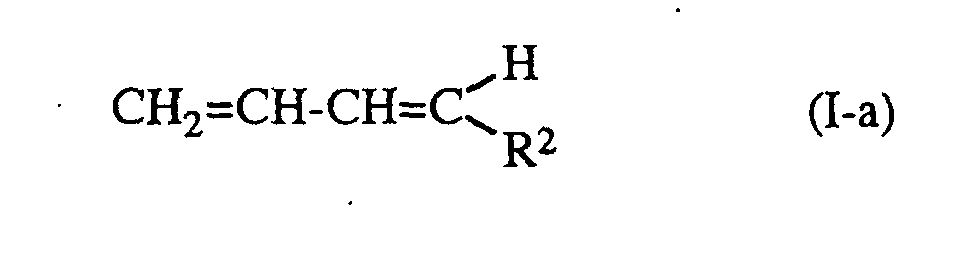 (a) dans ledit copolymère, les motifs d'addition en 1-2 (y compris les motifs d'addition en 3-4) provenant du monomère diène conjugué (I-a) forment des doubles liaisons dans la chaíne latérale du copolymère, les motifs d'addition en 1-4 provenant du monomère diène conjugué (I-a) forment des doubles liaisons dans la chaíne principale du copolymère, et le rapport en quantité des doubles liaisons de la chaíne latérale provenant des motifs d'addition en 1-2 aux doubles liaisons de la chaíne principale provenant des motifs d'addition en 1-4 (doubles liaisons de la chaíne latérale provenant des motifs d'addition en 1-2/doubles liaisons de la chaíne principale provenant des motifs d'addition en 1-4) est compris dans l'intervalle allant de 10/90 à 99/1,(b) des cycles à 5 chaínons sont présents dans la chaíne principale dudit copolymère, et(c) le rapport en quantité des doubles liaisons provenant de tous les motifs d'addition aux cycles à cinq chaínons (total des double liaisons provenant de tous les motifs d'addition/cycles à cinq chaínons) est compris dans l'intervalle allant de 20/80 à 90/10.
 - Copolymère selon la revendication 1, dont le monomère diène conjugué est le 1,3-butadiène.
- Copolymère selon la revendication 1 ou 2, dont l'α-oléfine est l'éthylène ou une combinaison d'éthylène et d'une α-oléfine ayant 3 à 12 atomes de carbone, dans laquelle le rapport molaire de l'éthylène à l'α-oléfine ayant 3 à 12 atomes de carbone est de 99/1 à 40/60.
- Copolymère selon l'une quelconque des revendications 1 à 3, dans lequel les motifs constitutifs provenant du monomère diène conjugué sont présents en une proportion totale de 0,01 à 30 % en moles.
- Copolymère selon l'une quelconque des revendications 1 à 4, qui a un indice d'iode de 1 à 50 g/100 g, une viscosité intrinsèque (η) mesurée dans la décaline à 135 °C, de 0,01 à 10 dl/g, et une température de transition vitreuse Tg, mesurée par analyse calorimétrique différentielle ACD, qui ne dépasse pas 25 °C.
- Copolymère insaturé modifié que l'on peut obtenir en modifiant par greffage un copolymère insaturé tel que défini dans l'une quelconque des revendications 1 à 5, avec au moins un composé choisi parmi (i) les acides carboxyliques insaturés et leurs dérivés, et (ii) les composés vinyliques aromatiques, le taux de greffage de l'acide carboxylique insaturé ou de son dérivé étant de 0,01 à 30 % en poids.
- Composition élastomère contenant un copolymère insaturé, qui comprend :(a) un copolymère tel que défini dans l'une quelconque des revendications 1 à 5, et(b)un agent de réticulation et/ou une charge.
- Procédé de préparation d'un copolymère insaturé tel que défini dans la revendication 1, qui comprend la copolymérisation d'une α-oléfine ayant 2 à 12 atomes de carbone et d'au moins un monomère diène conjugué de formule (I-a) en présence d'un catalyseur, procédé dans lequel on utilise comme catalyseur au moins un système catalytique comprenant le constituant (a) suivant et au moins un composé choisi parmi les constituants (b), (c) et (d) suivants :(a)un complexe de métal de transition représenté par la formule (II) ou (III) :
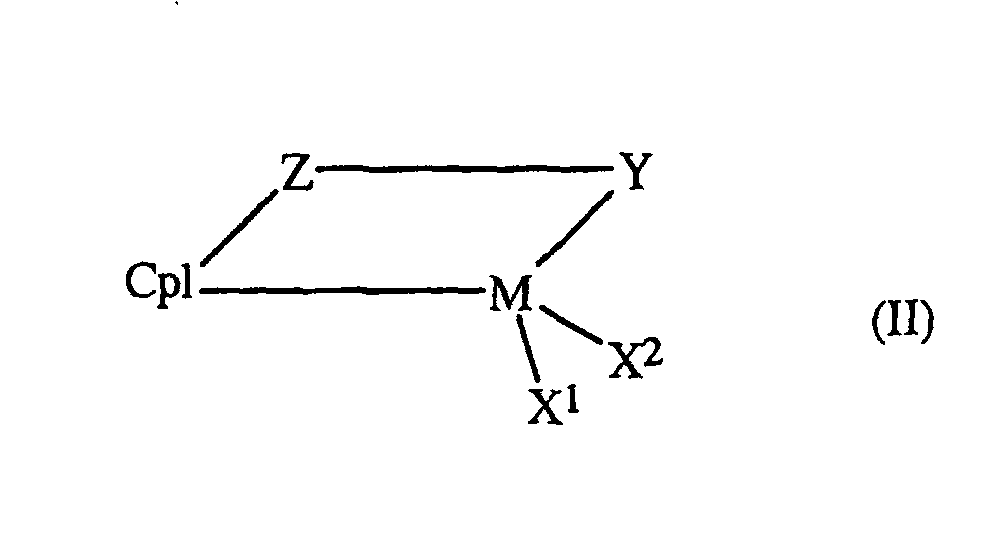 dans laquelle M représente Ti, Zr, Hf, Rn, Nd, Sm ou Ru, Cp1 et Cp2 représentent chacun indépendamment un groupe cyclopentadiényle, un groupe indényle, un groupe fluorényle ou l'un quelconque de leurs dérivés, qui est lié à M par des liaisons π, X1 et X2 représentent chacun indépendamment un ligand anionique ou un ligand neutre qui est une base de Lewis, Y représente un ligand contenant un atome d'azote, un atome d'oxygène, un atome de phosphore ou un atome de soufre, et Z représente C, O, B, S, Ge, Si, Sn ou un groupe contenant l'un quelconque de ces atomes,
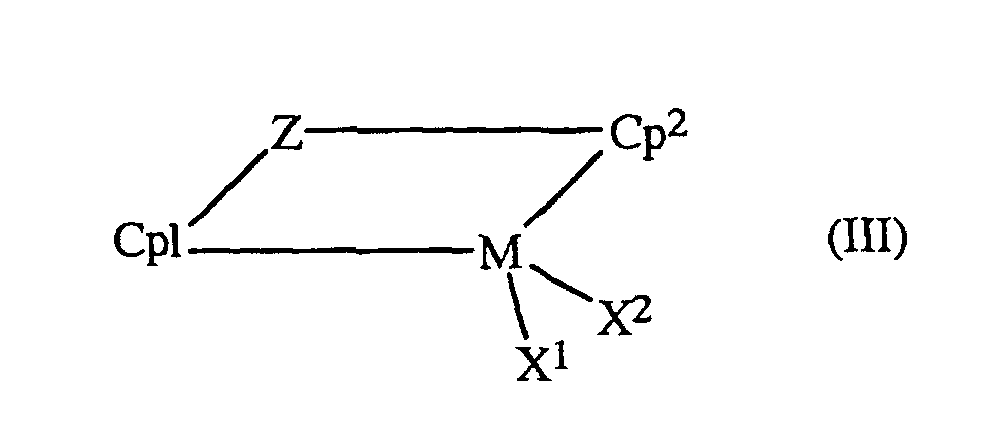 (b)un composé qui réagit avec le métal de transition M du constituant (a) pour former un complexe ionique,(c)un composé organoaluminium, et(d)un aluminoxane.
 - Copolymère insaturé d'une α-oléfine ayant 2 à 12 atomes de carbone et d'un monomère diène conjugué de formule (I-b) :dans laquelle R1 représente un groupe alkyle ayant 1 à 8 atomes de carbone ou un groupe aryle, ledit copolymère ayant les propriétés suivantes :
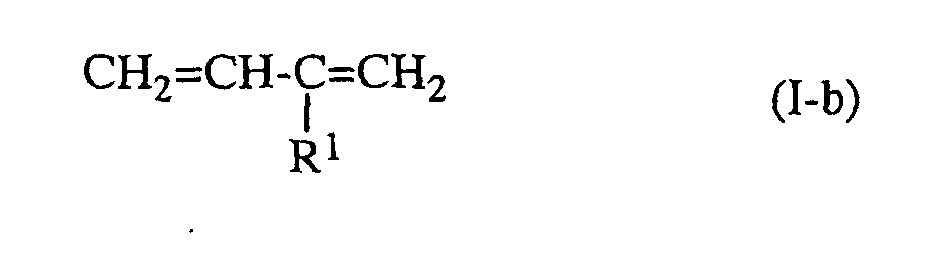 (a) dans ledit copolymère, les motifs d'addition en 1-2 (y compris les motifs d'addition en 3-4) issus du monomère diène conjugué (I-b) forment des doubles liaisons dans la chaíne latérale du copolymère, les motifs d'addition en 1-4 issus du monomère diène conjugué (I-b) forment des doubles liaisons dans la chaíne principale du copolymère, et le rapport en quantité des doubles liaisons de la chaíne latérale provenant des motifs d'addition en 1-2 aux doubles liaisons de la chaíne principale provenant des motifs d'addition en 1-4 (doubles liaisons de la chaíne latérale provenant des motifs d'addition en 1-2/doubles liaisons de la chaíne principale provenant des motifs d'addition en 1-4) est compris dans l'intervalle allant de 5/95 à 99/1.
 - Copolymère selon la revendication 9, qui présente en outre les propriétés suivantes :(b)des cycles à 5 chaínons sont présents dans la chaíne principale dudit copolymère, et(c)le rapport en quantité des doubles liaisons provenant de tous les motifs d'addition aux cycles à 5 chaínons (total des doubles liaisons provenant de tous les motifs d'addition/cycles à 5 chaínons) est compris dans l'intervalle allant de 20/80 à 90/10.
- Copolymère selon la revendication 9 ou 10, dont le monomère diène conjugué est l'isoprène.
- Copolymère selon l'une quelconque des revendications 9 à 11, dont l'α-oléfine est l'éthylène ou une combinaison d'éthylène et d'une α-oléfine ayant 3 à 12 atomes de carbone, dans laquelle le rapport molaire de l'éthylène à l'α-oléfine ayant 3 à 12 atomes de carbone est compris dans l'intervalle allant de 99/1 à 40/60.
- Copolymère selon l'une quelconque des revendications 9 à 12, dans lequel les motifs constitutifs provenant du monomère diène conjugué sont présents en une proportion totale de 0,01 à 30 % en moles.
- Copolymère selon l'une quelconque des revendications 9 à 13, qui a un indice d'iode de 1 à 50 g/100 g, une viscosité intrinsèque (η) mesurée dans la décaline à 135 °C, de 0,01 à 10 dl/g, et une température de transition vitreuse Tg, mesurée par ACD, qui ne dépasse pas 25 °C.
- Composition élastomère contenant un copolymère insaturé, qui comprend :(a) un copolymère tel que défini dans l'une quelconque des revendications 9 à 14, et(b)un agent de réticulation et/ou une charge.
- Procédé de préparation d'un copolymère insaturé tel que défini dans la revendication 9, qui comprend la copolymérisation d'une α-oléfine ayant 2 à 12 atomes de carbone et d'au moins un monomère diène conjugué de formule (I-b) en présence d'un catalyseur, procédé dans lequel on utilise comme catalyseur au moins un système catalytique comprenant le constituant (a) suivant et au moins un composé choisi parmi les constituants (b), (c) et (d) suivants :(a) un complexe de métal de transition représenté par la formule (II) ou (III) :
 dans laquelle M représente Ti, Zr, Hf, Rn, Nd, Sm ou Ru, Cp1 et Cp2 représentent chacun indépendamment un groupe cyclopentadiényle, un groupe indényle, un groupe fluorényle ou l'un quelconque de leurs dérivés, qui est lié à M par des liaisons π, X1 et X2 représentent chacun indépendamment un ligand anionique ou un ligand neutre qui est une base de Lewis, Y représente un ligand contenant un atome d'azote, un atome d'oxygène, un atome de phosphore ou un atome de soufre, et Z représente C, O, B, S, Ge, Si, Sn ou un groupe contenant l'un quelconque de ces atomes,
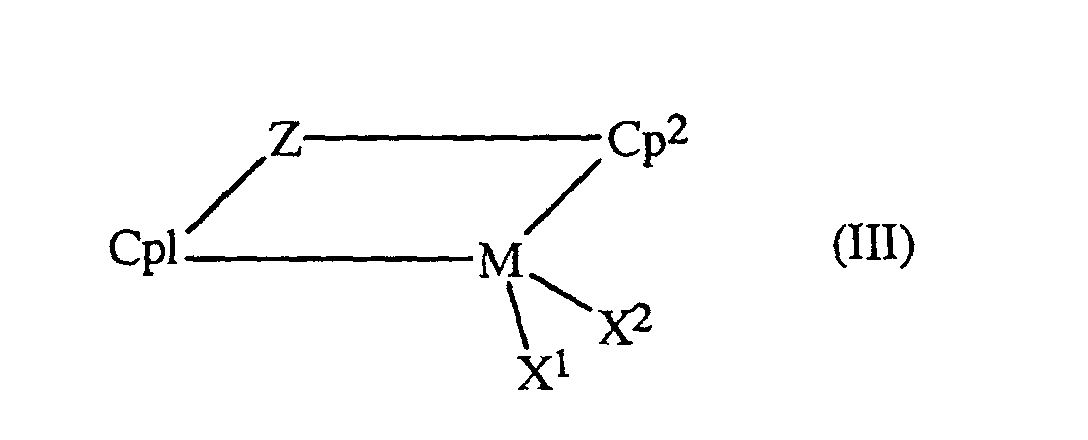 (b)un composé qui réagit avec le métal de transition M du constituant (a) pour former un complexe ionique,(c)un composé organoaluminium, et(d)un aluminoxane.
 - Copolymère statistique insaturé d'une α-oléfine ayant 2 à 12 atomes de carbone, d'un composé vinylique aromatique et d'un monomère diène conjugué.
- Copolymère insaturé qui est un copolymère d'une α-oléfine ayant 2 à 12 atomes de carbone, d'un composé vinylique aromatique et d'un monomère diène conjugué de formule (I)dans laquelle R1 et R2 représentent chacun indépendamment un atome d'hydrogène, un groupe alkyle ayant 1 à 8 atomes de carbone ou un groupe aryle, au moins l'un de R1 et R2 étant un atome d'hydrogène, ledit copolymère ayant les propriétés suivantes :
 (a) dans ledit copolymère, les motifs d'addition en1-2 (y compris les motifs d'addition en 3-4) issus du monomère diène conjugué (I) forment des doubles liaisons dans la chaíne latérale du copolymère, les motifs d'addition en 1-4 issus du monomère diène conjugué (I) forment des doubles liaisons dont la chaíne principale du copolymère, et le rapport en quantité des doubles liaisons de la chaíne latérale provenant des motifs d'addition en 1-2 aux doubles liaisons de la chaíne principale provenant des motifs d'addition en 1-4 (doubles liaisons de la chaíne latérale provenant des motifs d'addition en 1-2/doubles liaisons de la chaíne principale provenant des motifs d'addition en 1-4) est compris dans l'intervalle allant de 10/90 à 99/1.
 - Copolymère selon la revendication 18, qui présente en outre les propriétés suivantes :(b)des cycles à cinq chaínons sont présents dans la chaíne principale dudit copolymère,(c)le rapport en quantité des doubles liaisons provenant de tous les motifs d'addition aux cycles à cinq chaínons (total des doubles liaisons provenant de tous les motifs d'addition/cycles à cinq chaínons) est compris dans l'intervalle allant de 20/80 à 90/10, et(d)les motifs constitutifs provenant du composé vinylique aromatique sont présents en une proportion de 0,1 à 60 % en moles.
- Copolymère selon l'une quelconque des revendications 17 à 19, dans lequel les motifs constitutifs provenant du monomère diène conjugué sont présents en une proportion totale de 0,01 à 30 % en moles.
- Copolymère selon l'une quelconque des revendications 17 à 20, dont le monomère diène conjugué est le 1,3-butadiène.
- Copolymère selon l'une quelconque des revendications 17 à 20, dont le monomère diène conjugué est l'isoprène.
- Copolymère selon l'une quelconque des revendications 17 à 22, dont l'α-oléfine est l'éthylène ou une combinaison d'éthylène et d'une α-oléfine ayant 3 à 12 atomes de carbone, dans laquelle le rapport molaire de l'éthylène à l'α-oléfine ayant 3 à 12 atomes de carbone est de 99/1 à 40/60.
- Copolymère selon l'une quelconque des revendications 17 à 23, dont le composé vinylique aromatique est le styrène.
- Copolymère selon l'une quelconque des revendications 17 à 24, qui a un indice d'iode de 1 à 50 g/100 g, une viscosité intrinsèque (η), mesurée dans la décaline à 135 °C, de 0,01 à 10 dl/g, et une température de transition vitreuse Tg, mesurée par ACD, qui ne dépasse pas 25 °C.
- Copolymère selon l'une quelconque des revendications 17 à 25, dont le pic de point de fusion (Tf), déterminé par ACD, n'est pas supérieur à 120 °C.
- Copolymère modifié que l'on peut obtenir en modifiant par greffage le copolymère insaturé tel que défini dans l'une quelconque des revendications 17 à 26, avec au moins un composé choisi parmi (i) les acides carboxyliques insaturés et leurs dérivés et (ii) les composés vinyliques aromatiques, le taux de greffage étant compris dans l'intervalle allant de 0,01 à 30 % en poids.
- Composition élastomère contenant un copolymère insaturé, qui comprend :(a)un copolymère insaturé tel que défini dans l'une quelconque des revendications 17 à 26, et(b)un agent de réticulation et/ou une charge.
- Procédé de préparation d'un copolymère insaturé tel que défini dans la revendication 18, qui comprend la copolymérisation d'une α-oléfine ayant 2 à 12 atomes de carbone, d'un composé vinylique aromatique et d'au moins un monomère diène conjugué de formule (I) en présence d'un catalyseur, procédé dans lequel on utilise comme catalyseur au moins un système catalytique comprenant le constituant (a) suivant et au moins un composé choisi parmi les constituants (b), (c) et (d) suivants :(a) un complexe de métal de transition représenté par la formule (II) ou (III) :
 dans laquelle M représente Ti, Zr, Hf, Rn, Nd, Sm ou Ru, Cp1 et Cp2 représentent chacun indépendamment un groupe cyclopentadiényle, un groupe indényle, un groupe fluorényle ou l'un quelconque de leurs dérivés, qui est lié à M par des liaisons π, X1 et X2 représentent chacun indépendamment un ligand anionique ou un ligand neutre qui est une base de Lewis, Y représente un ligand contenant un atome d'azote, un atome d'oxygène, un atome de phosphore ou un atome de soufre, et Z représente C, O, B, S, Ge, Si, Sn ou un groupe contenant l'un quelconque de ces atomes,
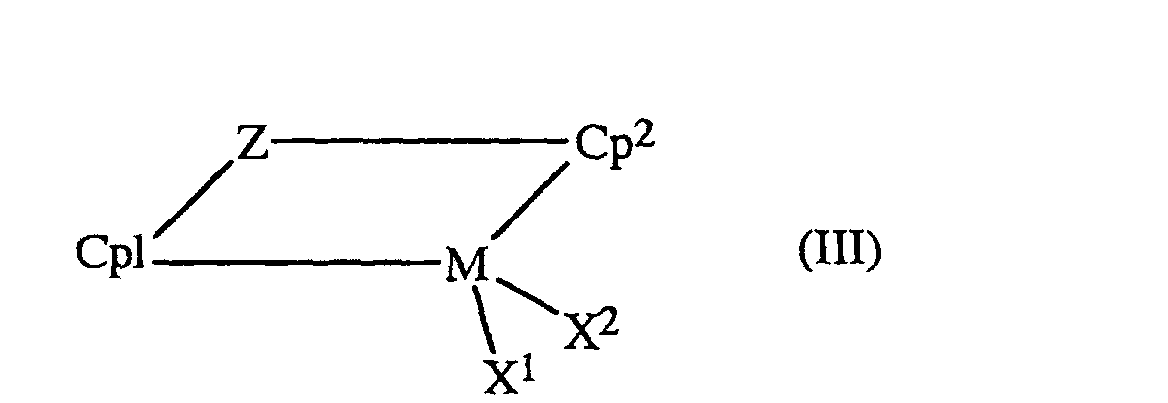 (b)un composé qui réagit avec le métal de transition M du constituant (a) pour former un complexe ionique,(c)un composé organoaluminium, et(d)un aluminoxane.
 - Produit réticulé que l'on peut obtenir en réticulant une composition telle que définie dans l'une quelconque des revendications 7, 15 et 28.
- Produit selon la revendication 30, pour lequel la composition est réticulée au moyen d'un agent de réticulation du type peroxyde organique.
- Film ou feuille comprenant le produit réticulé tel que défini dans la revendication 30 ou 31.
Applications Claiming Priority (9)
| Application Number | Priority Date | Filing Date | Title |
|---|---|---|---|
| JP194664/97 | 1997-07-18 | ||
| JP19466497 | 1997-07-18 | ||
| JP194663/97 | 1997-07-18 | ||
| JP19466397 | 1997-07-18 | ||
| JP19466597 | 1997-07-18 | ||
| JP19466497 | 1997-07-18 | ||
| JP19466597 | 1997-07-18 | ||
| JP19466397 | 1997-07-18 | ||
| JP194665/97 | 1997-07-18 |
Publications (2)
| Publication Number | Publication Date |
|---|---|
| EP0891993A1 EP0891993A1 (fr) | 1999-01-20 |
| EP0891993B1 true EP0891993B1 (fr) | 2003-05-02 |
Family
ID=27326974
Family Applications (1)
| Application Number | Title | Priority Date | Filing Date |
|---|---|---|---|
| EP98305662A Expired - Lifetime EP0891993B1 (fr) | 1997-07-18 | 1998-07-16 | Copolymères insaturés, procédés de fabrication et compositions les contenant |
Country Status (6)
| Country | Link |
|---|---|
| US (1) | US6310164B1 (fr) |
| EP (1) | EP0891993B1 (fr) |
| KR (1) | KR100307037B1 (fr) |
| CN (1) | CN1155629C (fr) |
| DE (1) | DE69813958T2 (fr) |
| SG (1) | SG71134A1 (fr) |
Cited By (1)
| Publication number | Priority date | Publication date | Assignee | Title |
|---|---|---|---|---|
| US11236185B2 (en) | 2017-11-16 | 2022-02-01 | Bridgestone Corporation | Copolymer, production method for copolymer, rubber composition, and tire |
Families Citing this family (65)
| Publication number | Priority date | Publication date | Assignee | Title |
|---|---|---|---|---|
| TW442507B (en) * | 1997-10-24 | 2001-06-23 | Idemitsu Petrochemical Co | Ethylene copolymer and aromatic vinyl graft copolymer and method for producing the same |
| EP1030882A2 (fr) | 1997-11-13 | 2000-08-30 | H.B. Fuller Licensing & Financing, Inc. | Compositions durcissables par rayonnement contenant des polyolefines metallocenes |
| WO2000052062A1 (fr) * | 1999-03-04 | 2000-09-08 | Riken | Composition de catalyseur |
| DE19922020A1 (de) * | 1999-05-12 | 2000-11-16 | Targor Gmbh | Übergangsmetallverbindung, Katalysatorsystem, Verfahren zu seiner Herstellung und seine Verwendung zur Polymerisation von Olefinen |
| EP1183286A1 (fr) * | 1999-05-14 | 2002-03-06 | Dupont Dow Elastomers L.L.C. | Interpolymeres eaodm hautement cristallins |
| US8182457B2 (en) | 2000-05-15 | 2012-05-22 | Kimberly-Clark Worldwide, Inc. | Garment having an apparent elastic band |
| JP3260349B2 (ja) * | 2000-06-05 | 2002-02-25 | 松下電器産業株式会社 | 電気化学素子用封止剤およびそれを用いた電気化学素子 |
| DE10296586T5 (de) * | 2001-03-29 | 2004-04-22 | Idemitsu Petrochemical Co., Ltd. | Verbundharz auf Polyolefin-Basis, Verfahren zu seiner Herstellung, Katalysator für die Polymerisation von Vinylverbindungen und Verfahren zur Polymerisation von Vinylverbindungen unter Verwendung desselben |
| ITSA20010016A1 (it) * | 2001-06-05 | 2001-09-05 | Univ Degli Studi Salerno | Copolimeri a base di etilene contenenti anelli ciclopropanici nella catena principale. |
| JP4409121B2 (ja) * | 2001-07-11 | 2010-02-03 | 株式会社ジーシー | マウスガード用組成物 |
| EP1449869A4 (fr) * | 2001-11-29 | 2005-01-19 | Toray Industries | Feuille expansee continue en resine biodegradable reticulee et procede de fabrication |
| US6939334B2 (en) | 2001-12-19 | 2005-09-06 | Kimberly-Clark Worldwide, Inc. | Three dimensional profiling of an elastic hot melt pressure sensitive adhesive to provide areas of differential tension |
| US6902796B2 (en) | 2001-12-28 | 2005-06-07 | Kimberly-Clark Worldwide, Inc. | Elastic strand bonded laminate |
| US7335273B2 (en) | 2002-12-26 | 2008-02-26 | Kimberly-Clark Worldwide, Inc. | Method of making strand-reinforced elastomeric composites |
| US7316842B2 (en) | 2002-07-02 | 2008-01-08 | Kimberly-Clark Worldwide, Inc. | High-viscosity elastomeric adhesive composition |
| US6978486B2 (en) | 2002-07-02 | 2005-12-27 | Kimberly-Clark Worldwide, Inc. | Garment including an elastomeric composite laminate |
| US7316840B2 (en) | 2002-07-02 | 2008-01-08 | Kimberly-Clark Worldwide, Inc. | Strand-reinforced composite material |
| US7015155B2 (en) * | 2002-07-02 | 2006-03-21 | Kimberly-Clark Worldwide, Inc. | Elastomeric adhesive |
| JP4728643B2 (ja) * | 2002-10-02 | 2011-07-20 | ダウ グローバル テクノロジーズ エルエルシー | 液状およびゲル状の低分子量エチレンポリマー類 |
| WO2004044018A2 (fr) * | 2002-11-07 | 2004-05-27 | Dow Global Technologies, Inc. | Procede d'homopolymerisation ou de copolymerisation de dienes conjugues et de formation in situ de melanges polymeres et produits ainsi formes |
| FR2858817B1 (fr) * | 2003-08-13 | 2006-02-03 | Michelin Soc Tech | Systeme catalytique pour l'obtention de copolymeres diene(s) conjugue(s)/ mono-olefine(s) et ces copolymeres |
| EP2261283A3 (fr) * | 2003-11-28 | 2012-03-21 | Sumitomo Rubber Industries, Ltd. | Composition de caoutchouc pour pneu et pneu utilisant celle-ci |
| US7601657B2 (en) | 2003-12-31 | 2009-10-13 | Kimberly-Clark Worldwide, Inc. | Single sided stretch bonded laminates, and methods of making same |
| US7183343B2 (en) * | 2004-02-23 | 2007-02-27 | Polyone Coproration | Thermoplastic vulcanizate with improved surface properties |
| US7378476B2 (en) * | 2004-06-25 | 2008-05-27 | Ineos Usa Llc | Olefin polymerization process in the presence of a radical generating system |
| US20050287339A1 (en) * | 2004-06-25 | 2005-12-29 | Schlegel Corporation | Weatherseal having surface roughness forming particles of a polar material in a resin matrix having a maleated polyolefin |
| US7364672B2 (en) * | 2004-12-06 | 2008-04-29 | Arlon, Inc. | Low loss prepregs, compositions useful for the preparation thereof and uses therefor |
| EP1777240A1 (fr) * | 2005-10-24 | 2007-04-25 | Total Petrochemicals Research Feluy | procédés de préparation de copolymère styrène-isoprène et de copolymère styrène-isoprène-ethylène |
| JP5552232B2 (ja) | 2005-12-06 | 2014-07-16 | エクソンモービル・ケミカル・パテンツ・インク | エチレンエラストマー組成物 |
| DE102006014235A1 (de) * | 2006-03-28 | 2007-10-04 | Brugg Rohr Ag, Holding | Mantel für wärmeisolierte Leitungsrohre |
| US20080009211A1 (en) * | 2006-07-07 | 2008-01-10 | Matthew Raymond Himes | Assemblies useful for the preparation of electronic components and methods for making same |
| US7592384B2 (en) * | 2006-12-29 | 2009-09-22 | Shaun Fox | Elatomeric composition containing multiple silane coupling agents |
| JP2008255341A (ja) * | 2007-03-09 | 2008-10-23 | Nippon Zeon Co Ltd | 環状オレフィン付加重合体の製造方法、環状オレフィン付加重合用触媒、および遷移金属化合物 |
| US7714089B2 (en) * | 2007-12-13 | 2010-05-11 | The Goodyear Tire & Rubber Company | Functionalized monomers and functionalized rubbery polymers made therewith |
| JP5557835B2 (ja) * | 2009-03-30 | 2014-07-23 | 三井化学株式会社 | オレフィンと共役ジエンとの共重合体、およびその製造方法 |
| US8637616B2 (en) | 2010-10-07 | 2014-01-28 | Chevron Philips Chemical Company Lp | Bridged metallocene catalyst systems with switchable hydrogen and comonomer effects |
| US8609793B2 (en) | 2010-10-07 | 2013-12-17 | Chevron Phillips Chemical Company Lp | Catalyst systems containing a bridged metallocene |
| US8629292B2 (en) | 2010-10-07 | 2014-01-14 | Chevron Phillips Chemical Company Lp | Stereoselective synthesis of bridged metallocene complexes |
| CN106232646B (zh) * | 2014-04-18 | 2018-11-20 | 日本A&L株式会社 | 接枝共聚物以及热塑性树脂组合物 |
| CN106459311B (zh) * | 2014-06-12 | 2019-07-05 | 株式会社普利司通 | 多元共聚物的制备方法 |
| WO2016099236A1 (fr) * | 2014-12-17 | 2016-06-23 | Centro De Investigación En Química Aplicada | Hétérogénéisation d'aluminohydrures de zirconocènes sur des supports organiques pour la polymérisation d'éthylène |
| US9796795B2 (en) | 2015-01-14 | 2017-10-24 | Exxonmobil Chemical Patents Inc. | Tetrahydroindacenyl catalyst composition, catalyst system, and processes for use thereof |
| WO2016171807A1 (fr) | 2015-04-20 | 2016-10-27 | Exxonmobil Chemical Patents Inc. | Composition catalyseur comprenant un support fluoré et ses procédés d'utilisation |
| CN114685703A (zh) | 2015-04-20 | 2022-07-01 | 埃克森美孚化学专利公司 | 包含氟化物化的载体的催化剂组合物及其使用方法 |
| JP6602151B2 (ja) | 2015-10-16 | 2019-11-06 | 株式会社ブリヂストン | 多元共重合体、ゴム組成物、架橋ゴム組成物、及びゴム物品 |
| JP7255070B2 (ja) * | 2015-10-16 | 2023-04-11 | 株式会社ブリヂストン | 多元共重合体、ゴム組成物、架橋ゴム組成物、ゴム製品、及びタイヤ |
| EP3363824B1 (fr) * | 2015-10-16 | 2024-05-01 | Bridgestone Corporation | Copolymère à composants multiples, composition de caoutchouc, composition de caoutchouc réticulé, produit en caoutchouc et pneu |
| JP7097152B2 (ja) * | 2015-10-16 | 2022-07-07 | 株式会社ブリヂストン | 多元共重合体、ゴム組成物、架橋ゴム組成物及びゴム物品 |
| WO2017065298A1 (fr) | 2015-10-16 | 2017-04-20 | 株式会社ブリヂストン | Copolymère à plusieurs constituants, composition de caoutchouc, composition de caoutchouc réticulée, produit en caoutchouc et pneu |
| CN108137758B (zh) | 2015-10-16 | 2020-10-23 | 株式会社普利司通 | 多元共聚物、橡胶组合物、交联橡胶组合物和橡胶制品 |
| US9803037B1 (en) | 2016-05-03 | 2017-10-31 | Exxonmobil Chemical Patents Inc. | Tetrahydro-as-indacenyl catalyst composition, catalyst system, and processes for use thereof |
| WO2018092733A1 (fr) | 2016-11-21 | 2018-05-24 | 株式会社ブリヂストン | Copolymère multicomposant, composition de caoutchouc, composition de caoutchouc réticulée et produit en caoutchouc |
| FR3063732A1 (fr) * | 2017-03-08 | 2018-09-14 | Compagnie Generale Des Etablissements Michelin | Pneumatique muni d'une composition comprenant un elastomere riche en ethylene, un peroxyde et un derive d'acrylate polyfonctionnel |
| FR3063731A1 (fr) | 2017-03-08 | 2018-09-14 | Compagnie Generale Des Etablissements Michelin | Pneumatique muni d'une composition comprenant un elastomere riche en ethylene, un peroxyde et un acrylate de zinc |
| CN110520449B (zh) * | 2017-04-18 | 2021-09-21 | 株式会社普利司通 | 多元共聚物的制造方法、多元共聚物、橡胶组合物和轮胎 |
| EP3613777B1 (fr) * | 2017-04-18 | 2021-11-10 | Bridgestone Corporation | Procédé de production d'un multi-copolymère, multi-copolymère, composition de caoutchouc et pneumatique |
| CN111247177A (zh) * | 2017-10-20 | 2020-06-05 | 株式会社普利司通 | 多元共聚物、橡胶组合物、交联橡胶组合物、橡胶制品和轮胎 |
| US10703838B2 (en) | 2017-10-31 | 2020-07-07 | Exxonmobil Chemical Patents Inc. | Mixed catalyst systems with four metallocenes on a single support |
| FR3085167B1 (fr) | 2018-08-23 | 2020-07-31 | Michelin & Cie | Pneumatique muni d'une composition comprenant un elastomere riche en ethylene, un peroxyde et un derive d'acrylate specifique |
| FR3085166B1 (fr) | 2018-08-23 | 2020-07-17 | Compagnie Generale Des Etablissements Michelin | Pneumatique muni d'une composition comprenant un elastomere riche en ethylene, un peroxyde et un derive d'acrylate specifique |
| FR3085165B1 (fr) | 2018-08-23 | 2020-07-17 | Compagnie Generale Des Etablissements Michelin | Pneumatique muni d'une composition comprenant un elastomere riche en ethylene, un peroxyde et un derive d'acrylate specifique |
| CN110508033B (zh) * | 2019-08-06 | 2021-04-13 | 合肥宸为新材料科技有限公司 | 一种高分子吸收剂及其制备方法 |
| FR3118046B1 (fr) * | 2020-12-23 | 2022-12-30 | Michelin & Cie | Composition de caoutchouc comprenant un élastomère diénique fortement saturé |
| CN112794964B (zh) * | 2021-01-19 | 2021-07-30 | 天津大学 | 一种丙烯-共轭二烯共聚物及其制备方法 |
| CN119912733A (zh) * | 2025-01-13 | 2025-05-02 | 浙江金果实业有限公司 | 一种高性能注射器橡胶护帽及其制备方法 |
Family Cites Families (13)
| Publication number | Priority date | Publication date | Assignee | Title |
|---|---|---|---|---|
| NL105278C (fr) * | 1956-07-11 | 1900-01-01 | ||
| US3948868A (en) * | 1969-04-03 | 1976-04-06 | Exxon Research And Engineering Company | Homogeneous styrene/isoolefin copolymers |
| US3931127A (en) * | 1973-11-19 | 1976-01-06 | The Firestone Tire & Rubber Company | Cyclized copolymer from a conjugated diene and an alpha olefin, and the production thereof |
| DE2943129A1 (de) * | 1979-10-25 | 1981-05-07 | Bayer Ag, 5090 Leverkusen | Alternierende isopren-ethylen-copolymere sowie ein verfahren zu ihrer herstellung |
| JPS61123664A (ja) | 1984-07-25 | 1986-06-11 | Mitsui Petrochem Ind Ltd | 水性分散体およびその製法 |
| US5191052A (en) | 1985-06-21 | 1993-03-02 | Exxon Chemical Patents Inc. | Copolymers of ethylene and 1,3-butadiene |
| IN172494B (fr) * | 1986-12-19 | 1993-09-04 | Exxon Chemical Patents Inc | |
| FR2608776A1 (fr) * | 1986-12-23 | 1988-06-24 | Thomson Csf | Magnetometre triaxial homocentrique |
| JP2693517B2 (ja) | 1988-09-14 | 1997-12-24 | 三井石油化学工業株式会社 | ベンゼン不溶性の有機アルミニウムオキシ化合物の製造方法 |
| US5260394A (en) * | 1989-03-20 | 1993-11-09 | Idemitsu Kosan Co., Ltd. | Styrene copolymer and process for production thereof |
| EP0737694B1 (fr) * | 1993-12-28 | 2001-06-06 | Idemitsu Kosan Company Limited | Procede de production de polymere d'olefine et de polymere d'ethylene |
| IT1270253B (it) * | 1994-06-20 | 1997-04-29 | Spherilene Srl | Copolimeri dell'etilene e procedimento per la preparazione di polimeri dell'etilene |
| SG71754A1 (en) * | 1997-02-13 | 2000-04-18 | Sumitomo Chemical Co | Copolymer and copolymer composition |
-
1998
- 1998-07-16 EP EP98305662A patent/EP0891993B1/fr not_active Expired - Lifetime
- 1998-07-16 DE DE69813958T patent/DE69813958T2/de not_active Expired - Lifetime
- 1998-07-17 SG SG1998001817A patent/SG71134A1/en unknown
- 1998-07-18 KR KR1019980028990A patent/KR100307037B1/ko not_active Expired - Lifetime
- 1998-07-20 CN CNB981161847A patent/CN1155629C/zh not_active Expired - Lifetime
- 1998-07-20 US US09/118,901 patent/US6310164B1/en not_active Expired - Lifetime
Cited By (2)
| Publication number | Priority date | Publication date | Assignee | Title |
|---|---|---|---|---|
| US11236185B2 (en) | 2017-11-16 | 2022-02-01 | Bridgestone Corporation | Copolymer, production method for copolymer, rubber composition, and tire |
| EP3712183A4 (fr) * | 2017-11-16 | 2022-02-09 | Bridgestone Corporation | Copolymère, procédé de production d'un copolymère, composition de caoutchouc et pneumatique |
Also Published As
| Publication number | Publication date |
|---|---|
| SG71134A1 (en) | 2000-03-21 |
| DE69813958T2 (de) | 2004-03-11 |
| KR19990013979A (ko) | 1999-02-25 |
| DE69813958D1 (de) | 2003-06-05 |
| CN1206017A (zh) | 1999-01-27 |
| KR100307037B1 (ko) | 2001-12-05 |
| US6310164B1 (en) | 2001-10-30 |
| CN1155629C (zh) | 2004-06-30 |
| EP0891993A1 (fr) | 1999-01-20 |
Similar Documents
| Publication | Publication Date | Title |
|---|---|---|
| EP0891993B1 (fr) | Copolymères insaturés, procédés de fabrication et compositions les contenant | |
| JPH1180269A (ja) | 不飽和性共重合体、その製造方法および該共重合体系組成物 | |
| CN102203146B (zh) | 共聚物、橡胶组合物、交联橡胶、交联发泡体以及它们的用途 | |
| KR100385786B1 (ko) | 불포화성 올레핀계 공중합체, 그 제조방법 및 용도 | |
| JP3483176B2 (ja) | エチレン・α−オレフィン・非共役ポリエンランダム共重合体および該共重合体の用途 | |
| KR100632822B1 (ko) | 에틸렌계 공중합체 고무, 그 제조방법 및 용도 | |
| KR100323116B1 (ko) | 불포화엘라스토머조성물및그의가황고무 | |
| JP4213351B2 (ja) | エチレン・α−オレフィン・非共役ポリエン共重合体ゴム、シール用ゴム組成物、シール用ゴム成形体及び該成形体の製造方法 | |
| JPWO2000059962A1 (ja) | エチレン・α−オレフィン・非共役ポリエン共重合体ゴム、シール用ゴム組成物、シール用ゴム成形体及び該成形体の製造方法 | |
| JPH11228743A (ja) | 不飽和性エラストマー組成物およびその加硫ゴム | |
| JPH0971616A (ja) | エチレン系共重合体ゴム、該共重合体ゴムが含まれた加硫可能なゴム組成物並びに該ゴムの製造方法 | |
| EP0893245A1 (fr) | Moulage vulcanise a revetement decoratif, composition de resine thermoplastique peinte et composition elastomere peinte | |
| JP3388075B2 (ja) | エチレン・α−オレフィン・非共役ポリエンランダム共重合体、ゴム組成物およびその製造方法 | |
| JP2003268043A (ja) | エチレン・α−オレフィン・非共役ポリエンランダム共重合体およびその用途 | |
| JPH1135634A (ja) | 不飽和性共重合体およびその製造方法ならびに変性共重合体および不飽和性共重合体組成物 | |
| JP3486005B2 (ja) | 加硫可能なゴム組成物 | |
| JP3640116B2 (ja) | 不飽和性オレフィン系共重合体、製造方法および用途 | |
| KR100299078B1 (ko) | 불포화 공중합체, 이 공중합체의 제조방법 및 이공중합체를 함유한 조성물 | |
| JPH10204228A (ja) | エチレン系共重合体ゴム組成物 | |
| JP3465404B2 (ja) | 熱空気架橋用エチレン系共重合ゴム組成物 | |
| JPH09183817A (ja) | エチレン系共重合体、その製造方法およびその組成物 | |
| JP3876466B2 (ja) | ウェザーストリップ用ゴム組成物 | |
| JP3918384B2 (ja) | エチレン系共重合体ゴム、その製造方法および加硫可能なゴム組成物 | |
| JP3611388B2 (ja) | 不飽和性高級α−オレフィン系共重合体およびその製造方法 | |
| JP3578431B2 (ja) | 不飽和性オレフィン系共重合体およびその製造方法 |
Legal Events
| Date | Code | Title | Description |
|---|---|---|---|
| PUAI | Public reference made under article 153(3) epc to a published international application that has entered the european phase |
Free format text: ORIGINAL CODE: 0009012 |
|
| AK | Designated contracting states |
Kind code of ref document: A1 Designated state(s): DE FR GB IT NL |
|
| AX | Request for extension of the european patent |
Free format text: AL;LT;LV;MK;RO;SI |
|
| 17P | Request for examination filed |
Effective date: 19990305 |
|
| AKX | Designation fees paid |
Free format text: DE FR GB IT NL |
|
| 17Q | First examination report despatched |
Effective date: 20020219 |
|
| GRAH | Despatch of communication of intention to grant a patent |
Free format text: ORIGINAL CODE: EPIDOS IGRA |
|
| GRAH | Despatch of communication of intention to grant a patent |
Free format text: ORIGINAL CODE: EPIDOS IGRA |
|
| GRAA | (expected) grant |
Free format text: ORIGINAL CODE: 0009210 |
|
| AK | Designated contracting states |
Designated state(s): DE FR GB IT NL |
|
| PG25 | Lapsed in a contracting state [announced via postgrant information from national office to epo] |
Ref country code: NL Free format text: LAPSE BECAUSE OF FAILURE TO SUBMIT A TRANSLATION OF THE DESCRIPTION OR TO PAY THE FEE WITHIN THE PRESCRIBED TIME-LIMIT Effective date: 20030502 Ref country code: IT Free format text: LAPSE BECAUSE OF FAILURE TO SUBMIT A TRANSLATION OF THE DESCRIPTION OR TO PAY THE FEE WITHIN THE PRE;WARNING: LAPSES OF ITALIAN PATENTS WITH EFFECTIVE DATE BEFORE 2007 MAY HAVE OCCURRED AT ANY TIME BEFORE 2007. THE CORRECT EFFECTIVE DATE MAY BE DIFFERENT FROM THE ONE RECORDED.SCRIBED TIME-LIMIT Effective date: 20030502 |
|
| REG | Reference to a national code |
Ref country code: GB Ref legal event code: FG4D |
|
| REF | Corresponds to: |
Ref document number: 69813958 Country of ref document: DE Date of ref document: 20030605 Kind code of ref document: P |
|
| PG25 | Lapsed in a contracting state [announced via postgrant information from national office to epo] |
Ref country code: GB Free format text: LAPSE BECAUSE OF NON-PAYMENT OF DUE FEES Effective date: 20030802 |
|
| NLV1 | Nl: lapsed or annulled due to failure to fulfill the requirements of art. 29p and 29m of the patents act | ||
| ET | Fr: translation filed | ||
| PLBE | No opposition filed within time limit |
Free format text: ORIGINAL CODE: 0009261 |
|
| STAA | Information on the status of an ep patent application or granted ep patent |
Free format text: STATUS: NO OPPOSITION FILED WITHIN TIME LIMIT |
|
| GBPC | Gb: european patent ceased through non-payment of renewal fee |
Effective date: 20030802 |
|
| 26N | No opposition filed |
Effective date: 20040203 |
|
| PGFP | Annual fee paid to national office [announced via postgrant information from national office to epo] |
Ref country code: FR Payment date: 20080718 Year of fee payment: 11 |
|
| REG | Reference to a national code |
Ref country code: FR Ref legal event code: ST Effective date: 20100331 |
|
| PG25 | Lapsed in a contracting state [announced via postgrant information from national office to epo] |
Ref country code: FR Free format text: LAPSE BECAUSE OF NON-PAYMENT OF DUE FEES Effective date: 20090731 |
|
| PGFP | Annual fee paid to national office [announced via postgrant information from national office to epo] |
Ref country code: DE Payment date: 20170724 Year of fee payment: 20 |
|
| REG | Reference to a national code |
Ref country code: DE Ref legal event code: R071 Ref document number: 69813958 Country of ref document: DE |