EP0892293B1 - Boítier pour communication optique - Google Patents
Boítier pour communication optique Download PDFInfo
- Publication number
- EP0892293B1 EP0892293B1 EP97112282A EP97112282A EP0892293B1 EP 0892293 B1 EP0892293 B1 EP 0892293B1 EP 97112282 A EP97112282 A EP 97112282A EP 97112282 A EP97112282 A EP 97112282A EP 0892293 B1 EP0892293 B1 EP 0892293B1
- Authority
- EP
- European Patent Office
- Prior art keywords
- light
- optical
- module
- guiding
- chamber
- Prior art date
- Legal status (The legal status is an assumption and is not a legal conclusion. Google has not performed a legal analysis and makes no representation as to the accuracy of the status listed.)
- Expired - Lifetime
Links
- 230000003287 optical effect Effects 0.000 title claims description 163
- 238000004891 communication Methods 0.000 title claims description 55
- 230000005540 biological transmission Effects 0.000 claims description 34
- 239000013307 optical fiber Substances 0.000 claims description 25
- 239000002184 metal Substances 0.000 claims description 5
- 229920005989 resin Polymers 0.000 claims description 5
- 239000011347 resin Substances 0.000 claims description 5
- 229910010293 ceramic material Inorganic materials 0.000 claims 1
- 238000003466 welding Methods 0.000 description 10
- 238000010276 construction Methods 0.000 description 5
- ORQBXQOJMQIAOY-UHFFFAOYSA-N nobelium Chemical compound [No] ORQBXQOJMQIAOY-UHFFFAOYSA-N 0.000 description 5
- 238000004519 manufacturing process Methods 0.000 description 4
- 230000000717 retained effect Effects 0.000 description 4
- 230000000694 effects Effects 0.000 description 3
- 239000011521 glass Substances 0.000 description 3
- 239000000463 material Substances 0.000 description 3
- -1 polyethylene Polymers 0.000 description 3
- 229920000122 acrylonitrile butadiene styrene Polymers 0.000 description 2
- 230000000052 comparative effect Effects 0.000 description 2
- 238000009826 distribution Methods 0.000 description 2
- 239000002360 explosive Substances 0.000 description 2
- 238000000034 method Methods 0.000 description 2
- 239000004417 polycarbonate Substances 0.000 description 2
- 229920005668 polycarbonate resin Polymers 0.000 description 2
- 239000004698 Polyethylene Substances 0.000 description 1
- 239000004743 Polypropylene Substances 0.000 description 1
- 230000002745 absorbent Effects 0.000 description 1
- 239000002250 absorbent Substances 0.000 description 1
- 239000011358 absorbing material Substances 0.000 description 1
- 238000004026 adhesive bonding Methods 0.000 description 1
- 239000000919 ceramic Substances 0.000 description 1
- 238000012937 correction Methods 0.000 description 1
- 238000002474 experimental method Methods 0.000 description 1
- 238000003780 insertion Methods 0.000 description 1
- 230000037431 insertion Effects 0.000 description 1
- 238000005259 measurement Methods 0.000 description 1
- 239000007769 metal material Substances 0.000 description 1
- 238000012544 monitoring process Methods 0.000 description 1
- 229920000573 polyethylene Polymers 0.000 description 1
- 229920001155 polypropylene Polymers 0.000 description 1
- 238000012545 processing Methods 0.000 description 1
- 238000005476 soldering Methods 0.000 description 1
Images



Classifications
-
- G—PHYSICS
- G02—OPTICS
- G02B—OPTICAL ELEMENTS, SYSTEMS OR APPARATUS
- G02B6/00—Light guides; Structural details of arrangements comprising light guides and other optical elements, e.g. couplings
- G02B6/24—Coupling light guides
- G02B6/26—Optical coupling means
- G02B6/28—Optical coupling means having data bus means, i.e. plural waveguides interconnected and providing an inherently bidirectional system by mixing and splitting signals
- G02B6/293—Optical coupling means having data bus means, i.e. plural waveguides interconnected and providing an inherently bidirectional system by mixing and splitting signals with wavelength selective means
- G02B6/29346—Optical coupling means having data bus means, i.e. plural waveguides interconnected and providing an inherently bidirectional system by mixing and splitting signals with wavelength selective means operating by wave or beam interference
- G02B6/29361—Interference filters, e.g. multilayer coatings, thin film filters, dichroic splitters or mirrors based on multilayers, WDM filters
-
- G—PHYSICS
- G02—OPTICS
- G02B—OPTICAL ELEMENTS, SYSTEMS OR APPARATUS
- G02B6/00—Light guides; Structural details of arrangements comprising light guides and other optical elements, e.g. couplings
- G02B6/24—Coupling light guides
- G02B6/26—Optical coupling means
- G02B6/28—Optical coupling means having data bus means, i.e. plural waveguides interconnected and providing an inherently bidirectional system by mixing and splitting signals
- G02B6/293—Optical coupling means having data bus means, i.e. plural waveguides interconnected and providing an inherently bidirectional system by mixing and splitting signals with wavelength selective means
- G02B6/29346—Optical coupling means having data bus means, i.e. plural waveguides interconnected and providing an inherently bidirectional system by mixing and splitting signals with wavelength selective means operating by wave or beam interference
- G02B6/29361—Interference filters, e.g. multilayer coatings, thin film filters, dichroic splitters or mirrors based on multilayers, WDM filters
- G02B6/2937—In line lens-filtering-lens devices, i.e. elements arranged along a line and mountable in a cylindrical package for compactness, e.g. 3- port device with GRIN lenses sandwiching a single filter operating at normal incidence in a tubular package
-
- G—PHYSICS
- G02—OPTICS
- G02B—OPTICAL ELEMENTS, SYSTEMS OR APPARATUS
- G02B6/00—Light guides; Structural details of arrangements comprising light guides and other optical elements, e.g. couplings
- G02B6/24—Coupling light guides
- G02B6/26—Optical coupling means
- G02B6/32—Optical coupling means having lens focusing means positioned between opposed fibre ends
-
- G—PHYSICS
- G02—OPTICS
- G02B—OPTICAL ELEMENTS, SYSTEMS OR APPARATUS
- G02B6/00—Light guides; Structural details of arrangements comprising light guides and other optical elements, e.g. couplings
- G02B6/24—Coupling light guides
- G02B6/42—Coupling light guides with opto-electronic elements
- G02B6/4201—Packages, e.g. shape, construction, internal or external details
- G02B6/4246—Bidirectionally operating package structures
-
- G—PHYSICS
- G02—OPTICS
- G02B—OPTICAL ELEMENTS, SYSTEMS OR APPARATUS
- G02B6/00—Light guides; Structural details of arrangements comprising light guides and other optical elements, e.g. couplings
- G02B6/24—Coupling light guides
- G02B6/42—Coupling light guides with opto-electronic elements
- G02B6/4201—Packages, e.g. shape, construction, internal or external details
- G02B6/4204—Packages, e.g. shape, construction, internal or external details the coupling comprising intermediate optical elements, e.g. lenses, holograms
- G02B6/4207—Packages, e.g. shape, construction, internal or external details the coupling comprising intermediate optical elements, e.g. lenses, holograms with optical elements reducing the sensitivity to optical feedback
- G02B6/4208—Packages, e.g. shape, construction, internal or external details the coupling comprising intermediate optical elements, e.g. lenses, holograms with optical elements reducing the sensitivity to optical feedback using non-reciprocal elements or birefringent plates, i.e. quasi-isolators
Definitions
- the present invention relates to a module for optical communication where optical elements for transmission and for reception to be used in both the direction communications or a module for optical communication provided with a optical receiving elements for monitor use.
- the module for both the direction communication use shown in FIG. 5 is arranged in the body 7 so that the optical element 1 for transmission use and the optical element 2 for reception can become orthogonal in their mutual optical axes.
- a beam splitter plate 3, as an allotment body for light signals in the crossing portion of the mutual optical axes, is included by 45° with respect to the mutual optical axes.
- a ferrule 6 having retained an optical fiber 5 is arranged in the optical axis direction of the optical element 1 for transmission.
- the transmission light 20 outputted from the optical element 1 for transmission use passes through a lens 4, and is partially reflected by the beam splitter plate 3 to transmit the remaining portion of it.
- the transmitted transmission light 20 is guided out by the optical fiber 5.
- the received light 21 introduced from the optical fiber 5 is partially transmitted by the beam splitter plate 3 and is reflected in its remaining portion.
- the received light 21 reflected becomes incident into the optical element 2 for reception, thus making it possible to communicate in both the directions.
- the beam splitter plate 3 a glass plate, reflects the light signal partially and is to conduct a distribution operation through transmission of the remaining portion.
- a distribution body of light signals is used a prism type splitter or a hologram.
- the module for both the direction communication shown in FIG. 5 has a problem in that the component, reflected by the beam splitter 3, of the transmission light 20 outputted from the optical element 1 for transmission becomes further stray lights 22 transmitting through the beam splitter 3 by the reflection by the inner wall face 7c of the body 7, and the stray lights 22 become incident into the optical element 2 for reception to make the crosstalk characteristics worse.
- the use of an light absorbent cavity is disclosed in documents EP 0 250 331, EP 0 197 842 and EP 0 197 841.
- an object of the invention is provided to prevent the stray lights from being caused by the reflection of the transmission light, in the module for both the direction optical communication, to improve the crosstalk characteristics.
- the light nonreturn chamber of the invention is a portion having a function of preventing the incident light being reflected in its opposite direction.
- the crosstalk characteristic is improved, because the reflection lights outputted from the optical element for transmission and reflected by the allotment body are absorbed, diffused by the light nonreturn chamber, and are further reflected into stray lights, thus preventing from being incident into the optical element for reception.
- the return lights from the light guiding-out side are prevented from becoming incident into the optical receiving element through the reflection by the allotment body.
- the invention relates to a module for optical communication or the like.
- the module for optical communication shown in FIG. 9 has a light guiding-in means 101 composed of a ferrule 101b provided with an optical fiber 101a, a light guiding-out means 105 composed of a ferrule 105b provided with a optical fiber 105a, and optical parts, 104 disposed between them, arranged linearly within a pipe 108, with the pipe 108 being provided within a through hole 106a of the body 106.
- the optical parts 104 include, for example, an isolator, a WDM filter, a beam splitter, a lens and so on.
- a light signal 131 introduced from the light guiding-in means 101 is passed through the optical parts 104, so as to guide out the signal from the light guiding-out means 105.
- the respective ferrules 101b, 105b, and the optical parts 104 are spliced with a pipe 108, with YAG welding or the like, by prior position alignment of them within a pipe 108. Then, the module for optical communication is constructed by the splicing operation of the whole pipe 108 with the body 106. To splice the pipe 108 with the body 106, a welding hole (not shown) for communication with the exterior in the inner wall of the through hole 106a to conduct the YAG welding operation through the welding hole.
- the module for optical communication shown in FIG. 10 is provided with a collimate lens 113a and 117a for converting the optical signal 131 into collimate (parallel) light.
- the light guiding-in means 111 composed of ferrule 111b provided with an optical fiber 111a is spliced with the ferrule support member 112, and the lens support member 113 for retaining the collimate lens 113a is spliced in positioning alignment in advance with the ferrule support member 112, on the light guiding-in side of the module for the optical communication, to form a subassembly 119a.
- a light guiding-out means 115 composed of ferrule 115b provided with an optical fiber 115a is spliced with the ferrule support member 118, and a lens support member 117 for retaining the collimator lens 117a is spliced in advance through the positioning alignment with the ferrule support member 118, on the light guiding out side, so as to form a subassembly 119b.
- a splicing operation is conducted with YAG welding, while the subassemblies 119a and 119b are in positional alignment respectively in the XY direction with both the ends of the body 116 provided with the optical parts 114 in the interior thereof.
- the positional alignment in a Z axial direction is conducted when the ferrule 111b and 115b are respectively spliced with the ferrule support members 112 and 118.
- a module for optical communication as shown in FIG. 9 has a third problem in that the size cannot be made smaller.
- the number of the parts is higher, because the pipe 108 is necessary.
- the pipe 108 has to be spliced with the body 106, after the respective members have been spliced with the pipe 108, the manufacturing step is complicated.
- the module for optical communication of such construction shown in FIG. 10 has a fourth problem in that the loss of the optical signal becomes larger, because the inferior parallel degree of the splicing face between the subassemblies 119a, 119b on both the sides, and the body 116 puts the optical axis on the guiding-in side and the guiding-out side out of place. Namely, when the respective subassemblies 119a and 119b are to be spliced with the body 116, the improper angle of the optical axis cannot be adjusted although the positional alignment in the XY direction can be conducted.
- modules for optical communication have a fifth problem in that the large axial shift L is caused finally when these axial shifts are met, because the axial shifts L 1 , L 2 and L 3 of the incident light and the output light of the light signals 131 respectively in each optical parts 121, 122 and 123 as shown in FIG. 11 although a plurality of optical parts are provided within the bodies 106 and 116.
- a module for optical communication where a light guiding-in means and a light-out means are provided in both the end portions of the through hole and are arranged with the optical parts being provided within the through hole formed in the body, it is secured to a body in a condition where the respective optical axes of the light guiding-in means, the optical parts and the light guiding-out means are aligned to the central axis of the through hole.
- a module for optical communication where a light guiding-in means and a light guiding-out means are spliced with both the ends with an optical parts being provided within the body, the positional alignment between the light guiding-in means • guiding-out means and the body is conducted with a lens retaining member respectively interposed between the light guiding-in • guiding-out means and the body.
- the axial shifts between the incident light and the output light in the plurality of optical parts are arranged to be in a direction of mutually being corrected.
- the third problem can be settled because of fixedly splicing each member directly with the body.
- the manufacturing step can be simplified and the number of the parts can be reduced.
- the optical parts of the body interior portion can be spliced easily from another mounting hole crossing with respect to the through hole.
- the fourth problem can be settled, because adjustment can be conducted even when shift exists in the angle of the optical axis.
- a position for adjustment in the XY direction can be formed in two places between the body and the light guiding-in ⁇ guiding-out means.
- the fifth problem can be settled, because the total axial shift amount can be made smaller with mutual axial shifts being corrected in a direction in the arrangement of a plurality of optical parts.
- FIG. 1 is a sectional view showing the optical communication module of the invention.
- a transmission optical element 1 such as laser diode or the like and a receiving optical element 2 such as photo diode or the like are arranged in a metal body 7 so that the mutual optical axis may become orthogonal to each other with a beam splitter plate 3 inclined by 45° with respect to the mutual optical axis being provided as an allotment body of the light signals in the respective optical axis orthogonal portion.
- a ferrule 6 is arranged with the optical fiber 5 being retained in the optical axial direction of the transmission optical element 1.
- the transmission light 20 outputted from the transmission optical element 1 passes through the lens 4 and is reflected partially by the beam splitter plate 3, being transmitted in its remaining portion.
- the transmitted transmission light 20 is guided out by the optical fiber 5.
- the reception light 21 introduced from the optical fiber 5 is partially transmitted by the beam splitter plate 3 and is reflected in its remaining portion.
- the reflected reception light 21 becomes incident into the reception optical element 2, thus making it possible to conduct the communication in both the directions.
- a nonreturn chamber 8 is formed, in the body 7, in a position where a reflection light 23 hits, in which the transmission light 20 outputted from the transmission optical element 1 is reflected by the beam splitter plate 3.
- the light nonreturn chamber 8 is composed of a concave portion 7a formed in the body 7 and a cover member 9 for covering it with the space being closed except for a pin hole 7b being opened in the inner wall of the body 7.
- the reflection light 23 is penetrated into the light nonreturn chamber 8 through the pin hole 7b and is diffused and absorbed, reflecting repeatedly within the light nonreturn chamber 8. Therefore, the reflection light 23 is prevented from being incident onto the reception optical element 2 side, thus improving the crosstalk.
- the reflection light 23 also becomes focusing light, because the transmission light 20 is tapered reflection light at this time.
- the pin hole 7b is formed in a position where the focusing light 23 is focused, and the pin hole 7b can be made into a size of minimum, thus preventing the reflection light 23 from being leaked from the light nonreturn chamber 8.
- the pin hole 7b is preferable 0.5mm or less in diameter.
- the cover member 9 is formed for covering the light nonreturn chamber 8 with a light absorbing member, and an effect of absorbing the reflection light 23 can be increased.
- the light absorbing material is made of various materials such as resin, metal, ceramic or the like.
- the face where at least the reflection light 23 impinges is desirable to have a color tone of black.
- a black coat layer provided on the surface of the resin or a metal material of wholly black color is used.
- the various experiments conducted indicate that the black resin of these materials has higher effect of absorbing the reflection light 23.
- black polycarbonate or ABS resin is preferable.
- various resins such as polyethylene, tetrafloroethylene, polypropylene or the like can be used.
- the beam splitter plate 3 is a glass plate, which reflects the light signal partially to transmit the remaining portion thereof, so as to effect an allotting operation.
- a prism type splitter or a hologram is used as an allotting body of the optical signal in addition, a light nonreturn chamber 8 has only to be provided in the inner wall of the body 7 where the reflection light 23 impinges, because the reflection light 23 of the transmission light 20 exists even in any case.
- a light communication module shown in FIG. 3 is used in the light amplifier or the like.
- a ferrule provided with an optical fiber 11 which is light introducing means, and the optical receiving element 12 are arranged in the body 17 so that the mutual optical axis may become orthogonal to each other.
- a beam splitter plate 13 for forming the allotment body is provided in a portion where these optical axes are enclosed.
- Ferrules, each having various types of devices 14 and an optical fiber 15 which is a light guiding-out means, are respectively arranged on the optical axis of the ferrule 11.
- the transmission light 20 transmitted from the optical fiber 11 side on the entry side is reflected partially by the beam splitter plate 13 and the reflection light 24 is detected by the optical receiving element 12, so as to monitor whether or not the transmission light 20 has passed.
- the transmission light 20 having transmitted through the beam splitter plate 13 passes the various devices 14 and is guided out from the optical fiber 15 on the guiding-out side.
- the device 14 can arrange an isolator, a WDM filter for allowing only the light of partial wavelength to pass, a lens or the like each having a given function.
- various processing operations can be conducted by the device 14 while monitoring the transmission light 20.
- the optical communication module transmits the transmission light 20 in one way direction.
- the transmission light 20 having passed the beam splitter plate 13 is reflected by the end face of the device 14 or is reflected by a member placed before the optical fiber 15 on the guiding-out side, so as to cause the return light 25.
- a light nonreturn chamber 18 similar to that in the aforementioned embodiment is provided in a body 17 in a position where the reflection light 23 impinges, wherein the return light 25 is reflected by the beam splitter plate 13 which is the allotting body, so as to absorb and diffuse the reflection light 23.
- the light nonreturn chamber 18 is composed of a concave portion 17a formed in the body 17 and a cover member 19 for covering it with the space being closed except for a pin hole 7b being opened on the inner wall of the body 17.
- the reflection light 23 penetrated into the light nonreturn chamber 18 is diffused and absorbed. Therefore, the reflection light 23 is prevented from being incident into the reception optical element 12.
- a space closed, except for a pin hole 17b, as the optical nonreturn chamber 18 is shown.
- a material higher in optical absorbing property as a cover member 19 as shown in, for example, FIG. 4 (a), and the reflection light 23 can be absorbed.
- the reflection light 23 is made not to return onto the optical receiving element 12 side with the end face of the cover member 19 being provided as an inclined face as shown in FIG. 4 (b).
- the reflection light 18 can be diffused with the end face of the cover member 19 as a rough face.
- the light nonreturn chamber 18 has only to have a function of preventing the light from being reflected in a direction opposite to the incident direction through the absorbing, diffusing of the incident reflection light 23 or the reflection of the light in a different direction.
- an optical communication module shown in FIG. 1 has been manufactured for trial.
- the concave portion 7a of the body 7 is covered with a cover member 9 made of polycarbonate or ABS resin, to form the light nonreturn chamber 8.
- a comparative example is prepared an optical communication module having a metal body 7 as shown FIG. 5.
- the measurement of the crosstalk property when both the direction communication has been conducted using the optical communication of wavelength of 1.31 ⁇ m about the respective optical communication modules confirms that the crosstalk property is improved by 15dB or more where it is 25 through 30dB in the embodiment of the invention, while it is approximately 10 through 15dB in the comparative example.
- the reflection light is prevented from being further reflected and straying by the provision of the light nonreturn chamber in a body of a position where the light is outputted from the transmission transmission optical element and the reflection light from the allotment body impinges.
- a module for optical communication where a light guiding-in means and a light guiding-out means are provided, an allotment body of light signals is provided between them, and an optical receiving element for detecting the light signal allotted by the allotment body is arranged, the reflection light is prevented from being further reflected and straying by provision of a light nonreturn chamber in a body portion of a position where reflection light impinges, where the return light passes through the allotment body and with return light passing through the allotment body and reflected by another member being reflected by the allotment body.
- the invention can provide an optical communication module superior in crosstalk property and higher in performance which prevents the stray lights to become incident onto the side of the optical receiving optical element.
- FIG. 6 is a sectional view showing the optical communication module to be used for light amplifier or the like.
- a through hole 106a and a mounting hole 106b for vertically crossing with respect to it is formed in the metal body 106 of stainless or the like.
- These members are fixed to the body 106 on a straight line in a condition where the respective optical axis being aligned with the central axis of the through hole 106a, with a light guiding-in means 101 composed of the optical fiber 101a and the ferrule 101b being spliced with one end of the through hole 106a and the optical parts 104 being spliced into the interior portion of the through hole 106a, and a light guiding-out means composed of the optical fiber 105a and the ferrule 105b being spliced with the other end portion.
- the optical parts 104 adapted to transmit the optical signal 131 and to achieve some function, is, for example, one type of an isolator, a WDM filter, a beam split
- An optical receiving element 102 is spliced with the end portion of the mounting hole 106b.
- a beam splitter plate 103 inclined by 45° with respect to the central axis of both the through hole 106a and the mounting hole 106b is arranged in the crossing portion between the through hole 106a and the mounting hole 106b.
- the light signal 131 introduced from the light guiding-in means 101 is reflected partially by the beam splitter plate 103 and the reflection light 132 is detected by the optical receiving element 102.
- the light signal 131 which has transmitted through the beam splitter 103 passes through optical parts 104 and is guided externally from the light guiding-out means 105.
- the light signal 131 to be transmitted is detected partially by the optical receiving element 102 to confirm whether or not the light signal 131 is transmitted properly.
- the light guiding-in means 101, the optical parts 104, the light guiding-out means 105 are respectively spliced directly with the body 106. Namely, as each member is inserted into the through light 106a of the body 106 and is spliced directly by the YAG welding 107, such a pipe as that in the conventional example (FIG. 9) is not required. The number of the parts items can be reduced and the steps of the manufacturing operation can be simplified. The optical axis of each member can be aligned with the through hole 106a itself as a reference.
- a mounting hole 106b crossing the through hole 106a is used in the invention, and the optical parts 104 is spliced by the YAG welding 107 from the mounting hole 106b.
- Each member can be easily spliced with higher accuracy by such construction as described above.
- a method of splicing each member with the body 106 can include not only the YAG welding, but also the welding through soldering or gluing. Or a splicing operation can be conducted with a method of pressure insertion or the like. In an either case, form the through hole 106a with higher accuracy, and the positioning operation of each member can be conducted accurately.
- the mounting hole 106b and the optical receiving element 102 can be provided by plural as another embodiment.
- an optical fiber 101a is provided as a light guiding-in means 1 in the example of FIG. 6, the light signal 131 from the light emitting element is detected by the optical receiving element 102 with the light guiding-in means 101 as an optical emitting element in another embodiment, and also can be introduced out from the light guiding-out means 105.
- the optical communication module for both the directions can be provided with the light guiding-in means 1 as an optical emitting element.
- the optical communication module shown in FIG. 7 (A) is composed of a ferrule support member 112 spliced with the light guiding-in means 111 composed of ferrule 111b provided with the optical fiber 111a, a lens support member 113 with collimate lens 113a being retained, a body 116 with an optical parts 114 as that of the aforementioned example being provided in the interior thereof, a lens support member 117 with the collimate lens 117a being retained, and a ferrule support member 118 spliced with the light guiding-out means 115 composed of a ferrule 115b provided with a optical fiber 115a.
- the splicing operation is adapted to be conducted through the positional aligning of these members in the XY direction to each other.
- the optical communication module is adapted to conduct the positional alignment in XY direction respectively in total four locations between the body 116 and between the lens support members 113 and 117 in both the ends thereof, and between these lens support members 113, 117 and the ferrule support members 112 and 118.
- the shifting of the angle of the optical axis can be adjusted by the positional alignment in XY direction in two locations respectively between the body 116 and the lens support members 113, 117 and the lens support members 113, 117 and the ferrule support members 112, 118.
- the positional alignment has only to be conducted in the Z axial direction to splice in advance the ferrule 111b, 115b and the ferrule support members 112, 118.
- the construction shown in FIG. 6 can be provided with the mounting hole and the optical receiving element in the body 116.
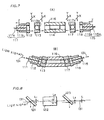
- a plurality of optical parts can be provided within the bodies 106 and 116.
- the WDM filter 121 for separating the light communication 131 by wavelength, an isolator 122 and a beam splitter 123 can be arranged on the straight line.
- the WDM filter 121 reflects the light signal 131 of, for example, 1.48 ⁇ m in wavelength and transmits the light signal 131 of 1.55 ⁇ m in wavelength.
- the WDM filter 121 is arranged obliquely to separate the reflection light of 1.48 ⁇ m in wavelength, allowing the light signal 131 of 1.55 ⁇ m in wavelength only to be transmitted, so as to function as a filter.
- the transmitting light signal 131 is bent to cause the axial shift L 1 .
- the isolator 122 is composed of a polarizer and a rotator combined.
- the isolator 122 allows the light signal 131 to pass in one way direction (in a right-hand direction in the drawing), but is adapted not to present it in an opposite direction.
- the light signal 131 causes the axial shift L 2 due to refraction in passing through the isolator 122.
- the beam splitter 123 obliquely placed glass plate, reflects one portion of the light signal 131 and divides it, so as to transmit the remaining portion thereof. For example, the reflection light is detected by light receiving element not shown, and can be monitored.
- the light signal 131 passing through the beam splitter 123 causes the axial shift L 3 due to refraction.
- the axial shifts L 1 , L 2 and L 3 caused by each optical parts may become mutually corrected.
- the mutually correcting direction means that the axial shift of each optical parts is arranged in a direction to make the total axial shift L smaller.
- the WDM filter 121 is arranged so that an axial shift L 1 is caused in the upper direction in the drawing
- the isolator 122 is arranged so that the axial shift L 2 may be caused in the downward direction in the drawing
- the beam splitter 123 is arranged so that the axial shift L 3 may be caused in the upward direction in the drawing. Therefore, the total axial shift L by the correction of the mutual axial shifts can be made comparatively smaller.
- each optical parts has only to be arranged in such a direction as at least the total axial shift L may be made smaller.
- the axial shift direction is decided by a rotating position around an optical axis of each optical parts of the WDM filter 121, the isolator 122, the beam splitter 123. Therefore, the positioning operation of the rotating direction has only to be conducted in advance so that the axial shift of each optical parts may become different mutually.
- the axial shift amount can be adjusted by the thickness, inclination angle or the like of each optical parts.
- an optical communication module where optical parts are provided within the through hole formed in the body and a light guiding-in means and a light guiding-out means are arranged in both the end portions of the through hole, the parts are fixed to the body in a condition where the respective optical axes of the light guiding-in means, the optical parts, and the light guiding-out means are aligned with the central axis of the through hole, simplifying the manufacturing step, so as to reduce the number of the parts items.
- the positional alignment is adapted to be conducted between the light guiding-in ⁇ guiding-out members and the body by a lens retaining member interposed respectively between the light guiding-in guiding-out means and the body.
- an optical communication module where a plurality of optical parts are provided within the body and a light guiding-in means and the light guiding-out means are spliced with both the ends, it is arranged so that the axial shift between the incident light and the outputting light in the plurality of optical parts are corrected mutually, and the total axial amount can be made smaller and the connection loss can be made smaller.
Landscapes
- Physics & Mathematics (AREA)
- General Physics & Mathematics (AREA)
- Optics & Photonics (AREA)
- Optical Couplings Of Light Guides (AREA)
Claims (8)
- Module de communication optique, comprenant :caractérisé en ce queun élément optique de transmission (1) pour l'émission d'un signal lumineux (20) ;un élément optique de réception (2) pour la réception d'un signal lumineux (21) ;une fibre optique (5) pour le guidage bidirectionnel des signaux lumineux (20, 21) à partir de/vers ces éléments optiques (1, 2) ;un corps d'allotissement (3) positionné entre ledit élément optique de transmission (1), ledit élément optique de réception (2) et la(les)dite(s) fibre (s) optique(s) pour l'allotissement des signaux lumineux dudit élément optique de transmission (1) audit élément optique dé réception (2) et à ladite fibre optique (5), et de ladite (lesdites) fibre (s) optique (s) audit élément optique de réception (2), etune chambre sans retour lumineux (8) fournie dans un corps (7) dudit module dans une position dans laquelle la lumière de réflexion (23) émise depuis ledit élément optique de transmission (1) et réfléchie au niveau dudit corps d'allotissement (3) est incidente ;
ladite chambre sans retour lumineux (8) est structurée de telle sorte que l'ensemble de la lumière de réflexion (23) ayant pénétré dans ladite chambre (8) est réfléchie de façon répétée dans ladite chambre (8) et est ainsi diffusée et absorbée. - Module de transmission optique, comprenant
un moyen de guidage 'd'entrée de la lumière (11) pour le guidage d'un signal lumineux dans ledit module et un moyen de guidage de sortie de la lumière (15) pour le guidage d'un signal lumineux en dehors dudit module ;
un corps d'allotissement (13) fourni entre ledit moyen de guidage d'entrée de la lumière (11) et ledit moyen de guidage de sortie de la lumière (15) pour laisser passer une partie dudit signal lumineux dudit moyen de' guidage d'entrée de la lumière (11) audit moyen de guidage de sortie de la lumière (15) et pour réfléchir une partie dudit signal lumineux ;
un élément de réception optique (12) pour la détection du signal lumineux réfléchi par le corps d'allotissement (13) ;
un élément (14) pour refléter et renvoyer une partie du signal lumineux ayant traversé ledit corps d'allotissement (13) en tant que signal de retour (25) ; et
une chambre sans retour lumineux (8) fournie dans un corps (17) dudit module dans une position dans laquelle une lumière de réflexion (23) dudit signal de retour (25) réfléchi au niveau dudit corps d'allotissement (3) est incidente ;
caractérisé en ce que
ladite chambre sans retour lumineux (18) est structurée de telle sorte que l'ensemble de la lumière de réflexion (23) ayant pénétré dans ladite chambre (18) est réfléchie de façon répétée dans ladite chambre (18) et est ainsi diffusée et absorbée. - Module selon la revendication 1 ou 2, caractérisé en ce que ladite chambre sans retour lumineux (8 ; 18) est formée comme une partie concave (7a ; 17a) formée dans ledit corps (7 ; 17) et ayant un sténopé (7b ; 17b) à travers lequel la lumière de réflexion (23) peut pénétrer dans ladite chambre (8 ; 18).
- Module selon la revendication 3, caractérisé en ce que le diamètre dudit sténopé (7b ; 17b) est de 0,5 mm ou moins.
- Module selon la revendication 3 ou 4, caractérisé en ce que ladite chambre sans retour lumineux (8 ; 18) comprend une autre ouverture fermée par un élément de couvercle (9 ; 19).
- Module selon la revendication 5, caractérisé en ce que ledit élément de couvercle (9 ; 19) constitue un élément absorbant la lumière.
- Module selon la revendication 6, caractérisé en ce que ledit élément de couvercle (9 ; 19) est formé d'un matériau métallique ou en résine ou en céramique de couleur noire partout, ou avec une surface, sur laquelle au moins la lumière de réflexion (23) est incidente, recouverte d'une couche de revêtement noir.
- Module selon l'une quelconque des revendications 1 à 7, caractérisé en ce que ledit corps d'allotissement (13) est une plaque de séparation du faisceau, un séparateur de faisceau de type prisme ou un hologramme.
Priority Applications (3)
| Application Number | Priority Date | Filing Date | Title |
|---|---|---|---|
| US08/892,824 US5867622A (en) | 1997-07-15 | 1997-07-15 | Module for optical communication |
| DE69734281T DE69734281T2 (de) | 1997-07-17 | 1997-07-17 | Modul für optische Nachrichtentechnik |
| EP97112282A EP0892293B1 (fr) | 1997-07-15 | 1997-07-17 | Boítier pour communication optique |
Applications Claiming Priority (2)
| Application Number | Priority Date | Filing Date | Title |
|---|---|---|---|
| US08/892,824 US5867622A (en) | 1997-07-15 | 1997-07-15 | Module for optical communication |
| EP97112282A EP0892293B1 (fr) | 1997-07-15 | 1997-07-17 | Boítier pour communication optique |
Publications (2)
| Publication Number | Publication Date |
|---|---|
| EP0892293A1 EP0892293A1 (fr) | 1999-01-20 |
| EP0892293B1 true EP0892293B1 (fr) | 2005-09-28 |
Family
ID=26145627
Family Applications (1)
| Application Number | Title | Priority Date | Filing Date |
|---|---|---|---|
| EP97112282A Expired - Lifetime EP0892293B1 (fr) | 1997-07-15 | 1997-07-17 | Boítier pour communication optique |
Country Status (2)
| Country | Link |
|---|---|
| US (1) | US5867622A (fr) |
| EP (1) | EP0892293B1 (fr) |
Families Citing this family (40)
| Publication number | Priority date | Publication date | Assignee | Title |
|---|---|---|---|---|
| JP3739540B2 (ja) * | 1997-08-04 | 2006-01-25 | アルプス電気株式会社 | 光送受信モジュール |
| JPH1164674A (ja) * | 1997-08-18 | 1999-03-05 | Alps Electric Co Ltd | 光送受信モジュール |
| JP2000171671A (ja) * | 1998-12-09 | 2000-06-23 | Matsushita Electric Ind Co Ltd | 光通信用モジュールおよびその実装方法 |
| JP3698393B2 (ja) * | 1998-12-11 | 2005-09-21 | 富士通株式会社 | 光送受信モジュールの構造及びその製法 |
| US6652158B2 (en) | 2000-09-05 | 2003-11-25 | Optical Zonu Corporation | Optical networking unit employing optimized optical packaging |
| WO2002029461A1 (fr) * | 2000-09-29 | 2002-04-11 | Cielo Communications, Inc. | Appareil et procede de controle de laser a cavite verticale et a emission par la surface (vcsel), utilisant la diffusion et la reflexion de la lumiere emise |
| US6778585B2 (en) * | 2000-10-02 | 2004-08-17 | Optical Communication Products, Inc. | VCSEL monitoring using refracted ray coupling |
| US6879784B1 (en) * | 2001-09-13 | 2005-04-12 | Thomas H. Blair | Bi-directional optical/electrical transceiver module |
| JP4352661B2 (ja) * | 2002-07-25 | 2009-10-28 | 住友電気工業株式会社 | 光モジュール |
| US20040184759A1 (en) * | 2003-03-18 | 2004-09-23 | Ying-Moh Liu | Integrated optical fiber collimator |
| JP2004354752A (ja) * | 2003-05-29 | 2004-12-16 | Sumitomo Electric Ind Ltd | 一心双方向光モジュールのジョイントフォルダ |
| US7062171B2 (en) * | 2003-07-15 | 2006-06-13 | Yusuke Ota | Multi-wavelength, bi-directional optical multiplexer |
| KR20050055203A (ko) * | 2003-12-05 | 2005-06-13 | 한국전자통신연구원 | 광모듈 제작용 구조물 |
| CN1561015A (zh) * | 2004-03-08 | 2005-01-05 | �人��Ѹ�Ƽ��������ι�˾ | 三波长光分插复用器件 |
| US7172326B2 (en) * | 2004-08-19 | 2007-02-06 | Honeywell International, Inc. | Optical filter system employing a tilted reflector |
| JP4809353B2 (ja) * | 2004-09-13 | 2011-11-09 | 台湾積體電路製造股▲ふん▼有限公司 | マイクロマシン構造体に気密パッケージされた光学モジュール |
| TWI259297B (en) * | 2004-11-25 | 2006-08-01 | Ind Tech Res Inst | Fiber waveguide optical subassembly module |
| JP2007057859A (ja) * | 2005-08-25 | 2007-03-08 | Sumitomo Electric Ind Ltd | 光送受信モジュール |
| CN2898856Y (zh) * | 2005-08-29 | 2007-05-09 | 昂纳信息技术(深圳)有限公司 | 一体化封装光电组件 |
| KR20070050216A (ko) * | 2005-11-10 | 2007-05-15 | 삼성전자주식회사 | 양방향 광 송수신기 |
| KR100734868B1 (ko) | 2005-12-10 | 2007-07-03 | 한국전자통신연구원 | 광송수신기 모듈 |
| US8160451B2 (en) * | 2007-02-13 | 2012-04-17 | Finisar Corporation, Inc. | Optical network unit transceiver module with arrayed I/O video contacts |
| CN101652689B (zh) * | 2007-02-14 | 2012-04-11 | 菲尼萨公司 | 用于光学三路复用器的准直球透镜 |
| JP5159897B2 (ja) | 2008-01-31 | 2013-03-13 | ヒューレット−パッカード デベロップメント カンパニー エル.ピー. | 回路基板に実装される光導波路のための光タップ |
| JP2010054984A (ja) * | 2008-08-29 | 2010-03-11 | Sumitomo Electric Ind Ltd | 光モジュール及びその製造方法 |
| JP2010091824A (ja) * | 2008-10-08 | 2010-04-22 | Sumitomo Electric Ind Ltd | 光モジュール |
| KR101127633B1 (ko) * | 2010-12-14 | 2012-03-22 | 주식회사 오이솔루션 | 반사 노이즈를 감소시키는 구조를 갖는 양방향 광 서브 어셈블리 |
| CN102324975B (zh) * | 2011-07-21 | 2014-08-27 | 索尔思光电(成都)有限公司 | 一种单芯双向光学次模块 |
| CN102759779A (zh) * | 2012-06-19 | 2012-10-31 | 深圳市光为光通信科技有限公司 | 光收发装置 |
| CN102967907B (zh) * | 2012-12-06 | 2016-01-20 | 马勇强 | 一种同波长同轴单纤双向器件 |
| CN104009804A (zh) * | 2013-02-22 | 2014-08-27 | 中兴通讯股份有限公司 | 光收发装置及方法 |
| WO2015021634A1 (fr) * | 2013-08-15 | 2015-02-19 | 华为技术有限公司 | Ensemble optique, réflectomètre optique dans le domaine temporel incorporé et dispositif de réseau optique |
| JP6494094B2 (ja) * | 2015-03-09 | 2019-04-03 | 住友電工デバイス・イノベーション株式会社 | 光モジュール |
| CN106569304A (zh) * | 2016-10-25 | 2017-04-19 | 青岛海信宽带多媒体技术有限公司 | 一种收发光器件和光学模块 |
| CN109212690A (zh) * | 2018-10-29 | 2019-01-15 | 青岛海信宽带多媒体技术有限公司 | 单纤双向光组件及光模块 |
| CN110190901A (zh) * | 2019-05-29 | 2019-08-30 | 武汉威盛通科技有限公司 | 一种结构件以及具有该结构件的光收发组件 |
| EP4086658A4 (fr) * | 2020-01-03 | 2023-04-05 | Suteng Innovation Technology Co., Ltd | Module d'émission-réception laser et système lidar |
| EP4086657B1 (fr) * | 2020-01-03 | 2024-09-18 | Suteng Innovation Technology Co., Ltd. | Module d'émission-réception laser, lidar et dispositif de conduite autonome |
| CN221408847U (zh) * | 2022-05-17 | 2024-07-23 | 光红建圣股份有限公司 | 光传输装置 |
| WO2025016461A1 (fr) * | 2023-07-20 | 2025-01-23 | 青岛海信宽带多媒体技术有限公司 | Module optique |
Family Cites Families (5)
| Publication number | Priority date | Publication date | Assignee | Title |
|---|---|---|---|---|
| GB2162336B (en) * | 1984-07-25 | 1988-07-13 | Magnetic Controls Co | Bi-directional optical fibre coupler |
| FR2579772B1 (fr) * | 1985-03-29 | 1987-05-29 | Socapex | Duplexeur optique a raccordement optique semi-permanent integre |
| FR2579773B1 (fr) * | 1985-03-29 | 1987-05-29 | Socapex | Duplexeur optique miniaturise a point optique deconnectable |
| FR2600427B1 (fr) * | 1986-06-20 | 1989-08-25 | Deutsch Co | Dispositif de connexion d'extremite pour fibre optique avec composants opto-electroniques et couplage optique |
| JPH06160674A (ja) * | 1992-11-19 | 1994-06-07 | Hitachi Ltd | 光電子装置 |
-
1997
- 1997-07-15 US US08/892,824 patent/US5867622A/en not_active Expired - Fee Related
- 1997-07-17 EP EP97112282A patent/EP0892293B1/fr not_active Expired - Lifetime
Also Published As
| Publication number | Publication date |
|---|---|
| US5867622A (en) | 1999-02-02 |
| EP0892293A1 (fr) | 1999-01-20 |
Similar Documents
| Publication | Publication Date | Title |
|---|---|---|
| EP0892293B1 (fr) | Boítier pour communication optique | |
| US6498876B1 (en) | Multi-port fiber optic device with v-groove ferrule | |
| US5841562A (en) | Bidirectional modular optoelectronic transceiver assembly | |
| US7071458B2 (en) | Optical element, optical transmission unit and optical transmission system | |
| US6722793B2 (en) | Optical bidirectional transceiver module having a pin element with integrated WDM filter | |
| US4958897A (en) | Thin film optical component for use in optical transmission lines and method of manufacturing the same | |
| US7153038B2 (en) | Jointing holder for optical module for single-fiber bidirectional communication and optical module incorporating the jointing holder | |
| US6075635A (en) | Bidirectional optical transceiver assembly | |
| US6957006B2 (en) | Optical element and optical device using the same | |
| US5757994A (en) | Three-part optical coupler | |
| US7336905B2 (en) | Bidirectional optical transceiver | |
| US6501876B1 (en) | Bidirectional optical communication device and bidirectional optical communication apparatus | |
| US7235774B2 (en) | Optical module | |
| US5838859A (en) | Bidirectional optical transceiver assembly | |
| US5796899A (en) | Bidirectional optical transceiver assembly with reduced crosstalk | |
| US6854897B2 (en) | Ferrule part and optical communications module | |
| US6757460B2 (en) | Electro-optical module for transmitting and/or receiving optical signals on at least two optical data channels | |
| GB2162336A (en) | Bidirectional optical fibre coupler | |
| US6597837B2 (en) | Optical circuit module and method for assembling the same | |
| US20230244040A1 (en) | Fibre optic cable plugs and fibre optic cable connectors having such | |
| CN107250863A (zh) | 具有与壳体被动对准的分波滤光器的光学组件 | |
| US20030072525A1 (en) | Multi-mode fiber bandwidth enhancement using an optical fiber coupler | |
| JP7102377B2 (ja) | 光コネクタ | |
| CN219871874U (zh) | 一种高反射回损的单纤双向器件与光模块 | |
| CA2418918A1 (fr) | Module optique |
Legal Events
| Date | Code | Title | Description |
|---|---|---|---|
| PUAI | Public reference made under article 153(3) epc to a published international application that has entered the european phase |
Free format text: ORIGINAL CODE: 0009012 |
|
| AK | Designated contracting states |
Kind code of ref document: A1 Designated state(s): DE FR GB IT |
|
| AX | Request for extension of the european patent |
Free format text: AL;LT;LV;RO;SI |
|
| RIN1 | Information on inventor provided before grant (corrected) |
Inventor name: KIMOTO, NORITANE, KYOCERA CORPORATION Inventor name: YASUDA, TOSHIMICHI, KYOCERA CORPORATION Inventor name: ENOEDA, SHIGEMASA, KYOCERA CORPORATION Inventor name: MIYASAKA, MASAHIRO, KYOCERA CORPORATION |
|
| 17P | Request for examination filed |
Effective date: 19990713 |
|
| AKX | Designation fees paid |
Free format text: DE FR GB IT |
|
| 17Q | First examination report despatched |
Effective date: 20040602 |
|
| GRAP | Despatch of communication of intention to grant a patent |
Free format text: ORIGINAL CODE: EPIDOSNIGR1 |
|
| GRAS | Grant fee paid |
Free format text: ORIGINAL CODE: EPIDOSNIGR3 |
|
| GRAA | (expected) grant |
Free format text: ORIGINAL CODE: 0009210 |
|
| AK | Designated contracting states |
Kind code of ref document: B1 Designated state(s): DE FR GB IT |
|
| REG | Reference to a national code |
Ref country code: GB Ref legal event code: FG4D |
|
| REF | Corresponds to: |
Ref document number: 69734281 Country of ref document: DE Date of ref document: 20060209 Kind code of ref document: P |
|
| ET | Fr: translation filed | ||
| PLBE | No opposition filed within time limit |
Free format text: ORIGINAL CODE: 0009261 |
|
| STAA | Information on the status of an ep patent application or granted ep patent |
Free format text: STATUS: NO OPPOSITION FILED WITHIN TIME LIMIT |
|
| 26N | No opposition filed |
Effective date: 20060629 |
|
| PGFP | Annual fee paid to national office [announced via postgrant information from national office to epo] |
Ref country code: FR Payment date: 20090710 Year of fee payment: 13 |
|
| PGFP | Annual fee paid to national office [announced via postgrant information from national office to epo] |
Ref country code: GB Payment date: 20090715 Year of fee payment: 13 Ref country code: DE Payment date: 20090709 Year of fee payment: 13 |
|
| PGFP | Annual fee paid to national office [announced via postgrant information from national office to epo] |
Ref country code: IT Payment date: 20090718 Year of fee payment: 13 |
|
| GBPC | Gb: european patent ceased through non-payment of renewal fee |
Effective date: 20100717 |
|
| REG | Reference to a national code |
Ref country code: FR Ref legal event code: ST Effective date: 20110331 |
|
| PG25 | Lapsed in a contracting state [announced via postgrant information from national office to epo] |
Ref country code: DE Free format text: LAPSE BECAUSE OF NON-PAYMENT OF DUE FEES Effective date: 20110201 |
|
| REG | Reference to a national code |
Ref country code: DE Ref legal event code: R119 Ref document number: 69734281 Country of ref document: DE Effective date: 20110201 |
|
| PG25 | Lapsed in a contracting state [announced via postgrant information from national office to epo] |
Ref country code: FR Free format text: LAPSE BECAUSE OF NON-PAYMENT OF DUE FEES Effective date: 20100802 Ref country code: IT Free format text: LAPSE BECAUSE OF NON-PAYMENT OF DUE FEES Effective date: 20100717 |
|
| PG25 | Lapsed in a contracting state [announced via postgrant information from national office to epo] |
Ref country code: GB Free format text: LAPSE BECAUSE OF NON-PAYMENT OF DUE FEES Effective date: 20100717 |